Article

The Effect of Framing on Heterosexuals’ Attitudes Toward Homosexuals: Evidence from Two Cohorts of Turkish University Students


1
Institute of Psychology, Department of Developmental Psychology, University of Bern, CH-3012 Bern, Switzerland
2
Faculty of Humanities and Social Sciences, Department of Psychology, Acıbadem University, 34752 Istanbul, Turkey
*
Author to whom correspondence should be addressed.
Societies 2026, 16(4), 110; https://doi.org/10.3390/soc16040110
Submission received: 24 January 2026 / Revised: 6 March 2026 / Accepted: 23 March 2026 / Published: 26 March 2026

Abstract

Framing—how issues are communicated—can influence attitudes. This study examined (1) the impact of value-framing on attitudes toward homosexuality among Turkish university students in 2012 and 2024, (2) cohort differences over time, and (3) socio-demographic predictors. Participants were 199 psychology students (161 female; M age = 21). Attitudes were most positive after equality framing, followed by neutral, then morality framing. Cohorts did not differ in overall attitudes. Morality framing led to significantly less positive views than neutral framing. Positive attitudes were associated with being female, higher parental education, and having more gay friends (for women) or lesbian friends (for men). Findings highlight the negative impact of morality framing and suggest that personal and social factors shape attitudes toward homosexuals.

1. Introduction

Public opinion on social issues is shaped not only by personal beliefs but also by how issues are presented. Framing is a central mechanism in political communication: as Druckman [1] notes, framing effects occur when a message emphasizes certain considerations, leading individuals to rely on these considerations when forming judgments. In other words, the way an issue is communicated can influence which aspects people consider most relevant. Chong and Druckman [2] formalize this process in an expectancy model, arguing that frames in communication shift the weighting of considerations within an individual’s “frame in thought,” thereby shaping evaluations. The present study examines whether and how framing in messages about homosexuality influences heterosexual individuals’ attitudes toward homosexual individuals.
This study focuses on heterosexual individuals because prejudice and discrimination are most consequentially enacted across perceived in-group/out-group boundaries (e.g., heterosexual in-group evaluating sexual-minority out-groups [3]). Including sexual-minority participants would change the psychological meaning of the outcome for part of the sample, introducing factors such as self-relevance, in-group evaluation, and identity-protective cognition that may alter framing responses. We therefore focus on the heterosexual majority as the population most directly implicated in shaping social climates and policy preferences affecting sexual minorities.
A key form of framing is value framing, which cues particular abstract values to define the meaning of an issue. As Rhodebeck et al. [4] argue, when communication highlights values such as egalitarianism or moral traditionalism, individuals are more likely to apply those values in their judgments. Value framing thus operates by making specific considerations salient, activating culturally or personally relevant values that indirectly shape opinions. Prior research has shown that value framing can meaningfully influence attitudes across domains such as discrimination, political issues, and sexuality [5,6,7]. In particular, equality and morality frames have been found to influence attitudes toward homosexuality [4,8,9]). Equality framing emphasizes egalitarian principles (e.g., “gay rights are equal rights”), whereas morality framing highlights moral traditionalism (e.g., “gay rights violate traditional values”). For instance, Johnson [10] found that equality framing decreases opposition to same-sex marriage, whereas morality framing increases it.
Yet most of this evidence stems from Western, liberal-democratic contexts, raising the question of whether value frames operate similarly in societies with different cultural norms and political climates. Cultural psychology research suggests that value activation depends on culturally dominant normative schemas and relational models [11]. In more collectivistic and norm-oriented societies, moral order, social harmony, and the preservation of traditional roles often carry greater normative weight than abstract individual-rights discourse, whereas in highly individualistic and egalitarian contexts equality-based reasoning may be more chronically accessible and institutionally reinforced [12]. Consequently, the resonance of different value frames may vary across cultural environments.
Türkiye provides a particularly informative context for examining such variation. A predominantly Muslim but historically secular and Western-oriented country, Türkiye combines secular–modernist traditions with strong collectivistic and religiously informed moral norms. In such a context, morality frames invoking social order, family structure, or tradition may align more closely with culturally embedded value hierarchies, whereas equality frames may be perceived as politically liberal or externally derived. At the same time, Türkiye has experienced a marked shift toward political conservatism since the early 2000s, accompanied by increasing restrictions on LGBTQ+ visibility and rights. As a result, public attitudes toward homosexuality—and the values invoked to evaluate it—are contested and evolving. This interplay of political conservatism, modernization, and socio-cultural change makes Türkiye an informative setting for examining whether value framing effects generalize beyond Western settings and whether their strength may shift over time.
Building on this cultural perspective, Chong and Druckman’s [2] “frame in thought” account suggests that framing effects depend on which considerations are chronically accessible and socially reinforced. In the contemporary Turkish media and political environment, LGBTQ+ issues have increasingly been communicated through asymmetrical and often moralized narratives [13,14]. In such a context, morality considerations may become more readily available and socially sanctioned, making them easier to activate through framing. Equality considerations, in contrast, may be comparatively less institutionally reinforced and more contested, potentially producing weaker marginal change. In this sense, frame resonance may be culturally asymmetric: morality frames may align with dominant normative schemas, whereas equality frames may be discounted or perceived as politically charged.
The nature of the communication environment is also relevant for the types of framing individuals encounter. In many political communication contexts, individuals are exposed to competitive (two-sided) frames that emphasize opposing values or considerations [1,15]. Research on competitive framing shows that when opposing frames are simultaneously accessible, framing effects tend to be attenuated because individuals weigh countervailing considerations when forming judgments (e.g., [15,16]). However, when public discourse is characterized by asymmetrical narratives and limited exposure to counter-framing, individuals may predominantly encounter one-sided messages. Focusing on one-sided value frames therefore allows us to isolate how dominant value cues may influence attitudes in such environments.
Attitudes toward homosexuals in Türkiye have historically been highly negative: intolerance was reported at 93% in 1990 and 84% in 2011 [17]. While global surveys show rising acceptance of homosexuality worldwide [18], levels in Türkiye remain low—22% in 2002, 14% in 2007, 11% in 2011, 9% in 2013, and a slight increase to 25% in 2019 believe homosexuality should be accepted [18]. These figures illustrate a long-term resistance followed by modest gains, highlighting that attitudes have become increasingly more positive in recent years, particularly in the period following 2013.
A major inflection point was the 2013 Gezi movement, during which LGBTQ+ groups’ visibility triggered backlash from conservative actors who framed the protests as advancing a “Western” agenda [19,20]. Since then, LGBTQ+ rights have sharply deteriorated, evidenced by escalating hate speech, bans on LGBTQ+ events, and large-scale detentions—for example, over 530 people during Pride 2022 following Türkiye’s withdrawal from the Istanbul Convention [19,21,22].
Despite generally negative societal attitudes, Turkish university students constitute a more modern and less traditional segment of the population [23]. Early research in the 2000s still found predominantly negative attitudes among students [24,25,26], a pattern supported by a meta-analysis covering 2002–2017 [27]. However, more recent studies from the late 2010s [28,29] and 2020s [30] indicate a generational shift toward increasingly positive attitudes, positioning university students as a theoretically relevant group for examining both framing effects and temporal changes in attitudes.
Critically, research on framing suggests that the influence of a message depends on individuals’ prior beliefs: framing effects are often strongest when preexisting attitudes are weak or ambivalent, whereas individuals with strong prior beliefs tend to be less influenced [31]. In light of the documented trend toward increasingly positive attitudes toward homosexuals, we expected overall attitudes to be more positive in the 2024 cohort than in the 2012 cohort. Relatedly, we expected the impact of equality framing to be less strong in the 2024 cohort relative to 2012, due to more positive baseline attitudes. Furthermore, reconciling the increased cultural salience of moralized narratives with the likely psychological resistance of the 2024 cohort suggests that the influence of the moral frame is theoretically ambiguous. On one hand, the pervasiveness of these narratives may render morality considerations more “chronically accessible” and easily activated by framing. On the other hand, the increasingly oppressive political climate might lead this specific subpopulation to rely on selective exposure and disconfirmatory motivated reasoning to counter-argue messages perceived as politically coercive [2,15]. Consequently, while the moral frame may be more culturally salient in 2024 than in 2012, its effectiveness in depressing attitudes might be diminished by this heightened psychological pushback.
Beyond political and generational dynamics, a rich body of research points to socio-demographic predictors of attitudes toward homosexuality. Individuals with more homosexual friends or greater interpersonal contact tend to express more positive attitudes [29,32,33,34,35,36,37]. Gender differences are pronounced, with men generally holding more negative views than women [29,32,38,39,40]. Moreover, men’s negative attitudes are often stronger toward gay men than toward lesbians, particularly in non-Western contexts [41,42]. In contrast, women’s attitudes toward gay and lesbian individuals tend to be more balanced, or in some contexts, slightly more negative toward lesbians than gays [43,44]. This pattern suggests that contact with cross-gender homosexuals may have a stronger mitigating effect on negative attitudes. Socioeconomic indicators also matter: higher household income and parental education predict more accepting views [45], and social status variables such as age and area of residence have been shown to shape attitudes in broader populations [46,47,48,49]. These findings align with social contact theory and modernization perspectives, both suggesting that exposure, education, and urbanization facilitate more positive attitudes.
Taken together, Türkiye’s combination of Eastern and Western value orientations, its recent political and cultural shifts, and the evolving attitudes among university students make it an important context for examining both the presence and the stability of value framing effects. Although prior research has demonstrated that equality and morality frames influence attitudes in Western settings, it remains unclear whether these effects generalize to Türkiye’s culturally hybrid and politically polarized environment—or whether the magnitude or direction of these effects may have changed over a decade of significant socio-political transformation.
Against this backdrop, the present research had two aims. First, we examined whether value framing—operationalized through equality, morality, and neutral (no-frame) messages—influences attitudes toward homosexuality among Turkish university students. We expected that, in both cohorts, equality framing would lead to more positive attitudes toward homosexuality, whereas morality framing would lead to more negative attitudes compared to no framing. Second, we investigated whether baseline attitudes and responsiveness to these frames changed between 2012 and 2024. We expected overall attitudes to be more positive in the 2024 cohort than in the 2012 cohort, reflecting recent trends toward greater acceptance of homosexuality. Based on this expected shift toward more positive baseline attitudes in 2024, we hypothesized that the effect of framing would be smaller in the 2024 cohort compared with 2012. Finally, based on prior literature, we expected that gender, parental education, household income, area of residence, and the number of homosexual friends would predict attitudes, with being a woman, coming from a higher socioeconomic background, being raised in an urban setting, and having more homosexual friends associated with more positive attitudes. Given the reviewed potential impact of contact with cross-gender homosexuals, we expected the number of gay friends to be more strongly associated with attitudes toward homosexuals for women and the number of lesbian friends for men.

2. Method

2.1. Participants

The participants were psychology students from three country-wise high-ranking universities in Istanbul, Türkiye. The first cohort students (n = 76, 48 female) were aged 19.6 years on average (SD = 1.6) and the second cohort students (n = 123, 113 female) were aged 22 years on average (SD = 3.6). Seventeen participants (12 females) from the first cohort and 13 participants (11 female, 1 unknown) from the second cohort were excluded from the analyses because they did not report themselves as heterosexuals for their sexual orientation.
The overall sample is strongly female-skewed (and particularly so in the 2024 cohort). Consequently, any gender comparisons—especially effects involving men in 2024—should be treated as exploratory and interpreted with substantial caution (see Section 4.6).
Participants in the first cohort were recruited and tested as part of a psychology undergraduate course, making psychology students a natural convenience sample. To ensure comparability between cohorts, the second cohort was also composed of psychology undergraduates. Participants were recruited by announcing the study on boards, email lists and in seminars. Participants gave written informed consent and were compensated by course credit. The data of the 2012 cohort was collected as part of an experimental psychology course at Boğaziçi University and the ethical approval process was not through a formal institutional review board; rather, it was obtained internally within the department. The data collection of the 2024 cohort was approved by the Human Research Ethics Committee of Kadir Has University. Both sets of data were conducted in accordance with the Declaration of Helsinki. After participation, participants were debriefed by email about the aims of the study, including why deception was used.

2.2. Materials, Design, and Procedure

The data was collected in person in the first cohort and online using SoSci Survey [50] in the second cohort. Deception was used in this study in that the participants were told that the study was about how discussion texts are perceived. Participants had to read two texts in a fixed order, a text on mother–child attachment and a text on homosexuality. The text on homosexuality was either given from a morality, equality or neutrality frame (see Appendix A for an English translation of the texts). Participants were randomly assigned to either of these framing conditions in a between-subjects design. After each text, they answered two forced-choice questions (“Was this a discussion text?” and “Was it difficult to read this text?”) and one open-ended question (“What is the main idea of this text”?) as a foil. No direct manipulation check was included to verify that participants encoded the intended value cues (morality vs. equality) as such. The implications of this for interpreting framing effects are discussed in Section 4.6. Following this, attitude towards homosexuals was measured by “Eşcinsellik Tutum Ölçeği” (ETO) [37], which is the Turkish adaptation of Index of Attitudes toward Homosexuals (IAH) [51]. This scale measures prejudice and homophobia among heterosexual individuals by measuring their affective, cognitive, and behavioral responses toward gay men and lesbians. It captures the degree of discomfort, anxiety, or acceptance an individual feels regarding homosexuality across three primary dimensions: Social Interaction, Probable Family Ties, Personal Tendency/Identity Anxiety. The responses were obtained on a Likert scale from 1 to 7. The ETO scale demonstrated excellent internal consistency in the 2024 sample (Cronbach’s α = 0.96). Because item-level data from the 2012 cohort were no longer accessible, internal consistency could not be computed for that sample. Subsequently, an attachment scale, “Ana-Baba Tutum Ölçeği” (Parental Attitude Scale) [52], was used as a foil, paired up with the text on mother–child attachment, to conceal the real purpose of the study. Hence, the scores of this scale were not used. Finally, participants filled out a demographic form asking their age in years, gender (binary: female or male), sexual orientation (categorical: heterosexual, homosexual, bisexual, other, I do not want to report), maternal education, paternal education, household income, the type of residential area where they had spent the majority of their life (categorical: village, town, city, metropolis), and the number of gay and lesbian friends they have. Maternal and paternal education were assessed categorically based on the highest degree completed, using a scale from 1 to 8 (1: Illiterate, 2: Literate but no formal education, 3: Primary school, 4: Middle school, 5: High school, 6: University, 7: Postgraduate, 8: Doctorate). Household income was asked to be reported in the Turkish Lira currency (TRY).

2.3. Data Analysis

Data were analyzed using R (version 4.1.3) [53]. A multiple linear regression was conducted where the mean score on the Attitude towards Homosexuals scale (ETO) was the dependent variable, with higher scores representing a more positive attitude toward homosexuals. Independent variables were the cohort (2012 versus 2024), framing condition (morality, equality, neutrality), age in years, gender, parental education, household income, the type of residential area, and the number of gay and lesbian friends (in interaction with gender). Since maternal/paternal education scale represents increasing levels of education, it was treated as a continuous variable in the regression analyses. Preliminary analyses revealed a high correlation between maternal and paternal education (r = 0.72, p < 0.001); therefore, their mean value was calculated and entered in the regression as parental education. There was one missing age data and two missing household income data from the first cohort. These missing values were imputed using the median of the raw income distribution due to its skewness. Given the differences in economic conditions and inflation rates between 2012 and 2024, raw household income values are not directly comparable across cohorts. To account for these differences and focus on the relative position of each household within their respective cohort, household income was standardized (z-scored) within each cohort before being included in the regression analyses.
To test for interaction between cohort and framing, two regression models, with or without interaction, were compared. Moreover, for the interaction between gender and number of gay friends, and gender and number of lesbian friends, two models, with or without interaction, were compared. The interaction terms were considered significant and therefore retained only when it improved model fit; otherwise, the model without the interaction was used.
Nested models were compared using anova() function in R, which conducts an F-test on the change in residual sum of squares (RSS) between models. We report the associated F-statistic, degrees of freedom, and p-value. An omnibus type III F-test on the regression model with the anova() function was run to evaluate whether, across all three framing levels, there is evidence that at least one frame differs from the others. Pairwise comparisons of the three framing conditions were estimated using estimated marginal means (emmeans) with Tukey adjustment, controlling family-wise error across the set of three pairwise tests.
Regression assumptions were evaluated using standard diagnostic procedures. Visual inspection of residual-fitted plots, Q–Q plots, and scale–location plots indicated no substantial violations of linearity, normality, or homoscedasticity. Influential observations were assessed using Cook’s distance (D > 4/n). Sensitivity analyses excluding these observations yielded substantively identical results for all key predictors and conclusions; the only difference was a slightly stronger contrast between equality and morality framing, which does not alter the substantive interpretation of the framing effects.

3. Results

3.1. Descriptive Statistics

Descriptive statistics of the independent variables are presented in Table 1. The type of residential area is presented in Table 2. Figure 1 shows the mean attitude toward sexuals as a function of framing condition and cohort. The mean scores are above the average value of 4 (middle value on the scale from 1 to 7), reflecting a rather positive attitude overall. Preliminary analyses showed no significant differences in the number of gay or lesbian friends between men and women (all p > 0.05).

3.2. The Effect of Framing on Attitudes Toward Homosexuals

The results did not reveal a significant difference between the two models predicting attitudes toward homosexuals, with or without interaction between cohort and framing condition, F(2, 178) = 0.21, p = 0.815. Therefore, we interpret that the effect of framing did not differ between the two cohorts and report the model without the interaction term. The output of this model is presented in Table 3. The omnibus F-test revealed that the main effect of framing condition was non-significant in the regression model, F(2, 184) = 1.32, p = 0.270. However, pairwise comparisons revealed a significant difference between Neutrality (M = 4.86, SD = 1.40) and Morality frames (M = 4.52, SD = 1.45). Namely, participants who read a neutrality-framed text reported more positive attitudes toward homosexuals than those who read a morality-framed text (p = 0.016). Yet Neutrality did not differ from Equality and Morality did not differ from Equality (ps > 0.19). Because these pairwise tests were family-wise-error-controlled (Tukey), we report this specific contrast while also noting that the omnibus test did not reach significance, consistent with a pattern in which only one pair differs and the overall effect is small.

3.3. Attitudes Toward Homosexuals in Cohorts of 2012 Versus 2024

Cohort was not found to be significant (Est = −0.10, CI [−0.56–0.37], p = 0.675), indicating that attitudes toward homosexuals were comparable between the 2012 and 2024 cohorts of Turkish psychology undergraduates.

3.4. Socio-Demographic Factors and Attitudes Toward Homosexuals

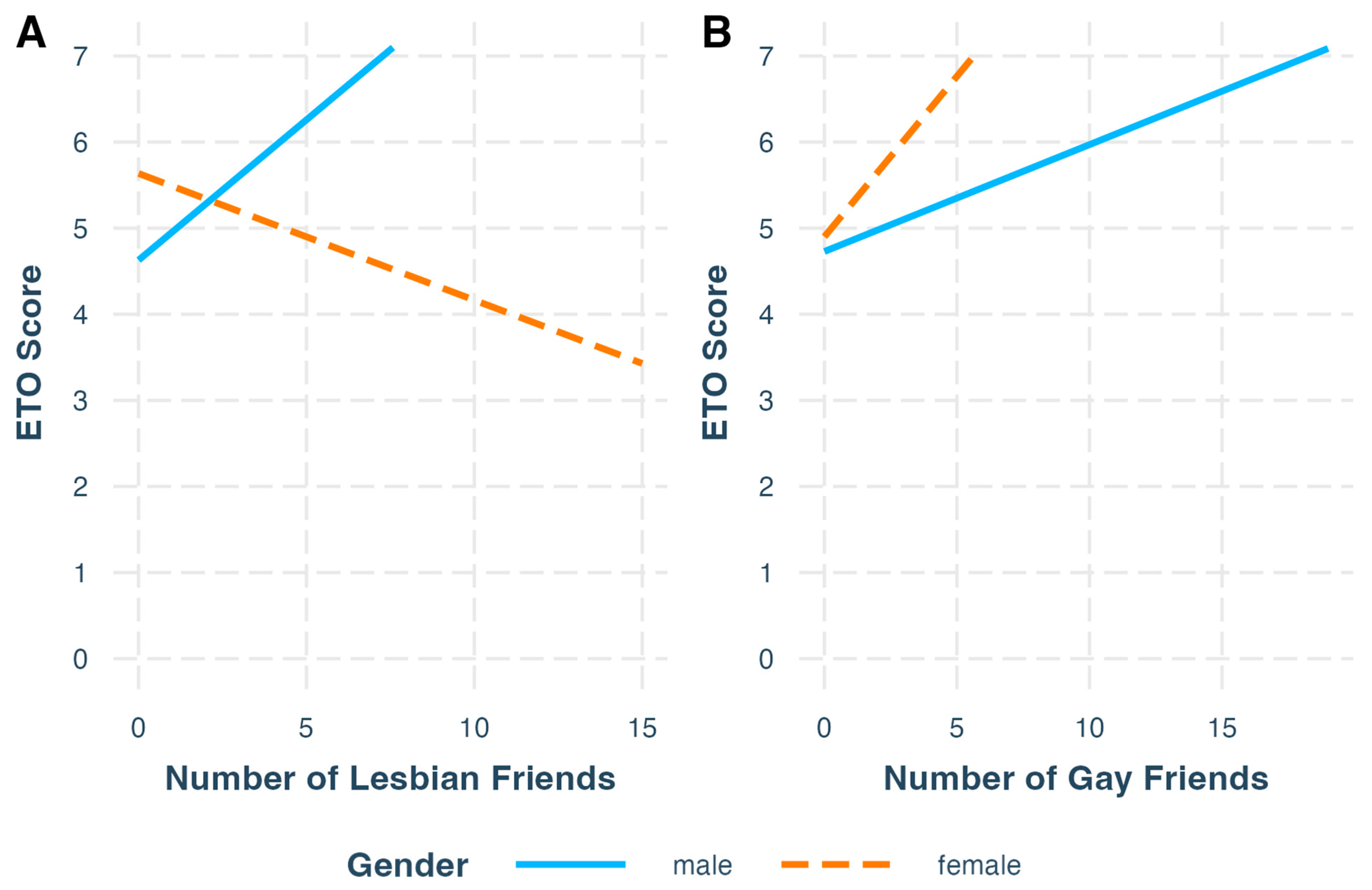
The results revealed that the model with interactions between gender and number of gay friends and between gender and number of lesbian friends provided a significantly better fit, F(2, 184) = 3.73, p = 0.026), and therefore this model was selected. Female students (M = 4.82, SD = 1.35) reported overall more positive attitudes toward homosexuals than male students (M = 4.21, SD = 1.56), t(184) = −2.44, p = 0.016). Parental education positively predicted the attitude toward homosexuals (Table 3). That is, the higher education one’s parents completed, the more positive the attitude the individual reported. Finally, the interactions between gender and the number of gay friends and between gender and the number of lesbian friends were significant. Specifically, simple slope analyses revealed that the number of lesbian friends positively predicted only male students’ attitudes toward homosexuals (Est = 0.33, SE = 0.15, p = 0.040; Figure 2A), and the number of gay friends positively predicted only female students’ attitudes toward homosexuals (Est = 0.37, SE = 0.07, p < 0.001; Figure 2B). The effect of any other predictor was not found to be significant.
Given the severe underrepresentation of men (especially in 2024), gender effects and gender-by-contact interactions should be treated as exploratory and potentially unstable. We therefore interpret these patterns cautiously and emphasize the need for replication in gender-balanced samples.

3.5. Power Considerations

Power was evaluated using post-hoc analyses for multiple regression models in G*Power (version 3.1.9.6). The overall model explained a substantial proportion of variance in attitudes toward gay and lesbian people (R2 = 0.33), indicating sufficient power to detect the combined set of predictors. Focusing on incremental effects, the framing main effect accounted for a small-to-moderate proportion of unique variance (ηp2 = 0.041; f2 ≈ 0.043), for which the achieved power was 0.74. In contrast, the cohort (year) effect was negligible in size (ηp2 ≈ 0.001; f2 ≈ 0.001), with correspondingly low achieved power (.07). The hypothesized framing × cohort interaction was tested in an initial model but accounted for a trivial proportion of variance (ηp2 ≈ 0.002; f2 ≈ 0.002), yielding low achieved power (≈ 0.08). Importantly, in both cases low power primarily reflects extremely small observed effect sizes rather than evidence that substantively meaningful effects were missed. Accordingly, interpretation emphasizes effect sizes and model fit rather than post-hoc power as inferential criteria.

4. Discussion

In this study, we examined the effects of value framing on attitudes toward homosexuals among two cohorts of Turkish university students, one from 2012 and the other from 2024. Contrary to expectations, no significant differences emerged between the cohorts, and no interaction was observed between cohort and framing condition in their overall attitude scores. However, when data from both cohorts were collapsed together, morality framing led to significantly less positive attitudes toward homosexuals compared to neutral framing. Additionally, gender, parental education, and the number of gay and lesbian friends (conditional on gender) emerged as significant predictors of attitudes, suggesting that individual characteristics and social networks play an important role in influencing these attitudes.

4.1. The Effects of Framing

Previous research suggests that value framing can influence how individuals view homosexuals. Brewer [8] found individuals to particularly use equality language when expressing their views on gay rights when framed with equality, and to particularly use morality language when framed with morality. Johnson [10] found equality framing to exert a stronger influence on attitudes toward homosexuals than morality framing. However, our findings diverged from these patterns, as only morality framing was associated with significantly less positive attitudes compared to neutrality framing, while equality framing did not differ significantly from neutral framing. This discrepancy could be attributed to the relatively positive baseline attitudes in our sample, as shifting already favorable attitudes further may require a more robust equality framing. Beyond baseline attitudes, it is plausible that the egalitarian text itself was simply less emotionally resonant than the morality text, which invoked potent concepts such as moral collapse and harm to national values. Another plausible explanation lies in the broader socio-political context of Türkiye. Over the past decade, media narratives around LGBTQ+ rights have increasingly adopted negative and morality-based framings, contributing to their familiarity and amplifying their negative impact [19,22]. This entrenched negativity might have reduced the effectiveness of equality framing, while reinforcing the detrimental influence of morality framing.
From a framing-theoretical perspective [1,2,15], these findings suggest that morality frames may have more effectively shifted the weighting of considerations within participants’ “frames in thought,” activating moral norms that have long structured evaluations of homosexuality in Türkiye and dominated the latest public discourse. In contrast, equality frames may have added little new information for a sample with relatively favorable baseline attitudes, limiting their capacity to further alter evaluative judgments. However, it must be noted that the theoretical bridge between reading a single, short paragraph and a shift in sociopolitical attitudes is naturally tenuous. Our design likely captures immediate, short-term priming rather than deep, enduring attitude shifts; the failure to measure the duration of this effect limits the conceptual weight of the findings. Together, these results underscore that framing effects are context-dependent: in Türkiye’s broader socio-cultural and political context, value frames that resonate with entrenched moral discourses may exert stronger influence than those appealing to egalitarian ideals, even among relatively liberal subpopulations.

4.2. Gender Differences

Consistent with prior literature, women in our sample reported significantly more positive attitudes toward homosexuals than men. This pattern aligns with findings from both Turkish [24,29,32,38] and global contexts [39,40], which suggest that women may generally display greater tolerance and acceptance toward marginalized groups, including homosexual individuals. These differences are often attributed to gendered socialization processes rather than inherent gender traits [54,55]. Specifically, women are more frequently encouraged to adopt more empathetic and egalitarian perspectives (e.g., higher internal motivation to respond without prejudice). In contrast, men may experience stronger social pressures to conform to traditional masculinity norms that foster less favorable attitudes toward homosexuals [56,57], particularly in conservative societies like Türkiye [58,59].
On a cautionary note, because—especially in the 2024 cohort—there were very few men, gender differences should be interpreted as exploratory and potentially unstable. Replication with gender-balanced samples is essential before drawing strong conclusions about gender effects in this context.

4.3. The Role of Parental Education

As expected, higher parental education was associated with more positive attitudes toward homosexuals. This finding supports previous research highlighting the link between socioeconomic status, educational attainment, and tolerance toward nonconforming sexualities [45]. Parents with higher education levels may be more likely to endorse liberal and egalitarian values [60,61], which they could transmit to their children. Moreover, higher education often exposes individuals to diverse perspectives and encourages critical thinking, potentially fostering greater acceptance of LGBTQ+ individuals. Parental mediation, particularly when it involves critiquing media portrayals, has been shown to enhance critical thinking skills [62]. Effective parental mediation serves as a protective factor against the negative effects of objectionable content by fostering a critical orientation toward media, which in turn helps young people make healthier decisions and reduces the influence of biased mediated messages.

4.4. The Interaction Between Gender and Gay and Lesbian Friends

The interaction between gender and the number of gay and lesbian friends provides intriguing insights. Specifically, having more lesbian friends positively predicted men’s attitudes toward homosexuals, while having more gay friends positively predicted women’s attitudes. This gender-specific pattern may reflect dynamics of social affiliation and perceived group boundaries. Individuals might find it easier to accept homosexuals when it pertains to members of the opposite sex, who are perceived as part of an outgroup, compared to members of the same sex, who may challenge their own gender norms and identities more directly. Indeed, research shows that men hold more negative attitudes toward gay men than lesbians [41], and especially in non-Western countries [42]. In contrast, women’s attitudes toward gay and lesbian individuals are more similar [43] or more negative toward lesbians than gays under certain contextual conditions [44]. Hence, the contact with cross-gender homosexuals may mitigate the negative attitudes toward homosexuals to a greater extent.
One interpretation is that same-gender sexual-minority targets may more strongly implicate threatened gender identity or masculinity/femininity norms, such as men reacting more negatively to gay men [63,64]. Cross-gender contact may reduce identity threat because it is less directly linked to one’s own gender-role expectations and in-group prototypes [65], enabling contact to operate through empathy and individuation rather than defensive boundary maintenance [66]. These findings align with broader contact literature suggesting that contact is most effective when it lowers intergroup anxiety [67], which may be inherently lower in cross-gender interactions where the “contagion” of gender non-conformity is less salient. However, given the gender imbalance, these interaction effects should be treated as exploratory and interpreted with caution until replicated.

4.5. Cohort Comparisons and Broader Implications

Contrary to our hypothesis, no significant differences were observed between the 2012 and 2024 cohorts in their overall attitudes toward homosexuals. Thus, despite societal and generational change, attitudes among university students did not appear to become more positive in 2024 relative to 2012. This is surprising given the substantial socio-political changes in Türkiye over the past decade, including increased conservatism and heightened marginalization of the LGBTQ+ community [19,20]. One explanation could be that university students, as a more liberal subset of the population [68], and/or through the educational environments that emphasize critical thinking, scientific norms, and peer cultures supportive of egalitarian values, may be somewhat insulated from these broader societal shifts. In this sense, temporal stability may reflect the more liberal profile of this population and/or the buffering role of higher education contexts rather than stagnation. Moreover, stability may represent a form of resistance, whereby students maintain relatively positive attitudes despite increasing political repression and moralized public discourse surrounding LGBTQ+ issues. Importantly, attitudes in both cohorts were moderately positive but not at ceiling, suggesting that the absence of cohort differences cannot be attributed to measurement saturation. In increasingly restrictive political environments, public expression of attitudes may be constrained even when private beliefs remain stable, potentially flattening observed differences across cohorts. Finally, the 2024 cohort was on average older than the 2012 cohort, with slightly greater age variance. Although age was included as a covariate to account for these differences, the slightly more positive attitudes observed in the 2024 cohort could in part reflect developmental effects associated with higher age [29,32] and may also confound observed frame effects across cohorts.
Across both cohorts, exposure to morality-based framing was associated with significantly more negative attitudes toward homosexuals. This suggests that moralizing discourse remains a potent mechanism for reinforcing prejudice, regardless of generational change. The finding underscores the need to critically examine how moral appeals are employed in public messaging and policy debates surrounding LGBTQ+ rights.
The absence of cohort-by-framing interactions suggests that these framing dynamics may be relatively stable across time, at least within university student samples. Drawing on the theoretical framework positing that framing effects are moderated by the strength of prior attitudes [31], we had expected that more positive baseline attitudes in 2024 would be associated with attenuated framing effects. However, because attitudes did not differ between cohorts, the absence of cohort differences in framing strength is consistent with this theoretical framework. At the same time, the observed framing-by-cohort interaction was extremely small, and power to detect an interaction of this magnitude was correspondingly low, indicating that while meaningful moderation effects are unlikely, very subtle cohort differences cannot be definitively excluded.

4.6. Limitations, Strengths, and Future Directions

Several limitations of the present study should be acknowledged when interpreting the findings. The sample consisted exclusively of psychology students from high-ranking universities in Istanbul, which limits generalizability to students in other disciplines, regions of Türkiye, or to non-university young adults. Psychology students may be particularly exposed to egalitarian norms and diversity-related content, potentially reducing variability in attitudes and limiting the extent to which findings can be generalized to broader populations. Relatedly, the sample was strongly skewed toward women, especially in the 2024 cohort, where male participants were very limited. As a result, gender differences and gender-by-contact effects should be interpreted cautiously and treated as exploratory, as these estimates may be unstable and not representative of male university students more generally. In addition, religiosity—an important factor known to influence attitudes toward homosexuality in Turkish university students (e.g., [69])—was not assessed in the present study. Religiosity likely intersects with moral framing and attitudes toward homosexuality and should be incorporated as a central variable in future research.
The study also focused exclusively on heterosexual participants. This decision was theoretically motivated by the aim to examine heterosexuals’ evaluations of sexual minorities, as prejudice and discrimination are most consequentially enacted across perceived in-group and out-group boundaries [3]. Nevertheless, excluding non-heterosexual participants reduces statistical power and limits the generalizability of the findings to the broader student population, including LGBTQ+ individuals themselves. Future research would benefit from including participants of diverse sexual orientations and explicitly modeling sexual orientation as a moderator, thereby enabling direct comparison between in-group and out-group evaluations and providing a more inclusive understanding of attitude formation.
Other important limitations concern measurement comparability across cohorts. Although the Attitudes toward Homosexuals scale demonstrated excellent internal consistency in the 2024 cohort, item-level data from the 2012 cohort were no longer accessible due to anonymization and data retention constraints, precluding the calculation of reliability estimates or formal tests of measurement invariance across time. Moreover, the 2012 data were collected in person, whereas the 2024 data were collected online, a difference in administration mode that may have affected responses to a sensitive topic such as attitudes toward homosexuals, for example through differential social desirability pressures. While the same instrument and response format were used in both cohorts, these methodological differences constrain the strength of conclusions regarding temporal stability and cohort comparisons. In addition, the ETO is based on an instrument originally developed to assess relatively overt forms of sexual prejudice. While it remains widely used in Turkish research (e.g., [32,70]), it may be less sensitive to more subtle or contemporary forms of LGBTQ+ acceptance, which should be considered when interpreting the findings. Future research should employ updated, multidimensional measures of LGBTQ+ attitudes and ensure measurement equivalence across cohorts, including comparable administration modes and item-level data, to strengthen temporal and cross-cohort comparisons.
Some procedural limitations should also be noted. For one, we did not have a direct manipulation check. Although deception and foil tasks were used to mask the true purpose of the study, it remains unclear whether participants consistently encoded the intended value cues in the framing texts. Limited engagement with, or awareness of, the framing manipulation may have attenuated framing effects, particularly for the equality frame, and therefore caution is warranted when interpreting null or weak effects associated with this condition. Including explicit manipulation checks or process measures in future studies would allow for stronger conclusions regarding the mechanisms through which framing operates. For another, all participants read a mother–child attachment text prior to the homosexuality-related text. Exposure to family-oriented content may have activated traditional or relational values across all conditions, potentially attenuating framing effects. Future studies should counterbalance text order or avoid value-laden foil materials. In addition, household income was self-reported by undergraduate students and may be subject to reporting error, as highlighted in prior research. In our model, household income was not collinear with parental education (VIF = 1.02 for household income, 1.22 for parental education), but an exploratory model comparison indicated that including income does not significantly improve model fit (ANOVA comparing models with vs. without income: F(1, 184) = 1.80, p = 0.18). Consequently, parental education may capture the relevant variance in socioeconomic background in this sample.
The cross-sectional nature of the design further limits causal interpretation. Because attitudes and predictors were measured at a single time point within each cohort, the observed associations cannot establish directionality or rule out reciprocal or unmeasured influences. Longitudinal or panel designs would be necessary to determine whether framing exposure, interpersonal contact, or sociodemographic factors causally shape attitudes toward gay and lesbian people over time. Moreover, the data were collected at two specific historical moments embedded in distinct sociopolitical contexts in Türkiye. Attitudes toward sexual minorities and responsiveness to framing may vary as a function of political discourse, media salience, and policy developments; accordingly, the present findings should be interpreted as temporally situated rather than as reflecting stable or timeless patterns. Replication across additional time points and political contexts would be necessary to assess the robustness of these effects across periods of differing sociopolitical climates.
At the same time, the study has several important strengths that contextualize these limitations. It addresses a genuine empirical gap by examining value framing effects outside Western liberal-democratic contexts, contributing to a more culturally grounded understanding of framing processes. The temporal comparison across two cohorts enables an examination of stability and change in attitudes within a population segment that is theoretically relevant yet underrepresented in longitudinal framing research. The Turkish context—marked by increasing political conservatism, contested LGBTQ+ visibility, and moralized public discourse—offers particularly important insights into how attitudes toward sexual minorities are formed and maintained under restrictive conditions. In addition, the finding that cross-gender friendships with sexual minorities are differentially associated with attitudes among men and women is novel and theoretically suggestive, highlighting the nuanced role of social contact and identity-related threat in shaping prejudice. Finally, the inclusion of multiple sociodemographic predictors allows for a more fine-grained analysis of individual differences than is typical in experimental framing studies.
Taken together, despite the methodological constraints outlined above, the present study provides a theoretically and empirically informative contribution to understanding how value framing, social contact, and sociopolitical context jointly influence attitudes toward sexual minorities. Future research building on these findings—through more diverse and balanced samples, inclusive designs, direct manipulation checks, longitudinal approaches, and repeated temporal sampling—would further strengthen understanding of framing effects in culturally and politically specific contexts.

5. Conclusions

This study sheds light on the effects of framing, individual characteristics, and sociodemographic factors in influencing attitudes toward homosexuals among Turkish university students. While morality framing was found to undermine acceptance, equality framing had no significant impact, likely reflecting broader societal influences. Gender, parental education, and cross-gender homosexual friendships emerged as key predictors of attitudes, highlighting the importance of both individual and relational factors. These findings imply the need for nuanced approaches to promoting acceptance and suggest potential strategies for fostering tolerance, such as increasing contact to individuals with different sexual orientations, in increasingly conservative contexts.
Given limited power for small effects, the absence of manipulation checks, and cohort measurement comparability constraints, future research should replicate these findings with larger and more balanced samples, direct manipulation checks, and formal tests of measurement invariance across time.

Author Contributions

Conceptualization, E.G.; Methodology, E.G.; Formal analysis, E.G.; Investigation, E.G.; Data curation, E.G.; Writing—original draft, E.G.; Writing—review & editing, E.G. and S.E.; Visualization, E.G.; Supervision, S.E.; Project administration, E.G. and S.E. All authors have read and agreed to the published version of the manuscript.

Funding

This research received no external funding. The APC was funded by the Open Access Publication Fund of the University of Bern.

Institutional Review Board Statement

The study was conducted in accordance with the Declaration of Helsinki and approved by the Kadir Has University Human Research Ethics Committee (protocol code E-17446481-600-84082, and date of approval 28 February 2024).

Informed Consent Statement

Informed consent was obtained from all subjects involved in the study.

Data Availability Statement

The data presented in this study are not publicly available due to ethical and privacy restrictions.

Acknowledgments

We thank all students who participated in this study for their time and contribution. Many thanks to Hüseyin Yüksel, Gizem Köksal, and Elif Aysimi Duman for their invaluable contributions to the study design and data collection of the first cohort data and their feedback on the manuscript. We thank Yusuf Atabay and Fırat Kimya for their contributions to the first cohort data collection.

Conflicts of Interest

The authors declare no conflict of interest.

Appendix A

Appendix A.1. Morality Text

It is known that homosexuality has been discussed since the second half of the 20th century. Many people think that this divisive issue is too important to ignore. Whether or not certain regulations should be made to prevent the discrimination that homosexuals face is being discussed by many segments of society. Some political parties and civil society organizations oppose the demand for regulations to recognize and protect the rights of homosexuals. The main basis of the political parties and civil society organizations that oppose regulations to recognize and protect the rights of homosexuals is that homosexuality is contrary to social morality. According to those who oppose these regulations, this type of relationship, which has a structure that harms the traditions and customs of our society, will negatively reflect on the morality of future generations. According to them, regulations regarding the recognition of the rights of homosexuals will make homosexuals more visible in social, cultural, political and economic areas and will cause moral collapse. Again, according to those who oppose the regulation, these legal regulations designed to recognize the rights of homosexuals will also pave the way for gay and lesbian marriages, but no regulations should be made that will harm our national and moral values.

Appendix A.2. Neutral Text

It is known that homosexuality has been debated since the second half of the 20th century. Many people think that this divisive issue is too important to ignore. Whether or not certain regulations should be made to prevent the discrimination that homosexuals are subject to is being discussed by many segments of society. While some political parties and civil society organizations demand that regulations be made to recognize and protect the rights of homosexuals, some political parties and civil society organizations oppose this demand. Both sides conduct various studies to learn about the public’s perception of homosexuality. These studies are becoming more common with the spread of social media. The fact that the issue is more debatable and talkable allows both sides, who have different ideas, to present new arguments day by day. The diversity of the arguments presented leads to the expansion of individuals’ perspectives and the creation of an impartial area of discussion. In this way, individuals shape their own ideas on the subject of homosexuality in Türkiye.

Appendix A.3. Equality Text

It is known that homosexuality has been discussed since the second half of the 20th century. Many people think that this divisive issue is too important to ignore. Many segments of society are discussing whether or not certain regulations should be made to prevent the discrimination that homosexuals are subject to. Some political parties and civil society organizations demand that regulations be made to recognize and protect the rights of homosexuals. The fundamental basis of political parties and civil society organizations demanding that regulations be made to recognize and protect the rights of homosexuals is that every individual living in society should have equal rights and freedoms. According to those who defend these regulations, no matter how different people’s feelings and thoughts are, every individual should have the right to freely express and live their feelings and thoughts. At the same time, they state that gender discrimination is a crime legally and that discrimination against homosexuals should also be considered a crime. They say that we should accept that no individual is superior or inferior, that homosexuals have the same rights and freedoms as all individuals, and that excluding them would not be a civilized behavior. As a result, an individual is equal to other individuals regardless of their sexual orientation.

References

  1. Druckman, J.N. On the limits of framing effects: Who can frame? J. Polit. 2001, 63, 1041–1066. [Google Scholar] [CrossRef]
  2. Chong, D.; Druckman, J.N. Framing theory. Annu. Rev. Polit. Sci. 2007, 10, 103–126. [Google Scholar] [CrossRef]
  3. Hewstone, M.; Rubin, M.; Willis, H. Intergroup bias. Annu. Rev. Psychol. 2002, 53, 575–604. [Google Scholar] [CrossRef]
  4. Rhodebeck, L.; Gainous, J.; Kleinsteuber, B. Race, political targeting, and value application: The effects of framing on gay rights opinions among Blacks and Whites. Ethn. Racial Stud. 2020, 43, 2826–2845. [Google Scholar] [CrossRef]
  5. Amsalem, E.; Zoizner, A. Real, but limited: A meta-analytic assessment of framing effects in the political domain. Br. J. Polit. Sci. 2022, 52, 221–237. [Google Scholar] [CrossRef]
  6. Peck, J. Talk about racism: Framing a popular discourse of race on Oprah Winfrey. Cult. Crit. 1994, 27, 89–126. [Google Scholar] [CrossRef]
  7. Wolsko, C.; Park, B.; Judd, C.M.; Wittenbrink, B. Framing interethnic ideology: Effects of multicultural and color-blind perspectives on judgments of groups and individuals. J. Personal. Soc. Psychol. 2000, 78, 635–654. [Google Scholar] [CrossRef]
  8. Brewer, P.R. Framing, value words, and citizens’ explanations of their issue opinions. Political Commun. 2002, 19, 303–316. [Google Scholar] [CrossRef]
  9. Harrison, B.F.; Michelson, M.R. What’s love got to do with it?: Emotion, rationality, and framing LGBT rights. New Political Sci. 2017, 39, 177–197. [Google Scholar] [CrossRef]
  10. Johnson, T. Equality, morality, and the impact of media framing: Explaining opposition to same-sex marriage and civil unions. Politics Policy 2012, 40, 1053–1080. [Google Scholar] [CrossRef]
  11. Schwartz, S. A theory of cultural value orientations: Explication and applications. Comp. Sociol. 2006, 5, 137–182. [Google Scholar] [CrossRef]
  12. Bentahila, L.; Fontaine, R.; Pennequin, V. Universality and cultural diversity in moral reasoning and judgment. Front. Psychol. 2021, 12, 764360. [Google Scholar] [CrossRef]
  13. Asdemir, M.; Yurtsal, E.T. The representation of LGBTIQ+ individuals in the media: An analysis on digital news. Soli Dergi 2025, 1, 30–41. Available online: https://izlik.org/JA85KN22EK (accessed on 4 February 2026).
  14. Çağlak, E.; Kaya, E.C. Evaluation of the representation of LGBTİ+ news in national and local newspaper in the context of alternative media and rights news. AJIT-E Acad. J. Inf. Technol. 2022, 13, 320–334. [Google Scholar] [CrossRef]
  15. Chong, D.; Druckman, J.N. Framing public opinion in competitive democracies. Am. Polit. Sci. Rev. 2007, 101, 637–655. [Google Scholar] [CrossRef]
  16. Xu, M.; Petty, R.E. Using two-sided messages to combat misinformation: An overview. Behav. Sci. Policy 2025, 11, 1–8. [Google Scholar] [CrossRef]
  17. Esmer, Y. Turkey Values Atlas. 2012. Available online: https://www.academia.edu/9620697/T%C3%BCrkiye_De%C4%9Ferler_Atlas%C4%B1_2012 (accessed on 4 February 2026).
  18. Poushter, J.; Kent, N. The Global Divide on Homosexuality Persists. Pew Research Center 25. 2020. Available online: https://www.pewresearch.org/global/2020/06/25/global-divide-on-homosexuality-persists/ (accessed on 7 January 2026).
  19. Acconcia, G.; Perego, A.; Perini, L. LGBTQ activism in repressive contexts: The struggle for (in)visibility in Egypt, Tunisia and Turkey. Soc. Mov. Stud. 2024, 23, 207–225. [Google Scholar] [CrossRef]
  20. Muedini, F. LGBTI Rights in Turkey: Sexuality and the State in the Middle East, 1st ed.; Cambridge University Press: Cambridge, UK, 2018. [Google Scholar] [CrossRef]
  21. Smallens, Y. Pride Month in Turkey Showcased Homophobia, Resistance. Al Araby. Available online: https://www.hrw.org/news/2022/08/02/pride-month-turkey-showcased-homophobia-resistance (accessed on 7 January 2026).
  22. Yackley, A.J. Turkey’s LGBTQ Community at Risk Amid Rise in Homophobic Rhetoric. POLITICO. Available online: https://www.politico.eu/article/turkey-lgbtq-community-risk-rise-in-homophobic-rhetoric (accessed on 7 January 2026).
  23. Aygün, Z.K.; Imamoğlu, E.O. Value domains of Turkish adults and university students. J. Soc. Psychol. 2002, 142, 333–351. [Google Scholar] [CrossRef]
  24. Çirakoğlu, O.C. Perception of homosexuality among Turkish university students: The roles of labels, gender, and prior contact. J. Soc. Psychol. 2006, 146, 293–305. [Google Scholar] [CrossRef]
  25. Duyan, V.; Duyan, G. Turkish social work students’ attitudes toward sexuality. Sex Roles 2005, 52, 697–706. [Google Scholar] [CrossRef]
  26. Güney, N.; Kargı, E.; Çorbacı-Oruç, A. An examination of university students’ views on homosexuality. Turk. J. HIV/AIDS 2004, 7, 131–137. [Google Scholar]
  27. Metin-Orta, I.; Metin-Camgöz, S. A general overview on research on homophobia in Turkey. J. Fac. Lang. Hist. Geogr. Ank. Univ. 2018, 58, 409. Available online: https://dergipark.org.tr/tr/download/article-file/2153733 (accessed on 7 January 2026).
  28. Saraç, L. Relationships between religiosity level and attitudes toward lesbians and gay men among Turkish university students. J. Homosex. 2015, 62, 481–494. [Google Scholar] [CrossRef]
  29. Sadıç, E.; Beydağ, K.D. Nursing students’ attitudes toward lesbians and gays and affecting factors. J. Nurs. Sci. 2018, 1, 5–13. Available online: https://izlik.org/JA99WC73JF (accessed on 4 February 2026).
  30. Metin-Orta, I. The relationship between social dominance orientation, gender role orientation and attitudes toward gay men and lesbians in a Turkish sample. Curr. Psychol. 2021, 40, 3425–3439. [Google Scholar] [CrossRef]
  31. Druckman, J.N.; Leeper, T.J. Is public opinion stable? Resolving the micro/macro disconnect in studies of public opinion. Daedalus 2012, 141, 50–68. [Google Scholar] [CrossRef]
  32. Ayğar, B.B.; Gündoğdu, M.; Ayğar, H. Mersin University Faculty of Education students’ attitudes toward homosexuals. J. Int. Soc. Res. 2015, 8, 769–777. Available online: http://sosyalarastirmalar.net/cilt8/sayi41_pdf/4sosyoloji_psikoloji_felsefe/bakiragyar_bilge_vd.pdf (accessed on 4 February 2026).
  33. Gelbal, S.; Duyan, V. Attitudes of university students toward lesbians and gay men in Turkey. Sex Roles 2006, 55, 573–579. [Google Scholar] [CrossRef]
  34. Herek, G.M.; Glunt, E.K. Interpersonal contact and heterosexuals’ attitudes toward gay men: Results from a national survey. J. Sex Res. 1993, 30, 239–244. Available online: https://www.jstor.org/stable/3812722 (accessed on 4 February 2026). [CrossRef]
  35. Metin-Orta, I.; Metin-Camgöz, S. Attachment style, openness to experience, and social contact as predictors of attitudes toward homosexuality. J. Homosex. 2020, 67, 528–553. [Google Scholar] [CrossRef] [PubMed]
  36. Sakalli, N. The relationship between sexism and attitudes toward homosexuality in a sample of Turkish college students. J. Homosex. 2002, 42, 53–64. [Google Scholar] [CrossRef] [PubMed]
  37. Sakalli, N.; Ugurlu, O. The effects of social contact with a lesbian person on the attitude change toward homosexuality in Turkey. J. Homosex. 2003, 44, 111–119. [Google Scholar] [CrossRef] [PubMed]
  38. Aker, S.; Mıdık, Ö.; Böke, Ö. The effect of education on homophobia and attitudes toward gay men and lesbian women among medical faculty students: A Turkish sample. Teach. Learn. Med. 2024, 36, 358–368. [Google Scholar] [CrossRef]
  39. Herek, G.M. Heterosexuals’ attitudes toward lesbians and gay men: Correlates and gender differences. J. Sex Res. 1988, 25, 451–477. Available online: https://www.jstor.org/stable/3812894 (accessed on 4 February 2026). [CrossRef]
  40. Steffens, M.C.; Wagner, C. Attitudes toward lesbians, gay men, bisexual women, and bisexual men in Germany. J. Sex Res. 2004, 41, 137–149. [Google Scholar] [CrossRef]
  41. LaMar, L.; Kite, M. Sex differences in attitudes toward gay men and lesbians: A multidimensional perspective. J. Sex Res. 1998, 35, 189–196. [Google Scholar] [CrossRef]
  42. Bettinsoli, M.L.; Suppes, A.; Napier, J.L. Predictors of attitudes toward gay men and lesbian women in 23 countries. Soc. Psychol. Pers. Sci. 2020, 11, 697–708. [Google Scholar] [CrossRef]
  43. Herek, G.M. Sexual prejudice and gender: Do heterosexuals’ attitudes toward lesbians and gay men differ? J. Soc. Issues 2000, 56, 251–266. [Google Scholar] [CrossRef]
  44. Herek, G.M.; Capitanio, J.P. Sex differences in how heterosexuals think about lesbians and gay men: Evidence from survey context effects. J. Sex Res. 1999, 36, 348–360. [Google Scholar] [CrossRef]
  45. Pampel, F.C. Cohort changes in the social distribution of tolerant sexual attitudes. Soc. Forces 2016, 95, 753–777. [Google Scholar] [CrossRef] [PubMed]
  46. Bobo, L.; Licari, F.C. Education and political tolerance: Testing the effects of cognitive sophistication and target group affect. Public Opin. Q. 1989, 53, 285–308. [Google Scholar] [CrossRef]
  47. Burdette, A.M.; Ellison, C.G.; Hill, T.D. Conservative Protestantism and tolerance toward homosexuals: An examination of potential mechanisms. Sociol. Inq. 2005, 75, 177–196. [Google Scholar] [CrossRef]
  48. Ellison, C.G.; Musick, M.A. Southern intolerance: A fundamentalist effect? Soc. Forces 1993, 72, 379–398. [Google Scholar] [CrossRef]
  49. Kohut, A.; Wike, R.; Bell, J.; Horowitz, J.M.; Simmons, K.; Stokes, B.; Poushter, J.; Ponce, A.; Gross, E.M.; Barker, C.; et al. The Global Divide on Homosexuality: Greater Acceptance in More Secular and Affluent Countries. Pew Research Center. Available online: https://www.pewresearch.org/global/2013/06/04/the-global-divide-on-homosexuality/ (accessed on 7 January 2026).
  50. Leiner, D.J. SoSci Survey, version 3.2.31; Computer Software; SoSci Survey GmbH: Munich, Germany, 2021. [Google Scholar]
  51. Hudson, W.W.; Ricketts, W.A. A strategy for the measurement of homophobia. J. Homosex. 1980, 5, 357–372. [Google Scholar] [CrossRef] [PubMed]
  52. Yılmaz, A. A reliability and validity study of the Parental Attitude Scale. J. Child Adolesc. Ment. Health 2000, 7, 160–172. Available online: https://toad.halileksi.net/wp-content/uploads/2022/07/anne-baba-tutum-olcegi-toad.pdf (accessed on 7 January 2026).
  53. R Core Team. R: A Language and Environment for Statistical Computing; R Foundation for Statistical Computing: Vienna, Austria, 2025; Available online: https://www.R-project.org/ (accessed on 24 March 2026).
  54. Hildebrandt, A.; Jäckle, S. Particularly in highly developed and more gender egalitarian societies: Sex differences in attitudes towards homosexuality. J. Sex Res. 2024, 61, 1400–1413. [Google Scholar] [CrossRef]
  55. Ratcliff, J.J.; Lassiter, G.D.; Markman, K.D.; Snyder, C.J. Gender differences in attitudes toward gay men and lesbians: The role of motivation to respond without prejudice. Personal. Soc. Psychol. Bull. 2006, 32, 1325–1338. [Google Scholar] [CrossRef]
  56. Davies, M. Correlates of negative attitudes toward gay men: Sexism, male role norms, and male sexuality. J. Sex Res. 2004, 41, 259–266. [Google Scholar] [CrossRef]
  57. Konopka, K.; Rajchert, J.; Dominiak-Kochanek, M.; Roszak, J. The role of masculinity threat in homonegativity and transphobia. J. Homosex. 2021, 68, 802–829. [Google Scholar] [CrossRef]
  58. Eslen-Ziya, H.; Koc, Y. Being a gay man in Turkey: Internalised sexual prejudice as a function of prevalent hegemonic masculinity perceptions. Cult. Health Sex. 2016, 18, 799–811. [Google Scholar] [CrossRef]
  59. Tekkas Kerman, K.; Betrus, P. What makes a man a “real man”?: Perspectives regarding masculinities and gender roles among young men in Turkey. Asian J. Women’s Stud. 2019, 25, 491–514. [Google Scholar] [CrossRef]
  60. Kulik, L. The impact of social background on gender-role ideology: Parents’ versus children’s attitudes. J. Fam. Issues 2002, 23, 53–73. [Google Scholar] [CrossRef]
  61. Leaper, C.; Valin, D. Predictors of Mexican American mothers’ and fathers’ attitudes toward gender equality. Hisp. J. Behav. Sci. 1996, 18, 343–355. [Google Scholar] [CrossRef]
  62. Radanielina-Hita, M.L. Parental mediation of media messages does matter: More interaction about objectionable content is associated with emerging adults’ sexual attitudes and behaviors. Health Commun. 2015, 30, 784–798. [Google Scholar] [CrossRef]
  63. Bosson, J.K.; Vandello, J.A. Precarious manhood and its links to action and aggression. Curr. Dir. Psychol. Sci. 2011, 20, 82–86. [Google Scholar] [CrossRef]
  64. Glick, P.; Gangl, C.; Gibb, S.; Klumpner, S.; Weinberg, E. Defensive reactions to masculinity threat: More negative affect toward effeminate (but not masculine) gay men. Sex Roles 2007, 57, 55–59. [Google Scholar] [CrossRef]
  65. Hogg, M.A. A social identity theory of leadership. Personal. Soc. Psychol. Rev. 2001, 5, 184–200. [Google Scholar] [CrossRef]
  66. Pettigrew, T.F.; Tropp, L.R. How does intergroup contact reduce prejudice? Meta-analytic tests of three mediators. Eur. J. Soc. Psychol. 2008, 38, 922–934. [Google Scholar] [CrossRef]
  67. Stephan, W.G. Intergroup anxiety: Theory, research, and practice. Personal. Soc. Psychol. Rev. 2014, 18, 239–255. [Google Scholar] [CrossRef]
  68. Hastie, B. Cold hearts and bleeding hearts: Disciplinary differences in university students’ sociopolitical orientations. J. Soc. Psychol. 2007, 147, 211–241. [Google Scholar] [CrossRef]
  69. Bahadir, Z.; Yücel, H. Examination of health sciences faculty students’ attitudes toward lesbians and gays. Eur. J. Math. Eng. Nat. Med. Sci. 2022, 9, 51–59. Available online: https://euroasiajournal.org/index.php/ejas/article/view/282 (accessed on 4 February 2026).
  70. Kara, Z.; Karaca, S. Investigation of the relationship between gender roles and homophobia in a group of university students. J. Contin. Med. Educ. 2022, 30, 392–399. [Google Scholar] [CrossRef]
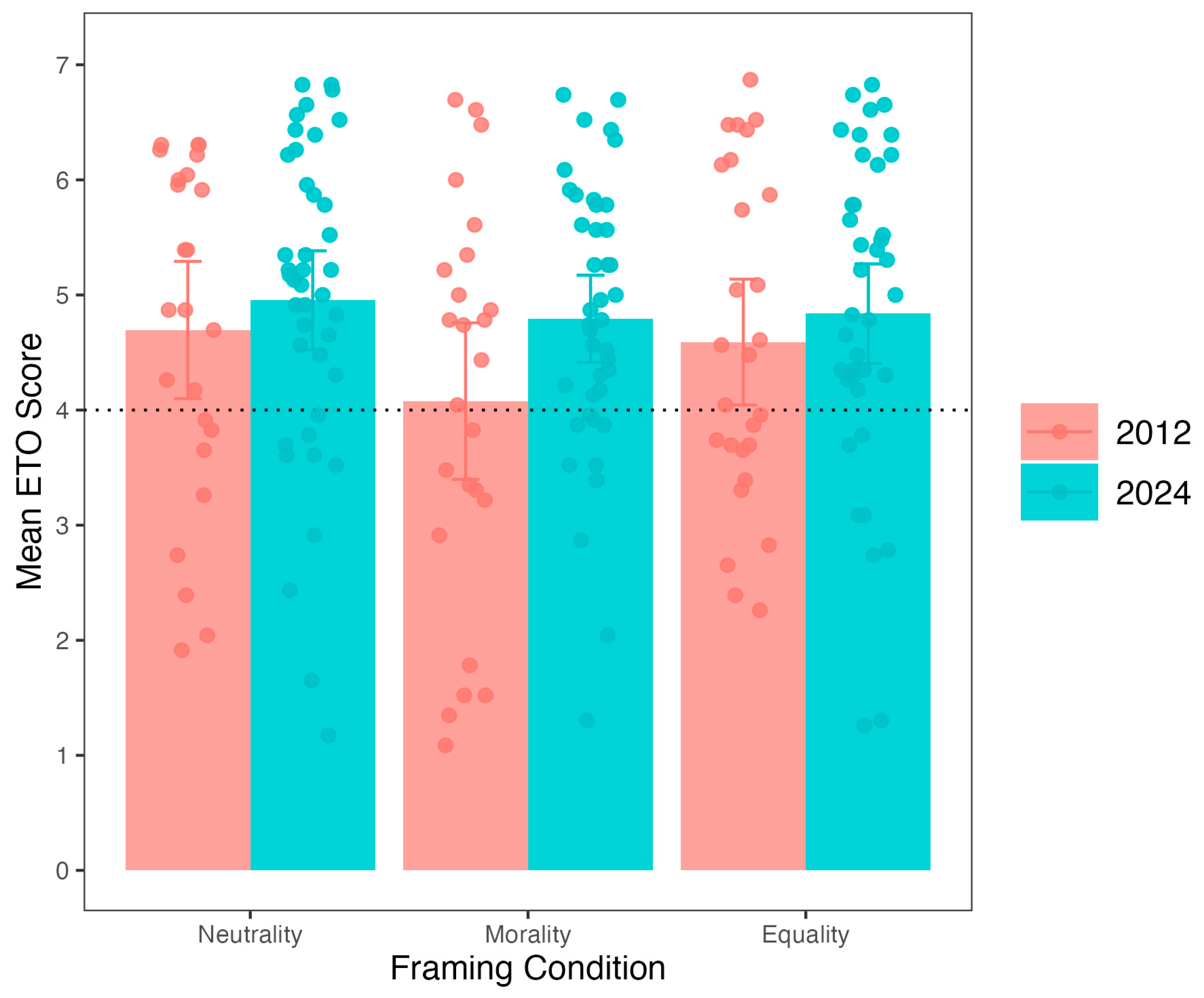
Figure 1. Mean score on the Attitudes toward Homosexuals scale (ETO) as a function of framing condition and cohort. The ETO Scale is on a range from 1 to 7. The dotted line on the score of 4 therefore represents the middle value of the scale.
Societies 16 00110 g001
Figure 2. Effects of the number of lesbian friends (A) and gay friends (B) on scores on the Attitudes toward Homosexuals Scale (ETO), as a function of gender.
Societies 16 00110 g002
Table 1. Descriptive statistics of independent variables.
YearFramesMean AgeSD AgeN (Female)Mean Parental EducationSD Parental EducationMean Household IncomeSD Household IncomeMean Gay FriendsSD Gay FriendsMean Lesbian FriendsSD Lesbian Friends
2012Neutrality19.41.124 (14)3.71.1257511671.61.80.30.6
2012Morality20.02.125 (17)4.11.1343522531.62.31.12.0
2012Equality19.31.427 (17)4.01.4512075122.14.41.23.1
2024Neutrality21.71.741 (37)5.00.9180,293210,5881.41.51.11.3
2024Morality22.44.341 (37)5.30.8152,756184,2462.02.11.01.3
2024Equality22.04.341 (39)5.31.099,37877,7021.11.60.71.0
Note. Household income is in TRY currency.
Table 2. Percentages of participants’ types of residential area.
Residence20122024
NeutralityMoralityEqualityNeutralityMoralityEquality
village4.20.03.72.42.40.0
town4.212.011.14.90.04.9
city54.264.048.134.139.034.1
metropolis37.524.037.058.558.561.0
Table 3. Output of model predicting Attitudes toward Homosexuals (ETO Score).
ETO Score
PredictorsEstimatesCIp
(Intercept)2.941.16–4.710.001
Frame [Morality]−0.60−1.02–−0.170.006
Frame [Equality]−0.23−0.65–0.190.274
Cohort [2024]−0.10−0.56–0.370.675
Age0.02−0.04–0.080.480
Gender [female]0.610.06–1.150.028
Lesbian Friend Number0.330.02–0.630.036
Gay Friend Number0.12−0.04–0.290.149
Household Income−0.12−0.29–0.060.181
Parental Education0.220.05–0.390.010
Residence [town]−0.70−2.13–0.730.334
Residence [city]−0.39−1.62–0.840.532
Residence [metropolis]−0.27−1.50–0.960.667
Gender [female] × Lesbian
Friend Number
−0.47−0.82–−0.120.008
Gender [female] × Gay
Friend Number
0.250.03–0.470.026
Observations199
R2/R2 adjusted0.328/0.277
Note. Significant values are given in bold.
Disclaimer/Publisher’s Note: The statements, opinions and data contained in all publications are solely those of the individual author(s) and contributor(s) and not of MDPI and/or the editor(s). MDPI and/or the editor(s) disclaim responsibility for any injury to people or property resulting from any ideas, methods, instructions or products referred to in the content.