1. Digital Inclusion in Later Life Under Liquid Modernity
The value and significance of older adults in contemporary societies are widely recognized [
1,
2]. Their participation in social, economic and civic life constitutes a central dimension of democratic inclusion. However, this participation is increasingly mediated by digital technologies. Communication with family and peers, access to health and social services, interactions with public administrations, and financial and commercial transactions are now largely structured through digital systems [
3,
4,
5,
6]. In this context, digital inclusion is no longer optional; it has become a precondition for exercising full citizenship in later life.
Two interrelated dimensions are especially salient for understanding this transformation. First, the cultivation and maintenance of meaningful social ties are fundamental for well-being and quality of life among older adults. Social relationships are strongly associated with reduced loneliness, improved mental and physical health, and even lower mortality risk [
6,
7,
8,
9,
10]. From the perspective of socioemotional selectivity theory [
11,
12], older adults increasingly prioritize emotionally meaningful interactions, which reinforces the importance of relational connectivity in later life. Longitudinal evidence further suggests that richer social networks buffer cognitive decline and promote resilience [
13].
Second, the expanding role of information and communication technologies (ICTs) permeates nearly all domains of everyday life. ICT use has been associated with enhanced well-being, social connectedness and perceived autonomy among older adults [
14,
15], yet adoption remains uneven, and significant disparities persist. Barriers such as technology-related anxiety, perceived obsolescence, limited prior exposure, and unequal access to support networks continue to shape differentiated adoption trajectories [
16,
17]. Consequently, the digital divide affecting older adults is multidimensional, encompassing not only access and skills but also patterns of use and the capacity to integrate technologies into meaningful daily routines [
18,
19].
These dynamics unfold within what Bauman [
20] conceptualized as liquid modernity, a condition characterized by accelerated social change, institutional instability, and the erosion of durable support structures. In this context, technological systems evolve continuously through software updates, interface redesigns and the ongoing digitalization of essential services. Qualitative research shows that older adults frequently experience these transformations as destabilizing, generating frustration and perceptions of rapid obsolescence [
21]. Insecurity and mistrust further complicate engagement, particularly considering heightened exposure to online fraud and concerns about data protection [
22,
23]. At the same time, the shift toward “digital-by-default” service provision reduces opportunities for face-to-face assistance, disproportionately affecting those with lower digital literacy [
19,
24].
Liquid modernity also reshapes the temporal and institutional organization of learning and support. Knowledge becomes provisional, competencies require continuous updating, and responsibility for adaptation is increasingly individualized. In digitally mediated environments, this fluidity is intensified by the rapid obsolescence of interfaces, the proliferation of platforms, and the migration of essential services to mobile ecosystems. For older adults, whose technological socialization often occurred under conditions of greater stability, this shift may generate a mismatch between expectations of durability and the reality of perpetual change. Consequently, digital inclusion in later life must be understood not only as an issue of access or skills, but as a challenge of navigating unstable technological infrastructures that demand ongoing relational support.
Under these conditions, digital exclusion in later life emerges as a salient social risk. Technological participation becomes closely tied to access to rights, services and social belonging, while responsibility for maintaining digital competence is progressively individualized. Technology adoption cannot be adequately understood as a discrete decision driven solely by perceived usefulness or ease of use. Rather, it constitutes a dynamic and socially embedded process shaped by recurrent cycles of disruption and adaptation. This structural fragility exposes the limits of technology adoption models that prioritize individual cognitive determinants and infrastructural access while insufficiently theorizing the relational processes through which older adults learn, adapt, and sustain engagement with digital technologies. Addressing digital inclusion in later life thus requires moving beyond exclusively individual-centered frameworks toward approaches that foreground mediation and networked forms of support.
These dynamics reflect a broader condition of liquidity in which technological participation is shaped less by stable competencies than by the capacity to continuously renegotiate engagement in the face of change.
2. From Technology Acceptance to Relational Mediation
2.1. The Relational Limits of Technology Acceptance Models
Over the past three decades, a range of theoretical models has sought to explain how individuals accept, adopt, and use digital technologies. Among these, the Technology Acceptance Model (TAM) [
25] and the Unified Theory of Acceptance and Use of Technology (UTAUT) [
26] have become the most influential frameworks in the field. More recently, the Senior Technology Acceptance Model (STAM) [
27] was developed to account more explicitly for age-related factors shaping technology adoption among older adults.
TAM, originally grounded in the Theory of Reasoned Action [
28], conceptualizes adoption as primarily driven by two cognitive determinants: perceived usefulness and perceived ease of use. Perceived usefulness refers to the degree to which an individual believes that using a particular system will enhance performance, while perceived ease of use reflects the extent to which the technology is expected to require minimal effort [
25]. The model’s parsimony and empirical robustness have made it highly adaptable across technologies and contexts, with extensive validation through longitudinal and meta-analytic research [
29,
30].
UTAUT represents a significant extension of this framework. Integrating elements from multiple adoption theories, it proposes four core determinants of behavioral intention and use: performance expectancy, effort expectancy, social influence, and facilitating conditions [
26]. It further incorporates moderating variables such as age, gender, experience, and voluntariness of use, acknowledging that adoption processes vary across social groups and life stages. Both TAM and UTAUT have been widely applied in studies of older adults’ technology use, including research on computers, smartphones, e-health applications and digital public services [
27,
31,
32,
33]. Their contribution to understanding recurring barriers, particularly effort expectancy, anxiety, and facilitating conditions in later life, is substantial.
In response to the limitations of general models when applied to aging populations, Chen & Chan [
27] proposed STAM, an adaptation of TAM that incorporates age-related physical, psychological, and social characteristics. STAM extends the original framework by including factors such as health conditions, cognitive abilities, self-efficacy and gerontechnological anxiety, thereby recognizing that aging is not merely a moderating variable but a structural condition influencing technology interaction. This development represents an important conceptual advance in situating adoption within the realities of later life.
Despite their theoretical and empirical value, these models share a common structural limitation. Adoption is predominantly framed as an individual-level process shaped by cognitive evaluations and contextual access conditions. While UTAUT introduces social influence and facilitating conditions, these constructs are typically operationalized as external variables affecting individual intention, rather than as dynamic, relational processes unfolding through interaction and shared learning. Similarly, STAM incorporates age-related vulnerabilities but does not fully theorize how older adults navigate technological challenges through sustained interpersonal mediation in everyday contexts.
Recent research has begun to address post-adoption learning processes more explicitly. The Senior Technology Learning Preferences Model for Mobile Technology (STELE) [
34] identifies two dominant learning preferences among older adults—self-exploration and social learning—and distinguishes between general support (e.g., help menus, online tutorials) and social support from family or peers. STELE represents an important shift toward recognizing that facilitating conditions are not merely infrastructural but learning-oriented and socially embedded. However, while STELE advances understanding of learning preferences, it does not fully conceptualize the broader relational ecologies within which such support unfolds, nor does it integrate network-level dynamics into a multi-layered adoption architecture.
As a result, the relational infrastructures through which digital competence is acquired, maintained, and adapted remain analytically underdeveloped. The models successfully explain why individuals may intend to use technology, yet they are less equipped to account for how engagement is stabilized over time, particularly in contexts marked by recurrent technological disruption and the progressive virtualization of essential services. This relational blind spot becomes especially salient in later life, where informal support networks frequently play a decisive role in sustaining digital participation [
35,
36].
The limitations of these models become particularly visible under conditions of liquid modernity. When technological environments are characterized by instability, continuous updating, and the erosion of predictable support structures, adoption cannot be adequately captured as a stable attitudinal state. Instead, engagement is repeatedly renegotiated through processes of breakdown, assistance, and adaptation. Models centered primarily on intention formation therefore struggle to explain how users maintain participation across successive cycles of disruption.
Addressing this gap requires shifting the analytical focus from isolated determinants toward the processes of mediation that shape effort expectancy, anxiety, self-efficacy, and continuity of use. It is within this space that the concept of the warm expert acquires theoretical relevance.
2.2. Warm Experts as Relational Mediators of Digital Appropriation
To address the relational limitations of prevailing adoption models, this article turns to the concept of the warm expert. Originally introduced by Bakardjieva [
37], the term refers to trusted and accessible individuals within one’s personal environment who provide informal support in engaging with digital technologies. Unlike formal technical support services or structured digital literacy programs, warm experts operate within everyday relational contexts (family ties, friendships, neighborhood networks, peer groups, or community settings) where learning unfolds through trust, proximity, and shared experience [
35,
37].
Warm expertise is not defined primarily by high technical proficiency but by relational accessibility and contextualized competence. Warm experts translate abstract system logics into meaningful practices embedded in daily routines [
38]. They provide explanations, demonstrate procedures, assist during breakdowns, and normalize uncertainty. In doing so, they transform technological engagement from an individual cognitive task into a socially mediated process. For older adults, who may experience anxiety, insecurity, or perceptions of obsolescence in rapidly changing digital environments, such mediation can be decisive.
Importantly, warm expertise should not be understood as a fixed personal attribute but as a relational role enacted within specific interactional contexts. The same individual may perform different mediation functions at different moments, and these functions may be distributed across multiple actors [
36]. Support may emerge episodically, when a device fails after a software update, or through sustained accompaniment that gradually builds competence. What unifies these forms is the embedding of learning within relational trust rather than institutionalized instruction.
From an analytical perspective, warm experts influence core determinants identified in adoption models. Autonomy-oriented mediation may reduce perceived effort and strengthen self-efficacy [
39]. Emotional reassurance may mitigate technology-related anxiety. Contextual explanation may enhance perceived usefulness by linking digital tools to personally meaningful goals. Conversely, overly substitutive assistance, where tasks are completed without explanation, may inhibit competence development and generate dependency. Thus, the presence of mediation alone is insufficient; its orientation and quality are central.
In the context of older adulthood, warm experts acquire particular relevance due to the volatility of contemporary technological systems. Mobile technologies require ongoing learning and troubleshooting as interfaces and services change, making post-adoption engagement dependent on access to effective support resources [
34,
40]. As essential services such as health care, banking, and public administration shift to web-based and app-based channels, older adults’ continued participation increasingly relies on the availability of responsive support, which is unevenly distributed across social networks [
35,
41]. This volatility is compounded by device and software obsolescence, which can increase vulnerability and complicate sustained engagement [
42].
Recognizing warm expertise as a structural component of digital engagement invites a shift from models centered exclusively on individual cognition toward frameworks that incorporate mediation as an integral facilitating condition. Rather than functioning as a peripheral contextual factor, relational mediation shapes how older adults interpret technological change, manage disruption, and integrate digital practices into everyday life. This perspective opens the path toward a more relationally grounded account of technology appropriation, which the following sections develop through a role-based and network-sensitive framework.
3. Toward a Relational Theory of Technology Appropriation
From the perspective of liquid modernity, mediation ecologies can be interpreted as adaptive responses to the erosion of stable institutional support. As formal assistance becomes less accessible and technological change accelerates, relational networks increasingly function as flexible infrastructures that absorb uncertainty and sustain engagement.
Building on the concept of warm expertise as relational mediation, this section develops a structured account of how mediation operates in later-life technology appropriation. Rather than focusing on individual helpers as fixed actors, the analysis conceptualizes mediation as a set of distributed roles embedded within relational and networked configurations. This shift from individual support to mediation ecology allows for a more precise understanding of how digital engagement is sustained over time.
3.1. Mediation as Role: Enabling and Limiting Functions
Warm expertise is best understood as a set of mediation functions rather than as stable personal categories. Different actors may enact similar roles, and the same actor may perform different roles depending on context and technological demands.
Warm experts, then, are relational figures whose significance emerges in concrete learning situations rather than from fixed identities or positions. Building on this idea, recent studies on older adults’ digital practices show how warm experts can simultaneously foster and hinder digital inclusion, depending on how they scaffold autonomy, set the pace of learning, and negotiate dependence [
36,
43,
44].
Framing warm expertise in terms of roles allows analytical differentiation without reifying individuals. Several enabling mediation functions can be identified.
The initiating function lowers initial barriers to engagement by introducing technologies as socially meaningful tools, often connected to relational purposes such as communication with family or access to services.
The accompaniment function supports progressive learning through explanation, guided experimentation and repetition. This function prioritizes comprehension over efficiency and is particularly relevant in contexts where confidence and self-efficacy are fragile.
The restorative function becomes salient during moments of disruption: software updates, interface redesigns or service migration. Its role is not merely technical correction but interpretive stabilization, helping older adults understand what has changed and how to respond.
The civic-bridging function mediates access to digitally delivered services, linking technological competence to the exercise of rights and institutional participation.
Alongside these enabling roles, limiting forms of mediation must also be acknowledged.
The substitutive function, often enacted by highly competent but efficiency-oriented helpers or “super-solvers”, involves completing tasks on behalf of the older adult without fostering understanding. While effective in the short term, this function may weaken self-efficacy and increase dependency.
Directive or gatekeeping patterns, where access is restricted “for protection”, may similarly constrain autonomy.
The analytical relevance of this typology lies not in categorizing individuals but in distinguishing mediation orientations that either promote or inhibit sustained appropriation.
Beyond interactional limitations, reliance on warm experts may generate broader structural risks. As informal mediation becomes normalized, institutions and service providers may implicitly assume the availability of relational support, reducing incentives to design accessible interfaces or maintain alternative service channels. This dynamic may contribute to a form of delegated inclusion, in which responsibility for navigating complex digital environments is displaced from institutions to families, peers, or community networks. Such delegation risks reinforcing inequalities, as access to warm expertise is unevenly distributed across socio-economic contexts and life situations [
19,
35].
From the perspective of liquid modernity, this reliance on relational mediation reflects the broader individualization of risk and responsibility. Not all older adults possess stable support networks, and some may experience relational isolation precisely at the moment when digital participation becomes most necessary. Consequently, the absence of warm experts may deepen exclusion, transforming relational support from a resource into a potential axis of inequality [
24,
35].
Recent work has cautioned against treating warm experts as a universal solution to digital exclusion, highlighting how informal support may reproduce structural inequalities and obscure institutional responsibilities [
35].
This critique reinforces the importance of conceptualizing mediation ecologies rather than assuming that the mere presence of informal support guarantees digital inclusion.
3.2. From Roles to Mediation Ecologies
Although mediation often appears in dyadic interactions, older adults typically rely on multiple actors who collectively form a support ecology. Roles may shift across situations, overlap among actors or be activated episodically in response to technological disruption. Consequently, the relevant unit of analysis extends beyond individual relationships to encompass broader relational configurations [
35,
45,
46].
Three structural characteristics of mediation ecologies are particularly relevant:
First, distribution of roles: mediation functions may be concentrated in a single actor or distributed across several individuals. Distributed configurations may enhance resilience by reducing reliance on one substitutive figure. Second, network density and diversity: the number and heterogeneity of support actors may influence exposure to varied competencies and perspectives. Third, reliability of support: perceived availability during breakdowns may condition confidence and willingness to engage with evolving technologies.
Group-based contexts add another dimension. Peer learning environments, community initiatives and collective digital workshops can normalize uncertainty and reduce stigma associated with “not knowing.” In such settings, mediation is not merely assistance but a shared learning process embedded within relational reciprocity [
39,
47,
48].
Conceptualizing mediation ecologies in this way reframes digital inclusion as structurally relational. The capacity to sustain engagement depends not solely on individual attitudes or competencies but on the configuration and orientation of the support environment.
3.3. Analytical Dimensions of Mediation Ecologies
To systematize this framework, mediation processes can be analyzed along a limited set of cross-cutting dimensions:
Autonomy orientation: the degree to which mediation promotes independent competence versus substitution.
Pedagogical intentionality: the extent to which support involves explanation, scaffolding, and skill transfer.
Emotional–motivational orientation: the presence of reassurance and normalization during disruption.
Temporal orientation: whether support is designed to fade as competence grows or stabilizes ongoing dependency.
Relational structure: whether mediation is dyadic or embedded within distributed networks.
These dimensions apply both to individual interactions and to broader mediation ecologies. They allow relational processes to be incorporated analytically into adoption models without reducing them to vague contextual variables.
Taken together, the typology of mediation roles and the ecological framing of support networks highlight a structural gap in prevailing technology adoption frameworks. While TAM, UTAUT, STAM and STELE identify cognitive and age-related determinants of intention and use, they do not explicitly model the relational infrastructures through which these determinants are shaped, moderated, or transformed. Bridging this gap requires an extended framework capable of integrating individual, relational and network-level determinants within a dynamic architecture of appropriation. It is this objective that motivates the formulation of the Relational (Older Adult) Technology Appropriation Model, REL(OA)TAM.
4. REL(OA)TAM: The Relational (Older Adult) Technology Appropriation Model
The preceding analysis culminates in the formulation of the Relational (Older Adult) Technology Appropriation Model (REL(OA)TAM). The REL(OA)TAM should be understood as a context-specific instantiation of a broader relational framework for technology appropriation, here referred to as RELTAM (Relational Technology Appropriation Model). While REL(OA)TAM is calibrated to the conditions of later life, particularly age-related vulnerabilities, support needs, and the role of warm expertise, the underlying architecture is not population-bound. The relational, networked, and dynamic principles articulated in RELTAM may be adapted to other populations experiencing technological transition, structural vulnerability, or reliance on mediated learning environments.
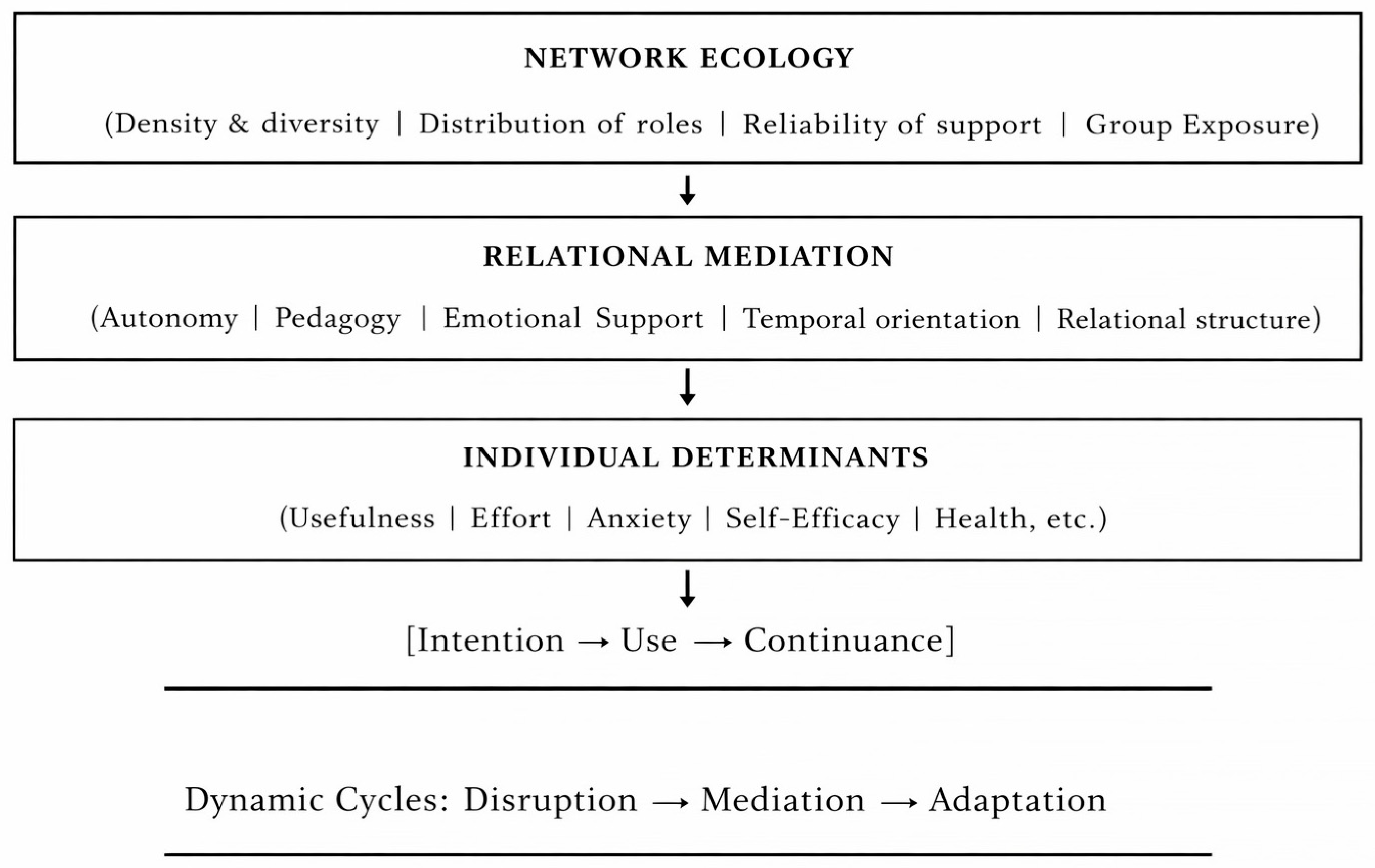
REL(OA)TAM is conceived as a structured extension of existing technology adoption models that incorporates relational mediation and networked support as constitutive elements of digital inclusion in later life. Rather than replacing TAM, UTAUT, STAM or STELE, the model integrates their individual-level determinants within a multi-layered relational architecture (see
Table 1).
At its core, REL(OA)TAM retains the principal constructs identified in prior frameworks: perceived usefulness, effort expectancy, social influence, facilitating conditions, technology-related anxiety, self-efficacy, and age-related health and cognitive factors [
26,
27,
28]. These variables continue to explain behavioral intention and initial engagement. However, REL(OA)TAM reconceptualizes their operation as embedded within relational mediation processes and broader support ecologies.
4.1. Multi-Level Structure of REL(OA)TAM
REL(OA)TAM is organized across three analytically distinct but interdependent levels.
Individual level. Cognitive and affective determinants influence behavioral intention, use, and continuance. In the context of older adulthood, effort expectancy, anxiety, and self-efficacy are particularly sensitive to mediation effects.
Relational level. Mediation processes—characterized by autonomy orientation, pedagogical intentionality, emotional reassurance, and substitution risk—function as moderators and mediators. Autonomy-oriented support may strengthen the relationship between effort expectancy and continuance. Pedagogical mediation may enhance self-efficacy. Emotional support may attenuate anxiety. Substitutive mediation may weaken long-term competence development.
Network level. Support ecologies shape the stability and distribution of mediation roles. Network density, role distribution, reliability of assistance, and group-based learning exposure influence the robustness of relational mediation and indirectly affect continuance and adaptive engagement.
This layered structure situates adoption within relational infrastructures rather than treating social influence as an external variable. Individual determinants are not displaced but relationally conditioned.
Although specified here for older adults, this multi-level structure reflects a generalizable relational architecture in which population-specific determinants may be incorporated without altering the underlying logic of mediated and networked appropriation. REL(OA)TAM therefore represents not a population-specific deviation but a calibrated articulation of a broader relational logic of technology appropriation.
4.2. Dynamic Dimension: Cycles of Disruption and Adaptation
Consistent with the analysis of liquid modernity [
20], REL(OA)TAM conceptualizes technology appropriation as a temporally extended process characterized by recurrent cycles of disruption and adaptation. Software updates, interface redesigns, and service virtualization generate repeated demands for relearning. Consequently, continuance intention and adaptive use become central outcome variables, complementing initial behavioral intention. The availability and orientation of mediation across time are therefore integral components of sustained digital inclusion.
This dynamic instability is not incidental but structurally linked to the liquidity of contemporary socio-technical environments, where permanence is replaced by continuous reconfiguration.
Figure 1 depicts REL(OA)TAM as an ecological and mediational architecture in which relational processes condition individual determinants and are themselves structured by network-level configurations, while appropriation unfolds through recurrent cycles of disruption and adaptation. REL(OA)TAM represents an application of the broader RELTAM framework adapted to later-life conditions.
4.3. Operationalization and Measurement
Operationalizing REL(OA)TAM requires integrating individual, relational, and network-level variables within coherent empirical designs.
At the individual level, established instruments measuring usefulness, effort expectancy, anxiety, and self-efficacy may be retained.
At the relational level, mediation constructs may be measured through scales assessing autonomy orientation (e.g., encouragement of independent practice), pedagogical support (explanation and scaffolding), emotional reassurance (normalization of error), and substitution frequency.
Recent measurement efforts further support the need to distinguish between support types in later life. The Mobile Tech Support Questionnaire (MTSQ) developed by Sharifi et al. [
34] identifies two dimensions of mobile support (self-reliant resources and social support) and demonstrates their influence on perceived ease of use and frequency of engagement. While the MTSQ provides a valuable instrument for assessing support preference and quality, REL(OA)TAM extends this approach by situating support not only as a preference or resource but as a structural mediator embedded within distributed relational networks.
At the network level, ego-network modules may capture the number and diversity of support actors, distribution of mediation functions, and perceived reliability of assistance. Participation in group-based learning environments may be measured through exposure and frequency indicators.
Structural equation modeling or multilevel modeling approaches are particularly suited to testing the proposed mediation and moderation pathways. Longitudinal designs would further allow examination of adaptive trajectories over time.
4.4. Theoretical Contribution
REL(OA)TAM advances technology adoption theory in three respects. First, it reframes relational mediation as a structural facilitating condition rather than a peripheral contextual variable. Second, it introduces a network-sensitive layer that accounts for distributed support ecologies. Third, it incorporates temporal instability as a constitutive feature of digital engagement in later life.
In doing so, the model provides a more socially grounded account of technology appropriation among older adults—one that remains compatible with established adoption frameworks while extending their explanatory and predictive scope.
5. Discussion and Conclusions: Relational Mediation and Digital Inclusion in Liquid Modernity
This article set out to address a structural gap in prevailing technology adoption frameworks by foregrounding relational mediation as a constitutive element of digital inclusion in later life. While models such as TAM, UTAUT, STAM and STELE have provided robust explanations of individual determinants of adoption, they have remained comparatively silent on the relational infrastructures through which technological engagement is stabilized, adapted, and sustained over time. By introducing a role-based and network-sensitive account of mediation and formalizing it in the Relational (Older Adult) Technology Appropriation Model (REL(OA)TAM), this article advances a multi-level framework that situates cognitive determinants within distributed ecologies of support.
The primary theoretical contribution lies in reconceptualizing facilitating conditions as relationally structured rather than merely infrastructural. In REL(OA)TAM, mediation is not treated as an auxiliary contextual factor but as a dynamic process that conditions effort expectancy, anxiety, and self-efficacy across time. The model also extends adoption theory by integrating network-level variables, such as role distribution and support reliability, into the explanatory architecture. In doing so, it bridges individual-centered information systems models with relational and ecological perspectives more commonly associated with social work and community research. This integration contributes to a more socially grounded understanding of technology appropriation among older adults.
A second contribution concerns temporality. By emphasizing recurrent cycles of disruption and adaptation, the model shifts attention from initial acceptance toward continuance and adaptive use. In contexts characterized by rapid technological transformation and service virtualization, sustained engagement depends not solely on attitudes toward technology but on the availability and orientation of mediation across time. This dynamic perspective enhances the predictive scope of adoption research in later life.
Despite these contributions, several limitations must be acknowledged. First, the model increases analytical complexity by incorporating relational and network-level constructs, which may pose challenges for parsimonious empirical testing. Operationalizing distributed mediation ecologies requires careful measurement design and may necessitate multilevel or longitudinal approaches that are not always feasible. Second, while REL(OA)TAM is theoretically calibrated to later life, it has not yet been empirically validated as an integrated model. Future research should test its components across diverse socio-economic and cultural contexts to assess generalizability and boundary conditions.
Third, the present analysis has focused primarily on informal mediation. The interaction between informal support and formal institutional interventions warrants further investigation. Digital inclusion policies cannot rely solely on informal mediation but must consider how institutional design interacts with relational infrastructures of support. While warm experts can mitigate barriers to engagement, overreliance on informal mediation may inadvertently legitimize the withdrawal of institutional responsibility for inclusive digital design.
These limitations open a clear research agenda. Empirical studies should examine how different mediation configurations moderate established determinants such as effort expectancy and anxiety, and whether distributed support networks enhance adaptive resilience in the face of technological disruption. Longitudinal research is particularly needed to capture trajectories of appropriation over time. Comparative studies may also explore whether the relational architecture proposed here extends beyond older adulthood to other populations facing structural vulnerabilities in digital environments. The relational architecture proposed here may also inform future adaptations of RELTAM to other populations facing discontinuous technological socialization, including migrants, individuals with disabilities, or workers undergoing digital reskilling.
At the same time, the model’s scalability invites further research on how relational mediation operates around emerging technologies such as AI-based services or the Internet of Things (IoT), whose opacity and infrastructural complexity are likely to make supportive ecologies even more consequential for meaningful appropriation.
In conclusion, digital inclusion in later life cannot be adequately explained through individual attitudes and access conditions alone. Technological appropriation unfolds within relational and networked ecologies that shape learning, adaptation, and sustained participation. By integrating these dimensions into adoption theory, REL(OA)TAM offers a framework that is both theoretically grounded and responsive to the evolving realities of digitally mediated societies. Rather than displacing established models, it invites their expansion toward a more relationally attuned understanding of digital inclusion. In this sense, relational mediation does not merely facilitate adoption but constitutes a key social resource for navigating the uncertainties and discontinuities characteristic of liquid modernity. Relational mediation should therefore be understood not as a substitute for inclusive institutional design but as a complementary resource whose availability cannot be assumed across all contexts.




 ,
,