1. Introduction
Violence in schools—including bullying—remains a serious global concern and urgent public health issue [
1]. While most research on school bullying centres on pupils, the roles of teachers—whether as perpetrators, co-perpetrators, or bystanders—have received significantly less scholarly attention. Teachers are, for the most part, committed professionals who play a crucial role in fostering care, learning, and inclusion. However, documented cases from the Initiative for a Discrimination-Free Education System in Austria [
2] indicate that teachers can themselves be implicated in the very dynamics of bullying and discrimination they are legally and professionally mandated to prevent. In Austria, this duty is embedded in multiple legal frameworks, including Section 51(3) of the School Education Act, the Austrian Federal Constitution, and the UN Convention on the Rights of the Child, ratified in 1992, all of which oblige educators to protect pupils from physical and psychological harm [
2,
3]. These legal protections, however, stand in stark contrast to subjective reports from pupils describing harm inflicted or overlooked by some of those in positions of authority—raising questions about selected teachers’ involvement, complicity, or agency in sustaining school-based violence—though such actions should not be taken as representative of the profession as a whole.
While bullying has traditionally been conceptualised as peer-to-peer aggression [
4], its occurrence across physical and digital environments—such as classrooms, hallways, and an ever-expanding array of social media and educational platforms—complicates this understanding [
5,
6,
7,
8]. These spaces are shaped by intersecting social norms, power relations, and institutional structures [
8,
9]. When unchallenged, such norms can enable or reinforce bullying—including that tolerated or perpetrated by teachers. Lefebvre’s [
10] theory of space conceptualises schools as socio-spatial constructs that privilege normative identities while marginalising others. Within these institutionalised spaces, teacher bullying is not merely individual misconduct but may be structurally embedded—sustained by spatial, institutional, and normative logics of schooling. Educational institutions are frequently governed by cisnormative and heteronormative frameworks, which marginalise pupils and teachers who do not—or choose not to—conform to dominant gender and sexual norms [
11,
12,
13,
14]. Intersectionality theory provides a critical lens for examining how overlapping social positions—such as gender, sexuality, race, disability, and class—shape experiences of vulnerability and discrimination in school contexts [
15]. These intersectional and spatial dynamics are crucial for analysing how teacher-perpetrated bullying is enabled, experienced, and perceived—not as isolated acts, but as socially and spatially produced practices embedded within institutional structures.
Although peer bullying has been widely studied, teacher involvement remains underexplored—especially in Austria. Empirical studies on teacher-perpetrated bullying are scarce, and qualitative insights into pupils’ experiences are especially limited [
16]. Yet teachers may act as aggressors, co-aggressors, or passive bystanders—roles that each affect pupil well-being and academic outcomes [
17,
18]. This study addresses this gap through qualitative analysis of written pupil narratives collected in Tyrolean schools. It explores how pupils experience and frame teachers’ involvement (active or passive) in bullying processes. These narratives are personal, self-reported accounts reflecting pupils’ perception rather than objectively verifiable facts. They should thus be read as subjective perspectives shaped by emotion, memory, and context. Still, they offer valuable and often overlooked insights into how young people emotionally experience and make sense of teacher involvement in bullying. Some accounts reach back into primary school, illustrating how early experiences of exclusion, teacher practices, or peer dynamics can have lasting emotional significance. The research is guided by two questions:
How do pupils perceive and interpret the dynamics and negotiation processes that emerge when they find teachers involved in school bullying as (co-)perpetrators or bystanders?
How do spatial and normative conditions within schools influence these bullying processes?
By foregrounding teacher involvement in bullying from the perspective of pupils, this article offers a specific but underexplored perspective on power and violence in schools and expands the emerging body of qualitative bullying research in Austria. Through an analysis of pupils’ written accounts, the study shows how perceived teacher practices can escalate, sustain, or resolve bullying—and how institutional and normative settings shape these dynamics. It also highlights how pupils’ lived experiences of teacher-perpetrated bullying—and of (cyber-)bullying ignored or inadequately addressed by teachers—relate to intersecting dimensions of identity, including gender, sexuality, race, and other axes of difference. Further studies are needed to gain qualitative insights from the perspective of teachers to compare them with those of pupils and to gain a more comprehensive insight into socio-spatial relations of power and violence in school settings in Austria.
2. Spatialising School Violence: Bullying Across Socio-Material-Digital Spheres
Bullying in schools does not occur in a vacuum; it is embedded within the socio-material, socio-digital, and spatial organisation of schools and their broader socio-cultural context. Understanding how space contributes to (cyber-)bullying requires conceptualising the school as more than a physical location. Schools can be understood through three intertwined spatial layers: the official (e.g., rules and regulations), the physical (e.g., buildings, playgrounds, learning spaces), and the informal (e.g., social hierarchies and interactions) [
19]. Related frameworks distinguish between mental space, referring to the idea of the school and its educational and social purpose; physical space, referring to the built environment and geographic location; and social space, which considers how spaces are used and inhabited by pupils and staff [
10,
20,
21].
This spatial lens enables a more nuanced analysis of how bullying is shaped by material and social conditions. Studies have identified ‘hotspots’ within schools—often unstructured, unsupervised areas—where bullying is especially common, such as playgrounds, corridors, changing rooms, and transition zones [
5,
21]. Toilets, in particular, have been identified as highly vulnerable spaces where pupils—especially genderqueer youth—face increased risk of homophobic or transphobic bullying [
5]. Such spaces include environmental features that can exacerbate bullying, such as inadequate lighting, poor visibility, long distances between buildings, and isolating architectural designs [
20,
22]. Visibility is a crucial mitigating factor: appropriate lighting and strategic window placement not only enhance supervision but also foster bystander intervention, reinforcing positive norms [
5]. However, teachers’ capacity to intervene is often hindered by spatial and organisational factors—including large school sizes, unsupervised areas, lack of staff, and socially competitive or overstimulating playgrounds [
21]. These patterns align with Lefebvre’s [
10] assertion that spatial arrangements both reflect and shape social practices and institutional power relations.
Beyond the material and relational structuring of physical spaces, digital technologies have introduced new spatialities that influence bullying dynamics. Schools are increasingly environments where offline and online bullying occur in combined, entangled ways—a phenomenon referred to as cON/FFlating bullying [
8]. Digital platforms extend the reach of bullying beyond school hours and premises. Like physical ‘hotspots’, online spaces—particularly social media platforms—often lack adult oversight, making them conducive to cyberbullying [
22,
23]. The blurring of school/non-school boundaries enables persistent victimisation and complicates efforts to monitor and respond to harmful practices [
1,
2]. This underscores the need for anti-bullying interventions that address both digital and physical dimensions, recognising the shared power dynamics and norms that underpin bullying across spaces.
The production of school space is also shaped by gendered and normative logics. Schools often reinforce cisnormative and heteronormative frameworks, marginalising those who do not—or do not wish to—conform to dominant (gender or sexual) norms [
13,
14]. This occurs through explicit and implicit mechanisms, from ‘gendered’ school uniforms and the persistence of single-sex schooling to curricular omissions or misrepresentation of gender and sexual diversity. Such practices reinforce binary and heteronormative norms, embedding structural inequality into everyday spatial and social routines. They also normalise homophobic and transphobic attitudes, creating environments in which verbal harassment and bullying become expressions of these embedded cultural codes [
11,
12]. In such contexts, authoritarian school cultures, rigid hierarchies, and status-driven environments further enable bullying [
24].
The interconnection between spatiality, relationality, and bullying shows that school environments are not passive backdrops to social interaction. Rather, they are actively produced and contested spaces that structure power relations, define norms, and shape everyday practices [
10,
20]. Understanding how spatial, digital, and relational dimensions intersect is therefore crucial for developing safer school environments and reducing bullying and other forms of violence.
3. Teachers as Agents in (Cyber-)Bullying Dynamics
This section provides an overview of the current state of research and conceptual insights on teacher-perpetrated bullying, as well as teachers’ attempts—or failures—to intervene in peer bullying, while also addressing institutional structures and challenges. Teachers hold central roles as educators, socialisers, and classroom managers, with a professional responsibility to protect pupils from harm [
25,
26]. However, research shows that some teachers may not only fail to intervene effectively but also engage in bullying themselves by leveraging their institutional power over pupils. While bullying is typically defined by intent, repetition, and power imbalance [
4], these dynamics are intensified in teacher–pupil relationships, which are structurally unequal by design [
27]. When teachers misuse their authority to harm pupils, it constitutes a distinct form of child maltreatment [
28,
29]. Such actions harm not only individual pupils but also the broader school climate, reinforcing patterns of peer and cyberbullying.
Like pupils, teachers can assume various roles in peer bullying—ranging from active aggressors to passive bystanders. Twemlow et al. [
27] differentiate between sadistic teachers, who deliberately humiliate pupils, and bully–victim teachers, who struggle with maintaining control and inadvertently enable bullying through inconsistency or biases [
27,
30].
Research further identifies multiple forms of active teacher bullying. Whitted and Dupper [
17] distinguish between physical maltreatment (e.g., hitting, throwing objects, or restricting bathroom access) and psychological maltreatment (e.g., verbal humiliation, exclusion, or neglecting pupils’ needs). Burriss and Snead [
31] identify verbal abuse, unfair grading, and discrimination based on appearance or identity. Zerillo and Osterman [
18] add two further forms: denial of access (e.g., exclusion from activities or ignoring help requests) and belittlement (e.g., public mocking).
In terms of passive involvement, teacher responses reflect broader bystander dynamics that can either sustain or disrupt bullying. Twemlow and Sacco [
32] argue that bystanders—consciously or not—align with either bullies or victims, often perpetuating harm. When teachers ignore or fail to address bullying, pupils may interpret this as tacit approval [
26], leading to feelings of futility around reporting incidents [
33]. Moral disengagement—such as deflecting blame or downplaying harm—can further justify inaction [
34].
Regarding the prevalence of teacher-to-pupil bullying, Gusfre, Støen, and Fandrem [
28], in their scoping review Bullying by Teachers Towards Students, analysed 38 studies and concluded that such practices are widespread. Reported prevalence rates vary significantly, ranging from 0.6 percent of pupils reporting teacher bullying in Stockholm [
35] (p. 16) to nearly 90 percent of pupils in a south-eastern U.S. school reporting at least one instance of physical or psychological maltreatment in the past month [
17] (p. 329). These discrepancies reflect differences in research methodology, cultural context, and definitional criteria. In a U.S.-based study, McEvoy [
36] found that most pupils and staff could identify teachers who engage in bullying, with many noting a lack of consequences—particularly for long-serving staff members. Twemlow and colleagues [
27,
30] (p. 6) linked teacher bullying to increased suspension rates, noted that many perpetrators had themselves been bullied, and reported that 45 percent of U.S. primary teachers at one school admitted to engaging in bullying practices. Burriss and Snead [
31] further found that many teachers tend to downplay the prevalence of teacher bullying, with some school leaders denying its existence altogether.
In Austria, research on teacher-to-pupil abuse is limited but reveals significant patterns. According to the Initiative for a Discrimination-Free Education System [
2], racism based on ethnicity and/or skin colour was identified as the most common form of discrimination in Austrian schools in its 2022 Annual Report, with over 50 percent of reported cases involving discriminatory practices by teachers. Additional incidents were based on factors such as religion, sexuality, gender identity, and disability, often overlapping with other forms of discrimination, compounding the harm [
2] (p. 16). Strohmeier et al. [
37] (p. 181) reported regular verbal abuse by teachers, affecting five percent of girls and 17 percent of boys.
Research into the consequences of bullying shows that pupils with marginalised identities, low academic performance, and negative teacher relationships are particularly vulnerable to teacher bullying, especially in schools with poor overall climates [
29,
38]. Initial findings from a longitudinal Austrian study [
29] indicate that pupils who are bullied by teachers experience reduced academic self-efficacy, increased social withdrawal, and heightened risk of peer victimisation—further reinforcing cycles of marginalisation and disadvantage.
Scholars of bullying have argued that the persistence of teacher bullying is reinforced by institutional structures, including unclear prevention policies, divergent approaches to discipline, and a tendency to hold pupils more accountable for bullying than teachers [
18,
28]. Despite evidence of teacher-bullying incidents, disciplinary consequences for offending teachers remain rare [
2].
Furthermore, discrepancies persist between teachers’ self-reported intervention rates and pupils’ accounts, with pupils consistently reporting higher levels of victimisation than teachers acknowledge [
22,
39]. In Austria, most teachers favour authority-based disciplinary interventions—such as consistent consequences or structured enforcement—which have proven effective in anti-bullying programmes. In contrast, teacher-facilitated discussions aimed at fostering pupil reflection may be helpful when they emerge organically, but tend to be less effective when imposed without genuine engagement. Conflict resolution strategies often fall short, as they presuppose that both the target and the perpetrator are equally capable of articulating and defending their interests. Research also highlights that teachers frequently prioritise addressing bullies’ practices over supporting targets, despite evidence showing that direct support can significantly reduce bullying [
25,
26,
40,
41].
Teachers’ perceptions of bullying severity strongly influence their likelihood to intervene. Physical aggression is often addressed, while social exclusion and verbal bullying are frequently seen as less serious and thus overlooked [
26,
42]. Intervention also depends on how teachers perceive the individuals involved: popular or compliant bullies tend to face less scrutiny, whereas targets viewed as vulnerable are more likely to receive support than those seen as provocative [
18]. Regardless of outcome, pupils’ perceptions of teacher responses significantly impact their well-being and trust. Addressing bullying remains challenging, as it often involves subtle, covert tactics, while socially withdrawn targets may further reduce visibility [
33]. Moreover, systematic training on bullying prevention is largely absent from teacher education programmes, and no standardised policies addressing (teacher) bullying (intervention) exist across Austrian schools [
42]. While the ViSC (Viennese Social Competence) programme has proven effective in violence prevention, it has had limited impact on improving teachers’ intervention [
41].
Teachers were also found to lack confidence and to underestimate their impact [
43,
44]. For example, Stauffer et al. [
45] (p. 11) found that around 25 percent of teachers in a study in a western U.S. urban secondary school believed cyberbullying had no lasting consequences and might even build resilience. Although teachers may report incidents, confront bullies, or support victims, many struggle to identify key features like repetition and power dynamics [
46], and moral disengagement can lead to minimising the issue [
47]. Few schools have clear policies, despite evidence that teacher knowledge supports prevention and reporting [
46,
48]. Effective early interventions combine emotional competence, digital literacy, self-regulation, and the promotion of a positive school climate [
49,
50]. Disclosure is more likely when pupils—especially girls—perceive the school climate as supportive, although minor incidents often go unreported even in favourable conditions.
4. Materials and Methods: Written Narratives
This article draws on qualitative data exploring young people’s experiences of inclusion and exclusion within socio-material-digital spaces, with a particular focus on (cyber-)violence and (cyber-)bullying. Participants were recruited in spring and autumn 2022 from higher vocational colleges (upper secondary level) in urban and rural areas of Tyrol, Austria. Participation was voluntary, and the narratives were translated from German into English.
A subset of 41 narratives was selected from a total of 215 written accounts. Selection criteria focused on narratives containing substantive references to (cyber-)bullying involving teachers. Narratives that included only brief mentions, general reflections, or unrelated content were excluded to maintain analytical focus. This selection was necessary because the original data collection did not explicitly target teacher-perpetrated bullying; rather, these themes emerged from broader narratives on inclusion, exclusion, and violence. In line with qualitative content analysis procedures, this subset represents those narratives most relevant for addressing the study’s research questions while maintaining an analytically manageable corpus [
51].
Data were collected during regular school hours over two consecutive lessons. All participants were at least 17 years old. Written informed consent was obtained from all participants; for those under the age of 18, parental consent was also obtained. Ethical approval was granted by the University of Innsbruck’s Board for Ethical Issues and the Tyrolean Directorate of Education.
A narrative approach was chosen due to its suitability for exploring sensitive topics and processes of identity formation [
52]. Narratives enable young people to articulate experiences and emotions in their own words and provide space for subjective descriptions and interpretations of everyday experiences [
53,
54]. Qualitative approaches are widely considered particularly appropriate for studying bullying, as they allow researchers to examine social interactions, meaning-making processes, and everyday negotiations within specific contexts [
33].
Written narratives offer several methodological advantages. As participants write their accounts independently, they are exposed to less social pressure than in face-to-face interviews, where responses may be shaped by perceived expectations of the interviewer [
55]. Writing also provides participants with more time to reflect on, structure, and formulate their experiences and thoughts [
56]. Compared with oral accounts, written narratives often appear more structured and detailed and allow for a higher level of reflection on personal experiences and emotions. These characteristics are particularly relevant when studying sensitive topics such as experiences of bullying and discrimination in school contexts. Participants produced their narratives independently during class time; teachers were not present during the writing process.
All narratives were pseudonymised prior to analysis. Identifying information was removed and replaced with pseudonyms to ensure that no conclusions could be drawn about individual pupils, teachers, or schools. Age and gender were self-reported by the participants and were only considered analytically where relevant.
The analysis followed two stages. First, inductive qualitative content analysis following Mayring [
51] was conducted using the software MaxQDA 2024 to identify passages referring to teachers’ involvement in bullying processes and to develop initial coding categories. In accordance with qualitative content analysis procedures, relevant passages were paraphrased, reduced, and grouped into inductively developed categories. Two researchers coded the narratives independently and subsequently compared their coding in several iterative discussions in order to refine the categories and resolve disagreements.
To deepen the analysis, qualitative content analysis was complemented by narrative analysis [
57,
58]. While the content analysis enabled the identification of cross-case patterns, the narrative analysis focused on how experiences were constructed, contextualised, and embedded in broader social and discursive structures. The combination of both approaches allowed for the identification of recurring themes while preserving the contextual complexity of individual narratives [
59,
60].
Several methodological limitations should be acknowledged. Written narratives represent retrospective reconstructions and therefore reflect subjective perceptions shaped by memory and context rather than independently verifiable accounts. Furthermore, the written format does not allow follow-up questions that might further clarify or deepen particular passages. The study is based exclusively on pupils’ narratives and does not include teachers’ perspectives, which limits the possibility of triangulating accounts across different actors within the school system. In addition, the sample consists of pupils attending higher vocational colleges and thus reflects a specific educational context; as a result, certain marginalised groups may be underrepresented. At the same time, the narratives provide direct insight into how young people perceive and interpret experiences of (cyber-)bullying and teacher involvement in everyday school contexts, thereby offering valuable perspectives on the social dynamics of bullying in schools.
5. Results
The following section first outlines the different roles teachers assumed in participants’ narratives. This section aims to foreground the voices of the participants, offering them an ‘opportunity to share parts of their lives’ [
61] (pp. 587–588) and to allow readers to directly engage with brief glimpses into their accounts. Given our study’s exclusive focus on pupils, the data reflect only their subjective accounts and perceptions. While this provides valuable insights into how young people experience and interpret teacher involvement in bullying, it does not capture teachers’ own understandings, intentions, or reflections.
5.1. Pupils’ Perspectives on Teachers’ Roles and Their Impact on Peer (Cyber-)Bullying Dynamics
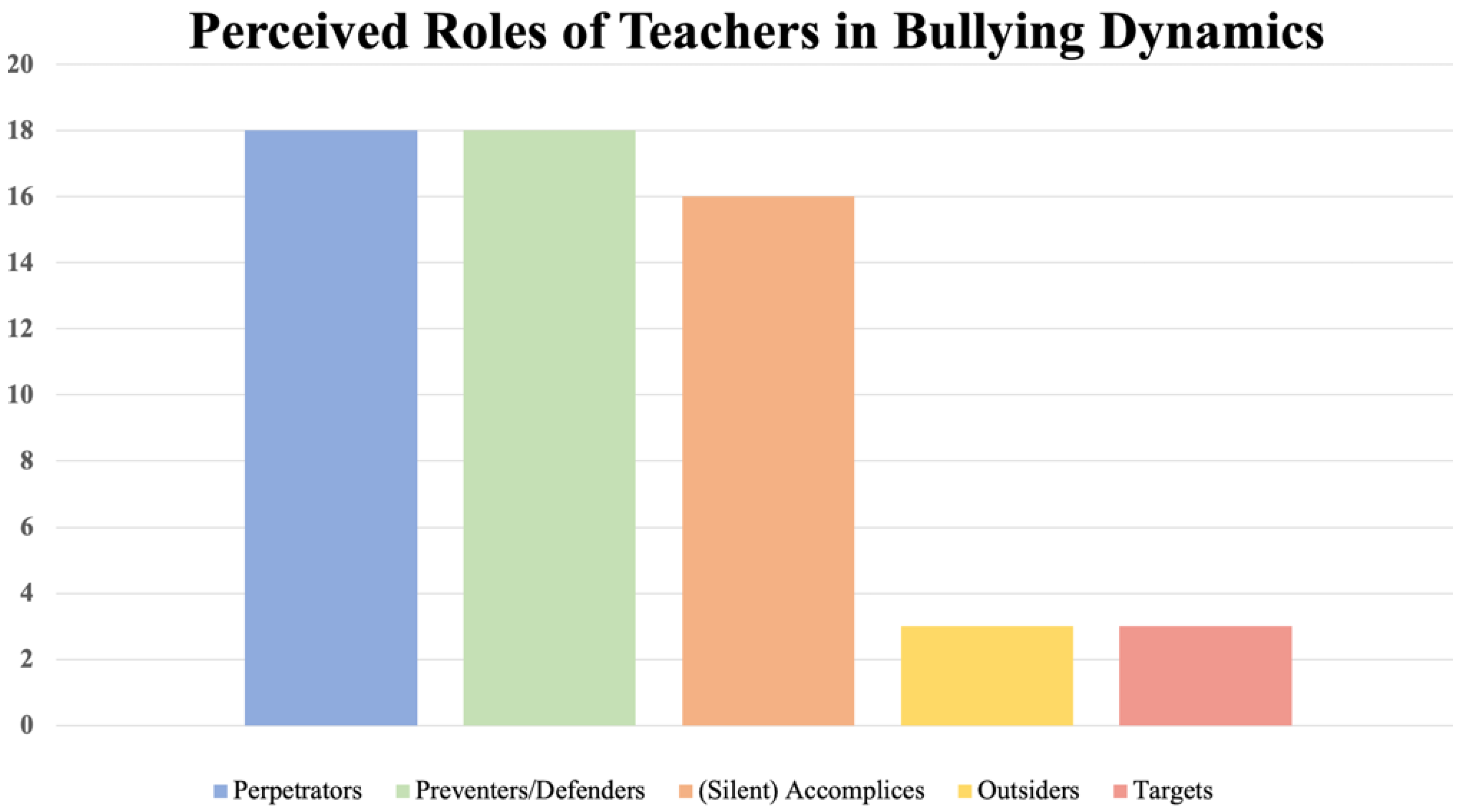
Of the 41 valid narratives, 58 distinct bullying situations involving teachers were described by pupils. Teachers were assigned various roles (see
Figure 1). This quantification is illustrative rather than representative and serves to contextualise the varied and sometimes overlapping roles teachers played in the described bullying dynamics. The figure shows the distribution of these roles, indicating that teachers were most frequently perceived as perpetrators, preventers/defenders, and (silent) accomplices, while other roles were reported less often. In 18 accounts, they were described as perpetrators, actively bullying pupils. Equally often, they were seen as proactive or supportive: preventers fostered inclusive environments through anti-bullying measures, while defenders either intervened during incidents (direct defenders) or supported targets afterwards (supportive defenders). In 16 instances, teachers were perceived as (silent) accomplices—adults who failed to act despite being aware of the bullying. We draw a distinction within this group: those who were described as actively endorsing or contributing to bullying practices are defined as co-perpetrators, whereas those who were described as ignoring or normalising aggression without direct involvement are classified as encouragers. Passive witnesses are those who remained inactive and neglected their duty to intervene. Three participants described teachers as outsiders, unaware of the bullying, and three others identified teachers as targets of pupil bullying. Some narratives highlighted complex bully–victim dynamics, portraying some teachers as both targets and perpetrators.
5.2. Teachers as Perpetrators
Several narratives report on the potential role of teachers as perpetrators of bullying. Participants recounted verbal, psychological, and even physical abuse by teachers. Ella (female, 20) and Kira (female, 21) noted how this challenges the assumption that such practices are confined to peers.
Several participants described spatial contexts where teacher bullying was prevalent, alongside strategies teachers used to conceal it. Rural school contexts were particularly highlighted as sites of intensified abuse. Bastian (male, 19) and Verena (female, 19) noted certain teachers in these settings maintained bullying conduct, while Kasper (male, 18) attributed it to long-established staff. Bastian reflected on the spatial complexity, saying: ‘As we know from experience, these teachers can behave normally among other colleagues.’ Abusive practices in several accounts were reported to be confined to specific spaces and concealed in the presence of colleagues or authorities.
Classrooms were described as key sites where, in pupils’ experience, criticism or derogatory remarks delivered in front of peers reinforced power asymmetries and consolidated social hierarchies. Other narratives locate such incidents in transitional zones, corridors, or playgrounds, where the absence of teachers, or their presence perceived as passive, was seen to allow exclusionary dynamics to continue. Some accounts also point to the strategic use of spatial positioning—for example, seating arrangements or publicly singling out pupils—that contributed to physical and social isolation.
A recurring theme was the normalisation of teacher bullying. Several participants described it as a regular, even expected, part of school life. Kasper and Bastian remarked how ‘pupils become accustomed to teacher bullying’ (Bastian). While Kasper felt pupils could handle it, Bastian admitted it diminished motivation. Their accounts reveal how abusive dynamics become routinised and internalised. In contrast, other pupils—like Katja (female, 20)—were still grappling with the realisation that teachers could bully, even at the end of their schooling: ‘Yes, I often had experiences with exclusion and discrimination, and above all, I wouldn’t have thought that it would come from teachers.’ Her narrative highlights how the gap between schools as caring spaces—with teachers as protectors—and the reality of teachers as sources of harm undermines trust and fosters lasting insecurity and trauma. Additionally, pupils reported harmful teacher practices being trivialised or framed as humour. Isi (female, 19) recalled moments when teachers’ ‘jokes’ left pupils feeling exposed and uncomfortable.
Nisa’s (female, 18) experience illustrates this: ‘We had a teacher who always called the girls pet names like “bunny” or “little princess”. I was 11 years old […] and felt uncomfortable with it because this teacher was around 50 years old.’
Isi’s narrative adds a further layer: ‘Teachers who don’t look me in the eyes but rather at my cleavage […] Sexist remarks are also not uncommon, especially in the classroom (even from teachers) […] The headteacher saying, “Can you blame him when you wear such a low-cut top?” or the laughter of the entire class after a sexist or homophobic joke.’
Conne (male, 19) and Leeroy (male, 19) described similar experiences: ‘A teacher also made a habit of ridiculing and condemning gay people in particular […] The topic was different sexualities, but according to him, only heterosexuality exists. He said, “I’m not going to let myself get fucked in the ass. That’s disgusting” (Conne).’ Leeroy added: ‘A teacher at our school also aggressively claimed, in the presence of two transgender pupils, that changing one’s gender was impossible and that they would eventually come to understand this.’
Teacher-perpetrated bullying also related to other axes of identity, such as body image, family circumstances, language skills, refugee status, religion, or skin colour. Scarlett Austen’s (female, 19) narrative exemplifies intersecting marginalisations: ‘I have rarely witnessed a Muslim boy being excluded. However, a Muslim girl with a darker complexion and rough accent has to endure all kinds of insults and mocking remarks from both teachers and pupils because she is a woman, a Muslim, and a person of colour.’
Many pupils felt powerless to act against teacher bullying due to authority imbalances. Public incidents, often in classrooms, intensified their humiliation, while reporting was seen as futile. Verena noted: ‘Even when these things are reported […] even to the Ministry, nothing comes of it […] A teacher will always feel secure.’
5.3. Teachers as Preventers and Defenders
Participants reported a range of teacher strategies to prevent or address (cyber-)bullying and support targeted pupils. The most common approach involved initiating conversations—either with the class, the target, or the perpetrator. Teachers also raised awareness through educational activities, reprimanded bullies, physically intervened, involved parents, referred pupils to psychological support, or appointed prevention staff.
Vera (female, 18) highlighted the impact of assertive school-wide prevention: ‘I experienced very little of it in lower secondary school because […] a radical zero-tolerance policy was enforced […] which may have felt over the top to us at this time but certainly led to a superficially respectful interaction in the classroom and even outside of it.’
Several participants successfully sought support from school leadership. In a few cases, perpetrators were punished. Eva (female, 18) noted: ‘Several pupils […] who had sent bullying-like messages were held accountable and punished.’
However, some participants perceived teacher interventions as superficial or ineffectual. Maria Moreau (female, 19) reflected: ‘The teachers held workshops on bullying throughout this school year and showed us films on the topic […] it didn’t help at all.’ Steven (male, 19) similarly noted: ‘Teachers gave a short speech saying that certain pupils should refrain from such actions […] nothing changed, and the issue wasn’t addressed further.’
Some interventions worsened the situation. When Maria Moreau urged her teacher to support a peer, the disclosure backfired: the bullies found out and escalated their aggression. Maria then became a cyberbullying target, receiving hundreds of insults and threats.
5.4. Teachers as Silent Accomplices or as Outsiders
Participants described different ways in which teachers were positioned in situations of bullying: in some cases, as (silent) accomplices who were perceived as aware of ongoing peer victimisation but failed to intervene, and in other cases as outsiders who appeared absent or unaware of what was happening.
Where teachers were described as (silent) accomplices, participants recalled instances in which educators were perceived as aware of ongoing peer victimisation—either through direct observation or pupil disclosure—yet did not intervene or provide support. Verena (female, 19) described her teacher as empathetic but inactive, Chris (n.a., 19) criticised a teacher who downplayed bullying in lower secondary school, and Maxi (non-binary, 19) explained how peer aggression was misinterpreted as benign. Similarly, Louisa (female, 17) recalled that her teacher noticed discriminatory bullying targeting LGBTQI+ identifying peers but failed to take action.
Several pupils’ accounts illustrate the consequences of such inaction. Ella (female, 20) described how prolonged bullying affected her practices: ‘No one helped me […] not even the teachers, though they should.’ Saskia (female, 20) reported persistent verbal bullying combined with a lack of support: ‘Every time I sought help from my parents or teachers, they claimed there was nothing they could do […] I started avoiding school.’ Chiara (female, 19) described withdrawing from lower secondary school due to bullying: ‘The bullying affected me so much that I was just overwhelmed with fear.’
In other accounts, teachers were portrayed as outsiders who appeared absent or unaware of bullying. Luna (female, 17) described how perpetrators adjusted their practices in the presence of teachers: ‘The perpetrators […] suck up to the teachers, but as soon as they leave the classroom, they slip back into their role as perpetrators.’ Camilla (female, 18) similarly noted: ‘During class, the others couldn’t do anything because the teacher was present […] The teachers didn’t notice anything.’
Some participants also described actively avoiding bullying situations by hiding during breaks in places such as bathrooms or libraries.
5.5. Entangled Teacher and Peer Bullying Practices
In many participants’ narratives, teacher and peer bullying were closely interconnected. Some accounts described situations in which pupils who were already targeted by peers later experienced negative treatment from teachers.
Verena (female, 19) described how a peer who had been mocked by classmates later experienced derogatory treatment from a teacher: ‘The teacher often spoke to him in a derogatory manner […] not calling on him in class because nothing good can come of that.’
Conne (male, 19) described being insulted by peers during breaks while also encountering discriminatory remarks from a teacher in class. Scarlett Austen (female, 19) described how a peer experienced insults from both pupils and teachers due to her gender, religion, and skin colour. These narratives illustrate how pupils described experiences involving both teacher and peer bullying within their school environments.
The results presented above illustrate the diverse roles teachers can assume within bullying dynamics in school environments. The following section discusses these findings in relation to existing research and broader theoretical perspectives.
6. Discussion
Based on pupils’ accounts, the findings of this study highlight the complex and multifaceted roles teachers may assume within school bullying dynamics. While teachers are institutionally positioned as responsible for protecting pupils from harm, the narratives analysed here illustrate that they may simultaneously act as preventers, defenders, bystanders, or perpetrators of bullying. These findings complicate the dominant conceptualisation of bullying as primarily a peer-to-peer phenomenon and emphasise the need to consider teachers as influential actors within broader bullying dynamics in schools.
A central insight emerging from the participants’ accounts concerns the ways in which teacher practices shape peer bullying dynamics. Teachers do not merely respond to bullying incidents but actively structure the social norms and expectations within classrooms. Participants’ narratives suggest that teacher responses can either disrupt or reinforce peer victimisation. When teachers intervene consistently and visibly, pupils described bullying as more likely to be addressed or contained. Conversely, when teachers ignore incidents, trivialise harassment, or treat discriminatory remarks as humour, pupils may interpret this practice as tacit approval. In such situations, teacher practices can contribute to the normalisation of aggression and the reinforcement of existing hierarchies among pupils [
7]. These observations align with research demonstrating that teacher responses play a crucial role in shaping pupils’ adoption of bullying roles and classroom norms [
25,
26].
The findings further highlight the close entanglement of teacher and peer bullying practices. Several narratives describe situations in which pupils who were already marginalised within peer groups experienced further humiliation or exclusion through teacher practices. In other cases, teachers’ failure to intervene allowed peer bullying to continue unchecked. These dynamics illustrate how teacher practices can influence peer group dynamics and contribute to the reproduction of exclusionary classroom climates. Similar dynamics have been described as processes of hierarchical transmission in bullying, whereby authority figures inadvertently reinforce or amplify peer victimisation [
28]. Teachers therefore function not only as potential protectors but also as influential actors within the relational systems that structure bullying practices in schools.
Another important dimension emerging from the narratives concerns the spatial organisation of bullying. Participants frequently referred to specific locations within schools—such as classrooms, corridors, playgrounds, or transitional spaces—where bullying occurred or intensified. These accounts support spatial perspectives on school violence which emphasise that bullying is embedded within socio-material spaces and institutional arrangements [
10,
20]. Teacher presence or absence within these spaces emerged as a key factor shaping pupils’ experiences of safety and vulnerability.
Classrooms, in particular, were described as spaces where teacher authority could both constrain and facilitate bullying. While teacher presence often limited overt peer aggression during lessons, classrooms also functioned as sites where teacher-perpetrated bullying occurred publicly. Derogatory remarks or public criticism delivered in front of peers were described as reinforcing power asymmetries and intensifying pupils’ humiliation. Such dynamics illustrate how school environments operate as socially produced spaces in which power relations and social hierarchies are enacted and reproduced [
10].
The narratives also reveal how bullying practices intersect with broader normative structures within school environments. Several participants described bullying targeting pupils whose identities diverged from dominant social norms related to gender, sexuality, ethnicity, religion, or appearance. These accounts demonstrate how bullying is often embedded within wider systems of social inequality and cultural norms that structure belonging within school spaces. Intersectionality therefore provides an important lens for understanding how multiple dimensions of identity shape pupils’ experiences of marginalisation and vulnerability within educational settings [
15].
In some narratives, teachers themselves were described as reinforcing discriminatory attitudes through sexist, homophobic, or derogatory remarks. Such practices contribute to school climates in which exclusionary norms become normalised in everyday interactions. Previous research has shown that authority figures play a significant role in shaping pupils’ attitudes towards marginalised groups [
62,
63]. When teachers engage in discriminatory practices or fail to challenge them, they may inadvertently legitimise these attitudes within the classroom.
Finally, the findings point to the importance of institutional conditions in shaping teacher responses to bullying. Several participants described situations in which reporting bullying resulted in limited or no institutional response, reinforcing perceptions that such incidents remain insufficiently addressed. At the same time, narratives describing schools with clear anti-bullying policies and consistent leadership suggest that institutional support structures can play an important role in mitigating bullying dynamics. These observations align with research demonstrating that sustained and institutionally supported prevention strategies are more effective than isolated awareness initiatives [
40].
Taken together, the findings underscore the importance of understanding bullying as a relational and institutional process embedded within socio-material and socio-digital school environments. Teachers occupy a central position within these dynamics, as their actions shape classroom norms, influence peer interactions, and affect pupils’ experiences of inclusion and exclusion. Addressing bullying therefore requires not only focusing on pupil practices but also critically reflecting on teacher practices and institutional conditions that structure everyday interactions within schools.
7. Conclusions
This article examined Austrian pupils’ accounts of teacher roles in bullying. Following recent calls [
64], it moves beyond prevalence analysis to explore socio-spatial aspects, dynamics, and negotiation processes when teachers are involved in bullying.
School space is political and shaped by power relations [
9,
10]. Bullying often relates to non-conformity with dominant norms, such as heteronormativity and intersecting systems of oppression—sexism, racism, nationalism, fatphobia. Austrian socio-political discourse intensifies exclusion, especially for gendered, racialised, or refugee-background pupils. Schools emerged as central spaces where norms are reproduced and enforced—socio-materially and digitally through entangled spaces and platforms. Our findings suggest that class groups, as socio-spatial units within Austrian schools, play a reinforcing role by enclosing teacher-pupil interactions and fostering bullying routines that persist unchallenged. In these contexts, teachers were seen as either mitigating or worsening bullying, depending on their actions. While our study suggests a relation between peer and teacher bullying in these confined spaces, more research is needed to explore these connections.
While the majority of teachers in Austria are dedicated professionals who work hard to support pupils and uphold inclusive values, participants’ accounts described some situations in which they felt this protective role had broken down. Generally, teacher roles in bullying remain underexplored, and this study adds to work calling for attention to relational and systemic roots of school violence [
2,
65,
66,
67]. Without structural change, bullying remains embedded in normative school dynamics. Recent international research, for example, by Siddiqui and Schultze-Krumbholz [
49], Nagar and Talwar [
48], and Chicote-Beato et al. [
50], confirms the need for early, evidence-based, intersectional interventions to disrupt both offline and online bullying and, we add, cON/FFlating bullying.
In Austria, the short-lived ViSC programme [
68] illustrated a policy gap. Austria is currently mandating schools to establish anti-bullying frameworks, thereby leaving each school to design its own approach without dedicated funding, which often results in schools and concerned staff being overwhelmed. At the time of our data collection, our participants were largely unaware of anti-bullying policies or sustained support structures, echoing other Austrian findings [
25]. Since some teachers, according to our participants, were involved in complicit, reinforcing, or conforming ways, our findings suggest that anti-bullying programmes also need to involve all teachers, and not just those involved in the implementation of the new schemes.
This study is limited to pupil perspectives. This makes these findings partial and potentially ambiguous due to the absence of teacher-reported data, potential inaccuracies in pupils’ memory of events or timelines, and lack of additional evidence. Future studies should adopt multi-informant approaches—including teachers, parents, and school leaders—and centre intersectional identities to reflect diverse experiences. Furthermore, the issue of teachers themselves being bullied by pupils is another important aspect that deserves greater attention. Expanding data collection to compulsory schools would be a valuable step towards capturing broader perspectives on the issue of power and bullying within school spaces. Nevertheless, the findings of this study clearly suggest that both research and schools need to pay greater attention to teachers’ roles in bullying and in its prevention.