
Peer Influence and Individual Motivations in Global Small Business Adaptation


Abstract
1. Introduction
2. Conceptual Framework
2.1. Crisis Adaptation
2.2. Research Questions
2.2.1. Peer Effects
2.2.2. Personal Context
2.2.3. Innovation and Entrepreneurial Motivations
2.2.4. Pre-Pandemic and Pandemic Periods
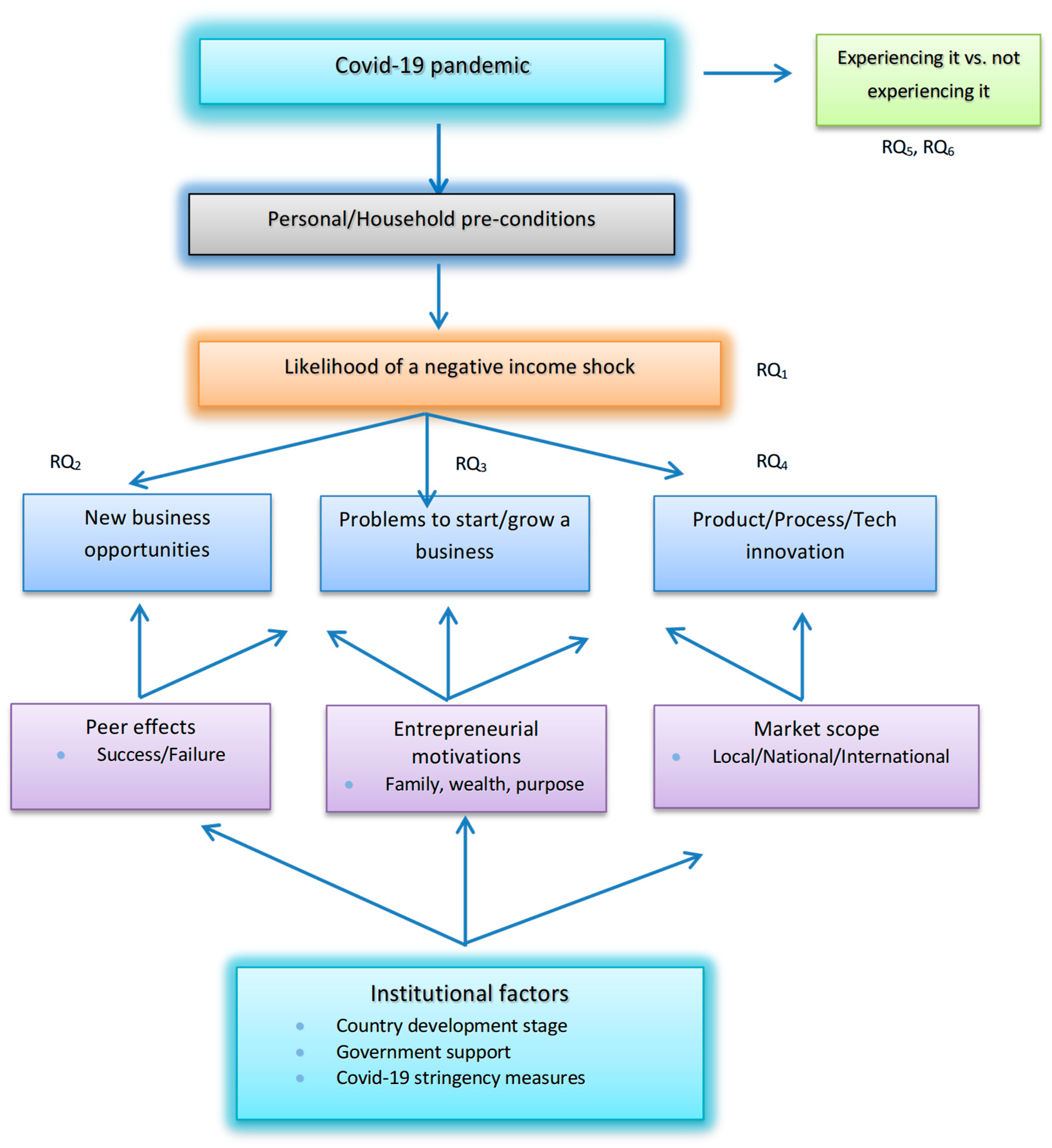
2.3. Synthesis of Research Questions
- Effectuation theory emphasizes bird-in-hand principle (starting with available resources), affordable loss (controlling downside risk rather than maximizing upside), and lemonade (leveraging unexpected contingencies)—e.g., [51]. In the uncertainty of COVID-19, entrepreneurs moved away from predictive planning toward effectual logic. Here, available resources were not just physical assets but were socially embedded, including the trust and reciprocity found in immediate networks (e.g., [52]).
- Contingency theory suggests there is no single best way to organize; the optimal approach depends on internal and external factors (e.g., [53]). This aligns with the idea that adaptation is a fit between the business and its changing social environment (e.g., [54]). For micro-businesses, this fit often required a strategic response that balanced internal resource constraints with the external realities of lockdowns and shifting consumer behavior (e.g., [3]).
- Social capital theory directly addresses peer effects (e.g., [5]). Social capital—i.e., information, influence, and support gained from networks—is the engine of embedded social processes (e.g., [55]). During a crisis, bridging social capital (i.e., links to diverse external groups) is vital for opportunity recognition, while bonding social capital (i.e., tight-knit internal circles) is essential for rapid resource mobilization and psychological survival (e.g., [55,56]). These embedded ties allow entrepreneurs to interpret peer experiences and income shocks not as isolated incidents, but as collective challenges requiring collaborative innovation.
3. Resources and Methods
3.1. Data
3.2. Descriptive Statistics
3.3. Methodological Aspects
4. Results and Discussion
4.1. COVID-19 Times: Perils and Opportunities
4.1.1. Impact on Household Income
4.1.2. Perceptions of Business Opportunities
4.1.3. Obstacles to Start and Grow a Business
4.1.4. Profitability and Innovation
4.2. Extensions: Entrepreneurs Interviewed in 2019 and 2020
4.2.1. Innovation Rates
4.2.2. Entrepreneurial Initiatives
4.3. Multidimensional Theoretical Analysis of Findings
5. Conclusions
5.1. Summary of Findings
5.2. Policy Recommendations
5.2.1. Targeted Financial Support and Income Protection
5.2.2. Enhancing Resilience Through Diversification and Preparedness
5.2.3. Fostering Digital Adoption and Addressing Short-Term Creation Dips
5.2.4. Use of Artificial Intelligence (AI)
5.3. Limitations and Future Research
Funding
Institutional Review Board Statement
Informed Consent Statement
Data Availability Statement
Conflicts of Interest
Appendix A

| Variable | Description | Type | Source |
|---|---|---|---|
| Age of entrepreneur | =1 if under 35, =2 if 35–54, =3 if 55+. | Categorical | GEM age |
| Country income | Low, middle, or high. | Categorical | GEM wbincrev |
| COVID-19 cases | COVID-19 cases per million people. 7-day rolling average as of 31 August 2020. | Numerical | https://ourworldindata.org/covid-cases (accessed on 8 January 2026) |
| COVID-19 stringency | =1 if index value ≤ sample median. | Binary | https://ourworldindata.org/covid-stringency-index (accessed on 8 January 2026) |
| Employed | =1 if has a part- or full-time job. | Binary | GEM gemoccu |
| Entrepreneur | =1 if business owner/manager or trying to start a business. | Binary | GEM ownmge, bstart |
| Entrepreneurial motivation | 1: make a difference in the world; 2: build wealth; 3: family tradition; 4: earn a living due to scarce jobs. | Binary | GEM teayymot1-teayymot4 eb_yymot1-eb_yymot4 |
| Government response to COVID-19 | =1 if somewhat/strongly agrees that government so far has effectively responded to the economic consequences of the coronavirus pandemic. | Binary | GEM su_cpgovres, bb_cpgovres, eb_cpgovres, teacpgovres |
| Growth business | =1 if expects to create 20+ jobs in 5 years. | Binary | GEM teayyj5y, eb_yyj5y |
| Household income | Household income recorded into 3rd. | Categorical | GEM gemhhinc |
| Know people who started | =1 if know 2 or more people who started a business due to COVID-19. | Binary | GEM cpknstart |
| Know people who stopped | =1 if know 2 or more people who stopped owing/managing a business due to COVID-19. | Binary | GEM cpknstop |
| Large-sized household | =1 if household size > 75%tile. | Binary | GEM hhsize |
| Market scope | 1: local, 2: national, 3: international | Categorical | GEM TEAyyMKSC, EB_MKSC |
| Nascent entrepreneur | =1 if alone or with others, currently trying to start a new business. | Binary | GEM bstart |
| New opportunities | =1 if somewhat/strongly agrees that coronavirus pandemic provided new opportunities to pursue with business. | Binary | GEM su_cpnewopp, bb_cpnewopp, eb_cpnewopp, teacpnewopp |
| Opportunity alertness | =1 if sees good opportunities for starting a business in the next 6 months. | Binary | GEM opportyy |
| Personal network | =1 if knows at least 2 entrepreneurs. | Binary | GEM knowentr |
| Potential entrepreneur | =1 alone or with others, expecting to start a new business within the next three years. | Binary | GEM futsup |
| Product innovation | =1 if product (service) is new to area, country or world. | Binary | GEM teanewprod, eb_newprod |
| Process/Tech innovation | =1 if procedure/technology used is new to area, country or world. | Binary | GEM teanewproc, eb_newproc |
| R&D transfer | National R&D leads to new commercial opportunities and is available to SMEs on a Likert scale of 1 (“Completely false”) to 9 (“Completely true”). | Categorical | NES |
| Risk aversion | =1 if fear of failing. | Binary | GEM frfailyy |
| Sector | (1) Extractive: agriculture, forestry & fishing, mining & quarrying; (2) Transforming: manufacturing, construction, and wholesale trade; (3) Services: professional and business service; (4) Consumer oriented: trading activities to final consumer & personal services. | Categorical | GEM TEASIC4C/EB_SIC4C |
| Self-efficacy | =1 has the knowledge, skill and experience required to start a new business. | Binary | GEM suskilyy |
| Strong/mild income decrease | =1 if somewhat/strong household income decrease due to COVID-19. | Binary | GEM cphhinc |
| Tertiary education | =1 if at least has tertiary education. | Binary | GEM uneduc |
| Observations | |||||||
|---|---|---|---|---|---|---|---|
| No. | Code | Name | 2019 | 2020 | Total | Percent | Region |
| 1 | 1 | United States | 3000 | 2000 | 5000 | 1.64 | North America |
| 2 | 7 | Russia | 2006 | 2000 | 4006 | 1.32 | Europe |
| 3 | 20 | Egypt | 2540 | 2786 | 5326 | 1.75 | Middle East & Africa |
| 4 | 27 | South Africa | 2991 | 2991 | 0.98 | Middle East & Africa | |
| 5 | 30 | Greece | 2000 | 2000 | 4000 | 1.31 | Europe |
| 6 | 31 | Netherlands | 2252 | 2266 | 4518 | 1.48 | Europe |
| 7 | 34 | Spain | 23,300 | 26,075 | 49,375 | 16.22 | Europe |
| 8 | 39 | Italy | 2000 | 2000 | 4000 | 1.31 | Europe |
| 9 | 41 | Switzerland | 2015 | 2008 | 4023 | 1.32 | Europe |
| 10 | 43 | Austria | 4529 | 4529 | 1.49 | Europe | |
| 11 | 44 | United Kingdom | 2032 | 2000 | 4032 | 1.32 | Europe |
| 12 | 46 | Sweden | 5067 | 5043 | 10,110 | 3.32 | Europe |
| 13 | 47 | Norway | 2000 | 2000 | 4000 | 1.31 | Europe |
| 14 | 48 | Poland | 8000 | 8000 | 16,000 | 5.26 | Europe |
| 15 | 49 | Germany | 3004 | 3003 | 6007 | 1.97 | Europe |
| 16 | 52 | Mexico | 5361 | 5361 | 1.76 | Latin America & Caribbean | |
| 17 | 55 | Brazil | 2000 | 2000 | 4000 | 1.31 | Latin America & Caribbean |
| 18 | 56 | Chile | 9110 | 9196 | 18,306 | 6.01 | Latin America & Caribbean |
| 19 | 57 | Colombia | 2109 | 2107 | 4216 | 1.38 | Latin America & Caribbean |
| 20 | 61 | Australia | 2000 | 2000 | 0.66 | Central & East Asia | |
| 21 | 62 | Indonesia | 2500 | 2500 | 0.82 | Central & East Asia | |
| 22 | 81 | Japan | 2027 | 2027 | 0.67 | Central & East Asia | |
| 23 | 82 | South Korea | 2000 | 2000 | 4000 | 1.31 | Central & East Asia |
| 24 | 86 | China | 3841 | 3841 | 1.26 | Central & East Asia | |
| 25 | 91 | India | 3398 | 3317 | 6715 | 2.21 | Central & East Asia |
| 26 | 92 | Pakistan | 2000 | 2000 | 0.66 | Central & East Asia | |
| 27 | 98 | Iran | 3122 | 3144 | 6266 | 2.06 | Middle East & Africa |
| 28 | 101 | Canada | 9304 | 2910 | 12,214 | 4.01 | North America |
| 29 | 212 | Morocco | 3510 | 3527 | 7037 | 2.31 | Middle East & Africa |
| 30 | 226 | Burkina Faso | 2325 | 2325 | 0.76 | Middle East & Africa | |
| 31 | 228 | Togo | 2248 | 2248 | 0.74 | Middle East & Africa | |
| 32 | 244 | Angola | 2000 | 2000 | 0.66 | Middle East & Africa | |
| 33 | 261 | Madagascar | 2395 | 2395 | 0.79 | Middle East & Africa | |
| 34 | 351 | Portugal | 2013 | 2013 | 0.66 | Europe | |
| 35 | 352 | Luxembourg | 2100 | 2011 | 4111 | 1.35 | Europe |
| 36 | 353 | Ireland | 2000 | 2000 | 0.66 | Europe | |
| 37 | 357 | Cyprus | 2014 | 2006 | 4020 | 1.32 | Europe |
| 38 | 371 | Latvia | 2000 | 2000 | 4000 | 1.31 | Europe |
| 39 | 374 | Armenia | 2000 | 2000 | 0.66 | Central & East Asia | |
| 40 | 375 | Belarus | 2001 | 2001 | 0.66 | Europe | |
| 41 | 385 | Croatia | 2000 | 2000 | 4000 | 1.31 | Europe |
| 42 | 386 | Slovenia | 2001 | 2000 | 4001 | 1.31 | Europe |
| 43 | 389 | Macedonia | 2000 | 2000 | 0.66 | Europe | |
| 44 | 421 | Slovakia | 2001 | 2000 | 4001 | 1.31 | Europe |
| 45 | 502 | Guatemala | 2958 | 2905 | 5863 | 1.93 | Latin America & Caribbean |
| 46 | 507 | Panama | 2024 | 2000 | 4024 | 1.32 | Latin America & Caribbean |
| 47 | 593 | Ecuador | 2063 | 2063 | 0.68 | Latin America & Caribbean | |
| 48 | 598 | Uruguay | 2002 | 2002 | 0.66 | Latin America & Caribbean | |
| 49 | 701 | Kazakhstan | 2100 | 2100 | 0.69 | Central & East Asia | |
| 50 | 787 | Puerto Rico | 2000 | 2000 | 0.66 | Latin America & Caribbean | |
| 51 | 886 | Taiwan | 2343 | 2229 | 4572 | 1.5 | Central & East Asia |
| 52 | 962 | Jordan | 2000 | 2000 | 0.66 | Middle East & Africa | |
| 53 | 965 | Kuwait | 2092 | 2092 | 0.69 | Middle East & Africa | |
| 54 | 966 | Saudi Arabia | 4003 | 4027 | 8030 | 2.64 | Middle East & Africa |
| 55 | 968 | Oman | 2000 | 2000 | 4000 | 1.31 | Middle East & Africa |
| 56 | 971 | United Arab Emirates | 2002 | 2004 | 4006 | 1.32 | Middle East & Africa |
| 57 | 972 | Israel | 2036 | 2000 | 4036 | 1.33 | Middle East & Africa |
| 58 | 974 | Qatar | 3063 | 3043 | 6106 | 2.01 | Middle East & Africa |
| Total | 163,006 | 141,403 | 304,409 | 100 | |||
| TEA | Established | |||||
|---|---|---|---|---|---|---|
| Year | No | Yes | Total | No | Yes | Total |
| 2019 | 143,174 | 19,832 | 163,006 | 149,848 | 13,158 | 163,006 |
| % | 87.83 | 12.17 | 100 | 91.93 | 8.07 | 100 |
| 2020 | 124,181 | 17,222 | 141,403 | 130,334 | 11,069 | 141,403 |
| % | 87.82 | 12.18 | 100 | 92.17 | 7.83 | 100 |
| Total | 267,355 | 37,054 | 304,409 | 280,182 | 24,227 | 304,409 |
| % | 87.83 | 12.17 | 100 | 92.04 | 7.96 | 100 |
| p-value Pearson χ2 test of independence = 0.913 | p-value Pearson χ2 test of independence = 0.013 | |||||
| (a) Product Innovation | N = 7724 | |||||
| Average treatment effect | Coefficient | Robust s.e | z | p > |z| | 95% conf. interval | |
| Negative income shock (Yes vs. No) | −0.024 | 0.012 | −1.95 | 0.050 | −0.048 | 0.000 |
| (b) Process/Technology Innovation | N = 7702 | |||||
| Average treatment effect | Coefficient | Robust s.e | z | p > |z| | 95% conf. interval | |
| Negative income shock (Yes vs. No) | −0.019 | 0.018 | −1.59 | 0.111 | −0.042 | 0.004 |
References
- Lee, Y.; Kim, J.; Mah, S.; Karr, A. Entrepreneurship in Times of Crisis: A Comprehensive Review with Future Directions. Entrep. Res. J. 2024, 14, 905–950. [Google Scholar] [CrossRef]
- Apedo-Amah, M.C.; Avdiu, B.; Cirera, X.; Cruz, M.; Davies, E.; Grover, A.; Iacovone, L.; Kilinc, U.; Medvedev, D.; Maduko, F.O.; et al. Unmasking the impact of COVID-19 on businesses: Firm level evidence from across the world. In Policy Research Working Paper Series; The World Bank: Washington, DC, USA, 2020; p. 9434. Available online: https://www.worldbank.org/en/research/brief/world-bank-policy-research-working-papers (accessed on 1 August 2025).
- Peñarroya-Farell, M.; Miralles, F. Business model adaptation to the COVID-19 crisis: Strategic response of the Spanish cultural and creative firms. J. Open Innov. Technol. Mark. Complex. 2022, 8, 39. [Google Scholar] [CrossRef]
- Fairlie, R.; Fossen, F.M.; Johnsen, R.; Droboniku, G. Were small businesses more likely to permanently close in the pandemic? Small Bus. Econ. 2023, 60, 1613–1629. [Google Scholar] [CrossRef]
- Al-Omoush, K.S.; Simón-Moya, V.; Sendra-García, J. The impact of social capital and collaborative knowledge creation on e-business proactiveness and organizational agility in responding to the COVID-19 crisis. J. Innov. Knowl. 2020, 5, 279–288. [Google Scholar] [CrossRef]
- Liguori, E.W.; Pittz, T.G. Strategies for small business: Surviving and thriving in the era of COVID-19. J. Int. Counc. Small Bus. 2020, 1, 106–110. [Google Scholar] [CrossRef]
- Al-Omoush, K.S.; Ribeiro-Navarrete, S.; Lassala, C.; Skare, M. Networking and knowledge creation: Social capital and collaborative innovation in responding to the COVID-19 crisis. J. Innov. Knowl. 2022, 7, 100181. [Google Scholar] [CrossRef]
- Engidaw, A.E. Small businesses and their challenges during COVID-19 pandemic in developing countries: In the case of Ethiopia. J. Innov. Entrep. 2022, 11, 1. [Google Scholar] [CrossRef]
- Otrachshenko, V.; Popova, O.; Nikolova, M.; Tyurina, E. COVID-19 and entrepreneurship entry and exit: Opportunity amidst adversity. Technol. Soc. 2022, 71, 102093. [Google Scholar] [CrossRef]
- Chapman Cook, M.; Karau, S.J. Opportunity in uncertainty: Small business response to COVID-19. Innov. Manag. Rev. 2023, 20, 162–178. [Google Scholar] [CrossRef]
- Fernandes Crespo, N.; Fernandes Crespo, C.; Miranda Silva, G.; Bedin Nicola, M. Innovation in times of crisis: The relevance of digitalization and early internationalization strategies. Technol. Forecast. Soc. Change 2023, 188, 122283. [Google Scholar] [CrossRef]
- Otero, G.; Völker, B.; Rözer, J.; Mollenhorst, G. Differences in access to social capital across societies. Eur. Sociol. Rev. 2024, 40, 493–510. [Google Scholar] [CrossRef]
- Jaumotte, F.; Li, L.; Medici, A.; Oikonomou, M.; Pizzinelli, C.; Shibata, I.; Soh, J.; Tavares, M.T. Digitalization during the COVID-19 Crisis: Implications for productivity and labor markets in advanced economies. In Staff Discussion Note 2023/003; International Monetary Fund: Washington, DC, USA, 2023; Available online: https://www.imf.org/en/Publications/Staff-Discussion-Notes/ (accessed on 1 August 2025).
- Hundt, C.; Sternberg, R. How did the economic crisis influence new firm creation? A multilevel approach based upon data from German regions. In The Great Recession and Its Aftermath: Evidence from Micro-Data: Themenheft 6/Bd. 234(2014) Jahrbücher für Nationalökonomie und Statistik; Görg, H., Wagner, J., Eds.; De Gruyter Oldenbourg: Berlin, Germany; Boston, MA, USA, 2014; pp. 722–756. [Google Scholar] [CrossRef]
- Amabile, T.M.; Pratt, M.G. The dynamic componential model of creativity and innovation in organizations: Making progress, making meaning. Res. Organ. Behav. 2016, 36, 157–183. [Google Scholar] [CrossRef]
- Santos, S.C.; Caetano, A.; Spagnoli, P.; Costa, S.F.; Neumeyer, X. Predictors of entrepreneurial activity before and during the European economic crisis. Int. Entrep. Manag. J. 2017, 13, 1263–1288. [Google Scholar] [CrossRef]
- González-Pernía, J.L.; Guerrero, M.; Jung, A.; Legazkue, P. Economic recession shake-out and entrepreneurship: Evidence from Spain. BRQ Bus. Res. Q. 2018, 21, 153–167. [Google Scholar] [CrossRef]
- Devece, C.; Peris-Ortiz, M.; Rueda-Armengot, C. Entrepreneurship during economic crisis: Success factors and path to failure. J. Bus. Res. 2016, 69, 5366–5370. [Google Scholar] [CrossRef]
- Fairlie, R. The impact of COVID-19 on small business owners: Evidence from the first three months after widespread social-distancing restrictions. J. Econ. Manag. Strategy 2020, 29, 727–740. [Google Scholar] [CrossRef] [PubMed]
- Shafi, M.; Liu, J.; Ren, W. Impact of COVID-19 pandemic on micro, small, and medium-sized Enterprises operating in Pakistan. Res. Glob. 2020, 2, 100018. [Google Scholar] [CrossRef]
- Mahto, R.; Llanos-Contreras, O.; Hebles, M. Post-disaster recovery for family firms: The role of owner motivations, firm resources, and dynamic capabilities. J. Bus. Res. 2022, 145, 117–129. [Google Scholar] [CrossRef]
- Kim, J.; Lee, S. Can stimulus checks to households save the local economy? The impact of South Korea’s COVID-19 stimulus on small business sales. Econ. Anal. Policy 2024, 84, 159–176. [Google Scholar] [CrossRef]
- Matikonis, K.; Graham, B. Dynamic capabilities and employment during COVID-19: The moderating effect of government support. Int. Small Bus. J. 2024, 42, 157–184. [Google Scholar] [CrossRef]
- Alshebami, A.S. Crisis management and customer adaptation: Pathways to adaptive capacity and resilience in micro- and small-sized enterprises. Sustainability 2025, 17, 3759. [Google Scholar] [CrossRef]
- Koporcic, N.; Kukkamalla, P.K.; Markovic, S.; Maran, T. Resilience of small and medium-sized enterprises in times of crisis: An umbrella review. Rev. Manag. Sci. 2025, 20, 301–329. [Google Scholar] [CrossRef]
- Fernandez, V. Capital, digitalization, and formality: Chilean micro-enterprises during COVID-19. Adm. Sci. 2025, 15, 409. [Google Scholar] [CrossRef]
- Shoychet, G.; Browne, D.T.; Wade, M.; Prime, H. Assessing positive adaptation during a global crisis: The development and validation of the family positive adaptation during COVID-19 scale. Front. Psychol. 2022, 13, 886504. [Google Scholar] [CrossRef] [PubMed]
- Cardona-Montoya, R.A.; Cruz, V.; Mongrut, S.A. Financial fragility and financial stress during the COVID-19 crisis: Evidence from Colombian households. J. Econ. Financ. Adm. Sci. 2022, 27, 376–393. [Google Scholar] [CrossRef]
- Walsh, F. Family resilience: A dynamic systemic framework. In Multisystemic Resilience: Adaptation and Transformation in Contexts of Change; Ungar, M., Ed.; Oxford University Press: Oxford, UK, 2021; pp. 255–270. [Google Scholar] [CrossRef]
- Kuckertz, A.; Brändle, L.; Gaudig, A.; Hinderer, S.; Morales Reyes, C.A.; Prochotta, A.; Steinbrick, K.M.; Berger, E.S.C. Startups in times of crisis—A rapid response to the COVID-19 pandemic. J. Bus. Ventur. Insights 2020, 13, e00169. [Google Scholar] [CrossRef]
- Fairlie, R.W. Entrepreneurship, economic conditions, and the Great Recession. J. Econ. Manag. Strategy 2013, 22, 207–231. [Google Scholar] [CrossRef]
- Salvato, C.; Sargiacomo, M.; Amore, M.D.; Minichilli, A. Natural disasters as a source of entrepreneurial opportunity: Family business resilience after an earthquake. Strateg. Entrep. J. 2020, 14, 594–615. [Google Scholar] [CrossRef]
- Harries, T. Understanding small business adaptation to natural hazards: A critical review. Int. J. Disaster Risk Reduct. 2021, 63, 102403. [Google Scholar] [CrossRef]
- Clark, R.L.; Lusardi, A.; Mitchell, O.S. Financial fragility during the COVID-19 pandemic. AEA Pap. Proc. 2021, 111, 292–296. [Google Scholar] [CrossRef]
- Agosto, A.; Giudici, P.; Tanda, A. Statistical learning models to measure the impact of COVID-19 on financial fragility. Front. Artif. Intell. 2024, 7, 1358812. [Google Scholar] [CrossRef]
- Ben Hassen, T.; El Bilali, H. Three years into the pandemic: Insights of the COVID-19 impacts on food security and nutrition in low and middle-income countries. Heliyon 2024, 10, e28946. [Google Scholar] [CrossRef] [PubMed]
- Dang, H.-A.; Huynh, T.L.D.; Nguyen, M.-H. Does the COVID-19 pandemic disproportionately affect the poor? Evidence from a six-country survey. J. Econ. Dev. 2024, 26, 2–18. [Google Scholar] [CrossRef]
- Omotayo, A.O.; Ogunniyi, A.I. COVID-19 induced shocks and its implications for human capital development. Int. J. Equity Health 2024, 23, 30. [Google Scholar] [CrossRef]
- Di Pietro, G. Changes in household income during COVID-19: A longitudinal analysis. SN Bus. Econ. 2022, 2, 159. [Google Scholar] [CrossRef] [PubMed]
- Wyrwich, M.; Sternberg, R.; Stuetzer, M. Failing role models and the formation of fear of entrepreneurial failure: A study of regional peer effects in German regions. J. Econ. Geogr. 2019, 19, 567–588. [Google Scholar] [CrossRef]
- Dornean, A.; Oanea, D. The effectiveness of fiscal-budgetary measures to counteract the COVID-19 crisis. Evidence from EU countries. Economics 2022, 16, 137–151. [Google Scholar] [CrossRef]
- Murnieks, C.Y.; Klotz, A.C.; Shepherd, D.A. Entrepreneurial motivation: A review of the literature and an agenda for future research. J. Organ. Behav. 2020, 41, 115–143. [Google Scholar] [CrossRef]
- Fernandez, V. Purpose-driven entrepreneurship and innovation: The moderating effect of altruism. Sustain. Futures 2025, 10, 100838. [Google Scholar] [CrossRef]
- Bartik, A.W.; Bertrand, M.; Cullen, Z.; Glaeser, E.L.; Luca, M. The impact of COVID-19 on small business outcomes and expectations. Proc. Natl. Acad. Sci. USA 2020, 117, 17656–17666. [Google Scholar] [CrossRef]
- Núñez, Y.M.; Morales-Alonso, G. Longitudinal study of necessity- and opportunity-based entrepreneurship upon COVID lockdowns—The importance of misery and economic freedom indexes. Technol. Forecast. Soc. Change 2024, 200, 123079. [Google Scholar] [CrossRef]
- Marino, M.; Melillo, F.; Parrotta, P.; Smith, N. What makes entrepreneurship counter-cyclical? Evidence from a shutdown of start-up subsidies in Denmark. Entrep. Reg. Dev. 2024, 36, 1232–1256. [Google Scholar] [CrossRef]
- Bosma, N.; Hessels, J.; Schutjens, V.; Van Praag, M.; Verheul, I. Entrepreneurship and role models. J. Econ. Psychol. 2012, 33, 410–424. [Google Scholar] [CrossRef]
- Gostin, L.; Friedman, E.A.; Hossain, S.; Mukherjee, J.; Zia-Zarifi, S.; Clinton, C.; Rugege, U.; Buss, P.; Were, M.; Dhai, A. Human rights and the COVID-19 pandemic: A retrospective and prospective analysis. Lancet 2023, 401, 154–168. [Google Scholar] [CrossRef] [PubMed]
- Jance, K.; Reci, M. Restrictions on human rights during the COVID-19 pandemic in the Western Balkans. Jurid. Trib. Rev. Comp. Int. Law 2024, 14, 465–480. [Google Scholar] [CrossRef]
- North, D.C. Institutions, Institutional Change and Economic Performance; Cambridge University Press: Cambridge, UK, 1990. [Google Scholar]
- Matalamäki, M.J. Effectuation, an emerging theory of entrepreneurship—Towards a mature stage of the development. J. Small Bus. Enterp. Dev. 2017, 24, 928–949. [Google Scholar] [CrossRef]
- Kerr, R.; Coviello, N. Weaving network theory into effectuation: A multi-level reconceptualization of effectual dynamics. J. Bus. Ventur. 2020, 35, 105937. [Google Scholar] [CrossRef]
- Childs, M.; Turner, T.; Sneed, C.; Berry, A. A contingency theory approach to understanding small retail business continuity during COVID-19. Fam. Consum. Sci. Res. J. 2022, 50, 216–230. [Google Scholar] [CrossRef]
- Carnabuci, G.; Diószegi, B. Social networks, cognitive style, and innovative performance: A contingency perspective. Acad. Manag. J. 2015, 58, 881–905. [Google Scholar] [CrossRef]
- Adler, P.S.; Kwon, S.-W. Social capital: Prospects for a new concept. Acad. Manag. Rev. 2002, 27, 17–40. [Google Scholar] [CrossRef]
- Williams, T.A.; Shepherd, D. A Building resilience or providing sustenance: Different paths of emergent ventures in the aftermath of the Haiti earthquake. Acad. Manag. J. 2016, 59, 2069–2102. [Google Scholar] [CrossRef]
- Boschma, R. Proximity and innovation: A critical assessment. Reg. Stud. 2005, 39, 61–74. [Google Scholar] [CrossRef]
- Korsgaard, S.; Hunt, R.A.; Townsend, D.M.; Ingstrup, M.B. COVID-19 and the importance of space in entrepreneurship research and policy. Int. Small Bus. J. Res. Entrep. 2020, 38, 697–710. [Google Scholar] [CrossRef]
- Bosma, N.; Hill, S.; Ionescu-Somers, A.; Kelley, D.; Guerrero, M.; Schott, T. Global Entrepreneurship Monitor (GEM) 2020/2021 Global Report; GEM: London, UK, 2021; Available online: https://www.gemconsortium.org/report (accessed on 30 May 2025).
- Mehta, P.D. Control variable in research. Int. Encycl. Soc. Behav. Sci. 2001, 2727–2730. [Google Scholar] [CrossRef]
- Stuart, E.A. Matching methods for causal inference: A review and a look forward. Stat. Sci. 2010, 25, 1–21. [Google Scholar] [CrossRef] [PubMed]
- Austin, P.C. An introduction to propensity score methods for reducing the effects of confounding in observational studies. Multivar. Behav. Res. 2011, 46, 399–424. [Google Scholar] [CrossRef]
- Amoah, J.; Stuart, E.A.; Cosgrove, S.E.; Harris, A.D.; Han, J.H.; Lautenbach, E.; Tamma, P.D. Comparing propensity score methods versus traditional regression analysis for the evaluation of observational data: A case study evaluating the treatment of gram-negative bloodstream infections. Clin. Infect. Dis. 2020, 71, e497–e505. [Google Scholar] [CrossRef]
- Perraillon, M.C.; Owsley, K.M.; Welton, J.M. Propensity scores and regression adjustment. Nurs. Econ. 2020, 38, 218–221. Available online: https://oce.ovid.com/article/00006073-202007000-00006 (accessed on 20 May 2025).
- Pinho, J.C.; de Lurdes Martins, M. The opportunity to create a business: Systemic banking crisis, institutional factor conditions and trade openness. J. Int. Entrep. 2020, 18, 393–418. [Google Scholar] [CrossRef]
- Bosma, N.; Content, J.; Sanders, M.; Stam, E. Institutions, entrepreneurship, and economic growth in Europe. Small Bus. Econ. 2018, 51, 483–499. [Google Scholar] [CrossRef]
- Boudreaux, C.J.; Nikolaev, B.N.; Klein, P. Socio-cognitive traits and entrepreneurship: The moderating role of economic institutions. J. Bus. Ventur. 2019, 34, 178–196. [Google Scholar] [CrossRef]
- Bosma, N.; Hill, S.; Ionescu-Somers, A.; Kelley, D.; Levie, J.; Tarnawa, A. Global Entrepreneurship Monitor (GEM) 2019/2020 Global Report; GEM: London, UK, 2020; Available online: https://www.gemconsortium.org/report (accessed on 30 May 2025).
- Peroni, C.; Riillo, C.A.F.; Sarracino, F. Entrepreneurship and immigration: Evidence from GEM Luxembourg. Small Bus. Econ. 2016, 46, 639–656. [Google Scholar] [CrossRef]
- Fernandez, V. Immigrants and the entrepreneurial process: Cross-country evidence. Int. Entrep. Manag. J. 2024, 20, 761–805. [Google Scholar] [CrossRef]
- De Massis, A.; Frattini, F.; Pizzurno, E.; Cassia, L. Product innovation in family versus nonfamily firms: An exploratory analysis. J. Small Bus. Manag. 2015, 53, 1–36. [Google Scholar] [CrossRef]
- Fernandez, V. Family entrepreneurship around the world. Int. Rev. Financ. Anal. 2023, 89, 102808. [Google Scholar] [CrossRef]
- Le Breton-Miller, I.L.; Miller, D. Family businesses under COVID-19: Inspiring models–Sometimes. J. Fam. Bus. Strategy 2022, 13, 100452. [Google Scholar] [CrossRef]
- Leppäaho, T.; Ritala, P. Surviving the coronavirus pandemic and beyond: Unlocking family firms’ innovation potential across crises. J. Fam. Bus. Strategy 2022, 13, 100440. [Google Scholar] [CrossRef]
- Soler-Porta, M.; Rodríguez Díaz, B. Family businesses overcoming the COVID-19 crisis with innovation: An exploratory analysis of the jewelry retail sector in Spain. Sustainability 2024, 16, 2259. [Google Scholar] [CrossRef]
- Trunschke, M.; Peters, B.; Czarnitzki, D.; Rammer, C. Pandemic effects: Do innovation activities of firms suffer from Long COVID? Res. Policy 2024, 53, 105024. [Google Scholar] [CrossRef]
- Freixanet, J.; Braojos, J.; Rialp-Criado, A.; Rialp-Criado, J. Does international entrepreneurial orientation foster innovation performance? The mediating role of social media and open innovation. Int. J. Entrep. Innov. 2021, 22, 33–44. [Google Scholar] [CrossRef]
- Du, J.; Zhu, S.; Li, W.H. Innovation through internationalization: A systematic review and research agenda. Asia Pac. J. Manag. 2023, 40, 1217–1251. [Google Scholar] [CrossRef]
- Jiao, A.; Lu, J.; Wei, J.; Zhang, W. Do pro-social CEOs promote innovation? Financ. Res. Lett. 2023, 55, 103977. [Google Scholar] [CrossRef]
- Au, K.; Jeong, S.S.; Hsu, A.J.C.; Xiao, Y. When does prosocial motivation deliver? A dual-motivations approach to social enterprise outcomes. J. Bus. Ethics 2024, 193, 159–178. [Google Scholar] [CrossRef]
- Branzei, O.; Fathallah, R. The end of resilience? Managing vulnerability through temporal resourcing and resisting. Entrep. Theory Pract. 2021, 47, 831–863. [Google Scholar] [CrossRef]
- Anwar, A.; Coviello, N.; Rouziou, M. Weathering a crisis: A multi-level analysis of resilience in young ventures. Entrep. Theory Pract. 2021, 47, 864–892. [Google Scholar] [CrossRef]
- Martina, R.A. Toward a theory of affordable loss. Small Bus. Econ. 2020, 54, 751–774. [Google Scholar] [CrossRef]
- Pereira, H.M.F.; Saes, M.S.M. Government support and institutions’ intermediation throughout companies’ adaptation to the COVID-19 crisis. Sustainability 2022, 14, 5450. [Google Scholar] [CrossRef]
- Herhausen, D.; Morgan, R.E.; Brozović, D.; Volberda, H.W. Re-examining strategic flexibility: A meta-analysis of its antecedents, consequences and contingencies. Br. J. Manag. 2021, 32, 435–455. [Google Scholar] [CrossRef]
- Gerdeman, D. How the Coronavirus Is Already Rewriting the Future of Business. 2020. Available online: https://hbswk.hbs.edu/item/how-the-coronavirus-is-already-rewriting-the-future-of-business (accessed on 30 May 2025).
- Lau, C.K.; Zhang, D.; Gozgor, G. Support policies for small businesses during the COVID-19 Crisis: Evidence from club convergence clustering approach. Emerg. Mark. Financ. Trade 2023, 60, 401–416. [Google Scholar] [CrossRef]
- Peráček, T.; Kaššaj, M. Strategic management of urban services using artificial intelligence in the development of sustainable smart cities—Managerial and legal challenges. Sustainability 2026, 18, 582. [Google Scholar] [CrossRef]
- Podsakoff, P.M.; MacKenzie, S.B.; Lee, J.-Y.; Podsakoff, N.P. Common method biases in behavioral research: A critical review of the literature and recommended remedies. J. Appl. Psychol. 2003, 88, 879–903. [Google Scholar] [CrossRef] [PubMed]


| (a) | |||||
| Region | Frequency | Percent | |||
| Middle East & Africa | 60,858 | 19.99 | |||
| Central & East Asia | 31,755 | 10.43 | |||
| Latin America & Caribbean | 47,835 | 15.71 | |||
| Europe | 146,747 | 48.21 | |||
| North America | 17,214 | 5.65 | |||
| Total | 304,409 | 100 | |||
| (b) | |||||
| Region | No | Yes | Total | ||
| Middle East & Africa | 51,720 | 9138 | 60,858 | ||
| % | 84.98 | 15.02 | 100 | ||
| Central & East Asia | 28,326 | 3429 | 31,755 | ||
| % | 89.2 | 10.8 | 100 | ||
| Latin America & Caribbean | 35,641 | 12,194 | 47,835 | ||
| % | 74.51 | 25.49 | 100 | ||
| Europe | 136,861 | 9886 | 146,747 | ||
| % | 93.26 | 6.74 | 100 | ||
| North America | 14,807 | 2407 | 17,214 | ||
| % | 86.02 | 13.98 | 100 | ||
| Total | 267,355 | 37,054 | 304,409 | ||
| % | 87.83 | 12.17 | 100 | ||
| p-value of Pearson chi-squared test of independence = 0.000 | |||||
| (c) | |||||
| Region | No | Yes | Total | ||
| Middle East & Africa | 56,440 | 4418 | 60,858 | ||
| % | 92.74 | 7.26 | 100 | ||
| Central & East Asia | 28,781 | 2974 | 31,755 | ||
| % | 90.63 | 9.37 | 100 | ||
| Latin America & Caribbean | 43,578 | 4257 | 47,835 | ||
| % | 91.1 | 8.9 | 100 | ||
| Europe | 135,751 | 10,996 | 135,751 | ||
| % | 92.51 | 7.49 | 92.51 | ||
| North America | 15,632 | 1582 | 15,632 | ||
| % | 90.81 | 9.19 | 90.81 | ||
| Total | 280,182 | 24,227 | 304,409 | ||
| % | 92.04 | 7.96 | 100 | ||
| p-value of Pearson chi-squared test of independence = 0.000 | |||||
| (d) | |||||
| No Employees | Freq. | Percent | No Owners | Freq. | Percent |
| 0–5 | 31,439 | 81.50 | 1 | 38,056 | 63.67 |
| 6–19 | 4818 | 12.49 | 2–3 | 17,193 | 28.77 |
| 20+ | 2319 | 6.01 | >3 | 4521 | 7.56 |
| Total | 38,576 | 100 | Total | 59,770 | 100 |
| (e) | |||||
| Entrepreneur’s Answer | |||||
| Region | No | Yes | Total | ||
| Middle East & Africa | 3170 | 3298 | 6468 | ||
| % | 49.01 | 50.99 | 100 | ||
| Central & East Asia | 1245 | 1009 | 2254 | ||
| % | 55.24 | 44.76 | 100 | ||
| Latin America & Caribbean | 3858 | 2104 | 5962 | ||
| % | 64.71 | 35.29 | 100 | ||
| Europe & North America | 5578 | 3795 | 9373 | ||
| & | 59.51 | 40.49 | 100 | ||
| Total | 13,851 | 10,206 | 24,057 | ||
| % | 57.58 | 42.42 | 100 | ||
| p-value of Pearson chi-squared test of independence = 0.000 | |||||
| Note: Answers to this question are those from new and established entrepreneurs included in the APS 2020. | |||||
| (f) | |||||
| Region | No | Yes | Total | ||
| Middle East & Africa | 10,458 | 20,108 | 30,566 | ||
| % | 34.21 | 65.79 | 100 | ||
| Central & East Asia | 3747 | 8159 | 11,906 | ||
| % | 31.47 | 68.53 | 100 | ||
| Latin America & Caribbean | 6185 | 13,932 | 20,117 | ||
| % | 30.75 | 69.25 | 100 | ||
| Europe & North America | 45,868 | 30,151 | 76,019 | ||
| & | 60.34 | 39.66 | 100 | ||
| Total | 66,258 | 72,350 | 138,608 | ||
| % | 47.8 | 52.2 | 100 | ||
| p-value of Pearson chi-squared test of independence = 0.000 | |||||
| Note: Answers to this question are those from individuals included in the APS 2020. | |||||
| Decrease | |
|---|---|
| Odds Ratio | |
| Individual-level predictors | |
| Male | 0.957 *** |
| (0.014) | |
| 35–54 years old | 1.037 ** |
| (0.017) | |
| Over 54 years old | 0.666 *** |
| (0.013) | |
| Tertiary education | 0.891 *** |
| (0.014) | |
| Entrepreneurial activity | 1.695 *** |
| (0.029) | |
| Employed | 0.741 *** |
| (0.011) | |
| Middle 33%tile income | 0.790 *** |
| (0.014) | |
| Upper 33%tile income | 0.542 *** |
| (0.010) | |
| Large-sized household | 1.426 *** |
| (0.021) | |
| Know people who stopped due to COVID-19 | 1.826 *** |
| (0.029) | |
| Country-level predictors | |
| Log(COVID-19 confirmed cases/million) | 1.037 *** |
| (0.008) | |
| COVID-19 stringency Index (≤median) | 0.927 *** |
| (0.019) | |
| Middle-income country | 0.507 *** |
| (0.021) | |
| High-income country | 0.335 *** |
| (0.012) | |
| Central & East Asia | 1.086 ** |
| (0.036) | |
| Latin America & Caribbean | 1.383 *** |
| (0.036) | |
| Europe &North America | 0.659 *** |
| (0.015) | |
| Observations | 98,313 |
| Pseudo R2 | 0.118 |
| New Opportunities | |
|---|---|
| Odds Ratio | |
| Individual-level predictors | |
| Know people who started due to COVID-19 | 2.073 *** |
| (0.081) | |
| Male | 0.985 |
| (0.033) | |
| 35–54 years old | 0.815 *** |
| (0.029) | |
| Over 54 years old | 0.546 *** |
| (0.028) | |
| Tertiary education | 1.248 *** |
| (0.044) | |
| Risk aversion | 0.942 * |
| (0.032) | |
| Self-efficacy | 1.211 *** |
| (0.066) | |
| Strong/Mild income decrease | 0.633 *** |
| (0.023) | |
| Government response to COVID-19 | 1.767 *** |
| (0.059) | |
| Personal network | 1.182 *** |
| (0.042) | |
| Motivation: Family tradition | 1.181 *** |
| (0.041) | |
| Motivation: Wealth accumulation | 1.309 *** |
| (0.046) | |
| Motivation: Earn a living | 1.045 |
| (0.040) | |
| Motivation: Make a difference | 2.156 *** |
| (0.073) | |
| Country-level predictors | |
| Middle-income country | 1.148 * |
| (0.082) | |
| High-income country | 1.306 *** |
| (0.083) | |
| Central & East Asia | 0.998 |
| (0.070) | |
| Latin America & Caribbean | 1.732 *** |
| (0.100) | |
| Europe &North America | 0.927 |
| (0.052) | |
| Observations | 20,026 |
| Pseudo R2 | 0.124 |
| (a) Logistic Regressions | ||||||
| (1) | (2) | |||||
| Start | Growth | |||||
| Odds Ratio | Odds Ratio | |||||
| Individual-level predictors | ||||||
| Male | 0.853 *** | 0.920 *** | ||||
| (0.028) | (0.029) | |||||
| 35–54 years old | 1.184 *** | 1.270 *** | ||||
| (0.043) | (0.045) | |||||
| Over 54 years old | 1.277 *** | 1.398 *** | ||||
| (0.063) | (0.066) | |||||
| Risk aversion | 1.371 *** | 1.286 *** | ||||
| (0.048) | (0.043) | |||||
| Self-efficacy | 0.734 *** | 0.959 | ||||
| (0.040) | (0.049) | |||||
| Personal network | 0.786 *** | 0.825 *** | ||||
| (0.027) | (0.028) | |||||
| Tertiary education | 0.933 ** | 1.014 | ||||
| (0.033) | (0.035) | |||||
| Strong/Mild income decrease | 1.929 *** | 3.103 *** | ||||
| (0.067) | (0.108) | |||||
| Know people who stopped due to COVID-19 | 0.662 *** | 0.809 *** | ||||
| (0.022) | (0.026) | |||||
| Motivation: Family tradition | 1.586 *** | 1.431 *** | ||||
| (0.054) | (0.047) | |||||
| Motivation: Wealth accumulation | 1.042 | 0.791 *** | ||||
| (0.036) | (0.027) | |||||
| Motivation: Earn a living | 0.877 *** | 0.888 *** | ||||
| (0.031) | (0.030) | |||||
| Motivation: Make a difference | 1.014 | 0.994 | ||||
| (0.036) | (0.033) | |||||
| Market scope: National | 1.181 *** | 1.204 *** | ||||
| (0.044) | (0.044) | |||||
| Market scope: International | 0.896 *** | 0.901 *** | ||||
| (0.032) | (0.031) | |||||
| Government response to COVID-19 | 0.868 *** | 0.840 *** | ||||
| (0.041) | (0.039) | |||||
| Country-level predictors | ||||||
| Middle-income country | 0.896 | 1.334 *** | ||||
| (0.064) | (0.091) | |||||
| High-income country | 0.909 | 1.703 *** | ||||
| (0.060) | (0.107) | |||||
| Central & East Asia | 1.294 *** | 1.533 *** | ||||
| (0.094) | (0.110) | |||||
| Latin America & Caribbean | 1.041 | 0.553 *** | ||||
| (0.059) | (0.031) | |||||
| Europe & North America | 0.619 *** | 0.678 *** | ||||
| (0.034) | (0.037) | |||||
| Observations | 19,204 | 19,255 | ||||
| Pseudo R2 | 0.069 | 0.081 | ||||
| *** p < 0.01, ** p < 0.05. Notes: (1) Robust standard errors in parenthesis. (2) The baseline market scope is regional. (3) The baseline region is Middle East & Africa. (4) The baseline country income level is low. | ||||||
| (b) Impact of COVID-19 Stringency on Starting and Growing a Business: Regression Adjustment. | ||||||
| (i) Difficulty starting a business: all entrepreneurs | N = 19,204 | |||||
| Average treatment effect | Coefficient | Robust s.e | z | p > |z| | 95% conf. interval | |
| Stringency ≤ median (Yes vs. No) | −0.124 | 0.010 | −12.97 | 0.000 | −0.142 | −0.105 |
| Potential outcome | ||||||
| Stringency > median | 0.724 | 0.004 | 165.21 | 0.000 | 0.716 | 0.733 |
| (ii) Difficulty growing a business: all entrepreneurs | N = 19,255 | |||||
| Average treatment effect | Coefficient | Robust s.e | z | p > |z| | 95% conf. interval | |
| Stringency ≤ median (Yes vs. No) | 0.026 | 0.011 | 2.44 | 0.015 | 0.005 | 0.048 |
| Potential outcome | ||||||
| Stringency > median | 0.559 | 0.005 | 120.00 | 0.000 | 0.550 | 0.568 |
| (a) | ||||||
| (i) All entrepreneurs | N = 19,630 | |||||
| Average treatment effect | Coefficient | Robust s.e | z | p > |z| | 95% conf. interval | |
| Negative income shock (Yes vs. No) | −0.036 | 0.009 | −4.17 | 0.000 | −0.053 | −0.019 |
| (ii) Entrepreneurs driven by family tradition and making a difference | N = 3726 | |||||
| Average treatment effect | Coefficient | Robust s.e | z | p > |z| | 95% conf. interval | |
| Negative income shock (Yes vs. No) | −0.063 | 0.022 | −2.86 | 0.004 | −0.107 | −0.020 |
| (iii) Entrepreneurs driven by wealth accumulation and making a difference | N = 5664 | |||||
| Average treatment effect | Coefficient | Robust s.e | z | p > |z| | 95% conf. interval | |
| Above-median family rate (Yes vs. No) | −0.042 | 0.018 | −2.31 | 0.021 | −0.078 | −0.006 |
| (b) | ||||||
| (i) All entrepreneurs | N = 19,588 | |||||
| Average treatment effect | Coefficient | Robust s.e | z | p > |z| | 95% conf. interval | |
| Negative income shock (Yes vs. No) | −0.020 | 0.009 | −2.36 | 0.018 | −0.037 | −0.003 |
| (ii) Entrepreneurs driven by family tradition and making a difference | N = 3716 | |||||
| Average treatment effect | Coefficient | Robust s.e | z | p > |z| | 95% conf. interval | |
| Negative income shock (Yes vs. No) | −0.049 | 0.022 | −2.19 | 0.028 | −0.093 | −0.005 |
| (iii) Entrepreneurs driven by wealth accumulation and making a difference | N = 5645 | |||||
| Average treatment effect | Coefficient | Robust s.e | z | p > |z| | 95% conf. interval | |
| Above-median family rate (Yes vs. No) | −0.037 | 0.017 | −2.16 | 0.030 | −0.070 | −0.003 |
| (1) | (2) | |
|---|---|---|
| Product | Process/Tech | |
| Odds Ratio | Odds Ratio | |
| Individual-level predictors | ||
| COVID-19 | 0.915 *** | 0.963 |
| (0.023) | (0.024) | |
| Male | 1.045 * | 1.169 *** |
| (0.027) | (0.031) | |
| Self-efficacy | 1.244 *** | 1.183 *** |
| (0.050) | (0.047) | |
| Under 35 years old | 1.208 *** | 1.171 *** |
| (0.032) | (0.032) | |
| Upper 33%tile income | 1.027 | 1.058 ** |
| (0.026) | (0.027) | |
| Growth business | 1.736 *** | 2.061 *** |
| (0.062) | (0.073) | |
| Early-stage entrepreneur (TEA) | 1.739 *** | 1.488 *** |
| (0.051) | (0.043) | |
| ≥3 business owners | 1.279 *** | 1.346 *** |
| (0.059) | (0.062) | |
| Market scope: National | 1.421 *** | 1.476 *** |
| (0.041) | (0.043) | |
| Market scope: International | 2.265 *** | 2.217 *** |
| (0.080) | (0.080) | |
| Sector: Transforming | 1.729 *** | 1.323 *** |
| (0.111) | (0.080) | |
| Sector: Business service | 1.820 *** | 1.537 *** |
| (0.120) | (0.096) | |
| Sector: Consumer oriented | 1.954 *** | 1.370 *** |
| (0.120) | (0.080) | |
| Country-level predictors | ||
| R&D transfer | 1.074 *** | 1.007 |
| (0.025) | (0.024) | |
| Middle-income country | 0.963 | 1.072 |
| (0.058) | (0.067) | |
| High-income country | 1.289 *** | 1.584 *** |
| (0.074) | (0.097) | |
| Regional fixed effects | Yes | Yes |
| Observations | 36,850 | 36,754 |
| Pseudo R2 | 0.059 | 0.063 |
| (a) Product innovation: all entrepreneurs | N = 36,850 | |||||
| Average treatment effect | Coefficient | Robust s.e | z | p > |z| | 95% conf. interval | |
| COVID-19 (Yes vs. No) | −0.016 | 0.004 | −3.59 | 0.000 | −0.027 | −0.007 |
| Potential outcome | ||||||
| No COVID-19 | 0.262 | 0.003 | 84.48 | 0.000 | 0.256 | 0.268 |
| (b) Process/technology innovation: all entrepreneurs | N = 36,754 | |||||
| Average treatment effect | Coefficient | Robust s.e | z | p > |z| | 95% conf. interval | |
| COVID-19 (Yes vs. No) | −0.007 | 0.004 | −1.50 | 0.134 | −0.015 | 0.002 |
| Potential outcome | ||||||
| No COVID-19 | 0.254 | 0.003 | 82.58 | 0.000 | 0.248 | 0.260 |
| (c) Product innovation: entrepreneurs driven by family and making a difference | N = 7690 | |||||
| Average treatment effect | Coefficient | Robust s.e | z | p > |z| | 95% conf. interval | |
| COVID-19 (Yes vs. No) | −0.008 | 0.011 | −0.72 | 0.474 | −0.030 | 0.014 |
| Potential outcome | ||||||
| No COVID-19 | 0.331 | 0.001 | 46.05 | 0.000 | 0.317 | 0.345 |
| (d) Product innovation: entrepreneurs driven by wealth and making a difference | N = 10,822 | |||||
| Average treatment effect | Coefficient | Robust s.e | z | p > |z| | 95% conf. interval | |
| COVID-19 (Yes vs. No) | −0.008 | 0.009 | −0.83 | 0.408 | −0.026 | 0.010 |
| Potential outcome | ||||||
| No COVID-19 | 0.345 | 0.006 | 54.78 | 0.000 | 0.333 | 0.358 |
| (e) Process/tech innovation: entrepreneurs driven by family and making a difference | N = 7669 | |||||
| Average treatment effect | Coefficient | Robust s.e | z | p > |z| | 95% conf. interval | |
| COVID-19 (Yes vs. No) | 0.002 | 0.011 | 0.17 | 0.865 | −0.020 | 0.023 |
| Potential outcome | ||||||
| No COVID-19 | 0.338 | 0.007 | 46.61 | 0.000 | 0.324 | 0.352 |
| (f) Process/tech innovation: entrepreneurs driven by wealth and making a difference | N = 10,793 | |||||
| Average treatment effect | Coefficient | Robust s.e | z | p > |z| | 95% conf. interval | |
| COVID-19 (Yes vs. No) | −0.002 | 0.009 | −0.18 | 0.855 | −0.020 | 0.016 |
| Potential outcome | ||||||
| No COVID-19 | 0.353 | 0.006 | 55.68 | 0.000 | 0.340 | 0.365 |
| (1) | (2) | |
|---|---|---|
| Potential Entrepreneur | Nascent Entrepreneur | |
| Odds Ratio | Odds Ratio | |
| Individual-level predictors | ||
| COVID-19 | 1.098 *** | 0.830 *** |
| (0.014) | (0.012) | |
| 35–54 years old | 0.680 *** | 0.863 *** |
| (0.009) | (0.013) | |
| Over 54 years old | 0.365 *** | 0.531 *** |
| (0.007) | (0.012) | |
| Male | 1.231 *** | 1.211 *** |
| (0.016) | (0.017) | |
| Self-efficacy | 2.523 *** | 3.404 *** |
| (0.038) | (0.065) | |
| Risk aversion | 0.826 *** | 0.762 *** |
| (0.011) | (0.011) | |
| Opportunity alertness | 1.374 *** | 1.385 *** |
| (0.018) | (0.020) | |
| Personal network | 1.814 *** | 1.942 *** |
| (0.024) | (0.028) | |
| Employed | 0.980 | 0.733 *** |
| (0.013) | (0.011) | |
| Tertiary education | 1.174 *** | 1.119 *** |
| (0.017) | (0.017) | |
| Middle 33%tile income | 0.962 ** | 1.045 ** |
| (0.015) | (0.018) | |
| Upper 33%tile income | 0.934 *** | 1.008 |
| (0.015) | (0.018) | |
| Country-level predictors | ||
| Middle-income country | 0.545 *** | 0.583 *** |
| (0.014) | (0.016) | |
| High-income country | 0.651 *** | 0.672 *** |
| (0.015) | (0.016) | |
| Asia & Oceania | 0.593 *** | 0.723 *** |
| (0.014) | (0.018) | |
| Latin America & Caribbean | 1.450 *** | 1.361 *** |
| (0.028) | (0.028) | |
| Europe | 0.267 *** | 0.337 *** |
| (0.005) | (0.007) | |
| North America | 0.429 *** | 0.844 *** |
| (0.013) | (0.027) | |
| Observations | 159,769 | 165,448 |
| Pseudo R2 | 0.186 | 0.161 |
| (a) | ||||||
| (i) Considering starting a business | N = 159,769 | |||||
| Average treatment effect | Coefficient | Robust s.e | z | p > |z| | 95% conf. interval | |
| COVID-19 (Yes vs. No) | 0.015 | 0.002 | 7.42 | 0.000 | 0.011 | 0.019 |
| Potential outcome | ||||||
| No COVID-19 | 0.272 | 0.001 | 185.92 | 0.000 | 0.269 | 0.275 |
| (ii) Starting a business | N = 165,448 | |||||
| Average treatment effect | Coefficient | Robust s.e | z | p > |z| | 95% conf. interval | |
| COVID-19 (Yes vs. No) | −0.023 | 0.002 | −12.90 | 0.000 | −0.027 | −0.020 |
| Potential outcome | ||||||
| No COVID-19 | 0.195 | 0.001 | 150.47 | 0.000 | 0.193 | 0.198 |
| (b) | ||||||
| (i) Considering starting a business | N = 20,484 | |||||
| Average treatment effect | Coefficient | Robust s.e | z | p > |z| | 95% conf. interval | |
| COVID-19 (Yes vs. No) | 0.003 | 0.007 | 0.47 | 0.641 | −0.010 | 0.016 |
| Potential outcome | ||||||
| No COVID-19 | 0.499 | 0.005 | 97.08 | 0.000 | 0.489 | 0.509 |
| (ii) Starting a business | N = 20,766 | |||||
| Average treatment effect | Coefficient | Robust s.e | z | p > |z| | 95% conf. interval | |
| COVID-19 (Yes vs. No) | −0.060 | 0.006 | −9.64 | 0.000 | −0.072 | −0.048 |
| Potential outcome | ||||||
| No COVID-19 | 0.350 | 0.005 | 72.62 | 0.000 | 0.341 | 0.359 |
Disclaimer/Publisher’s Note: The statements, opinions and data contained in all publications are solely those of the individual author(s) and contributor(s) and not of MDPI and/or the editor(s). MDPI and/or the editor(s) disclaim responsibility for any injury to people or property resulting from any ideas, methods, instructions or products referred to in the content. |
© 2026 by the author. Licensee MDPI, Basel, Switzerland. This article is an open access article distributed under the terms and conditions of the Creative Commons Attribution (CC BY) license.
Share and Cite
Fernandez, V. Peer Influence and Individual Motivations in Global Small Business Adaptation. Societies 2026, 16, 86. https://doi.org/10.3390/soc16030086
Fernandez V. Peer Influence and Individual Motivations in Global Small Business Adaptation. Societies. 2026; 16(3):86. https://doi.org/10.3390/soc16030086
Chicago/Turabian StyleFernandez, Viviana. 2026. "Peer Influence and Individual Motivations in Global Small Business Adaptation" Societies 16, no. 3: 86. https://doi.org/10.3390/soc16030086
APA StyleFernandez, V. (2026). Peer Influence and Individual Motivations in Global Small Business Adaptation. Societies, 16(3), 86. https://doi.org/10.3390/soc16030086