1. Introduction
Quality assurance (QA) in higher education has become a pivotal element in the management of Higher Education Institutions (HEIs) globally, with a growing emphasis on the evaluation and accreditation of the services offered. Studies reveal that almost half of the countries worldwide have QA monitoring bodies dedicated to enhancing HEI outcomes [
1].
Despite the claims by QA proponents that such systems are designed to improve HEI outcomes, numerous studies highlight significant flaws that could result in value loss and failure [
2,
3]. It is argued that QA systems demand substantial effort from both faculty and administrative staff, as well as considerable resources. The processes of self-evaluation that occur before external reviews are perceived to have a greater impact than the reviews themselves. The bureaucracy associated with QA has increased in both cost and time, diverting attention away from improving learning and teaching for students’ benefit [
4].
Quality design and QA have been found to be separate from the evaluation and improvement of teaching, learning and research [
5]. Within institutions, it appears that institutional leadership and administration benefit the most from QA processes, while academic staff and students are less convinced of their impact on learning and teaching. Institutional leadership must develop translational processes that align external quality monitoring schemes with internal quality improvements to foster change within the institution and enhance the effectiveness of external evaluation systems as a dynamic improvement outcome [
4].
However, the effectiveness of these systems remains debatable [
1]. The literature review reveals considerable ambiguity regarding the definition of quality in higher education, which directly impacts related issues such as QA and the accreditation of institutional and academic programs. These ambiguities lead to changes that may influence the processes and outcomes of QA systems [
6]. Consequently, contemporary reviews stress the need for further research to accurately reflect the reality of QA systems in the higher education sector and their interactions with the HEI environment.
Despite the increasing relevance of QA in higher education, there is limited empirical research examining how internal institutional factors contribute to the effectiveness of QA systems and their impact on performance. Faculty engagement, management support, and infrastructure quality are key elements that may influence the success of QA initiatives [
7,
8,
9], yet their combined effects remain underexplored. Understanding these relationships is particularly important in the Portuguese context, where both public and private HEIs operate under the same regulatory framework [
10] but may differ in resources and strategic priorities. This study addresses this gap by investigating how these variables interact and affect institutional outcomes, contributing to a more integrated and practical understanding of Quality Assurance Effectiveness (QAE) through a model that incorporates organisational factors, stakeholder perceptions, and explicit performance indicators—an approach aligned with recent calls in the literature to move beyond fragmented models and empirically assess the impact of QA systems [
11,
12,
13].
Recent evidence reinforces the importance of analysing internal organisational determinants of QAE. [
14] demonstrated that management support, faculty engagement, infrastructure quality and student involvement operate as core predictors of QAE, jointly explaining a substantial proportion of its variance and exerting indirect effects on institutional performance. Their findings confirm that the effectiveness of QA systems depends not only on compliance-oriented processes, but on the capacity of HEIs to mobilise strategic internal resources and incorporate stakeholder participation into decision-making. These insights strengthen the relevance of examining how QAE shapes HEI outcomes and provide a robust empirical foundation for exploring differences between public and private institutions.
The aim of this study is to distinguish the Quality Assurance Effectiveness (QAE) and the performance of HEIs in Portugal, analysing the differences between public and private institutions, and the individual and combined effects of QAE on their performance. The novelty of this research lies in three key aspects: First, it investigates the current state of QAE and the performance of HEIs in public and private institutions, addressing a gap in the existing literature. It compares these aspects within the higher education context. Secondly, there is limited evidence in previous research that examines QAE as a predictor of HEI performance. Finally, in third place, this study addresses this gap by exploring QAE impact on HEI performance from the perspectives of professors within the institution setting.
In Portugal, QA in higher education is under the responsibility of the Agência de Avaliação e Acreditação do Ensino Superior (A3ES), which, since 2007, has been developing activities focused on the evaluation and accreditation of study cycles and institutions. HEIs in Portugal are required to ensure the quality of their performance by complying with the guidelines established by the Regime Jurídico de Avaliação do Ensino Superior [
15] and the standards of the European Association for Quality Assurance in Higher Education (ENQA). The institutional evaluation focuses on the management of quality activities and the fulfilment of the institutional mission, promoting an internal quality culture and continuous improvement. Since the first evaluation cycle in 2016, the process has required HEIs to demonstrate how their strategic objectives are supported by their QA systems, how the results guide management and decision-making, and how the QA systems encourage the active participation of the entire academic community [
10].
The second cycle of institutional evaluation, concluded by A3ES in 2024, relates to the process carried out in 2022/23 and aims to promote continuous improvements in HEIs, informing society about the performance of these institutions and strengthening the quality culture. The creation of quality offices in almost all HEIs, the commitment of a member of the leadership for quality supervision, and the implementation of communication systems between institutional platforms and the A3ES illustrate the progress in institutional involvement. This cycle also highlighted a significant increase in institutional accountability, with a third of HEIs achieving full accreditation for six years, compared to 6% of full accreditations in the 2016/17 evaluation [
10].
Analysing public–private differences is essential because, although both sectors operate under the same national regulatory framework in Portugal, they often diverge in governance models, funding structures, strategic orientations, and organisational cultures. Public HEIs typically rely on state funding and follow more bureaucratic procedures, whereas private HEIs tend to adopt market-oriented strategies and operate with greater managerial flexibility. These structural differences may shape how institutions mobilise internal resources, engage with quality assurance processes, and translate QAE into performance outcomes. For this reason, examining public and private HEIs separately provides a more accurate understanding of how QAE operates across distinct organisational contexts.
The paper is structured as follows: after the introduction, a literature review is presented along with the development of hypotheses. This is followed by a discussion of research methods, including sampling, data collection, and measurement. The results, discussions, and conclusions are then presented, along with recommendations for future research.
2. Literature Review and Hypothesis Development
The study uses neo-institutional theory to explain why HEIs adopt certain measures to remain legitimate and competitive. This theory suggests that organisations become increasingly similar, or ‘isomorphic,’ by adopting approved processes, techniques, and ideas from their external environment. Isomorphism is linked to organisational success and can convince both external and internal stakeholders of an organisation’s ability to change and adapt by adopting externally approved structures and activities [
16].
Isomorphism occurs through three mechanisms: coercive, from influential entities like governments and funding bodies; mimetic, where organisations model themselves after successful peers; and normative, spread through professional networks, associations, conferences, and journals [
16].
The regulatory framework for establishing and operating institutions in Portugal exemplifies coercive isomorphism. The Portuguese Agency (A3ES) mandates that all institutions and their programs must be assessed and accredited before they can operate, with sanctions for non-compliance. An institution’s legitimacy, whether public or private, depends on adhering to these regulations, which also offer incentives like attracting quality students, staff, and funding [
17].
While researchers have emphasised that the significance of quality assurance is crucial for all types of organisations, including schools, higher education institutions, commercial enterprises, non-profit entities, and government organisations, there is limited evidence of comparative studies focusing on QAE within an organisational context [
18]. Specifically, there is a lack of research aimed at examining the current state of perceived QAE in public and private institutions.
Given the gaps identified in the existing literature, a conceptual framework grounded in the Resource-Based View (RBV) theory has been proposed. According to the RBV theory, organisations can achieve a sustainable competitive advantage by focusing on their strategic resources, which must be valuable, rare, and inimitable. These strategic resources represent the internal strengths of organisations that determine their competitiveness and, consequently, their performance [
19]. Applying the RBV theory to higher education, institutions can develop and utilise their internal capabilities to ensure that both teaching and non-teaching staff are quality-conscious [
18]. Therefore, this study suggests that QAE, as a valuable resource, can significantly enhance the quality of services in both public and private institutions.
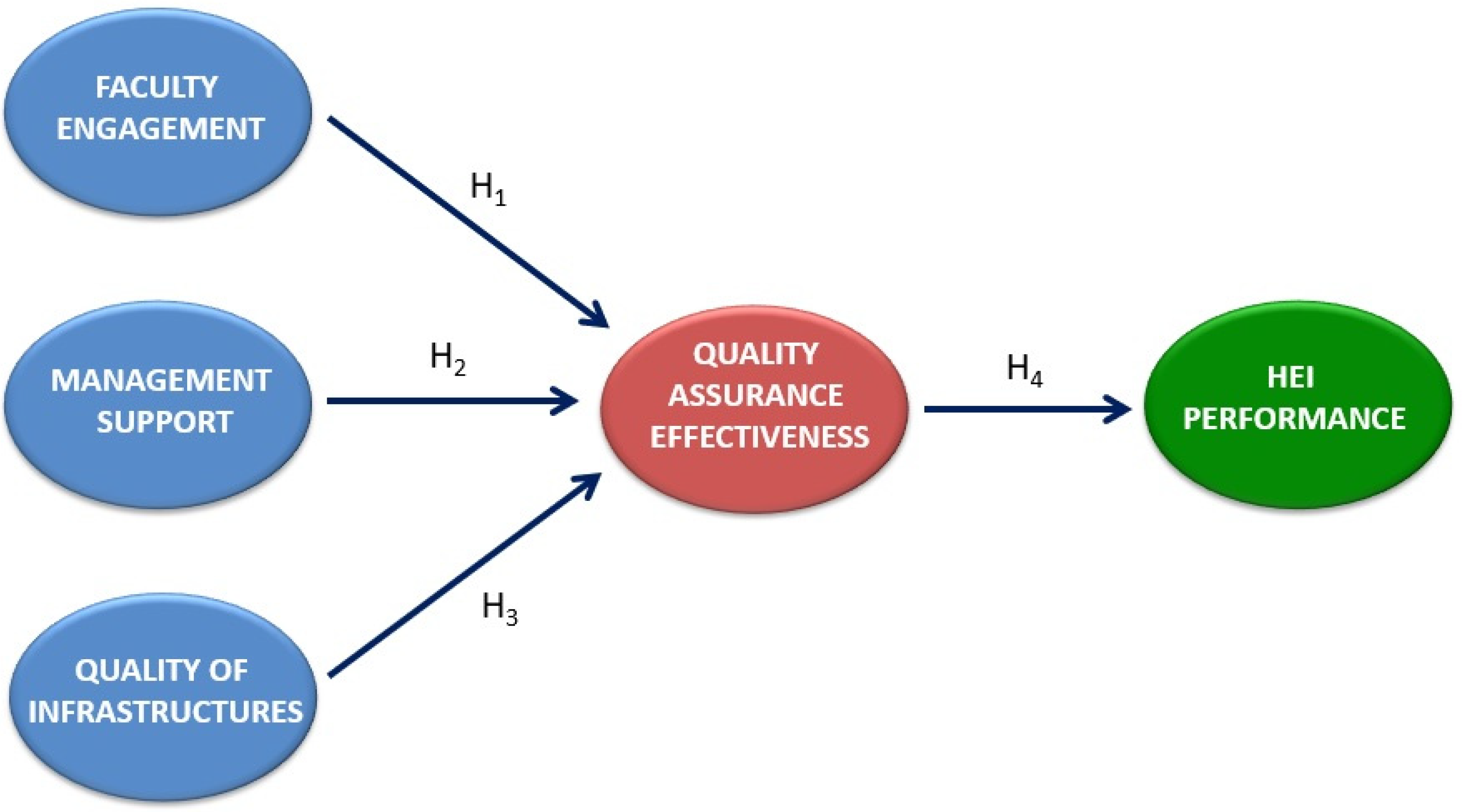
The proposed model, adapted from [
20,
21], illustrates the relationship between QAE and HEI performance, incorporating faculty engagement, management support, and infrastructure quality as antecedents of QAE (see
Figure 1).
In this model, faculty engagement is crucial as it ensures active participation in quality initiatives, leading to improved teaching practices and student outcomes. Management support provides the necessary resources and fosters a culture of accountability, which is essential for the successful implementation of QA processes. Additionally, high-quality infrastructures create an optimal environment for teaching and learning, further enhancing QAE measures. Together, these factors contribute to a robust QA system, which in turn positively influences the overall performance of HEIs.
In Portugal, isomorphism is evident through the strong coercive pressure exerted by A3ES accreditation requirements, which oblige all HEIs to adopt similar QA structures and procedures. Mimetic behaviour also emerges as institutions benchmark themselves against high-performing peers, while normative pressures arise from shared professional networks and national QA training initiatives. Together, these mechanisms contribute to the convergence of QA practices across the sector.
Although HEIs may not explicitly apply RBV theory in their strategic planning, it is used in this study as an analytical framework to interpret how internal resources enhance QAE and institutional performance.
Within the RBV perspective, internal resources such as faculty engagement and infrastructure quality function as strategic assets that can generate competitive advantage in higher education. Highly engaged faculty contribute to pedagogical innovation, research productivity, and stronger student outcomes, all of which enhance institutional reputation and attractiveness. Likewise, high-quality infrastructures—modern laboratories, digital learning environments, and well-equipped facilities—support effective teaching and research, enabling institutions to deliver superior academic experiences. When these resources are valuable, difficult to imitate, and effectively mobilised, they allow HEIs to differentiate themselves and improve their competitive position.
This study adopts a dual-theoretical lens to analyse QAE in HEIs. Neo-Institutional Theory (NIT) explains the external motivations—such as regulatory pressures and legitimacy concerns—that drive institutions to adopt QA systems. In contrast, the Resource-Based View (RBV) provides a framework for understanding how internal resources and capabilities—such as faculty engagement, infrastructure, and leadership—contribute to the effectiveness of these systems. Integrating both perspectives allows for a more comprehensive analysis of the factors influencing QA adoption and performance outcomes.
Although QA systems are widely promoted as mechanisms for improvement, their rapid expansion has also raised concerns. Several studies note that QA often becomes a legitimacy-driven exercise shaped by coercive, mimetic, and normative pressures, leading institutions to prioritise compliance and documentation over substantive pedagogical enhancement [
22,
23]. The increasing reliance on standardised indicators may narrow the meaning of “quality,” reinforcing proceduralism and administrative burden [
24,
25]. Recognising these tensions is essential, as they highlight that QAE is not merely a technical outcome but a socially embedded process influenced by organisational dynamics and internal resources [
24,
26]. This perspective reinforces the relevance of examining how faculty engagement, management support, and infrastructure quality shape the effectiveness of QA systems and their impact on institutional performance.
2.1. Faculty Engagement
Faculty engagement is a critical factor in the QAE within HEIs. Engaged faculty members are more likely to be committed to their teaching responsibilities, participate actively in institutional initiatives, and contribute to a positive academic environment. This engagement can lead to improved teaching practices, better student outcomes, and a more effective implementation of QA processes [
4].
We would like to introduce a parenthesis here and note that recent literature underlines the growing role of students in QA, not just as beneficiaries, but as active participants in the evaluation and improvement of HEIs. According to [
27], students contribute at three levels: participation (feedback on teaching/learning); involvement (participation in governance and institutional processes); and commitment (participation in audits and the co-creation of quality policies). These elements highlight the importance of integrating the student perspective into evaluation and continuous improvement mechanisms at institutions.
Returning to the role of committed faculty members, they are often more willing to collaborate in the continuous evaluation and improvement of academic programs, which can result in greater pedagogical innovation and a quicker adaptation to the changing needs of students and the job market. Active faculty participation can also foster a culture of quality within the institution, where all members of the academic community feel responsible for collective success.
Conversely, various studies have highlighted that insufficient faculty commitment can adversely affect the QAE in academic programs [
28,
29]. Lack of participation can lead to a superficial implementation of quality policies, lower motivation to improve teaching practices, and resistance to change, ultimately harming the educational experience of students [
30].
With stricter requirements in quality management and increased accountability to external stakeholders for sharing evidence of student success, faculty engagement in the QA process is essential [
31].
Therefore, given that faculty engagement is essential for QAE in HEIs, it can be hypothesised that:
H1. Faculty engagement has a positive influence on QAE.
2.2. Management Support
Management support plays a crucial role in QAE processes within HEI. When management actively endorses and participates in QA initiatives, it sets a positive tone and demonstrates a commitment to maintaining high standards [
1,
20,
32]. This support can provide the necessary resources, such as funding, training, and time, which are essential for the successful implementation and continuous improvement of QA measures.
Furthermore, management’s involvement can foster a culture of accountability and continuous improvement, encouraging faculty and staff to engage more deeply with QA activities [
32,
33]. Therefore, the presence of strong management support is likely to enhance the overall QAE efforts [
21,
32,
34], leading to better educational outcomes and institutional performance.
So, for these reasons, we are led to formulate a second hypothesis:
H2. Management support has a positive influence on QAE.
2.3. Quality of Infrastructures
High-quality infrastructures, including modern classrooms, well-equipped laboratories, libraries and advanced technological resources, provide an optimal environment for teaching and learning [
35]. These facilities enable faculty to implement innovative teaching methods and conduct cutting-edge research, which are essential components of quality education [
36]. Moreover, well-maintained infrastructures contribute to a positive student experience, enhancing their engagement and satisfaction.
Studies have shown that inadequate infrastructure can hinder the implementation of QA measures, resulting in inferior educational achievements and decreased institutional performance [
1,
34]. Therefore, investing in high-quality infrastructure is crucial for the successful execution of QA processes, ultimately leading to improved educational standards and better student outcomes.
This leads us to present a third hypothesis:
H3. Quality of infrastructures has a positive influence on QAE.
2.4. QAE and HEI Performance
Organisational performance is considered a broad and ambiguous concept, despite being the most researched dependent variable for measuring organisational success or failure in the management discipline. This concept is problematic even within the context of higher education, where there is no consensus on how to measure performance, as evidenced in the existing literature [
37,
38]. Some researchers view higher education performance in terms of the financial aspects of institutions, while others emphasise non-financial aspects (innovation, research operations, service, internationalisation, etc.).
QAE is a pivotal factor in enhancing the overall performance of HEIs [
21]. Effective QA systems ensure that educational programs meet high standards, which in turn leads to improved teaching and learning outcomes. This alignment with quality standards fosters a culture of continuous improvement, encouraging faculty and staff to strive for excellence [
39]. Additionally, robust QA processes can enhance the institution’s reputation, attracting more students and funding opportunities.
Studies have shown that institutions with strong QA mechanisms tend to perform better in terms of student satisfaction, graduation rates, and employability of graduates [
21,
30,
37,
40]. Therefore, the effectiveness of QA processes is directly linked to the overall performance and success of HEIs.
The above reasons lead to this fourth hypothesis:
H4. QAE has a positive influence on HEI performance.
2.5. Public vs. Private
The distinction between public and private HEIs significantly influences various institutional dynamics and outcomes [
41]. Public HEIs often benefit from substantial government funding, which can enhance infrastructure quality and provide robust management support. Conversely, private HEIs may rely more on tuition fees and private investments, potentially leading to different priorities and resource allocations.
Faculty engagement is crucial for institutional success, and its impact can vary depending on the type of HEI. In public institutions, faculty engagement might be driven by job security and academic freedom, while in private institutions, it could be influenced by performance-based incentives and market-driven goals. Management support in public HEIs often involves navigating bureaucratic structures, whereas private HEIs may exhibit more flexible and entrepreneurial management styles [
4].
QAE also differs, with public HEIs typically adhering to stringent government regulations and standards, while private HEIs might adopt more innovative and competitive approaches to maintain their reputation and attract students. These variations can lead to differences in overall HEI performance, making the public or private status a critical moderating factor in these relationships [
17,
42].
So, the following hypothesis is supported by literature indicating that the type of HEI influences how faculty engagement, management support, infrastructure quality, and QA practices are implemented and perceived, ultimately affecting institutional performance.
Given these structural differences, the moderating role of institutional type becomes particularly relevant. Private HEIs, which typically operate with greater managerial flexibility, market-oriented strategies, and more agile resource allocation, are expected to exhibit stronger links between internal resources—such as faculty engagement, management support, and infrastructure quality—and QAE. In contrast, public HEIs often function within more rigid bureaucratic frameworks and face constraints in decision-making and resource distribution, which may weaken the strength of these relationships. These contextual distinctions justify examining whether the impact of internal determinants on QAE varies across public and private institutions.
H5. The influence of determinants (FE, MS and QI) on QAE is moderated by public or private nature of a HEI.
3. Methodology
The research focused on the teaching staff from 97 HEIs in Portugal in 2024. The sample consisted of polytechnic institutions (61) and university institutions (36), where 63 are private and 34 are public [
43].
The sampling strategy followed a purposive approach based on publicly available staff information from institutional websites, as no comprehensive national list of academic personnel exists. The questionnaire (see
Supplementary Materials) was distributed online via email.
The resulting proportion of public and private institutions in the sample reflects the actual structure of the Portuguese higher education system, where private HEIs outnumber public ones (63 private vs. 34 public). Consequently, the higher representation of private institutions in the sample is consistent with their prevalence in the national landscape. However, although private HEIs outnumber public ones in Portugal, the distribution of respondents in our survey was the opposite. We therefore distinguish between institutional composition and respondent composition to avoid bias and ensure transparency in the interpretation of the results.
The research model was adapted from previous studies on QA and organisational performance [
20,
21]. Measurement items for each construct were selected based on validated instruments used in prior research [
30,
37]. These items were reviewed during the pre-test phase to ensure conceptual alignment with the Portuguese higher education context. The experts provided feedback on clarity, relevance, and consistency, which led to minor adjustments in wording and structure. This process ensured the reliability and validity of the measurement tools used in the final questionnaire.
Drawing from previous research [
21,
30,
37], the faculty engagement variable was assessed with 7 items; management support with 9 items; infrastructure quality with 8 items; QAE with 8 items; and HEI performance with 9 items.
A total of 1018 responses were collected, all valid, resulting in a sampling error of 3.03% (see
Table 1), and providing a sample size significantly larger than those in similar studies.
The data analysis method selected for this study is partial least squares (PLS) regression [
44]. This technique was chosen because it accommodates complex models with multiple latent variables and relationships, is resilient to non-normal distributions, and performs well with small sample sizes. Furthermore, PLS is particularly suitable for exploratory research in emerging fields like QAE, where the theoretical framework is still evolving. It also allows for the simultaneous modelling of personal and contextual factors.
All constructs were treated as reflective and measured using Likert scales (1–5) based on prior research. The model was estimated using SmartPLS 4, and parameter significance was determined through a bootstrap resampling procedure with 5.000 subsamples of the same size as the original sample.
To assess the overall model fit, three indices recommended by SmartPLS were considered: the Standardised Root Mean Square Residual (SRMR), the squared Euclidean distance (d_ULS), and the geodesic distance (d_G). The estimated model yielded values of SRMR = 0.062, d_ULS = 2.449, and d_G = 0.686, all of which indicate an acceptable fit and support the robustness of the proposed structural model.
To ensure the validity of group comparisons between public and private HEIs, the Measurement Invariance of Composite Models (MICOM) procedure was applied (see
Table 2). The results confirmed compositional invariance for most constructs, with permutation p-values exceeding the 0.05 threshold. This indicates that the measurement instrument functions equivalently across both groups, supporting the robustness of the multi-group analysis. However, one path—Quality Infrastructures → QAE—did not meet the invariance criterion, which is acknowledged in the interpretation of results.
4. Results
The evaluation of the relationship model considered the individual reliability of the items and the discriminant validity of the constructs [
45]. For assessing the reliability of each item, factor loadings were utilised as the benchmark, with a common threshold being a value greater than 0.707 [
46]
. After refining the scales,
Table 3 shows that all items have loadings above the reference value.
The Cronbach’s alpha value for each construct ranges from 0.878 to 0.961, indicating good reliability among the indicators of each construct. Additionally, the composite reliability of all constructs exceeds the reference threshold of 0.7. even the stricter threshold of 0.8 [
47]. Furthermore, the average variance extracted (AVE) values are above 0.5, ensuring the convergent validity of the model [
48].
The significant difference observed in the Infrastructure → QAE relationship indicates that infrastructure quality plays a more decisive role in shaping QAE in private HEIs than in public ones. This result is consistent with the organisational characteristics of the Portuguese system: private institutions tend to rely more heavily on visible, high-quality infrastructures to attract students and signal institutional legitimacy, making infrastructure investments a central component of their quality strategies. In contrast, public HEIs often operate within more stable demand conditions and under stricter budgetary constraints, which may reduce the marginal impact of infrastructure improvements on perceived QAE. Consequently, the moderating effect suggests that infrastructure functions as a more strategic and differentiating resource in private institutions, whereas its influence on QAE is comparatively weaker in the public sector.
The significant effects of internal resources—particularly faculty engagement and infrastructure quality—support the RBV argument that valuable and difficult-to-imitate capabilities enhance institutional effectiveness. The stronger Infrastructure → QAE relationship in private HEIs further illustrates how institutions strategically mobilise internal resources to differentiate themselves in competitive environments.
To evaluate discriminant validity, it was confirmed that each item had higher loadings on its intended construct rather than on any other constructs [
49]. Discriminant validity is established if a construct’s AVE exceeds the square of its correlations with other constructs [
48]. According to this criterion, all constructs in the model demonstrate discriminant validity (see
Table 4), enabling us to move forward with the structural model assessment.
Although most HTMT values fell below the recommended threshold of 0.90, indicating satisfactory discriminant validity, one exception was observed in the pair “Management Support—Quality Infrastructures” (HTMT = 0.947) (see
Table 5).
This result suggests a potential conceptual proximity between these constructs, which may reflect the intertwined nature of managerial practices and infrastructural support in the implementation of QA systems. While this overlap does not invalidate the measurement model, it is acknowledged as a limitation and considered in the interpretation of the structural relationship.
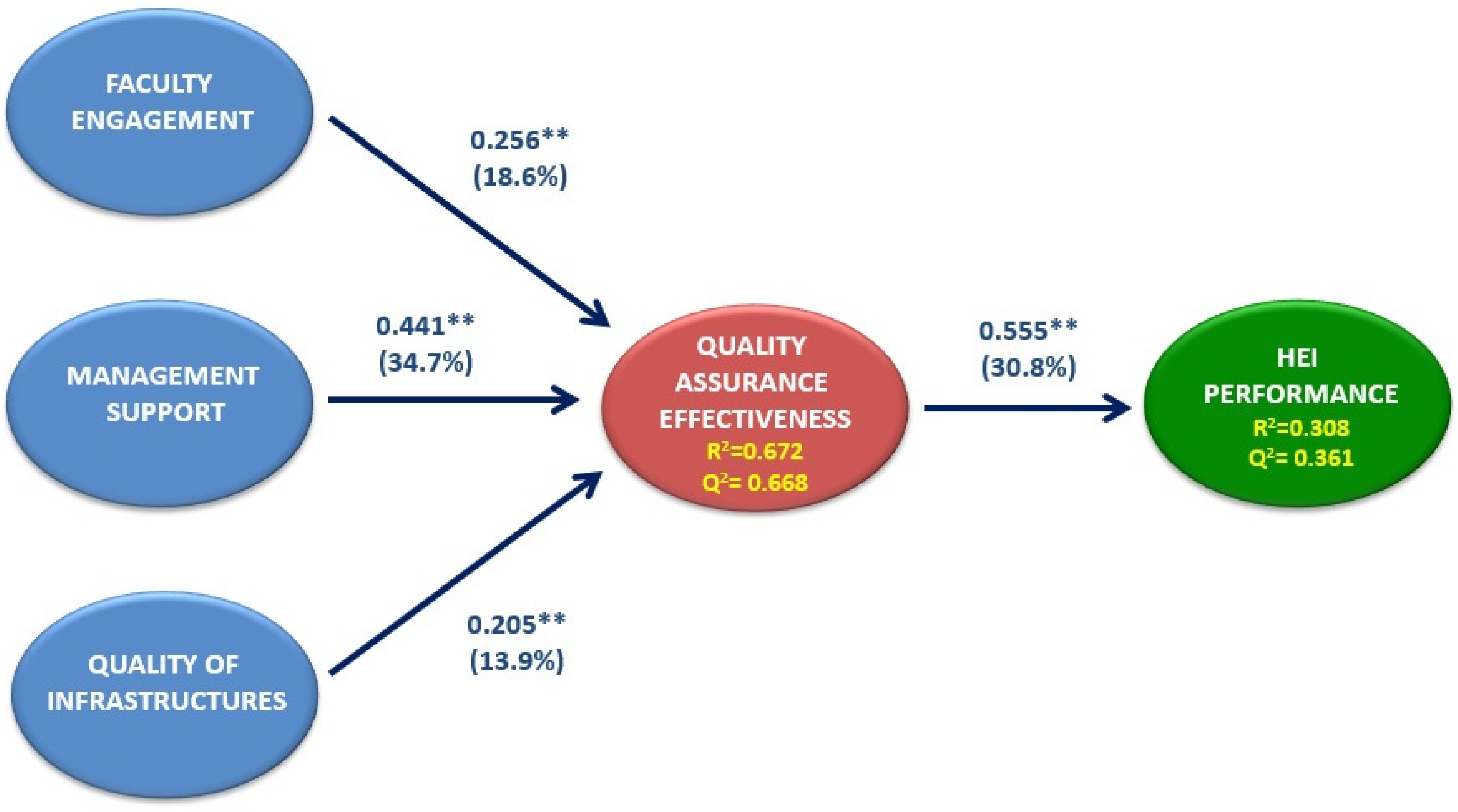
Figure 2 presents the outcomes of our structural model estimation. The arrows depict relationships, and the number adjacent to each arrow represents its standardised coefficient. Additionally, the product of this standardised coefficient and the correlation coefficient between the two constructs is shown as a percentage in parentheses [
50].
Management support is the construct that most contributes to explaining QAE (34.7%). The variables faculty engagement (18.6%) and quality of infrastructures (13.9%) also have a high explanatory power of intention. Our model also confirms the positive impact of the QAE on the HEI performance (30.8%).
The figure shows that all Q
2 values from the Stone–Geiser test have predictive relevance as they are greater than zero. The model shows good predictive power (R
2), as it helps explain 67.2% of the variance in the construct QAE and 30.8% of HEI performance. The goodness of fit value is calculated through three indices according to SmartPLS, the standardised root mean square residual (SRMR), which is equal to 0.062; the squared Euclidean distance (d_ULS) = 2.449, and the geodesic distance (d_G) = 0.686, all of them indicating that our model fits the empirical data [
51].
Multigroup Analysis: Public vs. Private HEIs
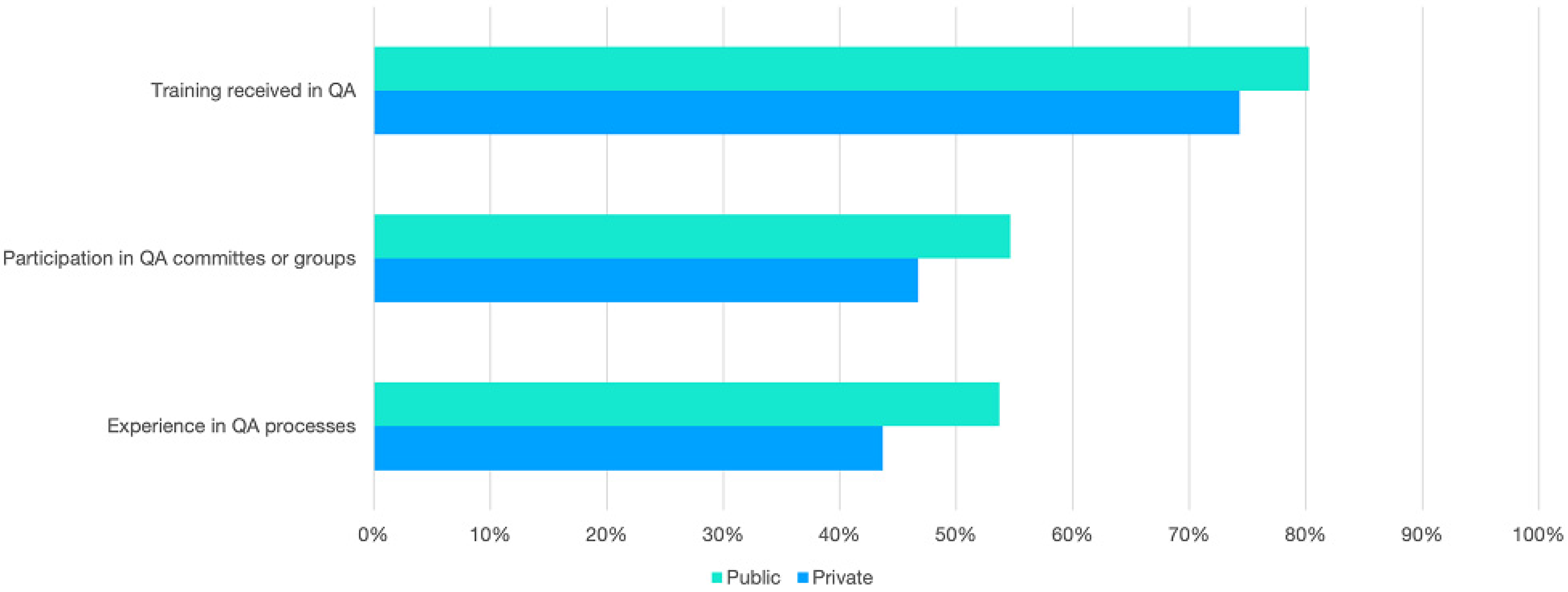
Figure 3 summarises the percentage of respondents from public and private HEIs who have engaged in various QA-related activities. A higher percentage of respondents from public HEIs (53.7%) have experience in QA processes compared to those from private HEIs (43.7%). T-tests for differences in means indicate that the differences between public and private HEIs are significant (
p = 0.006). Similarly, a greater proportion of respondents from public HEIs (54.6%) have participated in QA committees or groups than those from private HEIs (46.7%). T-tests for differences in means also indicate that they are significant (
p = 0.030).
More respondents from public HEIs (80.3%) have received training in QA compared to those from private HEIs (74.3%), although in this case the t-test for difference in means is not significant. (See
Figure 3)
The results indicate that public HEIs are more proactive in engaging their staff in QA-related activities compared to private HEIs. This could be due to several factors, including the availability of government support and resources, which may facilitate more extensive QA training and participation in QA processes and committees. Public HEIs might have more structured and mandatory QA programs, leading to higher engagement rates among their staff.
For private HEIs, the lower percentages suggest a need to enhance their QA initiatives. These institutions may benefit from investing more in QA training programs to ensure their staff are well-equipped with the necessary skills and knowledge. Increasing participation in QA committees and groups can also foster a culture of quality and continuous improvement within the institution.
The previously analysed data represent the outcomes of a global model (see
Figure 2), where no specific criteria were applied to categorise them, if the shared variance spans the entire sample. Multigroup analysis is a technique used to determine if there are statistically significant differences between various data groups for the same model [
52].
One variable was identified as a potential moderator of the established relationships: the public or private nature of the institution.
Table 6 presents the groups formed, their divisions, respective sample sizes, and the frequency of each group relative to the total sample.
According to
Table 6, the two groups meet the criteria for a satisfactory sample size, with each group having more than 20 observations [
52]. The groups were created using SmartPLS 4 software as described in the table, and the new models were tested to verify the results. In this regard, after validating all models for each group of each moderator variable, the outcomes of the tests conducted are presented below.
Table 7 displays a multigroup analysis private vs. public HEIs. According to the data presented, it can be observed that the variable moderates the relationships established by H3 in the proposed model [
52]. The quality of infrastructure has a significantly higher relationship with QAE in private institutions compared to public ones.
The other hypotheses do not present significant differences between public and private HEIs. Specifically, for H1 (FE → QAE), the difference between private and public institutions is not significantly different, which indicates that the relationship between faculty engagement and QAE is similar in both types of institutions. Similarly, for H2 (MS → QAE), the difference is not significantly different, suggesting that managerial support does not have a significantly different impact on QAE in private versus public institutions. Lastly, for H4 (QAE → PERF), the difference is not significantly different, indicating that the relationship between QAE and HEI performance is consistent across private and public institutions.
The stronger influence of infrastructure quality on QAE in private HEIs may reflect the strategic role that physical and technological resources play in competitive positioning. Unlike public institutions, which often benefit from centralised infrastructure planning and stable public funding, private HEIs may rely more heavily on visible quality indicators—such as modern facilities and digital platforms—to signal institutional credibility and attract students. This reliance could amplify the perceived effectiveness of QA systems when supported by robust infrastructure. Conversely, the absence of significant differences in faculty engagement and management support suggests that these dimensions are more uniformly embedded across institutional types, possibly due to shared professional standards and regulatory expectations.
Beyond the Portuguese context, the evidence from this study is consistent with international evidence showing that internal organisational factors strongly shape the effectiveness of QA systems. Studies conducted in Europe and Asia similarly report that faculty engagement and management support are central drivers of QA implementation and institutional performance [
4,
53]. The stronger role of infrastructure in private institutions also mirrors patterns observed in systems where market competition is more pronounced, such as in the UK and Southeast Asia, where private HEIs rely heavily on visible resource investments to signal quality and attract students. At the same time, our results diverge from findings in more centralised systems—such as those in Scandinavia—where public institutions dominate and infrastructure differences have a weaker impact on QA outcomes. These comparisons reinforce the broader relevance of our model while highlighting how national governance structures shape the relative influence of internal resources on QAE.
5. Conclusions and Management Implications
This study, grounded in both neo-institutional theory and the resource-based view (RBV), reveals that HEIs adopt QAE practices not only to maintain external legitimacy and comply with regulatory norms, but also to leverage internal strategic resources that enhance institutional performance. The neo-institutional perspective explains how HEIs respond to external pressures through isomorphic mechanisms, while the RBV framework highlights the role of valuable, rare, and inimitable resources—such as faculty engagement, management support, and infrastructure quality—in driving sustainable competitive advantage. Together, these theoretical lenses provide a comprehensive understanding of the motivations and mechanisms behind QAE adoption and its impact on HEI outcomes.
The empirical evidence of this study supports these theoretical mechanisms. The significant role of management support and the consistent implementation of QA practices across institutions suggest that Portuguese HEIs respond to coercive pressures from accreditation bodies and engage in mimetic behaviors by adopting practices from peers. These dynamics reflect institutional convergence, reinforcing the relevance of isomorphism in understanding how QA systems shape performance.
These findings reinforce the need for HEIs to invest in internal capacity-building, foster inclusive leadership, and ensure adequate infrastructure to support QA processes. For policymakers, the study suggests complementing regulatory frameworks with strategic support measures—such as dedicated funding, professional development programmes, and incentives for faculty engagement—to ensure the long-term success and sustainability of QA systems in higher education.
The results indicate that management support is the main factor contributing to QAE, with an impact of 34.7%. This highlights the importance of strengthening institutional leadership, promoting the direct involvement of managers in quality policies. Effective leadership creates an environment conducive to continuous improvement and ensures that quality practices are aligned with the institution’s strategic objectives.
In addition, the involvement of teaching staff (18.6%) and the quality of infrastructure (13.9%) are also determining factors in QAE. HEIs must continue to invest in the professional development of teaching staff and ensure that infrastructure is appropriate for teaching and learning needs, creating a collaborative environment between teaching staff, students and management.
Regarding HEI performance, the results confirm the significant impact of QAE with a coefficient of 30.8%. This demonstrates that the effective implementation of a QA system not only ensures compliance with standards, but also has a substantial effect on institutional performance, especially in key areas such as research and teaching and learning. It is therefore essential that HEIs continually invest in QA systems, as these systems directly impact on the overall performance of institutions.
The multi-group analysis revealed significant differences between public and private institutions. Public institutions showed greater involvement in QA activities, which can be explained by government support and the robust structure of training programs. Private institutions, on the other hand, demonstrated the need for greater investment in quality infrastructure to improve QAE and, consequently, institutional performance.
Therefore, to improve institutional performance, it is imperative that HEIs, both public and private, strengthen leadership, invest in quality infrastructure and promote the active participation of teaching staff in QA processes. An effective QA system can be the differentiator that boosts the performance of HEIs, reflected in better educational practices, greater social impact and national and international recognition.
The results of this study demonstrate that faculty engagement, management support, and infrastructure quality are key drivers of QAE, which in turn enhances institutional performance. These conclusions suggest that HEIs should invest in internal capacity-building, foster inclusive leadership, and ensure adequate infrastructure to support QA processes. For policymakers, the study highlights the need to complement regulatory frameworks with strategic support measures—such as funding programs, professional development initiatives, and incentives for faculty participation—to reinforce the long-term impact of QA systems in higher education.
Despite achieving a total of 1018 valid responses, significantly exceeding the numbers of similar studies, the data collection process was not without its difficulties. The main difficulty was the complexity of disseminating the questionnaire, which was subject to institutional ethical approval and data protection requirements. Some HEIs required formal opinions from their Ethics Committees and approval from the Data Protection Officer, which caused delays in the process of obtaining responses. In other institutions, it was necessary to obtain additional authorisations from the Research Units and the Management Board, which further prolonged the process. These procedures, although essential to ensure compliance, impacted the speed with which the questionnaire was distributed.
Moreover, the diversity in administrative standards and processes among HEIs also influenced accessibility and adherence to the study, with additional requirements making it difficult to cover the study and obtain more responses from teaching staff at the 97 public and private HEIs in Portugal. As a result, it was not possible to collect contributions from a larger number of teaching staff, limiting the analysis of the impact of QAE on institutional performance.
In future studies, our intention is to bring forward the submission of ethical and administrative opinions to reduce delays. However, we recognise that data collection will remain dependent on institutional policies, which may impact accessibility for participants, especially in institutions with stricter procedures.
Furthermore, in future research, we want to carry out a more in-depth qualitative analysis of the QAE, also incorporating the comments and suggestions provided by teachers in the open question of the questionnaire: “Would you like to leave any comments or suggestions for improving the quality system at your institution?”. These suggestions will be analysed using a content analysis methodology, with the support of appropriate software, which will allow for a richer understanding of teachers’ perceptions.
However, several methodological limitations should be acknowledged. First, the use of an online survey may introduce self-selection bias, as participation depended on the willingness and availability of academic staff to respond. It is possible that individuals with stronger views on quality assurance—either positive or negative—were more likely to participate, which may influence the representativeness of the sample. Second, although the sample size is large, external validity remains limited because the study focuses exclusively on Portuguese HEIs operating under a specific regulatory framework. Caution is therefore required when generalising the conclusions to other higher education systems with different governance structures, funding models, or QA traditions. Future research could mitigate these limitations by employing probabilistic sampling strategies or conducting comparative studies across multiple national contexts.
This study fills an important gap in the literature by tackling a subject that lacks empirical research on QAE as a predictor of the performance of HEIs. Based on teaching staff perceptions, this work makes a significant contribution to understanding the impact of QAE on HEIs and opens the door to new findings that will enrich the field. In addition, it identifies and points out the need to deepen the active participation of students in QA processes.