
Corporate Social Responsibility with Chinese Characteristics: Institutional Embeddedness, Political Logic, and Comparative Theoretical Perspective

Abstract
1. Introduction
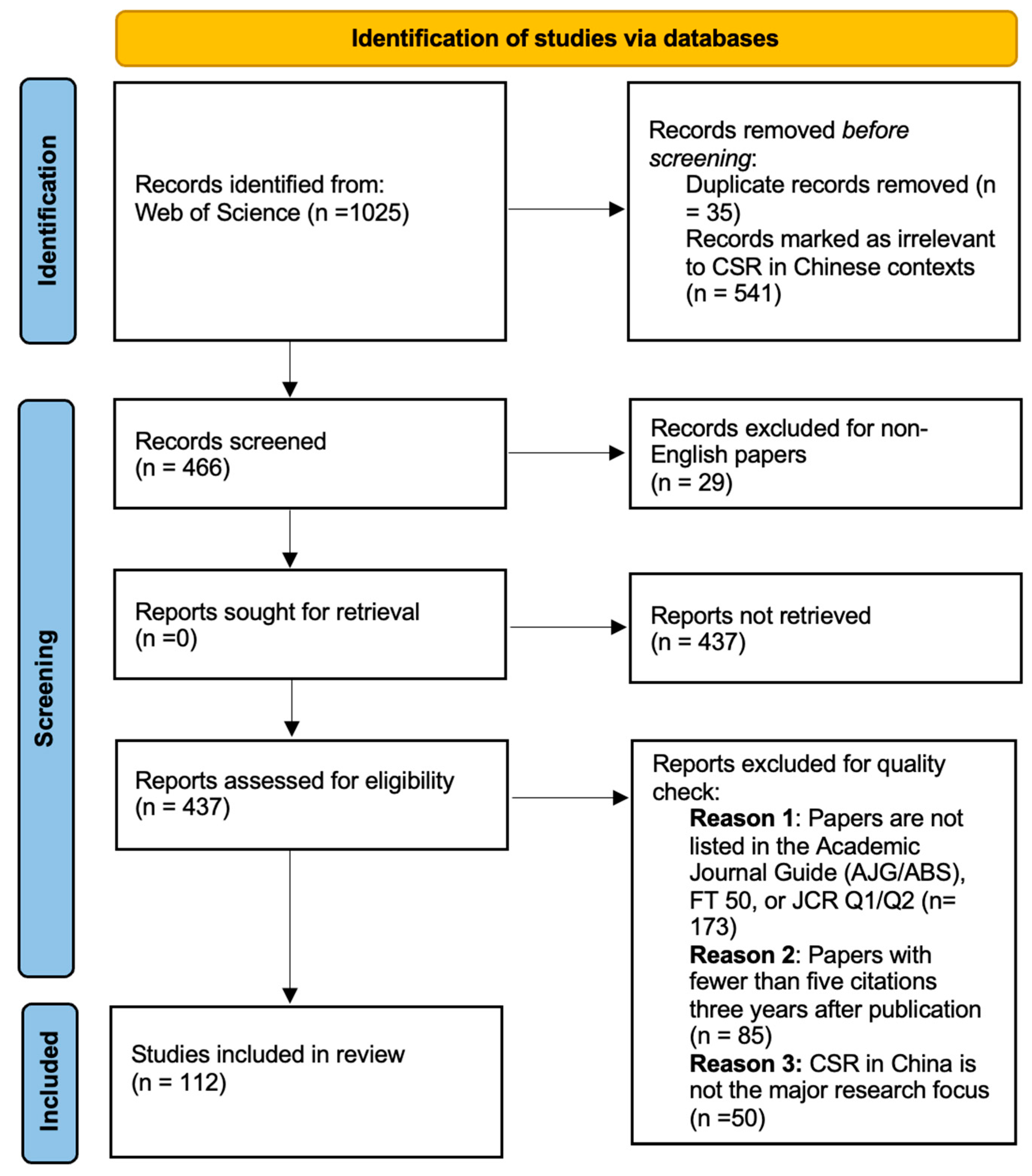
2. Materials and Methods
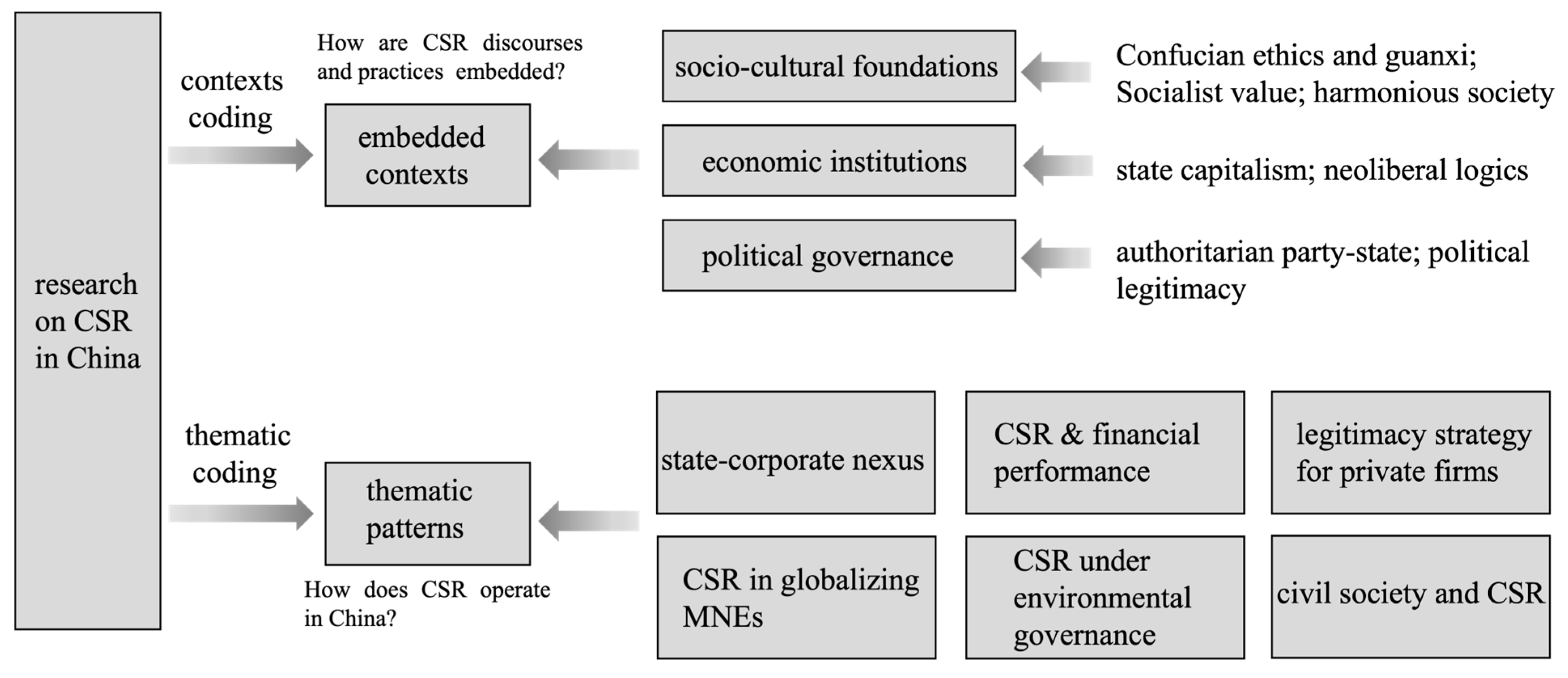
3. The Local Embeddedness of Corporate Social Responsibility in China
3.1. The Social-Cultural Context: Confucianism and Socialist Harmonious Society
3.2. The Economic Context: Between State-Led Capitalism and Neoliberalism
3.3. The Political Context: Political Legitimacy and Party-State Embeddedness
4. Key Research Agendas of CSR in China
4.1. CSR as a Legitimacy Strategy for Private Firms
4.2. CSR Reporting
4.3. Globalization, Supply Chain and CSR in Multinational Enterprises
4.4. CSR and Financial Performance
4.5. Environmental Corporate Social Responsibility (ECSR)
4.6. Civil Society and CSR
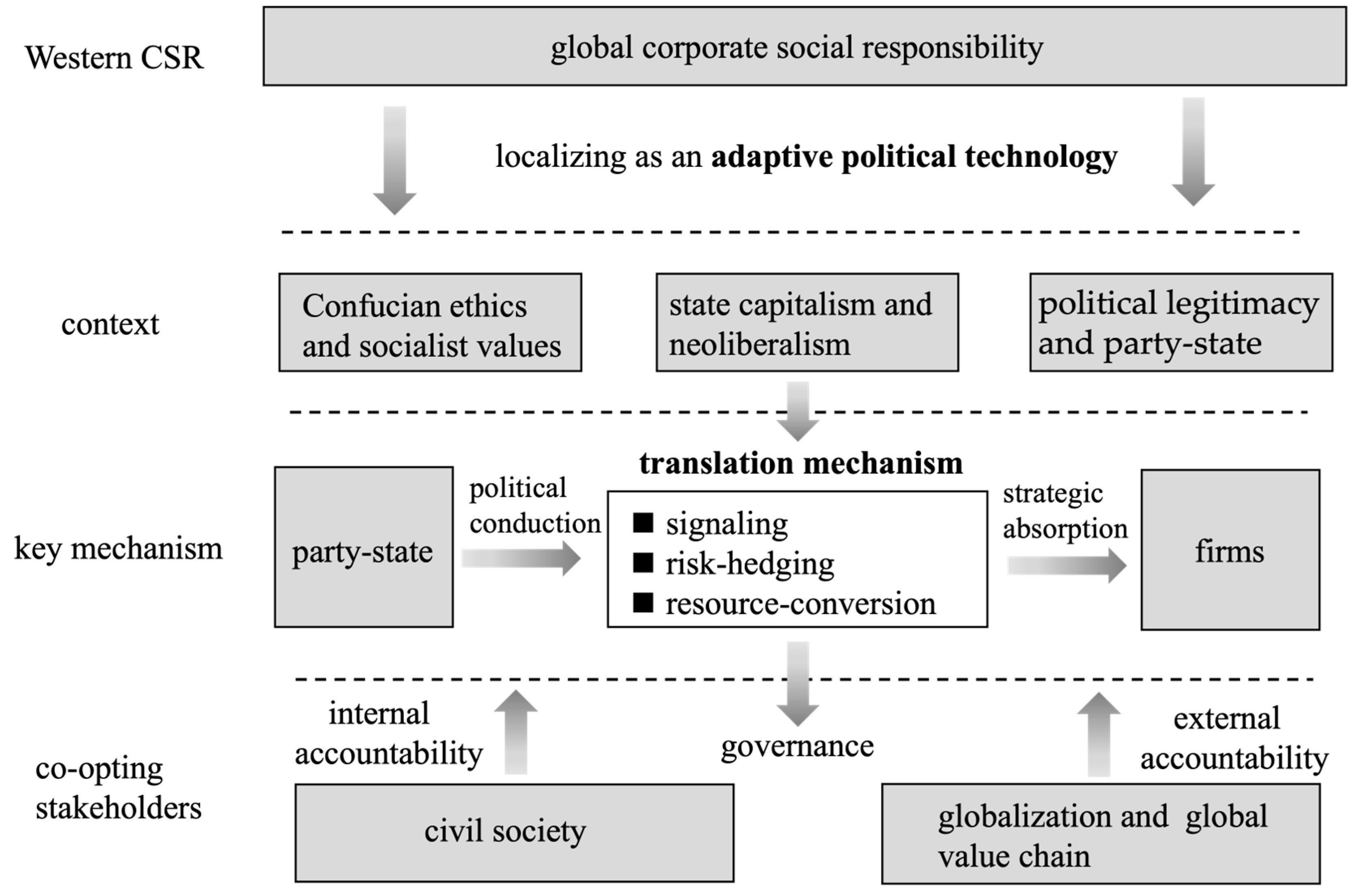
5. Discussion: A Comparative Perspective
6. Conclusions, Limitations and Future Research
- (1)
- The embeddedness of CSR in small and medium-sized enterprises (SMEs). As Oduro, Bruno and Maccario recently argue, treating SMEs as miniature versions of large corporations leads to a flawed understanding [116]. They therefore highlight the informal, value-driven, and locally embedded nature of SME CSR. Similarly, existing research on CSR in China disproportionately focuses on state-owned and large listed firms, leaving the CSR practices of SMEs largely invisible. Yet SMEs and especially those that are often family-owned and locally rooted are central to China’s regional economies and social governance. Future studies should investigate how local political networks, clan associations, and informal guanxi relations mediate CSR implementation among SMEs. This line of inquiry could illuminate how CSR becomes a tool of moral legitimacy and political exchange at the county and township levels, revealing the everyday embeddedness of CSR in grassroots state–business relations. Unpacking this distinct logic is essential for a complete picture of corporate responsibility in China.
- (2)
- CSR under geopolitical fragmentation and supply chain decoupling. In the context of rising geopolitical tensions and supply chain reconfiguration, Chinese firms are compelled to rearticulate CSR strategies to navigate global scrutiny, trade barriers, and the politics of decoupling. Chowdhury et al. observe that the current trade war between the US and China has created a future that is not just risky but fundamentally unpredictable and incalculable; therefore, investment in CSR acts as a flexible, low-cost “real option” that allows firms to maintain strategic agility and social capital that can strengthen risk management [114]. Future research should analyze how global production networks and geopolitical realignments reshape CSR’s spatial logic—how firms recalibrate responsibility narratives, risk management, and stakeholder engagement when operating across politically fragmented markets. This direction calls for integrating geoeconomic and political economy perspectives into CSR studies, examining how firms balance national loyalty with global competitiveness.
- (3)
- Digital technology and the governance of CSR. The emergence of digital CSR—including AI-based sustainability reporting, blockchain-enabled supply chain traceability, and the social credit system—represents a new phase in the governance of corporate responsibility. Digitalization not only enhances transparency but also expands the state’s capacity for surveillance and regulatory control. Future research should thus explore how digital platforms and data infrastructures reconfigure CSR accountability, how algorithmic governance mediates corporate behavior, and how digital CSR simultaneously enables and constrains corporate autonomy under China’s “smart governance” paradigm.
Author Contributions
Funding
Institutional Review Board Statement
Informed Consent Statement
Data Availability Statement
Conflicts of Interest
References
- Carroll, A.B. The Pyramid of Corporate Social Responsibility: Toward the Moral Management of Organizational Stakeholders. Bus. Horiz. 1991, 34, 39–48. [Google Scholar] [CrossRef]
- Matten, D.; Moon, J. “Implicit” and “explicit” CSR: A conceptual framework for a comparative understanding of corporate social responsibility. Acad. Manag. Rev. 2008, 33, 404–424. [Google Scholar] [CrossRef]
- Mosca, F.; Civera, C. The Evolution of CSR: An Integrated Approach. Symphonya Emerg. Issues Manag. 2017, 1, 16–35. [Google Scholar] [CrossRef]
- Fatima, T.; Elbanna, S. Corporate Social Responsibility (CSR) Implementation: A Review and a Research Agenda Towards an Integrative Framework. J. Bus. Ethics 2023, 183, 105–121. [Google Scholar] [CrossRef]
- Tourky, M.; Kitchen, P.; Shaalan, A. The role of corporate identity in CSR implementation: An integrative framework. J. Bus. Res. 2020, 117, 694–706. [Google Scholar] [CrossRef]
- Wickert, C.; Potočnik, K.; Prashantham, S.; Shi, W.; Snihur, Y. Embracing non-Western contexts in management scholarship. J. Manag. Stud. 2024, 61, e1–e24. [Google Scholar] [CrossRef]
- Hofman, P.S.; Moon, J.; Wu, B. Corporate Social Responsibility Under Authoritarian Capitalism: Dynamics and Prospects of State-Led and Society-Driven CSR. Bus. Soc. 2017, 56, 651–671. [Google Scholar] [CrossRef]
- Xu, S.; Yang, R. Indigenous characteristics of Chinese corporate social responsibility conceptual paradigm. J. Bus. Ethics 2010, 93, 321–333. [Google Scholar] [CrossRef]
- Zhu, Q.; Zhang, Q. Evaluating practices and drivers of corporate social responsibility: The Chinese context. J. Clean. Prod. 2015, 100, 315–324. [Google Scholar] [CrossRef]
- Zeng, J. Corporate social responsibility in China: A tool of policy implementation. Account. Econ. Law 2024, 1–45. [Google Scholar] [CrossRef]
- Lau, C.; Lu, Y.; Liang, Q. Corporate social responsibility in China: A corporate governance approach. J. Bus. Ethics 2016, 136, 73–87. [Google Scholar] [CrossRef]
- Kang, X. Corporate social responsibility at the intersection of state and market: CSR interpretation in China. Bus. Soc. Rev. 2025, 130, 233–259. [Google Scholar] [CrossRef]
- Hossain, M. Frugal innovation: A review and research agenda. J. Clean. Prod. 2018, 182, 926–936. [Google Scholar] [CrossRef]
- Marquis, C.; Qian, C. Corporate social responsibility reporting in China: Symbol or substance? Organ. Sci. 2014, 25, 127–148. [Google Scholar] [CrossRef]
- Li, W.; Zhang, R. Corporate social responsibility, ownership structure, and political interference: Evidence from China. J. Bus. Ethics 2010, 96, 631–645. [Google Scholar] [CrossRef]
- Tian, Z.; Wang, R.; Yang, W. Consumer responses to corporate social responsibility (CSR) in China. J. Bus. Ethics 2011, 101, 197–212. [Google Scholar] [CrossRef]
- Liao, L.; Lin, T.; Zhang, Y. Corporate board and corporate social responsibility assurance: Evidence from China. J. Bus. Ethics 2018, 150, 211–225. [Google Scholar] [CrossRef]
- Yin, J.; Zhang, Y. Institutional dynamics and corporate social responsibility (CSR) in an emerging country context: Evidence from China. J. Bus. Ethics 2012, 111, 301–316. [Google Scholar] [CrossRef]
- Ye, K.; Zhang, R. Do lenders value corporate social responsibility? Evidence from China. J. Bus. Ethics 2011, 104, 197–206. [Google Scholar] [CrossRef]
- Wei, Z.; Shen, H.; Zhou, K.Z.; Li, J.J. How does environmental corporate social responsibility matter in a dysfunctional institutional environment? Evidence from China. J. Bus. Ethics 2017, 140, 209–223. [Google Scholar] [CrossRef]
- Liu, X.; Zhang, C. Corporate governance, social responsibility information disclosure, and enterprise value in China. J. Clean. Prod. 2017, 142, 1075–1084. [Google Scholar] [CrossRef]
- Hao, J.; He, F. Corporate social responsibility (CSR) performance and green innovation: Evidence from China. Financ. Res. Lett. 2022, 48, 102889. [Google Scholar] [CrossRef]
- Wang, L.; Juslin, H. The impact of Chinese culture on corporate social responsibility: The harmony approach. J. Bus. Ethics 2009, 88, 433–451. [Google Scholar] [CrossRef]
- Low, K.C.P.; Ang, S.-L. Confucian leadership and corporate social responsibility (CSR), the way forward. J. Bus. Res. 2012, 2, 85–101. [Google Scholar] [CrossRef]
- Wang, X.; Li, F.; Sun, Q. Confucian ethics, moral foundations, and shareholder value perspectives: An exploratory study. Bus. Ethics Eur. Rev. 2018, 27, 260–271. [Google Scholar] [CrossRef]
- Snell, R.S.; Wu, C.X.; Lei, H.W. Junzi virtues: A Confucian foundation for harmony within organizations. Asian J. Bus. Ethics 2022, 11, 183–226. [Google Scholar] [CrossRef]
- Huang, M.; Li, X.; Xia, J.; Li, M. Does Confucianism prompt firms to participate in poverty alleviation campaigns? J. Bus. Ethics 2024, 189, 743–762. [Google Scholar] [CrossRef]
- Li, H.; Li, J.; Wang, J.; Yang, L. Informal institutions and corporate social responsibility: A Confucian culture perspective. Appl. Econ. 2024, 56, 7083–7096. [Google Scholar] [CrossRef]
- Low, P.K.C.; Ang, S.L. Confucian ethics, governance and corporate social responsibility. Int. J. Bus. Manag. 2013, 8, 30–43. [Google Scholar] [CrossRef]
- See, G. Harmonious society and Chinese CSR: Is there really a link? J. Bus. Ethics 2009, 89, 1–22. [Google Scholar] [CrossRef]
- Jiang, F.; Zalan, T.; Tse, H.H.; Shen, J. Mapping the relationship among political ideology, CSR mindset, and CSR strategy: A contingency perspective applied to Chinese managers. J. Bus. Ethics 2018, 147, 419–444. [Google Scholar] [CrossRef]
- Ip, P.K. Is Confucianism good for business ethics in China? J. Bus. Ethics 2009, 88, 463–476. [Google Scholar] [CrossRef]
- Lin, L.W.; Milhaupt, C.J. We are the (national) champions: Understanding the mechanisms of state capitalism in China. Rev. Chil. Derecho 2013, 40, 801. [Google Scholar] [CrossRef]
- Lin, L.Y.H.; Milhaupt, C.J. China’s corporate social credit system: The dawn of surveillance state capitalism? China Q. 2023, 256, 835–853. [Google Scholar] [CrossRef]
- Lin, L.W. Corporate social responsibility in China: Window dressing or structural change. Berkeley J. Int. Law (BJIL) 2010, 28, 64. [Google Scholar]
- Yang, L.; Wang, B.; Luo, D. Corporate social responsibility in market liberalization: Evidence from Shanghai-Hong Kong stock connect. J. Int. Financ. Mark. Inst. Money 2022, 77, 101519. [Google Scholar] [CrossRef]
- Li, T.; Belal, A. Authoritarian state, global expansion and corporate social responsibility reporting: The narrative of a Chinese state-owned enterprise. Account. Forum 2018, 42, 199–217. [Google Scholar] [CrossRef]
- Jingbo, H.; Natalie, W.W.M. Corporate Social Responsibility in the Development of China’s Rural Education: A Case Study of Two Counties in Anhui Province. China Int. J. 2020, 18, 141–165. [Google Scholar]
- Wang, Y.; Tang, Y.; Wang, T. To Glorify the Ancestors: How CEOs’ Clan Values Affect Corporate Social Responsibility. Manag. Organ. Rev. 2024, 20, 586–621. [Google Scholar] [CrossRef]
- Ramasamy, B.; Yeung, M. Chinese consumers’ perception of corporate social responsibility (CSR). J. Bus. Ethics 2009, 88, 119–132. [Google Scholar] [CrossRef]
- Kim, R.C. Rethinking corporate social responsibility under contemporary capitalism: Five ways to reinvent CSR. Bus. Ethics Environ. Responsib. 2022, 31, 346–362. [Google Scholar] [CrossRef]
- Situ, H.; Tilt, C.A.; Seet, P.S. The influence of the government on corporate environmental reporting in China: An authoritarian capitalism perspective. Bus. Soc. 2020, 59, 1589–1629. [Google Scholar] [CrossRef]
- Li, J.; Sasaki, M. Political embeddedness and corporate social responsibility (CSR) in a state-led developing country: Evidence from China. Asian Bus. Manag. 2024, 23, 597–621. [Google Scholar] [CrossRef]
- Xu, S.; Liu, D. Political connections and corporate social responsibility: Political incentives in China. Bus. Ethics Eur. Rev. 2020, 29, 664–693. [Google Scholar] [CrossRef]
- Song, S.; Jun, A.; Luo, T.; Ma, S. Political legitimacy and CSR reporting: Evidence from non-SOEs in China. Glob. Financ. J. 2024, 60, 100942. [Google Scholar] [CrossRef]
- Zhang, C.; Qian, A.; Lou, X.; Zhang, G. The politics of corporate social responsibility disclosure: Evidence from China. Econ. Anal. Policy 2024, 82, 1406–1428. [Google Scholar] [CrossRef]
- Li, J.; Sasaki, M. The impact of state ownership on corporate social responsibility reporting: A comparison between state-owned and non-state-owned enterprises in China. Manag. Commun. Q. 2024, 38, 504–533. [Google Scholar] [CrossRef]
- Zhao, M. CSR-based political legitimacy strategy: Managing the state by doing good in China and Russia. J. Bus. Ethics 2012, 111, 439–460. [Google Scholar] [CrossRef]
- Fan, L.; Wu, C.; Zhou, Z. The dance of power and responsibility: Understanding the multilevel government influence on CSR practices in Chinese state-owned enterprises. Public Manag. Rev. 2026, 28, 45–66. [Google Scholar] [CrossRef]
- Zhou, P.; Arndt, F.; Jiang, K.; Dai, W. Looking backward and forward: Political links and environmental corporate social responsibility in China. J. Bus. Ethics 2021, 169, 631–649. [Google Scholar] [CrossRef]
- Ervits, I. CSR reporting in China’s private and state-owned enterprises: A mixed methods comparative analysis. Asian Bus. Manag. 2023, 22, 55–83. [Google Scholar] [CrossRef]
- Bergman, Z.; Bergman, M.M.; Liu, B.; Zhang, J. The roots of corporate philanthropy in China. J. Int. Bus. Ethics 2015, 8, 3–27. [Google Scholar]
- Bai, X.; Chang, J.; Li, J.J. How do international joint ventures build legitimacy effectively in emerging economies? CSR, political ties, or both? Manag. Int. Rev. 2019, 59, 387–412. [Google Scholar] [CrossRef]
- Huang, H.; Shang, R.; Wang, L.; Gong, Y. Corporate social responsibility and firm value: Evidence from Chinese targeted poverty alleviation. Manag. Decis. 2022, 60, 3255–3274. [Google Scholar] [CrossRef]
- Medina-Muñoz, R.D.; Medina-Muñoz, D.R. Corporate social responsibility for poverty alleviation: An integrated research framework. Bus. Ethics Eur. Rev. 2020, 29, 3–19. [Google Scholar] [CrossRef]
- Dai, N.T.; Du, F.; Young, S.M.; Tang, G. Seeking legitimacy through CSR reporting: Evidence from China. J. Manag. Account. Res. 2018, 30, 1–29. [Google Scholar] [CrossRef]
- Wang, J. CSR as CPR: The political logic of corporate social responsibility in China. USALI East-West Stud. 2022, 2. Available online: https://usali.org/asia-pacific-symposium-essays/csr-as-cpr-the-political-logic-of-corporate-social-responsibility-in-china (accessed on 10 October 2025).
- Kharpal, A. China’s Tech Giants Pour Billions into Xi’s Vision of “Common Prosperity”. CNBC. 2021. Available online: https://www.cnbc.com/2021/09/03/chinas-tech-giants-pour-billions-into-xis-goal-of-common-prosperity.html (accessed on 10 October 2025).
- Chowdhury, M.S.R.; Koussis, N.; Makrominas, M.; Trigeorgis, L. Geopolitical risk, uncertainty, real options, and corporate social responsibility. Financ. Rev. 2025, 60, 729–759. [Google Scholar] [CrossRef]
- Yao, Z.; Zhang, Z.; Ma, J. Party branches, policy perception and corporate social responsibility: Evidence from Chinese private enterprises. Front. Psychol. 2023, 13, 1048060. [Google Scholar] [CrossRef]
- Jiang, F.; Kim, K.A. Corporate governance in China: A survey. Rev. Financ. 2020, 24, 733–772. [Google Scholar] [CrossRef]
- Jiang, F.; Kim, K.A. Understanding corporate governance in China. Br. Account. Rev. 2024, 56, 101459. [Google Scholar] [CrossRef]
- Lin, Y. Legitimation strategies in corporate discourse: A comparison of UK and Chinese corporate social responsibility reports. J. Pragmat. 2021, 77, 157–169. [Google Scholar] [CrossRef]
- Noronha, C.; Tou, S.; Cynthia, M.I.; Guan, J.J. Corporate social responsibility reporting in China: An overview and comparison with major trends. Corp. Soc. Responsib. Environ. Manag. 2013, 20, 29–42. [Google Scholar] [CrossRef]
- Parsa, S.; Dai, N.; Belal, A.; Li, T.; Tang, G. Corporate social responsibility reporting in China: Political, social and corporate influences. Account. Bus. Res. 2021, 51, 36–64. [Google Scholar] [CrossRef]
- Liao, P.C.; Xia, N.N.; Wu, C.L.; Zhang, X.L.; Yeh, J.-L. Communicating the corporate social responsibility (CSR) of international contractors: Content analysis of CSR reporting. J. Clean Prod. 2017, 156, 327–336. [Google Scholar] [CrossRef]
- Zhang, Z.; Chen, H. Media coverage and impression management in corporate social responsibility reports: Evidence from China. Sustain. Account. Manag. Policy J. 2020, 11, 863–886. [Google Scholar] [CrossRef]
- Ervits, I. CSR reporting by Chinese and Western MNEs: Patterns combining formal homogenization and substantive differences. Int. J. Corp. Soc. Responsib. 2021, 6, 6. [Google Scholar] [CrossRef]
- Carey, P.; Liu, L.; Qu, W. Voluntary corporate social responsibility reporting and financial statement auditing in China. J. Contemp. Account. Econ. 2017, 13, 244–262. [Google Scholar] [CrossRef]
- Guan, J.; Noronha, C. Corporate social responsibility reporting research in the Chinese academia: A critical review. Soc. Responsib. J. 2013, 9, 33–55. [Google Scholar] [CrossRef]
- Wang, K.T.; Li, D. Market reactions to the first-time disclosure of corporate social responsibility reports: Evidence from China. J. Bus. Ethics 2016, 138, 661–682. [Google Scholar] [CrossRef]
- Yu, W.; Zheng, Y. Does CSR reporting matter to foreign institutional investors in China? J. Int. Account. Audit. Tax. 2020, 40, 100322. [Google Scholar] [CrossRef]
- Li, Y.; Zhang, J.; Foo, C.T. Towards a theory of social responsibility reporting: Empirical analysis of 613 CSR reports by listed corporations in China. Chin. Manag. Stud. 2013, 7, 519–534. [Google Scholar] [CrossRef]
- Miska, C.; Witt, M.A.; Stahl, G.K. Drivers of global CSR integration and local CSR responsiveness: Evidence from Chinese MNEs. Bus. Ethics Q. 2016, 26, 317–345. [Google Scholar] [CrossRef]
- Zhang, G.; Wang, L.; Guo, F.; Yang, G. Does corporate internationalization affect corporate social responsibility? Evidence from China. Emerg. Mark. Rev. 2021, 46, 100794. [Google Scholar] [CrossRef]
- Zhao, J.; Zhu, L.; He, W.; Tong, T.W. Isolating the Effect of Social Risk on MNEs’ CSR Reporting: A New Approach Based on China’s Belt & Road Initiative. Manag. Organ. Rev. 2024, 20, 425–465. [Google Scholar]
- Chen, X.; Liang, X.; Wu, H. Cross-border mergers and acquisitions and CSR performance: Evidence from China. J. Bus. Ethics 2023, 183, 255–288. [Google Scholar] [CrossRef]
- Ma, H.; Zeng, S.; Shen, G.Q.; Lin, H.; Chen, H. International diversification and corporate social responsibility: An empirical study of Chinese contractors. Manag. Decis. 2016, 54, 750–774. [Google Scholar] [CrossRef]
- Li, J.; Shapiro, D.; Peng, M.W.; Ufimtseva, A. Corporate diplomacy in the age of US–China rivalry. Acad. Manag. Perspect. 2022, 36, 1007–1032. [Google Scholar] [CrossRef]
- Lewin, A.Y.; Witt, M.A. China’s Belt and Road Initiative and international business: The overlooked centrality of politics. J. Int. Bus. Policy 2022, 5, 266–275. [Google Scholar] [CrossRef]
- Villena, V.H.; Wilhelm, M.; Xiao, C.Y. Untangling drivers for supplier environmental and social responsibility: An investigation in Philips Lighting’s Chinese supply chain. J. Oper. Manag. 2021, 67, 476–510. [Google Scholar] [CrossRef]
- Zhu, Q.; Lai, K. Enhancing supply chain operations with extended corporate social responsibility practices by multinational enterprises: Social capital perspective from Chinese suppliers. Int. J. Prod. Econ. 2019, 213, 1–12. [Google Scholar] [CrossRef]
- Zhou, N.; Wang, H. Foreign subsidiary CSR as a buffer against parent firm reputation risk. J. Int. Bus. Stud. 2020, 51, 1256–1282. [Google Scholar] [CrossRef]
- Chi, T. Building a sustainable supply chain: An analysis of corporate social responsibility (CSR) practices in the Chinese textile and apparel industry. J. Text. Inst. 2011, 102, 837–848. [Google Scholar] [CrossRef]
- Moon, J.; Shen, X. CSR in China research: Salience, focus and nature. J. Bus. Ethics 2010, 94, 613–629. [Google Scholar] [CrossRef]
- Chen, H.; Wang, X. Corporate social responsibility and corporate financial performance in China: An empirical research from Chinese firms. Corp. Gov.-Int. J. Bus. Soc. 2011, 11, 361–370. [Google Scholar] [CrossRef]
- Wu, L.; Shao, Z.; Yang, C.; Ding, T.; Zhang, W. The impact of CSR and financial distress on financial performance—Evidence from Chinese listed companies of the manufacturing industry. Sustainability 2020, 12, 6799. [Google Scholar] [CrossRef]
- Long, W.; Li, S.; Wu, H.; Song, X. Corporate social responsibility and financial performance: The roles of government intervention and market competition. Corp. Soc. Responsib. Environ. Manag. 2020, 27, 525–541. [Google Scholar] [CrossRef]
- Wang, Z.; Reimsbach, D.; Braam, G. Political embeddedness and the diffusion of corporate social responsibility practices in China: A trade-off between financial and CSR performance? J. Clean. Prod. 2018, 198, 1185–1197. [Google Scholar] [CrossRef]
- Ang, R.; Shao, Z.; Liu, C.; Yang, C.; Zheng, Q. The relationship between CSR and financial performance and the moderating effect of ownership structure: Evidence from Chinese heavily polluting listed enterprises. Sustain. Prod. Consum. 2022, 30, 117–129. [Google Scholar] [CrossRef]
- Li, B.; Xu, L.; McIver, R.P.; Liu, X.; Pan, A. Mixed-ownership reform and private firms’ corporate social responsibility practices: Evidence from China. Bus. Soc. 2022, 61, 389–418. [Google Scholar] [CrossRef]
- Deng, B.; Ji, L.; Liu, Z. The effect of strategic corporate social responsibility on financial performance: Evidence from China. Emerg. Mark. Financ. Trade 2022, 58, 1726–1739. [Google Scholar] [CrossRef]
- Su, R.; Liu, C.; Teng, W. The heterogeneous effects of CSR dimensions on financial performance–a new approach for CSR measurement. J. Bus. Econ. Manag. 2020, 21, 987–1009. [Google Scholar] [CrossRef]
- Kuo, L.; Yeh, C.C.; Yu, H.C. Disclosure of corporate social responsibility and environmental management: Evidence from China. Corp. Soc. Responsib. Environ. Manag. 2012, 19, 273–287. [Google Scholar] [CrossRef]
- Wang, W.; Zhao, C.; Jiang, X.; Huang, Y.; Li, S. Corporate environmental responsibility in China: A strategic political perspective. Sustain. Account. Manag. Policy J. 2021, 12, 220–239. [Google Scholar] [CrossRef]
- Tang, P.; Jiang, Q.; Wang, C. Beyond environmental actions: How environmental regulations stimulate strategic-political CSR engagement in China? Energy Econ. 2024, 129, 107171. [Google Scholar] [CrossRef]
- Zhang, Y.; Zhao, Z. Environmental regulations and corporate social responsibility: Evidence from China’s real-time air quality monitoring policy. Financ. Res. Lett. 2022, 48, 102973. [Google Scholar] [CrossRef]
- Huang, H.; Wu, D. Chinese shareholders’ reaction to the disclosure of environmental violations: A CSR perspective. Int. J. Corp. Soc. Responsib. 2017, 2, 12. [Google Scholar] [CrossRef]
- Jiang, W.; Wong, J.K. Key activity areas of corporate social responsibility (CSR) in the construction industry: A study of China. J. Clean. Prod. 2016, 113, 850–860. [Google Scholar] [CrossRef]
- Xu, X.; Jing, R.; Lu, F. Environmental regulation, corporate social responsibility (CSR) disclosure and enterprise green innovation: Evidence from listed companies in China. Int. J. Environ. Res. Public Health. 2022, 19, 14771. [Google Scholar] [CrossRef] [PubMed]
- Ping, W.; Yue, M.; Qi, Z.; Hao, S. ESG-driven corporate value creation under the paradigm of ecological civilization: Evidence from the shareholder, industrial chain and consumer channels. Soc. Sci. China 2023, 44, 129–157. [Google Scholar] [CrossRef]
- Shen, H.; Lin, H.; Han, W.; Wu, H. ESG in China: A review of practice and research, and future research avenues. China J. Account. Res. 2023, 16, 100325. [Google Scholar] [CrossRef]
- Zhang, X.; Zhao, X.; He, Y. Does it pay to be responsible? The performance of ESG investing in China. Emerg. Mark. Financ. Trade 2022, 58, 3048–3075. [Google Scholar] [CrossRef]
- Xu, J.; Liu, F.; Shang, Y. R&D investment, ESG performance and green innovation performance: Evidence from China. Kybernetes 2021, 50, 737–756. [Google Scholar]
- Ngai, P. Global production, company codes of conduct, and labor conditions in China: A case study of two factories. China J. 2005, 54, 101–113. [Google Scholar] [CrossRef]
- Ngai, P.; Yuen-Tsang, W.A. The challenges of corporate social responsibility (CSR) multi-stakeholder practices: Searching for a new occupational social work model in China. China J. Soc. Work 2011, 4, 57–68. [Google Scholar] [CrossRef]
- Yu, X. Impacts of corporate code of conduct on labor standards: A case study of Reebok’s athletic footwear supplier factory in China. J. Bus. Ethics 2008, 81, 513–529. [Google Scholar] [CrossRef]
- Yu, X. Upholding labour standards through corporate social responsibility policies in China. Glob. Soc. Policy 2015, 15, 167–187. [Google Scholar] [CrossRef]
- Buhmann, K. Chinese human rights guidance on minerals sourcing: Building soft power. J. Curr. Chin. Aff. 2017, 46, 135–154. [Google Scholar] [CrossRef]
- Wang, T.; Wang, J. Corporate social responsibility and labor investment efficiency: Evidence from China. China Financ. Rev. Int. 2025, 15, 715–736. [Google Scholar] [CrossRef]
- Kang, X. Navigating Tensions between Authoritarian Governance and Human Rights: Towards a Business and Human Rights Regime within China’s Dual-State Context. Nord. J. Hum. Rights 2025, 43, 19–39. [Google Scholar] [CrossRef]
- Whitehead, D. Chinese NGO-firm partnerships and CSR from an institutional perspective. J. Curr. Chin. Aff. 2014, 43, 41–74. [Google Scholar] [CrossRef]
- Davis, S.M.; Moosmayer, D.C. Greening the field? How NGOs are shaping corporate social responsibility in China. J. Curr. Chin. Aff. 2014, 43, 75–110. [Google Scholar] [CrossRef]
- Liu, W.; Heugens, P.P. Cross-sector collaborations in global supply chains as an opportunity structure: How NGOs promote corporate sustainability in China. J. Int. Bus. Stud. 2024, 55, 429–449. [Google Scholar] [CrossRef]
- Zhan, Y. The moralization of philanthropy in China: NGOs, voluntarism, and the reconfiguration of social responsibility. China Inf. 2020, 34, 68–87. [Google Scholar] [CrossRef]
- Oduro, S.; Bruno, L.; Maccario, G. Corporate social responsibility (CSR) in SMEs: What we know, what we don’t know, and what we should know. J. Small Bus. Entrep. 2024, 36, 207–238. [Google Scholar] [CrossRef]



| Rank | Author and Year | Title | Journal | Citations | Major Concerns |
|---|---|---|---|---|---|
| 1 | Marquis C. and Qian CL. 2014 [14] | Corporate Social Responsibility Reporting in China: Symbol or Substance? | Organization Science | 1158 | political governance, corporate–state nexus, state-own enterprises |
| 2 | Li WJ. and Zhang R. 2010 [15] | Corporate Social Responsibility, Ownership Structure, and Political Interference: Evidence from China | Journal of Business Ethics | 491 | political interference in state-owned and non-state-owned firms |
| 3 | Lau CM., Lu Y. and Liang Q. 2016 [11] | Corporate Social Responsibility in China: A Corporate Governance Approach | Journal of Business Ethics | 355 | CSR and corporate governance mechanisms |
| 4 | Tian Z., Wang, R. and Yang W. 2011 [16] | Consumer Responses to Corporate Social Responsibility (CSR) in China | Journal of Business Ethics | 339 | consumer response and corporate performance |
| 5 | Liao L., Lin T. and Zhang YY. 2018 [17] | Corporate Board and Corporate Social Responsibility Assurance: Evidence from China | Journal of Business Ethics | 333 | corporate board and voluntary CSR assurance decision |
| 6 | Yin JY. and Zhang YL. 2012 [18] | Institutional Dynamics and Corporate Social Responsibility (CSR) in an Emerging Country Context: Evidence from China | Journal of Business Ethics | 323 | institutional embeddedness of CSR in China |
| 7 | Ye KT. and Zhang R. 2011 [19] | Do Lenders Value Corporate Social Responsibility? Evidence from China | Journal of Business Ethics | 246 | CSR and financial performance |
| 8 | Wei ZL. et al. 2017 [20] | How Does Environmental Corporate Social Responsibility Matter in a Dysfunctional Institutional Environment? Evidence from China | Journal of Business Ethics | 235 | environmental Corporate Social Responsibility (ECSR) and environmental governance |
| 9 | Liu X. and Zhang C. 2017 [21] | Corporate governance, social responsibility information disclosure, and enterprise value in China | Journal of Cleaner Production | 203 | CSR reporting and environment governance |
| 10 | Hao J and He F. 2022 [22] | Corporate Social Responsibility (CSR) performance and green innovation: Evidence from China | Financial Research Letters | 190 | CSR reporting and environment governance |
| Analytical Dimension | Primary Emphasis in Chinese CSR Model (“Adaptive Political Technology”) | Primary Emphasis in Western CSR Models (“Managerial-Stakeholder Framework”) |
|---|---|---|
| Foundational Imperative | Political alignment and social cohesion: CSR functions as an institutional bridge between corporate behavior and state-defined developmental/ideological objectives. | Pluralist negotiation and market reconciliation: CSR emerges from the interplay of ethical expectations, reputational considerations, and strategic opportunities within market societies. |
| Governance Architecture | State-orchestrated coordination: The Party state sets the agenda, provides evaluative criteria, and serves as the primary accountability recipient. | Multi-stakeholder dynamics: Governance emerges from the interactions among investors, civil society, media, and regulatory frameworks. |
| Disclosure Paradigm | Narrative of contribution: Reporting emphasizes alignment with policy discourses; quality is assessed through political consonance and responsiveness to state guidelines. | Metrics of performance: Reporting prioritizes standardized ESG indicators, materiality assessment, and third-party verification for stakeholder decision making. |
| Corporate Agency | Strategic navigation within political-economic constraints: CSR engagement is optimized for building political capital, securing resources, and managing regulatory relationships. | Strategic discretion and identity formation: Firms exercise relative autonomy in defining their social role, investment levels, and partnership strategies. |
| Engagement with Globalization | Contextual hybridization: Selective adoption of global CSR forms for external legitimacy, while substantively aligning with domestic political frameworks. | Normative integration: Aspiration toward implementing consistent, principle-based standards across global operations in response to transnational pressures. |
| Civil Society | Managed participation: Societal actors engage primarily through technical collaboration and implementation within state-corporate defined parameters. | Contested co-creation: Civil society operates through advocacy, litigation, and market activism to challenge and reshape corporate responsibility norms. |
Disclaimer/Publisher’s Note: The statements, opinions and data contained in all publications are solely those of the individual author(s) and contributor(s) and not of MDPI and/or the editor(s). MDPI and/or the editor(s) disclaim responsibility for any injury to people or property resulting from any ideas, methods, instructions or products referred to in the content. |
© 2026 by the authors. Licensee MDPI, Basel, Switzerland. This article is an open access article distributed under the terms and conditions of the Creative Commons Attribution (CC BY) license.
Share and Cite
Ouyang, Y.; Zhu, H.; Zou, M.; Gao, Q. Corporate Social Responsibility with Chinese Characteristics: Institutional Embeddedness, Political Logic, and Comparative Theoretical Perspective. Societies 2026, 16, 19. https://doi.org/10.3390/soc16010019
Ouyang Y, Zhu H, Zou M, Gao Q. Corporate Social Responsibility with Chinese Characteristics: Institutional Embeddedness, Political Logic, and Comparative Theoretical Perspective. Societies. 2026; 16(1):19. https://doi.org/10.3390/soc16010019
Chicago/Turabian StyleOuyang, Yi, Hong Zhu, Man Zou, and Quan Gao. 2026. "Corporate Social Responsibility with Chinese Characteristics: Institutional Embeddedness, Political Logic, and Comparative Theoretical Perspective" Societies 16, no. 1: 19. https://doi.org/10.3390/soc16010019
APA StyleOuyang, Y., Zhu, H., Zou, M., & Gao, Q. (2026). Corporate Social Responsibility with Chinese Characteristics: Institutional Embeddedness, Political Logic, and Comparative Theoretical Perspective. Societies, 16(1), 19. https://doi.org/10.3390/soc16010019