

Machine Learning and Non-Invasive Monitoring Technologies for Training Load Management in Women’s Volleyball: A Scoping Review
 ,
,  ,
,  and
and 
Abstract
1. Introduction
1.1. Comprehensive Characterization of Responses to Training Load
1.2. Multidimensional Fatigue Assessment
1.3. Application of AI/ML Models and Predictive Tools
2. Materials and Methods
2.1. Search Strategy
2.2. Inclusion Criteria
- Population. Female volleyball athletes at any competitive level (competitive amateur, school, regional, university, national, semi-professional, and professional). Mixed-sex studies (women and men) were considered when they met a predefined minimum threshold of female participation (≥35%) and/or reported analyses or results specific to women. The ≥35% threshold was adopted for an operational purpose, aiming to balance the inclusivity required in an emerging field (where part of the evidence derives from mixed samples) with external validity for women’s volleyball. We acknowledge that when results are not disaggregated by sex, direct inference to women may be limited; therefore, this criterion is interpreted as an eligibility condition (not a guarantee of female specificity), and its implications are explicitly addressed in the interpretation of findings and in the limitations section.
- Study design. We included: (i) observational studies (prospective/retrospective cohorts, cross-sectional, and longitudinal); (ii) descriptive studies; (iii) technological validation and/or accuracy studies; (iv) algorithm development, training, and evaluation studies; (v) experimental studies (randomized controlled trials and quasi-experimental designs); (vi) pilot and feasibility studies; (vii) case studies with methodological relevance; and (viii) systematic reviews, when they provided evidence directly linked to technologies or analytical approaches applicable to volleyball and contributed to mapping the field. Considering the diversity of designs included in a scoping review, studies were categorized by design type (e.g., technological validation/accuracy, observational, experimental/pilot/feasibility, and reviews) for synthesis and presentation purposes, avoiding treating them as equivalent in interpretive terms.
- Phenomenon of interest/outcomes. We included studies that assessed at least one of the following domains: external load, internal load, neuromuscular fatigue, perceptual fatigue/well-being, performance readiness (readiness), performance, and/or injury prevention, in training and/or competition contexts in volleyball.
- Technological exposure and/or analytical approach. We included studies that applied or evaluated: (a) Artificial intelligence/machine learning (AI/ML) only. Artificial intelligence and/or machine learning (AI/ML) models applied to volleyball-related data for classification, prediction, or pattern detection in load, fatigue, readiness, performance, or injury, provided that they reported an explicit training and validation procedure (e.g., train/test split or cross-validation) and/or performance metrics. Conventional descriptive or inferential analyses without predictive validation were not classified as AI/ML in this review. (b) Non-invasive monitoring technologies only. Non-invasive devices, sensors, or measurement systems to quantify load, assess multidimensional fatigue, or monitor readiness (e.g., inertial measurement units, force platforms, heart rate and heart rate variability, wellness questionnaires, global/local positioning systems), regardless of whether the analysis was descriptive or based on traditional statistical methods. (c) AI/ML + monitoring combination. Integrated systems combining non-invasive technologies with AI/ML models (as per the operational definition above) for multi-source integration and/or predictive estimation of states (e.g., fatigue/readiness). (d) Comparative studies. Studies comparing technologies, metrics, or analytical approaches (including AI/ML versus traditional approaches) regarding their practical value for monitoring load/fatigue/readiness and/or their association with performance or injury outcomes.
2.3. Exclusion Criteria
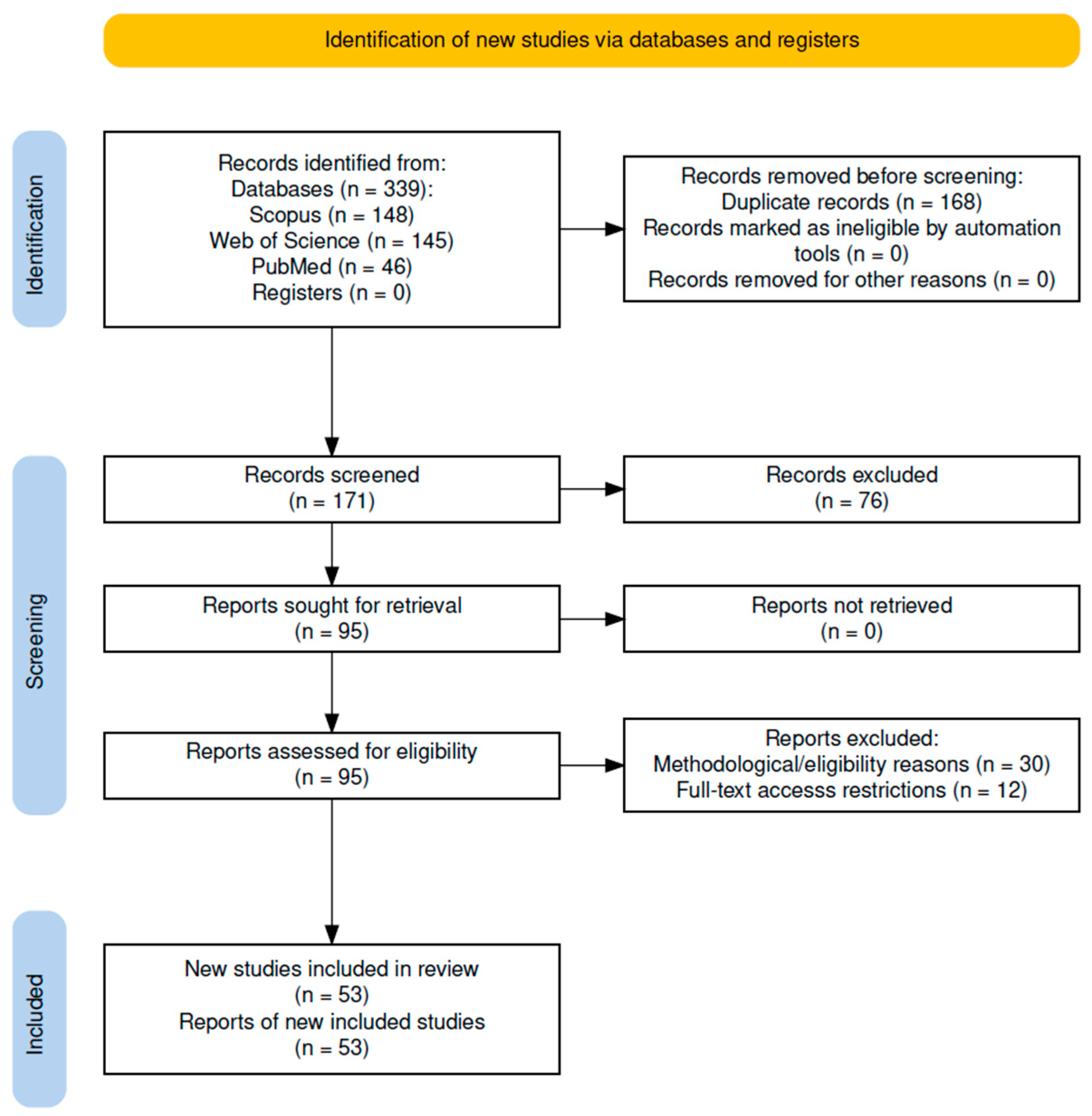
2.4. Study Selection Process
3. Results

| Domain | Findings (Evidence Map) |
|---|---|
| Scope | 23 countries; evidence ranging from youth to professional levels |
| Age range (examples) | 12.5 years [20] to 51.1 years [21] |
| Sample size (examples) | Pilot studies n = 3–6 [22] to longitudinal cohorts up to n = 125 [17] |
| Modality | Indoor n = 45 (83.3%); Beach n = 9 (16.7%) [23,24] |
| Predominant study designs | Longitudinal observational studies; validation/accuracy studies; pilot/experimental studies; systematic reviews (for mapping) |
| Primary focus | External and internal load; neuromuscular/perceptual fatigue; performance and/or injury risk |
3.1. Predominant Technologies and Metrics Used
| Technology | Typical Metrics/Outputs | Primary Applied Use | Representative Evidence |
|---|---|---|---|
| IMU (incl. VERT) | Jump count; accelerometry-derived load; algorithm-dependent jump height | External load; weekly monitoring; jump profiling | Recurrent VERT use [3,25,26,27]; weekly quantification [28,29]; jump-count validity [6]; jump-height limitations [30,31]; WIMU PRO in competition [16] |
| Force platforms (CMJ) | Jump height; force–time metrics; neuromuscular proxies | Fatigue/readiness; seasonal neuromuscular profiling | CMJ and multiple metrics [33]; reliability [31]; changes with competitive volume [34]; sex-specific references [35] |
| GPS/LPS | Distance; movement patterns; acceleration/deceleration exposure | Contextualizing demands (beach vs. indoor; role) | GPS in beach volleyball [24,25,26,27,28,29,30,31,32,33,34,35,36]; LPS in indoor volleyball [10,11,12,13,14,15,16,17,18,19,20,21,22,23,24,25,26,27,28,29,30,31,32,33,34,35,36,37]; weekly variations by intensity [38] |
| HR/HRV | Heart rate (HR); heart rate variability (HRV; e.g., rMSSD) | Internal load; autonomic status/recovery | Comparable benchmarks [39]; support within wearable frameworks [8,18] |
| Perceptual tools | Session rating of perceived exertion (s-RPE); wellness; Total Quality Recovery (TQR) | Low-cost internal monitoring; recovery | s-RPE and associations [13]; tactical-context limitations [40]; TQR associated with HRV/stress [41] |
3.2. External and Internal Load Demands by Training and Competition Context
3.3. Position-Specific Differences and Load Profiles
3.4. Neuromuscular Fatigue, Sensitive Metrics, and Predictive Relationships
3.5. Injuries, Load Variability, and Biomechanical Risk Indicators
3.6. Artificial Intelligence/Machine Learning, Non-Linear Models, and Applied Tolos
| Theme/Pattern | What the Evidence Consistently Suggests (Mapping) | Representative Evidence |
|---|---|---|
| Intensity > volume for fatigue sensitivity | Exposure to high-intensity actions (e.g., very high jumps and multidirectional acceleration demands) is more frequently reported as being associated with fatigue-sensitive outcomes than accumulated volume alone; supports monitoring the “quality” of exposure alongside quantity, within the descriptive scope of a scoping review. | Force–time associations [33]; accelerations vs. RPE/s-RPE [29] |
| Context moderates load (training/match; indoor/beach; surface) | Training sessions may accumulate higher accelerometric load than a single match due to longer exposure and the rotational structure of play; however, competition can exceed typical training load in specific scenarios. Beach volleyball generally shows higher external demands, plausibly linked to the surface, requiring context- and modality-specific interpretation. | Training vs. match [3,28]; beach vs. indoor [37]; surface-related kinetics [43] |
| Position/role differences | Load profiles differ systematically by position/role (jump exposure vs. multidirectional displacement); therefore, team-level averages can mask meaningful between-position variability and reduce applied interpretability. | Position patterns [45]; multidirectional displacement [3]; positional variability [46]; beach roles [36] |
| Multimodal monitoring improves interpretability | Integrating external load with autonomic (HRV) and perceptual (s-RPE/TQR/wellness) indicators improves interpretation of the stress–recovery balance and reduces single-metric misinterpretation; perceptual sensitivity may vary with cognitive/tactical demands, so context-aware interpretation is required. | HRV rMSSD and recovery/load [41,51]; cognitive/perceptual influence [52]; s-RPE utility and limits [13,40]; TQR [41] |
| Injury/risk: variability and asymmetries | Greater load variability is associated with injury; asymmetries and landing-related markers provide useful risk signals. Bilateral and unilateral assessments offer complementary (non-interchangeable) information about take-off/landing asymmetries. | Variability and injuries [27]; asymmetries [54]; biomechanical markers [55,56,57]; bilateral vs. unilateral complementarity [58] |
| Women-specific biological moderators (cross-cutting gap) | Despite the women-focused scope, women-specific biological moderators (e.g., menstrual-cycle-related variables or other biological modulators) are incorporated infrequently and unsystematically, limiting transfer to truly individualized monitoring. | Calls for sex-specific reference curves/thresholds for metric and risk interpretation [35] |
| AI/ML: potential with validation and transfer barriers | AI/ML evidence is less prevalent than monitoring-only studies; it mainly targets multi-source integration and prediction/estimation (fatigue/readiness/performance). Applied adoption is constrained by recurring gaps in external validation, cross-context generalization, and interpretability/calibration requirements. | Non-linear models and prediction [14]; applied biofeedback [61]; LLMs as complementary tools [62] |
4. Discussion
4.1. Main Interpretation of the Findings
4.2. Limitations
5. Conclusions
Supplementary Materials
Author Contributions
Funding
Institutional Review Board Statement
Informed Consent Statement
Data Availability Statement
Acknowledgments
Conflicts of Interest
Abbreviations
| ACWR | Acute:Chronic Workload Ratio |
| AI | Artificial Intelligence |
| CMJ | Countermovement Jump |
| EWMA | Exponentially Weighted Moving Average |
| HR | Heart Rate |
| GPS | Global Positioning System |
| HRV | Heart Rate Variability |
| ICC | Intraclass Correlation Coefficient |
| IMU | Inertial Measurement Unit |
| LLM | Large Language Model |
| LPS | Local Positioning System |
| MeSH | Medical Subject Heading |
| PPG | Photoplethysmography |
| rMSSD | Root Mean Square of Successive Differences |
| RPE | Rating of Perceived Exertion |
| Session-RPE (s-RPE) | Session Rating of Perceived Exertion |
| STR | Stress Score (Workload Metric) |
| UWB | Ultra-Wideband |
| VO2max | Maximal Oxygen Uptake |
References
- Armstrong, L.E.; Bergeron, M.F.; Lee, E.C.; Mershon, J.E.; Armstrong, E.M. Overtraining syndrome as a complex systems phenomenon. Front. Netw. Physiol. 2022, 1, 794392. [Google Scholar] [CrossRef]
- Neumann, N.D.; Brauers, J.J.; van Yperen, N.W.; van der Linde, M.; Lemmink, K.A.P.M.; Brink, M.S.; Hasselman, F.; den Hartigh, R.J.R. Critical fluctuations as an early warning signal of sports injuries? A proof of concept using football monitoring data. Sports Med. Open 2024, 10, 129. [Google Scholar] [CrossRef] [PubMed]
- Kupperman, N.; Curtis, M.A.; Saliba, S.A.; Hertel, J. Quantification of workload and wellness measures in a women’s collegiate volleyball season. Front. Sports Act. Living 2021, 3, 702419. [Google Scholar] [CrossRef] [PubMed]
- Seshadri, D.R.; Thom, M.L.; Harlow, E.R.; Gabbett, T.J.; Geletka, B.J.; Hsu, J.J.; Drummond, C.K.; Phelan, D.M.; Voos, J.E. Wearable technology and analytics as a complementary toolkit to optimize workload and to reduce injury burden. Front. Sports Act. Living 2021, 2, 630576. [Google Scholar] [CrossRef] [PubMed]
- Seshadri, D.R.; Li, R.T.; Voos, J.E.; Rowbottom, J.R.; Alfes, C.M.; Zorman, C.A.; Drummond, C.K. Wearable sensors for monitoring the internal and external workload of the athlete. npj Digit. Med. 2019, 2, 71. [Google Scholar] [CrossRef]
- Villarejo-García, D.H.; Moreno-Villanueva, A.; Soler-López, A.; Reche-Soto, P.; Pino-Ortega, J. Use, Validity and Reliability of Inertial Movement Units in Volleyball: Systematic Review of the Scientific Literature. Sensors 2023, 23, 3960. [Google Scholar] [CrossRef]
- Claudino, J.G.; Capanema, D.O.; de Souza, T.V.; Serrão, J.C.; Machado Pereira, A.C.; Nassis, G.P. Current approaches to the use of artificial intelligence for injury risk assessment and performance prediction in team sports: A systematic review. Sports Med. Open 2019, 5, 28. [Google Scholar] [CrossRef]
- Rebelo, A.; Pereira, J.R.; Nakamura, F.Y.; Valente-dos-Santos, J. Beyond the jump: A scoping review of external training load metrics in volleyball. Sports Health 2025, 17, 111–125. [Google Scholar] [CrossRef]
- Vavassori, R.; Moreno Arroyo, M.P.; Espa, A.U. Training load and players’ readiness monitoring methods used in volleyball: A systematic review. Kinesiology 2024, 56, 61–77. [Google Scholar] [CrossRef]
- Akyildiz, Z.; de Oliveira Castro, H.; Çene, E.; Laporta, L.; Parim, C.; Altundağ, E.; Akarçeşme, C.; Guidetti, G.; Miale, G.; Silva, A.F.; et al. Within-week differences in external training load demands in elite volleyball players. BMC Sports Sci. Med. Rehabil. 2022, 14, 188. [Google Scholar] [CrossRef]
- Young, W.K.; Briner, W.; Dines, D.M. Epidemiology of common injuries in the volleyball athlete. Curr. Rev. Musculoskelet. Med. 2023, 16, 229–234. [Google Scholar] [CrossRef] [PubMed]
- Haupenthal, A.; Bufon, T.; dos Santos, M.C.; Matte, L.M.; Dell’Antonio, E.; Franco, F.M.; Pecegueiro do Amaral, N.C.; dos Santos Costa, L.; Nunes, G.S. Injuries and complaints in the Brazilian national volleyball male team: A case study. BMC Sports Sci. Med. Rehabil. 2023, 15, 77. [Google Scholar] [CrossRef]
- Tometz, M.J.; Jevas, S.A.; Esposito, P.M.; Annaccone, A.R. Validation of internal and external load metrics in NCAA D1 women’s beach volleyball. J. Strength Cond. Res. 2022, 36, 2223–2229. [Google Scholar] [CrossRef] [PubMed]
- Bouzigues, T.; Candau, R.; Äyrämö, S.; Maurelli, O.; Prioux, J. Quantification of workload and characterisation of key performance factors in elite adolescent female volleyball players using machine learning. Int. J. Perform. Anal. Sport Early Online 2024, 25, 610–626. [Google Scholar] [CrossRef]
- Setuain, I.; Berriel, G.; Lanz, D.; Schons, P.; Bianchi, H.; Grazioli, R.; Peyré-Tartaruga, L.; Garcia-Tabar, I.; Cadore, E. Jump performance and mechanics after a regular training bout in elite volleyball players. J. Sports Med. Phys. Fit. 2022, 62, 633–640. [Google Scholar] [CrossRef]
- Marzano-Felisatti, J.M.; Pino-Ortega, J.; García-de-Alcaraz, A.; Portillo, J.; Guzmán-Luján, J.F.; Priego-Quesada, J.I. Validation of the WIMU PROTMDevice for Jump Detection in Beach Volleyball: A Gender-Based Analysis during Official Competitions. J. Hum. Kinet. 2025, 98, 183–193. [Google Scholar] [CrossRef]
- Liao, L.; Li, J. Research on effect of load stimulation change on heart rate variability of women volleyball athletes. Comput. Comput. Intell. Neurosci. 2022, 2022, 3917415. [Google Scholar] [CrossRef]
- Rebelo, A.; Teixeira, D.S.; Martinho, D.V.; Valente-dos-Santos, J.; Coelho-e-Silva, M.J. From data to action: A scoping review of wearable technologies and biomechanical assessments informing injury prevention strategies in sport. BMC Sports Sci. Med. Rehabil. 2023, 15, 169. [Google Scholar] [CrossRef]
- Aromataris, E.; Lockwood, C.; Porritt, K.; Pilla, B.; Jordan, Z. (Eds.) JBI Manual for Evidence Synthesis; JBI: Adelaide, Australia, 2024. [Google Scholar] [CrossRef]
- Bertozzi, F.; Brunetti, C.; Maver, P.; Galli, M.; Tarabini, M. The role of age and maturation on jump performance and postural control in female adolescent volleyball players over a season. BMC Sports Sci. Med. Rehabil. 2025, 17, 85. [Google Scholar] [CrossRef]
- Nikolaidou, M.-E.; Sotiropoulos, K.; Barzouka, K. Postural balance ability and vertical jumping performance in female veteran volleyball athletes and non-athletes. Front. Sports Act. Living 2023, 5, 1109488. [Google Scholar] [CrossRef]
- Andrade, A.; Simim, M.; Kassiano, W.; Palao, J.; De Jesus, K.; Maia, N.; Assumpção, C.; Medeiros, A.I. Do differences between the training load perceived by elite beach volleyball players and that planned by coaches affect neuromuscular function? Retos 2020, 38, 632–636. [Google Scholar] [CrossRef]
- Pelzer, T.; Schmidt, M.; Jaitner, T.; Pfeiffer, M. External training load and the effects on training response following three different training sessions in young elite beach volleyball players. Int. J. Sports Sci. Coach. 2020, 15, 717–727. [Google Scholar] [CrossRef]
- Bellinger, P.M.; Newans, T.; Whalen, M.; Minahan, C. Quantifying the activity profile of female beach volleyball tournament match-play. J. Sports Sci. Med. 2021, 20, 142–148. [Google Scholar] [CrossRef] [PubMed]
- Foster, E.; Bunn, J.A. Comparison of external load across multi-day tournaments in female youth volleyball athletes. Youth 2024, 4, 1152–1157. [Google Scholar] [CrossRef]
- Sanders, G.J.; Skodinski, S.; Peacock, C.A. Impact of early season jump loads on neuromuscular performance in Division I volleyball: Analyzing force, velocity, and power from countermovement jump tests. Transl. Sports Med. 2025, 2025, 7216781. [Google Scholar] [CrossRef]
- Taylor, J.B.; Barnes, H.C.; Gombatto, S.P.; Greenwood, D.; Ford, K.R. Quantifying external load and injury occurrence in women’s collegiate volleyball players across a competitive season. J. Strength Cond. Res. 2022, 36, 805–812. [Google Scholar] [CrossRef]
- Bozzini, B.N.; McFadden, B.A.; Scruggs, S.K.; Arent, S.M. Evaluation of performance characteristics and internal and external training loads in female collegiate beach volleyball players. J. Strength Cond. Res. 2021, 35, 1559–1567. [Google Scholar] [CrossRef]
- Pawlik, D.; Mroczek, D. Fatigue and training load factors in volleyball. Int. J. Environ. Res. Public Health 2022, 19, 11149. [Google Scholar] [CrossRef]
- Jiménez-Olmedo, J.M.; Pueo, B.; Mossi, J.M.; Villalon-Gasch, L. Concurrent validity of the inertial measurement unit Vmaxpro in vertical jump estimation. Appl. Sci. 2023, 13, 959. [Google Scholar] [CrossRef]
- Marković, S.; Dopsaj, M.; Tomažič, S.; Kos, A.; Nedeljković, A.; Umek, A. Can IMU provide an accurate vertical jump height estimate? Appl. Sci. 2021, 11, 12025. [Google Scholar] [CrossRef]
- Pisa, M.F.; Zecchin, A.M.; Gomes, L.G.; Norberto, M.S.; Puggina, E.F. Internal load in male professional volleyball: A systematic review. J. Sports Med. Phys. Fit. 2022, 62, 1465–1473. [Google Scholar] [CrossRef] [PubMed]
- Sanders, G.J.; Skodinski, S.; Peacock, C.A. Analyzing the impact of various jump load intensities on countermovement jump metrics: A comparison of average, peak, and peak-to-average ratios in force-based metrics. Sensors 2025, 25, 151. [Google Scholar] [CrossRef] [PubMed]
- Kipp, K.; Kiely, M.; Geiser, C. Competition volume and changes in countermovement jump biomechanics and motor signatures in female collegiate volleyball players. J. Strength Cond. Res. 2021, 35, 970–975. [Google Scholar] [CrossRef] [PubMed]
- Sharma, M.; Singh, A. A cross-sectional study on gender and sports specific biomechanical analysis of countermovement jump force, velocity, power and time parameters in Indian players. J. Bodyw. Mov. Ther. 2025, 43, 221–227. [Google Scholar] [CrossRef]
- João, P.V.; Medeiros, A.; Ortigão, H.; Lee, M.; Mota, M.P. Global position analysis during official elite female beach volleyball competition: A pilot study. Appl. Sci. 2021, 11, 9382. [Google Scholar] [CrossRef]
- Hank, M.; Cabell, L.; Zahalka, F.; Miřátský, P.; Cabrnoch, B.; Mala, L.; Maly, T. Differences in external load among indoor and beach volleyball players during elite matches. PeerJ 2024, 12, e16736. [Google Scholar] [CrossRef]
- Lima, R.; Silva, B.; Gracinda, A.; Silva, A.F.; Pereira, J.; Silva, R.M.; Clemente, F.M. Week-to-week variations of internal and external intensity measures in professional women volleyball players. Int. J. Sports Sci. Coach. 2024, 19, 294–300. [Google Scholar]
- Cardoso, A.S.; Klein, L.; Harden, L.; Kruel, L.F.M.; Costa, R.R. Heart rate profile and heart rate variability in volleyball athletes: A systematic review with meta-analyses. Mot. Rev. Educ. Física 2022, 28. [Google Scholar] [CrossRef]
- Lupo, C.; Ungureanu, A.N.; Brustio, P.R. Session-RPE is a valuable internal loading evaluation method in beach volleyball for both genders, elite and amateur players, conditioning and technical sessions, but limited for tactical training and games. Kinesiology 2020, 52, 30–38. [Google Scholar] [CrossRef]
- Miranda-Mendoza, J.; Hernández-Cruz, G.; Reynoso-Sánchez, L.F.; González-Fimbres, R.A.; Cejas Hernández, B.A. Control of recovery using the Total Quality Recovery (TQR) scale during four accumulation microcycles and its relationship to physiological factors. Retos 2023, 50, 1155–1162. [Google Scholar] [CrossRef]
- Vavassori, R.; Moreno, M.P.; Ureña Espa, A. The perception of volleyball student-athletes: Evaluation of well-being, sport workload, players’ response, and academic demands. Healthcare 2023, 11, 1538. [Google Scholar] [CrossRef]
- Giatsis, G.; Panoutsakopoulos, V.; Frese, C.; Kollias, I.A. Vertical jump kinetic parameters on sand and rigid surfaces in young female volleyball players with a combined background in indoor and beach volleyball. J. Funct. Morphol. Kinesiol. 2023, 8, 115. [Google Scholar] [CrossRef] [PubMed]
- Edmonds, R.; Schmidt, B.; Siedlik, J. Eligibility classification as a factor in understanding student-athlete responses to collegiate volleyball competition. Sports 2021, 9, 43. [Google Scholar] [CrossRef] [PubMed]
- Sanders, G.J.; Skodinski, S.; Cabarkapa, D.V.; Howard, M.; Cabarkapa, D.; Peacock, C.A. Positional differences in jump loads and force and velocity metrics throughout a 16-week Division I volleyball season. Transl. Sports Med. 2024, 2024, 5933923. [Google Scholar] [CrossRef]
- Makaracı, Y.; Makaracı, M.; Zorba, E.; Lautenbach, F. A pilot study of the biofeedback training to reduce salivary cortisol level and improve mental health in highly-trained female athletes. Appl. Psychophysiol. Biofeedback 2023, 48, 357–367. [Google Scholar] [CrossRef]
- Fuchs, P.X.; Mitteregger, J.; Hoelbling, D.; Menzel, H.-J.K.; Bell, J.W.; von Duvillard, S.P.; Wagner, H. Relationship between general jump types and spike jump performance in elite female and male volleyball players. Appl. Sci. 2021, 11, 1105. [Google Scholar] [CrossRef]
- Ungureanu, A.N.; Brustio, P.R.; Boccia, G.; Rainoldi, A.; Lupo, C. Effects of presession well-being perception on internal training load in female volleyball players. Int. J. Sports Physiol. Perform. 2021, 16, 622–627. [Google Scholar] [CrossRef]
- Ungureanu, A.N.; Lupo, C.; Boccia, G.; Brustio, P.R. Internal training load affects day-after-pretraining perceived fatigue in female volleyball players. Int. J. Sports Physiol. Perform. 2021, 16, 1844–1850. [Google Scholar] [CrossRef]
- Schumann, C.; Wojciechowski, M.; Bunn, J.A. Comparing two methods of acute: Chronic workload calculations in girls’ youth volleyball. Sports 2023, 11, 51. [Google Scholar] [CrossRef]
- Rabbani, M.; Agha-Alinejad, H.; Gharakhanlou, R.; Rabbani, A.; Flatt, A.A. Monitoring training in women’s volleyball: Supine or seated heart rate variability? Physiol. Behav. 2021, 240, 113537. [Google Scholar] [CrossRef]
- Coyne, J.O.C.; Coutts, A.J.; Newton, R.U.; Haff, G.G. The influence of mental fatigue on sessional ratings of perceived exertion in elite open and closed skill sports athletes. J. Strength Cond. Res. 2021, 35, 936–969. [Google Scholar] [CrossRef]
- Tsarbou, C.; Liveris, N.I.; Tsimeas, P.D.; Papageorgiou, G.; Xergia, S.A.; Tsiokanos, A. The effect of fatigue on jump height and the risk of knee injury after a volleyball training game: A pilot study. Biomed. Hum. Kinetics. Univ. Phys. Educ. Wars. 2021, 13, 197–204. [Google Scholar] [CrossRef]
- Bartol, V.; Vauhnik, R.; Rugelj, D. Influence of the sport specific training background on the symmetry of the single legged vertical counter movement jump among female ballet dancers and volleyball players. Heliyon 2022, 8, e10669. [Google Scholar] [CrossRef] [PubMed]
- Marotta, N.; Demeco, A.; Moggio, L.; Isabello, L.; Iona, T.; Ammendolia, A. Correlation between dynamic knee valgus and quadriceps activation time in female athletes. J. Phys. Educ. Sport 2020, 20, 2508–2512. [Google Scholar] [CrossRef]
- Patti, A.; Gervasi, M.; Giustino, V.; Figlioli, F.; Canzone, A.; Drid, P.; Thomas, E.; Messina, G.; Vicari, D.S.S.; Palma, A.; et al. The influence of ankle mobility and foot stability on jumping ability and landing mechanics: A cross-sectional study. J. Funct. Morphol. Kinesiol. 2024, 9, 160. [Google Scholar] [CrossRef] [PubMed]
- Uslu, S.; Abazović, E.; Čaušević, D.; Mahmutović, I.; Riza, B. The relationship between isokinetic strength and jump performance in elite female volleyball players. Acta Kinesiol. 2021, 15, 127–131. [Google Scholar] [CrossRef]
- Cabarkapa, D.; Cabarkapa, D.V.; Fry, A.C. Inter-limb asymmetries in professional male basketball and volleyball players: Bilateral vs. unilateral jump comparison. Int. Biomech. 2025, 12, 28–34. [Google Scholar] [CrossRef]
- Karabel, F.; Makaracı, Y. Optimal recovery time for post-activation performance enhancement after an acute bout of plyometric exercise on unilateral countermovement jump and postural sway in national-level female volleyball players. Appl. Sci. 2025, 15, 4079. [Google Scholar] [CrossRef]
- Holtgeerts, R.N.; Gann, J.; Jung, H.C.; Hey, W. The impact of recovery time on performance in Division I collegiate beach volleyball players. J. Strength Cond. Res. 2022, 36, 667–673. [Google Scholar] [CrossRef]
- Bonnette, S.; DiCesare, C.A.; Kiefer, A.W.; Riley, M.A.; Barber Foss, K.D.; Thomas, S.; Diekfuss, J.A.; Myer, G.D. A technical report on the development of a real-time visual biofeedback system to optimize motor learning and movement deficit correction. J. Sports Sci. Med. 2020, 19, 84–94. [Google Scholar]
- Pajo, L.S.; Rabuya, R.; Andacao, A.; Tuano, A.M.S.; Lobo, J. A 10-week Large Language Model (LLM)-generated versus human-made volleyball training program on the jumping performance of collegiate volleyball athletes. J. Phys. Educ. 2025, 36. [Google Scholar] [CrossRef]
- Tricco, A.C.; Lillie, E.; Zarin, W.; O’Brien, K.K.; Colquhoun, H.; Levac, D.; Moher, D.; Peters, M.D.J.; Horsley, T.; Weeks, L.; et al. PRISMA Extension for Scoping Reviews (PRISMAScR): Checklist and Explanation. Ann. Intern. Med. 2018, 169, 467–473. [Google Scholar] [CrossRef] [PubMed]

| Population (P) | Female volleyball athletes participating at any organized competitive level, including competitive amateur, scholastic, regional, collegiate, national, semi-professional, and professional categories. |
| Concept (C) | Non-invasive monitoring technologies to quantify external and internal load, neuromuscular/perceptual fatigue, and/or performance readiness, and artificial intelligence/machine learning (AI/ML) approaches used for multi-source integration, classification, or prediction (e.g., fatigue/readiness). AI/ML will be considered only when models are trained with an explicit validation procedure and report performance metrics, distinguishing them from conventional statistical analyses. |
| Context (C) | Training and competition environments, including laboratory-based studies that evaluate technologies or algorithms applicable to game contexts, considering sport-specific execution actions such as explosive tasks, multiple directional changes, and essential technical–tactical components of the discipline. |
Disclaimer/Publisher’s Note: The statements, opinions and data contained in all publications are solely those of the individual author(s) and contributor(s) and not of MDPI and/or the editor(s). MDPI and/or the editor(s) disclaim responsibility for any injury to people or property resulting from any ideas, methods, instructions or products referred to in the content. |
© 2026 by the authors. Licensee MDPI, Basel, Switzerland. This article is an open access article distributed under the terms and conditions of the Creative Commons Attribution (CC BY) license.
Share and Cite
Sanhueza Tapia, H.G.; Giakoni-Ramírez, F.; de Souza-Lima, J.; Diaz Suarez, A. Machine Learning and Non-Invasive Monitoring Technologies for Training Load Management in Women’s Volleyball: A Scoping Review. Sports 2026, 14, 74. https://doi.org/10.3390/sports14020074
Sanhueza Tapia HG, Giakoni-Ramírez F, de Souza-Lima J, Diaz Suarez A. Machine Learning and Non-Invasive Monitoring Technologies for Training Load Management in Women’s Volleyball: A Scoping Review. Sports. 2026; 14(2):74. https://doi.org/10.3390/sports14020074
Chicago/Turabian StyleSanhueza Tapia, Héctor Gabriel, Frano Giakoni-Ramírez, Josivaldo de Souza-Lima, and Arturo Diaz Suarez. 2026. "Machine Learning and Non-Invasive Monitoring Technologies for Training Load Management in Women’s Volleyball: A Scoping Review" Sports 14, no. 2: 74. https://doi.org/10.3390/sports14020074
APA StyleSanhueza Tapia, H. G., Giakoni-Ramírez, F., de Souza-Lima, J., & Diaz Suarez, A. (2026). Machine Learning and Non-Invasive Monitoring Technologies for Training Load Management in Women’s Volleyball: A Scoping Review. Sports, 14(2), 74. https://doi.org/10.3390/sports14020074