

Six Weeks of Boxing Training Lowers Blood Pressure and Improves Vascular Function in Young Men and Women with Elevated Blood Pressure or Stage 1 Hypertension †
 , ,
, , 
Abstract
1. Introduction
2. Materials and Methods
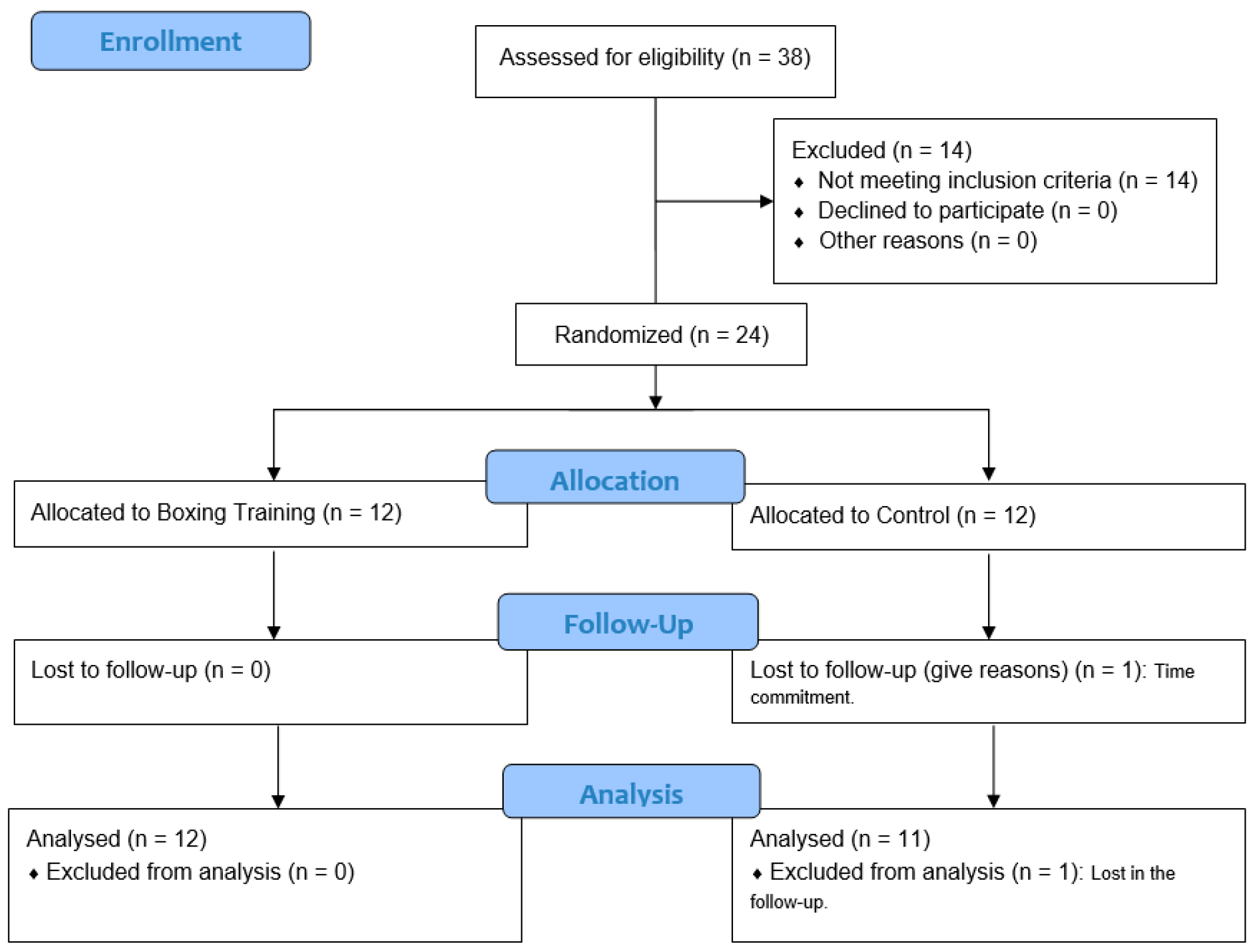
2.1. Participants
2.2. Protocol
2.3. Measurements
2.3.1. Brachial Blood Pressure
2.3.2. Central Blood Pressure
2.3.3. Pulse Wave Velocity
2.3.4. Flow-Mediated Dilation
2.3.5. Forearm and Calf Blood Flow
2.3.6. Forearm and Calf Blood Flow During Reactive Hyperemia
2.3.7. Carotid Artery Ultrasound
2.3.8. Endothelial Shear Stress Estimations
2.3.9. Antecubital Vein Blood Collection
2.4. Interventions
2.4.1. Boxing Training
2.4.2. Flexibility and Balance Training (Control)
2.5. Statistical Analysis
3. Results
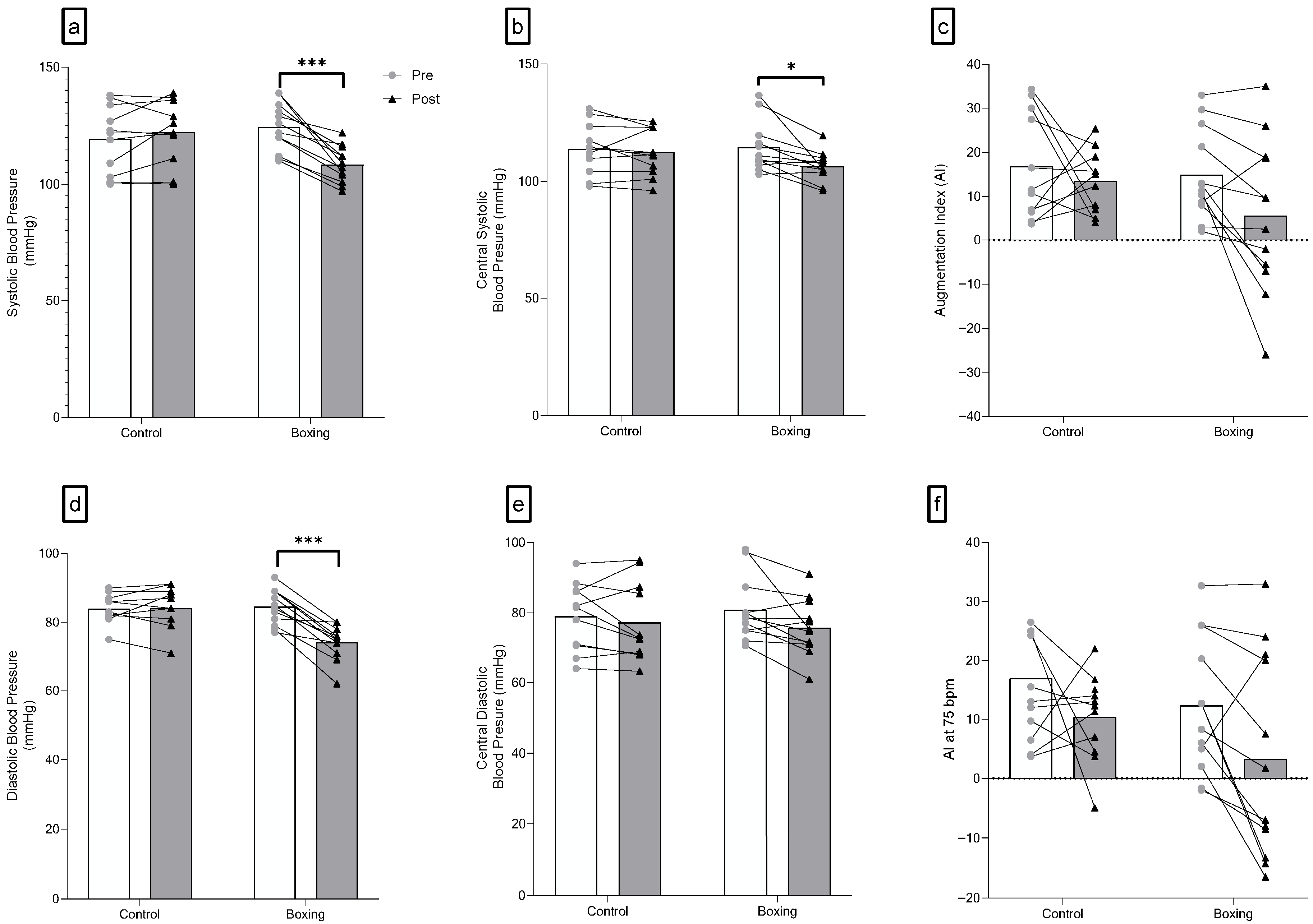
3.1. Peripheral Blood Pressure
3.2. Pulse Wave Analysis
3.3. Arterial Stiffness
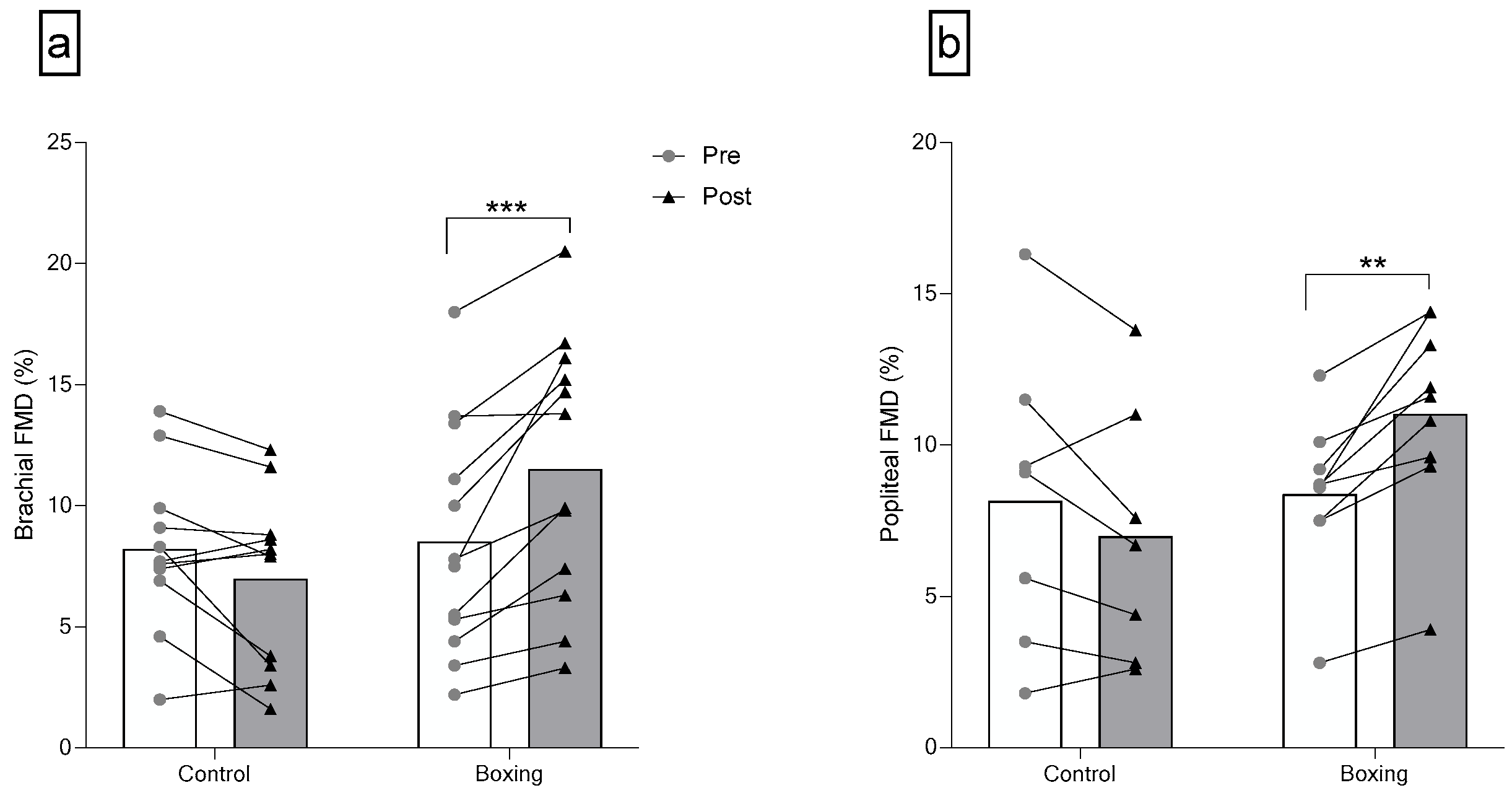
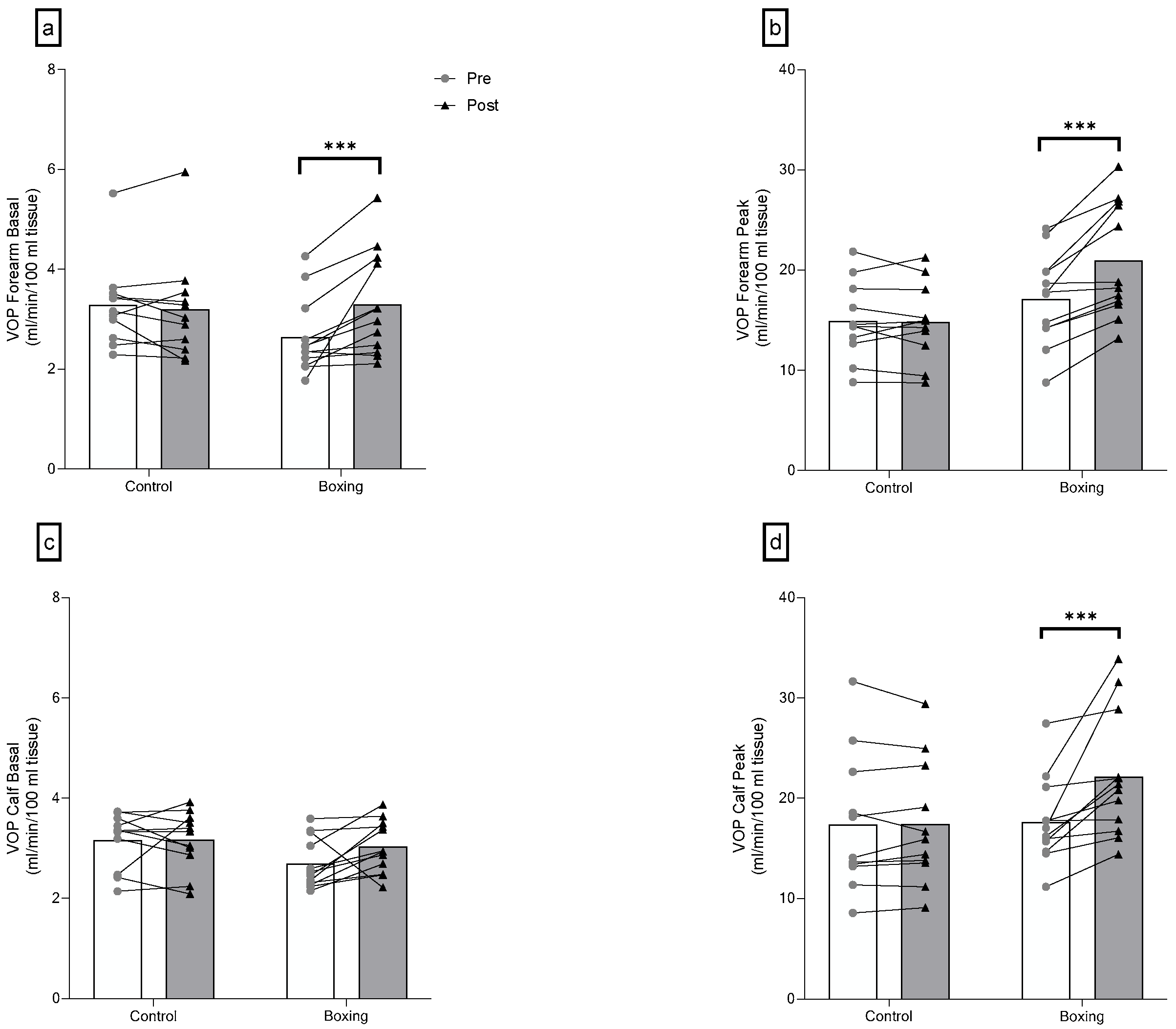
3.4. Vascular Adaptations
3.5. Nitric Oxide Bioavailability
3.6. Inflammation
3.7. Oxidative Stress
4. Discussion
4.1. Peripheral and Central Blood Pressure
4.2. Arterial Stiffness
4.3. Vascular Adaptations
4.4. Nitric Oxide Bioavailability
4.5. Inflammation
4.6. Oxidative Stress
5. Conclusions
Supplementary Materials
Author Contributions
Funding
Institutional Review Board Statement
Informed Consent Statement
Data Availability Statement
Conflicts of Interest
Abbreviations
| ACC/AHA | American College of Cardiology/American Heart Association |
| AIx | Augmentation index |
| AIx@75 | Augmentation index normalized to a heart rate of 75 bpm |
| ANOVA | Analysis of variance |
| CBF | Calf blood flow |
| cSBP | Central systolic blood pressure |
| cDBP | Central diastolic blood pressure |
| cPP | Central pulse pressure |
| cAIx | Central augmentation index |
| CVD | Cardiovascular diseases |
| D | Diameter |
| DBP | Diastolic blood pressure |
| ESS | Endothelial shear stress |
| FBF | Forearm blood flow |
| FMD | Flow-mediated dilation |
| LVEW | Left ventricular energy |
| NO | Nitric oxide |
| NOx | Nitric oxide metabolites nitrite/nitrate |
| PP | Pulse pressure |
| PWA | Pulse wave analysis |
| PWVcf | Pulse wave velocity carotid–femoral |
| RPE | Rate of perceived exertion |
| SBP | Systolic blood pressure |
| SD | Standard deviation |
| VOP | Venous occlusion plethysmography |
References
- Benjamin, E.J.; Blaha, M.J.; Chiuve, S.E.; Cushman, M.; Das, S.R.; Deo, R.; de Ferranti, S.D.; Floyd, J.; Fornage, M.; Gillespie, C.; et al. Heart Disease and Stroke Statistics-2017 Update: A Report from the American Heart Association. Circulation 2017, 135, e146–e603. [Google Scholar] [CrossRef]
- Williams, B.; Mancia, G.; Spiering, W.; Agabiti Rosei, E.; Azizi, M.; Burnier, M.; Clement, D.L.; Coca, A.; de Simone, G.; Dominiczak, A.; et al. 2018 Esc/Esh Guidelines for the Management of Arterial Hypertension. Eur. Heart J. 2018, 39, 3021–3104. [Google Scholar] [CrossRef]
- Egan, B.M.; Stevens-Fabry, S. Prehypertension—Prevalence, Health Risks, and Management Strategies. Nat. Rev. Cardiol. 2015, 12, 289–300. [Google Scholar] [CrossRef]
- Oparil, S.; Acelajado, M.C.; Bakris, G.L.; Berlowitz, D.R.; Cifkova, R.; Dominiczak, A.F.; Grassi, G.; Jordan, J.; Poulter, N.R.; Rodgers, A.; et al. Hypertension. Nat. Rev. Dis. Primers 2018, 4, 18014. [Google Scholar] [CrossRef]
- Harrison, D.G. The Mosaic Theory Revisited: Common Molecular Mechanisms Coordinating Diverse Organ and Cellular Events in Hypertension. J. Am. Soc. Hypertens. 2013, 7, 68–74. [Google Scholar] [CrossRef]
- Laughlin, M.H.; Newcomer, S.C.; Bender, S.B. Importance of Hemodynamic Forces as Signals for Exercise-Induced Changes in Endothelial Cell Phenotype. J. Appl. Physiol. (1985) 2008, 104, 588–600. [Google Scholar] [CrossRef] [PubMed]
- Ecobici, M.; Stoicescu, C. Arterial Stiffness and Hypertension—Which Comes First? Maedica 2017, 12, 184–190. [Google Scholar] [PubMed]
- Zieman, S.J.; Melenovsky, V.; Kass, D.A. Mechanisms, Pathophysiology, and Therapy of Arterial Stiffness. Arterioscler. Thromb. Vasc. Biol. 2005, 25, 932–943. [Google Scholar] [CrossRef]
- Whelton, P.K.; Carey, R.M.; Aronow, W.S.; Casey, D.E., Jr.; Collins, K.J.; Dennison Himmelfarb, C.; DePalma, S.M.; Gidding, S.; Jamerson, K.A.; Jones, D.W.; et al. 2017 Acc/Aha/Aapa/Abc/Acpm/Ags/Apha/Ash/Aspc/Nma/Pcna Guideline for the Prevention, Detection, Evaluation, and Man-agement of High Blood Pressure in Adults: A Report of the American College of Cardiology/American Heart Association Task Force on Clinical Practice Guidelines. J. Am. Coll. Cardiol. 2018, 71, e127–e248. [Google Scholar] [PubMed]
- Cornelissen, V.A.; Smart, N.A. Exercise Training for Blood Pressure: A Systematic Review and Meta-Analysis. J. Am. Heart Assoc. 2013, 2, e004473. [Google Scholar] [CrossRef]
- Green, D.J.; Hopman, M.T.E.; Padilla, J.; Laughlin, M.H.; Thijssen, D.H.J. Vascular Adaptation to Exercise in Humans: Role of Hemodynamic Stimuli. Physiol. Rev. 2017, 97, 495–528. [Google Scholar] [CrossRef]
- Cheema, B.S.; Davies, T.B.; Stewart, M.; Papalia, S.; Atlantis, E. The Feasibility and Effectiveness of High-Intensity Boxing Training Versus Moderate-Intensity Brisk Walking in Adults with Abdominal Obesity: A Pilot Study. BMC Sports Sci. Med. Rehabil. 2015, 7, 3. [Google Scholar] [CrossRef]
- Shultz, S.P.; Stoner, L.; Lambrick, D.M.; Lane, A.M. A Boxing-Oriented Exercise Intervention for Obese Adolescent Males: Findings from a Pilot Study. J. Sports Sci. Med. 2014, 13, 751–757. [Google Scholar]
- Park, J.; Gong, J.; Yim, J. Effects of a Sitting Boxing Program on Upper Limb Function, Balance, Gait, and Quality of Life in Stroke Patients. NeuroRehabilitation 2017, 40, 77–86. [Google Scholar] [CrossRef]
- Combs, S.A.; Diehl, M.D.; Staples, W.H.; Conn, L.; Davis, K.; Lewis, N.; Schaneman, K. Boxing Training for Patients with Parkinson Disease: A Case Series. Phys. Ther. 2011, 91, 132–142. [Google Scholar] [CrossRef] [PubMed]
- Butlin, M.; Qasem, A.; Avolio, A.P. Estimation of Central Aortic Pressure Waveform Features Derived from the Brachial Cuff Volume Displacement Waveform. In Proceedings of the 2012 34th Annual International Conference of the IEEE Engineering in Medicine and Biology Society (EMBC), San Diego, CA, USA, 28 August–1 September 2012; pp. 2591–2594. [Google Scholar]
- Martin, J.S.; Beck, D.T.; Gurovich, A.N.; Braith, R.W. The Acute Effects of Smokeless Tobacco on Central Aortic Blood Pressure and Wave Reflection Characteristics. Exp. Biol. Med. 2010, 235, 1263–1268. [Google Scholar] [CrossRef]
- Gurovich, A.N.; Braith, R.W. Pulse Wave Analysis and Pulse Wave Velocity Techniques: Are They Ready for the Clinic? Hypertens. Res. 2011, 34, 166–169. [Google Scholar] [CrossRef]
- Martin, J.S.; Casey, D.P.; Gurovich, A.N.; Beck, D.T.; Braith, R.W. Association of Age with Timing and Amplitude of Reflected Pressure Waves During Exercise in Men. Am. J. Hypertens. 2011, 24, 415–420. [Google Scholar] [CrossRef] [PubMed][Green Version]
- Gurovich, A.N.; Beck, D.T.; Braith, R.W. Aortic Pulse Wave Analysis Is Not a Surrogate for Central Arterial Pulse Wave Velocity. Exp. Biol. Med. 2009, 234, 1339–1344. [Google Scholar] [CrossRef] [PubMed]
- Townsend, R.R.; Wilkinson, I.B.; Schiffrin, E.L.; Avolio, A.P.; Chirinos, J.A.; Cockcroft, J.R.; Heffernan, K.S.; Lakatta, E.G.; McEniery, C.M.; Mitchell, G.F.; et al. Recommendations for Improving and Standardizing Vascular Research on Arterial Stiffness: A Scientific Statement from the American Heart Association. Hypertension 2015, 66, 698–722. [Google Scholar] [CrossRef]
- Townsend, R.R. Arterial Stiffness: Recommendations and Standardization. Pulse 2017, 4 (Suppl. 1), 3–7. [Google Scholar] [CrossRef]
- Wilkinson, I.B.; McEniery, C.M.; Schillaci, G.; Boutouyrie, P.; Segers, P.; Donald, A.; Chowienczyk, P.J. Artery Society Guidelines for Validation of Non-Invasive Haemodynamic Measurement Devices: Part 1, Arterial Pulse Wave Velocity. Artery Res. 2010, 4, 34−40. [Google Scholar] [CrossRef]
- Hwang, M.-H.; Yoo, J.-K.; Kim, H.-K.; Hwang, C.-L.; Mackay, K.; Hemstreet, O.; Nichols, W.W.; Christou, D.D. Validity and Reliability of Aortic Pulse Wave Velocity and Augmentation Index Determined by the New Cuff-Based Sphygmocor Xcel. J. Hum. Hypertens. 2014, 28, 475–481. [Google Scholar] [CrossRef]
- Salvi, P. Pulse Waves: How Vascular Hemodynamics Affects Blood Pressure, 2nd ed.; Springer: Berlin/Heidelberg, Germany, 2018. [Google Scholar]
- Corretti, M.C.; Anderson, T.J.; Benjamin, E.J.; Celermajer, D.; Charbonneau, F.; Creager, M.A.; Deanfield, J.; Drexler, H.; Gerhard-Herman, M.; Herrington, D.; et al. Guidelines for the Ultrasound Assessment of Endothelial-Dependent Flow-Mediated Vasodilation of the Brachial Arterya Report of the International Brachial Artery Reactivity Task Force. J. Am. Coll. Cardiol. 2002, 39, 257–265. [Google Scholar] [CrossRef]
- Harris, R.A.; Nishiyama, S.K.; Wray, D.W.; Richardson, R.S. Ultrasound Assessment of Flow-Mediated Dilation. Hypertension 2010, 55, 1075–1085. [Google Scholar] [CrossRef]
- Thijssen, D.H.J.; Bruno, R.M.; Van Mil, A.C.C.M.; Holder, S.M.; Faita, F.; Greyling, A.; Zock, P.L.; Taddei, S.; Deanfield, J.E.; Luscher, T.; et al. Expert Consensus and Evidence-Based Recommendations for the Assessment of Flow-Mediated Dilation in Humans. Eur. Heart J. 2019, 40, 2534–2547. [Google Scholar] [CrossRef]
- Sonka, M.; Liang, W.; Lauer, R. Automated Analysis of Brachial Ultrasound Image Sequences: Early Detection of Cardiovascular Disease Via Surrogates of Endothelial Function. IEEE Trans. Med. Imaging 2002, 21, 1271–1279. [Google Scholar] [CrossRef]
- Ratcliffe, B.; Pawlak, R.; Morales, F.; Harrison, C.; Gurovich, A.N. Internal Validation of an Automated System for Brachial and Femoral Flow Mediated Dilation. Clin. Hypertens. 2017, 23, 17. [Google Scholar] [CrossRef] [PubMed]
- Atkinson, G.; Batterham, A.M.; Thijssen, D.H.; Green, D.J. A New Approach to Improve the Specificity of Flow-Mediated Dilation for Indicating Endothelial Function in Cardiovascular Research. J. Hypertens. 2013, 31, 287–291. [Google Scholar] [CrossRef] [PubMed]
- Beck, D.T.; Martin, J.S.; Casey, D.P.; Braith, R.W. Exercise Training Improves Endothelial Function in Resistance Arteries of Young Prehypertensives. J. Hum. Hypertens. 2014, 28, 303–309. [Google Scholar] [CrossRef] [PubMed]
- McMackin, C.J.; Vita, J.A. Update on Nitric Oxide-Dependent Vasodilation in Human Subjects. Methods Enzymol. 2005, 396, 541–553. [Google Scholar]
- Parker, B.A.; Trehearn, T.L.; Meendering, J.R. Pick Your Poiseuille: Normalizing the Shear Stimulus in Studies of Flow-Mediated Dilation. J. Appl. Physiol. (1985) 2009, 107, 1357–1359. [Google Scholar]
- Simon, A.C.; Levenson, J.; Flaud, P. Pulsatile Flow and Oscillating Wall Shear Stress in the Brachial Artery of Normotensive and Hypertensive Subjects. Cardiovasc. Res. 1990, 24, 129–136. [Google Scholar] [CrossRef] [PubMed]
- Charlesworth, D. Relationship of Blood Rheology to Blood Flow. In Clinical Aspects of Blood Viscosity and Cell Deformability; Lowe, G.D.O., Barbenel, J.C., Forbes, C.D., Eds.; Springer: New York, NY, USA, 1981; pp. 91–96. [Google Scholar]
- Dormandy, J.A. Measurement of Whole-Blood Viscosity. In Clinical Aspects of Blood Viscosity and Cell Deformability; Lowe, G.D.O., Barbenel, J.C., Forbes, C.D., Eds.; Springer: New York, NY, USA, 1981; pp. 67–78. [Google Scholar]
- Gurovich, A.N.; Braith, R.W. Analysis of Both Pulsatile and Streamline Blood Flow Patterns During Aerobic and Re-sistance Exercise. Eur. J. Appl. Physiol. 2012, 112, 3755–3764. [Google Scholar] [CrossRef]
- Vargas, S.; Petro, J.L.; Romance, R.; Bonilla, D.A.; Florido, M.Á.; Kreider, R.B.; Schoenfeld, B.J.; Benítez-Porres, J. Com-parison of Changes in Lean Body Mass with a Strength- Versus Muscle Endurance-Based Resistance Training Program. Eur. J. Appl. Physiol. 2019, 119, 933–940. [Google Scholar] [CrossRef]
- Izadi, M.R.; Ghardashi Afousi, A.; Asvadi Fard, M.; Babaee Bigi, M.A. High-Intensity Interval Training Lowers Blood Pressure and Improves Apelin and NOx Plasma Levels in Older Treated Hypertensive Individuals. J. Physiol. Biochem. 2018, 74, 47–55. [Google Scholar] [CrossRef]
- de Sousa, E.C.; Abrahin, O.; Ferreira, A.L.L.; Rodrigues, R.P.; Alves, E.A.C.; Vieira, R.P. Resistance Training Alone Reduces Systolic and Diastolic Blood Pressure in Prehypertensive and Hypertensive Individuals: Meta-Analysis. Hypertens. Res. 2017, 40, 927–931. [Google Scholar] [CrossRef] [PubMed]
- Inder, J.D.; Carlson, D.J.; Dieberg, G.; McFarlane, J.R.; Hess, N.C.; Smart, N.A. Isometric Exercise Training for Blood Pressure Management: A Systematic Review and Meta-Analysis to Optimize Benefit. Hypertens. Res. 2016, 39, 88–94. [Google Scholar] [CrossRef]
- Williamson, W.; Foster, C.; Reid, H.; Kelly, P.; Lewandowski, A.J.; Boardman, H.; Roberts, N.; McCartney, D.; Huckstep, O.; Newton, J.; et al. Will Exercise Advice Be Sufficient for Treatment of Young Adults with Prehypertension and Hypertension? Hypertension 2016, 68, 78–87. [Google Scholar] [CrossRef]
- Lewington, S.; Clarke, R.; Qizilbash, N.; Peto, R.; Collins, R. Age-Specific Relevance of Usual Blood Pressure to Vascular Mortality: A Meta-Analysis of Individual Data for One Million Adults in 61 Prospective Studies. Lancet 2002, 360, 1903–1913. [Google Scholar] [PubMed]
- Verdecchia, P.; Gentile, G.; Angeli, F.; Mazzotta, G.; Mancia, G.; Reboldi, G. Influence of Blood Pressure Reduction on Composite Cardiovascular Endpoints in Clinical Trials. J. Hypertens. 2010, 28, 1356–1365. [Google Scholar] [CrossRef]
- Hashimoto, J. Central Hemodynamics and Target Organ Damage in Hypertension. Tohoku J. Exp. Med. 2014, 233, 1–8. [Google Scholar] [CrossRef]
- Roman, M.J.; Devereux, R.B.; Kizer, J.R.; Lee, E.T.; Galloway, J.M.; Ali, T.; Umans, J.G.; Howard, B.V. Central Pressure More Strongly Relates to Vascular Disease and Outcome Than Does Brachial Pressure: The Strong Heart Study. Hypertension 2007, 50, 197–203. [Google Scholar] [CrossRef] [PubMed]
- Wang, K.-L.; Cheng, H.-M.; Chuang, S.-Y.; Spurgeon, H.A.; Ting, C.-T.; Lakatta, E.G.; Yin, F.C.; Chou, P.; Chen, C.-H. Central or Peripheral Systolic or Pulse Pressure: Which Best Relates to Target Organs and Future Mortality? J. Hypertens. 2009, 27, 461–467. [Google Scholar] [CrossRef]
- Beck, D.T.; Martin, J.S.; Casey, D.P.; Braith, R.W. Exercise Training Reduces Peripheral Arterial Stiffness and Myocardial Oxygen Demand in Young Prehypertensive Subjects. Am. J. Hypertens. 2013, 26, 1093–1102. [Google Scholar] [CrossRef]
- Donley, D.A.; Fournier, S.B.; Reger, B.L.; DeVallance, E.; Bonner, D.E.; Olfert, I.M.; Frisbee, J.C.; Chantler, P.D. Aerobic Exercise Training Reduces Arterial Stiffness in Metabolic Syndrome. J. Appl. Physiol. (1985) 2014, 116, 1396–1404. [Google Scholar] [CrossRef]
- Krustrup, P.; Randers, M.B.; Andersen, L.J.; Jackman, S.R.; Bangsbo, J.; Hansen, P.R. Soccer Improves Fitness and Attenuates Cardiovascular Risk Factors in Hypertensive Men. Med. Sci. Sports Exerc. 2013, 45, 553–561. [Google Scholar] [CrossRef]
- Nualnim, N.; Parkhurst, K.; Dhindsa, M.; Tarumi, T.; Vavrek, J.; Tanaka, H. Effects of Swimming Training on Blood Pressure and Vascular Function in Adults >50 Years of Age. Am. J. Cardiol. 2012, 109, 1005–1010. [Google Scholar] [CrossRef]
- Seals, D.R.; Tanaka, H.; Clevenger, C.M.; Monahan, K.D.; Reiling, M.J.; Hiatt, W.R.; Davy, K.P.; DeSouza, C.A. Blood Pressure Reductions with Exercise and Sodium Restriction in Postmenopausal Women with Elevated Systolic Pressure: Role of Arterial Stiffness. J. Am. Coll. Cardiol. 2001, 38, 506–513. [Google Scholar] [CrossRef]
- Westhoff, T.H.; Franke, N.; Schmidt, S.; Vallbracht-Israng, K.; Meissner, R.; Yildirim, H.; Schlattmann, P.; Zidek, W.; Dimeo, F.; van der Giet, M. Too Old to Benefit from Sports? The Cardiovascular Effects of Exercise Training in Elderly Subjects Treated for Isolated Systolic Hypertension. Kidney Blood Press. Res. 2007, 30, 240–247. [Google Scholar] [CrossRef] [PubMed]
- Heffernan, K.S.; Yoon, E.S.; Sharman, J.E.; Davies, J.E.; Shih, Y.-T.; Chen, C.-H.; Fernhall, B.; Jae, S.Y. Resistance Exercise Training Reduces Arterial Reservoir Pressure in Older Adults with Prehypertension and Hypertension. Hypertens. Res. 2013, 36, 422–427. [Google Scholar] [CrossRef]
- Vlachopoulos, C.; Aznaouridis, K.; O’Rourke, M.F.; Safar, M.E.; Baou, K.; Stefanadis, C. Prediction of Cardiovascular Events and All-Cause Mortality with Central Haemodynamics: A Systematic Review and Meta-Analysis. Eur. Heart J. 2010, 31, 1865–1871. [Google Scholar] [CrossRef]
- Hashimoto, J.; Nichols, W.W.; O’Rourke, M.F.; Imai, Y. Association between Wasted Pressure Effort and Left Ventricular Hypertrophy in Hypertension: Influence of Arterial Wave Reflection. Am. J. Hypertens. 2008, 21, 329–333. [Google Scholar] [CrossRef]
- Chirinos, J.A.; Segers, P.; Hughes, T.; Townsend, R. Large-Artery Stiffness in Health and Disease: Jacc State-of-the-Art Review. J. Am. Coll. Cardiol. 2019, 74, 1237–1263. [Google Scholar] [CrossRef] [PubMed]
- Oh, Y.S. Arterial Stiffness and Hypertension. Clin. Hypertens. 2018, 24, 17. [Google Scholar] [CrossRef] [PubMed]
- Mitchell, G.F. Arterial Stiffness and Hypertension: Chicken or Egg? Hypertension 2014, 64, 210–214. [Google Scholar] [CrossRef]
- Lattanzi, S.; Brigo, F.; Silvestrini, M. Hypertension and Arterial Stiffness. J. Clin. Hypertens. 2019, 21, 1481–1483. [Google Scholar] [CrossRef]
- Pierce, G.L. Aortic Stiffness in Aging and Hypertension: Prevention and Treatment with Habitual Aerobic Exercise. Curr. Hypertens. Rep. 2017, 19, 90. [Google Scholar] [CrossRef]
- Ferrier, K.E.; Waddell, T.K.; Gatzka, C.D.; Cameron, J.D.; Dart, A.M.; Kingwell, B.A. Aerobic Exercise Training Does Not Modify Large-Artery Compliance in Isolated Systolic Hypertension. Hypertension 2001, 38, 222–226. [Google Scholar] [CrossRef] [PubMed]
- Stewart, K.J.; Bacher, A.C.; Turner, K.L.; Fleg, J.L.; Hees, P.S.; Shapiro, E.P.; Tayback, M.; Ouyang, P. Effect of Exercise on Blood Pressure in Older Persons: A Randomized Controlled Trial. Arch. Intern. Med. 2005, 165, 756–762. [Google Scholar] [CrossRef]
- Guimarães, G.V.; Ciolac, E.G.; Carvalho, V.O.; D’AVila, V.M.; Bortolotto, L.A.; Bocchi, E.A. Effects of Continuous Vs. Interval Exercise Training on Blood Pressure and Arterial Stiffness in Treated Hypertension. Hypertens. Res. 2010, 33, 627–632. [Google Scholar] [CrossRef]
- Madden, K.M.; Lockhart, C.; Cuff, D.; Potter, T.F.; Meneilly, G.S. Aerobic Training-Induced Improvements in Arterial Stiffness Are Not Sustained in Older Adults with Multiple Cardiovascular Risk Factors. J. Hum. Hypertens. 2013, 27, 335–339. [Google Scholar] [CrossRef]
- Collier, S.R.; Kanaley, J.A.; Carhart, R., Jr.; Frechette, V.; Tobin, M.M.; Hall, A.K.; Luckenbaugh, A.N.; Fernhall, B. Effect of 4 Weeks of Aerobic or Resistance Exercise Training on Arterial Stiffness, Blood Flow and Blood Pressure in Pre- and Stage-1 Hypertensives. J. Hum. Hypertens. 2008, 22, 678–686. [Google Scholar] [CrossRef] [PubMed]
- Bhuva, A.N.; D’sIlva, A.; Torlasco, C.; Jones, S.; Nadarajan, N.; Van Zalen, J.; Chaturvedi, N.; Lloyd, G.; Sharma, S.; Moon, J.C.; et al. Training for a First-Time Marathon Reverses Age-Related Aortic Stiffening. J. Am. Coll. Cardiol. 2020, 75, 60–71. [Google Scholar] [CrossRef] [PubMed]
- Green, D.J.; Spence, A.; Halliwill, J.R.; Cable, N.T.; Thijssen, D.H.J. Exercise and Vascular Adaptation in Asymptomatic Humans. Exp. Physiol. 2011, 96, 57–70. [Google Scholar] [CrossRef]
- Padilla, J.; Simmons, G.H.; Bender, S.B.; Arce-Esquivel, A.A.; Whyte, J.J.; Laughlin, M.H. Vascular Effects of Exercise: Endothelial Adaptations Beyond Active Muscle Beds. Physiology 2011, 26, 132–145. [Google Scholar] [CrossRef]
- Thijssen, D.H.J.; Cable, N.T.; Green, D.J. Impact of Exercise Training on Arterial Wall Thickness in Humans. Clin. Sci. 2012, 122, 311–322. [Google Scholar] [CrossRef]
- Tinken, T.M.; Thijssen, D.H.J.; Black, M.A.; Cable, N.T.; Green, D.J. Time Course of Change in Vasodilator Function and Capacity in Response to Exercise Training in Humans. J. Physiol. 2008, 586, 5003–5012. [Google Scholar] [CrossRef] [PubMed]
- Beck, D.T.; Casey, D.P.; Martin, J.S.; Emerson, B.D.; Braith, R.W. Exercise Training Improves Endothelial Function in Young Prehypertensives. Exp. Biol. Med. 2013, 238, 433–441. [Google Scholar] [CrossRef]
- Swift, D.L.; Earnest, C.P.; Blair, S.N.; Church, T.S. The Effect of Different Doses of Aerobic Exercise Training on Endo-thelial Function in Postmenopausal Women with Elevated Blood Pressure: Results from the Drew Study. Br. J. Sports Med. 2012, 46, 753–758. [Google Scholar] [CrossRef]
- Molmen-Hansen, H.E.; Stolen, T.; Tjonna, A.E.; Aamot, I.L.; Ekeberg, I.S.; Tyldum, G.A.; Wisloff, U.; Ingul, C.B.; Stoylen, A. Aerobic Interval Training Reduces Blood Pressure and Improves Myocardial Function in Hypertensive Patients. Eur. J. Prev. Cardiol. 2012, 19, 151–160. [Google Scholar] [CrossRef]
- Teixeira, A.L.; Padilla, J.; Vianna, L.C. Impaired Popliteal Artery Flow-Mediated Dilation Caused by Reduced Daily Physical Activity Is Prevented by Increased Shear Stress. J. Appl. Physiol. (1985) 2017, 123, 49–54. [Google Scholar] [CrossRef]
- Morishima, T.; Restaino, R.M.; Walsh, L.K.; Kanaley, J.A.; Fadel, P.J.; Padilla, J. Prolonged Sitting-Induced Leg Endothelial Dysfunction Is Prevented by Fidgeting. Am. J. Physiol. Heart Circ. Physiol. 2016, 311, H177–H182. [Google Scholar] [CrossRef]
- Walsh, L.K.; Restaino, R.M.; Martinez-Lemus, L.A.; Padilla, J. Prolonged Leg Bending Impairs Endothelial Function in the Popliteal Artery. Physiol. Rep. 2017, 5, e13478. [Google Scholar] [CrossRef]
- Westhoff, T.H.; Schmidt, S.; Gross, V.; Joppke, M.; Zidek, W.; van der Giet, M.; Dimeo, F. The Cardiovascular Effects of Upper-Limb Aerobic Exercise in Hypertensive Patients. J. Hypertens. 2008, 26, 1336–1342. [Google Scholar] [CrossRef][Green Version]
- Spence, A.L.; Carter, H.H.; Naylor, L.H.; Green, D.J. A Prospective Randomized Longitudinal Study Involving 6 Months of Endurance or Resistance Exercise. Conduit Artery Adaptation in Humans. J. Physiol. 2013, 591, 1265–1275. [Google Scholar] [CrossRef]
- Dinenno, F.A.; Tanaka, H.; Monahan, K.D.; Clevenger, C.M.; Eskurza, I.; DeSouza, C.A.; Seals, D.R. Regular Endurance Exercise Induces Expansive Arterial Remodelling in the Trained Limbs of Healthy Men. J. Physiol. 2001, 534 Pt 1, 287–295. [Google Scholar] [CrossRef] [PubMed]
- Higashi, Y.; Sasaki, S.; Kurisu, S.; Yoshimizu, A.; Sasaki, N.; Matsuura, H.; Kajiyama, G.; Oshima, T. Regular Aerobic Exercise Augments Endothelium-Dependent Vascular Relaxation in Normotensive as Well as Hypertensive Subjects: Role of Endothelium-Derived Nitric Oxide. Circulation 1999, 100, 1194–1202. [Google Scholar] [CrossRef] [PubMed]
- Jin, R.C.; Loscalzo, J. Vascular Nitric Oxide: Formation and Function. J. Blood Med. 2010, 1, 147–162. [Google Scholar] [CrossRef]
- Tomeleri, C.M.; Marcori, A.J.; Ribeiro, A.S.; Gerage, A.M.; Padilha, C.d.S.; Schiavoni, D.; Souza, M.F.; Mayhew, J.L.; Nascimento, M.A.D.; Venturini, D.; et al. Chronic Blood Pressure Reductions and Increments in Plasma Nitric Oxide Bioavailability. Int. J. Sports Med. 2017, 38, 290–299. [Google Scholar] [CrossRef] [PubMed]
- Hasegawa, N.; Fujie, S.; Horii, N.; Miyamoto-Mikami, E.; Tsuji, K.; Uchida, M.; Hamaoka, T.; Tabata, I.; Iemitsu, M. Effects of Different Exercise Modes on Arterial Stiffness and Nitric Oxide Synthesis. Med. Sci. Sports Exerc. 2018, 50, 1177–1185. [Google Scholar] [CrossRef] [PubMed]
- Maeda, S.; Tanabe, T.; Otsuki, T.; Sugawara, J.; Iemitsu, M.; Miyauchi, T.; Kuno, S.; Ajisaka, R.; Matsuda, M. Moderate Regular Exercise Increases Basal Production of Nitric Oxide in Elderly Women. Hypertens. Res. 2004, 27, 947–953. [Google Scholar] [CrossRef]
- Morales-Acuna, F.; Ochoa, L.; Valencia, C.; Gurovich, A.N. Characterization of Blood Flow Patterns and Endothelial Shear Stress During Flow-Mediated Dilation. Clin. Physiol. Funct. Imaging 2019, 39, 240–245. [Google Scholar] [CrossRef]
- Newcomer, S.C.; Thijssen, D.H.J.; Green, D.J. Effects of Exercise on Endothelium and Endothelium/Smooth Muscle Cross Talk: Role of Exercise-Induced Hemodynamics. J. Appl. Physiol. (1985) 2011, 111, 311–320. [Google Scholar] [CrossRef]
- Davies, P.F. Hemodynamic Shear Stress and the Endothelium in Cardiovascular Pathophysiology. Nat. Clin. Pract. Cardiovasc. Med. 2009, 6, 16–26. [Google Scholar] [CrossRef]
- Green, D.J.; Maiorana, A.; O’DRiscoll, G.; Taylor, R. Effect of Exercise Training on Endothelium-Derived Nitric Oxide Function in Humans. J. Physiol. 2004, 561 Pt 1, 1–25. [Google Scholar] [CrossRef]
- Conde, D.; Garcia, M.; Gomez, M.; Gurovich, A. Quantification of Proteins and Genes Associated with Endothelial Cell Function after Different Shear Stress Intensities in Vitro. Protocols.io 2023. [Google Scholar] [CrossRef] [PubMed]
- Montalvo, S.; Gomez, M.; Lozano, A.; Arias, S.; Rodriguez, L.; Morales-Acuna, F.; Gurovich, A.N. Differences in Blood Flow Patterns and Endothelial Shear Stress at the Carotid Artery Using Different Exercise Modalities and Intensities. Front. Physiol. 2022, 13, 857816. [Google Scholar] [CrossRef] [PubMed]
- Pauletto, P.; Rattazzi, M. Inflammation and Hypertension: The Search for a Link. Nephrol. Dial. Transplant. 2006, 21, 850–853. [Google Scholar] [CrossRef] [PubMed]
- Savoia, C.; Schiffrin, E.L. Inflammation in Hypertension. Curr. Opin. Nephrol. Hypertens. 2006, 15, 152–158. [Google Scholar] [CrossRef] [PubMed]
- Androulakis, E.S.; Tousoulis, D.; Papageorgiou, N.; Tsioufis, C.; Kallikazaros, I.; Stefanadis, C. Essential Hypertension: Is There a Role for Inflammatory Mechanisms? Cardiol. Rev. 2009, 17, 216–221. [Google Scholar] [CrossRef] [PubMed]
- Hage, F.G. C-Reactive Protein and Hypertension. J. Hum. Hypertens. 2014, 28, 410–415. [Google Scholar] [CrossRef]
- Del Giudice, M.; Gangestad, S.W. Rethinking Il-6 and Crp: Why They Are More Than Inflammatory Biomarkers, and Why It Matters. Brain Behav. Immun. 2018, 70, 61–75. [Google Scholar] [CrossRef]
- Bautista, L.E.; Vera, L.M.; Arenas, I.A.; Gamarra, G. Independent Association between Inflammatory Markers (C-Reactive Protein, Interleukin-6, and Tnf-Alpha) and Essential Hypertension. J. Hum. Hypertens. 2005, 19, 149–154. [Google Scholar] [CrossRef]
- Chrysohoou, C.; Pitsavos, C.; Panagiotakos, D.B.; Skoumas, J.; Stefanadis, C. Association between Prehypertension Status and Inflammatory Markers Related to Atherosclerotic Disease: The Attica Study. Am. J. Hypertens. 2004, 17, 568–573. [Google Scholar] [CrossRef]
- Davey Smith, G.; Lawlor, D.A.; Harbord, R.; Timpson, N.; Rumley, A.; Lowe, G.D.; Day, I.N.; Ebrahim, S. Association of C-Reactive Protein with Blood Pressure and Hypertension: Life Course Confounding and Mendelian Randomization Tests of Causality. Arterioscler. Thromb. Vasc. Biol. 2005, 25, 1051–1056. [Google Scholar] [CrossRef]
- Yu, X.; Yang, Z.; Yu, M. Correlation of Tumor Necrosis Factor Alpha and Interleukin 6 with Hypertensive Renal Damage. Ren. Fail. 2010, 32, 475–479. [Google Scholar] [CrossRef] [PubMed]
- Rość, D.; Adamczyk, P.; Boinska, J.; Szafkowski, R.; Ponikowska, I.; Stankowska, K.; Góralczyk, B.; Ruszkowska-Ciastek, B. Crp, but Not Tnf-Alpha or Il-6, Decreases after Weight Loss in Patients with Morbid Obesity Exposed to Intensive Weight Reduction and Balneological Treatment. J. Zhejiang Univ. Sci. B 2015, 16, 404–411. [Google Scholar] [CrossRef] [PubMed]
- Smidowicz, A.; Regula, J. Effect of Nutritional Status and Dietary Patterns on Human Serum C-Reactive Protein and Interleukin-6 Concentrations. Adv. Nutr. Int. Rev. J. 2015, 6, 738–747. [Google Scholar] [CrossRef]
- Venugopal, S.K.; Devaraj, S.; Jialal, I. Macrophage Conditioned Medium Induces the Expression of C-Reactive Protein in Human Aortic Endothelial Cells: Potential for Paracrine/Autocrine Effects. Am. J. Pathol. 2005, 166, 1265–1271. [Google Scholar] [CrossRef]
- Pasceri, V.; Willerson, J.T.; Yeh, E.T.H. Direct Proinflammatory Effect of C-Reactive Protein on Human Endothelial Cells. Circulation 2000, 102, 2165–2168. [Google Scholar] [CrossRef]
- Yasojima, K.; Schwab, C.; McGeer, E.G.; McGeer, P.L. Generation of C-Reactive Protein and Complement Components in Atherosclerotic Plaques. Am. J. Pathol. 2001, 158, 1039–1051. [Google Scholar] [CrossRef]
- Qamirani, E.; Ren, Y.; Kuo, L.; Hein, T.W. C-Reactive Protein Inhibits Endothelium-Dependent No-Mediated Dilation in Coronary Arterioles by Activating P38 Kinase and Nad(P)H Oxidase. Arterioscler. Thromb. Vasc. Biol. 2005, 25, 995–1001. [Google Scholar] [CrossRef]
- Lamina, S.; Okoye, C.; Hanif, S. Effects of Interval Exercise Training Programme on the Indices of Adiposity and Biomarker of Inflammation in Hypertension: A Randomised Controlled Trial. Niger. Postgrad. Med. J. 2014, 21, 136–143. [Google Scholar] [CrossRef]
- Yeh, E.T.; Willerson, J.T. Coming of Age of C-Reactive Protein: Using Inflammation Markers in Cardiology. Circulation 2003, 107, 370–371. [Google Scholar] [CrossRef]
- Sathiyapriya, V.; Nandeesha, H.; Bobby, Z.; Selvaraj, N.; Pavithran, P. Perturbation of Oxidant-Antioxidant Status in Non-Obese Prehypertensive Male Subjects. J. Hum. Hypertens. 2007, 21, 176–178. [Google Scholar] [CrossRef]
- Feairheller, D.L.; Brown, M.D.; Park, J.-Y.; Brinkley, T.E.; Basu, S.; Hagberg, J.M.; Ferrell, R.E.; Fenty-Stewart, N.M. Exercise Training, Nadph Oxidase P22phox Gene Polymorphisms, and Hypertension. Med. Sci. Sports Exerc. 2009, 41, 1421–1428. [Google Scholar] [CrossRef]
- Dantas, F.F.O.; Brasileiro-Santos, M.D.S.; Batista, R.M.F.; Nascimento, L.S.D.; Castellano, L.R.C.; Ritti-Dias, R.M.; Lima, K.C.; Santos, A.D.C. Effect of Strength Training on Oxidative Stress and the Correlation of the Same with Forearm Vasodilatation and Blood Pressure of Hypertensive Elderly Women: A Randomized Clinical Trial. PLoS ONE 2016, 11, e0161178. [Google Scholar] [CrossRef]



| Boxing Training Group | Control Group | ||||||
|---|---|---|---|---|---|---|---|
| Male | Female | Total | Male | Female | Total | p | |
| n = 8 | n = 4 | N = 12 | n = 7 | n = 4 | N = 11 | ||
| Age (y) | 27.6 (6.7) | 23.5 (0.6) | 26.3 (5.7) | 26.0 (4.9) | 22.0 (0.8) | 24.6 (4.3) | 0.235 |
| Height (m) | 1.7 (0.1) | 1.5 (0.1) | 1.7 (0.1) | 1.7 (0.1) | 1.6 (0.1) | 1.7 (0.1) | 0.698 |
| Weight (kg) | 97.7 (24.9) | 72.4 (17.9) | 89.3 (25.2) | 100.6 (17.9) | 88.8 (11.7) | 96.3 (16.4) | 0.442 |
| Hct (%) | 49.3 (3.4) | 46.0 (3.3) | 48.0 (3.7) | 49.0 (2.9) | 46.0 (4.2) | 47.9 (3.5) | 0.953 |
| SBP (mmHg) | 130.0 (7.2) | 113.3 (4.6) | 124.4 (10.3) | 124.7 (13.3) | 110.0 (11.8) | 119.4 (14.3) | 0.339 |
| DBP (mmHg) | 84.9 (6.1) | 83.8 (2.5) | 84.5 (5.1) | 83.9 (4.7) | 84.0 (4.1) | 83.9 (4.2) | 0.766 |
| Boxing Training | Control | Interaction | Group | Time | |||||
|---|---|---|---|---|---|---|---|---|---|
| Before | After | Δ | Before | After | Δ | p | p | p | |
| SBP (mmHg) | 124.4 (10.3) | 108.4 (7.7) | −16.0 (8.7) | 119.4 (14.3) | 122.2 (13.5) | 2.8 (7.0) | <0.001 | 0.351 | 0.001 |
| DBP (mmHg) | 84.5 (5.1) | 74.2 (5.0) | −10.3 (4.6) | 83.9 (4.3) | 84.2 (6.0) | 0.3 (3.3) | <0.001 | 0.026 | <0.001 |
| cSBP (mmHg) | 114.5 (10.7) | 106.5 (6.3) | −7.9 (9.0) | 113.9 (11.0) | 112.5 (10.0) | −1.4 (5.6) | 0.050 | 0.476 | 0.008 |
| cDBP (mmHg) | 80.8 (9.0) | 75.7 (8.0) | −5.1 (7.0) | 79.0 (9.7) | 77.2 (11.2) | −1.8 (6.0) | 0.231 | 0.972 | 0.020 |
| cPP (mmHg) | 33.6 (4.1) | 31.0 (3.6) | −2.8 (3.8) | 34.8 (3.3) | 33.8 (7.1) | −1.0 (7.3) | 0.479 | 0.207 | 0.129 |
| AIx (%) | 15.0 (10.3) | 5.6 (17.4) | −9.3 (12.7) | 16.8 (12.1) | 13.5 (7.0) | −3.4 (15.0) | 0.314 | 0.271 | 0.040 |
| AIx@75 (%) | 12.3 (11.6) | 3.3 (17.3) | −9.0 (11.8) | 16.9 (12.7) | 10.4 (7.4) | −6.5 (14.9) | 0.658 | 0.213 | 0.011 |
| LVEW (dynes/s/cm2) | 1217.5 (509.1) | 764.9 (606.1) | −452.7 (351.5) | 1422.0 (607.5) | 1132.6 (415.0) | −289.4 (747.6) | 0.504 | 0.150 | 0.006 |
| PWV cf (m/s) | 6.7 (1.3) | 6.5 (1.2) | −0.2 (0.4) | 6.4 (1.5) | 6.5 (1.2) | 0.2 (0.7) | 0.096 | 0.797 | 0.779 |
| Boxing Training | Control | Interaction | Group | Time | |||||
|---|---|---|---|---|---|---|---|---|---|
| Before | After | Δ | Before | After | Δ | p | p | p | |
| Brachial Diameter (mm) | 3.7 (0.6) | 3.8 (0.7) | 0.1 (0.2) | 3.9 (0.6) | 3.8 (0.7) | −0.1 (0.2) | 0.095 | 0.881 | 0.895 |
| Resting Brachial ESS (dynes/cm2) | 31.7 (6.2) | 30.0 (6.9) | −1.7 (5.4) | 31.6 (6.4) | 28.1 (5.1) | −3.5 (4.5) | 0.398 | 0.674 | 0.022 |
| Brachial FMD (mm) | 0.30 (0.14) | 0.42 (0.17) | 0.12 (0.07) | 0.30 (0.1) | 0.25 (0.11) | −0.05 (0.08) | <0.001 | 0.338 | <0.001 |
| Brachial FMD (%) | 8.5 (4.8) | 11.5 (5.4) | 3.0 (2.3) | 8.2 (3.4) | 7.0 (3.6) | −1.2 (1.9) | <0.001 | 0.191 | 0.061 |
| Popliteal Diameter (mm) | 5.5 (1.1) | 5.8 (1.1) | 0.2 (0.2) | 6.6 (1.0) | 6.5 (0.9) | −0.1 (0.3) | 0.015 | 0.108 | 0.411 |
| Resting Popliteal ESS (dynes/cm2) | 19.3 (3.0) | 20.5 (3.0) | 1.1 (2.6) | 22.2 (6.6) | 21.6 (4.6) | −0.6 (4.5) | 0.354 | 0.336 | 0.760 |
| Popliteal FMD (Δ mm) | 0.46 (0.16) | 0.62 (0.18) | 0.16 (0.09) | 0.53 (0.32) | 0.45 (0.28) | −0.08 (0.12) | <0.001 | 0.349 | <0.001 |
| Popliteal FMD (%) | 8.4 (2.6) | 11.0 (3.3) | 2.6 (1.6) | 8.2 (5.0) | 7.0 (4.2) | −1.2 (2.0) | 0.001 | 0.265 | 0.12 |
| Carotid Diameter (mm) | 6.7 (0.6) | 7.0 (0.6) | 0.3 (0.2) | 7.2 (0.5) | 7.0 (0.6) | −0.2 (0.3) | 0.001 | 0.348 | 0.301 |
| Resting Carotid ESS (dynes/cm2) | 32.4 (5.3) | 34.4 (5.9) | 2.0 (5.1) | 33.3 (7.5) | 32.6 (6.6) | −0.7 (5.5) | 0.228 | 0.836 | 0.572 |
| VOP Forearm Basal (ml/min/100 mL tissue) | 2.6 (0.8) | 3.3 (1.0) | 0.7 (0.7) | 3.3 (0.9) | 3.2 (1.1) | −0.1 (0.4) | 0.003 | 0.469 | 0.019 |
| VOP Forearm Peak (ml/min/100 mL tissue) | 17.1 (4.5) | 20.9 (5.7) | 3.8 (2.6) | 14.9 (3.9) | 14.8 (3.9) | −0.1 (1.3) | <0.001 | 0.037 | <0.001 |
| VOP Calf Basal (ml/min/100 mL tissue) | 2.7 (0.5) | 3.0 (0.5) | 0.3 (0.6) | 3.2 (0.6) | 3.2 (0.6) | 0.0 (0.5) | 0.134 | 0.143 | 0.126 |
| VOP Calf Peak (ml/min/100 mL tissue) | 17.6 (4.3) | 22.1 (6.2) | 4.5 (4.6) | 17.4 (6.9) | 17.4 (6.2) | 0(1.2) | 0.005 | 0.305 | 0.005 |
| Boxing Training | Control | Interaction | Group | Time | |||||
|---|---|---|---|---|---|---|---|---|---|
| Before | After | Δ | Before | After | Δ | p | p | p | |
| NOx (μmol/L) | 53.9 (19.6) | 68.4 (23.3) | 14.5 (17.4) | 60.7 (19.9) | 52.7 (26.5) | −8.0 (27.0) | 0.005 | 0.627 | 0.370 |
| CRP (mg/L) | 9.1 (7.3) | 5.9 (5.1) | −3.2 (3.5) | 6.3 (4.4) | 6.6 (4.6) | 0.3 (2.3) | 0.010 | 0.643 | 0.028 |
| IL-6 (pg/mL) | 19.1 (18.3) | 19.0 (15.3) | −0.1 (5.7) | 15.3 (13.8) | 14.7 (14.9) | −0.6 (7.0) | 0.851 | 0.546 | 0.810 |
| TNFα (pg/mL) | 126.9 (185.7) | 134.1 (183.6) | 7.2 (14.5) | 91.4 (138.5) | 91.1 (139.7) | −0.3 (9.0) | 0.203 | 0.605 | 0.244 |
| 8-isoprostane (pg/mL) | 465.1 (108.0) | 487.3 (139.7) | 22.2 (90.1) | 440.2 (142.2) | 535.7 (159.2) | 95.5 (245.8) | 0.364 | 0.792 | 0.152 |
| SOD (mU/mL) | 44.5 (6.2) | 44.7 (6.4) | 0.3 (2.2) | 43.7 (6.5) | 43.5 (6.9) | −0.3 (4.7) | 0.731 | 0.710 | 1.000 |
| TAC (mM/mL) | 5.6 (2.5) | 6.8 (3.5) | 1.2 (2.4) | 5.2 (2.7) | 4.8 (2.0) | −0.3 (2.6) | 0.151 | 0.242 | 0.408 |
Disclaimer/Publisher’s Note: The statements, opinions and data contained in all publications are solely those of the individual author(s) and contributor(s) and not of MDPI and/or the editor(s). MDPI and/or the editor(s) disclaim responsibility for any injury to people or property resulting from any ideas, methods, instructions or products referred to in the content. |
© 2026 by the authors. Licensee MDPI, Basel, Switzerland. This article is an open access article distributed under the terms and conditions of the Creative Commons Attribution (CC BY) license.
Share and Cite
Morales-Acuna, F.; Gomez, M.; Monsalves-Álvarez, M.; Rodriguez, L.; Caraveo, P.; Gurovich, A.N. Six Weeks of Boxing Training Lowers Blood Pressure and Improves Vascular Function in Young Men and Women with Elevated Blood Pressure or Stage 1 Hypertension. Sports 2026, 14, 5. https://doi.org/10.3390/sports14010005
Morales-Acuna F, Gomez M, Monsalves-Álvarez M, Rodriguez L, Caraveo P, Gurovich AN. Six Weeks of Boxing Training Lowers Blood Pressure and Improves Vascular Function in Young Men and Women with Elevated Blood Pressure or Stage 1 Hypertension. Sports. 2026; 14(1):5. https://doi.org/10.3390/sports14010005
Chicago/Turabian StyleMorales-Acuna, Francisco, Manuel Gomez, Matías Monsalves-Álvarez, Lisa Rodriguez, Paulina Caraveo, and Alvaro N. Gurovich. 2026. "Six Weeks of Boxing Training Lowers Blood Pressure and Improves Vascular Function in Young Men and Women with Elevated Blood Pressure or Stage 1 Hypertension" Sports 14, no. 1: 5. https://doi.org/10.3390/sports14010005
APA StyleMorales-Acuna, F., Gomez, M., Monsalves-Álvarez, M., Rodriguez, L., Caraveo, P., & Gurovich, A. N. (2026). Six Weeks of Boxing Training Lowers Blood Pressure and Improves Vascular Function in Young Men and Women with Elevated Blood Pressure or Stage 1 Hypertension. Sports, 14(1), 5. https://doi.org/10.3390/sports14010005