
Comparative Effects of Repeated Linear Sprint and Change-of-Direction Speed Training on Performance, Perceived Exertion and Enjoyment in Youth Soccer Players

 , , ,
, , ,  , ,
, ,
Abstract
1. Introduction
2. Materials and Methods
2.1. Participants
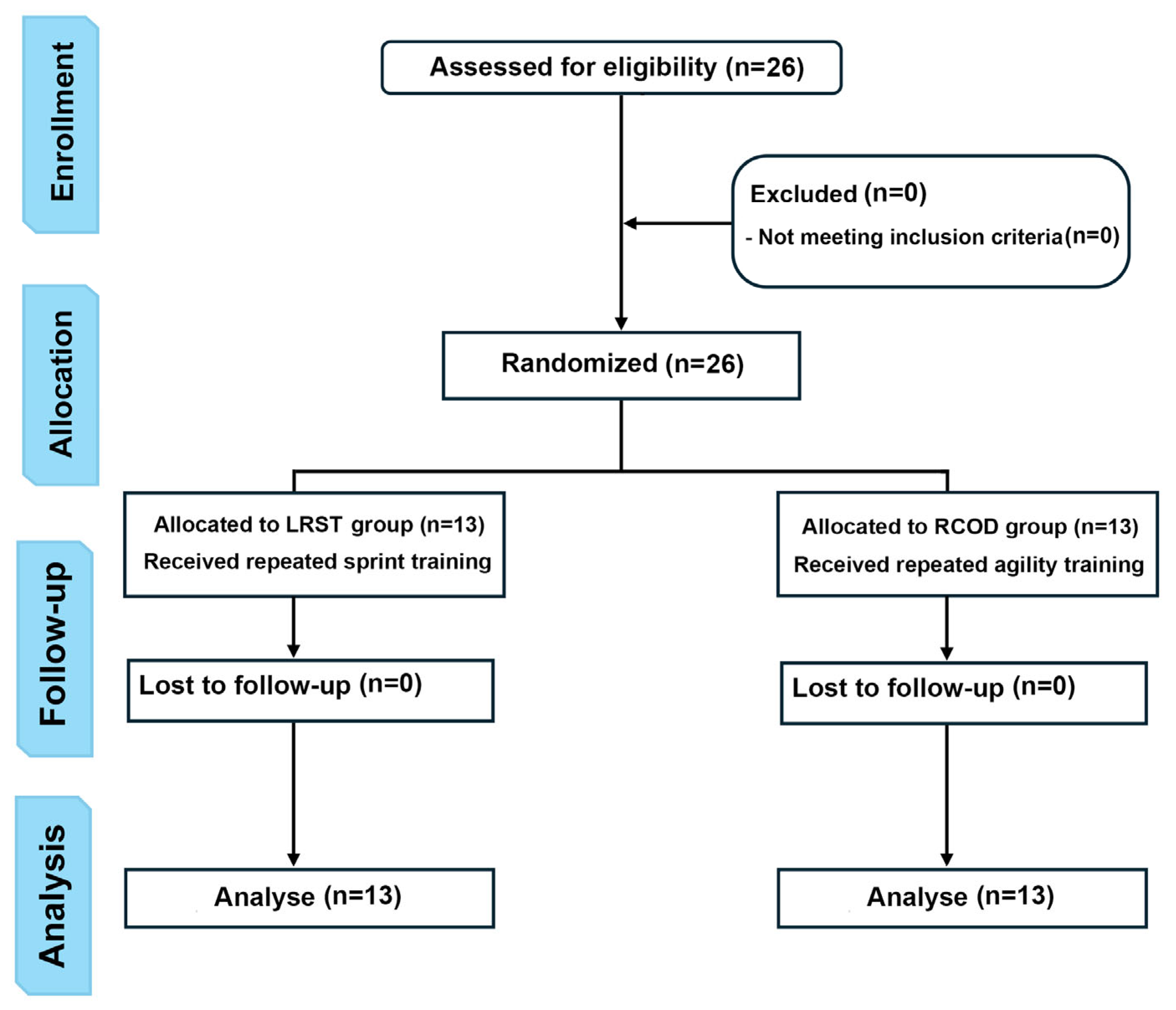
2.2. Experimental Design
2.3. Procedures
2.3.1. Acceleration and Speed Assessment
2.3.2. Change of Direction Assessment
2.3.3. Jumping Assessment
2.3.4. Endurance-Intensive Fitness Assessment
2.3.5. Rating of Perceived Exertion
2.3.6. Physical Enjoyment Assessment
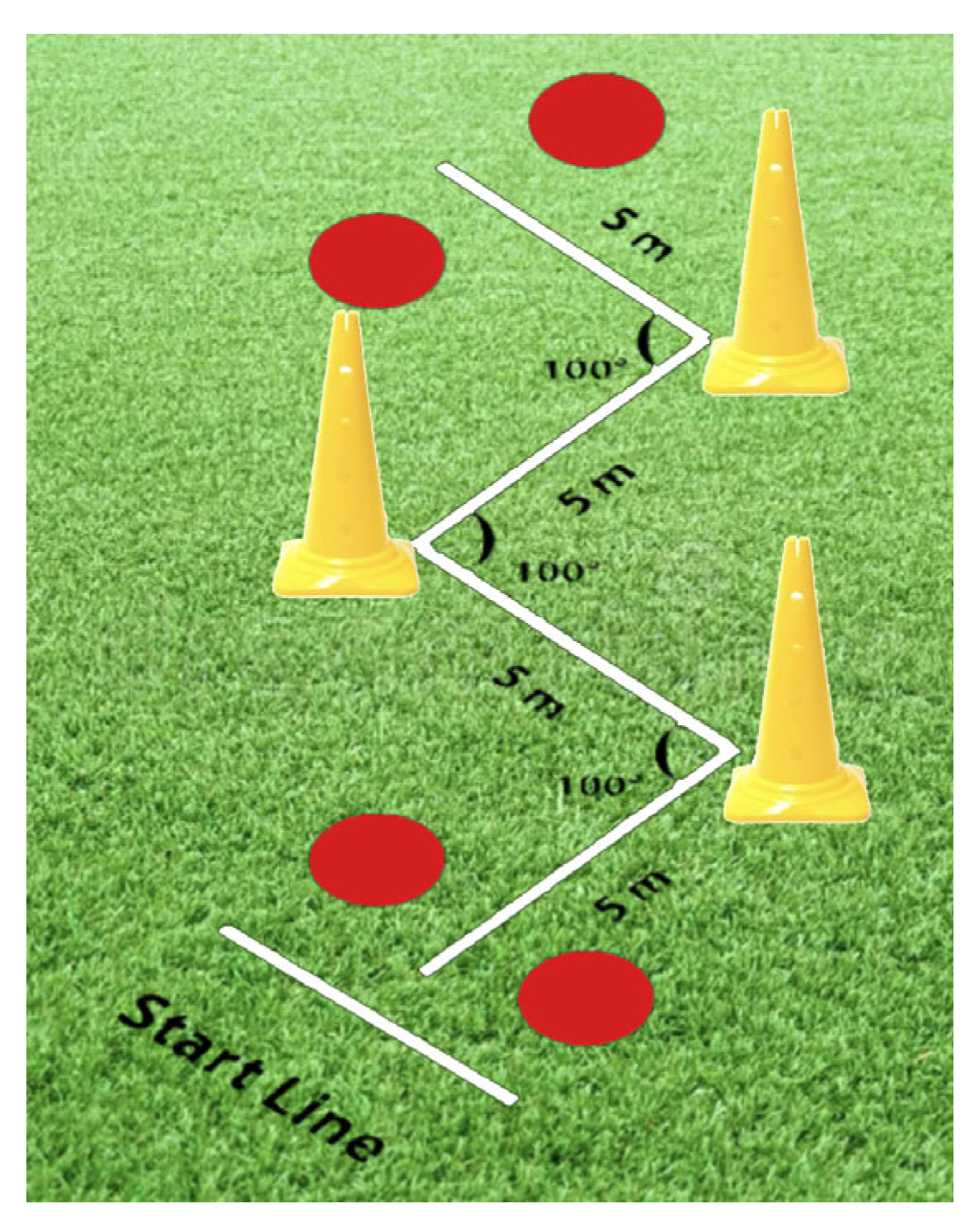
2.3.7. Training Protocols
2.4. Statistical Analyses
3. Results
4. Discussion
5. Conclusions
Author Contributions
Funding
Institutional Review Board Statement
Informed Consent Statement
Data Availability Statement
Conflicts of Interest
References
- Uysal, H.Ş.; Korkmaz, S.; Sen, S.; Thapa, R.K.; Pojskic, H. Effect of speed, agility, and quickness training on linear sprint, jump, and change of direction speed performance in soccer players: A systematic review and three-level meta-analysis. Strength Cond. J. 2025, 47, 184–204. [Google Scholar] [CrossRef]
- Selmi, O.; Jelleli, H.; Bouali, S.; Aydi, B.; Hindawi, O.; Muscella, A.; Bouassida, A.; Weiss, K.; Knechtle, B. The impact of verbal encouragement during the repeated agility speed training on internal intensity, mood state, and physical enjoyment in youth soccer players. Front. Psychol. 2023, 14, 1180985. [Google Scholar] [CrossRef] [PubMed]
- McBurnie, A.J.; Parr, J.; Kelly, D.M.; Dos’ Santos, T. Multidirectional speed in youth soccer players: Programming considerations and practical applications. Strength Cond. J. 2022, 44, 10–32. [Google Scholar] [CrossRef]
- Mardov, I.; Chakarov, I. Short characteristics of sport preparation of the modern football (physical, technical and tactical ability). Act. Phys. Educ. Sport 2020, 5, 171–173. [Google Scholar]
- Marzouki, H.; Ouergui, I.; Cherni, B.; Ben Ayed, K.; Bouhlel, E. Effects of different sprint training programs with ball on explosive, high-intensity and endurance-intensive performances in male young soccer players. Int. J. Sports Sci. Coach. 2023, 18, 123–131. [Google Scholar] [CrossRef]
- Fernández-Penedo, D.; García-Santamaría, A.; Lorenzo-Martínez, M.; Carrera, S.; Padrón-Cabo, A.; Costa, P.B.; Rey, E. Effects of short- versus long-distance repeated-sprint ability training on physical performance in youth male soccer players. Pediatr. Exerc. Sci. 2024, 37, 413–420. [Google Scholar] [CrossRef]
- Tvrdý, M.; Holienka, M.; Babic, M. Effectiveness of repeated sprint ability (RSA) development in youth soccer players. J. Phys. Educ. Sport 2022, 22, 2530–2538. [Google Scholar]
- Haj-Sassi, R.; Dardouri, W.; Gharbi, Z.; Chaouachi, A.; Mansour, H.; Rabhi, A.; Mahfoudhi, M.E. Reliability and validity of a new repeated agility test as a measure of anaerobic and explosive power. J. Strength Cond. Res. 2011, 25, 472–480. [Google Scholar] [CrossRef]
- Lörinczi, F.; Vavák, M.; Woorons, X. Additional benefits of repeated-sprint training with prolonged end-expiratory breath holding for improving repeated-sprint ability in semi-professional soccer players. Int. J. Sports Physiol. Perform. 2025, 20, 568–574. [Google Scholar] [CrossRef]
- Clemente, F.M.; Ramirez-Campillo, R.; Afonso, J.; Sarmento, H.; Rosemann, T.; Knechtle, B. A meta-analytical comparison of the effects of small-sided games vs. running-based high-intensity interval training on soccer players’ repeated-sprint ability. Int. J. Environ. Res. Public Health 2021, 18, 2781. [Google Scholar] [CrossRef]
- Buchheit, M.; Laursen, P.B. High-intensity interval training, solutions to the programming puzzle. Sports Med. 2013, 43, 313–338. [Google Scholar] [CrossRef] [PubMed]
- Sheppard, J.M.; Young, W.B. Agility literature review: Classifications, training and testing. J. Sports Sci. 2006, 24, 919–932. [Google Scholar] [CrossRef] [PubMed]
- Buchheit, M.; Laursen, P.B.; Kuhnle, J.; Ruch, D.; Renaud, C.; Ahmaidi, S. Game-based training in young elite handball players. Int. J. Sports Med. 2009, 30, 251–258. [Google Scholar] [CrossRef] [PubMed]
- Rampinini, E.; Bishop, D.; Marcora, S.M.; Ferrari Bravo, D.; Sassi, R.; Impellizzeri, F.M. Validity of simple field tests as indicators of match-related physical performance in top-level professional soccer players. Int. J. Sports Med. 2007, 28, 228–235. [Google Scholar] [CrossRef]
- Nimphius, S.; Callaghan, S.J.; Bezodis, N.E.; Lockie, R.G. Change of direction and agility tests: Challenging our current measures of performance. Strength Cond. J. 2018, 40, 26–38. [Google Scholar] [CrossRef]
- Dos’Santos, T.; McBurnie, A.; Thomas, C.; Comfort, P.; Jones, P.A. Biomechanical determinants of change of direction speed performance in male athletes. J. Strength Cond. Res. 2019, 33, 2575–2585. [Google Scholar]
- Ryan, R.M.; Deci, E.L. Self-Determination Theory: Basic Psychological Needs in Motivation, Development, and Wellness; Guilford Press: New York, NY, USA, 2017. [Google Scholar]
- Deci, E.L.; Ryan, R.M. The “what” and “why” of goal pursuits: Human needs and the self-determination of behavior. Psychol. Inq. 2000, 11, 227–268. [Google Scholar] [CrossRef]
- Csikszentmihalyi, M. Flow: The Psychology of Optimal Experience; Harper & Row: New York, NY, USA, 1990. [Google Scholar]
- Clemente, F.M.; Nikolaidis, P.T.; Rosemann, T.; Knechtle, B. Dose–response relationship between external load variables, rating of perceived exertion, and fitness adaptations in soccer players. Front. Physiol. 2020, 11, 1–12. [Google Scholar]
- Moran, J.; Sandercock, G.; Ramirez-Campillo, R.; Meylan, C.; Collison, J.; Parry, D.A. Age-related variation in male youth athletes’ countermovement jump after plyometric training: A meta-analysis of controlled trials. J. Strength Cond. Res. 2017, 31, 552–565. [Google Scholar] [CrossRef]
- Gabbett, T.J. The training-injury prevention paradox: Should athletes be training smarter and harder? Br. J. Sports Med. 2016, 50, 273–280. [Google Scholar] [CrossRef]
- Erdfelder, E.; Faul, F.; Buchner, A. Gpower: A general power analysis program. Behav. Res. Methods Instrum. Comput. 1996, 28, 1–11. [Google Scholar] [CrossRef]
- Faul, F.; Erdfelder, E.; Lang, A.G.; Buchner, A. G*Power 3: A flexible statistical power analysis program for the social, behavioral, and biomedical sciences. Behav. Res. Methods 2007, 39, 175–191. [Google Scholar] [CrossRef] [PubMed]
- Marzouki, H.; Sbai, S.; Ouergui, I.; Selmi, O.; Andrade, M.S.; Bouhlel, E.; Thuany, M.; Weiss, K.; Nikolaidis, P.T.; Knechtle, B. Effects of Biological Age on Athletic Adaptations to Combined Plyometric and Sprint with Change of Direction with Ball Training in Youth Soccer Players. Biology 2023, 12, 120. [Google Scholar] [CrossRef] [PubMed]
- Foster, C.; Florhaug, J.A.; Franklin, J.; Gottschall, L.; Hrovatin, L.A.; Parker, S.; Dodge, C. A new approach to monitoring exercise training. J. Strength Cond. Res. 2001, 15, 109–115. [Google Scholar] [PubMed]
- Mullen, S.P.; Olson, E.A.; Phillips, S.M.; Szabo, A.N.; Wójcicki, T.R.; Mailey, E.L.; Gothe, N.P.; Fanning, J.T.; Kramer, A.F.; McAuley, E. Measuring enjoyment of physical activity in older adults: Invariance of the physical activity enjoyment scale (paces) across groups and time. Int. J. Behav. Nutr. Phys. Act. 2011, 8, 103. [Google Scholar] [CrossRef]
- Mirwald, R.L.; Baxter-Jones, A.D.; Bailey, D.A.; Beunen, G.P. An assessment of maturity from anthropometric measurements. Med. Sci. Sports Exerc. 2002, 34, 689–694. [Google Scholar]
- Hachana, Y.; Chaabène, H.; Ben Rajeb, G.; Khlifa, R.; Aouadi, R.; Chamari, K.; Gabbett, T.J. Validity and reliability of new agility test among elite and subelite under 14-soccer players. PLoS ONE 2014, 9, e95773. [Google Scholar] [CrossRef]
- Bosco, C.; Luhtanen, P.; Komi, P.V. A simple method for measurement of mechanical power in jumping. Eur. J. Appl. Physiol. Occup. Physiol. 1983, 50, 273–282. [Google Scholar] [CrossRef]
- Chamari, K.; Chaouachi, A.; Hambli, M.; Kaouech, F.; Wisløff, U.; Castagna, C. The five-jump test for distance as a field test to assess lower limb explosive power in soccer players. J. Strength Cond. Res. 2008, 22, 944–950. [Google Scholar] [CrossRef]
- Bangsbo, J.; Iaia, F.M.; Krustrup, P. The Yo-Yo intermittent recovery test: A useful tool for evaluation of physical performance in intermittent sports. Sports Med. 2008, 38, 37–51. [Google Scholar] [CrossRef]
- Aziz, A.R.; Mukherjee, S.; Chia, M.Y.H.; Teh, K.C. Validity of the running repeated sprint ability test among playing positions and level of competitiveness in trained soccer players. Int. J. Sports Med. 2008, 29, 833–838. [Google Scholar] [CrossRef] [PubMed]
- Little, T.; Williams, A.G. Specificity of acceleration, maximum speed, and agility in professional soccer players. J. Strength Cond. Res. 2005, 19, 76–78. [Google Scholar]
- Hopkins, W.G. Measures of reliability in sports medicine and science. Sports Med. 2000, 30, 1–15. [Google Scholar] [CrossRef]
- Marzouki, H.; Farhani, Z.; Gmada, N.; Tabka, Z.; Shephard, R.J.; Bouhlel, E. Relative and absolute reliability of the crossover and maximum fat oxidation points during treadmill running. Sci. Sports 2014, 29, e107–e114. [Google Scholar] [CrossRef]
- Zieliński, G. Effect Size Guidelines for Individual and Group Differences in Physiotherapy. Arch. Phys. Med. Rehabil. 2025, 106, 1844–1849. [Google Scholar] [CrossRef] [PubMed]
- Cohen, J. Statistical Power Analysis for the Behavioral Sciences; Routledge: Hillsdale, NJ, USA, 1988. [Google Scholar]
- Shalfawi, S.A.; Young, M.; Tønnessen, E.; Haugen, T.A.; Enoksen, E. The effect of repeated agility training vs. repeated sprint training on elite female soccer players’ physical performance. Kinesiol. Slov. 2013, 19, 29–42. [Google Scholar]
- Zheng, T.; Kong, R.; Liang, X.; Huang, Z.; Luo, X.; Zhang, X.; Xiao, Y. Effects of plyometric training on jump, sprint, and change of direction performance in adolescent soccer player: A systematic review with meta-analysis. PLoS ONE 2025, 20, e0319548. [Google Scholar] [CrossRef]
- Luo, H.; Zhu, X.; Nasharuddin, N.A.; Kamalden, T.F.T.; Xiang, C. Effects of Strength and Plyometric Training on Vertical Jump, Linear Sprint, and Change-of-Direction Speed in Female Adolescent Team Sport Athletes: A Systematic Review and Meta-Analysis. J. Sports Sci. Med. 2025, 24, 406. [Google Scholar] [CrossRef] [PubMed]
- Hall, E.C.R.; John, G.; Ahmetov, I.I. Testing in Football: A Narrative Review. Sports 2024, 12, 307. [Google Scholar] [CrossRef]
- Haff, G.G.; Nimphius, S. Training Principles for Power. Strength Cond. J. 2012, 34, 2–12. [Google Scholar] [CrossRef]
- Chelly, M.S.; Ghenem, M.A.; Abid, K.; Hermassi, S.; Tabka, Z.; Shephard, R.J. Effects of in-season short-term plyometric training program on leg power, jump- and sprint performance of soccer players. J. Strength Cond. Res. 2010, 24, 2670–2676. [Google Scholar] [CrossRef] [PubMed]
- Sal-de-Rellán, A.; Ben Brahim, M.; Hernaiz-Sánchez, A.; Tarwneh, R.; Martín, V. Effects of resisted sprint training with ball on speed and agility performance in U-19 elite soccer players. PLoS ONE 2024, 19, e0311002. [Google Scholar] [CrossRef]
- He, Z.; Duan, T.; Li, D.; Zhang, X. Effects of resisted sprint training on agility and change-of-direction performance in soccer players: A systematic review with meta-analysis. PeerJ 2025, 13, e20084. [Google Scholar] [CrossRef] [PubMed]
- Pavillon, T.; Tourny, C.; Ben Aabderrahman, A.; Salhi, I.; Zouita, S.; Rouissi, M.; Hackney, A.C.; Granacher, U.; Zouhal, H. Sprint and jump performances in highly trained young soccer players of different chronological age: Effects of linear vs. change-of-direction sprint training. J. Exerc. Sci. Fit. 2021, 19, 81–90. [Google Scholar] [CrossRef] [PubMed]
- Beato, M.; Bianchi, M.; Coratella, G.; Merlini, M.; Drust, B. A Single Session of Straight Line and Change-of-Direction Sprinting per Week Does Not Lead to Different Fitness Improvements in Elite Young Soccer Players. J. Strength Cond. Res. 2022, 36, 518–524. [Google Scholar] [CrossRef]
- Bibić, E.; Milić, V.; Radaković, M.; Ćeremidžic, D.; Andrašić, S.; Korobeynikov, G.; Trajković, N. Effects of change of direction during high-intensity interval training on physical performance in young football players. Sci. Rep. 2025, 15, 33865. [Google Scholar] [CrossRef]
- Gómez-Álvarez, N.; Federico-Tuccelli, L.; SanMartín-Godoy, P.; Vieyra-Fuenzalida, M.; Hermosilla-Palma, F.; Reyes-Amigo, T.; Oliveira, J.; Fonseca, H. Workload and Enjoyment Perception in Small-Sided Soccer Games: A Systematic Review of Studies in Untrained Children and Adolescents. Sports Health 2025, 19417381251385590. [Google Scholar] [CrossRef]
- Clemente, F.M. The enjoyment of small-sided games: A narrative review. Hum. Mov. 2025, 26, 1–14. [Google Scholar] [CrossRef]
- Deci, E.L.; Ryan, R.M. Self-determination theory and the facilitation of intrinsic motivation, social development, and well-being. Am. Psychol. 2000, 55, 68–78. [Google Scholar]
- Crane, J.; Temple, V. A systematic review of dropout from organized sport among children and youth. Eur. Phys. Educ. Rev. 2015, 21, 114–131. [Google Scholar] [CrossRef]
- Fraser-Thomas, J.; Côté, J.; Deakin, J. Understanding dropout and prolonged engagement in adolescent competitive sport. Psychol. Sport Exerc. 2008, 9, 645–662. [Google Scholar] [CrossRef]



| Day | Main Objective(s) | Time | Duration (min) |
|---|---|---|---|
| Monday | Day off (physical and mental recovery) | - | - |
| Tuesday | Aerobic training + technical-tactical drills | 18:30–20:00 | 80–90 |
| Wednesday | Small-sided games + technical-tactical drills | 18:30–20:00 | 80–90 |
| Thursday | Power/anaerobic training + technical-tactical drills | 18:30–20:00 | 80–90 |
| Friday | Speed training + technical drills + simulated competitive games | 17:00–19:00 | 80–90 |
| Saturday | Reaction speed + technical-tactical drills | 13:00–14:30 | 40–50 |
| Sunday | Official match | - | - |
| Week | Number of Sessions | RCOD | LRST | RPE (AU) |
|---|---|---|---|---|
| 1 | Pre intervention testing | |||
| 2–5 | 8 | 2 × (6 × 20 m of COD drill at maximum effort); r = 20 s, R = 3 min | 2 × (6 × 20 m of linear sprint at maximum effort); r = 20 s; R = 3 min | 6–7 |
| 6–9 | 8 | 3 × (6 × 20 m of COD drill at maximum effort); r = 20 s; R = 3 min | 3 × (6 × 20 m of linear sprint at maximum effort); r = 20 s; R = 3 min | 6–7 |
| 10 | Post intervention testing | |||
| Variability (CV%) | Group Comparisons | |||||||
|---|---|---|---|---|---|---|---|---|
| Variable | Group | Mean ± SD | 95% CI | Intersession, 95% CI | Intrasubject, 95% CI | Z | p | r |
| RPE (AU) | LRST | 6.7 ± 0.6 | 6.3–7.1 | 13.9–15.7 | 10.5–13.4 | 0.258 | 0.797 | 0.050 |
| RCOD | 6.6 ± 0.6 | 6.3–7.0 | 13.7–16.2 | 10.5–13.4 | ||||
| PACES (AU) | LRST | 41.6 ± 3.5 | 39.4–43.7 | 8.4–9.1 | 6.8–10.7 | 3.462 † | <0.0001 | 0.679 |
| RCOD | 47.8 ± 3.3 | 45.8–49.8 | 7.9–8.8 | 4.8–5.4 | ||||
| Variable | Group | Pre | Post | d (p) | Δ (%) | ANOVA/ANCOVA * |
|---|---|---|---|---|---|---|
| S10 (s) | LRST | 1.98 ± 0.12 | 1.88 ± 0.08 † | 0.981 (<0.0001) | −4.8 ± 4.4 | Time: F1,24 = 32.274; p < 0.0001; η2p = 0.573 Group: F1,24 = 1.651; p = 0.211; η2p = 0.064 Time × Group: F1,24 = 2.516; p = 0.126; η2p = 0.095 |
| RCOD | 2.01 ± 0.13 | 1.96 ± 0.13 † | 0.385 (0.008) | −2.7 ± 1.7 | ||
| S30 (s) | LRST | 4.76 ± 0.17 | 4.65 ± 0.15 † | 0.686 (<0.0001) | −2.5 ± 1.2 | Time: F1,24 = 50.646; p < 0.0001; η2p = 0.678 Group: F1,24 = 1.364; p = 0.254; η2p = 0.054 Time × Group: F1,24 = 1.365; p = 0.254; η2p = 0.054 |
| RCOD | 4.82 ± 0.19 | 4.73 ± 0.15 † | 0.526 (<0.0001) | −1.7 ± 1.8 | ||
| THT (s) | LRST | 5.88 ± 0.11 ‡ | 5.81 ± 0.14 † | 0.487 (0.002) | −1.2 ± 1.1 | Time: F1,24 = 56.321; p < 0.0001; η2p = 0.701 Group (adjusted for pre-test): F1,23 = 3.710; p = 0.067; η2p = 0.134 Time × Group: F1,24 = 9.426; p = 0.005; η2p = 0.282 |
| RCOD | 6.02 ± 0.18 | 5.85 ± 0.12 † | 0.806 (<0.0001) | −2.7 ± 1.5 | ||
| IAT (s) | LRST | 18.15 ± 0.64 | 18.02 ± 0.59 † | 0.211 (0.012) | −0.7 ± 1.0 | Time: F1,24 = 50.346; p < 0.0001; η2p = 0.677 Group: F1,24 = 0.741; p = 0.398; η2p = 0.029 Time × Group: F1,24 = 10.430; p = 0.004; η2p = 0.303 |
| RCOD | 18.45 ± 0.56 | 18.11 ± 0.53 † | 0.624 (<0.0001) | −1.8 ± 0.7 |
| Variable | Group | Pre | Post | d (p) | Δ (%) | ANOVA |
|---|---|---|---|---|---|---|
| 5JT (m) | LRST | 11.4 ± 0.7 | 11.6 ± 0.7 † | 0.352 (0.001) | 2.2 ± 2.3 | Time: F1,24 = 69.642; p < 0.0001; η2p = 0.744 Group: F1,24 = 0.912; p = 0.349; η2p = 0.037 Time × Group: F1,24 = 7.738; p = 0.01; η2p = 0.244 |
| RCOD | 11.0 ± 0.8 | 11.5 ± 0.9 † | 0.621 (<0.0001) | 4.5 ± 1.8 | ||
| CMJ (cm) | LRST | 35.2 ± 3.0 | 37.3 ± 2.7 † | 0.736 (<0.0001) | 6.0 ± 3.8 | Time: F1,24 = 85.575; p < 0.0001; η2p = 0.781 Group: F1,24 = 1.413; p = 0.246; η2p = 0.056 Time × Group: F1,24 = 6.571; p = 0.017; η2p = 0.215 |
| RCOD | 33.1 ± 2.7 | 36.7 ± 3.3 † | 1.194 (<0.0001) | 11.2 ± 5.8 | ||
| SJ (cm) | LRST | 31.1 ± 2.7 | 32.4 ± 2.6 † | 0.490 (0.002) | 4.3 ± 2.8 | Time: F1,24 = 35.433; p < 0.0001; η2p = 0.596 Group: F1,24 = 1.269; p = 0.271; η2p = 0.050 Time × Group: F1,24 = 9.735; p = 0.005; η2p = 0.288 |
| RCOD | 29.0 ± 3.1 | 32.0 ± 3.0 † | 0.983 (<0.0001) | 10.6 ± 6.1 | ||
| Distance (m) | LRST | 2049.2 ± 307.7 | 2203.1 ± 283.1 † | 0.521 (0.010) | 8.1 ± 8.1 | Time: F1,24 = 23.329; p < 0.0001; η2p = 0.491 Group: F1,24 = 1.528; p = 0.228; η2p = 0.059 Time × Group: F1,24 = 0.759; p = 0.392; η2p = 0.031 |
| RCOD | 1886.2 ± 283.7 | 2017.7 ± 261.0 † | 0.482 (<0.0001) | 12.8 ± 14.2 | ||
| MAV (km·h−1) | LRST | 17.0 ± 0.8 | 17.4 ± 0.8 † | 0.500 (0.010) | 2.5 ± 2.7 | Time: F1,24 = 23.102; p < 0.0001; η2p = 0.490 Group: F1,24 = 1.522; p = 0.229; η2p = 0.059 Time × Group: F1,24 = 0.738; p = 0.399; η2p = 0.029 |
| RCOD | 16.5 ± 0.8 | 17.1 ± 0.7 † | 0.798 (0.001) | 3.6 ± 3.8 | ||
| Estimated VO2max (mL·min−1·kg−1) | LRST | 55.8 ± 2.2 | 56.9 ± 2.0 † | 0.523 (0.010) | 2.0 ± 2.2 | Time: F1,24 = 23.333; p < 0.0001; η2p = 0.493 Group: F1,24 = 1.530; p = 0.228; η2p = 0.060 Time × Group: F1,24 = 0.761; p = 0.392; η2p = 0.031 |
| RCOD | 54.6 ± 2.0 | 56.2 ± 1.9 † | 0.820 (<0.0001) | 3.3 ± 3.3 |
Disclaimer/Publisher’s Note: The statements, opinions and data contained in all publications are solely those of the individual author(s) and contributor(s) and not of MDPI and/or the editor(s). MDPI and/or the editor(s) disclaim responsibility for any injury to people or property resulting from any ideas, methods, instructions or products referred to in the content. |
© 2026 by the authors. Licensee MDPI, Basel, Switzerland. This article is an open access article distributed under the terms and conditions of the Creative Commons Attribution (CC BY) license.
Share and Cite
Selmi, O.; Rahmoune, M.A.; Marzouki, H.; Cherni, B.; Bouassida, A.; Muscella, A.; Marsigliante, S.; Vveinhardt, J.; Douzi, W. Comparative Effects of Repeated Linear Sprint and Change-of-Direction Speed Training on Performance, Perceived Exertion and Enjoyment in Youth Soccer Players. Sports 2026, 14, 33. https://doi.org/10.3390/sports14010033
Selmi O, Rahmoune MA, Marzouki H, Cherni B, Bouassida A, Muscella A, Marsigliante S, Vveinhardt J, Douzi W. Comparative Effects of Repeated Linear Sprint and Change-of-Direction Speed Training on Performance, Perceived Exertion and Enjoyment in Youth Soccer Players. Sports. 2026; 14(1):33. https://doi.org/10.3390/sports14010033
Chicago/Turabian StyleSelmi, Okba, Mohamed Amine Rahmoune, Hamza Marzouki, Bilel Cherni, Anissa Bouassida, Antonella Muscella, Santo Marsigliante, Jolita Vveinhardt, and Wafa Douzi. 2026. "Comparative Effects of Repeated Linear Sprint and Change-of-Direction Speed Training on Performance, Perceived Exertion and Enjoyment in Youth Soccer Players" Sports 14, no. 1: 33. https://doi.org/10.3390/sports14010033
APA StyleSelmi, O., Rahmoune, M. A., Marzouki, H., Cherni, B., Bouassida, A., Muscella, A., Marsigliante, S., Vveinhardt, J., & Douzi, W. (2026). Comparative Effects of Repeated Linear Sprint and Change-of-Direction Speed Training on Performance, Perceived Exertion and Enjoyment in Youth Soccer Players. Sports, 14(1), 33. https://doi.org/10.3390/sports14010033