
DNA Barcoding Reveals Hidden Genetic Diversity and Environmental Correlates of Lineage Differentiation in Neozavrelia Goetghebuer & Thienemann, 1941 (Diptera: Chironomidae)


Simple Summary
Abstract
1. Introduction
2. Materials and Methods
2.1. Specimen Collection and Morphological Identification
2.2. DNA Extraction, PCR Amplification, and Sequencing
2.3. Sequence Processing and Molecular Delimitation
2.4. Extracting and Reducing the Dimensionality of Geographic and Environmental Data
2.5. Statistical Analyses of Genetic Differentiation
3. Results
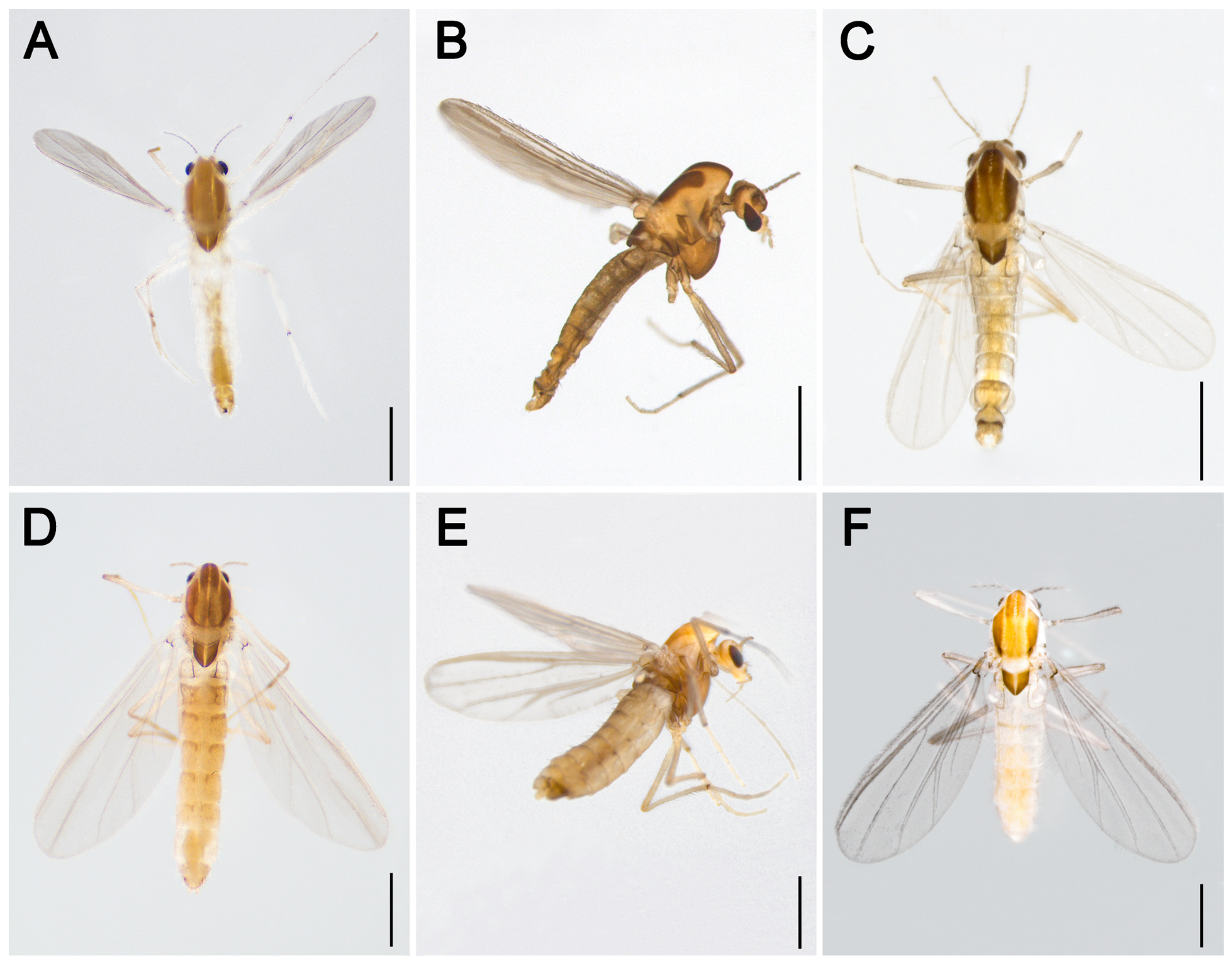
3.1. Dataset Characteristics and Geographic Distribution
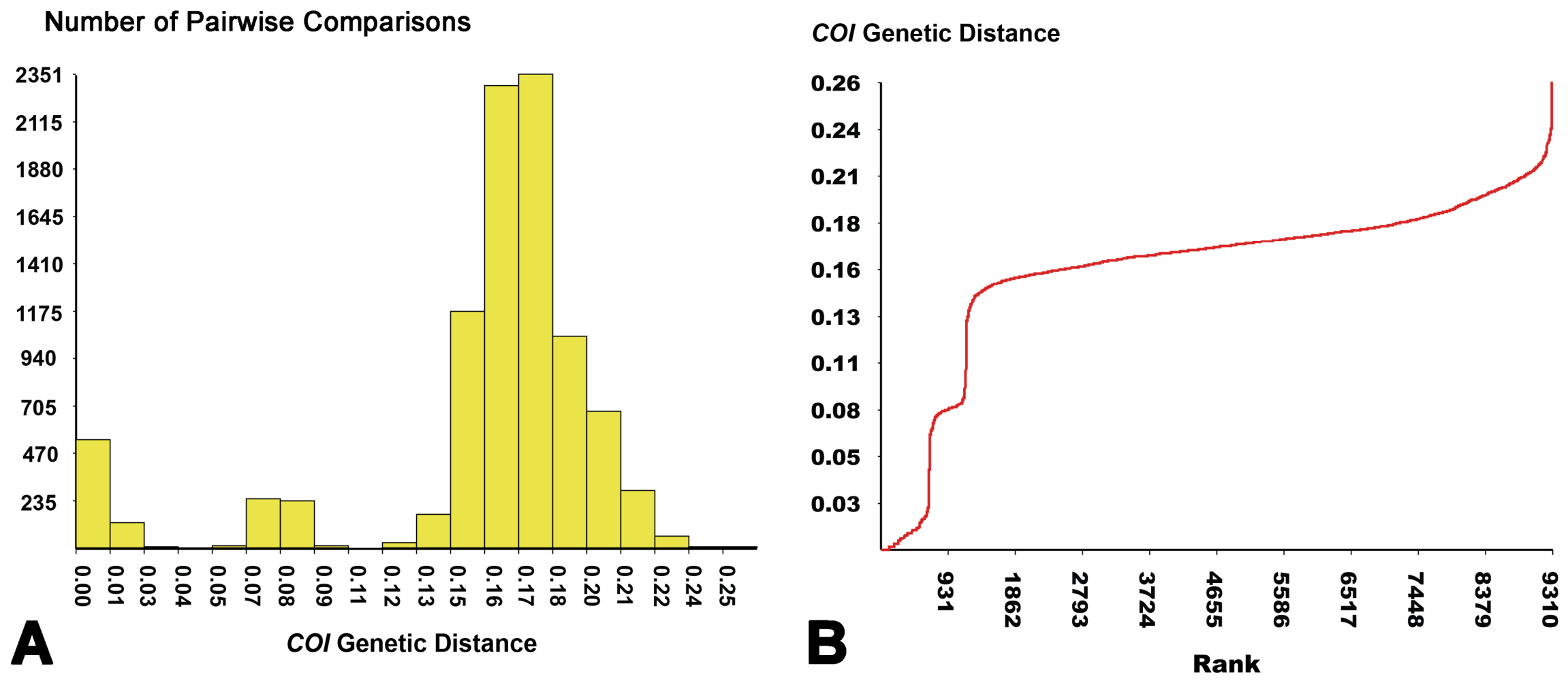
3.2. Species Delimitation via ABGD
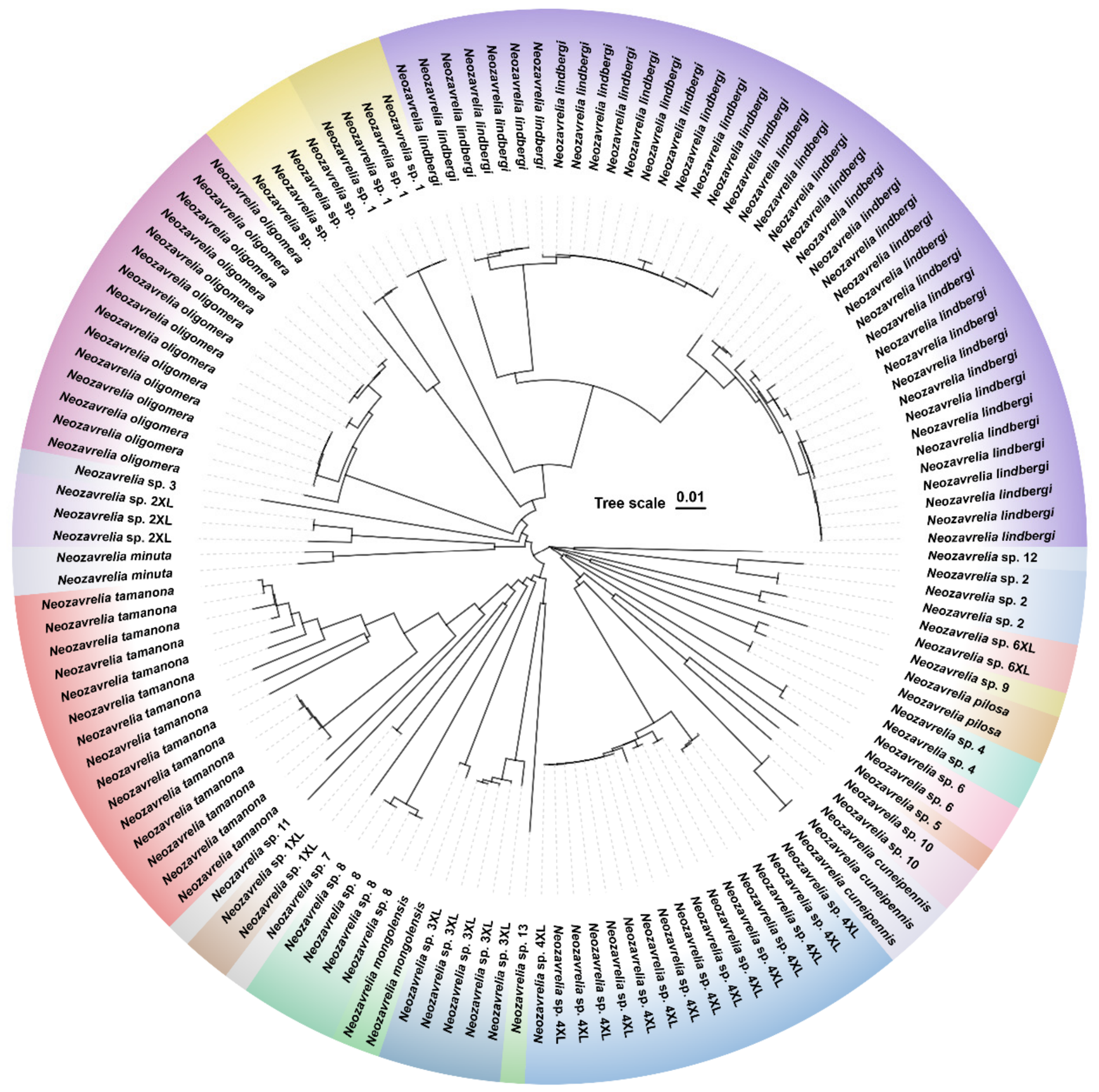
3.3. Phylogenetic Clustering Validated by NJ Tree
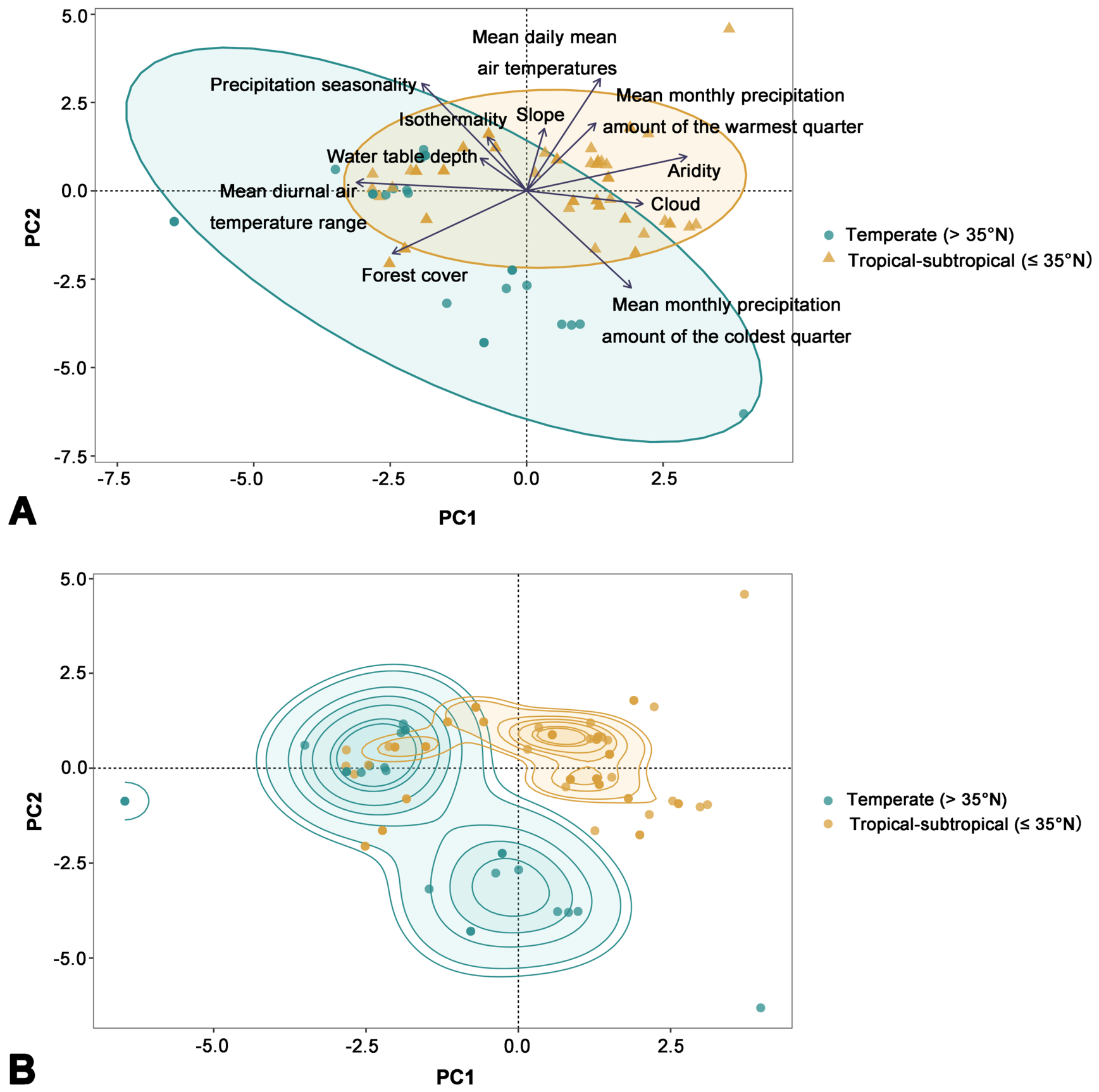
3.4. Environmental Variation and PCA Structure
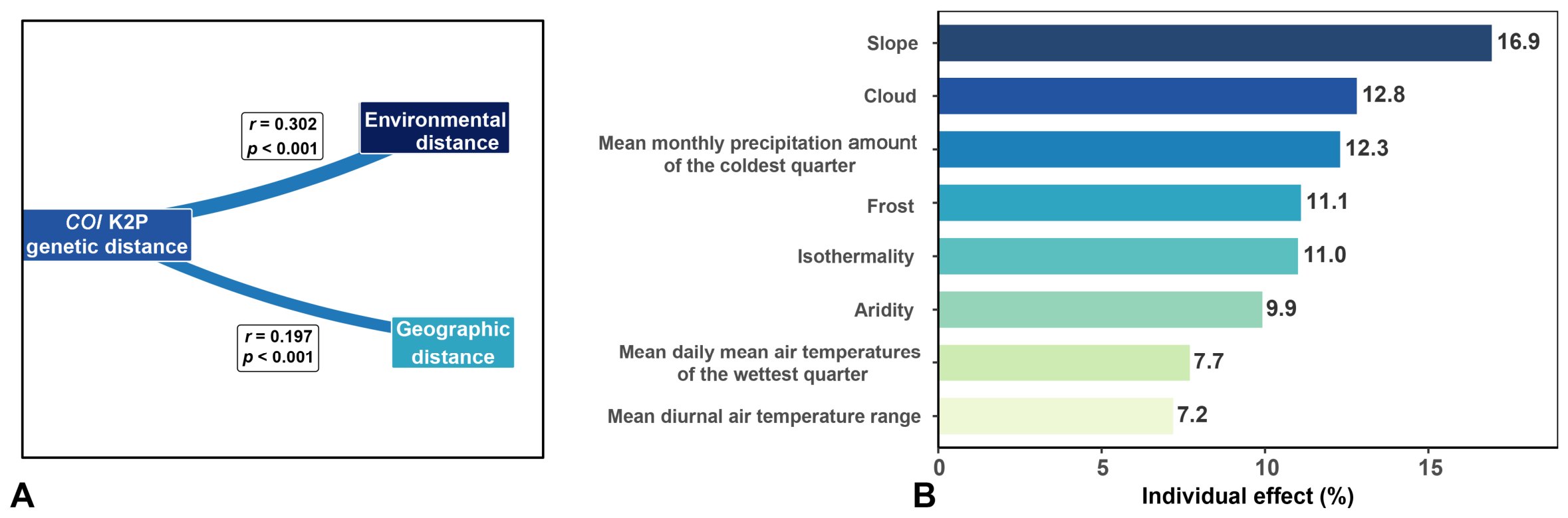
3.5. Genetic Differentiation and Environmental-Geographic Associations
4. Discussion
4.1. Genetic Diversity and Cryptic Lineages in Neozavrelia
4.2. Environmental Heterogeneity and Genetic Differentiation
4.3. Environmental Factors Correlated with Lineage Genetic Differentiation
4.4. Environmental Differentiation Across Latitudinal Regions
5. Conclusions
Supplementary Materials
Author Contributions
Funding
Data Availability Statement
Acknowledgments
Conflicts of Interest
References
- Huryn, A.D.; Wallace, J.B. A method for obtaining in situ growth rates of larval Chironomidae (Diptera) and its application to studies of secondary production. Limnol. Oceanogr. 1986, 31, 216–222. [Google Scholar] [CrossRef] [Scilit]
- Hirabayashi, K. Annual and seasonal trends in density, biomass, and secondary production of Chironomid midges (Diptera: Chironomidae) in the middle reaches of the Shinano River, Japan, 2015–2019. Limnol. Rev. 2025, 25, 27. [Google Scholar] [CrossRef] [Scilit]
- Suhri, A.G.M.; Jafar, J.; Rahmah, M.H.; Salatnaya, H.; Utami, R.B. Diversity and ecological role of aquatic insects as bioindicators of water quality in tropical streams. Egypt. J. Aquat. Biol. Fish. 2025, 29, 403–418. [Google Scholar] [CrossRef] [Scilit]
- Souto, R.d.M.G.; Corbi, J.J.; Jacobucci, G.B. Aquatic insects as bioindicators of heavy metals in sediments in Cerrado streams. Limnetica 2019, 38, 575–586. [Google Scholar] [CrossRef] [Scilit]
- Popović, N.; Đuknić, J.; Marinković, N.; Tubić, B.; Atanacković, A.; Milošević, D.; Raković, M. Environmental factors determining the distribution pattern of Chironomidae in different types of freshwater habitats. Insects 2025, 16, 501. [Google Scholar] [CrossRef] [Scilit] [PubMed]
- Chowdhury, S.; Dubey, V.K.; Choudhury, S.; Das, A.; Jeengar, D.; Sujatha, B.; Kumar, A.; Kumar, N.; Semwal, A.; Kumar, V. Insects as bioindicator: A hidden gem for environmental monitoring. Front. Environ. Sci. 2023, 11, 1146052. [Google Scholar] [CrossRef] [Scilit]
- Adham, F.K.; Gabre, R.M.; Ibrahim, I.A. Some aquatic insects and invertebrates as bioindicators for the evaluation of bacteriological pollution in El-Zomor and El-Mariotya canals, Giza, Egypt. Egypt. Acad. J. Biol. Sci. A Entomol. 2009, 2, 125–131. [Google Scholar] [CrossRef] [Scilit]
- Rosenberg, D.M. Freshwater biomonitoring and Chironomidae. Neth. J. Aquat. Ecol. 1992, 26, 101–122. [Google Scholar] [CrossRef] [Scilit]
- Simwisat, K.K.; Uttaruk, P.P.; Pramual, P.P. Morphology, cytogenetics and DNA barcode of the Chironomidae (Diptera) in Thailand. J. Sci. Technol. Mahasarakham Univ. 2015, 34, 74–85. [Google Scholar]
- Kang, H.J.; Baek, M.J.; Kang, J.H.; Bae, Y.J. DNA barcoding of chironomid larvae (diptera: Chironomidae) from large rivers in south korea to facilitate freshwater biomonitoring and public health surveillance. Int. J. Environ. Res. Public Health 2022, 19, 12035. [Google Scholar] [CrossRef] [Scilit] [PubMed]
- Theissinger, K.; Kästel, A.; Elbrecht, V.; Makkonen, J.; Michiels, S.; Schmidt, S.; Allgeier, S.; Leese, F.; Brühl, C. Using DNA metabarcoding for assessing chironomid diversity and community change in mosquito controlled temporary wetlands. Metabarcoding Metagenomics 2018, 2, e21060. [Google Scholar] [CrossRef] [Scilit]
- Carew, M.E.; Pettigrove, V.J.; Metzeling, L.; Hoffmann, A.A. Environmental monitoring using next generation sequencing: Rapid identification of macroinvertebrate bioindicator species. Front. Zool. 2013, 10, 45. [Google Scholar] [CrossRef] [Scilit] [PubMed]
- Folmer, O.; Black, M.; Hoeh, W.; Lutz, R.; Vrijenhoek, R. DNA primers for amplification of mitochondrial cytochrome c oxidase subunit I from diverse metazoan invertebrates. Mol. Mar. Biol. Biotechnol. 1994, 3, 294–299. [Google Scholar] [PubMed]
- Song, C.; Zhu, B.Q.; Moubayed-Breil, J.; Lei, T.; Qi, X. Taxonomic study on the genus Stenochironomus Kieffer from the Baishanzu Nature Reserve, China (Diptera, Chironomidae). ZooKeys 2022, 1104, 93–113. [Google Scholar] [CrossRef] [Scilit] [PubMed]
- Hebert, P.D.; Gregory, T.R. The promise of DNA barcoding for taxonomy. Syst. Biol. 2005, 54, 852–859. [Google Scholar] [CrossRef] [Scilit] [PubMed]
- Lin, X.L.; Jiang, K.; Liu, W.B.; Liu, W.; Bu, W.J.; Wang, X.H.; Mo, L.d. Toward a global DNA barcode reference library of the intolerant nonbiting midge genus Rheocricotopus Brundin, 1956. Ecol. Evol. 2021, 11, 12161–12172. [Google Scholar] [CrossRef] [Scilit] [PubMed]
- Xu, H.F.; Lv, M.Y.; Zhao, Y.; Zhang, Z.C.; Liu, Z.; Lin, X.L. Cryptic diversity and climatic niche divergence of Brillia Kieffer (Diptera: Chironomidae): Insights from a global DNA barcode dataset. Insects 2025, 16, 675. [Google Scholar] [CrossRef] [Scilit] [PubMed]
- Fittkau, E.J. Die Gattung Neozavrelia Goetghebuer (Dipt. Chironomidae). Chironomidenstudien II. Dtsch. Entomol. Z. 1954, 1, 161–179. [Google Scholar] [CrossRef]
- Bitusik, P. New Records of Chironomids (Diptera, Chironomidae) from Czech Republic and Slovak Republic. Biologia 1993, 48, 189–194. [Google Scholar] [CrossRef] [Scilit] [PubMed]
- Ekrem, T. A redescription of Neozavrelia cuneipennis (Edwards) comb. nov., with a checklist of Neozavrelia species of the world (Diptera: Chironomidae). Zootaxa 2006, 1153, 1–16. [Google Scholar] [CrossRef] [Scilit]
- Giłka, W. A systematic review of European Stempellina Thienemann et Bause, 1913 (Diptera: Chironomidae) with description of a new species from Fennoscandia. Ann. Zool. 2005, 55, 413–419. [Google Scholar]
- Cranston, P.S. The Australian species of Neozavrelia Goetghebuer (Diptera: Chironomidae: Tanytarsini). Aust. J. Entomol. 1998, 37, 107–112. [Google Scholar] [CrossRef]
- Giłka, W. Notes on the systematics of East Asian Neozavrelia Goetghebuer (Diptera, Chironomidae, Tanytarsini). Euroasian Entomol. J. 2012, 11, 35–39. [Google Scholar]
- Mondal, A.; Hui, P.; Hazra, N. First Record of the Genus Neozavrelia Goetghebuer with Redescription of Neozavrelia lindbergi Reiss (Diptera: Chironomidae) from India. Indian J. Entomol. 2025, 88, 814–822. [Google Scholar] [CrossRef] [Scilit]
- Wang, J.C.; Wang, X.H. Two new species of Chironomidae from Liaoning Province, China (Diptera: Chironomidae). Zool. Res. 1996, 17, 121–124. [Google Scholar] [CrossRef] [Scilit]
- Orel, O.V. Revision of the genus Neozavrelia Goetghebuer, Thienemann, 1941 (Diptera: Chironomidae) from Eastern Siberia and the Russian Far East, with the description of new species. Zootaxa 2021, 4938, 251–297. [Google Scholar] [CrossRef] [Scilit] [PubMed]
- Bitušík, P.; Novikmec, M.; Svitok, M.; Hamerlík, L. New faunistic records of chironomids and phantom midges (Diptera, Chironomidae and Chaoboridae) from Ukraine indicate recent climatic refugia in the Eastern Carpathians. ZooKeys 2024, 1211, 349–367. [Google Scholar] [CrossRef] [Scilit] [PubMed]
- Giłka, W. Analysis of faunistic diversity in chironomids of the tribe Tanytarsini in Europe (Diptera: Chironomidae). Dipteron 2011, 27, 11–31. [Google Scholar] [CrossRef] [Scilit]
- Płóciennik, M.; Dmitrović, D.; Pešić, V.; Gadawski, P. Ecological patterns of Chironomidae assemblages in Dynaric karst springs. Knowl. Manag. Aquat. Ecosyst. 2016, 417, 11. [Google Scholar] [CrossRef] [Scilit]
- Guo, Y.H.; Wang, X.H. A review of the genus Neozavrelia Goetghebuer from China (Diptera: Chironomidae: Chironominae: Tanytarsini). Orient. Insects 2005, 39, 187–202. [Google Scholar] [CrossRef] [Scilit]
- Ekrem, T.; Willassen, E.; Stur, E. A comprehensive DNA sequence library is essential for identification with DNA barcodes. Mol. Phylogenet. Evol. 2007, 43, 530–542. [Google Scholar] [CrossRef] [Scilit] [PubMed]
- Ekrem, T. Towards a phylogeny of Tanytarsus van der Wulp (Diptera: Chironomidae). Is morphology alone sufficient to reconstruct the genealogical relationship? Insect Syst. Evol. 2003, 34, 199–219. [Google Scholar] [CrossRef] [Scilit]
- Stur, E.; Ekrem, T. Exploring unknown life stages of Arctic Tanytarsini (Diptera: Chironomidae) with DNA barcoding. Zootaxa 2011, 2743, 27–39. [Google Scholar] [CrossRef] [Scilit]
- Stasiukynas, L.; Havelka, J.; da Silva, F.L.; Torres Jimenez, M.F.; Podėnas, S.; Lekoveckaitė, A. COI insights into diversity and species delimitation of immature stages of Non-Biting midges (Diptera: Chironomidae). Insects 2025, 16, 174. [Google Scholar] [CrossRef] [Scilit] [PubMed]
- Floss, E.C.S.; Secretti, E.; Kotzian, C.B.; Spies, M.R.; Pires, M.M.; Palumbo, J. Spatial and temporal distribution of non-biting midge larvae assemblages in streams in a mountainous region in southern Brazil. J. Insect Sci. 2013, 13, 156. [Google Scholar] [CrossRef] [Scilit] [PubMed]
- Dijkstra, K.D.B.; Monaghan, M.T.; Pauls, S.U. Freshwater biodiversity and aquatic insect diversification. Annu. Rev. Entomol. 2014, 59, 143–163. [Google Scholar] [CrossRef] [Scilit] [PubMed]
- Krosch, M.N.; Baker, A.M.; Mather, P.B.; Cranston, P.S. Comparison of intraspecific genetic structure among related chironomids (Diptera) from New Zealand and Patagonia: Disparity between potential and realized dispersal. Freshw. Sci. 2012, 31, 1105–1120. [Google Scholar] [CrossRef] [Scilit]
- Takenaka, M.; Shibata, S.; Ito, T.; Shimura, N.; Tojo, K. Phylogeography of the northernmost distributed Anisocentropus caddisflies and their comparative genetic structures based on habitat preferences. Ecol. Evol. 2021, 11, 4957–4971. [Google Scholar] [CrossRef] [Scilit] [PubMed]
- Karmokov, M.K. Karyotype characteristics and gene COI sequences of Chironomusbonus Shilova et Dzhvarsheishvili, 1974 (Diptera, Chironomidae) from the South Caucasus (Republic of Georgia, Paravani river). Comp. Cytogenet. 2022, 16, 19–38. [Google Scholar] [CrossRef] [Scilit] [PubMed]
- Krosch, M.N.; Baker, A.M.; Mather, P.B.; Cranston, P.S. Spatial population genetic structure reveals strong natal site fidelity in Echinocladius martini (Diptera: Chironomidae) in northeast Queensland, Australia. Freshw. Biol. 2011, 56, 1328–1341. [Google Scholar] [CrossRef] [Scilit]
- Lin, X.L.; Stur, E.; Ekrem, T. DNA barcodes and morphology reveal unrecognized species in Chironomidae (Diptera). Insect Syst. Evol. 2018, 49, 329–398. [Google Scholar] [CrossRef] [Scilit]
- Sæther, O.A. Some Nearctic Podonominae, Diamesinae, and Orthocladiinae (Diptera: Chironomidae). Bull. Fish. Res. Board. Can. 1969, 170, 149–154. [Google Scholar]
- Ratnasingham, S.; Hebert, P.D.N. BOLD: The Barcode of Life Data System (http://www.barcodinglife.org). Mol. Ecol. Notes 2007, 7, 355–364. [Google Scholar] [CrossRef] [Scilit] [PubMed]
- Kearse, M.; Moir, R.; Wilson, A.; Stones-Havas, S.; Cheung, M.; Sturrock, S.; Buxton, S.; Cooper, A.; Markowitz, S.; Duran, C. Geneious Basic: An integrated and extendable desktop software platform for the organization and analysis of sequence data. Bioinformatics 2012, 28, 1647–1649. [Google Scholar] [CrossRef] [Scilit] [PubMed]
- Kumar, S.; Stecher, G.; Suleski, M.; Sanderford, M.; Sharma, S.; Tamura, K. MEGA12: Molecular evolutionary genetic analysis version 12 for adaptive and green computing. Mol. Biol. Evol. 2024, 41, msae263. [Google Scholar] [CrossRef] [Scilit] [PubMed]
- Edgar, R.C. MUSCLE: Multiple sequence alignment with high accuracy and high throughput. Nucleic Acids Res. 2004, 32, 1792–1797. [Google Scholar] [CrossRef] [Scilit] [PubMed]
- Kimura, M. A simple method for estimating evolutionary rates of base substitutions through comparative studies of nucleotide sequences. J. Mol. Evol. 1980, 16, 111–120. [Google Scholar] [CrossRef] [Scilit] [PubMed]
- Saitou, N.; Nei, M. The neighbor-joining method: A new method for reconstructing phylogenetic trees. Mol. Biol. Evol. 1987, 4, 406–425. [Google Scholar] [CrossRef] [Scilit] [PubMed]
- Puillandre, N.; Lambert, A.; Brouillet, S.; Achaz, G. ABGD, Automatic Barcode Gap Discovery for primary species delimitation. Mol. Ecol. 2012, 21, 1864–1877. [Google Scholar] [CrossRef] [Scilit] [PubMed]
- Wickham, H.; Bryan, J.; Chang, W.; McGowan, L.; François, R.; Grolemund, G.; Lemon, J.; Kassambara, A.; Mundt, F.; Revelle, W. R: A Language and Environment for Statistical Computing; R Foundation for Statistical Computing: Vienna, Austria, 2020; Volume 8, pp. 1–20. [Google Scholar]
- Paradis, E.; Schliep, K. Ape 5.0: An environment for modern phylogenetics and evolutionary analyses in R. Bioinformatics 2019, 35, 526–528. [Google Scholar] [CrossRef] [Scilit] [PubMed]
- Pebesma, E. Simple features for R: Standardized support for spatial vector data. R J. 2018, 10, 439. [Google Scholar] [CrossRef] [Scilit]
- Revell, L.J. phytools 2.0: An updated R ecosystem for phylogenetic comparative methods (and other things). PeerJ 2024, 12, e16505. [Google Scholar] [CrossRef] [Scilit] [PubMed]
- Karger, D.N.; Conrad, O.; Böhner, J.; Kawohl, T.; Kreft, H.; Soria-Auza, R.W.; Zimmermann, N.E.; Linder, H.P.; Kessler, M. Climatologies at high resolution for the earth’s land surface areas. Sci. Data 2017, 4, 170122. [Google Scholar] [CrossRef] [Scilit] [PubMed]
- Wilson, A.M.; Jetz, W. Remotely sensed high-resolution global cloud dynamics for predicting ecosystem and biodiversity distributions. PLoS Biol. 2016, 14, e1002415. [Google Scholar] [CrossRef] [Scilit] [PubMed]
- Robinson, N.; Regetz, J.; Guralnick, R.P. EarthEnv-DEM90: A nearly-global, void-free, multi-scale smoothed, 90m digital elevation model from fused ASTER and SRTM data. ISPRS J. Photogramm. Remote Sens. 2014, 87, 57–67. [Google Scholar] [CrossRef] [Scilit]
- Mantel, N. The detection of disease clustering and a generalized regression approach. Cancer Res. 1967, 27, 209–220. [Google Scholar] [PubMed]
- Vincenty, T. Direct and inverse solutions of geodesics on the ellipsoid with application of nested equations. Surv. Rev. 1975, 23, 88–93. [Google Scholar] [CrossRef] [Scilit]
- Legendre, P.; Anderson, M.J. Distance-based redundancy analysis: Testing multispecies responses in multifactorial ecological experiments. Ecol. Monogr. 1999, 69, 1–24. [Google Scholar] [CrossRef]
- Borcard, D.; Gillet, F.; Legendre, P. Numerical Ecology with R, 2nd ed.; Springer: New York, NY, USA, 2018. [Google Scholar] [CrossRef] [Scilit]
- Borcard, D.; Legendre, P.; Drapeau, P. Partialling out the spatial component of ecological variation. Ecology 1992, 73, 1045–1055. [Google Scholar] [CrossRef] [Scilit]
- Lai, J.; Zou, Y.; Zhang, J.; Peres-Neto, P. Rdacca. hp: An R package for generalizing hierarchical and variation partitioning in multiple regression and canonical analysis. BioRxiv 2021. [Google Scholar] [CrossRef] [Scilit]
- Hebert, P.D.N.; Cywinska, A.; Ball, S.L.; DeWaard, J.R. Biological identifications through DNA barcodes. Ser. B Biol. Sci. 2003, 270, 313–321. [Google Scholar] [CrossRef] [Scilit] [PubMed]
- Hebert, P.D.N.; Penton, E.H.; Burns, J.M.; Janzen, D.H.; Hallwachs, W. Ten species in one: DNA barcoding reveals cryptic species in the neotropical skipper butterfly Astraptes fulgerator. Proc. Natl. Acad. Sci. USA 2004, 101, 14812–14817. [Google Scholar] [CrossRef] [Scilit] [PubMed]
- Song, C.; Wang, Q.; Zhang, R.; Sun, B.; Wang, X.H. Exploring the utility of DNA barcoding in species delimitation of Polypedilum (Tripodura) non-biting midges (Diptera: Chironomidae). Zootaxa 2016, 4079, 534–550. [Google Scholar] [CrossRef] [Scilit] [PubMed]
- Zhang, Z.P.; Wang, X.Y.; Zhang, Z.; Yao, H.; Zhang, X.M.; Zhang, Y.; Zhang, B.G. The impact of genetic diversity on the accuracy of DNA barcoding to identify species: A study on the genus Phellodendron. Ecol. Evol. 2019, 9, 10723–10733. [Google Scholar] [CrossRef] [Scilit] [PubMed]
- Funk, D.J.; Omland, K.E. Species-level paraphyly and polyphyly: Frequency, causes, and consequences, with insights from animal mitochondrial DNA. Annu. Rev. Ecol. Evol. Syst. 2003, 34, 397–423. [Google Scholar] [CrossRef] [Scilit]
- Bocek, M.; Motyka, M.; Kusy, D.; Bocak, L. Genomic and mitochondrial data identify different species boundaries in aposematically polymorphic Eniclases net-winged beetles (Coleoptera: Lycidae). Insects 2019, 10, 295. [Google Scholar] [CrossRef] [Scilit] [PubMed]
- Duran, D.P.; Laroche, R.A.; Roman, S.J.; Godwin, W.; Herrmann, D.P.; Bull, E.; Egan, S.P. Species delimitation, discovery and conservation in a tiger beetle species complex despite discordant genetic data. Sci. Rep. 2024, 14, 6617. [Google Scholar] [CrossRef] [Scilit] [PubMed]
- Diniz-Filho, J.A.F.; Soares, T.N.; Lima, J.S.; Dobrovolski, R.; Landeiro, V.L.; Telles, M.P.d.C.; Rangel, T.F.; Bini, L.M. Mantel test in population genetics. Genet. Mol. Biol. 2013, 36, 475–485. [Google Scholar] [CrossRef] [Scilit] [PubMed]
- Legendre, P. Comparison of permutation methods for the partial correlation and partial Mantel tests. J. Stat. Comput. Simul. 2000, 67, 37–73. [Google Scholar] [CrossRef] [Scilit]
- Puntí, T.; Rieradevall, M.; Prat, N. Environmental factors, spatial variation, and specific requirements of Chironomidae in Mediterranean reference streams. J. N. Am. Benthol. Soc. 2009, 28, 247–265. [Google Scholar] [CrossRef] [Scilit]
- Popović, N.; Marinković, N.; Čerba, D.; Raković, M.; Đuknić, J.; Paunović, M. Diversity patterns and assemblage structure of non-biting midges (Diptera: Chironomidae) in urban waterbodies. Diversity 2022, 14, 187. [Google Scholar] [CrossRef] [Scilit]
- Vasquez, A.A.; Bonnici, B.L.; Yusuf, S.H.; Cruz, J.I.; Hudson, P.L.; Ram, J.L. Improved chironomid barcode database enhances identification of water mite dietary content. Diversity 2022, 14, 65. [Google Scholar] [CrossRef] [Scilit]
- Lods-Crozet, B.; Oertli, B.; Robinson, C.T. Long-term patterns of chironomid assemblages in a high elevation stream/lake network (Switzerland): Implications to global change. Fauna Nor. 2012, 31, 71–85. [Google Scholar] [CrossRef] [Scilit]
- Cortese, B.; Zanotto Arpellino, J.P.; Paggi, A.C.; Rodrigues Capítulo, A. Chironomid genera distribution related to environmental characteristics of a highly impacted basin (Argentina, South America). Environ. Sci. Pollut. Res. 2019, 26, 8087–8097. [Google Scholar] [CrossRef] [Scilit] [PubMed]
- Mayfield, R.J.; Dearing, J.A.; Doncaster, C.P.; Langdon, P.G. Stability of chironomid community structure during historic climatic and environmental change in subarctic Alaska. Limnol. Oceanogr. 2022, 67, S444–S460. [Google Scholar] [CrossRef] [Scilit]
- Amir Afzali, Y.; Naderloo, R.; Keikhosravi, A.; Klaus, S. Phylogeography of the freshwater crab Potamon persicum (Decapoda: Potamidae): An ancestral ring species? J. Hered. 2024, 115, 277–291. [Google Scholar] [CrossRef] [Scilit] [PubMed]
- Marziali, L.; Rossaro, B. Response of chironomid species (Diptera, Chironomidae) to water temperature: Effects on species distribution in specific habitat. J. Entomol. Acarol. Res. 2013, 45, 73–89. [Google Scholar] [CrossRef] [Scilit]
- Giłka, W.; Gadawski, P. Tanytarsini (Diptera: Chironomidae) collected during Polish expeditions to North Korea. Zootaxa 2022, 5214, 151–175. [Google Scholar] [CrossRef] [Scilit] [PubMed]



| Protocol | Reagent | Volume |
|---|---|---|
| PCR Reaction Mixture | 2× Es Taq Master Mix (Dye) | 12.5 µL |
| LCO Primer (10 μmol·L−1) | 0.5 µL | |
| HCO Primer (10 μmol·L−1) | 0.5 µL | |
| ddH2O | 9.5 µL | |
| DNA | 2 µL |
| Step | Temperature | Purpose | Time | Cycle(s) |
|---|---|---|---|---|
| Pre-denaturation | 94 °C | Initial Denaturation | 2 min | 1 |
| First amplification stage | 5 | |||
| 94 °C | Denaturation | 1 min | ||
| 49 °C | Annealing | 30 s | ||
| 72 °C | Extension | 50 s | ||
| Second amplification stage | 35 | |||
| 94 °C | Denaturation | 1 min | ||
| 51 °C | Annealing | 90 s | ||
| 72 °C | Extension | 1 min | ||
| Final Extension | 72 °C | Final Extension | 5 min | 1 |
| Hold | 4 °C | Storage | Forever | 1 |
Disclaimer/Publisher’s Note: The statements, opinions and data contained in all publications are solely those of the individual author(s) and contributor(s) and not of MDPI and/or the editor(s). MDPI and/or the editor(s) disclaim responsibility for any injury to people or property resulting from any ideas, methods, instructions or products referred to in the content. |
© 2026 by the authors. Licensee MDPI, Basel, Switzerland. This article is an open access article distributed under the terms and conditions of the Creative Commons Attribution (CC BY) license.
Share and Cite
Xie, T.-Y.; Zhang, Y.; Chen, Y.-Z.; Liu, Z.; Lin, X.-L. DNA Barcoding Reveals Hidden Genetic Diversity and Environmental Correlates of Lineage Differentiation in Neozavrelia Goetghebuer & Thienemann, 1941 (Diptera: Chironomidae). Insects 2026, 17, 814. https://doi.org/10.3390/insects17080814
Xie T-Y, Zhang Y, Chen Y-Z, Liu Z, Lin X-L. DNA Barcoding Reveals Hidden Genetic Diversity and Environmental Correlates of Lineage Differentiation in Neozavrelia Goetghebuer & Thienemann, 1941 (Diptera: Chironomidae). Insects. 2026; 17(8):814. https://doi.org/10.3390/insects17080814
Chicago/Turabian StyleXie, Tong-Yin, Yan Zhang, Yi-Zhu Chen, Zheng Liu, and Xiao-Long Lin. 2026. "DNA Barcoding Reveals Hidden Genetic Diversity and Environmental Correlates of Lineage Differentiation in Neozavrelia Goetghebuer & Thienemann, 1941 (Diptera: Chironomidae)" Insects 17, no. 8: 814. https://doi.org/10.3390/insects17080814
APA StyleXie, T.-Y., Zhang, Y., Chen, Y.-Z., Liu, Z., & Lin, X.-L. (2026). DNA Barcoding Reveals Hidden Genetic Diversity and Environmental Correlates of Lineage Differentiation in Neozavrelia Goetghebuer & Thienemann, 1941 (Diptera: Chironomidae). Insects, 17(8), 814. https://doi.org/10.3390/insects17080814