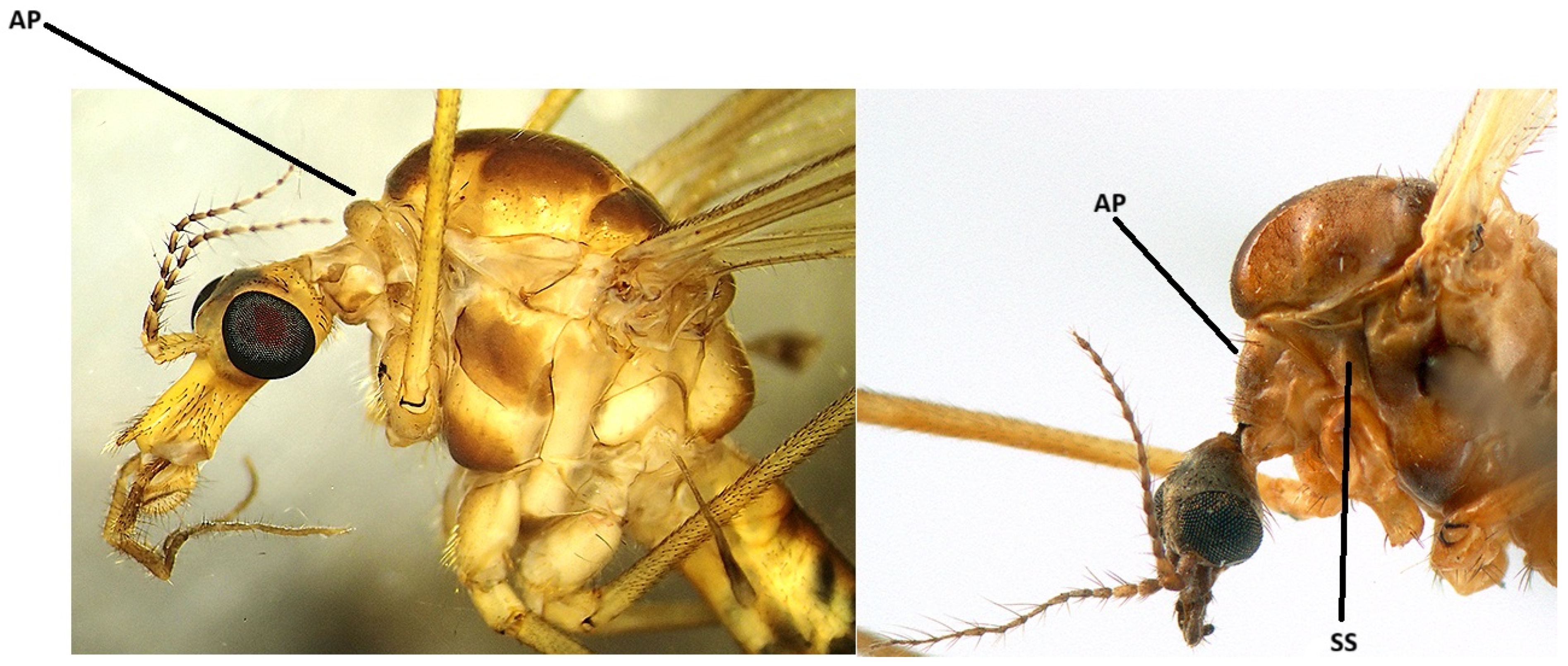


The Application of Molecular Techniques to Improve the Classification of Limoniidae

Simple Summary
Abstract
1. Introduction

| Infraorder Tipulomorpha | Superfamily Tipuloidea | Family Tipulidae |
|---|---|---|
| Families | Families | Subfamilies |
| Trichoceridae Cylindrotomidae Limoniidae Pediciidae Tipulidae | Cylindrotomidae Limoniidae Pediciidae Tipulidae | Cylindrotominae Tipulinae Limnobiinae Tribe Pediciini |
2. Classification of Limoniidae Using Molecular Techniques
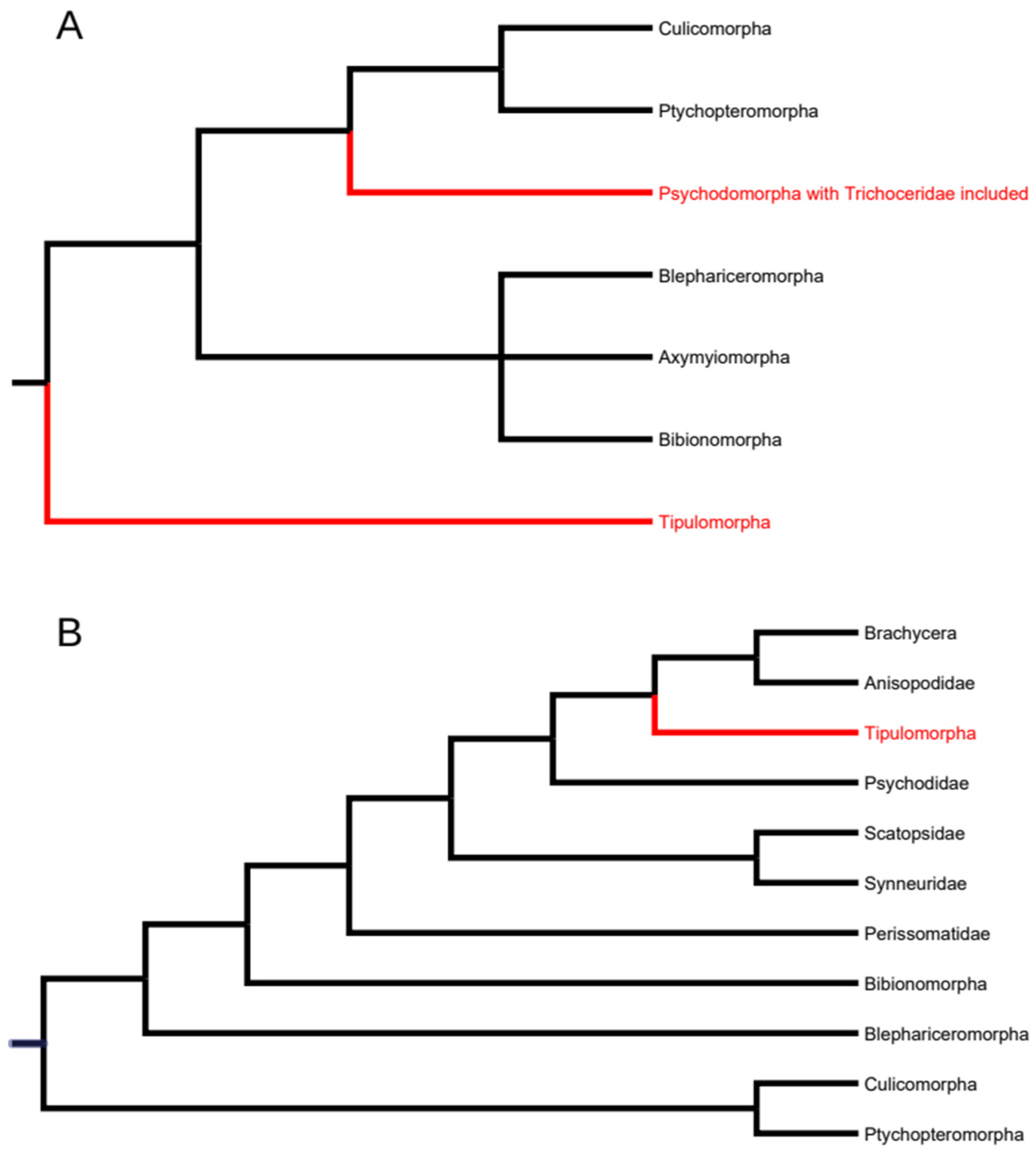
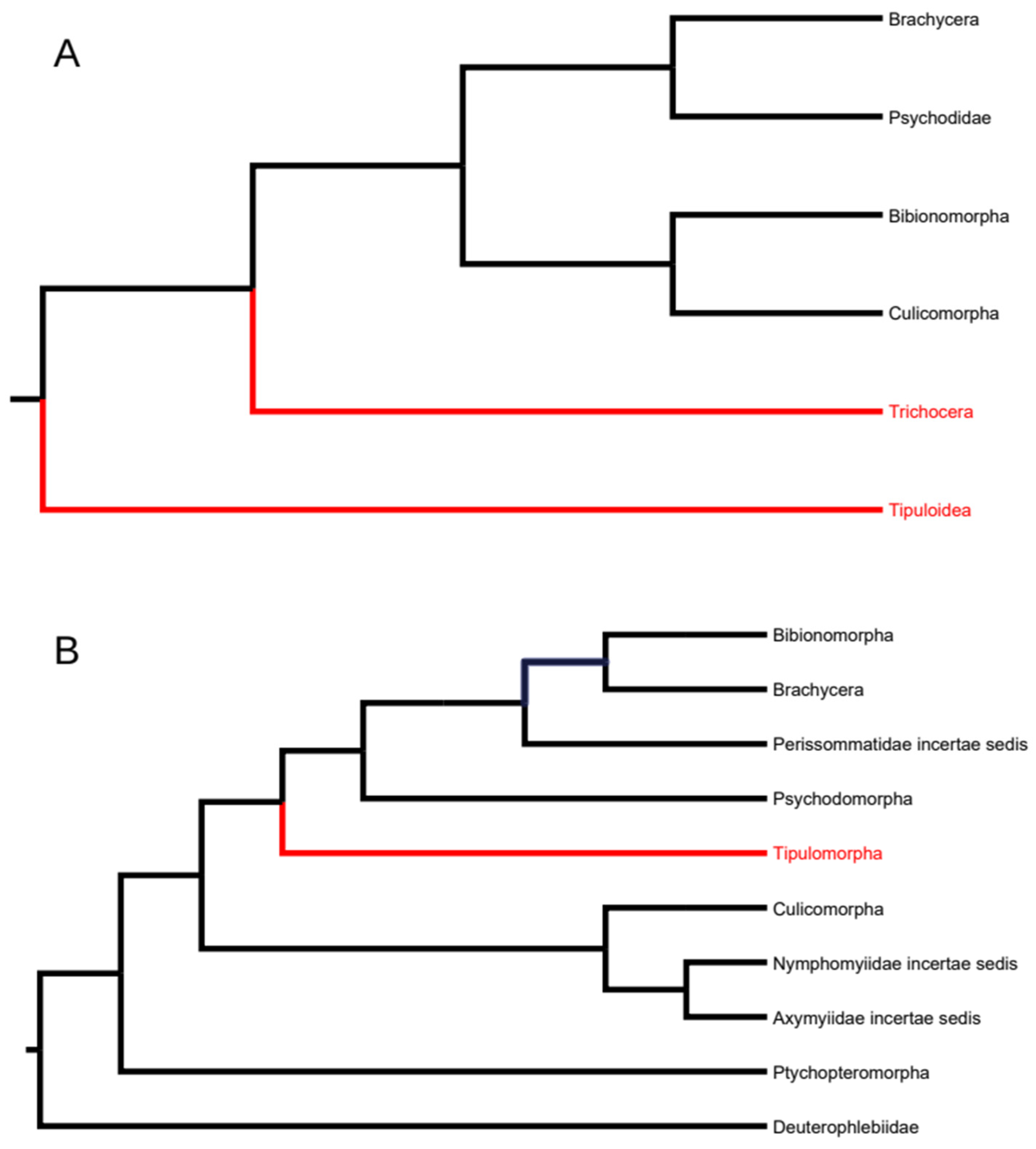
2.1. Position of the Limoniidae and Tipulomorpha Within the Diptera
| Study | Principal Question Investigated | Number of Ingroup Species | Outgroup Species | Number of Tipulomorpha Species | Study Design | Phylogenetic Tree Construction | Main Conclusions |
|---|---|---|---|---|---|---|---|
| Friedrich and Tautz [19] | Relationships among Nematocera | 16 | One Lepidoptera, one Mecoptera and one Siphonaptera species | 3 | Single-gene used to infer phylogeny | Maximum Likelihood, Maximum Parsinomy, Neighbor Joining | Tipuloidea monophyletic, withouth Trichoceridae |
| Bertone et al. [25] | Relationships among Nematocera | 64 lower diptera, 3 Brachycera | Two Mecoptera and one Siphonaptera species | 10 | Four genes used to infer phylogeny | Maximum Likelihood, Maximum Parsinomy, Bayesian inference | Tipulomorpha monophyletic, intermediate within the Diptera tree |
| Wiegmann et al. [18] | Phylogeny of the Diptera | Tier1: 42 taxa, Tier 2: 202 taxa | One Lepidoptera, one Siphonaptera and 4 Mecoptera species | 9 | Two-tier study: Tier 1: 14 nuclear genes, complete mitochondrial genomes, and 371 morphological characters; Tier 2: five nuclear genes. Both tiers were used to infer phylogenetic relationships. | Maximum likelihood, Bayesian inference | Tipulomorpha monophyletic, near base of the Diptera tree |
| Zhang et al. [26] | Relationships among Nematocera | 29 | Two Mecoptera and one Siphonaptera species | 9 | Two combinations of mitochondrial genome used to infer phylogeny: 9815 bp and 6067 bp with several protein-coding genes excluded in the second dataset. | Bayesian inference | Tipulomorpha monophyletic in both dataset and placed in an intermediate position |
| Kang et al. [27] | Phylogeny of the Tipulomorpha | 17 Lower Diptera, three Brachycera | One Mecoptera and one Siphonaptera species | 5 | 1709 single-copy orthologous genes used to infer phylogeny | Maximum likelihood | Tipulomorpha monophyletic, intermediate within the Diptera tree |
| Zhang et al. [28] | Relationships among Nematocera | 108 | Four Mecoptera and Four Siphonaptera species | 12 | 13,513 bp of mitochondrial genome used to infer phylogeny | Bayesian inference | Tipulomorpha monophyletic, positioned near base of Diptera tree |
| Study | Principal Question Investigated | Number of Ingroup Species | Outgroup Species | Number of Limoniidae Species | Number of Tipuloidea Excl. Limoniidae | Dataset | Phylogenetic Tree Construction | Main Conclusions |
|---|---|---|---|---|---|---|---|---|
| Ahonen [29] | Relationship among subfamilies of the Tipulomorpha | 37 | Two Trichoceridae species | 18 | 17 | Two genes used to infer phylogeny | Maximum Parsinomy, Maximum Likelihood, Neighbor Joining, Bayesian Inference | Pediciidae basal lineage, Limnophilinae paraphyletic, Cylindrotomidae and Tipulidae closely related |
| Petersen et al. [5] | Higher-level classification of Tipuloidea | 45 | Two Ptychopteridae and two Trichoceridae species | 30 | 15 | Two genes + 100 morphological characters used to infer phylogeny | Maximum Parsinomy, Bayesian Inference | Pediciidae basal lineage of Tipuloidea, Limoniidae paraphyletic, Cylindrotomidae and Tipulidae sister taxa. |
| Kang et al. [30] | Characterization of mitochondriial genome of. C. crassipes gracylistila Phylogeny of Tipuloidea | 8 | Two Trichoceridae species | 4 | 4 | Whole mitochondrial genome | Bayesian inference | Pediciidae basal lineage of Tipuloidea, Limoniidae paraphyletic, Cylindrotomidae and Tipulidae sister taxa |
| Ren et al. [31] | Characterization of mitochondrial genome of L. phragmitidis. Phylogeny of Tipuloidea | 8 | One Trichoceridae species | 4 | 4 | 13 protein-coding genes of mitochondrial genome | Bayesian inference | Pediciidae basal lineage of Tipuloidea, Limoniidae paraphyletic, Cylindrotomidae and Tipulidae sister taxa |
| Ren et al. [32] | Characterization of mitochondrial genome of N. tenuipes Phylogeny of Tipuloidea | 10 | One Anisopodidae and two Trichoceridae species | 4 | 6 | 13 protein-coding genes and 2 rRNAs of mitochondrial genome | Bayesian inference | Pediciidae basal lineage of Tipuloidea, Limoniidae paraphyletic, Cylindrotomidae and Tipulidae |
| sister taxa | ||||||||
| Ren et al. [33] | Characterization of mitochondrial genome of P. brunneinota. Phylogeny of Tipuloidea | 11 | One Anisopodidae and two Trichoceridae species | 5 | 6 | 13 protein-coding genes and 2 rRNAs of mitochondrial genome | Bayesian inference | Pediciidae basal lineage of Tipuloidea, Limoniidae paraphyletic, Cylindrotomidae and Tipulidae sister taxa |
| Kang et al. [34] | Characterization of mitochondrial genome of the tribe Elephantomyiini Phylogeny of Tipuloidea | 27 | Three Trichoceridae species | 12 | 15 | Four different mitochondrial dataset combinations. | Maximum Likelihood, Bayesian inference | Pediciidae basal lineage of Tipuloidea, Limoniidae paraphyletic, Cylindrotomidae and Tipulidae sister taxa |
| Xu et al. [35] | Characterization of mitochondrial genome of the tribe Dicranoptychini Phylogeny of Tipuloidea | 17 | One Pediciidae species | 12 | 5 | Four different mitochondrial dataset combinations. | Maximum Likelihood, Bayesian inference | Limoniidae paraphyletic, Cylindrotomidae and Tipulidae sister taxa |

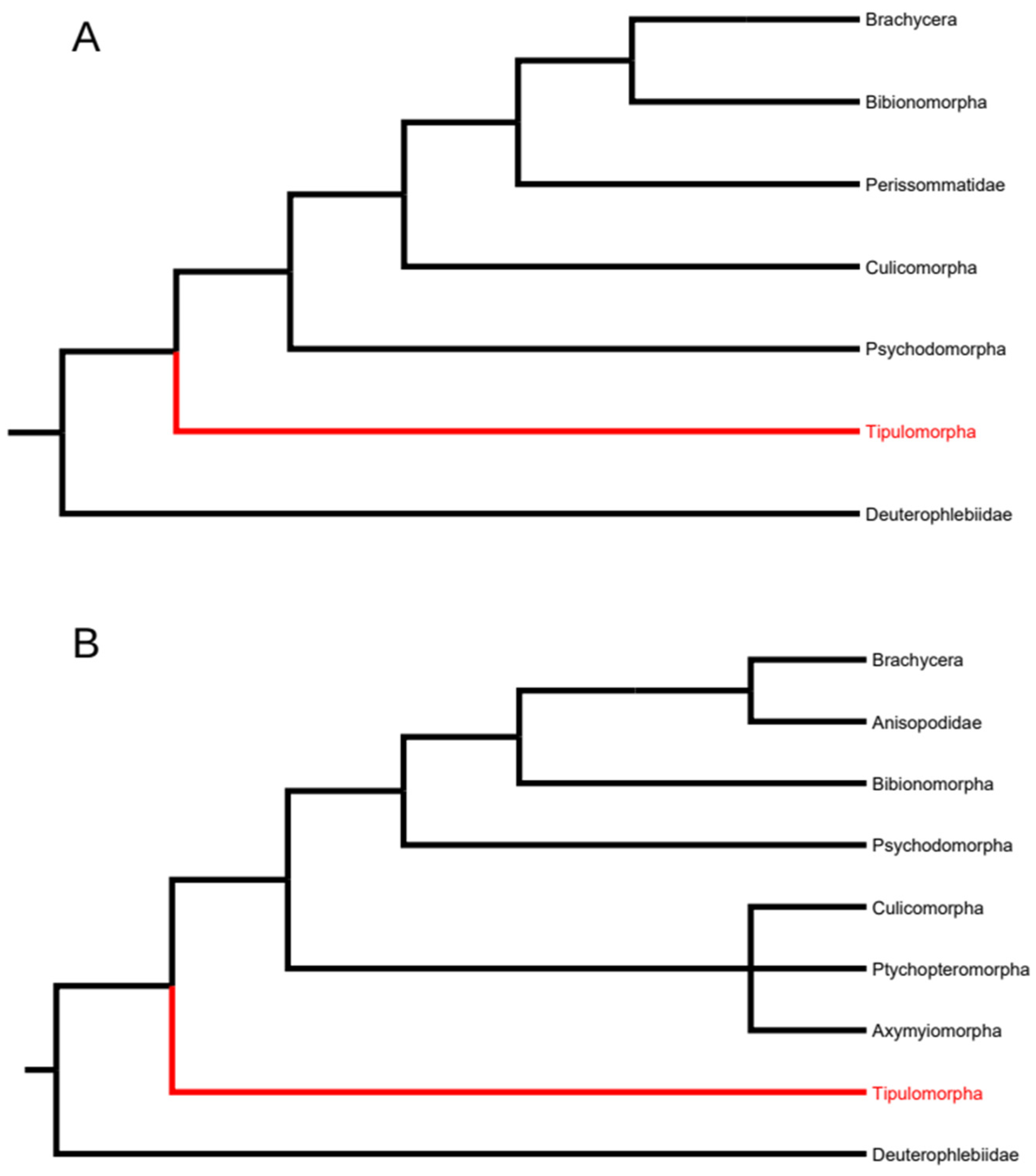
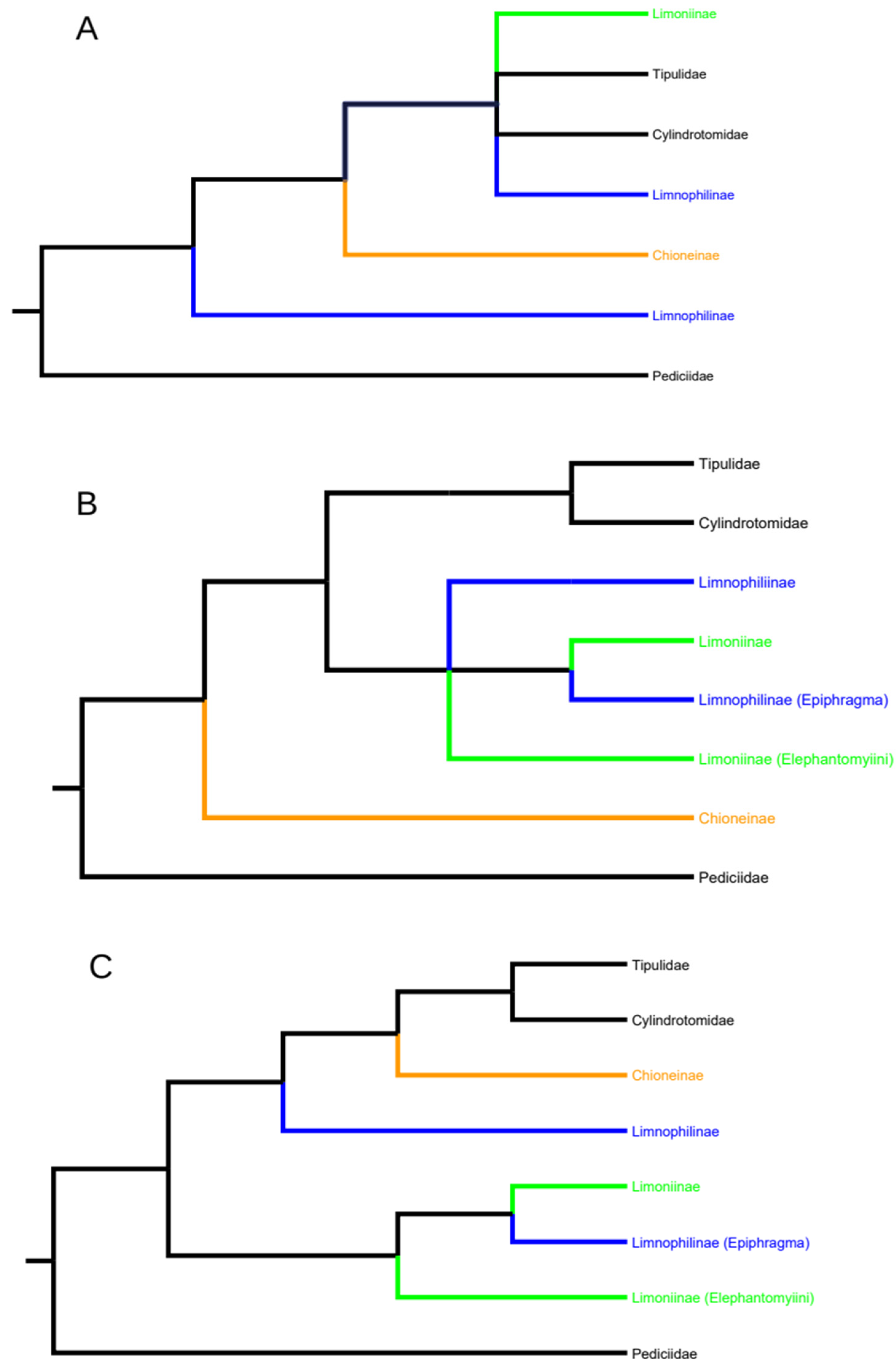
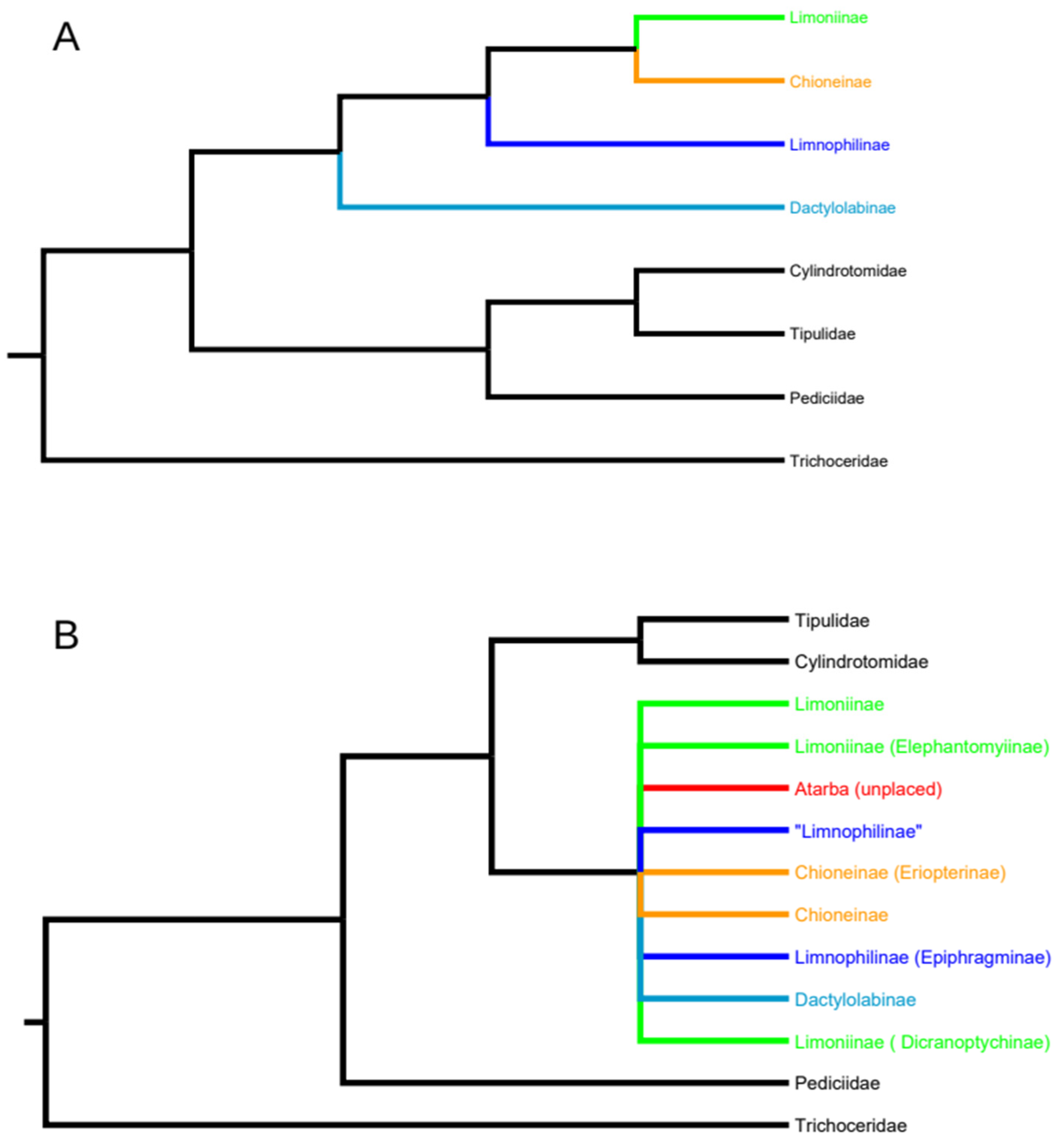
2.2. Test of the Monophyly of the Limoniidae and Analysis of Crane Flies’ Relationships
3. Improving the Classification of Limoniidae
4. Concluding Remarks
Author Contributions
Funding
Data Availability Statement
Acknowledgments
Conflicts of Interest
References
- Oosterbroek, P. Catalogue of the Crane Flies of the World. 2005. Available online: https://ccw.naturalis.nl/ (accessed on 1 May 2025).
- Petersen, M.; Gelhaus, J.; Oosterbroek, P.; Podėnas, S.; Podėnienė, V.; Ribeiro, G.; Santos, D.; Zhang, X. Crane Fly (Diptera: Tipuloidea) Systematics: Past, Present, and Future. Insect Syst. Divers. 2025, 9, 5. [Google Scholar] [CrossRef]
- Alexander, C.P. The Crane-Flies of New York: Biology and Phylogeny; Cornell University: Ithaca, NY, USA, 1920; Volume 38. [Google Scholar]
- Starỳ, J. Phylogeny and Classification of Tipulomorpha, with Special Emphasis on the Family Limoniidae. Acta Zool. Cracoviensia 1992, 35, 11–36. [Google Scholar]
- Petersen, M.J.; Bertone, M.A.; Wiegmann, B.M.; Courtney, G.W. Phylogenetic Synthesis of Morphological and Molecular Data Reveals New Insights into the Higher-Level Classification of Tipuloidea (Diptera). Syst. Entomol. 2010, 35, 526–545. [Google Scholar] [CrossRef]
- Hennig, W. Diptera (Zweiflugler). In Handbuch der Zoologie; Walter de Gruyter: Berlin, Germany, 1973; Volume 4, pp. 1–337. [Google Scholar]
- Byers, G. Crane Flies-Three Families or One. Acta Zool. Cracoviensia 1992, 35, 37–41. [Google Scholar]
- Skuse, F.A.A. Diptera of Australia, Part 7. The Tipulidae Brevipalpi. Proc. Linn. Soc. New South Wales 1890, 2, 757–892. [Google Scholar] [CrossRef]
- Lundstrom, C. Beitrage Zur Kenntnis der Dipteren Finlands. VIII. Supplement 2, Mycetophilidae, Tipulidae, Cylindrotomidae Und Limnobiidae. Acta Soc. Pro Fauna Et. Flora Fenn. 1912, 36, 1–70. [Google Scholar]
- Lackschewitz, P. Neue Limnobiiden Und Tipuliden Aus Dem Ostbaltikum. Arb. Des. Naturforscher-Ver. Zu Riga. (N.F.) 1925, 16, 3–15. [Google Scholar]
- Savchenko, E. New Species of Dactylolabis O.-S. (Diptera, Limoniidae) from the Crimea. Dopovidi Akad. Nauk. Ukr. RSR (B) 1963, 1963, 129–132. [Google Scholar] [CrossRef]
- Savchenko, E. On a Stenopterous Form of Dicranomyia complicata de Meijere (Diptera, Limoniidae). Dopovidi Akad. Nauk. Ukr. RSR (B) 1970, 1970, 466–469. [Google Scholar]
- Mannheims, B. Die Europäischen Phyllolabis-Arten (Dipt., Limoniidae). Bonn. Zool. Beiträge 1959, 10, 149–156. [Google Scholar]
- Oosterbroek, P.; Theowald, B. Phylogeny of the Tipuloidea Based on Characters of Larvae and Pupae (Diptera, Nematocera) with an Index to the Literature except Tipulidae. Tijdschr. Voor Entomol. 1991, 134, 211–267. [Google Scholar]
- Mayr, E. Cladistic Analysis or Cladistic Classification. Z. Für Zool. Syst. Und Evol. 1974, 12, 94–128. [Google Scholar]
- Ribeiro, G.C. Phylogeny of the Limnophilinae (Limoniidae) and Early Evolution of the Tipulomorpha (Diptera). Invertebr. Syst. 2008, 22, 627–694. [Google Scholar] [CrossRef]
- Mauro, D.S.; Agorreta, A. Molecular Systematics: A Synthesis of the Common Methods and the State of Knowledge. Cell. Mol. Biol. Lett. 2010, 15, 311–341. [Google Scholar] [CrossRef] [PubMed]
- Wiegmann, B.M.; Trautwein, M.D.; Winkler, I.S.; Barr, N.B.; Kim, J.-W.; Lambkin, C.; Bertone, M.A.; Cassel, B.K.; Bayless, K.M.; Heimberg, A.M.; et al. Episodic Radiations in the Fly Tree of Life. Proc. Natl. Acad. Sci. USA 2011, 108, 5690–5695. [Google Scholar] [CrossRef] [PubMed]
- Friedrich, M.; Tautz, D. Evolution and Phylogeny of the Diptera: A Molecular Phylogenetic Analysis Using 28S rDNA Sequences. Syst. Biol. 1997, 46, 674–698. [Google Scholar] [CrossRef]
- Yeates, D.K.; Wiegmann, B.M. Congruence and Controversy: Toward a Higher-Level Phylogeny of Diptera. Annu. Rev. Entomol. 1999, 44, 397–428. [Google Scholar] [CrossRef] [PubMed]
- Amorim, D.d.S.; Yeates, D. Pesky Gnats: Ridding Dipteran Classification of the Nematocera. Stud. Dipterol. 2006, 13, 3–9. [Google Scholar]
- Krzeminski, W. Triassic and Lower Jurassic Stage of Diptera Evolution. Mitteilungen Der Schweiz. Entomol. Ges. 1992, 65, 39–59. [Google Scholar]
- Wood, D.; Borkent, A. Phylogeny and Classification of the Nenatocera. Man. Nearctic Diptera 1989, 3, 1333–1370. [Google Scholar]
- Oosterbroek, P.; Courtney, G. Phylogeny of the Nematocerous Families of Diptera (Insecta). Zool. J. Linn. Soc. 1995, 115, 267–311. [Google Scholar] [CrossRef]
- Bertone, M.A.; Courtney, G.W.; Wiegmann, B.M. Phylogenetics and Temporal Diversification of the Earliest True Flies (Insecta: Diptera) Based on Multiple Nuclear Genes. Syst. Entomol. 2008, 33, 668–687. [Google Scholar] [CrossRef]
- Zhang, X.; Kang, Z.; Mao, M.; Li, X.; Cameron, S.L.; de Jong, H.; Wang, M.; Yang, D. Comparative Mt Genomics of the Tipuloidea (Diptera: Nematocera: Tipulomorpha) and Its Implications for the Phylogeny of the Tipulomorpha. PLoS ONE 2016, 11, e0158167. [Google Scholar] [CrossRef] [PubMed]
- Kang, Z.; Zhang, X.; Ding, S.; Tang, C.; Wang, Y.; de Jong, H.; Cameron, S.L.; Wang, M.; Yang, D. Transcriptomes of Three Species of Tipuloidea (Diptera, Tipulomorpha) and Implications for Phylogeny of Tipulomorpha. PLoS ONE 2017, 12, e0173207. [Google Scholar] [CrossRef] [PubMed]
- Zhang, X.; Yang, D.; Kang, Z. New Data on the Mitochondrial Genome of Nematocera (Lower Diptera): Features, Structures and Phylogenetic Implications. Zool. J. Linn. Soc. 2023, 197, 229–245. [Google Scholar] [CrossRef]
- Ahonen, S. Analysis of the Crane Flies (Diptera, Tipuloidea) Subfamilies Relationships Using Molecular Sequence Data. Master’s Thesis, Department of Ecological and Environmental Science, University of Jyvaskyla, Jyväskylä, Finland, 2008; pp. 1–28. [Google Scholar]
- Kang, Z.; Zhang, X.; Yang, D. Characterization of the Complete Mitochondrial Genome of the Snow Crane-Fly Chionea crassipes gracilistyla (Diptera, Tipuloidea, Limoniidae) with Phylogenetic Analysis. Mitochondrial DNA Part B 2019, 4, 2662–2663. [Google Scholar] [CrossRef] [PubMed]
- Ren, J.; Yang, Q.; Gao, S.; Pan, Z.; Chang, W.; Yang, D. The Mitochondrial Genome of Limonia phragmitidis (Diptera Limoniidae). Mitochondrial DNA Part B 2019, 4, 719–720. [Google Scholar] [CrossRef]
- Ren, J.; Zhang, C.; Chang, W.; Yang, D. The Mitochondrial Genome of Nephrotoma tenuipes (Diptera Tipulidae). Mitochondrial DNA Part B 2019, 4, 3092–3093. [Google Scholar] [CrossRef] [PubMed]
- Ren, J.; Zhang, B.; Yang, D. The Mitochondrial Genome of Chinese Endemic Species Pseudolimnophila (Pseudolimnophila) brunneinota (Diptera: Limoniidae). Mitochondrial DNA Part B 2019, 4, 3742–3743. [Google Scholar] [CrossRef] [PubMed]
- Kang, Z.; Xu, Y.; Wang, G.; Yang, D.; Zhang, X. First Mitochondrial Genomes of the Crane Fly Tribe Elephantomyiini (Diptera, Tipuloidea, Limoniidae): Comparative Analysis and Phylogenetic Implications. Arthropod Syst. Phylogeny 2023, 81, 731–746. [Google Scholar] [CrossRef]
- Xu, Y.; Zhang, S.; Chen, Y.; Wang, G.; Yang, D.; Zhang, X. Contribution to the Knowledge of Dicranoptychini (Diptera, Tipuloidea, Limoniidae) in China, with the First Mitochondrial Genome of the Tribe and Its Phylogenetic Implications. Insects 2023, 14, 535. [Google Scholar] [CrossRef] [PubMed]
- Delsuc, F.; Stanhope, M.J.; Douzery, E.J. Molecular Systematics of Armadillos (Xenarthra, Dasypodidae): Contribution of Maximum Likelihood and Bayesian Analyses of Mitochondrial and Nuclear Genes. Mol. Phylogenetics Evol. 2003, 28, 261–275. [Google Scholar] [CrossRef] [PubMed]
- Gadagkar, S.R.; Rosenberg, M.S.; Kumar, S. Inferring Species Phylogenies from Multiple Genes: Concatenated Sequence Tree versus Consensus Gene Tree. J. Exp. Zool. Part B Mol. Dev. Evol. 2005, 304, 64–74. [Google Scholar] [CrossRef] [PubMed]
- Delsuc, F.; Brinkmann, H.; Philippe, H. Phylogenomics and the Reconstruction of the Tree of Life. Nat. Rev. Genet. 2005, 6, 361–375. [Google Scholar] [CrossRef] [PubMed]
- Rokas, A.; Williams, B.L.; King, N.; Carroll, S.B. Genome-Scale Approaches to Resolving Incongruence in Molecular Phylogenies. Nature 2003, 425, 798–804. [Google Scholar] [CrossRef] [PubMed]
- Eisen, J.A.; Fraser, C.M. Phylogenomics: Intersection of Evolution and Genomics. Science 2003, 300, 1706–1707. [Google Scholar] [CrossRef] [PubMed]
- Gee, H. Ending Incongruence. Nature 2003, 425, 782. [Google Scholar] [CrossRef] [PubMed]
- Rosenberg, M.S.; Kumar, S. Incomplete Taxon Sampling Is Not a Problem for Phylogenetic Inference. Proc. Natl. Acad. Sci. USA 2001, 98, 10751–10756. [Google Scholar] [CrossRef] [PubMed]
- Rokas, A.; Carroll, S.B. More Genes or More Taxa? The Relative Contribution of Gene Number and Taxon Number to Phylogenetic Accuracy. Mol. Biol. Evol. 2005, 22, 1337–1344. [Google Scholar] [CrossRef] [PubMed]
- Pollock, D.D.; Zwickl, D.J.; McGuire, J.A.; Hillis, D.M. Increased Taxon Sampling Is Advantageous for Phylogenetic Inference. Syst. Biol. 2002, 51, 664–671. [Google Scholar] [CrossRef] [PubMed]
- Zwickl, D.J.; Hillis, D.M. Increased taxon sampling greatly reduces phylogenetic error. Syst. Biol. 2002, 51, 588–598. [Google Scholar] [CrossRef] [PubMed]
- Dong, Z.; Qu, S.; Landrein, S.; Yu, W.-B.; Xin, J.; Zhao, W.; Song, Y.; Tan, Y.; Xin, P. Increasing Taxa Sampling Provides New Insights on the Phylogenetic Relationship Between Eriobotrya and Rhaphiolepis. Front. Genet. 2022, 13, 831206. [Google Scholar] [CrossRef] [PubMed]
- Li, G.; Steel, M.; Zhang, L. More Taxa Are Not Necessarily Better for the Reconstruction of Ancestral Character States. Syst. Biol. 2008, 57, 647–653. [Google Scholar] [CrossRef] [PubMed]
- Madsen, O.; Scally, M.; Douady, C.J.; Kao, D.J.; DeBry, R.W.; Adkins, R.; Amrine, H.M.; Stanhope, M.J.; de Jong, W.W.; Springer, M.S. Parallel Adaptive Radiations in Two Major Clades of Placental Mammals. Nature 2001, 409, 610–614. [Google Scholar] [CrossRef] [PubMed]
- Murphy, W.J.; Eizirik, E.; Johnson, W.E.; Zhang, Y.P.; Ryder, O.A.; O’Brien, S.J. Molecular Phylogenetics and the Origins of Placental Mammals. Nature 2001, 409, 614–618. [Google Scholar] [CrossRef] [PubMed]
- Qiu, Y.-L.; Li, L.; Wang, B.; Chen, Z.; Knoop, V.; Groth-Malonek, M.; Dombrovska, O.; Lee, J.; Kent, L.; Rest, J.; et al. The Deepest Divergences in Land Plants Inferred from Phylogenomic Evidence. Proc. Natl. Acad. Sci. USA 2006, 103, 15511–15516. [Google Scholar] [CrossRef] [PubMed]
- Misof, B.; Liu, S.; Meusemann, K.; Peters, R.S.; Donath, A.; Mayer, C.; Frandsen, P.B.; Ware, J.; Flouri, T.; Beutel, R.G.; et al. Phylogenomics Resolves the Timing and Pattern of Insect Evolution. Science 2014, 346, 763–767. [Google Scholar] [CrossRef] [PubMed]
- Yan, B.; Dietrich, C.H.; Yu, X.-F.; Jiang, Y.; Dai, R.-H.; Du, S.-Y.; Cai, C.-Y.; Yang, M.-F.; Zhang, F. Missing Data and Model Selection in Phylogenomics: A Re-Evaluation of Cicadomorpha (Hemiptera: Auchenorrhyncha) Superfamily Level Relationships. J. Syst. Evol. 2025, 63, 1203–1216. [Google Scholar] [CrossRef]
- Philippe, H.; Zhou, Y.; Brinkmann, H.; Rodrigue, N.; Delsuc, F. Heterotachy and Long-Branch Attraction in Phylogenetics. BMC Evol. Biol. 2005, 5, 50. [Google Scholar] [CrossRef] [PubMed]
- Philippe, H.; Brinkmann, H.; Lavrov, D.V.; Littlewood, D.T.J.; Manuel, M.; Wörheide, G.; Baurain, D. Resolving Difficult Phylogenetic Questions: Why More Sequences Are Not Enough. PLoS Biol. 2011, 9, e1000602. [Google Scholar] [CrossRef] [PubMed]
- Boussau, B.; Walton, Z.; Delgado, J.A.; Collantes, F.; Beani, L.; Stewart, I.J.; Cameron, S.A.; Whitfield, J.B.; Johnston, J.S.; Holland, P.W.; et al. Strepsiptera, Phylogenomics and the Long Branch Attraction Problem. PLoS ONE 2014, 9, e107709. [Google Scholar] [CrossRef] [PubMed]
- Nabhan, A.R.; Sarkar, I.N. The Impact of Taxon Sampling on Phylogenetic Inference: A Review of Two Decades of Controversy. Brief. Bioinform. 2012, 13, 122–134. [Google Scholar] [CrossRef] [PubMed]
- Degnan, J.H.; Rosenberg, N.A. Gene Tree Discordance, Phylogenetic Inference and the Multispecies Coalescent. Trends Ecol. Evol. 2009, 24, 332–340. [Google Scholar] [CrossRef] [PubMed]
- Feng, S.; Bai, M.; Rivas-González, I.; Li, C.; Liu, S.; Tong, Y.; Yang, H.; Chen, G.; Xie, D.; Sears, K.E.; et al. Incomplete Lineage Sorting and Phenotypic Evolution in Marsupials. Cell 2022, 185, 1646–1660. [Google Scholar] [CrossRef] [PubMed]
- Liu, L.; Yu, L.; Kubatko, L.; Pearl, D.K.; Edwards, S.V. Coalescent Methods for Estimating Phylogenetic Trees. Mol. Phylogenetics Evol. 2009, 53, 320–328. [Google Scholar] [CrossRef] [PubMed]
- Podeniene, V.; Gelhaus, J.K. The First Description of the Larva and Pupa of Crane Fly Genus Phyllolabis Osten Sacken, 1877 (Diptera, Limoniidae, Limnophilinae), with Information for Understanding the Phylogenetic Relationships and Systematical Position of the Genus. Zootaxa 2017, 4365, 559–570. [Google Scholar] [CrossRef] [PubMed]
- Lozano-Fernandez, J. A Practical Guide to Design and Assess a Phylogenomic Study. Genome Biol. Evol. 2022, 14, evac129. [Google Scholar] [CrossRef] [PubMed]
- Lunghi, E.; Ficetola, G.F.; Zhao, Y.; Manenti, R. Are the Neglected Tipuloidea Crane Flies (Diptera) an Important Component for Subterranean Environments? Diversity 2020, 12, 333. [Google Scholar] [CrossRef]
- Chang, J.J.M.; Raupach, M.J.; Cheng, L.; Damgaard, J.; Hongjamrassilp, W.; Ip, Y.C.A.; Ng, M.H.-C.; Chan, W.W.R.; Kunning, I.; Liang, B.J.Y.; et al. Skimming the Skaters: Genome Skimming Improves Phylogenetic Resolution of Halobatinae (Hemiptera: Gerridae). Insect Syst. Divers. 2024, 8, 3. [Google Scholar] [CrossRef]
- Lopes, F.; Gunter, N.; Gillett, C.P.; Montanaro, G.; Rossini, M.; Losacco, F.; Daniel, G.M.; Straube, N.; Tarasov, S. From Museum Drawer to Tree: Historical DNA Phylogenomics Clarifies the Systematics of Rare Dung Beetles (Coleoptera: Scarabaeinae) from Museum Collections. PLoS ONE 2024, 19, e0309596. [Google Scholar] [CrossRef] [PubMed]
- He, S.; Su, Y.N.; Tan, M.K.; Zwick, A.; Warren, B.H.; Robillard, T. Museomics, Molecular Phylogeny and Systematic Revision of the Eurepini Crickets (Orthoptera: Gryllidae: Eneopterinae), with Description of Two New Genera. Syst. Entomol. 2024, 49, 389–411. [Google Scholar] [CrossRef]
- Quattrini, A.M.; McCartin, L.J.; Easton, E.E.; Horowitz, J.; Wirshing, H.H.; Bowers, H.; Mitchell, K.; González-García, M.d.P.; Sei, M.; McFadden, C.S.; et al. Skimming Genomes for Systematics and DNA Barcodes of Corals. Ecol. Evol. 2024, 14, e11254. [Google Scholar] [CrossRef] [PubMed]
- Yeates, D.K.; Zwick, A.; Mikheyev, A.S. Museums Are Biobanks: Unlocking the Genetic Potential of the Three Billion Specimens in the World’s Biological Collections. Curr. Opin. Insect Sci. 2016, 18, 83–88. [Google Scholar] [CrossRef] [PubMed]
- Short, A.E.Z.; Dikow, T.; Moreau, C.S. Entomological Collections in the Age of Big Data. Annu. Rev. Entomol. 2018, 63, 513–530. [Google Scholar] [CrossRef] [PubMed]


| Classification Proposed by Petersen et al. [5] | |
|---|---|
| Family | Subfamilies |
| Pediciidae | |
| Tipulidae | Dicranoptychinae |
| Dactylolabinae | |
| Epiphragminae | |
| Chioneinae | |
| Eriopterinae | |
| “Limnophilinae” | |
| Atarba? | |
| Elephantomyiinae | |
| Limoniinae | |
| Cylindrotominae | |
| Tipulinae | |
Disclaimer/Publisher’s Note: The statements, opinions and data contained in all publications are solely those of the individual author(s) and contributor(s) and not of MDPI and/or the editor(s). MDPI and/or the editor(s) disclaim responsibility for any injury to people or property resulting from any ideas, methods, instructions or products referred to in the content. |
© 2026 by the authors. Licensee MDPI, Basel, Switzerland. This article is an open access article distributed under the terms and conditions of the Creative Commons Attribution (CC BY) license.
Share and Cite
Ciliberti, P.; Podėnas, S.; Podėnienė, V.; Havelka, J. The Application of Molecular Techniques to Improve the Classification of Limoniidae. Insects 2026, 17, 805. https://doi.org/10.3390/insects17080805
Ciliberti P, Podėnas S, Podėnienė V, Havelka J. The Application of Molecular Techniques to Improve the Classification of Limoniidae. Insects. 2026; 17(8):805. https://doi.org/10.3390/insects17080805
Chicago/Turabian StyleCiliberti, Pasquale, Sigitas Podėnas, Virginjia Podėnienė, and Jekaterina Havelka. 2026. "The Application of Molecular Techniques to Improve the Classification of Limoniidae" Insects 17, no. 8: 805. https://doi.org/10.3390/insects17080805
APA StyleCiliberti, P., Podėnas, S., Podėnienė, V., & Havelka, J. (2026). The Application of Molecular Techniques to Improve the Classification of Limoniidae. Insects, 17(8), 805. https://doi.org/10.3390/insects17080805