1. Introduction
Forensic entomology plays an important role in estimating the minimum postmortem interval (PMI
min), particularly in cases involving advanced decomposition, with necrophagous flies constituting one of the principal sources of entomological evidence [
1]. Development-based estimates generally reflect the PMI
min rather than the full interval elapsed since death, as insect colonization may be delayed after death [
2]. During decomposition, these flies complete their development and emerge as adults, leaving behind large numbers of empty puparia at the scene [
3]. Owing to their rigid structure and resistance to environmental factors, empty puparia can persist for extended periods at crime scenes. The progressive changes associated with their weathering over time provide information on the post-eclosion interval (PEI), defined as the interval between adult emergence and evidence collection, and may therefore complement PMI
min estimation [
4]. In forensic casework, estimation of the PEI may help approximate the timing of adult emergence when the collection time of empty puparia is known. When combined with species-specific developmental data, this information may contribute to PMI
min assessment.
In natural environments, organic matter undergoes gradual weathering under the combined influence of environmental factors such as temperature, humidity, and biological activity, leading to time-dependent changes in chemical composition and structure [
5,
6]. Similar processes also occur in biological remains. In forensic entomology, puparia are protective structures formed by the contraction and sclerotization of the cuticle of late instar larvae. They are primarily composed of chitin and associated proteins, which confer a relatively high degree of stability [
7,
8]. However, when empty puparia are exposed to natural conditions over prolonged periods, their structural features and chemical composition may still gradually change under environmental influences, including temperature, humidity, and light [
9]. Previous studies have indicated that these changes are, to a certain extent, correlated with exposure duration, suggesting their potential utility for estimating the PEI in long-interval cases [
10].
In studies involving empty puparia as complementary evidence for PMI inference, Bajerlein et al. incorporated empty puparia as one of several entomological indicators within a development-based approach, in which the PMI
min was inferred from the age of the most advanced insect stage using thermal summation methods, alongside additional estimates derived from other taxa [
11]. However, as pointed out by Wydra et al., PMI
min estimation based on empty puparia is subject to substantial uncertainty due to the unknown PEI, particularly under long-term or variable environmental conditions, which complicates the determination of the appropriate starting point for retrospective estimation of insect development [
12]. Therefore, empty-puparial weathering primarily provides an estimate of the PEI, which should be combined with insect developmental information when used to support PMI
min assessment. In recent years, chemical analytical techniques have provided new avenues to address this limitation. Among these, studies focusing on cuticular hydrocarbons (CHCs) have been extensively investigated. Zhu et al. demonstrated through field experiments that the total abundance of CHCs in empty puparia decreases significantly with increasing exposure time, and that differences in degradation patterns among individual hydrocarbons may serve as potential indicators for assessing puparia weathering [
13]. Paula et al. further confirmed that chemical profiling based on GC-MS can not only estimate weathering time but also distinguish empty puparia from different generations [
14]. In addition, Sharif et al. reported that local microenvironmental conditions significantly influence chemical weathering processes, and that integrating machine learning approaches improves prediction accuracy [
6]. Furthermore, Qu et al. applied Fourier transform infrared (FTIR) in combination with machine learning to model empty puparia weathering time, demonstrating that spectral features reflect the kinetics of chemical degradation and support rapid estimation of long-term puparial weathering intervals [
15]. However, these studies mainly focused on CHCs or spectral features, whereas broader metabolomic alterations and bacterial community changes during empty-puparia weathering remain insufficiently characterized.
As organic remains, empty puparia may undergo degradation processes involving physical weathering, chemical transformations, and bacterial community changes [
6,
16]. Previous studies have indicated links between bacterial succession and changes in the chemical characteristics of decomposing biological remains [
17]. However, in the context of empty-puparia weathering, temporal changes in bacterial communities and their associations with metabolite profiles remain to be systematically investigated.
The blowfly
Aldrichina grahami (Aldrich, 1930) (Diptera: Calliphoridae) is a forensically important necrophagous species widely used in forensic entomology [
18]. Due to its cold tolerance, which may broaden its seasonal occurrence and forensic applicability under cooler or sheltered conditions, together with locally derived developmental data,
A. grahami is particularly relevant for indoor long-interval cases in this region, where persistent empty puparia may remain after larval evidence is no longer available [
19,
20]. In forensic practice, certain indoor death cases often involve individuals living alone or experiencing loss of contact with others, and may remain undiscovered for extended periods [
21]. By the time of discovery, the body has often undergone several months or even longer decomposition, frequently reaching advanced decomposition or skeletonization [
22]. Under such conditions, early postmortem indicators and insect developmental data commonly used for PMI
min estimation are often no longer applicable, leaving empty puparia in the surrounding environment as one of the few remaining sources of entomological evidence [
10]. Therefore, investigating the indoor weathering of
A. grahami empty puparia provides a basis for estimating the PEI and for supporting PMI
min assessment in long-interval cases.
Based on the above, the present study used empty puparia of A. grahami and combined bacterial community analysis with untargeted metabolomics to characterize changes during long-term weathering. By comparing bacterial community composition and metabolite profiles across weathering time, their temporal associations were evaluated. Furthermore, candidate time-associated molecular markers were identified to estimate the PEI of empty puparia and to evaluate its potential contribution to PMImin assessment in long-interval cases.
2. Materials and Methods
2.1. Adult Rearing and Colony Maintenance
A laboratory colony of
A. grahami was established from wild individuals collected from decomposing pig carcasses in Changsha, Hunan Province, China (28°12′ N, 112°58′ E), and had been continuously maintained under laboratory conditions for more than two years and more than six generations before the experiment. Species identification was confirmed using a combination of morphological and molecular methods. Morphological identification was performed according to the diagnostic criteria described in Corpse-Feeding Flies in China, and the species identity was confirmed by Prof. Lushi Chen (Guizhou Police Officer Vocational College) [
23]. Molecular identification was conducted by amplifying the mitochondrial cytochrome c oxidase subunit I (COI) region using primers 658F (5′-GGTCAACAAATCATAAAGATATTGG-3′) and 658R (5′-RAAACTTCAGGRTGACCAAAGAATCA-3′). The resulting sequences were compared with reference sequences in the NCBI GenBank database using BLAST (
https://blast.ncbi.nlm.nih.gov/Blast.cgi, accessed on 13 July 2026) to confirm species identity. The rearing chamber was maintained at 25.0 °C, 75% relative humidity, and a 12:12 h (light:dark) photoperiod. Adult flies were housed in nylon cages (15.0 × 15.0 × 10.0 cm) and provided with a mixture of milk powder and sucrose (1:1) in a 12 cm diameter dish. Water was supplied via cotton pads soaked in water and placed in containers within the cages. Fresh pig lung (15 g) was placed in containers inside the cages to stimulate oviposition. Egg masses laid within 2 h were collected and transferred to containers containing pig lung for incubation. When locomotor activity had markedly decreased and was nearly absent at the onset of pupariation, approximately 200 larvae were transferred together to a plastic pupation container (approximately 20.0 × 30.0 × 10.0 cm) containing a 2.0 cm layer of sterile sand. The pupation container was covered with breathable gauze and was not sealed. Once pupariation was complete, the pupae were removed from the sand and placed on nylon mesh until adult emergence.
2.2. Weathering Simulation and Sampling Procedure
Empty puparia were collected after adult emergence and used for long-term weathering experiments. Weathering time was defined as the interval after adult emergence. All empty puparia originated from a single emergence cohort and were exposed on an A4-sized nylon mesh frame (20.0 × 30.0 cm), without plastic containers or additional substrate. They were maintained under uncontrolled indoor conditions in a laboratory in Changsha, Hunan Province, China (28°12′ N, 112°58′ E). Outdoor temperature and relative humidity data recorded by a local meteorological station were included as reference indicators of regional seasonal trends (
Figure S1). Under these conditions, the samples were protected from direct precipitation and solar radiation. Sampling was performed at 1, 3, 5, 7, 9, 11, and 13 months after adult emergence. This schedule was designed to cover indoor post-eclosion weathering from early to long-term intervals. At each time point, nine empty puparia were randomly selected and divided into three non-overlapping replicate pools, each consisting of three puparia. Each replicate pool was placed in a separate sterile 2 mL microcentrifuge tube. Bacterial community and metabolome analyses were performed on matched aliquots from the same replicate pool, ensuring one-to-one correspondence between the two omics datasets. All sampling procedures were conducted using sterile forceps. Immediately after collection, the samples were frozen in liquid nitrogen and stored at −80 °C for subsequent metabolomic and bacterial community analyses.
2.3. DNA Extraction, 16S rRNA Gene Sequencing, and Data Analysis
Genomic DNA was extracted from empty puparia samples using the E.Z.N.A. Soil DNA Kit (Omega Bio-tek, Norcross, GA, USA) according to the manufacturer’s instructions. The quality of the extracted DNA was assessed by 1% agarose gel electrophoresis, and DNA concentration and purity were measured using a NanoDrop 2000 spectrophotometer (Thermo Fisher Scientific, Wilmington, DE, USA). The extracted total DNA was used as the template for amplification of the V3-V4 hypervariable regions of the bacterial 16S rRNA gene. The primer pair 338F (5′-ACTCCTACGGGAGGCAGCAG-3′) and 806R (5′-GGACTACHVGGGTWTCTAAT-3′) was used for amplification. PCR reactions were performed in a 20 μL mixture containing 4 μL of 5× TransStart FastPfu Buffer, 2 μL of 2.5 mM dNTPs, 0.8 μL of each primer (5 μM), 0.4 μL of TransStart FastPfu DNA Polymerase, and approximately 10 ng of template DNA. The amplification program consisted of an initial denaturation at 95 °C for 3 min, followed by 27 cycles of denaturation at 95 °C for 30 s, annealing at 55 °C for 30 s, and extension at 72 °C for 30 s, with a final extension at 72 °C for 10 min. PCR products were verified by 2% agarose gel electrophoresis, and the target fragments were excised and purified. The purified products were quantified using a Qubit 4.0 fluorometer (Thermo Fisher Scientific, USA), followed by library construction using the NEXTFLEX Rapid DNA-Seq Kit (Bioo Scientific Corporation, Austin, TX, USA). The libraries were pooled in equimolar amounts and subjected to paired-end sequencing on an Illumina NextSeq 2000 platform (Illumina, San Diego, CA, USA).
Raw paired-end reads were demultiplexed and quality-filtered using fastp v0.19.6, and paired reads were merged using FLASH v1.2.11. Low-quality bases with quality scores below 20 were trimmed using a 50 bp sliding window, reads shorter than 50 bp after quality filtering and reads containing ambiguous bases were removed, and paired reads were merged when the minimum overlap length was 10 bp and the maximum mismatch ratio in the overlap region was 0.2. Samples were assigned according to barcode and primer sequences, allowing no barcode mismatches and a maximum of two primer mismatches. High-quality merged sequences were denoised with DADA2 in QIIME2 v2020.2, yielding 913,170 denoised sequences from 1,175,423 raw reads. After removing chloroplast and mitochondrial sequences, 727,822 reads remained, comprising 673 ASVs and 163 genus-level taxa; samples were then rarefied to 34,667 reads, with Good’s coverage ranging from 0.999885 to 1.000000. Taxonomic assignment was performed against the SILVA 16S rRNA gene database (v138) using a Naive Bayes classifier implemented in QIIME2. Alpha diversity indices, including Chao1 and Shannon indices, were calculated using mothur. Differences in alpha diversity among weathering intervals were first assessed using the Kruskal–Wallis test, followed by pairwise Wilcoxon rank-sum tests with Benjamini–Hochberg correction when appropriate. Principal coordinates analysis (PCoA) based on Bray–Curtis dissimilarity was performed to evaluate differences in bacterial community structure among samples, and permutational multivariate analysis of variance (PERMANOVA) was used to test group differences. Spearman correlation analysis was performed to identify bacterial taxa associated with weathering time. To account for multiple testing,
p values were adjusted using the Benjamini–Hochberg false discovery rate (FDR) method. Bacterial genera with |r| > 0.6 and q < 0.05 were considered FDR-supported time-associated features. All analyses were conducted on the Majorbio Cloud Platform (
https://cloud.majorbio.com, accessed on 10 May 2026). The sequencing project has been registered in the NCBI BioProject database under accession number PRJNA1464520.
2.4. GC-MS-Based Metabolic Profiling of Empty Puparia and Data Analysis
Untargeted metabolomic profiling was performed using a GC-MS-based workflow. For each pooled puparial sample, metabolites were extracted using a methanol–water/chloroform protocol. Briefly, the sample was transferred to a 2 mL grinding tube and mixed with 500 µL methanol–water solution (CH3OH:H2O, 4:1, v/v; methanol from Macklin, Shanghai, China) containing 0.02 mg/mL ribitol (P1069993, Damas-beta, Shanghai, China) as an internal standard. A steel ball and 200 µL chloroform (Macklin, Shanghai, China)were added, and the sample was frozen and ground at 50 Hz for 3 min twice. The extract was ultrasonicated at low temperature for 30 min, kept at −20 °C for 30 min, and centrifuged at 13,000 rcf and 4 °C for 15 min. The supernatant was transferred to a glass derivatization vial (ANPEL, Shanghai, China) and dried under nitrogen. Methoxyamination was performed by adding 80 µL methoxyamine hydrochloride in pyridine (15 mg/mL; Macklin, Shanghai, China), followed by vortexing for 2 min and incubation at 37 °C for 90 min. Subsequently, 80 µL BSTFA containing 1% TMCS (ANPEL, Shanghai, China) was added, followed by vortexing for 2 min and derivatization at 70 °C for 60 min. The derivatized samples were kept at room temperature for 30 min before GC-MS analysis.
GC-MS analysis was performed using a TRACE 1610 gas chromatograph coupled with an Orbitrap Exploris mass spectrometer (Thermo Fisher Scientific, USA) at Majorbio Bio-Pharm Technology Co., Ltd. (Shanghai, China). Derivatized samples were injected in split mode with an injection volume of 1 µL and a split ratio of 10:1. Separation was performed on a TG-5SILMS capillary column (30 m × 0.25 mm × 0.25 µm, 26096-1420, Thermo Fisher Scientific, USA), with high-purity helium as the carrier gas at a constant flow rate of 1.0 mL/min. The inlet temperature was 300 °C. The oven temperature was initially held at 80 °C for 0 min, increased to 310 °C at 20 °C/min, and then held for 8 min, with a total run time of 20 min. Mass spectrometry was performed using an electron impact ionization source at 70 eV. Data were acquired in full-scan mode over an m/z range of 35–500 with a mass resolution of 30,000 full width at half maximum. A pooled quality-control (QC) sample was prepared by mixing aliquots from all study samples and processed in the same manner as the analytical samples. Study samples were injected according to the weathering-time sequence rather than a randomized order. Three pooled QC injections were inserted across the analytical sequence, with QC1 before the study samples, QC2 between the Mon7 and Mon9 samples, and QC3 after the final study sample.
Raw GC-MS data were preprocessed using Compound Discoverer 3.3 SP3, including ion-peak filtering, deconvolution, peak matching, and feature extraction. Internal-standard peaks and known false-positive peaks, including noise, column-bleed peaks, and derivatization-reagent peaks, were removed from the data matrix, followed by redundancy removal and peak merging. Metabolites were putatively identified by matching mass spectra and retention indices (RI) against the NIST 2023 library, the Thermo Scientific GC-Orbitrap Metabolomics library, and an in-house Majorbio database. Alkane standards (C10–C33) were analyzed under the same chromatographic conditions for RI calculation. Candidate identifications were retained when the high-resolution filtering (HRF) score was >80, the match score was >600, and the absolute RI difference was <50. The resulting data matrix was uploaded to the Majorbio Cloud Platform (
https://cloud.majorbio.com, accessed on 10 May 2026) for downstream analysis. Features with non-zero values in at least 80% of samples in at least one group were retained, missing values were imputed using the minimum value, and peak intensities were normalized by total-sum normalization. QC RSD values were calculated from pooled QC samples and reported for candidate metabolites. The normalized data matrix was log10 transformed before downstream analysis. PCA and PLS-DA were performed using the R package ropls (v1.6.2), and PLS-DA model stability was evaluated using cross-validation and a 200-permutation test. Differential metabolites were screened using VIP > 1 and
p < 0.05. KEGG pathway annotation and Fisher’s exact test-based enrichment analysis were performed for annotated metabolites. In addition, Spearman correlation analysis was performed to identify metabolites associated with weathering time. To account for multiple testing,
p values were adjusted using the Benjamini–Hochberg false discovery rate (FDR) method. Metabolites with |r| > 0.7 and q < 0.05 were considered FDR-supported time-associated features.
2.5. Bacterial Community–Metabolite Correlation Analysis
To evaluate the overall association between bacterial community structure and metabolite profiles during the weathering of empty puparia, Procrustes analysis was performed to assess the concordance between bacterial community and metabolome ordination results. Bacterial data were based on genus-level abundance matrices, while metabolomic data were derived from metabolite abundance matrices. PCA was performed separately on the genus-level and metabolite abundance matrices, and the first three components were used for Procrustes fitting. Procrustes analysis was performed using the vegan package (v2.4.3) in R (v3.3.1), and statistical significance was assessed by Monte Carlo permutation tests.
Based on the overall analysis at the feature level, key bacterial and metabolite features significantly associated with weathering time were selected. Procrustes analysis was then repeated using this subset of time-associated features to explore whether the two datasets showed similar time-related patterns.
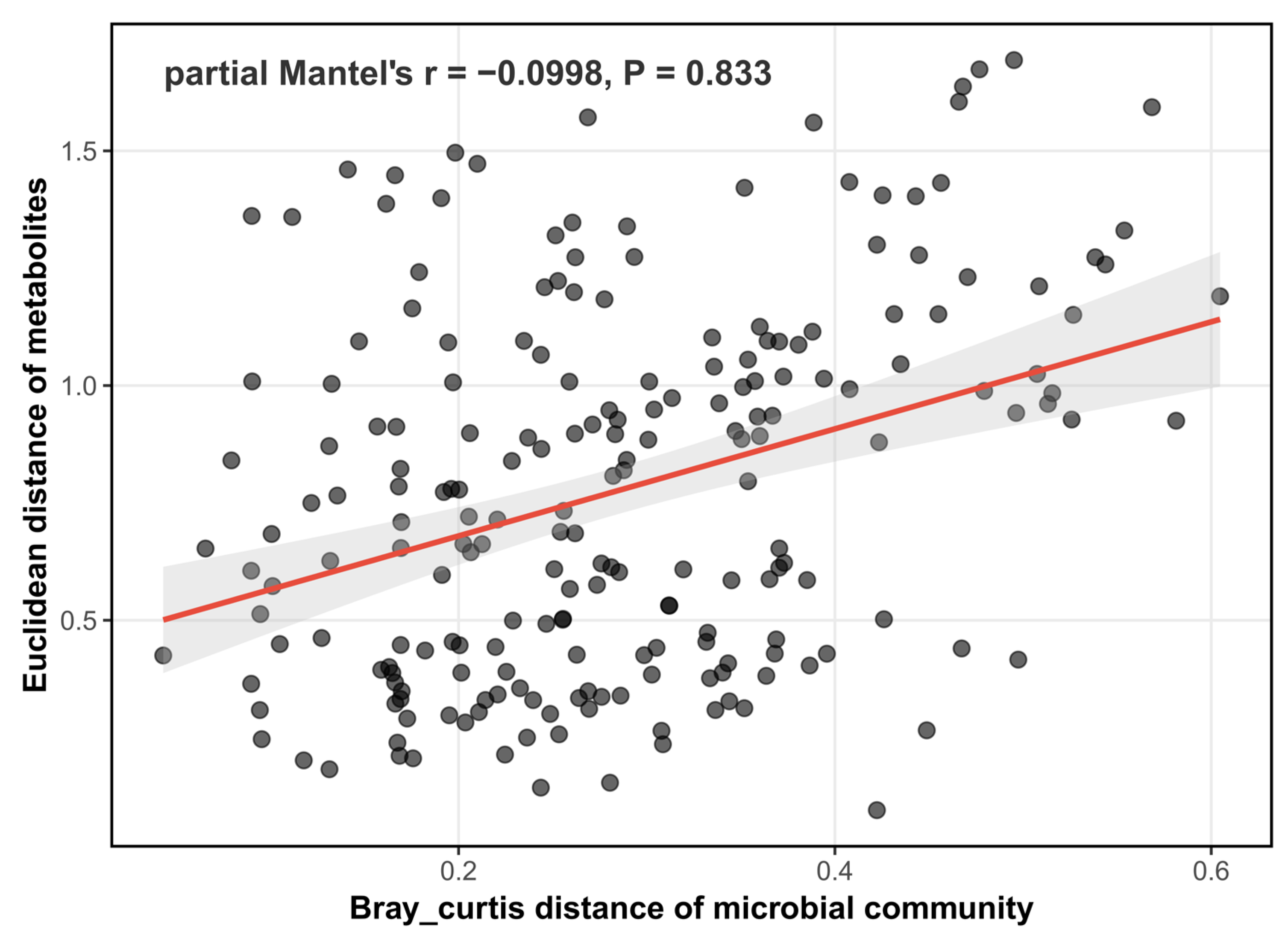
In addition, partial Mantel analysis was performed to assess whether the correlation between the bacterial community and metabolome was independent of weathering time as a confounding factor. Distance matrices were constructed for both datasets, and the weathering time distance matrix was included as a controlling variable. Mantel correlation coefficients and their significance were assessed using permutation tests. Unless otherwise stated,
p < 0.05 was considered statistically significant. All analyses were performed on the Majorbio Cloud Platform (
https://cloud.majorbio.com, accessed on 10 May 2026).
2.6. Weathering-Time Prediction Analysis
Weathering-time prediction was performed using bacterial community, metabolome, and decision-level multi-omics datasets. Weathering time, corresponding to the experimentally controlled PEI after adult emergence, was treated as a continuous response variable corresponding to 1, 3, 5, 7, 9, 11, and 13 months. Only samples shared by the bacterial community and metabolome datasets were used for model construction, resulting in 21 pooled samples, with three pooled samples at each time point.
For the bacterial community model, genus-level count data were summed by genus, converted to relative abundance, and transformed as log10(CPM + 1). For the metabolome model, the preprocessed GC-MS metabolite abundance matrix was used, and quality-control samples were excluded before model fitting. Missing values were imputed using the median value calculated from the training set only.
Model performance was evaluated using leave-one-group-out cross-validation (LOGO-CV). In each outer fold, all three samples from one weathering time point were held out as the test set, while samples from the remaining six time points were used for training. Within each training set, non-constant features were ranked according to the absolute Spearman correlation between feature abundance and weathering time, and the top 15 features were retained for model fitting. Random forest regression models were constructed separately for the bacterial community and metabolome datasets using 800 trees, square-root feature sampling at each split, bootstrap sampling, and a fixed random seed.
For the multi-omics model, a decision-level late-integration strategy was used. Within each outer training set, nested leave-one-group-out predictions were first generated from the bacterial community and metabolome random forest models. These out-of-fold predictions were then used as two input variables to train a ridge regression meta-model. The final bacterial community and metabolome base models were refitted on the full outer training set and used to predict the held-out test samples, after which the ridge meta-model generated the integrated multi-omics prediction.
Prediction performance was summarized using MAE and R2 from pooled held-out test predictions, with 95% confidence intervals estimated by 10,000 weathering-time-point-level cluster-bootstrap resamples. Chance-level performance was assessed using 10,000 prediction-label permutations of the pooled held-out predictions. All machine-learning analyses were performed in Python (v3.14.5) using scikit-learn.
4. Discussion
This study showed that empty puparia of
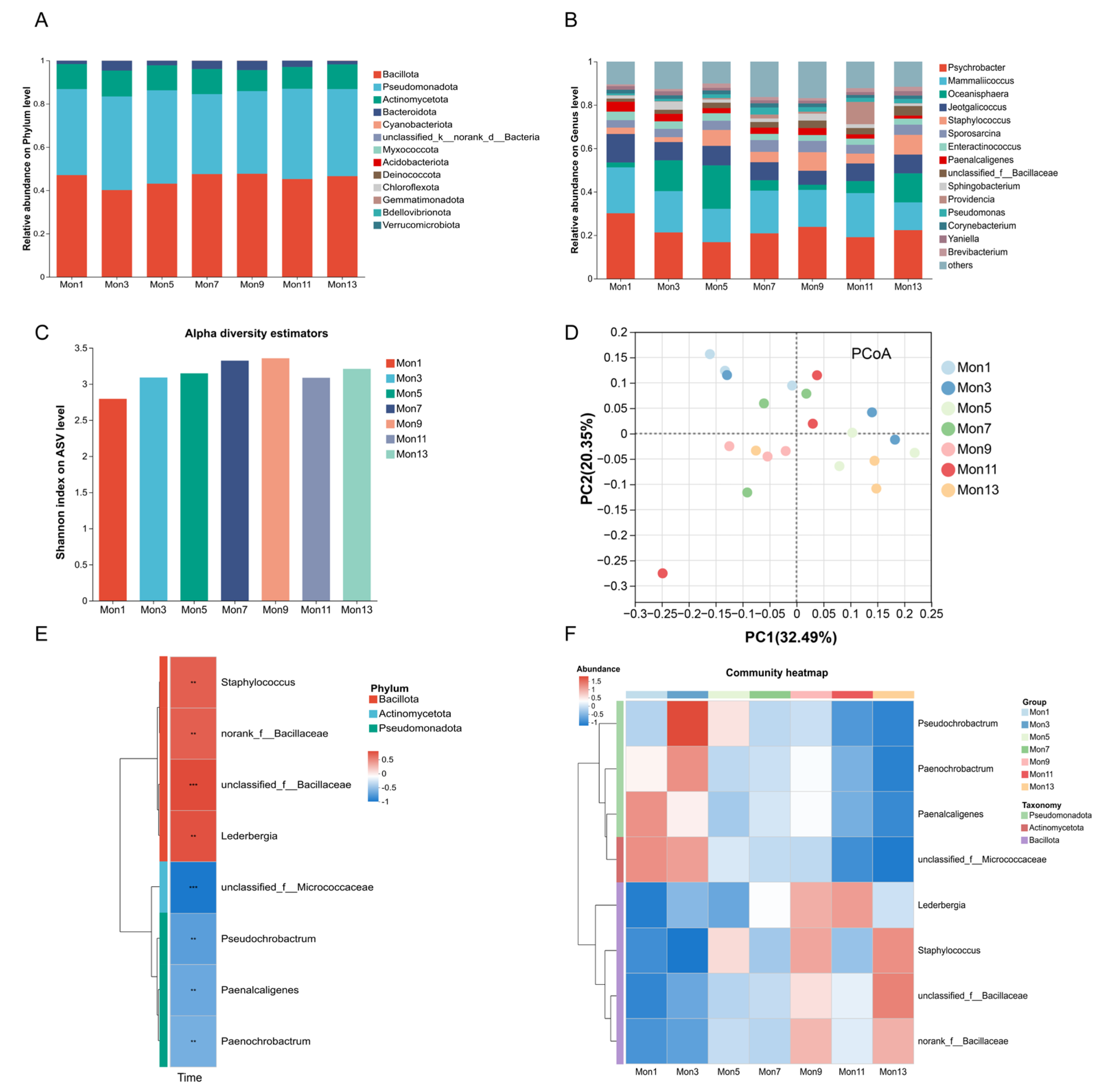
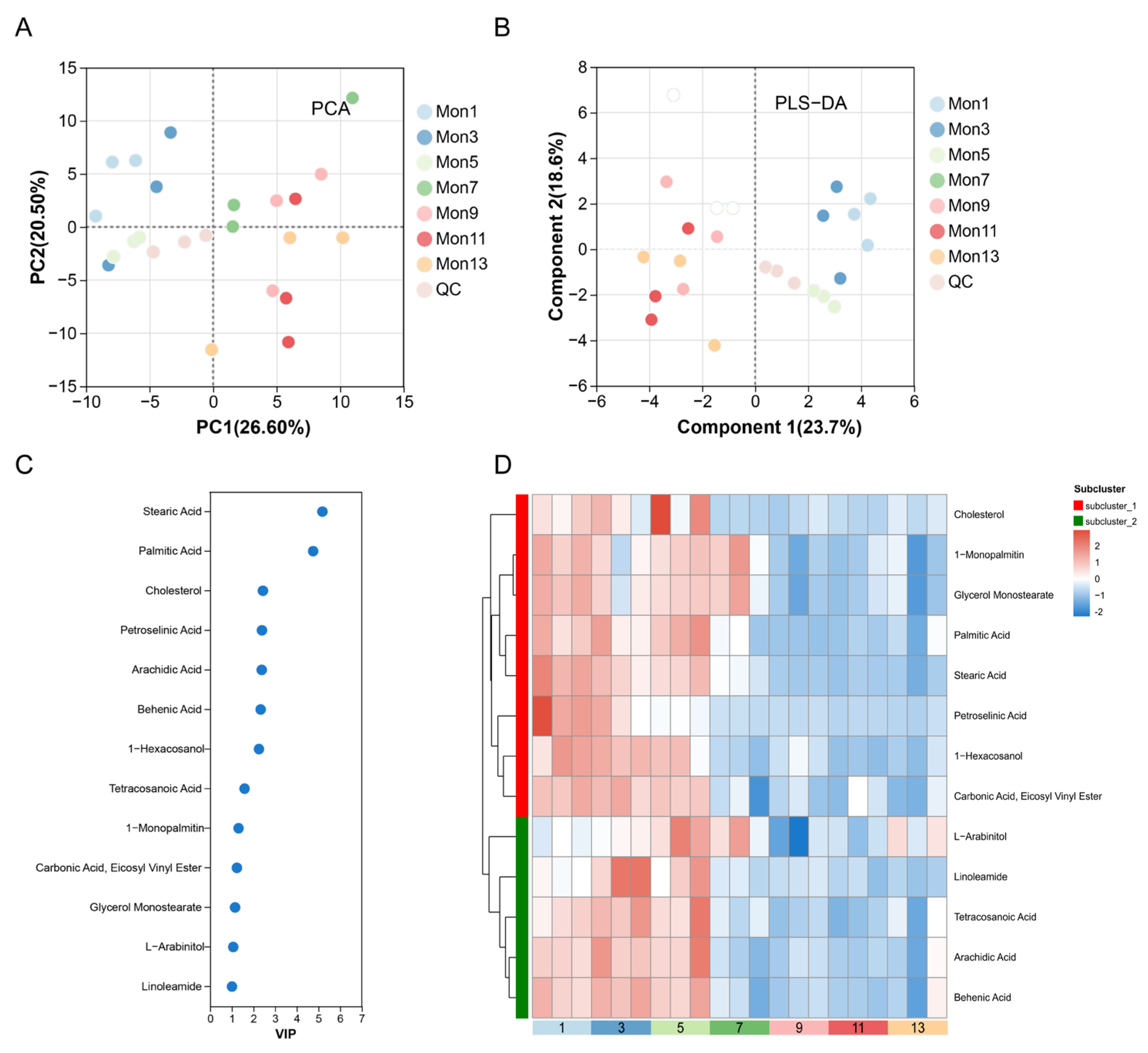
A. grahami underwent measurable bacterial community and metabolomic changes during 13 months of indoor weathering. Metabolomic profiles showed clearer time-associated patterns than bacterial communities, particularly the consistent decrease in lipid-related metabolites. Conventional PMI
min estimation is mainly based on larval development [
24], but such evidence is often unavailable in late-stage decomposition or skeletal remains [
25]. Therefore, weathering-related molecular changes in empty puparia may provide supplementary information for estimating the PEI and supporting long-interval PMI
min assessment.
Previous studies on weathering time estimation of empty puparia have mainly focused on CHCs, which exhibit high chemical stability and show consistent changes in composition and relative abundance during weathering [
26,
27]. Analytical methods for CHCs are also well established, making them widely used indicators for estimating weathering time in forensic entomological evidence. However, the present study suggests that changes during the weathering of empty puparia are not limited to hydrocarbons but also involve multiple classes of lipid compounds. These findings indicate broader changes in lipid composition during the weathering process [
28]. Among the 11 candidate time-dependent metabolic markers, lipids and lipid-like molecules were predominant, particularly long-chain fatty acids such as palmitic acid and stearic acid, which decreased consistently with increasing weathering time. This finding is consistent with previous reports on lipid degradation during biological decomposition and supports their potential as indicators of weathering time [
29].
Further analysis showed that individual metabolites exhibited different trends over time during the weathering of empty puparia. Long-chain fatty acids, including stearic acid, palmitic acid, arachidic acid, and behenic acid, were abundant at the early stage (Mon1–3), decreased during the mid stage, and remained at low levels in the late stage (Mon7–13) [
26,
29,
30]. In contrast, some metabolites, including linoleamide, tetracosanoic acid, and 1 monopalmitin, showed a different trend during the weathering of empty puparia. These compounds did not reach their highest levels at the earliest stage but instead increased during the mid stage (Mon3–5) and then gradually decreased over time. This observation suggests that weathering is not a simple linear degradation process but may involve the transient accumulation of intermediate products during lipid degradation. Previous studies have shown that complex lipids such as glycerides can be gradually converted into free fatty acids or amide derivatives during degradation. These intermediate products may accumulate temporarily at specific stages before further transformation by oxidative or other environmental processes. However, this remains a possible explanation and was not directly demonstrated in the present study [
31,
32,
33].
In contrast to the trends described above, certain metabolites, such as cholesterol, exhibited high discriminative power in the PLS-DA model but showed relatively weak correlations with weathering time, failing to demonstrate stable time-dependent changes. This finding is consistent with previous observations on sterol compounds, which are relatively stable during decomposition but are susceptible to influences from initial biological variation and environmental factors [
34,
35]. Therefore, cholesterol is more likely to reflect overall differences among samples rather than serve as a reliable time-indicative marker. These results further suggest that reliance solely on multivariate statistical models for candidate-marker selection may introduce bias, and that correlation-based approaches should be incorporated for comprehensive evaluation. In addition, the metabolites significantly associated with weathering time in this study were predominantly lipids and lipid-like molecules, such as long-chain fatty acids and their derivatives, whereas positively correlated metabolites were relatively limited and mainly consisted of a small number of aromatic compounds. This finding differs from observations in some decomposition studies, where metabolites tend to accumulate during the later stages. A possible explanation is that empty puparia, as structurally resilient remains with low water content and limited nutrient availability, provide restricted substrates for further transformation, thereby limiting the sustained production and accumulation of secondary metabolites [
30].
From a forensic application perspective, these findings indicate that long-chain fatty acids, such as stearic acid and palmitic acid, and their related derivatives show consistent decreases during the weathering of empty puparia, highlighting their potential as indicators of weathering time. In contrast, metabolites that increase during the mid stage, such as linoleamide and monoacylglycerols, may be useful for distinguishing intermediate stages of weathering. Therefore, integrating information from different classes of metabolites to construct multi-indicator models may improve the accuracy and robustness of weathering-time estimation, rather than relying on single metabolite markers.
At the bacterial level, this study observed temporal changes in bacterial communities associated with empty puparia during weathering. However, the overall magnitude of change was relatively limited. In general, the community structure did not exhibit pronounced or abrupt turnover, but rather gradual shifts in the relative proportions of dominant taxa, suggesting that the influence of weathering time on bacterial community structure was comparatively moderate. Moreover, after FDR correction, only one genus remained significantly associated with weathering time, indicating that genus-level bacterial indicators of temporal progression were limited under the conditions of this study. Therefore, relying solely on the bacterial community structure of empty puparia for long-term weathering-time estimation may be inherently limited.
Among the bacterial genera associated with weathering time, Bacillaceae-affiliated taxa and Staphylococcus increased in relative abundance during later weathering stages. Some members of these groups have been reported to utilize hydrophobic substrates or produce lipases [
36,
37,
38,
39]. In the present study, lipid-related metabolites, including fatty acids, long-chain alcohols, and esters, were also the main time-associated compounds. This pattern may indicate a potential ecological link between bacterial community shifts and the changing chemical composition of empty puparia. However, because the bacterial analysis was based on relative 16S rRNA gene abundance, this interpretation should be regarded as a possible explanation rather than direct evidence of absolute bacterial growth or bacterial lipid degradation.
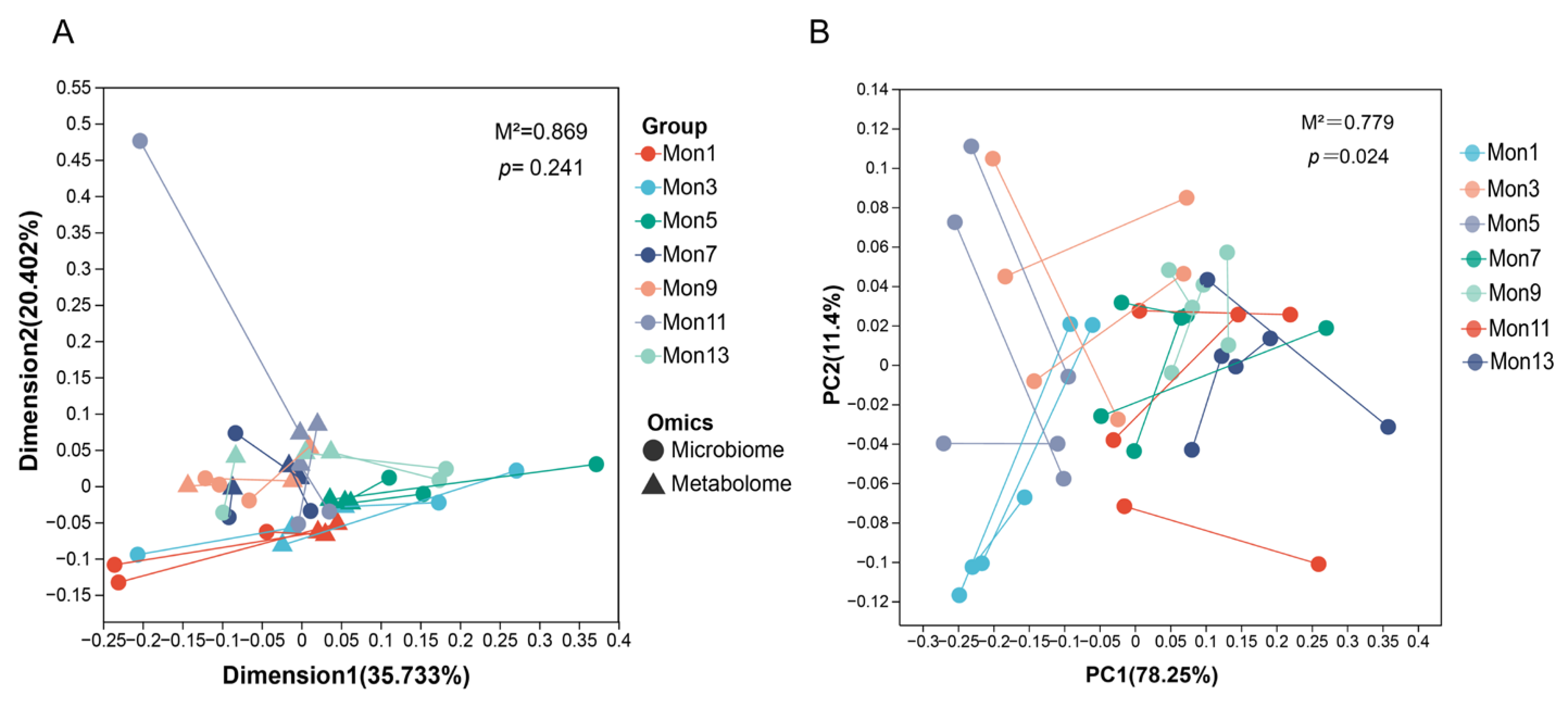
The bacterial community–metabolite association should be interpreted cautiously because the significant Procrustes result was obtained only after selecting time-associated features from both datasets. Together with the non-significant partial Mantel test after controlling for weathering time, this suggests parallel responses to weathering time and environmental exposure rather than direct bacterial community–metabolite coupling. The limited concordance between bacterial and metabolomic changes suggests that these two datasets reflect different aspects of the weathering process.
Overall, the findings of this study indicate that changes in metabolite profiles during the weathering of empty puparia are primarily associated with transformations of intrinsic chemical components under environmental exposure, whereas bacterial community data may reflect compositional changes during exposure. These results suggest that, when empty puparia are used to estimate the PEI and support long-term PMImin assessment, bacterial community and metabolome data reflect different aspects of the weathering process. Although they provide complementary information, their overall changes are not necessarily consistent.
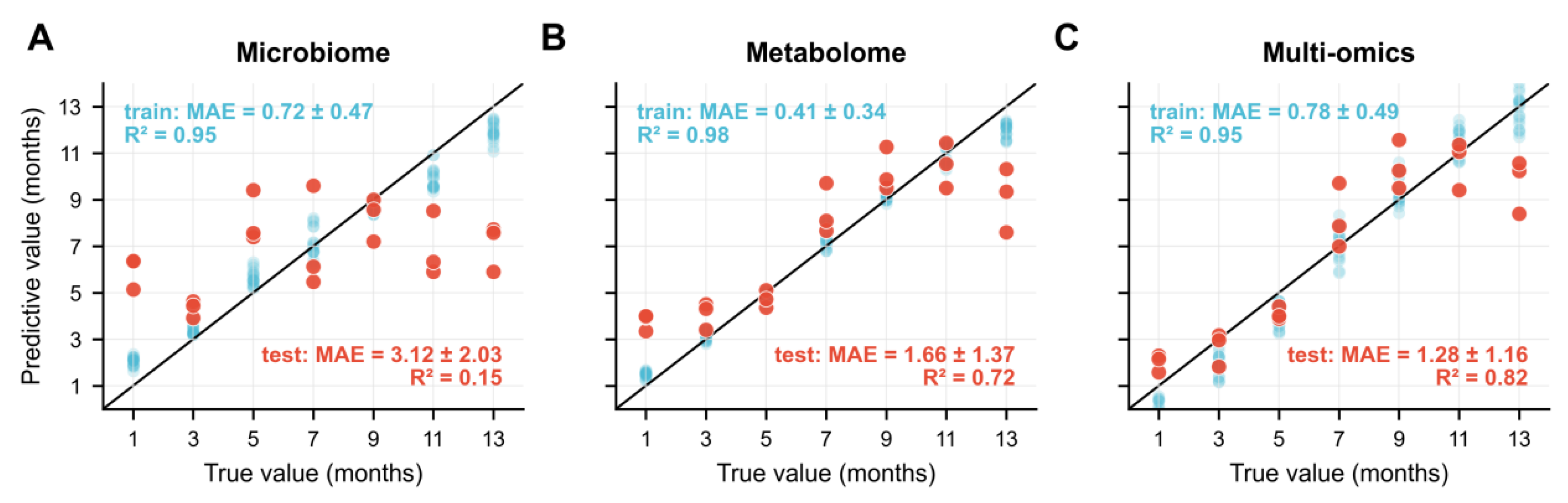
These findings highlight a potential application of empty puparia as a source of temporal information in long-interval forensic investigations. When larval or pupal developmental evidence is no longer available, molecular changes preserved in empty puparia may help estimate the PEI and thereby add information to the entomological timeline. When combined with species identification, species-specific developmental data, relevant temperature records, and scene-specific information, the estimated PEI may provide supplementary evidence for PMImin assessment. Although the multi-omics model yielded an MAE of 1.28 months, this value was obtained from sampling points separated by two months and should not be interpreted as one-month temporal precision in forensic casework. Rather, it indicates broad discrimination of post-eclosion weathering stages within this dataset, rather than precise timing in long-interval cases.
It should be noted that this study was conducted under a single uncontrolled indoor exposure condition using one emergence cohort; thus, the three pooled samples at each time point reflected within-cohort sampling variation rather than independent cohort or environmental replication. Indoor microenvironmental factors were not directly monitored, and extraction blanks, PCR negative controls, and environmental/container controls were not included, which is a major limitation for low-biomass empty puparial samples. Accordingly, the bacterial community profiles and prediction models should be interpreted cautiously. The reported MAE and R2 represent exploratory within-experiment performance rather than generalizable forensic performance. Although the multi-omics MAE of 1.28 months was lower than the two-month sampling interval, it should indicate broad stage discrimination within this dataset rather than one-month precision in long-interval casework. Future studies using independently reared cohorts, appropriate negative/environmental controls, and different exposure conditions are needed to assess the reproducibility and forensic applicability of these findings.




 ,
,