Functional Analysis of PxylPBP2 Responding to Repellent Activity of Natural Pyrazine Against Diamondback Moth


Simple Summary
Abstract
1. Introduction
2. Materials and Methods
2.1. Insect Rearing
2.2. Generation of PxylPBP2 Interference Mutant
2.2.1. Design for the Primers and PCR Amplification of RNAi
2.2.2. Synthesis for dsRNA and Product Recollection
2.2.3. Silencing by RNAi and Repellent Activity Assay
2.3. Binding Mechanism Between PxylPBP2 and 2,3-Dimethyl-6-(1-hydroxy)-pyrazine
2.3.1. Microscale Thermophoresis Analysis to 2,3-Dimethyl-6-(1-hydroxy)-pyrazine and PxylPBP2
2.3.2. Molecular Dynamics Simulation
2.4. Construction of the Mutant Protein PxylPBP2I122A and the Fluorescence Competitive Binding Assays
2.4.1. Selection of the Mutant Site
2.4.2. Cloning and Vector Construction for the Mutant Protein PxylPBP2I122A
2.4.3. Fluorescence Competitive Binding Experiment for Mutant Protein PxylPBP2
2.5. Recognition Characteristics of PxylPBP2 with Some Volatile Compounds
3. Results
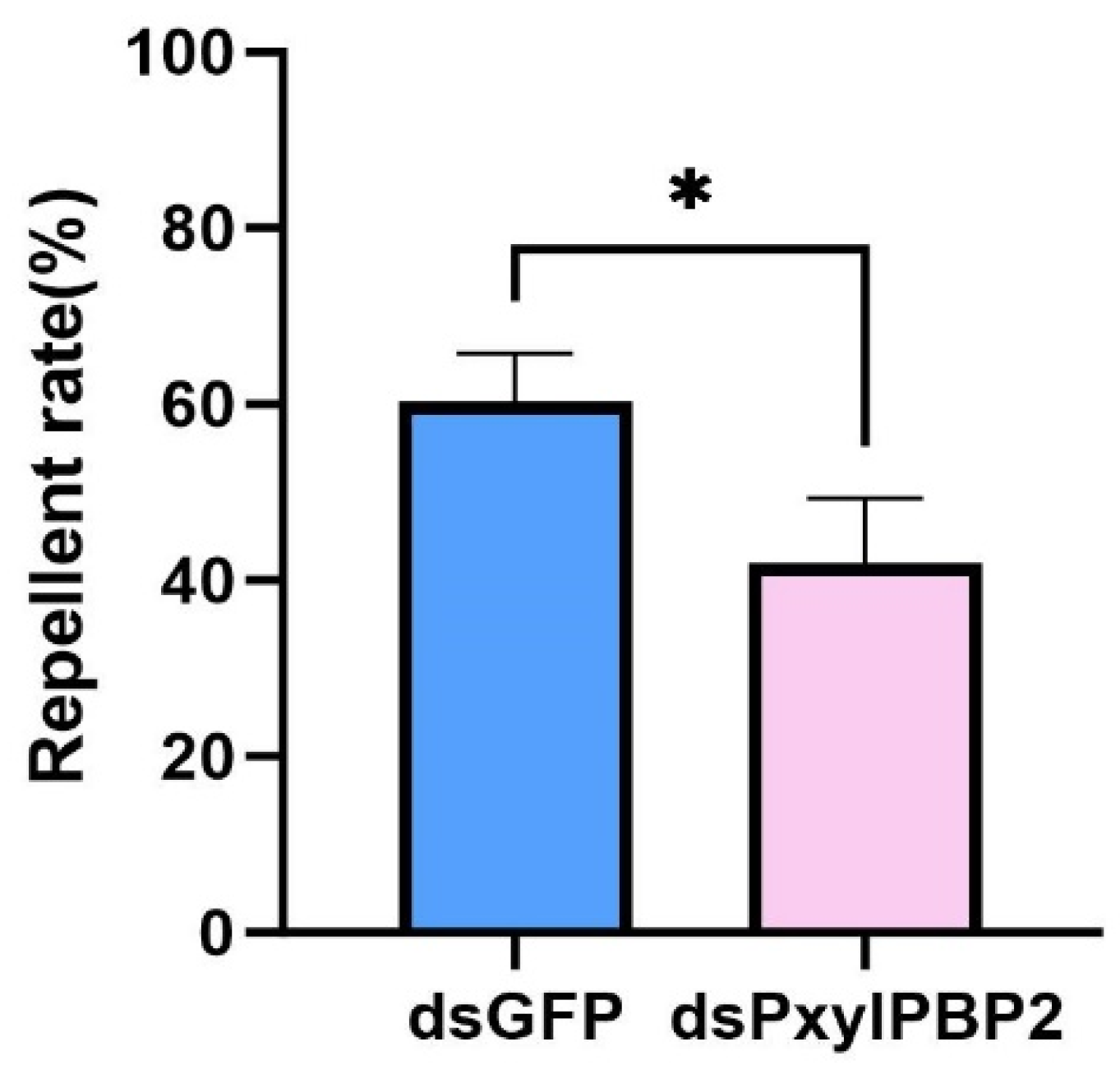
3.1. PxylPBP2 Is Involved in the Repellent Activity of 2,3-Dimethyl-6-(1-hydroxy)-pyrazine
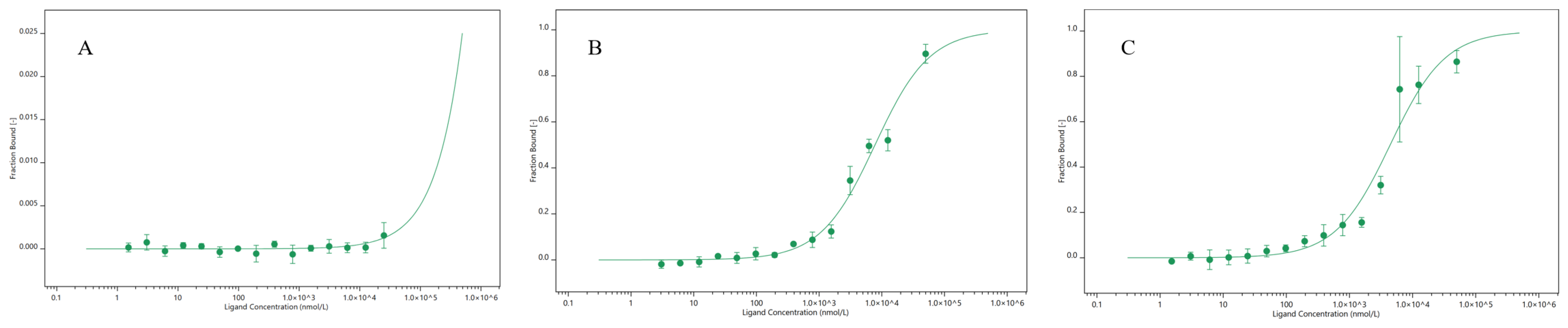
3.2. MST Characteristics Shared 2,3-Dimethyl-6-(1-hydroxy)-pyrazine and the Olfactory System Protein
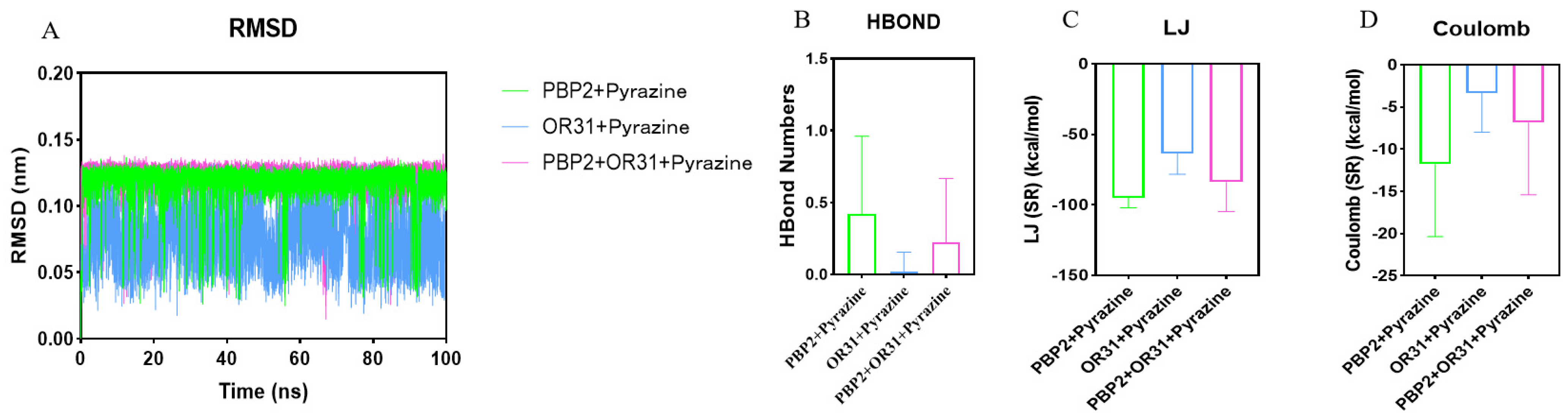
3.3. Molecular Dynamics Simulation of the Interaction Between the Olfactory System Protein and 2,3-Dimethyl-6-(1-hydroxy)-pyrazine
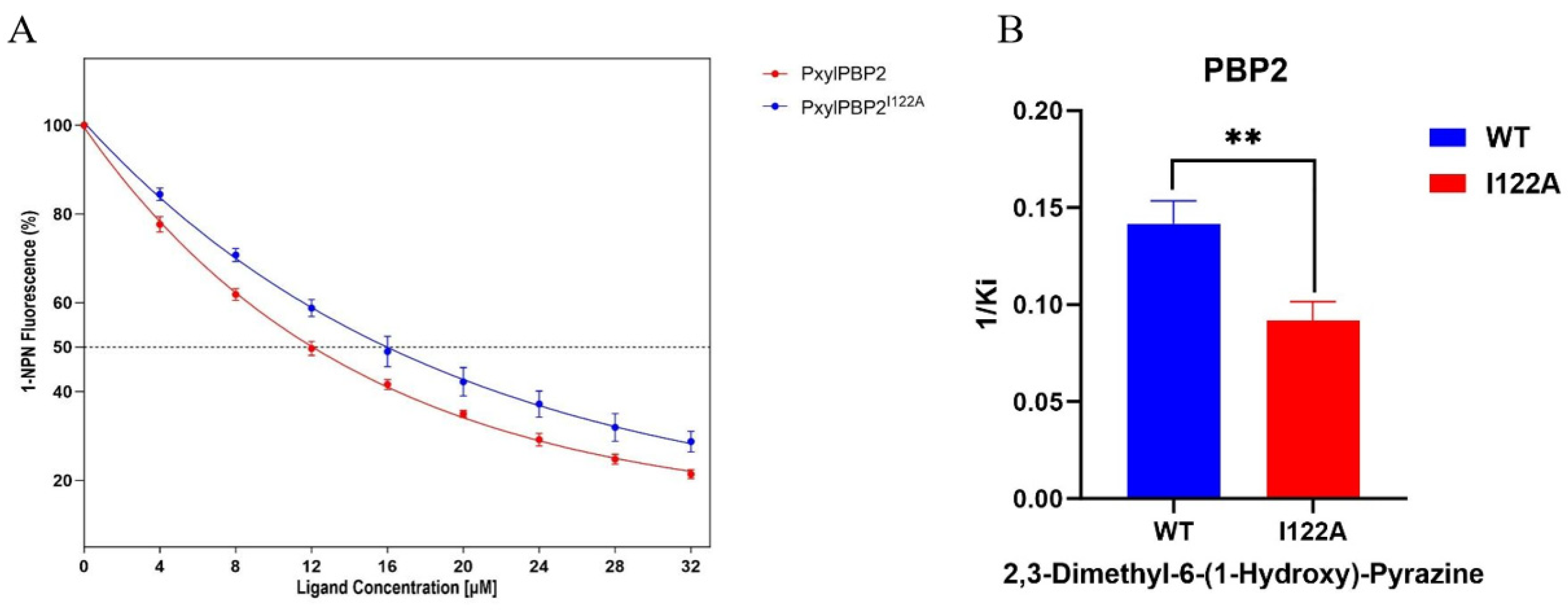
3.4. Combination Mechanism Between PxylPBP2 and 2,3-Dimethyl-6-(1-hydroxy)-pyrazine
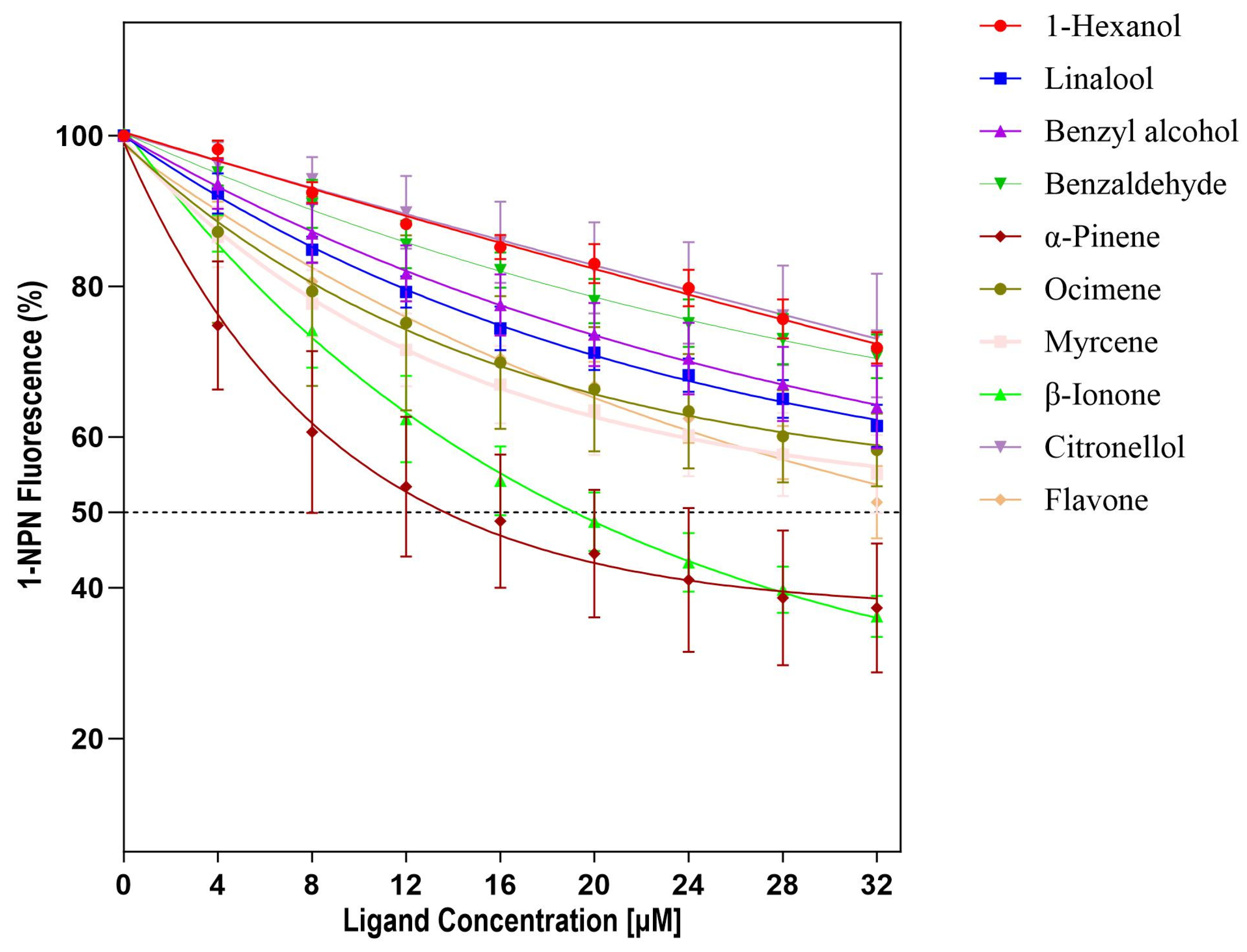
3.5. Recognition Characteristics of PxylPBP2 for Some Common Volatile Compounds
4. Discussion
5. Conclusions
Supplementary Materials
Author Contributions
Funding
Data Availability Statement
Conflicts of Interest
References
- You, M.; Ke, F.; You, S.; Wu, Z.; Liu, Q.; He, W.; Baxter, S.W.; Yuchi, Z.; Vasseur, L.; Gurr, G.M.; et al. Variation among 532 genomes unveils the origin and evolutionary history of a global insect herbivore. Nat. Commun. 2020, 11, 2321. [Google Scholar] [CrossRef] [PubMed]
- Ma, C.S.; Zhang, W.; Peng, Y.; Zhao, F.; Chang, X.Q.; Xing, K.; Zhu, L.; Ma, G.; Yang, H.P.; Rudolf, V.H.W. Climate warming promotes pesticide resistance through expanding overwintering range of a global pest. Nat. Commun. 2021, 12, 5351. [Google Scholar] [CrossRef] [PubMed]
- Shakeel, M.; Farooq, M.; Nasim, W.; Akram, W.; Khan, F.Z.A.; Jaleel, W.; Zhu, X.; Yin, H.; Li, S.; Fahad, S.; et al. Environment polluting conventional chemical control compared to an environmentally friendly IPM approach for control of diamondback moth, Plutella xylostella (L.), in China, a review. Environ. Sci. Pollut. Res. 2017, 24, 14537–14550. [Google Scholar] [CrossRef]
- Wang, X.; Wang, R.; Yang, Y.; Wu, S.; O’Reilly, A.O.; Wu, Y. A point mutation in the glutamate-gated chloride channel of Plutella xylostella is associated with resistance to abamectin. Insect Mol. Biol. 2016, 25, 116–125. [Google Scholar] [CrossRef] [PubMed]
- Wang, X.; Li, X.; Shen, A.; Wu, Y. Baseline susceptibility of the diamondback moth (Lepidoptera, Plutellidae) to chlorantraniliprole in China. J. Econ. Entomol. 2016, 103, 843–848. [Google Scholar]
- Li, X.; Liu, Z.; Lv, X.; Liu, X.; Li, Y.; Tian, Z.; Zhang, Y.; Liu, J. Molecular mechanism of λ-cyhalothrin detoxification by a delta-class glutathione S-transferase (PxGSTD3) from Plutella xylostella. J. Agric. Food Chem. 2025, 73, 6559–6566. [Google Scholar] [PubMed]
- Oplopoiou, M.; Elias, J.; Slater, R.; Bass, C.; Zimmer, C.T. Characterization of emamectin benzoate resistance in the diamondback moth, Plutella xylostella (Lepidoptera, Plutellidae). Pest Manag. Sci. 2024, 80, 498–507. [Google Scholar] [PubMed]
- Nitta, A.; Boopathi, T.; Ankireddy, J.R. Evaluation of insecticide resistance and associated enzyme activity in field populations of Diamondback Moth (Plutella xylostella). J. Appl. Toxicol. 2025, 46, 2400–2411. [Google Scholar] [CrossRef] [PubMed]
- Li, X.; Li, R.; Zhu, B.; Gao, X.; Liang, P. Overexpression of cytochrome P450 CYP6BG1 may contribute to chlorantraniliprole resistance in Plutella xylostella (L.). Pest Manag. Sci. 2018, 74, 1386–1393. [Google Scholar] [CrossRef] [PubMed]
- Wu, Q.J.; Zhang, S.F.; Yao, J.L.; Xu, B.Y.; Wang, S.L.; Zhang, Y.J. Management of diamondback moth, Plutella xylostella (Lepidoptera, Plutellidae) by mating disruption. Insect Sci. 2012, 19, 643–648. [Google Scholar] [CrossRef]
- Shanmugapriya, V.; Edward, Y.S.J.T.; Kannan, M.; Kumar, S.M.; Ramanathan, A. Inheritance of resistance and fitness cost parameters to cyantraniliprole in the resistant and susceptible strains of Plutella xylostella L. Sci. Rep. 2025, 15, 39981. [Google Scholar] [CrossRef]
- Kolani, L.; Sanda, K.; Agboka, K.; Mawussi, G.; Koba, K.; Djouaka, R. Investigation of insecticidal activity of blend of essential oil of Cymbopogon schoenanthus and neem oil on Plutella xylostella (Lepidoptera, Plutellidae). J. Essent. Oil Bear. Plants 2016, 19, 1478–1486. [Google Scholar] [CrossRef]
- Tavares, W.R.; Barreto, M.D.C.; Seca, A.M. Aqueous and ethanolic plant extracts as bio-insecticides—Establishing a bridge between raw scientific data and practical reality. Plants 2021, 10, 920. [Google Scholar] [CrossRef] [PubMed]
- Li, J.; Zhou, R.; Han, Q.; Hui, T.; Qu, Y.; Yu, S.; Liang, P.; Ma, Z.; Gao, Y. Study of natural turpentine-derived molecules as potential GOBP target indicators to control Plutella xylostella. J. Agric. Food Chem. 2026, 74, 3523–3533. [Google Scholar] [CrossRef]
- Wang, S.; Li, S.C.; Cheng, F.S.; Ren, T.; Mei, D.H.; Gao, K.; Song, Q.Y. Antifungal, repellency, and insecticidal activities of Cymbopogon distans and Ruta graveolens essential oils and their main chemical constituents. Chem. Biodivers. 2022, 19, e202200351. [Google Scholar] [CrossRef] [PubMed]
- Song, C.; Zhao, J.; Zheng, R.; Hao, C.; Yan, X. Chemical composition and bioactivities of thirteen non-host plant essential oils against Plutella xylostella L. (Lepidoptera, Plutellidae). J. Asia-Pac. Entomol. 2022, 25, 101881. [Google Scholar] [CrossRef]
- Peres, L.L.; Sobreiro, A.I.; Couto, I.F.; Silva, R.M.; Pereira, F.F.; Heredia-Vieira, S.C.; Cardoso, C.A.; Mauad, M.; Scalon, S.P.; Verza, S.S.; et al. Chemical compounds and bioactivity of aqueous extracts of Alibertia spp. in the control of Plutella xylostella L. (Lepidoptera, Plutellidae). Insects 2017, 8, 125. [Google Scholar] [CrossRef] [PubMed]
- Ferreira, E.A.; de Souza, S.A.; Domingues, A.; Da Silva, M.M.M.; Padial, I.M.P.M.; de Carvalho, E.M.; Cardoso, C.A.L.; da Silva, S.V.; Mussury, R.M. Phytochemical screening and bioactivity of Ludwigia spp. in the control of Plutella xylostella (Lepidoptera, Plutellidae). Insects 2020, 11, 596. [Google Scholar] [CrossRef] [PubMed]
- Yotavong, P.; Boonsoong, B.; Pluempanupat, W.; Koul, O.; Bullangpoti, V. Effects of the botanical insecticide thymol on biology of a braconid, Cotesia plutellae (Kurdjumov), parasitizing the diamondback moth, Plutella xylostella L. Int. J. Pest Manag. 2015, 61, 171–178. [Google Scholar] [CrossRef]
- Peng, J.; Chen, Z.; Chen, X.; Zheng, R.; Lu, S.; Seyab, M.; Yang, F.; Li, Q.; Tang, Q. Insecticidal potential of a Consolida ajacis extract and its major compound (ethyl linoleate) against the diamondback moth, Plutella xylostella. Pestic. Biochem. Physiol. 2023, 195, 105557. [Google Scholar] [CrossRef] [PubMed]
- Christiaens, O.; Sweet, J.; Dzhambazova, T.; Urru, I.; Smagghe, G.; Kostov, K.; Arpaia, S. Implementation of RNAi-based arthropod pest control: Environmental risks, potential for resistance and regulatory considerations. J. Pest Sci. 2022, 95, 1–15. [Google Scholar]
- Bettencourt, R.; Terenius, O.; Faye, I. Hemolin gene silencing by ds-RNA injected into Cecropia pupae is lethal to next generation embryos. Insect Mol. Biol. 2002, 11, 267–271. [Google Scholar] [PubMed]
- Li, Z.; Liu, Y.; Liang, Y.; Pan, T.; Liu, J. RNA interference-based pesticides: Mechanism, application, and commercialization in sustainable pest management. Pestic. Biochem. Physiol. 2026, 219, 107034. [Google Scholar] [CrossRef] [PubMed]
- Fleischer, J.; Pregitzer, P.; Breer, H.; Krieger, J. Access to the odor world, olfactory receptors and their role for signal transduction in insects. Cell. Mol. Life Sci. 2018, 75, 485–508. [Google Scholar] [PubMed]
- Del Mármol, J.; Yedlin, M.A.; Ruta, V. The structural basis of odorant recognition in insect olfactory receptors. Nature 2021, 597, 126–131. [Google Scholar] [CrossRef] [PubMed]
- Yuan, T.; Wang, H.; Zhang, Q.H.; Wickham, J.D.; Zhang, Y.N.; Gu, T.; Zhang, L. General odorant binding protein 2 and odorant binding protein 36 facilitate the recognition of adult sex pheromone components by Hyphantria cunea larvae. Insect Sci. 2025. advance online publication. [Google Scholar] [CrossRef] [PubMed]
- Haverkamp, A.; Hansson, B.S.; Knaden, M. Combinatorial codes and labeled lines, how insects use olfactory cues to find and judge food, mates, and oviposition sites in complex environments. Front. Physiol. 2018, 9, 49. [Google Scholar] [CrossRef] [PubMed]
- Robertson, H.M. Molecular evolution of the major arthropod chemoreceptor gene families. Annu. Rev. Entomol. 2019, 64, 227–242. [Google Scholar] [CrossRef] [PubMed]
- Hekmat-Scafe, D.S.; Scafe, C.R.; McKinney, A.J.; Tanouye, M.A. Genome-wide analysis of the odorant-binding protein gene family in Drosophila melanogaster. Genome Res. 2002, 12, 1357–1369. [Google Scholar] [CrossRef] [PubMed]
- Vieira, F.G.; Rozas, J. Comparative genomics of the odorant-binding and chemosensory protein gene families across the Arthropoda, origin and evolutionary history of the chemosensory system. Genome Biol. Evol. 2011, 3, 476–490. [Google Scholar] [CrossRef] [PubMed]
- Zhang, Z.C.; Wang, M.Q.; Lu, Y.B.; Zhang, G. Molecular characterization and expression pattern of two general odorant binding proteins from the diamondback moth, Plutella xylostella. J. Chem. Ecol. 2009, 35, 1188–1196. [Google Scholar] [CrossRef] [PubMed]
- Sun, M.; Liu, Y.; Wang, G. Expression patterns and binding properties of three pheromone binding proteins in the diamondback moth, Plutella xyllotella. J. Insect Physiol. 2013, 59, 46–55. [Google Scholar] [CrossRef] [PubMed]
- Zhu, J.; Pelosi, P.; Liu, Y. Ligand-binding properties of three odorant-binding proteins of the diamondback moth Plutella xylostella. J. Integr. Agric. 2016, 15, 580–590. [Google Scholar] [CrossRef]
- Cai, L.J.; Zheng, L.S.; Huang, Y.P.; Xu, W.; You, M.S. Identification and characterization of odorant binding proteins in the diamondback moth, Plutella xylostella. Insect Sci. 2021, 28, 987–1004. [Google Scholar] [PubMed]
- Wang, P.; Liu, M.; Lv, C.; Tian, Z.; Li, R.; Li, Y.; Zhang, Y.; Liu, J. Identifying the key role of Plutella xylostella general odorant binding protein 2 in perceiving a larval attractant, (E, E)-2, 6-farnesol. J. Agric. Food Chem. 2024, 72, 5690–5698. [Google Scholar] [PubMed]
- Zhang, Y.; Wang, B.; Zhou, Y.; Liao, M.; Sheng, C.; Cao, H.; Gao, Q. Identification and characterization of odorant receptors in Plutella xylostella antenna response to 2,3-dimethyl-6-(1-hydroxy)-pyrazine. Pestic. Biochem. Physiol. 2023, 194, 105523. [Google Scholar] [CrossRef] [PubMed]
- Wang, B.; Zhang, Y.; Wei, Y.; Liao, M.; Cao, H.; Gao, Q. Functional analysis of three odorant receptors in Plutella xylostella response to repellent activity of 2,3-dimethyl-6-(1-hydroxy)-pyrazine. Pestic. Biochem. Physiol. 2024, 201, 105856. [Google Scholar] [CrossRef] [PubMed]
- Wang, B.; Zhang, Y.; Zhang, C.; Liao, M.; Cao, H.; Gao, Q. Identification and functional characterization of two antenna-specifc odorant-binding proteins in Plutella xylostella response to 2,3-dimethyl-6-(1-hydroxy)-pyrazine. Int. J. Biol. Macromol. 2024, 262, 130031. [Google Scholar] [PubMed]
- Stein, J.A.; Ianeselli, A.; Braun, D. Kinetic microscale thermophoresis for simultaneous measurement of binding affinity and kinetics. Angew. Chem. 2021, 133, 14107–14114. [Google Scholar] [CrossRef]
- Hreusova, M.; Novakova, O.; Brabec, V. Thermodynamic insights by microscale thermophoresis into translesion DNA synthesis catalyzed by DNA polymerases across a lesion of antitumor platinum–acridine complex. Int. J. Mol. Sci. 2020, 21, 7806. [Google Scholar] [CrossRef] [PubMed]
- Xu, J.; Wang, Z.; Wang, Y.; Ma, H.; Zhu, H.; Liu, J.; Zhou, Y.; Deng, X.; Zhou, X. ABCC2 participates in the resistance of Plutella xylostella to chemical insecticides. Pestic. Biochem. Physiol. 2020, 162, 52–59. [Google Scholar] [CrossRef] [PubMed]
- Zhang, Z.C.; Wang, M.Q.; Zhang, G. Molecular cloning and expression of pheromone-binding protein1 from the diamondback moth, Plutella xylostella. Entomol. Exp. ET Appl. 2009, 133, 136–145. [Google Scholar]
- Zhang, S.F.; Zhang, Z.; Kong, X.B.; Wang, H.B.; Liu, F. Dynamic changes in chemosensory gene expression during the Dendrolimus punctatus mating process. Front. Physiol. 2018, 8, 1127. [Google Scholar] [CrossRef] [PubMed]
- Zhu, J.; Renzone, G.; Arena, S.; Dani, F.R.; Paulsen, H.; Knoll, W.; Cambillau, C.; Scaloni, A.; Pelosi, P. The odorant-binding proteins of the spider mite Tetranychus urticae. Int. J. Mol. Sci. 2021, 22, 6828. [Google Scholar] [CrossRef] [PubMed]
- Xiao, Y.; Sun, L.; Wu, Y.; Wang, Q.; Zhang, Y.; Jing, X.; Li, Z. The larvae of Phyllotreta striolata share the same olfactory cues for locating Brassicaceae plant with conspecific adults. J. Pest Sci. 2024, 97, 979–992. [Google Scholar]
- Sun, Z.; Wang, R.; Du, Y.; Gao, B.; Gui, F.; Lu, K. Olfactory perception of herbicide butachlor by GOBP2 elicits ecdysone biosynthesis and detoxification enzyme responsible for chlorpyrifos tolerance in Spodoptera litura. Environ. Pollut. 2021, 285, 117409. [Google Scholar] [CrossRef] [PubMed]
- Li, J.; Zhang, L.; Wang, X. An Odorant-binding protein involved in perception of host plant odorants in locust Locusta migratoria. Arch. Insect Biochem. Physiol. 2016, 91, 221–229. [Google Scholar] [PubMed]
- Chen, X.; Lei, Q.; Liang, C.; Wang, J.; Jiang, H. A case study on the γ-octalactone induced expression of Obp83g-2 in Bactrocera dorsalis (Hendel) revealed the transcriptional regulation of insect odorant binding protein. Commun. Biol. 2025, 8, 1355. [Google Scholar] [PubMed]
- Yue, Y.; Ma, C.; Zhang, Y.; Ma, W.H.; Wang, J.J.; Tian, Z.Y.; Chen, G.M.; Li, R.M.; Li, J.H.; Yang, J.F.; et al. Functional analysis of Ophraella communa Lesage OcomOBP11 in recognition of Ambrosia artemisiifolia L. volatiles. Pestic. Biochem. Physiol. 2025, 210, 106392. [Google Scholar] [CrossRef] [PubMed]
- Zhang, W.; Chen, X.; Tian, J.; Schal, C.; Mohamed, A.; Zang, L.S.; Xia, Y.; Keyhani, N.O. An odorant-binding protein functions in fire ant social immunity interfacing with innate immunity. Open Biol. 2025, 15, 240254. [Google Scholar] [CrossRef] [PubMed]
- Guarna, M.M.; Melathopoulos, A.P.; Huxter, E.; Iovinella, I.; Parker, R.; Stoynov, N.; Tam, A.; Moon, K.M.; Chan, Q.W.T.; Pelosi, P.; et al. A search for protein biomarkers links olfactory signal transduction to social immunity. In Farm Animal Proteomics; Wageningen Academic: Wageningen, The Netherlands, 2014; pp. 45–46. [Google Scholar]
- Zheng, R.; Xie, M.; Keyhani, N.O.; Xia, Y. An insect chemosensory protein facilitates locust avoidance to fungal pathogens via recognition of fungal volatiles. Int. J. Biol. Macromol. 2023, 253, 127389. [Google Scholar] [CrossRef] [PubMed]
- Zhang, W.; Xie, M.; Eleftherianos, I.; Mohamed, A.; Cao, Y.; Song, B.; Zang, L.S.; Jia, C.; Bian, J.; Keyhani, N.O.; et al. An odorant binding protein is involved in counteracting detection-avoidance and Toll-pathway innate immunity. J. Adv. Res. 2023, 48, 1–16. [Google Scholar] [PubMed]
- Tian, W.; Zhang, T.; Gu, S.; Guo, Y.; Gao, X.; Zhang, Y. OBP14 (Odorant-Binding Protein) sensing in Adelphocoris lineolatus based on peptide nucleic acid and graphene oxide. Insects 2021, 12, 422. [Google Scholar] [CrossRef] [PubMed]
- Arnold, K.; Bordoli, L.; Kopp, J.; Schwede, T. The SWISS-MODEL workspace, a web-based environment for protein structure homology modelling. Bioinformatics 2006, 22, 195–201. [Google Scholar] [PubMed]
- Chen, Y.J.; Zhang, T.Y.; Wan, N.F.; Zhao, J.; Jiang, J.X.; Ji, X.Y. Role of odorant binding proteins in the response of Tetranychus cinnabarinus to repellent activity of ethyl oleate. Insect Biochem. Mol. Biol. 2025, 185, 104427. [Google Scholar] [CrossRef]
- Liu, K.; Jiang, W.; Guo, H.; Rao, C.; Su, J. The identification of insecticyanin with high insecticide-binding affinity in Spodoptera exigua. Pestic. Biochem. Physiol. 2025, 216, 106739. [Google Scholar] [CrossRef] [PubMed]
- Liu, K.; Guo, H.; Jiang, W.; Rao, C.; Su, J. Identification and structural analysis of apolipoprotein D with high insecticide-binding affinity in Spodoptera exigua. J. Agric. Food Chem. 2025, 73, 30173–30182. [Google Scholar] [CrossRef] [PubMed]
- Kim, K.; Li, C.; Li, B. Identification of novel inhibitor against Tribolium castaneum GSTe2, protein modelling, structure-based virtual screening and molecular dynamics simulation. Mol. Simul. 2025, 51, 1081–1094. [Google Scholar]
- Mangat, H.K.; Rani, M.; Pathak, R.K.; Yadav, I.S.; Utreja, D.; Chhuneja, P.K.; Chhuneja, P. Virtual screening, molecular dynamics and binding energy-MM-PBSA studies of natural compounds to identify potential EcR inhibitors against Bemisia tabaci Gennadius. PLoS ONE 2022, 17, e0261545. [Google Scholar] [CrossRef] [PubMed]
- Wang, Y.; Zheng, Q.C.; Zhang, J.L.; Cui, Y.L.; Xue, Q.; Zhang, H.X. Highlighting a π–π interaction, a protein modeling and molecular dynamics simulation study on Anopheles gambiae glutathione S-transferase 1-2. J. Mol. Model. 2013, 19, 5213–5223. [Google Scholar] [PubMed]
- Sun, Y.L.; Huang, L.Q.; Pelosi, P.; Wang, C.Z. A lysine at the C-terminus of an odorant-binding protein is involved in binding aldehyde pheromone components in two Helicoverpa species. PLoS ONE 2013, 8, e55132. [Google Scholar] [CrossRef] [PubMed]
- Zhuang, X.; Wang, Q.; Wang, B.; Zhong, T.; Cao, Y.; Li, K.; Yin, J. Prediction of the key binding site of odorant-binding protein of Holotrichia oblita Faldermann (Coleoptera: Scarabaeida). Insect Mol. Biol. 2014, 23, 381–390. [Google Scholar] [PubMed]
- Yin, N.N.; Yang, A.J.; Wu, C.; Xiao, H.Y.; Guo, Y.R.; Liu, N.Y. Genome-wide analysis of odorant-binding proteins in Papilio xuthus with focus on the perception of two PxutGOBPs to host odorants and insecticides. J. Agric. Food Chem. 2022, 70, 10747–10761. [Google Scholar] [PubMed]


Disclaimer/Publisher’s Note: The statements, opinions and data contained in all publications are solely those of the individual author(s) and contributor(s) and not of MDPI and/or the editor(s). MDPI and/or the editor(s) disclaim responsibility for any injury to people or property resulting from any ideas, methods, instructions or products referred to in the content. |
© 2026 by the authors. Licensee MDPI, Basel, Switzerland. This article is an open access article distributed under the terms and conditions of the Creative Commons Attribution (CC BY) license.
Share and Cite
Zhou, Y.-L.; Wang, Z.-X.; Wang, X.-W.; Wang, B.-G.; Li, Q.; Wang, L.; Liao, M.; Cao, H.-Q.; Gao, Q. Functional Analysis of PxylPBP2 Responding to Repellent Activity of Natural Pyrazine Against Diamondback Moth. Insects 2026, 17, 708. https://doi.org/10.3390/insects17070708
Zhou Y-L, Wang Z-X, Wang X-W, Wang B-G, Li Q, Wang L, Liao M, Cao H-Q, Gao Q. Functional Analysis of PxylPBP2 Responding to Repellent Activity of Natural Pyrazine Against Diamondback Moth. Insects. 2026; 17(7):708. https://doi.org/10.3390/insects17070708
Chicago/Turabian StyleZhou, Yan-Lu, Zi-Xian Wang, Xian-Wen Wang, Bu-Guo Wang, Qing Li, Lan Wang, Min Liao, Hai-Qun Cao, and Quan Gao. 2026. "Functional Analysis of PxylPBP2 Responding to Repellent Activity of Natural Pyrazine Against Diamondback Moth" Insects 17, no. 7: 708. https://doi.org/10.3390/insects17070708
APA StyleZhou, Y.-L., Wang, Z.-X., Wang, X.-W., Wang, B.-G., Li, Q., Wang, L., Liao, M., Cao, H.-Q., & Gao, Q. (2026). Functional Analysis of PxylPBP2 Responding to Repellent Activity of Natural Pyrazine Against Diamondback Moth. Insects, 17(7), 708. https://doi.org/10.3390/insects17070708