Insights from Pheromone Trap Catches in the Northern Part of the Ips typographus Range


Simple Summary
Abstract
1. Introduction
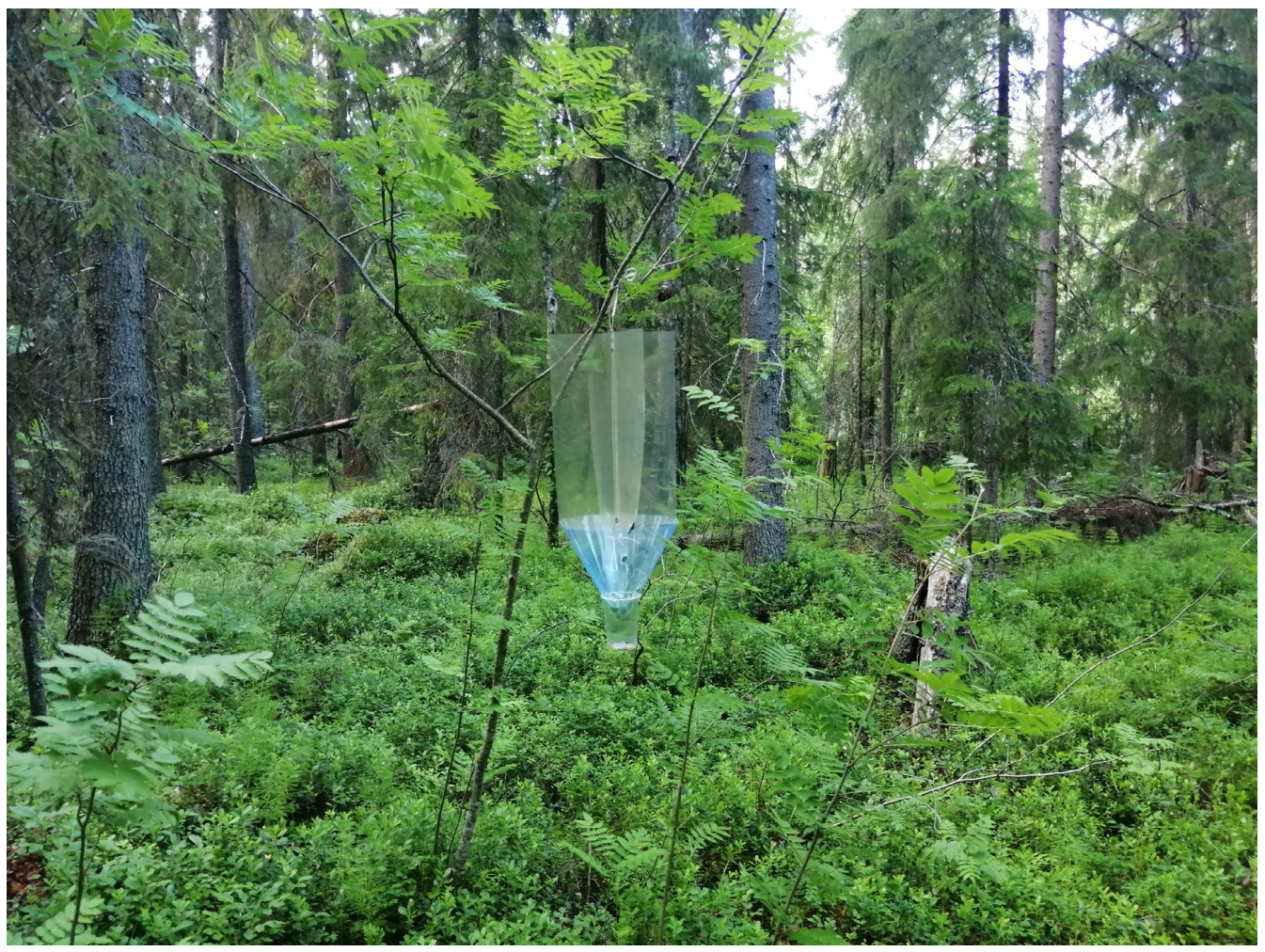
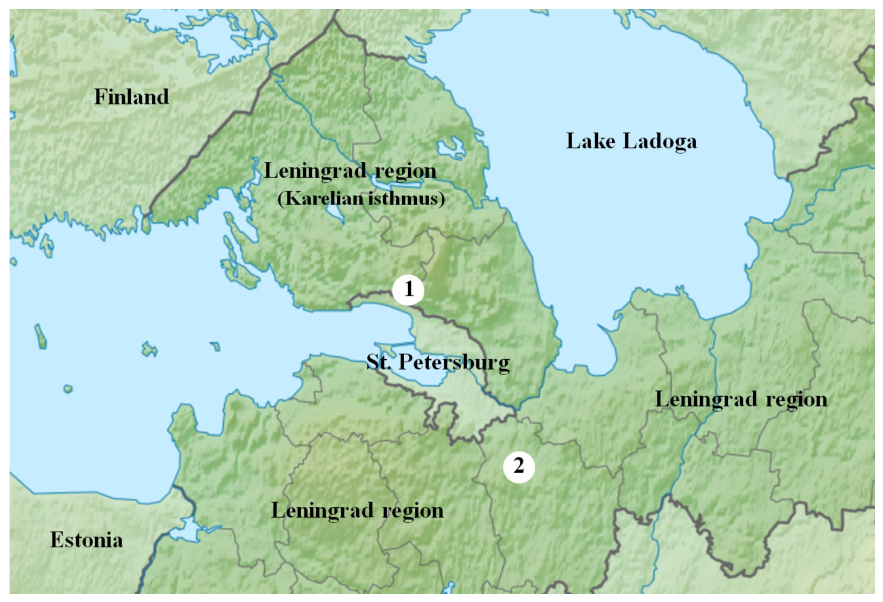
2. Objects and Methods for Obtaining Data
3. Data Processing Methods
4. Results
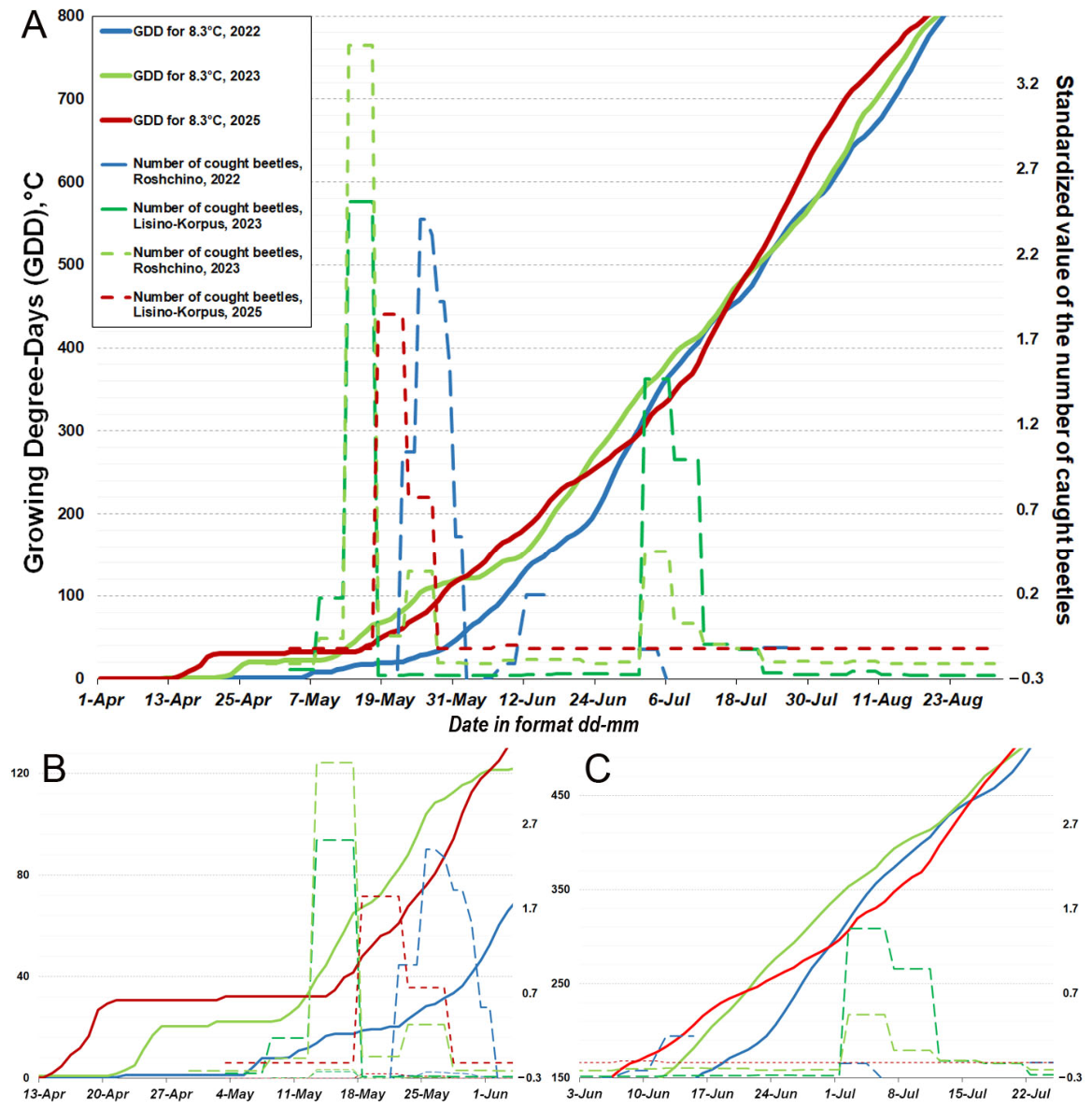
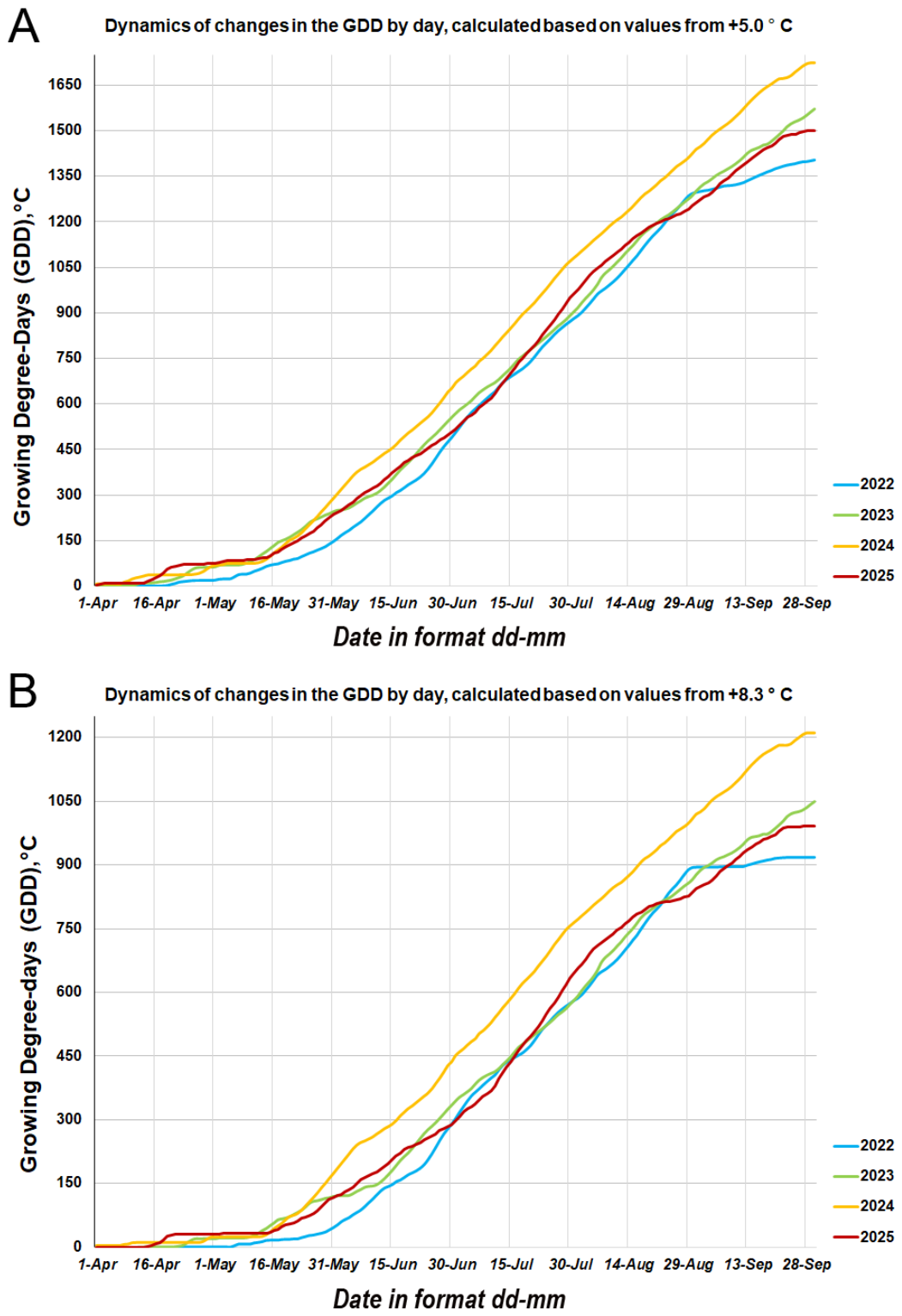
- In 2022 (20–23 May): for 5.0 °C—84–97, for 8.3 °C—19–20;
- In 2023 (10–15 May): for 5.0 °C—81–124, for 8.3 °C—22–25;
- In 2025 (18–20 May): for 5.0 °C—122–137, for 8.3 °C—39–52.
5. Discussion
6. Conclusions
Author Contributions
Funding
Data Availability Statement
Acknowledgments
Conflicts of Interest
Abbreviation
| GDD | Growing Degree Day |
References
- Maslov, A.D. Ips typographus and Spruce Forest Decline; VNIILM: Pushkino, Russia, 2010; 138p. (In Russian) [Google Scholar]
- Selikhovkin, A.V.; Popovichev, B.G.; Mandel’shtam, M.Y.; Alekseev, A.S. The role of stem pests in changing the condition of coniferous forests in the north-west of the European part of Russia. Russ. For. Sci. 2023, 3, 304–321. (In Russian) [Google Scholar] [CrossRef] [Scilit]
- Schelhaas, M.; Nabuurs, G.J.; Schuck, A. Natural disturbances in the European forests in the 19th and 20th centuries. Glob. Change Biol. 2003, 9, 1620–1633. [Google Scholar] [CrossRef] [Scilit]
- Wermelinger, B. Ecology and management of the spruce bark beetle—A review of recent research. For. Ecol. Manag. 2004, 202, 67–82. [Google Scholar] [CrossRef] [Scilit]
- Blackwell, E.; Wimmer, V.; Baier, P.; Schopf, A. Induction and spread of spruce bark beetle outbreak in the wilderness area of Durrenstein, Austria. In 3rd Symposium for Research in Protected Areas 2013; Salzburger Nationalparkfonds: Mittersill, Austria, 2013; pp. 65–70. [Google Scholar]
- Fleischer, P., Jr.; Fleischer, P.; Ferenčík, J.; Hlaváč, P.; Kozánek, M. Elevated bark temperature in unremoved stumps after disturbances facilitates multi-voltinism in Ips typographus population in a mountainous forest. Lesn. Cas.-For. J. 2016, 62, 15–22. [Google Scholar] [CrossRef] [Scilit]
- Jakuš, R.; Blaženec, A. Influence of proportion of (4S)-cis-verbenol in pheromone bait on Ips typographus (Col., Scolytidae) catch in pheromone trap barrier and in single traps. J. Appl. Entomol. 2002, 126, 306–311. [Google Scholar] [CrossRef] [Scilit]
- Dimitri, L.; Gebauer, U.; Lösekrug, R.; Vaupel, O. Influence of mass trapping on the population dynamic and damage-effect of bark beetles. J. Appl. Entomol. 1992, 114, 103–109. [Google Scholar] [CrossRef] [Scilit]
- Kuhn, A.; Hautier, L.; Martin, G.S. Do pheromone traps help to reduce new attacks of Ips typographus at the local scale after a sanitary cut? PeerJ 2022, 10, e14093. [Google Scholar] [CrossRef] [Scilit]
- Weslien, J.; Lindelöw, Å. Recapture of marked spruce bark beetles (Ips typographus) in pheromone traps using area-wide mass trapping. Can. J. For. Res. 1990, 20, 1786–1790. [Google Scholar] [CrossRef] [Scilit]
- Weslien, J. Effects of mass trapping on Ips typographus (L.) populations. J. Appl. Entomol. 1992, 114, 228–232. [Google Scholar] [CrossRef] [Scilit]
- Niemeyer, H. Monitoring Ips typographus and Pityogenes chalcographus (Col., Scolytidae) in Lower Saxony and Schleswig-Holstein. J. Appl. Entomol. 1992, 114, 98–102. [Google Scholar] [CrossRef] [Scilit]
- Faccoli, M.; Stergulc, F. A practical method for predicting the short-time trend of bivoltine populations of Ips typographus (L.) (Col., Scolytidae). J. Appl. Entomol. 2006, 130, 61–66. [Google Scholar] [CrossRef] [Scilit]
- Grodzki, W. Do pheromone trapping always reflect Ips typographus (L.) population level? A study from the Tatra National Park in Poland. Folia For. Pol. Ser. A-For. 2021, 63, 36–47. [Google Scholar] [CrossRef] [Scilit]
- Selikhovkin, A.V.; Popovichev, B.G.; Osechkina, T.A.; Mamaev, N.A.; Martirova, M.B. Population dynamics of Ips typographus in an outbreak focus in Leningrad region. In Proceedings of the St. Petersburg State Forest Technical Academy 2023, Saint Petersburg, Russia, 10 May 2023; pp. 184–199. (In Russian) [Google Scholar] [CrossRef] [Scilit]
- Lange, H.; Økland, B.; Krokene, P. To be or twice to be? The life cycle development of the spruce bark beetle under climate change. In Proceedings of the Sixth International Conference on Complex Systems 2008, Boston, MA, USA, 25–30 June 2006; Volume VI, pp. 251–258. [Google Scholar] [CrossRef] [Scilit]
- Schebeck, M.; Dobart, N.; Ragland, G.J.; Schopf, A.; Stauffer, C. Facultative and obligate diapause phenotypes in populations of the European spruce bark beetle Ips typographus. J. Pest Sci. 2022, 95, 889–899. [Google Scholar] [CrossRef] [Scilit] [PubMed]
- Hofmann, S.; Kautz, M.; Schebeck, M. High plasticity in diapause responses benefits bark beetles in a changing climate. Ecol. Entomol. 2024, 50, 62–73. [Google Scholar] [CrossRef] [Scilit]
- Lyamtsev, N.I.; Kolobov, V.N. Results of pheromone monitoring of Ips typographus in the Moscow region in 2018–2019. In Bulletin of the Council of Botanical Gardens of the CIS Countries at the International Association of Academies of Sciences; Nauchtekhlitizdat: Moscow, Russia, 2020; pp. 26–30. (In Russian) [Google Scholar]
- Lyamtsev, N.I. Monitoring Ips typographus with pheromone traps in the Moscow region in 2022–2023. For. Inf. 2025, 25–35. (In Russian) [Google Scholar] [CrossRef] [Scilit]
- Lobinger, G. Einfluss von Witterung und Pheromonfallen auf die Flugaktivität des Buchdruckers Ips typographus L. J. Appl. Entomol. 1995, 119, 123–129. [Google Scholar]
- Fritscher, D.; Schroeder, M. Thermal sum requirements for development and flight initiation of new-generation spruce bark beetles based on seasonal change in cuticular colour of trapped beetles. Agric. For. Entomol. 2022, 24, 405–421. [Google Scholar] [CrossRef] [Scilit]
- Instructions for Monitoring, Recording and Forecasting Mass Outbreaks of Stem Pests and Forest Health; Ministry of Natural Resources of the Russian Federation, Federal Forestry Agency, VNIILM: Pushkino, Russia, 2006; 114p. (In Russian)
- Maslov, A.D.; Komarova, I.A.; Pletnev, V.A.; Vendilo, N.V.; Selivanov, V.A. Protection of Spruce Against Ips typographus and the Use of Anti-Pheromones; VNIILM: Pushkino, Russia, 2014; 12p. (In Russian) [Google Scholar]
- Selikhovkin, A.V.; Mamaev, N.A.; Martirova, M.B.; Merkuriev, S.A.; Popovichev, B.G. A new outbreak of the European spruce bark beetle, Ips typographus (L.) (Coleoptera, Curculionidae) in Leningrad Province. Entomol. Rev. 2022, 101, 239–251. (In Russian) [Google Scholar] [CrossRef] [Scilit]
- Lyamtsev, N.I.; Kolobov, V.N. Indicator of the threat of mass reproduction of Ips typographus (L.) (Coleoptera: Curculionidae). In Dendrobiont Invertebrates and Fungi and Their Role in Forest Ecosystems (XI Readings in Memory of O.A. Kataev); St. Petersburg State Forest Technical University: Saint Petersburg, Russia, 2020; pp. 204–205. (In Russian) [Google Scholar] [CrossRef] [Scilit]
- Shelukho, V.P.; Shoshin, V.I.; Klyuev, V.S. Dynamics of spruce stand health during the culmination of Ips typographus reproduction and effectiveness of forest protection measures. For. J. 2014, 2, 30–39. (In Russian) [Google Scholar]
- Chalkin, A.A.; Lyabzina, S.N.; Sinitsyna, E.V.; Lobur, A.Y.; Donskoy, O.A. Monitoring of bark beetles (Scolytinae) in forest cenoses of the Kivach Nature Reserve using domestic pheromone traps. For. Bull. 2021, 25, 98–105. (In Russian) [Google Scholar] [CrossRef] [Scilit]
- Chalkin, A.A.; Lyabzina, S.N. Results of monitoring xylophilous Coleoptera with pheromone traps in the Botanical Garden of PetrSU. Hortus Bot. 2022, 17, 289–301. (In Russian) [Google Scholar] [CrossRef] [Scilit]
- Lyabzina, S.N.; Chalkin, A.A. Pheromone monitoring of Ips typographus in Karelia. Plant Prot. Quar. 2023, 6, 27–29. (In Russian) [Google Scholar]
- Stepanycheva, E.A.; Petrova, M.O.; Chermenskaya, T.D.; Vendilo, N.V. Comparative evaluation of pheromone activity for Ips typographus (L.) (Coleoptera, Scolytidae) and methods of their application. Plant Prot. Quar. 2017, 96, 213–219. (In Russian) [Google Scholar]
- Selikhovkin, A.V.; Martirova, M.B.; Mamaev, N.A.; Mandel’shtam, M.Y. Stem pests of protected natural areas of St. Petersburg and possibilities for their population control. In Proceedings of the St. Petersburg State Forest Technical Academy 2025, Saint Petersburg, Russia, 24–26 September 2025; pp. 212–234. (In Russian) [Google Scholar]
- Weather and Climate: Weather Archive (2025). Available online: www.pogodaiklimat.ru (accessed on 30 May 2025). (In Russian)
- Wermelinger, B.; Seifert, M. Analysis of temperature dependent development of the spruce bark beetle Ips typographus L. (Coleoptera, Scolytidae). J. Appl. Entomol. 1998, 122, 185–191. [Google Scholar] [CrossRef] [Scilit]
- Öhrn, P.; Långström, B.; Lindelöw, Å.; Björklund, N. Seasonal flight patterns of Ips typographus in southern Sweden and thermal sums required for emergence. Agric. For. Entomol. 2014, 16, 147–157. [Google Scholar] [CrossRef] [Scilit]
- Hollander, M.; Wolfe, D.A. Nonparametric Statistical Methods; Kendall and Spearman tests; John Wiley & Sons: New York, NY, USA, 1973; pp. 185–194. [Google Scholar]
- Best, D.J.; Roberts, D.E. Algorithm AS 89: The upper tail probabilities of Spearman’s rho. Appl. Stat. 1975, 24, 377–379. [Google Scholar] [CrossRef] [Scilit]
- R Core Team. R: A Language and Environment for Statistical Computing; R Foundation for Statistical Computing: Vienna, Austria, 2025; Available online: https://www.R-project.org/ (accessed on 23 June 2025).
- Jönsson, A.M.; Harding, S.; Hans, L.; Ravn, P. Impact of climate change on the population dynamics of Ips typographus in southern Sweden. Agric. For. Meteorol. 2007, 146, 70–81. [Google Scholar] [CrossRef] [Scilit]
- Økland, B.; Nikolov, C.; Krokene, P.; Vakula, J. Transition from windfall- to patch-driven outbreak dynamics of the spruce bark beetle Ips typographus. For. Ecol. Manag. 2016, 363, 63–73. [Google Scholar] [CrossRef] [Scilit]
- Milosavljević, M.; Tabaković-Tošić, M.; Stajić, S.; Češljar, G.; Mitrović, S. Phenological Study of the Spruce Bark Beetles Ips typographus (L.) and Pityogenes chalcographus (L.) (Coleoptera: Curculionidae) on Tara Mountain, Serbia. South-East Eur. For. 2025, 16, 123–130. [Google Scholar] [CrossRef] [Scilit]
- Marini, L.; ke Lindel, Å.; Jönsson, A.M.; Wulff, S.; Schroeder, L.M. Population dynamics of the spruce bark beetle: A long-term study. Oikos 2013, 122, 1768–1776. [Google Scholar] [CrossRef] [Scilit]
- Štefková, K.; Okrouhlík, J.; Doleža, P. Development and survival of the spruce bark beetle, Ips typographus (Coleoptera: Curculionidae: Scolytinae) at low temperatures in the laboratory and the field. Eur. J. Entomol. 2017, 114, 1–6. [Google Scholar] [CrossRef] [Scilit]
- Annila, E. Influence of temperature upon the development and voltinism of Ips typographus, (L.) (Coleoptera, Scolytidae). Ann. Zool. Fenn. 1969, 6, 161–208. [Google Scholar]
- Kasumović, L.; Lindelöw, A.; Hrašovec, B. Overwintering strategy of Ips typographus L. (Coleoptera, Curculionidae, Scolytinae) in Croatian spruce forests on lowest elevation. Šumar. List 2019, 143, 19–24. [Google Scholar] [CrossRef] [Scilit]
- Åit, K.; Õunap, H.; Vodde, F.; Metslaid, M. Bivoltinism in the northern bark beetle Ips duplicatus (Sahlberg, 1836) (Coleoptera: Curculionidae, Scolytinae) observed in Estonia. EPPO Bull. 2025, 55, 264–272. [Google Scholar] [CrossRef] [Scilit]




| Year | Location 1 | Location 2 | ||
|---|---|---|---|---|
| Period | Specimens per Trap per Day | Period | Specimens per Trap per Day | |
| 2022 | 23.05–30.05 | 585 | - | - |
| 03.06–13.06 | 68 | - | - | |
| 27.06–07.07 | 20 | - | - | |
| 17.07–01.08 | 24 | - | - | |
| 2023 | 06.05–25.05 | 654 | 06.05–15.05 | 155 |
| 05.06–19.06 | 14 | 16.05–29.06 | <10 | |
| 30.06–19.07 | 95 | 30.06–19.07 | 137 | |
| 2025 | - | - | 16.05–25.05 | 24 |
| - | - | 03.08 * | 0 | |
| Year | Location 1 | Location 2 | ||||
|---|---|---|---|---|---|---|
| Total per Season, Specimens | After Swarming, Specimens * | Ratio, % | Total per Season, Specimens | After Swarming, Specimens * | Ratio, % | |
| 2022 | 40,585 | 8860 | 21.8% | - | - | - |
| 2023 | 20,085 | 4355 | 21.6% | 6546 | 3356 | 51.2% |
| 2024 | - | - | - | 399 | 53 | 13.2% |
| 2025 | - | - | - | 291 | 2 | 0.6% |
Disclaimer/Publisher’s Note: The statements, opinions and data contained in all publications are solely those of the individual author(s) and contributor(s) and not of MDPI and/or the editor(s). MDPI and/or the editor(s) disclaim responsibility for any injury to people or property resulting from any ideas, methods, instructions or products referred to in the content. |
© 2026 by the authors. Licensee MDPI, Basel, Switzerland. This article is an open access article distributed under the terms and conditions of the Creative Commons Attribution (CC BY) license.
Share and Cite
Selikhovkin, A.; Mamaev, N.; Martirova, M.; Sedikhin, N. Insights from Pheromone Trap Catches in the Northern Part of the Ips typographus Range. Insects 2026, 17, 610. https://doi.org/10.3390/insects17060610
Selikhovkin A, Mamaev N, Martirova M, Sedikhin N. Insights from Pheromone Trap Catches in the Northern Part of the Ips typographus Range. Insects. 2026; 17(6):610. https://doi.org/10.3390/insects17060610
Chicago/Turabian StyleSelikhovkin, Andrey, Nikita Mamaev, Maria Martirova, and Nickolai Sedikhin. 2026. "Insights from Pheromone Trap Catches in the Northern Part of the Ips typographus Range" Insects 17, no. 6: 610. https://doi.org/10.3390/insects17060610
APA StyleSelikhovkin, A., Mamaev, N., Martirova, M., & Sedikhin, N. (2026). Insights from Pheromone Trap Catches in the Northern Part of the Ips typographus Range. Insects, 17(6), 610. https://doi.org/10.3390/insects17060610