Projected Northward Expansion and Southern Core-Habitat Contraction of Zeugodacus tau in China Under Climate Change: An Optimized MaxEnt Analysis


Simple Summary
Abstract
1. Introduction
2. Materials and Methods
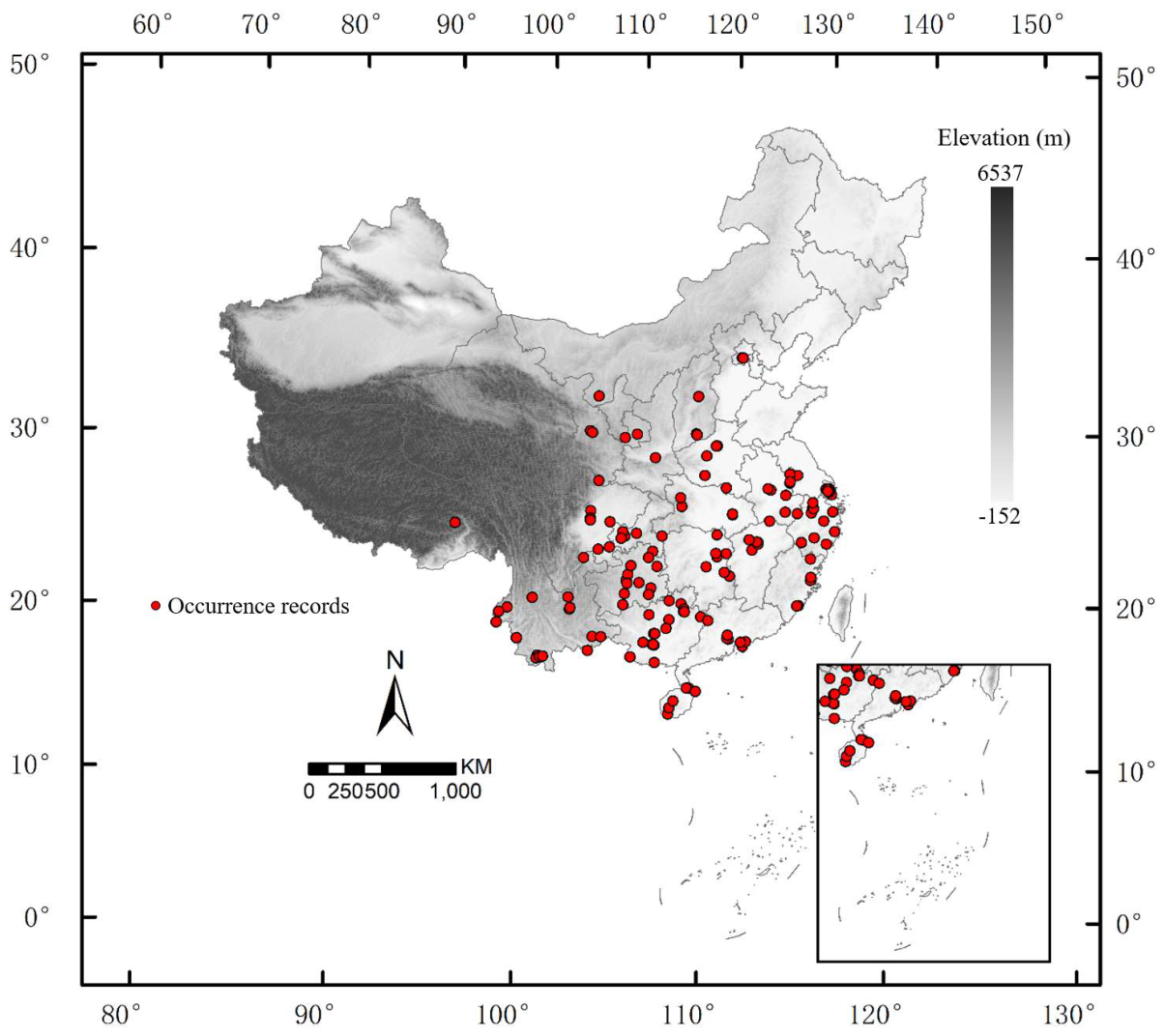
2.1. Species Occurrence Data and Spatial Thinning
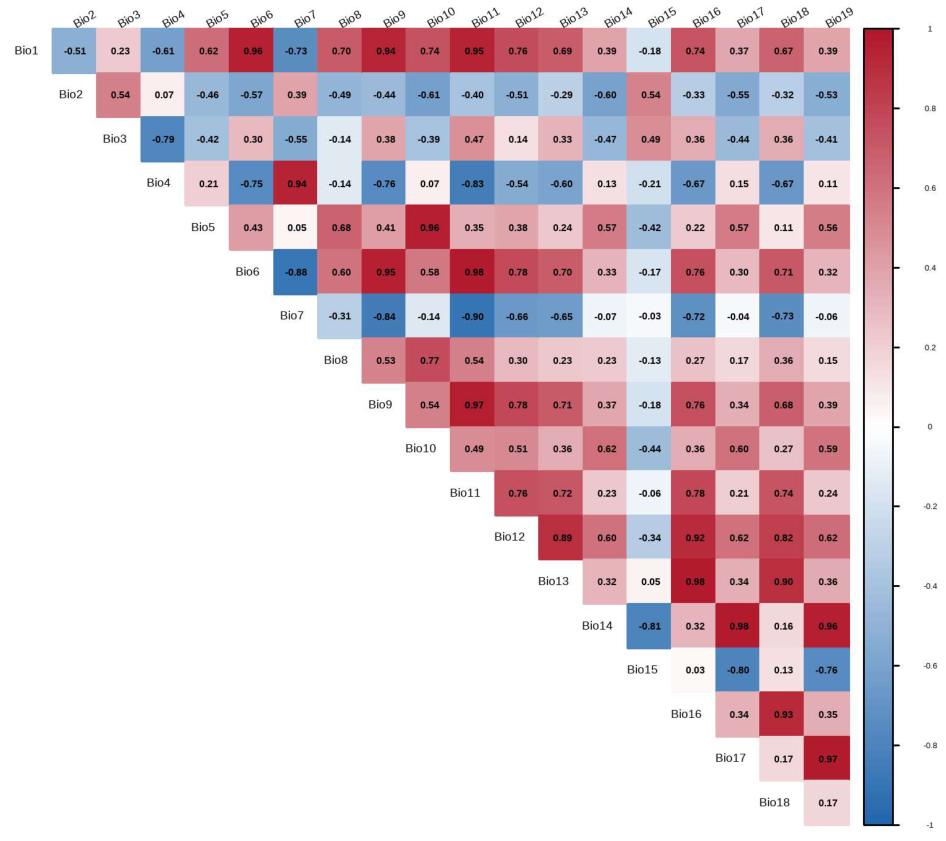
2.2. Bioclimatic Variables and Multicollinearity Diagnostics
2.3. Algorithmic Hyperparameter Optimization and Spatial Block Cross-Validation
2.4. Final Model Construction and Cartographic Projection
2.5. Ecological Thresholding and Geometric Centroid Tracking
2.6. Threshold Sensitivity Analysis
3. Results
3.1. Model Accuracy Evaluation and Dominant Environmental Variables
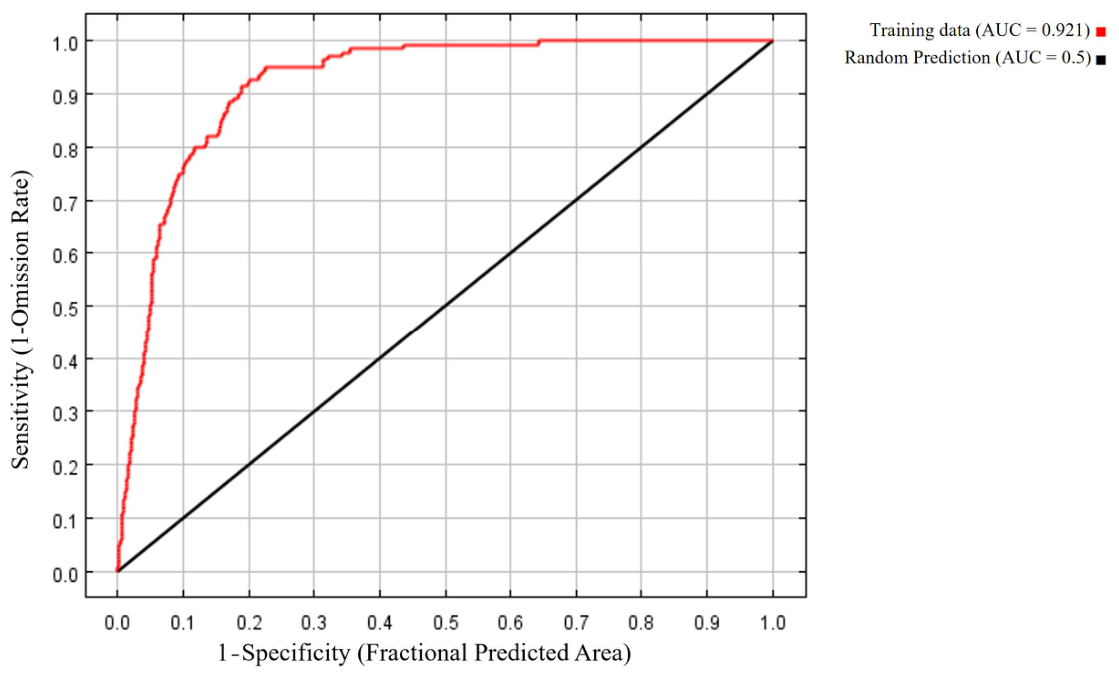
3.1.1. Model Prediction Accuracy Evaluation
3.1.2. Selection and Analysis of Dominant Environmental Variables
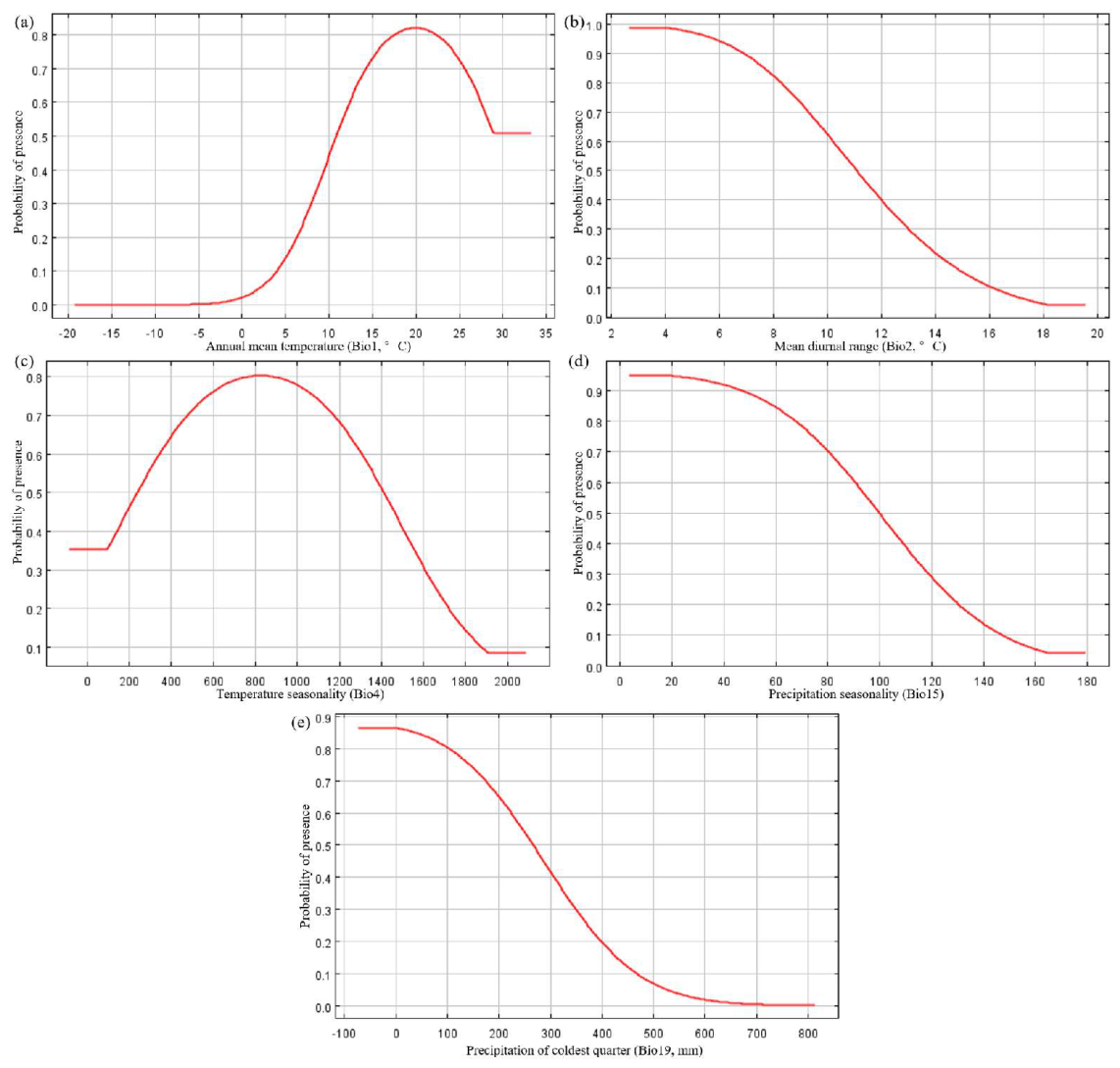
3.2. Responses of Presence Probability to Dominant Environmental Factors
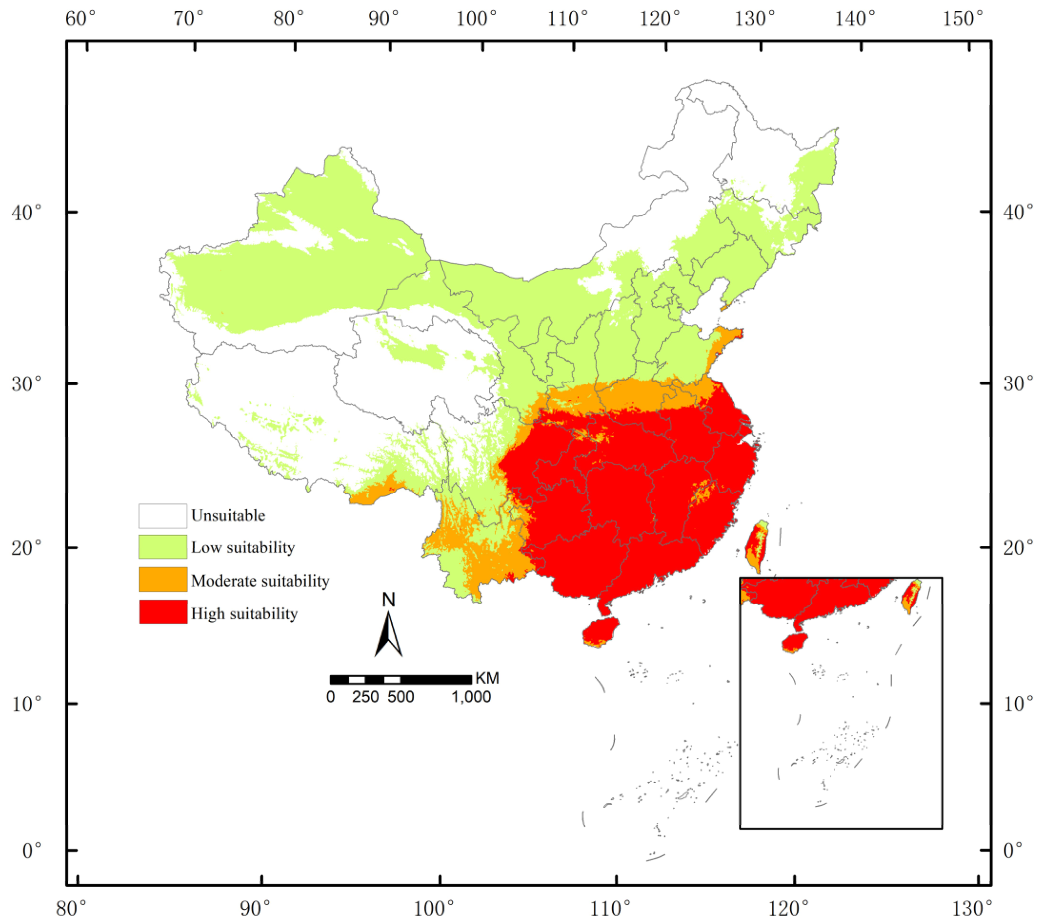
3.3. Spatial Pattern of Suitable Habitats for Zeugodacus tau in China Under Historical Baseline Climate
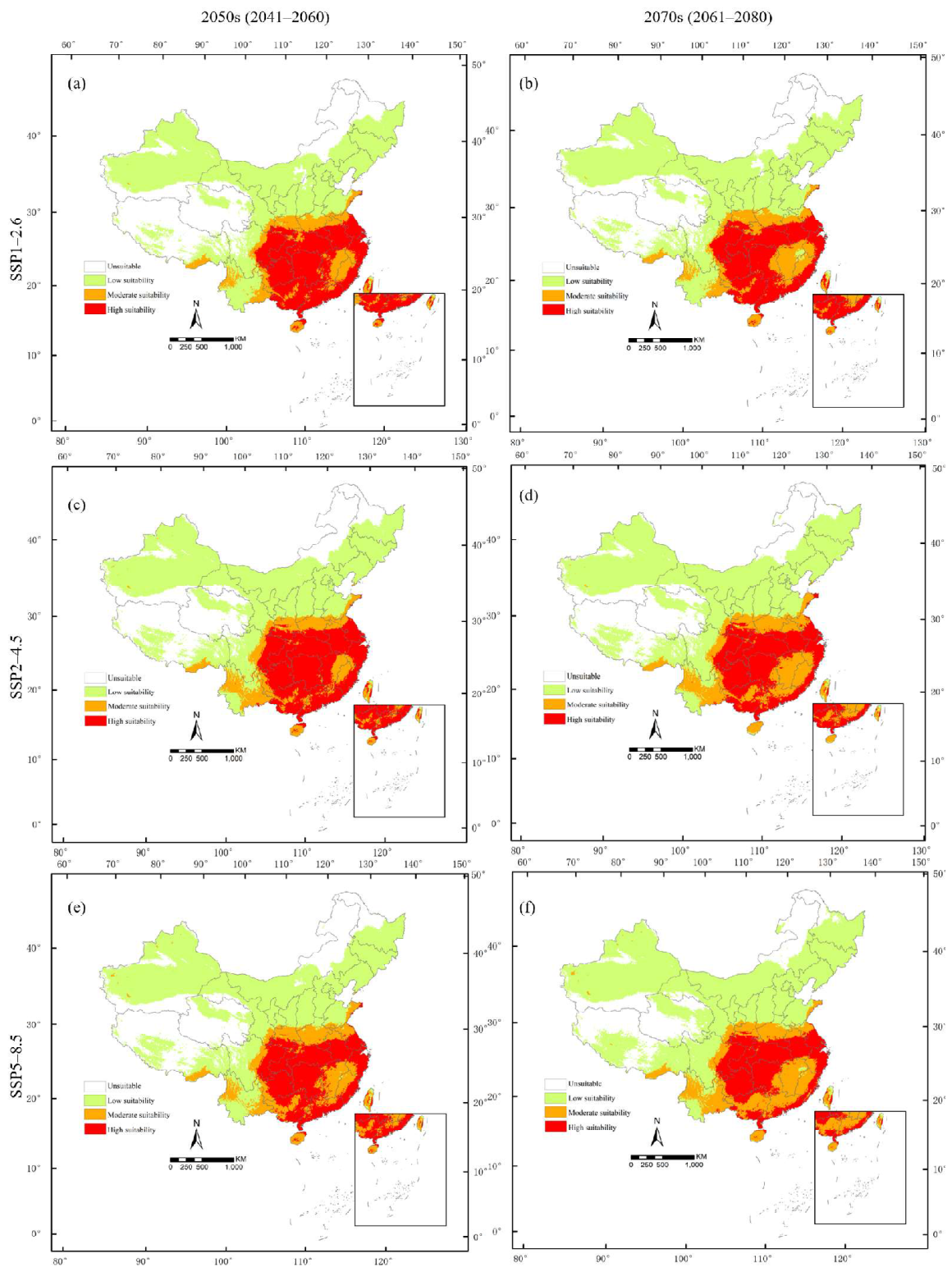
3.4. Future Redistribution of Climatic Suitability Under Climate Change
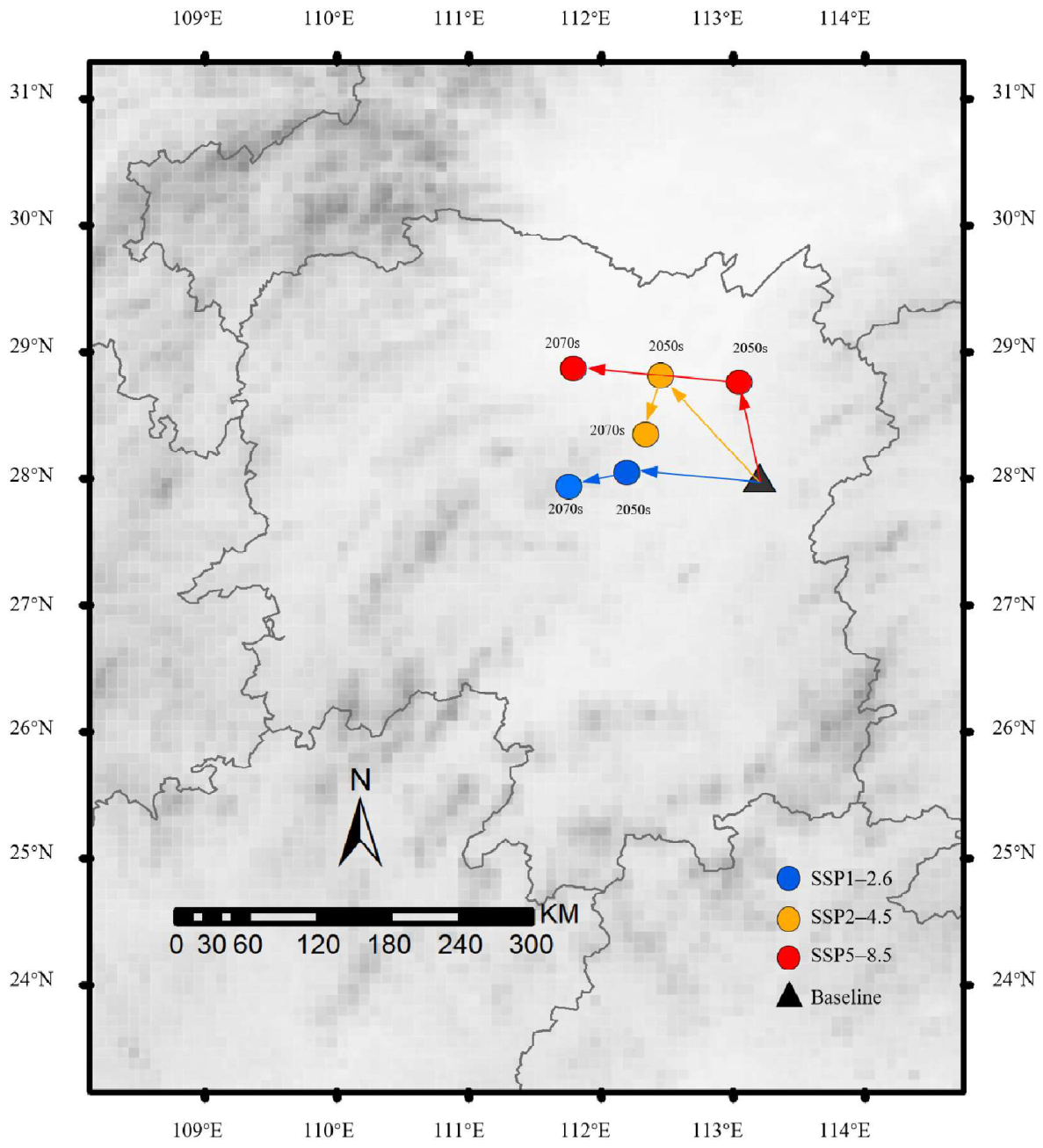
3.5. Spatial Trajectories of the Centroids of High-Suitability Habitats Under Climate Change
4. Discussion
4.1. Winter Warming and the Potential Northward Expansion of Suitable Habitats
4.2. Potential Role of Summer Heat Stress in the Contraction of Southern Core Habitats
4.3. Future Risk-Oriented Areas and Implications for Integrated Pest Management
4.4. Model Uncertainties and Future Perspectives
5. Conclusions
Supplementary Materials
Author Contributions
Funding
Data Availability Statement
Acknowledgments
Conflicts of Interest
Abbreviations
| MaxEnt | Maximum Entropy |
| SDMs | Species Distribution Models |
| CMIP6 | Coupled Model Intercomparison Project Phase 6 |
| SSPs | Shared Socioeconomic Pathways |
| ROC | Receiver Operating Characteristic |
| AUC | Area Under the Curve |
| MTP | Minimum Training Presence |
| 10PTP | 10th Percentile Training Presence |
| FC | Feature Class |
| RM | Regularization Multiplier |
| DEM | Digital Elevation Model |
| IPM | Integrated Pest Management |
Appendix A
Appendix A.1. Multicollinearity Diagnostics of Bioclimatic Variables

References
- Liu, X.; Ji, Q. Review of Zeugodacus tau (Walker) (Diptera: Tephritidae): Biological Characteristics and Control Strategy. CABI Agric. Biosci. 2024, 5, 90. [Google Scholar] [CrossRef]
- Zhao, Z.; Carey, J.R.; Li, Z. The Global Epidemic of Bactrocera Pests: Mixed-Species Invasions and Risk Assessment. Annu. Rev. Entomol. 2024, 69, 219–237. [Google Scholar] [CrossRef]
- Ullah, F.; Zhang, Y.; Gul, H.; Hafeez, M.; Desneux, N.; Qin, Y.; Li, Z. Estimation of the Potential Geographical Distribution of Invasive Peach Fruit Fly under Climate Change by Integrated Ecological Niche Models. CABI Agric. Biosci. 2023, 4, 46. [Google Scholar] [CrossRef]
- Deutsch, C.; Tewksbury, J.J.; Huey, R.B.; Sheldon, K.S.; Ghalambor, C.K.; Haak, D.C.; Martin, P.R. Impacts of Climate Warming on Terrestrial Ectotherms across Latitude. Proc. Natl. Acad. Sci. USA 2008, 105, 6668–6672. [Google Scholar] [CrossRef]
- Paaijmans, K.P.; Heinig, R.L.; Seliga, R.A.; Blanford, J.I.; Blanford, S.; Murdock, C.C.; Thomas, M.B. Temperature Variation Makes Ectotherms More Sensitive to Climate Change. Glob. Change Biol. 2013, 19, 2373–2380. [Google Scholar] [CrossRef]
- Bates, O.K.; Bertelsmeier, C. Predictions of Future Insect Distributions Under Climate Change. Divers. Distrib. 2025, 31, e70106. [Google Scholar] [CrossRef]
- Vasseur, D.A.; DeLong, J.P.; Gilbert, B.; Greig, H.S.; Harley, C.D.G.; McCann, K.S.; Savage, V.M.; Tunney, T.D.; O’Connor, M.I. Increased Temperature Variation Poses a Greater Risk to Species than Climate Warming. Proc. R. Soc. B Biol. Sci. 2014, 281, 20132612. [Google Scholar] [CrossRef]
- Dong, Z.; He, Y.; Ren, Y.; Wang, G.; Chu, D. Seasonal and Year-Round Distributions of Bactrocera dorsalis (Hendel) and Its Risk to Temperate Fruits under Climate Change. Insects 2022, 13, 550. [Google Scholar] [CrossRef] [PubMed]
- Sultana, S.; Baumgartner, J.B.; Dominiak, B.C.; Royer, J.E.; Beaumont, L.J. Impacts of Climate Change on High Priority Fruit Fly Species in Australia. PLoS ONE 2020, 15, e0213820. [Google Scholar] [CrossRef] [PubMed]
- Zingore, K.M.; Sithole, G.; Abdel-Rahman, E.M.; Mohamed, S.A.; Ekesi, S.; Tanga, C.M.; Mahmoud, M.E.E. Global Risk of Invasion by Bactrocera zonata: Implications on Horticultural Crop Production under Changing Climatic Conditions. PLoS ONE 2020, 15, e0243047. [Google Scholar] [CrossRef]
- Gutierrez, A.P.; Ponti, L.; Neteler, M.; Suckling, D.M.; Cure, J.R. Invasive Potential of Tropical Fruit Flies in Temperate Regions under Climate Change. Commun. Biol. 2021, 4, 1141. [Google Scholar] [CrossRef]
- Sunday, J.M.; Bates, A.E.; Kearney, M.R.; Colwell, R.K.; Dulvy, N.K.; Longino, J.T.; Huey, R.B. Thermal-Safety Margins and the Necessity of Thermoregulatory Behavior across Latitude and Elevation. Proc. Natl. Acad. Sci. USA 2014, 111, 5610–5615. [Google Scholar] [CrossRef]
- Holzmann, K.L.; Peters, M. Limited Thermal Tolerance in Tropical Insects and Its Genomic Signature. Nature 2026, 651, 672–678. [Google Scholar] [CrossRef]
- Li, M.; Wei, X.-M.; Li, J.; Wei, S.-M.; Zhang, J.-L.; Chen, G.-H.; Zhang, X.-M. Effect of Short-Term Exposure to High Temperatures on the Reproductive Behavior and Physiological Enzyme Activities in the Fruit Fly Zeugodacus tau (Walker). Front. Physiol. 2023, 14, 1036397. [Google Scholar] [CrossRef]
- Liu, H.; Wang, X.; Chen, Z.; Lu, Y. Characterization of Cold and Heat Tolerance of Bactrocera tau (Walker). Insects 2022, 13, 329. [Google Scholar] [CrossRef]
- GBIF.org. GBIF Occurrence Download. Available online: https://doi.org/10.15468/dl.sh7vmu (accessed on 27 March 2026).
- Fourcade, Y.; Engler, J.O.; Rödder, D.; Secondi, J. Mapping Species Distributions with MAXENT Using a Geographically Biased Sample of Presence Data: A Performance Assessment of Methods for Correcting Sampling Bias. PLoS ONE 2014, 9, e97122. [Google Scholar] [CrossRef] [PubMed]
- Syfert, M.M.; Smith, M.J.; Coomes, D.A. The Effects of Sampling Bias and Model Complexity on the Predictive Performance of MaxEnt Species Distribution Models. PLoS ONE 2013, 8, e55158. [Google Scholar] [CrossRef]
- Aiello-Lammens, M.E.; Boria, R.A.; Radosavljevic, A.; Vilela, B.; Anderson, R.P. spThin: An R Package for Spatial Thinning of Species Occurrence Records for Use in Ecological Niche Models. Ecography 2015, 38, 541–545. [Google Scholar] [CrossRef]
- Fick, S.E.; Hijmans, R.J. WorldClim 2: New 1-Km Spatial Resolution Climate Surfaces for Global Land Areas. Int. J. Climatol. 2017, 37, 4302–4315. [Google Scholar] [CrossRef]
- Wu, T.; Lu, Y.; Fang, Y.; Xin, X.; Li, L.; Li, W.; Jie, W.; Zhang, J.; Liu, Y.; Zhang, L.; et al. The Beijing Climate Center Climate System Model (BCC-CSM): The Main Progress from CMIP5 to CMIP6. Geosci. Model Dev. 2019, 12, 1573–1600. [Google Scholar] [CrossRef]
- O’Neill, B.C.; Tebaldi, C.; van Vuuren, D.P.; Eyring, V.; Friedlingstein, P.; Hurtt, G.; Knutti, R.; Kriegler, E.; Lamarque, J.-F.; Lowe, J.; et al. The Scenario Model Intercomparison Project (ScenarioMIP) for CMIP6. Geosci. Model Dev. 2016, 9, 3461–3482. [Google Scholar] [CrossRef]
- Dormann, C.F.; Elith, J.; Bacher, S.; Buchmann, C.; Carl, G.; Carré, G.; Marquéz, J.R.G.; Gruber, B.; Lafourcade, B.; Leitão, P.J. Collinearity: A Review of Methods to Deal with It and a Simulation Study Evaluating Their Performance. Ecography 2013, 36, 27–46. [Google Scholar] [CrossRef]
- Warren, D.L.; Seifert, S.N. Ecological Niche Modeling in Maxent: The Importance of Model Complexity and the Performance of Model Selection Criteria. Ecol. Appl. 2011, 21, 335–342. [Google Scholar] [CrossRef]
- Muscarella, R.; Galante, P.J.; Soley-Guardia, M.; Boria, R.A.; Kass, J.M.; Uriarte, M.; Anderson, R.P. ENMeval: An R Package for Conducting Spatially Independent Evaluations and Estimating Optimal Model Complexity for Maxent Ecological Niche Models. Methods Ecol. Evol. 2014, 5, 1198–1205. [Google Scholar] [CrossRef]
- Kass, J.M.; Muscarella, R.; Galante, P.J.; Bohl, C.L.; Pinilla-Buitrago, G.E.; Boria, R.A.; Soley-Guardia, M.; Anderson, R.P. ENMeval 2.0: Redesigned for Customizable and Reproducible Modeling of Species’ Niches and Distributions. Methods Ecol. Evol. 2021, 12, 1602–1608. [Google Scholar] [CrossRef]
- Valavi, R.; Elith, J.; Lahoz-Monfort, J.J.; Guillera-Arroita, G. blockCV: An R Package for Generating Spatially or Environmentally Separated Folds for k-Fold Cross-Validation of Species Distribution Models. Methods Ecol. Evol. 2019, 10, 225–232. [Google Scholar] [CrossRef]
- Phillips, S.J.; Anderson, R.P.; Dudík, M.; Schapire, R.E.; Blair, M.E. Opening the Black Box: An Open-Source Release of Maxent. Ecography 2017, 40, 887–893. [Google Scholar] [CrossRef]
- ESRI. Albers Equal Area Conic. Available online: https://pro.arcgis.com/en/pro-app/latest/help/mapping/properties/albers.htm (accessed on 3 June 2026).
- ESRI. Coordinate Systems, Map Projections, and Transformations. Available online: https://pro.arcgis.com/en/pro-app/latest/help/mapping/properties/coordinate-systems-and-projections.htm (accessed on 3 June 2026).
- Liu, C.; White, M.; Newell, G. Selecting Thresholds for the Prediction of Species Occurrence with Presence-Only Data. J. Biogeogr. 2013, 40, 778–789. [Google Scholar] [CrossRef]
- Liu, C.; Newell, G.; White, M. On the Selection of Thresholds for Predicting Species Occurrence with Presence-Only Data. Ecol. Evol. 2016, 6, 337–348. [Google Scholar] [CrossRef]
- ESRI Data Classification Methods. Available online: https://pro.arcgis.com/en/pro-app/latest/help/mapping/layer-properties/data-classification-methods.htm (accessed on 3 June 2026).
- Huang, Y.; Gu, X.; Peng, X.; Tao, M.; Peng, L.; Chen, G.; Zhang, X. Effect of Short-Term Low Temperature on the Growth, Development, and Reproduction of Bactrocera tau (Diptera: Tephritidae) and Bactrocera cucurbitae. J. Econ. Entomol. 2020, 113, 2141–2149. [Google Scholar] [CrossRef]
- Dongmo, K.M.A.; Fiaboe, K.K.M.; Kekeunou, S.; Nanga, S.N.; Kuate, A.F.; Tonnang, H.E.Z.; Gnanvossou, D.; Hanna, R. Temperature-Based Phenology Model to Predict the Development, Survival, and Reproduction of the Oriental Fruit Fly Bactrocera dorsalis. J. Therm. Biol. 2021, 97, 102877. [Google Scholar] [CrossRef]
- Teixeira, C.M.; Krüger, A.P.; Nava, D.E.; Garcia, F.R.M. Potential Global Distribution of the South American Cucurbit Fruit Fly Anastrepha grandis (Diptera: Tephritidae). Crop Prot. 2021, 145, 105647. [Google Scholar] [CrossRef]
- Teixeira, C.M.; Krüger, A.P.; Nava, D.E.; Garcia, F.R.M. Global Potential Distribution of Anastrepha grandis (Diptera, Tephritidae) under Climate Change Scenarios. Crop Prot. 2022, 151, 105836. [Google Scholar] [CrossRef]
- Abeijon, L.M.; Gómez Llano, J.H.; Robe, L.J.; Ovruski, S.M.; Garcia, F.R.M. Mapping the Potential Presence of the Spotted Wing Drosophila Under Current and Future Scenario: An Update of the Distribution Modeling and Ecological Perspectives. Agronomy 2025, 15, 838. [Google Scholar] [CrossRef]
- Papadopoulos, N.T.; De Meyer, M.; Terblanche, J.S.; Kriticos, D.J. Fruit Flies: Challenges and Opportunities to Stem the Tide of Global Invasions. Annu. Rev. Entomol. 2024, 69, 355–373. [Google Scholar] [CrossRef]
- Hou, B.; Xie, Q.; Zhang, R. Depth of Pupation and Survival of the Oriental Fruit Fly, Bactrocera dorsalis (Diptera: Tephritidae) Pupae at Selected Soil Moistures. Appl. Entomol. Zool. 2006, 41, 515–520. [Google Scholar] [CrossRef]
- Dias, V.S.; Hallman, G.J.; Araújo, A.S.; Lima, I.V.G.; Galvão-Silva, F.L.; Caravantes, L.A.; Rivera, M.N.G.; Aguilar, J.S.; Cáceres-Barrios, C.E.; Vreysen, M.J.B. High Cold Tolerance and Differential Population Response of Third Instars from the Zeugodacus tau Complex to Phytosanitary Cold Treatment in Navel Oranges. Postharvest Biol. Technol. 2023, 203, 112392. [Google Scholar] [CrossRef]
- Qin, Y.; Zhang, Y.; Clarke, A.R.; Zhao, Z.; Li, Z. Including Host Availability and Climate Change Impacts on the Global Risk Area of Carpomya pardalina (Diptera: Tephritidae). Front. Ecol. Evol. 2021, 9, 724441. [Google Scholar] [CrossRef]
- Li, Z.; Chambi, C.; Du, T.; Huang, C.; Wang, F.; Zhang, G.; Li, C.; Kayeke, M.J. Effects of Water Immersion and Soil Moisture Content on Larval and Pupal Survival of Bactrocera minax (Diptera: Tephritidae). Insects 2019, 10, 138. [Google Scholar] [CrossRef]
- Ma, G.; Pincebourde, S.; Bai, X.; Peng, Y.; Wang, X.-J.; Yang, H.-P.; Zhu, L.; Zhang, W.; Ma, C.-S. Behavioural Plasticity of a Pest Species May Aggravate Global Wheat Yield Loss under Climate Change. Nat. Commun. 2025, 16, 11163. [Google Scholar] [CrossRef]
- Suggitt, A.J.; Wilson, R.J.; Isaac, N.J.B.; Beale, C.M.; Auffret, A.G.; August, T.; Bennie, J.J.; Crick, H.Q.P.; Duffield, S.; Fox, R.; et al. Extinction Risk from Climate Change Is Reduced by Microclimatic Buffering. Nat. Clim. Change 2018, 8, 713–717. [Google Scholar] [CrossRef]
- Scheffers, B.R.; Edwards, D.P.; Diesmos, A.; Williams, S.E.; Evans, T.A. Microhabitats Reduce Animal’s Exposure to Climate Extremes. Glob. Change Biol. 2014, 20, 495–503. [Google Scholar] [CrossRef]
- Terlau, J.F.; Brose, U.; Eisenhauer, N.; Amyntas, A.; Boy, T.; Dyer, A.; Gebler, A.; Hof, C.; Liu, T.; Scherber, C.; et al. Microhabitat Conditions Remedy Heat Stress Effects on Insect Activity. Glob. Change Biol. 2023, 29, 3747–3758. [Google Scholar] [CrossRef] [PubMed]
- Bussy, M.; Destierdt, W.; Masnou, P.; Lazzari, C.; Goubault, M.; Pincebourde, S. The Lack of Plasticity and Interspecific Variability in Thermal Limits Produce a Highly Heat-Tolerant Tropical Host-Parasitoid System. J. Therm. Biol. 2024, 123, 103930. [Google Scholar] [CrossRef]
- Machekano, H.; Zidana, C.; Gotcha, N.; Nyamukondiwa, C. Limited Thermal Plasticity May Constrain Ecosystem Function in a Basally Heat Tolerant Tropical Telecoprid Dung Beetle, Allogymnopleurus thalassinus (Klug, 1855). Sci. Rep. 2021, 11, 22192. [Google Scholar] [CrossRef]
- Aluja, M.; Guillén, L. Environmentally Induced Changes on Tephritid Fly Behavior and Physiology and Their Implications for Management. Curr. Opin. Insect Sci. 2025, 71, 101408. [Google Scholar] [CrossRef] [PubMed]
- Lin, J.; Yue, G.; Xiao, K.; Chen, J.; Hao, X.; Yang, D.; Yang, J.; Zheng, M.; Ji, Q. Development of Bait Station to Complement Attract-and-Kill Agents of Zeugodacus tau (Diptera: Tephritidae). J. Econ. Entomol. 2024, 117, 2009–2018. [Google Scholar] [CrossRef]
- Fezza, T.; Shelly, T.E.; Fox, A.; Beucke, K.; Rohrig, E.; Aldebron, C.; Manoukis, N.C. Less Is More: Fewer Attract-and-Kill Sites Improve the Male Annihilation Technique against Bactrocera dorsalis (Diptera: Tephritidae). PLoS ONE 2024, 19, e0300866. [Google Scholar] [CrossRef]
- Aguirre-Liguori, J.A.; Ramírez-Barahona, S.; Gaut, B.S. The Evolutionary Genomics of Species’ Responses to Climate Change. Nat. Ecol. Evol. 2021, 5, 1350–1360. [Google Scholar] [CrossRef] [PubMed]
- Tsiftsis, S.; Štípková, Z.; Rejmánek, M.; Kindlmann, P. Predictions of Species Distributions Based Only on Models Estimating Future Climate Change Are Not Reliable. Sci. Rep. 2024, 14, 25778. [Google Scholar] [CrossRef]
- Thuiller, W.; Guéguen, M.; Renaud, J.; Karger, D.N.; Zimmermann, N.E. Uncertainty in Ensembles of Global Biodiversity Scenarios. Nat. Commun. 2019, 10, 1446. [Google Scholar] [CrossRef]
- Harishchandra, A.; Xue, H.; Salinas, S.; Jayasundara, N. Thermal Physiology Integrated Species Distribution Model Predicts Profound Habitat Fragmentation for Estuarine Fish with Ocean Warming. Sci. Rep. 2022, 12, 21781. [Google Scholar] [CrossRef] [PubMed]
- Araújo, M.B.; New, M. Ensemble Forecasting of Species Distributions. Trends Ecol. Evol. 2007, 22, 42–47. [Google Scholar] [CrossRef]
- Anstett, D.N.; Anstett, J.; Sheth, S.N.; Moxley, D.R.; Branch, H.A.; Jahani, M.; Huang, K.; Todesco, M.; Jordan, R.; Lazaro-Guevara, J.M.; et al. Rapid Evolution Predicts Demographic Recovery after Extreme Drought. Science 2026, 391, 1172–1176. [Google Scholar] [CrossRef] [PubMed]
- Norberg, J.; Urban, M.C.; Vellend, M.; Klausmeier, C.A.; Loeuille, N. Eco-Evolutionary Responses of Biodiversity to Climate Change. Nat. Clim. Change 2012, 2, 747–751. [Google Scholar] [CrossRef]


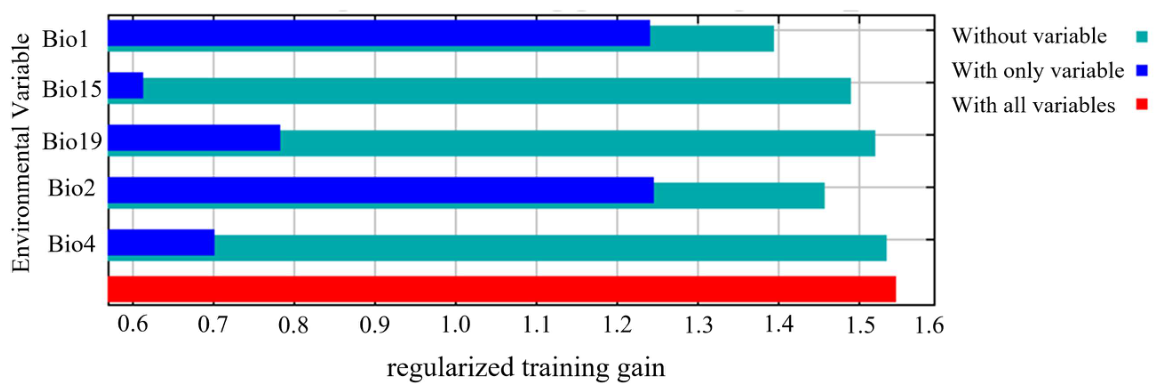



| Variable | Description | Percent Contribution (%) | Permutation Importance (%) |
|---|---|---|---|
| Bio1 | Annual Mean Temperature (°C) | 17.2 | 69.8 |
| Bio2 | Mean Diurnal Range (°C) | 73.6 | 12.3 |
| Bio4 | Temperature Seasonality (Coefficient of Variation) | 0.8 | 4.4 |
| Bio15 | Precipitation Seasonality (Coefficient of Variation) | 6.3 | 11.8 |
| Bio19 | Precipitation of Coldest Quarter (mm) | 2.2 | 1.6 |
| Scenario | Period | Unsuitable Habitats | Low-Suitability Habitats | Moderate-Suitability Habitats | High-Suitability Habitats | ||||
|---|---|---|---|---|---|---|---|---|---|
| Area (106 km2) | Area Change (%) | Area (106 km2) | Area Change (%) | Area (106 km2) | Area Change (%) | Area (106 km2) | Area Change (%) | ||
| Historical baseline | Baseline | 3.23 | - | 3.73 | - | 0.63 | - | 1.93 | - |
| SSP1–2.6 | 2050s | 2.75 | −14.86 | 4.33 | 16.09 | 0.8 | 26.98 | 1.63 | −15.54 |
| 2070s | 2.75 | −14.86 | 4.41 | 18.23 | 0.92 | 46.03 | 1.44 | −25.39 | |
| SSP2–4.5 | 2050s | 2.41 | −25.39 | 4.5 | 20.64 | 0.9 | 42.86 | 1.71 | −11.4 |
| 2070s | 2.35 | −27.24 | 4.55 | 21.98 | 1.17 | 85.71 | 1.45 | −24.87 | |
| SSP5–8.5 | 2050s | 2.48 | −23.22 | 4.53 | 21.45 | 1.04 | 65.08 | 1.46 | −24.35 |
| 2070s | 1.94 | −39.94 | 4.99 | 33.78 | 1.26 | 100 | 1.32 | −31.61 | |
| Period | Climate Scenario | Longitude (°E) | Latitude (°N) | Approximate Shift Distance (km) | Approximate Shift Direction |
|---|---|---|---|---|---|
| Historical baseline | Baseline | 113.20 | 28.00 | - | - |
| 2050s | SSP1–2.6 | 112.20 | 28.05 | 98 | Northwestward (NW) |
| SSP2–4.5 | 112.34 | 28.35 | 93 | Northwestward (NW) | |
| SSP5–8.5 | 113.05 | 28.76 | 86 | Northwestward (NW) | |
| 2070s | SSP1–2.6 | 111.76 | 27.94 | 141 | Southwestward (SW) |
| SSP2–4.5 | 112.46 | 28.81 | 116 | Northwestward (NW) | |
| SSP5–8.5 | 111.79 | 28.87 | 168 | Northwestward (NW) |
Disclaimer/Publisher’s Note: The statements, opinions and data contained in all publications are solely those of the individual author(s) and contributor(s) and not of MDPI and/or the editor(s). MDPI and/or the editor(s) disclaim responsibility for any injury to people or property resulting from any ideas, methods, instructions or products referred to in the content. |
© 2026 by the authors. Licensee MDPI, Basel, Switzerland. This article is an open access article distributed under the terms and conditions of the Creative Commons Attribution (CC BY) license.
Share and Cite
Du, Y.; Li, Z. Projected Northward Expansion and Southern Core-Habitat Contraction of Zeugodacus tau in China Under Climate Change: An Optimized MaxEnt Analysis. Insects 2026, 17, 596. https://doi.org/10.3390/insects17060596
Du Y, Li Z. Projected Northward Expansion and Southern Core-Habitat Contraction of Zeugodacus tau in China Under Climate Change: An Optimized MaxEnt Analysis. Insects. 2026; 17(6):596. https://doi.org/10.3390/insects17060596
Chicago/Turabian StyleDu, Yifu, and Zhiwen Li. 2026. "Projected Northward Expansion and Southern Core-Habitat Contraction of Zeugodacus tau in China Under Climate Change: An Optimized MaxEnt Analysis" Insects 17, no. 6: 596. https://doi.org/10.3390/insects17060596
APA StyleDu, Y., & Li, Z. (2026). Projected Northward Expansion and Southern Core-Habitat Contraction of Zeugodacus tau in China Under Climate Change: An Optimized MaxEnt Analysis. Insects, 17(6), 596. https://doi.org/10.3390/insects17060596