Learning the Structural Diversity of Olfactory Receptors: A Genomic Case Study in Two Longhorn Beetles (Cerambycidae: Lamiinae)

 , and
, and
Simple Summary
Abstract
1. Introduction
2. Materials and Methods
2.1. Protein Sequences
2.2. Protein Structure Predictions
2.3. Comparing AlphaFold and RoseTTAFold
2.4. Phylogenetic Trees
2.5. Unsupervised Learning of OR Protein Structural Diversity Within TETRA
2.6. Cross-Species Comparisons of OR Structural and Sequence Diversity
3. Results
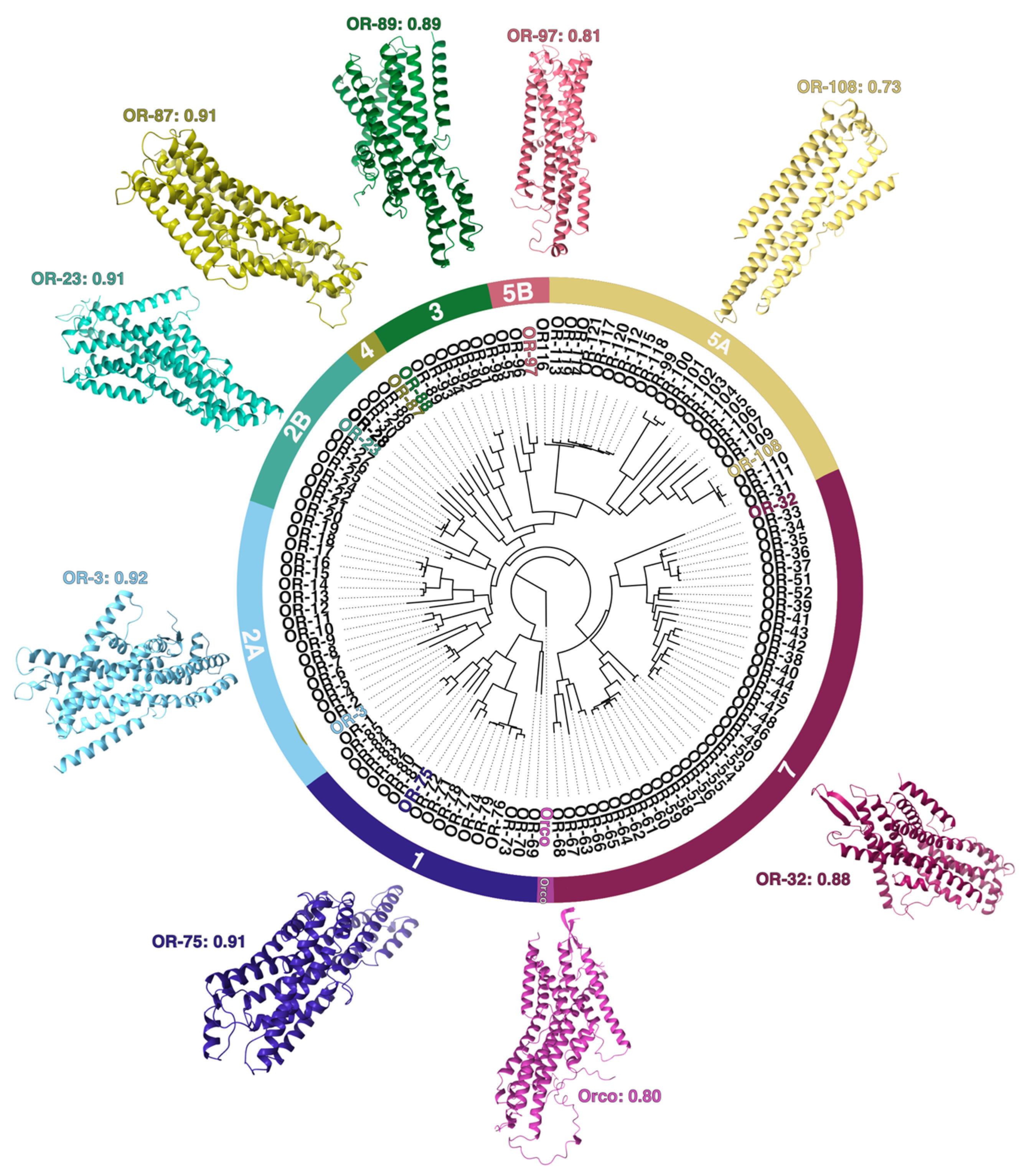
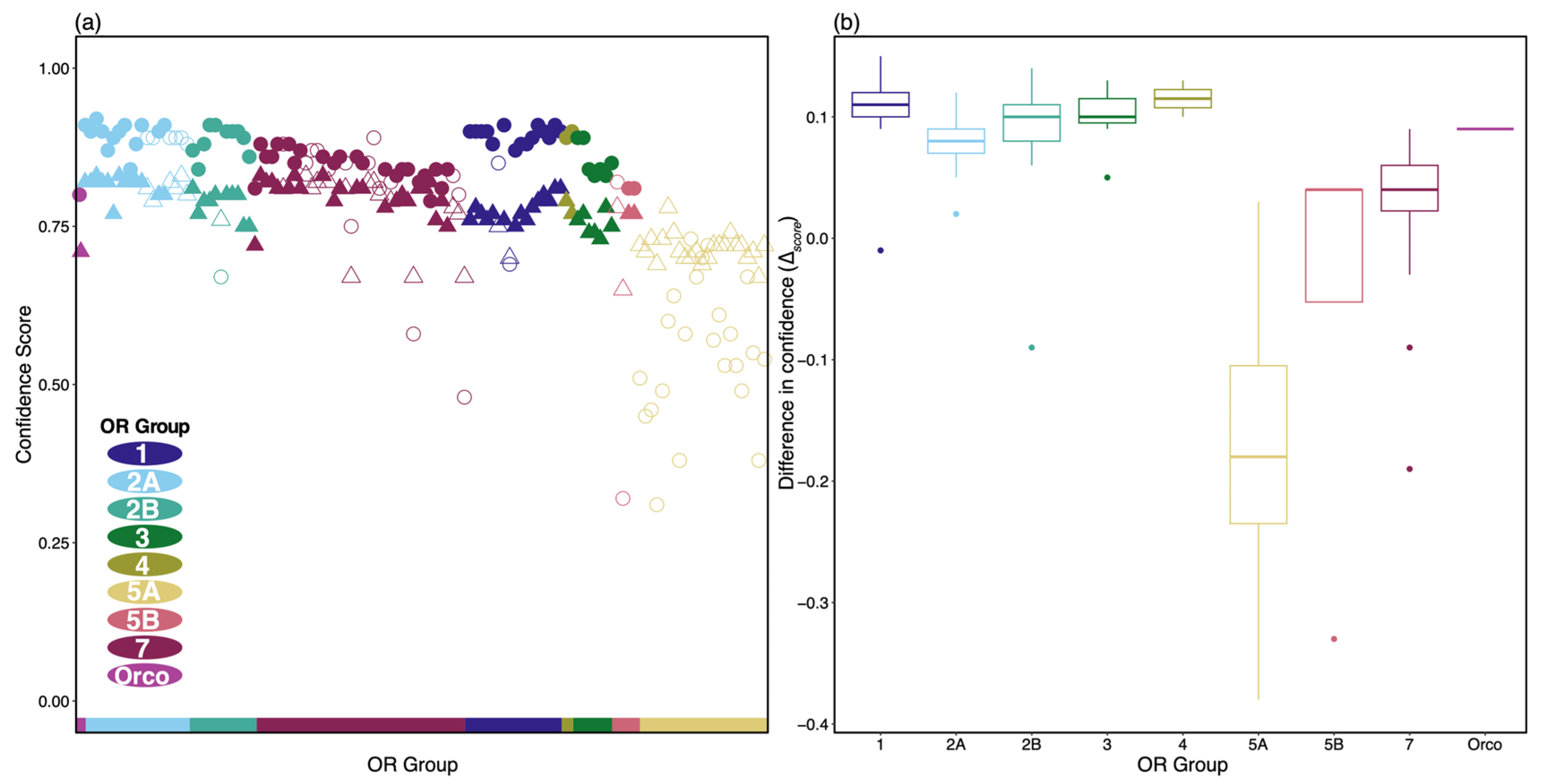
3.1. Predicting the Structure of Beetle OR Proteins
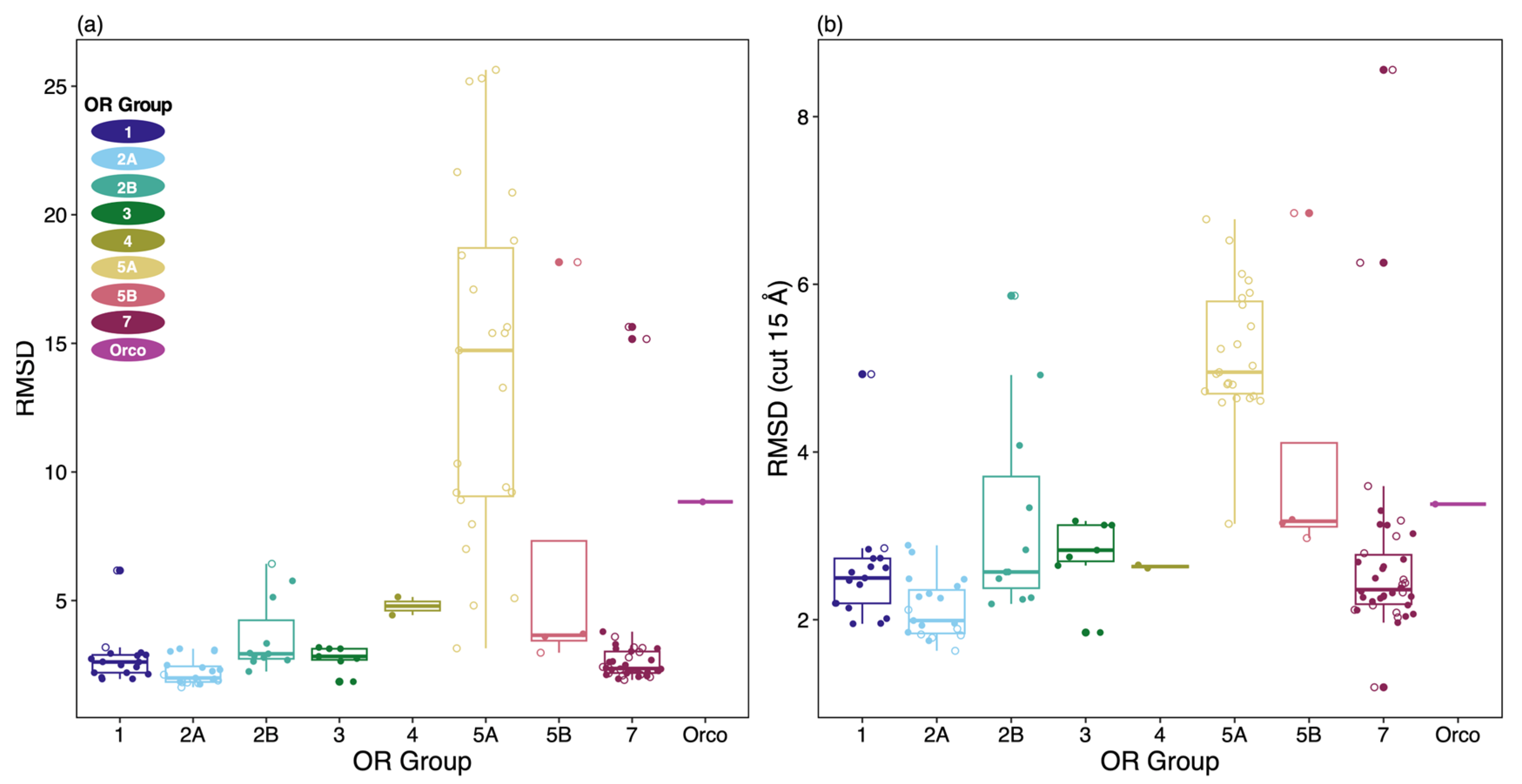
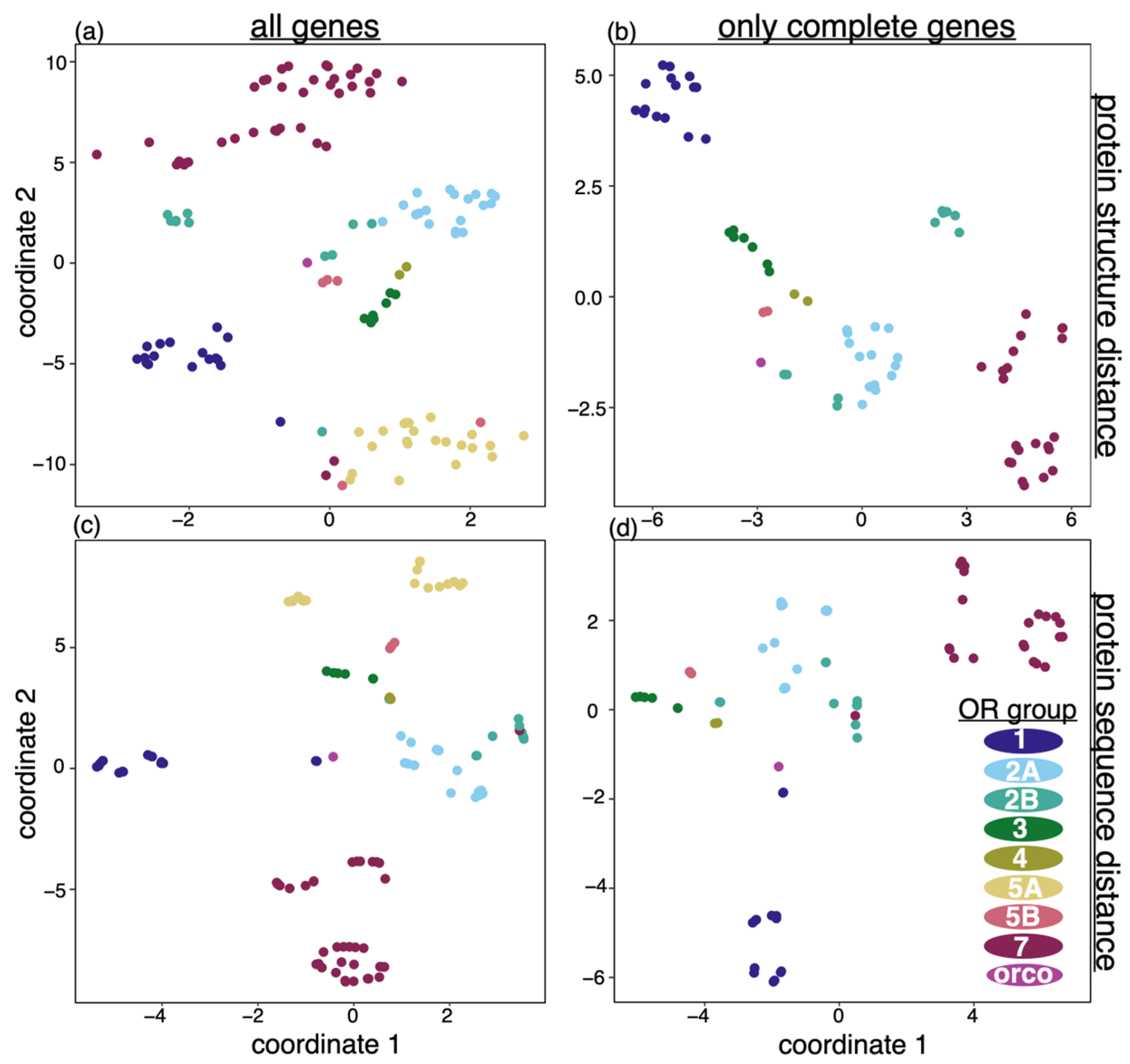
3.2. OR Structural Diversity Within the TETRA Genome
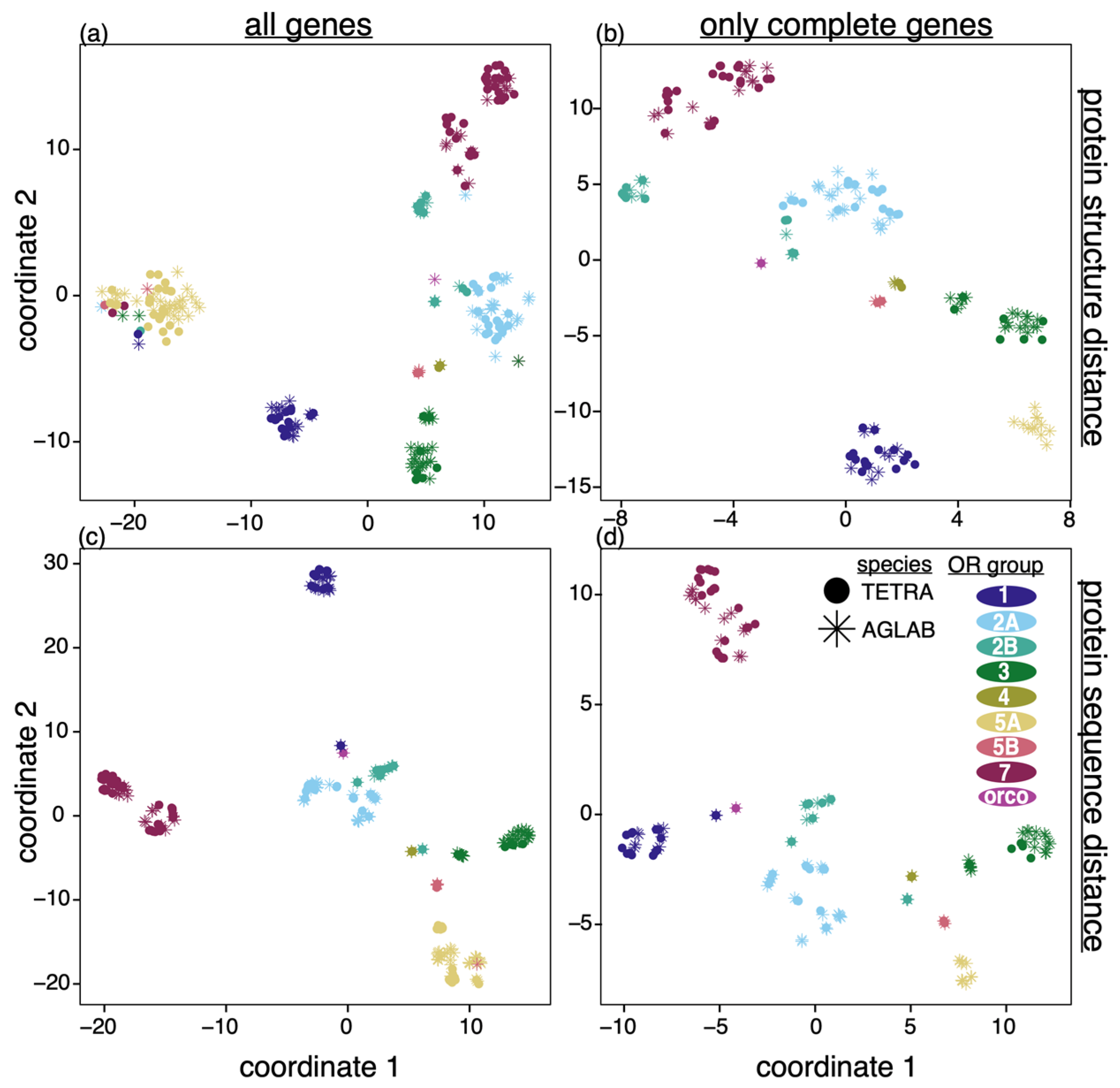
3.3. OR Diversity Across the TETRA and AGLAB Genomes
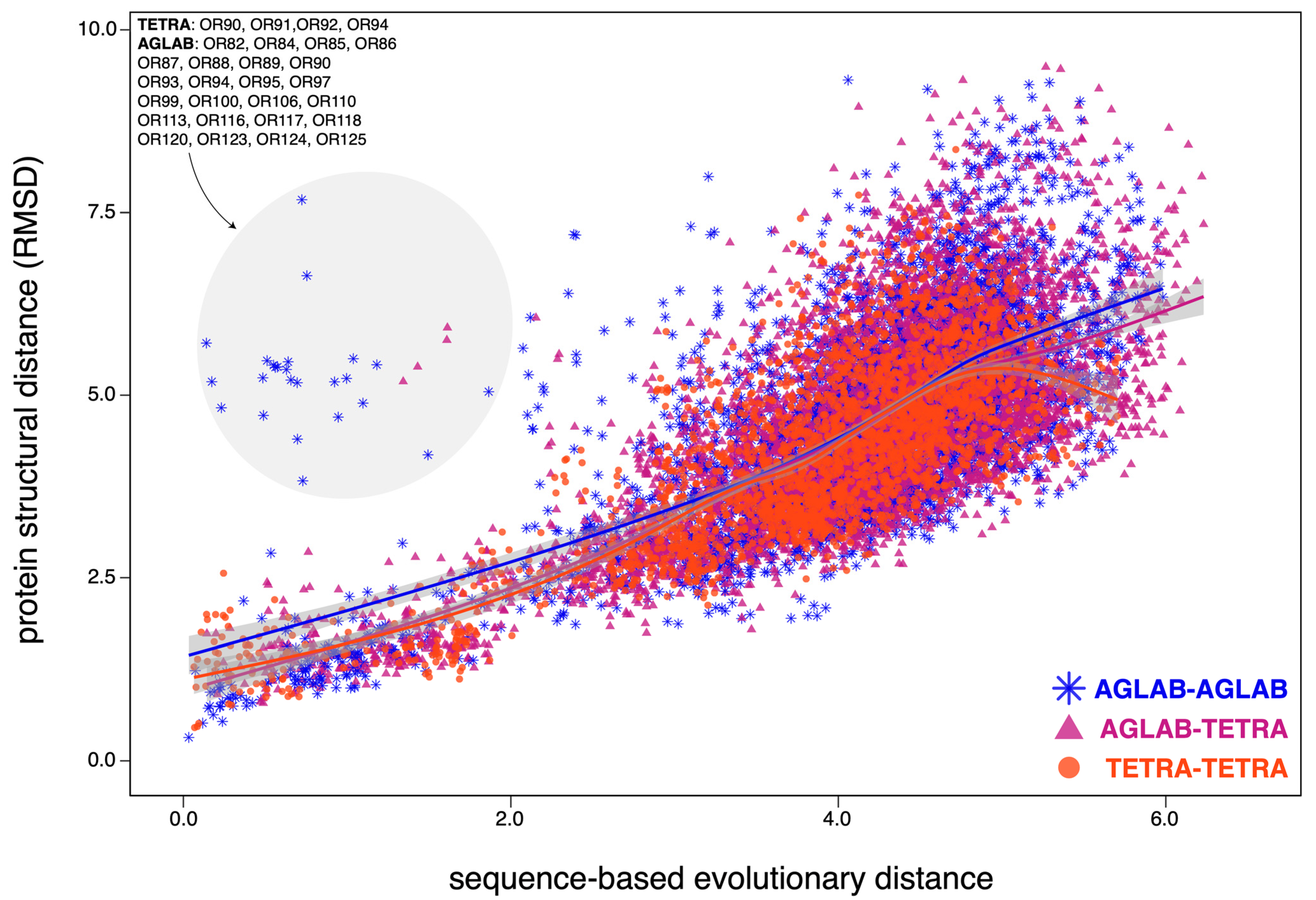
3.4. Structural vs. Phylogenetic Distance
4. Discussion
Supplementary Materials
Author Contributions
Funding
Data Availability Statement
Conflicts of Interest
References
- Dill, K.A.; Ozkan, S.B.; Shell, M.S.; Weikl, T.R. The Protein Folding Problem. Annu. Rev. Biophys. 2008, 37, 289–316. [Google Scholar] [CrossRef] [PubMed]
- Fisher, A.G. Cell and Developmental Biology: Grand Challenges. Front. Cell Dev. Biol. 2024, 12, 1377073. [Google Scholar] [CrossRef]
- Acharya, K.R.; Lloyd, M.D. The Advantages and Limitations of Protein Crystal Structures. Trends Pharmacol. Sci. 2005, 26, 10–14. [Google Scholar] [CrossRef]
- Anfinsen, C.B. Principles That Govern the Folding of Protein Chains. Science 1973, 181, 223–230. [Google Scholar] [CrossRef] [PubMed]
- Kay, L.E. NMR Studies of Protein Structure and Dynamics. J. Magn. Reson. 2011, 213, 477–491. [Google Scholar] [CrossRef]
- Chruszcz, M.; Wlodawer, A.; Minor, W. Determination of Protein Structures—A Series of Fortunate Events. Biophys. J. 2008, 95, 1–9. [Google Scholar] [CrossRef]
- Huang, F.; Nau, W.M. Photochemical Techniques for Studying the Flexibility of Polypeptides. Res. Chem. Intermed. 2005, 31, 717–726. [Google Scholar] [CrossRef]
- Whitford, D. Proteins: Structure and Function; Wiley: Hoboken, NJ, USA, 2013; ISBN 978-1-118-68572-3. [Google Scholar]
- Baek, M.; DiMaio, F.; Anishchenko, I.; Dauparas, J.; Ovchinnikov, S.; Lee, G.R.; Wang, J.; Cong, Q.; Kinch, L.N.; Schaeffer, R.D.; et al. Accurate Prediction of Protein Structures and Interactions Using a Three-Track Neural Network. Science 2021, 373, 871–876. [Google Scholar] [CrossRef]
- Gordon, C.H.; Hendrix, E.; He, Y.; Walker, M.C. AlphaFold Accurately Predicts the Structure of Ribosomally Synthesized and Post-Translationally Modified Peptide Biosynthetic Enzymes. Biomolecules 2023, 13, 1243. [Google Scholar] [CrossRef]
- Jumper, J.; Evans, R.; Pritzel, A.; Green, T.; Figurnov, M.; Ronneberger, O.; Tunyasuvunakool, K.; Bates, R.; Žídek, A.; Potapenko, A.; et al. Highly Accurate Protein Structure Prediction with AlphaFold. Nature 2021, 596, 583–589. [Google Scholar] [CrossRef]
- Varadi, M.; Velankar, S. The Impact of AlphaFold Protein Structure Database on the Fields of Life Sciences. Proteomics 2023, 23, 2200128. [Google Scholar] [CrossRef]
- Perrakis, A.; Sixma, T.K. AI Revolutions in Biology: The Joys and Perils of AlphaFold. EMBO Rep. 2021, 22, e54046. [Google Scholar] [CrossRef]
- Ruff, K.M.; Pappu, R.V. AlphaFold and Implications for Intrinsically Disordered Proteins. J. Mol. Biol. 2021, 433, 167208. [Google Scholar] [CrossRef] [PubMed]
- Porta-Pardo, E.; Ruiz-Serra, V.; Valentini, S.; Valencia, A. The Structural Coverage of the Human Proteome before and after AlphaFold. PLoS Comput. Biol. 2022, 18, e1009818. [Google Scholar] [CrossRef] [PubMed]
- Tang, Q.-Y.; Ren, W.; Wang, J.; Kaneko, K. The Statistical Trends of Protein Evolution: A Lesson from AlphaFold Database. Mol. Biol. Evol. 2022, 39, msac197. [Google Scholar] [CrossRef]
- Dejnirattisai, W.; Huo, J.; Zhou, D.; Zahradník, J.; Supasa, P.; Liu, C.; Duyvesteyn, H.M.E.; Ginn, H.M.; Mentzer, A.J.; Tuekprakhon, A.; et al. SARS-CoV-2 Omicron-B.1.1.529 Leads to Widespread Escape from Neutralizing Antibody Responses. Cell 2022, 185, 467–484.e15. [Google Scholar] [CrossRef]
- Meng, E.C.; Goddard, T.D.; Pettersen, E.F.; Couch, G.S.; Pearson, Z.J.; Morris, J.H.; Ferrin, T.E. UCSF ChimeraX: Tools for Structure Building and Analysis. Protein Sci. 2023, 32, e4792. [Google Scholar] [CrossRef] [PubMed]
- Tunyasuvunakool, K.; Adler, J.; Wu, Z.; Green, T.; Zielinski, M.; Žídek, A.; Bridgland, A.; Cowie, A.; Meyer, C.; Laydon, A.; et al. Highly Accurate Protein Structure Prediction for the Human Proteome. Nature 2021, 596, 590–596. [Google Scholar] [CrossRef]
- Badaczewska-Dawid, A.E.; Kuriata, A.; Pintado-Grima, C.; Garcia-Pardo, J.; Burdukiewicz, M.; Iglesias, V.; Kmiecik, S.; Ventura, S. A3D Model Organism Database (A3D-MODB): A Database for Proteome Aggregation Predictions in Model Organisms. Nucleic Acids Res. 2024, 52, D360–D367. [Google Scholar] [CrossRef]
- Askari Rad, A.; Fayazi, J.; Beigi Nassiri, M.T.; Hasani Baferani, A. Functional Annotation of Some Hypothetical Genes in the Schistosoma Parasite Based on Reciprocal Best Structural-Hit Relationship. Res. Mol. Med. 2022, 10, 225–234. [Google Scholar] [CrossRef]
- Moreland, R.T.; Zhang, S.; Barreira, S.N.; Ryan, J.F.; Baxevanis, A.D. An AI-generated Proteome-scale Dataset of Predicted Protein Structures for the Ctenophore Mnemiopsis leidyi. Proteomics 2024, 24, 2300397. [Google Scholar] [CrossRef]
- Stephan, G.; Dugdale, B.; Deo, P.; Harding, R.; Dale, J.; Visendi, P. Bridging Functional Annotation Gaps in Non-Model Plant Genes with AlphaFold, DeepFRI and Small Molecule Docking. BoRxiv 2021. [Google Scholar] [CrossRef]
- McKenna, D.D. Beetle Genomes in the 21st Century: Prospects, Progress and Priorities. Curr. Opin. Insect Sci. 2018, 25, 76–82. [Google Scholar] [CrossRef] [PubMed]
- Li, F.; Zhao, X.; Li, M.; He, K.; Huang, C.; Zhou, Y.; Li, Z.; Walters, J.R. Insect Genomes: Progress and Challenges. Insect Mol. Biol. 2019, 28, 739–758. [Google Scholar] [CrossRef]
- Petit, S.; Usher, M.B. Biodiversity in Agricultural Landscapes: The Ground Beetle Communities of Woody Uncultivated Habitats. Biodivers. Conserv. 1998, 7, 1549–1561. [Google Scholar] [CrossRef]
- García-López, A.; Micó, E.; Múrria, C.; Galante, E.; Vogler, A.P. Beta Diversity at Multiple Hierarchical Levels: Explaining the High Diversity of Scarab Beetles in Tropical Montane Forests. J. Biogeogr. 2013, 40, 2134–2145. [Google Scholar] [CrossRef]
- Rossa, R.; Goczał, J. Global Diversity and Distribution of Longhorn Beetles (Coleoptera: Cerambycidae). Eur. Zool. J. 2021, 88, 289–302. [Google Scholar] [CrossRef]
- Kromp, B. Carabid Beetles in Sustainable Agriculture: A Review on Pest Control Efficacy, Cultivation Impacts and Enhancement. Agric. Ecosyst. Environ. 1999, 74, 187–228. [Google Scholar] [CrossRef]
- Paz, F.S.; Pinto, C.E.; De Brito, R.M.; Imperatriz-Fonseca, V.L.; Giannini, T.C. Edible Fruit Plant Species in the Amazon Forest Rely Mostly on Bees and Beetles as Pollinators. J. Econ. Entomol. 2021, 114, 710–722. [Google Scholar] [CrossRef]
- McKenna, D.D.; Shin, S.; Ahrens, D.; Balke, M.; Beza-Beza, C.; Clarke, D.J.; Donath, A.; Escalona, H.E.; Friedrich, F.; Letsch, H.; et al. The Evolution and Genomic Basis of Beetle Diversity. Proc. Natl. Acad. Sci. USA 2019, 116, 24729–24737. [Google Scholar] [CrossRef]
- Stork, N.E.; McBroom, J.; Gely, C.; Hamilton, A.J. New Approaches Narrow Global Species Estimates for Beetles, Insects, and Terrestrial Arthropods. Proc. Natl. Acad. Sci. USA 2015, 112, 7519–7523. [Google Scholar] [CrossRef]
- Pointer, M.D.; Gage, M.J.G.; Spurgin, L.G. Tribolium Beetles as a Model System in Evolution and Ecology. Heredity 2021, 126, 869–883. [Google Scholar] [CrossRef] [PubMed]
- Day, J.C.; Tisi, L.C.; Bailey, M.J. Evolution of Beetle Bioluminescence: The Origin of Beetle Luciferin. Luminescence 2004, 19, 8–20. [Google Scholar] [CrossRef]
- Liou, Y.-C.; Daley, M.E.; Graham, L.A.; Kay, C.M.; Walker, V.K.; Sykes, B.D.; Davies, P.L. Folding and Structural Characterization of Highly Disulfide-Bonded Beetle Antifreeze Protein Produced in Bacteria. Protein Expr. Purif. 2000, 19, 148–157. [Google Scholar] [CrossRef]
- Evans, J.D.; McKenna, D.; Scully, E.; Cook, S.C.; Dainat, B.; Egekwu, N.; Grubbs, N.; Lopez, D.; Lorenzen, M.D.; Reyna, S.M. Genome of the Small Hive Beetle (Aethina Tumida, Coleoptera: Nitidulidae), a Worldwide Parasite of Social Bee Colonies, Provides Insights into Detoxification and Herbivory. GigaScience 2018, 7, giy138. [Google Scholar] [CrossRef]
- Nagy, N.A.; Rácz, R.; Rimington, O.; Póliska, S.; Orozco-terWengel, P.; Bruford, M.W.; Barta, Z. Draft Genome of a Biparental Beetle Species, Lethrus Apterus. BMC Genom. 2021, 22, 301. [Google Scholar] [CrossRef]
- Xue, H.-J.; Niu, Y.-W.; Segraves, K.A.; Nie, R.-E.; Hao, Y.-J.; Zhang, L.-L.; Cheng, X.-C.; Zhang, X.-W.; Li, W.-Z.; Chen, R.-S. The Draft Genome of the Specialist Flea Beetle Altica Viridicyanea (Coleoptera: Chrysomelidae). BMC Genom. 2021, 22, 243. [Google Scholar] [CrossRef]
- Cunningham, C.B.; Benowitz, K.M.; Moore, A.J. The Updated Genome of the Burying Beetle Nicrophorus Vespilloides, a Model Species for Evolutionary and Genetic Studies of Parental Care. Ecol. Evol. 2024, 14, e70601. [Google Scholar] [CrossRef] [PubMed]
- Sylvester, T.; Adams, R.; Mitchell, R.F.; Ray, A.M.; Shen, R.; Shin, N.R.; Daundasekara, K.C.; McKenna, D.D. Insights into Longhorn Beetle (Cerambycidae) Evolution from Comparative Analyses of the Red-Headed Ash Borer (Neoclytus Acuminatus Acuminatus) Genome. J. Hered. 2025, 116, 558–567. [Google Scholar] [CrossRef] [PubMed]
- Sylvester, T.; Adams, R.; Hunter, W.B.; Li, X.; Rivera-Marchand, B.; Shen, R.; Shin, N.R.; McKenna, D.D. The Genome of the Invasive and Broadly Polyphagous Diaprepes Root Weevil, Diaprepes Abbreviatus (Coleoptera), Reveals an Arsenal of Putative Polysaccharide-Degrading Enzymes. J. Hered. 2024, 115, 94–102. [Google Scholar] [CrossRef]
- McKenna, D.D.; Scully, E.D.; Pauchet, Y.; Hoover, K.; Kirsch, R.; Geib, S.M.; Mitchell, R.F.; Waterhouse, R.M.; Ahn, S.-J.; Arsala, D.; et al. Genome of the Asian Longhorned Beetle (Anoplophora glabripennis), a Globally Significant Invasive Species, Reveals Key Functional and Evolutionary Innovations at the Beetle–Plant Interface. Genome Biol. 2016, 17, 227. [Google Scholar] [CrossRef] [PubMed]
- Thornhill, R.; Alcock, J. The Evolution of Insect Mating Systems; Harvard University Press: Cambridge, MA, USA, 1983; ISBN 978-0-674-43395-3. [Google Scholar]
- Andersson, M.N.; Keeling, C.I.; Mitchell, R.F. Genomic Content of Chemosensory Genes Correlates with Host Range in Wood-Boring Beetles (Dendroctonus Ponderosae, Agrilus Planipennis, and Anoplophora glabripennis). BMC Genom. 2019, 20, 690. [Google Scholar] [CrossRef] [PubMed]
- Fleischer, J.; Pregitzer, P.; Breer, H.; Krieger, J. Access to the Odor World: Olfactory Receptors and Their Role for Signal Transduction in Insects. Cell. Mol. Life Sci. 2018, 75, 485–508. [Google Scholar] [CrossRef]
- Hansson, B.S.; Stensmyr, M.C. Evolution of Insect Olfaction. Neuron 2011, 72, 698–711. [Google Scholar] [CrossRef] [PubMed]
- Mustaparta, H.; Angst, M.E.; Lanier, G.N. Specialization of Olfactory Cells to Insect-and Host-Produced Volatiles in the Bark beetleIps Pini (Say). J. Chem. Ecol. 1979, 5, 109–123. [Google Scholar] [CrossRef]
- Tanaka, K.; Uda, Y.; Ono, Y.; Nakagawa, T.; Suwa, M.; Yamaoka, R.; Touhara, K. Highly Selective Tuning of a Silkworm Olfactory Receptor to a Key Mulberry Leaf Volatile. Curr. Biol. 2009, 19, 881–890. [Google Scholar] [CrossRef]
- Todd, I.L.; Baker, T.C. Response of Single Antennal Neurons of Female Cabbage Loopers to Behaviorally Active Attractants. Naturwissenschaften 1993, 80, 183–186. [Google Scholar] [CrossRef]
- Mitchell, R.F.; Schneider, T.M.; Schwartz, A.M.; Andersson, M.N.; McKenna, D.D. The Diversity and Evolution of Odorant Receptors in Beetles (Coleoptera). Insect Mol. Biol. 2020, 29, 77–91. [Google Scholar] [CrossRef]
- Pequeno-Zurro, A.; Rano, I.; Shaikh, D. A Chemosensory Navigation Model Inspired by the On/Off Neural Processing Mechanism in Cockroaches. IEEE Trans. Med. Robot. Bionics 2020, 2, 338–346. [Google Scholar] [CrossRef]
- Del Mármol, J.; Yedlin, M.A.; Ruta, V. The Structural Basis of Odorant Recognition in Insect Olfactory Receptors. Nature 2021, 597, 126–131. [Google Scholar] [CrossRef]
- Butterwick, J.A.; Del Mármol, J.; Kim, K.H.; Kahlson, M.A.; Rogow, J.A.; Walz, T.; Ruta, V. Cryo-EM Structure of the Insect Olfactory Receptor Orco. Nature 2018, 560, 447–452. [Google Scholar] [CrossRef]
- Robertson, H.M.; Warr, C.G.; Carlson, J.R. Molecular Evolution of the Insect Chemoreceptor Gene Superfamily in Drosophila Melanogaster. Proc. Natl. Acad. Sci. USA 2003, 100, 14537–14542. [Google Scholar] [CrossRef] [PubMed]
- Adams, R.; Sylvester, T.; Mitchell, R.F.; Price, M.A.; Shen, R.; McKenna, D.D. Functional and Evolutionary Insights into Chemosensation and Specialized Herbivory from the Genome of the Red Milkweed Beetle, Tetraopes Tetrophthalmus (Cerambycidae: Lamiinae). J. Hered. 2024, 16, esae049. [Google Scholar] [CrossRef]
- Farrell, B.D.; Mitter, C. The Timing of Insect/Plant Diversification: Might Tetraopes (Coleoptera: Cerambycidae) and Asclepias (Asclepiadaceae) Have Co-Evolved? Biol. J. Linn. Soc. 1998, 63, 553–577. [Google Scholar] [CrossRef]
- Farrell, B.D. Evolutionary Assembly of the Milkweed Fauna: Cytochrome Oxidase I and the Age of TetraopesBeetles. Mol. Phylogenetics Evol. 2001, 18, 467–478. [Google Scholar] [CrossRef]
- Ali, J.G.; Agrawal, A.A. Trade-offs and Tritrophic Consequences of Host Shifts in Specialized Root Herbivores. Funct. Ecol. 2017, 31, 153–160. [Google Scholar] [CrossRef]
- Kariyanna, B.; Mohan, M.; Gupta, R. Biology, Ecology and Significance of Longhorn Beetles (Coleoptera: Cerambycidae). J. Entomol. Zool. Stud. 2017, 5, 1207–1212. [Google Scholar]
- Batalden, R.V.; Oberhauser, K.; Peterson, A.T. Ecological Niches in Sequential Generations of Eastern North American Monarch Butterflies (Lepidoptera: Danaidae): The Ecology of Migration and Likely Climate Change Implications. Environ. Entomol. 2007, 36, 1365–1373. [Google Scholar] [CrossRef]
- Rasmann, S.; Agrawal, A.A. Evolution of Specialization: A Phylogenetic Study of Host Range in the Red Milkweed Beetle (Tetraopes Tetraophthalmus). Am. Nat. 2011, 177, 728–737. [Google Scholar] [CrossRef] [PubMed]
- Züst, T.; Agrawal, A.A. Population Growth and Sequestration of Plant Toxins along a Gradient of Specialization in Four Aphid Species on the Common Milkweed Asclepias Syriaca. Funct. Ecol. 2016, 30, 547–556. [Google Scholar] [CrossRef]
- McCauley, D.E.; Eanes, W.F. Hierarchical Population Structure Analysis of the Milkweed Beetle, Tetraopes Tetraophthalmus (Forster). Heredity 1987, 58, 193–201. [Google Scholar] [CrossRef]
- Agrawal, A.A.; Hastings, A.P. Tissue-Specific Plant Toxins and Adaptation in a Specialist Root Herbivore. Proc. Natl. Acad. Sci. USA 2023, 120, e2302251120. [Google Scholar] [CrossRef]
- Mitchell, R.F.; Hall, L.P.; Reagel, P.F.; McKenna, D.D.; Baker, T.C.; Hildebrand, J.G. Odorant Receptors and Antennal Lobe Morphology Offer a New Approach to Understanding Olfaction in the Asian Longhorned Beetle. J. Comp. Physiol. A 2017, 203, 99–109. [Google Scholar] [CrossRef]
- Gutiérrez-Trejo, N.; Van Dam, M.H.; Lam, A.W.; Martínez-Herrera, G.; Noguera, F.A.; Weissling, T.; Ware, J.L.; Toledo-Hernández, V.H.; Skillman, F.W., Jr.; Farrell, B.D.; et al. Phylogenomics of Tetraopes Longhorn Beetles Unravels Their Evolutionary History and Biogeographic Origins. Sci. Rep. 2024, 14, 7285. [Google Scholar] [CrossRef]
- Andersson, M.N.; Löfstedt, C.; Newcomb, R.D. Insect Olfaction and the Evolution of Receptor Tuning. Front. Ecol. Evol. 2015, 3, 53. [Google Scholar] [CrossRef]
- Auer, T.O.; Khallaf, M.A.; Silbering, A.F.; Zappia, G.; Ellis, K.; Álvarez-Ocaña, R.; Arguello, J.R.; Hansson, B.S.; Jefferis, G.S.; Caron, S.J. Olfactory Receptor and Circuit Evolution Promote Host Specialization. Nature 2020, 579, 402–408. [Google Scholar] [CrossRef]
- McBride, C.S. Rapid Evolution of Smell and Taste Receptor Genes during Host Specialization in Drosophila Sechellia. Proc. Natl. Acad. Sci. USA 2007, 104, 4996–5001. [Google Scholar] [CrossRef]
- Engsontia, P.; Sangket, U.; Robertson, H.M.; Satasook, C. Diversification of the Ant Odorant Receptor Gene Family and Positive Selection on Candidate Cuticular Hydrocarbon Receptors. BMC Res. Notes 2015, 8, 380. [Google Scholar] [CrossRef] [PubMed]
- Yan, H. Insect Olfactory Neurons: Receptors, Development, and Function. Curr. Opin. Insect Sci. 2025, 67, 101288. [Google Scholar] [PubMed]
- Nei, M.; Niimura, Y.; Nozawa, M. The Evolution of Animal Chemosensory Receptor Gene Repertoires: Roles of Chance and Necessity. Nat. Rev. Genet. 2008, 9, 951–963. [Google Scholar] [CrossRef] [PubMed]
- Maiorov, V.N.; Crippen, G.M. Significance of Root-Mean-Square Deviation in Comparing Three-Dimensional Structures of Globular Proteins. J. Mol. Biol. 1994, 235, 625–634. [Google Scholar] [CrossRef] [PubMed]
- Engsontia, P.; Sanderson, A.P.; Cobb, M.; Walden, K.K.; Robertson, H.M.; Brown, S. The Red Flour Beetle’s Large Nose: An Expanded Odorant Receptor Gene Family in Tribolium Castaneum. Insect Biochem. Mol. Biol. 2008, 38, 387–397. [Google Scholar] [CrossRef] [PubMed]
- Mitchell, R.F.; Hughes, D.T.; Luetje, C.W.; Millar, J.G.; Soriano-Agatón, F.; Hanks, L.M.; Robertson, H.M. Sequencing and Characterizing Odorant Receptors of the Cerambycid Beetle Megacyllene Caryae. Insect Biochem. Mol. Biol. 2012, 42, 499–505. [Google Scholar] [CrossRef]
- Pereira, J.; Simpkin, A.J.; Hartmann, M.D.; Rigden, D.J.; Keegan, R.M.; Lupas, A.N. High-accuracy Protein Structure Prediction in CASP14. Proteins 2021, 89, 1687–1699. [Google Scholar] [CrossRef]
- Lee, C.; Su, B.-H.; Tseng, Y.J. Comparative Studies of AlphaFold, RoseTTAFold and Modeller: A Case Study Involving the Use of G-Protein-Coupled Receptors. Brief. Bioinform. 2022, 23, bbac308. [Google Scholar] [CrossRef]
- Kovalevskiy, O.; Mateos-Garcia, J.; Tunyasuvunakool, K. AlphaFold Two Years on: Validation and Impact. Proc. Natl. Acad. Sci. USA 2024, 121, e2315002121. [Google Scholar] [CrossRef]
- Mirdita, M.; Schütze, K.; Moriwaki, Y.; Heo, L.; Ovchinnikov, S.; Steinegger, M. ColabFold: Making Protein Folding Accessible to All. Nat. Methods 2022, 19, 679–682. [Google Scholar] [CrossRef]
- Saldaño, T.; Escobedo, N.; Marchetti, J.; Zea, D.J.; Mac Donagh, J.; Velez Rueda, A.J.; Gonik, E.; García Melani, A.; Novomisky Nechcoff, J.; Salas, M.N.; et al. Impact of Protein Conformational Diversity on AlphaFold Predictions. Bioinformatics 2022, 38, 2742–2748. [Google Scholar] [CrossRef]
- Cole, J.C.; Murray, C.W.; Nissink, J.W.M.; Taylor, R.D.; Taylor, R. Comparing Protein–Ligand Docking Programs Is Difficult. Proteins 2005, 60, 325–332. [Google Scholar] [CrossRef] [PubMed]
- Kirchmair, J.; Markt, P.; Distinto, S.; Wolber, G.; Langer, T. Evaluation of the Performance of 3D Virtual Screening Protocols: RMSD Comparisons, Enrichment Assessments, and Decoy Selection—What Can We Learn from Earlier Mistakes? J. Comput. Aided Mol. Des. 2008, 22, 213–228. [Google Scholar] [CrossRef]
- Ille, A.M.; Markosian, C.; Burley, S.K.; Mathews, M.B.; Pasqualini, R.; Arap, W. Generative Artificial Intelligence Performs Rudimentary Structural Biology Modeling. Sci. Rep. 2024, 14, 19372. [Google Scholar] [CrossRef] [PubMed]
- Price, M.N.; Dehal, P.S.; Arkin, A.P. FastTree: Computing Large Minimum Evolution Trees with Profiles Instead of a Distance Matrix. Mol. Biol. Evol. 2009, 26, 1641–1650. [Google Scholar] [CrossRef]
- Sievers, F.; Higgins, D.G. Clustal Omega. Curr. Protoc. Bioinform. 2014, 48, 3–13. [Google Scholar] [CrossRef] [PubMed]
- Capella-Gutiérrez, S.; Silla-Martínez, J.M.; Gabaldón, T. trimAl: A Tool for Automated Alignment Trimming in Large-Scale Phylogenetic Analyses. Bioinformatics 2009, 25, 1972–1973. [Google Scholar] [CrossRef]
- Paradis, E.; Claude, J.; Strimmer, K. APE: Analyses of Phylogenetics and Evolution in R Language. Bioinformatics 2004, 20, 289–290. [Google Scholar] [CrossRef]
- Paradis, E.; Schliep, K. Ape 5.0: An Environment for Modern Phylogenetics and Evolutionary Analyses in R. Bioinformatics 2019, 35, 526–528. [Google Scholar] [CrossRef]
- van der Maaten, L.; Hinton, G. Visualizing Data Using T-SNE. J. Mach. Learn. Res. 2008, 9, 2579–2605. [Google Scholar]
- Yokota, R.; Kaminaga, Y.; Kobayashi, T.J. Quantification of Inter-Sample Differences in T-Cell Receptor Repertoires Using Sequence-Based Information. Front. Immunol. 2017, 8, 1500. [Google Scholar] [CrossRef]
- Xu, X.; Xie, Z.; Yang, Z.; Li, D.; Xu, X. A T-SNE Based Classification Approach to Compositional Microbiome Data. Front. Genet. 2020, 11, 620143. [Google Scholar] [CrossRef] [PubMed]
- Cieslak, M.C.; Castelfranco, A.M.; Roncalli, V.; Lenz, P.H.; Hartline, D.K. T-Distributed Stochastic Neighbor Embedding (t-SNE): A Tool for Eco-Physiological Transcriptomic Analysis. Mar. Genom. 2020, 51, 100723. [Google Scholar] [CrossRef]
- Bachmann, F.; Hennig, P.; Kobak, D. Wasserstein T-SNE; Springer: Berlin/Heidelberg, Germany, 2022; pp. 104–120. [Google Scholar]
- Krijthe, J.; van der Maaten, L.; Krijthe, M.J. Package ‘Rtsne’, R Package Version. 2018; Volume 13, p. 577. Available online: https://cran.r-project.org/web/packages/Rtsne (accessed on 8 March 2024).
- Dixon, P. VEGAN, a Package of R Functions for Community Ecology. J. Veg. Sci. 2003, 14, 927–930. [Google Scholar]
- Binder, J.L.; Berendzen, J.; Stevens, A.O.; He, Y.; Wang, J.; Dokholyan, N.V.; Oprea, T.I. AlphaFold Illuminates Half of the Dark Human Proteins. Curr. Opin. Struct. Biol. 2022, 74, 102372. [Google Scholar] [CrossRef] [PubMed]
- Lozano, J.R.; DeGiorgio, M.; Assis, R.; Adams, R. Discriminating Models of Trait Evolution. Evolution 2025, 80, 697–710. [Google Scholar]
- Duncan, M.; DeGiorgio, M.; Assis, R.; Adams, R. Robust Regression Rescues Poor Phylogenetic Decisions. BMC Ecol. Evo. 2025, 25, 108. [Google Scholar] [CrossRef]
- Brahmantio, B.; Bartoszek, K.; Yapar, E. Bayesian Inference of Mixed Gaussian Phylogenetic Models. BMC Bioinform. 2024, 27, 77. [Google Scholar]
- Adams, R.; DeGiorgio, M. Likelihood-Based Tests of Species Tree Hypotheses. Mol. Biol. Evol. 2023, 40, msad159. [Google Scholar] [CrossRef]
- Brown, J.M.; Thomson, R.C. Evaluating Model Performance in Evolutionary Biology. Annu. Rev. Ecol. Evol. Syst. 2018, 49, 95–114. [Google Scholar] [CrossRef]
- Kulmuni, J.; Wurm, Y.; Pamilo, P. Comparative Genomics of Chemosensory Protein Genes Reveals Rapid Evolution and Positive Selection in Ant-Specific Duplicates. Heredity 2013, 110, 538–547. [Google Scholar] [CrossRef]
- Brand, P.; Robertson, H.M.; Lin, W.; Pothula, R.; Klingeman, W.E.; Jurat-Fuentes, J.L.; Johnson, B.R. The Origin of the Odorant Receptor Gene Family in Insects. eLife 2018, 7, e38340. [Google Scholar] [CrossRef]
- Karpe, S.D.; Tiwari, V.; Ramanathan, S. InsectOR—Webserver for Sensitive Identification of Insect Olfactory Receptor Genes from Non-Model Genomes. PLoS ONE 2021, 16, e0245324. [Google Scholar] [CrossRef] [PubMed]
- Bachler, A.; Walsh, T.K.; Rane, R.V.; Pandey, G. Chimeric Mis-Annotations of Genes Remain Pervasive in Eukaryotic Non-Model Organisms. BMC Genom. 2025, 26, 630. [Google Scholar] [CrossRef]
- Olvera-Vazquez, S.G.; Chen, X.; Mesnil, A.; Meslin, C.; Almeida-Silva, F.; Confais, J.; Bourgeois, Y.; Lombardi, G.; Lougmani, C.; Alix, K. Comprehensive Annotation of Olfactory and Gustatory Receptor Genes and Transposable Elements Revealed Their Evolutionary Dynamics in Aphids. Mol. Biol. Evol. 2025, 42, msaf238. [Google Scholar] [CrossRef]
- Barbarin-Bocahu, I.; Graille, M. The X-Ray Crystallography Phase Problem Solved Thanks to AlphaFold and RoseTTAFold Models: A Case-Study Report. Corrigendum. Acta Crystallogr. D Struct. Biol. 2023, 79, 353. [Google Scholar] [CrossRef] [PubMed]
- Xu, Q.; Dunbrack, R.L. Assignment of Protein Sequences to Existing Domain and Family Classification Systems: Pfam and the PDB. Bioinformatics 2012, 28, 2763–2772. [Google Scholar] [CrossRef]
- Shi, Y.; Zhang, W.; Yang, Y.; Murzin, A.G.; Falcon, B.; Kotecha, A.; Van Beers, M.; Tarutani, A.; Kametani, F.; Garringer, H.J.; et al. Structure-Based Classification of Tauopathies. Nature 2021, 598, 359–363. [Google Scholar] [CrossRef]
- Aggarwal, R.; Gupta, A.; Chelur, V.; Jawahar, C.; Priyakumar, U.D. DeepPocket: Ligand Binding Site Detection and Segmentation Using 3D Convolutional Neural Networks. J. Chem. Inf. Model. 2021, 62, 5069–5079. [Google Scholar] [CrossRef]
- Mylonas, S.K.; Axenopoulos, A.; Daras, P. DeepSurf: A Surface-Based Deep Learning Approach for the Prediction of Ligand Binding Sites on Proteins. Bioinformatics 2021, 37, 1681–1690. [Google Scholar] [CrossRef]
- Kandel, J.; Tayara, H.; Chong, K.T. PUResNet: Prediction of Protein-Ligand Binding Sites Using Deep Residual Neural Network. J. Cheminformatics 2021, 13, 65. [Google Scholar] [CrossRef] [PubMed]
- Jacquin-Joly, E.; Merlin, C. Insect olfactory receptors: Contributions of molecular biology to chemical ecology. J. Chem. Ecol. 2004, 30, 2359–2397. [Google Scholar] [CrossRef] [PubMed]
- Schmidt, H.R.; Benton, R. Molecular Mechanisms of Olfactory Detection in Insects: Beyond Receptors. Open Biol. 2020, 10, 200252. [Google Scholar] [CrossRef]
- Del Alamo, D.; Sala, D.; Mchaourab, H.S.; Meiler, J. Sampling Alternative Conformational States of Transporters and Receptors with AlphaFold2. eLife 2022, 11, e75751. [Google Scholar] [CrossRef] [PubMed]
- Zufall, F.; Domingos, A.I. The Structure of Orco and Its Impact on Our Understanding of Olfaction. J. Gen. Physiol. 2018, 150, 1602–1605. [Google Scholar] [CrossRef] [PubMed]
- Zhao, J.; Chen, A.Q.; Ryu, J.; Del Mármol, J. Structural Basis of Odor Sensing by Insect Heteromeric Odorant Receptors. Science 2024, 384, 1460–1467. [Google Scholar] [CrossRef]
- Raschka, S.; Kaufman, B. Machine Learning and AI-Based Approaches for Bioactive Ligand Discovery and GPCR-Ligand Recognition. Methods 2020, 180, 89–110. [Google Scholar] [CrossRef]
- Chatterjee, A.; Walters, R.; Shafi, Z.; Ahmed, O.S.; Sebek, M.; Gysi, D.; Yu, R.; Eliassi-Rad, T.; Barabási, A.-L.; Menichetti, G. Improving the Generalizability of Protein-Ligand Binding Predictions with AI-Bind. Nat. Commun. 2023, 14, 1989. [Google Scholar] [CrossRef]
- Chen, W.; Song, C.; Leng, L.; Zhang, S.; Chen, S. The Application of Artificial Intelligence Accelerates G Protein-Coupled Receptor Ligand Discovery. Engineering 2024, 32, 18–28. [Google Scholar] [CrossRef]
- Bohbot, J.D.; Vernick, S. The Emergence of Insect Odorant Receptor-Based Biosensors. Biosensors 2020, 10, 26. [Google Scholar] [CrossRef]
- Lu, Y.; Liu, Q. Insect Olfactory System Inspired Biosensors for Odorant Detection. Sens. Diagn. 2022, 1, 1126–1142. [Google Scholar] [CrossRef]
- Venthur, H.; Zhou, J.-J. Odorant Receptors and Odorant-Binding Proteins as Insect Pest Control Targets: A Comparative Analysis. Front. Physiol. 2018, 9, 1163. [Google Scholar] [CrossRef]



Disclaimer/Publisher’s Note: The statements, opinions and data contained in all publications are solely those of the individual author(s) and contributor(s) and not of MDPI and/or the editor(s). MDPI and/or the editor(s) disclaim responsibility for any injury to people or property resulting from any ideas, methods, instructions or products referred to in the content. |
© 2026 by the authors. Licensee MDPI, Basel, Switzerland. This article is an open access article distributed under the terms and conditions of the Creative Commons Attribution (CC BY) license.
Share and Cite
Duncan, M.; Sylvester, T.; Walden, E.; Roa Lozano, J.; Turner, E.; Duncan, S.; Mitchell, R.F.; McKenna, D.D.; Adams, R. Learning the Structural Diversity of Olfactory Receptors: A Genomic Case Study in Two Longhorn Beetles (Cerambycidae: Lamiinae). Insects 2026, 17, 587. https://doi.org/10.3390/insects17060587
Duncan M, Sylvester T, Walden E, Roa Lozano J, Turner E, Duncan S, Mitchell RF, McKenna DD, Adams R. Learning the Structural Diversity of Olfactory Receptors: A Genomic Case Study in Two Longhorn Beetles (Cerambycidae: Lamiinae). Insects. 2026; 17(6):587. https://doi.org/10.3390/insects17060587
Chicago/Turabian StyleDuncan, Mataya, Terrence Sylvester, Emilee Walden, Jenniffer Roa Lozano, Emma Turner, Samuel Duncan, Robert F. Mitchell, Duane D. McKenna, and Rich Adams. 2026. "Learning the Structural Diversity of Olfactory Receptors: A Genomic Case Study in Two Longhorn Beetles (Cerambycidae: Lamiinae)" Insects 17, no. 6: 587. https://doi.org/10.3390/insects17060587
APA StyleDuncan, M., Sylvester, T., Walden, E., Roa Lozano, J., Turner, E., Duncan, S., Mitchell, R. F., McKenna, D. D., & Adams, R. (2026). Learning the Structural Diversity of Olfactory Receptors: A Genomic Case Study in Two Longhorn Beetles (Cerambycidae: Lamiinae). Insects, 17(6), 587. https://doi.org/10.3390/insects17060587