What Really Lurks in the Dark? Revisiting the Occurrence of Tomicus destruens (Coleoptera, Curculionidae, Scolytinae) in Greece

 ,
,  ,
,  ,
,  ,
,  ,
,  and
and
Simple Summary
Abstract
1. Introduction
2. Materials and Methods
2.1. Insect Sampling
2.2. Insect Molecular Analysis
2.3. Phylogenetic Analysis
2.4. Super Cooling Point Analysis
3. Results
3.1. Phylogenetic Analysis of Tomicus Haplotypes
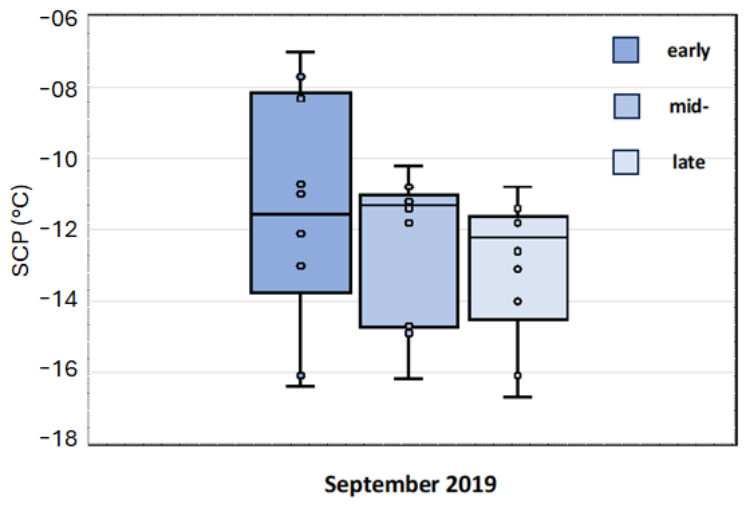
3.2. Super Cooling Point
4. Discussion
4.1. Tomicus destruens Occurrence in Greece
4.2. Tomicus destruens Phylogeography
4.3. Nested Clade Analysis
4.4. Super Cooling Point
Author Contributions
Funding
Data Availability Statement
Conflicts of Interest
References
- Sarikaya, O.; Avci, M. Distribution and biology of the Mediterranean pine shoot beetle Tomicus destruens (Wollaston, 1865) in the western Mediterranean region of Turkey. Turk. Entomoloji Derg. 2010, 34, 289–298. [Google Scholar]
- Gallego, D.; Canovas, F.; Esteve, M.A.; Galian, J. Descriptive biogeography of Tomicus (Coleoptera: Scolytidae) species in Spain. J. Biogeogr. 2004, 31, 2011–2024. [Google Scholar] [CrossRef]
- Faccoli, M.; Battisti, A.; Masutti, L. Phenology of Tomicus destruens (Wollaston) in northern Italian pine stands. In Entomological Research in Mediterranean Forest Ecosystems; Lieutier, F., Ghaioule, D., Eds.; INRA Editions: Paris, French, 2005; pp. 185–193. [Google Scholar]
- Vasconcelos, T.; Horn, A.; Lieutier, F.; Branco, M.; Kerdelhué, C. Distribution and population genetic structure of the Mediterranean pine shoot beetle Tomicus destruens in the Iberian Peninsula and Southern France. Agric. For. Entomol. 2006, 8, 103–111. [Google Scholar] [CrossRef]
- Lieutier, F. Host resistance to bark beetles and its variations. In Bark and Wood Boring Insects in Living Trees in Europe: A Synthesis; Lieutier, F., Day, K.R., Battisti, A., Grégoire, J.-C., Evans, H.F., Eds.; Kluwer Academic Publishers: Dordrecht, The Netherlands, 2004; pp. 135–180. [Google Scholar]
- Faccoli, M. Morphological separation of Tomicus piniperda and T. destruens (Coleoptera, Curculionidae, Scolytinae): New and old characters. Eur. J. Entomol. 2006, 103, 433–442. [Google Scholar] [CrossRef]
- Kerdelhué, C.; Roux-Morabito, G.; Forichon, J.; Chambon, J.M.; Robert, A.; Lieutier, F. Population genetic structure of Tomicus piniperda L. (Curculionidae: Scolytinae) on different pine species and validation of T. destruens (Woll.). Mol. Ecol. 2002, 11, 483–494. [Google Scholar] [CrossRef] [PubMed]
- Kohlmayr, B.; Riegler, M.; Wegensteiner, R.; Stauffer, C. Morphological and genetic identification of the three pine pests of the genus Tomicus (Coleoptera, Scolytidae) in Europe. Agric. For. Entomol. 2002, 4, 151–157. [Google Scholar] [CrossRef]
- Faccoli, M.; Piscedda, A.; Salvato, P.; Simonato, M.; Masutti, L.; Battisti, A. Genetic structure and phylogeography of the pine shoot beetles Tomicus destruens and T. piniperda (Coleoptera Scolytidae) in Italy. Ann. For. Sci. 2005, 62, 361–368. [Google Scholar] [CrossRef]
- Horn, A.; Roux-Morabito, G.; Lieutier, F.; Kerdelhué, C. Phylogeographic structure and past history of the circum-Mediterranean species Tomicus destruens Woll. (Coleoptera: Scolytinae). Mol. Ecol. 2006, 15, 1603–1615. [Google Scholar] [CrossRef]
- Gallego, D.; Galián, J. Hierarchical structure of mitochondrial lineages of Tomicus destruens (Coleoptera, Scolytidae) related to environmental variables. J. Zoo. Syst. Evol. Res. 2008, 46, 331–339. [Google Scholar] [CrossRef]
- Lieutier, F.; Långström, B.; Faccoli, M. The Genus Tomicus. In Bark Beetles: Biology and Ecology of Native and Invasive Species; Vega, F.E., Hofstetter, R.W., Eds.; Elsevier: Amsterdam, The Netherlands, 2015; pp. 371–426. [Google Scholar]
- Lombardero, M.J.; Ayres, M.P.; Sadof, C.S.; Carlson, J.E. Cold tolerance of four species of bark beetle (Coleoptera: Scolytidae) in North America. Environ. Ent. 2000, 29, 421–428. [Google Scholar] [CrossRef]
- Koštál, V.; Doležal, P.; Rozsypal, P.; Moravcová, M.; Zahradníčková, H.; Simek, P. Physiological and biochemical analysis of two overwintering and cold tolerance in two Central European populations of the spruce bark beetle, Ips typographus. J. Insect. Physiol. 2011, 57, 1136–1146. [Google Scholar] [CrossRef]
- Zachariassen, K.E. Physiology of cold tolerance in insects. Physiol. Rev. 1985, 65, 799–832. [Google Scholar] [CrossRef] [PubMed]
- Block, Β. Cold hardiness in invertebrate poikilotherms. Comp. Biochem. Physiol. A Physiol. 1982, 73, 581–593. [Google Scholar] [CrossRef]
- Bakke, A. Ecological studies on bark beetles (Coleoptera: Scolytidae) associated with Scots pine (Pinus sylvestris L.) in Norway with particular reference to the influence of temperature. MSS 1968, 21, 443–602. [Google Scholar]
- Saarenmaa, H. The role of temperature in the population dynamics of Tomicus piniperda (L.) (Coleoptera: Scolytidae} in northern conditions. J. Appl. Entomol. 1985, 99, 224–236. [Google Scholar]
- Horn, A.; Kerdelhué, C.; Rossi, J.-P.; Lieutier, F. Predicting the distribution of the two bark beetles Tomicus destruens and Tomicus piniperda in Europe and the Mediterranean region. Agric. For. Entomol. 2012, 14, 358–366. [Google Scholar] [CrossRef]
- Pan, X.; Wang, B.; Qin, P.; Lei, Z.; Wang, B. Cold tolerance and cold-resistant substances in two Tomicus species. Agriculture 2022, 12, 2690. [Google Scholar]
- Simon, C.; Frati, F.; Beckenbach, A.; Crespi, B.; Liu, H.; Flook, P. Evolution, weighting, and phylogenetic utility of mitochondrial gene sequences and a compilation of conserved PCR primers. Ann. Entomol. Soc. Am. 1994, 87, 651–701. [Google Scholar] [CrossRef]
- Avtzis, D.N.; Markoudi, V.; Mizerakis, V.; Devalez, J.; Nakas, G.; Poulakakis, N.; Petanidou, T. The Aegean Archipelago as cradle: Divergence of the glaphyrid genus Pygopleurus and phylogeography of P. foina. Syst. Biodivers. 2021, 19, 346–358. [Google Scholar] [CrossRef]
- Larkin, M.A.; Blackshields, G.; Brown, N.P.; Chenna, R.; McGettigan, P.A.; McWilliam, H.; Valentin, F.; Wallace, I.M.; Wilm, A.; Lopez, R.; et al. Clustal W and Clustal X version 2.0. Bioinformatics 2007, 23, 2947–2948. [Google Scholar] [CrossRef] [PubMed]
- Kobayashi, N.; Tamura, K.; Aotsuka, T. PCR error and molecular population genetics. Biochem. Gen. 1999, 37, 317–321. [Google Scholar] [CrossRef]
- Nei, M. Molecular Evolutionary Genetics; Columbia University Press: New York, NY, USA, 1987. [Google Scholar]
- Tajima, F. Evolutionary relationship of DNA sequences in finite populations. Genetics 1983, 105, 437–460. [Google Scholar] [CrossRef]
- Kumar, S.; Stecher, G.; Suleski, M.; Sanderford, M.; Sharma, S.; Tamura, K. Molecular Evolutionary Genetics Analysis Version 12 for adaptive and green computing. Mol. Biol. Evol. 2024, 41, msae263. [Google Scholar] [CrossRef]
- Ronquist, F.; Huelsenbeck, J.P. MRBAYES 3: Bayesian phylogenetic inference under mixed models. Bioinformatics 2003, 19, 1572–1574. [Google Scholar] [CrossRef]
- Posada, D. jModelTest: Phylogenetic model averaging. Mol. Biol. Evol. 2008, 25, 1253–1256. [Google Scholar] [CrossRef] [PubMed]
- Guindon, S.; Gascuel, O. A simple, fast, and accurate algorithm to estimate large phylogenies by maximum likelihood. Syst. Biol. 2003, 52, 696–704. [Google Scholar] [CrossRef]
- Tajima, F. Statistical method for testing the neutral mutation hypothesis by DNA polymorphism. Genetics 1989, 123, 585–595. [Google Scholar] [CrossRef]
- Fu, Y.X.; Li, W.H. Statistical tests of neutrality of mutations. Genetics 1993, 133, 693–709. [Google Scholar] [CrossRef]
- Panchal, M. The automation of nested clade phylogeographic analysis. Bioinformatics 2007, 23, 509–510. [Google Scholar] [CrossRef]
- Clement, M.; Posada, D.; Crandall, K.A. TCS: A computer program to estimate gene genealogies. Mol. Ecol. 2000, 9, 1657–1659. [Google Scholar] [CrossRef]
- Posada, D.; Crandall, K.A.; Templeton, A.R. GeoDis: A program for the cladistic nested analysis of the geographic distribution of genetic haplotypes. Mol. Ecol. 2000, 9, 487–488. [Google Scholar] [CrossRef]
- Andreadis, S.S.; Milonas, P.G.; Savopoulou-Soultani, M. Cold hardiness of diapausing and non-diapausing pupae of the grape berry moth, Lobesia botrana. Entomol. Exp. Appl. 2005, 117, 113–118. [Google Scholar] [CrossRef]
- Lee, R.E.; Denlinger, D.L.; Lee, R.E., Jr. (Eds.) A primer on insect cold-tolerance. In Low Temperature Biology of Insects; Cambridge University Press: Cambridge, UK, 2010; pp. 3–34. [Google Scholar]
- Kailidis, D.S. Forest Entomology and Zoology; Christodoulidi-Melenikou: Thessaloniki, Greece, 1991. (In Greek) [Google Scholar]
- Kirkendall, L.R.; Faccoli, M.; Ye, H. Description of the Yunnan shoot borer, Tomicus yunnanensis Kirkendall & Faccoli sp. N. (Curculionidae, Scolytinae), an unusually aggressive pine shoot beetle from southern China, with a key to the species of Tomicus. Zootaxa 2008, 1819, 25–39. [Google Scholar] [CrossRef]
- Triggiani, O. Tomicus (Blastophagus) piniperda (Coleoptera, Scolytidae Hylesininae): Biologia, danni e controllo nel litorale ionico. Entomologica 1984, 19, 5–21. [Google Scholar]
- Faccoli, M. Insecta Coleoptera Curculionidae Scolytinae, Platypodinae. In Checklist of the Italian Fauna. Version 1.0; Bologna, M.A., Zapparoli, M., Oliverio, M., Minelli, A., Bonato, L., Cianferoni, F., Stoch, F., Eds.; FaunaItalia: Rome, Italy, 2021. [Google Scholar]
- Lekander, B.; Bejer-Petersen, B.; Kangas, E.; Bakke, A. The Distribution of Bark Beetles in the Nordic Countries. Entomol. Fenn. 1977, 32, 1–37. [Google Scholar]
- Pfeffer, A. Zentral- und Westpaläarktische Borken- und Kernkäfer; Pro Entomologia; Naturhistorisches Museum: Basel, Switzerland, 1995. [Google Scholar]
- Hulcr, J.; Atkinson, T.H.; Cognato, A.I.; Jordal, B.H.; McKenna, D.D. Morphology, Taxonomy and Phylogenetics of Bark beetles. In Bark Beetles—Biology and Ecology of Native and Invasive Species; Vega, F.E., Hofstetter, R.W., Eds.; Academic Press: New York, NY, USA, 2015; pp. 41–84. [Google Scholar]
- Faccoli, M. Winter mortality of the pine shoot beetles Tomicus destruens and T. piniperda (Col., Scolytidae) in northeastern Italy. J. Appl. Entomol. 2002, 126, 384–390. [Google Scholar]
- Lieutier, F.; Mendel, Z.; Faccoli, M. Bark beetles of Mediterranean Forests. In Insects and Diseases of Mediterranean Forest Systems; Paine, T.D., Lieutier, F., Eds.; Springer International Publishing Switzerland: Cham, Switzerland, 2016; pp. 105–197. [Google Scholar]
- Taberlet, P.; Fumagalli, L.; Wust-Saucy, A.G.; Cosson, J.F. Comparative phylogeography and postglacial colonization routes in Europe. Mol. Ecol. 1998, 7, 453–464. [Google Scholar] [CrossRef]
- Hewitt, G.M. The genetic legacy of the Quaternary ice ages. Nature 2000, 405, 907–913. [Google Scholar] [CrossRef]
- Schmitt, T. Molecular Biogeography of Europe: Pleistocene cycles and postglacial trends. Front. Zool. 2007, 4, 11. [Google Scholar] [CrossRef]
- Stauffer, C.; Lakatos, F.; Hewitt, G.M. Phylogeography and postglacial colonization routes of Ips typographus L. (Coleoptera, Scolytidae). Mol. Ecol. 2002, 8, 763–773. [Google Scholar] [CrossRef]
- Simonato, M.; Battisti, A.; Kerdelhué, C.; Burban, C.; Lopez-Vaamonde, C.; Pivotto, I.; Salvato, P.; Negrisolo, E. Host and phenology shifts in the evolution of the social moth genus Thaumetopoea. PLoS ONE 2013, 8, e57192. [Google Scholar] [CrossRef]
- Médail, F.; Diadema, K. Glacial refugia influence plant diversity patterns in the Mediterranean basin. J. Biogeogr. 2009, 36, 1333–1345. [Google Scholar] [CrossRef]
- Nieto Feliner, G. Southern European glacial refugia: A tale of tales. Mod. Plant Syst. 2011, 60, 365–372. [Google Scholar] [CrossRef]
- Rull, V. Microrefugia. J. Biogeogr. 2009, 36, 481–484. [Google Scholar] [CrossRef]
- Tzedakis, P.C.; Lawson, I.T.; Frogley, M.R.; Hewitt, G.M.; Preece, R.C. Buffered tree population changes in a quaternary refugium: Evolutionary implications. Science 2002, 297, 2044–2047. [Google Scholar] [CrossRef]
- Gómez, A.; Lunt, D.H. Refugia within refugia: Patterns of phylogeographic concordance in the Iberian Peninsula. In Phylogeography of Southern European Refugia: Evolutionary Perspectives on the Origins and Conservation of European Biodiversity; Weiss, S., Ferrand, N., Eds.; Springer: Berlin/Heidelberg, Germany, 2007; pp. 155–188. [Google Scholar]
- Hewitt, G.M. Mediterranean Peninsulas: The Evolution of Hotspots. In Biodiversity Hotspots; Zachos, F., Habel, J., Eds.; Springer: Berlin/Heidelberg, Germany, 2011; pp. 123–147. [Google Scholar]
- Schmitt, T.; Varga, Z. Extra-Mediterranean refugia: The rule and not the exception. Front. Zool. 2012, 9, 22. [Google Scholar] [CrossRef]
- Slatkin, M. Gene flow and the geographic structure of natural populations. Science 1983, 220, 787–792. [Google Scholar] [CrossRef]
- Templeton, A.R. Nested clade analyses of phylogeographic data: Testing hypotheses about gene flow and population history. Mol. Ecol. 1998, 7, 381–397. [Google Scholar] [CrossRef]
- Templeton, A.R. Statistical phylogeography: Methods of evaluating and minimizing inference errors. Mol. Ecol. 2004, 13, 789–809. [Google Scholar] [CrossRef]
- Kerdelhué, C.; Zane, L.; Simonato, M.; Salvato, P.; Rousselet, J.; Roques, A.; Battisti, A. Quaternary history and contemporary patterns in a currently expanding species. BMC Evol. Biol. 2009, 9, 220. [Google Scholar]
- Bertheau, C.; Schuler, H.; Arthofer, W.; Avtzis, D.N.; Mayer, F.; Krumböck, S.; Moodley, Y.; Stauffer, C. Divergent evolutionary histories of two sympatric spruce bark beetle species. Mol. Ecol. 2013, 22, 3318–3332. [Google Scholar] [CrossRef]
- Knowles, L.L.; Maddison, W.P. Statistical phylogeography. Mol. Ecol. 2002, 11, 2623–2635. [Google Scholar] [CrossRef]
- Petit, R. On the falsifiability of the nested clade phylogeographic analysis method. Mol. Ecol. 2008, 17, 1404. [Google Scholar] [CrossRef]
- Rogers, A.R.; Harpending, H. Population growth makes waves in the distribution of pairwise genetic differences. Mol. Biol. Evol. 1992, 9, 552–569. [Google Scholar] [CrossRef]
- Ramos-Onsins, S.; Rozas, J. Statistical properties of new neutrality tests against population growth. Mol. Biol. Evol. 2002, 19, 2092–2100. [Google Scholar] [CrossRef]
- Sømme, L. Supercooling and winter survival in terrestrial arthropods. Comp. Biochem. Physiol. Part A Mol. Integr. Physiol. 1982, 73, 519–543. [Google Scholar] [CrossRef]
- Bale, J.S.; Hayward, S.A.L. Insect overwintering in a changing climate. J. Exp. Biol. 2010, 213, 980–994. [Google Scholar] [CrossRef]
- Keppel, G.; Van Niel, K.P.; Wardell-Johnson, G.W.; Yates, C.J.; Byrne, M.; Mucina, L.; Schut, A.G.T.; Hopper, S.D.; Franklin, A.G.T. Refugia: Identifying and understanding safe havens for biodiversity under climate change. Glob. Ecol. Biogeogr. 2012, 21, 393–404. [Google Scholar] [CrossRef]



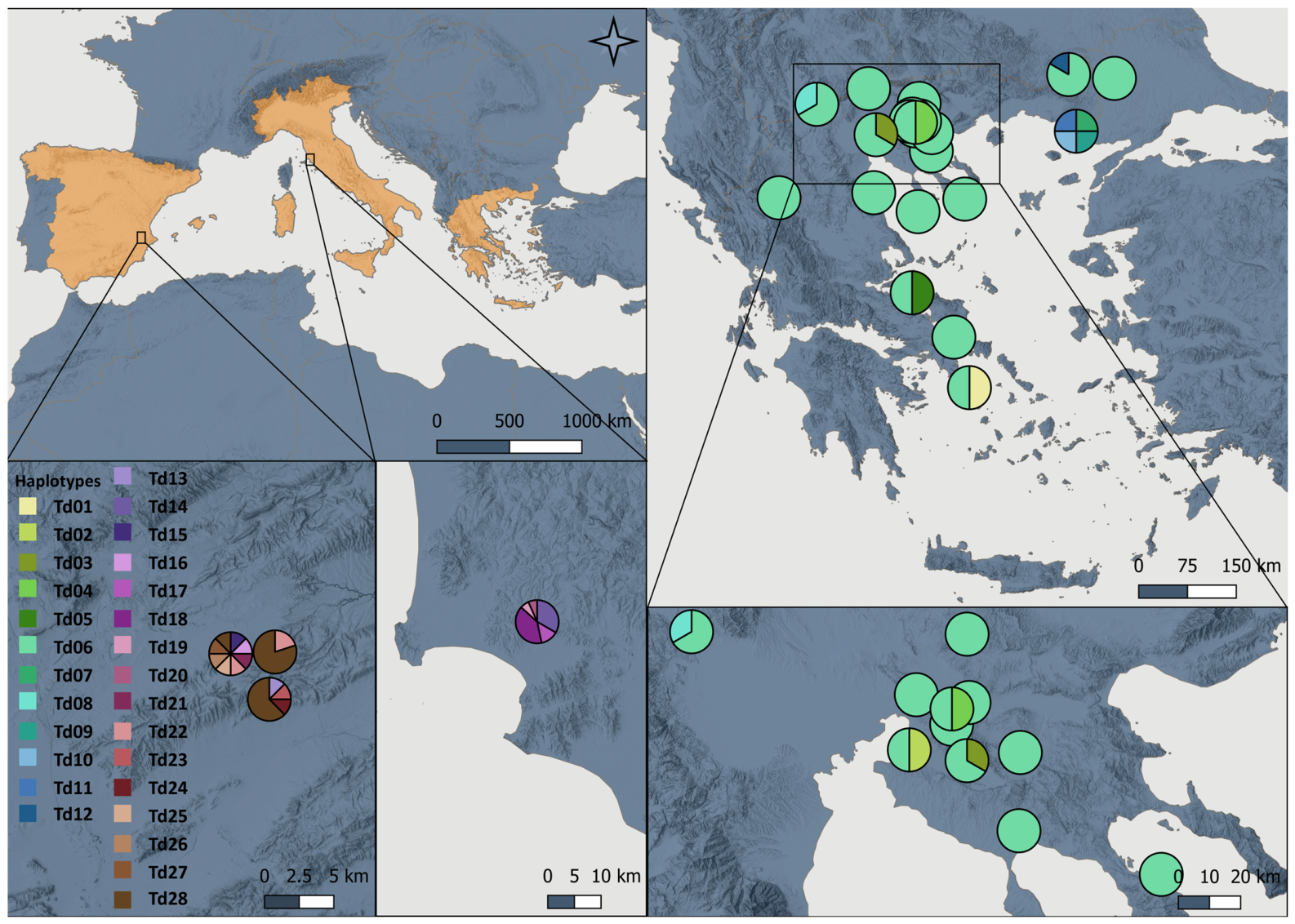
| Location | Country | X | Y | No. of Specimens | Host Tree |
|---|---|---|---|---|---|
| Rodopi | Greece | 41°10′14.55″ N | 25°28′50.83″ E | 6 | P. brutia |
| Moudania (Halkidiki) | Greece | 40°14′42.70″ N | 23°16′45.33″ E | 2 | P. halepensis |
| Lagkadas | Greece | 40°49′18.76″ N | 23°5′0.01″ E | 3 | P. brutia |
| Thermi (Thessaloniki) | Greece | 40°32′57.36″ N | 23°1′33.93″ E | 2 | P. brutia |
| Lagonisi | Greece | 37°46′41.62″ N | 23°53′25.78″ E | 2 | P. halepensis |
| Galatista (Halkidiki) | Greece | 40°28′7.10″ N | 23°17′3.91″ E | 1 | P. brutia |
| Hortiatis | Greece | 40°36′39.60″ N | 23°5′31.24″ E | 1 | P. brutia |
| Samothraki | Greece | 40°29′8.36″ N | 25°36′11.10″ E | 4 | P. brutia |
| Kilkis | Greece | 41°0′3.56″ N | 22°52′42.98″ E | 8 | P. brutia |
| Orhomenos | Greece | 38°29′40.25″ N | 22°58′16.35″ E | 2 | P. brutia |
| Thessaloniki | Greece | 40°37′57.41″ N | 22°58′33.41″ E | 4 | P. brutia |
| Kassandra (Halkidiki) | Greece | 40°1′56.24″ N | 23°24′41.51″ E | 8 | P. halepensis |
| Edessa | Greece | 40°48′43.14″ N | 22°2′51.46″ E | 3 | P. brutia |
| Parthenonas (Halkidiki) | Greece | 40°7′12.75″ N | 23°48′52.66″ E | 3 | P. halepensis |
| Paralia (Thessaloniki) | Greece | 40°36′8.88″ N | 22°56′58.55″ E | 4 | P. pinea |
| Panorama (Thessaloniki) | Greece | 40°35′31.97″ N | 23°1′37.64″ E | 4 | P. brutia |
| Vassilika | Greece | 40°30′30.26″ N | 23°4′59.22″ E | 6 | P. brutia |
| Dadia | Greece | 41°7′23.24″ N | 26°12′50.31″ E | 5 | P. brutia |
| Egaleo | Greece | 38°0′20.79″ N | 23°38′27.97″ E | 6 | P. halepensis |
| Ioannina | Greece | 39°40′18.55″ N | 20°50′13.62″ E | 5 | P. brutia |
| Agia | Greece | 39°44′4.48″ N | 22°42′4.79″ E | 4 | P. brutia |
| Follonica—Tuscany | Italy | 42°57′25.79″ N | 10°45′28.31″ E | 15 | P. pinea |
| Valencia T14 | Spain | 38°45′4.87″ N | 0°45′49.12″ W | 5 | P. halepensis |
| Valencia T33 | Spain | 38°44′59.71″ N | 0°46′6.07″ W | 8 | P. halepensis |
| Valencia Bloque 1 | Spain | 38°45′6.36″ N | 0°45′57.08″ W | 8 | P. halepensis |
| Location | No. of Specimens | No of Haplotypes | Haplotypes |
|---|---|---|---|
| Rodopi | 6 | 2 | Td12(1); Td06(5) |
| Moudania (Halkidiki) | 2 | 1 | Td06(2) |
| Lagkadas | 3 | 1 | Td06(3) |
| Thermi (Thessaloniki) | 2 | 1 | Td06(2) |
| Lagonisi | 2 | 2 | Td01(1); Td06(1) |
| Galatista (Halkidiki) | 1 | 1 | Td06(1) |
| Hortiatis | 1 | 1 | Td06(1) |
| Samothraki | 4 | 4 | Td07(1); Td09(1); Td10(1); Td11(1) |
| Kilkis | 8 | 1 | Td06(8) |
| Orhomenos | 2 | 2 | Td05(1); Td06(1) |
| Thessaloniki | 4 | 1 | Td06(4) |
| Kassandra (Halkidiki) | 8 | 1 | Td06(8) |
| Edessa | 3 | 2 | Td06(2); Td08(1) |
| Parthenonas (Halkidiki) | 3 | 1 | Td06(3) |
| Paralia (Thessaloniki) | 4 | 2 | Td02(2); Td06(2) |
| Panorama (Thessaloniki | 4 | 2 | Td04(2); Td06(2) |
| Vassilika | 6 | 2 | Td03(2); Td06(4) |
| Dadia | 5 | 1 | Td06(5) |
| Egaleo | 6 | 1 | Td06(6) |
| Ioannina | 5 | 1 | Td06(5) |
| Agia | 4 | 1 | Td06(4) |
| Follonica—Tuscany | 15 | 5 | Td14(5); Td17(2); Td18(6); Td19(1); Td20(1); |
| Valencia T14 | 5 | 2 | Td22(1); Td28(4) |
| Valencia T33 | 8 | 8 | Td15(1); Td16(1); Td21(1); Td22(1); Td25(1); Td26(1); Td27(1); Td28(1) |
| Valencia Bloque 1 | 8 | 4 | Td13(1); Td23(1); Td24(1); Td28(5) |
Disclaimer/Publisher’s Note: The statements, opinions and data contained in all publications are solely those of the individual author(s) and contributor(s) and not of MDPI and/or the editor(s). MDPI and/or the editor(s) disclaim responsibility for any injury to people or property resulting from any ideas, methods, instructions or products referred to in the content. |
© 2026 by the authors. Licensee MDPI, Basel, Switzerland. This article is an open access article distributed under the terms and conditions of the Creative Commons Attribution (CC BY) license.
Share and Cite
Avtzis, D.N.; Mas, H.; Bracalini, M.; Kaltsidis, A.; Koutsogeorgiou, E.I.; Andreadis, S.S.; Eleftheriadou, N.; Faccoli, M. What Really Lurks in the Dark? Revisiting the Occurrence of Tomicus destruens (Coleoptera, Curculionidae, Scolytinae) in Greece. Insects 2026, 17, 579. https://doi.org/10.3390/insects17060579
Avtzis DN, Mas H, Bracalini M, Kaltsidis A, Koutsogeorgiou EI, Andreadis SS, Eleftheriadou N, Faccoli M. What Really Lurks in the Dark? Revisiting the Occurrence of Tomicus destruens (Coleoptera, Curculionidae, Scolytinae) in Greece. Insects. 2026; 17(6):579. https://doi.org/10.3390/insects17060579
Chicago/Turabian StyleAvtzis, Dimitrios N., Hugo Mas, Matteo Bracalini, Achilleas Kaltsidis, Eleni I. Koutsogeorgiou, Stefanos S. Andreadis, Nikoleta Eleftheriadou, and Massimo Faccoli. 2026. "What Really Lurks in the Dark? Revisiting the Occurrence of Tomicus destruens (Coleoptera, Curculionidae, Scolytinae) in Greece" Insects 17, no. 6: 579. https://doi.org/10.3390/insects17060579
APA StyleAvtzis, D. N., Mas, H., Bracalini, M., Kaltsidis, A., Koutsogeorgiou, E. I., Andreadis, S. S., Eleftheriadou, N., & Faccoli, M. (2026). What Really Lurks in the Dark? Revisiting the Occurrence of Tomicus destruens (Coleoptera, Curculionidae, Scolytinae) in Greece. Insects, 17(6), 579. https://doi.org/10.3390/insects17060579