Tactile Sensing During Backward Locomotion in the Mole Cricket



1
School of Zoology, Tel Aviv University, Tel Aviv 6997801, Israel
2
Sagol School of Neuroscience, Tel Aviv University, Tel Aviv 6997801, Israel
*
Author to whom correspondence should be addressed.
†
These authors contributed equally to this work.
Insects 2026, 17(6), 564; https://doi.org/10.3390/insects17060564
Submission received: 15 April 2026
/
Revised: 24 May 2026
/
Accepted: 27 May 2026
/
Published: 29 May 2026
(This article belongs to the Special Issue Insects Sensory Ecology: From Natural Environments to Neural Mechanisms)
Simple Summary
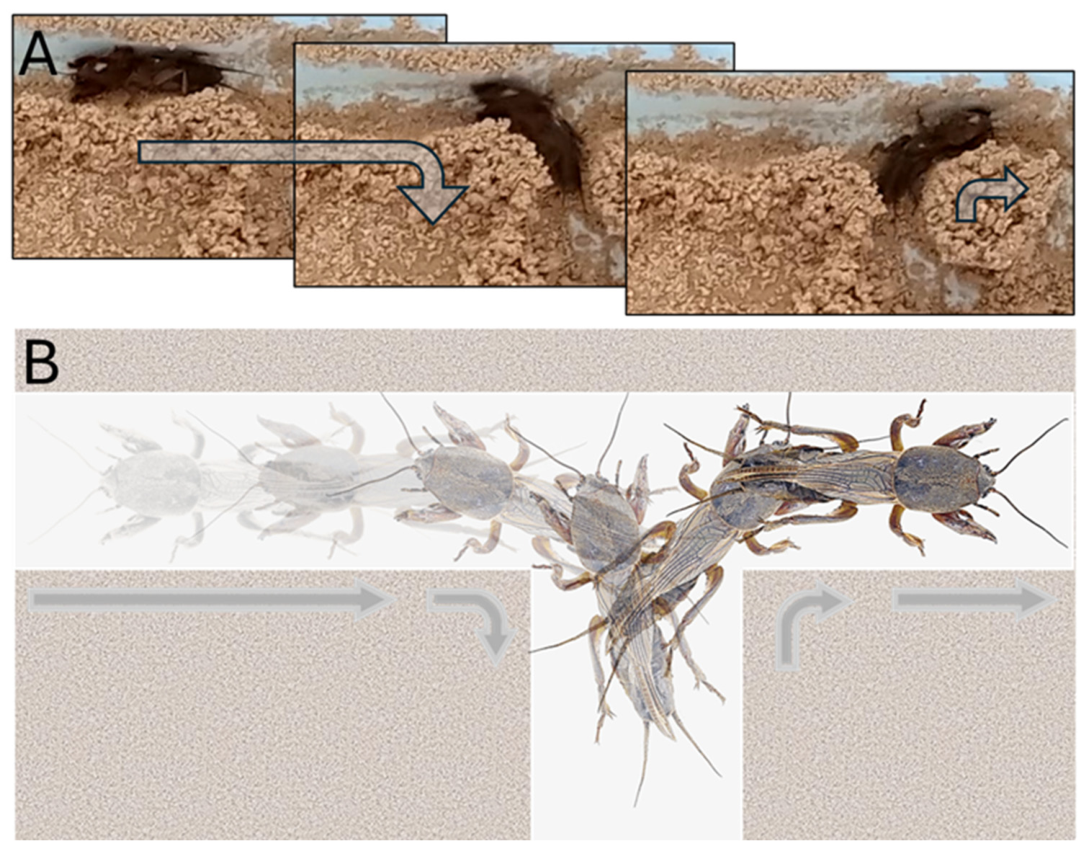
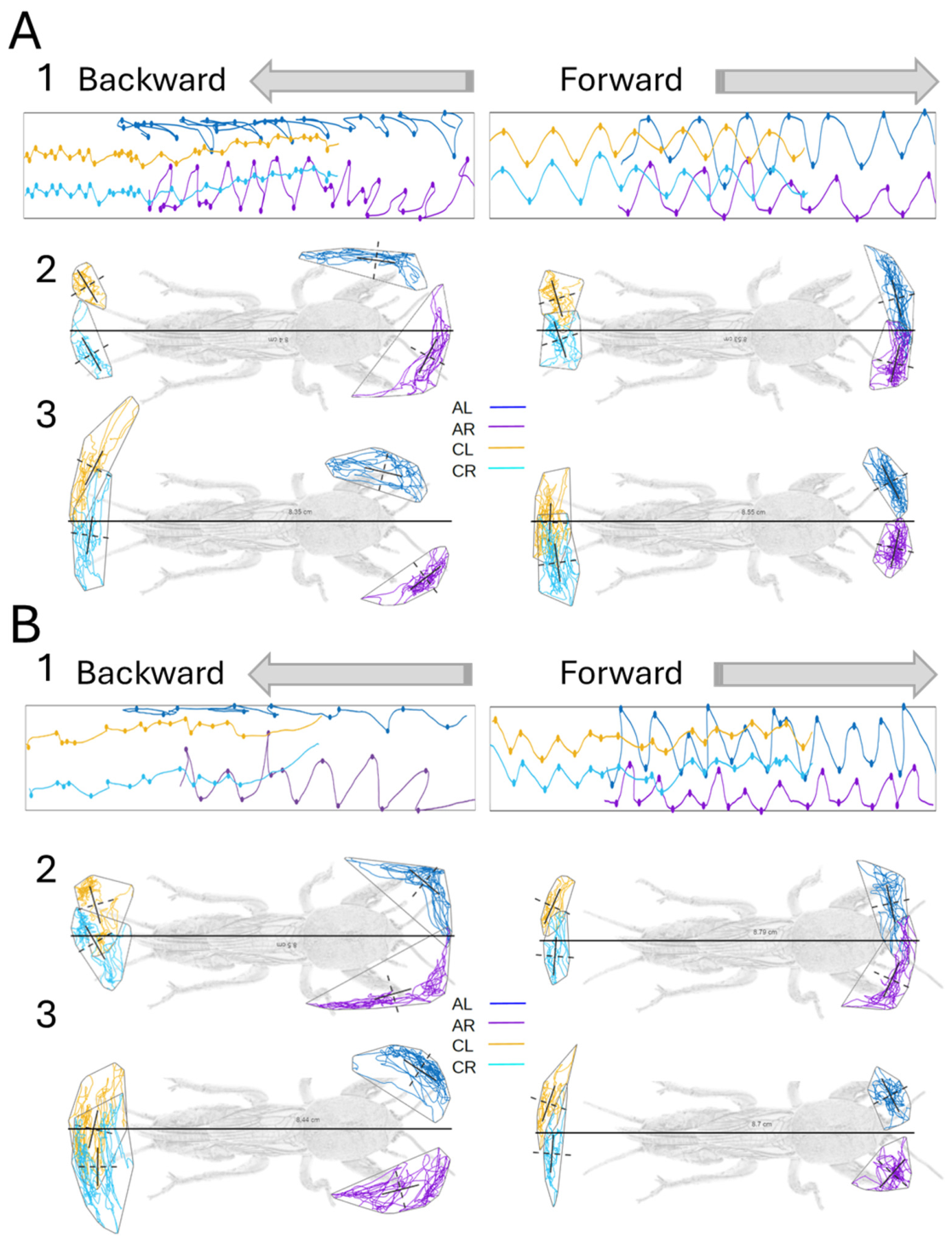
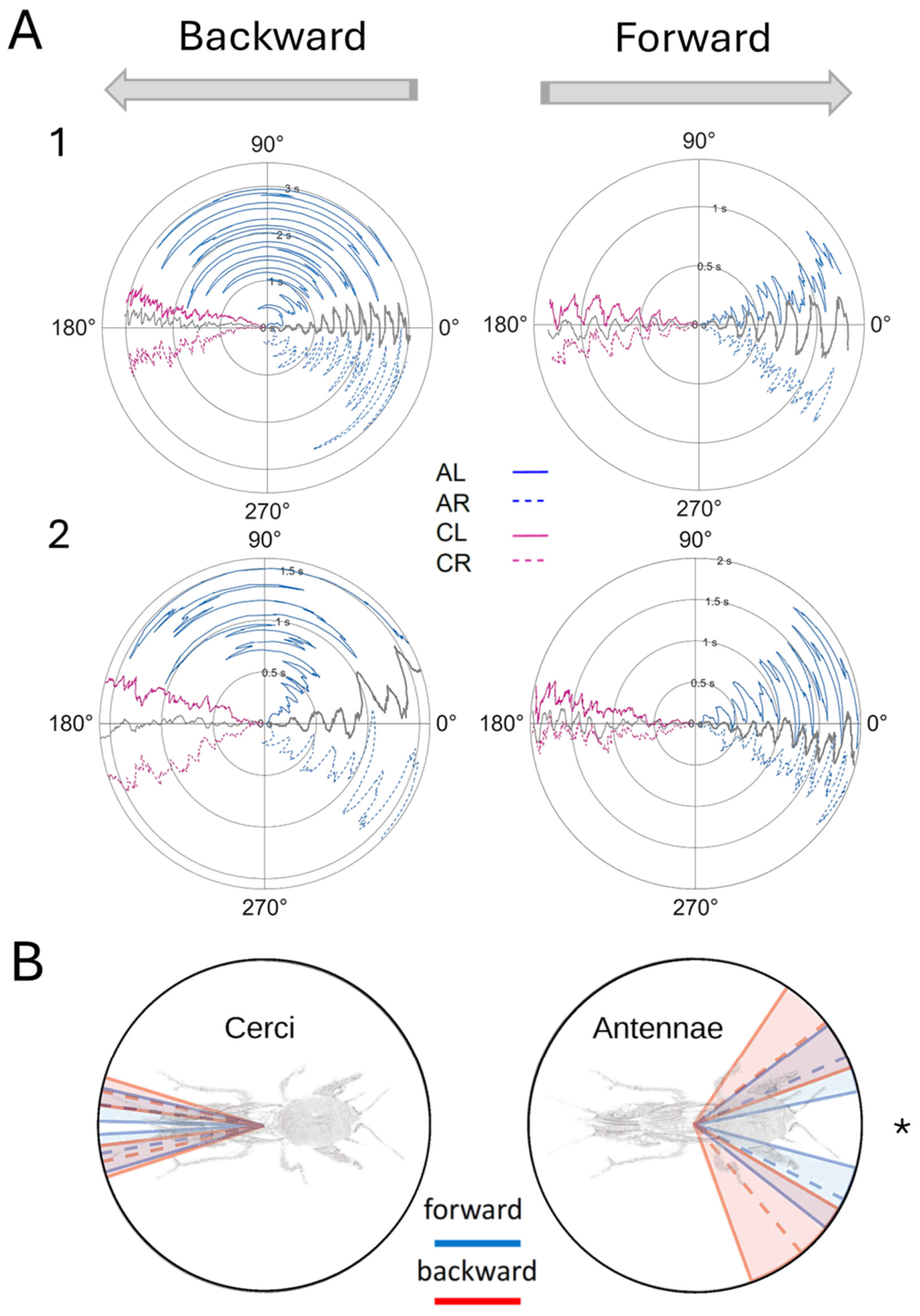
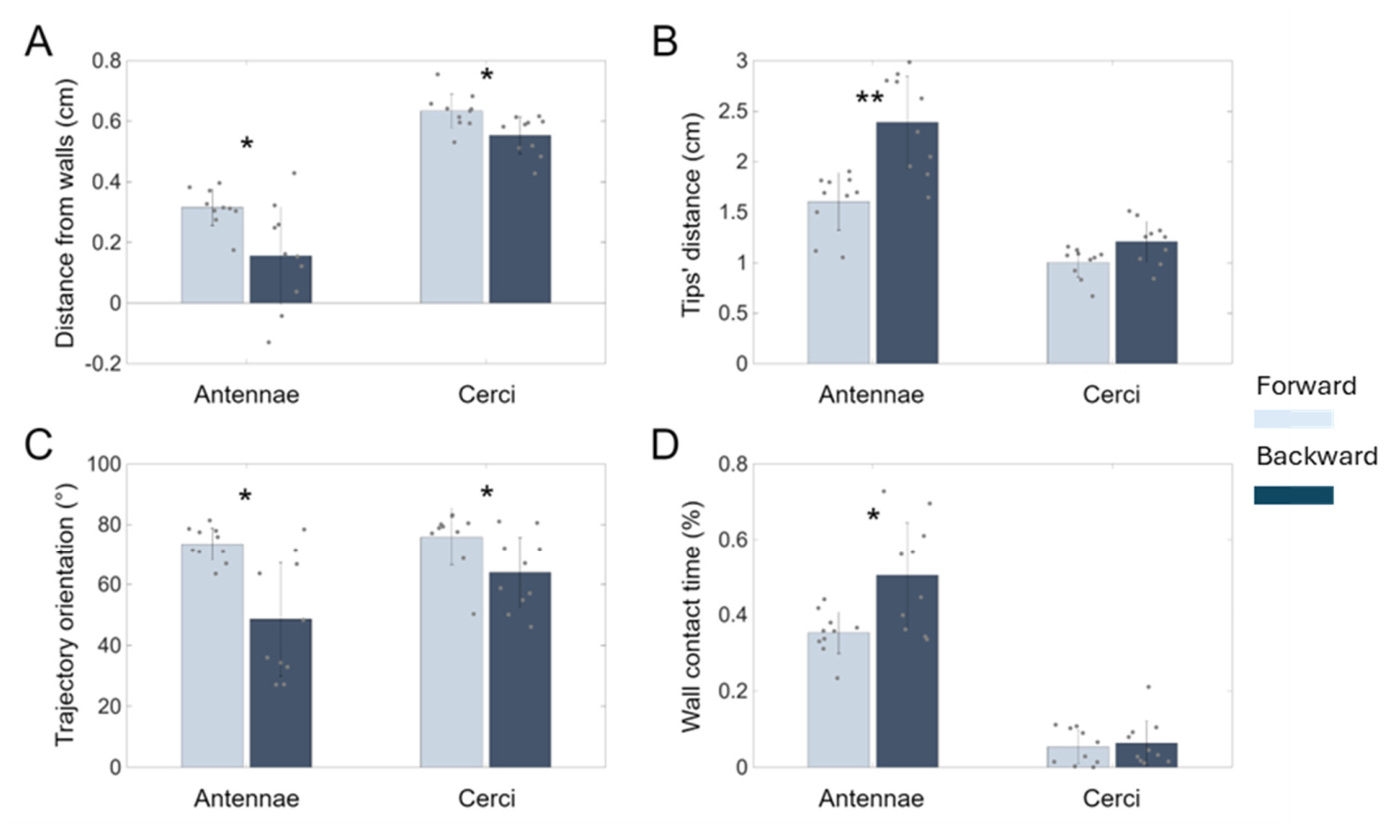
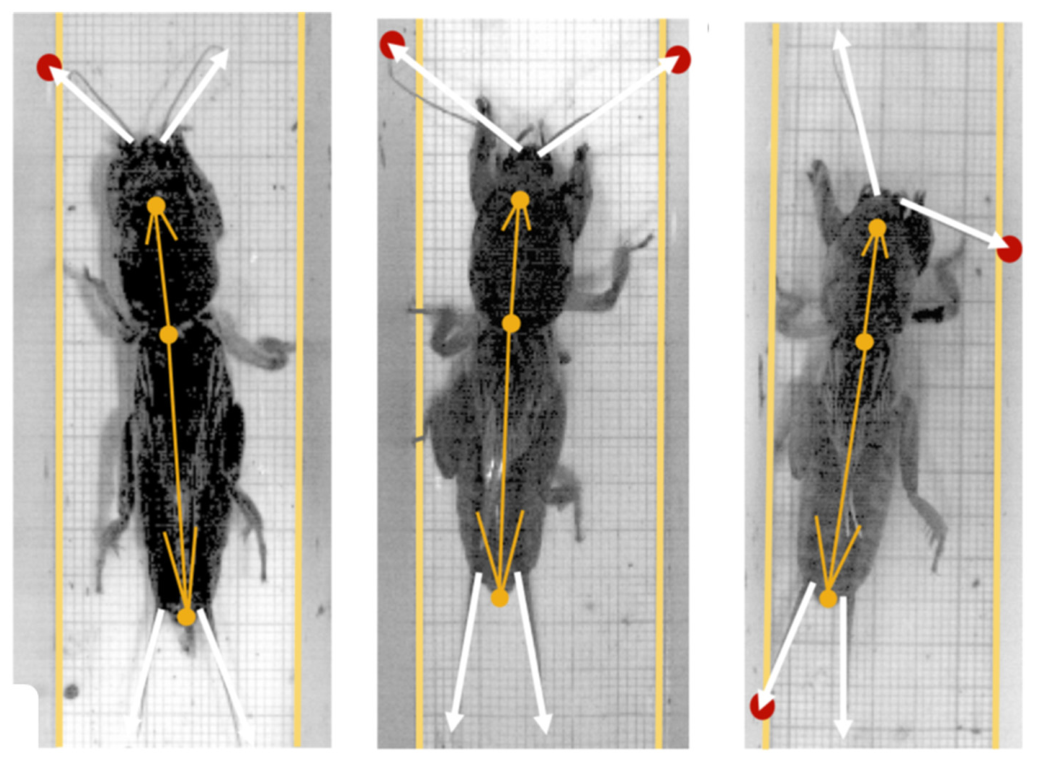
Moving underground is difficult because animals cannot rely much on vision and must constantly sense the environment around them. Mole crickets are a good example because they often move through the tunnels that they dig themselves. This study looked at how mole crickets manage to walk backward in such tight spaces. Researchers recorded adult mole crickets walking forward and backward in a narrow tunnel and tracked the movement of two pairs of sensory body parts: the antennae at the front and the cerci at the rear. When the mole crickets moved backward, their antennae shifted to reach farther back, while the cerci moved more from side to side, increasing the area they could sense. The insects also touch the tunnel walls more often when walking backward. These results suggest that mole crickets adjust how they gather touch information depending on the direction they move. This flexible sensing system helps them stay oriented, avoid collisions, and move safely through narrow underground tunnels.
Abstract
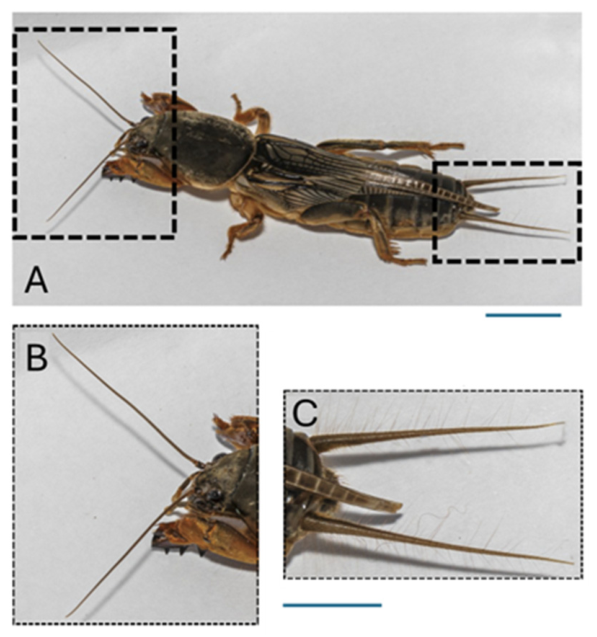
Subterranean locomotion challenges animals to maintain orientation and efficiently navigate confined spaces where vision is limited and local geometry is uncertain. Mole crickets (Gryllotalpidae), which regularly travel through self-excavated tunnels, provide a useful model for studying mechanosensory control of locomotion under these conditions. We hypothesized that backward walking, a prominent component of the mole cricket’s behavioral repertoire, is supported by complementary tactile input from the antennae and cerci. Adult Gryllotalpa tali were filmed while walking forward and backward in a narrow, straight tunnel arena under red light using high-speed video. Markerless pose tracking was used to quantify antennal and cercal tip movements, orientations, and wall-contact events in body and arena coordinates. Backward walking produced clear changes in tactile sampling behavior: antennae were reoriented and extended more posteriorly, while lateral cercal movements increased sensory coverage and posterior tactile input. Wall-contact monitoring suggested more frequent touching during backward locomotion by the antennae. These findings indicate that mole crickets adaptively reorganize active and passive mechanosensory sampling when moving backward, potentially improving boundary detection, stabilizing body posture, negotiating tunnel constraints, and supporting locomotion-related decision making during locomotion in tunnels.