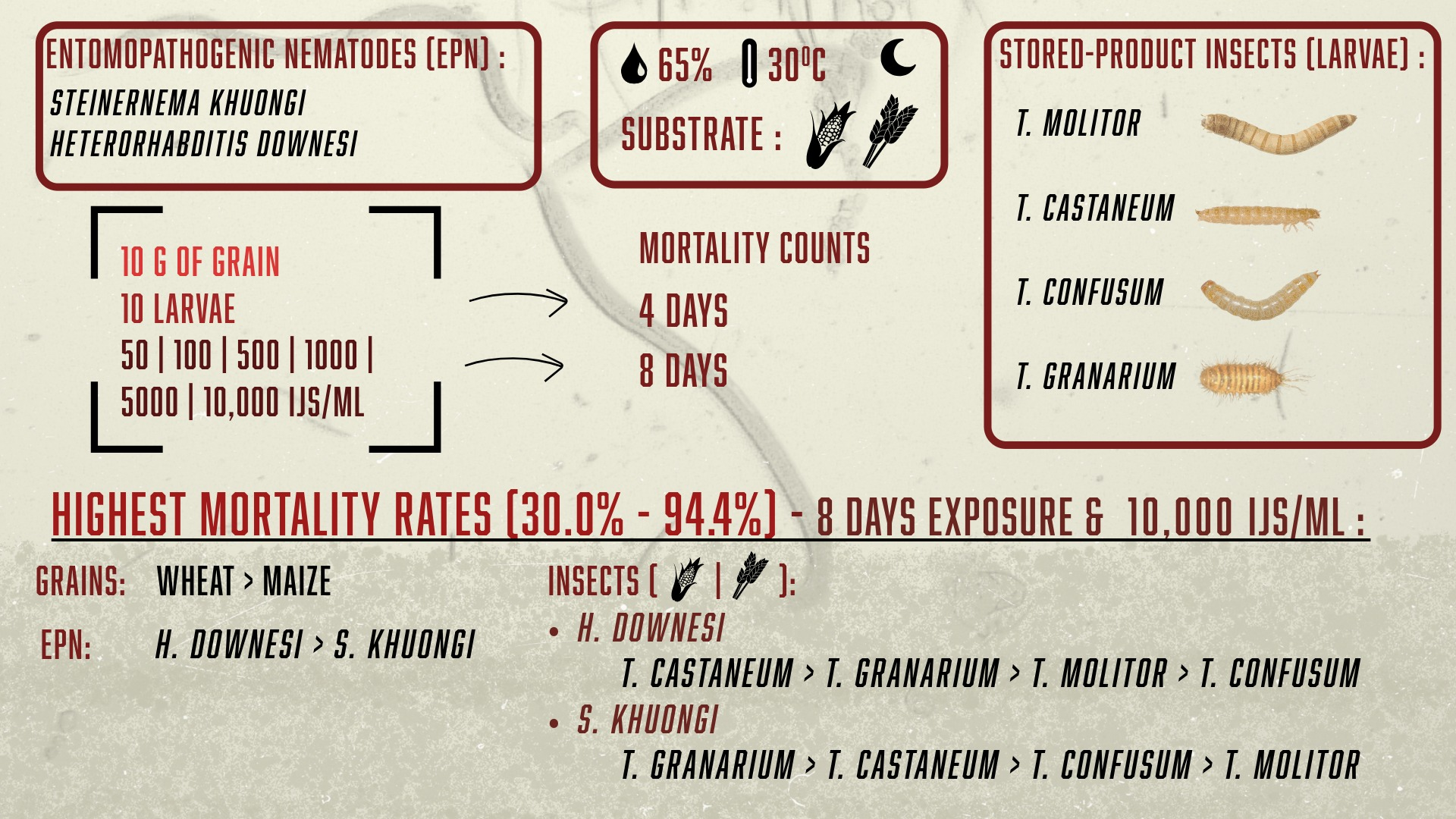
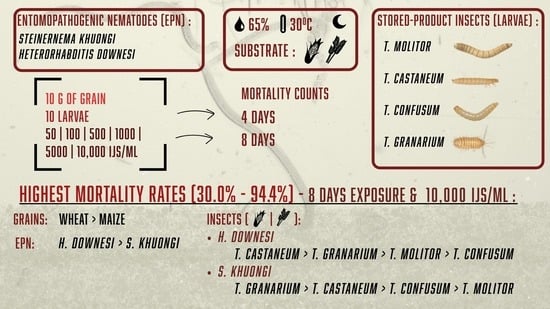
Evaluation of Steinernema khuongi and Heterorhabditis downesi as Biological Control Agents Against Four Stored Product Beetle Pests


 , ,
, ,  , ,
, , 

Simple Summary
Abstract
1. Introduction
2. Materials and Methods
2.1. EPNs Cultures
2.2. Insect Cultures
2.3. Commodities
2.4. Bioassays
2.5. Statistical Analysis
3. Results
3.1. Mortality of Tenebrio molitor Larvae
3.2. Mortality of Tribolium castaneum Larvae
3.3. Mortality of Tribolium confusum Larvae
3.4. Mortality of Trogoderma granarium Larvae
4. Discussion
5. Conclusions
Author Contributions
Funding
Data Availability Statement
Conflicts of Interest
References
- Shapiro-Ilan, D.I.; Hazir, S.; Glazer, I. Basic and applied research: Entomopathogenic nematodes. In Microbial Agents for Control of Insect Pests: From Discovery to Commercial Development and Use; Lacey, L.A., Ed.; Academic Press: San Diego, CA, USA, 2017; pp. 91–105. [Google Scholar]
- Alotaibi, S.S.; Darwish, H.; Zaynab, M.; Alharthi, S.; Alghamdi, A.; Al-Barty, A.; Asif, M.; Wahdan, R.H.; Baazeem, A.; Noureldeen, A. Isolation, identification, and biocontrol potential of entomopathogenic nematodes and associated bacteria against Virachola livia (Lepidoptera: Lycaenidae) and Ectomyelois ceratoniae (Lepidoptera: Pyralidae). Biology 2022, 11, 295. [Google Scholar] [CrossRef]
- van der Linden, C.F.H.; Fatouros, N.E.; Kammenga, J.E. The potential of entomopathogenic nematodes to control moth pests of ornamental plantings. Biol. Control 2022, 165, 104815. [Google Scholar] [CrossRef]
- San-Blas, E.; Campos-Herrera, R.; Dolinski, C.; Monteiro, C.; Andaló, V.; Garrigós Leite, L.; Rodríguez, M.G.; Morales-Montero, P.; Sáenz-Aponte, A.; Cedano, C.; et al. Entomopathogenic nematology in Latin America: A brief history, current research and future prospects. J. Invertebr. Pathol. 2019, 165, 22–45. [Google Scholar] [CrossRef]
- Pansri, S.; Ardpairin, J.; Subkrasae, C.; Dumidae, A.; Homkaew, C.; Wattanachaiyingcharoen, W.; Thanwisai, A.; Vitta, A. Heterorhabditis indica and Steinernema siamkayai in central Thailand and their potential for controlling Aedes aegypti larvae in artificial container-breeding site. Acta Trop. 2025, 266, 107636. [Google Scholar] [CrossRef] [PubMed]
- Stock, S.P.; Hazir, S. The bacterial symbionts of entomopathogenic nematodes and their role in symbiosis and pathogenesis. J. Invertebr. Pathol. 2025, 211, 108295. [Google Scholar] [CrossRef] [PubMed]
- Vashisth, S.; Chandel, Y.S.; Sharma, K. Entomopathogenic nematodes—A review. Agric. Rev. 2013, 34, 163–175. [Google Scholar] [CrossRef]
- Gulcu, B.; Cimen, H.; Raja, R.K.; Hazir, S. Entomopathogenic nematodes and their mutualistic bacteria: Their ecology and application as microbial control agents. Biopestic. Int. 2017, 13, 79–112. [Google Scholar]
- Tarasco, E.; Fanelli, E.; Salvemini, C.; El-Khoury, Y.; Troccoli, A.; Vovlas, A.; De Luca, F. Entomopathogenic nematodes and their symbiotic bacteria: From genes to field uses. Front. Insect Sci. 2023, 3, 1195254. [Google Scholar] [CrossRef]
- Singh, A.K.; Kumar, M.; Ahuja, A.; Vinay, B.; Kommu, K.K.; Thakur, S.; Paschapur, A.U.; Jeevan, B.; Mishra, K.; Meena, R.P. Entomopathogenic nematodes: A sustainable option for insect pest management. In Biopesticides; Rakshit, A., Meena, V.S., Abhilash, P.C., Sarma, B.K., Singh, H.B., Fraceto, L., Parihar, M., Singh, A.K., Eds.; Elsevier: Amsterdam, The Netherlands, 2022; pp. 73–92. [Google Scholar]
- Yağci, M. Insecticidal effect of two Turkish entomopathogenic nematode isolates against Tribolium castaneum (Herbst) larvae and adults at different conditions. J. Stored Prod. Res. 2024, 109, 102432. [Google Scholar] [CrossRef]
- Kaya, H.K.; Gaugler, R. Entomopathogenic nematodes. Annu. Rev. Entomol. 1993, 38, 181–206. [Google Scholar] [CrossRef]
- Bode, H.B. Entomopathogenic bacteria as a source of secondary metabolites. Curr. Opin. Chem. Biol. 2009, 13, 224–2230. [Google Scholar] [CrossRef]
- Yüksel, E. Biocontrol potential of endosymbiotic bacteria of entomopathogenic nematodes against the tomato leaf miner, Tuta absoluta (Meyrick) (Lepidoptera: Gelechiidae). Egypt J. Biol. Pest. Control 2022, 32, 135. [Google Scholar] [CrossRef]
- Tobias, N.J.; Shi, Y.-M.; Bode, H.B. Refining the natural product repertoire in entomopathogenic bacteria. Trends Microbiol. 2018, 26, 833–840. [Google Scholar] [CrossRef] [PubMed]
- Ramos-Rodríguez, O.; Campbell, J.F.; Ramaswamy, S.B. Pathogenicity of three species of entomopathogenic nematodes to some major stored-product insect pests. J. Stored Prod. Res. 2006, 42, 241–252. [Google Scholar] [CrossRef]
- Ramos-Rodriguez, O.; Campbell, J.F.; Christen, J.M.; Shapiro-Ilan, D.I.; Lewis, E.E.; Ramaswamy, S.B. Attraction behaviour of three entomopathogenic nematode species towards infected and uninfected hosts. Parasitology 2006, 134, 729–738. [Google Scholar] [CrossRef]
- Shakeel, Q.; Shakeel, M.; Raheel, M.; Ali, S.; Ashraf, W.; Iftikhar, Y.; Bajwa, R.T. Entomopathogenic nematodes (EPNs): A green strategy for management of insect-pests of crops. In New and Future Development in Biopesticide Research: Biotechnological Exploration; Mandal, S.D., Ramkumar, G., Karthi, S., Jin, F., Eds.; Springer: Singapore, 2022; pp. 115–135. [Google Scholar]
- Yadav, K.; Bharti, L.; Chaubey, A.K. Behavior of entomopathogenic nematodes. In Behavior of Insect Natural Enemies; Omkar, O., Fathipour, Y., Eds.; Academic Press: Cambridge, MA, USA, 2026; pp. 159–169. [Google Scholar]
- Wu, S.Y.; Duncan, L.W. Entomopathogenic nematode species combinations alter rates of dispersal, host encounter and insecticidal efficiency. J. Pest Sci. 2022, 95, 1111–1119. [Google Scholar] [CrossRef]
- ffrench-Constant, R.; Eleftherianos, I.; Reynolds, S.E. A nematode symbiont sheds light on invertebrate immunity. Trends Parasitol. 2007, 23, 514–517. [Google Scholar] [CrossRef]
- Rajendran, S. Insect pest management in stored products. Outlooks Pest. Manag. 2020, 31, 24–35. [Google Scholar] [CrossRef]
- Demis, E.; Yenewa, W. Review on major storage insect pests of cereals and pulses. Asian J. Adv. Res. 2022, 5, 41–56. [Google Scholar]
- Rosentrater, K.A. Insects in grains: Identification, damage, and detection. In Storage of Cereal Grains and their Products; Rosentrater, K.A., Ed.; Elsevier: Duxford, UK, 2022; pp. 261–292. [Google Scholar]
- Nath, B.; Chen, G.; O’Sullivan, C.M.; Zare, D. Research and technologies to reduce grain postharvest losses: A review. Foods 2024, 13, 1875. [Google Scholar] [CrossRef]
- Kumar, R. Insect Pests of Stored Grain: Biology, Behavior, and Management Strategies; Apple Academic Press: Waretown, MJ, USA, 2017. [Google Scholar]
- Nayak, M.K.; Daglish, G.J. Importance of Stored Product Insects. In Recent Advances in Stored Product Protection; Athanassiou, C.G., Arthur, F.H., Eds.; Springer: Berlin, Germany, 2018; pp. 1–19. [Google Scholar]
- Yadav, S.K.; Bhowmik, S.; Yadav, P.C.; Sharma, K.C. Identification and control of Trogoderma granarium (Coleoptera: Dermestidae), a potential threat to stored products and international trade. Int. J. Trop. Insect Sci. 2021, 42, 999–1017. [Google Scholar] [CrossRef]
- Khan, H.A.A.; Bukhari, M. Effects of selected nuts on the biology of Trogoderma granarium Everts. Sci. Rep. 2026, 16, 10190. [Google Scholar] [CrossRef] [PubMed]
- Hagstrum, D.W.; Subramanyam, B. Stored-Product Insect Resource; AACC International: Saint Paul, MN, USA, 2009. [Google Scholar]
- de Carvalho Barbosa Negrisoli, C.R.; Negrisoli, A.S., Jr.; Bernardi, D.; Garcia, M.S. Activity of eight strains of entomopathogenic nematodes (Rhabditida: Steinernematidae: Heterorhabditidae) against five stored product pests. Exp. Parasitol. 2013, 134, 384–388. [Google Scholar] [CrossRef]
- Campbell, J.F.; Lewis, E.E. Entomopathogenic nematode host-search strategies. Behav. Ecol. Parasites 2002, 5, 13–38. [Google Scholar]
- Lewis, E.E.; Clarke, D.J. Nematode parasites and entomopathogens. In Insect Pathology, 2nd ed.; Vega, F., Kaya, H., Eds.; Academic Press: London, UK, 2012; pp. 395–424. [Google Scholar]
- Karanastasi, E.; Nikorezou, A.; Stamouli, M.; Skourti, A.; Boukouvala, M.C.; Kavallieratos, N.G. Temperature effect on the efficacy of 3 entomopathogenic nematode isolates against larvae of the lesser mealworm, Alphitobius diaperinus (Coleoptera: Tenebrionidae). J. Econ. Entomol. 2025, 118, 93–99. [Google Scholar] [CrossRef] [PubMed]
- Athanassiou, C.G.; Kavallieratos, N.G.; Menti, H.; Karanastasi, E. Mortality of four stored product pests in stored wheat when exposed to doses of three entomopathogenic nematodes. J. Econ. Entomol. 2010, 103, 977–984. [Google Scholar] [CrossRef] [PubMed]
- Zampara, I.; Zamparas, C.; Mantzoukas, S.; Karanastasi, E. Study on the combined action of the entomopathogenic bacterium Bacillus thuringiensis subsp. kurstaki and the entomopathogenic nematode Heterorhabditis bacteriophora. Entomol. Hell. 2014, 23, 74–86. [Google Scholar] [CrossRef]
- Yuksel, E.; Canhilal, R.; Imren, M. Potential of four Turkish isolates of entomopathogenic nematodes against three major stored products insect pests. J. Stored Prod. Res. 2019, 83, 317–321. [Google Scholar] [CrossRef]
- Karanastasi, E.; Kavallieratos, N.G.; Boukouvala, M.C.; Christodoulopoulou, A.D.; Papadopoulou, A.A. Effect of three entomopathogenic nematode species to Trogoderma granarium Everts (Coleoptera: Dermestidae) larvae on stored-wheat. J. Stored Prod. Res. 2020, 88, 101641. [Google Scholar] [CrossRef]
- Erdoğuş, F.D. On the efficiency of entomopathogenic nematodes (Rhabditida: Heterorhabditidae and Steinernematidae) on rust red flour beetle, Tribolium castaneum (Herbst.) (Coleoptera: Tenebrionidae). Egypt. J. Biol. Pest Control 2021, 31, 116. [Google Scholar] [CrossRef]
- Kavallieratos, N.G.; Karanastasi, E.; Nika, E.P.; Skourti, A.; Boukouvala, M.C.; Sampazioti, I.E. Sustainable grain protectants: Recruiting entomopathogenic nematodes against stored-product coleopterans. Sustainability 2022, 14, 16038. [Google Scholar] [CrossRef]
- Stock, S.; Campos-Herrera, R.; El-Borai, F.; Duncan, L. Steinernema khuongi n. sp. (Panagrolaimomorpha, Steinernematidae), a new entomopathogenic nematode species from Florida, USA. J. Helminthol. 2019, 93, 226–241. [Google Scholar] [CrossRef]
- Baniya, A.; DiGennaro, P. Genome announcement of Steinernema khuongi and its associated symbiont from Florida. G3 2021, 11, jkab053. [Google Scholar] [CrossRef] [PubMed]
- EPPO (European and Mediterranean Plant Protection Organization). PM 6/3 (5) Biological control agents safely used in the EPPO region. EPPO Bull. 2021, 51, 452–454. [Google Scholar] [CrossRef]
- Griffin, C.T.; Dix, I.; Joyce, S.A.; Burnell, A.M.; Downes, M.J. Isolation and characterisation of Heterorhabditis spp. (Nematoda: Heterorhabditidae) from Hungary, Estonia and Denmark. Nematology 1999, 1, 321–332. [Google Scholar] [CrossRef]
- Stock, S.P.; Griffin, C.T.; Burnell, A.M. Morphological characterisation of three isolates of Heterorhabditis Poinar, 1976 from the ‘Irish group’ (Nematoda: Rhabditida: Heterorhabditidae) and additional evidence supporting their recognition as a distinct species, H. downesi n. sp. System. Parasitol. 2002, 51, 95–106. [Google Scholar] [CrossRef] [PubMed]
- Tarasco, E.; Clausi, M.; Rappazzo, G.; Panzavolta, T.; Curto, G.; Sorino, R.; Oreste, M.; Longo, A.; Leone, D.; Tiberi, R.; et al. Biodiversity of entomopathogenic nematodes in Italy. J. Helminthol. 2015, 89, 359–366. [Google Scholar] [CrossRef]
- Barg, M.C.; Molina, C.; Strauch, O.; Ehlers, R.U.; Vandenbossche, B. In situ baiting reveals occurrence of Heterorhabditis downesi at the German Baltic coast. Biocontrol Sci. Technol. 2023, 33, 885–889. [Google Scholar] [CrossRef]
- Nguyen, K.B. Methodology, morphology and identification. In Entomopathogenic Nematodes: Systematics, Phylogeny and Bacterial Symbionts; Nguyen, K.B., Hunt, D., Eds.; Brill: Leiden, The Netherland, 2007; pp. 59–119. [Google Scholar]
- Campos-Herrera, R.; El-Borai, F.E.; Stuart, R.J.; Graham, J.H.; Duncan, L.W. Entomopathogenic nematodes, phoretic Paenibacillus spp., and the use of real time quantitative PCR to explore soil food webs in Florida citrus groves. J. Invertebr. Pathol. 2011, 108, 30–39. [Google Scholar] [CrossRef]
- Campos-Herrera, R.; Johnson, E.; El-Borai, F.; Stuart, R.; Graham, J.; Duncan, L. Long-term stability of entomopathogenic nematode spatial patterns in soil as measured by sentinel insects and real-time PCR assays. Ann. Appl. Biol. 2011, 158, 55–68. [Google Scholar] [CrossRef]
- Campos-Herrera, R.; Jaffuel, G.; Chiriboga, X.; Blanco-Pérez, R.; Fesselet, M.; Puža, V.; Mascher, F.; Turlings, T.C.J. Traditional and molecular detection methods reveal intense interguild competition and other multitrophic interactions associated with native entomopathogenic nematodes in Swiss tillage soils. Plant Soil 2015, 389, 237–255. [Google Scholar] [CrossRef]
- Dritsoulas, A.; El-Borai, F.E.; Shehata, I.E.; Hammam, M.M.; El-Ashry, R.M.; Mohamed, M.M.; Abd-Elgawad, M.M.; Duncan, L.W. Reclaimed desert habitats favor entomopathogenic nematode and microarthropod abundance compared to ancient farmlands in the Nile Basin. J. Nematol. 2021, 53, 1–13. [Google Scholar] [CrossRef]
- Curran, J.; Driver, F.; Ballard, J.W.O.; Milner, R.J. Phylogeny of Metarhizium: Analysis of ribosomal DNA sequence data. Mycol. Res. 1994, 98, 547–552. [Google Scholar] [CrossRef]
- Kotsinis, V.; Dritsoulas, A.; Ntinokas, D.; Giannakou, I.O. Nematicidal effects of four terpenes differ among entomopathogenic nematode species. Agriculture 2023, 13, 1143. [Google Scholar] [CrossRef]
- Kavallieratos, N.G.; Michail, E.J.; Boukouvala, M.C.; Nika, E.P.; Skourti, A. Efficacy of pirimiphos-methyl, deltamethrin, spinosad and silicoSec against adults and larvae of Tenebrio molitor L. on wheat, barley and maize. J. Stored Prod. Res. 2019, 83, 161–167. [Google Scholar] [CrossRef]
- Zar, J.H. Biostatistical Analysis, 5th ed.; Pearson: Essex, UK, 2014. [Google Scholar]
- Scheff, D.S.; Arthur, F.H. Fecundity of Tribolium castaneum and Tribolium confusum adults after exposure to deltamethrin packaging. J. Pest Sci. 2018, 91, 717–725. [Google Scholar] [CrossRef]
- Sall, J.; Lehman, A.; Creighton, L. JMP Start Statistics: A Guide to Statistics and Data Analysis Using JMP and JMP IN Software; Duxbury Press: Belmont, CA, USA, 2001. [Google Scholar]
- Sokal, R.R.; Rohlf, F.J. Biometry: The Principles and Practice of Statistics in Biological Research; Freeman & Company: New York, NY, USA, 1995. [Google Scholar]
- SAS Institute Inc. Using JMP 16.2; SAS Institute Inc.: Cary, NC, USA, 2021. [Google Scholar]
- Lephoto, T.E.; Gray, V.M. Desiccation stress tolerance of Steinernema australe and Heterorhabditis bacteriophora. Arch. Phytopathol. Plant Prot. 2021, 54, 611–624. [Google Scholar] [CrossRef]
- Dillon, A.B.; Ward, D.; Downes, M.J.; Griffin, C.T. Suppression of the large pine weevil Hylobius abietis (L.) (Coleoptera: Curculionidae) in pine stumps by entomopathogenic nematodes with different foraging strategies. Biol. Control 2006, 38, 217–226. [Google Scholar] [CrossRef]
- Mason, L.J.; McDonough, M. Biology, behavior, and ecology of stored grain and legume insects. In Stored Product Protection; Hagstrum, D.W., Phillips, T.W., Cuperus, G., Eds.; Kansas State University: Manhattan, KS, USA, 2012; pp. 7–20. [Google Scholar]
- Filgueiras, C.C.; Willett, D.S. Non-lethal effects of entomopathogenic nematode infection. Sci. Rep. 2021, 11, 17090. [Google Scholar] [CrossRef] [PubMed]
- Kavallieratos, N.; Athanassiou, C.; Barda, M.; Boukouvala, M. Efficacy of five insecticides for the control of Trogoderma granarium Everts (Coleoptera: Dermestidae) larvae on concrete. J. Stored Prod. Res. 2016, 66, 18–24. [Google Scholar] [CrossRef]
- Khan, H.A.A. Variation in susceptibility to insecticides and synergistic effect of enzyme inhibitors in Pakistani strains of Trogoderma granarium. J. Stored Prod. Res. 2021, 91, 101775. [Google Scholar] [CrossRef]
- Shahina, F.; Salma, J. Pakistani strains of entomopathogenic nematode as a biological control agent against stored grain pest, Tribolium castaneum. Pak. J. Nematol. 2011, 29, 25–34. [Google Scholar]
- Athanassiou, C.G.; Palyvos, N.E.; Kakouli-Duarte, T. Insecticidal effect of Steinernema feltiae (Filipjev) (Nematoda: Steinernematidae) against Tribolium confusum du Val (Coleoptera: Tenebrionidae) and Ephestia kuehniella (Zeller) (Lepidoptera: Pyralidae) in stored wheat. J. Stored Prod. Res. 2008, 44, 52–57. [Google Scholar] [CrossRef]
- Bütüner, A.K.; Ergene, E.; Ilktan, M.; Sepin, S.; Susurluk, H.; Susurluk, I.A. Impact of some entomopathogenic nematode isolates on the mortality and penetration rate of Rhyzopertha dominica and Tenebrio molitor. Crop Prot. 2024, 179, 106629. [Google Scholar] [CrossRef]
- Li, X.; Liu, Q.; Lewis, E.E.; Tarasco, E. Activity changes of antioxidant and detoxifying enzymes in Tenebrio molitor (Coleoptera: Tenebrionidae) larvae infected by the entomopathogenic nematode Heterorhabditis beicherriana (Rhabditida: Heterorhabditidae). Parasitol. Res. 2016, 115, 4485–4494. [Google Scholar] [CrossRef] [PubMed]
- Bartosik, R.E.; Maier, D.E. Effect of airflow distribution on the performance of NA/LT in-bin drying of corn. Trans. ASAE 2006, 49, 1095–1104. [Google Scholar] [CrossRef]
- Vayias, B.J.; Athanassiou, C.G.; Kavallieratos, N.G.; Tsesmeli, C.D.; Buchelos, C.T. Persistence and efficacy of two diatomaceous earth formulations and a mixture of diatomaceous earth with natural pyrethrum against Tribolium confusum Jacquelin du Val (Coleoptera: Tenebrionidae) on wheat and maize. Pest Manag. Sci. 2006, 62, 456–464. [Google Scholar] [CrossRef] [PubMed]
- Williams, C.D.; Dillon, A.B.; Ennis, D.E.; Hennessy, R.; Griffin, C.T. Differential susceptibility of pine weevil, Hylobius abietis (Coleoptera: Curculionidae), larvae and pupae to entomopathogenic nematodes and death of adults infected as pupae. BioControl 2015, 60, 537–546. [Google Scholar] [CrossRef]


| T. molitor | T. castaneum | T. confusum | T. granarium | ||||||
|---|---|---|---|---|---|---|---|---|---|
| Between exposure intervals | |||||||||
| Source | df | F | p | F | p | F | p | F | p |
| Intercept | 1 | 4989.6 | <0.01 | 57,323.1 | <0.01 | 19,184.1 | <0.01 | 60,207.1 | <0.01 |
| EPN | 1 | 190.4 | <0.01 | 39.9 | <0.01 | 79.1 | <0.01 | 34.4 | <0.01 |
| Commodity | 1 | 4.6 | 0.03 | 8.4 | 0.01 | 15.2 | 0.01 | 25.1 | <0.01 |
| Concentration | 5 | 24.2 | <0.01 | 84.4 | <0.01 | 37.2 | <0.01 | 66.7 | <0.01 |
| EPN × commodity | 1 | 0.3 | 0.60 | 0.5 | 0.46 | 0.7 | 0.40 | 0.4 | 0.56 |
| EPN × concentration | 5 | 1.2 | 0.32 | 1.3 | 0.26 | 1.5 | 0.20 | 1.4 | 0.22 |
| Commodity × concentration | 5 | 0.2 | 0.96 | 0.5 | 0.79 | 1.5 | 0.20 | 0.1 | 1.00 |
| EPN × commodity × concentration | 5 | 0.2 | 0.97 | 0.4 | 0.87 | 2.0 | 0.08 | 0.1 | 0.98 |
| Within exposure intervals | |||||||||
| Source | |||||||||
| Exposure | 1 | 284.5 | <0.01 | 92.7 | <0.01 | 68.7 | <0.01 | 169.6 | <0.01 |
| Exposure × EPN | 1 | 10.1 | 0.01 | 0.2 | 0.63 | 5.4 | 0.02 | 1.7 | 0.20 |
| Exposure × commodity | 1 | 1.6 | 0.21 | 0.4 | 0.55 | 1.7 | 0.19 | 0.3 | 0.60 |
| Exposure × concentration | 5 | 1.0 | 0.41 | 5.2 | 0.01 | 2.4 | 0.05 | 4.3 | 0.01 |
| Exposure × EPN × commodity | 1 | 0.3 | 0.61 | 0.6 | 0.43 | 2.0 | 0.16 | 0.1 | 0.88 |
| Exposure × EPN × concentration | 5 | 1.3 | 0.27 | 0.5 | 0.80 | 0.4 | 0.82 | 0.6 | 0.69 |
| Exposure × commodity × concentration | 5 | 0.2 | 0.98 | 0.1 | 0.99 | 0.6 | 0.72 | 0.9 | 0.50 |
| Exposure × EPN × commodity × concentration | 5 | 0.4 | 0.82 | 0.8 | 0.53 | 1.0 | 0.42 | 0.7 | 0.63 |
| Exposure | 4 Days | |||||||
|---|---|---|---|---|---|---|---|---|
| Commodity | Wheat | Maize | ||||||
| Concentration | H. downesi | S. khuongi | t | p | H. downesi | S. khuongi | t | p |
| 50 IJs/mL | 16.7 ± 1.7 d * | 4.4 ± 1.8 b | −4.1 | 0.01 | 16.7 ± 2.4 b * | 3.3 ± 1.7 b | −4.7 | 0.01 |
| 100 IJs/mL | 22.2 ± 2.2 cd * | 6.7 ± 1.7 ab | −3.6 | 0.01 | 18.9 ± 2.0 b * | 5.6 ± 1.8 ab | −3.7 | 0.01 |
| 500 IJs/mL | 27.8 ± 3.2 bc * | 10.0 ± 2.4 ab | −3.1 | 0.01 | 22.2 ± 2.2 b * | 8.9 ± 2.0 ab | −3.0 | 0.01 |
| 1000 IJs/mL | 37.8 ± 2.8 ab * | 13.3 ± 2.4 ab | −3.7 | 0.01 | 24.4 ± 3.8 ab | 10.0 ± 1.7 ab | −1.6 | 0.13 |
| 5000 IJs/mL | 41.1 ± 3.9 ab * | 14.4 ± 2.4 ab | −3.5 | 0.01 | 33.3 ± 4.1 ab * | 13.3 ± 2.9 ab | −2.7 | 0.02 |
| 10,000 IJs/mL | 55.6 ± 2.9 a * | 18.9 ± 1.1 a | −11.7 | <0.01 | 43.3 ± 3.3 a * | 15.6 ± 1.8 a | −7.4 | <0.01 |
| F | 18.9 | 4.0 | 3.9 | 3.9 | ||||
| p | <0.01 | 0.01 | 0.01 | 0.01 | ||||
| 8 Days | ||||||||
| 50 IJs/mL | 24.4 ± 2.4 e * | 11.1 ± 2.6 b | −2.6 | 0.02 | 24.4 ± 4.4 d * | 10.0 ± 2.9 b | −2.6 | 0.02 |
| 100 IJs/mL | 45.6 ± 2.4 d * | 13.3 ± 1.7 ab | −10.3 | <0.01 | 35.6 ± 2.9 c * | 12.2 ± 1.5 ab | −8.0 | <0.01 |
| 500 IJs/mL | 51.1 ± 5.6 cd * | 22.2 ± 4.3 ab | −2.8 | 0.01 | 45.6 ± 2.4 bc * | 20.0 ± 3.3 a | −5.4 | <0.01 |
| 1000 IJs/mL | 63.3 ± 1.7 bc * | 26.7 ± 3.3 ab | −6.5 | <0.01 | 47.8 ± 4.7 bc * | 22.2 ± 2.8 a | −4.5 | 0.01 |
| 5000 IJs/mL | 81.1 ± 3.9 ab * | 28.9 ± 4.2 ab | −3.2 | 0.01 | 60.0 ± 5.8 ab * | 27.8 ± 4.3 a | −3.9 | 0.01 |
| 10,000 IJs/mL | 91.1 ± 3.5 a * | 33.3 ± 2.9 a | −9.8 | <0.01 | 83.3 ± 4.1 a * | 30.0 ± 2.9 a | −9.5 | <0.01 |
| F | 42.6 | 3.1 | 17.0 | 6.5 | ||||
| p | <0.01 | 0.02 | <0.01 | 0.01 |
| Exposure | 4 Days | |||||||
|---|---|---|---|---|---|---|---|---|
| Commodity | Wheat | Maize | ||||||
| Concentration | H. downesi | S. khuongi | t | p | H. downesi | S. khuongi | t | p |
| 50 IJs/mL | 40.0 ± 3.3 e * | 24.4 ± 3.8 d | −2.9 | 0.01 | 28.9 ± 4.2 d | 23.3 ± 3.3 d | −0.9 | 0.37 |
| 100 IJs/mL | 48.9 ± 4.6 de * | 35.6 ± 2.9 c | −2.3 | 0.04 | 43.3 ± 4.7 c | 33.3 ± 4.1 cd | −1.5 | 0.15 |
| 500 IJs/mL | 55.6 ± 4.1 cd | 44.4 ± 3.8 bc | −2.0 | 0.07 | 52.2 ± 2.8 bc * | 41.1 ± 3.5 bc | −2.5 | 0.02 |
| 1000 IJs/mL | 67.8 ± 2.8 bc | 63.3 ± 4.1 ab | −1.0 | 0.34 | 63.3 ± 3.3 ab | 56.7 ± 2.9 ab | −1.5 | 0.15 |
| 5000 IJs/mL | 76.7 ± 2.9 ab * | 66.7 ± 3.3 a | −2.2 | 0.04 | 73.3 ± 2.4 ab * | 62.2 ± 2.2 a | −3.4 | 0.01 |
| 10,000 IJs/mL | 92.2 ± 1.5 a * | 75.6 ± 2.9 a | −4.8 | 0.01 | 80.0 ± 3.3 a * | 71.1 ± 2.0 a | −2.2 | 0.05 |
| F | 21.1 | 24.4 | 20.3 | 23.9 | ||||
| p | <0.01 | <0.01 | <0.01 | <0.01 | ||||
| 8 Days | ||||||||
| 50 IJs/mL | 46.7 ± 4.4 c * | 32.2 ± 4.3 d | −2.3 | 0.04 | 36.7 ± 5.5 d | 28.9 ± 4.2 d | −1.1 | 0.30 |
| 100 IJs/mL | 55.6 ± 5.3 bc * | 38.9 ± 3.5 cd | −2.3 | 0.04 | 50.0 ± 5.3 cd | 37.8 ± 4.9 cd | −1.5 | 0.15 |
| 500 IJs/mL | 60.0 ± 3.7 bc | 50.0 ± 5.0 bc | −1.7 | 0.11 | 56.7 ± 1.7 bc | 47.8 ± 4.0 bc | −2.0 | 0.06 |
| 1000 IJs/mL | 73.3 ± 3.3 ab | 67.8 ± 4.0 ab | −1.1 | 0.29 | 70.0 ± 2.4 ab * | 62.2 ± 2.2 ab | −2.4 | 0.03 |
| 5000 IJs/mL | 82.2 ± 3.2 a * | 70.0 ± 4.4 a | −2.4 | 0.03 | 75.6 ± 2.4 ab * | 66.7 ± 3.3 ab | −2.2 | 0.04 |
| 10,000 IJs/mL | 94.4 ± 1.8 a * | 81.1 ± 3.1 a | −3.7 | 0.01 | 87.8 ± 1.5 a * | 74.4 ± 3.4 a | −3.6 | 0.01 |
| F | 13.8 | 20.2 | 16.9 | 15.9 | ||||
| p | <0.01 | <0.01 | <0.01 | <0.01 |
| Exposure | 4 Days | |||||||
|---|---|---|---|---|---|---|---|---|
| Commodity | Wheat | Maize | ||||||
| Concentration | H. downesi | S. khuongi | t | p | H. downesi | S. khuongi | t | p |
| 50 IJs/mL | 26.7 ± 3.3 d | 18.9 ± 2.6 d | −1.7 | 0.11 | 23.3 ± 2.4 c * | 10.0 ± 2.9 b | −2.8 | 0.01 |
| 100 IJs/mL | 31.1 ± 2.6 cd * | 22.2 ± 2.2 cd | −2.6 | 0.02 | 28.9 ± 2.6 bc * | 19.8 ± 2.6 a | −2.7 | 0.02 |
| 500 IJs/mL | 44.4 ± 6.0 bc * | 24.4 ± 1.8 bcd | −3.5 | 0.01 | 36.7 ± 3.3 abc * | 22.2 ± 3.2 a | −3.0 | 0.01 |
| 1000 IJs/mL | 47.8 ± 2.2 abc * | 32.2 ± 2.8 abc | −4.4 | 0.01 | 41.1 ± 4.2 ab * | 28.9 ± 2.6 a | −2.3 | 0.04 |
| 5000 IJs/mL | 57.8 ± 6.0 ab * | 36.7 ± 3.3 ab | −2.5 | 0.02 | 51.1 ± 7.0 ab | 32.2 ± 2.8 a | −1.6 | 0.12 |
| 10,000 IJs/mL | 73.3 ± 5.3 a * | 42.2 ± 2.8 a | −5.5 | <0.01 | 60.0 ± 6.2 a * | 38.9 ± 3.5 a | −2.9 | 0.01 |
| F | 12.5 | 10.8 | 7.0 | 9.3 | ||||
| p | <0.01 | <0.01 | <0.01 | <0.01 | ||||
| 8 Days | ||||||||
| 50 IJs/mL | 32.2 ± 3.2 d | 23.3 ± 2.9 d | −2.0 | 0.07 | 27.8 ± 1.5 c * | 13.3 ± 2.4 b | −2.9 | 0.01 |
| 100 IJs/mL | 37.8 ± 3.6 cd * | 25.6 ± 2.4 cd | −2.9 | 0.01 | 32.2 ± 2.2 bc * | 24.4 ± 1.8 a | −2.7 | 0.02 |
| 500 IJs/mL | 46.7 ± 5.8 bcd * | 28.9 ± 2.6 bcd | −2.8 | 0.01 | 41.1 ± 3.5 abc * | 27.8 ± 4.9 a | −2.2 | 0.04 |
| 1000 IJs/mL | 52.2 ± 2.8 abc * | 37.8 ± 4.3 abc | −2.8 | 0.01 | 46.7 ± 5.0 abc * | 31.1 ± 2.6 a | −2.7 | 0.02 |
| 5000 IJs/mL | 66.7 ± 6.5 ab * | 43.3 ± 4.1 ab | −2.3 | 0.04 | 54.4 ± 7.7 ab | 41.1 ± 1.1 a | −6.7 | 0.50 |
| 10,000 IJs/mL | 77.8 ± 5.7 a * | 48.9 ± 2.6 a | −4.8 | 0.01 | 64.4 ± 5.0 a * | 45.6 ± 1.8 a | −4.1 | 0.01 |
| F | 9.9 | 9.2 | 6.5 | 10.0 | <0.01 | |||
| p | <0.01 | <0.01 | 0.01 | <0.01 |
| Exposure | 4 Days | |||||||
|---|---|---|---|---|---|---|---|---|
| Commodity | Wheat | Maize | ||||||
| Concentration | H. downesi | S. khuongi | t | p | H. downesi | S. khuongi | t | p |
| 50 IJs/mL | 38.9 ± 3.5 d * | 27.8 ± 3.6 e | −2.3 | 0.04 | 34.4 ± 2.9 d * | 24.4 ± 2.9 d | −2.4 | 0.03 |
| 100 IJs/mL | 47.8 ± 3.2 cd * | 36.7 ± 4.1 de | −2.2 | 0.04 | 40.0 ± 4.1 cd | 34.4 ± 5.0 cd | −1.0 | 0.33 |
| 500 IJs/mL | 63.3 ± 6.5 bc | 47.8 ± 3.2 cd | −1.5 | 0.16 | 50.0 ± 2.4 bc | 42.2 ± 3.6 bc | −1.9 | 0.08 |
| 1000 IJs/mL | 68.9 ± 3.5 ab * | 54.4 ± 2.9 bc | −3.1 | 0.01 | 58.9 ± 2.6 ab * | 47.8 ± 4.0 abc | −2.4 | 0.03 |
| 5000 IJs/mL | 80.0 ± 2.4 ab * | 66.7 ± 3.7 ab | −2.9 | 0.01 | 63.3 ± 3.3 ab | 58.9 ± 3.5 ab | −0.9 | 0.37 |
| 10,000 IJs/mL | 87.8 ± 3.6 a | 82.2 ± 2.8 a | −1.2 | 0.27 | 72.2 ± 3.6 a | 68.9 ± 3.5 a | −0.7 | 0.52 |
| F | 14.8 | 26.9 | 17.7 | 13.9 | ||||
| p | <0.01 | <0.01 | <0.01 | <0.01 | ||||
| 8 Days | ||||||||
| 50 IJs/mL | 50.0 ± 4.4 c * | 34.4 ± 3.4 e | −3.0 | 0.01 | 40.0 ± 4.1 c | 30.0 ± 3.3 c | −1.7 | 0.11 |
| 100 IJs/mL | 57.8 ± 4.9 bc * | 44.4 ± 2.9 d | −2.1 | 0.05 | 44.4 ± 5.6 bc | 41.1 ± 4.2 bc | −0.4 | 0.73 |
| 500 IJs/mL | 68.9 ± 7.7 abc | 53.3 ± 3.7 cd | −1.2 | 0.26 | 56.7 ± 2.9 ab | 48.9 ± 3.9 ab | −1.7 | 0.12 |
| 1000 IJs/mL | 76.7 ± 5.0 ab | 64.4 ± 2.9 bc | −2.0 | 0.08 | 66.7 ± 2.9 a * | 54.4 ± 5.0 ab | −2.1 | 0.05 |
| 5000 IJs/mL | 86.7 ± 3.7 a * | 73.3 ± 3.3 ab | −2.8 | 0.02 | 73.3 ± 2.9 a | 64.4 ± 4.4 a | −1.9 | 0.08 |
| 10,000 IJs/mL | 92.2 ± 2.8 a | 88.9 ± 2.6 a | −0.9 | 0.40 | 77.8 ± 4.0 a | 72.2 ± 4.0 a | −1.0 | 0.35 |
| F | 7.7 | 31.7 | 13.5 | 11.8 | ||||
| p | <0.01 | <0.01 | <0.01 | <0.01 |
Disclaimer/Publisher’s Note: The statements, opinions and data contained in all publications are solely those of the individual author(s) and contributor(s) and not of MDPI and/or the editor(s). MDPI and/or the editor(s) disclaim responsibility for any injury to people or property resulting from any ideas, methods, instructions or products referred to in the content. |
© 2026 by the authors. Licensee MDPI, Basel, Switzerland. This article is an open access article distributed under the terms and conditions of the Creative Commons Attribution (CC BY) license.
Share and Cite
Matzavaki, A.M.N.; Boukouvala, M.C.; Skourti, A.; Gidari, D.L.S.; Ntinokas, D.; Dritsoulas, A.; Giannakou, I.O.; Kavallieratos, N.G. Evaluation of Steinernema khuongi and Heterorhabditis downesi as Biological Control Agents Against Four Stored Product Beetle Pests. Insects 2026, 17, 534. https://doi.org/10.3390/insects17060534
Matzavaki AMN, Boukouvala MC, Skourti A, Gidari DLS, Ntinokas D, Dritsoulas A, Giannakou IO, Kavallieratos NG. Evaluation of Steinernema khuongi and Heterorhabditis downesi as Biological Control Agents Against Four Stored Product Beetle Pests. Insects. 2026; 17(6):534. https://doi.org/10.3390/insects17060534
Chicago/Turabian StyleMatzavaki, Angeliki Maria N., Maria C. Boukouvala, Anna Skourti, Demeter Lorentha S. Gidari, Dionysios Ntinokas, Alexandros Dritsoulas, Ioannis O. Giannakou, and Nickolas G. Kavallieratos. 2026. "Evaluation of Steinernema khuongi and Heterorhabditis downesi as Biological Control Agents Against Four Stored Product Beetle Pests" Insects 17, no. 6: 534. https://doi.org/10.3390/insects17060534
APA StyleMatzavaki, A. M. N., Boukouvala, M. C., Skourti, A., Gidari, D. L. S., Ntinokas, D., Dritsoulas, A., Giannakou, I. O., & Kavallieratos, N. G. (2026). Evaluation of Steinernema khuongi and Heterorhabditis downesi as Biological Control Agents Against Four Stored Product Beetle Pests. Insects, 17(6), 534. https://doi.org/10.3390/insects17060534