This is an early access version, the complete PDF, HTML, and XML versions will be available soon.
Diversity and Functional Prediction of Gut Microbiota in Forficulidae Natural Enemies from Mulberry Orchards and Cornfields in Southern China
by
 ,
,
Yanli Zheng
1,2,3,†,
Qiwen Yan
1,2,3,†,
Qiwei Chen
1,2,3,*,
Guangjie Luo
1,2,3,*,
Yan Yang
2,
Xuejian Wang
2,
Shuang Yang
1,2,3 and
Dandan Liu
1,2,3 1
School of Geography and Resources, Guizhou Education University, Guiyang 550018, China
2
Guizhou Provincial Key Laboratory of Geographic State Monitoring of Watershed, Guizhou Education University, Guiyang 550018, China
3
Mountain Research Institute, Guizhou Education University, Guiyang 550018, China
*
Authors to whom correspondence should be addressed.
†
These authors contributed equally to this work.
Insects 2026, 17(5), 512; https://doi.org/10.3390/insects17050512 (registering DOI)
Submission received: 29 March 2026
/
Revised: 9 May 2026
/
Accepted: 15 May 2026
/
Published: 18 May 2026
(This article belongs to the Topic Diversity of Insect-Associated Microorganisms)
Simple Summary
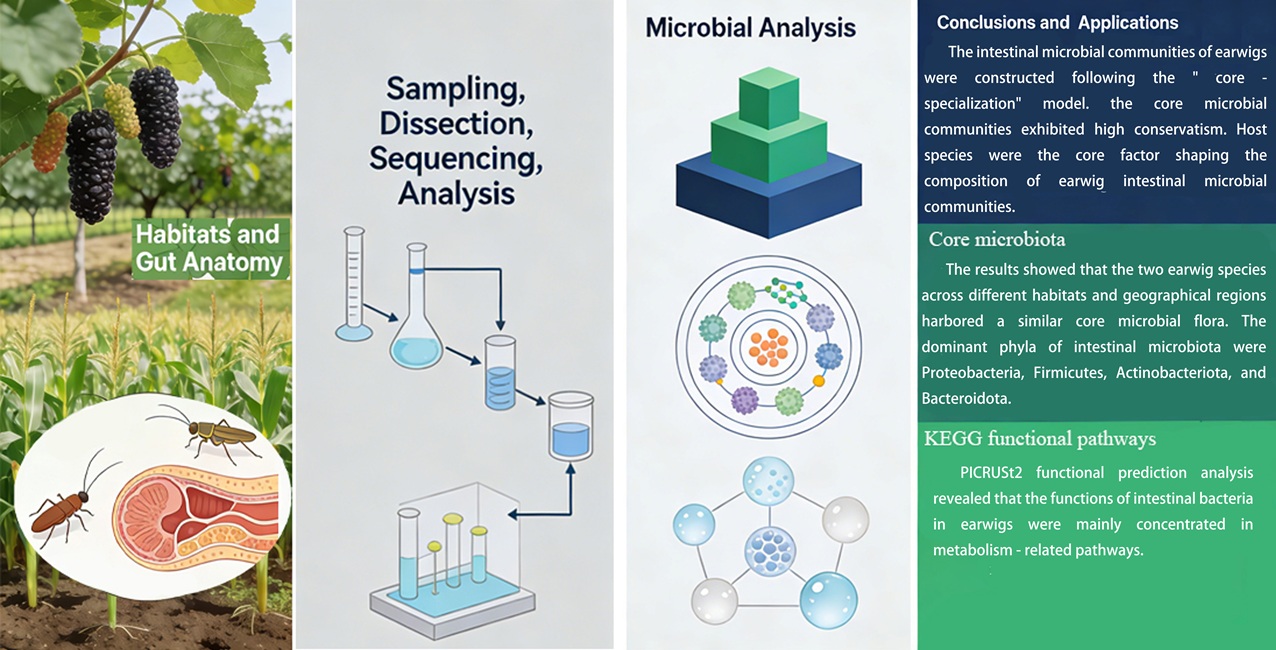
To explore the potential of earwigs (Dermaptera) for development and utilization as natural enemies, this study selected two earwig species widely distributed in mulberry orchards and cornfields of Guizhou Province in China as research objects. High-throughput sequencing technology was applied to conduct an in-depth investigation about the gut microbiota of earwigs across different geographical regions, habitats, and species, revealing the community composition, diversity characteristics, and potential functions of the microbiota. These findings clarify the compositional features and functional mechanisms of gut microbial communities in wild earwigs, which lays an important foundation for understanding the host–microbe interaction mechanisms of this group and provides a theoretical basis for the conservation and utilization of wild natural enemy insect resources.
Abstract
To clarify the compositional characteristics and functional mechanisms of gut microbial communities in wild earwigs (Dermaptera) and explore the potential of earwigs for development and utilization as natural enemies, this study conducted a comparative analysis of the gut microbial diversity and community structure of two earwig species, Timomenus komarovi (Semenov, 1901) and Eudohrnia metallica (Dohrn, 1865), which are widely distributed in mulberry orchards and cornfields of Guizhou Province, China. It also predicted the microbial functions based on the third-generation high-throughput sequencing technology targeting the 16S rRNA gene. The results showed that the two earwig species across different habitats and geographical regions harbored a similar core microbial flora. The dominant phyla of gut microbiota were Proteobacteria, Firmicutes. PICRUSt2 functional prediction analysis revealed that the functions of intestinal bacteria in earwigs were mainly concentrated in metabolism-related pathways. Through multi-dimensional analysis, it was confirmed that the gut microbial communities of earwigs were constructed following the “core-specialization” model. The core microbial communities exhibited high conservatism. Host species were the core factor shaping the composition of earwig gut microbial communities. Habitats could further regulate the commonness and diversity characteristics of the microbial communities, while geographical regions had an extremely weak impact on the gut microbial communities. Significant differences were observed in the gut microbial adaptation strategies between the two earwig species, which determined their distinct development potential and application scenarios as natural enemy insects: T. komarovi is suitable for development as a broad-spectrum natural enemy, while E. metallica is more appropriate for targeted development based on its microbial community characteristics. All data supporting the findings of this study are accessible in the NCBI database under BioProject accession number PRJNA1449822. This study provides a theoretical basis for exploring the functional mechanisms of intestinal microbes in dermapteran insects and supporting the development and utilization of these natural enemy resources.