Olfactory Responses of Apis mellifera and Bombus terrestris to Floral Volatiles from Three Solanaceae Crops


Simple Summary
Abstract
1. Introduction
2. Materials and Methods
2.1. Plants and Bees
2.2. Olfactory Selection Behavior
2.3. Extraction and Identification of Floral Volatiles
2.4. Electroantennography (EAG)
2.5. Statistical Analysis
3. Results
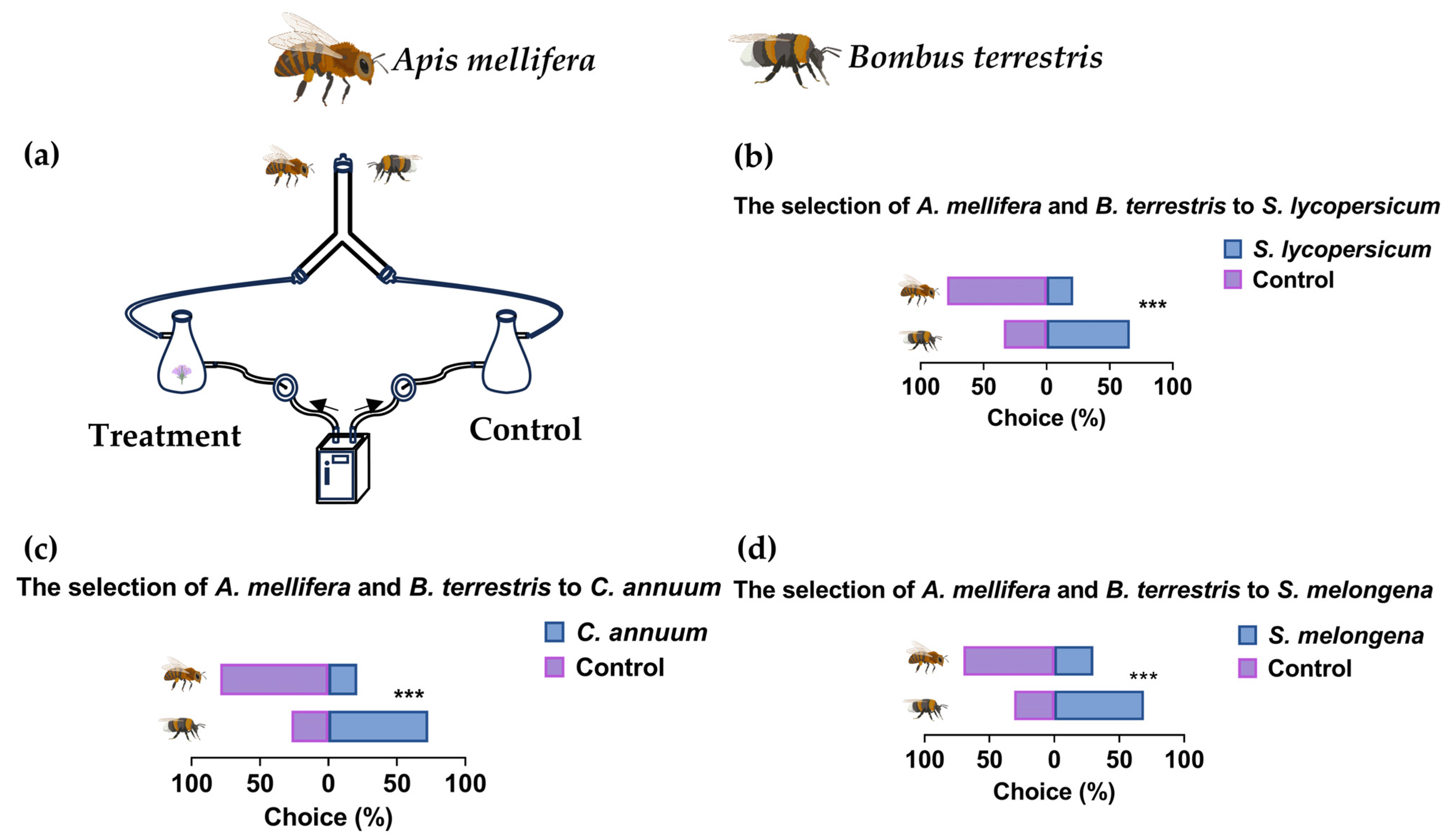
3.1. Comparisons of the Behavioral Preferences of A. mellifera and B. terrestris for the Flowers of Three Solanaceous Crop Plants
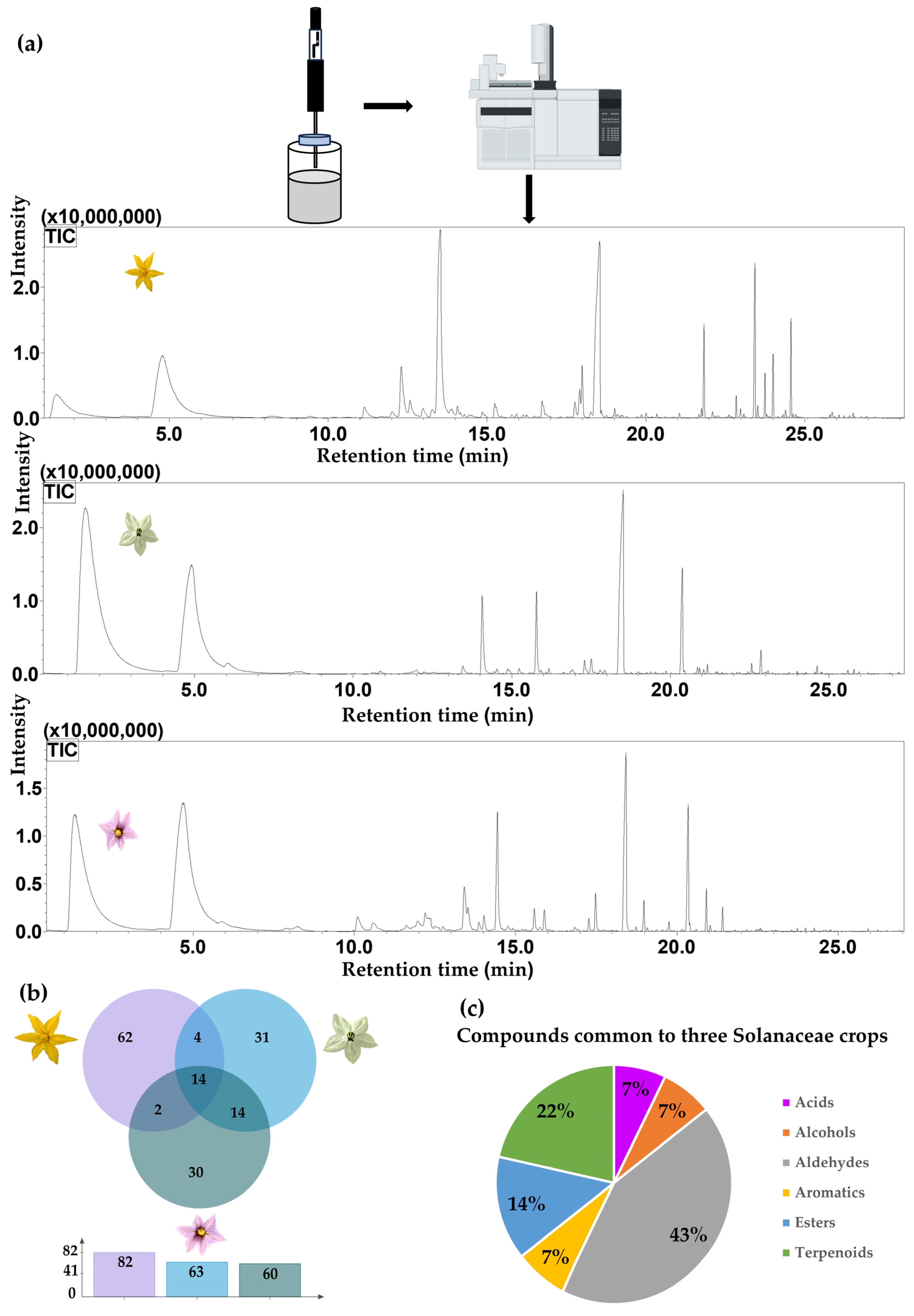
3.2. Identification of Common Volatile Compounds in Flowers of the Three Solanaceous Crop Plants
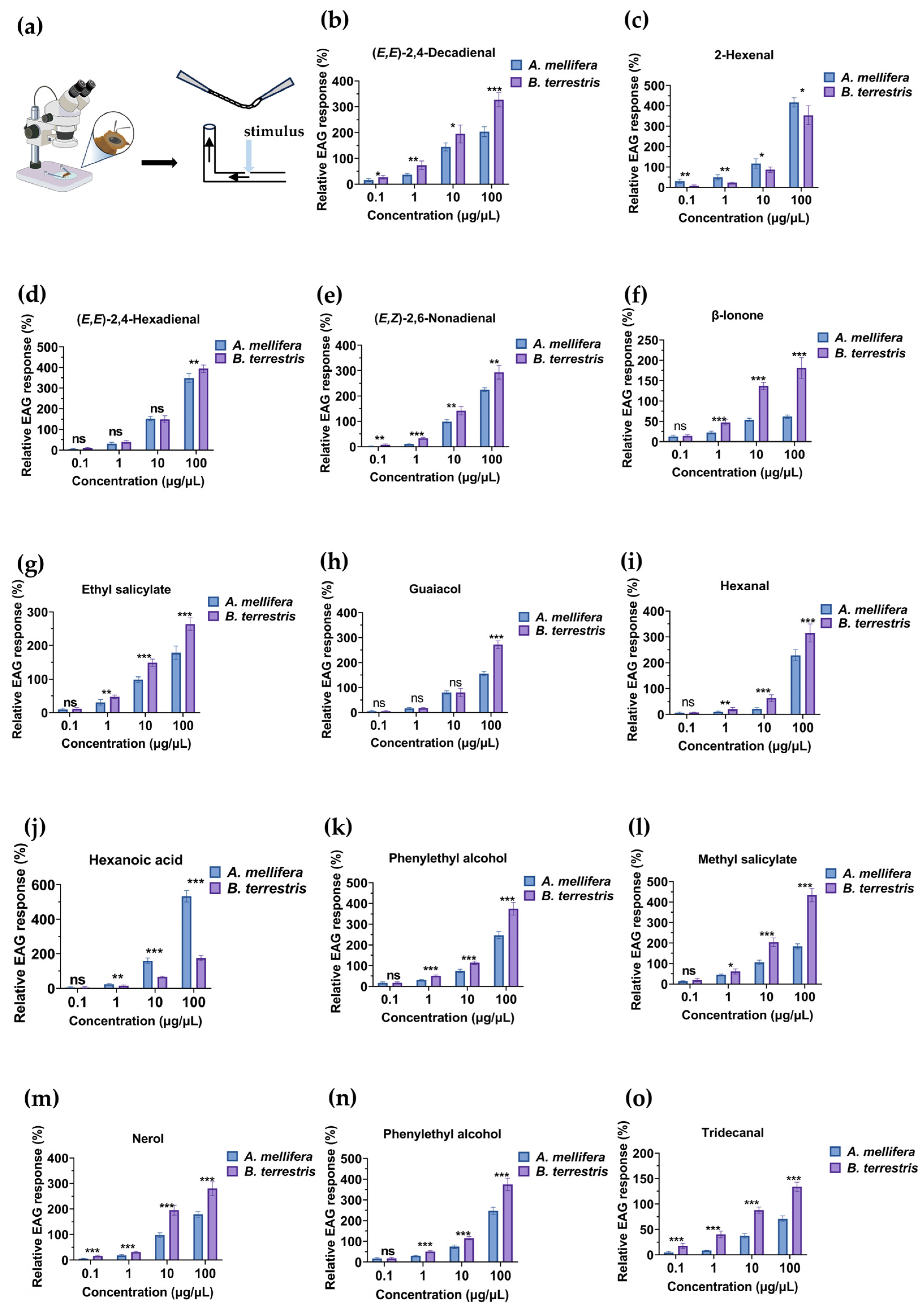
3.3. Electrophysiological Analysis of the Antennae of A. mellifera and B. terrestris
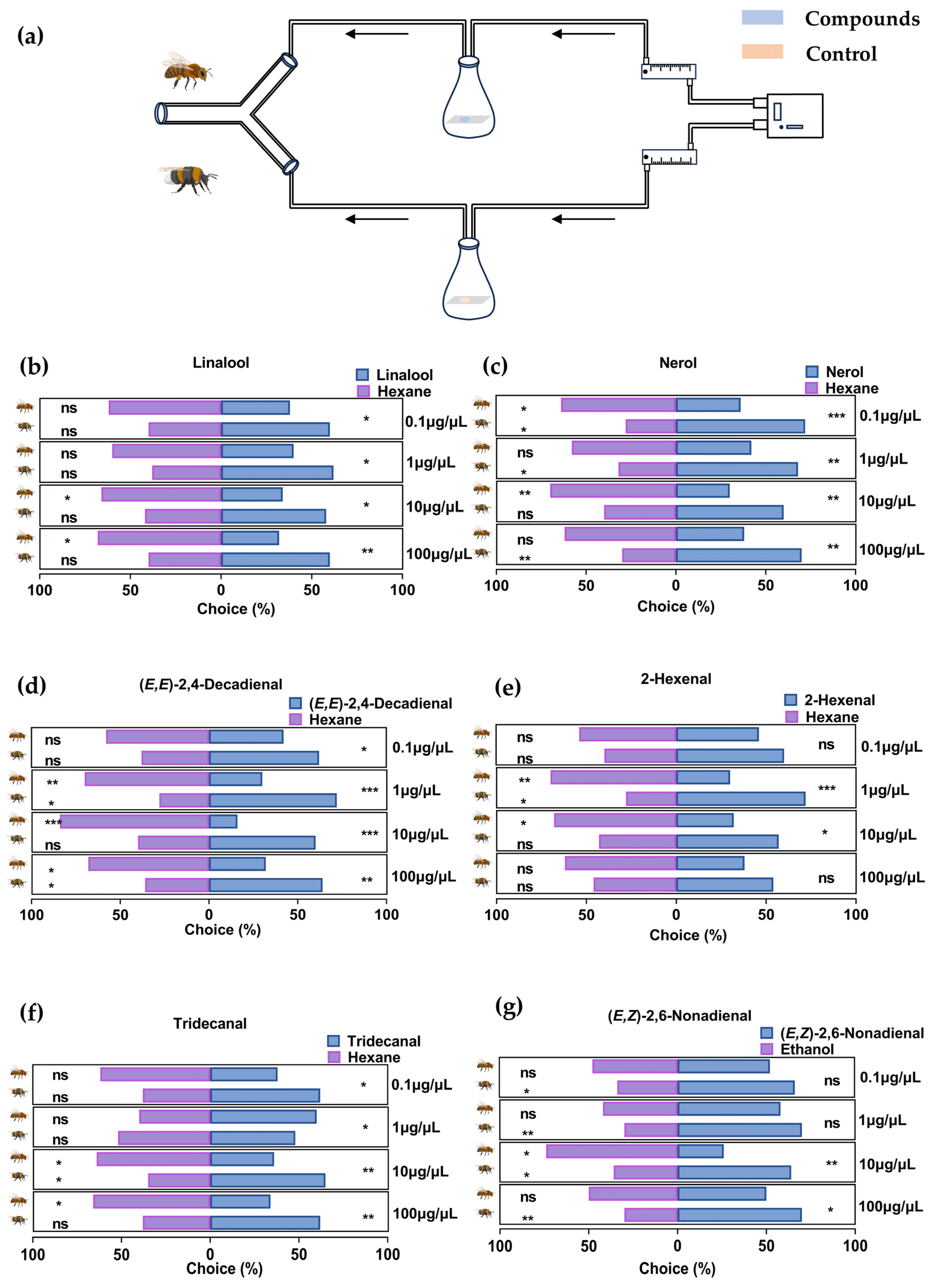
3.4. Behavioral Preferences of A. mellifera and B. terrestris for Common Emitted by Three Solanaceous Crop Plants
4. Discussion
5. Conclusions
Supplementary Materials
Author Contributions
Funding
Data Availability Statement
Conflicts of Interest
References
- Kline, O.; Joshi, N.K. Mitigating the Effects of Habitat Loss on Solitary Bees in Agricultural Ecosystems. Agriculture 2020, 10, 115. [Google Scholar] [CrossRef]
- Chapurlat, E.; Agren, J.; Anderson, J.; Friberg, M.; Sletvold, N. Conflicting Selection on Floral Scent Emission in the Orchid Gymnadenia conopsea. New Phytol. 2019, 222, 2009–2022. [Google Scholar] [CrossRef]
- Patel, V.; Pauli, N.; Biggs, E.; Barbour, L.; Boruff, B. Why Bees Are Critical for Achieving Sustainable Development. Ambio 2021, 50, 49–59. [Google Scholar] [CrossRef]
- Khalifa, S.A.M.; Elshafiey, E.H.; Shetaia, A.A.; El-Wahed, A.A.A.; Algethami, A.F.; Musharraf, S.G.; AlAjmi, M.F.; Zhao, C.; Masry, S.H.D.; Abdel-Daim, M.M.; et al. Overview of Bee Pollination and Its Economic Value for Crop Production. Insects 2021, 12, 688. [Google Scholar] [CrossRef] [PubMed]
- Reilly, J.; Bartomeus, I.; Simpson, D.; Allen-Perkins, A.; Garibaldi, L.; Winfree, R. Wild Insects and Honey Bees Are Equally Important to Crop Yields in a Global Analysis. Glob. Ecol. Biogeogr. 2024, 33, e13843. [Google Scholar] [CrossRef]
- Zhang, K.; He, C.; Wang, S.; Hou, X. Influence of Pollination Methods on Fruit Development, Fruit Yield and Oil Quality in Oil Tree Peony. Sci. Hortic. 2022, 295, 110877. [Google Scholar] [CrossRef]
- Papa, G.; Maier, R.; Durazzo, A.; Lucarini, M.; Karabagias, I.K.; Plutino, M.; Bianchetto, E.; Aromolo, R.; Pignatti, G.; Ambrogio, A.; et al. The Honey Bee Apis mellifera: An Insect at the Interface between Human and Ecosystem Health. Biology 2022, 11, 233. [Google Scholar] [CrossRef]
- Osterman, J.; Mateos-Fierro, Z.; Siopa, C.; Castro, H.; Castro, S.; Eeraerts, M. The Impact of Pollination Requirements, Pollinators, Landscape and Management Practices on Pollination in Sweet and Sour Cherry: A Systematic Review. Agric. Ecosyst. Environ. 2024, 374, 109163. [Google Scholar] [CrossRef]
- Gebremedhn, H. Pollination Activity and Foraging Behavior of Local Honeybee (Apis mellifera) under Open and Caged Conditions in Mekelle, Tigray, Ethiopia. Afr. J. Agric. Res. 2017, 12, 2620–2624. [Google Scholar] [CrossRef][Green Version]
- Waseem, M.; Khan, D.H.; Ali, M.; Khan, F.Z.A.; Hakim, A.; Ullah, S.; Manzoor, S.A.; Awan, T.H.; Mozūraitis, R. Insect Pollination Enhances Yield and Physicochemical Quality Traits in Three Jujube Cultivars. Insects 2025, 16, 1183. [Google Scholar] [CrossRef] [PubMed]
- Shpak, Y.V.; Leheta, U.V.; Sosnovskyi, K.S. Importance of Pollinator Diversity for Sunflower Seed Production. Agrology 2023, 6, 79–85. [Google Scholar] [CrossRef]
- de Souza, G.T.; Torquato, I.H.S.; Castro, C.C. Understanding the Relations between Solanaceae Crops and Their Pollinators: A Global Meta-Network. Plant Biol. 2024, 26, 157–165. [Google Scholar] [CrossRef] [PubMed]
- Wilf, P.; Carvalho, M.R.; Gandolfo, M.A.; Ruben Cuneo, N. Eocene Lantern Fruits from Gondwanan Patagonia and the Early Origins of Solanaceae. Science 2017, 355, 71–74. [Google Scholar] [CrossRef] [PubMed]
- Cooley, H.; Vallejo-Marín, M. Buzz-Pollinated Crops: A Global Review and Meta-Analysis of the Effects of Supplemental Bee Pollination in Tomato. J. Econ. Entomol. 2021, 114, 505–519. [Google Scholar] [CrossRef]
- Hiraguri, T.; Kimura, T.; Endo, K.; Ohya, T.; Takanashi, T.; Shimizu, H. Shape Classification Technology of Pollinated Tomato Flowers for Robotic Implementation. Sci. Rep. 2023, 13, 2159. [Google Scholar] [CrossRef]
- Wanza Soli, E.; Gladys, K.O.; Esther, N.K. Insect Pollinator Diversity and Their Influence on Yield and Quality of Capsicum annuum Linné; (Solanaceae), Machakos, Kenya. Open J. Anim. Sci. 2020, 10, 545–559. [Google Scholar] [CrossRef]
- Bänsch, S.; Tscharntke, T.; Gabriel, D.; Westphal, C. Crop Pollination Services: Complementary Resource Use by Social vs Solitary Bees Facing Crops with Contrasting Flower Supply. J. Appl. Ecol. 2021, 58, 476–485. [Google Scholar] [CrossRef]
- Jocković, J.; Grahovac, N.; Milovac, Ž.; Jocković, M.; Jocić, S.; Marjanović Jeromela, A.; Cvejić, S. Exploring Helianthus Species for Resilience to Drought during the Critical Reproductive Stage. Plants 2025, 14, 631. [Google Scholar] [CrossRef] [PubMed]
- Takahashi, K.; Itino, T. Comparison of Flower-Visiting Behaviour of Bumblebees and Swallowtail Butterflies to the Japanese Azalea (Rhododendron japonicum). J. Pollinat. Ecol. 2020, 26, 32–37. [Google Scholar] [CrossRef]
- Colda, A.; Bossaert, S.; Verreth, C.; Vanhoutte, B.; Honnay, O.; Keulemans, W.; Lievens, B. Inoculation of Pear Flowers with Metschnikowia reukaufii and Acinetobacter nectaris Enhances Attraction of Honeybees and Hoverflies, but Does Not Increase Fruit and Seed Set. PLoS ONE 2021, 16, e0250203. [Google Scholar] [CrossRef]
- Estravis-Barcala, M.C.; Palottini, F.; Macri, I.; Nery, D.; Farina, W.M. Managed Honeybees and South American Bumblebees Exhibit Complementary Foraging Patterns in Highbush Blueberry. Sci. Rep. 2021, 11, 8187. [Google Scholar] [CrossRef] [PubMed]
- Burger, H.; Dötterl, S.; Ayasse, M. Host-Plant Finding and Recognition by Visual and Olfactory Floral Cues in an Oligolectic Bee. Funct. Ecol. 2010, 24, 1234–1240. [Google Scholar] [CrossRef]
- Moore, C.D.; Farman, D.I.; Särkinen, T.; Stevenson, P.C.; Vallejo-Marín, M. Floral Scent Changes in Response to Pollen Removal Are Rare in Buzz-Pollinated Solanum. Planta 2024, 260, 15. [Google Scholar] [CrossRef] [PubMed]
- Mostafa, S.; Wang, Y.; Zeng, W.; Jin, B. Floral Scents and Fruit Aromas: Functions, Compositions, Biosynthesis, and Regulation. Front. Plant Sci. 2022, 13, 860157. [Google Scholar] [CrossRef]
- Shen, Y.; Rao, Y.; Ma, M.; Li, Y.; He, Y.; Wang, Z.; Liang, M.; Ning, G. Coordination among Flower Pigments, Scents and Pollinators in Ornamental Plants. Hortic. Adv. 2024, 2, 6–24. [Google Scholar] [CrossRef]
- Raguso, R.A.; Levin, R.A.; Foose, S.E.; Holmberg, M.W.; McDade, L.A. Fragrance Chemistry, Nocturnal Rhythms and Pollination “Syndromes” in Nicotiana. Phytochemistry 2003, 63, 265–284. [Google Scholar] [CrossRef]
- Bisrat, D.; Jung, C. Roles of Flower Scent in Bee-Flower Mediations: A Review. J. Ecol. Environ. 2022, 46, 3. [Google Scholar] [CrossRef]
- Zhao, X.; Zhou, M. Review on Chemical Constituents of Schizonepeta tenuifolia Briq. and Their Pharmacological Effects. Molecules 2022, 27, 5249. [Google Scholar] [CrossRef]
- Tu, M.; Liu, N.; He, Z.-S.; Dong, X.-M.; Gao, T.-Y.; Zhu, A.; Yang, J.-B.; Zhang, S.-B. Integrative Omics Reveals Mechanisms of Biosynthesis and Regulation of Floral Scent in Cymbidium tracyanum. Plant Biotechnol. J. 2025, 23, 2162–2181. [Google Scholar] [CrossRef]
- Kamal, I.M.; Zayed, A.; Eissa, T.F.; Farag, M.A. Aroma-Based Discrimination of Egyptian versus Indian Guava Fruits and in Response to Probiotics as Analyzed via SPME/GC–MS and Chemometric Tools. Sci. Rep. 2023, 13, 18420. [Google Scholar] [CrossRef]
- Colazza, S.; Peri, E.; Cusumano, A. Chemical Ecology of Floral Resources in Conservation Biological Control. Annu. Rev. Entomol. 2023, 68, 13–29. [Google Scholar] [CrossRef]
- Haber, A.I.; Sims, J.W.; Mescher, M.C.; Moraes, C.M.D.; Carr, D.E. A Key Floral Scent Component (β-trans-bergamotene) Drives Pollinator Preferences Independently of Pollen Rewards in Seep Monkeyflower. Funct. Ecol. 2019, 33, 218–228. [Google Scholar] [CrossRef]
- Rachersberger, M.; Cordeiro, G.D.; Schäffler, I.; Dötterl, S. Honeybee Pollinators Use Visual and Floral Scent Cues to Find Apple (Malus domestica) Flowers. J. Agric. Food Chem. 2019, 67, 13221–13227. [Google Scholar] [CrossRef]
- Twidle, A.M.; Barker, D.; Seal, A.G.; Fedrizzi, B.; Suckling, D.M. Identification of Floral Volatiles and Pollinator Responses in Kiwifruit Cultivars, Actinidia chinensis var. chinensis. J. Chem. Ecol. 2018, 44, 406–415. [Google Scholar] [CrossRef]
- Liu, J.; Chen, M.; Ma, W.; Zheng, L.; Zhang, B.; Zhao, H.; Jiang, Y. Composition of Strawberry Flower Volatiles and Their Effects on Behavior of Strawberry Pollinators, Bombus terrestris and Apis mellifera. Agronomy 2023, 13, 339. [Google Scholar] [CrossRef]
- Williams, G.R.; Alaux, C.; Costa, C.; Csáki, T.; Doublet, V.; Eisenhardt, D.; Fries, I.; Kuhn, R.; McMahon, D.P.; Medrzycki, P.; et al. Standard Methods for Maintaining Adult Apis mellifera in Cages under in Vitro Laboratory Conditions. J. Apic. Res. 2013, 52, 1–36. [Google Scholar] [CrossRef]
- Velthuis, H.H.W.; Van Doorn, A. A Century of Advances in Bumblebee Domestication and the Economic and Environmental Aspects of Its Commercialization for Pollination. Apidologie 2006, 37, 421–451. [Google Scholar] [CrossRef]
- Zhang, H.; Shan, S.; Gu, S.; Huang, X.; Li, Z.; Khashaveh, A.; Zhang, Y. Prior Experience with Food Reward Influences the Behavioral Responses of the Honeybee Apis mellifera and the Bumblebee Bombus lantschouensis to Tomato Floral Scent. Insects 2020, 11, 884. [Google Scholar] [CrossRef] [PubMed]
- Ai, S.; Luo, C.; Yao, X.; Qu, W.; Wang, Y.; Zhang, T.; Zhong, G.; Yi, X. Manipulation of Host-Plant Preference by Virus-Induced Changes to Its Insect Vector’s Olfactory System. Curr. Biol. 2025, 35, 3587–3600.e6. [Google Scholar] [CrossRef]
- Salzman, S.; Dahake, A.; Kandalaft, W.; Valencia-Montoya, W.A.; Calonje, M.; Specht, C.D.; Raguso, R.A. Cone Humidity Is a Strong Attractant in an Obligate Cycad Pollination System. Curr. Biol. 2023, 33, 1654–1664.e4. [Google Scholar] [CrossRef]
- Gao, J.; Ma, S.; Wang, X.; Yang, Y.; Luo, Q.; Wang, X.; Liu, F.; Wang, Q.; Fu, Z.; Diao, Q.; et al. Tropilaelaps mercedesae Parasitism Changes Behavior and Gene Expression in Honey Bee Workers. PLoS Pathog. 2021, 17, e1009684. [Google Scholar] [CrossRef]
- Zhang, J.; Liu, J.; Gao, F.; Chen, M.; Jiang, Y.; Zhao, H.; Ma, W. Electrophysiological and Behavioral Responses of Apis mellifera and Bombus terrestris to Melon Flower Volatiles. Insects 2022, 13, 973. [Google Scholar] [CrossRef]
- Favaro, R.; Roved, J.; Haase, A.; Angeli, S. Impact of Chronic Exposure to Two Neonicotinoids on Honey Bee Antennal Responses to Flower Volatiles and Pheromonal Compounds. Front. Insect Sci. 2022, 2, 821145. [Google Scholar] [CrossRef]
- Wang, Y.; Dong, H.; Qu, Y.; Zhou, Y.; Qin, J.; Li, K.; Luo, C.; Ren, B.; Cao, Y.; Zhang, S.; et al. Circabidian Rhythm of Sex Pheromone Reception in a Scarab Beetle. Curr. Biol. 2024, 34, 568–578.e5. [Google Scholar] [CrossRef] [PubMed]
- Miano, R.N.; Ayelo, P.M.; Musau, R.; Hassanali, A.; Mohamed, S.A. Electroantennogram and Machine Learning Reveal a Volatile Blend Mediating Avoidance Behavior by Tuta absoluta Females to a Wild Tomato Plant. Sci. Rep. 2022, 12, 8965. [Google Scholar] [CrossRef] [PubMed]
- Liu, J.; Zhang, J.; Shen, J.; Zhao, H.; Ma, W.; Jiang, Y. Differences in EAG Response and Behavioral Choices between Honey Bee and Bumble Bee to Tomato Flower Volatiles. Insects 2022, 13, 987. [Google Scholar] [CrossRef] [PubMed]
- Meijer, D.; van Doesburg, F.; Jungerling, L.; Weldegergis, B.T.; Kappers, I.F.; Van Oystaeyen, A.; van Loon, J.J.; Dicke, M. Supplemental Far-Red Light Influences Flowering Traits and Interactions with a Pollinator in Tomato Crops. Environ. Exp. Bot. 2023, 213, 105438. [Google Scholar] [CrossRef]
- Zhang, J.; Ma, W.; Zhang, Y.; Lu, S.; Zhang, C.; Zhao, H.; Jiang, Y. Odor-Binding Protein 2 in Apis mellifera ligustica Plays Important Roles in the Response to Floral Volatiles Stimuli from Melon and Tomato Flowers. Int. J. Mol. Sci. 2025, 26, 3176. [Google Scholar] [CrossRef]
- Ali, M.Y.; Naseem, T.; Zhang, J.; Pan, M.; Zhang, F.; Liu, T.-X. Plant Volatiles and Herbivore Induced Plant Volatiles from Chili Pepper Act as Attractant of the Aphid Parasitoid Aphelinus varipes (Hymenoptera: Aphelinidae). Plants 2022, 11, 1350. [Google Scholar] [CrossRef]
- Darshanee, H.L.C.; Ren, H.; Ahmed, N.; Zhang, Z.-F.; Liu, Y.-H.; Liu, T.-X. Volatile-Mediated Attraction of Greenhouse Whitefly Trialeurodes vaporariorum to Tomato and Eggplant. Front. Plant Sci. 2017, 8, 1285. [Google Scholar] [CrossRef]
- Su, W.; Ma, W.; Zhang, Q.; Hu, X.; Ding, G.; Jiang, Y.; Huang, J. Honey Bee Foraging Decisions Influenced by Pear Volatiles. Agriculture 2022, 12, 1074. [Google Scholar] [CrossRef]
- Kutty, N.N.; Mishra, M. Dynamic Distress Calls: Volatile Info Chemicals Induce and Regulate Defense Responses during Herbivory. Front. Plant Sci. 2023, 14, 1135000. [Google Scholar] [CrossRef]
- Li, H.; Li, J.; Dong, Y.; Hao, H.; Ling, Z.; Bai, H.; Wang, H.; Cui, H.; Shi, L. Time-Series Transcriptome Provides Insights into the Gene Regulation Network Involved in the Volatile Terpenoid Metabolism during the Flower Development of Lavender. BMC Plant Biol. 2019, 19, 313. [Google Scholar] [CrossRef]
- Guo, L.; Wang, J.; Yu, D.; Zhang, Y.; Zhang, H.; Guo, Y. Expression and Functional Analysis of the Smo Protein in Apis mellifera. Insects 2024, 15, 555. [Google Scholar] [CrossRef]
- Ruiz-Hernández, V.; Joubert, L.; Rodríguez-Gómez, A.; Artuso, S.; Pattrick, J.G.; Gómez, P.A.; Eckerstorfer, S.; Brandauer, S.S.; Trcka-Rojas, C.G.I.; Martínez-Reina, L.; et al. Humans Share More Preferences for Floral Phenotypes with Pollinators than with Pests. Front. Plant Sci. 2021, 12, 647347. [Google Scholar] [CrossRef]
- He, Y.; Zhang, J.; Hu, Z.; Cao, Y.; Mayo, K.H.; Liu, D.; E, M. Behavioral Responses of the Bumblebee Bombus terrestris to Volatile Compounds from Blueberries. Biology 2025, 14, 1570. [Google Scholar] [CrossRef]



| Class | Compounds | CAS | Relative Content (%) | ||
|---|---|---|---|---|---|
| S. lycopersicum | C. annuum | S. melongena | |||
| Aldehydes | (E,E)-2,4-decadienal | 25152-84-5 | 0.033 ± 0.007 | 0.04 ± 0.044 | 0.633 ± 0.14 |
| (E,E)-2,4-hexadienal | 142-83-6 | 0.347 ± 0.074 | 0.27 ± 0.098 | 0.437 ± 0.146 | |
| (E,Z)-2,6-nonadienal | 557-48-2 | 0.055 ± 0.015 | 0.27 ± 0.052 | 0.4 ± 0.157 | |
| 2-hexenal | 505-57-7 | 11.883 ± 6.42 | 10.555 ± 2.114 | 17.61 ± 5.926 | |
| Hexanal | 66-25-1 | 5.807 ± 2.207 | 36.015 ± 28.914 | 20.077 ± 11.096 | |
| Tridecanal | 10486-19-8 | 0.01 ± 0 | 0.01 ± 0 | 0.01 ± 0 | |
| Terpenoids | Linalool | 78-70-6 | 0.133 ± 0.015 | 0.027 ± 0.006 | 0.16 ± 0 |
| Nerol | 106-25-2 | 0.137 ± 0.019 | 0.037 ± 0.015 | 0.023 ± 0.006 | |
| β-ionone | 79-77-6 | 0.065 ± 0.005 | 0.037 ± 0.015 | 0.043 ± 0.006 | |
| Esters | methyl salicylate | 119-36-8 | 16.273 ± 0.807 | 10.273 ± 1.133 | 7.233 ± 1.964 |
| ethyl salicylate | 118-61-6 | 0.353 ± 0.122 | 2.43 ± 0.245 | 2.397 ± 0.725 | |
| Acids | hexanoic acid | 142-62-1 | 0.05 ± 0 | 0.29 ± 0.085 | 0.42 ± 0 |
| Alcohols | phenylethyl alcohol | 60-12-8 | 0.043 ± 0.012 | 0.027 ± 0.021 | 0.067 ± 0.006 |
| Aromatics | Guaiacol | 90-05-1 | 0.617 ± 0.219 | 0.263 ± 0.098 | 0.06 ± 0.017 |
| No. | Compounds | Purity (%) | Origin |
|---|---|---|---|
| 1 | (E,E)-2,4-decadienal | ≥90.0 | TCI 1 |
| 2 | (E,E)-2,4-hexadienal | ≥95.0 | Aladdin 2 |
| 3 | (E,Z)-2,6-nonadienal | ≥95.0 | TCI |
| 4 | 2-hexenal | ≥97.0 | TCI |
| 5 | hexanal | ≥98.0 | TCI |
| 6 | tridecanal | ≥95.0 | TCI |
| 7 | linalool | ≥96.0 | TCI |
| 8 | nerol | ≥98.0 | TCI |
| 9 | β-ionone | ≥95.0 | TCI |
| 10 | methyl salicylate | ≥99.0 | TCI |
| 11 | ethyl salicylate | ≥99.0 | TCI |
| 12 | hexanoic acid | ≥98.0 | TCI |
| 13 | phenylethyl alcohol | ≥98.0 | TCI |
| 14 | guaiacol | ≥98.0 | TCI |
Disclaimer/Publisher’s Note: The statements, opinions and data contained in all publications are solely those of the individual author(s) and contributor(s) and not of MDPI and/or the editor(s). MDPI and/or the editor(s) disclaim responsibility for any injury to people or property resulting from any ideas, methods, instructions or products referred to in the content. |
© 2026 by the authors. Licensee MDPI, Basel, Switzerland. This article is an open access article distributed under the terms and conditions of the Creative Commons Attribution (CC BY) license.
Share and Cite
Sun, Y.; Jin, J.; Jiao, G.; Huang, X.; Chen, C.; Zhang, H. Olfactory Responses of Apis mellifera and Bombus terrestris to Floral Volatiles from Three Solanaceae Crops. Insects 2026, 17, 507. https://doi.org/10.3390/insects17050507
Sun Y, Jin J, Jiao G, Huang X, Chen C, Zhang H. Olfactory Responses of Apis mellifera and Bombus terrestris to Floral Volatiles from Three Solanaceae Crops. Insects. 2026; 17(5):507. https://doi.org/10.3390/insects17050507
Chicago/Turabian StyleSun, Yingying, Jisu Jin, Guangyuan Jiao, Xiaolei Huang, Chao Chen, and Hong Zhang. 2026. "Olfactory Responses of Apis mellifera and Bombus terrestris to Floral Volatiles from Three Solanaceae Crops" Insects 17, no. 5: 507. https://doi.org/10.3390/insects17050507
APA StyleSun, Y., Jin, J., Jiao, G., Huang, X., Chen, C., & Zhang, H. (2026). Olfactory Responses of Apis mellifera and Bombus terrestris to Floral Volatiles from Three Solanaceae Crops. Insects, 17(5), 507. https://doi.org/10.3390/insects17050507