Insect Odorant Receptors: From Structure and Evolution to Mechanism and Application
 , ,
, ,
Simple Summary
Abstract
1. Introduction
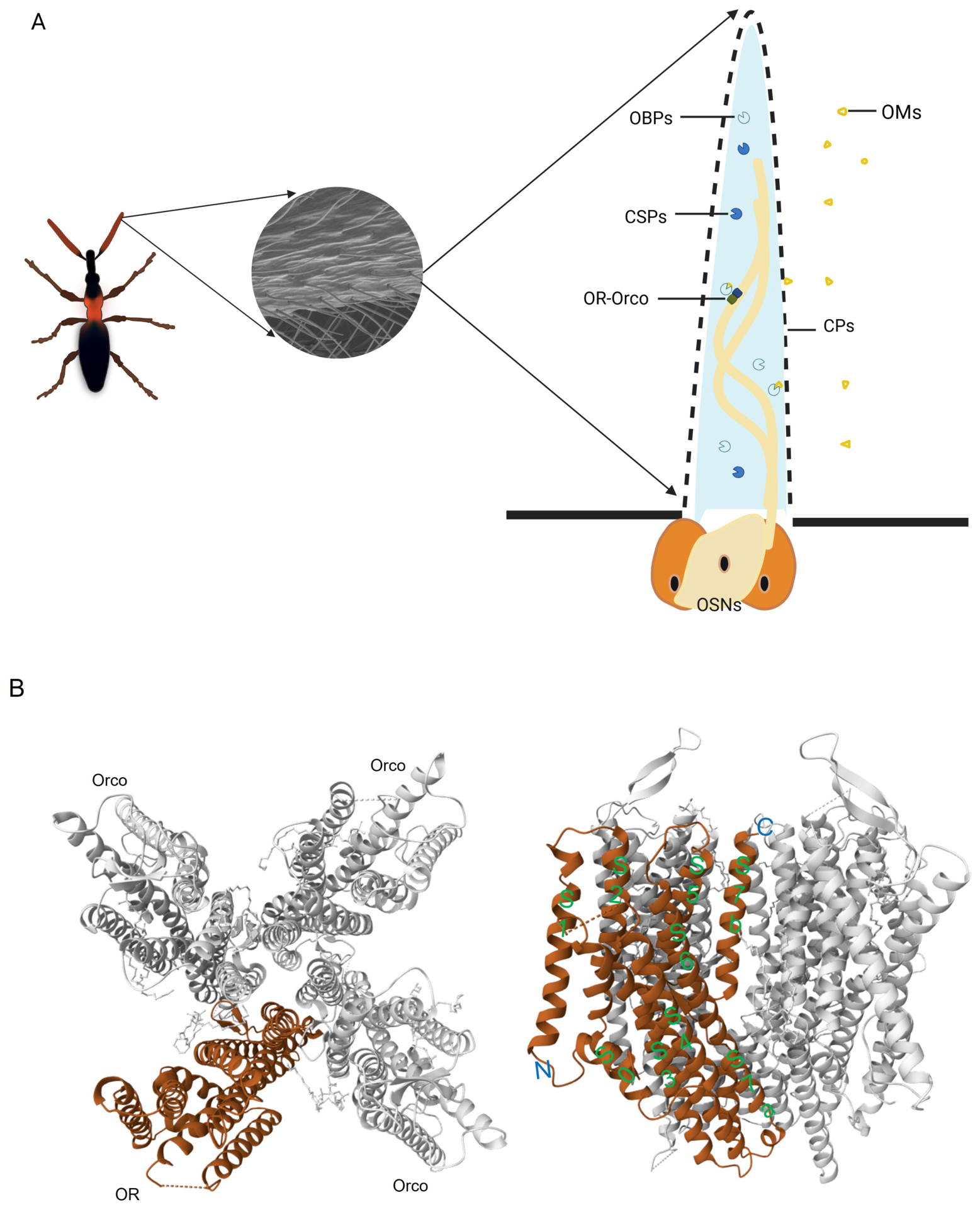
2. The Structural Blueprint of Insect Odorant Receptors
2.1. Topology and Classification: A Unique Membrane Protein Fold
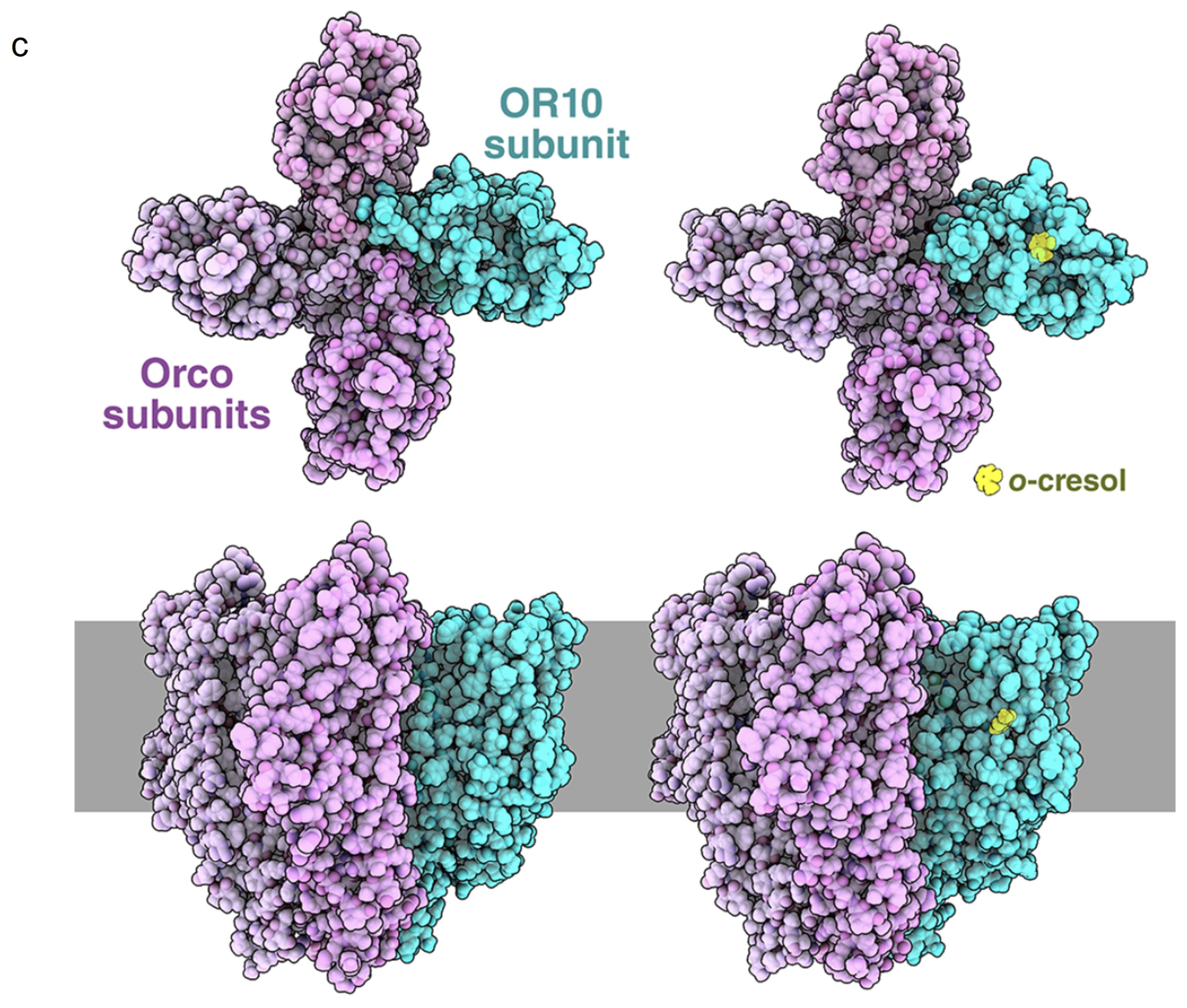
2.2. The 2024–2025 Revolution: High-Resolution Cryo-EM Structures
3. Molecular Evolution and Diversity of the OR Repertoire
3.1. Evolutionary Origins: From Taste to Smell
3.2. Dynamic Evolution and the “Birth-And-Death” Model
3.3. Structural Conservation Amidst Sequence Divergence
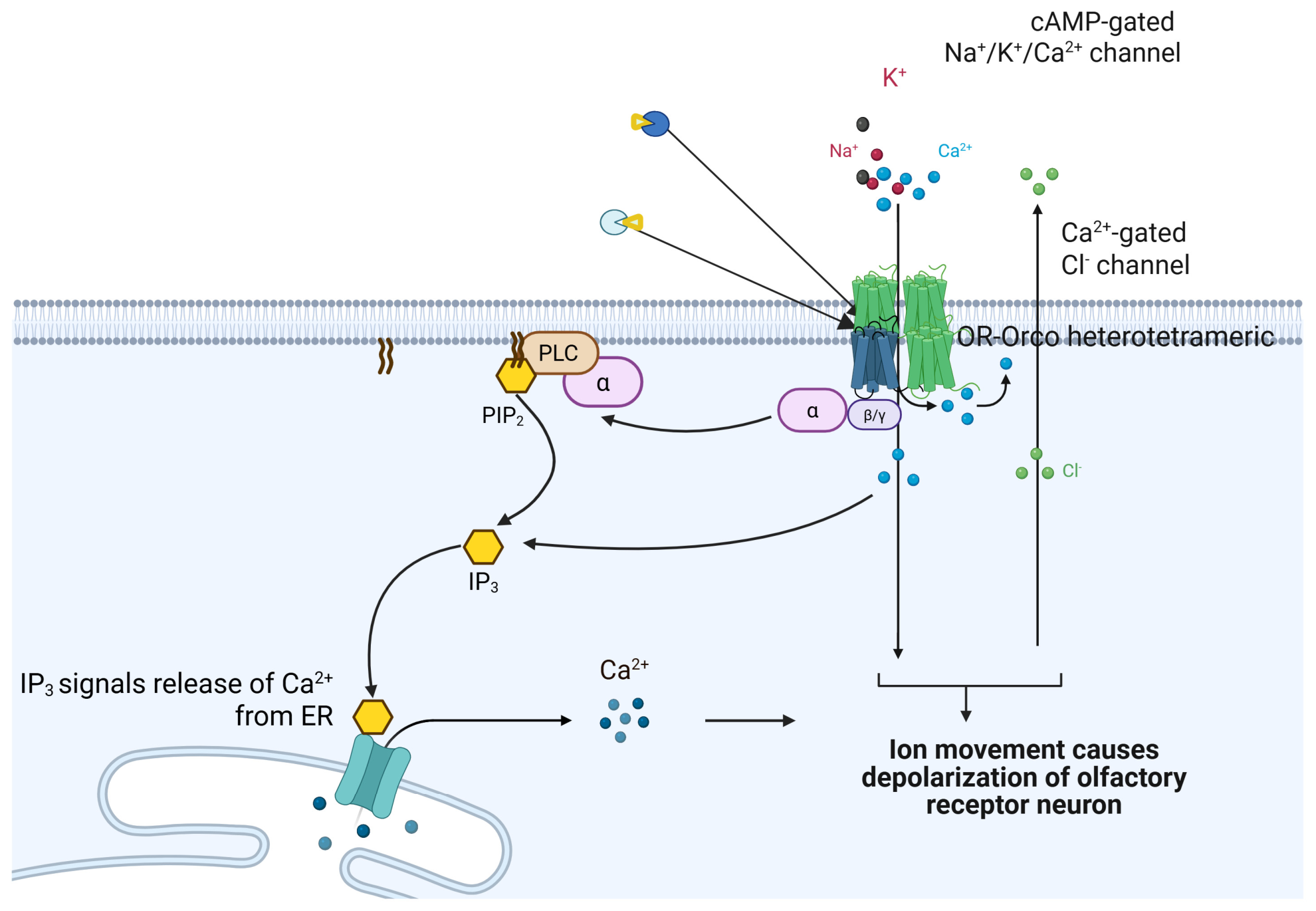
4. Reconciling the Signal Transduction Mechanism
4.1. Ionotropic Gating: The Fast Pathway
4.2. Signal Termination
5. Functional Landscapes and Emerging Applications
5.1. Functional Diversity of Tuning ORs
5.2. The Pivotal Role of Orco in Olfactory Signal Transduction
- Correct Subcellular Localization: Orco is required for the proper trafficking and stabilization of tuning ORs on the OSN dendritic membrane [84].
- Forming the Ion Channel Pore: Orco S7b helices are primary constituents of the pore [17].
- Enhancing Sensitivity: Orco dramatically increases the sensitivity of the OR complex to its ligand [28].
5.3. Structure-Guided Applications in Pest Management
6. Future Perspectives
- Capturing Conformational Dynamics: Time-resolved cryo-EM and advanced molecular dynamics simulations will visualize the complete movie of channel gating [93].
7. Conclusions
Author Contributions
Funding
Data Availability Statement
Acknowledgments
Conflicts of Interest
References
- Leal, W.S. Odorant reception in insects: Functional and evolutionary perspectives. Annu. Rev. Entomol. 2025, 70, 275–297. [Google Scholar] [CrossRef]
- Hansson, B.S.; Stensmyr, M.C. Evolution of insect olfaction. Neuron 2011, 72, 698–711. [Google Scholar] [CrossRef] [PubMed]
- Fabre, J.H. Souvenirs Entomologiques: Études sur L’Instinct et les Moeurs des Insects; Première série; Librairie Ch. Delagrave: Paris, France, 1879; p. 298. [Google Scholar]
- Vosshall, L.B.; Stocker, R.F. Molecular architecture of smell and taste in Drosophila. Annu. Rev. Neurosci. 2007, 30, 505–533. [Google Scholar] [CrossRef] [PubMed]
- Fleischer, J.; Pregitzer, P.; Breer, H.; Krieger, J. Access to the odor world: Olfactory receptors and their role for signal transduction in insects. Cell. Mol. Life Sci. 2018, 75, 485–508. [Google Scholar] [CrossRef]
- Hua, J.F.; Fu, Y.J.; Zhou, Q.L.; Huang, Y.M.; Li, H.H.; Chen, T.Y.; Ma, D.F.; Li, Z.Y. Three chemosensory proteins from the sweet potato weevil, Cylas formicarius, are involved in the perception of host plant volatiles. Pest Manag. Sci. 2021, 77, 4497–4509. [Google Scholar] [CrossRef]
- Pelosi, P.; Iovinella, I.; Zhu, J.; Wang, G.; Dani, F.R. Beyond chemoreception: Diverse tasks of soluble olfactory proteins in insects. Biol. Rev. 2018, 93, 184–200. [Google Scholar] [CrossRef]
- Jaffar, S.; Smagghe, G.; Lu, Y. Olfactory receptors in Bactrocera species for sustainable fruit fly management: A review and future perspectives. Physiol. Entomol. 2024, 49, 67–90. [Google Scholar] [CrossRef]
- Leal, W.S. Odorant reception in insects: Roles of receptors, binding proteins, and degrading enzymes. Annu. Rev. Entomol. 2013, 58, 373–391. [Google Scholar] [CrossRef]
- Sato, K.; Touhara, K. Insect olfaction: Receptors, signal transduction, and behavior. Results Probl. Cell Differ. 2009, 47, 203–220. [Google Scholar] [CrossRef]
- Wilson, R.I. Early olfactory processing in Drosophila: Mechanisms and principles. Annu. Rev. Neurosci. 2013, 36, 217–241. [Google Scholar] [CrossRef]
- Galizia, C.G.; Rössler, W. Parallel olfactory systems in insects: Anatomy and function. Annu. Rev. Entomol. 2010, 55, 399–420. [Google Scholar] [CrossRef]
- Clyne, P.J.; Warr, C.G.; Freeman, M.R.; Lessing, D.; Carlson, J.R. A novel family of divergent seven-transmembrane proteins: Candidate odorant receptors in Drosophila. Neuron 1999, 22, 327–338. [Google Scholar] [CrossRef]
- Vosshall, L.B.; Amrein, H.; Morozov, P.S.; Rzhetsky, A.; Axel, R. A spatial map of olfactory receptor expression in the Drosophila antenna. Cell 1999, 96, 725–736. [Google Scholar] [CrossRef]
- Benton, R.; Sachse, S.; Michnick, S.W.; Vosshall, L.B. Atypical membrane topology and heteromeric function of Drosophila odorant receptors in vivo. PLoS Biol. 2006, 4, e20. [Google Scholar] [CrossRef]
- Robertson, H.M.; Warr, C.G.; Carlson, J.R. Molecular evolution of the insect chemoreceptor gene superfamily in Drosophila melanogaster. Proc. Natl. Acad. Sci. USA 2003, 100, 14537–14542. [Google Scholar] [CrossRef]
- Wang, Y.D.; Qiu, L.; Wang, B.; Guan, Z.Y.; Dong, Z.; Yang, L.L.; Zhang, Z.; Cao, S.; Yang, Y.; Wang, B.; et al. Structural basis for odorant recognition of the insect odorant receptor OR-Orco heterocomplex. Science 2024, 384, 1453–1460. [Google Scholar] [CrossRef]
- Zhao, J.W.; Chen, A.Q.; Ryu, J.; Mármol, J.D. Structural basis of odor sensing by insect heteromeric odorant receptors. Science 2024, 384, 1460–1467. [Google Scholar] [CrossRef]
- Yang, J.; He, H.; Dong, S.; Lv, J.; Cheng, L.; Yu, Q.; Kang, L.; Guo, X. Locusts adopt IP3 as a second messenger for olfactory signal transduction. Sci. Adv. 2025, 11, e12345. [Google Scholar] [CrossRef]
- Tiwari, V.; Karpe, S.D.; Sowdhamini, R. Topology prediction of insect olfactory receptors. Curr. Opin. Struct. Biol. 2019, 55, 194–203. [Google Scholar] [CrossRef] [PubMed]
- Bai, P.H.; Wang, B.; Zhang, X.H.; Wang, G.R. Research methods and advances of odorant receptors in insects. Acta Entomol. Sin. 2022, 65, 364–385. [Google Scholar] [CrossRef]
- Smart, R.; Kiely, A.; Beale, M.; Vargas, E.; Carraher, C.; Kralicek, A.V.; Christie, D.L.; Chen, C.; Newcomb, R.D.; Warr, C.G. Drosophila odorant receptors are novel seven transmembrane domain proteins that can signal independently of heterotrimeric G proteins. Insect Biochem. Mol. Biol. 2008, 38, 770–780. [Google Scholar] [CrossRef]
- Benton, R. Molecular basis of odor detection in insects. Ann. N. Y. Acad. Sci. 2009, 1170, 478–482. [Google Scholar] [CrossRef]
- Wicher, D. Functional evolution of insect olfactory receptors. Chem. Senses 2017, 42, 173–180. [Google Scholar] [CrossRef]
- Larsson, M.C.; Domingos, A.I.; Jones, W.D.; Chiappe, M.E.; Amrein, H.; Vosshall, L.B. Or83b encodes a broadly expressed odorant receptor essential for Drosophila olfaction. Neuron 2004, 43, 703–714. [Google Scholar] [CrossRef]
- Vosshall, L.B.; Hansson, B.S. A unified nomenclature system for the insect olfactory coreceptor. Chem. Senses 2011, 36, 497–498. [Google Scholar] [CrossRef]
- Schmidt, H.R.; Benton, R. Molecular mechanisms of olfactory detection in insects: Beyond receptors. Open Biol. 2020, 10, 200252. [Google Scholar] [CrossRef] [PubMed]
- Jones, P.L.; Pask, G.M.; Rinker, D.C.; Zwiebel, L.J. Functional agonism of insect odorant receptor ion channels. Proc. Natl. Acad. Sci. USA 2011, 108, 8821–8825. [Google Scholar] [CrossRef] [PubMed]
- Zhang, X.N.; Ma, D.M.; Wang, J.Q.; Su, N.N.; Guo, J.T. Structures and molecular mechanisms of insect odorant and gustatory receptors. Physiology 2025, 40, 518–537. [Google Scholar] [CrossRef]
- Xue, W.; Lu, X.L.; Zhang, T.M.; Guo, Y.; Li, Y.H.; Li, G.; Xu, C.; Lu, H.M. Probing the optimal architecture and molecular mechanism of insect odorant receptor heteromeric channels. Commun. Biol. 2025, 8, 1119. [Google Scholar] [CrossRef]
- Yan, H.; Jafari, S.; Pask, G.; Zhou, X.; Reinberg, D.; Desplan, C. Evolution, developmental expression and function of odorant receptors in insects. J. Exp. Biol. 2020, 223, jeb208215. [Google Scholar] [CrossRef]
- Missbach, C.; Dweck, H.K.; Vogel, H.; Vilcinskas, A.; Stensmyr, M.C.; Hansson, B.S.; Grosse-Wilde, E. Evolution of insect olfactory receptors. eLife 2014, 3, e02115. [Google Scholar] [CrossRef]
- Eyun, S.I.; Soh, H.Y.; Posavi, M.; Munro, J.B.; Hughes, D.S.T.; Murali, S.C.; Qu, J.; Dugan, S.; Lee, S.L.; Chao, H.; et al. Evolutionary history of chemosensory-related gene families across the Arthropoda. Mol. Biol. Evol. 2017, 34, 1838–1862. [Google Scholar] [CrossRef] [PubMed]
- Ma, D.M.; Hu, M.Q.; Yang, X.T.; Liu, Q.; Ye, F.; Cai, W.J.; Wang, Y.; Xu, X.Y.; Chang, S.H.; Wang, R.Y.; et al. Structural basis for sugar perception by Drosophila gustatory receptors. Science 2024, 383, eadj2609. [Google Scholar] [CrossRef] [PubMed]
- Brand, P.; Robertson, H.M.; Lin, W.; Pothula, R.; Klingeman, W.E.; Jurat-Fuentes, J.L.; Johnson, B.R. The origin of the odorant receptor gene family in insects. eLife 2018, 7, e38340. [Google Scholar] [CrossRef]
- Mármol, J.D.; Yedlin, M.A.; Ruta, V. The structural basis of odorant recognition in insect olfactory receptors. Nature 2021, 597, 126–131. [Google Scholar] [CrossRef]
- Robertson, H.M. Molecular evolution of the major arthropod chemoreceptor gene families. Annu. Rev. Entomol. 2019, 64, 227–242. [Google Scholar] [CrossRef]
- Sánchez-Gracia, A.; Vieira, F.G.; Rozas, J. Molecular evolution of the major chemosensory gene families in insects. Heredity 2009, 103, 208–216. [Google Scholar] [CrossRef]
- Andersson, M.N.; Löfstedt, C.; Newcomb, R.D. Insect olfaction and the evolution of receptor tuning. Front. Ecol. Evol. 2015, 3, 53. [Google Scholar] [CrossRef]
- Zhou, X.; Rokas, A.; Berger, S.L.; Liebig, J.; Ray, A.; Zwiebel, L.J. Chemoreceptor evolution in Hymenoptera and its implications for the evolution of eusociality. Genome Biol. Evol. 2015, 7, 2407–2416. [Google Scholar] [CrossRef]
- McKenzie, S.K.; Kronauer, D.J.C. The genomic architecture and molecular evolution of ant odorant receptors. Genome Res. 2018, 28, 1757–1765. [Google Scholar] [CrossRef] [PubMed]
- Zhang, X.X.; Liu, Y.; Guo, M.B.; Sun, D.D.; Zhang, M.J.; Chu, X.; Berg, B.G.; Wang, G.R. A female-specific odorant receptor mediates oviposition deterrence in the moth Helicoverpa armigera. Curr. Biol. 2024, 34, 1–11. [Google Scholar] [CrossRef]
- Chang, H.T.; Guo, M.B.; Wang, B.; Liu, Y.; Dong, S.L.; Wang, G.R. Sensillar expression and responses of olfactory receptors reveal different peripheral coding in two Helicoverpa species using the same pheromone components. Sci. Rep. 2016, 6, 18742. [Google Scholar] [CrossRef] [PubMed]
- Wang, G.R. Recent advances in insect odorant receptor deorphanization. Curr. Opin. Insect Sci. 2023, 58, 101064. [Google Scholar]
- Zhang, S.; Jacquin-Joly, E.; Montagné, N.; Liu, F.; Liu, Y.; Wang, G.R. Identification of an odorant receptor responding to sex pheromones in Spodoptera frugiperda extends the novel type-1 PR lineage in moths. Insect Sci. 2024, 31, 489–502. [Google Scholar] [CrossRef]
- Chen, M.D.; Bai, T.F.; Wang, J.X.; Mai, D.N.; Obiero, G.F.; Getahun, M.N.; Zhang, J.; Dong, S.L.; Yan, Q. Key volatiles and ORs mediating oviposition preference for maize plants in Chinese population of Spodoptera frugiperda. J. Agric. Food Chem. 2025, 73, 17156–17166. [Google Scholar] [CrossRef]
- Sakurai, T.; Nakagawa, T.; Mitsuno, H.; Mori, H.; Endo, Y.; Tanoue, S.; Yasukochi, Y.; Touhara, K.; Nishioka, T. Identification and functional characterization of a sex pheromone receptor in the silkmoth Bombyx mori. Proc. Natl. Acad. Sci. USA 2004, 101, 16653–16658. [Google Scholar] [CrossRef]
- Nakagawa, T.; Sakurai, T.; Nishioka, T.; Touhara, K. Insect sex-pheromone signals mediated by specific combinations of olfactory receptors. Science 2005, 307, 1638–1642. [Google Scholar] [CrossRef]
- Sato, K.; Pellegrino, M.; Nakagawa, T.; Nakagawa, T.; Vosshall, L.B.; Touhara, K. Insect olfactory receptors are heteromeric ligand-gated ion channels. Nature 2008, 452, 1002–1006. [Google Scholar] [CrossRef]
- Wicher, D.; Schäfer, R.; Bauernfeind, R.; Stensmyr, M.C.; Heller, R.; Heinemann, S.H.; Hansson, B.S. Drosophila odorant receptors are both ligand-gated and cyclic-nucleotide-activated cation channels. Nature 2008, 452, 1007–1011. [Google Scholar] [CrossRef]
- Bohbot, J.D.; Pitts, R.J.; Kwon, H.W.; Rützler, M.; Robertson, H.M.; Zwiebel, L.J. Molecular characterization of the Aedes aegypti odorant receptor gene family. Insect Mol. Biol. 2007, 16, 525–537. [Google Scholar] [CrossRef] [PubMed]
- Carey, A.F.; Wang, G.; Su, C.Y.; Zwiebel, L.J.; Carlson, J.R. Odorant reception in the malaria mosquito Anopheles gambiae. Nature 2010, 464, 66–71. [Google Scholar] [CrossRef]
- Mitchell, R.F.; Schneider, T.M.; Schwartz, A.M.; Andersson, M.N.; McKenna, D.D. The diversity and evolution of odorant receptors in beetles (Coleoptera). Insect Mol. Biol. 2020, 29, 77–92. [Google Scholar] [CrossRef]
- Hua, J.F.; Zhang, L.; Han, Y.H.; Gou, X.W.; Chen, T.Y.; Huang, Y.M.; Li, Y.Q.; Ma, D.F.; Li, Z.Y. Chromosome-level genome assembly of Cylas formicarius provides insights into its adaptation and invasion mechanism. J. Integr. Agric. 2023, 22, 825–843. [Google Scholar] [CrossRef]
- Hua, J.F.; Pan, C.; Huang, Y.M.; Li, Y.Q.; Li, H.F.; Wu, C.R.; Chen, T.Y.; Ma, D.F.; Li, Z.Y. Functional characteristic analysis of three odorant-binding proteins from the sweet potato weevil (Cylas formicarius) in the perception of sex pheromones and host plant volatiles. Pest Manag. Sci. 2021, 77, 300–312. [Google Scholar] [CrossRef]
- Slone, J.D.; Pask, G.M.; Ferguson, S.T.; Millar, J.G.; Berger, S.L.; Reinberg, D.; Liebig, J.; Ray, A.; Zwiebel, L.J. Functional characterization of odorant receptors in the ponerine ant, Harpegnathos saltator. Proc. Natl. Acad. Sci. USA 2017, 114, 8586–8591. [Google Scholar] [CrossRef]
- Robertson, H.M.; Wanner, K.W. The chemoreceptor superfamily in the honey bee, Apis mellifera: Expansion of the odorant, but not gustatory, receptor family. Genome Res. 2006, 16, 1395–1403. [Google Scholar] [CrossRef] [PubMed]
- Huang, T.; Yang, L.; Tian, Y.; Wang, B.; Liu, W.; Bai, P.; Liu, Y.; Francis, F.; Cheng, X.; Wang, B.; et al. Evolutionarily entrenched odorant receptors for (E)-β-farnesene signaling in Aphidinae aphids. iScience 2026, 29, 114785. [Google Scholar] [CrossRef]
- Liu, J.T.; Xie, J.X.; Khashaveh, A.; Zhou, J.J.; Zhang, Y.J.; Dong, H.; Cong, B.; Gu, S.H. Identification and tissue expression profiles of odorant receptor genes in the green peach aphid Myzus persicae. Insects 2022, 13, 398. [Google Scholar] [CrossRef] [PubMed]
- Pan, X.Q.; Liu, J.; Xu, X.; Zhang, L.W.; Zhang, L. Combinatorial olfactory signaling in short-distance determines host plant recognition in locust. Agriculture 2023, 13, 1030. [Google Scholar] [CrossRef]
- Nei, M.; Rooney, A.P. Concerted and birth-and-death evolution of multigene families. Annu. Rev. Genet. 2005, 39, 121–152. [Google Scholar] [CrossRef]
- Nozawa, M.; Nei, M. Evolutionary dynamics of olfactory receptor genes in Drosophila species. Proc. Natl. Acad. Sci. USA 2007, 104, 712–717. [Google Scholar] [CrossRef] [PubMed]
- Bastin-Héline, L.; de Fouchier, A.; Cao, S.; Koutroumpa, F.; Caballero-Vidal, G.; Robakiewicz, S.; Monsempes, C.; François, M.C.; Ribeyre, T.; Maria, A.; et al. A novel lineage of candidate pheromone receptors for sex communication in moths. eLife 2019, 8, e49826. [Google Scholar] [CrossRef]
- Leary, G.P.; Allen, J.E.; Bunger, P.L.; Luginbill, J.B.; Linn, C.E.; Macallister, I.E.; Kavanaugh, M.P.; Wanner, K.W. Single mutation to a sex pheromone receptor provides adaptive specificity between closely related moth species. Proc. Natl. Acad. Sci. USA 2012, 109, 14081–14086. [Google Scholar] [CrossRef]
- Li, Z.; Baruah, A.; Bhamidipati, S.; Montagné, N.; Jacquin-Joly, E.; Meslin, C. Molecular bases of insect odorant receptor function: Specificity and evolution. Biol. Rev. 2026, 101, 1036–1049. [Google Scholar] [CrossRef]
- Prieto-Godino, L.L.; Rytz, R.; Cruchet, S.; Bargeton, B.; Abuin, L.; Silbering, A.F.; Ruta, V.; Dal Peraro, M.; Benton, R. Evolution of acid-sensing olfactory circuits in drosophilids. Neuron 2017, 93, 661–676. [Google Scholar] [CrossRef]
- Vogt, R.G.; Riddiford, L.M. Pheromone binding and inactivation by moth antennae. Nature 1981, 293, 161–163. [Google Scholar] [CrossRef] [PubMed]
- Xue, Q.; Hasan, K.S.; Dweck, O.; Ebrahim, S.A.; Dweck, H.K. Functional characterization and evolution of olfactory responses in coeloconic sensilla of the global fruit pest Drosophila suzukii. BMC Biol. 2025, 23, 50. [Google Scholar] [CrossRef] [PubMed]
- Cassau, S.; Krieger, J. The role of SNMPs in insect olfaction. Cell Tissue Res. 2020, 383, 21–33. [Google Scholar] [CrossRef]
- Gomez-Diaz, C.; Bargeton, B.; Abuin, L.; Bukar, N.; Reina, J.H.; Bartoi, T.; Graf, M.; Ong, H.; Ulbrich, M.H.; Masson, J.F.; et al. A CD36 ectodomain mediates insect pheromone detection via a putative tunnelling mechanism. Nat. Commun. 2016, 7, 11866. [Google Scholar] [CrossRef]
- Chertemps, T.; Maïbèche, M. Odor degrading enzymes and signal termination. Insect Biochem. Mol. Biol. 2021, 619–644. [Google Scholar] [CrossRef]
- Guo, X.X.; Hou, J.G.; Zhang, W.J.; Zhang, Y.H.; Li, H.L.; Cao, W.J.; Li, H.H.; Li, X.S. A cytochrome P450 monooxygenase (CYP337B5) plays a key role in regulating juvenile hormone biosynthesis and degrading chlorantraniliprole in Spodoptera frugiperda (Lepidoptera: Noctuidae). J. Asia-Pac. Entomol. 2024, 27, 102298. [Google Scholar] [CrossRef]
- De Fouchier, A.; Walker, W.B., III; Montagné, N.; Steiner, C.; Binyameen, M.; Schlyter, F.; Chertemps, T.; Maria, A.; Francois, M.C.; Monsempes, C.; et al. Functional evolution of Lepidoptera olfactory receptors revealed by deorphanization of a moth repertoire. Nat. Commun. 2017, 8, 15709. [Google Scholar] [CrossRef] [PubMed]
- Ma, W.C.; Li, Y.N.; Yang, L.N.; Yan, S.C. Sex differences in antennal transcriptome of Hyphantria cunea and analysis of odorant receptor expression profiles. Int. J. Mol. Sci. 2024, 25, 9070. [Google Scholar] [CrossRef]
- Gu, T.Z.; Chen, X.W.; Ma, T.Y.; Ye, J.; Hao, D.J.; Zhang, L.W. SNMPs function as molecular bridges between OBPs and ORs in the olfactory recognition of Clostera Retitura (Walker)(Lepidoptera: Notodontidae). J. Chem. Ecol. 2025, 51, 95. [Google Scholar] [CrossRef]
- Qian, J.L.; Mang, D.Z.; Lv, G.C.; Ye, J.; Li, Z.Q.; Chu, B.; Sun, L.; Liu, Y.J.; Zhang, L.W. Identification and expression profile of olfactory receptor genes based on Apriona germari (Hope) antennal transcriptome. Front. Physiol. 2020, 11, 807. [Google Scholar] [CrossRef]
- Li, S.J.; Gao, X.Y.; Ma, C.; Tian, Z.Y.; Zhang, Y.; Chen, H.S.; Zhou, Z.S. Identification and functional verification of active volatiles recognition by the olfactory co-receptor Orco in Chrysopa pallens (Rambur) (Neuroptera: Chrysopidae). J. Insect Sci. 2025, 25, 8. [Google Scholar] [CrossRef] [PubMed]
- Zhang, J.H.; Li, L.; Li, N.; Li, Y.Y.; Pang, B.P. Expression profiling and functional analysis of candidate odorant receptors in Galeruca daurica. Insects 2022, 13, 563. [Google Scholar] [CrossRef]
- Liu, W.B.; Li, H.M.; Wang, G.R.; Cao, H.Q.; Wang, B. Conserved odorant receptor, EcorOR4, mediates attraction of mated female Eupeodes corollae to 1-Octen-3-ol. J. Agric. Food Chem. 2023, 71, 1837–1844. [Google Scholar] [CrossRef] [PubMed]
- Zheng, H.X.; Zhang, M.; Wei, G.H.; Cui, X.L.; Zhang, X.H. Cloning and spatio-temporal expression profiling of odorant receptor genes in Callosobruchus chinensis (Coleoptera: Bruchidae). Acta Entomol. Sin. 2023, 66, 171–180. [Google Scholar] [CrossRef]
- Wang, C.; Li, G.N.; Miao, C.J.; Zhao, M.; Wang, B.; Guo, X.R. Nonanal modulates oviposition preference in female Helicoverpa assulta (Lepidoptera: Noctuidae) via the activation of peripheral neurons. Pest Manag. Sci. 2020, 76, 3159–3167. [Google Scholar] [CrossRef]
- Comte, A.; Lalis, M.; Brajon, L.; Moracci, R.; Montagné, N.; Topin, J.; Jacquin-Joly, E.; Fiorucci, S. Accelerating ligand discovery for insect odorant receptors. Int. J. Biol. Sci. 2025, 21, 2101. [Google Scholar] [CrossRef]
- Cheng, J.J.; Gui, J.W.; Yao, X.M.; Zhao, H.; Zhou, Y.J.; Du, Y.J. Functional identification of olfactory receptors of Cnaphalocrocis medinalis (Lepidoptera: Crambidae) for plant odor. Insects 2023, 14, 930. [Google Scholar] [CrossRef]
- Bahk, S.; Jones, W.D. The insect odorant receptor co-receptor Orco is required for the trafficking and function of conventional odorant receptors. J. Neurosci. 2016, 36, 11487–11499. [Google Scholar]
- Shimomura, K.; Mori, K.; Akasaka, S.; Tomizawa, M. Gene silencing of olfactory receptor coreceptor by systemic RNA interference in Callosobruchus maculatus. J. Chem. Ecol. 2025, 51, 5. [Google Scholar] [CrossRef] [PubMed]
- Benton, R.; Vannice, K.S.; Gomez-Diaz, C.; Vosshall, L.B. Variant ionotropic glutamate receptors as chemosensory receptors in Drosophila. Cell 2009, 136, 149–162. [Google Scholar] [CrossRef]
- Chang, T.; Zhao, K.Z.; Wang, Y.B.; Qiao, H.H.; Liu, W.B.; Yan, C.C. Progress of RNAi technology in insect genomics research and biological control. J. Environ. Entomol. 2023, 45, 1514–1524. [Google Scholar] [CrossRef]
- Jayanthi, P.D.K.; Kempraj, V.; Aurade, R.M.; Roy, T.K.; Shivashankara, K.S.; Verghese, A. Computational reverse chemical ecology: Virtual screening and predicting behaviorally active semiochemicals for Bactrocera dorsalis. BMC Genom. 2014, 15, 209. [Google Scholar] [CrossRef] [PubMed]
- Leal, W.S. Reverse chemical ecology at the service of conservation biology. Proc. Natl. Acad. Sci. USA 2017, 114, 12030–12032. [Google Scholar] [CrossRef]
- Antony, B.; Montagné, N.; Comte, A.; Mfarrej, S.; Jakše, J.; Capoduro, R.; Shelke, R.; Cali, K.; Alsaleh, M.A.; Persaud, K.; et al. Deorphanizing an odorant receptor tuned to palm tree volatile esters in the Asian palm weevil sheds light on the mechanisms of palm tree selection. Insect Biochem. Mol. Biol. 2024, 169, 104129. [Google Scholar] [CrossRef]
- Hirao, T.; Ihara, Y.; Ijichi, C.; Kudo, G.; Yoshino, R.; Hirokawa, T. Molecular simulation-based 3D structural construction of olfactory receptor with agonist binding. J. Comput. Aid. Mol. Des. 2026, 40, 15. [Google Scholar] [CrossRef]
- Thanu, V.C.; Jabeen, A.; Zographos, S.E.; Taylor, P.W.; Ranganathan, S. TBM preferred to AlphaFold 3 for functional models of insect odorant receptors. Comput. Struct. Biotec. 2025, 27, 3908–3918. [Google Scholar] [CrossRef]
- Frank, J. Time-resolved cryo-electron microscopy: Recent progress. J. Struct. Biol. 2017, 200, 303–306. [Google Scholar] [CrossRef]
- Jumper, J.; Evans, R.; Pritzel, A.; Green, T.; Figurnov, M.; Ronneberger, O.; Tunyasuvunakool, K.; Bates, R.; Žídek, A.; Potapenko, A.; et al. Highly accurate protein structure prediction with AlphaFold. Nature 2021, 596, 583–589. [Google Scholar] [CrossRef]
- Varadi, M.; Anyango, S.; Deshpande, M.; Nair, S.; Natassia, C.; Yordanova, G.; Yuan, D.; Stroe, O.; Wood, G.; Laydon, A.; et al. AlphaFold protein structure database: Massively expanding the structural coverage of protein-sequence space with high-accuracy models. Nucleic Acids Res. 2022, 50, D439–D444. [Google Scholar] [CrossRef]
- Task, D.; Lin, C.C.; Vulpe, A.; Afify, A.; Ballou, S.; Brbic, M.; Schlegel, P.; Raji, J.; Jefferis, G.S.; Li, H.; et al. Chemoreceptor co-expression in Drosophila melanogaster olfactory neurons. eLife 2022, 11, e72599. [Google Scholar] [CrossRef]
- Berck, M.; Khandelwal, A.; Claus, L.; Hernandez-Nunez, L.; Si, G.; Tabone, C.J.; Li, F.; Truman, J.W.; Fetter, R.D.; Louis, M.; et al. The wiring diagram of a glomerular olfactory system. eLife 2016, 5, e14859. [Google Scholar] [CrossRef]
- Franco, T.A.; Oliveira, D.S.; Moreira, M.F.; Leal, W.S.; Melo, A.C.A. Silencing the odorant receptor co-receptor (Orco) disrupts the behavior of a blood-sucking bug. Insect Biochem. Mol. Biol. 2018, 101, 39–46. [Google Scholar] [CrossRef]
- Su, C.Y.; Menuz, K.; Carlson, J.R. Olfactory perception: Receptors, cells, and circuits. Cell 2009, 139, 45–59. [Google Scholar] [CrossRef] [PubMed]
- Winding, M.; Pedigo, B.D.; Barnes, C.L.; Patsolic, H.G.; Park, Y.; Kazimiers, T.; Fushiki, A.; Andrade, I.V.; Khandelwal, A.; Valdes-Aleman, J.; et al. The connectome of an insect brain. Science 2023, 379, eadd9330. [Google Scholar] [CrossRef] [PubMed]
- Soman, S.; Ramaswamy, S.S.; Sane, S.P. Odor tracking in insects: A multisensory behavior. J. Exp. Biol. 2026, 229, jeb250945. [Google Scholar] [CrossRef]



| Order | Representative Species | No. of Deorphanized ORs | Major Ligand Classes | Key Behavioral Functions | Selected References |
|---|---|---|---|---|---|
| Lepidoptera | Helicoverpa armigera | >20 | Sex pheromones, green leaf volatiles, terpenoids | Oviposition deterrence, mating, host finding | [42,43,44] |
| Lepidoptera | Spodoptera frugiperda | ~15 | Pheromones, plant volatiles (e.g., (Z)-9-tetradecenyl acetate) | Oviposition preference, male attraction | [45,46] |
| Lepidoptera | Bombyx mori | 4 (classic) | Bombykol, bombykal | Mating | [47,48] |
| Diptera | Drosophila melanogaster | >50 | Fruit esters, alcohols, acids | Food search, courtship | [13,49,50] |
| Diptera | Aedes aegypti | ~12 | Indole, ammonia derivatives, octenol | Host seeking, ovip | [18,51] |
| Diptera | Anopheles gambiae | ~10 | Human skin odors, plant volatiles | Host preference | [18,52] |
| Coleoptera | Tribolium castaneum | ~8 | Pheromones (4,8-dimethyldecanal), food odors | Aggregation, mate recognition | [53] |
| Coleoptera | Cylas formicarius | 6 (via OBPs/CSPs) | Host plant volatiles (e.g., (E)-2-hexenal) | Host location | [6,54,55] |
| Hymenoptera | Harpegnathos saltator | ~9 | Cuticular hydrocarbons, general odorants | Nestmate recognition, social behavior | [41,56] |
| Hymenoptera | Apis mellifera | ~12 | Queen pheromone components (9-ODA), floral scents | Queen retinue, foraging | [57] |
| Hemiptera | Acyrthosiphon pisum | 5 | Alarm pheromone (E)-β-farnesene | Escape behavior | [17,58] |
| Hemiptera | Myzus persicae | 4 | Green leaf volatiles (e.g., nonanal) | Host plant selection | [59] |
| Orthoptera | Locusta migratoria | 3 | Aggregation pheromone (4-vinylanisole), plant volatiles | Aggregation, feeding | [19,30,60] |
| Species | Genes | Expression Pattern | Key Finding | Reference |
|---|---|---|---|---|
| Hyphantria cunea | HcunORs (21 genes) | Antennae-high | Most ORs antennae-high | [74] |
| Clostera restitura | CresOR37,41,43,56 | Male antennae-specific | Sex-biased expression suggests roles in pheromone detection | [75] |
| Apriona germari | AgerOR1,3,4,37,40 | Female antennae-specific | Sex- and tissue-specific expression; AgerOR9 in female maxillary palp | [76] |
| Drosophila suzukii | DsuzOrco | 3rd instar larvae (trace); adult high | Developmental regulation; increases with age | [68] |
| Locusta migratoria | LmigOR12,20 | Antennae = palps; palps-high | Distinct spatial expression patterns in olfactory organs | [60] |
| Chrysopa pallens | CpalOR3, etc. (28 genes) | Antennae-high | Broad tissue distribution; CpalOR6 in thorax; CpalOR26,27 in abdomen | [77] |
| Galeruca daurica | GdauOR4, Orco | Antennae-highest | Sex- and tissue-biased expression; GdauOR1 female antennae-high | [78] |
| Eupeodes corollae | EcorOR4 | Antennae-specific | Strict antennae-specific expression; conserved recognition of 1-octen-3-ol | [79] |
| Callosobruchus chinensis | CchiOR8, 10 | Antennae-high; female antennae-high | Sexually dimorphic expression; spatio-temporal expression profiling | [80] |
Disclaimer/Publisher’s Note: The statements, opinions and data contained in all publications are solely those of the individual author(s) and contributor(s) and not of MDPI and/or the editor(s). MDPI and/or the editor(s) disclaim responsibility for any injury to people or property resulting from any ideas, methods, instructions or products referred to in the content. |
© 2026 by the authors. Licensee MDPI, Basel, Switzerland. This article is an open access article distributed under the terms and conditions of the Creative Commons Attribution (CC BY) license.
Share and Cite
Hua, J.; Li, H.; Huang, Y.; Li, Y.; Li, Z.; Chen, T.; Pan, C.; Qin, R.; Wang, Y. Insect Odorant Receptors: From Structure and Evolution to Mechanism and Application. Insects 2026, 17, 496. https://doi.org/10.3390/insects17050496
Hua J, Li H, Huang Y, Li Y, Li Z, Chen T, Pan C, Qin R, Wang Y. Insect Odorant Receptors: From Structure and Evolution to Mechanism and Application. Insects. 2026; 17(5):496. https://doi.org/10.3390/insects17050496
Chicago/Turabian StyleHua, Jinfeng, Huifeng Li, Yongmei Huang, Yanqing Li, Zhenwei Li, Tianyuan Chen, Chao Pan, Renbing Qin, and Yongbo Wang. 2026. "Insect Odorant Receptors: From Structure and Evolution to Mechanism and Application" Insects 17, no. 5: 496. https://doi.org/10.3390/insects17050496
APA StyleHua, J., Li, H., Huang, Y., Li, Y., Li, Z., Chen, T., Pan, C., Qin, R., & Wang, Y. (2026). Insect Odorant Receptors: From Structure and Evolution to Mechanism and Application. Insects, 17(5), 496. https://doi.org/10.3390/insects17050496