Functional Responses of Three Insect Predators to Plutella xylostella Across Developmental Stages


Simple Summary
Abstract
1. Introduction
2. Materials and Methods
2.1. Insect Colonies
2.2. Rearing of P. xylostella
2.3. Functional Response Experiments
2.3.1. Predation by E. furcellata on Larval Stages
2.3.2. Predation on Pupal Stages
2.3.3. Predation by Mantids on Late-Instar Larvae
2.3.4. Predation on Adult Moths
3. Statistical Analyses
3.1. Density-Dependent Comparisons Within Predator–Prey Combinations
3.2. Functional Response Classification
3.3. Functional Response Parameter Estimation
3.4. Model Robustness Evaluation
3.5. Strict Cross-Species Comparison Under Matched Conditions
4. Results
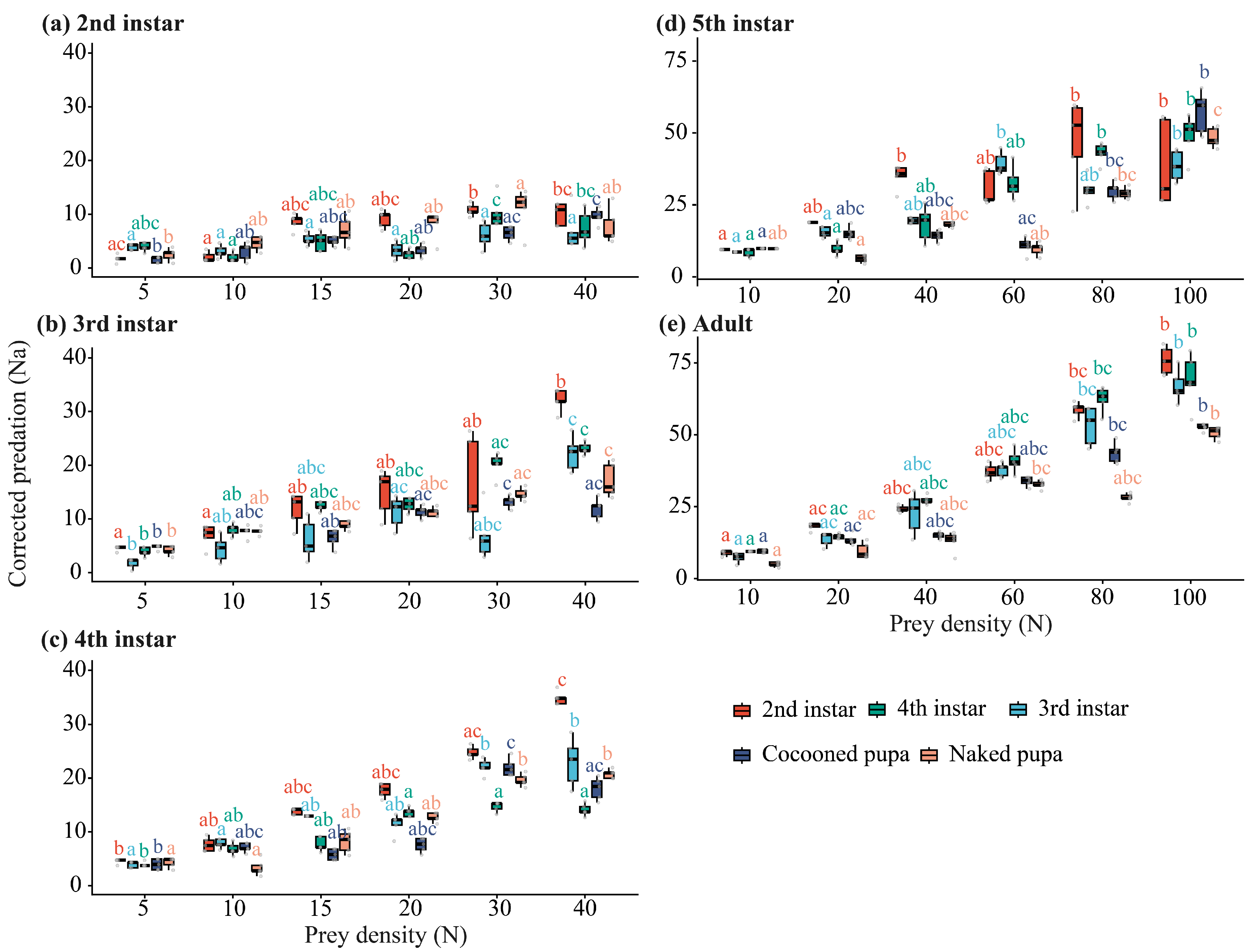
4.1. Density-Dependent Variation in Corrected Predation by E. furcellata
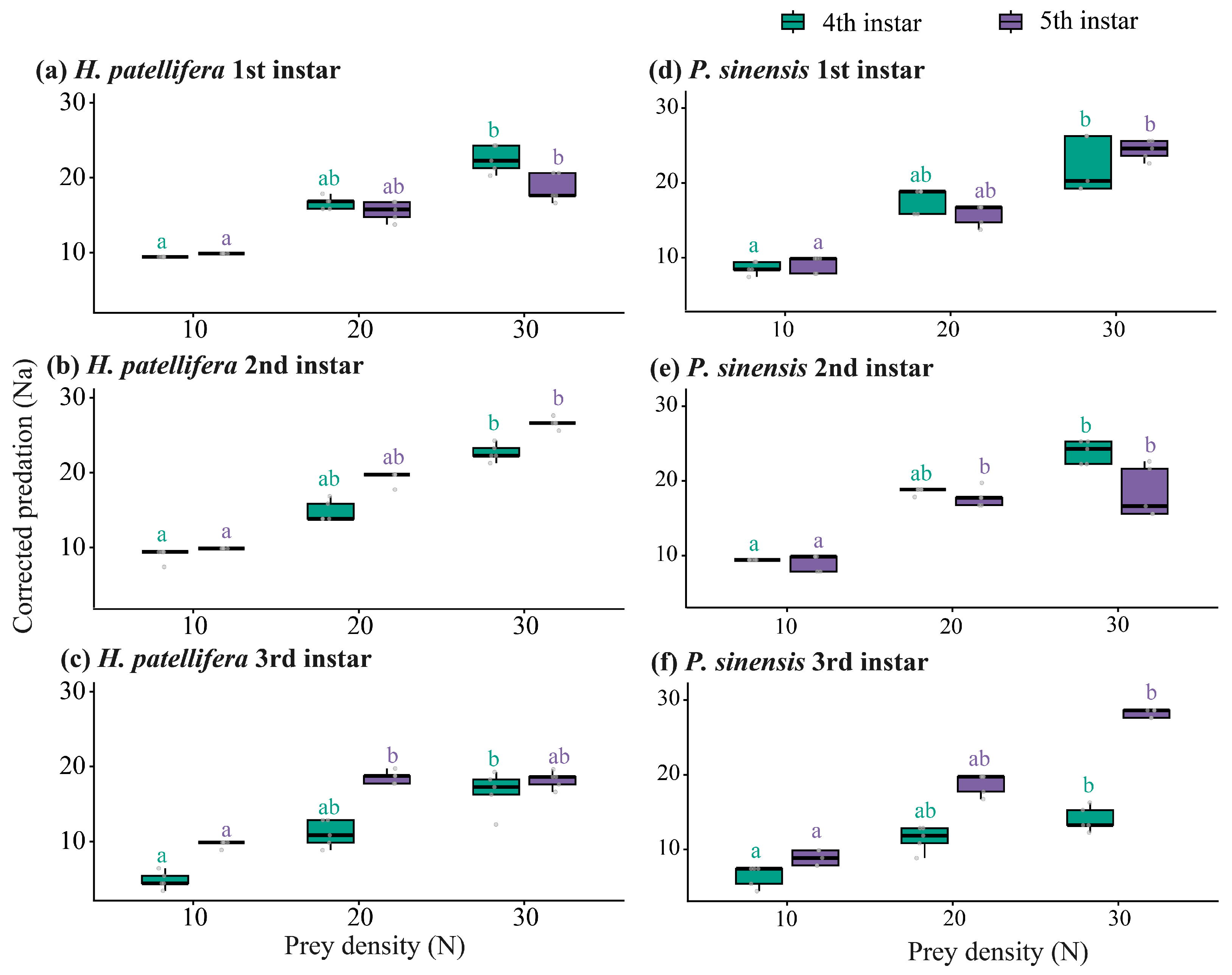
4.2. Density-Dependent Predation Patterns of H. patellifera and P. sinensis
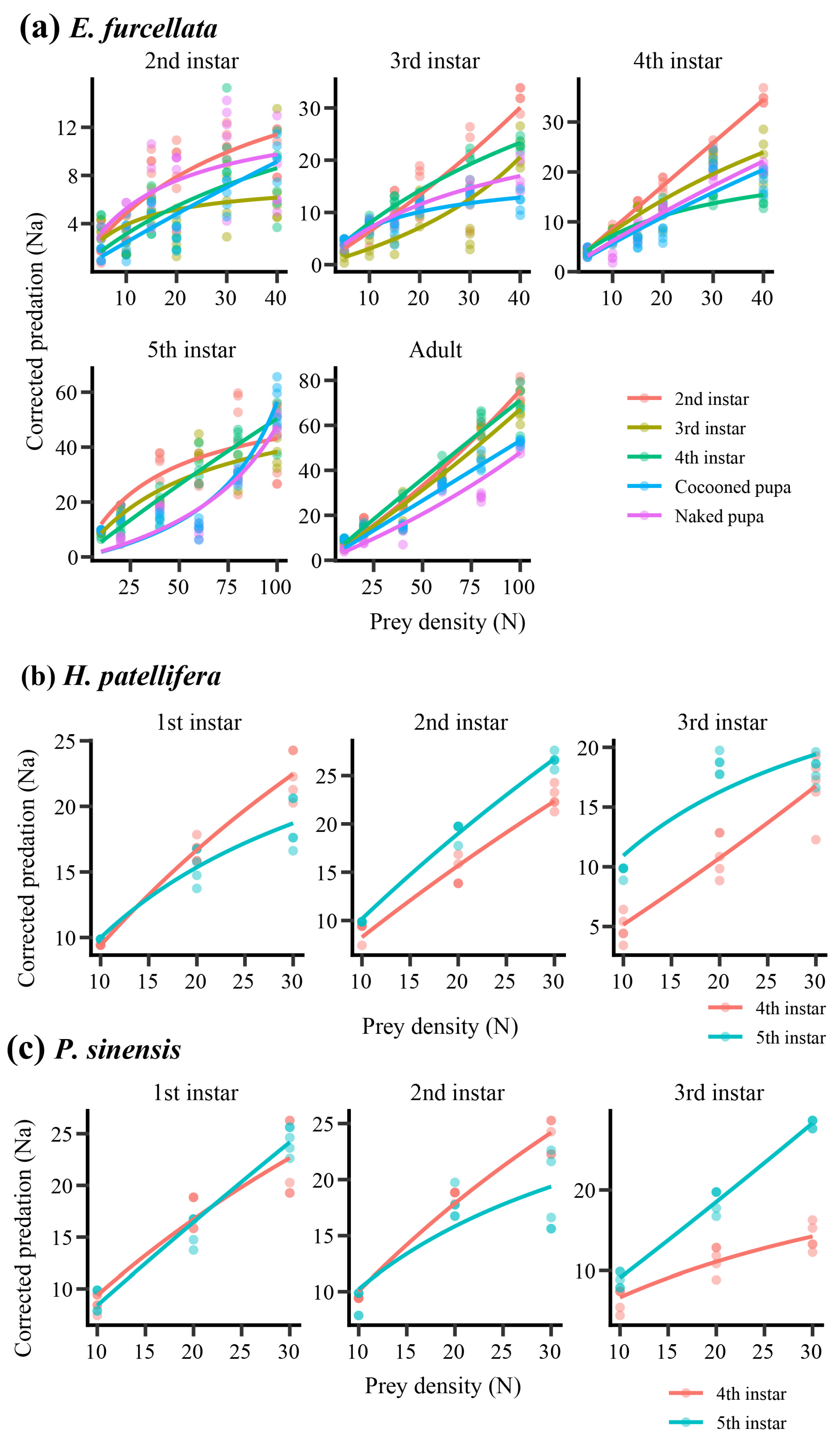
4.3. Functional Response Patterns and Parameter Estimates
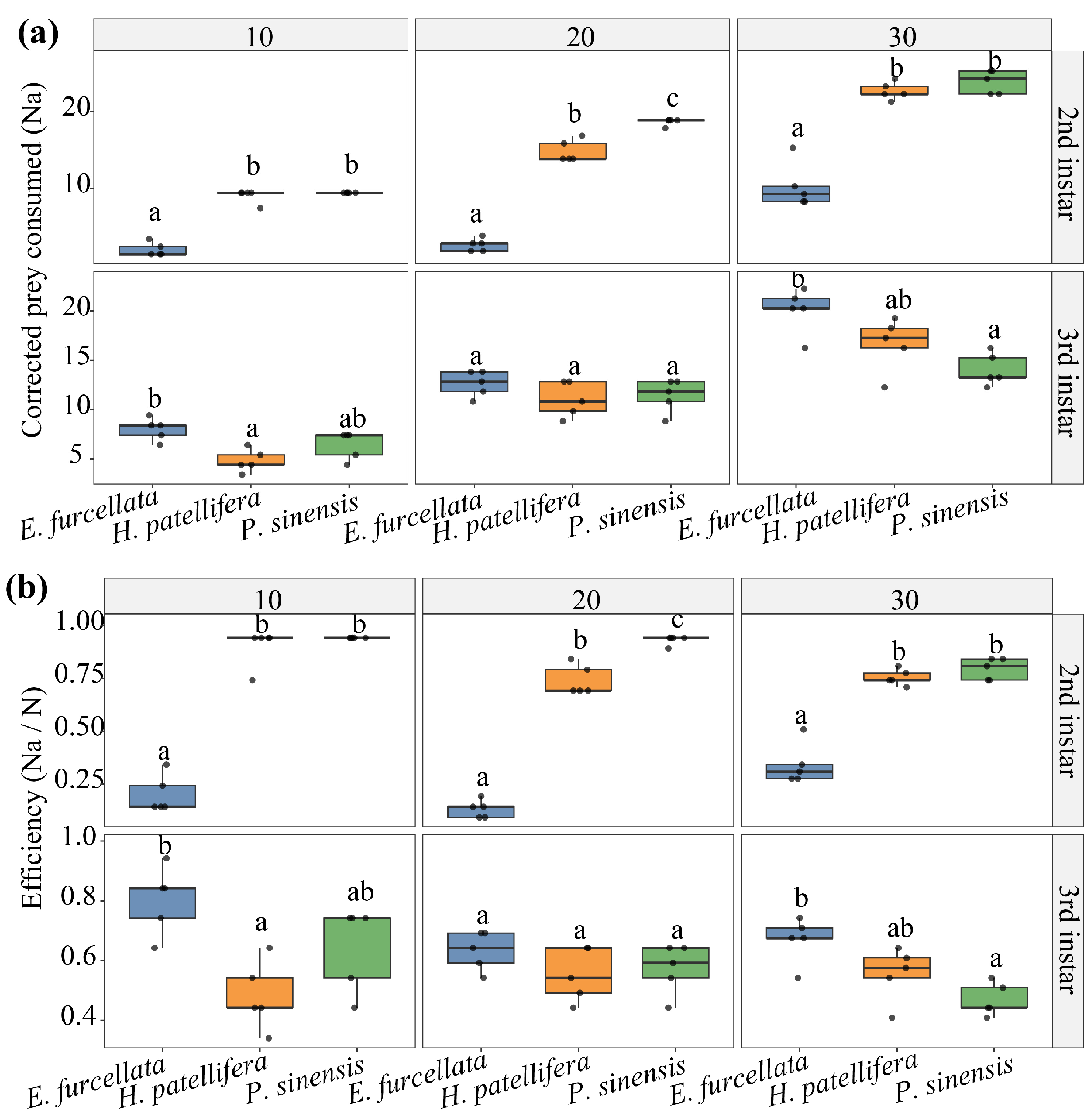
4.4. Strict Cross-Species Comparison Within the Matched Subset
5. Discussion
5.1. Ontogenetic Changes in Predation Capacity
5.2. Influence of Prey Developmental Stage
5.3. Functional Response Patterns and Predator Feeding Strategies
5.4. Comparative Predation Efficiency Among Predator Species
5.5. Implications for Biological Control of P. xylostella
5.6. Limitations and Future Research Directions
6. Conclusions
Supplementary Materials
Author Contributions
Funding
Data Availability Statement
Conflicts of Interest
References
- Paudel, A.; Yadav, P.K.; Karna, P. Diamondback Moth Plutella xylostella (Linnaeus, 1758) (Lepidoptera: Plutellidae); A Real Menace to Crucifers And Its Integrated Management Tactics. Turk. J. Agric. Food Sci. Technol. 2022, 10, 2504–2515. [Google Scholar] [CrossRef] [Scilit]
- Baibussenov, K.; Ismailova, A.; Topayev, S. Environmental factors’ influence on the diamondback moth (Plutella xylostella L.) population dynamics on cruciferous crops. SABRAO J. Breed. Genet. 2023, 55, 2077–2091. [Google Scholar] [CrossRef] [Scilit]
- Li, Z.; Feng, X.; Liu, S.S.; You, M.; Furlong, M.J. Biology, ecology, and management of the diamondback moth in China. Annu. Rev. Entomol. 2016, 61, 277–296. [Google Scholar] [CrossRef] [Scilit]
- Li, J.Y.; Chen, Y.T.; Shi, M.Z.; Li, J.W.; Xu, R.B.; Pozsgai, G.; You, M.S. Spatio-temporal distribution patterns of Plutella xylostella (Lepidoptera: Plutellidae) in a fine-scale agricultural landscape based on geostatistical analysis. Sci. Rep. 2021, 11, 13622. [Google Scholar] [CrossRef] [Scilit]
- Chen, M.Z.; Cao, L.J.; Li, B.Y.; Chen, J.C.; Gong, Y.J.; Yang, Q.; Schmidt, T.L.; Yue, L.; Zhu, J.Y.; Li, H.; et al. Migration trajectories of the diamondback moth Plutella xylostella in China inferred from population genomic variation. Pest Manag. Sci. 2021, 77, 1683–1693. [Google Scholar] [CrossRef] [Scilit]
- Zalucki, M.P.; Shabbir, A.; Silva, R.; Adamson, D.; Liu, S.-S.; Furlong, M.J. Estimating the economic cost of one of the world’s major insect pests, Plutella xylostella (Lepidoptera: Plutellidae): Just how long is a piece of string? J. Econ. Entomol. 2012, 105, 1115–1129. [Google Scholar] [CrossRef] [Scilit]
- Sarfraz, M.; Keddie, B.A. Conserving the efficacy of insecticides against Plutella xylostella (L.) (Lep., Plutellidae). J. Appl. Entomol. 2005, 129, 149–157. [Google Scholar] [CrossRef] [Scilit]
- Jamtsho, T.; Banu, N.; Kinley, C. Critical review on past, present and future scope of diamondback moth management. Plant Arch. 2021, 21, 1199–1210. [Google Scholar] [CrossRef] [Scilit]
- Banazeer, A.; Afzal, M.B.S.; Hassan, S.; Ijaz, M.; Shad, S.A.; Serrão, J.E. Status of insecticide resistance in Plutella xylostella (Linnaeus) (Lepidoptera: Plutellidae) from 1997 to 2019: Cross-resistance, genetics, biological costs, underlying mechanisms, and implications for management. Phytoparasitica 2022, 50, 465–485. [Google Scholar] [CrossRef] [Scilit]
- Shen, C.; Li, G.; Han, T.; Ilyas, N.; He, M.; Huang, Z.; Zhang, X.; Xu, C.; Chen, C.; Chen, W.; et al. Generation of alpaca-derived nanobody fragments as potential insecticidal agents against Plutella xylostella via cadherin toxin binding region-based screening. Pest Manag. Sci. 2025, 81, 8087–8095. [Google Scholar] [CrossRef] [Scilit]
- Shehzad, M.; Bodlah, I.; Siddiqui, J.A.; Bodlah, M.A.; Fareen, A.G.E.; Islam, W. Recent insights into pesticide resistance mechanisms in Plutella xylostella and possible management strategies. Environ. Sci. Pollut. Res. 2023, 30, 95296–95311. [Google Scholar] [CrossRef] [Scilit]
- Philips, C.R.; Fu, Z.; Kuhar, T.P.; Shelton, A.M.; Cordero, R.J. Natural history, ecology, and management of diamondback moth (Lepidoptera: Plutellidae), with emphasis on the United States. J. Integr. Pest Manag. 2014, 5, D1–D11. [Google Scholar] [CrossRef] [Scilit]
- Shakeel, M.; Farooq, M.; Nasim, W.; Akram, W.; Khan, F.Z.A.; Jaleel, W.; Zhu, X.; Yin, H.; Li, S.; Fahad, S.; et al. Environment polluting conventional chemical control compared to an environmentally friendly IPM approach for control of diamondback moth, Plutella xylostella (L.), in China: A review. Environ. Sci. Pollut. Res. 2017, 24, 14537–14550. [Google Scholar] [CrossRef] [Scilit]
- Naranjo, S.E.; Ellsworth, P.C.; Frisvold, G.B. Economic value of biological control in integrated pest management of managed plant systems. Annu. Rev. Entomol. 2015, 60, 621–645. [Google Scholar] [CrossRef] [Scilit]
- Baker, B.P.; Green, T.A.; Loker, A.J. Biological control and integrated pest management in organic and conventional systems. Biol. Control. 2020, 140, 104095. [Google Scholar] [CrossRef] [Scilit]
- Tuan, S.J.; Yeh, C.C.; Atlihan, R.; Chi, H. Linking life table and predation rate for biological control: A comparative study of Eocanthecona furcellata (Hemiptera: Pentatomidae) fed on Spodoptera litura (Lepidoptera: Noctuidae) and Plutella xylostella (Lepidoptera: Plutellidae). J. Econ. Entomol. 2016, 109, 13–24. [Google Scholar] [CrossRef] [Scilit]
- Sarkar, S.; Babu, A.; Chakraborty, K.; Deka, B.; Roy, S. Eocanthecona furcellata (Wolff)(Hemiptera: Pentatomidae), a potential biocontrol agent of the black inch worm, Hyposidra talaca Walker (Lepidoptera: Geometridae) infesting tea. Phytoparasitica 2021, 49, 363–376. [Google Scholar] [CrossRef] [Scilit]
- Maurya, R.P.; Dobhal, P. Field evaluation of the delivery system of native predatory bug, Eocanthecona furcellata for the management of lepidopteran pests in pulse crops. J. Biol. Control. 2024, 38, 413. [Google Scholar] [CrossRef] [Scilit]
- Bao, K.; Zhuang, Y.; Zhang, Y.; Wang, X.; Broadley, H.J.; Fan, M.; Wang, X. Predation efficiency of praying mantises as important natural enemies of spotted lanternfly, Lycorma delicatula. Pest Manag. Sci. 2026, 82, 530–538. [Google Scholar] [CrossRef] [Scilit]
- Kulkarni, S.S.; Evenden, M.L. Functional response of larval and adult Coccinella septempunctata to eggs and larvae of Plutella xylostella on canola. Entomol. Exp. Appl. 2024, 172, 334–344. [Google Scholar] [CrossRef] [Scilit]
- Vacari, A.M.; De Bortoli, S.A.; Torres, J.B. Relationship between predation by Podisus nigrispinus and developmental phase and density of its prey, Plutella xylostella. Entomol. Exp. Appl. 2012, 145, 30–37. [Google Scholar] [CrossRef] [Scilit]
- Ebrahimi, M.; Mahdian, K.; De Clercq, P. Life-history parameters and predation capacity of Macrolophus pygmaeus and Nesidiocoris tenuis (Hemiptera: Miridae) on eggs of Plutella xylostella (Lepidoptera: Plutellidae). Agric. For. Entomol. 2019, 21, 50–57. [Google Scholar] [CrossRef] [Scilit]
- Alto, B.W.; Lounibos, L.P.; Mores, C.N.; Reiskind, M.H. Stage-dependent predation on competitors: Consequences for the outcome of a mosquito invasion. J. Anim. Ecol. 2009, 78, 928–936. [Google Scholar] [CrossRef] [Scilit]
- Cuthbert, R.N.; Dalu, T.; Wasserman, R.J.; Callaghan, A.; Weyl, O.L.F.; Dick, J.T.A.; Sentis, A. Influence of intra- and interspecific variation in predator–prey body size ratios on trophic interaction strengths. Ecol. Evol. 2020, 10, 5946–5962. [Google Scholar] [CrossRef] [Scilit]
- Dawes, J.H.P.; Souza, M. A derivation of Holling’s type I, II and III functional responses in predator–prey systems. J. Theor. Biol. 2013, 327, 11–22. [Google Scholar] [CrossRef] [Scilit]
- Kiørboe, T.; Saiz, E.; Tiselius, P.; Andersen, K.H. Adaptive feeding behavior and functional responses in zooplankton. Limnol. Oceanogr. 2018, 63, 308–321. [Google Scholar] [CrossRef] [Scilit]
- Dunn, R.P.; Hovel, K.A. Predator type influences the frequency of functional responses to prey in marine habitats. Biol. Lett. 2020, 16, 20190758. [Google Scholar] [CrossRef] [Scilit]
- Gobin, J.; Hossie, T.J.; Derbyshire, R.E.; Sonnega, S.; Cambridge, T.W.; Scholl, L.; Kloch, N.D.; Scully, A.; Thalen, K.; Smith, G.; et al. Functional Responses Shape Node and Network Level Properties of a Simplified Boreal Food Web. Front. Ecol. Evol. 2022, 10, 898805. [Google Scholar] [CrossRef] [Scilit]
- Echarroudi, Y. Null controllability of a coupled model in population dynamics. Math. Bohem. 2023, 148, 349–408. [Google Scholar] [CrossRef] [Scilit]
- Beardsell, A.; Gravel, D.; Berteaux, D.; Gauthier, G.; Clermont, J.; Careau, V.; Lecomte, N.; Juhasz, C.C.; Royer-Boutin, P.; Bêty, J. Derivation of predator functional responses using a mechanistic approach in a natural system. Front. Ecol. Evol. 2021, 9, 630944. [Google Scholar] [CrossRef] [Scilit]
- Kalinkat, G.; Rall, B.C.; Uiterwaal, S.F.; Uszko, W. Empirical evidence of type III functional responses and why it remains rare. Front. Ecol. Evol. 2023, 11, 1033818. [Google Scholar] [CrossRef] [Scilit]
- DeLong, J.P.; Coblentz, K.E.; Uiterwaal, S.F. Are type 3 functional responses just statistical apparitions? Ecosphere 2025, 16, e70247. [Google Scholar] [CrossRef] [Scilit]
- Köhnke, M.C.; Siekmann, I.; Seno, H.; Malchow, H. A type IV functional response with different shapes in a predator–prey model. J. Theor. Biol. 2020, 505, 110419. [Google Scholar] [CrossRef] [Scilit] [PubMed]
- Smith, B.E.; Smith, L.A. Multispecies functional responses reveal reduced predation at high prey densities and varied responses among and within trophic groups. Fish Fish. 2020, 21, 891–905. [Google Scholar] [CrossRef] [Scilit]
- Bruzzone, O.A.; Aguirre, M.B.; Hill, J.G.; Virla, E.G.; Logarzo, G. Revisiting the influence of learning in predator functional response, how it can lead to shapes different from type III. Ecol. Evol. 2022, 12, e8593. [Google Scholar] [CrossRef] [Scilit]
- Islam, Y.; Shah, F.M.; Güncan, A.; DeLong, J.P.; Zhou, X. Functional response of Harmonia axyridis to the larvae of Spodoptera litura: The combined effect of temperatures and prey instars. Front. Plant Sci. 2022, 13, 849574. [Google Scholar] [CrossRef] [Scilit]
- Lehtinen, S.O.; Perälä, T.A.; Uusi-Heikkilä, S.K.; Kuparinen, A.K. Mutually exclusive feeding yields Holling type III functional response. Funct. Ecol. 2024, 38, 403–416. [Google Scholar] [CrossRef] [Scilit]
- Elliott, J.M. Ontogenetic shifts in the functional response and interference interactions of Rhyacophila dorsalis larvae (Trichoptera). Freshw. Biol. 2005, 50, 2021–2033. [Google Scholar] [CrossRef] [Scilit]
- van Leeuwen, A.; Huss, M.; Gårdmark, A.; de Roos, A.M. Ontogenetic specialism in predators with multiple niche shifts prevents predator population recovery and establishment. Ecology 2014, 95, 2409–2422. [Google Scholar] [CrossRef] [Scilit]
- Robertson, M.L.; Hammill, E. Temperature and prey morphology influence attack rate and handling time in a predator–prey interaction. Hydrobiologia 2021, 848, 4637–4646. [Google Scholar] [CrossRef] [Scilit]
- Suzuki, Y.; Ikemoto, M.; Yokoi, T. The ontogenetic dietary shift from non-dangerous to dangerous prey in predator-eating predators under capture risk. Ecol. Evol. 2022, 12, e9609. [Google Scholar] [CrossRef] [Scilit] [PubMed]
- dos Santos, B.D.B.; Ramalho, F.S.; Malaquias, J.B.; Lira, A.C.; Pachú, J.K.; Fernandes, F.S.; Zanuncio, J.C. How predation by Podisus nigrispinus is influenced by developmental stage and density of its prey Alabama argillacea. Entomol. Exp. Appl. 2016, 158, 142–151. [Google Scholar] [CrossRef] [Scilit]
- Pessarrodona, A.; Boada, J.; Pagès, J.F.; Arthur, R.; Alcoverro, T. Consumptive and non-consumptive effects of predators vary with the ontogeny of their prey. Ecology 2019, 100, e02649. [Google Scholar] [CrossRef] [Scilit] [PubMed]
- Wasserman, R.J.; Alexander, M.E.; Dalu, T.; Ellender, B.R.; Kaiser, H.; Weyl, O.L. Using functional responses to quantify interaction effects among predators. Funct. Ecol. 2016, 30, 1988–1998. [Google Scholar] [CrossRef] [Scilit]
- Schmitz, O. Predator and prey functional traits: Understanding the adaptive machinery driving predator–prey interactions. F1000Research 2017, 6, 1767. [Google Scholar] [CrossRef] [Scilit]
- Abrams, P.A. Food web functional responses. Front. Ecol. Evol. 2022, 10, 984384. [Google Scholar] [CrossRef] [Scilit]
- Juliano, S.A. Nonlinear curve fitting: Predation and functional response curves. In Design and Analysis of Ecological Experiments, 2nd ed.; Scheiner, S.M., Gurevitch, J., Eds.; Oxford University Press: Oxford, UK, 2001; pp. 178–196. [Google Scholar] [CrossRef] [Scilit]
- Rosenbaum, B.; Rall, B.C. Fitting functional responses: Direct parameter estimation by simulating differential equations. Methods Ecol. Evol. 2018, 9, 2076–2090. [Google Scholar] [CrossRef] [Scilit]
- Uiterwaal, S.F.; Mares, R.; DeLong, J.P. Body size, body size ratio, and prey type influence the functional response of damselflies. Oecologia 2018, 188, 307–317. [Google Scholar] [CrossRef] [Scilit]
- Holling, C.S. Some characteristics of simple types of predation and parasitism. Can. Entomol. 1959, 91, 385–398. [Google Scholar] [CrossRef] [Scilit]
- Rogers, D. Random search and insect population models. J. Anim. Ecol. 1972, 41, 369–383. [Google Scholar] [CrossRef] [Scilit] [PubMed]
- Papanikolaou, N.E.; Kypraios, T.; Moffat, H.; Fantinou, A.A.; Perdikis, D.P.; Drovandi, C. Predators’ functional response: Statistical inference, experimental design, and biological interpretation of the handling time. Front. Ecol. Evol. 2021, 9, 740848. [Google Scholar] [CrossRef] [Scilit]
- Htwe, A.N.; Takasu, K.; Takagi, M. Laboratory rearing of the diamondback moth Plutella xylostella (L.) (Lepidoptera: Plutellidae) with artificial diet. J. Fac. Agric. Kyushu Univ. 2009, 54, 147–151. [Google Scholar] [CrossRef] [Scilit] [PubMed]
- Chen, G.; Guo, K.; Luo, Q.; Ding, Y.; Fang, L.; Hu, Y.; Ren, W.; Chen, Z. Effects of photoperiod and temperature on the development and survival of Eocanthecona furcellata (Hemiptera: Pentatomidae). Acta Zool. Bulg. 2025, 77, 377–385. [Google Scholar] [CrossRef] [Scilit]
- Halder, J.; Kushwaha, D.; Rai, A.B. Biology and feeding potential of Eocanthecona furcellata (Wolff) on its lesser known prey, Spilosoma obliqua (Walker). J. Biol. Control. 2020, 34, 109–112. [Google Scholar] [CrossRef] [Scilit]
- Sarkar, S.; Babu, A.; Chakraborty, K.; Deka, B. Predatory behaviour of Eocanthecona furcellata (Hemiptera: Pentatomidae) feeding on larvae of Hyposidra talaca (Lepidoptera: Geometridae), a major tea pest of North East India. Int. J. Sci. Res. 2020, 9, 68–70. [Google Scholar]
- Gadad, H.; Bhagat, A.; Naqvi, A.H.; Kutala, S. Host instar susceptibility and stage specific predatory potential of stink bug Eocanthecona furcellata on tasar silkworm Antheraea mylitta. J. Environ. Biol. 2022, 43, 702–708. [Google Scholar] [CrossRef] [Scilit]
- Zibaee, A.; Ramzi, S.; Hoda, H. The stink bug, Andrallus spinidens (Hemiptera: Pentatomidae), a potential predator for effective biological control. J. Plant Prot. Res. 2020, 60, 336–344. [Google Scholar] [CrossRef] [Scilit]
- Pervez, A.; Omkar. Functional responses of coccinellid predators: An illustration of a logistic approach. J. Insect Sci. 2005, 5, 5. [Google Scholar] [CrossRef] [Scilit]
- Hassanpour, M.; Mohaghegh, J.; Iranipour, S.; Nouri-Ganbalani, G.; Enkegaard, A. Functional response of Chrysoperla carnea (Neuroptera: Chrysopidae) to Helicoverpa armigera (Lepidoptera: Noctuidae): Effect of prey and predator stages. Insect Sci. 2011, 18, 217–224. [Google Scholar] [CrossRef] [Scilit]
- Piyani, A.R.; Shishehbor, P.; Kocheili, F.; Riddick, E.W. Functional and numerical responses of the predator Amblyseius swirskii to its prey Tetranychus turkestani in the laboratory. Acarologia 2021, 61, 901–909. [Google Scholar] [CrossRef] [Scilit]
- Xu, S.; Yao, Q.; Quan, L.; Dong, Y.; Chen, B.; Zeng, D. Sublethal effect of chlorpyrifos on predatory behavior and physiology of Eocanthecona furcellata (Hemiptera: Pentatomidae). J. Econ. Entomol. 2023, 117, 156–166. [Google Scholar] [CrossRef] [Scilit]
- R Core Team. R: A Language and Environment for Statistical Computing, Version 4.4; Computer Software; The R Foundation: Vienna, Austria, 2024. Available online: https://cran.r-project.org (accessed on 3 May 2026).
- Kruskal, W.H.; Wallis, W.A. Use of ranks in one-criterion variance analysis. J. Am. Stat. Assoc. 1952, 47, 583–621. [Google Scholar] [CrossRef]
- Dunn, O.J. Multiple Comparisons Using Rank Sums. Technometrics 1964, 6, 241–252. [Google Scholar] [CrossRef]
- Griffen, B.D. Considerations when applying the consumer functional response measured under artificial conditions. Front. Ecol. Evol. 2021, 9, 713147. [Google Scholar] [CrossRef] [Scilit]
- Wood, S.N. Generalized Additive Models: An Introduction with R, 2nd ed.; Chapman and Hall/CRC: London, UK, 2017. [Google Scholar] [CrossRef] [Scilit]
- Akaike, H. A new look at the statistical model identification. IEEE Trans. Autom. Control. 1974, 19, 716–723. [Google Scholar] [CrossRef] [Scilit]
- Lin, Q.; Ruan, G.; Tang, M.; Guo, X.; Yang, M.; Wang, X.; Chen, X. Functional Response, Interference, and Predation Efficiency of Diomus guilavoguii (Coleoptera: Coccinellidae) on Paracoccus marginatus (Hemiptera: Pseudococcidae). Insects 2025, 16, 971. [Google Scholar] [CrossRef] [Scilit]
- Xue, C.; Mao, J.; Xu, B.; Zhou, L.; Zhou, H.; Mao, J.; Shen, Z.; Zhang, L.; Wang, M.; Li, Y. Biological control potential of the reduviid predator Rhynocoris fuscipes (Fabricius) in managing noctuid pests: Insights into predation and prey preference. Insects 2025, 16, 224. [Google Scholar] [CrossRef] [Scilit]
- Chen, J.H.; Wen, X.R.; Wang, C.X.; Zhang, Q.Q.; Liu, H.M.; Ning, W.G.; Guo, S.B. Predation and predilection of Eocanthecona furcellata to larvae of Scopula subpunctaria (Lepidoptera: Geometridae). J. Tea Sci. 2025, 45, 87–98. [Google Scholar] [CrossRef]
- Meseguer, R.; Desneux, N.; Jaeckel, S.; Agboka, K.; Verheggen, F.J. May predator body-size hamper furtive predation strategy by inducing detection of prey? PLoS ONE 2021, 16, e0256991. [Google Scholar] [CrossRef] [Scilit]
- Kayahan, B.; Karaca, İ. Functional Responses of Hippodamia variegata (Goeze) and Coccinella septempunctata (L.) (Coleoptera: Coccinellidae) on Aphis fabae Scopoli and Acyrthosiphon pisum (Harris) (Hemiptera: Aphididae). Turk. J. Sci. Eng. 2025, 7, 31–37. [Google Scholar] [CrossRef] [Scilit]
- Rosenheim, J.A.; Kaya, H.K.; Ehler, L.E.; Marois, J.J.; Jaffee, B.A. Intraguild predation among biological-control agents: Theory and evidence. Biol. Control. 1995, 5, 303–335. [Google Scholar] [CrossRef] [Scilit]
- Hu, N.; Huang, Y.; Yu, Z.; Zhang, T.; Liu, D.; Lee, M. Handling-or digestion-limited predators: The role of body mass and habitat complexity in predator functional response. Mar. Ecol. Prog. Ser. 2023, 725, 1–14. [Google Scholar] [CrossRef] [Scilit]
- Charnov, E.L. Optimal foraging, the marginal value theorem. Theor. Popul. Biol. 1976, 9, 129–136. [Google Scholar] [CrossRef] [Scilit]
- Stephens, D.W.; Krebs, J.R. Foraging Theory; Princeton University Press: Princeton, NJ, USA, 1986. [Google Scholar]
- Jeschke, J.M.; Kopp, M.; Tollrian, R. Predator functional responses: Discriminating between handling and digesting prey. Ecol. Monogr. 2002, 72, 95–112. [Google Scholar] [CrossRef]
- Klecka, J.; Boukal, D.S. Foraging and vulnerability traits modify predator–prey body mass allometry: Freshwater macroinvertebrates as a case study. J. Anim. Ecol. 2013, 82, 1031–1041. [Google Scholar] [CrossRef] [Scilit]
- Boets, P.; Laverty, C.; Fukuda, S.; Verreycken, H.; Green, K.; Britton, R.J.; Caffrey, J.; Goethals, P.L.; Pegg, J.; Médoc, V.; et al. Intra-and intercontinental variation in the functional responses of a high impact alien invasive fish. Biol. Invasions 2019, 21, 1751–1762. [Google Scholar] [CrossRef] [Scilit]
- Collier, T.; Van Steenwyk, R. A critical evaluation of augmentative biological control. Biol. Control. 2004, 31, 245–256. [Google Scholar] [CrossRef] [Scilit]
- Gallego, V.C.; Escalona, R.T.; Ferreira, J.M.S. Biology and mass rearing studies of Eucanthecona furcellata Wolf (Hemiptera: Pentatomidae), a potential polyphagous predator, and its effect on field population of white slug caterpillar, Parasa philepida, in Cabadbaran, Agusan del Norte, Philippines. CORD 1993, 9, 34. [Google Scholar] [CrossRef] [Scilit]
- Chen, G.; Li, X.; Lu, Y.; Liu, T.-X. A review of the predatory adaptation and applications of Eocanthecona furcellata (Hemiptera: Pentatomidae) as a biological control agent. J. Entomol. Sci. 2025, 60, 666–688. [Google Scholar] [CrossRef] [Scilit]
- Sarfraz, M.; Keddie, B.A.; Dosdall, L.M. Biological control of the diamondback moth, Plutella xylostella: A review. Biocontrol Sci. Technol. 2005, 15, 763–789. [Google Scholar] [CrossRef] [Scilit]
- Giacomini, H.C. Metabolic responses of predators to prey density. Front. Ecol. Evol. 2022, 10, 980812. [Google Scholar] [CrossRef] [Scilit]



| Predator Species | No. of Combinations | Type II-Like | Type III-Like | Ambiguous | Holling II Preferred | Rogers Preferred | Stable Th | Weakly Identified Th | Boundary Estimate | Non-Identifiable Th | Reportable 1/Th |
|---|---|---|---|---|---|---|---|---|---|---|---|
| E. furcellata | 25 | 22 | 3 | 0 | 15 | 10 | 1 | 12 | 10 | 2 | 1 |
| H. patellifera | 6 | 5 | 0 | 1 | 4 | 2 | 0 | 5 | 1 | 0 | 0 |
| P. sinensis | 6 | 2 | 3 | 1 | 2 | 4 | 0 | 4 | 2 | 0 | 0 |
| Total | 37 | 29 | 6 | 2 | 21 | 16 | 1 | 21 | 13 | 2 | 1 |
Disclaimer/Publisher’s Note: The statements, opinions and data contained in all publications are solely those of the individual author(s) and contributor(s) and not of MDPI and/or the editor(s). MDPI and/or the editor(s) disclaim responsibility for any injury to people or property resulting from any ideas, methods, instructions or products referred to in the content. |
© 2026 by the authors. Licensee MDPI, Basel, Switzerland. This article is an open access article distributed under the terms and conditions of the Creative Commons Attribution (CC BY) license.
Share and Cite
Liu, G.; Xiong, Y.; Song, Y.; Liang, Y.; Lu, Y. Functional Responses of Three Insect Predators to Plutella xylostella Across Developmental Stages. Insects 2026, 17, 490. https://doi.org/10.3390/insects17050490
Liu G, Xiong Y, Song Y, Liang Y, Lu Y. Functional Responses of Three Insect Predators to Plutella xylostella Across Developmental Stages. Insects. 2026; 17(5):490. https://doi.org/10.3390/insects17050490
Chicago/Turabian StyleLiu, Guanghua, Yilin Xiong, Yunbo Song, Yuling Liang, and Yongyue Lu. 2026. "Functional Responses of Three Insect Predators to Plutella xylostella Across Developmental Stages" Insects 17, no. 5: 490. https://doi.org/10.3390/insects17050490
APA StyleLiu, G., Xiong, Y., Song, Y., Liang, Y., & Lu, Y. (2026). Functional Responses of Three Insect Predators to Plutella xylostella Across Developmental Stages. Insects, 17(5), 490. https://doi.org/10.3390/insects17050490