



Temperature Effects on the Efficacy of Phytoseiulus persimilis and Amblyseius swirskii (Acari: Phytoseiidae) Against Tetranychus urticae (Acari: Tetranychidae) in Strawberry Crops
Simple Summary
Abstract
1. Introduction
2. Materials and Methods
2.1. Greenhouse Experiment
2.2. Temperature and Humidity Data
2.3. Experimental Design
2.4. Development of T. urticae Population on Strawberry Plants
2.5. Experiment Execution and Recorded Data
- NCdn1 = Number of spider mites per plant on untreated control plants.
- NTdn1 = Number of spider mites per plant after application of a given treatment.
- d = Date of collection.
2.6. Data Analysis
3. Results
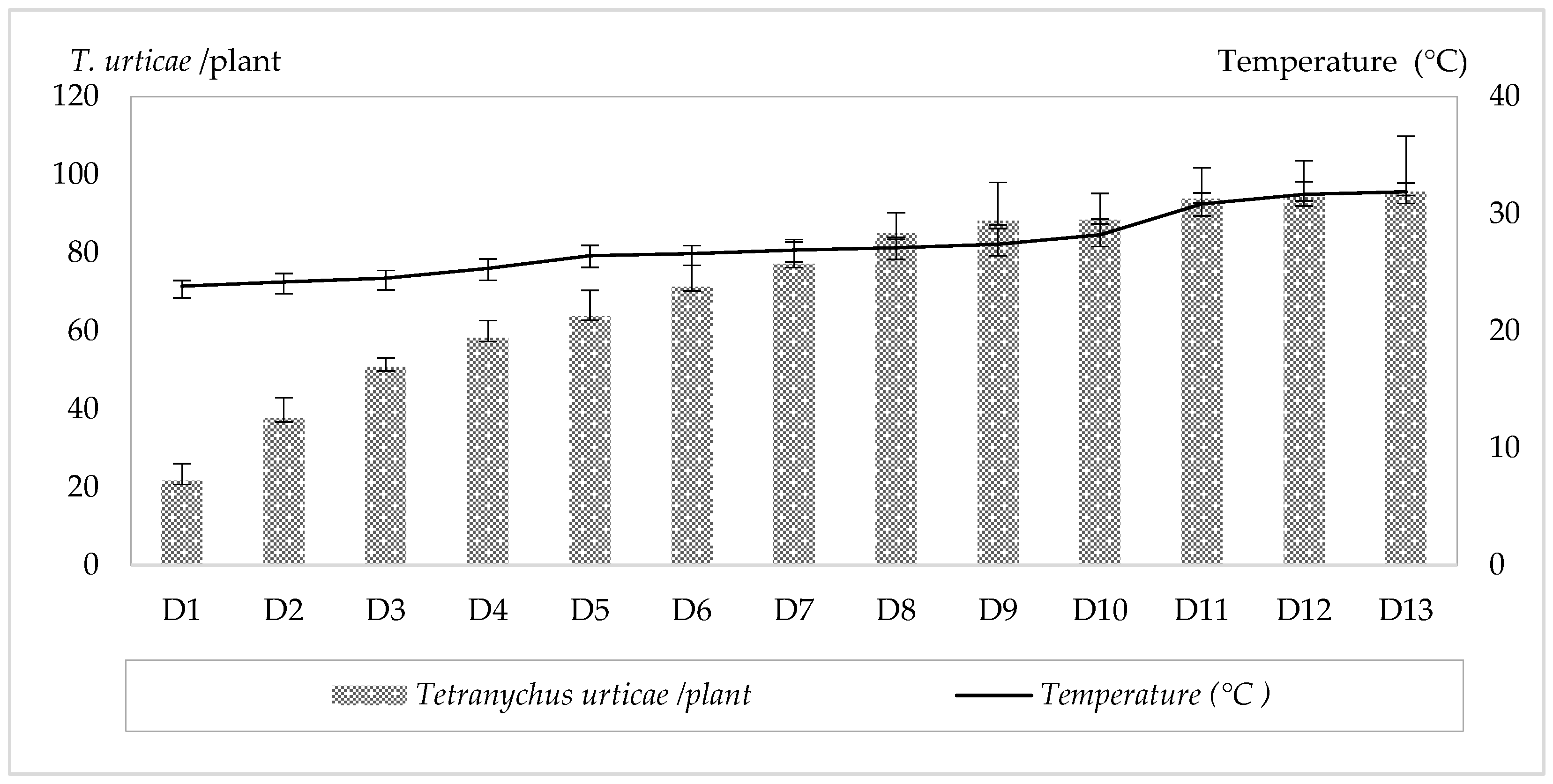
3.1. Development of T. urticae Population on Strawberry Plants
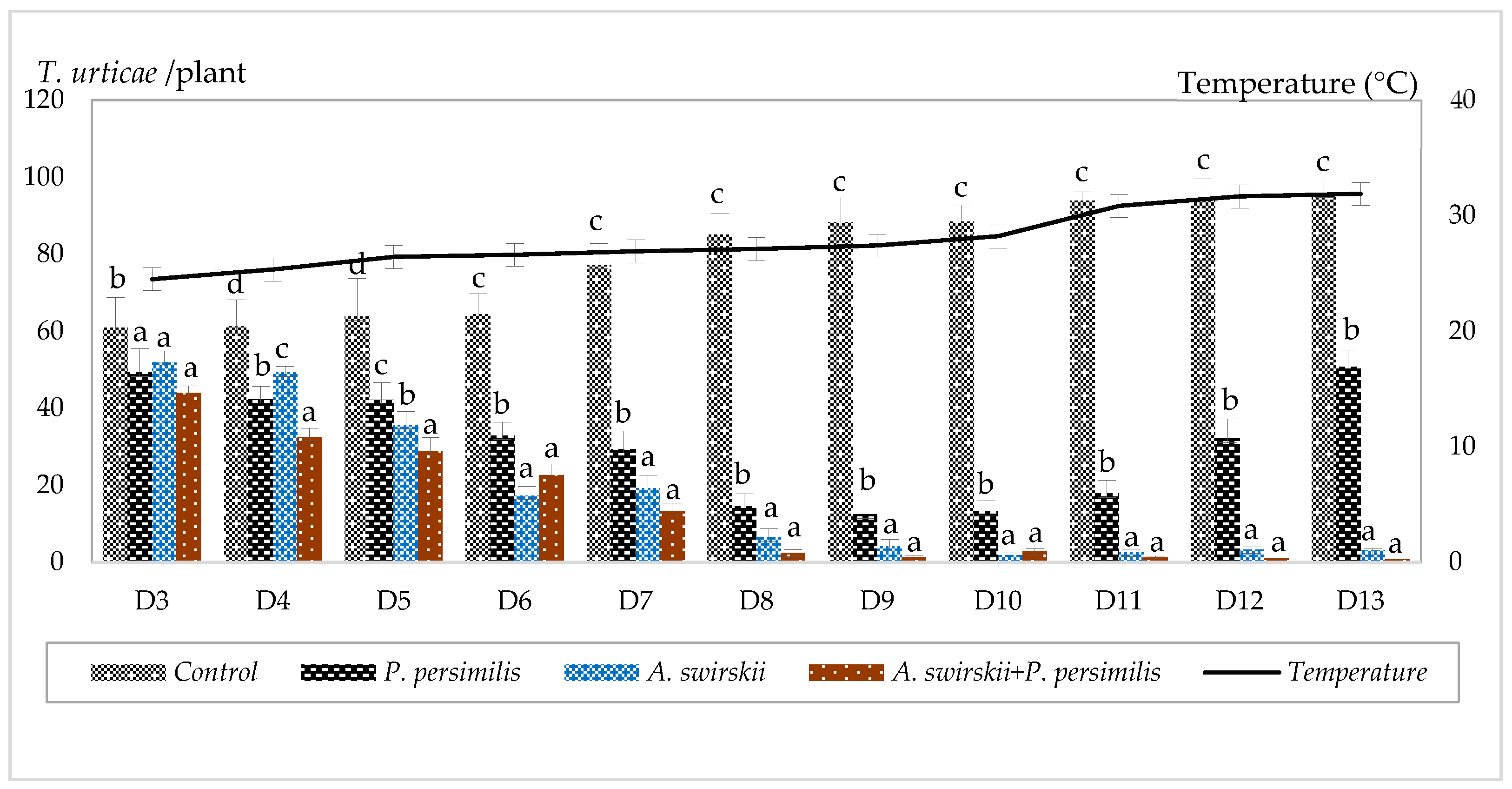
3.2. Dynamic of T. urticae Population Under Different Treatments
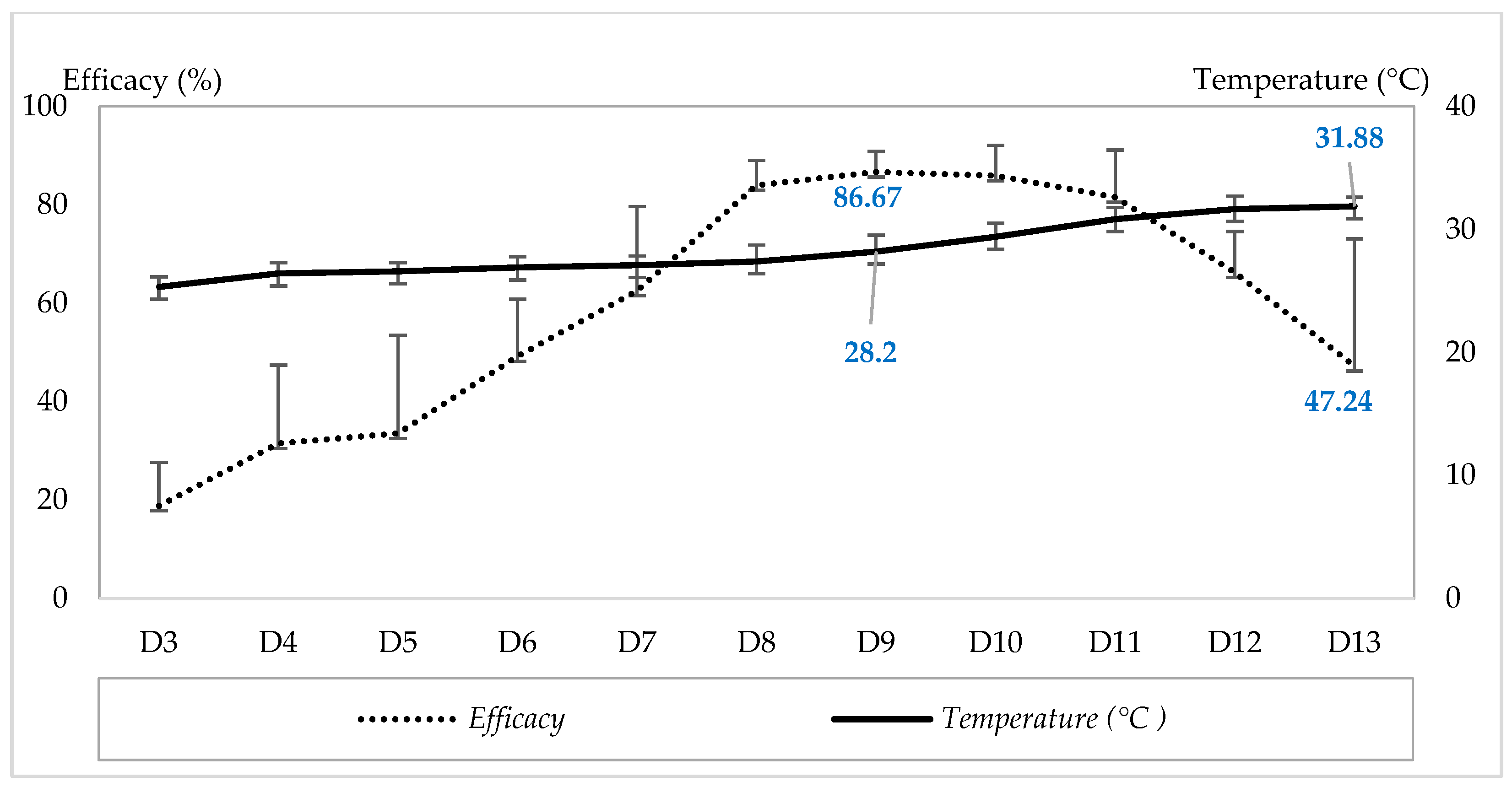
3.3. Effect of Temperature on the Efficacy of P. persimilis to Control T. urticae on Strawberry
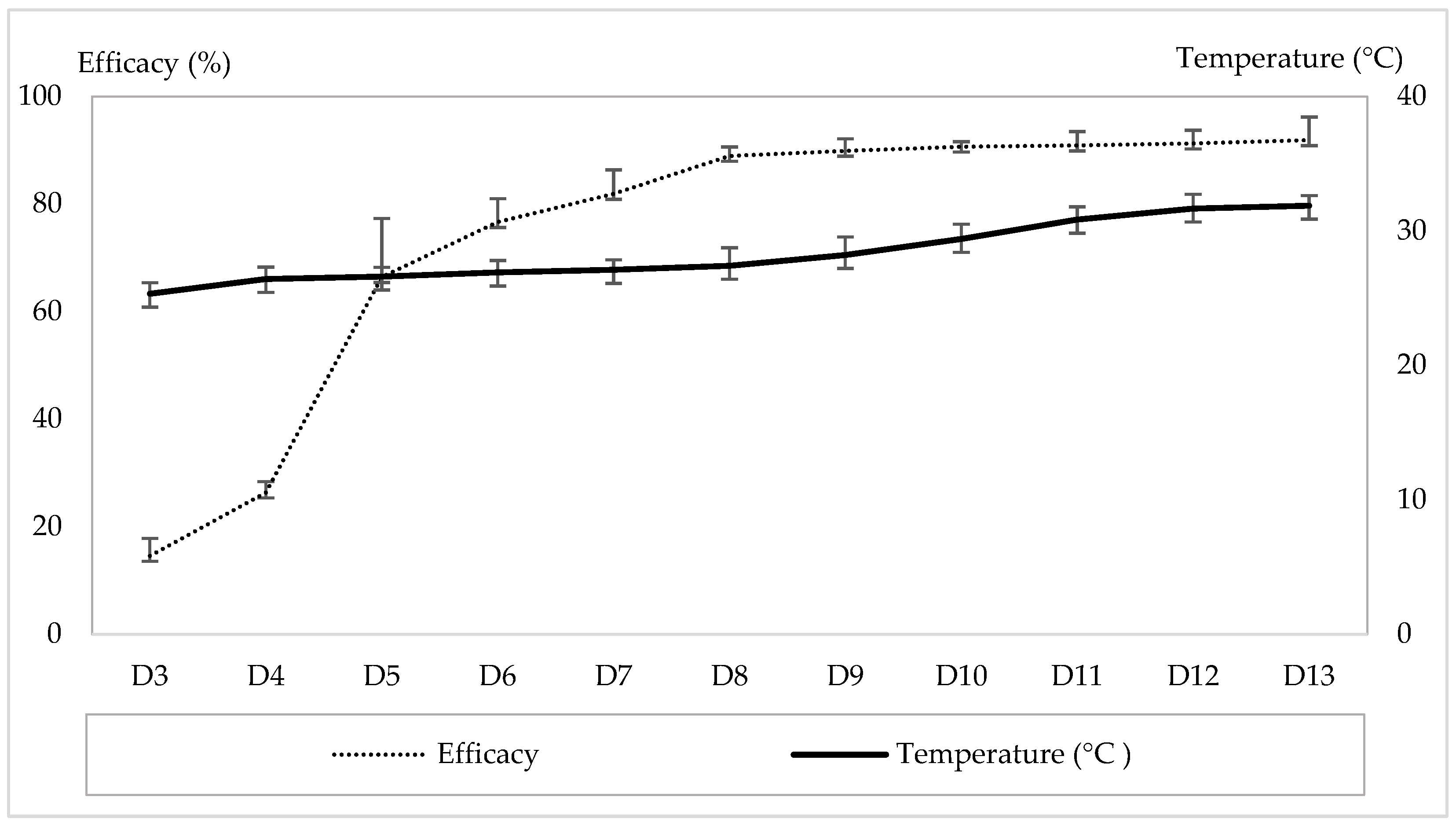
3.4. Effect on Temperature on Efficacy of A. swirskii to Control T. urticae on Strawberry in Greenhouse
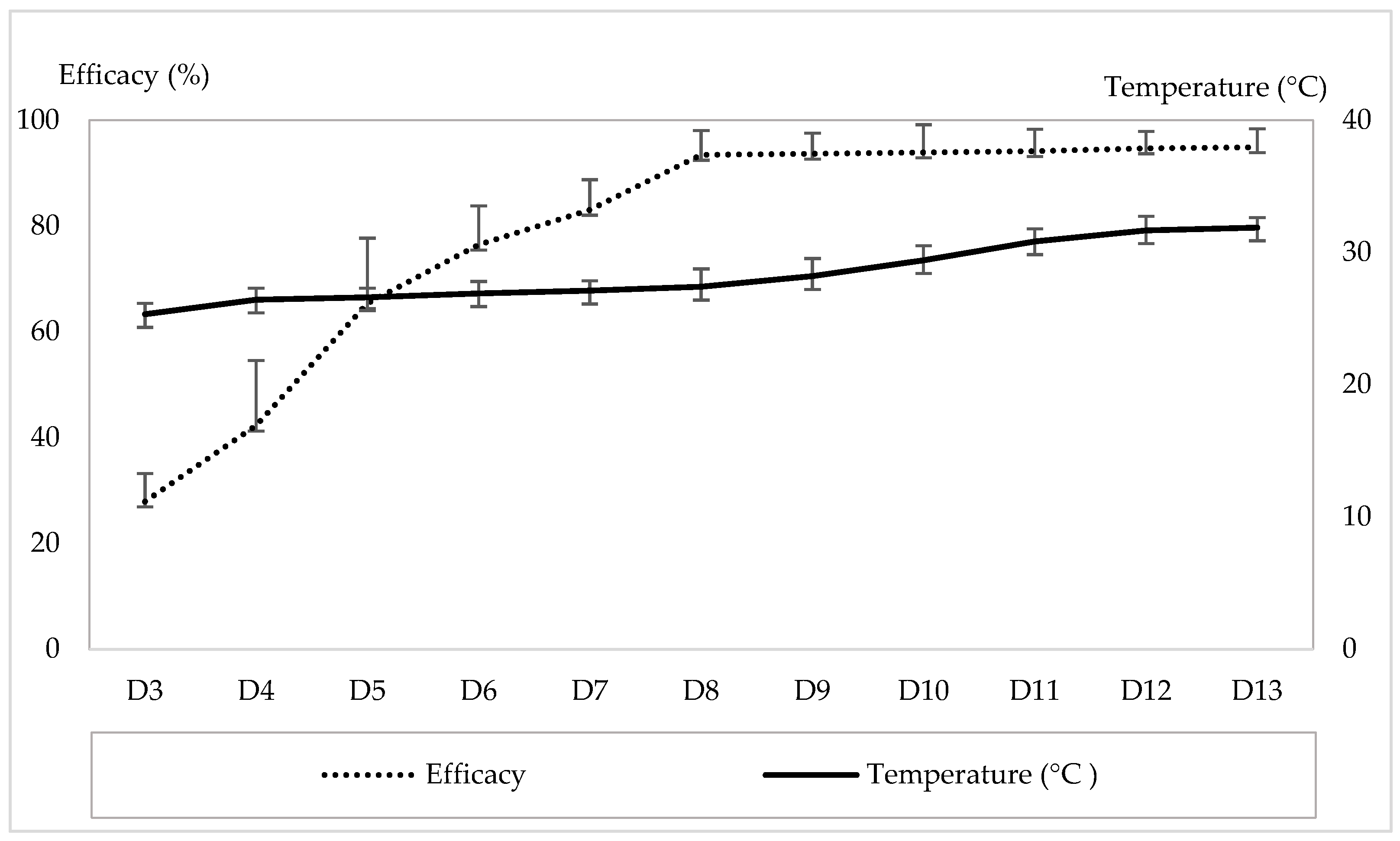
3.5. Efficacy of Combining the Predators P. persimilis and A. swirskii to Control T. urticae on Strawberry in Greenhouse
3.6. Comparative Efficacy of P. persimilis, A. swirskii, and Their Combined Use for Controlling T. urticae Across a Range of Temperatures
4. Discussion
5. Conclusions
Author Contributions
Funding
Data Availability Statement
Acknowledgments
Conflicts of Interest
References
- Mahmoud, M.-F.-R.; Sherin, H.-M.-S. Population Density of the Red Spider Mite Tetranychus urticae Koch (Acari: Tetranychidae) on Some Vegetable Crops at Fayoum Governorate. J. Plant Prot. Path. 2016, 7, 785–789. [Google Scholar] [CrossRef] [Scilit]
- Zhao, S.; Zhao, Q.; Dai, X.; Bing, L.; Ruijuan, W.; Zhenjuan, Y.; Feng, Z.; Yan, L.; Long, S.; Hao, C.; et al. Control of two-spotted spider mite, Tetranychus urticae, on strawberry by integrating with cyetpyrafen and Phytoseiulus persimilis. CABI Agric. Biosci. 2023, 4, 54. [Google Scholar] [CrossRef] [Scilit]
- Nieberding, C.-M.; Kaiser, A.; Visser, B. Inbreeding and learning affect fitness and colonization of new host plants, a behavioral innovation in the spider mite Tetranychus urticae. Entomol. Gen. 2022, 42, 531–538. [Google Scholar] [CrossRef] [Scilit]
- Akyazi, R.; Oscar, E.-L. Biological Control of the Twospotted Spider Mite (Trombidiformes: Tetranychidae) with the Predatory Mite Neoseiulus californicus (Mesotigmata: Phytoseiidae) in Blackberries. Fla. Entomol. 2019, 102, 373–381. [Google Scholar] [CrossRef] [Scilit]
- Livinali, E.; Sperottob, R.-A.; Ferlab, N.-J.; Volken de Souza, C.-F. Physicochemical and nutritional alterations induced by two-spotted spider mite infestation on strawberry plants. Electron. J. Biotechnol. 2014, 17, 193–198. [Google Scholar] [CrossRef] [Scilit]
- Dicke, M. Chemical ecology of host-plant selection by herbivorous arthropods: A multitrophic per-spective. Biochem. Syst. Ecol. 2000, 28, 601–617. [Google Scholar] [CrossRef] [Scilit]
- James, D.-G.; Price, T.-S. Fecundity in two-spottedspider mite (Acari: Tetranychidae) is increased bydirect and systemic exposure to imidacloprid. J. Econ. Entom. 2002, 95, 729–732. [Google Scholar] [CrossRef] [Scilit]
- Marcic, D. The effects of clofentezine on life-table parameters in two-spotted spider mite Tetranychus urticae. Exp. Appl. Acarol. 2003, 30, 249–263. [Google Scholar] [CrossRef] [Scilit]
- Riahi, E.; Nemati, A.; Shishehbor, P.; Saeidi, Z. Population growth parameters of the two-spotted spider mite, Tetranychus urticae, on three peach varieties, in Iran. Acarologia 2011, 51, 473–480. [Google Scholar] [CrossRef]
- Damos, P.; Papathanasiou, F.; Tsikos, E.; Kyriakidis, T.; Louta, M. Predicting the Occurrence and Risk Damage Caused by the Two-Spotted Spider Mite Tetranychus urticae (Koch) in Dry Beans (Phaseolus vulgaris L.) Combining Rate and Heat Summation Models for Digital Decisions Support. Agriculture 2023, 13, 756. [Google Scholar] [CrossRef] [Scilit]
- Bilbo, T.-R.; Walgenbach, J.-F. Compatibility of bifenazate and the Phytoseiulus persimilis (Acari: Phytoseiidae) for management of two-spotted spider mites (Acari: Tetranychidae) in North Carolina staked tomatoes. J. Econ. Entomol. 2020, 113, 2096–2103. [Google Scholar] [CrossRef] [Scilit] [PubMed]
- Bernardi, D.; Botton, M.; da Cunha, U.S.; Bernardi, O.; Malausa, T.; Garcia, M.S.; Nava, D.E. Effects of azadirachtin on Tetranychus urticae (Acari: Tetranychidae) and its compatibility with predatory mites (Acari: Phytoseiidae) on strawberry. Pest. Manag. Sci. 2013, 69, 75–80. [Google Scholar] [CrossRef] [Scilit] [PubMed]
- Gaid, E.-H.; Chouikhi, S.; Assadi, B.-H.; Nagaz, K.; Lebdi, K.-G.; BelKadhi, M.-S. Evaluation of chemical acaricides against the two-spotted spider mite, Tetranychus urticae (Koch) (Acari: Tetranychidae) in geothermal greenhouses in southern Tunisia. J. OASIS Agric. Sustain. Dev. 2024, 6, 149–157. [Google Scholar] [CrossRef] [Scilit]
- Ahmad, F.-M.; Fakhruddin, A.-A.; Abdulrahman, A.-A.; Zeyaullah, M.-M.; AlShahrani, A.M.; Khursheed, M.; Saati, A.-A.; Wahab, S.; Elbendary, E.Y.; Kambal, N.; et al. Pesticides impacts on human health and the environment with their mechanisms of action and possible countermeasures. Heliyon 2024, 10, e29128. [Google Scholar] [CrossRef] [Scilit] [PubMed] [PubMed Central]
- Pimentel, D.; Acquay, H.; Biltonen, M.; Rice, P.; Silva, M.; Nelson, J.; Lipner, V.; Giordano, S.; Horowitz, A.; D’Amore, M. Environmental and economic costs of pesticide use. BioScience 1992, 42, 750–760. [Google Scholar] [CrossRef] [Scilit]
- Carvalho, F.-P. Pesticides, environment, and food safety. Food Energy Secur. 2017, 6, 48–60. [Google Scholar] [CrossRef] [Scilit]
- Lassaad, M.; Khaled, O.; Youssef, G.; Mazen, K. Acaricidal Activity of Essential Oil and Aqueous Extract of Eucalyptus globulus L. Against Tetranychus urticae Koch (Acarina: Tetranychidae) on Eggplant. Environ. Anal. Ecol. Stud. 2023, 11, 1278–1284. [Google Scholar] [CrossRef] [Scilit]
- Farouk, S.; Almutairi, A.-B.; Alharbi, Y.-O.; Al-Bassam, W.-I. Acaricidal Efficacy of Jasmine and Lavender Essential Oil or Mustard Fixed Oil against Two-Spotted Spider Mite and Their Impact on Growth and Yield of Eggplants. Biology 2021, 10, 410. [Google Scholar] [CrossRef] [Scilit]
- Bilbo, T.-R.; Owens, D.-R.; Golec, J.-R.; Walgenbach, J.-F. Impact of insecticide programs on pests, the predatory mite Phytoseiulus persimilis, and staked tomato profitability. Pest. Manag. Sci. 2022, 78, 2390–2397. [Google Scholar] [CrossRef] [Scilit] [PubMed]
- Wang, H.; Zhang, D.; Guo, H.; He, X.; Liu, B.; Wang, S.; Lu, Y. Preliminary Evaluation of the Biocontrol Potential of Stethorus punctillum, a Key Natural Enemy of Spider Mites in Northwest China. Agronomy 2025, 15, 1092. [Google Scholar] [CrossRef] [Scilit]
- Busuulwa, A.; Gutiérrez, A.C.; Lahiri, S. Prey Preference of Neoseiulus californicus (McGregor) (Mesostigmata: Phytoseiidae) When Offered Two Strawberry Pests, Scirtothrips dorsalis Hood (Thysanoptera: Thripidae) and Tetranychus urticae Koch (Acari: Tetranychidae). Insects 2025, 16, 1077. [Google Scholar] [CrossRef] [Scilit] [PubMed]
- Walzer, A.; Blümel, S.; Schausberger, P. Population dynamics of interacting predatory mites, Phytoseiulus persimilis and Neoseiulus californicus, held on detached bean leaves. Exp. Appl. Acarol. 2001, 25, 731–743. [Google Scholar] [CrossRef] [Scilit] [PubMed]
- Gerson, U.; Weintraub, P.-G. Mites for the control of pests in protected cultivation. Pest. Manag. Sci. 2007, 63, 658–676. [Google Scholar] [CrossRef] [Scilit] [PubMed]
- Yanar, D.; Gebologlu, N.; Cakar, T.; Engür, M. The use of predatory mite Phytoseiulus persimilis (Acari: Phytoseiidae) in the control of two-spotted spider mite (Tetranychus urticae Koch, Acari: Tetranychidae) at greenhouse cucumber production in Tokat province, Turkey. Appl. Ecol. Environ. Res. 2019, 17, 2033–2041. [Google Scholar] [CrossRef] [Scilit]
- Liao, J.-R.; Ho, C.-C.; Chiu, M.-C.; Ko, C.-C. Niche Modeling May Explain the Historical Population Failure of Phytoseiulus persimilis in Taiwan: Implications of Biocontrol Strategies. Insects 2021, 12, 418. [Google Scholar] [CrossRef] [Scilit]
- Biswas, G.-C.; Islam, W.; Haque, M.-M. Biology and predation of Stethorus punctillum Weise (Coleoptera: Coccinellidae) feeding on Tetranychus urticae Koch. J. Bio-Sci. 2007, 15, 1–5. [Google Scholar] [CrossRef] [Scilit]
- Haque, M.-M.; Hossain, M.-N.; Rumpa, J.-F.; Neeroj, M.-H.; Tithy, S.-H.; Khan, A.-M. Efficacy of predators against spider mite Tetranychus urticae. Indian J. Entomol. 2025, 87, 497–500. [Google Scholar] [CrossRef] [Scilit]
- Yaşar, I.; Kök, S.; Kasap, I. Investigation of the synergistic effect of two predatory mites, Phytoseiulus persimilis and Amblyseius swirskii (Acari: Phytoseiidae), in the biological control of Tetranychus urticae (Acari: Tetranychidae). Int. J. Acarol. 2024, 50, 315–319. [Google Scholar] [CrossRef] [Scilit]
- Dalir, S.; Fathipour, Y.; Khanamani, M.; Hajiqanbar, H. Assessing performance of Amblyseius swirskii as predatory mite of Tetranychus urticae and Frankliniella occiidentalis life table and foraging behavior studies. Int. J. Acarol. 2024, 50, 587–594. [Google Scholar] [CrossRef] [Scilit]
- Skirvin, D.-J.; Fenlon, J.-S. The effect of temperature on the functional response of Phytoseiulus persimilis (Acari: Phytoseiidae). Exp. Appl. Acarol. 2003, 31, 37–49. [Google Scholar] [CrossRef] [Scilit]
- Elmoghazy, M.-M.-E.; Elsherbini, D.-M.-A.; Mashlawi, A.-M.; Ibrahim, A.-M.; El-Mansi, A.-A.; El-Sherbiny, M. Implications of Temperature and Prey Density on Predatory Mite Amblyseius swirskii (Acari: Phytoseiidae) Functional Responses. Insects 2024, 15, 444. [Google Scholar] [CrossRef] [Scilit] [PubMed]
- EL Aalaoui, M.; Sbaghi, M. Effects of temperature on the development and feeding efficiency of Amblyseius swirskii (Acari: Phytoseiidae) in the biological control of Dactylopius opuntiae (Hemiptera: Dactylopiidae). Phytoparasitica 2025, 53, 90. [Google Scholar] [CrossRef] [Scilit]
- Gontijo, L.-M.; Nechols, J.-R.; Margolies, D.-C.; Cloyd, R.-A. Plant architecture, prey distribution and predator release strategy interact to affect foraging efficiency of the predatory mite Phytoseiulus persimilis (Acari: Phytoseiidae) on cucumber. Biol. Control 2010, 53, 136–141. [Google Scholar] [CrossRef] [Scilit]
- García-Marí, F.; Enrique González-Zamora, J. Biological Control of Tetranychus urticae (Acari: Tetranychidae) with Naturally Occurring Predators in Strawberry Plantings in Valenica, Spain. Exp. Appl. Acarol. 1999, 23, 487–495. [Google Scholar] [CrossRef] [Scilit]
- Walzer, A.; Moder, K.; Schausberger, P. Spatiotemporal within-plant distribution of the spider mite Tetranychus urticae and associated specialist and generalist predators. Bull. Entomol. Res. 2009, 99, 457–466. [Google Scholar] [CrossRef] [Scilit]
- Adly, D. Effective use of the predatory species, Phytoseiulus persimilis and Stethorus punctillum in controlling the two-spotted mite Tetranychus urticae in croton greenhouse. Res. Sq. 2022. [Google Scholar] [CrossRef] [Scilit]
- Barber, A.; Campbell, C.-A.-M.; Crane, H.; Lilley, R.; Tregidga, E. Biocontrol of Two-spotted Spider Mite Tetranychus urticae on Dwarf Hops by the Phytoseiid Mites Phytoseiulus persimilis and Neoseiulus californicus. Biocontrol Sci. Technol. 2003, 3, 275–284. [Google Scholar] [CrossRef] [Scilit]
- Schausberger, P.; Walzer, A. Combined versus Single Species Release of Predaceous Mites: Predator–Predator Interactions and Pest Suppression. Biol. Control 2001, 20, 269–278. [Google Scholar] [CrossRef] [Scilit]
- Duso, C.; Vettorazzo, E. Mite population dynamics on different grape varieties with or without phytoseiids released (Acari: Phytoseiidae). Exp. Appl. Acarol. 1999, 23, 741–763. [Google Scholar] [CrossRef] [Scilit]
- Schausberger, P. Population growth and persistence when prey is diminishing in single-species and two-species systems of the predatory mites Euseius finlandicus, Typhlodromus pyri and Kampimodromus aberrans. Entomol. Exp. Appl. 1998, 82, 275–286. [Google Scholar] [CrossRef] [Scilit]
- Walzer, A.; Nachman, G.; Spangl, B.; Stijak, M.; Tscholl, T. Trans- and Within-Generational Developmental Plasticity May Benefit the Prey but Not Its Predator during Heat Waves. Biology 2022, 11, 1123. [Google Scholar] [CrossRef] [Scilit] [PubMed]
- Tscholl, T.; Nachman, G.; Spangl, B.; Serve, H.C.; Walzer, A. Reproducing during Heat Waves: Influence of Juvenile and Adult Environment on Fecundity of a Pest Mite and Its Predator. Biology 2023, 12, 554. [Google Scholar] [CrossRef] [Scilit] [PubMed]
- Wilby, A.; Thomas, M.-B. Natural enemy diversity and pest control: Patters of pest emergence with agricultural intensification. Ecol. Lett. 2002, 5, 353–360. [Google Scholar] [CrossRef] [Scilit]
- Snyder, W.; Ives, A.-R.-E. Interactions between specialist and generalist natural enemies: Parasitoids, predators, and pea aphid biocontrol. Ecology 2003, 84, 91–107. [Google Scholar] [CrossRef] [Scilit]
- Rott, A.-S.; Ponsonby, D.-J. Improving the control of Tetranychus urticae on edible greenhouse crops using a specialist coccinellid (Stethorus punctillum Weise) and a generalist mite (Amblyseius californicus McGregor) as biocontrol agents. Biocontrol Sci. Technol. 2000, 10, 487–498. [Google Scholar] [CrossRef] [Scilit]
- Roy, M.; Brodeur, J.; Cloutier, C. Relationship Between Temperature and Developmental Rate of Stethorus punctillum (Coleoptera: Coccinellidae) and Its Prey Tetranychus mcdanieli (Acarina: Tetranychidae). Environ. Entomol. 2002, 31, 177–187. [Google Scholar] [CrossRef] [Scilit]
- Rojas, M.-G.; Morales-Ramos, J.-A.; Riddick, E.-W. Determining an Optimal Temperature Range for Reproduction of Phytoseiulus persimilis, a Predator of the Two-Spotted Spider Mite Tetranychus urticae. Biopestic. Int. 2013, 9, 101–112. [Google Scholar]
- Tscholl, T.; Nachman, G.; Spangl, B.; Walzer, A. Heat Waves Affect Prey and Predators Differently via Developmental Plasticity: Who May Benefit Most from Global Warming? Pest. Manag. Sci. 2022, 78, 1099–1108. [Google Scholar] [CrossRef] [Scilit]
- Li, Y.; Jiang, J.; Huang, Y.; Wang, Z.; Zhang, J. Effects of temperature on development and reproduction of Neoseiulus bicaudus (Phytoseiidae) feeding on Tetranychus turkestani (Tetranychidae). Syst. Appl. Acarol. 2015, 20, 478–490. [Google Scholar] [CrossRef] [Scilit]
- Ckamak, I.; Janssen, A.; Sabelis, M.W.; Baspinar, H. Biological control of an acarine pest by single and multiple natural enemies. Biol. Control 2009, 50, 60–65. [Google Scholar] [CrossRef] [Scilit]
- Patel, S.-R.; Patel, K.-G.; Ghetiya, L.-V. Population dynamics of pod borer (Helicoverpa armigera Hubner) infesting chickpea in relation to abiotic factors. AGRES 2015, 4, 163–170. [Google Scholar]
- Praslicka, J.; Huszar, J. Influence of temperature and host plants on the development and fecundity of the spider mite Tetranychus urticae (Acari: Tetranychidae). Plant Prot. Sci. 2004, 4, 141–144. [Google Scholar] [CrossRef] [Scilit]
- Farazmand, A. Effect of the temperature on development of Tetranychus urticae (Acari: Tetranychidae) feeding on cucumber leaves. Int. J. Acarol. 2020, 46, 381–386. [Google Scholar] [CrossRef] [Scilit]
- Hernández-Rivera, S.-E.; Rodriguez-Maciel, J.-C.; Lagunes-Tejeda, A.; Guzman-Franco, A.-W.; Tejeda-Reyes, M.-A.; Silva-Aguayo, G. Temperature-mortality response of eggs, larvae, protonymphs, deutonymphs, and adult females of Tetranychus urticae (Acari: Tetranychidae). J. Entomol. Sci. 2021, 57, 248–257. [Google Scholar] [CrossRef] [Scilit]
- Riahi, E.; Shishchbor, P.; Nemati, A.-R.; Sacidi, Z. Temperature development and life table Parameters of Tetranychus urticae (Acari: Tetranychidae). J. Agr. Sci. Tech. 2013, 15, 661–672. [Google Scholar]
- Meena, N.-K.; Rampal, B.-D.; Medhi, R.-P. Biology and seasonal abundance of the two-spotted spider mite, Tetranychus urticae, on orchids and rose. Phytoparasitica 2013, 41, 597–609. [Google Scholar] [CrossRef] [Scilit]
- Abou-Haidar, A.; Tawidian, P.; Sobh, H.; Skhinner, M.; Parker, B.; Abou-Jawdah, Y. Efficacy of Phytoseiulus persimilis and Amblyseius swirskii for integrated pest management for greenhouse cucumbers under Mediterranean environmental conditions. Can. Entomol. 2021, 153, 598–615. [Google Scholar] [CrossRef] [Scilit]
- Calvo, F.-J.; Knapp, M.; van Houten, Y.-M.; Hoogerbrugge, H.; Belda, J.-E. Amblyseius swirskii: What made this predatory mite such a successful biocontrol agent? Exp. Appl. Acarol. 2015, 65, 419–433. [Google Scholar] [CrossRef] [Scilit]
- Farazmand, A.; Amir-Maafi, M.; Atlihan, R. Temperature-dependent development of Amblyseius swirskii (Acari: Phytoseiidae) on Tetranychus urticae (Acari: Tetranychidae). Syst. Appl. Acarol. 2020, 25, 538–547. [Google Scholar] [CrossRef] [Scilit]
- Lee, H.-S.; Gillespie, D.-R. Life tables and development of Amblyseius swirskii (Acari: Phytoseiidae) at different temperatures. Exp. Appl. Acarol. 2011, 53, 17–27. [Google Scholar] [CrossRef] [Scilit]
- van Houten, Y.-M.; Hoogerbrugge, H.; Bolckmans, K.-J.-F. The influence of Amblyseius swirskii on biological control of two-spotted spider mites with the specialist predator Phytoseiulus persimilis (Acari: Phytoseiidae). Integrated control of plant-feeding mites. Int. Organ. Biol. Integr. Control West. Palaeoarctic Reg. Sect. Bull. 2007, 30, 129–132. [Google Scholar]
- Yari, S.; Hajiqanbar, H.; Farazmand, A.; Rashed, A.; Fathipour, Y. Efficacy of single and combined release of Phytoseiulus persimilis and Amblyseius swirskii at different release ratios to control of Tetranychus urticae and Frankliniella occidentalis on rose plants. Int. J. Pest. Manag. 2025, 71, 245–255. [Google Scholar] [CrossRef] [Scilit]
- Haghani, S.; Golpayegani, A.-Z.; Saboori, A.; Allahrari, H. Aggressiveness and predation preference of predatory mites Amblyseius swirskii (Athias-Henriot), Neoseiulus californicus (McGregor) and Phytoseiulus persimilis (Athias-Henriot) (Acari: Phytoseiidae) towards to heterospecific larvae. Ecol. Mont. 2015, 3, 46–55. [Google Scholar] [CrossRef] [Scilit]
- Maleknia, B.; Fathipour, Y.; Soufbaf, M. Intraguild predation among three phytoseiid species, Neoseiulus barkeri, Phytoseiulus persimilis and Amblyseius swirskii. Syst. Appl. Acarol. 2016, 21, 417. [Google Scholar] [CrossRef] [Scilit]



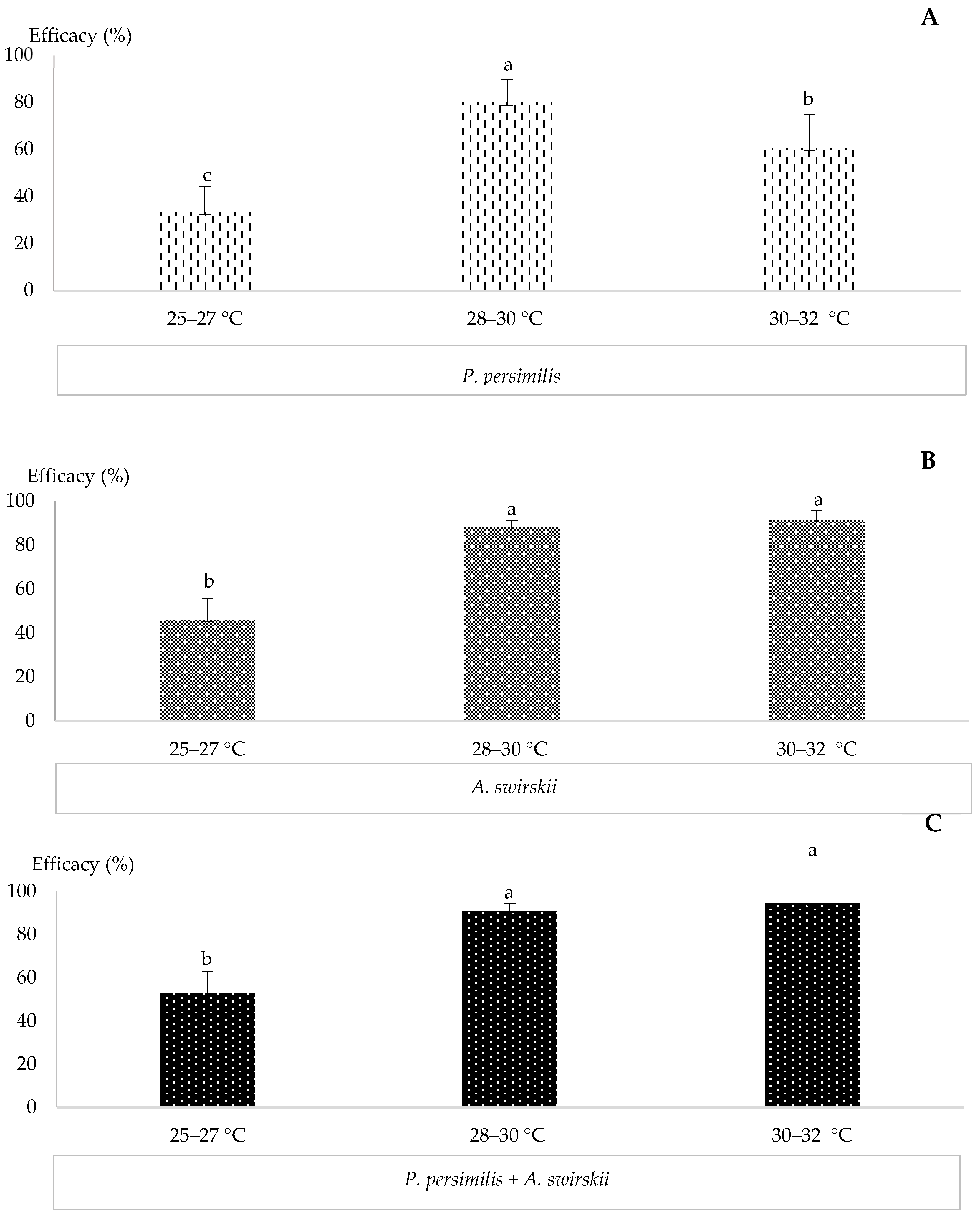

| Efficacy (%) | Range of Temperatures | ||
|---|---|---|---|
| 25–27 °C | 28–30 °C | 30–32 °C | |
| P. persimilis | 33.28 ± 10.78 | 79.77 ± 10.01 | 60.57 ± 14.39 b |
| A. swirskii | 45.98 ± 9.83 | 87.84 ± 3.49 | 91.47 ± 4.26 a |
| P. persimilis + A. swirskii | 52.98 ± 8.44 | 91.00 ± 4.58 | 94.63 ± 3.10 a |
Disclaimer/Publisher’s Note: The statements, opinions and data contained in all publications are solely those of the individual author(s) and contributor(s) and not of MDPI and/or the editor(s). MDPI and/or the editor(s) disclaim responsibility for any injury to people or property resulting from any ideas, methods, instructions or products referred to in the content. |
© 2026 by the authors. Licensee MDPI, Basel, Switzerland. This article is an open access article distributed under the terms and conditions of the Creative Commons Attribution (CC BY) license.
Share and Cite
Mdallel, L.M.; Mquiteb, A.; Guerban, A.; Sudayri, B.S.; Al-Oudah, S.; Al-Eid, S.M. Temperature Effects on the Efficacy of Phytoseiulus persimilis and Amblyseius swirskii (Acari: Phytoseiidae) Against Tetranychus urticae (Acari: Tetranychidae) in Strawberry Crops. Insects 2026, 17, 366. https://doi.org/10.3390/insects17040366
Mdallel LM, Mquiteb A, Guerban A, Sudayri BS, Al-Oudah S, Al-Eid SM. Temperature Effects on the Efficacy of Phytoseiulus persimilis and Amblyseius swirskii (Acari: Phytoseiidae) Against Tetranychus urticae (Acari: Tetranychidae) in Strawberry Crops. Insects. 2026; 17(4):366. https://doi.org/10.3390/insects17040366
Chicago/Turabian StyleMdallel, Lassaad Mahmoud, Abderrahman Mquiteb, Abdallah Guerban, Bader Sulaiman Sudayri, Selman Al-Oudah, and Soltan Mohamed Al-Eid. 2026. "Temperature Effects on the Efficacy of Phytoseiulus persimilis and Amblyseius swirskii (Acari: Phytoseiidae) Against Tetranychus urticae (Acari: Tetranychidae) in Strawberry Crops" Insects 17, no. 4: 366. https://doi.org/10.3390/insects17040366
APA StyleMdallel, L. M., Mquiteb, A., Guerban, A., Sudayri, B. S., Al-Oudah, S., & Al-Eid, S. M. (2026). Temperature Effects on the Efficacy of Phytoseiulus persimilis and Amblyseius swirskii (Acari: Phytoseiidae) Against Tetranychus urticae (Acari: Tetranychidae) in Strawberry Crops. Insects, 17(4), 366. https://doi.org/10.3390/insects17040366