1. Introduction
Amrasca biguttula (Ishida) (Hemiptera: Cicadellidae), hereafter referred to as the two-spot cotton leafhopper (TSCL), is an emerging invasive pest of increasing concern in the southeastern United States. Native to South and Southeast Asia, TSCL is a destructive pest of cotton, okra, eggplant, potato, roselle, and other crops, where feeding by nymphs and adults causes hopperburn, leaf necrosis, stunting, and substantial yield loss [
1,
2]. In its native and expanded ranges, TSCL has also developed resistance to multiple insecticide classes, including pyrethroids, organophosphates, and neonicotinoids, complicating management efforts [
3,
4,
5].
TSCL was first detected in the Western Hemisphere in Puerto Rico in 2023 [
6] and subsequently in Florida in 2024 [
7]. By mid-2025, coordinated surveys documented TSCL in more than 100 counties across Alabama, Florida, Georgia, and South Carolina, with injury ranging from mild chlorosis to severe hopperburn and defoliation [
8]. Recent phylogeographic analysis revealed that U.S. populations represent a single mtCOI haplotype identical to Hap01, the globally dominant lineage, indicating a recent introduction and rapid regional spread [
9]. The pest has now been confirmed on cotton, okra, eggplant, hibiscus, and several weedy hosts, raising concerns about establishment, overwintering, and spillover into high-value crops [
10].
Regulatory agencies have responded aggressively to TSCL detections. In 2025, the Texas Department of Agriculture enacted an emergency quarantine to prevent the movement of TSCL-infested plant material after detections in nursery and landscape settings raised concerns about rapid spread and potential economic losses to cotton, vegetables, and ornamentals. The quarantine restricted the movement of host plants, required mandatory inspections, and emphasized that TSCL poses a significant risk to interstate commerce and agricultural production. These actions highlight the vulnerability of ornamental pathways—particularly hibiscus—to long-distance movement of TSCL and underscore the need for validated management tools suitable for nursery systems.
Although TSCL is historically recognized as a cotton and vegetable pest, recent reports indicate that ornamental hibiscus (
Hibiscus rosa-sinensis) has become a key host in the southeastern U.S. Commercial nurseries have reported rapid hopperburn development, plant decline, and regulatory concern due to “Stop Sale and Hold” orders triggered by TSCL detections [
11]. Hibiscus is widely marketed as a pollinator-friendly, low-input ornamental, and many nurseries avoid insecticide applications on flowering plants to maintain pollinator-safe labeling [
12]. This creates a management gap: hibiscus plants can harbor undetected TSCL populations, serve as overwintering refugia, and act as bridge hosts enabling early-season infestations in nearby cotton and vegetable fields. Because hibiscus is shipped across state lines year-round, infested plants also pose a regulatory risk for interstate movement.
Despite the increasing importance of hibiscus as a reservoir host, nearly all published insecticide efficacy studies for TSCL have been conducted on cotton, okra, eggplant, or other vegetable crops. No standardized chemical efficacy data exist for ornamental hibiscus, even though nursery production systems differ markedly from field crops in canopy structure, irrigation practices, residue persistence, and application constraints. This lack of information limits the ability of growers, regulators, and extension specialists to implement effective management programs for ornamental systems and to prevent the movement of infested plants through interstate commerce.
To address this gap, we selected three insecticides—bifenthrin (IRAC 3A), flupyradifurone (IRAC 4D), and tolfenpyrad (IRAC 21A)—because they represent major modes of action currently available, labeled for use, and realistically applicable in U.S. nursery and landscape systems for piercing–sucking pests. These products differ in speed of kill, systemic activity, and residual persistence, providing growers with rotation options essential for resistance management. They also reflect the chemistries most frequently used or requested by hibiscus producers facing TSCL outbreaks [
11].
We conducted a leaf-disc laboratory bioassay because it provides a standardized, containment-safe method for evaluating acute and residual toxicity while eliminating confounding nursery variables such as irrigation leaching, uneven spray coverage, and canopy architecture. Leaf-disc assays allow precise control of dose, exposure, and timing, enabling clear separation of acute toxicity (0–24 h) from residual activity (24–72 h and 72–96 h). This approach is widely used for sap-feeding pest toxicology and is the required first step before greenhouse or nursery-scale trials.
Given the rapid spread of TSCL in the southeastern U. S., the increasing frequency of hibiscus infestations, the regulatory actions triggered by its detection, and the absence of insecticide performance data for ornamental hosts, this study provides the first evidence-based evaluation of insecticide efficacy against TSCL on hibiscus. Our results offer immediate guidance for nursery producers and regulatory agencies and establish a foundation for future whole-plant and field-scale evaluations.
2. Materials and Methods
2.1. Insects
Adults and immatures of the two-spot cotton leafhopper (TSCL) were originally collected from field-grown cotton at the Clemson University Pee Dee Research and Education Center in Florence, South Carolina. A supplemental colony was then maintained on unsprayed hibiscus plants (Hibiscus rosa sinensis ‘Hot Shot’) at the same location. All insects used in the bioassays were taken from these hibiscus plants. Hibiscus plants of uniform size and age were obtained from a commercial nursery on 22 August 2025 and transplanted into 5-gallon pots containing a commercial substrate. Insects were collected with a mouth aspirator to avoid mechanical injury. They were immediately transferred into ventilated plastic containers filled with untreated hibiscus leaves. All insects were held for one hour at 26 ± 1 °C, 70–80% RH, and a 14:10 (L:D) photoperiod to recover from handling stress. Only active and undamaged individuals were used. Adults and immatures were tested in separate experiments, but all procedures and environmental conditions were identical.
2.2. Insecticides and Dose Preparation
Three insecticides were selected to represent the major IRAC groups and different modes of action relevant to TSCL management. Tolfenpyrad (Hachi Hachi SC, IRAC Group 21A) is a mitochondrial complex I electron transport inhibitor. It acts mainly by contact and shows translaminar movement in treated foliage. Flupyradifurone (Altus, IRAC Group 4D) is a butenolide nicotinic acetylcholine receptor modulator. It is systemic, xylem-mobile, and also moves translaminarly. Bifenthrin (Talstar Professional, IRAC Group 3A) is a pyrethroid that modulates sodium channels. It acts by contact and forms persistent surface residues but has no systemic or translaminar activity.
Five dose levels were prepared for each insecticide. These doses were calculated from the median label rate used in our field experiment [
13]. The same median label rates were also used in our previously published field study on TSCL management (Yadav et al. 2026) [
13], ensuring consistency between laboratory and field evaluations. For each product, the median value within the EPA-registered application range was converted to mL L
−1, and the five-level dose series (D1–D5) was generated by scaling this field-relevant rate proportionally. This approach ensures that all concentrations tested reflect realistic application intensities rather than artificially elevated laboratory doses. Tolfenpyrad was tested at 0.80, 1.26, 2.00, 3.16, and 5.00 mL L
−1 (T1D1–T1D5). Flupyradifurone was tested at 0.12, 0.21, 0.35, 0.59, and 1.00 mL L
−1 (T2D1–T2D5). Bifenthrin was tested at 0.20, 0.30, 0.45, 0.67, and 1.00 g L
−1 (T3D1–T3D5). An untreated control was included at each dose position (T4D1–T4D5). All solutions were prepared fresh with distilled water.
2.3. Leaf Disc Treatment
Hibiscus leaves of uniform age and size were selected at the newly fully expanded stage. Leaves were rinsed with distilled water and air-dried at room temperature until all surface moisture had evaporated. Whole leaves were then dipped into the treatment solution until fully immersed and removed. Treated leaves were placed directly into 9 cm plastic Petri dishes. Each Petri dish lid had a 3 cm-diameter hole covered with a no-thrips screen to allow ventilation (
Figure S1). Leaves were allowed to air-dry at room temperature for 45 min following insecticide application. Adult and immature TSCL were collected using a standard mouth aspirator into 4–5 mL polypropylene collection vials (≈12–16 mm diameter). To suppress activity and prevent escape during transfer, the vials were placed on crushed ice for approximately five minutes, inducing transient cold immobilization. After drying, live adults and immatures were transferred to control and treated leaves using a fine camel-hair brush, with careful handling to minimize stress and reduce natural mortality.
2.4. Experimental Design
The experiment followed a randomized complete block design with five blocks. Within each block, all insecticide × dose combinations and the corresponding control positions (4 treatments × 5 dose levels = 20 combinations) were represented once and assigned to Petri dishes (DishID) in random order. Each insecticide × dose combination was replicated three times across blocks, and DishID served as the experimental unit. For each DishID and each cohort, five TSCL were introduced into each Petri dish. Adults and immatures were tested in separate experiments using identical randomization and blocking. A randomized complete block design was selected instead of a completely randomized design because preliminary observations indicated block-level variation in insect vigor, leaf condition, and microenvironmental factors. Blocking allowed this structured variability to be accounted for explicitly, reducing residual error and increasing the precision of treatment comparisons relative to a CRD.
2.5. Acute Toxicity Assay (0–24 h)
Acute toxicity was evaluated using a first cohort of TSCL exposed immediately to freshly treated leaf discs. Five insects were introduced into each Petri dish and placed onto the treated leaf disc using a mouth aspirator and a fine camel-hair brush. Petri dishes were sealed with Parafilm® and maintained at 26 ± 1 °C, 70–80% RH, and a 14:10 L:D photoperiod. Mortality for this first cohort was recorded at 5 h and 24 h after introduction. Insects were considered dead if they failed to move when gently probed with a fine brush. Immediately after the 24 h assessment, all insects from the first cohort were removed and discarded, and the treated discs remained in the dishes for the next cohort.
2.6. Residual Toxicity Assay (24–72 h and 72–96 h)
Residual toxicity was evaluated using two sequential cohorts of TSCL, each representing a distinct exposure group introduced at a different residue age rather than repeated observations on the same insects. The second cohort assessed the toxicity of 24 h-old residues. This cohort was independent of the first cohort and was used to isolate mortality caused by aged residues rather than prolonged exposure. At 24 h after treatment, five new insects were introduced into each Petri dish onto the same treated leaf discs used in the acute assay. Dishes were resealed with Parafilm® and maintained under the same environmental conditions. Mortality of this second cohort was recorded at 72 h after treatment, corresponding to approximately 48 h of exposure to 24 h-old residues. Thus, the 72 h time point reflects mortality of a new cohort exposed to 24 h-old residues, not continued survival of the first cohort. Immediately after the 72 h assessment, all second-cohort insects were removed and discarded, and the treated discs remained in the dishes.
A third cohort was used to evaluate the toxicity of older residues, again representing a new group of insects introduced specifically to measure mortality on 72 h-old residues. At 72 h after treatment, five new insects were introduced into each Petri dish onto the same treated discs. Dishes were resealed and maintained under the same environmental conditions. Mortality of this third cohort was recorded at 96 h after treatment, corresponding to approximately 24 h of exposure to 72 h-old residues. The 48 h exposure window used for the second cohort was selected to capture potential delayed mortality on relatively fresh residues, whereas the shorter 24 h window for the third cohort provided a conservative test of lethality on older residues without confounding residue decay with prolonged exposure. Accordingly, the 96 h time point reflects mortality of this third cohort and should be interpreted as residue-age-specific mortality rather than a continuation of earlier observations. Adults and immatures were analyzed independently because they differ in cuticle thickness, feeding intensity, body size, and detoxification capacity, which produce distinct susceptibility profiles despite feeding on the same leaf surface.
2.7. Data Processing and Statistical Analysis
All analyses were conducted in R (R Core Team, Vienna, Austria) [
14]. For each DishID and time point, the number of dead and alive TSCL individuals (out of five) was recorded. Acute (5 and 24 h) and residual (72 and 96 h) assays were analyzed separately because they represent distinct exposure cohorts. Mortality was corrected for control mortality using Abbott’s formula [
15].
Because mortality in most insecticide treatments reached 100% by 24 h and remained uniformly high across doses and time points, the data did not exhibit the graded responses required for probit or log-logistic dose–response modeling. Consequently, LC50 estimation was not appropriate for this dataset and was not attempted. Instead, analyses focused on models and summary metrics suitable for datasets with complete or near-complete mortality.
Corrected mortality at each time point was analyzed using generalized linear models (GLMs) with a binomial error distribution and logit link. Insecticide, dose, and their interaction were treated as fixed effects. Overdispersion was assessed by comparing residual deviance with residual degrees of freedom; when present, an observation-level random effect was added to account for extra-binomial variation. For each time point, treatment effects were further evaluated using ANOVA, and pairwise comparisons were adjusted using Tukey’s method (α = 0.05). To summarize insecticide performance under conditions of uniformly high mortality, two descriptive potency metrics were calculated: (1) Minimum Effective Dose (MED), defined as the lowest tested dose achieving ≥ 90% mean mortality, and (2) T90, the earliest time point at which ≥90% mean mortality was observed for each insecticide × life stage combination.
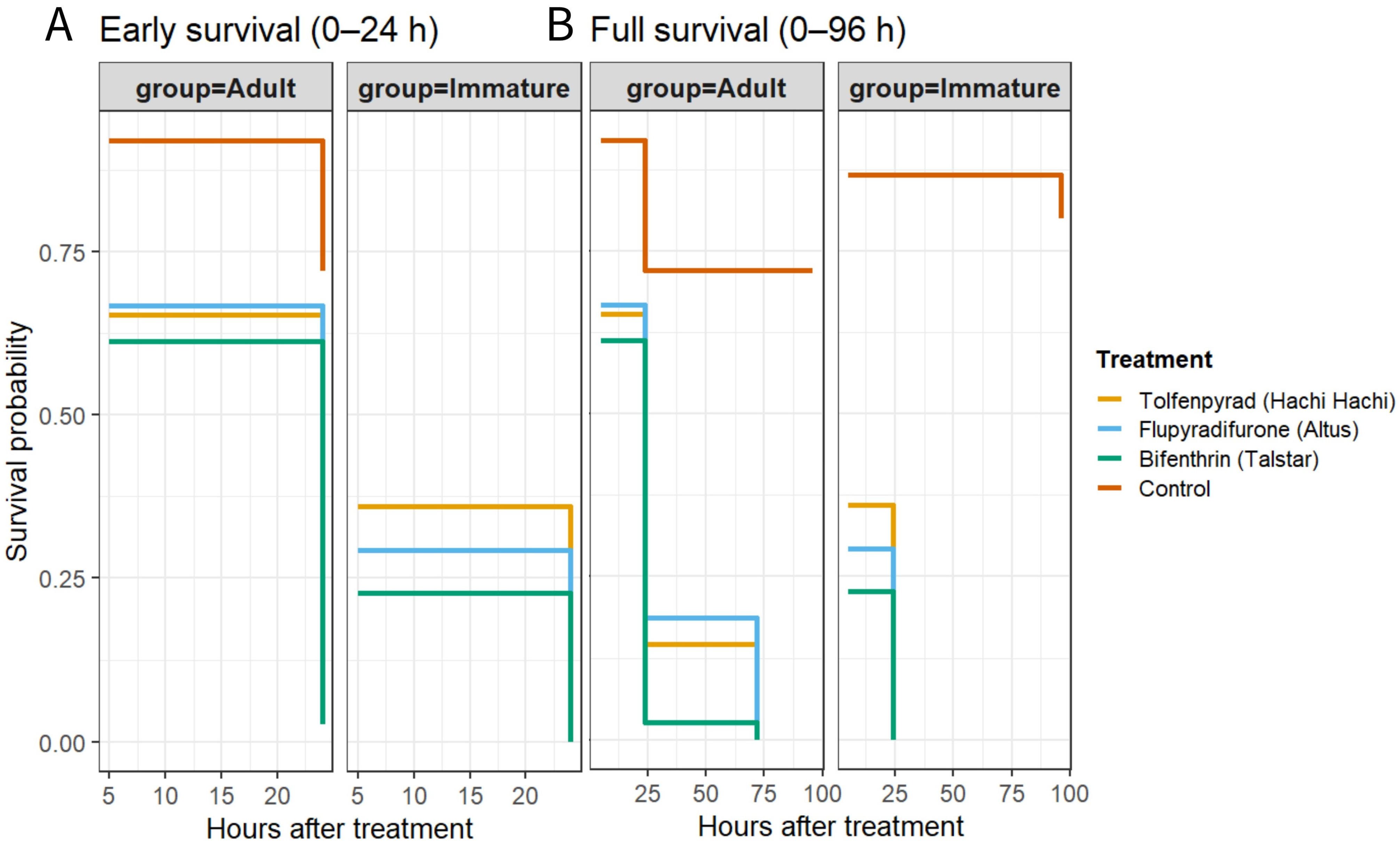
Survival across the full assay period was analyzed using Kaplan–Meier estimators.
Individual-level survival times were reconstructed from cumulative mortality counts, and survival curves were compared descriptively across insecticides and life stages. All graphical outputs included corrected mortality trajectories, dose-indexed mortality patterns at 24 h, and Kaplan–Meier survival curves. Model diagnostics (residual plots, dispersion checks, and fit statistics) were examined to verify appropriate model performance.
4. Discussion
This study provides the first insecticide efficacy data for TSCL on ornamental hibiscus in the U.S. Although TSCL is a well-known pest of cotton and vegetables in Asia [
1,
2], its rapid establishment in the southeastern U.S. [
6,
8] and recent detections in nursery systems have created an urgent need for management recommendations specific to ornamental production. Until now, no data existed to guide chemical control on hibiscus, despite its role as a high-risk reservoir and a major pathway for interstate movement. Our results directly address this gap and provide the first evidence-based framework for managing TSCL in nursery environments.
A sequential-cohort design was essential to accurately quantify acute and residual activity. The insects evaluated at 72 h and 96 h were not the same individuals tested at 24 h. Instead, new cohorts were introduced onto the same treated leaf discs after each observation period. This design eliminates starvation-related mortality, age-related decline, and cumulative sublethal effects that would otherwise inflate mortality estimates. TSCL survival declines rapidly in the absence of feeding, and holding the same insects for 96 h would have produced mortality unrelated to chemical activity. By introducing new insects at 24 h and again at 72 h, mortality at 72 h and 96 h reflects true residue-based toxicity. This approach is widely used for sap-feeding pests because it isolates chemical persistence on the substrate from the biology of the insects themselves. It provides a more rigorous and defensible estimate of residual performance than single-cohort assays.
An alternative framework introduces insects at several residue ages and measures mortality at fixed intervals such as 6, 12, 24, 48, and 72 h. This creates a clear matrix of residue age and exposure duration. It separates chemical decay from time-dependent physiological decline. It also captures residue weathering and canopy effects that occur under greenhouse or whole-plant conditions. Our study used a sequential-cohort design because it isolates acute and residue-based mortality under controlled conditions and avoids starvation or age-related artifacts. The more granular residue-age × exposure-duration approach is a logical next step for refining residual performance under production-scale environments.
Bifenthrin produced the highest acute mortality at 24 h for both adults and immatures, consistent with the rapid neurotoxic action of pyrethroids reported in other leafhopper systems [
3]. Flupyradifurone and tolfenpyrad exhibited slower initial activity, which aligns with their systemic and metabolic modes of action. Immatures were more susceptible than adults, likely due to thinner cuticles, higher feeding rates, and reduced detoxification capacity. These patterns reinforce the importance of targeting early instars whenever possible and highlight the biological relevance of life-stage-specific susceptibility.
These life-stage differences are consistent with known physiological traits of hemipterans. Immatures typically possess thinner and less sclerotized cuticles, higher relative feeding rates, and reduced constitutive detoxification capacity, all of which increase internal dose per unit exposure and contribute to greater susceptibility [
16,
17].
These life-stage differences are consistent with known physiological traits of hemipterans. Immatures typically possess thinner cuticles, higher relative feeding rates, and lower constitutive detoxification enzyme activity, all of which increase internal dose per unit exposure. These mechanisms provide a biological basis for the consistently higher susceptibility observed in immature TSCL.
Apparent residual mortality increased sharply after 24 h for all insecticides, with near-complete mortality by 72 h. This pattern reflects the feeding biology of TSCL and the time required for systemic and translaminar chemistries to penetrate leaf tissues. The significant treatment and dose effects at 72 h confirm that these products provide strong residual control once fully expressed. Dose–response curves at 24 h showed steep concentration-dependent mortality for bifenthrin and tolfenpyrad, and a time-dependent response for flupyradifurone. These findings align with reports from cotton and okra systems in Asia, where flupyradifurone provides strong control but requires sustained feeding exposure [
5,
12]. Together, these results demonstrate that hibiscus foliage does not diminish the inherent toxicity or residual expression of these chemistries.
TSCL infestations on hibiscus pose unique challenges for nursery producers. Hibiscus is widely marketed as a pollinator-friendly ornamental, and many growers avoid insecticide applications on flowering plants to maintain pollinator-safe labeling [
11]. This increases reliance on systemic products applied during vegetative stages. Our results show that flupyradifurone and tolfenpyrad provide strong residual control, making them suitable for prebloom applications in nursery systems. Bifenthrin provides rapid knockdown but may be less compatible with pollinator-sensitive marketing practices. These distinctions are critical for developing rotation programs that balance efficacy, pollinator safety, and regulatory compliance.
Regulatory actions further elevate the importance of effective management. TSCL detections have triggered “Stop Sale and Hold” orders in multiple states, and Texas implemented an emergency quarantine in 2025 to prevent movement of infested plant material through the nursery trade. Because hibiscus is shipped year-round across state lines, infested plants represent a high-risk pathway for long-distance dispersal. Effective chemical suppression at the nursery level is therefore essential not only for crop protection but also for regulatory compliance and interstate commerce.
Hibiscus can support high TSCL populations and provides year-round foliage in warm regions, enabling overwintering and early-season buildup [
11]. This reservoir role has been documented in Puerto Rico, Florida, and South Carolina [
7,
11]. Our findings confirm that TSCL readily feeds and survives on hibiscus foliage, reinforcing the need for targeted management in ornamental systems. The strong residual activity observed for all three insecticides suggests that hibiscus can be effectively protected with properly timed applications.
Leaf-disc assays allowed precise control of dose, exposure, and timing, enabling clear separation of acute and residual effects. Although whole-plant studies are needed to evaluate spray coverage, phytotoxicity, and persistence under nursery irrigation regimes, leaf-disc assays are the standard first step for sap-feeding pest toxicology and provide essential baseline data. Future work should evaluate whole-plant performance, compatibility with biological control agents, and rotation programs to delay resistance.
The high mortality observed across most doses also reflects the inherent exposure intensity of the leaf-dip method, which produces uniform residue coverage and limits behavioral avoidance. While this may exceed exposure heterogeneity under nursery conditions, the doses tested were based on median label rates used in our field experiment, and the strong mortality response is consistent with field observations [
13]. Whole-plant studies will be important for refining exposure realism under production irrigation and canopy structure.
This study provides foundational data for TSCL management on ornamental hibiscus and supports the development of integrated strategies for nursery producers and regulatory agencies. It establishes a scientifically rigorous baseline for future greenhouse and field evaluations and provides the first actionable chemical control recommendations for a pest of growing regulatory and economic importance.