A Review of Artificial Diets for Aphids (Hemiptera: Aphididae)


Simple Summary
Abstract
1. Introduction
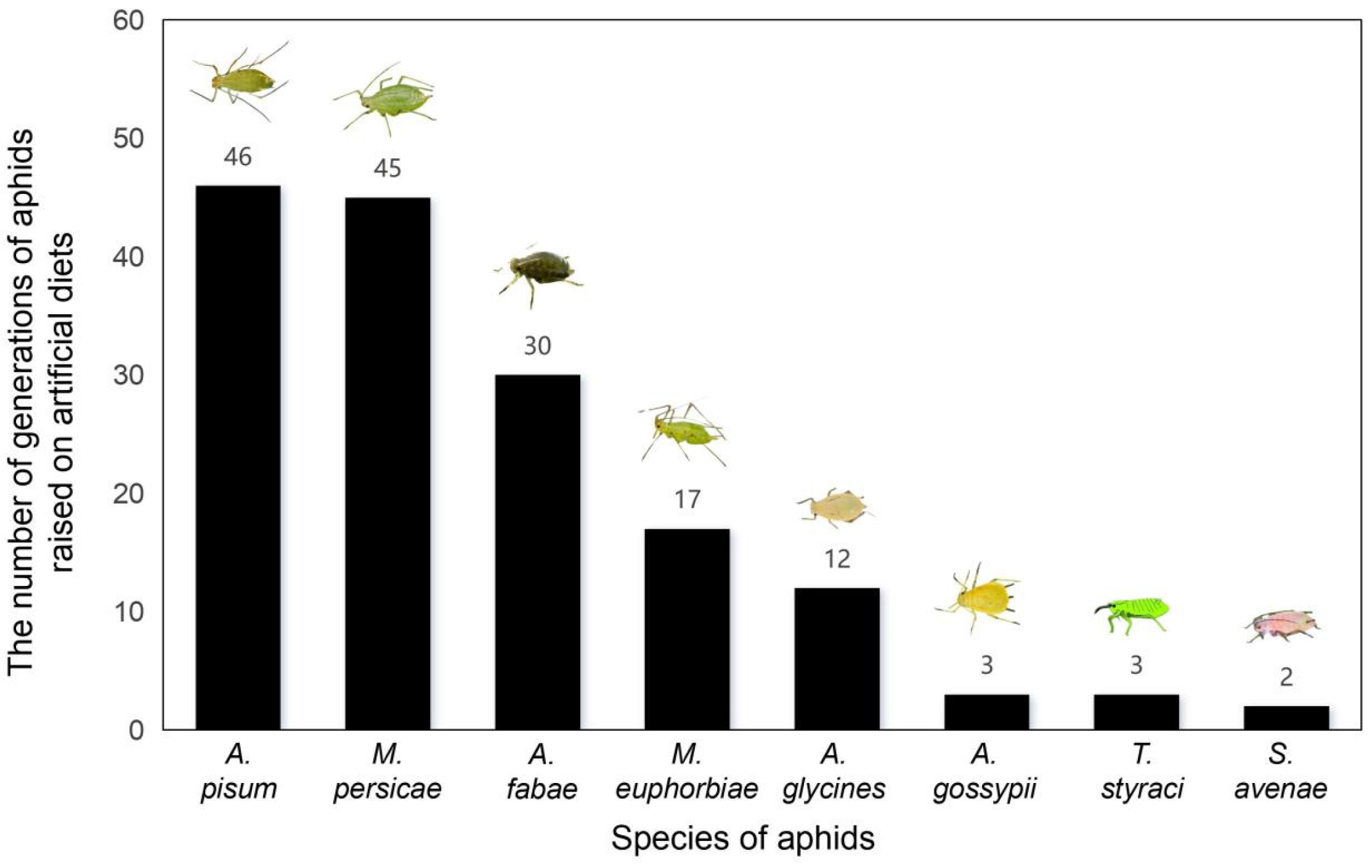
2. Historical Development of Aphids Reared on Artificial Diets
3. Effects of Different Nutritional Components on Aphid Growth and Development
3.1. Carbohydrates
3.1.1. Sucrose
3.1.2. Other Sugars
3.1.3. Interaction Between Different Carbohydrates
3.2. Amino Acids
3.2.1. Amino Acid Functions
3.2.2. Amino Acid Concentrations in Artificial Diets
3.3. Lipids
3.4. Vitamins
3.4.1. Ascorbic Acid
3.4.2. B-Complex Vitamins
3.5. Inorganic Salts
3.5.1. Mineral Elements
3.5.2. Chelator
3.5.3. Sodium Acetate and Sulfur Nutrition
3.6. Complex Supplements
4. Non-Nutritional Factors Affecting the Efficacy of Artificial Diets for Aphids
4.1. Suitable pH and Pressure of the Diet
4.2. Diet Delivery Methods
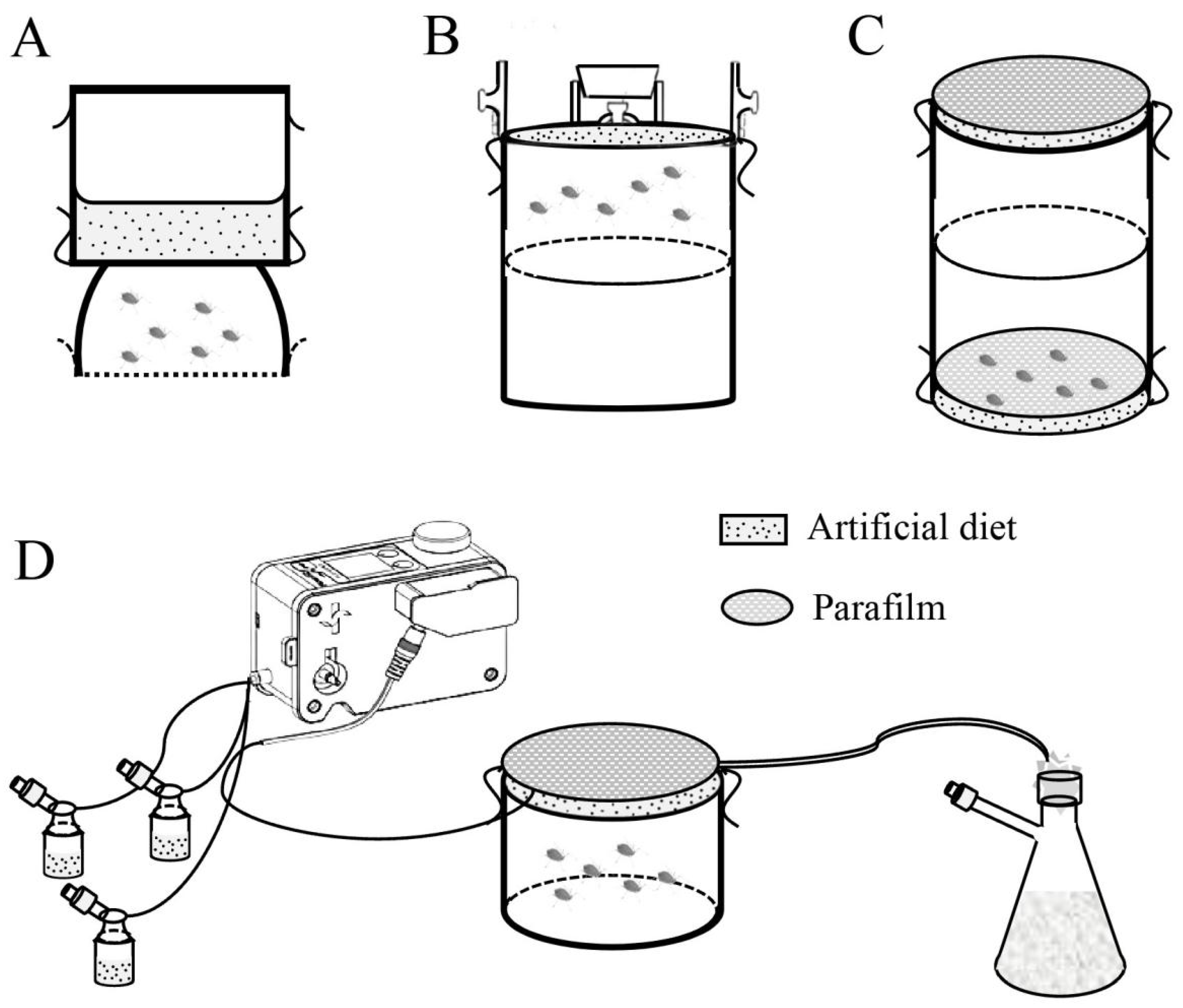
4.2.1. Aphid Rearing Apparatus
4.2.2. Artificial Diet Membranes
4.2.3. Diet Sterilization and Automated Feeding System
4.3. Feeding Stimulants
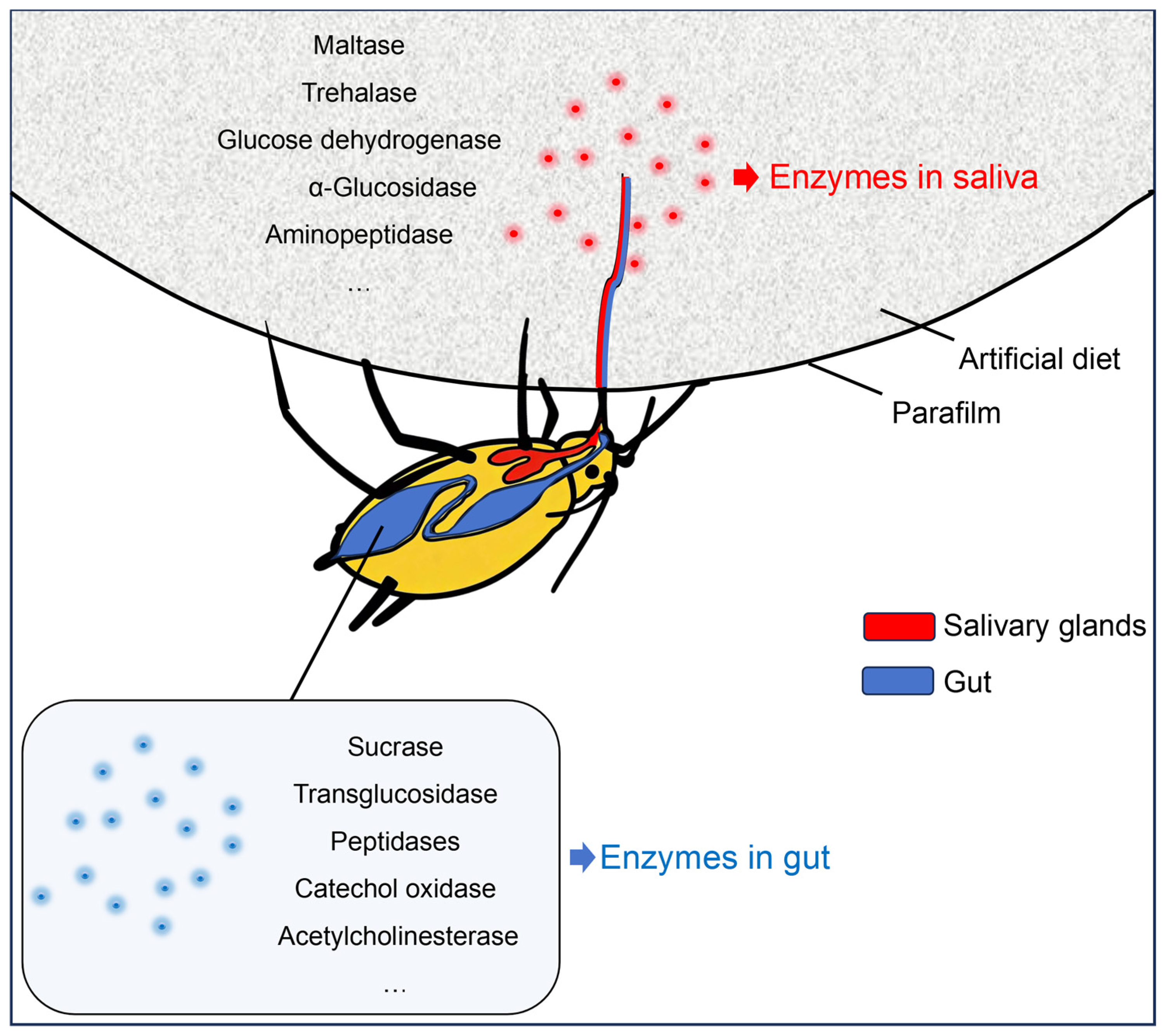
4.4. Aphid Digestive Enzymes
4.5. Aphid Gut Microbiota
5. Summary and Prospects
5.1. Environmental Conditions Controlled in Artificial Rearing Systems
5.2. Diet Development Strategy
5.3. Summary
5.4. Prospects
Author Contributions
Funding
Data Availability Statement
Acknowledgments
Conflicts of Interest
Abbreviations
| CH | Casein hydrolysate |
| YE | Yeast extract |
| PABA | P-Aminobenzoic acid/4-aminobenzoic acid |
| EDTA | Ethylene diamine tetraacetic scid |
| GLD | Glucose dehydrogenase |
| GOX | Glucose oxidase |
| ACE | Angiotensin-converting enzyme |
| TRE | Trehalase |
| GST-1 | Glutathione S-transferase 1 |
| CaM | Calmodulin |
| RCN | Regucalcin |
| CALU | Calumenin |
| Ro | Net reproductive rate |
References
- Görür, G.; Şenol, Ö.; Beğen, H.A.; Akyürek, B. Foresights derived from recent studies conducted on Turkey aphid fauna. Atatürk Üniversitesi Ziraat Fakültesi Derg. 2020, 51, 63–68. [Google Scholar] [CrossRef] [Scilit]
- Dedryver, C.A.; Le Ralec, A.; Fabre, F. The conflicting relationships between aphids and men: A review of aphid damage and control strategies. C.R. Biol. 2010, 333, 539–553. [Google Scholar] [CrossRef] [Scilit]
- Holman, J. Host Plant Catalog of Aphids: Palaearctic Region; Springer: Dordrecht, The Netherlands; Berlin/Heidelberg, Germany, 2009. [Google Scholar]
- Zhuang, H.; Li, J.; Song, J.; Hettenhausen, C.; Schuman, M.C.; Sun, G.; Zhang, C.; Li, J.; Song, D.; Wu, J. Aphid (Myzus persicae) feeding on the parasitic plant dodder (Cuscuta australis) activates defense responses in both the parasite and soybean host. New Phytol. 2018, 218, 1586–1596. [Google Scholar] [CrossRef] [Scilit]
- Hill, D.S. Agricultural Insect Pests of Temperate Regions and Their Control; CUP Archive: Cambridge, UK, 1987. [Google Scholar]
- Blackman, R.L.; Eastop, V.F. Aphids on the World’s Crops: An Identification and Information Guide; Wiley: Hoboken, NJ, USA, 1984. [Google Scholar]
- Wang, M.; Yuan, G.; Chen, J.; Lei, Z.; Wu, Z. Research advances of occurrence pattern, damage characteristics of wheat aphid and resistance identification of wheat. J. Henan Agric. Sci. 2006, 7, 58–60. [Google Scholar] [CrossRef]
- Tatchell, G.M. An estimate of the potential economic losses to some crops due to aphids in Britain. Crop Prot. 1989, 8, 25–29. [Google Scholar] [CrossRef] [Scilit]
- Hamilton, M.A. Notes on the Culturing of Insects for Virus Work. Ann. Appl. Biol. 1930, 17, 487–492. [Google Scholar] [CrossRef] [Scilit]
- Bradley, R.H.E. Effects of Depth of Stylet Penetration on Aphid Transmission of Potato Virus Y. Can. J. Microbiol. 1956, 2, 539–547. [Google Scholar] [CrossRef] [Scilit]
- Mittler, T.E.; Dadd, R.H. Artificial Feeding and Rearing of the Aphid, Myzus persicae (Sulzer), on a Completely Defined Synthetic Diet. Nature 1962, 195, 404. [Google Scholar] [CrossRef] [Scilit]
- Auclair, J.L.; Cartier, J.J. Pea Aphid: Rearing on a Chemically Defined Diet. Science 1963, 142, 1068–1069. [Google Scholar] [CrossRef] [Scilit]
- Dadd, R.H.; Mittler, T.E. Permanent culture of an aphid on a totally synthetic diet. Experientia 1966, 22, 832–833. [Google Scholar] [CrossRef] [Scilit]
- Mittler, T.E.; Dadd, R.H. Studies on the artificial feeding of the aphid Myzus persicae (Sulzer)—I. Relative uptake of water and sucrose solutions. J. Insect Physiol. 1963, 9, 623–645. [Google Scholar] [CrossRef] [Scilit]
- Mittler, T.E.; Dadd, R.H. Studies on the artificial feeding of the aphid Myzus persicae (Sulzer)—II. Relative survival, development, and larviposition on different diets. J. Insect Physiol. 1963, 9, 741–757. [Google Scholar] [CrossRef] [Scilit]
- Dadd, R.H.; Mittler, T.E. Studies on the artificial feeding of the aphid Myzus persicae (Sulzer)—III. Some major nutritional requirements. J. Insect Physiol. 1965, 11, 717–743. [Google Scholar] [CrossRef] [Scilit]
- Auclair, J.L. Feeding and nutrition of the pea aphid, Acyrthosiphon pisum (Homoptera: Aphidae), on chemically defined diets of various pH and nutrient levels. Ann. Entomol. Soc. Am. 1965, 58, 855–875. [Google Scholar] [CrossRef] [Scilit]
- Auclair, J.L. Effects of light and sugars on rearing the cotton aphid, Aphis gossypii, on a germ-free and holidic diet. J. Insect Physiol. 1967, 13, 1247–1268. [Google Scholar] [CrossRef] [Scilit]
- Dadd, R.H.; Krieger, D.L.; Mittler, T.E. Studies on the artificial feeding of the aphid Myzus persicae (Sulzer)—IV. Requirements for water-soluble vitamins and ascorbic acid. J. Insect Physiol. 1967, 13, 249–272. [Google Scholar] [CrossRef] [Scilit]
- Dadd, R.H. Improvement of synthetic diet for the aphid Myzus persicae using plant juices, nucleic acids, or trace metals. J. Insect Physiol. 1967, 13, 763–778. [Google Scholar] [CrossRef] [Scilit]
- Dadd, R.H.; Krieger, D.L. Continuous Rearing of Aphids of the Aphis fabae Complex on Sterile Synthetic Diet. J. Econ. Entomol. 1967, 60, 1512–1514. [Google Scholar] [CrossRef] [Scilit]
- Tahori, A.; Hazan, A. Rearing of the black citrus aphid Toxoptera aurantii on chemically defined diets. J. Insect Physiol. 1970, 16, 1975–1981. [Google Scholar] [CrossRef] [Scilit]
- Srivastava, P.N.; Auclair, J.L. An improved chemically defined diet for the pea aphid, Acyrthosiphon pisum. Ann. Entomol. Soc. Am. 1971, 64, 474–478. [Google Scholar] [CrossRef] [Scilit]
- Akey, D.H.; Beck, S.D. Nutrition of the pea aphid, Acyrthosiphon pisum: Requirements for trace metals, sulphur, and cholesterol. J. Insect Physiol. 1972, 18, 1901–1914. [Google Scholar] [CrossRef] [Scilit]
- Akey, D.H.; Beck, S.D. Continuous rearing of the pea aphid, Acyrthosiphon pisum, on a holidic diet. Ann. Entomol. Soc. Am. 1971, 64, 353–356. [Google Scholar] [CrossRef] [Scilit]
- Kunkel, H. Membrane feeding systems in aphid research. In Aphids as Virus Vectors; Elsevier: Amsterdam, The Netherlands, 1977; pp. 311–338. [Google Scholar]
- Auclair, J.L. Biotypes of the pea aphid, Acyrthosiphon pisum, in relation to host plants and chemically defined diets. Entomol. Exp. Appl. 1978, 24, 212–216. [Google Scholar] [CrossRef] [Scilit]
- Gao, W.; Wang, M.; Chen, H. Progress in Research and Application of Aphids’ Artificial Diet. Chin. J. Biol. Control 2012, 28, 121–127. Available online: http://dianda.cqvip.com/Qikan/Article/Detail?id=40736262 (accessed on 30 January 2026).
- Van Emden, H.F.; Wild, E.A. A fully defined artificial diet for Myzus persicae–the detailed technical manual. Entomol. Exp. Appl. 2020, 168, 582–586. [Google Scholar] [CrossRef] [Scilit]
- Mittler, T.E.; Koski, P. Development of meridic and oligidic diets for rearing the aphid Myzus persicae. J. Insect Physiol. 1976, 22, 1135–1141. [Google Scholar] [CrossRef] [Scilit]
- Chawla, S.S.; Perron, J.M.; Cloutier, M. Effects of different growth factors on the potato aphid, Macrosiphum euphorbiae (Aphididae: Homoptera), fed on an artificial diet. Can. Entomol. 1974, 106, 273–280. [Google Scholar] [CrossRef] [Scilit]
- Wille, B.D.; Hartman, G.L. Evaluation of artificial diets for rearing Aphis glycines (Hemiptera: Aphididae). J. Econ. Entomol. 2008, 101, 1228–1232. [Google Scholar] [CrossRef] [Scilit]
- Shibao, H.; Kutsukake, M.; Lee, J.M.; Fukatsu, T. Maintenance of soldier-producing aphids on an artificial diet. J. Insect Physiol. 2002, 48, 495–505. [Google Scholar] [CrossRef] [Scilit] [PubMed]
- Shibao, H.; Kutsukake, M.; Fukatsu, T. Temporal division of labor in an aphid social system. Sci. Rep. 2021, 11, 1183. [Google Scholar] [CrossRef] [Scilit] [PubMed]
- Chen, J.; Ni, H.; Ding, H.; Sun, J. Studies on A Chemically Defined Diet of English Grain Aphid. Sci. Agric. Sin. 2000, 33, 54–59. Available online: https://www.researchgate.net/publication/285223068_Studies_on_chemically_defined_diet_of_English_grain_aphid (accessed on 30 January 2026).
- Wool, D.; Van Emden, H.F. A possible genetic component in the adaptability of Myzus persicae (Sulz.) clones (Hom., Aphididae) to synthetic diet. Z. Angew. Entomol. 1981, 91, 225–231. [Google Scholar] [CrossRef] [Scilit]
- Retnakaran, A.; Beck, S.D. Aspects of mineral nutrition of the pea aphid, Acyrthosiphon pisum (Harris). J. Nutr. 1967, 92, 43–52. [Google Scholar] [CrossRef] [Scilit] [PubMed]
- Febvay, G.; Delobel, B.; Rahbé, Y. Influence of the amino acid balance on the improvement of an artificial diet for a biotype of Acyrthosiphon pisum (Homoptera: Aphididae). Can. J. Zool. 1988, 66, 2449–2453. [Google Scholar] [CrossRef] [Scilit]
- Sasaki, T.; Hayashi, H.; Ishikawa, H. Growth and reproduction of the symbiotic and aposymbiotic pea aphids, Acyrthosiphon pisum maintained on artificial diets. J. Insect Physiol. 1991, 37, 749–756. [Google Scholar] [CrossRef] [Scilit]
- Li, M. Effects of Nutrition in Diet on Host Range of the Host-Specialized Aphid, Aphis gossypii Glover. Master’s Thesis, Nanjing Agricultural University, Nanjing, China, 2020. [Google Scholar]
- Kieckhefer, R.W.; Derr, R.F. Rearing three species of cereal aphids on artificial diets. J. Econ. Entomol. 1967, 60, 663–665. [Google Scholar] [CrossRef] [Scilit]
- Karley, A.J.; Douglas, A.E.; Parker, W.E. Amino acid composition and nutritional quality of potato leaf phloem sap for aphids. J. Exp. Biol. 2002, 205, 3009–3018. [Google Scholar] [CrossRef] [Scilit]
- Balvasi, A.; Rassoulian, G.; Bandani, A.; Khalghani, J. Suitability of an artificial diet for rape aphid, Brevicoryne brassicae, using life table parameters. Afr. J. Biotechnol 2009, 8, 4663–4666. Available online: https://www.semanticscholar.org/paper/Suitability-of-an-artificial-diet-for-rape-aphid,-Balvasi-Rassoulian/9f6276a39a0c54d25ccc9ea4d00a8e29bc02dca0 (accessed on 30 January 2026).
- Zhang, Q.; Lu, Y. Optimal and optimization of components and sucrose concentration in the artificial diet for rearing Aphis gossypii. Chin. J. Appl. Entomol. 2024, 61, 229–236. [Google Scholar] [CrossRef]
- Miles, P.W.; Taylor, G.S. ‘Osmotic pump’ feeding by coreids. Entomol. Exp. Appl. 1994, 73, 163–173. [Google Scholar] [CrossRef] [Scilit]
- Karley, A.J.; Ashford, D.A.; Minto, L.M.; Pritchard, J.; Douglas, A.E. The significance of gut sucrase activity for osmoregulation in the pea aphid, Acyrthosiphon pisum. J. Insect Physiol. 2005, 51, 1313–1319. [Google Scholar] [CrossRef] [Scilit] [PubMed]
- Douglas, A.E.; Price, D.R.G.; Minto, L.B.; Jones, E.; Pescod, K.V.; François, C.L.M.J.; Pritchard, J.; Boonham, N. Sweet problems: Insect traits defining the limits to dietary sugar utilisation by the pea aphid, Acyrthosiphon pisum. J. Exp. Biol. 2006, 209, 1395–1403. [Google Scholar] [CrossRef] [Scilit]
- Ashford, D.A.; Smith, W.A.; Douglas, A.E. Living on a high sugar diet: The fate of sucrose ingested by a phloem-feeding insect, the pea aphid Acyrthosiphon pisum. J. Insect Physiol. 2000, 46, 335–341. [Google Scholar] [CrossRef] [Scilit]
- Markkula, M.; Laurema, S. The effect of amino acids, vitamins, and trace elements on the development of Acyrthosiphon pisum Harris (Hom., Aphididae). Biol. Agric. Food Sci. 1967, 6, 77–80. [Google Scholar]
- Srivastava, P.N.; Auclair, J.L. Influence of sucrose concentration on diet uptake and performance by the pea aphid, Acyrthosiphon pisum. Ann. Entomol. Soc. Am. 1971, 64, 739–743. [Google Scholar] [CrossRef] [Scilit]
- Auclair, J.L. Effects of pH and sucrose on rearing the cotton aphid, Aphis gossypii, on a germ-free and holidic diet. J. Insect Physiol. 1967, 13, 431–446. [Google Scholar] [CrossRef] [Scilit]
- Zhao, L.; Shi, G.; Wang, S. Study on artificial feeding technology of Sitobion aveane. J. Gansu Agric. Univ. 2013, 48, 73–77. [Google Scholar] [CrossRef]
- Mittler, T.E.; Dadd, R.H.; Daniels, S.C., Jr. Utilization of different sugars by the aphid Myzus persicae. J. Insect Physiol. 1970, 16, 1873–1890. [Google Scholar] [CrossRef] [Scilit]
- Wang, G.; Zhou, J.; Li, Y.; Gou, Y.; Quandahor, P.; Liu, C. Trehalose and glucose levels regulate feeding behavior of the phloem-feeding insect, the pea aphid Acyrthosiphon pisum Harris. Sci. Rep. 2021, 11, 15864. [Google Scholar] [CrossRef] [Scilit] [PubMed]
- Elbein, A.D.; Pan, Y.; Pastuszak, I.; Carroll, D. New insights on trehalose: A multifunctional molecule. Glycobiology 2003, 13, 17R–27R. [Google Scholar] [CrossRef] [Scilit] [PubMed]
- Shukla, E.; Thorat, L.J.; Nath, B.B.; Gaikwad, S.M. Insect trehalase: Physiological significance and potential applications. Glycobiology 2015, 25, 357–367. [Google Scholar] [CrossRef] [Scilit] [PubMed]
- Shen, Q.; Yang, M.; Xie, G.; Wang, H.; Zhang, L.; Qiu, L.; Wang, S.; Tang, B. Excess trehalose and glucose affects chitin metabolism in brown planthopper (Nilaparvata lugens). J. Asia-Pac. Entomol. 2017, 20, 449–455. [Google Scholar] [CrossRef] [Scilit]
- Yang, M.; Zhao, L.; Shen, Q.; Xie, G.; Wang, S.; Tang, B. Knockdown of two trehalose-6-phosphate synthases severely affects chitin metabolism gene expression in the brown planthopper Nilaparvata lugens. Pest. Manage. Sci. 2017, 73, 206–216. [Google Scholar] [CrossRef] [Scilit]
- Li, C.; Gao, L. Study on the rearing of aphids on a artificially holidic diets. J. Shanxi Agric. Univ. 1997, 3, 225–228. [Google Scholar] [CrossRef]
- Zimmermann, M.H. Transport in the phloem. Annu. Rev. Plant Physiol. 1960, 11, 167–190. [Google Scholar] [CrossRef] [Scilit]
- Dixon, A.F.G. Aphid Ecology An Optimization Approach, 2nd ed.; Springer: Dordrecht, The Netherlands, 1985. [Google Scholar]
- Sandström, J. Performance of pea aphid (Acyrthosiphon pisum) clones on host plants and synthetic diets mimicking the same plants phloem amino acid composition. J. Insect Physiol. 1994, 40, 1051–1057. [Google Scholar] [CrossRef] [Scilit]
- Sempruch, C.; Michalak, A.; Leszczynski, B.; Chrzanowski, G. Effect of Sitobion avenae (Fabricius, 1775) feeding on the free amino acid content within selected parts of triticale plants. Aphids Other Hemipterous Insects 2011, 17, 137–144. [Google Scholar]
- Broussard, L.; Abadie, C.; Lalande, J.; Limami, A.M.; Lothier, J.; Tcherkez, G. Phloem Sap Composition: What Have We Learnt from Metabolomics? Int. J. Mol. Sci. 2023, 24, 6917. [Google Scholar] [CrossRef] [Scilit]
- Dadd, R.H.; Krieger, D.L. Dietary amino acid requirements of the aphid, Myzus persicae. J. Insect Physiol. 1968, 14, 741–764. [Google Scholar] [CrossRef] [Scilit]
- Mittler, T.E. Gustation of dietary amino acids by the aphid Myzus persicae. Entomol. Exp. Appl. 1967, 10, 87–96. [Google Scholar] [CrossRef] [Scilit]
- Dadd, R.H. Dietary Amino Acids and Wing Determination in the Aphid Myzus persicae. Ann. Entomol. Soc. Am. 1968, 61, 1201–1210. [Google Scholar] [CrossRef] [Scilit]
- Mittler, T.E. Effects of dietary amino acids on the feeding rate of the aphid Myzus persicae. Entomol. Exp. Appl. 1970, 13, 432–437. [Google Scholar] [CrossRef] [Scilit]
- Harrewijn, P. Functional significance of indole alkylamines linked to nutritional factors in wing development of the aphid Myzus persicae. Entomol. Exp. Appl. 1973, 16, 499–513. [Google Scholar] [CrossRef] [Scilit]
- Febvay, G.; Liadouze, I.; Guillaud, J.; Bonnot, G. Analysis of energetic amino acid metabolism in Acyrthosiphon pisum: A multidimensional approach to amino acid metabolism in aphids. Arch. Insect Biochem. Physiol. 1995, 29, 45–69. [Google Scholar] [CrossRef] [Scilit]
- Srivastava, P.N.; Auclair, J.L. Role of single amino acids in phagostimulation, growth, and survival of Acyrthosiphon pisum. J. Insect Physiol. 1975, 21, 1865–1871. [Google Scholar] [CrossRef] [Scilit]
- Ye, C. Investigation on Artificial Diet and Rearing Technique of Pea Aphid(Acyrthosiphon pisum Harris). Master’s, Gansu Agricultural University, Lanzhou, China, 2016. [Google Scholar]
- Mittler, T.E. Effect of amino acid and sugar concentrations on the food uptake of the aphid Myzus persicae. Entomol. Exp. Appl. 1967, 10, 39–51. [Google Scholar] [CrossRef] [Scilit]
- Wu, J.; Lan, H.; Zhang, Z.-F.; Cao, H.-H.; Liu, T.-X. Performance and Transcriptional Response of the Green Peach Aphid Myzus persicae to the Restriction of Dietary Amino Acids. Front. Physiol. 2020, 11, 487. [Google Scholar] [CrossRef] [Scilit] [PubMed]
- Srivastava, P.N.; Auclair, J.L. Effect of amino acid concentration on diet uptake and performance by the pea aphid, Acyrthosiphon pisum (Homoptera: Aphididae). Can. Entomol. 1974, 106, 149–156. [Google Scholar] [CrossRef] [Scilit]
- Gao, Y.; Li, H.; Lu, Y. Bottom-up effects of nitrogen fertilizer on cotton growth and population expansion of Aphis gossypii (Hemiptera: Aphididae). J. Econ. Entomol. 2025, 118, 1225–1234. [Google Scholar] [CrossRef] [Scilit]
- Robbins, W.E.; Kaplanis, J.N.; Svoboda, J.A.; Thompson, M.J. Steroid metabolism in insects. Annu. Rev. Entomol. 1971, 16, 53–72. [Google Scholar] [CrossRef] [Scilit]
- Cohen, A. Insect Diets: Science and Technology, 2nd ed.; CRC Press: Boca Raton, FL, USA, 2015. [Google Scholar]
- Febvay, G.; Pageaux, J.F.; Bonnot, G. Lipid composition of the pea aphid, Acyrthosiphon pisum (Harris)(Homoptera: Aphididae), reared on host plant and on artificial media. Arch. Insect Biochem. Physiol. 1992, 21, 103–118. [Google Scholar] [CrossRef] [Scilit]
- Mittler, T.E. Dietary amino acid requirements of the aphid Myzus persicae affected by antibiotic uptake. J Nutr. 1971, 101, 1023–1028. [Google Scholar] [CrossRef] [Scilit]
- Mittler, T.E. Some effects on the aphid Myzus persicae of ingesting antibiotics incorporated into artificial diets. J. Insect Physiol. 1971, 17, 1333–1347. [Google Scholar] [CrossRef] [Scilit]
- Douglas, A.E. On the source of sterols in the green peach aphid, Myzus persicae, reared on holidic diets. J. Insect Physiol. 1988, 34, 403–408. [Google Scholar] [CrossRef] [Scilit]
- Ehrhardt, P. Der vitaminbedarf einer siebröhrensaugenden aphide, Neomyzus circumflexus Buckt. (Homoptera, Insecta). Z. Vergl. Physiol. 1968, 60, 416–426. [Google Scholar] [CrossRef] [Scilit]
- Bouvaine, S.; T.Behmer, S.; Lin, G.G.; Faure, M.-L.; Grebenok, R.J.; Douglas, A.E. The physiology of sterol nutrition in the pea aphid Acyrthosiphon pisum. J. Insect Physiol. 2012, 58, 1383–1389. [Google Scholar] [CrossRef] [Scilit]
- Mittler, T.E. Ascorbic acid and other chelating agents in the trace-mineral nutrition of the aphid Myzus persicae on artificial diets. Entomol. Exp. Appl. 2011, 20, 81–98. [Google Scholar] [CrossRef] [Scilit]
- Mittler, T.E.; Tsitsipis, J.A.; Kleinjan, J.E. Utilization of dehydroascorbic acid and some related compounds by the aphid Myzus persicae feeding on an improved diet. J. Insect Physiol. 1970, 16, 2315–2326. [Google Scholar] [CrossRef] [Scilit]
- Hopping, J.M.; Ruliffson, W.S. Roles of citric and ascorbic acids in enteric iron absorption in rats. Am. J. Physiol. 1966, 210, 1316–1320. [Google Scholar] [CrossRef] [Scilit]
- Douglas, A.E. The B vitamin nutrition of insects: The contributions of diet, microbiome and horizontally acquired genes. Curr. Opin. Insect Sci. 2017, 23, 65–69. [Google Scholar] [CrossRef] [Scilit] [PubMed]
- Blow, F.; Bueno, E.; Clark, N.; Zhu, D.T.; Chung, S.H.; Güllert, S.; Schmitz, R.A.; Douglas, A.E. B-vitamin nutrition in the pea aphid-Buchnera symbiosis. J. Insect Physiol. 2020, 126, 104092. [Google Scholar] [CrossRef] [Scilit]
- Hamada, A.M.; Jonsson, L.M. Thiamine treatments alleviate aphid infestations in barley and pea. Phytochemistry 2013, 94, 135–141. [Google Scholar] [CrossRef] [Scilit]
- Chang, C.-Y.; Zhao, Y.-N.; Guo, H.-F.; Liu, X.-D. Food nutrition and facultative endosymbiont modulate dietary breadth of a polyphagous aphid. Insect Sci. 2025. [Google Scholar] [CrossRef] [Scilit]
- Bracken, G.K. Role of ten dietary vitamins on fecundity of the parasitoid Exeristes comstockii (Cresson)(Hymenoptera: Ichneumonidae). Can. Entomol. 1966, 98, 918–922. [Google Scholar] [CrossRef] [Scilit]
- Akov, S. Effect of folic acid antagonists on larval development and egg production in Aedes aegypti. J. Insect Physiol. 1967, 13, 913–923. [Google Scholar] [CrossRef] [Scilit]
- Griffiths, D.C.; Greenway, A.R.; Lloyd, S.L. An artificial diet with improved acceptability to three strains of Myzus persicae (Sulz.) (Hemiptera, Aphididae). Bull. Entomol. Res. 1975, 65, 349–358. [Google Scholar] [CrossRef] [Scilit]
- Van Emden, H.F.; Dingley, J.; Dewhirst, S.Y.; Pickett, J.A.; Woodcock, C.M.; Wadhams, L.J. The effect of artificial diet on the production of alarm pheromone by Myzus persicae. Physiol. Entomol. 2014, 39, 285–291. [Google Scholar] [CrossRef] [Scilit]
- Robbins, W.E.; Kaplanis, J.N.; Louloudes, S.J.; Monroe, R.E. Utilization of 1–C14–Acetate in Lipid Synthesis by Adult House Flies. Ann. Entomol. Soc. Am. 1960, 53, 128–129. [Google Scholar] [CrossRef] [Scilit]
- Batra, L.R. Review of Endosymbiosis of Animals with Plant Microorganisms. Mycologia 1968, 60, 466–469. [Google Scholar] [CrossRef] [Scilit]
- Retnakaran, A.; Beck, S.D. Amino acid requirements and sulfur amino acid metabolism in the pea aphid, Acyrthosiphon pisum (Harris). Comp. Biochem. Physiol. 1968, 24, 611–619. [Google Scholar] [CrossRef] [Scilit] [PubMed]
- Zeng, F.; Chen, H. The System Engineering for Rearing Insect Natural Enemies; China Agricultural Science and Technology Press: Beijing, China, 2009. [Google Scholar]
- Dreyer, D.L.; Reese, J.C.; Jones, K.C. Aphid feeding deterrents in sorghum: Bioassay isolation and characterization. J. Chem. Ecol. 1981, 7, 273–284. [Google Scholar] [CrossRef] [Scilit]
- Gao, W.; Chen, H.; Zhang, L. Effects of diets pH value on survival, fecundity and antioxidant enzyme activities of green peach aphid, Myzus persicae. Chin. J. Appl. Entomol. 2011, 48, 605–610. [Google Scholar]
- Dinant, S.; Bonnemain, J.L.; Girousse, C.; Kehr, J. Phloem sap intricacy and interplay with aphid feeding. C.R. Biol. 2010, 333, 504–515. [Google Scholar] [CrossRef] [Scilit] [PubMed]
- Van Emden, H.F. An increase in the longevity of adult Aphis fabae fed artificially through parafilm membranes on liquids under pressure. Entomol. Exp. Appl. 1967, 10, 166–170. [Google Scholar] [CrossRef] [Scilit]
- Wearing, C. Response of aphids to pressure applied to liquids diet behind parafilm membrane longevity and larviposition of M. persicae (Sulzer) and B. brassicae L. feeding on sucrose and sinigrin solutions. N.Z. J. Sci. 1968, 11, 105–121. [Google Scholar]
- Akey, D.H.; Beck, S.D. Programmable automated system for continuous rearing of the pea aphid, Acyrthosiphon pisum, on holidic diets. Entomol. Exp. Appl. 1975, 18, 1–16. [Google Scholar] [CrossRef] [Scilit]
- Maltais, J.B. A Simple Apparatus for Feeding Aphids Aseptically on Chemically Defined Diets. Can. Entomol. 1952, 84, 291–294. [Google Scholar] [CrossRef] [Scilit]
- Mittler, T.E.; Dadd, R.H. Differences in the probing responses of Myzus persicae (Sulzer) elicited by different feeding solutions behind a parafilm membrane. Entomol. Exp. Appl. 1965, 8, 107–122. [Google Scholar] [CrossRef] [Scilit]
- Hennig, E. Untersuchungen am Saugakt von Aphis fabae Scop. mit 32 P. Die Naturwissenschaften 1959, 46, 410–411. [Google Scholar] [CrossRef] [Scilit]
- Hewer, A.; Will, T.; Van Bel, A.J.E. Plant cues for aphid navigation in vascular tissues. J. Exp. Biol. 2010, 213, 4030–4042. [Google Scholar] [CrossRef] [Scilit]
- Peng, Z.; Miles, P.W. Oxidases in the gut of an aphid, Macrosiphum rosae (L.) and their relation to dietary phenolics. J. Insect Physiol. 1991, 37, 779–787. [Google Scholar] [CrossRef] [Scilit]
- Nagata, S. Feeding modulation in insects through factors in the hemolymph. Biosci. Biotechnol. Biochem. 2019, 83, 33–38. [Google Scholar] [CrossRef] [Scilit]
- Shang, Z.; Liu, D. Advances in aphid salivary protein research. Acta Entomol. Sin. 2019, 62, 1435–1447. [Google Scholar] [CrossRef]
- Vandermoten, S.; Harmel, N.; Mazzucchelli, G.; Pauw, E.D.; Haubruge, E.; Francis, F. Comparative analyses of salivary proteins from three aphid species. Insect Mol. Biol. 2014, 23, 67–77. [Google Scholar] [CrossRef] [Scilit]
- Zhang, Y.; Fan, J.; Sun, J.; Francis, F.; Chen, J. Transcriptome analysis of the salivary glands of the grain aphid, Sitobion avenae. Sci. Rep. Cetacean Res. 2017, 7, 15911. [Google Scholar] [CrossRef] [Scilit]
- Harmel, N.; Létocart, E.; Cherqui, A.; Giordanengo, P.; Mazzucchelli, G.; Guillonneau, F.; Pauw, E.D.; Haubruge, E.; Francis, F. Identification of aphid salivary proteins: A proteomic investigation of Myzus persicae. Insect Mol. Biol. 2008, 17, 165–174. [Google Scholar] [CrossRef] [Scilit] [PubMed]
- Carolan, J.C.; Fitzroy, C.I.J.; Ashton, P.D.; Douglas, A.E.; Wilkinson, T.L. The secreted salivary proteome of the pea aphid Acyrthosiphon pisum characterised by mass spectrometry. Proteomics 2009, 9, 2457–2467. [Google Scholar] [CrossRef] [Scilit]
- Pavithran, S.; Murugan, M.; Yogendra, K.; Mannu, J.; Venkatasamy, B.; Sanivarapu, H.; Harish, S.; Natesan, S.; Onkarappa, D. Proteomic insights into the saliva and salivary glands of the cotton aphid, Aphis gossypii (Hemiptera: Aphididae). Phytoparasitica 2024, 52, 73. [Google Scholar] [CrossRef] [Scilit]
- Stålbrand, H.; Saloheimo, A.; Vehmaanperä, J.; Henrissat, B.; Penttilä, M. Cloning and expression in Saccharomyces cerevisiae of a Trichoderma reesei beta-mannanase gene containing a cellulose binding domain. Appl. Environ. Microbiol. 1995, 61, 1090–1097. [Google Scholar] [CrossRef] [Scilit]
- Ma, R.; Chen, J.; Cheng, D.; Sun, J. Activation of Defense Mechanism in Wheat by Polyphenol Oxidase from Aphid Saliva. J. Agric. Food. Chem. 2010, 58, 2410–2418. [Google Scholar] [CrossRef] [Scilit] [PubMed]
- Deraison, C.; Darboux, I.; Duportets, L.; Gorojankina, T.; Rahbé, Y.; Jouanin, L. Cloning and characterization of a gut-specific cathepsin L from the aphid Aphis gossypii. Insect Mol. Biol. 2004, 13, 165–177. [Google Scholar] [CrossRef] [Scilit]
- Jaffar, S.; Ahmad, S.; Lu, Y. Contribution of insect gut microbiota and their associated enzymes in insect physiology and biodegradation of pesticides. Front. Microbiol. 2022, 13, 979383. [Google Scholar] [CrossRef] [Scilit]
- Srivastava, P.N.; Auclair, J.L. Characteristics and nature of proteases from the alimentary canal of the pea aphid, Acyrthosiphon pisum (Harr.) (Homoptera, Aphididae). J. Insect Physiol. 1963, 9, 469–474. [Google Scholar] [CrossRef] [Scilit]
- Douglas, A.E. Nutritional Interactions in Insect-Microbial Symbioses: Aphids and Their Symbiotic Bacteria Buchnera. Annu. Rev. Entomol. 1998, 43, 17–37. [Google Scholar] [CrossRef] [Scilit] [PubMed]
- Douglas, A.E. Sulphate utilization in an aphid symbiosis. Insect Biochem. 1988, 18, 599–605. [Google Scholar] [CrossRef] [Scilit]
- Shigenobu, S.; Watanabe, H.; Hattori, M.; Sakaki, Y.; Ishikawa, H. Genome sequence of the endocellular bacterial symbiont of aphids Buchnera sp. APS. Nature 2000, 407, 81–86. [Google Scholar] [CrossRef] [Scilit] [PubMed]
- Srivastava, P.N.; Auclair, J.L. Amylase activity in the alimentary canal and honeydew of the pea aphid, Acyrthosiphon pisum (Harr.) (Homoptera, Aphididae). J. Insect Physiol. 1962, 8, 349–355. [Google Scholar] [CrossRef] [Scilit]
- Prosser, W.A.; Douglas, A.E. The aposymbiotic aphid: An analysis of chlortetracycline-treated pea aphid, Acyrthosiphon pisum. J. Insect Physiol. 1991, 37, 713–719. [Google Scholar] [CrossRef] [Scilit]
- Douglas, A.E.; Prosser, W.A. Synthesis of the essential amino acid tryptophan in the pea aphid (Acyrthosiphon pisum) symbiosis. J. Insect Physiol. 1992, 38, 565–568. [Google Scholar] [CrossRef] [Scilit]
- Sasaki, T.; Fukuchi, N.; Ishikawa, H. Amino acid flow through aphid and its symbiont: Studies with 15N-labeled glutamine. Zool. Sci. 1993, 10, 787–791. [Google Scholar]
- Sasaki, T.; Ishikawa, H. Production of essential amino acids from glutamate by mycetocyte symbionts of the pea aphid, Acyrthosiphon pisum. J. Insect Physiol. 1995, 41, 41–46. [Google Scholar] [CrossRef] [Scilit]
- Febvay, G.; Rahbé, Y.; Rynkiewicz, M.; Guillaud, J.; Bonnot, G. Fate of dietary sucrose and neosynthesis of amino acids in the pea aphid, Acyrthosiphon pisum, reared on different diets. J. Exp. Biol. 1999, 202, 2639–2652. [Google Scholar] [CrossRef] [Scilit] [PubMed]
- Lv, N.; Wang, L.; Sang, W.; Liu, C.; Qiu, B. Effects of Endosymbiont Disruption on the Nutritional Dynamics of the Pea Aphid Acyrthosiphon pisum. Insects 2018, 9, 161. [Google Scholar] [CrossRef] [Scilit] [PubMed]
- Reyes, M.L.; Laughton, A.M.; Parker, B.J.; Wichmann, H.; Fan, M.; Sok, D.; Hrček, J.; Acevedo, T.; Gerardo, N.M.; Cotter, S. The influence of symbiotic bacteria on reproductive strategies and wing polyphenism in pea aphids responding to stress. J. Anim. Ecol. 2019, 88, 601–611. [Google Scholar] [CrossRef] [Scilit]
- Manzano-Marín, A.; Coeur d’acier, A.; Clamens, A.-L.; Orvain, C.; Cruaud, C.; Barbe, V.; Jousselin, E. Serial horizontal transfer of vitamin-biosynthetic genes enables the establishment of new nutritional symbionts in aphids’ di-symbiotic systems. ISME J. 2019, 14, 259–273. [Google Scholar] [CrossRef] [Scilit]
- Liu, J.; Wu, J.; Lear, G.; Wang, L.; Yu, Y.; Gou, J.-Y.; Huang, C.-Y.; Yang, M. Meta-omics reveals dietary-dependent microbiota–metabolome interactions and often-overlooked impacts of artificial diets on laboratory-reared caterpillars. J. Pest Sci. 2025, 98, 2161–2176. [Google Scholar] [CrossRef] [Scilit]
- Ahn, J.J.; Kim, B.H.; Kim, J.E.; Kim, C.H. Impact of Constant and Fluctuating Temperatures on Development and Fertility of Myzus persicae Sulzer (Hemiptera: Aphididae). Entomol. Res. 2025, 55, e70033. [Google Scholar] [CrossRef] [Scilit]
- Mohammed, A.A.; Hatcher, P.E. Effect of temperature, relative humidity and aphid developmental stage on the efficacy of the mycoinsecticide Mycotal® against Myzus persicae. Biocontrol Sci. Technol. 2016, 26, 1379–1400. [Google Scholar] [CrossRef] [Scilit]
- Siddiqui, W.; Barlow, C.; Randolph, P. Effects of some constant and alternating temperatures on population growth of the pea aphid, Acyrthosiphon pisum (Homoptera: Aphididae). Can. Entomol. 1973, 105, 145–156. [Google Scholar] [CrossRef] [Scilit]
- Aldyhim, Y.N.; Khalil, A.F. Influence of temperature and daylength on population development of Aphis gossypii on Cucurbita pepo. Entomol. Exp. Appl. 1993, 67, 167–172. [Google Scholar] [CrossRef] [Scilit]
- Xia, J.Y.; van der Werf, W.; Rabbinge, R. Influence of temperature on bionomics of cotton aphid, Aphis gossypii, on cotton. Entomol. Exp. Appl. 1999, 90, 25–35. [Google Scholar] [CrossRef] [Scilit]
- Douglas, A.; Emden, H.v. Nutrition and symbiosis. CABI 2007, 115–134. [Google Scholar] [CrossRef] [Scilit]
- Consortium, I.; Atamian, H. Genome sequence of the pea aphid Acyrthosiphon pisum. PLoS Biol. 2010, 8, e1000313. [Google Scholar] [CrossRef] [Scilit]
- Manicardi, G.C.; Mandrioli, M.; Blackman, R.L. The cytogenetic architecture of the aphid genome. Biol. Rev. 2015, 90, 112–125. [Google Scholar] [CrossRef] [Scilit] [PubMed]
- Chen, W.; Shakir, S.; Bigham, M.; Richter, A.; Fei, Z.; Jander, G. Genome sequence of the corn leaf aphid (Rhopalosiphum maidis Fitch). GigaScience 2019, 8, giz033. [Google Scholar] [CrossRef] [Scilit]
- Jiang, X.; Zhang, Q.; Qin, Y.; Yin, H.; Zhang, S.; Li, Q.; Zhang, Y.; Fan, J.; Chen, J. A chromosome-level draft genome of the grain aphid Sitobion miscanthi. GigaScience 2019, 8, giz101. [Google Scholar] [CrossRef] [Scilit]
- Quan, Q.; Hu, X.; Pan, B.; Zeng, B.; Wu, N.; Fang, G.; Cao, Y.; Chen, X.; Li, X.; Huang, Y.; et al. Draft genome of the cotton aphid Aphis gossypii. Insect Biochem. Mol. Biol. 2019, 105, 25–32. [Google Scholar] [CrossRef] [Scilit] [PubMed]
- Ma, L.; Li, M.Y.; Chang, C.Y.; Chen, F.F.; Hu, Y.; Liu, X.D. The host range of Aphis gossypii is dependent on aphid genetic background and feeding experience. PeerJ 2019, 7, e7774. [Google Scholar] [CrossRef] [Scilit]
- Wenger, J.A.; Cassone, B.J.; Legeai, F.; Johnston, J.S.; Bansal, R.; Yates, A.D.; Coates, B.S.; Pavinato, V.A.C.; Michel, A. Whole genome sequence of the soybean aphid, Aphis glycines. Insect Biochem. Mol. Biol. 2020, 123, 102917. [Google Scholar] [CrossRef] [Scilit]
- Mathers, T.C. Improved Genome Assembly and Annotation of the Soybean Aphid (Aphis glycines Matsumura). G3 Genes Genomes Genet. 2020, 10, 899–906. [Google Scholar] [CrossRef] [Scilit]
- Tagu, D.; Klingler, J.P.; Moya, A.; Simon, J.-C. Early Progress in Aphid Genomics and Consequences for Plant–Aphid Interactions Studies. Mol. Plant-Microbe Interact. 2008, 21, 701–708. [Google Scholar] [CrossRef] [Scilit]
- Hansen, A.K.; Moran, N.A. Aphid genome expression reveals host–symbiont cooperation in the production of amino acids. Proc. Natl. Acad. Sci. USA 2011, 108, 2849–2854. [Google Scholar] [CrossRef] [Scilit] [PubMed]
- Huang, C.; Ji, B.; Shi, Z.; Wang, J.; Yuan, J.; Yang, P.; Xu, X.; Jing, H.; Xu, L.; Fu, J.; et al. A comparative genomic analysis at the chromosomal-level reveals evolutionary patterns of aphid chromosomes. Commun. Biol. 2025, 8, 427. [Google Scholar] [CrossRef] [Scilit] [PubMed]
- Field, L.; Bass, C.; Davies, T.G.E.; Williamson, M.; Zhou, J.-J. Aphid Genomics and Its Contribution to Understanding Aphids as Crop Pests; CABI: Wallingford, UK, 2017; pp. 37–49. [Google Scholar]
- Dastranj, M.; Gharechahi, J.; Salekdeh, G.H. Insect Pest Proteomics and Its Potential Application in Pest Control Management. In Agricultural Proteomics Volume 2: Environmental Stresses; Salekdeh, G.H., Ed.; Springer: Cham, Switzerland, 2016; pp. 267–287. [Google Scholar]
- Karley, A.J.; Parker, W.E.; Pitchford, J.W.; Douglas, A.E. The mid-season crash in aphid populations: Why and how does it occur? Ecol. Entomol. 2004, 29, 383–388. [Google Scholar] [CrossRef] [Scilit]
- Crossley, M.S.; Smith, O.M.; Davis, T.S.; Eigenbrode, S.D.; Hartman, G.L.; Lagos-Kutz, D.; Halbert, S.E.; Voegtlin, D.J.; Moran, M.D.; Snyder, W.E. Complex life histories predispose aphids to recent abundance declines. Glob. Change Biol. 2021, 27, 4283–4293. [Google Scholar] [CrossRef] [Scilit]
- Batz, P.; Will, T.; Thiel, S.; Ziesche, T.M.; Joachim, C. From identification to forecasting: The potential of image recognition and artificial intelligence for aphid pest monitoring. Front. Plant Sci. 2023, 14, 1150748. [Google Scholar] [CrossRef] [Scilit] [PubMed]


| Diet Developer and Aphid Species | |||||||||||||
|---|---|---|---|---|---|---|---|---|---|---|---|---|---|
| Nutritional Classification | Chemical Composition (Amount/mg) | Dadd and Mittler, 1966 [13] | Dadd, 1967 [20] | Mittler and Koski, 1976 [30] * | Van Emden and Wild, 2020 [29] | Srivastava and Auclair, 1971 [23] | Akey and Beck, 1971 [25] | Akey and Beck, 1972 [24] | Dadd and Krieger, 1967 [21] | Chawla, Perron, et al., 1974 [31] | Shibao, Kutsukake, et al., 2002 [33,39] | Wille and Hartman, 2008 [32] | |
| M. persicae | M. persicae | M. persicae | M. persicae | A. pisum | A. pisum | A. pisum | A. fabae | M. euphorbiae | T. styraci | A. glycines | |||
| Carbohydrates | Sucrose | 15,000 | 15,000 | 15,000 (Meridic) | 15,000 (Practical) | 15,000 | 35,000 | 35,000 | 35,000 | 15,000 | 35,000 | 29,000 | 29,000 |
| L-amino acids | Casein hydrolysate (CH) | 2500 | |||||||||||
| Alanine (Ala) | 100 | 100 | 100 | 100 | 100 | 100 | 100 | 100 | 100 | 179 | 44 | ||
| Arginine (Arg) | 270 | 270 | 270 | 270 | 270 | 400 | 400 | 270 | 270 | 296 | 99 | ||
| Asparagine (Asn) | 550 | 550 | 550 | 550 | 550 | 300 | 300 | 550 | 550 | 298 | 111 | ||
| Aspartic acid (Asp) | 140 | 140 | 140 | 140 | 140 | 100 | 100 | 140 | 140 | 88 | 208 | ||
| Cysteine (Cys) | 40 | 40 | 40 | 40 | 40 | 50 | 50 | 40 | 40 | 43 | 27 | ||
| Cystine (Cys) | 5 | 5 | |||||||||||
| γ-amino butyric acid | 20 | 20 | |||||||||||
| Glutamic acid (Glu) | 140 | 140 | 140 | 140 | 140 | 200 | 200 | 140 | 140 | 149 | 299 | ||
| Glutamine (Gln) | 150 | 150 | 150 | 150 | 150 | 600 | 600 | 150 | 150 | 446 | 535 | ||
| Glycine (Gly) | 80 | 80 | 80 | 80 | 80 | 20 | 20 | 80 | 80 | 167 | 16 | ||
| Histidine (His) | 80 | 80 | 80 | 80 | 80 | 200 | 200 | 80 | 80 | 101 | 29 | ||
| DL homoserine | 800 | 800 | |||||||||||
| Isoleucine (Ile) | 80 | 80 | 80 | 80 | 80 | 200 | 200 | 80 | 80 | 165 | 45 | ||
| Leucine (Leu) | 80 | 80 | 80 | 80 | 80 | 200 | 200 | 80 | 80 | 230 | 45 | ||
| Lysine (mono) hydrochloride | 120 | 120 | 120 | 120 | 120 | 200 | 200 | 120 | 120 | 351 | 95 | ||
| Methionine (Met) | 40 | 40 | 80 | 40 | 40 | 100 | 100 | 40 | 40 | 72 | 33 | ||
| Phenylalanine (Phe) | 40 | 40 | 40 | 40 | 40 | 100 | 100 | 40 | 40 | 170 | 76 | ||
| Proline (Pro) | 80 | 80 | 80 | 80 | 80 | 100 | 100 | 80 | 80 | 129 | 56 | ||
| Serine (Ser) | 80 | 80 | 80 | 80 | 80 | 100 | 100 | 80 | 80 | 124 | 85 | ||
| Threonine (Thr) | 140 | 140 | 140 | 140 | 140 | 200 | 200 | 140 | 140 | 127 | 114 | ||
| Tryptophan (Trp) | 80 | 80 | 80 | 80 | 80 | 100 | 100 | 80 | 80 | 43 | 108 | ||
| Tyrosine (Tyr) | 40 | 40 | 40 | 40 | 40 | 20 | 20 | 40 | 40 | 39 | 11 | ||
| β-alanyltyrosine | 189 | ||||||||||||
| Valine (Val) | 80 | 80 | 80 | 80 | 80 | 200 | 200 | 80 | 80 | 191 | 73 | ||
| Vitamins | YE | 2 g | 2 g | ||||||||||
| Ascorbic acid (vitC) | 100 | 100 | 100 | 100 | 100 | 100 | 100 | 100 | 100 | 100 | 100 | 100 | |
| Thiamine (vitB1) | 2.5 | 2.5 | 2.5 | 2.5 | 2.5 | 2.5 | 2.5 | 2.5 | 2.5 | 2.5 | 2.5 | 2.5 | |
| Riboflavin (vitB2) | 0.5 | 0.5 | 0.5 | 0.5 | 5 | 5 | 0.5 | 0.5 | 0.5 | 0.5 | |||
| Nicotinic acid (vitB3) | 10 | 10 | 10 | 10 | 10 | 10 | 10 | 10 | 10 | 10 | |||
| Calcium pantothenate (vitB5) | 5 | 5 | 5 | 5 | 5 | 5 | 5 | 5 | 5 | 5 | 5 | 5 | |
| Pyridoxine (vitB6) | 2.5 | 2.5 | 2.5 | 2.5 | 2.5 | 2.5 | 2.5 | 2.5 | 2.5 | 2.5 | 2.5 | 2.5 | |
| Biotin (vitB8) | 0.1 | 0.1 | 0.1 | 0.1 | 0.1 | 0.1 | 0.1 | 0.1 | 0.1 | 0.1 | 0.1 | ||
| Folic acid (vitB9) | 0.5 | 0.5 | 2 | 0.5 | 0.5 | 1 | 1 | 0.5 | 0.5 | 1 | 1 | ||
| Meso-inositol (vitB-h) | 50 | 50 | 50 | 50 | 50 | 50 | 50 | 50 | 50 | 42 | 42 | ||
| Choline chloride | 50 | 50 | 50 | 50 | 50 | 50 | 50 | 50 | 50 | 50 | 50 | ||
| Nicotinamide | 10 | 10 | |||||||||||
| P-aminobenzoic acid (PABA) | 10 | 10 | 10 | 10 | |||||||||
| Inorganic salts | Iron chelates | 1.5 | 1.5 | 1.1 | 1.5 | 1.5 | 1.336 | 0.92 | 1.5 | 1.5 | 4.45 | 4.45 | |
| Zinc chelates | 0.8 | 0.4 | 1.73 | 0.8 | 0.8 | 0.417 | 0.4 | 0.8 | 0.8 | 0.83 | 0.83 | ||
| Manganese chelates | 0.8 | 0.8 | 0.41 | 0.8 | 0.8 | 0.504 | 0.22 | 0.8 | 0.8 | 0.65 | 0.65 | ||
| Copper chelates | 0.4 | 0.4 | 0.176 | 0.4 | 0.4 | 0.254 | 0.12 | 0.4 | 0.4 | 0.47 | 0.47 | ||
| Sodium chloride | 1.271 | 1 | 2.54 | 2.54 | |||||||||
| Sodium acetate | 320 | ||||||||||||
| KH2PO4/K2HPO4·3H2O | 500 | 500 | 1500 | 1500 | 750 | 500 | 250 | 250 | 500 | 500 | 250 | 250 | |
| MgCl2·6H2O (magnesium chloride·6H2O) | 200 | 200 | 200 | 200 | 200 | 200 | |||||||
| MgSO4·7H2O (magnesium sulphate·7H2O) | 123 | 123 | 123 | 242 | 242 | 242 | |||||||
| Cholesterol benzoate | 2.5 | 2.5 | 2.5 | 2.5 | |||||||||
| Citric acid | 10 | ||||||||||||
| Calcium citrate | 10 | 10 | 10 | 10 | |||||||||
| Chlorogenic acid | 30 | ||||||||||||
| Water | Make up to 100 mL | ||||||||||||
| KOH | For pH adjustment | For pH adjustment | For pH adjustment | For pH adjustment | For pH adjustment | For pH adjustment | |||||||
| K2HPO4·3H2O | For pH adjustment | For pH adjustment | |||||||||||
| pH | 7 | 7 | 6.8 | 6.8 | 7.6 | 7.5 | 7.5 | 7 | 7.6 | 7.5 | 7.5 | ||
| Aphid Species | Enzyme/Protein Name | Classification | Function Description and Literature Citation |
|---|---|---|---|
| Myzus persicae | Oxidoreductase | Oxidoreductase | [113] |
| Glucose dehydrogenase (GLD) | Digestive enzyme/Effector | [114] | |
| Glucose oxidase (GOX) | Effector | [115] | |
| α-Amylase | Digestive enzyme | [115] | |
| α-Glucosidase | Digestive enzyme | [115] | |
| Aminopeptidase | Digestive enzyme | [113] | |
| Metalloprotease | Effector | [113] | |
| ATP-binding protein | Other | [113] | |
| Megoura viciae | Oxidoreductase | Oxidoreductase | [113] |
| Peroxiredoxin | Detoxification/Protective | [113] | |
| Angiotensin-converting enzyme (ACE) | Effector | Interferes with plant physiological processes, promotes aphid feeding [114] | |
| M1 zinc-dependent metalloprotease | Effector | [113] | |
| Glucose–methanol–choline oxidoreductase | Effector/Detoxification | [113] | |
| Regucalcin | Effector | [113] | |
| Aminopeptidase | Digestive enzyme | [113] | |
| Acyrthosiphon pisum | Oxidoreductase | Oxidoreductase | [113] |
| Peroxiredoxin | Detoxification/Protective | [113] | |
| ACE | Effector | Interferes with plant defense, promotes feeding [116] | |
| M1 zinc-dependent metalloprotease | Effector | Prevents sieve plate clogging [116] | |
| Glucose–methanol–choline oxidoreductase | Effector/Detoxification | Promotes salivary sheath protein gelation, oxidative detox [116] | |
| Regucalcin | Effector | Prevents sieve plate clogging [116] | |
| Aminopeptidase | Digestive enzyme | [113] | |
| Metalloprotease | Effector | [113] | |
| GLD | Digestive enzyme/Effector | [113] | |
| ATP-binding protein | Other | [113] | |
| Aphis gossypii | Dipeptidyl aminopeptidase | Digestive enzyme | [117] |
| Aminopeptidase | Digestive enzyme | [117] | |
| Endopeptidase | Digestive enzyme | [117] | |
| Serine protease | Digestive enzyme | [117] | |
| Trehalase (TRE) | Digestive enzyme/Effector | Degrades trehalose [117] | |
| Sitobion avenae | β-Mannosidase | Digestive enzyme | Degrades plant cell wall hemicellulose, aids stylet penetration [114,118] |
| Maltase | Digestive enzyme | Breaks down plant sugars [114] | |
| β-Glucuronidase | Digestive enzyme | Breaks down plant sugars [114] | |
| Serine protease | Digestive enzyme | Degrades plant proteins [114] | |
| Trypsin | Digestive enzyme | Degrades plant proteins [114] | |
| Cathepsin | Digestive enzyme | Degrades plant proteins [114] | |
| TRE | Digestive enzyme/Effector | Degrades trehalose, may interfere with plant stress response [114] | |
| Cytochrome oxidase | Antioxidant enzyme | Metabolizes plant secondary toxins [114] | |
| Glutathione S-transferase 1 (GST-1) | Antioxidant enzyme | Specifically expressed in salivary glands, binds toxins for excretion [114] | |
| Esterase | Antioxidant enzyme | Degrades ester toxins (e.g., jasmonic pathway products) [114] | |
| Peroxidase | Detoxification/Protective | Scavenges plant reactive oxygen species (e.g., H2O2), inhibits oxidative stress [114] | |
| β-glucosidase | Effector | Activates release of plant volatile defense compounds [114] | |
| Phospholipase | Effector | Induces accumulation of plant jasmonic pathway signaling molecules [114] | |
| GLD | Effector | Replaces GOX function, inhibits plant defense [114] | |
| ACE | Effector | Interferes with plant physiological processes, promotes aphid feeding [114] | |
| Calmodulin (CaM) (regucalcin RCN, calumenin CALU) | Effector | Blocks plant sieve tube clogging defense by chelating Ca2+ [114] | |
| Polyphenol oxidase | Effector/Protective | Defense function [119] | |
| Marssonina rosae | Catechol oxidase | Effector/Detoxification | Catalyzes catechin oxidation, converting it from feeding inhibitor to phagostimulant [110] |
| Peroxidase | Detoxification/Protective | Catalyzes catechin oxidation, converting it from feeding inhibitor to phagostimulant [110] |
| Aphid Species | Natural Host Plant Species | Effects of Aphids’ Artificial Feeding (Artificial Diet vs. Plant) | Reference |
|---|---|---|---|
| Myzus persicae | Raphanus sativus | Aphid growth: 60–80% vs. 100% Mean adult weight: 0.3 mg-0.4 mg vs. 1 mg | [30] |
| Myzus persicae | Brassica oleracea var. gemmifera Zenker [141] | Population doubling time: 7 d vs. 3 d Mean total fecundity: 16.5 vs. 47 | [29] |
| Acyrthosiphon pisum | Vicia faba L. [24] | Mean adult weight: 0.8–0.98 mg vs. 2.34 mg | [23] |
| Acyrthosiphon pisum | Vicia faba L. | Mean adult weight: 2.06 mg vs. 2.34 mg Average number of progeny: 2.2 vs. 5.5 | [24] |
| Aphis fabae infesting Tropaeolum plants | Tropaeolum | Mean 1st generation of adult aphids’ weight: 0.5–0.6 mg vs. 1 mg | [21] |
| Macrosiphum euphorbiae | Solanum tuberosum L. | Average fecundity of apterae: 43 vs. 70 | [31] |
Disclaimer/Publisher’s Note: The statements, opinions and data contained in all publications are solely those of the individual author(s) and contributor(s) and not of MDPI and/or the editor(s). MDPI and/or the editor(s) disclaim responsibility for any injury to people or property resulting from any ideas, methods, instructions or products referred to in the content. |
© 2026 by the authors. Licensee MDPI, Basel, Switzerland. This article is an open access article distributed under the terms and conditions of the Creative Commons Attribution (CC BY) license.
Share and Cite
Gao, R.; Zeng, Q.; Zhu, M.; Ren, Z.; Xue, K. A Review of Artificial Diets for Aphids (Hemiptera: Aphididae). Insects 2026, 17, 326. https://doi.org/10.3390/insects17030326
Gao R, Zeng Q, Zhu M, Ren Z, Xue K. A Review of Artificial Diets for Aphids (Hemiptera: Aphididae). Insects. 2026; 17(3):326. https://doi.org/10.3390/insects17030326
Chicago/Turabian StyleGao, Rongrong, Qingqiu Zeng, Ming Zhu, Zhentao Ren, and Kun Xue. 2026. "A Review of Artificial Diets for Aphids (Hemiptera: Aphididae)" Insects 17, no. 3: 326. https://doi.org/10.3390/insects17030326
APA StyleGao, R., Zeng, Q., Zhu, M., Ren, Z., & Xue, K. (2026). A Review of Artificial Diets for Aphids (Hemiptera: Aphididae). Insects, 17(3), 326. https://doi.org/10.3390/insects17030326