Emerging Arthropod-Borne Infections in Temperate Regions: Comparative Synthesis Across Mosquitoes, Ticks, Sandflies, and Biting Midges



Simple Summary
Abstract
1. Introduction
2. Methods (Transparent Narrative Review)
2.1. Search Approach and Sources (Databases + Institutional Sources; Search Blocks)
2.2. Eligibility Criteria (Temperate Emergence Evidence; Study Types; Tropical Exclusion Logic)
2.3. Data Charting and Coding (Required Coding Framework)
2.4. Synthesis Approach and Confidence Rubric
3. Conceptual Framing: Stages of Emergence in Temperate Regions
3.1. Introduction
3.2. Establishment/Overwintering (Persistence Across Winters)
3.3. Amplification (Seasonal Build-Up of Vector Populations and Infection Prevalence)
3.4. Spillover/Burden (Human and Veterinary Outcomes)
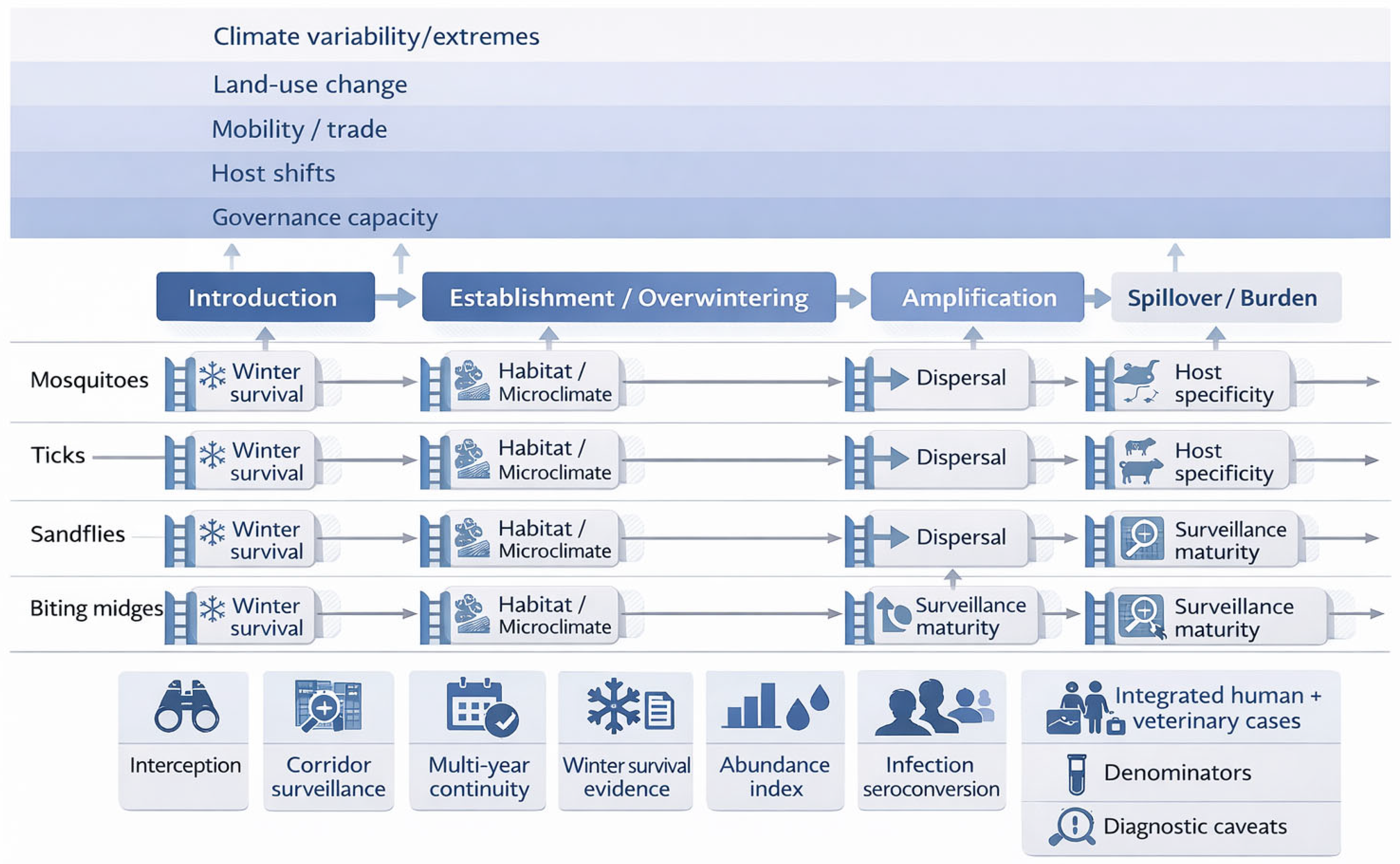
3.5. Mapping Stages to an Evidence Ladder and to Actionable Early-Warning Signals
4. Mosquito-Borne Emergence Patterns and Drivers

| Temperate-Region Exemplar (Köppen Broadly C/D Where Applicable) | Pathogen (System) | Principal Mosquito Vector(s) Implicated | Highest Evidence-Ladder Stage Reached in Exemplar | Brief Evidence Basis (Stage Justification) |
|---|---|---|---|---|
| Europe (multiple temperate C/D regions) | WNV (enzootic Culex–bird) | C. pipiens complex (context-dependent local vectors) | Burden | Predictive models and multi-year analyses consistent with expanding outbreak suitability and realized outbreaks; key determinants include temperature anomalies and moisture indices, supporting actionable early warning [16,44]. |
| Netherlands and NW Europe (temperate Cfb) | USUV (enzootic Culex–bird) | C. pipiens complex | Transmission (with human/avian impact variably documented by setting) | Field evidence supports overwintering in mosquitoes and integrated One Health reconstruction of arbovirus dynamics, strengthening inference beyond detection alone [43,52]. |
| Mainland France (temperate to warm-temperate Cfb/Cfa) | DENV (invasive Aedes; focal autochthonous) | A. albopictus | Transmission (episodic clusters; some settings approach outbreak-scale burden) | Autochthonous dengue transmission reported with geographic extension and increased incident foci, consistent with establishment plus importation-driven spillover [48,53]. |
| Italy (temperate Cfa/Cfb; central Italy exemplar 2024) | DENV (invasive Aedes) | A. albopictus | Burden (localized outbreak) | Large outbreak report (e.g., 86 cases in 2024 central Italy exemplar), consistent with sustained local transmission over weeks and substantial case ascertainment [47]. |
| Italy (temperate Cfa/Cfb) | CHIKV (invasive Aedes) | A. albopictus | Burden | Documented outbreak-scale transmission consistent with established A. albopictus and conducive seasonal conditions (tempered by surveillance and diagnostic heterogeneity) [54,55]. |
| Southeastern Australia (temperate riverine systems; 2022) | JEV (zoonotic amplification with pigs/birds) | Culex annulirostris and related vectors | Burden | Sentinel human case and widespread animal detections in 2022, with vector synthesis supporting plausible transmission ecology and control implications [56,57]. |
| Florida, USA (humid subtropical Cfa; 2023) | Plasmodium vivax (human malaria re-introduction) | Anopheles spp. (local vectors; exemplar includes Anopheles crucians) | Transmission (contained) | Cluster of locally acquired cases with genomic evidence consistent with introduction(s) and response synthesis emphasizing containment and low likelihood of sustained transmission under current conditions [50,51]. |
| Baltic countries (temperate Dfb/Cfb mix; emergence northward) | Dirofilaria repens (zoonotic filariasis) | Multiple mosquitoes (regional assemblages) | Transmission (established/endemic in dogs; human autochthonous cases documented) | Review evidence supports establishment/endemicity over a decade with One Health relevance; human incidence under-quantified, highlighting ascertainment bias [49]. |
5. Tick-Borne Emergence Patterns and Drivers
5.1. Range Shifts and Establishment: Climate Suitability Is Necessary but Not Sufficient
5.2. Amplification: Host Community Shifts, Wildlife Recovery, and Land Fragmentation
5.3. Spillover and Burden: Lags, “Slow-Burn” Epidemiology, and Multi-Pathogen Complexity
5.4. Ascertainment and Diagnostic Biases: Separating Emergence from Improved Detection
5.5. Beyond Ixodes: Introductions of Thermophilic Ticks and the Overwintering Question
6. Sandfly-Borne Emergence Patterns and Drivers: Microclimate Refugia, Peri-Domestic Reservoirs, Fragmented Surveillance
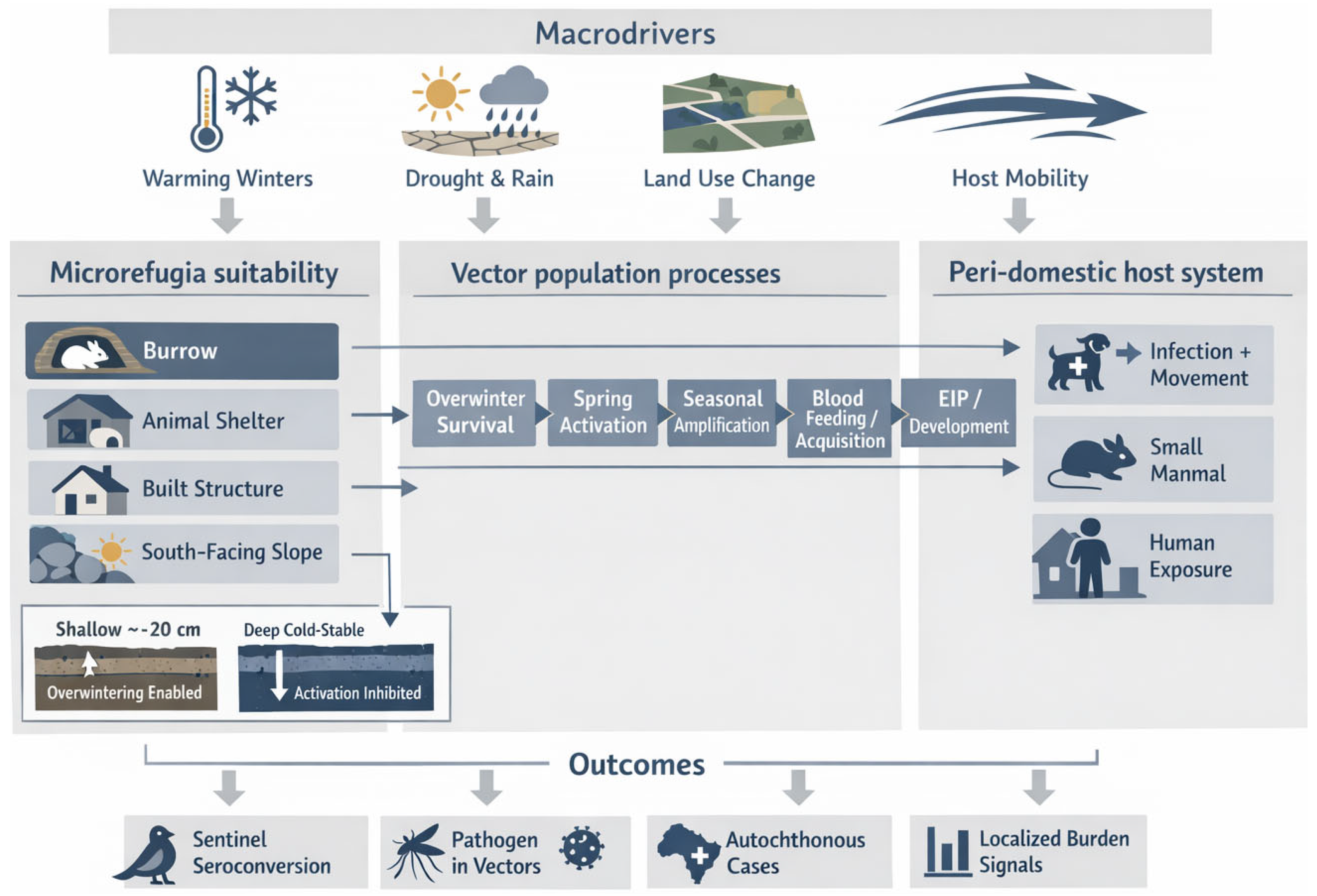
6.1. Microclimate Refugia as the Dominant “Gatekeeper” Mechanism in Temperate Settings
6.2. Climate Variability and Hydroclimate as Amplifiers Once Refugia Exist
6.3. Peri-Domestic Reservoirs and Host-Community Coupling: Introduction Versus Local Maintenance
6.4. Fragmented Surveillance and “Evidence Ladder” Slippage in Temperate Sandfly Systems
6.5. Sandfly-Borne Viruses: Microclimate-Sensitive Extrinsic Incubation and Operational Blind Spots
6.6. Implications for Operational Early Warning: From Microrefugia Mapping to Genomic Corroboration

7. Biting Midge–Borne Emergence Patterns and Drivers (Culicoides)
| Representative Temperate System (2015–2025 Exemplars) | Vector Node (Typical Temperate Vectors; Constraints) | Host Node (Dominant Hosts; Ecological Coupling) | Pathogen Node (Features Influencing Stage Progression) | Surveillance Leverage Points (Earliest Actionable Signals by Node; Examples) |
|---|---|---|---|---|
| BTV-8 re-emergence (temperate France, 2015 onward) [92] | C. imicola (Mediterranean) and Obsoletus/Pulicaris ensembles (temperate); winter persistence favored by indoor refugia and short/porous “vector-free” periods [100] | Cattle often have high infection/seroprevalence with limited clinical signal; sheep contribute conspicuous clinical detection; strong farm-building coupling | Multiple serotypes; transmission intensity is tightly temperature-dependent; potential vertical transmission complicates overwintering inference [104] | Host node: syndromic monitoring (sheep clinical signs; cattle bulk milk/serology); targeted youngstock serosurveys. Pathogen node: RT-qPCR confirmation + serotyping; sequencing for strain continuity. Vector node: routine UV light-trap indices (females/trap-night) + seasonality to inform surveillance windows and movement policy [112]. |
| BTV-3 emergence (northwestern Europe, 2023–2025; e.g., Germany/Belgium/Netherlands/Portugal) [94,109,111,115] | Predominantly Obsoletus/Pulicaris ensembles in temperate areas; high sensitivity to microclimate near flight thresholds [103] | Dairy cattle density and farm connectivity can structure amplification (risk factors as reported); sheep frequently provide an early clinical signal | Novel serotype introductions can outpace population immunity; strong incentive for rapid genomic surveillance to track spread and reassortment | Pathogen node (early): pooled Culicoides RT-qPCR during rising farm cases (supports transmission-relevant detection) [94]. Host node: bulk milk screening, mortality/production syndromics, targeted serology to quantify exposure; reproductive-event monitoring. Vector node: phenology/season-length monitoring as an early amplification indicator [105] |
| EHDV-8 emergence (Italy, 2022; Mediterranean–temperate interface) [93] | Likely C. imicola plus temperate ensembles were competent; introduction plausibly shaped by windborne dispersal and coastal meteorology [96] | Cattle clinically affected; wildlife (e.g., cervids) may contribute to silent circulation and detection challenges (context-dependent) | Genomic origin tracing can strongly support introduction inference (>99.9% identity to Tunisia 2021 strains) | Pathogen node: rapid RT-qPCR confirmation + whole-genome sequencing to infer origin and monitor spread [93]. Host node: syndromic surveillance in cattle (fever, oral lesions) plus targeted wildlife health reporting where relevant. Vector node: targeted trapping along coastal entry corridors during high-risk wind periods. |
| SBV enzootic circulation with episodic recrudescence (temperate Europe, 2015–2025) [106,116] | Primarily Obsoletus complex; winter/early spring activity can occur in and around stables [101] | Ruminant reproduction outcomes (abortions, congenital malformations) provide high-signal sentinel events; herd immunity waxing/waning drives periodicity | Short EIP at favorable temperatures; microclimate models enable fine-scale estimation of transmission potential | Host node (earliest): reproductive surveillance (abortion/malformation clusters) and serology in youngstock to detect immunity gaps. Pathogen node: RT-qPCR in clinical specimens and (where used) pooled vector testing. Vector node: microclimate-driven EIP alerting using farm-level temperature fields as a pre-season risk signal [106] |
8. Cross-Vector Comparison: Analytic Payoff Across Drivers, Constraints, Surveillance, and Control
8.1. Shared Drivers
8.2. Distinct Constraints (Why the Same Driver Yields Different Emergence Trajectories)
8.3. Control Feasibility (What Works Operationally in Temperate Contexts, and Where Expectations Should Be Constrained)
8.3.1. Policy, Feasibility, and Control Recommendations in Temperate Regions: Stage-Based Priorities with Vector-Specific Levers
8.3.2. Vector-Specific Feasibility and Priority Actions (Temperate Settings)
- Mosquitoes (Aedes; Culex–WNV systems): Integrated Aedes control is feasible but constrained by private-property access/compliance; program options include source reduction, targeted adult control, and evaluated integrated approaches, including SIT within integrated programs [124,125,126]. In Culex–WNV systems, multi-year surveillance–control can reduce C. pipiens counts (reported RR 0.66), but burden effects depend on timing relative to seasonal amplification and climate variability [123].
- Ticks: Landscape-scale suppression is constrained by diffuse habitats and wildlife hosts; deer management can reduce nymphal density in some contexts, but is complex and long-horizon [127]. Prioritize exposure mitigation, surveillance designs that track establishment/amplification (DON/NIP/DIN with stable denominators), and prevention tools where available (e.g., vaccination for TBE in parts of Europe) [128].
- Sandflies (northern borders): Frame control as peri-domestic risk management integrating reservoir-focused veterinary actions and microclimate-informed focal measures; treat establishment as plausible in newly detected temperate locations and prioritize early veterinary–entomological integration [77]. A practical lever in zoonotic L. infantum systems is insecticide-impregnated dog collars that reduce sandfly blood-feeding over long durations [129].
- Culicoides/livestock viruses: Because introduction can be windborne and outbreaks can escalate rapidly, vaccination and movement governance usually deliver the largest risk reduction; farm-level housing/biosecurity can reduce biting exposure when needed [130]. During the Dutch BTV-3 outbreak, surveillance outputs were used to anticipate overwintering and trigger vaccination/movement actions; vaccination can reduce mortality even when it does not fully prevent infection, so coverage/timing/effectiveness are core early-warning indicators for next-season risk (Table 4) [131,132].
9. Discussion
9.1. Integrated Interpretation Across Taxa: Where Shared-Driver Narratives Mislead
9.2. Implications for Integrated Surveillance (One Health): A Minimal Package and Interoperability Requirements
9.3. Research Agenda (2025–2035): Cross-Cutting, Vector-Specific, and Implementation Science Priorities
10. Limitations
11. Conclusions
Supplementary Materials
Funding
Institutional Review Board Statement
Informed Consent Statement
Data Availability Statement
Conflicts of Interest
Abbreviations
| AUC | Area Under the Curve |
| BTV | Bluetongue Virus |
| CCHFV | Crimean–Congo Hemorrhagic Fever Virus |
| CFR | Case Fatality Rate |
| CHIKV | Chikungunya Virus |
| DIN | Density of Infected Nymphs |
| DENV | Dengue Virus |
| DON | Density of Nymphs |
| ECDC | European Centre for Disease Prevention and Control |
| EHDV | Epizootic Hemorrhagic Disease Virus |
| EIP | Extrinsic Incubation Period |
| FAO | Food and Agriculture Organization of the United Nations |
| JEV | Japanese Encephalitis Virus |
| MIR | Minimum Infection Rate |
| NDWI | Normalized Difference Water Index |
| PCR | Polymerase Chain Reaction |
| PRISMA | Preferred Reporting Items for Systematic Reviews and Meta-Analyses |
| PRISMA-ScR | PRISMA Extension for Scoping Reviews |
| SBV | Schmallenberg Virus |
| TBE | Tick-Borne Encephalitis |
| TOSV | Toscana Virus |
| USUV | Usutu Virus |
| VBD | Vector-Borne Disease |
| WGS | Whole Genome Sequencing |
| WNV | West Nile Virus |
| WOAH | World Organization for Animal Health |
References
- Semenza, J.C.; Tran, A.; Espinosa, L.; Sudre, B.; Domanovic, D.; Paz, S. Climate Change Projections of West Nile Virus Infections in Europe: Implications for Blood Safety Practices. Environ. Health 2016, 15, S28. [Google Scholar] [CrossRef]
- Rocklöv, J.; Dubrow, R. Climate Change: An Enduring Challenge for Vector-Borne Disease Prevention and Control. Nat. Immunol. 2020, 21, 479–483. [Google Scholar] [CrossRef]
- Rulli, M.C.; D’Odorico, P.; Galli, N.; John, R.S.; Muylaert, R.L.; Santini, M.; Hayman, D.T.S. Land Use Change and Infectious Disease Emergence. Rev. Geophys. 2025, 63, e2022RG000785. [Google Scholar] [CrossRef]
- Garrido, M.; Parra, P.; Veiga, J.; Garrigós, M.; Panisse, G.; Martínez-de la Puente, J. Mosquitoes and the City: Effects of Urbanization on Aedes albopictus and Culex pipiens Captures in Southern Spain. Parasites Vectors 2025, 18, 456. [Google Scholar] [CrossRef]
- Lühken, R.; Brattig, N.; Becker, N. Introduction of Invasive Mosquito Species into Europe and Prospects for Arbovirus Transmission and Vector Control in an Era of Globalization. Infect. Dis. Poverty 2023, 12, 109. [Google Scholar] [CrossRef]
- Giunti, G.; Becker, N.; Benelli, G. Invasive Mosquito Vectors in Europe: From Bioecology to Surveillance and Management. Acta Trop. 2023, 239, 106832. [Google Scholar] [CrossRef]
- Beck, H.E.; Zimmermann, N.E.; McVicar, T.R.; Vergopolan, N.; Berg, A.; Wood, E.F. Present and Future Köppen-Geiger Climate Classification Maps at 1-Km Resolution. Sci. Data 2018, 5, 180214. [Google Scholar] [CrossRef] [PubMed]
- Cansado-Utrilla, C.; Zhao, S.Y.; McCall, P.J.; Coon, K.L.; Hughes, G.L. The Microbiome and Mosquito Vectorial Capacity: Rich Potential for Discovery and Translation. Microbiome 2021, 9, 111. [Google Scholar] [CrossRef] [PubMed]
- Wu, V.Y.; Chen, B.; Christofferson, R.; Ebel, G.; Fagre, A.C.; Gallichotte, E.N.; Sweeny, A.R.; Carlson, C.J.; Ryan, S.J. A Minimum Data Standard for Vector Competence Experiments. Sci. Data 2022, 9, 634. [Google Scholar] [CrossRef] [PubMed]
- Miranda, M.Á.; Barceló, C.; Arnoldi, D.; Augsten, X.; Bakran-Lebl, K.; Balatsos, G.; Bengoa, M.; Bindler, P.; Boršová, K.; Bourquia, M.; et al. AIMSurv: First Pan-European Harmonized Surveillance of Aedes Invasive Mosquito Species of Relevance for Human Vector-Borne Diseases. GigaByte 2022, 2022, gigabyte57. [Google Scholar] [CrossRef]
- One Health High-Level Expert Panel (OHHLEP); Adisasmito, W.B.; Almuhairi, S.; Behravesh, C.B.; Bilivogui, P.; Bukachi, S.A.; Casas, N.; Cediel Becerra, N.; Charron, D.F.; Chaudhary, A.; et al. One Health: A New Definition for a Sustainable and Healthy Future. PLoS Pathog. 2022, 18, e1010537. [Google Scholar] [CrossRef]
- Koch, L.K.; Kochmann, J.; Klimpel, S.; Cunze, S. Modeling the Climatic Suitability of Leishmaniasis Vector Species in Europe. Sci. Rep. 2017, 7, 13325. [Google Scholar] [CrossRef] [PubMed]
- Emes, E.; Kagambèga, A.; Dione, M. Determinants of Animal Disease and Nontherapeutic Antibiotic Use on Smallholder Livestock Farms. Front. Vet. Sci. 2023, 10, 1258214. [Google Scholar] [CrossRef] [PubMed]
- Möhlmann, T.W.R.; Keeling, M.J.; Wennergren, U.; Favia, G.; Santman-Berends, I.; Takken, W.; Koenraadt, C.J.M.; Brand, S.P.C. Biting Midge Dynamics and Bluetongue Transmission: A Multiscale Model Linking Catch Data with Climate and Disease Outbreaks. Sci. Rep. 2021, 11, 1892. [Google Scholar] [CrossRef]
- Kiran, N.; Brila, I.; Mappes, T.; Sipari, S.; Wang, Y.; Welsh, E.; Kallio, E.R. Effects of Rodent Abundance on Ticks and Borrelia: Results from an Experimental and Observational Study in an Island System. Parasites Vectors 2024, 17, 157. [Google Scholar] [CrossRef]
- Farooq, Z.; Rocklöv, J.; Wallin, J.; Abiri, N.; Sewe, M.O.; Sjödin, H.; Semenza, J.C. Artificial Intelligence to Predict West Nile Virus Outbreaks with Eco-Climatic Drivers. Lancet Reg. Health 2022, 17, 100370. [Google Scholar] [CrossRef]
- Uiterwijk, M.; Jacobs, F.; de Boer, K.; Feddema, A.-J.; Vloet, R.P.M.; Dik, M.; Gonzales, J.L.; van Rijn, P.A.; Elbers, A.R.W.; Holwerda, M. Culicoides Species Involved in the BTV-3 Epidemic, the Netherlands, 2023–2024. Med. Vet. Entomol. 2025, 1–12. [Google Scholar] [CrossRef]
- Harvey, R.; Williams, T.M.; Hernandez-Morgan, M.; Fischer, M.A.; Neelankavil, J. Peer Review Guidance for Evaluating the Narrative Review: Lessons Applied from the Systematic Review. J. Cardiothorac. Vasc. Anesth. 2022, 36, 735–738. [Google Scholar] [CrossRef]
- Gonot-Schoupinsky, F.N.; Garip, G.; Sheffield, D. Facilitating the Planning and Evaluation of Narrative Intervention Reviews: Systematic Transparency Assessment in Intervention Reviews (STAIR). Eval. Program Plan. 2022, 91, 102043. [Google Scholar] [CrossRef]
- Turnbull, D.; Chugh, R.; Luck, J. Systematic-Narrative Hybrid Literature Review: A Strategy for Integrating a Concise Methodology into a Manuscript. Soc. Sci. Humanit. Open 2023, 7, 100381. [Google Scholar] [CrossRef]
- Hudson, A.R.; McGregor, B.L.; Shults, P.; England, M.; Silbernagel, C.; Mayo, C.; Carpenter, M.; Sherman, T.J.; Cohnstaedt, L.W. Culicoides-Borne Orbivirus Epidemiology in a Changing Climate. J. Med. Entomol. 2023, 60, 1221–1229. [Google Scholar] [CrossRef] [PubMed]
- Kuhlisch, C.; Kampen, H.; Walther, D. The Asian Tiger Mosquito Aedes albopictus (Diptera: Culicidae) in Central Germany: Surveillance in Its Northernmost Distribution Area. Acta Trop. 2018, 188, 78–85. [Google Scholar] [CrossRef] [PubMed]
- Medlock, J.M.; Vaux, A.G.C.; Gandy, S.; Cull, B.; McGinley, L.; Gillingham, E.; Catton, M.; Pullan, S.T.; Hansford, K.M. Spatial and Temporal Heterogeneity of the Density of Borrelia burgdorferi-Infected Ixodes ricinus Ticks across a Landscape: A 5-Year Study in Southern England. Med. Vet. Entomol. 2022, 36, 356–370. [Google Scholar] [CrossRef]
- Wehmeyer, M.L.; Jaworski, L.; Jöst, H.; Șuleșco, T.; Rauhöft, L.; Afonso, S.M.M.; Neumann, M.; Kliemke, K.; Lange, U.; Kiel, E.; et al. Host Attraction and Host Feeding Patterns Indicate Generalist Feeding of Culex pipiens s.s. and Cx. Torrentium. Parasites Vectors 2024, 17, 369. [Google Scholar] [CrossRef] [PubMed]
- Giatropoulos, A.; Lymperopoulos, C.; Kioulos, I.; Michaelakis, A.; Balatsos, G.; Papachristos, D.; Koliopoulos, G. Overwintering Survival of Adults of Aedes albopictus and Aedes Cretinus (Diptera: Culicidae) in a Sheltered Microclimate in Northern Attica, Greece. Eur. J. Entomol. 2025, 122, 154–163. [Google Scholar] [CrossRef]
- Fyie, L.R.; Tronetti, H.R.; Gardiner, M.M.; Meuti, M.E. Potential for Urban Warming to Postpone Overwintering Dormancy of Temperate Mosquitoes. J. Therm. Biol. 2023, 115, 103594. [Google Scholar] [CrossRef]
- Lacour, G.; Chanaud, L.; L’Ambert, G.; Hance, T. Seasonal Synchronization of Diapause Phases in Aedes albopictus (Diptera: Culicidae). PLoS ONE 2015, 10, e0145311. [Google Scholar] [CrossRef]
- Kniha, E.; Koblmüller, S.; Platzgummer, K.; Kirstein, O.; Diaz, D.; Dvořák, V.; Kasap, O.E.; Xhekaj, B.; Sherifi, K.; Walochnik, J.; et al. Combining Phylogeography and Climate Models to Track the Diversification and Spread of Phlebotomus simici. Sci. Rep. 2025, 15, 10188. [Google Scholar] [CrossRef]
- Brady, O.J.; Godfray, H.C.J.; Tatem, A.J.; Gething, P.W.; Cohen, J.M.; McKenzie, F.E.; Perkins, T.A.; Reiner, R.C.; Tusting, L.S.; Sinka, M.E.; et al. Vectorial Capacity and Vector Control: Reconsidering Sensitivity to Parameters for Malaria Elimination. Trans. R. Soc. Trop. Med. Hyg. 2016, 110, 107–117. [Google Scholar] [CrossRef]
- Ogden, N.H.; Ben Beard, C.; Ginsberg, H.S.; Tsao, J.I. Possible Effects of Climate Change on Ixodid Ticks and the Pathogens They Transmit: Predictions and Observations. J. Med. Entomol. 2021, 58, 1536–1545. [Google Scholar] [CrossRef]
- Kim, Y.; Jaulhac, B.; Vesga, J.F.; Zilliox, L.; Boulanger, N.; Edmunds, W.J.; Métras, R. Environmental Drivers of Ixodes ricinus Tick Population Dynamics: Mechanistic Modelling Using Longitudinal Field Surveys and Climate Data. Epidemics 2025, 53, 100854. [Google Scholar] [CrossRef] [PubMed]
- Papa, A. Emerging Arboviruses in Europe. Acta Microbiol. Hell. 2024, 69, 322–337. [Google Scholar] [CrossRef]
- Semenza, J.C.; Suk, J.E. Vector-Borne Diseases and Climate Change: A European Perspective. FEMS Microbiol. Lett. 2018, 365, fnx244. [Google Scholar] [CrossRef] [PubMed]
- Guillot, C.; Bouchard, C.; Aenishaenslin, C.; Berthiaume, P.; Milord, F.; Leighton, P.A. Criteria for Selecting Sentinel Unit Locations in a Surveillance System for Vector-Borne Disease: A Decision Tool. Front. Public Health 2022, 10. [Google Scholar] [CrossRef]
- Morris, R.; Wang, S. Building a Pathway to One Health Surveillance and Response in Asian Countries. Sci. One Health 2024, 3, 100067. [Google Scholar] [CrossRef]
- Aguilera-Sepúlveda, P.; Napp, S.; Llorente, F.; Solano-Manrique, C.; Molina-López, R.; Obón, E.; Solé, A.; Jiménez-Clavero, M.Á.; Fernández-Pinero, J.; Busquets, N. West Nile Virus Lineage 2 Spreads Westwards in Europe and Overwinters in North-Eastern Spain (2017–2020). Viruses 2022, 14, 569. [Google Scholar] [CrossRef]
- Griep, J.S.; Grant, E.; Pilgrim, J.; Riabinina, O.; Baylis, M.; Wardeh, M.; Blagrove, M.S.C. Meta-Analyses of Culex Blood-Meals Indicates Strong Regional Effect on Feeding Patterns. PLoS Neglected Trop. Dis. 2025, 19, e0012245. [Google Scholar] [CrossRef]
- Romiti, F.; Casini, R.; Del Lesto, I.; Magliano, A.; Ermenegildi, A.; Droghei, S.; Tofani, S.; Scicluna, M.T.; Pichler, V.; Augello, A.; et al. Characterization of Overwintering Sites (Hibernacula) of the West Nile Vector Culex pipiens in Central Italy. Parasites Vectors 2025, 18, 74. [Google Scholar] [CrossRef]
- Farooq, Z.; Segelmark, L.; Rocklöv, J.; Lillepold, K.; Sewe, M.O.; Briet, O.J.T.; Semenza, J.C. Impact of Climate and Aedes albopictus Establishment on Dengue and Chikungunya Outbreaks in Europe: A Time-to-Event Analysis. Lancet Planet. Health 2025, 9, e374–e383. [Google Scholar] [CrossRef]
- Vavassori, L.; Honnen, A.-C.; Saarman, N.; Caccone, A.; Müller, P. Multiple Introductions and Overwintering Shape the Progressive Invasion of Aedes albopictus beyond the Alps. Ecol. Evol. 2022, 12, e9138. [Google Scholar] [CrossRef]
- Johnston, C.J.; Edwards, A.C.; Vaux, A.G.C.; Abbott, A.J.; Hardy, H.; Wilson, R.; Gardner, B.L.; Folly, A.J.; Strode, C.; Crosgrove, D.W.; et al. Invasive Mosquito Surveillance in the United Kingdom 2020 to 2024: First Detection of Aedes Aegypti Eggs in the UK and Further Detection of Aedes albopictus. PLoS Glob. Public Health 2025, 5, e0004968. [Google Scholar] [CrossRef]
- Marini, G.; Manica, M.; Delucchi, L.; Pugliese, A.; Rosà, R. Spring Temperature Shapes West Nile Virus Transmission in Europe. Acta Trop. 2021, 215, 105796. [Google Scholar] [CrossRef] [PubMed]
- Münger, E.; Atama, N.C.; van Irsel, J.; Blom, R.; Krol, L.; van Mastrigt, T.; van den Berg, T.J.; Braks, M.; de Vries, A.; van der Linden, A.; et al. One Health Approach Uncovers Emergence and Dynamics of Usutu and West Nile Viruses in the Netherlands. Nat. Commun. 2025, 16, 7883. [Google Scholar] [CrossRef] [PubMed]
- Watts, M.J.; Sarto i Monteys, V.; Mortyn, P.G.; Kotsila, P. The Rise of West Nile Virus in Southern and Southeastern Europe: A Spatial–Temporal Analysis Investigating the Combined Effects of Climate, Land Use and Economic Changes. One Health 2021, 13, 100315. [Google Scholar] [CrossRef] [PubMed]
- Koenraadt, C.J.M.; Münger, E.; Schrama, M.J.J.; Spitzen, J.; Altundag, S.; Sikkema, R.S.; Munnink, B.B.O.; Koopmans, M.P.G.; Blom, R. Overwintering of Usutu Virus in Mosquitoes, The Netherlands. Parasites Vectors 2024, 17, 537. [Google Scholar] [CrossRef]
- Cassaniti, I.; Ferrari, G.; Senatore, S.; Rossetti, E.; Defilippo, F.; Maffeo, M.; Vezzosi, L.; Campanini, G.; Sarasini, A.; Paolucci, S.; et al. Preliminary Results on an Autochthonous Dengue Outbreak in Lombardy Region, Italy, August 2023. Euro Surveill. 2023, 28, 2300471. [Google Scholar] [CrossRef]
- Santilli, L.; Canovari, B.; Balducci, M.; Corbelli, G.; Maracci, M.; Polenta, A.; Farinaccio, Y.; Ginevri, F.; Anzalone, N.; Franca, L.; et al. Outbreak of Autochthonous Dengue in Fano, Pesaro-Urbino Province—Marche Region, Italy, September 2024. Infection 2025, 53, 1213–1218. [Google Scholar] [CrossRef]
- Cochet, A.; Calba, C.; Jourdain, F.; Grard, G.; Durand, G.A.; Guinard, A.; Investigation Team; Noël, H.; Paty, M.-C.; Franke, F. Autochthonous Dengue in Mainland France, 2022: Geographical Extension and Incidence Increase. Euro Surveill. 2022, 27, 2200818. [Google Scholar] [CrossRef]
- Deksne, G.; Jokelainen, P.; Oborina, V.; Lassen, B.; Akota, I.; Kutanovaite, O.; Zaleckas, L.; Cīrule, D.; Tupīts, A.; Pimanovs, V.; et al. The Zoonotic Parasite Dirofilaria repens Emerged in the Baltic Countries Estonia, Latvia, and Lithuania in 2008–2012 and Became Established and Endemic in a Decade. Vector Borne Zoonotic Dis. 2021, 21, 1–5. [Google Scholar] [CrossRef]
- DeVita, T.N.; Morrison, A.M.; Stanek, D.; Drennon, M.; Sarney, E.; Brennan, W.; Tomson, K.; Blackmore, C.; Broussard, K.; Duwell, M.; et al. Public Health Response to the First Locally Acquired Malaria Outbreaks in the US in 20 Years. JAMA Netw. Open 2025, 8, e2535719. [Google Scholar] [CrossRef]
- Muneer, A.; Adapa, S.R.; Silbert, S.; Scanlan, K.; Vore, H.; Cannons, A.; Morrison, A.M.; Stanek, D.; Blackmore, C.; Adams, J.H.; et al. Autochthonous Plasmodium vivax Infections, Florida, USA, 2023. Emerg. Infect. Dis. 2024, 30, 1214–1217. [Google Scholar] [CrossRef] [PubMed]
- Checa, R.; Peteiro, L.; Pérez-Hernando, B.; de la Morena, M.; Cano, L.; López-Suárez, P.; Barrera, J.P.; Estévez-Sánchez, E.; Sarquis, J.; Fernández-Cebrián, B.; et al. High Serological and Molecular Prevalence of Ehrlichia Canis and Other Vector-Borne Pathogens in Dogs from Boa Vista Island, Cape Verde. Parasites Vectors 2024, 17, 374. [Google Scholar] [CrossRef] [PubMed]
- Zatta, M.; Brichler, S.; Vindrios, W.; Melica, G.; Gallien, S. Autochthonous Dengue Outbreak, Paris Region, France, September-October 2023. Emerg. Infect. Dis. 2023, 29, 2538–2540. [Google Scholar] [CrossRef] [PubMed]
- Cattaneo, P.; Salvador, E.; Manica, M.; Barzon, L.; Castilletti, C.; Di Gennaro, F.; Huits, R.; Merler, S.; Poletti, P.; Riccardo, F.; et al. Transmission of Autochthonous Aedes-Borne Arboviruses and Related Public Health Challenges in Europe 2007–2023: A Systematic Review and Secondary Analysis. Lancet Reg. Health Eur. 2025, 51, 101231. [Google Scholar] [CrossRef]
- Riccardo, F.; Venturi, G.; Di Luca, M.; Del Manso, M.; Severini, F.; Andrianou, X.; Fortuna, C.; Remoli, M.E.; Benedetti, E.; Caporali, M.G.; et al. Secondary Autochthonous Outbreak of Chikungunya, Southern Italy, 2017. Emerg. Infect. Dis. 2019, 25, 2093–2095. [Google Scholar] [CrossRef]
- Waller, C.; Tiemensma, M.; Currie, B.J.; Williams, D.T.; Baird, R.W.; Krause, V.L. Japanese Encephalitis in Australia—A Sentinel Case. N. Engl. J. Med. 2022, 387, 661–662. [Google Scholar] [CrossRef]
- van den Hurk, A.F.; Skinner, E.; Ritchie, S.A.; Mackenzie, J.S. The Emergence of Japanese Encephalitis Virus in Australia in 2022: Existing Knowledge of Mosquito Vectors. Viruses 2022, 14, 1208. [Google Scholar] [CrossRef]
- Ripoche, M.; Bouchard, C.; Irace-Cima, A.; Leighton, P.; Thivierge, K. Current and Future Distribution of Ixodes scapularis Ticks in Québec: Field Validation of a Predictive Model. PLoS ONE 2022, 17, e0263243. [Google Scholar] [CrossRef]
- Westcott, J.R.; Bowden, J.J.; Savage, J.; Doody, K.M. Rapid Northward Expansion of the Blacklegged Tick, Ixodes scapularis, in Response to Climate Change. Glob. Change Biol. 2025, 31, e70591. [Google Scholar] [CrossRef]
- Da Re, D.; Gilson, G.F.; Dalaiden, Q.; Goosse, H.; Bødker, R.; Kjær, L.J.; Ogden, N.H.; Rosà, R.; Vanwambeke, S.O. Northward Expansion of the Thermal Limit for the Tick Ixodes ricinus over the Past 40 Years. Parasites Vectors 2025, 18, 449. [Google Scholar] [CrossRef]
- Hansford, K.M.; McGinley, L.; Wheeler, B.W.; Tschirren, B.; Medlock, J.M. Ixodes ricinus Density, Borrelia Prevalence and the Density of Infected Nymphs along an Urban–Rural Gradient in Southern England. Zoonoses Public Health 2023, 70, 304–314. [Google Scholar] [CrossRef] [PubMed]
- Martin, A.M.; Buttke, D.; Raphael, J.; Taylor, K.; Maes, S.; Parise, C.M.; Ginsberg, H.S.; Cross, P.C. Deer Management Generally Reduces Densities of Nymphal Ixodes scapularis, but Not Prevalence of Infection with Borrelia burgdorferi Sensu Stricto. Ticks Tick-Borne Dis. 2023, 14, 102202. [Google Scholar] [CrossRef] [PubMed]
- Diuk-Wasser, M.A.; VanAcker, M.C.; Fernandez, M.P. Impact of Land Use Changes and Habitat Fragmentation on the Eco-Epidemiology of Tick-Borne Diseases. J. Med. Entomol. 2021, 58, 1546–1564. [Google Scholar] [CrossRef] [PubMed]
- Bregnard, C.; Rais, O.; Herrmann, C.; Kahl, O.; Brugger, K.; Voordouw, M.J. Beech Tree Masting Explains the Inter-Annual Variation in the Fall and Spring Peaks of Ixodes ricinus Ticks with Different Time Lags. Parasites Vectors 2021, 14, 570. [Google Scholar] [CrossRef]
- Logan, J.J.; Knudby, A.; Leighton, P.A.; Talbot, B.; McKay, R.; Ramsay, T.; Blanford, J.I.; Ogden, N.H.; Kulkarni, M.A. Ixodes scapularis Density and Borrelia burgdorferi Prevalence along a Residential-Woodland Gradient in a Region of Emerging Lyme Disease Risk. Sci. Rep. 2024, 14, 13107. [Google Scholar] [CrossRef]
- Robinson, E.L.; Jardine, C.M.; Koffi, J.K.; Russell, C.; Lindsay, L.R.; Dibernardo, A.; Clow, K.M. Range Expansion of Ixodes scapularis and Borrelia burgdorferi in Ontario, Canada, from 2017 to 2019. Vector Borne Zoonotic Dis. 2022, 22, 361–369. [Google Scholar] [CrossRef]
- Van Heuverswyn, J.; Hallmaier-Wacker, L.K.; Beauté, J.; Gomes Dias, J.; Haussig, J.M.; Busch, K.; Kerlik, J.; Markowicz, M.; Mäkelä, H.; Nygren, T.M.; et al. Spatiotemporal Spread of Tick-Borne Encephalitis in the EU/EEA, 2012 to 2020. Euro Surveill. 2023, 28, 2200543. [Google Scholar] [CrossRef]
- Kjær, L.J.; Johansson, M.; Lindgren, P.-E.; Asghar, N.; Wilhelmsson, P.; Fredlund, H.; Christensson, M.; Wallenhammar, A.; Bødker, R.; Rasmussen, G.; et al. Potential Drivers of Human Tick-Borne Encephalitis in the Örebro Region of Sweden, 2010–2021. Sci. Rep. 2023, 13, 7685. [Google Scholar] [CrossRef]
- Kwasnik, M.; Rola, J.; Rozek, W. Tick-Borne Encephalitis-Review of the Current Status. J. Clin. Med. 2023, 12, 6603. [Google Scholar] [CrossRef]
- Schwartz, A.M.; Hinckley, A.F.; Mead, P.S.; Hook, S.A.; Kugeler, K.J. Surveillance for Lyme Disease—United States, 2008–2015. Morb. Mortal. Wkly. Rep. Surveill. Summ. 2017, 66, 1–12. [Google Scholar] [CrossRef]
- Lloyd, V.K.; Hawkins, R.G. Under-Detection of Lyme Disease in Canada. Healthcare 2018, 6, 125. [Google Scholar] [CrossRef]
- Davidson, A.; Kelly, P.H.; Davis, J.; Major, M.; Moïsi, J.C.; Stark, J.H. Historical Summary of Tick and Animal Surveillance Studies for Lyme Disease in Canada, 1975–2023: A Scoping Review. Zoonoses Public Health 2025, 72, 9–22. [Google Scholar] [CrossRef] [PubMed]
- Ruyts, S.C.; Tack, W.; Ampoorter, E.; Coipan, E.C.; Matthysen, E.; Heylen, D.; Sprong, H.; Verheyen, K. Year-to-Year Variation in the Density of Ixodes ricinus Ticks and the Prevalence of the Rodent-Associated Human Pathogens Borrelia Afzelii and B. Miyamotoi in Different Forest Types. Ticks Tick-Borne Dis. 2018, 9, 141–145. [Google Scholar] [CrossRef]
- Uiterwijk, M.; Ibáñez-Justicia, A.; van de Vossenberg, B.; Jacobs, F.; Overgaauw, P.; Nijsse, R.; Dabekaussen, C.; Stroo, A.; Sprong, H. Imported Hyalomma Ticks in the Netherlands 2018–2020. Parasites Vectors 2021, 14, 244. [Google Scholar] [CrossRef] [PubMed]
- Rudolf, I.; Kejíková, R.; Vojtíšek, J.; Mendel, J.; Peňázziová, K.; Hubálek, Z.; Šikutová, S.; Estrada-Peña, A. Probable Overwintering of Adult Hyalomma rufipes in Central Europe. Ticks Tick-Borne Dis. 2021, 12, 101718. [Google Scholar] [CrossRef] [PubMed]
- Keve, G.; Csörgő, T.; Benke, A.; Huber, A.; Mórocz, A.; Németh, Á.; Kalocsa, B.; Tamás, E.A.; Gyurácz, J.; Kiss, O.; et al. Ornithological and Molecular Evidence of a Reproducing Hyalomma rufipes Population under Continental Climate in Europe. Front. Vet. Sci. 2023, 10, 1147186. [Google Scholar] [CrossRef]
- Obwaller, A.G.; Karakus, M.; Poeppl, W.; Töz, S.; Özbel, Y.; Aspöck, H.; Walochnik, J. Could Phlebotomus mascittii Play a Role as a Natural Vector for Leishmania infantum? New Data. Parasites Vectors 2016, 9, 458. [Google Scholar] [CrossRef]
- Wijerathna, T.; Gunathilaka, N. Diurnal Adult Resting Sites and Breeding Habitats of Phlebotomine Sand Flies in Cutaneous Leishmaniasis Endemic Areas of Kurunegala District, Sri Lanka. Parasites Vectors 2020, 13, 284. [Google Scholar] [CrossRef]
- Aj, T. The Correspondence between the Physiological Cold Tolerance and the Distribution Border of Mediterranean Sandflies in Southeast Europe. J. Vector Borne Dis. 2024, 61, 376–388. [Google Scholar] [CrossRef]
- Kniha, E.; Milchram, M.; Dvořák, V.; Halada, P.; Obwaller, A.G.; Poeppl, W.; Mooseder, G.; Volf, P.; Walochnik, J. Ecology, Seasonality and Host Preferences of Austrian Phlebotomus (Transphlebotomus) mascittii Grassi, 1908, Populations. Parasites Vectors 2021, 14, 291. [Google Scholar] [CrossRef]
- Calzolari, M.; Romeo, G.; Munari, M.; Bonilauri, P.; Taddei, R.; Sampieri, M.; Bariselli, S.; Rugna, G.; Dottori, M. Sand Flies and Pathogens in the Lowlands of Emilia-Romagna (Northern Italy). Viruses 2022, 14, 2209. [Google Scholar] [CrossRef]
- Rodríguez-Escolar, I.; Balmori-de la Puente, A.; Collado-Cuadrado, M.; Bravo-Barriga, D.; Delacour-Estrella, S.; Hernández-Lambraño, R.E.; Sánchez Agudo, J.Á.; Morchón, R. Analysis of the Current Risk of Leishmania infantum Transmission for Domestic Dogs in Spain and Portugal and Its Future Projection in Climate Change Scenarios. Front. Vet. Sci. 2024, 11, 1399772. [Google Scholar] [CrossRef]
- Ravasi, D.; Schnyder, M.; Guidi, V.; Haye, T.; Parrondo Monton, D.; Flacio, E. Exploring Emerging Challenges: Survey on Phlebotomine Sand Flies and Leishmania infantum at the Northern Endemic Border in Europe. Pathogens 2024, 13, 1074. [Google Scholar] [CrossRef]
- Moirano, G.; Zanet, S.; Giorgi, E.; Battisti, E.; Falzoi, S.; Acquaotta, F.; Fratianni, S.; Richiardi, L.; Ferroglio, E.; Maule, M. Integrating Environmental, Entomological, Animal, and Human Data to Model the Leishmania infantum Transmission Risk in a Newly Endemic Area in Northern Italy. One Health 2020, 10, 100159. [Google Scholar] [CrossRef]
- Alten, B.; Ozbel, Y.; Ergunay, K.; Kasap, O.E.; Cull, B.; Antoniou, M.; Velo, E.; Prudhomme, J.; Molina, R.; Bañuls, A.-L.; et al. Sampling Strategies for Phlebotomine Sand Flies (Diptera: Psychodidae) in Europe. Bull. Entomol. Res. 2015, 105, 664–678. [Google Scholar] [CrossRef] [PubMed]
- Maia, C.; Conceição, C.; Pereira, A.; Rocha, R.; Ortuño, M.; Muñoz, C.; Jumakanova, Z.; Pérez-Cutillas, P.; Özbel, Y.; Töz, S.; et al. The Estimated Distribution of Autochthonous Leishmaniasis by Leishmania infantum in Europe in 2005–2020. PLoS Neglected Trop. Dis. 2023, 17, e0011497. [Google Scholar] [CrossRef] [PubMed]
- Nzelu, C.O.; Bahrami, S.; Lawyer, P.G.; Peters, N.C. Detection of Leishmania Metacyclogenesis within the Sand Fly Vector Employing a Real-Time PCR for Sherp Gene Expression: A Tool for Leishmania Surveillance and Transmission Potential. PLoS Neglected Trop. Dis. 2025, 19, e0012915. [Google Scholar] [CrossRef] [PubMed]
- Laroche, L.; Bañuls, A.-L.; Charrel, R.; Fontaine, A.; Ayhan, N.; Prudhomme, J. Sand Flies and Toscana Virus: Intra-Vector Infection Dynamics and Impact on Phlebotomus perniciosus Life-History Traits. PLoS Neglected Trop. Dis. 2024, 18, e0012509. [Google Scholar] [CrossRef]
- Oerther, S.; Jöst, H.; Heitmann, A.; Lühken, R.; Krüger, A.; Steinhausen, I.; Brinker, C.; Lorentz, S.; Marx, M.; Schmidt-Chanasit, J.; et al. Phlebotomine Sand Flies in Southwest Germany: An Update with Records in New Locations. Parasites Vectors 2020, 13, 173. [Google Scholar] [CrossRef]
- Bruno, F.; Castelli, G.; Li, B.; Reale, S.; Carra, E.; Vitale, F.; Scibetta, S.; Calzolari, M.; Varani, S.; Ortalli, M.; et al. Genomic and Epidemiological Evidence for the Emergence of a L. infantum/L. donovani Hybrid with Unusual Epidemiology in Northern Italy. mBio 2024, 15, e0099524. [Google Scholar] [CrossRef]
- Sick, F.; Beer, M.; Kampen, H.; Wernike, K. Culicoides Biting Midges—Underestimated Vectors for Arboviruses of Public Health and Veterinary Importance. Viruses 2019, 11, 376. [Google Scholar] [CrossRef]
- Sailleau, C.; Bréard, E.; Viarouge, C.; Vitour, D.; Romey, A.; Garnier, A.; Fablet, A.; Lowenski, S.; Gorna, K.; Caignard, G.; et al. Re-Emergence of Bluetongue Virus Serotype 8 in France, 2015. Transbound. Emerg. Dis. 2017, 64, 998–1000. [Google Scholar] [CrossRef]
- Lorusso, A.; Cappai, S.; Loi, F.; Pinna, L.; Ruiu, A.; Puggioni, G.; Guercio, A.; Purpari, G.; Vicari, D.; Sghaier, S.; et al. Epizootic Hemorrhagic Disease Virus Serotype 8, Italy, 2022. Emerg. Infect. Dis. 2023, 29, 1063–1065. [Google Scholar] [CrossRef] [PubMed]
- Voigt, A.; Kampen, H.; Heuser, E.; Zeiske, S.; Hoffmann, B.; Höper, D.; Holsteg, M.; Sick, F.; Ziegler, S.; Wernike, K.; et al. Bluetongue Virus Serotype 3 and Schmallenberg Virus in Culicoides Biting Midges, Western Germany, 2023. Emerg. Infect. Dis. 2024, 30, 1438–1441. [Google Scholar] [CrossRef] [PubMed]
- Aguilar-Vega, C.; Fernández-Carrión, E.; Sánchez-Vizcaíno, J.M. The Possible Route of Introduction of Bluetongue Virus Serotype 3 into Sicily by Windborne Transportation of Infected Culicoides spp. Transbound. Emerg. Dis. 2019, 66, 1665–1673. [Google Scholar] [CrossRef]
- Bibard, A.; Martinetti, D.; Picado, A.; Chalvet-Monfray, K.; Porphyre, T. Assessing the Risk of Windborne Dispersal of Culicoides Midges in Emerging Epizootic Hemorrhagic Disease Virus Outbreaks in France. Transbound. Emerg. Dis. 2024, 2024, 5571195. [Google Scholar] [CrossRef]
- Bibard, A.; Martinetti, D.; Giraud, A.; Picado, A.; Chalvet-Monfray, K.; Porphyre, T. Quantitative Risk Assessment for the Introduction of Bluetongue Virus into Mainland Europe by Long-Distance Wind Dispersal of Culicoides spp.: A Case Study from Sardinia. Risk Anal. 2025, 45, 108–127. [Google Scholar] [CrossRef]
- Courtejoie, N.; Cauchemez, S.; Zanella, G.; Durand, B. A Network-Based Approach to Modelling Bluetongue Spread in France. Prev. Vet. Med. 2019, 170, 104744. [Google Scholar] [CrossRef]
- Ruget, A.-S.; Rossi, G.; Pepler, P.T.; Beaunée, G.; Banks, C.J.; Enright, J.; Kao, R.R. Multi-Species Temporal Network of Livestock Movements for Disease Spread. Appl. Netw. Sci. 2021, 6, 15. [Google Scholar] [CrossRef]
- Brugger, K.; Köfer, J.; Rubel, F. Outdoor and Indoor Monitoring of Livestock-Associated Culicoides spp. to Assess Vector-Free Periods and Disease Risks. BMC Vet. Res. 2016, 12, 88. [Google Scholar] [CrossRef]
- Kameke, D.; Kampen, H.; Walther, D. Activity of Culicoides spp. (Diptera: Ceratopogonidae) inside and Outside of Livestock Stables in Late Winter and Spring. Parasitol. Res. 2017, 116, 881–889. [Google Scholar] [CrossRef]
- Groschupp, S.; Kampen, H.; Werner, D. Winter Activity of Culicoides (Diptera: Ceratopogonidae) inside and Outside Stables in Germany. Med. Vet. Entomol. 2024, 38, 552–565. [Google Scholar] [CrossRef] [PubMed]
- Tugwell, L.A.; England, M.E.; Gubbins, S.; Sanders, C.J.; Stokes, J.E.; Stoner, J.; Graham, S.P.; Blackwell, A.; Darpel, K.E.; Carpenter, S. Thermal Limits for Flight Activity of Field-Collected Culicoides in the United Kingdom Defined under Laboratory Conditions. Parasites Vectors 2021, 14, 55. [Google Scholar] [CrossRef] [PubMed]
- Rojas, J.M.; Martín, V.; Sevilla, N. Vaccination as a Strategy to Prevent Bluetongue Virus Vertical Transmission. Pathogens 2021, 10, 1528. [Google Scholar] [CrossRef] [PubMed]
- Sanders, C.J.; Shortall, C.R.; England, M.; Harrington, R.; Purse, B.; Burgin, L.; Carpenter, S.; Gubbins, S. Long-Term Shifts in the Seasonal Abundance of Adult Culicoides Biting Midges and Their Impact on Potential Arbovirus Outbreaks. J. Appl. Ecol. 2019, 56, 1649–1660. [Google Scholar] [CrossRef]
- Haider, N.; Cuellar, A.C.; Kjær, L.J.; Sørensen, J.H.; Bødker, R. Microclimatic Temperatures at Danish Cattle Farms, 2000–2016: Quantifying the Temporal and Spatial Variation in the Transmission Potential of Schmallenberg Virus. Parasites Vectors 2018, 11, 128. [Google Scholar] [CrossRef]
- El Moustaid, F.; Thornton, Z.; Slamani, H.; Ryan, S.J.; Johnson, L.R. Predicting Temperature-Dependent Transmission Suitability of Bluetongue Virus in Livestock. Parasites Vectors 2021, 14, 382. [Google Scholar] [CrossRef]
- Villard, P.; Muñoz, F.; Balenghien, T.; Baldet, T.; Lancelot, R.; Hénaux, V. Modeling Culicoides Abundance in Mainland France: Implications for Surveillance. Parasites Vectors 2019, 12, 391. [Google Scholar] [CrossRef]
- van den Brink, K.M.J.A.; Mars, M.H.; Veldhuis, A.M.B.; Lam, T.J.G.M.; van den Brom, R.; Roos, C.A.J.; Stegeman, J.A.; Santman-Berends, I.M.G.A. Prevalence of Bluetongue Serotype 3 Following the 2023 Epidemic and Associated Risk Factors in Dutch Dairy Cattle. J. Dairy Sci. 2025, 109, 1925–1935. [Google Scholar] [CrossRef]
- Delooz, L.; De Regge, N.; De Leeuw, I.; Smeets, F.; Petitjean, T.; Grégoire, F.; Saegerman, C. Cattle Abortions and Congenital Malformations Due to Bluetongue Virus Serotype 3 in Southern Belgium, 2024. Viruses 2025, 17, 1356. [Google Scholar] [CrossRef]
- Van Leeuw, V.; De Leeuw, I.; Degives, N.; Depoorter, P.; Dewulf, J.; Hanon, J.-B.; Hooyberghs, J.; Linden, A.; Praet, L.; Raemaekers, M.; et al. Impact of BTV-3 Circulation in Belgium in 2024 and Current Knowledge Gaps Hindering an Evidence-Based Control Program. Viruses 2025, 17, 521. [Google Scholar] [CrossRef]
- Cuéllar, A.C.; Jung Kjær, L.; Baum, A.; Stockmarr, A.; Skovgard, H.; Nielsen, S.A.; Andersson, M.G.; Lindström, A.; Chirico, J.; Lühken, R.; et al. Monthly Variation in the Probability of Presence of Adult Culicoides Populations in Nine European Countries and the Implications for Targeted Surveillance. Parasites Vectors 2018, 11, 608. [Google Scholar] [CrossRef]
- Wernike, K.; Beer, M. Schmallenberg Virus: To Vaccinate, or Not to Vaccinate? Vaccines 2020, 8, 287. [Google Scholar] [CrossRef]
- King, S.; Nicholls, M.; Scales, J.; Gubbins, S.; Pearce-Kelly, P.; Saverimuttu, S.; Forsyth, S.; England, M. The Efficacy of Vector-Proof Accommodation for the Protection of Livestock against Culicoides Biting Midges. Parasites Vectors 2025, 18, 108. [Google Scholar] [CrossRef]
- Barros, S.C.; Henriques, A.M.; Ramos, F.; Luís, T.; Fagulha, T.; Magalhães, A.; Caetano, I.; Abade dos Santos, F.; Correia, F.O.; Santana, C.C.; et al. Emergence of Bluetongue Virus Serotype 3 in Portugal (2024). Viruses 2024, 16, 1845. [Google Scholar] [CrossRef]
- Collins, Á.B.; Barrett, D.; Doherty, M.L.; Larska, M.; Mee, J.F. Post-Epidemic Schmallenberg Virus Circulation: Parallel Bovine Serological and Culicoides Virological Surveillance Studies in Ireland. BMC Vet. Res. 2016, 12, 234. [Google Scholar] [CrossRef]
- Cox, V.M.; Tiley, K.; Rosa, R.; Pugliese, A.; Angelini, P.; Carrieri, M.; Bhatt, S.; Tamba, M.; Marini, G.; Calzolari, M.; et al. Meteorological and Environmental Drivers of West Nile Virus Prevalence in Culex pipiens Mosquitoes in Emilia-Romagna, Italy in 2013 to 2022. PLoS Pathog. 2025, 21, e1013753. [Google Scholar] [CrossRef]
- Ravasi, D.; Mangili, F.; Huber, D.; Cannata, M.; Strigaro, D.; Flacio, E. The Effects of Microclimatic Winter Conditions in Urban Areas on the Risk of Establishment for Aedes albopictus. Sci. Rep. 2022, 12, 15967. [Google Scholar] [CrossRef]
- Radici, A.; Hammami, P.; Cannet, A.; L’Ambert, G.; Lacour, G.; Fournet, F.; Garros, C.; Guis, H.; Fontenille, D.; Caminade, C. Aedes albopictus Is Rapidly Invading Its Climatic Niche in France: Wider Implications for Biting Nuisance and Arbovirus Control in Western Europe. Glob. Change Biol. 2025, 31, e70414. [Google Scholar] [CrossRef]
- Gandy, S.L.; Hansford, K.M.; Medlock, J.M. Possible Expansion of Ixodes ricinus in the United Kingdom Identified through the Tick Surveillance Scheme between 2013 and 2020. Med. Vet. Entomol. 2023, 37, 96–104. [Google Scholar] [CrossRef]
- Roy, L.; Uranw, S.; Rai, K.; Cloots, K.; Das, M.L.; Smitz, N.; Van Bortel, W. Mapping the Distribution of Phlebotomine Sand Fly Species with Emphasis on Leishmania Vectors in Nepal and Exploring the Potential of DNA Barcoding for Their Identification. Sci. Rep. 2025, 15, 36356. [Google Scholar] [CrossRef]
- Jacquet, S.; Huber, K.; Pagès, N.; Talavera, S.; Burgin, L.E.; Carpenter, S.; Sanders, C.; Dicko, A.H.; Djerbal, M.; Goffredo, M.; et al. Range Expansion of the Bluetongue Vector, Culicoides Imicola, in Continental France Likely Due to Rare Wind-Transport Events. Sci. Rep. 2016, 6, 27247. [Google Scholar] [CrossRef]
- Stiles, P.C.; Balatsos, G.; Liyanage, P.; Baron, J.N.; Sakellariou Sofianou, M.; Bisia, M.; Karras, V.; Bärnighausen, T.; Patsoula, E.; Rocklöv, J.; et al. Three-Year Assessment of Integrated Vector Management in Attica, Greece: Results from Surveillance and Control Activities. Commun. Biol. 2025, 8, 1533. [Google Scholar] [CrossRef]
- Ravasi, D.; Parrondo Monton, D.; Tanadini, M.; Flacio, E. Effectiveness of Integrated Aedes albopictus Management in Southern Switzerland. Parasites Vectors 2021, 14, 405. [Google Scholar] [CrossRef]
- López-de-Felipe, M.; Alarcón-Elbal, P.M.; García-Masiá, I.; Flor-Sánchez, A.; Mateo-Herrero, P.; Serna-Mompeán, J.P.; Orán-Cáceres, J.P.; Bueno-Marí, R.; Gil-Torró, I. Integrated Control of Aedes albopictus in a Residential Area Through a Community-Based Approach: NESCOTIGER, a Large-Scale Field Trial in Valencia, Spain. Pathogens 2025, 14, 367. [Google Scholar] [CrossRef]
- Tur, C.; Almenar, D.; Benlloch-Navarro, S.; Argilés-Herrero, R.; Zacarés, M.; Dalmau, V.; Pla, I. Sterile Insect Technique in an Integrated Vector Management Program against Tiger Mosquito Aedes albopictus in the Valencia Region (Spain): Operating Procedures and Quality Control Parameters. Insects 2021, 12, 272. [Google Scholar] [CrossRef]
- Olsthoorn, F.; Gilbert, L.; Fonville, M.; Blache, N.; May, L.; Mondini, F.; Rotbarth, R.; Schlierenzauer, C.; Gandy, S.; Sprong, H.; et al. Woodland Expansion and Deer Management Shape Tick Abundance and Lyme Disease Hazard. Ecol. Solut. Evid. 2025, 6, e12403. [Google Scholar] [CrossRef]
- Clow, K.M.; Leighton, P.A.; Ogden, N.H.; Lindsay, L.R.; Michel, P.; Pearl, D.L.; Jardine, C.M. Northward Range Expansion of Ixodes scapularis Evident over a Short Timescale in Ontario, Canada. PLoS ONE 2017, 12, e0189393. [Google Scholar] [CrossRef]
- Evans, A.; Bongiorno, G.; Fourie, J.J.; Lekouch, N.; Bianchi, R.; Khoury, C.; Thomas, E.; Chiummo, R.; Gradoni, L. Elevated and Sustained Anti-Feeding Effect of Scalibor® Deltamethrin Collar against the Sand Fly Phlebotomus perniciosus in Dogs Confirmed for 1 Year Following Treatment. Med. Vet. Entomol. 2022, 36, 14–19. [Google Scholar] [CrossRef]
- van den Brink, K.M.J.A.; Santman-Berends, I.M.G.A.; Harkema, L.; Scherpenzeel, C.G.M.; Dijkstra, E.; Bisschop, P.I.H.; Peterson, K.; van de Burgwal, N.S.; Waldeck, H.W.F.; Dijkstra, T.; et al. Bluetongue Virus Serotype 3 in Ruminants in the Netherlands: Clinical Signs, Seroprevalence and Pathological Findings. Vet. Rec. 2024, 195, e4533. [Google Scholar] [CrossRef]
- Dijkstra, E.; Santman-Berends, I.M.G.A.; Stegeman, A.; van den Brink, K.M.J.A.; van Schaik, G.; van den Brom, R. Evaluating the Effect of Vaccination on the Impact of BTV-3 in Dutch Sheep Flocks in 2024. Vet. Microbiol. 2025, 309, 110652. [Google Scholar] [CrossRef]
- Everts, R.R.; Groenevelt, M.; Oosterhuis, K.-J.; Kelderman, E.; Koop, G. Effect of Bluetongue Serotype 3 Vaccines on Probability of Viremia and NSAID Usage in Dutch Dairy Cattle Herds. Front. Vet. Sci. 2025, 12, 1619614. [Google Scholar] [CrossRef]
- Haussig, J.M.; Young, J.J.; Gossner, C.M.; Mezei, E.; Bella, A.; Sirbu, A.; Pervanidou, D.; Drakulovic, M.B.; Sudre, B. Early Start of the West Nile Fever Transmission Season 2018 in Europe. Euro Surveill. 2018, 23, 1800428. [Google Scholar] [CrossRef]
- Brandolini, M.; De Pascali, A.M.; Zaghi, I.; Dirani, G.; Zannoli, S.; Ingletto, L.; Lavazza, A.; Lelli, D.; Dottori, M.; Calzolari, M.; et al. Advancing West Nile Virus Monitoring through Whole Genome Sequencing: Insights from a One Health Genomic Surveillance Study in Romagna (Italy). One Health 2024, 19, 100937. [Google Scholar] [CrossRef]
- Ferraguti, M.; Dimas Martins, A.; Artzy-Randrup, Y. Quantifying the Invasion Risk of West Nile Virus: Insights from a Multi-Vector and Multi-Host SEIR Model. One Health 2023, 17, 100638. [Google Scholar] [CrossRef]
- Prudhomme, J.; Depaquit, J.; Robert-Gangneux, F. Phlebotomine Sand Fly Distribution and Abundance in France: A Systematic Review. Parasite 2024, 31, 45. [Google Scholar] [CrossRef]
- Meadows, A.J.; Oppenheim, B.; Guerrero, J.; Ash, B.; Badker, R.; Lam, C.K.; Pardee, C.; Ngoon, C.; Savage, P.T.; Sridharan, V.; et al. Infectious Disease Underreporting Is Predicted by Country-Level Preparedness, Politics, and Pathogen Severity. Health Secur. 2022, 20, 331–338. [Google Scholar] [CrossRef]
- Braks, M.; Giglio, G.; Tomassone, L.; Sprong, H.; Leslie, T. Making Vector-Borne Disease Surveillance Work: New Opportunities from the SDG Perspectives. Front. Vet. Sci. 2019, 6, 232. [Google Scholar] [CrossRef]
- Angulo, F.J.; Halsby, K.; Davidson, A.; Ravikumar, S.; Pilz, A.; Stark, J.H.; Moïsi, J.C. Publicly Available Surveillance Data on Tick-Borne Encephalitis in Europe, 2023. Ticks Tick-Borne Dis. 2024, 15, 102388. [Google Scholar] [CrossRef]
- Nagarajan, A.; Skufca, J.; Vyse, A.; Pilz, A.; Begier, E.; Riera-Montes, M.; Gessner, B.D.; Stark, J.H. The Landscape of Lyme Borreliosis Surveillance in Europe. Vector Borne Zoonotic Dis. 2023, 23, 142–155. [Google Scholar] [CrossRef]
- Abbas, I.; Ahmed, F.; Muqaddas, H.; Alberti, A.; Varcasia, A.; Sedda, L. Epidemiology and Surveillance of West Nile Virus in the Mediterranean Basin during 2010–2023: A Systematic Review. Curr. Res. Parasitol. Vector-Borne Dis. 2025, 7, 100277. [Google Scholar] [CrossRef]
- Kunze, M.; Banović, P.; Bogovič, P.; Briciu, V.; Čivljak, R.; Dobler, G.; Hristea, A.; Kerlik, J.; Kuivanen, S.; Kynčl, J.; et al. Recommendations to Improve Tick-Borne Encephalitis Surveillance and Vaccine Uptake in Europe. Microorganisms 2022, 10, 1283. [Google Scholar] [CrossRef]
- European Centre for Disease Prevention and Control; European Food Safety Authority. Surveillance, Prevention and Control of West Nile Virus and Usutu Virus Infections in the EU/EEA. EFSA Support. Publ. 2023, 20, 8242E. [Google Scholar] [CrossRef]
- Catania, A.M.; Grego, E.; Tomassone, L.; Giulia, C.; Giorgia, D.M.; Sara, F.; D’Angelo, A. Silent Circulation of Bluetongue and Schmallenberg Viruses in Culicoides Biting Midges in Northwestern Italy: Implications for the 2024 BTV Outbreak. J. Med. Entomol. 2025, 62, 1582–1589. [Google Scholar] [CrossRef]
- Zeiske, S.; Kampen, H.; Sick, F.; Dähn, O.; Voigt, A.; Heuser, E.; Beer, M.; Werner, D.; Wernike, K. Monitoring of Schmallenberg Virus, Bluetongue Virus and Epizootic Haemorrhagic Disease Virus in Biting Midges in Germany 2019–2023. Parasites Vectors 2025, 18, 262. [Google Scholar] [CrossRef]
- Stavrou, A.; Daly, J.M.; Maddison, B.; Gough, K.; Tarlinton, R. How Is Europe Positioned for a Re-Emergence of Schmallenberg Virus? Vet. J. 2017, 230, 45–51. [Google Scholar] [CrossRef]
- McPake, B.; Gilbert, K.; Vong, S.; Ros, B.; Has, P.; Khuong, A.T.; Phuc, P.-D.; Hoang, Q.C.; Nguyen, D.H.; Siengsounthone, L.; et al. Role of Regulatory Capacity in the Animal and Human Health Systems in Driving Response to Zoonotic Disease Outbreaks in the the Mekong Region. One Health Amst. Neth. 2022, 14, 100369. [Google Scholar] [CrossRef]
- de Freitas Costa, E.; Streng, K.; Avelino de Souza Santos, M.; Counotte, M.J. The Effect of Temperature on the Boundary Conditions of West Nile Virus Circulation in Europe. PLoS Neglected Trop. Dis. 2024, 18, e0012162. [Google Scholar] [CrossRef]
- Erazo, D.; Grant, L.; Ghisbain, G.; Marini, G.; Colón-González, F.J.; Wint, W.; Rizzoli, A.; Van Bortel, W.; Vogels, C.B.F.; Grubaugh, N.D.; et al. Contribution of Climate Change to the Spatial Expansion of West Nile Virus in Europe. Nat. Commun. 2024, 15, 1196. [Google Scholar] [CrossRef]
- Susong, K.M.; Tucker, B.J.; Bron, G.M.; Irwin, P.; Kirsch, J.M.; Vimont, D.; Stone, C.; Paskewitz, S.M.; Bartholomay, L.C. Snow-Covered Tires Generate Microhabitats That Enhance Overwintering Survival of Aedes Albopictus (Diptera: Culicidae) in the Midwest, USA. Environ. Entomol. 2022, 51, 586–594. [Google Scholar] [CrossRef]
- Grigoryeva, L.A. Influence of Air Humidity on the Survival Rate, Lifetime, and Development of Ixodes Ricinus (L., 1758) and Ixodes Persulcatus Schulze, 1930 (Acari: Ixodidae). Syst. Appl. Acarol. 2022, 27, 2241–2248. [Google Scholar] [CrossRef]

| Evidence Rung | Operational Criterion (Minimum) | Typical Data Streams (with Denominators) | High-Frequency Confounders to Declare Explicitly |
|---|---|---|---|
| Detection | Verified presence of vector and/or pathogen nucleic acid/antigen in a sample from a temperate locality | Trap captures (vectors per trap-night), tick drags (nymphs per 100 m2), midge light traps (females per trap-night), first records with georeferenced effort; pathogen detection in vectors/hosts with n tested | Surveillance expansion, trap placement bias, taxonomic misidentification, lab contamination, uneven effort across years |
| Competence | Demonstrated ability of a local vector population/species to acquire, support replication, and transmit under experimental conditions | Vector competence assays with infection/dissemination/transmission rates and n; temperature regime (°C) and gonotrophic timing | Non-representative colonized strains, unrealistic temperatures, microbiome effects, assay endpoint inconsistency |
| Transmission | Evidence of local transmission cycle (enzootic or livestock) consistent with vector biology and seasonality | Infected field vectors with infection rate estimates; sentinel seroconversion (%, n); temporally concordant animal cases; genomic clustering consistent with local circulation | Imported infections, serologic cross-reactivity, shifting diagnostics/case definitions, spatial misattribution of exposure |
| Burden | Quantified population-level impact in humans and/or animals | Incidence per 100,000 with case definitions; hospitalization/CFR; livestock losses with denominators; repeated seasonal recurrence | Under-ascertainment, healthcare access changes, awareness effects, reporting artefacts, changes in testing volumes |
| Vector Group | Emergence Stage | Best Early-Warning Indicators (Stage-Aligned; Examples) | Most Actionable Interventions (Temperate Feasibility) |
|---|---|---|---|
| Mosquitoes (Aedes, Culex) | Introduction | Imported case pressure (incidence per 100,000 among travelers; spatiotemporal clustering); detection of invasive vectors in transport corridors; genomic evidence of repeated introductions vs. persistence. insecticide-resistance markers where monitored | Point-of-entry risk communication; rapid peri-focal vector surveys; trigger-based preparedness plans (larval habitat mapping; response staffing) |
| Establishment/Overwintering | Recurrent early-season detections (trap-night indices); evidence of overwintered cohorts (early-season adult/egg detections); microclimate suitability signals (urban heat island/refugia) | Source reduction and container management; targeted larviciding in persistent habitats; enforcement/access strategies for private properties. winter preparedness audits | |
| Amplification | Vector abundance anomalies (per trap-night); pathogen detection in mosquito pools; sentinel animal signals where used; climate anomaly triggers linked to vectorial capacity proxies | Pre-emptive larviciding/adulticiding in defined risk polygons; integrated vector management packages; community engagement and compliance operations | |
| Spillover/Burden | Autochthonous case confirmation; genomic clustering consistent with local transmission; spatiotemporal concordance of cases with entomological indices | Incident management for outbreak response; peri-focal adult control; clinical/diagnostic advisories; blood safety measures where relevant | |
| Ticks (Ixodes spp.) | Introduction | Novel detections at leading edges (passive submissions calibrated to effort); modeled suitability expansion corroborated by field sampling | Standardized sentinel sampling transects; public reporting systems with denominator-aware analytics; clinician awareness in frontier zones |
| Establishment/Overwintering | Persistent multi-year presence across life stages; nymph density trends under standardized protocols; degree-day/land-cover metrics consistent with lifecycle completion | Habitat management pilots; targeted host management where feasible; structured evaluation of interventions (pre/post hazard metrics) | |
| Amplification | Rising infection prevalence in ticks (with denominators); increasing human exposure proxies (bite consultations; seroconversion in defined cohorts) adjusted for reporting changes | Exposure mitigation campaigns; acaricide strategies in high-risk microhabitats; occupational risk programs; integrated wildlife–landscape interventions where politically feasible | |
| Spillover/Burden | Clinically confirmed case incidence trends (per 100,000) with stable definitions; severe outcome monitoring; spatial concordance with entomological hazard | Improve diagnostics and reporting; targeted prevention in high-risk groups; long-horizon risk reduction via land-use and wildlife management policies | |
| Sandflies (Phlebotomus spp.) | Introduction | First detections in northern-edge surveys; refugia mapping (built/rocky/peri-domestic shelters); updated distribution syntheses to reduce misclassification | Establish standardized trapping and taxonomic capacity; microhabitat-focused surveillance at likely refugia; reservoir screening in high-risk import zones |
| Establishment/Overwintering | Repeated detections across seasons; evidence of local breeding/resting sites; microclimate stability within refugia | Targeted residual insecticide in resting sites (where appropriate); housing/peridomestic modifications; prioritize reservoir-focused prevention | |
| Amplification | Rising canine seroprevalence/clinical detection for Leishmania infantum; occasional pathogen detection in vectors; spatial expansion of vector abundance | Reservoir interventions (insecticide-treated dog collars; dog management); intensified entomological and veterinary surveillance; targeted focal control around clusters | |
| Spillover/Burden | Autochthonous human/animal cases with exposure histories; molecular typing consistent with local acquisition | Integrated case–vector response; strengthen clinical pathways; sustained reservoir control in emerging foci | |
| Biting midges (Culicoides spp.) | Introduction | Veterinary notifications with rapid typing; whole-genome sequencing of virus; early-season serology in sentinel herds were used | Movement controls and pre-movement testing where applicable; surge diagnostic capacity; deploy trapping/pool testing in at-risk corridors |
| Establishment/Overwintering | Off-season or early-season detection signals suggesting persistence (e.g., midge pool positives; early seroconversions); evidence of vector activity in housing | Routine midge surveillance at sentinel farms; biosecurity in livestock housing; preparedness vaccination planning (where vaccines exist/are authorized) | |
| Amplification | Rapid increase in farm-level positives; midge pool infection signals; modeled spread consistent with vector seasonality; vaccination coverage gaps | Vaccination campaigns (timing/coverage optimization); targeted communication to producers; enhanced outbreak analytics using farm network data | |
| Spillover/Burden | Excess mortality/production losses; clinical syndromic trends in ruminants with laboratory confirmation; assessment of vaccine effectiveness under field conditions | Sustain/expand vaccination; refine strain-matched vaccines; post-season evaluation (effectiveness, coverage, residual transmission) to inform next-season readiness |
Disclaimer/Publisher’s Note: The statements, opinions and data contained in all publications are solely those of the individual author(s) and contributor(s) and not of MDPI and/or the editor(s). MDPI and/or the editor(s) disclaim responsibility for any injury to people or property resulting from any ideas, methods, instructions or products referred to in the content. |
© 2026 by the authors. Licensee MDPI, Basel, Switzerland. This article is an open access article distributed under the terms and conditions of the Creative Commons Attribution (CC BY) license.
Share and Cite
Touati, A.; Idres, T.; De Champs, C.; Basher, N.S. Emerging Arthropod-Borne Infections in Temperate Regions: Comparative Synthesis Across Mosquitoes, Ticks, Sandflies, and Biting Midges. Insects 2026, 17, 311. https://doi.org/10.3390/insects17030311
Touati A, Idres T, De Champs C, Basher NS. Emerging Arthropod-Borne Infections in Temperate Regions: Comparative Synthesis Across Mosquitoes, Ticks, Sandflies, and Biting Midges. Insects. 2026; 17(3):311. https://doi.org/10.3390/insects17030311
Chicago/Turabian StyleTouati, Abdelaziz, Takfarinas Idres, Christophe De Champs, and Nosiba S. Basher. 2026. "Emerging Arthropod-Borne Infections in Temperate Regions: Comparative Synthesis Across Mosquitoes, Ticks, Sandflies, and Biting Midges" Insects 17, no. 3: 311. https://doi.org/10.3390/insects17030311
APA StyleTouati, A., Idres, T., De Champs, C., & Basher, N. S. (2026). Emerging Arthropod-Borne Infections in Temperate Regions: Comparative Synthesis Across Mosquitoes, Ticks, Sandflies, and Biting Midges. Insects, 17(3), 311. https://doi.org/10.3390/insects17030311