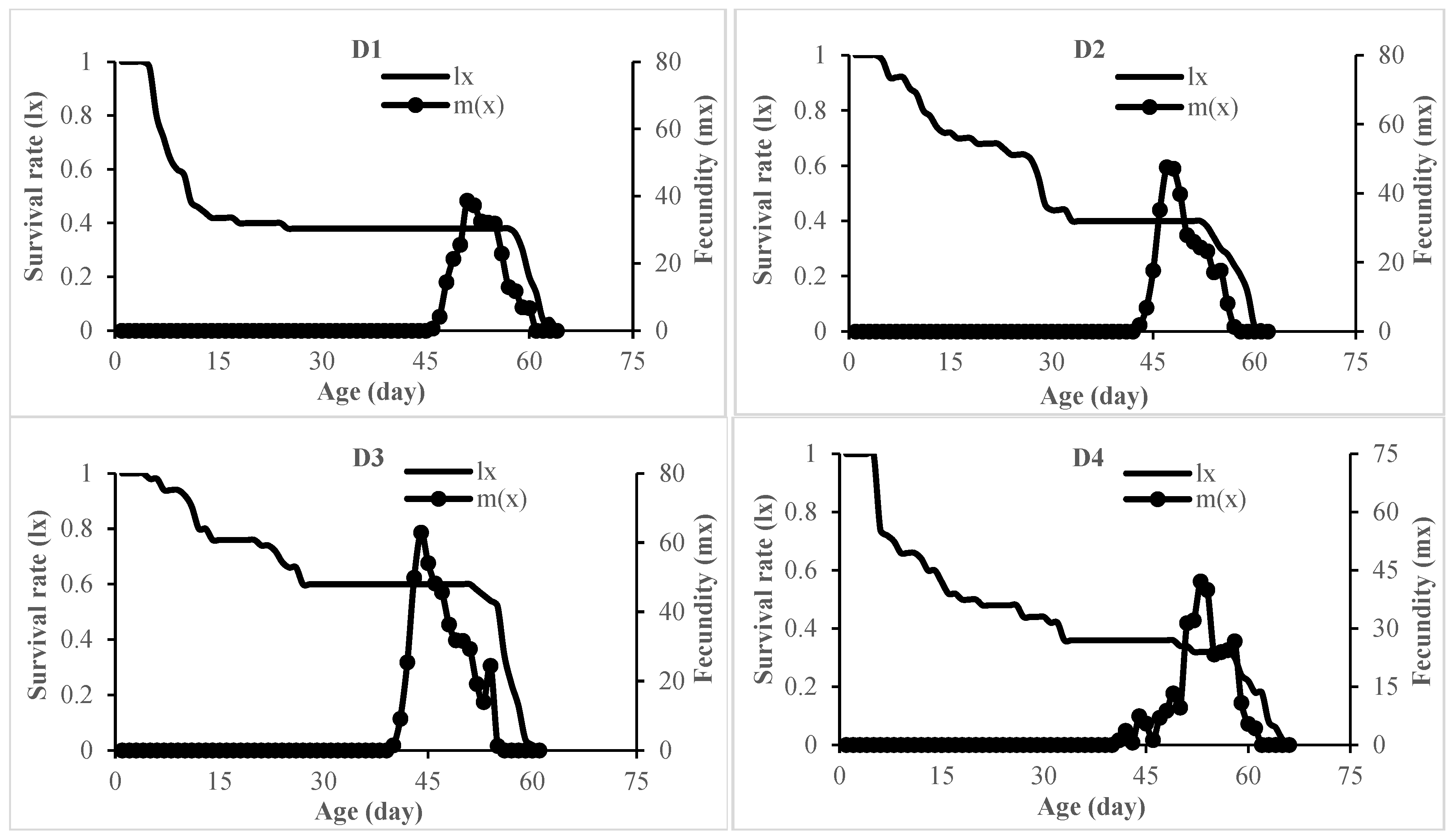
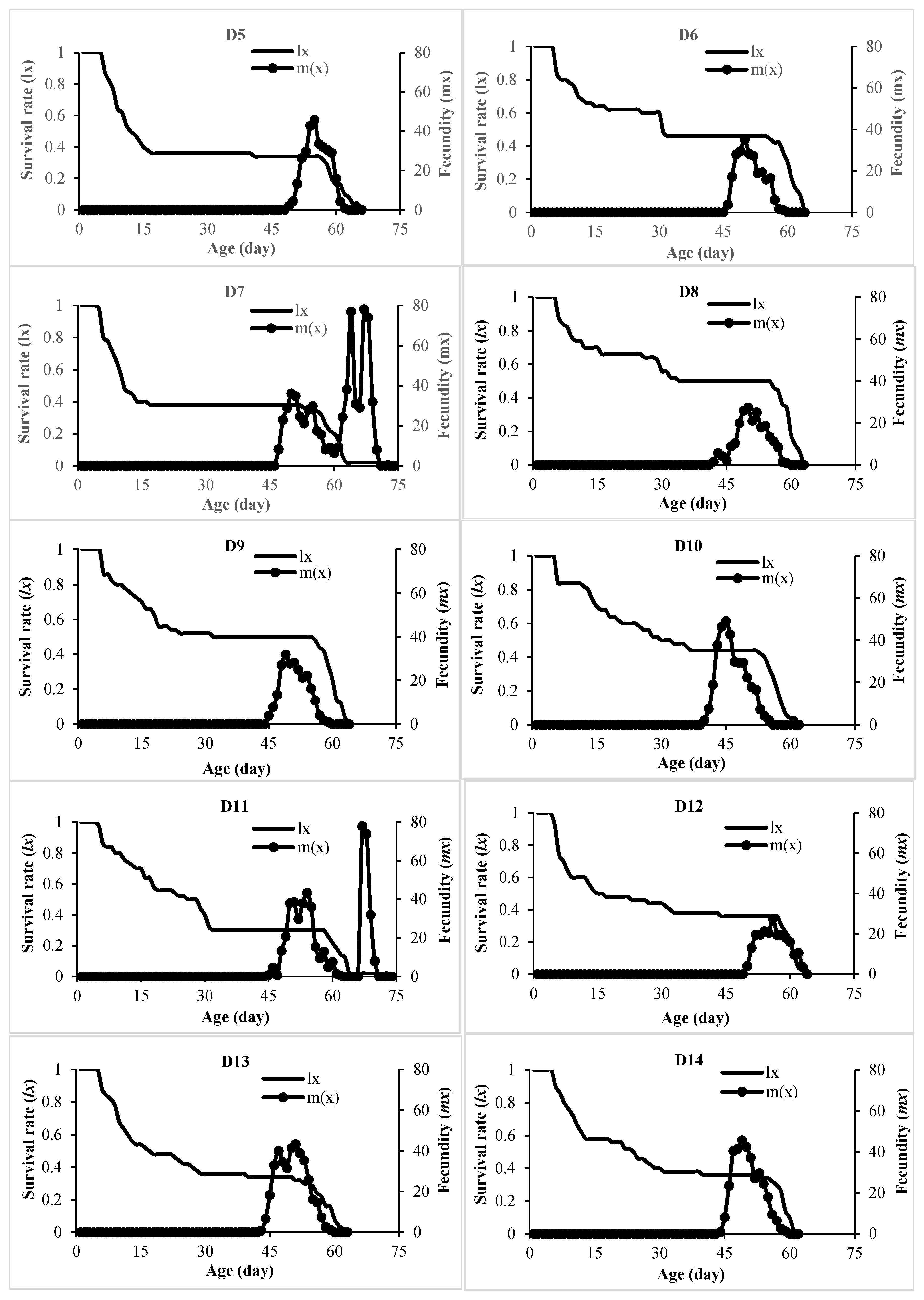
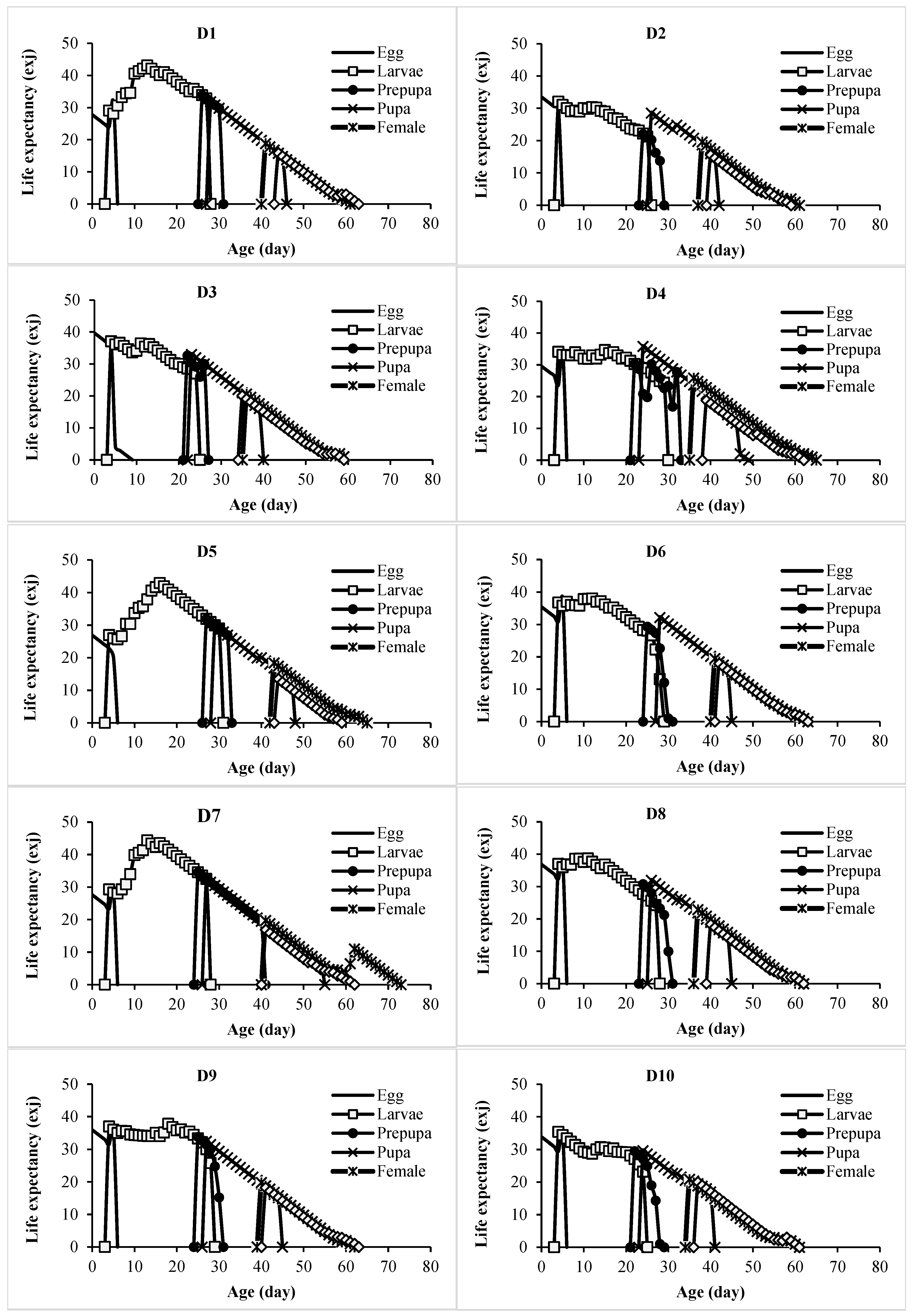
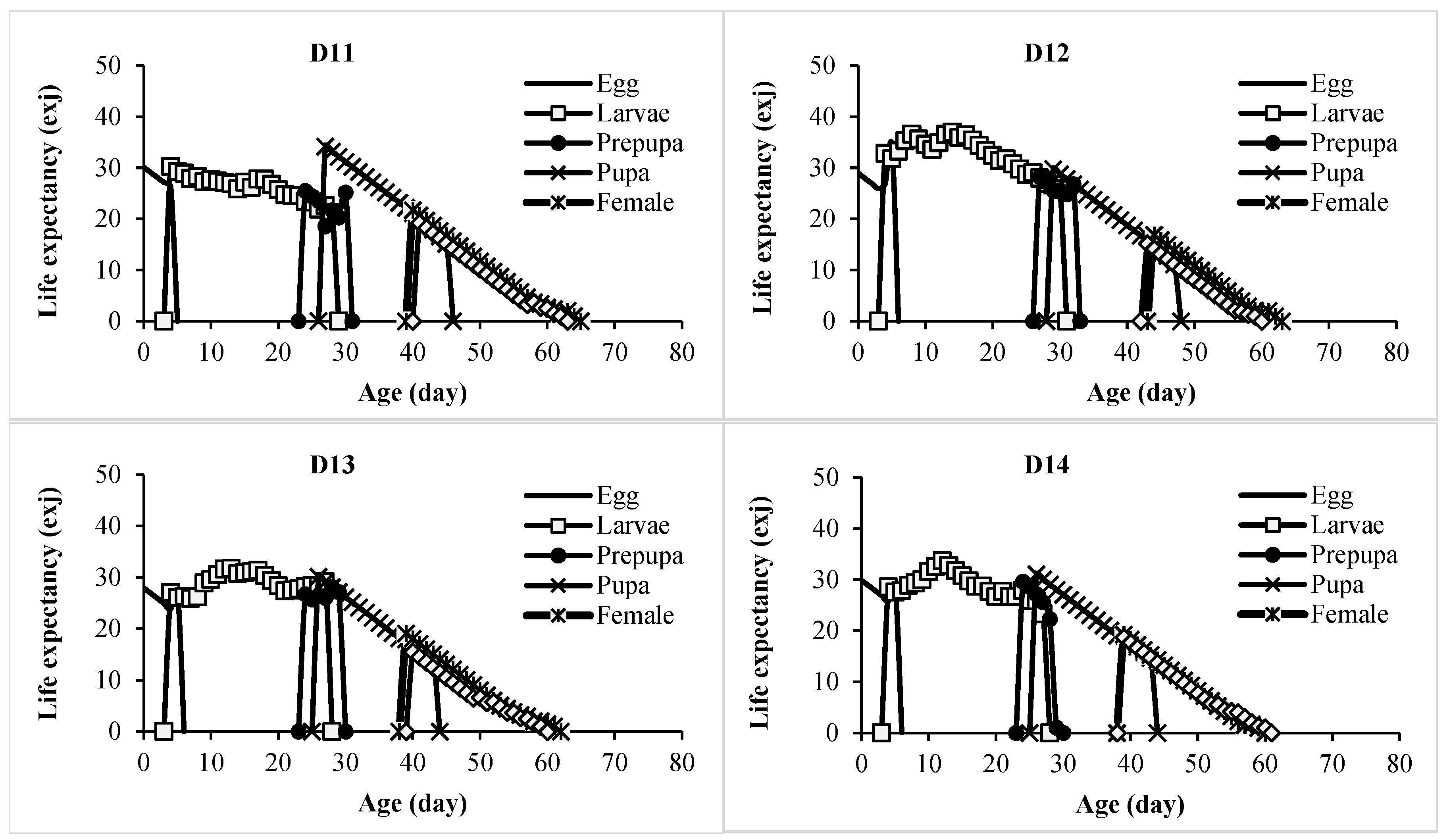
Supplementation of Maize- and Cowpea Seed-Based Artificial Diets with Diverse Pollen Sources Affects the Demographic Features of Leucania loreyi (Duponchel, 1827) (Lepidoptera: Noctuidae)



Simple Summary
Abstract
1. Introduction
2. Materials and Methods
2.1. Origin, Identification, and Rearing of Leucania loreyi
2.2. Seed and Pollen Sources
2.3. Diet Preparation
2.4. Development of Leucania loreyi on Experimental Diets
2.5. Reproduction of Leucania loreyi on Experimental Diets
2.6. Life Table of Leucania loreyi on the Studied Diets
2.7. Data Analysis
3. Results
4. Discussion
5. Conclusions
Author Contributions
Funding
Data Availability Statement
Acknowledgments
Conflicts of Interest
Abbreviations
| APOP | Adult pre-oviposition period |
| TPOP | Total pre-oviposition period |
| R0 | Net reproductive rate |
| r | Intrinsic rate of increase |
| GRR | Gross reproductive rate |
| λ | Finite rate of increase |
| T | Mean generation time |
References
- He, L.; Zhao, S.; He, W.; Wu, K. Pollen and nectar have different effects on the development and reproduction of noctuid moths. Front. Ecol. Evol. 2022, 10, 976987. [Google Scholar] [CrossRef]
- Ben Jemâa, J.M.; Soltani, A.; Djebbi, T.; Mejri, I.; Kanyesigye, D.; Otim, M.H. The maize caterpillar mythimna (=Leucania) loreyi (Duponchel, 1827) (Lepidoptera: Noctuidae): Identification, distribution, population density and damage in Tunisia. Insects 2023, 14, 786. [Google Scholar] [CrossRef]
- El-Sherif, S.I.; Hammad, S.M.; El-Sawaf, S.K. Field observations on Leucania loreyi (Dup.) (Lepid., Noctuidae) in Egypt. J. Appl. Entomol. 2009, 70, 160–166. [Google Scholar] [CrossRef]
- Jafari, H.; Hemmati, S.A.; Esfandiari, M.; Rasekh, A. Population growth, digestive physiology, and antioxidant enzyme activities of Leucania loreyi (Lepidoptera: Noctuidae) on maize hybrids. Crop Prot. 2025, 197, 107342. [Google Scholar] [CrossRef]
- Song, H.Y.; Li, L.L.; Zhang, Q.Q.; Song, Y.Y.; Zhu, Z.G.; Lu, Z.B.; Yu, Y.; Men, X. Southward migration routes of insect species in Shandong Province. Chin. J. Appl. Entomol. 2021, 58, 592–600. [Google Scholar]
- Baek, S.; Kim, M.J.; Kim, E.Y.; Jung, J.K.; Park, C.G. Assessment of the occurrence of the second generation of Mythimna loreyi duponchel (Lepidoptera: Noctuidae) using temperature-dependent developmental and oviposition models. PLoS ONE 2024, 19, e0303841. [Google Scholar] [CrossRef] [PubMed]
- He, L.; Sun, X.; Tan, Y.; Zhou, Y.; Wu, W.; Liu, X.; Wu, K. Flight capacity and wingbeat frequency of Mythimna loreyi (Lepidoptera: Noctuidae). Environ. Entomol. 2026, 55, nvaf121. [Google Scholar] [CrossRef]
- Ebrahimi, L.; Amir-Maafi, M.; Shiri, M. Investigating the effect of temperature on abundance of Mythimna loreyi (Lepidoptera: Noctuidae) in corn. J. Iran. Plant Prot. Res. 2024, 38, 197–208. [Google Scholar] [CrossRef]
- Ravan, B.; Esfandiari, M.; Mossadegh, M.S. First record of Leucania herrichii Herrich-Schäffer from Iran with new distribution data of Leucaniini (Lep., Noctuidae). J. Insect Biodivers. Syst. 2024, 10, 797–804. [Google Scholar] [CrossRef]
- Kim, E.Y.; Kim, I.H.; Jung, J.K. Developmental and reproductive characteristics of Mythimna loreyi (Noctuidae) reared on artificial diets. Korean J. Appl. Entomol. 2022, 61, 423–434. [Google Scholar] [CrossRef]
- Jafari, H.; Habibpour, B.; Hemmati, S.A.; Stelinski, L.L. Population growth parameters of Helicoverpa armigera (Hübner) on various legume seeds reveal potential tolerance traits. Sustainability 2023, 15, 7502. [Google Scholar] [CrossRef]
- Zergani, A.; Shishehbor, P.; Naser Nakkai, F.; Riahi, E. Life history traits and population parameters of the predatory mite Euseius scutalis (Acari: Phytoseiidae) fed on Tetranychus turkestani (Acari: Tetranychidae) and pollen from three different plants. Acarologia 2023, 63, 945–954. [Google Scholar] [CrossRef]
- Lukšic, K.; Mucalo, A.; Marinov, L.; Ozretic Zokovic, M.; Rankovic-Vasic, Z.; Nikolic, D.; Zdunic, G. X-ray microanalysis of elemental composition of Vitis sylvestris pollen grains. Plants 2024, 13, 2338. [Google Scholar] [CrossRef] [PubMed]
- Sobhy, I.S.; Gurr, G.M.; Jones, T.H. Induced plant resistance and its influence on natural enemy use of plant-derived foods. Curr. Opin. Insect Sci. 2024, 64, 101218. [Google Scholar] [CrossRef]
- Arab Yabarati, Z.; Hemmati, S.A.; Esfandiari, M.; Siahpoosh, M.R. Relationship between the nutritional and physiological responses of Helicoverpa armigera (Hübner) and phytochemical metabolites in various sesame cultivars. J. Appl. Entomol. 2025, 149, 1168–1179. [Google Scholar] [CrossRef]
- Kefayat, F.; Hemmati, S.A.; Rasekh, A.; Nasernakhaei, F.; Stelinski, L.L. Suitability of artificial diets containing various types of pollen grains to Helicoverpa armigera (Hübner, 1808): Nutritional performance and digestive enzyme response. Insects 2025, 16, 429. [Google Scholar] [CrossRef]
- Bakaze, E.; Kiggundu, A. Use of artificial diets with plant material to evaluate banana cultivars for resistance to Cosmopolites sordidus. Uganda J. Agric. Sci. 2018, 18, 103–109. [Google Scholar] [CrossRef]
- Arab Yabarati, Z.; Hemmati, S.A.; Esfandiari, M.; Siahpoosh, M.R. Population growth performance and antioxidant enzymes activities of Helicoverpa armigera (Lepidoptera: Noctuidae) on diets from various sesame cultivars. J. Insect Sci. 2025, 25, ieaf057. [Google Scholar] [CrossRef]
- Kefayat, F.; Hemmati, S.A.; Rasekh, A.; Nasernakhaei, F. The suitability of artificial diets containing diverse pollen grains to Helicoverpa armigera (Hübner): Population growth performance and antioxidant enzymes activities. J. Asia Pac. Entomol. 2025, 28, 102473. [Google Scholar] [CrossRef]
- Hayashida, R.; Bueno, A.D.F.; Hermel, A.O.; Hirakuri, M.H.; Silva, F.A.C.; Roggia, S. Euschistus heros (Hemiptera: Pentatomidae) fitness on artificial diets: An approach to optimize mass rearing of Telenomus podisi (Hymenoptera: Platygastridae) for augmentative biological control. J. Econ. Entomol. 2018, 111, 1605–1613. [Google Scholar] [CrossRef]
- Sayed, W.A.A.; El-Helaly, A.; Jamal, Z.A.; El-Bendary, H. Effect of a low cost diet on the cotton leaf worm, Spodoptera littoralis nucleopolyhedrosis virus pathogenicity and sterile insect technique. Egypt. J. Biol. Pest Control 2021, 31, 117. [Google Scholar] [CrossRef]
- Tibola, C.M.; Silva, L.; Sgubin, F.; Omoto, C. Monitoring resistance of Euschistus heros (Fabricius) (Hemiptera: Pentatomidae) to insecticides by using encapsulated artificial diet bioassay. Insects 2021, 12, 599. [Google Scholar] [CrossRef]
- Jung, J.K.; Kim, E.Y.; Kim, I.H.; Ahn, J.J.; Lee, G.S.; Seo, B.Y. Meridic diets for rearing of Spodoptera frugiperda larvae. Korean J. Appl. Entomol. 2020, 59, 243–250. [Google Scholar] [CrossRef]
- Hemmati, S.A.; Arab Yabarati, Z.; Stelinski, L.L. Enrichment of diverse seed-based artificial diets with date palm pollen affects the fitness and physiological responses of Spodoptera littoralis (Boisduval, 1833). Sci. Rep. 2025, 16, 484. [Google Scholar] [CrossRef] [PubMed]
- Shorey, H.H.; Hale, R.L. Mass-rearing of the larvae of nine noctuid species on a simple artificial medium. J. Econ. Entomol. 1965, 58, 522–524. [Google Scholar] [CrossRef]
- Jiang, S.; Sun, X.T.; Ge, S.S.; Yang, X.M.; Wu, K.M. Mating competitiveness of male Spodoptera frugiperda (Smith) irradiated by X-rays. Insects 2023, 14, 137. [Google Scholar] [CrossRef]
- Huang, Y.B.; Chi, H. Life tables of Bactrocera cucurbitae (Diptera: Tephritidae): With an invalidation of the jackknife technique. J. Appl. Entomol. 2013, 137, 327–339. [Google Scholar] [CrossRef]
- Chi, H. Life-table analysis incorporating both sexes and variable development rates among individuals. Environ. Entomol. 1988, 17, 26–37. [Google Scholar] [CrossRef]
- Chi, H.; Su, H.Y. Age-stage, two-sex life tables of Aphidius gifuensis (Ashmead) (Hymenoptera: Braconidae) and its host Myzus persicae (Sulzer) (Homoptera: Aphididae) with mathematical proof of the relationship between female fecundity and the net reproductive rate. Environ. Entomol. 2006, 35, 10–21. [Google Scholar] [CrossRef]
- Chi, H.; Liu, H. Two new methods for the study of insect population ecology. Bull. Inst. Zool. Acad. Sin. 1985, 24, 225–240. [Google Scholar]
- Chi, H. TWOSEX-MSChart: A Computer Program for the Age-Stage, Two-Sex Life Table Analysis. 2022. Available online: https://doi.org/10.5281/zenodo.7484085 (accessed on 24 December 2022).
- Ward, J.H. Hierarchical grouping to optimize an objective function. J. Am. Stat. Assoc. 1963, 58, 236–244. [Google Scholar] [CrossRef]
- Ge, S.; Chu, B.; He, W.; Jiang, S.; Lv, C.; Gao, L.; Sun, X.; Yang, X.; Wu, K. Wheat-bran-based artificial diet for mass culturing of the fall armyworm, Spodoptera frugiperda Smith (Lepidoptera: Noctuidae). Insects 2022, 13, 1177. [Google Scholar] [CrossRef] [PubMed]
- Toft, S.; Wise, D.H. Growth, development, and survival of a generalist predator fed single- and mixed-species diets of different quality. Oecologia 1999, 119, 191–197. [Google Scholar] [CrossRef]
- Singer, M.; Bernays, E.; Carriere, Y. The interplay between nutrient balancing and toxin dilution in foraging by a generalist insect herbivore. Anim. Behav. 2002, 64, 629–643. [Google Scholar] [CrossRef]
- Marques, R.V.; Sarmento, R.A.; Lemos, F.; Pedro-Neto, M.; Sabelis, M.W.; Venzon, M.; Pallini, A.; Janssen, A. Active prey mixing as an explanation for polyphagy in predatory arthropods: Synergistic dietary effects on egg production despite a behavioural cost. Funct. Ecol. 2015, 29, 1317–1324. [Google Scholar] [CrossRef]
- Ashok, K.; Balasubramani, V.; Kennedy, J.S.; Geethalakshmi, V.; Jeyakumar, P.; Sathiah, N. Evaluating artificial diets for the fall armyworm, Spodoptera frugiperda (J.E. Smith) (Lepidoptera: Noctuidae) through nutritional indices and an age stage, two-sex life table approach. Afr. Entomol. 2021, 29, 620–634. [Google Scholar] [CrossRef]
- Bujang, J.S.; Zakaria, M.H.; Ramaiya, S.D. Chemical constituents and phytochemical properties of floral maize pollen. PLoS ONE 2021, 16, e0247327. [Google Scholar] [CrossRef]
- Sivaguru, M.; Mander, L.; Fried, G.; Punyasena, S.W. Capturing the surface texture and shape of pollen: A comparison of microscopy techniques. PLoS ONE 2012, 7, e39129. [Google Scholar] [CrossRef]
- Eggs, B.; Sanders, D. Herbivory in spiders: The importance of pollen for orb-weavers. PLoS ONE 2013, 8, e82637. [Google Scholar] [CrossRef]
- Wu, K.J.; Li, M.H. Nutritional ecology of the cotton bollworm, Heliothis armigera (Hübner): Life tables of the population on the artificial diets with different protein levels. Acta Entomol. Sin. 1993, 36, 21–28. [Google Scholar]
- Samaras, K.; Pappas, M.L.; Fytas, E.; Broufas, G.D. Pollen provisioning enhances the performance of Amblydromalus limonicus on an unsuitable prey. Front. Ecol. Evol. 2019, 7, 122. [Google Scholar] [CrossRef]
- Jha, R.K.; Chi, H.; Tang, L.C. A comparison of artificial diet and hybrid sweet corn for the rearing of Helicoverpa armigera (Hubner) (Lepidoptera: Noctuidae) based on life table characteristics. Environ. Entomol. 2012, 41, 30–39. [Google Scholar] [CrossRef] [PubMed]
- Chamani, M.; Naseri, B.; Rafiee-Dastjerdi, H.; Emaratpardaz, J.; Farshbaf Pourabad, R.; Chenari Bouket, A.; Oszako, T.; Belbahri, L. Examining innovative technologies: Nano-chelated fertilizers for management of wheat aphid (Schizaphis graminum Rondani). Insects 2024, 15, 209. [Google Scholar] [CrossRef] [PubMed]
- Qin, J.; Zhang, L.; Liu, Y.; Sappington, T.W.; Cheng, Y.; Luo, L.; Jiang, X. Population projection and development of the Mythimna loreyi (Lepidoptera: Noctuidae) as affected by temperature: Application of an age-stage, two-sex life table. J. Econ. Entomol. 2017, 110, 1583–1591. [Google Scholar] [CrossRef]
- Wang, P.; Furlong, M.J.; Walsh, T.K.; Zalucki, M.P. Moving to keep fit: Feeding behavior and movement of Helicoverpa armigera (Lepidoptera: Noctuidae) on artificial diet with different protein: Carbohydrate ratios. J. Insect Sci. 2019, 19, 20. [Google Scholar] [CrossRef]
- Truzi, C.C.; Vieira, N.F.; de Souza, J.M.; De Bortoli, S.A. Artificial diets with different protein levels for rearing Spodoptera frugiperda (Lepidoptera: Noctuidae). J. Insect Sci. 2021, 21, 2. [Google Scholar] [CrossRef]
- Lazarov, S.B.; Georgiev, I.G.; Atanasov, A.Z.; Hristakov, I.S. Development of the hypopharyngeal glands of worker bees (Apis mellifera L.) when fed different protein sources during the spring period. Insects 2026, 17, 21. [Google Scholar] [CrossRef]
- Pascacio-Villafán, C.; Birke, A.; Williams, T.; Aluja, M. Modeling the cost-effectiveness of insect rearing on artificial diets: A test with a tephritid fly used in the sterile insect technique. PLoS ONE 2017, 12, e0173205. [Google Scholar] [CrossRef]
- Pan, X.; Connacher, R.P.; O’Connor, M.B. Control of the insect metamorphic transition by ecdysteroid production and secretion. Curr. Opin. Insect Sci. 2021, 43, 11–20. [Google Scholar] [CrossRef]
- Force, E.; Dacher, M.; Debernard, S. How the diet influences lepidopteran reproduction: Morpho-functional, behavioral, and endocrine aspects. J. Insect Physiol. 2025, 164, 104838. [Google Scholar] [CrossRef]


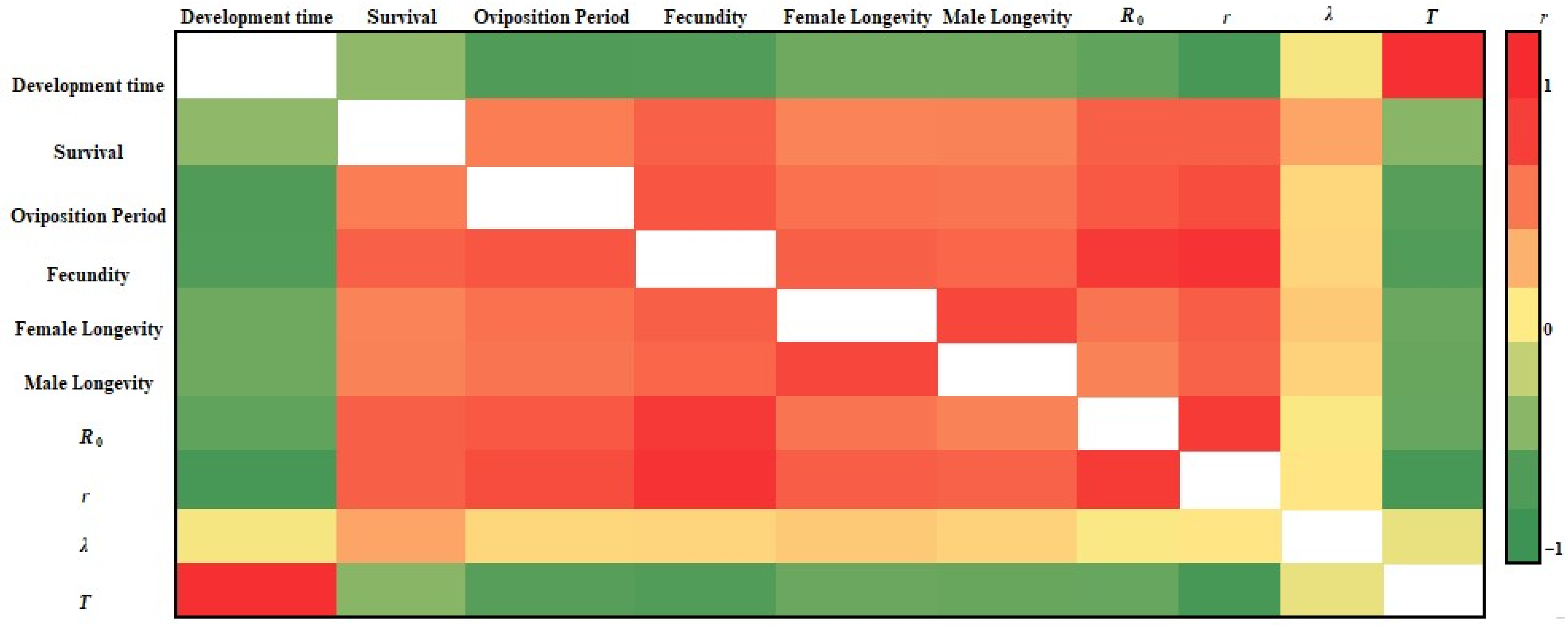
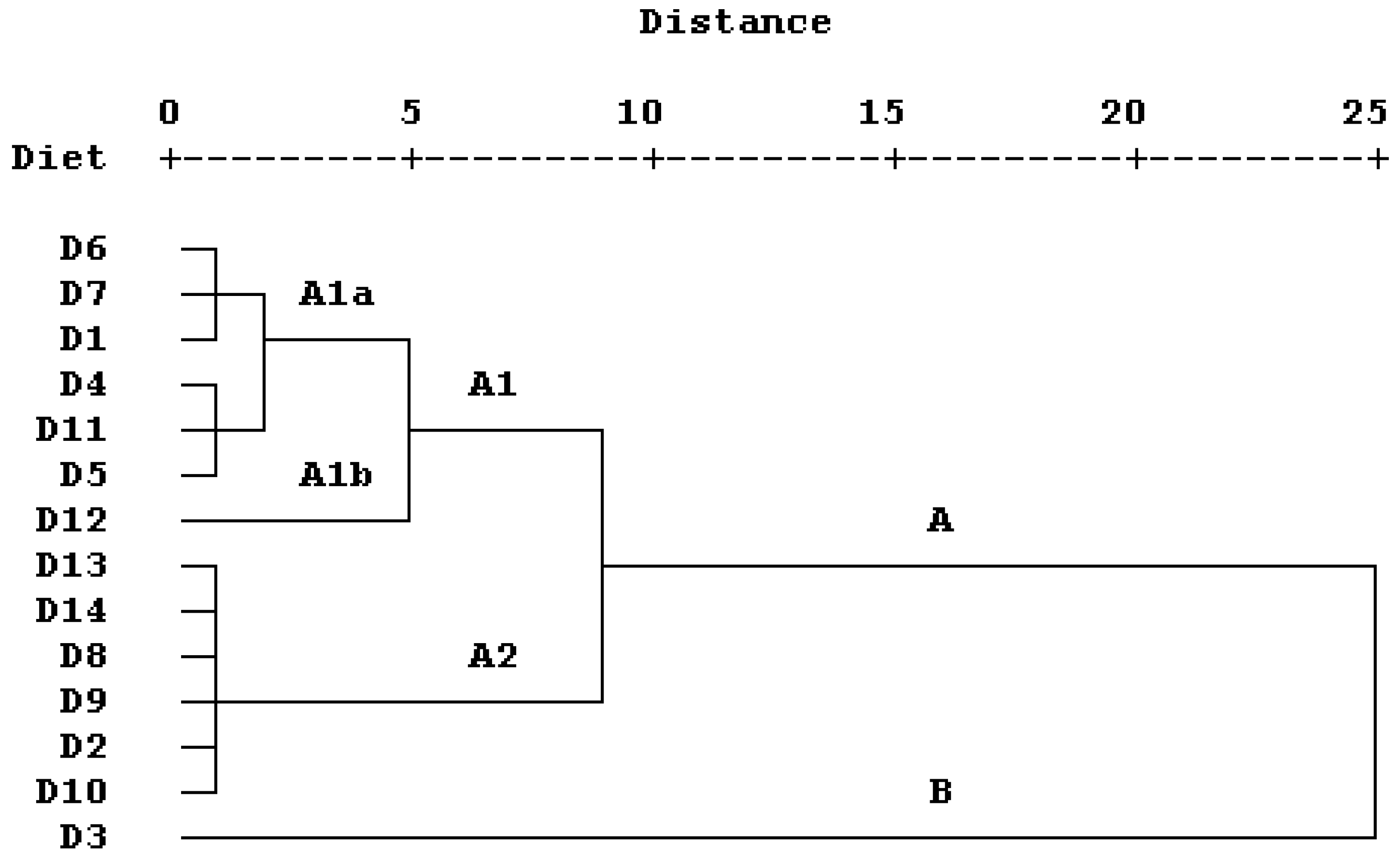

| Diet | Base Ingredient (g) | Pollen Source (g) | Additional Components (g or mL) |
|---|---|---|---|
| D1 | Maize (19.5) | Rapeseed (1) | wheat germ (3), yeast (3.5), ascorbic acid (0.35), sorbic acid (0.11), formaldehyde (0.25), methyl-p-hydroxy benzoate (0.22), agar (1.4), sunflower oil (0.5 mL), distilled water (65 mL) |
| D2 | Maize (19.5) | Date palm (1) | Same as D1 * |
| D3 | Maize (19.5) | Maize (1) | Same as D1 * |
| D4 | Maize (19.5) | Common hollyhock (1) | Same as D1 * |
| D5 | Maize (19.5) | Saffron (1) | Same as D1 * |
| D6 | Maize (19.5) | Honey bee (1) | Same as D1 * |
| D7 | Maize (20.5) | No pollen | Same as D1 * |
| D8 | Cowpea (19.5) | Rapeseed (1) | Same as D1 * |
| D9 | Cowpea (19.5) | Date palm (1) | Same as D1 * |
| D10 | Cowpea (19.5) | Maize (1) | Same as D1 * |
| D11 | Cowpea (19.5) | Common hollyhock (1) | Same as D1 * |
| D12 | Cowpea (19.5) | Saffron (1) | Same as D1 * |
| D13 | Cowpea (19.5) | Honey bee (1) | Same as D1 * |
| D14 | Cowpea (20.5) | No pollen | Same as D1 * |
| Diet | Incubation Period (Days) | Larval Period (Days) | Pre-Pupal Period (Days) | Pupal Period (Days) | Development Time (Days) | Pre-Adult Survival |
|---|---|---|---|---|---|---|
| D1 | 5.10 ± 0.006 abc | 22.21 ± 0.16 b | 2.47 ± 0.117 a | 14.05 ± 0.19 ab | 43.68 ± 0.29 bc | 0.38 ± 0.07 bc |
| D2 | 4.89 ± 0.005 def | 20.50 ± 0.11 d | 2.09 ± 0.006 a | 12.75 ± 0.14 d | 40.05 ± 0.22 f | 0.40 ±0.07 bc |
| D3 | 4.81 ± 0.006 f | 18.76 ± 0.12 e | 1.10 ± 0.005 a | 12.10 ± 0.12 e | 37.53 ± 0.18 g | 0.60 ± 0.07 a |
| D4 | 4.84 ± 0.009 ef | 22.46 ± 0.41 b | 2.72 ± 0.108 a | 13.53 ± 0.21 bc | 43.30 ± 0.71 bcd | 0.34 ± 0.07 bc |
| D5 | 5.12 ± 0.006 ab | 24.44 ± 0.22 a | 2.39 ± 0.117 a | 14.11 ± 0.22 ab | 45.82 ± 0.34 a | 0.34 ± 0.07 bc |
| D6 | 5.12 ± 0.008 abc | 22.07 ± 0.14 b | 2.09 ± 0.006 a | 14.00 ± 0.16 ab | 42.78 ± 0.21 cd | 0.46 ± 0.07 abc |
| D7 | 4.92 ± 0.007 cef | 21.63 ± 0.19 bc | 2.98 ± 0.61 a | 14.05 ± 0.18 ab | 43.35 ± 0.69 bcd | 0.38 ± 0.07 bc |
| D8 | 5.00 ± 0.007 abcde | 21.75 ± 0.15 bc | 2.15 ± 0.007 a | 13.68 ± 0.19 bc | 42.24 ± 0.33 d | 0.50 ± 0.07 ab |
| D9 | 5.14 ± 0.008 ab | 21.75 ± 0.22 bc | 2.16 ± 0.007 a | 13.84 ± 0.15 b | 42.60 ± 0.26 d | 0.50 ± 0.07 ab |
| D10 | 4.98 ± 0.053 bcde | 21.81 ± 0.13 e | 2.04 ± 0.004 a | 12.18 ± 0.19 e | 38.10 ± 0.30 g | 0.44 ± 0.07 abc |
| D11 | 4.86 ± 0.005 ef | 19.11 ± 0.21 b | 2.47 ± 0.131 a | 14.07 ± 0.18 ab | 43.53 ± 0.39 bc | 0.30 ± 0.06 c |
| D12 | 5.22 ± 0.009 a | 22.16 ± 0.17 a | 2.32 ± 0.109 a | 14.33 ± 0.11 a | 45.56 ± 0.30 a | 0.36 ± 0.07 bc |
| D13 | 4.98 ± 0.004 bcde | 23.95 ± 0.40 cd | 2.06 ± 0.006 a | 13.23 ± 0.16 c | 41.06 ± 0.37 e | 0.34 ± 0.07 bc |
| D14 | 5.02 ± 0.005 abcd | 20.82 ± 0.18 d | 2.00 ± 0.008 a | 13.33 ± 0.21 bc | 40.94 ± 0.33 e | 0.36 ± 0.07 bc |
| Diet | APOP (Days) | TPOP (Days) | Oviposition Period (Days) | Fecundity (Offspring) | Longevity (Days) | Whole Lifespan (Days) | ||
|---|---|---|---|---|---|---|---|---|
| Female | Male | Female | Male | |||||
| D1 | 4.91 ± 0.16 a | 47.91 ± 0.47 c | 9.28 ± 0.56 de | 509.39 ± 43.57 cdef | 16.81 ± 0.23 de | 15.24 ± 0.60 bc | 59.82 ± 0.41 bc | 59.86 ± 0.94 a |
| D2 | 4.41 ± 0.14 ab | 44.00 ± 0.30 f | 10.92 ± 0.50 abc | 550.71 ± 25.41 bcd | 18.00 ± 0.63 bcd | 14.89 ± 0.80 bc | 57.58 ± 0.64 def | 55.63 ± 0.94 ab |
| D3 | 3.78 ± 0.10 d | 41.05 ± 0.21 g | 11.89 ± 0.28 a | 801.69 ± 42.42 a | 19.33 ± 0.43 a | 17.18 ± 0.40 ab | 56.61 ± 0.41 ef | 55.09 ± 0.60 b |
| D4 | 4.72 ± 0.31 ab | 48.17 ± 1.03 bc | 9.91 ± 0.37 cde | 471.45 ± 31.63 def | 18.37 ± 0.62 abc | 14.81 ± 1.22 bcd | 61.82 ± 0.69 a | 57.76 ± 2.90 ab |
| D5 | 4.91 ± 0.25 ab | 50.45 ± 0.43 a | 9.09 ± 0.31 e | 432.77 ± 16.97 f | 15.91 ± 0.54 ef | 11.16 ± 0.50 e | 61.45 ± 0.74 ab | 57.44 ± 2.04 ab |
| D6 | 4.18 ± 0.18 bc | 46.37 ± 0.39 cd | 10.17 ± 0.48 bcde | 515.88 ± 24.23 cde | 18.27 ± 0.54 abc | 16.58 ± 0.64 abc | 60.45 ± 0.69 abc | 59.91 ± 0.65 a |
| D7 | 4.46 ± 0.16 ab | 47.98 ± 1.11 bc | 10.35 ± 0.51 bcd | 517.81 ± 37.70 cde | 17.18 ± 0.29 cde | 14.76 ± 1.00 cd | 60.70 ± 1.32 abc | 57.88 ± 1.35 ab |
| D8 | 4.30 ± 0.15 bc | 46.00 ± 0.74 cde | 10.50 ± 0.58 bcd | 554.34 ± 25.78 bc | 18.20 ± 0.41 abc | 15.73 ± 0.49 bc | 59.90 ± 0.50 bc | 58.33 ± 0.56 ab |
| D9 | 4.46 ± 0.21 ab | 46.18 ± 0.37 cd | 10.00 ± 0.50 cde | 548.42 ± 42.87 bcde | 18.09 ± 0.31 bc | 15.93 ± 0.70 abc | 59.82 ± 0.41 bc | 59.21 ± 0.72 ab |
| D10 | 3.85 ± 0.10 cd | 41.16 ± 0.30 g | 11.23 ± 0.34 ab | 612.98 ± 25.59 b | 18.54 ± 0.58 ab | 17.77 ± 0.59 a | 55.85 ± 0.69 f | 57.00 ± 0.64 ab |
| D11 | 4.70 ± 0.33 ab | 47.90 ± 0.64 c | 10.00 ± 0.25 cde | 468.66 ± 21.05 ef | 18.50 ± 0.56 ab | 15.91 ± 1.44 abc | 61.70 ± 0.63 a | 59.85 ± 4.56 ab |
| D12 | 4.90 ± 0.23 a | 50.20 ± 0.44 ab | 10.10 ± 0.40 cde | 339.73 ± 32.50 g | 15.60 ± 0.39 f | 12.24 ± 0.56 de | 60.90 ± 0.40 ab | 58.11 ± 0.71 ab |
| D13 | 4.36 ± 0.24 abc | 45.09 ± 0.67 def | 10.55 ± 0.34 bcd | 568.03 ± 22.91 bc | 17.37 ± 0.59 bcde | 13.83 ± 1.46 cde | 58.09 ± 0.76 cde | 55.43 ± 2.91 ab |
| D14 | 4.45 ± 0.20 ab | 45.09 ± 0.35 ef | 10.73 ± 0.46 bc | 577.10 ± 27.58 bc | 17.64 ± 0.43 bcd | 16.27 ± 1.12 abc | 58.27 ± 0.30 cd | 57.69 ± 1.52 ab |
| Diet | R0 (Offspring) | r (Day−1) | GRR (Offspring) | λ (Day−1) | T (Day) |
|---|---|---|---|---|---|
| D1 | 111.89 ± 31.28 bc | 0.089 ± 0.006 cd | 525.23 ± 189.69 a | 1.093 ± 0.006 cd | 52.47 ± 0.57 b |
| D2 | 132.36 ± 33.70 bc | 0.099 ± 0.006 bcd | 341.38 ± 63.70 ab | 1.105 ± 0.006 bcd | 48.81 ± 0.26 e |
| D3 | 288.691±55.944 a | 0.122 ± 0.004 a | 485.23 ± 76.87 a | 1.130 ± 0.005 a | 46.14 ± 0.35 f |
| D4 | 103.51 ± 28.59 bc | 0.087 ± 0.006 cd | 322.53 ± 58.68 ab | 1.092 ± 0.007 cd | 52.30 ± 1.28 bc |
| D5 | 95.33 ± 25.70 bc | 0.082 ± 0.005 d | 310.92 ± 48.30 abc | 1.086 ± 0.006 d | 54.82 ± 0.43 a |
| D6 | 113.10 ± 30.42 bc | 0.092 ± 0.006 cd | 247.85 ± 55.44 bc | 1.097 ± 0.006 cd | 50.85 ± 0.35 bc |
| D7 | 114.05 ± 31.21 bc | 0.089 ± 0.006 cd | 553.39 ± 201.48 a | 1.094 ± 0.006 cd | 52.51 ± 0.90 b |
| D8 | 111.29 ± 31.65 bc | 0.093 ± 0.006 cd | 225.08 ± 56.06 bc | 1.907 ± 0.007 cd | 50.27 ± 0.82 bcde |
| D9 | 120.69 ± 33.55 bc | 0.099 ± 0.005 bcd | 242.00 ± 58.49 bc | 1.103 ± 0.489 bcd | 50.62 ± 0.34 bcd |
| D10 | 159.14 ± 38.37 ab | 0.110 ± 0.006 b | 362.72 ± 66.63 ab | 1.116 ± 0.006 b | 45.95 ± 0.37 f |
| D11 | 93.52 ± 26.74 bc | 0.086 ± 0.006 cd | 315.01 ± 60.41 abc | 1.090 ± 0.007 cd | 52.40 ± 0.56 b |
| D12 | 68.15 ± 19.88 c | 0.076 ± 0.006 d | 222.12 ± 45.08 c | 1.079 ± 0.006 d | 55.00 ± 0.37 a |
| D13 | 125.07 ± 33.94 bc | 0.097 ± 0.006 bcd | 368.33 ± 68.11 ab | 1.102 ± 0.007 bcd | 49.51 ± 0.50 de |
| D14 | 126.98 ± 34.36 bc | 0.096 ± 0.006 bcd | 359.01 ± 70.18 ab | 1.101 ± 0.006 bcd | 49.51 ± 0.50 de |
Disclaimer/Publisher’s Note: The statements, opinions and data contained in all publications are solely those of the individual author(s) and contributor(s) and not of MDPI and/or the editor(s). MDPI and/or the editor(s) disclaim responsibility for any injury to people or property resulting from any ideas, methods, instructions or products referred to in the content. |
© 2026 by the authors. Licensee MDPI, Basel, Switzerland. This article is an open access article distributed under the terms and conditions of the Creative Commons Attribution (CC BY) license.
Share and Cite
Jafari, M.; Hemmati, S.A.; Stelinski, L.L. Supplementation of Maize- and Cowpea Seed-Based Artificial Diets with Diverse Pollen Sources Affects the Demographic Features of Leucania loreyi (Duponchel, 1827) (Lepidoptera: Noctuidae). Insects 2026, 17, 307. https://doi.org/10.3390/insects17030307
Jafari M, Hemmati SA, Stelinski LL. Supplementation of Maize- and Cowpea Seed-Based Artificial Diets with Diverse Pollen Sources Affects the Demographic Features of Leucania loreyi (Duponchel, 1827) (Lepidoptera: Noctuidae). Insects. 2026; 17(3):307. https://doi.org/10.3390/insects17030307
Chicago/Turabian StyleJafari, Maryam, Seyed Ali Hemmati, and Lukasz L. Stelinski. 2026. "Supplementation of Maize- and Cowpea Seed-Based Artificial Diets with Diverse Pollen Sources Affects the Demographic Features of Leucania loreyi (Duponchel, 1827) (Lepidoptera: Noctuidae)" Insects 17, no. 3: 307. https://doi.org/10.3390/insects17030307
APA StyleJafari, M., Hemmati, S. A., & Stelinski, L. L. (2026). Supplementation of Maize- and Cowpea Seed-Based Artificial Diets with Diverse Pollen Sources Affects the Demographic Features of Leucania loreyi (Duponchel, 1827) (Lepidoptera: Noctuidae). Insects, 17(3), 307. https://doi.org/10.3390/insects17030307