

Escherichia coli Mono-Association Modulates Ionotropic Receptor-Dependent Behaviors in Drosophila melanogaster

 and
and 
Simple Summary
Abstract
1. Introduction
2. Materials and Methods
2.1. Maintaining Fly Cultures
2.2. Preparation of Axenic (Germ-Free) Flies
2.3. Reinfection of Axenic Flies
2.4. Environmental Control and Batch Effects
2.5. Larval Tunneling Assay
2.6. Larval Phototaxis Assay
2.7. Larval Temperature Sensitivity Assay
2.8. Two-Choice Trap (Olfactory) Assay
2.9. Fly Liquid-Food Interaction Counter (FLIC) Assay
2.10. Randomization, Blinding, Inclusion/Exclusion Criteria
2.11. Data Analysis
3. Results
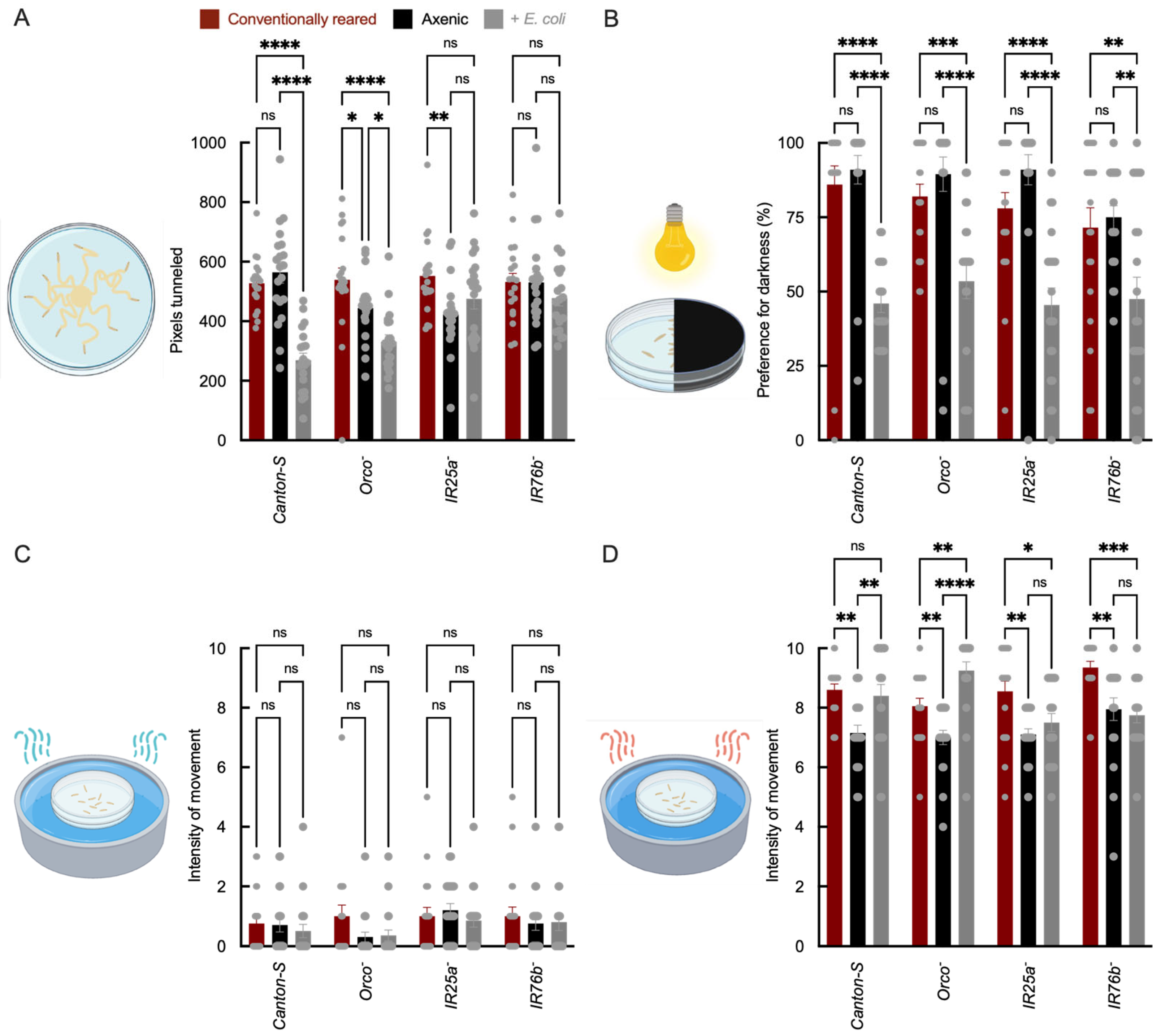
3.1. E. coli Mono-Association Alters Larval Sensory-Driven Behaviors
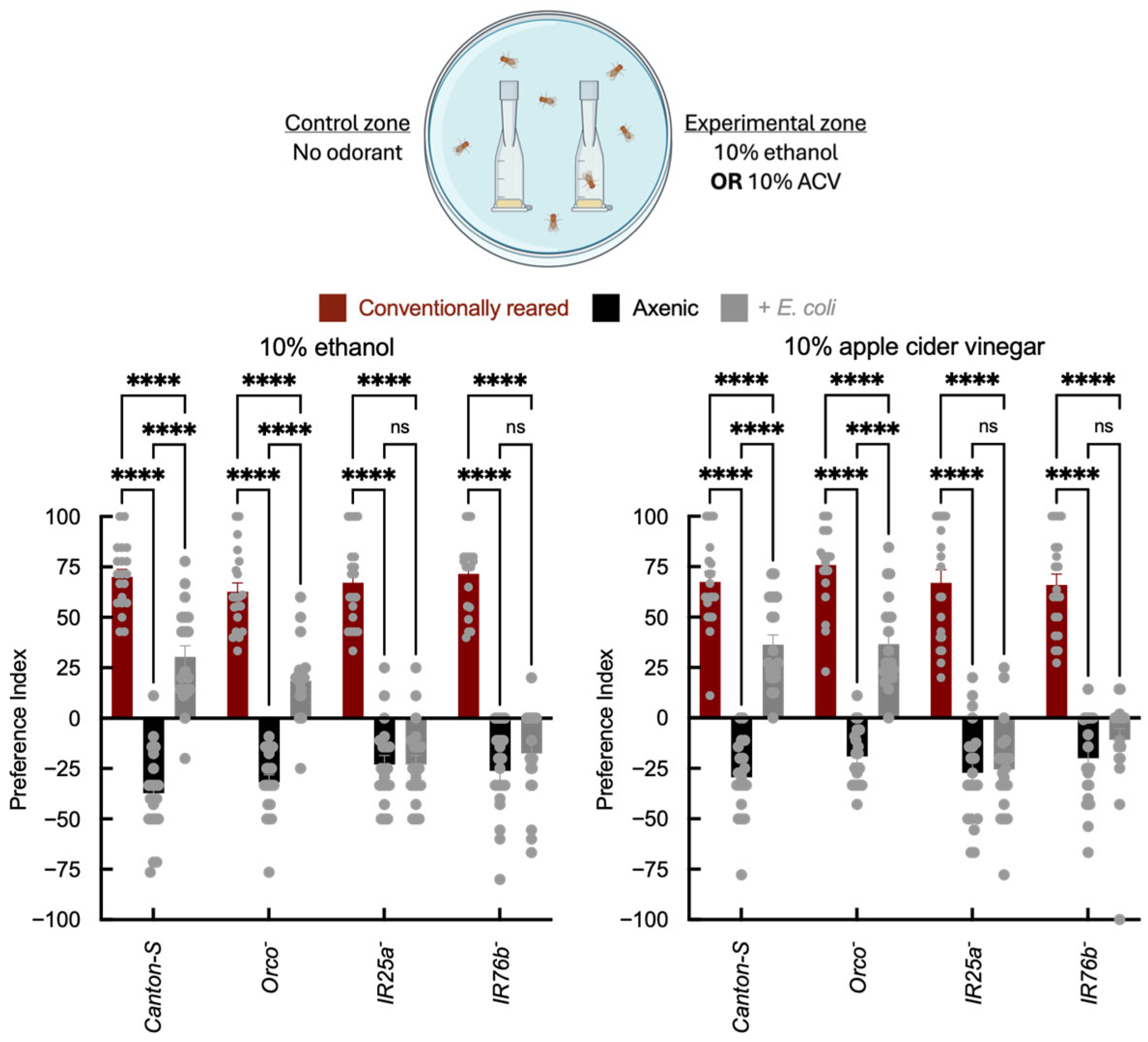
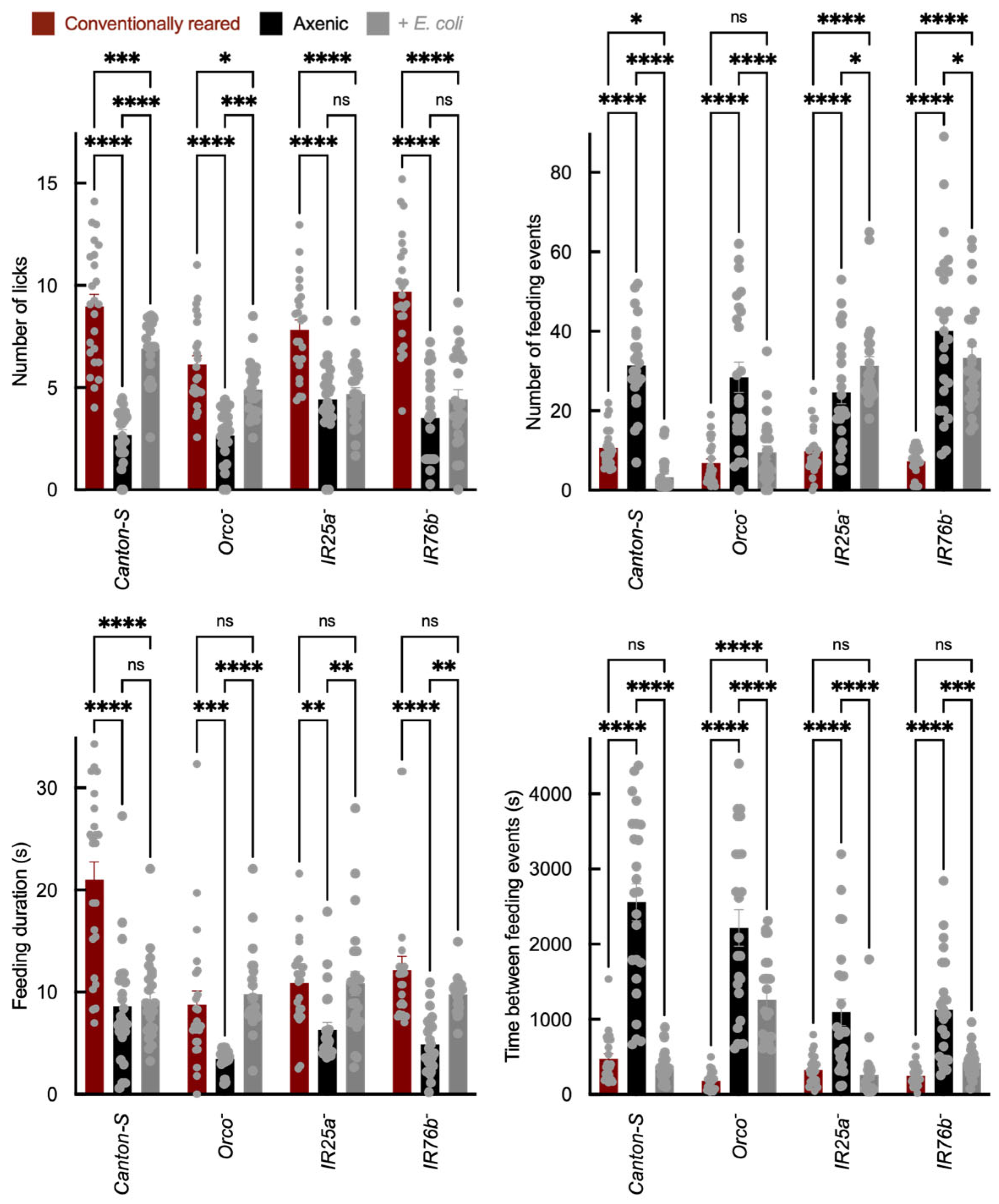
3.2. E. coli Mono-Association Alters Adult Olfactory and Gustatory Behaviors
4. Discussion
Supplementary Materials
Author Contributions
Funding
Data Availability Statement
Acknowledgments
Conflicts of Interest
Abbreviations
| ACV | Apple cider vinegar |
| FLIC | Fly Liquid-Food Interaction Counter |
| IR | Ionotropic receptor |
| LB | Luria broth |
| OR | Olfactory receptor |
| PI | Preference index |
| RH | Relative humidity |
| SD | Standard deviation |
| SEM | Standard error of the mean |
References
- Depetris-Chauvin, A.; Galagovsky, D.; Grosjean, Y. Chemicals and Chemoreceptors: Ecologically Relevant Signals Driving Behavior in Drosophila. Front. Ecol. Evol. 2015, 3, 41. [Google Scholar] [CrossRef]
- He, Z.; Yu, Z.; He, X.; Hao, Y.; Qiao, L.; Luo, S.; Zhang, J.; Chen, B. Genome-Wide Identification and Expression Profiling of Odorant Receptor Genes in the Malaria Vector Anopheles sinensis. Parasites Vectors 2022, 15, 143. [Google Scholar] [CrossRef] [PubMed]
- Sparks, J.T.; Vinyard, B.T.; Dickens, J.C. Gustatory Receptor Expression in the Labella and Tarsi of Aedes aegypti. Insect Biochem. Mol. Biol. 2013, 43, 1161–1171. [Google Scholar] [CrossRef]
- Gerber, B.; Stocker, R.F. The Drosophila Larva as a Model for Studying Chemosensation and Chemosensory Learning: A Review. Chem. Senses 2007, 32, 65–89. [Google Scholar] [CrossRef] [PubMed]
- Montell, C. A Taste of the Drosophila Gustatory Receptors. Curr. Opin. Neurobiol. 2009, 19, 345–353. [Google Scholar] [CrossRef]
- Schmidt, H.R.; Benton, R. Molecular Mechanisms of Olfactory Detection in Insects: Beyond Receptors. Open Biol. 2020, 10, 200252. [Google Scholar] [CrossRef]
- Benton, R.; Sachse, S.; Michnick, S.W.; Vosshall, L.B. Atypical Membrane Topology and Heteromeric Function of Drosophila Odorant Receptors In Vivo. PLoS Biol. 2006, 4, e20. [Google Scholar] [CrossRef]
- Larsson, M.C.; Domingos, A.I.; Jones, W.D.; Chiappe, M.E.; Amrein, H.; Vosshall, L.B. Or83b Encodes a Broadly Expressed Odorant Receptor Essential for Drosophila Olfaction. Neuron 2004, 43, 703–714. [Google Scholar] [CrossRef]
- Rytz, R.; Croset, V.; Benton, R. Ionotropic Receptors (IRs): Chemosensory Ionotropic Glutamate Receptors in Drosophila and Beyond. Insect Biochem. Mol. Biol. 2013, 43, 888–897. [Google Scholar] [CrossRef]
- Abuin, L.; Bargeton, B.; Ulbrich, M.H.; Isacoff, E.Y.; Kellenberger, S.; Benton, R. Functional Architecture of Olfactory Ionotropic Glutamate Receptors. Neuron 2011, 69, 44–60. [Google Scholar] [CrossRef]
- Silbering, A.F.; Rytz, R.; Grosjean, Y.; Abuin, L.; Ramdya, P.; Jefferis, G.S.X.E.; Benton, R. Complementary Function and Integrated Wiring of the Evolutionarily Distinct Drosophila Olfactory Subsystems. J. Neurosci. 2011, 31, 13357–13375. [Google Scholar] [CrossRef]
- Ni, L. The Structure and Function of Ionotropic Receptors in Drosophila. Front. Mol. Neurosci. 2021, 13, 638839. [Google Scholar] [CrossRef]
- Knecht, Z.A.; Silbering, A.F.; Cruz, J.; Yang, L.; Croset, V.; Benton, R.; Garrity, P.A. Ionotropic Receptor-Dependent Moist and Dry Cells Control Hygrosensation in Drosophila. eLife 2017, 6, e26654. [Google Scholar] [CrossRef]
- Ni, L.; Klein, M.; Svec, K.V.; Budelli, G.; Chang, E.C.; Ferrer, A.J.; Benton, R.; Samuel, A.D.; Garrity, P.A. The Ionotropic Receptors IR21a and IR25a Mediate Cool Sensing in Drosophila. eLife 2016, 5, e13254. [Google Scholar] [CrossRef]
- Hussain, A.; Zhang, M.; Üçpunar, H.K.; Svensson, T.; Quillery, E.; Gompel, N.; Ignell, R.; Kadow, I.C.G. Ionotropic Chemosensory Receptors Mediate the Taste and Smell of Polyamines. PLoS Biol. 2016, 14, e1002454. [Google Scholar] [CrossRef] [PubMed]
- Lee, M.J.; Sung, H.Y.; Jo, H.; Kim, H.-W.; Choi, M.S.; Kwon, J.Y.; Kang, K. Ionotropic Receptor 76b Is Required for Gustatory Aversion to Excessive Na+ in Drosophila. Mol. Cells 2017, 40, 787–795. [Google Scholar] [CrossRef] [PubMed]
- Vulpe, A.; Menuz, K. Ir76b Is a Co-Receptor for Amine Responses in Drosophila Olfactory Neurons. Front. Cell. Neurosci. 2021, 15, 759238. [Google Scholar] [CrossRef] [PubMed]
- Kim, B.; Hwang, G.; Yoon, S.-E.; Kuang, M.C.; Wang, J.W.; Kim, Y.-J.; Suh, G.S.B. Postprandial Sodium Sensing by Enteric Neurons in Drosophila. Nat. Metab. 2024, 6, 837–846. [Google Scholar] [CrossRef] [PubMed]
- Xiao, S.; Baik, L.S.; Shang, X.; Carlson, J.R. Meeting a Threat of the Anthropocene: Taste Avoidance of Metal Ions by Drosophila. Proc. Natl. Acad. Sci. USA 2022, 119, e2204238119. [Google Scholar] [CrossRef]
- Benoit, J.B.; Vigneron, A.; Broderick, N.A.; Wu, Y.; Sun, J.S.; Carlson, J.R.; Aksoy, S.; Weiss, B.L. Symbiont-Induced Odorant Binding Proteins Mediate Insect Host Hematopoiesis. eLife 2017, 6, e19535. [Google Scholar] [CrossRef]
- Bi, J.; Wang, Y. The Effect of the Endosymbiont Wolbachia on the Behavior of Insect Hosts. Insect Sci. 2020, 27, 846–858. [Google Scholar] [CrossRef]
- Gupta, A.; Nair, S. Dynamics of Insect–Microbiome Interaction Influence Host and Microbial Symbiont. Front. Microbiol. 2020, 11, 1357. [Google Scholar] [CrossRef] [PubMed]
- Keshavarz, M.; Jo, Y.H.; Edosa, T.T.; Han, Y.S. Tenebrio molitor PGRP-LE Plays a Critical Role in Gut Antimicrobial Peptide Production in Response to Escherichia coli. Front. Physiol. 2020, 11, 320. [Google Scholar] [CrossRef]
- Slankster, E.; Lee, C.; Hess, K.M.; Odell, S.; Mathew, D. Effect of Gut Microbes on Olfactory Behavior of Drosophila melanogaster Larva. Bios 2019, 90, 227–238. [Google Scholar] [CrossRef]
- Fischer, C.N.; Trautman, E.P.; Crawford, J.M.; Stabb, E.V.; Handelsman, J.; Broderick, N.A. Metabolite Exchange between Microbiome Members Produces Compounds That Influence Drosophila Behavior. eLife 2017, 6, e18855. [Google Scholar] [CrossRef]
- Liu, W.; Zhang, K.; Li, Y.; Su, W.; Hu, K.; Jin, S. Enterococci Mediate the Oviposition Preference of Drosophila melanogaster through Sucrose Catabolism. Sci. Rep. 2017, 7, 13420. [Google Scholar] [CrossRef]
- Stensmyr, M.C.; Dweck, H.K.M.; Farhan, A.; Ibba, I.; Strutz, A.; Mukunda, L.; Linz, J.; Grabe, V.; Steck, K.; Lavista-Llanos, S.; et al. A Conserved Dedicated Olfactory Circuit for Detecting Harmful Microbes in Drosophila. Cell 2012, 151, 1345–1357. [Google Scholar] [CrossRef]
- Keita, S.; Masuzzo, A.; Royet, J.; Kurz, C.L. Drosophila Larvae Food Intake Cessation Following Exposure to Erwinia Contaminated Media Requires Odor Perception, Trpa1 Channel and Evf Virulence Factor. J. Insect Physiol. 2017, 99, 25–32. [Google Scholar] [CrossRef]
- Soldano, A.; Alpizar, Y.A.; Boonen, B.; Franco, L.; López-Requena, A.; Liu, G.; Mora, N.; Yaksi, E.; Voets, T.; Vennekens, R.; et al. Gustatory-Mediated Avoidance of Bacterial Lipopolysaccharides via TRPA1 Activation in Drosophila. eLife 2016, 5, e13133. [Google Scholar] [CrossRef] [PubMed]
- Yanagawa, A.; Couto, A.; Sandoz, J.-C.; Hata, T.; Mitra, A.; Ali Agha, M.; Marion-Poll, F. LPS Perception through Taste-Induced Reflex in Drosophila melanogaster. J. Insect Physiol. 2019, 112, 39–47. [Google Scholar] [CrossRef] [PubMed]
- Pais, I.S.; Valente, R.S.; Sporniak, M.; Teixeira, L. Drosophila melanogaster Establishes a Species-Specific Mutualistic Interaction with Stable Gut-Colonizing Bacteria. PLoS Biol. 2018, 16, e2005710. [Google Scholar] [CrossRef] [PubMed]
- Cao, X.; Scoffield, J.; Xie, B.; Morton, D.B.; Wu, H. Drosophila melanogaster as a Model to Study Polymicrobial Synergy and Dysbiosis. Front. Cell. Infect. Microbiol. 2023, 13, 1279380. [Google Scholar] [CrossRef]
- Koga, R.; Moriyama, M.; Onodera-Tanifuji, N.; Ishii, Y.; Takai, H.; Mizutani, M.; Oguchi, K.; Okura, R.; Suzuki, S.; Gotoh, Y.; et al. Single Mutation Makes Escherichia coli an Insect Mutualist. Nat. Microbiol. 2022, 7, 1141–1150. [Google Scholar] [CrossRef]
- Wayland, M.T.; Defaye, A.; Rocha, J.; Jayaram, S.A.; Royet, J.; Miguel-Aliaga, I.; Leulier, F.; Cognigni, P. Spotting the Differences: Probing Host/Microbiota Interactions with a Dedicated Software Tool for the Analysis of Faecal Outputs in Drosophila. J. Insect Physiol. 2014, 69, 126–135. [Google Scholar] [CrossRef] [PubMed]
- Clark, R.I.; Salazar, A.; Yamada, R.; Fitz-Gibbon, S.; Morselli, M.; Alcaraz, J.; Rana, A.; Rera, M.; Pellegrini, M.; Ja, W.W.; et al. Distinct Shifts in Microbiota Composition during Drosophila Aging Impair Intestinal Function and Drive Mortality. Cell Rep. 2015, 12, 1656–1667. [Google Scholar] [CrossRef]
- Ren, C.; Webster, P.; Finkel, S.E.; Tower, J. Increased Internal and External Bacterial Load during Drosophila Aging without Life-Span Trade-Off. Cell Metab. 2007, 6, 144–152. [Google Scholar] [CrossRef] [PubMed]
- Claesson, M.J.; Wang, Q.; O’Sullivan, O.; Greene-Diniz, R.; Cole, J.R.; Ross, R.P.; O’Toole, P.W. Comparison of Two Next-Generation Sequencing Technologies for Resolving Highly Complex Microbiota Composition Using Tandem Variable 16S rRNA Gene Regions. Nucleic Acids Res. 2010, 38, e200. [Google Scholar] [CrossRef] [PubMed]
- Qiang, K.M.; Zhou, F.; Beckingham, K.M. A Burrowing/Tunneling Assay for Detection of Hypoxia in Drosophila melanogaster Larvae. J. Vis. Exp. 2018, 133, e57131. [Google Scholar] [CrossRef]
- Farca Luna, A.J.; von Essen, A.M.H.J.; Widmer, Y.F.; Sprecher, S.G. Light Preference Assay to Study Innate and Circadian Regulated Photobehavior in Drosophila Larvae. J. Vis. Exp. 2013, 74, e50237. [Google Scholar] [CrossRef]
- Liu, J.; Sokabe, T.; Montell, C. A Temperature Gradient Assay to Determine Thermal Preferences of Drosophila Larvae. J. Vis. Exp. 2018, 136, e57963. [Google Scholar] [CrossRef]
- Woodard, C.; Huang, T.; Sun, H.; Helfand, S.L.; Carlson, J. Genetic Analysis of Olfactory Behavior in Drosophila: A New Screen Yields the Ota Mutants. Genetics 1989, 123, 315–326. [Google Scholar] [CrossRef]
- Ro, J.; Harvanek, Z.M.; Pletcher, S.D. FLIC: High-Throughput, Continuous Analysis of Feeding Behaviors in Drosophila. PLoS ONE 2014, 9, e101107. [Google Scholar] [CrossRef]
- Callier, V.; Hand, S.C.; Campbell, J.B.; Biddulph, T.; Harrison, J.F. Developmental Changes in Hypoxic Exposure and Responses to Anoxia in Drosophila melanogaster. J. Exp. Biol. 2015, 218, 2927–2934. [Google Scholar] [CrossRef]
- Coon, K.L.; Valzania, L.; McKinney, D.A.; Vogel, K.J.; Brown, M.R.; Strand, M.R. Bacteria-Mediated Hypoxia Functions as a Signal for Mosquito Development. Proc. Natl. Acad. Sci. USA 2017, 114, E5362–E5369. [Google Scholar] [CrossRef] [PubMed]
- Leitão-Gonçalves, R.; Carvalho-Santos, Z.; Francisco, A.P.; Fioreze, G.T.; Anjos, M.; Baltazar, C.; Elias, A.P.; Itskov, P.M.; Piper, M.D.W.; Ribeiro, C. Commensal Bacteria and Essential Amino Acids Control Food Choice Behavior and Reproduction. PLoS Biol. 2017, 15, e2000862. [Google Scholar] [CrossRef] [PubMed]
- Gao, J.; Zhang, S.; Deng, P.; Wu, Z.; Lemaitre, B.; Zhai, Z.; Guo, Z. Dietary L-Glu Sensing by Enteroendocrine Cells Adjusts Food Intake via Modulating Gut PYY/NPF Secretion. Nat. Commun. 2024, 15, 3514. [Google Scholar] [CrossRef]
- Budelli, G.; Ni, L.; Berciu, C.; van Giesen, L.; Knecht, Z.A.; Chang, E.C.; Kaminski, B.; Silbering, A.F.; Samuel, A.; Klein, M.; et al. Ionotropic Receptors Specify the Morphogenesis of Phasic Sensors Controlling Rapid Thermal Preference in Drosophila. Neuron 2019, 101, 738–747.e3. [Google Scholar] [CrossRef] [PubMed]
- Suito, T.; Nagao, K.; Juni, N.; Hara, Y.; Sokabe, T.; Atomi, H.; Umeda, M. Regulation of Thermoregulatory Behavior by Commensal Bacteria in Drosophila. Biosci. Biotechnol. Biochem. 2022, 86, 1060–1070. [Google Scholar] [CrossRef]
- Chen, Y.; Amrein, H. Ionotropic Receptors Mediate Drosophila Oviposition Preference through Sour Gustatory Receptor Neurons. Curr. Biol. 2017, 27, 2741–2750.e4. [Google Scholar] [CrossRef]
- Henriques, S.F.; Dhakan, D.B.; Serra, L.; Francisco, A.P.; Carvalho-Santos, Z.; Baltazar, C.; Elias, A.P.; Anjos, M.; Zhang, T.; Maddocks, O.D.K.; et al. Metabolic Cross-Feeding in Imbalanced Diets Allows Gut Microbes to Improve Reproduction and Alter Host Behaviour. Nat. Commun. 2020, 11, 4236. [Google Scholar] [CrossRef]
- Montanari, M.; Manière, G.; Berthelot-Grosjean, M.; Dusabyinema, Y.; Gillet, B.; Grosjean, Y.; Kurz, C.L.; Royet, J. Larval Microbiota Primes the Drosophila Adult Gustatory Response. Nat. Commun. 2024, 15, 1341. [Google Scholar] [CrossRef]
- Breton, J.; Tennoune, N.; Lucas, N.; Francois, M.; Legrand, R.; Jacquemot, J.; Goichon, A.; Guérin, C.; Peltier, J.; Pestel-Caron, M.; et al. Gut Commensal E. coli Proteins Activate Host Satiety Pathways Following Nutrient-Induced Bacterial Growth. Cell Metab. 2016, 23, 324–334. [Google Scholar] [CrossRef]
- Becher, P.G.; Flick, G.; Rozpędowska, E.; Schmidt, A.; Hagman, A.; Lebreton, S.; Larsson, M.C.; Hansson, B.S.; Piškur, J.; Witzgall, P.; et al. Yeast, Not Fruit Volatiles Mediate Drosophila melanogaster Attraction, Oviposition and Development. Funct. Ecol. 2012, 26, 822–828. [Google Scholar] [CrossRef]
- Burgmer, S.; zu Altenschildesche, F.L.M.; Gyenis, A.; Lee, H.J.; Vilchez, D.; Giavalisco, P.; Fichant, A.; Uhlirova, M.; Storelli, G. Endosymbiont Control through Non-Canonical Immune Signaling and Gut Metabolic Remodeling. Cell Rep. 2025, 44, 115811. [Google Scholar] [CrossRef]
- Venu, I.; Durisko, Z.; Xu, J.; Dukas, R. Social Attraction Mediated by Fruit Flies’ Microbiome. J. Exp. Biol. 2014, 217, 1346–1352. [Google Scholar] [CrossRef] [PubMed]
- Sharon, G.; Segal, D.; Ringo, J.M.; Hefetz, A.; Zilber-Rosenberg, I.; Rosenberg, E. Commensal Bacteria Play a Role in Mating Preference of Drosophila melanogaster. Proc. Natl. Acad. Sci. USA 2010, 107, 20051–20056. [Google Scholar] [CrossRef] [PubMed]
- Broderick, N.; Lemaitre, B. Gut-Associated Microbes of Drosophila melanogaster. Gut Microbes 2012, 3, 307–321. [Google Scholar] [CrossRef]
- Cho, K.H.; Kang, S.O. The Gut Microbiota of Drosophila melanogaster: A Model for Host–Microbe Interactions in Metabolism, Immunity, Behavior, and Disease. Microorganisms 2025, 13, 2515. [Google Scholar] [CrossRef]
- Obadia, B.; Güvener, Z.T.; Zhang, V.; Ceja-Navarro, J.A.; Brodie, E.L.; Ja, W.W.; Ludington, W.B. Probabilistic Invasion Underlies Natural Gut Microbiome Stability. Curr. Biol. 2017, 27, 1999–2006.e8. [Google Scholar] [CrossRef]
- Morgan, S.J.; Chaston, J.M. Flagellar Genes Are Associated with the Colonization Persistence Phenotype of the Drosophila melanogaster Microbiota. Microbiol. Spectr. 2023, 11, e04585-22. [Google Scholar] [CrossRef] [PubMed]
- Dodge, R.; Jones, E.W.; Zhu, H.; Obadia, B.; Martinez, D.J.; Wang, C.; Aranda-Díaz, A.; Aumiller, K.; Liu, Z.; Voltolini, M.; et al. A Symbiotic Physical Niche in Drosophila melanogaster Regulates Stable Association of a Multi-Species Gut Microbiota. Nat. Commun. 2023, 14, 1557. [Google Scholar] [CrossRef]
- Tleiss, F.; Montanari, M.; Pierre, O.; Royet, J.; Osman, D.; Gallet, A.; Kurz, C.L. Spatial and Temporal Coordination of Duox/TrpA1/Dh31 and IMD Pathways Is Required for the Efficient Elimination of Pathogenic Bacteria in the Intestine of Drosophila Larvae. eLife 2024, 13, PR98716. [Google Scholar] [CrossRef] [PubMed]
- Buchon, N.; Broderick, N.A.; Lemaitre, B. Gut Homeostasis in a Microbial World: Insights from Drosophila melanogaster. Nat. Rev. Microbiol. 2013, 11, 615–626. [Google Scholar] [CrossRef]
- Chandler, J.A.; Lang, J.M.; Bhatnagar, S.; Eisen, J.A.; Kopp, A. Bacterial Communities of Diverse Drosophila Species: Ecological Context of a Host–Microbe Model System. PLoS Genet. 2011, 7, e1002272. [Google Scholar] [CrossRef]
- Adair, K.L.; Wilson, M.; Bost, A.; Douglas, A.E. Microbial Community Assembly in Wild Populations of the Fruit Fly Drosophila melanogaster. ISME J. 2018, 12, 959–972. [Google Scholar] [CrossRef]
- Kadoguchi, H.; Hori, A.; Kuraishi, T. Gut Microbes and Drosophila Behavior. In Behavioral Neurogenetics; Yamamoto, D., Ed.; Springer: New York, NY, USA, 2022; pp. 57–75. ISBN 978-1-0716-2321-3. [Google Scholar]
- Wong, A.C.-N.; Wang, Q.-P.; Morimoto, J.; Senior, A.M.; Lihoreau, M.; Neely, G.G.; Simpson, S.J.; Ponton, F. Gut Microbiota Modifies Olfactory-Guided Microbial Preferences and Foraging Decisions in Drosophila. Curr. Biol. 2017, 27, 2397–2404.e4. [Google Scholar] [CrossRef]
- Qiao, H.; Keesey, I.W.; Hansson, B.S.; Knaden, M. Gut Microbiota Affects Development and Olfactory Behavior in Drosophila melanogaster. J. Exp. Biol. 2019, 222, jeb192500. [Google Scholar] [CrossRef]
- Lizé, A.; McKay, R.; Lewis, Z. Kin Recognition in Drosophila: The Importance of Ecology and Gut Microbiota. ISME J. 2014, 8, 469–477. [Google Scholar] [CrossRef]
- Peng, Y.; Wang, Y. Infection of Wolbachia May Improve the Olfactory Response of Drosophila. Chin. Sci. Bull. 2009, 54, 1369–1375. [Google Scholar] [CrossRef]
- Ankrah, N.Y.D.; Barker, B.E.; Song, J.; Wu, C.; McMullen, J.G.; Douglas, A.E. Predicted Metabolic Function of the Gut Microbiota of Drosophila Melanogaster. mSystems 2021, 6, e01369-20. [Google Scholar] [CrossRef] [PubMed]


Disclaimer/Publisher’s Note: The statements, opinions and data contained in all publications are solely those of the individual author(s) and contributor(s) and not of MDPI and/or the editor(s). MDPI and/or the editor(s) disclaim responsibility for any injury to people or property resulting from any ideas, methods, instructions or products referred to in the content. |
© 2026 by the authors. Licensee MDPI, Basel, Switzerland. This article is an open access article distributed under the terms and conditions of the Creative Commons Attribution (CC BY) license.
Share and Cite
Al Darwish, H.; Cacao, M.; Hart, T.; Patel, D.; Russo, S.; Salama, S.; Tariq, M.; Ananda, A.T.; Sun, J.S. Escherichia coli Mono-Association Modulates Ionotropic Receptor-Dependent Behaviors in Drosophila melanogaster. Insects 2026, 17, 275. https://doi.org/10.3390/insects17030275
Al Darwish H, Cacao M, Hart T, Patel D, Russo S, Salama S, Tariq M, Ananda AT, Sun JS. Escherichia coli Mono-Association Modulates Ionotropic Receptor-Dependent Behaviors in Drosophila melanogaster. Insects. 2026; 17(3):275. https://doi.org/10.3390/insects17030275
Chicago/Turabian StyleAl Darwish, Hazem, Mia Cacao, Tia Hart, Deep Patel, Sammi Russo, Safiyah Salama, Muqaddasa Tariq, Aina T. Ananda, and Jennifer S. Sun. 2026. "Escherichia coli Mono-Association Modulates Ionotropic Receptor-Dependent Behaviors in Drosophila melanogaster" Insects 17, no. 3: 275. https://doi.org/10.3390/insects17030275
APA StyleAl Darwish, H., Cacao, M., Hart, T., Patel, D., Russo, S., Salama, S., Tariq, M., Ananda, A. T., & Sun, J. S. (2026). Escherichia coli Mono-Association Modulates Ionotropic Receptor-Dependent Behaviors in Drosophila melanogaster. Insects, 17(3), 275. https://doi.org/10.3390/insects17030275