Article

Assessing Temperature-Induced Changes in Arthropod Communities over One Year: A Comparative Analysis


1
CE3C—Centre for Ecology, Evolution and Environmental Changes/Azorean Biodiversity Group, CHANGE—Global Change and Sustainability Institute, School of Agricultural and Environmental Sciences, University of the Azores, Rua Capitão João d’Ávila, Pico da Urze, 9700-042 Angra do Heroísmo, Azores, Portugal
2
Center of Applied Economic Studies of the Atlantic, University of the Azores, 9700-042 Angra do Heroismo, Azores, Portugal
3
IUCN SSC Atlantic Islands Invertebrate Specialist Group, 9700-042 Angra do Heroísmo, Azores, Portugal
4
IUCN SSC Monitoring Specialist Group, 9700-042 Angra do Heroísmo, Azores, Portugal
*
Author to whom correspondence should be addressed.
Insects 2026, 17(3), 265; https://doi.org/10.3390/insects17030265
Submission received: 7 November 2025 / Revised: 13 February 2026 / Accepted: 25 February 2026 / Published: 1 March 2026

Simple Summary

This study examined the effects of simulated warming on arthropod diversity and grass productivity in intensively managed pastures on Terceira Island, Azores. Simulating an increase in temperature via Open Top Chambers (OTCs), we found that warming did not significantly alter grass biomass or arthropod diversity, although diversity slightly increased over the year. Community composition was influenced by both treatment and altitude, but other factors like vegetation structure or microclimate may also play a role and need to be investigated. These findings highlight the need for long-term, multifactorial studies to understand warming effects on island ecosystems.

Abstract

Understanding how rising temperatures driven by climate change affect biodiversity and ecosystem functioning is particularly relevant in fragile island environments. Terceira Island, part of the Azorean Archipelago (Portugal) in the mid-Atlantic Ocean, was selected for an in situ experiment to assess the effects of simulated warming on arthropod diversity and grass productivity in intensively managed pastures. Over one year, we examined the influence of a simulated increase in temperature via Open Top Chambers (OTCs) on ground-dwelling arthropod assemblages and plant biomass. We used several statistical methods to analyze both individual variables and overall community patterns to explore the relationships between treatments, grass biomass, and arthropod community structure. Although the OTC treatment did not result in any significant changes to the analyzed variables, an increase in diversity indices was observed over the course of the experiment. Distance-based redundancy analysis revealed significant effects of both OTC treatment and altitude on arthropod community composition. Models showed that the analyzed variables only partially explained the observed changes. Nevertheless, additional factors, such as vegetation structure and microclimatic variation, may also contribute to the observed patterns and warrant further investigation. These results underscore the importance of long-term, multifactorial approaches to understanding interactions between warming, plant productivity, and arthropod diversity.

1. Introduction

Climate change is one of the most urgent global challenges, profoundly affecting ecosystems, biodiversity, and agricultural productivity worldwide [1,2,3]. Rising temperatures, shifting precipitation patterns, and more frequent extreme weather events are transforming both natural and managed ecosystems [4].
Volcanic islands also face intensified threats from sea-level rise, stronger storms, and altered ocean currents, which amplify the direct effects of climate change on terrestrial systems [5]. These impacts are especially severe in oceanic archipelagos such as the Azores (Portugal) [6,7,8], where geographical isolation, limited land area, and high endemism make ecosystems particularly sensitive to environmental change [5,9,10,11,12,13]. Unique habitats like the Laurisilva forests, shaped by specific climatic conditions, are highly vulnerable to even small variations in temperature and precipitation [5,9,10,11,14].
Such shifts endanger not only native species but also the ecological processes sustaining these fragile environments. For example, changes in rainfall can alter air humidity and soil moisture—key factors for the health of hyperhumid island ecosystems [15]. Such shifts also endanger associated organisms living in the habitat, such as arthropods and ectothermic animals, which are particularly vulnerable to shifts in temperature and habitat structure [16,17,18,19,20,21,22,23].
In regions like the Azores, where biodiversity conservation and agricultural sustainability are closely linked, temperature and precipitation changes may therefore have far-reaching ecological and socio-economic consequences.
Currently, the Azores’ agricultural landscapes, including pastures, are of great importance as they are crucial for livestock production and therefore for the local economy [24,25,26]. Pastures serve as an essential resource for livestock, but they are also dynamic systems that respond to environmental changes [27,28]. Indeed, interactions between plant communities and their associated arthropod fauna are crucial for maintaining ecosystem functions [29]. Of particular interest in these ecosystems, therefore, are arthropod organisms that contribute significantly to essential ecosystem services such as nutrient cycling, soil formation, decomposition, and pest regulation [30,31,32,33]. As a key component of the food web, arthropods are highly sensitive to environmental changes, making them valuable bioindicators for assessing ecosystem health [34,35]. Also, herbivorous arthropods that rely on grasses for food and shelter are central components of grassland ecosystems, providing a critical food source for higher trophic levels [36].
It is therefore essential to understand the responses of arthropod communities to climate change in grasslands to build knowledge and advise stakeholders on future land management (risk assessment, grass selection, pasture elevation).
Thus, this study simulated an increased temperature in situ and assessed its impact on arthropod communities during the one-year in situ experiment on the island of Terceira (Azores, Portugal). By collecting data from the first and second years of the study, we aim to gain insight into immediate changes in arthropod community composition and shed light on rapid ecological responses to changing environmental conditions.
The aims of the study are:
(i)
To assess whether changes in arthropod community structure and species composition occur after one year of elevated temperature.
(ii)
To identify whether temperature or grass biomass, or the combination of these, plays a significant role in these potential changes.

2. Materials and Methods

2.1. Study Area

The study took place on two intensively managed pastures located on Terceira Island, part of the Azores archipelago in Portugal (between 38°37′ N and 38°48′ N in latitude and 27°02′ W and 27°23′ W in longitude) during the boreal summers of 2020 and 2021. The island’s area is 402 km2 and its maximum elevation is 1023 m. The two spatially independent study sites were located at 301 m above sea level (38.7016° N, −27.3258° W) and at 386 m above sea level (38.6978° N, −27.1701° W), hereafter referred to as the “mid-altitude” and “high-altitude” sites, respectively (Figure 1). Although the “high-altitude” site is far below the island’s peak (1023 m a.s.l.), it represents the upper elevation range within the study area. The two locations are classified as intensive pastures, with the mid-altitude field primarily covered by Italian ryegrass (Lolium multiflorum Lam., Poaceae) and the high-elevation field dominated by common velvet grass (Holcus lanatus L., Poaceae).

2.2. Experimental Design

The field experiment was conducted using Open Top Chambers (OTCs). OTCs are practical and effective tools in ecological research for simulating temperature increases, providing a controlled environment that mimics realistic warming effects while minimizing interference with other environmental variables. Their accessibility and simplicity make them especially useful for long-term field experiments studying the ecological impacts of climate change [37]. OTCs are constructed with panels that act as wind barriers, minimizing heat loss through convection. Their open top design allows rain to enter and air to circulate freely, creating small air vortices or eddies [37].
In each field, twenty 1 × 1 m plots were arranged in a grid, spaced 1.5 m apart. Ten plots were randomly selected to serve as controls, while the remaining ten were enclosed by OTCs. The OTCs were designed to cover the 1 × 1 m plots and included an additional 25 cm border around each plot [38]. This buffer zone allowed easy access for maintenance and monitoring while preventing damage to the plots. It also facilitated the placement of pitfall traps at each outer corner of the plots, all within the OTC boundaries. Additionally, the OTCs were elevated approximately 5 cm above ground, allowing crawling arthropods to move freely throughout the sampling area. To track temperature differences, data loggers (Easy Log: EL-USB-2) were placed both inside the OTCs and in the control plots. Over the two years, the average temperature in the OTCs was 1.2 °C (SD = 0.3 °C) higher than in the control plots (Table A1 and Table A2).

2.3. Arthropod Sampling and Identification

This research focused on arthropod communities found in intensively managed pastures. Since OTCs can act as barriers for flying insects and introduce bias, the study targeted ground-dwelling arthropods. Pitfall traps, which are designed to capture epigeal organisms crawling on the soil surface, were used for sampling. Four traps were placed at the outer corners of each plot, totaling 80 traps per field. In OTC plots, the traps were set in the 25 cm margin surrounding each plot within the OTCs (see also the Section 2.2). The traps consisted of 330 mL plastic cups, ca. 12 cm deep and 8 cm in diameter, filled with a solution of 20% ethylene glycol (car coolant) and a few drops of soap to break the surface tension. To protect the traps from rain, they were covered with plastic dishes raised on small metal supports, which left the trap openings accessible to arthropods. All collected specimens were preserved in 96% ethanol.
This analysis only used catch data from one of the four traps in each plot. Arthropod sampling was conducted in the summers of 2020 and 2021, with traps left open for 14 days. An exception occurred in the mid-altitude field during the summer of 2020, when traps were only functioning for 13 days. In this case, arthropod abundance was extrapolated to 14 days based on data from other traps, though species richness was not extrapolated.
All sampled arthropods were sorted and, where possible, identified to the species level for the following groups: Arachnida (including Araneae, Opiliones, and Pseudoscorpiones), Diplopoda, Chilopoda, and Insecta (excluding Diptera and Hymenoptera, but including Formicidae), and Lepidoptera. To each specimen that could not be identified to the species level, a morphospecies code was assigned. Initial sorting and identification were performed by the first author (SW) and a team of students acting as parataxonomists (see Acknowledgements), followed by verification by a taxonomic expert (PAVB). Species names and colonization status were based on the most recent checklist of Azorean arthropods [39]. Data analysis focused on the activity density of adult individuals identified to the morphospecies level. While earlier studies on Azorean arthropods (e.g., [38]) included juvenile spiders, this study excluded them due to the dominance of Erigoninae linyphiid spiders, which made the identification challenging.
All specimens are preserved and stored in the Dalberto Teixeira Pombo (DTP) Collection at the University of the Azores on Terceira Island. Data from 2020 and 2021 are publicly accessible in [38], available at https://ipt.gbif.pt/ipt/resource?r=pasturclim_otc&v=1.6 (accessed on 24 February 2026).

2.4. Grass Sampling

The experimental plots were established for the entire duration of the experiment. In 2020 and 2021, the grasses in each plot were manually harvested at the end of each season and after sampling arthropods with pitfall traps. Grass cover in each plot was visually estimated, with grass typically covering 80–100% of the area. Occasional minor disturbances (e.g., small patches removed by burrowing animals) were accounted for by calculating a standardized grass-cover ratio when comparing plots. These small variations did not affect arthropod sampling. For this analysis, only the grass productivity from the summer of both years was used. For each plot, the freshly harvested grass was weighed green and then dried in a drying oven at 60 °C to a constant weight (i.e., when all the water in the grasses had evaporated). The analysis was carried out using the dry mass of the grass, which will be referred to as “grasses” or “grass biomass” henceforth. Grass biomass data are presented in Appendix A (Table A3 and Table A4).

2.5. Data Analysis

The analysis of arthropod abundance and its relationship with environmental factors was conducted in R (version 4.2.3). The arthropod activity-density data (i.e., number of adult individuals caught), encompassing two summer seasons (2020 and 2021) and two fields (mid- and high-altitude), was used for the analysis (e.g., previous section “Arthropod Sampling and Identification”).
We analyzed the diversity and community composition of arthropods using a series of statistical models and visualizations (Table 1). The analysis aimed to explore the relationships between arthropod diversity, environmental factors, and treatment effects across two years.
Grass biomass was first analyzed to assess the effects of experimental warming and interannual variation and to justify its inclusion as a covariate in subsequent diversity models. Biomass was modeled as a continuous response variable using a linear mixed-effects model (LMM) fitted with the lmer() function from the lme4 package [40]. The treatment (control vs. OTC) and the year were included as fixed effects, while the field (representing elevation differences among sites) was included as a random effect. To quantify the diversity of arthropod assemblages, we employed the iNEXT R package, which estimates the first three Hill numbers (q = 0, 1, and 2) for multiple diversity indices. Hill numbers [41,42] are metrics used to quantify biodiversity by summarizing both the number of species and their relative abundances within a community into a single value. The importance assigned to dominant versus less dominant species varies with the value of the q parameter. Specifically, Hill number 0 corresponds to species richness, whilst Hill numbers 1 and 2 correspond to the exponential of the Shannon entropy and the inverse of the Simpson index, respectively. Hill number 1 captures the effective number of species by weighing the contribution of each species according to its abundance, while Hill number 2 emphasizes the dominance of the most abundant species, highlighting the influence of species richness, evenness, and dominance on community structure. This approach allows for a comprehensive assessment of species richness, Shannon diversity, and Simpson diversity across treatment groups and years. Hill numbers were computed using bootstrapping techniques (n = 500) to ensure robust estimates.
Shannon (q = 1) and Simpson (q = 2) diversity indices were analyzed using linear mixed-effects models (LMMs) with Gaussian error distributions. Treatment (control vs. OTC), year, and grass biomass were included as fixed effects. The field was included as a random effect to account for differences among sampling fields. Because elevation was confounded with field identity (i.e., one field per elevation), elevation was not tested as a fixed effect but was instead accounted for through the random effect of field. Model assumptions were assessed using residual diagnostics, and model fit was evaluated using marginal and conditional coefficients of determination (R2).
Species richness (q = 0), expressed as count data, was initially analyzed using a generalized linear mixed-effects model (GLMM) with a Poisson error distribution. However, inclusion of the field as a random effect resulted in singular model fits due to the limited number of field levels. Consequently, species richness was analyzed using generalized linear models (GLMs) with Poisson error distribution and without random effects. Two separate models were fitted to assess (i) interannual variation and (ii) experimental warming effects (Table 1).
To evaluate the influence of the treatment on arthropod community composition, we performed a distance-based redundancy analysis (dbRDA) using the capscale() function from the vegan package [42]. Prior to the analysis, arthropod abundance data were Hellinger-transformed with the decostand() function to reduce the weight of rare taxa. The dbRDA model was fitted with treatment and (experimental) field (including their interaction) as explanatory variables, while sampling year was included as a conditional variable to control for temporal heterogeneity. Euclidean distance was used as a dissimilarity measure. The explanatory power of the model was evaluated using the R2 and adjusted R2 statistics. The significance of the treatment effect was assessed through a permutation-based ANOVA with 999 permutations.
To further explore patterns within each sampling location, two additional dbRDA models were fitted separately for mid-altitude and high-altitude fields, using the treatment as the explanatory variable and the sampling year as a covariate. This allowed visualization of treatment effects within each field independently. The three species contributing most to treatment differences were identified using a SIMPER analysis [43] and were visualized as vectors in ordination plots. Ordination plots were created using the ggplot2 package [44] for visualization.

3. Results

A total of 7951 adult arthropod specimens were collected from two fields over two summers (2020 and 2021), belonging to 4 classes, 17 orders, 49 families, and 106 morphospecies. A total of 89 of these morphospecies were identified to the biological species level (which will be referred to as “species” in this paper), while 17 were identified at the order, family, or genus level. The 88 species-level identifications represent about 97% of the specimens (n = 7780).

3.1. OTC Influence on Grass Biomass

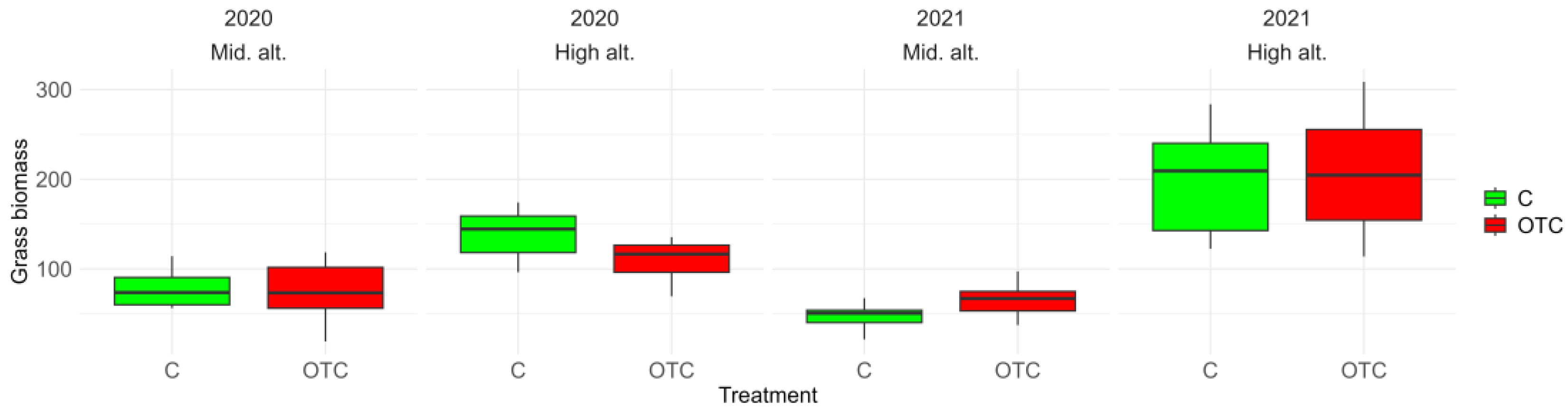
The estimated mean biomass for the controls was approximately 115.96 g (SE ± 10.80), while the mean for the OTC treatment was around 114.44 g (SE ± 15.27) (Figure 2). Grass biomass was first analyzed as a response variable to justify its inclusion as a covariate in the diversity models. The model indicated that the year had a significant effect on grass biomass, with an estimated increase of 28.78 g (SE = 10.15; t = 2.84; p < 0.01), whereas the treatment had no significant effect (estimate = −1.52 g; SE = 10.15; t = −0.15; p = 0.88).

3.2. Effect of Year, Treatment, and Biomass

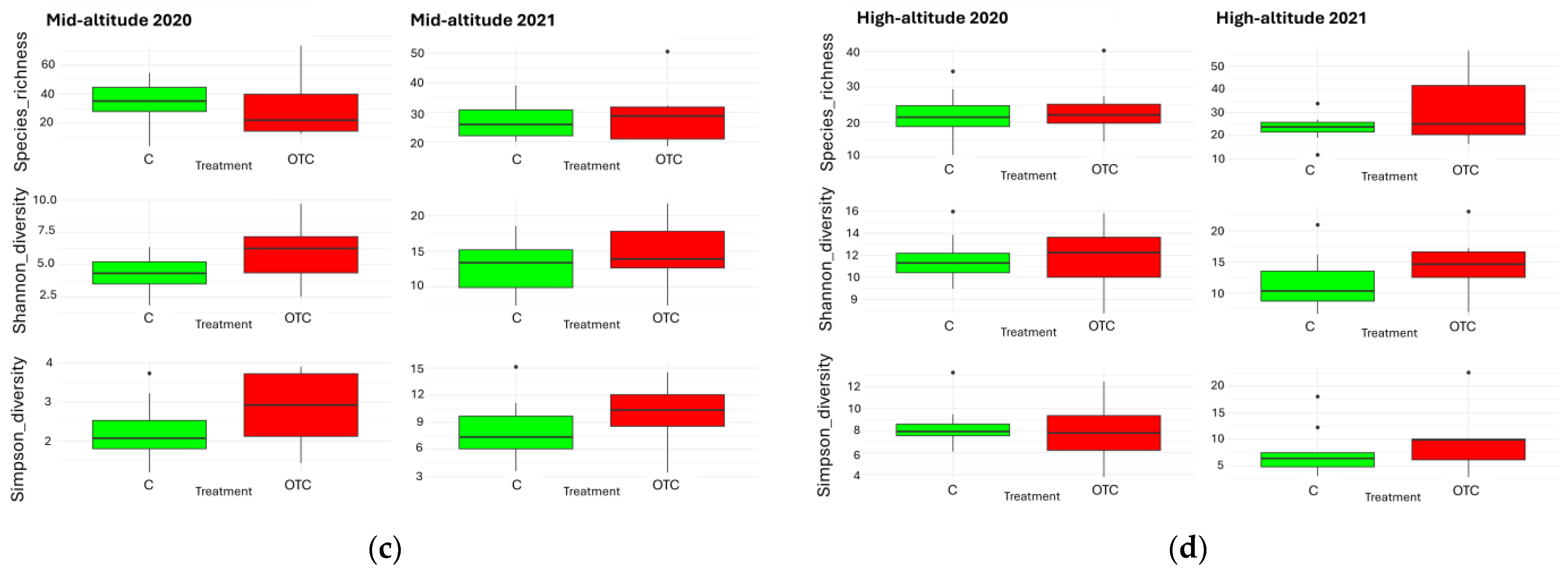
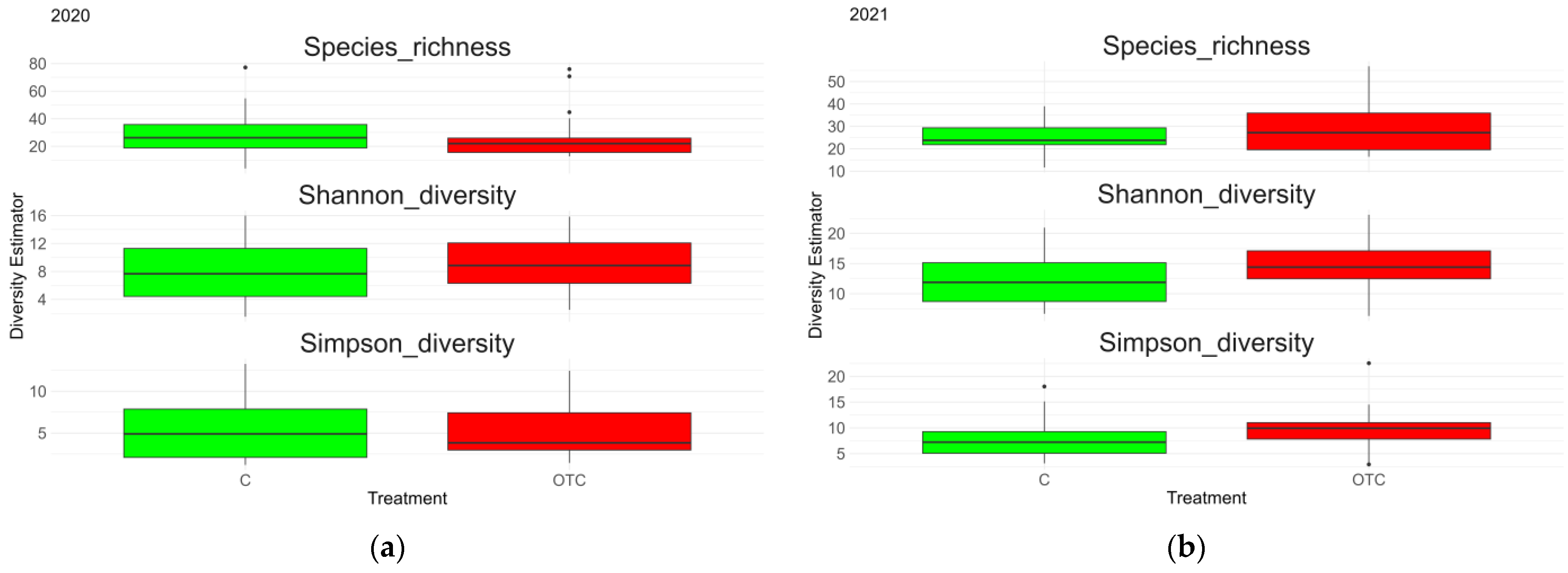
The results of the different models are presented in Table 2. The year of sampling was a significant predictor for species richness, Shannon diversity, and Simpson diversity. However, the treatment and the grass biomass showed no significance with the diversity indices analyzed. The model explained 22.1% of the variance in Shannon diversity based on fixed effects alone (marginal R2 = 0.221) and 50.9% when including the random effect of field (conditional R2 = 0.509). For the Simpson diversity, fixed effects (year and grass biomass) explained 17.8% of the variance in Simpson diversity (marginal R2 = 0.178), while the inclusion of the field as a random factor increased the explained variance to 46.3% (conditional R2 = 0.463), indicating a substantial variation as well among fields. These patterns are also illustrated in Figure 3.
The model to test the interannual variation in species richness showed that the year of sampling was a significant predictor. However, the model explained only a small proportion of the variance (McFadden’s pseudo-R2 = 0.012), indicating that while sampling year had a detectable effect, its overall influence on species richness was limited. Grass biomass did not have a significant effect, suggesting that species richness remained relatively stable between years, even though subtle changes in community composition or evenness may have occurred.
The model testing the effect of experimental warming on species richness showed extremely low explanatory power (McFadden’s pseudo-R2 = 0.00006), indicating that treatment and grass biomass explained virtually none of the variation in species richness. Neither treatment (p = 0.999) nor plant material (p = 0.868) had a significant effect on species richness. These results suggest that species richness was not influenced by experimental warming and remained relatively stable across treatments.

3.3. Distance-Based Redundancy Analysis

3.3.1. Middle and High Altitude Combined

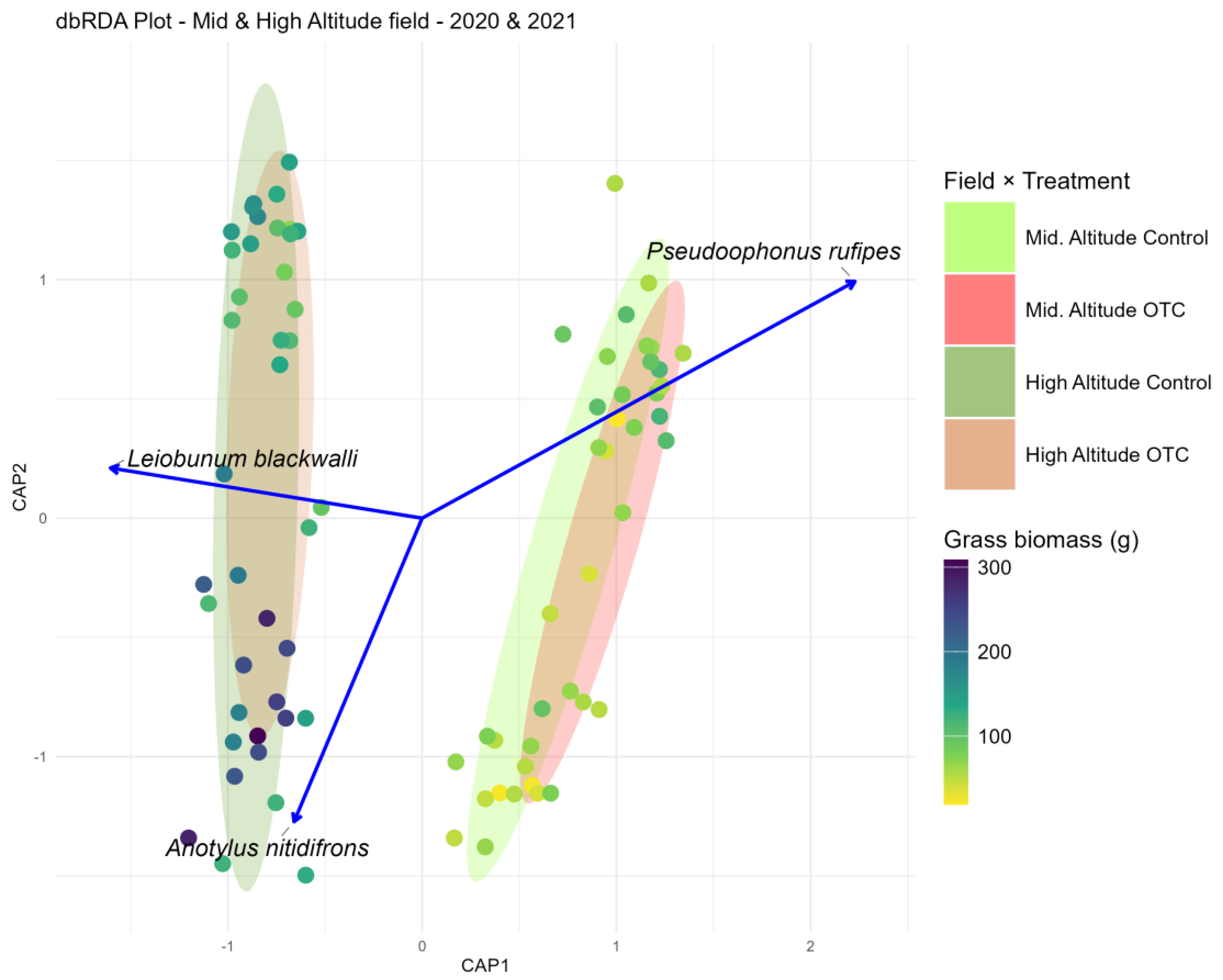
The dbRDA including summer 2020 and 2021 data from both the mid- and high-altitude fields (Figure 4) explained 47.7% of the variation in arthropod community composition (constrained inertia = 19.67, total inertia = 41.27; R2adj = 0.477). The remaining 51.7% of the variation was left unexplained by the model. The first two constrained axes accounted for 88.7% of the explained variance (CAP1 = 58.4%, CAP2 = 30.3%). CAP1 mainly represented differences between the two fields (altitudinal levels), while CAP2 captured additional variation related to the treatment (control vs. OTC) within fields. Although the previous analysis (see above) showed no response of grass biomass to the treatment during the summers of 2020 and 2021, the plotting of the grass biomass on the ordination plot highlighted a higher grass biomass on the field at higher elevation, which was expected.
Permutation ANOVA confirmed that the overall model was highly significant (F = 23.067, p < 0.001). Sequential tests showed significant effects of treatment (F = 8.441, p < 0.001), experimental field (F = 21.602, p < 0.001), and their interaction (F = 39.159, p < 0.001). Several taxa (e.g., Anotylus nitidifrons (Wollaston, 1871)—Coleoptera; Pseudoophonus rufipes (De Geer, 1774)—Coleoptera; Leiobunum blackwalli Meade, 1861—Opiliones) were strongly associated with these axes, highlighting their contribution to observed patterns. Overall, both the field and interaction between warming treatment and field jointly structured ground-dwelling arthropod assemblages.

3.3.2. Middle-Altitude Field

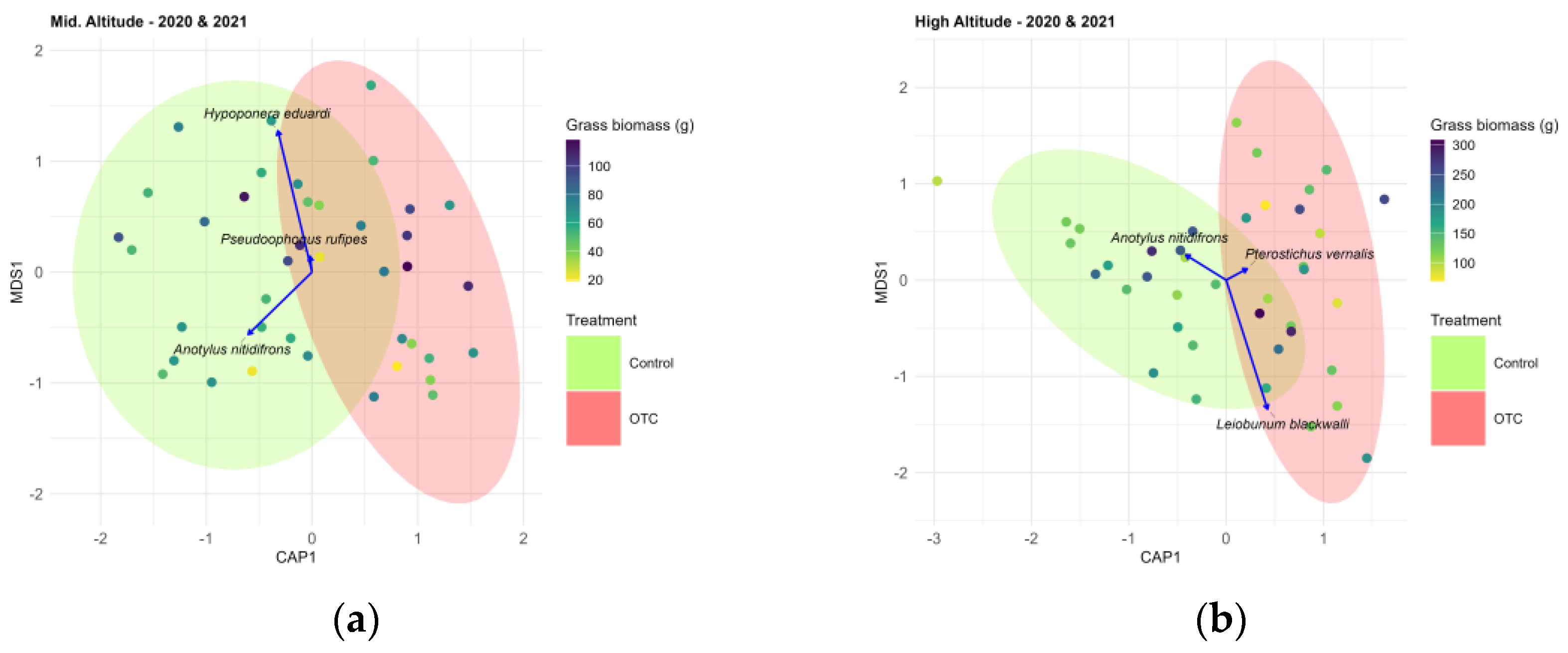
The dbRDA model that was conducted for the mid-altitude field (Figure 5a) explained 5.7% of the total variance in the assemblage data, with an adjusted R2 of 4.1%. The ordination revealed a clear separation between the control and OTC treatment along the first canonical axis (CAP1), which accounted for all the constrained variation. The effect of the treatment was statistically significant (F = 3.35, p < 0.001), indicating that warming induced by the OTCs influenced the composition of ground-dwelling arthropod communities in this field. For instance, rove beetle (Coleoptera: Staphylinidae), Anotylus nitidifrons, showed higher associations with control plots. However, as the model only explained 5.7% of the total variance in the assemblage, the observed pattern was influenced by other variables to a great extent.

3.3.3. High-Altitude Field

The dbRDA model that was conducted for the high-altitude field (Figure 5b) explained 7.1% of the total variation in community composition, with an adjusted R2 of 0.054. The effect of the treatment was statistically significant (F = 3.92, p < 0.001). Species such as the beetle Pterostichus vernalis were positively associated with OTC treatment, whereas the Staphylinidae Anotylus nitidifrons showed higher associations with the control. However, as with the mid-altitude field, the model only explained a small proportion of the observed pattern, suggesting that other variables may play a more significant role in shaping the arthropod community.

4. Discussion

The present study aimed to assess the effects of OTCs on grass biomass and arthropod diversity between two different years (2020 and 2021). Our initial findings regarding summer grass productivity indicated that the treatment did not significantly affect grass biomass during this season. These results are aligned with previous studies, which have shown that the responses of plant communities to simulated climate change can vary widely based on specific environmental factors, such as rain patterns [45], which can easily mask treatment effects over a relatively short period of time. As our experiment did not include rain shelters, we can assume that other environmental factors during the summer, for instance the amount of rainfall, may affect the structure of the grass more than the increased temperature within the OTCs. Also, in contrast to more mobile organisms such as arthropods, plant communities often exhibit slower responses to changes in their environment [46,47], which may explain the lack of significant response in the relatively short time frame of our experiment. However, in our experimental fields, we did observe higher grass biomass inside the OTCs at mid altitude when considering the grass biomass during the entire years of 2020 and 2021 and not only summer productivity [48] (p. 19). Roth et al. (2023) [49] also demonstrated that even modest temperature increases of +0.5 °C can alter competitive dynamics in grasslands, favoring productive grass species. In their study, however, the overall biomass response was limited, likely due to the mild warming effect and the experiment’s short duration.
Our results also indicate that temporal variation (year) had a measurable effect on arthropod diversity. Both Shannon diversity and Simpson diversity were significantly influenced by the year of sampling, and species richness showed a detectable response as well, although the explanatory power of the models for richness was very low. This suggests that while interannual environmental fluctuations may influence community composition and evenness, total species richness remains relatively stable over time.
In contrast, experimental warming via OTCs did not have a significant effect on species richness, nor did grass biomass, with the models explaining virtually none of the variation. This indicates that ground-dwelling arthropod communities in these pastures are relatively resilient to short-term warming and local differences in grass biomass. Notably, the inclusion of the field as a random factor in the Shannon and Simpson models increased the explained variance substantially, highlighting that spatial heterogeneity among pastures and altitude remains a key driver of arthropod diversity. Overall, these results suggest that while community evenness and composition may shift slightly between years, species richness is largely stable, and short-term warming or variations in plant biomass alone are insufficient to drive major changes in these arthropod assemblages.
This contrasts with some previous studies suggesting that increased plant biomass can provide additional resources and enhance habitat complexity, thereby supporting greater arthropod diversity [50,51,52,53]. Such relationships are often explained by the provision of more food resources for herbivorous arthropods and enhanced refuge from predation, which can in turn support higher predator biomass and diversity through bottom-up trophic cascades [54,55]. Increased structural complexity from greater vegetation can also create a wider array of microhabitats, allowing for niche partitioning among arthropod species [56]. While these mechanisms are well-supported in the literature, our findings suggest that, in these pasture systems, variations in grass biomass alone are insufficient to drive measurable changes in arthropod species richness or diversity.
However, the observed interannual variability in diversity indices underscores the potential for these communities to respond to longer-term environmental shifts, particularly as ectothermic organisms are known to exhibit variable physiological and metabolic responses to heat stress depending on their specific traits and developmental stages [57]. Consequently, understanding how these physiological constraints interact with changing precipitation patterns is essential, as rainfall regimes have been demonstrated to significantly influence species composition and multi-trophic interactions within arthropod communities [58]. Specifically, research indicates that arthropod community composition is largely determined by seasonal rainfall and plant cover, with detritivore groups being particularly sensitive to precipitation patterns [58]. This sensitivity is further corroborated by studies showing that precipitation and temperature act as key climatic drivers regulating species diversity and plant coverage through complex direct and indirect pathways [59]. These findings emphasize that the impacts of climate change on ground-dwelling arthropods are likely mediated not just by thermal increases, but by the interplay of multiple abiotic factors that structure habitat availability and resource quality over time [59,60].
When looking at arthropod diversity, the observed pattern with an increase in the diversity indices from the first to the second sampling year should be interpreted with caution as the difference may reflect natural interannual variability rather than a genuine temporal trend, given the short duration of the experiment. Many pasture-dwelling arthropods in the Azores are habitat generalists that can rapidly respond to environmental fluctuations and management intensity. Long-term monitoring in agricultural systems elsewhere has shown that arthropod richness can fluctuate considerably between years, with only marginal overall increases over time [61]. But the increased temperature inside the OTCs did not significantly alter diversity metrics. These results are consistent with those by Wallon et al. (2023) [60], who found no significant changes in arthropod diversity between treatments (OTCs versus control) when considering all species collected across various seasons within the same year. This lack of treatment effects challenges the assumption that increasing temperature in the magnitude that can be achieved via OTCs would lead to substantial changes in arthropod diversity. However, Hu et al. (2025) [62] reported that even modest experimental warming can significantly reduce arthropod species diversity and biomass. They highlighted that the effects of temperature may depend strongly on local environmental conditions and vegetation responses. Such findings also support the idea that other ecological factors, such as fluctuating humidity, rainfall patterns, or vegetation, may play a more important role in shaping community dynamics than the direct effects of increased temperature [63,64]. A longer-term experiment might also detect slower changes in the ecosystem that our experiment could not because of its short duration. Extending the duration of the experiment would therefore be essential to determine whether the observed variation represents a consistent response to warming or merely short-term variability.
On the other hand, the dbRDA results indicate that both experimental field and OTC warming influenced the composition of ground-dwelling arthropod assemblages, though the magnitude of these effects varied between fields. When both altitudinal levels were analyzed together, the model explained nearly half of the total variation in community structure, demonstrating that species composition was strongly field-dependent. The strong statistical support for the interaction between the treatment and the fields suggests that warming effects may have been modulated by altitude, with species responses differing between mid- and high-elevation environments. The altitudinal modulation of warming effects also highlights the complexity of ecological responses to climate change, particularly as elevational gradients often drive significant variation in microclimates and vegetation, influencing arthropod distributions [65]. Such variations in microclimates along altitudinal gradients can create distinct community structures, highlighting the influence of temperature and other climatic variables on species distribution [65,66]. This suggests that arthropod communities at different elevations may exhibit distinct sensitivities to thermal shifts, potentially leading to differential community restructuring under future warming scenarios [67].
Among the species identified as indicators, Anotylus nitidifrons stood out as particularly interesting due to its ecological characteristics. This common island species, known for its high dispersal capacities and attraction to light [39,68,69], has been observed in various types of decaying vegetation and, less frequently, in dung [69]. In our study, A. nitidifrons tended to be associated with the control plots across both altitudes. Although little is known about the biology of this species or even its genus, a few possible explanations can be proposed. Its attraction to light could have naturally drawn it to the control plots, which tended to be slightly more luminous than the OTCs. Alternatively, a higher amount of decaying vegetation in the control plots could have provided more suitable conditions for its occurrence. In contrast, Pterostichus vernalis, a common and abundant carabid predator in agricultural areas in Europe [70,71] and considered introduced in the Azores [39], was more frequently associated with OTC plots at higher elevations. This pattern may be linked to the species’ sensitivity to microclimatic conditions, as P. vernalis is known to thrive in environments with higher temperatures and humidity [72], which can enhance its metabolic efficiency and reproductive success [70]. These traits may explain its higher abundance in OTCs, where such conditions are likely to be more prevalent. Different responses across species and sampling sites highlight the intricate interplay between localized warming effects and broader environmental factors in shaping community dynamics [73]. Overall, the dbRDA analyses highlighted that experimental warming exerts a measurable influence on arthropod communities, but this influence is highly field-dependent, most likely depending on the local species pool and the surrounding landscape matrix.
The modest explanatory power of some models highlights the ecological complexity of these systems and suggests that additional environmental variables, such as soil moisture, vegetation cover, prey availability, and biotic interactions, should be integrated into future models to better understand the mechanisms driving the observed patterns. Factors like inter- and intraspecific competition, trophic interactions, food resource availability, and seasonality also warrant further investigation [74].
While this study contributes to understanding the effects of climate change on grass biomass and arthropod diversity, it is important to acknowledge certain limitations. The two-year study period could not capture long-term trends, and the results are likely influenced by site-specific factors.
Long-term monitoring is essential to distinguish between short-term plastic responses and potential evolutionary adaptation, as arthropod populations face compounding pressures from land use changes and climatic warming that have far-reaching implications for ecosystem functioning [75]. Because such studies are still uncommon in the Azores, especially in intensive pastures, long-term research is urgently needed to examine how climate change affects diverse organisms by relating their seasonal population dynamics to key environmental variables, thereby revealing the mechanisms behind these trends.

Author Contributions

Conceptualization, S.W., P.A.V.B. and R.B.E.; methodology, S.W., P.A.V.B. and R.B.E.; software, G.P. and S.W.; validation, S.W., P.A.V.B. and R.B.E.; formal analysis, G.P. and S.W.; investigation, S.W., P.A.V.B., G.P. and R.B.E.; resources, R.B.E. and P.A.V.B.; data curation, S.W. and P.A.V.B.; writing—original draft preparation, S.W.; writing—review and editing, S.W., P.A.V.B., G.P. and R.B.E.; visualization, S.W.; supervision, R.B.E., P.A.V.B. and G.P.; project administration, R.B.E.; funding acquisition, R.B.E. All authors have read and agreed to the published version of the manuscript.

Funding

Fieldwork and part of the analytical work were funded by the project PASTURCLIM (ACORES-01-0145-FEDER-000082), financed 85% by FEDER and 15% by Azorean Public funds through the Operational Program Azores 2020. All authors were also funded by FCT through national and European funds by UID/00329/2020 and UID/00329/2025—Centre for Ecology, Evolution and Environmental Changes (CE3C) and by the Regional Directorate for Science, Innovation and Development [Regional Government of the Azores] through the PROSCIENTIA Incentive System (M1.1.A/FUNC.UI&D/021/2025 [UI&D/GBA/2025]). SW was also funded by the Ph.D. Grant DRCT—M3.1.a/F/018/2020.

Data Availability Statement

Data from summer 2020 & 2021 used for this publication are available at Wallon et al. (2025)) [76]. Version 1.5. Universidade dos Açores. Sampling event dataset https://doi.org/10.15468/u2xh5g accessed via GBIF.org on 19 July 2024. Data from summer 2021 are available on request.

Acknowledgments

We would also like to thank Virginia Pires for allowing us to use the middle-altitude field. And finally, we would also like to thank Sébastien Louhmeau, Noelline Tsafack, and Mauros Matos for their help in the fieldwork.

Conflicts of Interest

The authors declare no conflicts of interest.

Abbreviations

The following abbreviations are used in this manuscript:
OTCOpen Top Chamber
dbRDAdistance-based redundancy analysis

Appendix A

Table A1. Average temperature (ºC) in control and Open Top Chambers (OTCs) for mid- and high-altitude fields during the summers of 2020 and 2021.
PlotsSummerMid. Alt.High. Alt.
Control202022.2520.54
OTC202023.8821.43
Control202122.0220.64
OTC202123.7521.32
Table A2. Average temperature (ºC) differences between control plots and Open Top Chambers (OTCs) for mid- and high-altitude fields during the summers of 2020 and 2021. Mean temperature differences between altitudes and the overall mean difference across fields and years are also presented.
SummerMid. Alt.High. Alt.Mean Difference Between
Fields (Altitude)
20201.630.91.26
20211.730.681.21
Average dif. 2020 & 2021--1.23
Table A3. Dry grass mass (g) for the 10 control plots (C) and 10 Open Top Chambers (OTCs) at mid altitude for the summers of 2020 and 2021.
Mid-Alt.C 1C 2C 3C 4C 5C 6C 7C 8C 9C 10
202083.768.456.3471.292.91107.157.3676.3114.357.24
202167.522.653.166.949.6951.621.5254.447.737.8
Mid-Alt.OTC 1OTC 2OTC 3OTC 4OTC 5OTC 6OTC 7OTC 8OTC 9OTC 10
202053.996.2170.8319.275.9838103.7118.56107.863.36
202167.8368.5877.1337.4357.3847.978.666.2497.351.9
Table A4. Dry grass mass (g) for the 10 control plots (C) and 10 Open Top Chambers (OTCs) at high altitude for the summers of 2020 and 2021.
High-Alt.C 1C 2C 3C 4C 5C 6C 7C 8C 9C 10
2020140.75143.44102.89145.5796.35153.33174.11160.86170.05110.82
2021122.61239.79129.85122.67181.9227.39243.07240.26283.66191.3
High-Alt.OTC 1OTC 2OTC 3OTC 4OTC 5OTC 6OTC 7OTC 8OTC 9OTC 10
2020127.88132.5193.6111.56104.41122.6569.56121.782.45135.53
2021308.7255.63122.55255.02221.37285.37113.9182.54144.99187.86

References

  1. Abhijeet; Singh, E.A.; Shindikar, M.R. A Comprehensive Review on Climate Change and Its Effects. Int. J. Environ. Clim. Change 2023, 13, 924–931. [Google Scholar] [CrossRef]
  2. Hartmann, H.; Bastos, A.; Das, A.J.; Esquivel-Muelbert, A.; Hammond, W.M.; Martínez-Vilalta, J.; Mcdowell, N.G.; Powers, J.S.; Pugh, T.A.M.; Ruthrof, K.X.; et al. Climate Change Risks to Global Forest Health: Emergence of Unexpected of Elevated Tree Worldwide. Annu. Rev. Plant Biol. 2022, 73, 673–702. [Google Scholar] [CrossRef]
  3. Portner, H.-O.; Roberts, D.C.; Adams, H.; Adelekan, I.; Alder, C.; Adrian, R.; Aldunce, P.; Ali, E.; Ara Begum, R.; Bednar-Friedl, B.; et al. Climate Change 2022: Impacts, Adaptation and Vulnerability. Contribution of Working Group II to the Sixth Assessment Report of the Intergovernmental Panel on Climate Change; Pörtner, H.-O., Roberts, D.C., Tignor, M., Poloczanska, E.S., Mintenbeck, K., Alegria, A., Craig, M., Langsdorf, S., Loschke, S., Moller, V., Eds.; Cambridge University Press: Cambridge, UK; New York, NY, USA, 2022. [Google Scholar]
  4. Papalexiou, S.M.; Montanari, A. Global and Regional Increase of Precipitation Extremes Under Global Warming. Water Resour. Res. 2019, 55, 4901–4914. [Google Scholar] [CrossRef]
  5. Harter, D.E.V.; Irl, S.D.H.; Seo, B.; Steinbauer, M.J.; Gillespie, R.; Triantis, K.A.; Fernández-Palacios, J.M.; Beierkuhnlein, C. Impacts of Global Climate Change on the Floras of Oceanic Islands—Projections, Implications and Current Knowledge. Perspect. Plant Ecol. Evol. Syst. 2015, 17, 160–183. [Google Scholar] [CrossRef]
  6. De Azevedo, E.B.; Pereira, L.S. Modeling the Local Climate in Islands Environments: Orographic Clouds Cover. In Proceedings of the 1st Conference on Fog and Fog Collection, Vancouver, BC, Canada, 19–24 July 1998; pp. 433–436. [Google Scholar]
  7. Costa, A.; Sousa, A.; Silva Vieira, R.; Encarnação Coelho, R. Programa Regional de Alterações Climáticas Dos Açores - Versão para consulta pública. 2017. Available online: https://10.13140/RG.2.2.23014.52801 (accessed on 24 February 2026).
  8. Santos, F.D.; Valente, M.A.; Miranda, P.M.A.; Aguiar, A.; Azevedo, E.B.; Tomé, A.R. Climate Change Scenarios in the Azores and Madeira Islands. World Resour. Rev. 2004, 16, 473–491. [Google Scholar]
  9. Gaspar, C.; Borges, P.A.V.; Gaston, K.J. Towards Systematic Conservation Planning in the Azores. Ecologia 2014, 7, 40–49. [Google Scholar]
  10. Pozsgai, G.; Lhoumeau, S.; Amorim, I.R.; Boieiro, M.; Cardoso, P.; Costa, R.; Ferreira, M.T.; Leite, A.; Malumbres-Olarte, J.; Oyarzabal, G.; et al. The BALA Project: A Pioneering Monitoring of Azorean Forest Invertebrates over Two Decades (1999–2022). Sci. Data 2024, 11, 368. [Google Scholar] [CrossRef]
  11. Taylor, S.; Kumar, L.; Taylor, S. Review Paper Global Climate Change Impacts on Pacific Islands Terrestrial Biodiversity: A Review. Trop. Conserv. Sci. 2016, 9, 203–223. [Google Scholar] [CrossRef]
  12. Duvat, V.K.E.; Magnan, A.K.; Wise, R.M.; Hay, J.E.; Fazey, I.; Hinkel, J.; Stojanovic, T.; Yamano, H.; Ballu, V. Trajectories of Exposure and Vulnerability of Small Islands to Climate Change. Wiley Interdiscip. Rev. Clim. Change 2017, 8, e478. [Google Scholar] [CrossRef]
  13. Petzold, J.; Magnan, A.K. Climate Change: Thinking Small Islands beyond Small Island Developing States (SIDS). Clim. Change 2019, 152, 145–165. [Google Scholar] [CrossRef]
  14. Whittaker, R.J.; Fernández-Palacios, J.M. Island Biogeography: Ecology, Evolution, and Conservation; Oxford University Press: New York, NY, USA, 2007. [Google Scholar]
  15. Fernández-Palacios, J.M.; Kreft, H.; Irl, S.D.H.; Norder, S.; Ah-Peng, C.; Borges, P.A.V.; Burns, K.C.; de Nascimento, L.; Meyer, J.Y.; Montes, E.; et al. Scientists’ Warning—The Outstanding Biodiversity of Islands Is in Peril. Glob. Ecol. Conserv. 2021, 31, e01847. [Google Scholar] [CrossRef]
  16. Bale, J.S.; Masters, G.J.; Hodkinson, I.D.; Awmack, C.; Bezemer, T.M.; Brown, V.K.; Butterfield, J.; Buse, A.; Coulson, J.C.; Farrar, J.; et al. Herbivory in Global Climate Change Research: Direct Effects of Rising Temperature on Insect Herbivores. Glob. Change Biol. 2002, 8, 1–16. [Google Scholar] [CrossRef]
  17. Borges, P.A.V.; Brown, V.K. Arthropod Community Structure in Pastures of an Island Archipelago (Azores): Looking for Local–Regional Species Richness Patterns at Fine-Scales. Bull. Entomol. Res. 2004, 94, 111–121. [Google Scholar] [CrossRef][Green Version]
  18. Clark, R.J.; Gerard, P.J.; Mellsop, J.M. Spider Biodiversity and Density Following Cultivation in Pastures in the Waikato, New Zealand. New Zealand J. Agric. Res. 2004, 47, 247–259. [Google Scholar] [CrossRef][Green Version]
  19. González-Tokman, D.; Córdoba-Aguilar, A.; Dáttilo, W.; Lira-Noriega, A.; Sánchez-Guillén, R.A.; Villalobos, F. Insect Responses to Heat: Physiological Mechanisms, Evolution and Ecological Implications in a Warming World. Biol. Rev. 2020, 95, 802–821. [Google Scholar] [CrossRef]
  20. Meijer, S.S.; Whittaker, R.J.; Borges, P.A.V. The Effects of Land-Use Change on Arthropod Richness and Abundance on Santa Maria Island (Azores): Unmanaged Plantations Favour Endemic Beetles. J. Insect Conserv. 2011, 15, 505–522. [Google Scholar] [CrossRef]
  21. Oyarzabal, G.; Cardoso, P.; Rigal, F.; Boieiro, M.; Santos, A.M.C.; Amorim, I.R.; Malumbres-Olarte, J.; Costa, R.; Lhoumeau, S.; Pozsgai, G.; et al. Arthropod Traits as Proxies for Abundance Trends in the Azorean Islands. Ecography 2024, 12, e07457. [Google Scholar] [CrossRef]
  22. Schmidt, M.H.; Tscharntke, T. Landscape Context of Sheetweb Spider (Araneae: Linyphiidae) Abundance in Cereal Fields. J. Biogeogr. 2005, 32, 467–473. [Google Scholar] [CrossRef]
  23. Zarnetske, P.L.; Baiser, B.; Strecker, A.; Record, S.; Belmaker, J.; Tuanmu, M.-N. The Interplay Between Landscape Structure and Biotic Interactions. Curr. Landsc. Ecol. Rep. 2017, 2, 12–29. [Google Scholar] [CrossRef]
  24. Almeida, A.M.; Alvarenga, P.; Fangueiro, D. The Dairy Sector in the Azores Islands: Possibilities and Main Constraints towards Increased Added Value. Trop. Anim. Health Prod. 2021, 53, 40. [Google Scholar] [CrossRef] [PubMed]
  25. Boval, M.; Dixon, R.M. The Importance of Grasslands for Animal Production and Other Functions: A Review on Management and Methodological Progress in the Tropics. Animal 2012, 6, 748–762. [Google Scholar] [CrossRef]
  26. Massot, A. Directorate-General for Internal Policies Policy Department B: Structural and Cohesion Policies Agriculture and Rural Development the Agriculture of the Azores Islands (COMAGRI Delegation) Study; European Union: Brussels, Belgium, 2015. [Google Scholar] [CrossRef]
  27. Henry, B.K.; Eckard, R.J.; Beauchemin, K.A. Review: Adaptation of Ruminant Livestock Production Systems to Climate Changes. Animal 2018, 12, 445–456. [Google Scholar] [CrossRef]
  28. Soussana, J.F.; Graux, A.I.; Tubiello, F.N. Improving the Use of Modelling for Projections of Climate Change Impacts on Crops and Pastures. J. Exp. Bot. 2010, 61, 2217–2228. [Google Scholar] [CrossRef] [PubMed]
  29. Joern, A.; Laws, A.N. Ecological Mechanisms Underlying Arthropod Species Diversity in Grasslands. Annu. Rev. Entomol. 2013, 58, 19–36. [Google Scholar] [CrossRef] [PubMed]
  30. Nagy, R.K.; Bell, L.W.; Schellhorn, N.A.; Zalucki, M.P. Role of Grasslands in Pest Suppressive Landscapes: How Green Are My Pastures? Aust. Entomol. 2020, 59, 227–237. [Google Scholar] [CrossRef]
  31. Solascasas, P.; Azcárate, F.M.; Hevia, V. Edaphic Arthropods as Indicators of the Ecological Condition of Temperate Grassland Ecosystems: A Systematic Review. Ecol. Indic. 2022, 142, 109277. [Google Scholar] [CrossRef]
  32. Teixeira, M.B.; Soares, A.O.; Borges, P.A.V.; Calvet, M.T.; Peñalver, Á.; Monteiro, H.R.; Frias, J.; Simoes, N. Monitoring Arthropods in Maize and Pasture Fields in São Miguel and São Jorge Islands: IPM-Popillia Project. Biodivers. Data J. 2023, 11, e109431. [Google Scholar] [CrossRef]
  33. Verma, R.C.; Waseem, M.A.; Sharma, N.; Bharathi, K.; Singh, S.; Anto Rashwin, A.; Pandey, S.K.; Singh, B.V. The Role of Insects in Ecosystems, an in-Depth Review of Entomological Research. Int. J. Environ. Clim. Change 2023, 13, 4340–4348. [Google Scholar] [CrossRef]
  34. Gerlach, J.; Samways, M.; Pryke, J. Terrestrial Invertebrates as Bioindicators: An Overview of Available Taxonomic Groups. J. Insect Conserv. 2013, 17, 831–850. [Google Scholar] [CrossRef]
  35. Harvey, J.A.; Heinen, R.; Armbrecht, I.; Basset, Y.; Baxter-Gilbert, J.H.; Bezemer, T.M.; Böhm, M.; Bommarco, R.; Borges, P.A.V.; Cardoso, P.; et al. International Scientists Formulate a Roadmap for Insect Conservation and Recovery. Nat. Ecol. Evol. 2020, 4, 174–176. [Google Scholar] [CrossRef] [PubMed]
  36. Welti, E.A.R.; Prather, R.M.; Sanders, N.J.; de Beurs, K.M.; Kaspari, M. Bottom-up When It Is Not Top-down: Predators and Plants Control Biomass of Grassland Arthropods. J. Anim. Ecol. 2020, 89, 1286–1294. [Google Scholar] [CrossRef] [PubMed]
  37. Hollister, R.D.; Elphinstone, C.; Henry, G.H.R.; Bjorkman, A.D.; Klanderud, K.; Björk, R.G.; Björkman, M.P.; Bokhorst, S.; Carbognani, M.; Cooper, E.J.; et al. A Review of Open Top Chamber (OTC) Performance across the ITEX Network. Arct. Sci. 2023, 9, 331–344. [Google Scholar] [CrossRef]
  38. Wallon, S.; Melo, C.; Tsafack, N.; Elias, R.B.; Borges, P.A.V. Assessing the Effects of Climate Change on Arthropod Abundance in Azorean Pastures: PASTURCLIM Project’s Baseline Monitoring Data. Biodivers. Data J. 2023, 11, e103723. [Google Scholar] [CrossRef]
  39. Borges, P.A.V.; Lamelas-Lopez, L.; Andrade, R.; Lhoumeau, S.; Vieira, V.; Soares, A.; Borges, I.; Boieiro, M.; Cardoso, P.; Crespo, L.C.; et al. An Updated Checklist of Azorean Arthropods (Arthropoda). Biodivers. Data J. 2022, 10, e97682. [Google Scholar] [CrossRef]
  40. Bates, D.; Mächler, M.; Bolker, B.; Walker, S. Fitting Linear Mixed-Effects Models Using Lme4. J. Stat. Softw. 2015, 67, 1–48. [Google Scholar] [CrossRef]
  41. Legendre, P.; Anderson, M.J. Distance-Based Redundancy Analysis: Testing Multispecies Responses in Multifactorial Ecological Experiments. Ecol. Monogr. 1999, 69, 1–24. [Google Scholar] [CrossRef]
  42. Oksanen; Simpson, G.L.; Blanchet, F.G.; Kindt, R.; Legendre, P.; Minchin, P.R.; O’Hara, R.B.; Solymos, P.; Stevens, M.H.H.; Szoecs, E.; et al. Vegan: Community Ecology Package 2024. Available online: https://CRAN.R-project.org/package=vegan (accessed on 24 February 2026). [CrossRef]
  43. Clarke, K.R. Non-parametric Multivariate Analyses of Changes in Community Structure. Aust. J. Ecol. 1993, 18, 117–143. [Google Scholar] [CrossRef]
  44. Wickham, H. Ggplot2: Elegant Graphics for Data Analysis; Springer International Publishing: Berlin/Heidelberg, Germany, 2016; ISBN 978-3-319-24275-0. [Google Scholar]
  45. Hovenden, M.J.; Newton, P.C.D.; Porter, M. Elevated CO2 and Warming Effects on Grassland Plant Mortality Are Determined by the Timing of Rainfall. Ann. Bot. 2017, 119, 1225–1233. [Google Scholar] [CrossRef]
  46. Chapin, F.S.; Matson, P.A.; Vitousek, P.M. Principles of Terrestrial Ecosystem Ecology, 2nd ed.; Springer: Berlin/Heidelberg, Germany, 2011; ISBN 978-1-4419-9503-2. [Google Scholar]
  47. Walker, L.R.; del Moral, R. Primary Succession and Ecosystem Rehabilitation; Cambridge University Press: Cambridge, UK, 2003; ISBN 9780521800761. [Google Scholar]
  48. Elias, R.B.; Melo, C.D.; Wallon, S.; Dias, C.S.A.M.M.; Borba, A.E.S.; Madruga, J.; Borges, P.A.V.; Ferreira, M.T. Possíveis Impactes Das Alterações Climáticas Nas Pastagens Dos Açores; UAc-FCAA-Azores; University of the Azores: Ponta Delgada, Portugal, 2023; ISBN 978-989-8870-49-0. [Google Scholar]
  49. Roth, N.; Baxter, R.; Furness, M.; Kimberley, A.; Cousins, S.A.O. Experimental Warming Outside the Growing Season and Exclusion of Grazing Has a Mild Effect on Upland Grassland Plant Communities in the Short Term. Plant Ecol. Divers. 2023, 16, 189–201. [Google Scholar] [CrossRef]
  50. Haddad, N.M.; Tilman, D.; Haarstad, J.; Ritchie, M.; Knops, J.M.H. Contrasting Effects of Plant Richness and Composition on Insect Communities: A Field Experiment. Am. Nat. 2001, 158, 17–35. [Google Scholar] [CrossRef]
  51. Siemanni, E. Experimental Tests of Effects of Plant Productivity and Diversity on Grassland Arthropod. Siemann Source Ecol. 1998, 79, 2057–2070. [Google Scholar] [CrossRef]
  52. Scherber, C.; Eisenhauer, N.; Weisser, W.W.; Schmid, B.; Voigt, W.; Fischer, M.; Schulze, E.D.; Roscher, C.; Weigelt, A.; Allan, E.; et al. Bottom-up Effects of Plant Diversity on Multitrophic Interactions in a Biodiversity Experiment. Nature 2010, 468, 553–556. [Google Scholar] [CrossRef]
  53. Borges, P.A.V.; Brown, V.K. Phytophagous Insects and Web-Building Spiders in Relation to Pasture Vegetation Complexity. Ecopgraphy 2001, 24, 68–82. [Google Scholar] [CrossRef]
  54. Canelo, T.; Marquina, D.; Chozas, S.; Bergsten, J.; Gaytán, Á.; Pérez-Izquierdo, C.; Bonal, R. Effects of Livestock on Arthropod Biodiversity in Iberian Holm Oak Savannas Revealed by Metabarcoding. J. Environ. Manag. 2024, 365, 121619. [Google Scholar] [CrossRef]
  55. Meyer, S.T.; Heuss, L.; Feldhaar, H.; Weisser, W.W.; Gossner, M.M. Land-Use Components, Abundance of Predatory Arthropods, and Vegetation Height Affect Predation Rates in Grasslands. Agric. Ecosyst. Environ. 2019, 270–271, 84–92. [Google Scholar] [CrossRef]
  56. Woodcock, B.A.; Pywell, R.F.; Macgregor, N.A.; Edwards, M.E.; Redhead, J.; Ridding, L.E.; Batáry, P.; Czerwiński, M.; Duffield, S. Historical, Local and Landscape Factors Determine the Success of Grassland Restoration for Arthropods. Agric. Ecosyst. Environ. 2021, 308, 107271. [Google Scholar] [CrossRef]
  57. Wallon, S.; Rigal, F.; Melo, C.D.; Elias, R.B.; Borges, P.A.V. Unveiling Arthropod Responses to Climate Change: A Functional Trait Analysis in Intensive Pastures. Insects 2024, 15, 677. [Google Scholar] [CrossRef]
  58. Fischer, C.; Gerstmeier, R.; Wagner, T.C. Seasonal and Temporal Patterns of Rainfall Shape Arthropod Community Composition and Multi-Trophic Interactions in an Arid Environment. Sci. Rep. 2022, 12, 3742. [Google Scholar] [CrossRef]
  59. Yao, Z.; Xin, Y.; Yang, L.; Zhao, L.; Ali, A. Precipitation and Temperature Regulate Species Diversity, Plant Coverage and Aboveground Biomass through Opposing Mechanisms in Large-Scale Grasslands. Front. Plant Sci. 2022, 13, 999636. [Google Scholar] [CrossRef]
  60. Wallon, S.; Tsafack, N.; Pozsgai, G.; Melo, C.; Borges, P.A.V.; Elias, R. Effects of a Short-Term Temperature Increase on Arthropod Communities Associated with Pastures. Biodivers. Data J. 2023, 11, e107385. [Google Scholar] [CrossRef]
  61. Obrist, M.K.; Duelli, P. Rapid Biodiversity Assessment of Arthropods for Monitoring Average Local Species Richness and Related Ecosystem Services. Biodivers. Conserv. 2010, 19, 2201–2220. [Google Scholar] [CrossRef]
  62. Hu, X.; Wu, X.; Xiang, S.; Chen, Y.; Jiang, L.; Eisenhauer, N.; Reich, P.B.; Sun, S. Modest Experimental Warming Reduces Species Diversity and Biomass of Arthropods in a Tibetan Alpine Meadow. Glob. Change Biol. 2025, 31, 70277. [Google Scholar] [CrossRef]
  63. Buchholz, S.; Rolfsmeyer, D.; Schirmel, J. Simulating Small-Scale Climate Change Effects-Lessons from a Short-Term Field Manipulation Experiment on Grassland Arthropods. Insect Sci. 2013, 20, 662–670. [Google Scholar] [CrossRef]
  64. Khaliq, A.; Javed, M.; Sagheer, M.; Sohail, M.; Sohail, M.; Sagheer, M. Environmental Effects on Insects and Their Population Dynamics. J. Entomol. Zool. Stud. 2014, 2, 1–7. [Google Scholar]
  65. Hansen, R.R. Effects of Climate Change on Arctic Arthropod Assemblages and Distribution. Ph.D. Thesis, Aarhus University, Aarhus Centrum, Denmark, 2016. [Google Scholar]
  66. Piseddu, F.; Bellocchi, G.; Picon-Cochard, C. Mowing and Warming Effects on Grassland Species Richness and Harvested Biomass: Meta-Analyses. Agron. Sustain. Dev. 2021, 41, 74. [Google Scholar] [CrossRef]
  67. Ho, H.C.; Brodersen, J.; Gossner, M.M.; Graham, C.H.; Kaeser, S.; Reji Chacko, M.; Seehausen, O.; Zimmermann, N.E.; Pellissier, L.; Altermatt, F. Blue and Green Food Webs Respond Differently to Elevation and Land Use. Nat. Commun. 2022, 13, 6415. [Google Scholar] [CrossRef] [PubMed]
  68. Gaspar, C.; Borges, P.A.V.; Gaston, K.J.; Gaspar, C.; Borges, P.A.V.; Gaston, K.J. Diversity and Distribution of Arthropods in Native Forests of the Azores Archipelago. Arquipélago Life Mar. Sci. 2008, 25, 01–30. [Google Scholar]
  69. Assing, V.; Schülke, M.; Mus, B.M.; Funchal, S.N. Systematic Catalogue of the Entomofauna of the Madeira Archipelago and Selvagens Islands Staphylinoidea, Staphylinidae (Coleoptera) Vol. II, Part 2. Bol. Mus. Funchal 2006, 5, 5. [Google Scholar]
  70. Frank, T.; Kehrli, P.; Germann, C. Density and Nutritional Condition of Carabid Beetles in Wildflower Areas of Different Age. Agric. Ecosyst. Environ. 2007, 120, 377–383. [Google Scholar] [CrossRef]
  71. Tudorache, V.T.; Tălmaciu, M.; Herea, M. Observations Regarding the Entomofauna of Coleopteras within Some Agricultural Crops from the North-East Part of Portugal. Lucr. Ştiinţifice 2020, 63. [Google Scholar]
  72. Thiele, H.U. Carabid Beetles in Their Environments. A Study on Habitat Selection by Adaptations in Physiology and Behaviour; Springer Science & Business Media: Berlin/Heidelberg, Germany, 1977; Volume 10. [Google Scholar]
  73. Nardi, D.; Giannone, F.; Marini, L. Short-Term Response of Ground-Dwelling Arthropods to Storm-Related Disturbances Is Mediated by Topography and Dispersal. Basic Appl. Ecol. 2022, 65, 86–95. [Google Scholar] [CrossRef]
  74. Holland, J. Carabid Beetles: Their Ecology, Survival and Use in Agroecosystems. In The Agroecology of Carabid Beetles; Holland, J.M., Ed.; Intercept Limited: Southampton, UK, 2002; ISBN 1898298769. [Google Scholar]
  75. Pawar, S.; Huxley, P.J.; Smallwood, T.R.C.; Nesbit, M.L.; Chan, A.H.H.; Shocket, M.S.; Johnson, L.R.; Kontopoulos, D.G.; Cator, L.J. Variation in Temperature of Peak Trait Performance Constrains Adaptation of Arthropod Populations to Climatic Warming. Nat. Ecol. Evol. 2024, 8, 500–510. [Google Scholar] [CrossRef] [PubMed]
  76. Wallon, S.; Elias, R.B.; Borges, P.A.V. Monitoring grassland arthropods in an in situ climate change experiment (Terceira, Azores, Portugal). Version 1.7. Universidade dos Açores. GBIF Sampling event dataset Download. 2025. Available online: http://10.15468/u2xh5g (accessed on 24 February 2026).
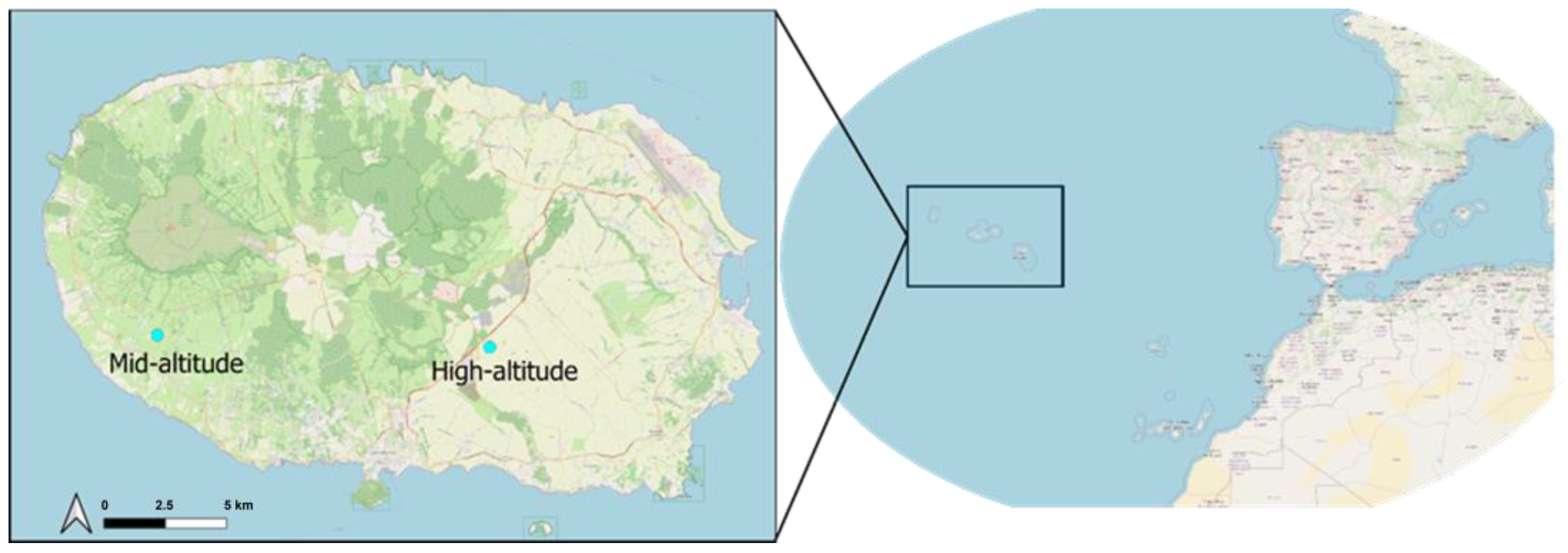
Figure 1. Location of the Azorean Archipelago, the island of Terceira, and the two experimental fields.
Insects 17 00265 g001
Figure 2. Boxplots of grass biomass (g) by sampling year, field, and treatment. “C” and “OTC” correspond respectively to control and Open Top Chamber.
Insects 17 00265 g002
Figure 3. Boxplots showing the different diversity indices, species richness (q0), exponential Shannon index (q1), and the inverse Simpson index (q2) in (a) 2020 mid and high altitude combined, (b) 2021 mid and high altitude combined, (c) mid altitude 2020 and 2021 and (d) high altitude 2020 and 2021. “C” and “OTC” correspond respectively to the control plot and Open Top Chamber.
Insects 17 00265 g003aInsects 17 00265 g003b
Figure 4. Ordination plot to represent the arthropod community while considering both fields and years together. Grass biomass for each sampling field and year was plotted following a color gradient. Vectors represent species that most influenced the community: Anotylus nitidifrons; Pseudoophonus rufipes; Leiobunum blackwalli.
Insects 17 00265 g004
Figure 5. (a) Ordination plot to represent the arthropod community while considering the mid-altitude field and both years. Grass biomass for each sampling site and year was plotted following a color gradient. Vectors represent species that most influenced the community: Anotylus nitidifrons (Wollaston, 1871)—Coleoptera; Pseudoophonus rufipes (De Geer, 1774)—Coleoptera; Hypoponera eduardi (Forel, 1894)—Hymenoptera. (b) Ordination plot to represent the arthropod community while considering the high-altitude field and both years. Grass biomass for each sampling site and year was plotted following a color gradient. Vectors represent species that most influenced the community: Anotylus nitidifrons (Wollaston, 1871)—Coleoptera; Pterostichus vernalis (Panzer, 1796)—Coleoptera; Leiobunum blackwalli Meade, 1861—Opiliones.
Insects 17 00265 g005
Table 1. Statistical models used for plant biomass and arthropod diversity analyses. Linear mixed-effects models (LMMs) were applied to continuous response variables, while generalized linear models (GLMs) were used for species richness. Field (elevation) was included as a random intercept when supported by the data.
VariableWhat Was Tested ?Which Model Was Used ?Why ?
Plant BiomassEffect of Treatment and YearLMM (Gaussian)
Fixed: Treatment + Year
Random: Field (Elevation)
To test how experimental warming or interannual variation affects grass biomass while accounting for differences between fields
Species richness
(Hill q = 0)
Interannual variation in diversityGLM (Poisson)
Fixed: Year + Grass biomass
Mixed-effects models including field resulted in singular fits; a GLM was used to robustly assess temporal effects
Effect of experimental warming (OTC)GLM (Poisson)
Fixed: Treatment + Grass biomass
Random effects could not be reliably estimated for count data with limited grouping levels
Shannon diversity (Hill q = 1)Combined effects on diversityLMM (Gaussian)
Fixed: Treatment + Year + Grass biomass
Random: Field (Elevation)
Model was not singular and allowed accounting for elevation-related grouping
Simpson diversity (Hill q = 2)Combined effects on diversityLMM (Gaussian)
Fixed: Treatment + Year + Grass biomass
Random: Field (Elevation)
Model was not singular and allowed accounting for elevation-related grouping
Table 2. Results from linear and mixed models assessing the effects of the year on species diversity levels, including species richness, Shannon diversity, and Simpson diversity.
Diversity IndexModelEffectEstimateStd. Errort Valuep-Value
ShannonLMMTreatment0.8880.6521.3620.177
Year3.8270.6845.596<0.001
Grass biomass−0.0100.007−1.4030.165
SimpsonLMMTreatment0.6720.5941.1310.262
Year2.9540.6234.741<0.001
Grass biomass−0.0100.007−1.4620.148
Species richness GLM (interannual variation)Year0.1260.0552.285<0.05
Grass biomass0.0000.000−0.3190.750
Species richness GLM (experimental warming effects)Treatment0.0000.0540.0020.999
Grass biomass0.0000.0000.1660.868
Disclaimer/Publisher’s Note: The statements, opinions and data contained in all publications are solely those of the individual author(s) and contributor(s) and not of MDPI and/or the editor(s). MDPI and/or the editor(s) disclaim responsibility for any injury to people or property resulting from any ideas, methods, instructions or products referred to in the content.