
Recent Advances in Sustainable Management of Cylas formicarius
 and
and
Simple Summary
Abstract
1. Introduction
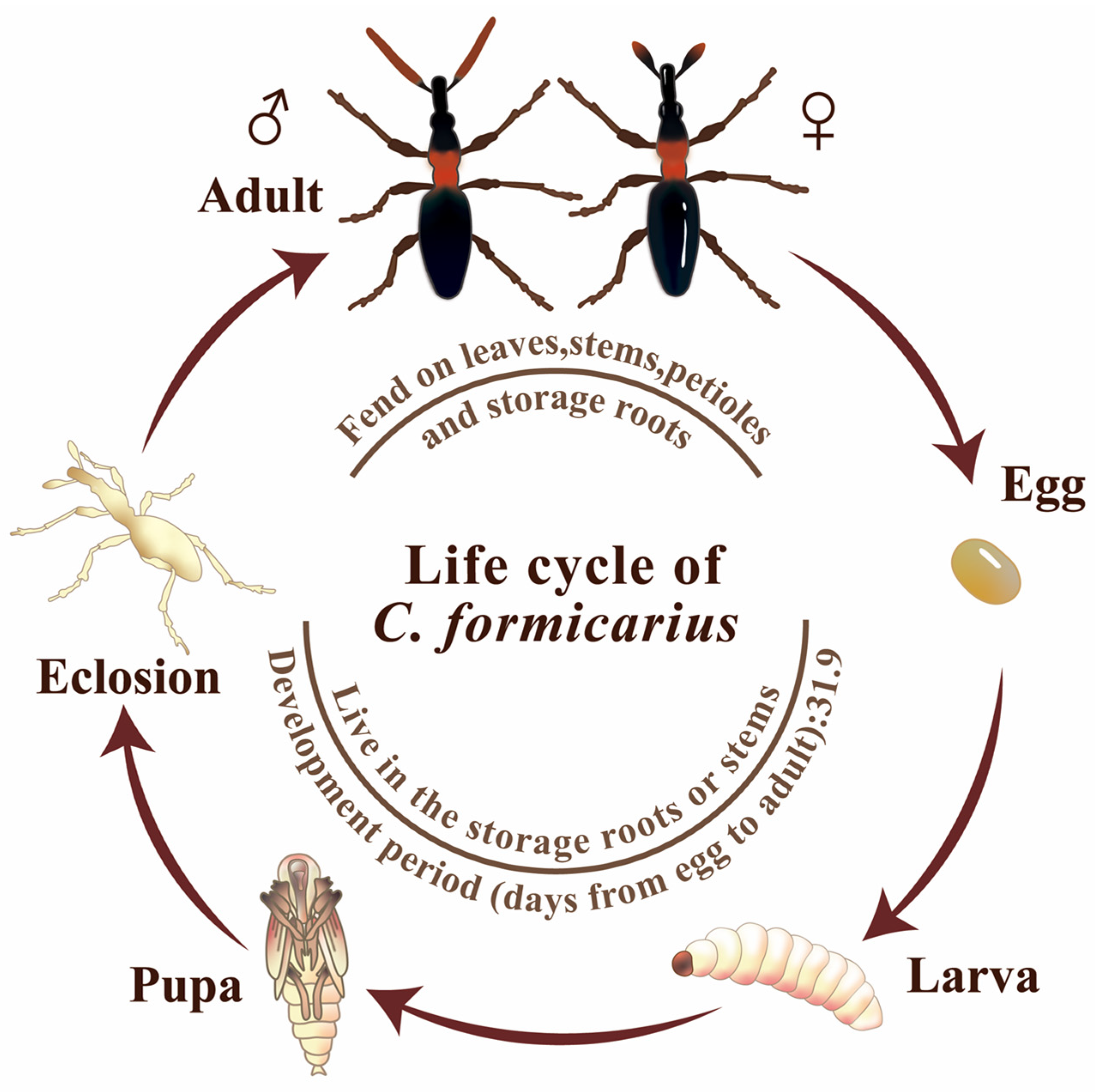
2. Life Cycle and Damage
3. Insect Pathogenic Microorganisms
3.1. Entomopathogenic Fungi

| Fungal Species | Experimental Conditions | Concentration (Conidia/mL) | LT50 | Efficacy (%) | Origin | References |
|---|---|---|---|---|---|---|
| Beauveria bassiana | ||||||
| B. bassiana | Laboratory | — | — | 80 | China | [31] |
| B. bassiana Gxj-10 | Laboratory | 2.5 × 10⁷ | 3 d | 82.1 | China | [33] |
| B. bassiana Xwy-1 | Laboratory | 2.5 × 10⁷ | 9 d | 60.7 | China | [33] |
| B. bassiana Bb1 | Laboratory | 1 × 10⁷ | 4 d | 95 | Philippines | [30] |
| B. bassiana ICIPE275 | Laboratory | 1 × 10⁷ | 13 d | 80.8 | Kenya | [32] |
| B. bassiana 51 | Laboratory | 1 × 10⁷ | 16.4 d | 77.5 | Kenya | [32] |
| B. Bassianabassiana ICIPE56 | Laboratory | 1 × 10⁷ | 17.1 d | 79.2 | Kenya | [32] |
| B. bassiana ICIPE114 | Laboratory | 1 × 10⁷ | 12.5 d | 84.2 | Kenya | [32] |
| B. bassiana R444 | Field | 10 g/100 L | — | 61 | South Africa | [22] |
| Metarhizium anisopliae | ||||||
| M. anisopliae Ma1 | Laboratory | 1 × 10⁷ | 4 d | 100 | Philippines | [30] |
| M. anisopliae ICIPE62 | Laboratory | 1 × 10⁷ | 9.7 d | 89.2 | Kenya | [32] |
| M. anisopliae ICIPE21 | Laboratory | 1 × 10⁷ | 10.9 d | 85 | Kenya | [32] |
| M. anisopliae ICIPE7 | Laboratory | 1 × 10⁷ | 14.2 d | 74.2 | Kenya | [32] |
| M. anisopliae ICIPE18 | Laboratory | 1 × 10⁷ | 10.9 d | 85.8 | Kenya | [32] |
| M. anisopliae ICIPE20 | Laboratory | 1 × 10⁷ | 13.4 d | 80 | Kenya | [32] |
| M. anisopliae ICIPE30 | Laboratory | 1 × 10⁷ | 12.1 d | 75.8 | Kenya | [32] |
| M. anisopliae ICIPE45 | Laboratory | 1 × 10⁷ | 12.1 d | 80 | Kenya | [32] |
| M. anisopliae 59 | Laboratory | 1 × 10⁷ | 18.5 d | 62.5 | Kenya | [32] |
| M. anisopliae LBM-30 | Laboratory | 5 × 10⁷ | 4.2 d | 96.6 | Cuba | [34] |
| M. anisopliae LBM-267 | Laboratory | 5 × 10⁷ | 4.58 d | 100 | Cuba | [16] |
| M. anisopliae LBM-5 | Laboratory | 5 × 10⁷ | 5.09 d | 100 | Cuba | [16] |
| M. anisopliae LBM-10 | Laboratory | 5 × 10⁷ | 6.91 d | 66 | Cuba | [16] |
| M. anisopliae LBM-11 | Laboratory | 5 × 10⁷ | 6.2 d | 96 | Cuba | [16] |
| M. anisopliae LBM-12 | Laboratory | 5 × 10⁷ | 7.38 d | 80 | Cuba | [16] |
| M. anisopliae MR | Laboratory | 5 × 10⁷ | — | 62.47 | Malaysia | [36] |
| bassiana GHA + M. brunneum F52 | Field | 20 mL/ha + 45 mL/ha | — | 100 | USA | [39] |
| Lecanicillium | ||||||
| Lecanicillium lecanii | Laboratory | 1 × 10⁷ | — | 74 | Indonesia | [39] |
3.2. Entomopathogenic Bacteria
3.3. Entomopathogenic Nematodes
| Genus | Nematode Species/Strain | Target Worm Stage | Country | Application Method | Application Quantity (“IJs” Infective Juveniles) | Mortality % | References |
|---|---|---|---|---|---|---|---|
| Heterorhabditis | H. bacteriorphora North Carolina | Larva | US | Petri dish filter paper method | 1668.7 IJs/insect | 90 | [55] |
| H. megidis | larvae, pupae, adults | Japan | Petri dish filter paper method | 4.75 × 10⁵ IJs/100 mL | 80~90 | [56] | |
| H. bacteriophora HC1 | Adult | Cuba | Petri dish filter paper method | 5000 IJs/mL | 100 | [50] | |
| H. indica KM89 | larvae, pupae | US | Culture plate biometry | 1–25 IJs/insect | 75, 100 | [48] | |
| H. indica OM158 | larvae, pupae, adults | US | Culture plate biometry | 1–25 IJs/insect | 92, 92, 9 | [48] | |
| H. sp. HM108 | larvae, pupae, adults | US | Culture plate biometry | 1–25 IJs/insect | 92, 92, 8 | [48] | |
| H. indica OM160 | larvae, pupae, adults | US | Barrel biometric assay | 1000 IJs/15 mL | 73.2, 56.5, 28.5 | [48] | |
| Steinernema | S. carpocapsae All | Adult | US | Petri dish filter paper method | 82.6 IJs/insect | 25~60 | [55] |
| S. feltiae MG-14 | Adult | US | Petri dish filter paper method | 100 IJs/insect | 50~60 | [54] | |
| S. carpocapsae All | Adult | Japan | Petri dish filter paper method | 25,000 IJs/100 mL | 90> | [57] | |
| S. feltiae | larvae, pupae, adults | Japan | Petri dish filter paper method | 4.25 × 10³ IJs/100 mL | 70~80 | [56] | |
| S. feltiae JY-17 | larvae | China | Virulence determination | 28 IJs/insect | 91.67 | [52] | |
| S. riobrave | larvae, pupae | Japan | Petri dish filter paper method | 25,000 IJs/100 mL | 30~60 | [57] | |
| S. glaseri (Mungyeong) | Larva, pupae | Japan | Petri dish filter paper | 25,000 IJs/100 mL | 30~60 | [57] | |
| S. glaseri (Dongrae) | Larva, pupae | Japan | Petri dish filter paper method | 25,000 IJs/100 mL | 30~60 | [57] | |
| S. ceratophorum HQA-87 | 3 instar, adult | China | Culture plate filter paper biometric assay | 500 IJs·cm−2 | 100, 33.3 | [53] | |
| S. glaseri KG | 3 instar, adult | China | Culture plate filter paper biometric assay | 500 IJs·cm−2 | 100, 33.3 | [53] | |
| S. longicaudum X-7 | 3rd instar, adult | China | Culture plate filter paper biometric assay | 500 IJs·cm−2 | 100, 33.3 | [53] |
4. Natural Enemies
5. Botanical Pesticides
| Species | Active Ingredients | Application Concentration | Experimental Conditions | Efficacy (%) | References |
|---|---|---|---|---|---|
| Azadirachta indica A. Juss | Azadirachtin | 1.2% | Laboratory | 100% mortality | [80] |
| Azadirachta indica A. Juss | Azadirachtin | 13.95 mg/L | Field | 64.92% control effect | [81] |
| Camellia sinensis (L.) | Tea saponin | 1% | Laboratory | 53.33% mortality | [82] |
| Matrine | 1.3% | Field | 82.64% control effect | [81] | |
| Rotenone | 6% | Field | 65.40% control effect | [81] | |
| Tanacetum cinerariifolium (Trevir.) | 25% pyrethroids | 2 g/L | Laboratory | 78.33% mortality | [78] |
| Melia toosendan Sieb. et Zucc. | 2% toosendanin | 2 g/L | Laboratory | 56.67% mortality | [78] |
| Croton linearis Jacq. | Diterpenoids | 0.32 μg/insect | Laboratory | 50% mortality | [87] |
| Manihot esculenta Crantz | Petroleum ethers | 5.0% | Laboratory | 86.7% mortality | [88] |
| Capraria biflora L. | Sesquiterpenoids | 0.902 mg/insect | Laboratory | 50% mortality | [83] |
| Hyptis verticillata Jacq. | Sesquiterpenoids | 60 mg/insect | Laboratory | 80–100% mortality | [83] |
| Hyptis verticillata Jacq. | Sesquiterpenoids | 1 μg/insect | Laboratory | 80% mortality | [84] |
| Bursera hollickii (Britton) | Bursera | 12 μg/g | Laboratory | 50% mortality | [85] |
| Cleome viscosa L. | Pyrethroids | 3 µg/insect | Laboratory | 30% mortality | [89] |
| Nicotiana tabacum L. | Chloroform and acetone extracts | 20 µg/insect | Laboratory | 100% mortality | [90] |
| Ipomoea mauritiana | Crude protein extract | 4–5 mg/mL | Laboratory | 40–50% mortality | [86] |
6. Insect Sex Pheromones
| Pheromone Component | Concentration | Trap Type | Trap Densitie | Intervals | Trapping Effect (%) | References |
|---|---|---|---|---|---|---|
| (Z)-3-dodecen1-ol (E)-2-butenoate | 1 mg | - | 1 trap/100 m2 | 10 m | 40~70 | [96] |
| (Z)-3-dodecen1-ol (E)-2-butenoate | - | - | 2 traps/667 m2 | 15 m | 53.1~58.2 | [97] |
| (Z)-3-dodecen1-ol (E)-2-butenoate | 10 mg | Pherocon Unitrap | - | 10 m | 50 | [98] |
| (Z)-3-dodecen1-ol (E)-2-butenoate | 0.1 mg | Plastic Pole Trap | - | 10 m | 60~78 | [99] |
| (Z)-3-dodecen1-ol (E)-2-butenoate | 12 mg | Funnel-type Solar Green LED Trap | - | 5 m | 204 | [100] |
7. Transgenics
8. RNA Interference (RNAi) Technology
9. Breeding of Resistant Varieties and Resistance Mechanisms
9.1. Existing Resistant Varieties
9.2. Advances in Resistance Mechanisms
9.2.1. Morphological and Physical Resistance
9.2.2. Secondary Metabolites
9.2.3. Molecular Mechanisms
10. Conclusions and Future Perspectives
10.1. Most Promising Strategies and Bottlenecks
10.2. Integrated Pest Management Framework for C. formicarius
- (1)
- Early to Mid-Season: Monitoring and Threshold-Based Intervention
- (2)
- Population Suppression: Integration of Behavioral and Biological Controls
- (3)
- Ecological Reinforcement: Fostering a Resilient Agroecosystem Long-Term
- (4)
- Prospective Enhancements: Toward Next-Generation Precision Control
10.3. Future Perspectives
Author Contributions
Funding
Data Availability Statement
Acknowledgments
Conflicts of Interest
References
- Mwanga, R.O.M.; Swanckaert, J.; Guilherme, D.S.P.; Andrade, M.I.; Makunde, G.; Gruneberg, W.J.; Kreuze, J.; David, M.; Boeck, B.D.; Carey, E.; et al. Breeding progress for vitamin a, iron and zinc biofortification, drought tolerance, and sweet potato virus disease resistance in sweet potato. Front. Sustain. Food Syst. 2021, 5, 616674. [Google Scholar] [CrossRef]
- Salelign, K.; Duraisamy, R. Sugar and ethanol production potential of sweet potato (Ipomoea batatas) as an alternative energy feedstock: Processing and physicochemical characterizations. Heliyon 2021, 7, e08402. [Google Scholar] [CrossRef]
- Mounika, V.; Deo, C.; Singh, S.; K. M., A.; Raja, P.; Shadap, A.; Kisan, N.P.; Mahidar Gowd, T.Y.; Devi, A.B. Field evaluation of sweet potato genotypes for resistance to Cylas formicarius. Indian J. Entomol. 2024, 87, 413–416. [Google Scholar] [CrossRef]
- Faostat. Available online: https://www.fao.org/faostat/en/#data/QCL (accessed on 19 December 2025).
- George, J.; Reddy, G.V.P.; Wadl, P.A.; Rutter, W.; Culbreath, J.; Lau, P.W.; Rashid, T.; Allan, M.C.; Johaningsmeier, S.D.; Nelson, A.M.; et al. Sustainable sweet potato production in the United States: Current status, challenges, and opportunities. Agron. J. 2024, 116, 630–660. [Google Scholar] [CrossRef]
- Junaid, M.; Gokce, A. Global agricultural losses and their causes. Bull. Biol. All. Sci. Res 2024, 2024, 66. [Google Scholar] [CrossRef]
- Hue, S.M.; Low, M.Y. An insight into sweet potato weevils management: A review. Psyche J. Entomol. 2015, 2015, 849560. [Google Scholar] [CrossRef]
- Xu, Y.; He, P.; Lu, F.; Li, M.; Munir, S.; Zhao, M.; Wu, Y.; He, Y.; Tang, G. Ultrastructure of the sensilla on antennae and mouthparts of larval and adult Cylas formicarius (Coleoptera: Brentidae). Insects 2025, 16, 235. [Google Scholar] [CrossRef]
- Ray, R.C.; Ravi, V. Post harvest spoilage of sweet potato in tropics and control measures. Crit. Rev. Food Sci. Nutr. 2005, 45, 623–644. [Google Scholar] [CrossRef] [PubMed]
- Rehman, M.; Liu, J.; Johnson, A.C.; Dada, T.E.; Gurr, G.M. Organic mulches reduce crop attack by sweet potato weevil (Cylas formicarius). Sci. Rep. 2019, 9, 14860. [Google Scholar] [CrossRef]
- Keyser, C.A.; Walters, F.S.; Turner, H.; Armstrong, E.; Davis, J.; Bissinger, B.; Johnson, B.; Alajo, A.; Musana, P.; Odongo, J.; et al. Tailoring IPM plans to fight a cloaked pest: Helping smallholder farmers combat the sweet potato weevil in sub-Saharan Africa. CABI Agric. Biosci. 2024, 5, 28. [Google Scholar] [CrossRef]
- Ngcobo, A.; Mianda, S.M.; Seke, F.; Sunette, L.M.; Sivakumar, D. Phytonutritional composition and antioxidant properties of southern African, purple-fleshed sweet potato (Ipomoea batatas (L.) Lam.) storage roots. Antioxidants 2024, 13, 338. [Google Scholar] [CrossRef]
- Liu, P.; Zhang, X.; Wang, R.; Chen, S.; Zhang, T. Monoterpene alcohols induced by sweet potato weevil larvae deter conspecific adults from feeding and oviposition. Pest Manag. Sci. 2023, 79, 3504–3510. [Google Scholar] [CrossRef] [PubMed]
- Sutherland, J.A. A review of the biology and control of the sweetpotato weevil Cylas formicarius (Fab). Trop. Pest Manag. 1986, 32, 304–315. [Google Scholar] [CrossRef]
- Korada, R.R.; Naskar, S.K.; Palaniswami, M.S.; Ray, R.C. Management of sweet potato weevil [Cylas formicarius (Fab)]: An overview. J. Root Crops 2010, 36, 14–26. [Google Scholar]
- Baro, Y.; Schuster, C.; Gato, Y.; Marquez, M.E.; Leclerque, A. Characterization, identification and virulence of metarhizium species from cuba to control the sweet potato weevil, Cylas formicarius Fabricius (Coleoptera: Brentidae). Appl. Microbiol. 2022, 1322, 3705–3716. [Google Scholar] [CrossRef]
- Chen, J. Evaluation of Control Tactics for Management of Sweet Potato Weevil (Coleoptera: Curculionidae). Ph.D. Thesis, Louisiana State University, Baton Rouge, LA, USA, 2017. [Google Scholar]
- Schloemer, C.M.; Graham, S.H.; Lawrence, K.S. Sweet potato pest challenges and management options. J. Integr. Pest Manag. 2025, 16, 4. [Google Scholar] [CrossRef]
- Pulakkatu-thodi, I.; Motomura-Wages, S.; Miyasaka, S. Evaluation of insecticides for the management of rough sweet potato weevil, Blosyrus asellus (Coleoptera: Curculionidae) in Hawai’i island. Crop Prot. 2018, 114, 223–227. [Google Scholar] [CrossRef]
- Lei, J.; Wang, L.; Su, W.; Chai, S.; Yang, X.S. Evaluation on toxicity of six insecticides to sweetpoato weevil. Hubei Agric. Sci. 2019, 58, 277–278. [Google Scholar]
- Ichinose, K.; Fukami, K. Efficacy of aerially applied chlorantraniliprole for control of two sweet potato weevil species, 2019. Arthropod Manag. Tests 2020, 45, tsaa076. [Google Scholar] [CrossRef]
- Hlerema, I.; Laurie, S.; Eiasu, B. Preliminary observations on use of Beauveria bassiana for the control of the sweet potato weevil (Cylas sp.) in South Africa. Open Agric. 2017, 2, 595–599. [Google Scholar] [CrossRef]
- Tudi, M.; Ruan, D.H.; Wang, L.; Lyu, J.; Sadler, R.; Connell, D.; Chu, C.; Phung, D.T. Agriculture development, pesticide application and its impact on the environment. Int. J. Environ. Res. Public Health 2021, 18, 1112. [Google Scholar] [CrossRef] [PubMed]
- Li, Y.; Li, Y.; Wang, G.; Li, J.; Zhang, M.; Wu, J.; Liang, C.; Zhou, H.; Tang, J.; Zhu, G. Differential metabolome responses to deltamethrin between resistant and susceptible anopheles sinensis. Ecotoxicol. Environ. Saf. 2022, 237, 113553. [Google Scholar] [CrossRef]
- Beyuo, J.; Sackey, L.N.A.; Yeboah, C.; Kayoung, P.Y.; Koudadje, D. The implications of pesticide residue in food crops on human health: A critical review. Discov. Agric. 2024, 2, 123. [Google Scholar] [CrossRef]
- Hua, J.; Li, Y.; Li, Z.; Ma, D.; He, S.; Li, C.; Zalucki, M.P.; Gao, Y. Advancing towards a sustainable green management system (SGMS) for the sweet potato weevil, Cylas formicarius: A synthesis of traditional knowledge and modern innovations. Pest Manag. Sci. 2026, 70556. [Google Scholar] [CrossRef]
- Thilagam, P.; Sharanappa, C.H.; Roy, S.; Deb, L.; Padhan, S.; Srividhya, S.; Awadhiya, P. A review on advances in biocontrol techniques formanaging insect pests in sustainable agriculture. Int. J. Environ. Clim. Change 2023, 13, 2114–2125. [Google Scholar] [CrossRef]
- Tomar, P.; Yadav, A.N. Entomopathogenic microorganisms as biocontrol agents for agricultural sustainability. Biocatal. Agric. Biotechnol. 2024, 62, 103431. [Google Scholar] [CrossRef]
- Prayogo, Y.; Bayu, M.S.Y.I.; Indiati, S.W.; Sumartini; Indriani, F.C.; Ginting, E.; Susanto, G.W.A.; Harnowo, D.; Mejaya, M.J. Eco-friendly biopesticide of Beauveria bassiana to control sweet potato weevil Cylas formicarius (Coleoptera: Curculionidae). IOP Conf. Ser. Earth Environ. Sci. 2024, 1312, 12025. [Google Scholar]
- Burdeos, A.T.; Villacarlos, L.T. Comparative pathogenicity of Metarhizium anisopliae, Beauveria bassiana and Paecilomyces lilacinus to adult sweet potato weevil, Cylas formicarius (Fabricius) (Coleoptera: Curculionidae). Philipp. Entomol. 1989, 7, 561–571. [Google Scholar]
- Su, C.Y.; Tzean, S.S.; Ko, W.H. Beauveria bassiana as the lethal factor in a Taiwanese soil pernicious to sweet potato weevil, Cylas formicarius. J. Invertebr. Pathol. 1988, 52, 195–197. [Google Scholar] [CrossRef]
- Ondiaka, S.; Maniania, N.K.; Nyamasyo, G.H.N.; Nderitu, J.H. Virulence of the entomopathogenic fungi Beauveria bassiana and Metarhizium anisopliae to sweet potato weevil Cylas puncticollis and effects on fecundity and egg viability. Ann. Appl. Biol. 2008, 153, 41–48. [Google Scholar] [CrossRef]
- Cao, W.P.; Song, J.; Wang, J.Y.; Feng, S.L.; Du, L.X. Screening of Beauveria bassiana strains against Cylas formicarius. J. Hebei Agric. Sci. 2011, 15, 45–47. [Google Scholar]
- Gato-Cardenas, Y.; Marquez-Gutierrez, M.E.; Baro-Robaina, Y.; Calle-Osorno, J.D.J. Deteccion de enzimas extracelulares en cepas cubanas del complejo Metarhizium anisopliae con accion entomopatogenica contra Cylas formicarius Fabricius (Coleoptera: Brentidae). Actual. Biol. 2017, 39, 71–78. [Google Scholar]
- Dotaona, R.; Wilson, B.A.L.; Stevens, M.M.; Holloway, J.; Ash, G.J. Chronic effects and horizontal transmission of Metarhizium anisopliae strain QS155 infection in the sweet potato weevil, Cylas formicarius (Coleoptera: Brentidae). Biol. Control 2017, 114, 24–29. [Google Scholar] [CrossRef]
- Mohd Nazri, B.; Nur Saliha, A.Z.; Tang, S.B.; Razean Haireen, M.R.; Nur Khairani, A.B. Biological control of sweet potato weevil using Metarhizium anisopliae: A step toward eco-friendly pest management. Asian Res. J. Agric. 2025, 18, 195–202. [Google Scholar] [CrossRef]
- Wong, L.G.K.; Wang, K.H.; Myers, R.; Sipes, B.S. An indigenous Metarhizium sp. strain amended in compost enhances sweet potato growing system and management of Cylas formicarius (Coleoptera: Curculionidae). BioControl 2025, 71, 53–65. [Google Scholar] [CrossRef]
- Afifah, L.; Aena, A.C.; Saputro, N.W.; Kurniati, A.; Maryana, R.; Lestari, A.; Abadi, S.; Enri, U. Maize media enhance the conidia production of entomopathogenic fungi Lecanicillium lecanii also its effective to control the weevil Cylas formicarius (Fabricius) (Coleoptera: Brentidae). Agrivita J. Agric. Sci. 2022, 44, 513–525. [Google Scholar]
- Reddy, G.V.P.; Zhao, Z.; Humber, R.A. Laboratory and field efficacy of entomopathogenic fungi for the management of the sweet potato weevil, Cylas formicarius (Coleoptera: Brentidae). J. Invertebr. Pathol. 2014, 122, 10–15. [Google Scholar] [CrossRef]
- Beltran Pineda, M.E.; Castellanos-Rozo, J. Bacterial insecticides beyond Bacillus thuringiensis. Phytopathol. Res. 2025, 7, 19. [Google Scholar] [CrossRef]
- Li, Y.J.; Wang, C.; Ge, L.; Hu, C.; Wu, G.; Sun, Y.; Song, L.; Wu, X.; Pan, A.; Xu, Q.; et al. Environmental behaviors of Bacillus thuringiensis (Bt) insecticidal proteins and their effects on microbial ecology. Plants 2022, 11, 1212. [Google Scholar] [CrossRef]
- Anyanga, M.O.; Farman, D.I.; Ssemakula, G.N.; Mwanga, R.O.M.; Stevenson, P.C. Effects of hydroxycinnamic acid esters on sweet potato weevil feeding and oviposition and interactions with Bacillus thuringiensis proteins. J. Pest Sci. 2021, 94, 783–794. [Google Scholar] [CrossRef]
- Isakova, I.A.; Isakov, Y.B.; Rymar, S.E.; Kordium, V.A.; Fuxa, J.R. Specificity of ukrainian Bacillus thuringiensis berliner strains for agricultural pests of the southeastern united states. J. Entomol. Sci. 2007, 42, 272–285. [Google Scholar]
- Patricia, H.M.; Khorramnejad, A.; Prentice, K.; Andres-Garrido, A.; Vera-Velasco, N.M.; Smagghe, G.; Escriche, B. The independent biological activity of Bacillus thuringiensis Cry23Aa protein against Cylas puncticollis. Front. Microbiol. 2020, 11, 1734. [Google Scholar] [CrossRef]
- Alvarez, I.M.; Gonzalez, L.J.; Ramos, Y.; Rabassa, M.; Somonte, D.; Falcon, V.; Gonzalez, S.; Kouri, J.; Diaz, M.; Fandino, Y. Identification of putative receptor proteins in Cylas formicarius ssp. elegantulus midgut BBMVs for the Cry3Aa toxin of Bacillus thuringiensis ssp. tenebrionis. Biotecnol. Appl. 2015, 32, 2231–2238. [Google Scholar]
- Arthurs, S.; Dara, S.K. Microbial biopesticides for invertebrate pests and their markets in the United States. J. Invertebr. Pathol. 2019, 165, 13–21. [Google Scholar] [CrossRef]
- Jansson, R.K.; Lecrone, S.H.; Gaugler, R. Comparison of single and multiple releases of Heterorhabditis bacteriophora poinar (Nematoda: Heterorhabditidae) for control of Cylas formicarius (Fabricius) (Coleoptera: Apionidae). Biol. Control 1991, 1, 320–328. [Google Scholar] [CrossRef]
- Myers, R.Y.; Sylva, C.D.; Mello, C.L.; Snook, K.A. Reduced emergence of Cylas formicarius elegantulus (Coleoptera: Curculionidae) from sweet potato roots by Heterorhabditis Indica. J. Econ. Entomol. 2020, 113, 1129–1133. [Google Scholar] [CrossRef] [PubMed]
- Ramakuwela, T.; Tarasco, E.; Chavarria-Hernandez, N.; Toepfer, S. Entomopathogenic nematodes: Commercial use and future perspectives. J. Invertebr. Pathol. 2025, 212, 108388. [Google Scholar] [CrossRef]
- Jimenez, L.C.; del Pozo, E. Pathogenicity, virulence and reproductive potential of Heterorhabditis bacteriophora (strain HC1) on Cylas formicarius var. elegantulus (Summers). Rev. Prot. Veg. 2010, 25, 113–118. [Google Scholar]
- Prayogo, Y.; Bayu, M.S.Y.I.; Indiati, S.W.; Sumartini; Susanto, G.W.A.; Harnowo, D.; Baliadi, Y.; Widiarta, I.N.; Harsono, A.; Budiono, R.; et al. Control measure of sweet potato weevil (Cylas formicarius Fab.) (Coleoptera: Curculionidae) in endemic land of entisol type using mulch and entomopathogenic fungus Beauveria bassiana. Open Agric. 2023, 8, 20220237. [Google Scholar] [CrossRef]
- Yu, H.B.; Ma, J.; Wang, R.Y.; Geng, Y.; Chen, S. Virulence of entomopathogenic nematodes against sweet potato weevils. China J. Biol. Control 2012, 28, 514–520. [Google Scholar]
- Huang, S. Determination of Insect Control Effect of Entomopathogenic Nematode and Functional Verification of Anti Desiccation Genes. Master’s Thesis, Hebei North University, Zhangjiakou, China, 2023. [Google Scholar]
- Wong, L.G.-K. Management of the Sweet Potato Weevil (Cylas formicarius) Using Pheromone Traps, Entomopathogenic Fungi, and Entomopathogenic Nematodes. Ph.D. Thesis, The University of Hawaii, Honolulu, HI, USA, 2023. [Google Scholar]
- Mannion, C.M.; Jansson, R.K. Comparison of ten entomopathogenic nematodes for control of sweet potato weevil (Coleoptera: Apionidae). J. Econ. Entomol. 1992, 85, 1642–1650. [Google Scholar] [CrossRef]
- Ekanayakei, H.M.R.K.; Abeysinghei, A.M.C.P.; Toida, Y. Potential of entomopathogenic nematodes as bio-control agents of sweet potato weevil, Cylas formicarius (Fabricius)(Coleoptera: Brenthidae). Nematol. Res. 2001, 31, 19–25. [Google Scholar] [CrossRef]
- Yamaguchi, T.; Kawasoe, K.; Izumi, S. Pathogenicity of steinernematid nematodes on the sweet potato weevil, Cylas formicarius (Fabricius) (Coleoptera: Brentidae) and their feasibility for suppression of the weevil population. Jpn. J. Appl. Entomol. Zool. 2006, 50, 217–224. [Google Scholar][Green Version]
- Chen, F.R.; Yang, X.J.; Zhang, L.S.; Lu, T.; Lin, G.F.; Yang, J.Y.; Huang, X.H. A study andapplication of the integrated control technologic system for the control of sweet potato weevil. Acta Agric. Univ. Jiangxiensis 2002, 24, 445–447. [Google Scholar]
- Schutter, K.E.; Taning, C.N.T.; Daele, L.V.; Damme, E.J.M.V.; Dubruel, P.; Smagghe, G. RNAi-based biocontrol products: Market status, regulatory aspects, and risk assessment. Front. Insect Sci. 2022, 1, 818037. [Google Scholar] [CrossRef]
- Basso, M.F.; Vasquez, D.D.N.; Campos-Pinto, E.R.; Pinheiro, D.H.; Cruz, B.; Maktura, G.C.; Guidelli, G.V.; Marques-Souza, H.; Grossi-de-Sa, M.F. Progress and opportunities of in planta and topical RNAi for the biotechnological control of agricultural pests. Agronomy 2025, 15, 859. [Google Scholar] [CrossRef]
- Van Seventer, J.M.; Hochberg, N.S. Principles of infectious diseases: Transmission, diagnosis, prevention, and control. Int. Encycl. Public Health 2017, 22, 22–39. [Google Scholar]
- Marquez-Gutierrez, M.E.; Perez-Lezcano, E.; Baro-Robaina, Y.; Vazquez, F.P.G.; Aguirre-Mancilla, C.; Santacruz, G.A.A. Effect of temperature and ultraviolet radiation on growth and pathogenicity of Metarhizium anisopliae. Agrociencia 2022, 56, 1484–1494. [Google Scholar] [CrossRef]
- Glazer, I.; Simoes, N.; Eleftherianos, I.; Ramakrishnan, J.; Ment, D.; Toubarro, D.; Mallick, S. Entomopathogenic nematodes: Survival, virulence and immunity. J. Invertebr. Pathol. 2025, 212, 108363. [Google Scholar] [CrossRef]
- Chatterjee, S.; Bag, S.; Biswal, D.; Sarkar Paria, D.; Bandyopadhyay, R.; Sarkar, B.; Mandal, A.; Dangar, T.K. Neem-based products as potential eco-friendly mosquito control agents over conventional eco-toxic chemical pesticides-a review. Acta Trop. 2023, 240, 106858. [Google Scholar] [CrossRef] [PubMed]
- Palaniswami, M.S.; Rajamma, P. Biological control of sweet potato weevil and cassava spider mites. In Annual Progress Report; CABI: Oxfordshire, UK, 1986; pp. 90–92. [Google Scholar]
- Jansson, R.K.; Lecrone, S.H. Euderus purpureas (Hymenoptera: Eulophidae): A parasitoid of sweet potato weevil (Coleoptera: Apionidae) in Southern Florida. Fla. Entomol. 1991, 74, 596–598. [Google Scholar] [CrossRef]
- Maeto, K.; Uesato, T. A new species of Bracon (Hymenoptera: Braconidae) parasitic on alien sweet potato weevils in the south-west islands of Japan. Entomol. Sci. 2007, 10, 55–63. [Google Scholar] [CrossRef]
- Lagnaoui, A.; Cisneros, F.H.; Alcazar, J.; Morales, F.; Yasuda, K.; Komi, K. Control of Sweet Potato Weevil. A) a Sustainable Pest Management Strategy for Sweet Potato Weevil in Cuba: A Success Story. B) Integrated Pest Management of West Indian Sweet Potato Weevil Euscepes postfaciatus (Fairmare) and Sweet Potato Cylas formicarius (Fabricius) in Okinawa, Japan. C) Eradication of Sweet Potato Weevil, Cylas formicarius Fabricius fro Muroto City, Kochi, Japan; Extension Bulletin No. 493; Food and Fertilizer Technology Center (FFTC): Taipei City, Taiwan, 2000. [Google Scholar]
- Sar, S.A.; King, C.; van de Fliert, E.; Opasa, R.; Atoai, M.; Appa, A. Engaging stakeholders through participatory research: Farmer innovations in the use of predatory ants for pest management in Papua New Guinea. In Proceedings of the Innovation Asia Pacific Symposium Papers, Kathmandu, Nepal, 4–7 May 2009; pp. 1–11. [Google Scholar]
- Schifani, E.; Giannetti, D.; Grasso, D. Ant-mediated biological control: A global meta-synthesis of antagonistic interactions against pests. J. Pest Sci. 2026, 99, 36. [Google Scholar] [CrossRef]
- Sankovitz, M.; Rivera, M.J.; Manjarress, T.; Mathis, K.A. The role of ant-mediated biological interactions in agroecosystems. Ann. Entomol. Soc. Am. 2024, 117, 79–91. [Google Scholar] [CrossRef]
- Kyereko, W.T.; Hongbo, Z.; Amoanimaa-Dede, H.; Meiwei, G.; Yeboah, A. The major sweet potato weevils; management and control: A review. Entomol. Ornithol. Herpetol. Curr. Res. 2019, 8, 1–9. [Google Scholar][Green Version]
- Jansson, R.K.; Raman, K.V. Sweet Potato Pest Management: A Global Perspective; CRC Press: Boca Raton, FL, USA, 1991; pp. 1–12. [Google Scholar]
- Alvarez, H.A.; Clemente-Orta, G.; Ruano, F. Ants and predators cope with pest pressures by interacting with the surrounding vegetation at low spatial scales. J. Appl. Entomol. 2024, 148, 1187–1197. [Google Scholar]
- Kilani-Morakchi, S.; Morakchi-Goudjil, H.; Sifi, K. Azadirachtin-based insecticide: Overview, risk assessments, and future directions. Front. Agron. 2021, 3, 676208. [Google Scholar] [CrossRef]
- Guo, C.; Wang, L.; Chen, N.; Zhang, M.; Jia, J.; Lv, L.; Li, M. Advances in research and utilization of botanical pesticides for agricultural pest management in Inner Mongolia, China. China Herb. Med. 2024, 16, 248–262. [Google Scholar] [CrossRef]
- He, W.; Zhang, X.F.; Hung, Z.L.; Huang, X.J.; Jiang, T.; Guo, S.Y. Indoor control effect of two botanical insecticides on Cylas formicarius. Agric. Res. Appl. 2022, 35, 32–36. [Google Scholar]
- Ren, L.Y.; Zheng, G.; Chen, B.; He, L.; Liao, Y.; Chen, A. Evaluation of ten botanical insecticides against the sweet potato weevil, Cylas formicarius (Fabricius, 1798) (Coleoptera: Brentidae). Afr. J. Agric. Res. 2020, 16, 1531–1539. [Google Scholar] [CrossRef]
- Wu, H.; Li, S.N.; Hou, R.Q.; Du, P.R.; Zhao, K.Y.; Zeeshan, M.; Xu, H.H.; Zhang, Z.X.; Zhang, P.W. Mechanisms of selectivity for azadirachtin in honeybees (Apis cerana): A new strategy for avoiding thiamethoxam ingestion. Pestic. Biochem. Physiol. 2024, 206, 106208. [Google Scholar] [CrossRef] [PubMed]
- Leng, P.H.; Reddy, G.V.P. Bioactivity of selected eco-friendly pesticides against Cylas formicarius (Coleoptera: Brentidae). Fla. Entomol. 2012, 95, 1040–1047. [Google Scholar] [CrossRef]
- Xu, Y.C.; Lu, J.; Luo, Q.; Liu, S.T.; Duan, L.; Zhang, B.J.; Huang, Y.; Zhang, L.J.; Tang, G.W. Indoor toxicity and field control efficacy of nine low toxicity insecticides to Cylas formicarius. China Plant Prot. 2025, 45, 90–93. [Google Scholar]
- Pan, R.J.; Tang, X.H.; He, L.F.; Li, Y.R. Evaluation of effects of tea saponin on behavior, growth and development of Cylas formicarius (Coleoptera: Brentidae). Agric. Biotechnol. 2019, 8, 36–41. [Google Scholar]
- Collins, D.O.; Gallimore, W.A.; Reynolds, W.F.; Williams, L.A.D.; Reese, P.B. New skeletal sesquiterpenoids, caprariolides A–D, from Capraria biflora and their insecticidal activity. J. Nat. Prod. 2000, 63, 1515–1518. [Google Scholar] [CrossRef] [PubMed]
- Facey, P.C.; Porter, R.B.R.; Reese, P.B.; Williams, L.A.D. Biological activity and chemical composition of the essential oil from Jamaican Hyptis verticillata Jacq. J. Agric. Food Chem. 2005, 53, 4774–4777. [Google Scholar] [CrossRef]
- Junor, G.A.O.; Porter, R.B.R.; Yee, T.H.; Williams, L.A.D. Chemical composition and insecticidal activity of the essential oils from Bursera hollickii (Britton) found in Jamaica. J. Essent. Oil Res. 2008, 20, 560–565. [Google Scholar] [CrossRef]
- Sangeetha, B.G.; Jayan, A.J.K.; Makeshkumar, T.; Santhoshkumar, T.; Ajesh, G.; Harish, E.R.; Rajeshwari, L.S. Insecticidal activity of leaf proteins isolated from tuberous Ipomoea mauritiana against sweet potato weevil. Curr. Sci. 2025, 128, 472–478. [Google Scholar] [CrossRef]
- Alexander, I.C.; Pascoe, K.O.; Manchard, P.; Williams, L.A.D. An insecticidal diterpene from croton linearis. Phytochemistry 1991, 30, 1801–1803. [Google Scholar] [CrossRef]
- Korada, R.R.; Naskar, S.K.; Mukherjee, A.; Jayaprakas, C.A. Management of sweet potato weevil, Cylas formicarius: A world review. Fruit Veg. Cereal Sci. Biotechnol. 2012, 6, 79–92. [Google Scholar]
- Williams, L.A.D.; Vasques, E.; Reid, W.; Porter, R.; Kraus, W. Biological activities of an extract from Cleome viscosa L. (Capparaceae). Naturwissenschaften 2003, 90, 468–472. [Google Scholar] [CrossRef]
- Lokesh, K.V.; Kanmani, S.; Adline, J.D.; Raveen, R.; Samuel, T.; Arivoli, S.; Jayakumar, M. Adulticidal activity of Nicotiana tabacum linnaeus (Solanaceae) leaf extracts against the sweet potato weevil Cylas formicarius Fabricius 1798 (Coleoptera: Brentidae). J. Entomol. Zool. Stud. 2017, 5, 518–524. [Google Scholar]
- He, R.; She, Z.; Zhang, Y.; Yao, S.; Wei, J.; Du, M.; An, S. PKC phospho-activated PFK1 is required for PBAN regulated sex pheromone biosynthesis in Helicoverpa armigera. J. Insect Physiol. 2025, 160, 104739. [Google Scholar] [CrossRef] [PubMed]
- Rizvi, S.A.H.; George, J.; Reddy, G.V.P.; Zeng, X.; Guerrero, A. Latest developments in insect sex Pheromone research and its application in agricultural pest management. Insects 2021, 12, 484. [Google Scholar] [CrossRef] [PubMed]
- Phuong, T.T.T.; Fujii, T.; Ishikawa, Y.; Tung, N.D.; Thu Giang, H.T. Female sex pheromone of spodoptera Frugiperda vietnam population and a selected lure for adult monitoring in maize fields. J. Asia-Pac. Entomol. 2024, 27, 102343. [Google Scholar] [CrossRef]
- Coffelt, J.A.; Vick, K.W.; Sower, L.L.; McClellan, W.T. Sex pheromone of the sweet potato weevil, Cylas formicarius elegantulus: Laboratory bioassay and evidence for a multiple component system. Environ. Entomol. 1978, 7, 756–758. [Google Scholar] [CrossRef]
- Heath, R.R.; Coffelt, J.A.; Sonnet, P.E.; Proshold, F.I.; Dueben, B.; Tumlinson, J.H. Identification of sex pheromone produced by female sweet potato weevil, Cylas formicarius elegantulus (Summers). J. Chem. Ecol. 1986, 12, 1489–1503. [Google Scholar] [CrossRef]
- Pillai, K.S.; Rajamma, P.; Palaniswami, M.S. New technique in the control of sweet potato weevil using synthetic sex pheromone in India. Int. J. Pest Manag. 1993, 39, 84–89. [Google Scholar] [CrossRef]
- Zhuo, L.Z. Control of Cylas formicarius (Fabricius) with pheromone. J. Plant Prot. 1998, 24, 28–30. [Google Scholar]
- Reddy, G.V.P.; Gadi, N.; Taianao, A.J. Efficient sex pheromone trapping: Catching the sweet potato weevil, Cylas formicarius. J. Chem. Ecol. 2012, 38, 846–853. [Google Scholar] [CrossRef]
- Dilipkumar, M.; Erwan-Shah, S.; Anuar, A.; Sivapragasam, A. A sex pheromone-baited trapping system for management of sweet potato weevil, Cylas formicarius (Coleoptera: Brentidae). J. Appl. Entomol. 2019, 143, 408–416. [Google Scholar] [CrossRef]
- McQuate, G.T. Green light synergistally enhances male sweet potato weevil response to sex pheromone. Sci. Rep. 2014, 4, 4499. [Google Scholar]
- Hansson, B.S.; Stensmyr, M.C. Evolution of insect olfaction. Neuron 2011, 72, 698–711. [Google Scholar] [CrossRef]
- Pelosi, P.; Zhou, J.J.; Ban, L.P.; Calvello, M. Soluble proteins in insect chemical communication. Cell. Mol. Life Sci. 2006, 63, 1658–1676. [Google Scholar] [CrossRef] [PubMed]
- Pei, Y.W.; Wu, Z.R.; Zhang, H.N.; Lu, M.; Liu, X.L. Transcriptome analysis and expression profiles of odorant binding proteins and chemosensory proteins in Orius sauteri. Comp. Biochem. Physiol. Part D Genom. Proteom. 2023, 48, 101137. [Google Scholar] [CrossRef]
- Pelosi, P.; Iovinella, I.; Zhu, J.; Wang, G.; Dani, F.R. Beyond chemoreception: Diverse tasks of soluble olfactory proteins in insects. Biol. Rev. 2018, 93, 184–200. [Google Scholar] [PubMed]
- Vogt, R.G.; Riddiford, L.M. Pheromone binding and inactivation by moth antennae. Nature 1981, 293, 161–163. [Google Scholar] [CrossRef] [PubMed]
- Breer, H.; Boekhoff, I.; Tareilus, E. Rapid kinetics of second messenger formation in olfactory transduction. Nature 1990, 345, 65–68. [Google Scholar] [CrossRef]
- Wang, Y.; Kays, S.J. Sweet potato volatile chemistry in relation to sweet potato weevil (Cylas formicarius) behavior. J. Am. Soc. Hortic. Sci. 2002, 127, 656–662. [Google Scholar] [CrossRef]
- Jia, X.J.; Gao, B.; Ma, J.; Li, X.H.; Chen, S.L.; Wang, R.Y. Gene expression profiling and ligand binding characterization of the odorant binding protein CforOBP8 in Cylas formicarius (Coleoptera: Brentidae). Acta Entomol. Sin. 2019, 62, 275–283. [Google Scholar]
- Hua, J.; Zhang, L.; Han, Y.; Gou, X.; Chen, T.; Huang, Y.; Li, Y.; Ma, D.; Li, Z. Chromosome-level genome assembly of Cylas formicarius provides insights into its adaptation and invasion mechanisms. J. Integr. Agric. 2023, 22, 825–843. [Google Scholar] [CrossRef]
- Hua, J.; Pan, C.; Huang, Y.; Li, Y.; Li, H.; Wu, C.; Chen, T.; Ma, D.; Li, Z. Functional characteristic analysis of three odorant-binding proteins from the sweet potato weevil (Cylas formicarius) in the perception of sex pheromones and host plant volatiles. Pest Manag. Sci. 2021, 77, 300–312. [Google Scholar] [CrossRef] [PubMed]
- Jia, X.J.; Gao, B.; Ma, J.; Gao, B.; Li, X.H.; Zhang, T.; Chen, S.L.; Wang, R.Y. EAG and olfactory responses of Cylas formicarius (Coleoptera: Curculionidae) to volatiles from plants of different sweet potato cultivars. Acta Entomol. Sin. 2017, 60, 1285–1291. [Google Scholar]
- Que, Q.; Chilton, M.D.M.; De Fontes, C.M.; He, C.; Nuccio, M.; Zhu, T.; Wu, Y.; Chen, J.S.; Shi, L. Trait stacking in transgenic crops: Challenges and opportunities. GM Crops 2010, 1, 220–229. [Google Scholar] [CrossRef]
- Moran, R.; Garcia, R.; Lopez, A.; Zaldua, Z.; Mena, J.; Garcia, M.; Armas, R.; Somonte, D.; Rodriguez, J.; Gomez, M.; et al. Transgenic sweet potato plants carrying the delta-endotoxin gene from Bacillus thuringiensis var. tenebrionis. Plant Sci. 1998, 139, 175–184. [Google Scholar] [CrossRef]
- Garcia, R.; Moran, R.; Mena, J.; Somontes, D.; Pimentel, E.; Zaldua, Z.; Lopez, A.; Garcia, M. Sweet potato (Ipomoea batatas L.) regeneration and transformation technology to provide weevil (Cylas formicarius) resistance. Field Trial Results. Dev. Plant Genet. Breed. 2000, 5, 112–117. [Google Scholar]
- Ekobu, M.; Solera, M.; Kyamanywa, S.; Mwanga, R.O.M.; Odongo, B.; Ghislain, M.; Moar, W.J. Toxicity of seven Bacillus thuringiensis Cry proteins against Cylas puncticollis and Cylas brunneus (Coleoptera: Brentidae) using a novel artificial diet. J. Econ. Entomol. 2010, 103, 1493–1502. [Google Scholar] [CrossRef]
- Ngoc, P.B.; Lan, V.T.; Trang, T.T.; Thuong, N.H.; Ngoc, L.T.; Ha, C.H.; Binh, L.T. Agrobacterium-mediated transformation of Cry8db gene in Vietnam sweet potato cultivar. J. Life Sci. 2015, 9, 262–271. [Google Scholar]
- Lan, V.T.; Ngoc, P.B.; Ha, C.H.; Binh, L.T. Agrobacterium–mediated transformation of Cry3ca1 gene into Kb1 sweet potato cultivar. Acad. J. Biol. 2018, 40, 252–258. [Google Scholar] [CrossRef][Green Version]
- Rukarwa, R.J.; Prentice, K.; Ormachea, M.; Kreuze, J.F.; Tovar, J.; Mukasa, S.B.; Ssemakula, G.; Mwanga, R.O.M.; Ghislain, M. Evaluation of bioassays for testing Bt sweet potato events against sweet potato weevils. Afr. Crop Sci. J. 2013, 21, 235–244. [Google Scholar]
- Ngongolo, K.; Mmbando, G.S. Adoption of genetically modified crops in sub-Saharan Africa: Challenges, opportunities, and regulatory considerations for sustainable agricultural development. Discov. Sustain. 2025, 6, 641. [Google Scholar] [CrossRef]
- Bosher, J.M.; Labouesse, M. RNA interference: Genetic wand and genetic watchdog. Nat. Cell Biol. 2000, 2, 31–36. [Google Scholar] [CrossRef]
- Zhu, K.Y.; Palli, S.R. Mechanisms, applications, and challenges of insect RNA interference. Annu. Rev. Entomol. 2020, 65, 293–311. [Google Scholar] [CrossRef]
- Koo, J.; Palli, S.R. Recent advances in understanding of the mechanisms of RNA interference in insects. Insect Mol. Biol. 2025, 34, 491–504. [Google Scholar] [CrossRef] [PubMed]
- Prentice, K.; Pertry, I.; Christiaens, O.; Bauters, L.; Bailey, A.; Niblett, C.; Ghislain, M.; Gheysen, G.; Smagghe, G. Transcriptome analysis and systemic RNAi response in the African sweet potato weevil (Cylas puncticollis, Coleoptera, Brentidae). PLoS ONE 2015, 10, e0115336. [Google Scholar] [CrossRef] [PubMed]
- Christiaens, O.; Prentice, K.; Pertry, I.; Ghislain, M.; Bailey, A.; Niblett, C.; Gheysen, G.; Smagghe, G. RNA interference: A promising biopesticide strategy against the African sweet potato weevil Cylas brunneus. Sci. Rep. 2016, 6, 38836. [Google Scholar] [CrossRef] [PubMed]
- Zhang, M.; Zhang, X.; Chen, T.; Liao, Y.; Yang, B.; Wang, G. RNAi-mediated pest control targeting the troponin I (wupA) gene in sweet potato weevil, Cylas formicarius. Insect Sci. 2024, 32, 631–648. [Google Scholar] [CrossRef]
- Hua, J.; Fu, Y.; Zhou, Q.; Huang, Y.; Li, H.; Chen, T.; Ma, D.; Li, Z. Three chemosensory proteins from the sweet potato weevil, Cylas formicarius, are involved in the perception of host plant volatiles. Pest. Manag. Sci. 2021, 77, 4497–4509. [Google Scholar] [CrossRef]
- Fan, J.; Jiang, S.; Zhang, T.; Gao, H.; Chang, B.H.; Qiao, X.; Han, P. Sgabd-2 plays specific role in immune response against biopesticide Metarhizium anisopliae in Aphis citricola. Pestic. Biochem. Physiol. 2024, 203, 106003. [Google Scholar] [CrossRef]
- Li, X.; Xiao, J.; Cheng, X.; Zhang, H.; Zheng, W. Nanomaterial-encapsulated dsRNA of ecdysone-induced early gene E75, a potential RNAi-based SIT strategy for pest control against Bactrocera dorsalis. Int. J. Biol. Macromol. 2024, 263, 130607. [Google Scholar] [CrossRef]
- Zotti, M.; dos Santos, E.A.; Cagliari, D.; Christiaens, O.; Taning, C.N.T.; Smagghe, G. RNA interference technology in crop protection against arthropod pests, pathogens and nematodes. Pest Manag. Sci. 2018, 74, 1239–1250. [Google Scholar] [CrossRef]
- Mosquera, S.; Ginesy, M.; Bocos-Asenjo, I.T.; Amin, H.; Diez-Hermano, S.; Diez, J.J.; Nino-Sanchez, J. Spray-induced gene silencing to control plant pathogenic fungi: A step-by-step guide. J. Integr. Plant Biol. 2025, 67, 801–825. [Google Scholar] [CrossRef]
- Cooper, A.M.W.; Yu, Z.; Biondi, M.; Song, H.; Silver, K.; Zhang, J.; Zhu, K.Y. Stability of double-stranded RNA in gut contents and hemolymph of Ostrinia nubilalis larvae. Pestic. Biochem. Physiol. 2020, 169, 104672. [Google Scholar] [CrossRef]
- Verma, K.; Modgil, M. RNA interference (RNAi) mediated technique for combating plant diseases: Harnessing nanoparticles for effective delivery and enhanced efficacy. Plant Cell Tissue Organ Cult. 2024, 157, 53. [Google Scholar] [CrossRef]
- Gunasekara, S.; Fidelman, P.; Fletcher, S.; Gardiner, D.; Manzie, N.; Ashworth, P.; Tardin-Coelho, R.; Mitter, N. The future of dsRNA-based biopesticides will require global regulatory cohesion. Nat. Plants 2025, 11, 664–667. [Google Scholar] [CrossRef]
- Choudhary, C.; Meghwanshi, K.K.; Shukla, N.; Shukla, J.N. Innate and adaptive resistance to RNAi: A major challenge and hurdle to the development of double stranded RNA-based pesticides. 3 Biotech 2021, 11, 498. [Google Scholar] [CrossRef] [PubMed]
- Zhao, J.H.; Liu, Q.Y.; Xie, Z.M.; Guo, H.S. Exploring the challenges of RNAi-based strategies for crop protection. Adv. Biotechnol. 2024, 2, 23. [Google Scholar] [CrossRef]
- Chen, J.; Zhang, R.; Zhang, X.; Li, C.; Yang, J.; Kong, X.; Liu, F.; Fang, J.; Zhang, S. Sustainable protection of multiple hosts against polyphagous pests using plant probiotic-based gene silencing. Trends Biotechnol. 2025, 44, 193–219. [Google Scholar] [CrossRef] [PubMed]
- Cervantes-Flores, J.C.; Yencho, G.C.; Kriegner, A.; Pecota, K.V.; Faulk, M.A.; Mwanga, R.O.M.; Sosinski, B.R. Development of a genetic linkage map and identification of homologous linkage groups in sweet potato using multiple-dose AFLP markers. Mol. Breed. 2008, 21, 511–532. [Google Scholar] [CrossRef]
- Nokihara, K.; Okada, Y.; Ohata, S.; Monden, Y. Transcriptome analysis reveals key genes involved in weevil resistance in the hexaploid sweet potato. Plants 2021, 10, 1535. [Google Scholar] [CrossRef] [PubMed]
- Chen, J.; Stout, M.J.; Beuzelin, J.; Smith, T.P.; LaBonte, D.; Murray, J.M.; Davis, J.A. Host preference of sweet potato weevil, Cylas formicarius elegantulus (Summers): An example of hopkins host-selection principle. Arthropod. Plant Interact. 2019, 13, 779–786. [Google Scholar] [CrossRef]
- Hua, J.F.; Huang, Y.M.; Li, Y.Q.; Wu, C.R.; Li, H.F.; Chen, T.Y. Identification methods and resistance of different sweet potato varieties to weevil, Cylas formicarius. Southwest China J. Agric. Sci. 2017, 30, 1082–1086. [Google Scholar]
- Ochieng, L.A. Evaluation of the selected sweet potato genotypes tolerance to sweet potato weevil (Cylas puncticollis Boheman). J. Hortic. Sci. Biotechnol. 2020, 95, 192–202. [Google Scholar] [CrossRef]
- Mau, Y.S.; Wadu, M.; Ndiwa, A.S.S.; Markus, J.E.R.; Arsa, I.G.B.A. A screening of resistance to sweet potato weevil (Cylas formicarius Fab.) in a collection of sweet potato clones under laboratory conditions. Int. J. Trop. Drylands. 2021, 5, 41–47. [Google Scholar] [CrossRef]
- Anyanga, M.O.; Yada, B.; Yencho, G.C.; Ssemakula, G.N.; Alajo, A.; Farman, D.I.; Mwanga, R.O.M.; Stevenson, P.C. Segregation of hydroxycinnamic acid esters mediating sweet potato weevil resistance in storage roots of sweet potato. Front. Plant Sci. 2017, 8, 1011. [Google Scholar] [CrossRef]
- Oloka, B.M.; da Silva, C.C.; Azevedo, C.F.; Unzimai, I.V.; Yada, B.; Gruneberg, W.; Andrade, M.; Pecota, K.V.; da Silva Pereira, G.; Yencho, G.C. The Future of Crop Improvement in Sweet Potato: Merging Traditional and Genomic-Assisted Breeding Methods; Springer International Publishing: Berlin, Germany, 2025; pp. 147–164. [Google Scholar]
- Hejjegar, I.; Hiremath, S.M.; Naik, K.R.; Shekharappa; Patil, V.S. Screening of sweet potato genotypes against sweet potato weevil (Cylas formicarius). Int. J. Plant Soil Sci. 2023, 35, 2225–2229. [Google Scholar] [CrossRef]
- Muyinza, H.; Talwana, H.L.; Mwanga, R.O.M.; Stevenson, P.C. Sweet potato weevil (Cylas spp.) resistance in African sweet potato germplasm. Int. J. Pest Manag. 2012, 58, 73–81. [Google Scholar] [CrossRef]
- Story, R.N.; Murray, M.J.; LaBonte, D.R. Evaluation of sweet potato germplasm for resistance to sweet potato weevil, 2011. Arthropod Manag. Tests 2012, 37, 8. [Google Scholar]
- Syahnas, F.; Bakti, D.; Lubis, L.; Rosmayati; Rahmawati, N. Resistance test of several sweet potato genotypes against sweet potato weevil Cylas formicarius Fabricus (Coleoptera: Curculionidae) in the lowlands. IOP Conf. Ser. Earth Environ. Sci. 2019, 260, 12135. [Google Scholar] [CrossRef]
- Anonymous. Correlation of root characteristics and root infestation by sweet potato weevil. Prog. Rep. 1987, 1985, 68–70. [Google Scholar]
- Lei, J.; Zhang, M.; Zhang, J.Z.; Wang, L.; Chai, S.; Jin, X.; Cheng, X.; Yang, Y.; Yang, X. Chemotaxis test of sweet potato weevil (Cylas formicarius) to sweet potato varieties. China Agric Sci. Bull. 2021, 37, 20–24. [Google Scholar]
- Liu, X.; Wang, Y.; Zhu, H.; Mei, G.; Liao, Y.; Rao, S.; Li, S.; Chen, A.; Liu, H.; Zeng, L.; et al. Natural allelic variation confers high resistance to sweet potato weevil in sweet potato. Nat. Plants 2022, 8, 1233–1244. [Google Scholar] [CrossRef]
- Sangeetha, B.G.; Jayaprakas, C.A.; Kumar, T.M.; Kumar, T.S.; Raichal, S.; Rajeshwari, L.S. Screening of wild Ipomoea genotypes for resistance against sweet potato weevil Cylas formicarius F. based on multiple choice bioassay and phytochemical constituents. Entomon 2023, 48, 511–518. [Google Scholar] [CrossRef]
- Teli, V.S.; Salunkhe, G.N. A search for sources of resistance to sweet potato weevil. I. morphological traits. J. Maharashtra. Agric. Univ. 1995, 20, 400–403. [Google Scholar]
- Osaru, F.; Karungi, J.; Odama, R.; Chelangat, D.M.; Musana, P.; Otema, M.A.; Oloka, B.; Gibson, P.; Edema, R.; Ssali, R.T.; et al. Identification of the key morphological sweet potato weevil resistance predictors in Ugandan sweet potato genotypes using correlation and path-coefficient analysis. Crop Sci. 2023, 63, 1126–1138. [Google Scholar] [CrossRef]
- Nottingham, S.F.; Wilson, D.D.; Severson, R.F.; Kays, S.J. Feeding and oviposition preference of the sweet potato weevil, Cylas formicarius elegantulus, on the outer periderm and exposed inner core of storage roots of selected sweet potato cultivars. Entomol. Exp. Appl. 1987, 45, 271–275. [Google Scholar]
- Nottingham, S.F.; Son, K.C.; Wilson, D.D.; Severson, R.F.; Kays, S.J. Feeding and oviposition preferences of sweet potato weevil, Cylas formicarius elegantulus (Summers), on storage roots of sweet potato cultivars with differing surface chemistries. J. Chem. Ecol. 1989, 15, 895–903. [Google Scholar] [CrossRef]
- Son, K.C.; Severson, R.F.; Arrendale, R.F.; Kays, S.J. Isolation and characterization of pentacyclic triterpene ovipositional stimulant for the sweet potato weevil from Ipomoea batatas (L.) Lam. J. Agric. Food Chem. 1990, 38, 134–137. [Google Scholar] [CrossRef]
- Wilson, D.D.; Son, K.C.; Severson, R.F.; Kays, S.J. Effect of a pentacyclic triterpene from sweet potato storage roots on oviposition by the sweet potato weevil (Coleoptera: Curculionidae). Environ. Enlomol. 1990, 19, 1663–1665. [Google Scholar]
- Wilson, D.D.; Severson, R.F.; Son, K.C.; Kays, S.J. Oviposition stimulant in sweet potato periderm for the sweet potato weevil, Cylas formicarius elegantulus (Coleoptera: Curculionidae). Environ. Entomol. 1988, 17, 691–693. [Google Scholar]
- Korada, R.R.; Misra, S.; Naskar, S.K.; Bhaktavatsalam, N.; Prasad, A.R.; Sinha, K.; Jayaprakas, C.A.; Mukherjee, A. Plant volatile organic compounds as chemical markers to identify resistance in sweet potato against weevil Cylas formicarius. Curr. Sci. 2013, 105, 1247–1253. [Google Scholar]
- Stevenson, P.C.; Muyinza, H.; Hall, D.R.; Porter, E.A.; Farman, D.I.; Talwana, H.; Mwanga, R.O.M. Chemical basis for resistance in sweet potato Ipomoea batatas to the sweet potato weevil Cylas puncticollis. Pure Appl. Chem. 2009, 81, 141–151. [Google Scholar] [CrossRef]
- Meents, A.K.; Chen, S.P.; Reichelt, M.; Lu, H.H.; Bartram, S.; Yeh, K.W.; Mithofer, A. Volatile DMNT systemically induces jasmonate-independent direct anti-herbivore defense in leaves of sweet potato (Ipomoea batatas) plants. Sci. Rep. 2019, 9, 17431. [Google Scholar] [CrossRef]
- Liao, Y.; Zeng, L.; Rao, S.; Gu, D.; Wang, Y.; Liu, X.; Zhu, H.; Hou, X.; Yang, Z. Induced biosynthesis of chlorogenic acid in sweet potato leaves confers the resistance against sweet potato weevil attack. J. Adv. Res. 2020, 24, 513–522. [Google Scholar] [CrossRef]
- Yada, B.; Alajo, A.; Ssemakula, G.; Mwanga, R.O.M. Simple sequence repeat marker analysis of genetic diversity among progeny of a biparental mapping population of sweet potato. HortScience 2015, 50, 1143–1147. [Google Scholar] [CrossRef]
- Yada, B.; Alajo, A.; Ssemakula, G.N.; Brown-Guedira, G.; Otema, M.A.; Stevenson, P.C.; Mwanga, R.O.M.; Craig Yencho, G. Identification of simple sequence repeat markers for sweet potato weevil resistance. Euphytica 2017, 213, 129. [Google Scholar] [CrossRef]
- Okada, Y.; Monden, Y.; Nokihara, K.; Shirasawa, K.; Isobe, S.; Tahara, M. Genome-wide association studies (GWAS) for yield and weevil resistance in sweet potato (Ipomoea batatas (L.) Lam). Plant Cell Rep. 2019, 38, 1383–1392. [Google Scholar] [CrossRef]
- Oloka, B.M. Genetic Linkage Map construction and QTL Analysis of Important Pest and Agronomic Traits in Two Bi-Parental Sweet Potato SNP Mapping Populations. Ph.D. Thesis, North Carolina State University, Raleigh, NC, USA, 2019. [Google Scholar]
- Xiao, Y.Y.; Qian, J.J.; Hou, X.L.; Zeng, L.T.; Liu, X.; Mei, G.G.; Liao, Y.Y. Diurnal emission of herbivore-induced(Z)-3-hexenyl acetate and allo-ocimene activates sweet potato defense responses to sweet potato weevils. J. Integr. Agric. 2023, 22, 1782–1796. [Google Scholar] [CrossRef]
- Wang, R.Z.; Chen, X.; Tariq, T.; Lv, R.E.; Chen, Y.M.; Zang, L.S. Parasitic behaviour and developmental morphology of Anastatus japonicus reared on the factitious host Antheraea pernyi. Bull. Entomol. Res. 2024, 114, 663–673. [Google Scholar] [CrossRef] [PubMed]
- Xue, J.Z.; Tariq, T.; Shen, Z.; Zhang, Y.H.; Tang, L.D.; Luo, R.B.; Sun, Y.; Hu, C.C.; Zang, L.S. Eri silkworm eggs as a superior factitious host for mass rearing Trichogramma leucaniae, the key natural enemy of soybean pod borer. Biol. Control 2025, 209, 105860. [Google Scholar]

| Product Name | Active Components | Registration Regions | Application Parameter | References |
|---|---|---|---|---|
| EcoBb | B. bassiana R444 | South Africa | 10 g/100 L | [19] |
| Botanigard | B. bassiana GHA | USA | 2.14 kg/ha | [37] |
| Met Maste | M. anisopliae | USA | - | [37] |
| Aza-Direct | 1.2% Azadirachtin | USA | 10 mL/L of water | [64] |
| Conserve SC | 11.6% Spinosyn | USA | 0.5 mL/L of water | [64] |
| Varieties | Experimental Conditions | a Resistance Level | Country | References |
|---|---|---|---|---|
| Pu Shu 32 | Field, Laboratory | MR | China | [140] |
| E Shu 15 | Laboratory | HR | China | [150] |
| N73 | _ | HR | China | [151] |
| N28 | _ | HR | China | [151] |
| Saribu Dolok Simalungun | Field | R | Indonesia | [148] |
| UNC2016. CIL/JPV-04 | Laboratory | MR | Indonesia | [142] |
| UNC2016. CIL/JPV-05 | Laboratory | MR | Indonesia | [142] |
| Beta2 | Laboratory | MR | Indonesia | [142] |
| Kidal | Laboratory | MR | Indonesia | [142] |
| New Kawogo | Field | MR | Uganda | [146] |
| RAK865 (Dimbuka) | Field | MR | Uganda | [146] |
| HMA519 (Kyebagambire) | Field | MR | Uganda | [146] |
| LIR302 (Anamoyito) | Field | MR | Uganda | [146] |
| Obugi | Field | HR | Kenya | [141] |
| 5Nyandere | Field | HR | Kenya | [141] |
| Mogesi Gikenja | Field | MR | Kenya | [141] |
| Bungoma | Field | MR | Kenya | [141] |
| 292-H-12 | Field | MR | Kenya | [141] |
| Santo Amaro | Field | MR | Kenya | [141] |
| 9 Nduma | Field | MR | Kenya | [141] |
| Kenspot 3 | Field | MR | Kenya | [141] |
| Wera | Field | MR | Kenya | [141] |
| 1-Ujili | Field | MR | Kenya | [141] |
| Mugande | Field | MR | Kenya | [141] |
| Kenspot 2 | Field | MR | Kenya | [141] |
| Murasaki | Laboratory | HR | America | [147] |
| BSP-1 | Field | MR | India | [145] |
| BSP-22 | Field | MR | India | [145] |
| BSP-26 | Field | MR | India | [145] |
| BSP-27 | Field | MR | India | [145] |
| BSP-32 | Field | MR | India | [145] |
| CHFSP-10 | Field | R | India | [3] |
| CHFSP-14 | Field | R | India | [3] |
| CHFSP-15 | Field | R | India | [3] |
| Ipomoea mauritiana | Laboratory | R | India | [152] |
Disclaimer/Publisher’s Note: The statements, opinions and data contained in all publications are solely those of the individual author(s) and contributor(s) and not of MDPI and/or the editor(s). MDPI and/or the editor(s) disclaim responsibility for any injury to people or property resulting from any ideas, methods, instructions or products referred to in the content. |
© 2026 by the authors. Licensee MDPI, Basel, Switzerland. This article is an open access article distributed under the terms and conditions of the Creative Commons Attribution (CC BY) license.
Share and Cite
Li, Y.; Ju, H.; Huang, W.; Ou, B.; Li, H.; Huang, Y.; Li, Y.; Chen, T.; Zheng, X.-L.; Hua, J. Recent Advances in Sustainable Management of Cylas formicarius. Insects 2026, 17, 245. https://doi.org/10.3390/insects17030245
Li Y, Ju H, Huang W, Ou B, Li H, Huang Y, Li Y, Chen T, Zheng X-L, Hua J. Recent Advances in Sustainable Management of Cylas formicarius. Insects. 2026; 17(3):245. https://doi.org/10.3390/insects17030245
Chicago/Turabian StyleLi, Youmiao, Henan Ju, Wanqiu Huang, Baolin Ou, Huifeng Li, Yongmei Huang, Yanqing Li, Tianyuan Chen, Xia-Lin Zheng, and Jinfeng Hua. 2026. "Recent Advances in Sustainable Management of Cylas formicarius" Insects 17, no. 3: 245. https://doi.org/10.3390/insects17030245
APA StyleLi, Y., Ju, H., Huang, W., Ou, B., Li, H., Huang, Y., Li, Y., Chen, T., Zheng, X.-L., & Hua, J. (2026). Recent Advances in Sustainable Management of Cylas formicarius. Insects, 17(3), 245. https://doi.org/10.3390/insects17030245