Article

Phylogeny and Historical Biogeography of the Scorpion Genus Hottentotta Birula, 1908 (Buthidae) in the Iranian Plateau and the Zagros Mountains


1
Department of Biology, Faculty of Science, Ferdowsi University of Mashhad, Mashhad 9177948974, Iran
2
Research Department of Zoological Innovations, Institute of Applied Zoology, Faculty of Science, Ferdowsi University of Mashhad, Mashhad 9177948974, Iran
3
Arachnology Lab and Scorpion Systematics Research Group, Division of Invertebrate Zoology, American Museum of Natural History, New York, NY 10024, USA
*
Authors to whom correspondence should be addressed.
Insects 2026, 17(3), 239; https://doi.org/10.3390/insects17030239
Submission received: 11 December 2025 / Revised: 12 February 2026 / Accepted: 19 February 2026 / Published: 25 February 2026
(This article belongs to the Section Insect Systematics, Phylogeny and Evolution)

Simple Summary

The scorpion genus Hottentotta is widely distributed across Africa, the Middle East, and parts of South Asia, but its evolutionary history is not well understood. In this study, we analyzed nuclear and mitochondrial DNA from species found in Africa, Arabia, and the Middle East, with a focus on species from Iran. Our results confirmed that all examined species form a single evolutionary group and that Iranian and Afro-Arabian species share a common ancestor. Biogeographic analyses suggest that Hottentotta species in the Iranian Plateau and Zagros Mountains originated from an African ancestor that later dispersed into the region. Their diversification appears to have been influenced by the uplift of the Zagros Mountains and climate changes during the Miocene epoch. These findings support the idea that the Zagros Mountains acted as a geographic barrier, promoting species separation and diversification in the Iranian Plateau.

Abstract

The scorpion genus Hottentotta Birula, 1908 is widely distributed across Africa and the Middle East, extending to Pakistan, India and Sri Lanka. The processes which resulted in their evolution and diversification across this vast area are poorly understood. The present study investigated the phylogeny and historical biogeography of the genus in the Iranian Plateau and the Zagros Mountains based on nuclear and mitochondrial DNA sequences from four African species, an Arabian species and eight species from the Middle East, most of which are endemic to Iran. Phylogenetic analyses confirmed the monophyly of all species included in the analysis and recovered a clade comprising Iranian and Afro-Arabian species. S-DIVA and BBM analyses demonstrated that the species of Hottentotta occurring in the Iranian Plateau and the Zagros Mountains originated from an African ancestor and then dispersed to their current geographical ranges. Further divergence coincided with the orogeny of the Zagros Mountains and climatic changes during the Miocene epoch. The results support the hypothesis that the Zagros Mountains formed a geographical barrier which promoted vicariance and diversification on the Iranian Plateau.

1. Introduction

Geographical barriers play a prominent role in hindering gene flow, which can lead to genetic differentiation among allopatric populations and, ultimately, speciation over evolutionary time scales [1,2,3,4,5]. Numerous investigations have underscored the roles of the Iranian Plateau and the Zagros Mountains, which harbor one of the most diverse biotas in southwestern Asia [6,7,8,9,10], as drivers of diversification in the Middle East [11,12,13,14,15,16,17,18,19]. The Zagros Mountains extend from southeastern Turkey, along the western margin of the Iranian Plateau, to the Makran subduction zone [20]. Formed by the collision of the Arabian and Eurasian tectonic plates during the Late Miocene to Early Pliocene, approximately 11.63–3.6 million years ago (Ma) [21], the orogeny of the Zagros Mountains, along with the emergence of the Kavir and Lut deserts, greatly influenced the evolution of the fauna on the Iranian Plateau [22].
Several studies have emphasized the significance of scorpions as model organisms for understanding the roles of geomorphology and paleoclimatic shifts on diversification [18,23,24,25,26,27,28,29]. The Iranian Plateau and the Zagros Mountains represent a biodiversity hotspot for scorpions, with over 80 species documented to date [30,31]. The mostly arid to semi-arid environment of this region created many favorable habitats for scorpions, particularly the diverse family Buthidae C.L. Koch, 1837, which contains several speciose genera distributed throughout the Palearctic deserts. One such genus, Hottentotta Birula, 1908, comprising approximately 60 species, occurs across the savannas and semi-deserts of Africa and the Middle East, from the Arabian Peninsula to Pakistan, India and Sri Lanka [12,30,32].
Twelve species of Hottentotta are currently recorded from Iran [12,32,33,34,35]. The distribution of Hottentotta across the Zagros Mountains and the Iranian Plateau renders these scorpions particularly interesting for investigating the processes that shaped arthropod diversification across the region. The present investigation estimated the phylogeny of Hottentotta in the Iranian Plateau and the Zagros Mountains using a multilocus dataset for an extensive taxon sample, including four African species, one Arabian species, and eight endemic species from Iran. A time-calibrated tree was generated to reconstruct the biogeographical history of Hottentotta in the Iranian Plateau and the Zagros Mountains and illuminate the geomorphological processes that influenced their diversification across the region.

2. Materials and Methods

2.1. Taxon Sampling

Nine of the twelve species of Hottentotta recorded from Iran were included in the present investigation: Hottentotta hatamtiorum Amiri et al., 2024; Hottentotta jayakari (Pocock, 1895); Hottentotta juliae Kovařík et al., 2019; Hottentotta khoozestanus Navidpour et al., 2008; Hottentotta navidpouri Kovařík et al., 2018; Hottentotta saulcyi (Simon, 1880); Hottentotta schach (Birula, 1905); Hottentotta sistanensis Kovařík et al., 2018; and Hottentotta zagrosensis Kovařík, 1997. All of these species are endemic to Iran except for H. saulcyi, which also occurs in Iraq and southeastern Turkey, and H. jayakari, which is endemic to the Arabian Peninsula and several islands in the Persian Gulf, which form part of the territory of Iran. The three remaining Iranian species, i.e., Hottentotta akbarii Yağmur et al., 2022, Hottentotta lorestanus Navidpour et al., 2010, and Hottentotta pooyani Moradi et al., 2022, each described from only a single specimen, are of dubious taxonomic validity.
Four African species of Hottenotta, i.e., the type species, Hottentotta hottentotta (Fabricius, 1787), from west Africa, Hottentotta franzwerneri (Birula, 1914) and Hottentotta gentili (Pallary, 1924), from the Maghreb, and Hottentotta minax (L. Koch, 1875), from east Africa, were also included in the ingroup. Two Palearctic buthid taxa, i.e., Androctonus crassicauda (Olivier, 1807) and Mesobuthus eupeus (C.L. Koch, 1839), served as outgroups and the tree was rooted on A. crassicauda. Where all sequences of the species occurring in Iran were newly generated for the study, sequences of the African species (one mitochondrial gene only) were obtained from GenBank (Table 1).

2.2. Material and Mapping

Specimens were collected using ultraviolet light detection at night and rock-rolling during daytime. Freshly collected material, transferred to 75–96% ethyl alcohol, was deposited at the American Museum of Natural History (AMNH), New York, NY, USA, and the Zoological Museum at Ferdowsi University of Mashhad (ZMFUM), Iran. Tissue samples were archived in the Ambrose Monell Cryocollection (AMCC) at the AMNH.
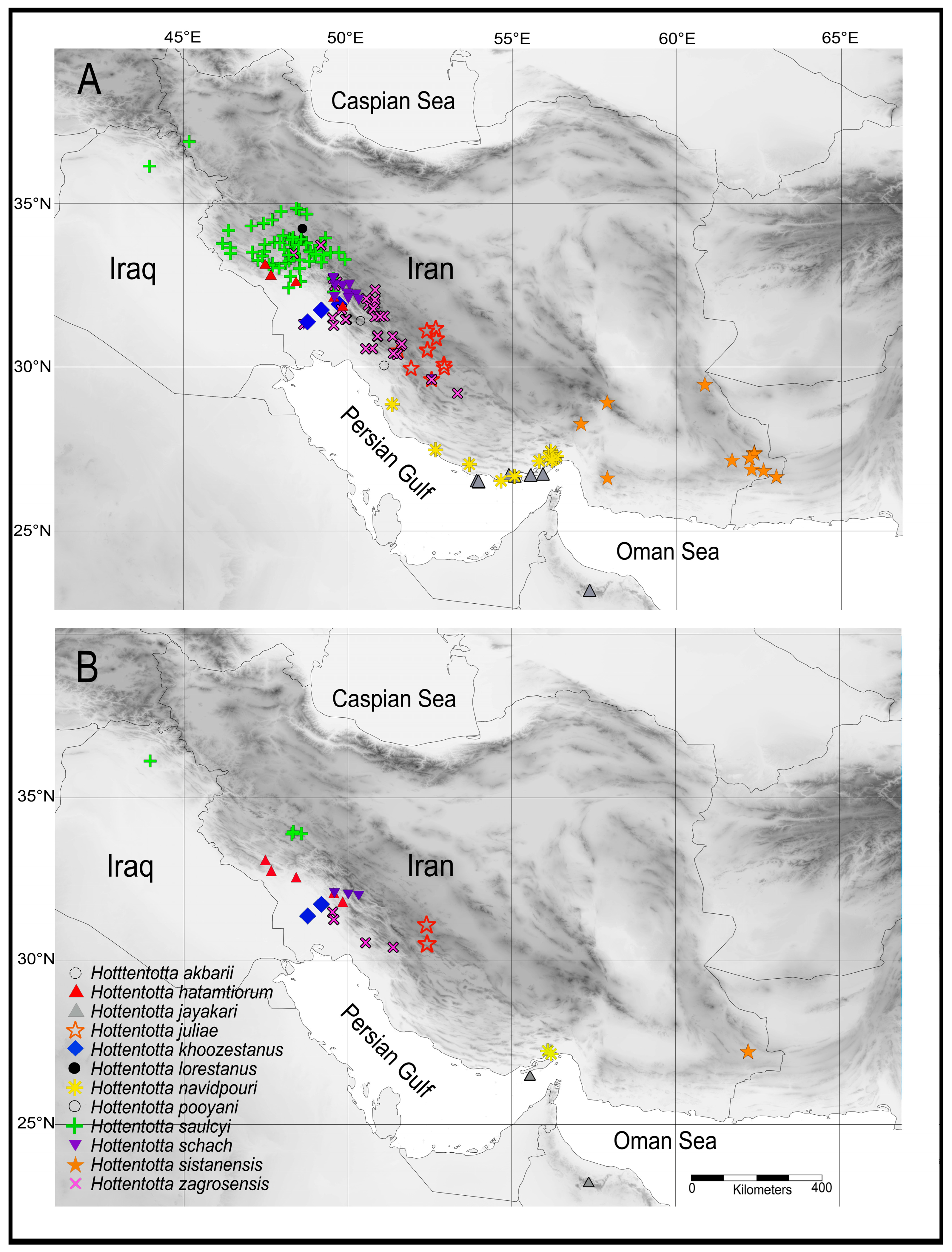
A distribution map (Figure 1) was created using DIVA-GIS [36] by overlaying point locality records of sampling locations on spatial layers depicting political boundaries and topography (elevation) at 2.5 arc-minutes altitude.

2.3. DNA Extraction, Amplification, Sequencing and Alignment

DNA was extracted from leg muscle tissue using the Favorgene (Taipei, Taiwan) DNA Extraction kit or the Qiagen (Hilden, Germany) DNeasy Blood and Tissue Kit. DNA sequences were generated from one nuclear gene locus, 28S rDNA (hereafter, 28S), and three mitochondrial gene loci, 12S rDNA (hereafter, 12S), 16S rDNA (hereafter, 16S) and Cytochrome c Oxidase Subunit I (hereafter, COI), amplified using standard primers [28,37,38]. The polymerase chain reaction (PCR) was performed with a variety of optimization protocols [13,28,37,38,39]. Each PCR contained 12.5 μL Ampliqon (Odense, Denmark) ready master mix, 7.5 μL deionized H2O, 1 μL (=1 pmol) of each primer and 3 μL of DNA template. PCR products were Sanger dideoxy sequenced using ABI Big Dye terminator chemistry on an ABI Prism 3700 (Applied Biosystems, Foster City, CA, USA). A total of 78 sequences were newly generated from 32 samples for this study and deposited in GenBank (Table 1).
Sequences were edited and assembled using Sequencher v.4.5.6 (GeneCodes Corporation, Ann Arbor, MI, USA). Edited sequences of the four gene loci were aligned using MUSCLE [40]. The protein coding locus, COI, was translated into amino acids to evaluate its quality and the coding frame adjusted by identifying stop codons MEGA X [41].

2.4. Phylogenetic Analysis

In the 513 base pair (bp) alignment of 28S, 506 (98.6%) positions were conserved, seven (1.4%) were variable, and six (1.2%) were parsimony informative. In the 343 bp alignment of 12S, 206 (60%) positions were conserved, 137 (40%) were variable, and 110 (32%) were parsimony informative. In the 496 bp alignment of 16S, 324 (65%) positions were conserved, 170 (35%) were variable, and 146 (29.4%) were parsimony informative. In the 657 bp alignment of COI, 450 (68.50%) positions were conserved, 207 (31.50%) were variable, and 181 (27.55%) were parsimony informative. The best-fitting models of nucleotide substitution were estimated for each gene locus using the Akaike Information Criterion [42] in jModeltest v.2.1.10 [43], and a tree estimated from the concatenated alignment of 2009 bp using GTR + I + G.
Analysis of the concatenated dataset with Bayesian Inference (BI) was conducted using MrBayes v.3.2 [44], applying the best-fit models to each gene locus. The analysis was performed using two independent runs with six chains for 1.5 × 10⁷ generations. Subsampling trees and parameters were saved every 1000th generation. Convergence on the stationary distribution was assessed with Tracer v.1.7.2 [45]. Independent runs converged well (ESS > 400 for all parameters; ASDSF = 0.0056), indicating adequate sampling of the posterior. Bayesian tree and posterior probabilities were calculated by 50% majority-rule consensus after burning off all pre-asymptotic topologies.
Kimura 2-parameter (K2P) pairwise genetic distances were calculated among and within species for each gene locus using MEGA X [41] (Table 2).

2.5. Divergence Time Estimation

Divergence time estimation was calculated with the GTR + G + I model applied to each gene locus in the concatenated dataset, using BEAST v.1.10.4 [46]. Site and clock models were unlinked across partitions. A relaxed clock (uncorrected) with lognormal prior distribution was applied with a Yule model process as tree prior. The ucld.mean of the clock model was set to COI and 16S scorpion-specific mutation rates of 0.007 and 0.005 substitution/site/myr, respectively [47,48]. The analysis was run for 5 × 10⁷ generations, sampling every 1000th generation. Convergence diagnostics for the MCMC analyses were checked in Tracer v.1.7.2 [49] to ensure that all ESS values were greater than 200. A lineage-through-time (LTT) analysis was conducted on the concatenated dataset using Tracer v.1.7.2.

2.6. Biogeographical Analysis

Statistical dispersal-vicariance (S-DIVA) analysis [50] was conducted using RASP v.4.4 [51] in BioGeoBears [52] to reconstruct ancestral ranges. The maximum clade credibility tree topology was input from BEAST with 50,000 topologies used to account for phylogenetic uncertainty. A statistical comparison of six models (DEC, DEC + J, DIVALIKE, DIVALIKE + J, BAYAREALIKE and BAYAREALIKE + J), performed using the Likelihood Ratio test (LRT), suggested BAYAREALIKE + J as the best fitting model for estimating ancestral ranges (AICc_wt = 0.41; Table 3). Species distributions were assigned to five geographical regions: (A) northern Zagros fold; (B) southern Zagros fold; (C) Makran; (D) Arabian Peninsula; (E) Africa. Analyses were conducted with dispersal only possible between adjoining areas, allowing for extinction, and only two-unit areas in the ancestral distributions.
Bayesian binary Markov Chain Monte Carlo (MCMC) (BBM) analysis [50,51] was also performed with eight MCMC chains running simultaneously for 5 × 10⁶ generations, and states sampled every 100 generations. A fixed Jukes-Cantor model with equal among-site rate variation was applied for the analysis.

3. Results

3.1. Phylogenetic Analysis

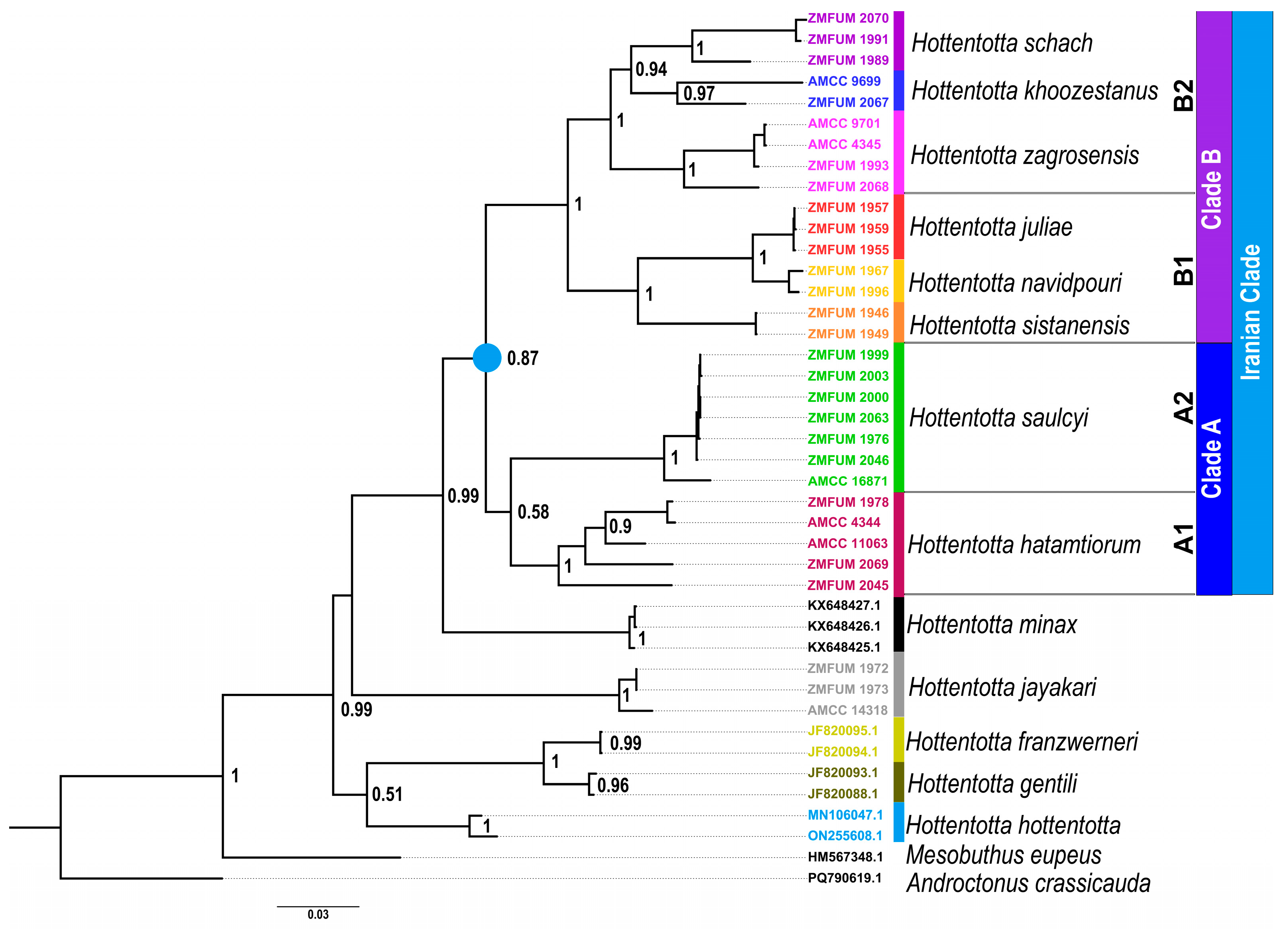
The tree topology obtained with BI confirmed the monophyly of Hottentotta (posterior probability, PP = 0.99) and all Hottentotta species included in the analysis (PP = 0.96–1) and recovered a well-supported clade comprising the species from the Iranian Plateau and the Zagros Mountains (PP = 0.87), in turn divided into two well-supported clades (Figure 2): Clade A, comprising H. hatamtiorum (Clade A1) and H. saulcyi (Clade A2), and Clade B, comprising the other six species. Clade B was further subdivided into two clades, Clade B1 comprising H. sistanensis, placed sister to a subclade comprising H. juliae and H. navidpouri, and Clade B2 comprising H. zagrosensis, placed sister to a subclade comprising H. khoozestanus and H. schach.
The African species of Hottentotta were paraphyletic with respect to the Asian species. Hottentotta minax, from east Africa, was placed sister to the clade of Iranian species, and H. jayakari, from the Arabian Peninsula and islands in the Persian Gulf, was placed sister to the clade comprising H. minax and the Iranian clade. A weakly supported clade (PP = 0.51) comprising H. hottentotta from west Africa and the two Maghreb species, H. franzwerneri and H. gentili, formed the basal sister group of all other species.

3.2. Genetic Distances

The average genetic distance between the species of Hottentotta varied from 5.2 to 22% for 12S, 6.7–23.7% for 16S, 5.0–17% for COI, and 0.1–0.7% for 28S (Table 2). The highest interspecific distance was observed between H. jayakari and the other species. The lowest interspecific distances for the mitochondrial loci were observed between H. juliae and H. navidpouri, and between H. franzwerneri and H. gentili. Intraspecific genetic distances varied from 0.0 to 9.0% for 12S, 0.0–5.0%, for 16S and 0.0–8.0% for COI.

3.3. Divergence Time Estimation

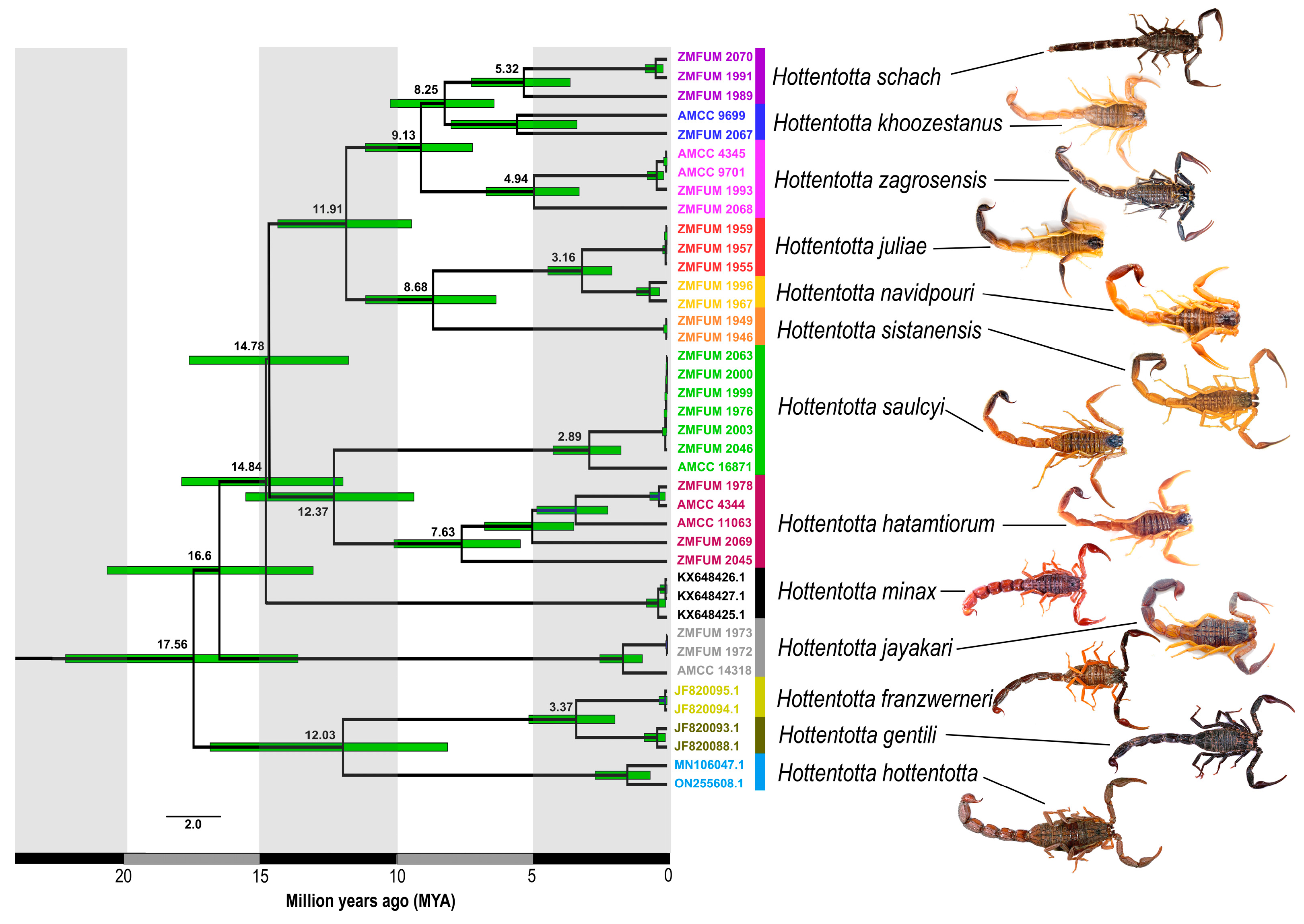
According to the divergence time estimations (Figure 3), the common ancestor of the west African H. hottentotta and the Maghreb species, H. franzwerneri and H. gentili, diverged from the common ancestor of all other species (Clades A, B, H. jayakari and H. minax) around 17.56 Ma (95% highest posterior density, HPD: 13.68–22.31), whereas the Arabian H. jayakari and the east African H. minax diverged from the common ancestor of Clades A and B 16.6 Ma (95% HPD: 13.12–20.76) and 14.84 Ma (95% HPD: 12.03–18), respectively. Clade A, comprising H. hatamtiorum and H. saulcyi, diverged from Clade B, comprising the other Iranian species, around 14.78 Ma (95% HPD: 11.82–17.72). Hottentotta hatamtiorum diverged from H. saulcyi around 12.37 Ma (95% HPD: 9.4–15.62). Clades B1 and B2 diverged nearly 11.91 Ma (95% HPD: 9.48–14.43). In Clade B1, H. sistanensis diverged from the common ancestor of H. juliae and H. navidpouri around 8.68 Ma (95% HPD: 6.35–11.19), whereas the latter species diverged around 3.16 Ma (95% HPD: 2.05–4.43). In Clade B2, H. zagrosensis diverged from the common ancestor of H. khoozestanus and H. schach around 9.13 Ma (95% HPD: 7.22–11.2), whereas the latter species diverged around 8.25 Ma (95% HPD: 6.42–10.27).

3.4. Biogeographical Analysis

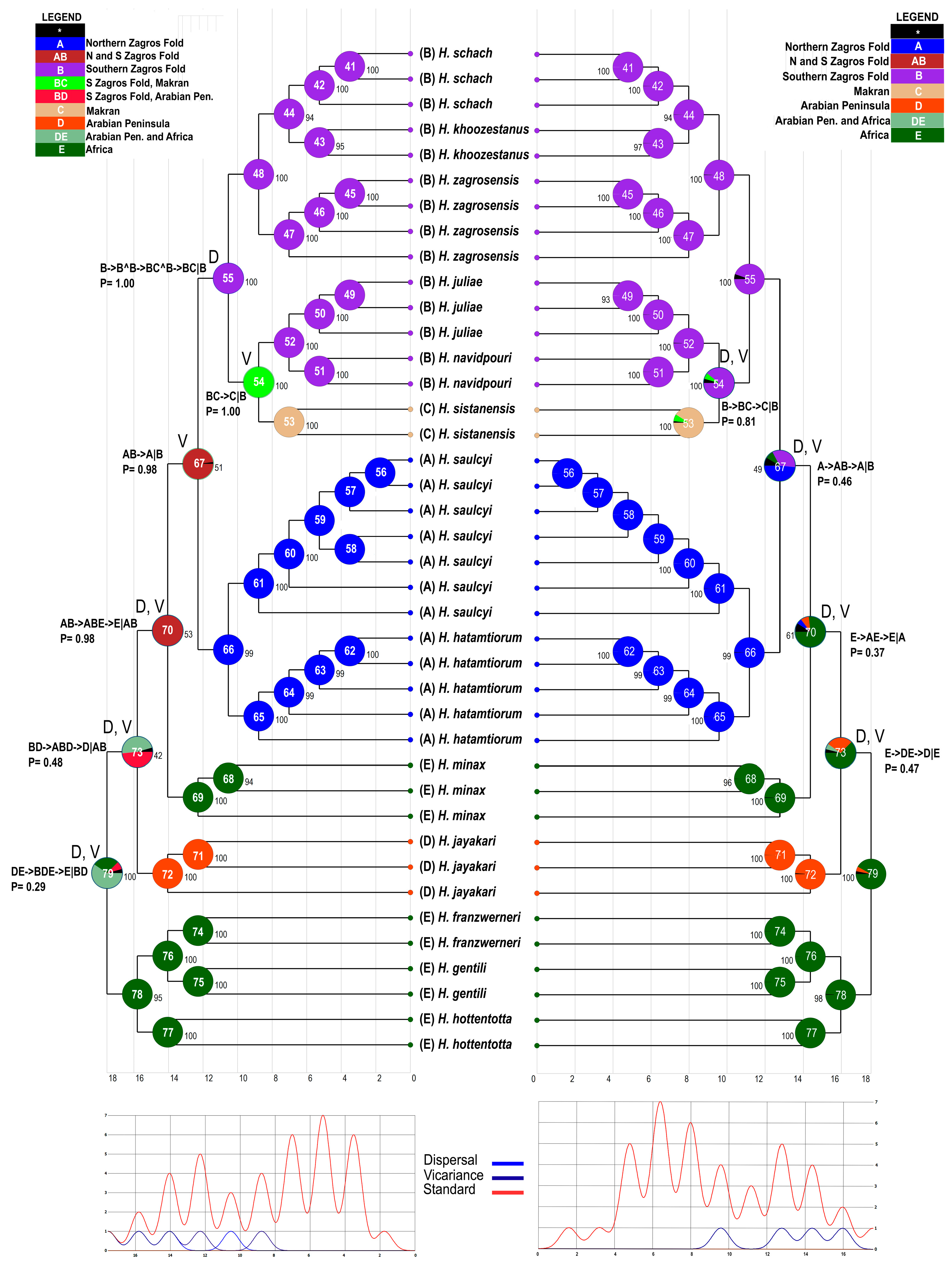
The results of S-DIVA and BBM were similar, revealing dispersal and vicariance events at the main ancestral nodes (Figure 4; Table 3). The ancestral node (79) of Hottentotta underwent one dispersal event and one vicariance event, which reflects range expansion followed by geographical partitioning, according to S-DIVA. The ancestral node (73) of H. jayakari, H. minax, and the Iranian clade underwent one dispersal event and one vicariance event according to both S-DIVA and BBM (relative probabilities of 0.48 and 0.47, respectively). These events led to divergence of the Arabian H. jayakari from the common ancestor of the east African H. minax and the Iranian species. The ancestral node (70) of the clade comprising H. minax and the Iranian species underwent one dispersal event and one vicariance event according to both S-DIVA and BBM, resulting in the divergence of H. minax from the common ancestor of the Iranian clade.
These events suggest recolonization of Africa via a single dispersal event, followed by vicariance which partitioned the ancestral range between areas E and A + B (relative probability = 0.98). The ancestral node (67) of the Iranian species underwent one vicariance event according to S-DIVA compared with one dispersal event and one vicariance event according to BBM. These events caused the divergence of the species occurring in the northern Zagros Mountains from those occurring in the southern Zagros Mountains and the Makran region (S-DIVA; relative probability: 0.98).
According to the S-DIVA analysis, four dispersal events and five vicariance events occurred among the species of Hottentotta. One of these is a vicariance event separating the species of the northern Zagros Mountains from those of the southern Zagros Mountains and the Makran region (node 67; relative probability: 0.98). Another vicariance event accounts for the divergence of H. sistanensis from the common ancestor of H. juliae and H. navidpouri (node 54; relative probability: 1.00).
According to the BBM analysis, four dispersal events and four vicariance events occurred among the species of Hottentotta. Dispersal and vicariance events occurred in the northern and southern Zagros Mountains (node 67; relative probability: 0.46), separating Clade A from Clade B, and in the southern Zagros Mountains and the Makran region, separating H. sistanensis from the common ancestor of H. juliae and H. navidpouri (node 54; relative probability: 0.81).
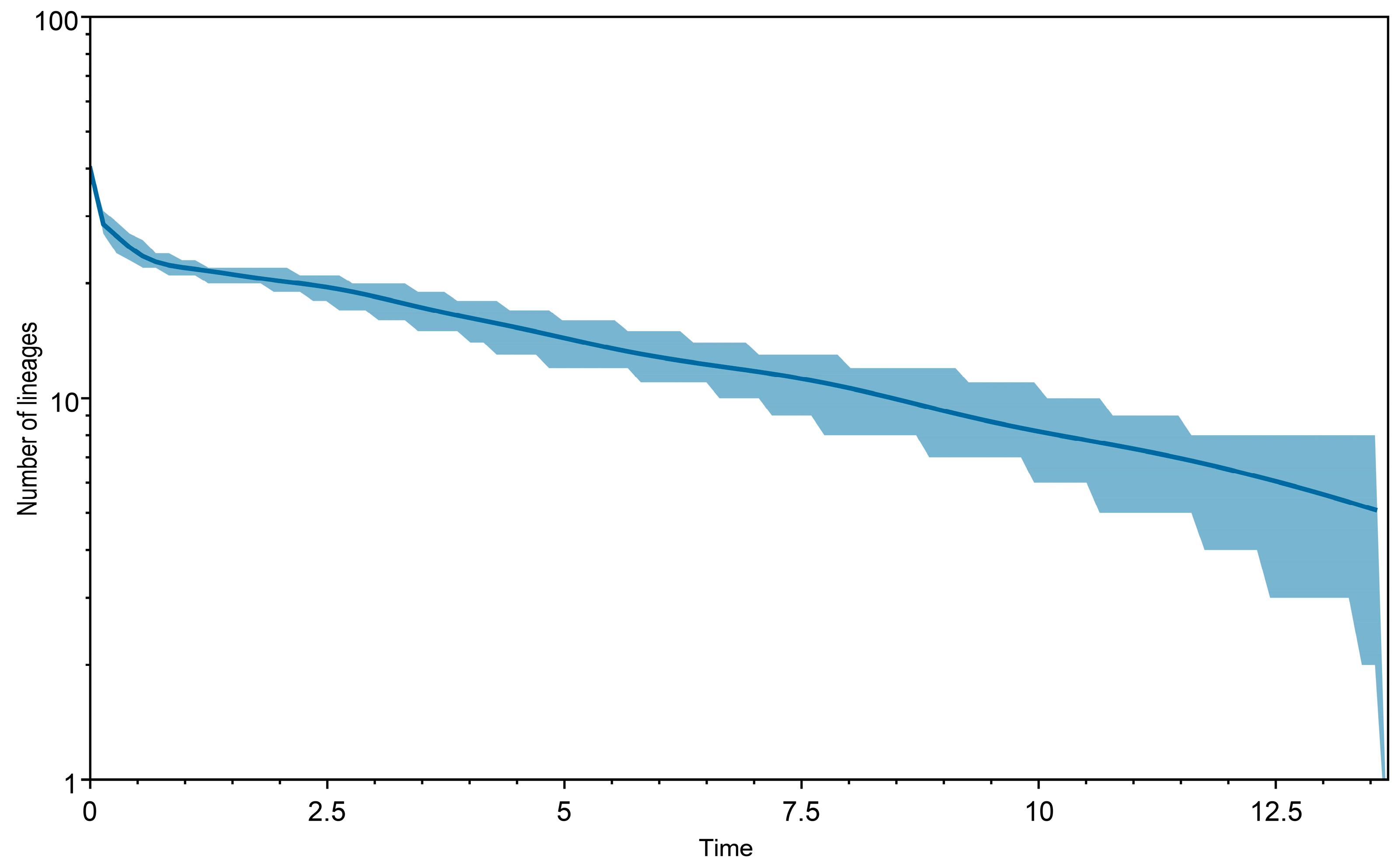
According to the S-DIVA and BBM analyses, 11 and 13 divergence events occurred within the northern and southern Zagros Mountains, respectively, whereas one and two divergence events occurred in the Makran region and the Arabian Peninsula, respectively, revealing the role of allopatric speciation in the diversification of Hottentotta in the Zagros Mountains (Figure 5). Six divergence events are evident in northern Africa.

4. Discussion

This study presents the first molecular phylogeny and historical biogeographical analysis of Hottentotta in the Iranian Plateau and Zagros Mountains. The high degree of genetic diversity among species of the genus underscores the role of the Iranian Plateau and the Zagros Mountains in driving their diversification.

4.1. Hottentotta Systematics

The phylogenetic analyses presented here confirmed the monophyly of Hottentotta and revealed a distinct clade of species inhabiting the Iranian Plateau and the Zagros Mountains (Figure 2 and Figure 3). Although the Iranian species formed a well-supported clade, the African species were paraphyletic with respect to the Asian species.
The phylogeny revealed several convergent patterns of coloration (Figure 2). For example, yellowish base coloration with infuscate pedipalps, partially infuscate tergites and/or infuscate posterior metasomal segments and telson evolved in multiple species, as did completely infuscate carapace, pedipalps, tergites, metasoma and telson, with or without infuscate legs. Morphologically similar species, like H. gentili, H. schach and H. zagrosensis, were not found to be closely related. This was also the case with species previously assumed to be closely related. For example, according to Kovařík [53], H. navidpouri was described based on specimens originally identified as H. saulcyi and considered closely related to it, whereas H. juliae was described based on the specimens originally identified as H. schach. However, the phylogeny did not reveal close relationships between H. navidpouri and H. saulcyi or between H. juliae and H. schach.
Although the phylogeny confirmed the monophyly of all species of Hottentotta included in the analysis, the taxonomic validity and phylogenetic relationships of several other species from northeast Africa, Iran, Afghanistan, Pakistan and India remain unresolved.

4.2. Palaeobiogeography of Hottentotta and Divergence Time Estimation

Divergence time estimation and historical biogeographical analyses (S-DIVA and BBM) indicate that the common ancestor of H. hottentotta, H. franzwerneri and H. gentili diverged from the common ancestor of H. jayakari, H. minax and the Iranian clade during the Early Miocene (17.56 Ma, 95% HPD: 13.68–22.31; Burdigalian age). These findings support the hypothesis that the Iranian species of Hottentotta originated from an African ancestor and subsequently dispersed to their current ranges.
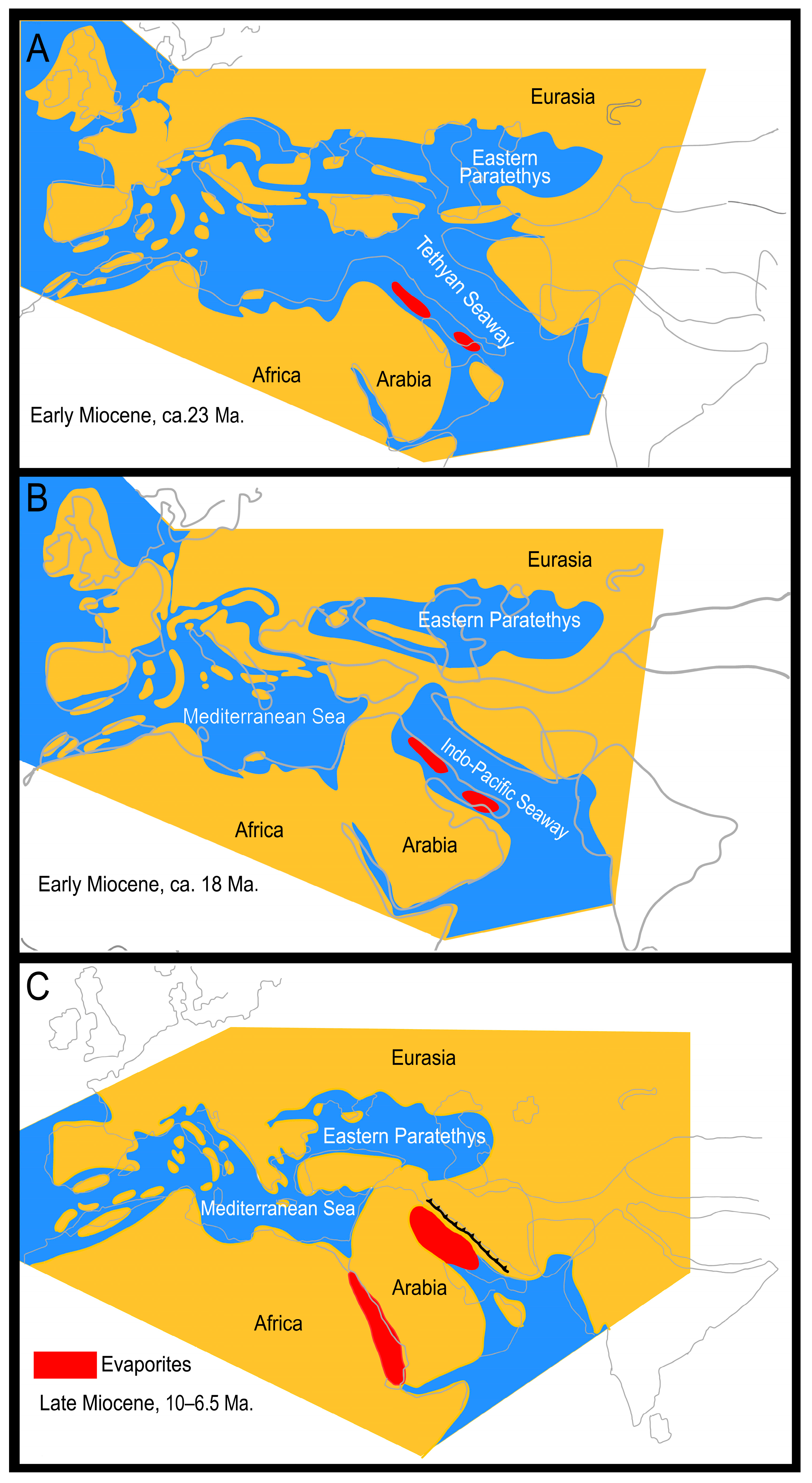
The present distributions of Afro-Arabian and Iranian Hottentotta are most plausibly attributed to major geomorphological processes and plate tectonic events during the Cenozoic. At the Oligocene/Miocene boundary, a deep trough between the Arabian and Iranian plates, known as the Tethyan Seaway (Figure 6A), connected the Mediterranean Sea with the Atlantic and the Indo-Pacific Oceans [54,55]. Closure of the Tethyan Seaway occurred gradually, starting at ca. 19.0 Ma, and continuing until ca. 18 Ma [56,57]. Fossil evidence from terrestrial mammals indicates that prior to its final closure (before 18 Ma), transient or intermittent land connections between Africa and Eurasia allowed periodic episodes of faunal exchange [58]. This faunal exchange was facilitated by the collision of the Afro-Arabian and Eurasian plates, which resulted in the formation of the Gomphotherium Landbridge, an emergent corridor that temporarily linked both landmasses [23,56,58,59]. Prior to this tectonic event, faunal exchange between Eurasia, the Arabian Plate, and thus Africa was substantially restricted during the Early Miocene, as the open Tethyan Seaway provided an effective geographical barrier to terrestrial animal dispersal.
The continental rifting between the African and Arabian plates initiated during the Oligocene–Miocene transition, approximately 30–25 Ma, was marked by the opening of the Red Sea Rift. This tectonic event established the Red Sea as an agent of vicariance, progressively fragmenting previously contiguous populations of terrestrial taxa. The ensuing geographical isolation facilitated subsequent divergence and radiation within the Arabian Peninsula. This is supported by molecular phylogenetic analyses of the gecko genus Hemidactylus Oken, 1817, which attributed a major divergence to this vicariance event [60]. Divergence time estimation and historical biogeographical analyses indicate that the separation of H. jayakari from its African congeners occurred approximately 22–15 Ma, a timeframe that aligns with the period of active tectonic fragmentation between the African and Arabian landmasses.
The Iranian species of Hottentotta began diverging during the Early Miocene (14.78 Ma 95% HPD: 11.82–17.72; Langhian age) probably due to seismic activity, volcanism, orogeny and associated palaeoclimatic changes driven by tectonic collision of the Arabian and Eurasian plates and associated basin dynamics [61,62,63,64,65] (Figure 6B). According to the time-calibrated tree, further divergence among lineages which colonized the northern and southern Zagros Mountains, and the central Iranian Plateau, continued from the Middle to Late Miocene (approximately 11.63–5.33 Ma) (Figure 6C). Consequently, climatic and geomorphological changes during the Miocene epoch, especially in the Zagros Mountains, represent a crucial period in the diversification of Hottentotta.
Taken together, the S-DIVA, BBM, and BioGeoBEARS model test results indicate that the biogeographical history of Hottentotta was shaped primarily by long-term regional persistence, geographical subdivision, and rare but consequential dispersal events. Both S-DIVA and BBM identified the northern and southern Zagros regions as major centers of in situ diversification, with particularly high levels of within-area divergence in the southern Zagros, which emerges as an important source area for dispersal to adjacent regions, including the Makran and Africa. The Makran appears largely as a recipient region with limited internal diversification, whereas the Arabian Peninsula shows comparatively fewer inferred dispersal connections. At a broader scale, both S-DIVA and BBM inferred similar numbers of dispersal and vicariance events and detected no extinction signal, suggesting that diversification was driven mainly by geographical isolation rather than widespread range loss. These patterns are consistent with the complex tectonic history of the region, particularly the uplift and segmentation of the Zagros Mountains and the progressive reorganization of land connections among Iran, Arabia, and Africa, which likely promoted isolation while intermittently permitting faunal exchange [57,58,59]. Consistent with this scenario, BioGeoBEARS model testing favored models incorporating founder-event speciation (+j). The near-zero estimates of anagenetic dispersal indicate that gradual range expansion was rare, and that colonization/recolonization of new regions probably occurred through infrequent jump dispersal events followed by speciation. This hypothesis is consistent with the sedentary ecology and low vagility of scorpions [47], in which rare founder events, against a backdrop of tectonically driven vicariance and long-term regional persistence, can have a disproportionate influence on lineage diversification.

4.3. Miocene Climate Change in the Zagros Mountains

During the Miocene epoch, the Zagros region experienced major climatic transitions driven by tectonic uplift, regional orogeny, and evolving atmospheric circulation [66]. The Early to Middle Miocene was marked by warm, humid conditions, fostering the development of extensive shallow marine carbonate platforms such as the Asmari Formation [67]. These relatively stable, subtropical climatic conditions supported high biodiversity. By the Middle to Late Miocene, however, the climate in the Zagros began shifting toward increased aridity [68]. This change is evident in the transition from carbonate-dominated to clastic-dominated sequences such as the Agha Jari Formation, indicating greater terrestrial influence and reduced precipitation [69]. The orographic effect of the uplifting Zagros Mountains also contributed to regional drying by blocking moist air masses, creating rain shadows and promoting the spread of savanna-like vegetation [70]. The progressive aridification altered vegetation cover and hydrology, influencing faunal distributions and shaping evolutionary pathways [70]. The drying climate likely contributed to faunal turnover and ecological isolation, setting the stage for species diversification among terrestrial taxa like scorpions.

4.4. Miocene Chronostratigraphy of the Zagros Mountains

The chronostratigraphy of the Zagros region during the Miocene epoch is defined by a transition from marine to continental depositional systems, marked in particular by the Asmari and Agha Jari formations [71]. The Early Miocene Asmari Formation predominantly comprises shallow marine carbonates, whereas the Middle to Late Miocene Agha Jari Formation reflects fluvial and deltaic sedimentation [72]. This sedimentary evolution introduced a mosaic of environments, including marine basins, coastal plains, and inland deltas, which created natural geographical barriers to the dispersal of terrestrial animals like scorpions. For example, alternating marine transgressions and clastic deltaic environments would have fragmented habitats and restricted gene flow between populations [73]. Allopatric speciation likely occurred as isolated populations adapted to localized ecological conditions [74].
The progressive rise of the Zagros thrust belt provided a further topographical barrier dividing eastern and western biotas [75]. The barrier created by these orogenic and sedimentary changes, combined with climatic fluctuations, contributed to faunal turnover and the emergence of endemic lineages [76]. Thus, Miocene sedimentary environments in the Zagros not only recorded tectono-stratigraphic transitions but actively influenced arthropod diversification through ecological isolation. These climatic changes, together with the accelerating collision of the Arabian plate with the Eurasian landmass during the Pliocene [77], contributed to the formation of unique environmental conditions on the elevated Iranian Plateau.
Recent studies confirm that the Zagros Mountains provided a significant geographical barrier promoting scorpion diversification. Genetic and ecological data reveal that scorpion taxa such as Hottentotta, Mesobuthus Vachon, 1950, and Odontobuthus Vachon, 1950 exhibit deep genetic divergences across this mountain range, consistent with vicariance and allopatric speciation [12,13,18,39]. The orogeny of the Zagros Mountains disrupted gene flow and created distinct ecological niches, leading to cryptic species formation and localized endemism [12,13,39,78]. These findings underscore the role of the Zagros Mountains in shaping arthropod diversity through habitat fragmentation across the arid and semi-arid landscape of the Iranian Plateau in a manner similar to the diversification of vertebrates such as reptiles and amphibians inhabiting the same region [14,15,22,79].

5. Conclusions

A historical biogeographical reconstruction based on the phylogeny confirmed the hypothesis that the Zagros Mountains provided a barrier to scorpion dispersal and promoted diversification on the Iranian Plateau. Divergence of the major clades of Hottentotta during the Miocene epoch was driven by orogeny of the Zagros Mountains and subsequent paleoclimatic change. Analyses based on a more comprehensive taxon sample, including additional species and populations, will further elucidate the evolutionary history of Hottentotta.

Author Contributions

Conceptualization, O.M. and L.P.; methodology, O.M. and M.A. (Masoumeh Amiri); software, O.M. and M.A. (Masoumeh Amiri); validation, O.M., L.P. and M.A. (Mansour Aliabadian); formal analysis, O.M.; investigation, O.M. and M.A. (Masoumeh Amiri); data curation, O.M.; writing—original draft preparation, O.M. and L.P.; writing—review and editing, O.M. and L.P.; visualization, O.M.; supervision, O.M. and L.P.; project administration, O.M.; funding acquisition, O.M. and L.P. All authors have read and agreed to the published version of the manuscript.

Funding

This study was supported in part by the Office of Research Affairs, Ferdowsi University of Mashhad, Iran (Project 3/50093) to O.M. and grant DEB 1655050 from the U.S. National Science Foundation to L.P.

Data Availability Statement

The original data presented in the study are openly available in National Center for Biotechnology Information at: https://www.ncbi.nlm.nih.gov/ (10 December 2025).

Acknowledgments

The authors express their gratitude to Abbas Ghaderi and two anonymous reviewers for constructive comments on previous drafts of the manuscript.

Conflicts of Interest

The authors declare no conflicts of interest. The funders had no role in the design of the study; in the collection, analyses, or interpretation of data; in the writing of the manuscript; or in the decision to publish the results.

References

  1. Li, Y.S.; Shih, K.M.; Chang, C.T.; Chung, J.D.; Hwang, S.-Y. Testing the effect of mountain ranges as a physical barrier to current gene flow and environmentally dependent adaptive divergence in Cunninghamia konishii (Cupressaceae). Front. Genet. 2019, 10, 742. [Google Scholar] [CrossRef] [Scilit]
  2. Machado, A.P.; Clément, L.; Uva, V.; Goudet, J.; Roulin, A. The Rocky Mountains as a dispersal barrier between barn owl (Tyto alba) populations in North America. J. Biogeogr. 2018, 45, 1288–1300. [Google Scholar] [CrossRef] [Scilit]
  3. Nesbø, C.; Magnhagen, C.; Jakobsen, K. Genetic differentiation among stationary and anadromous perch (Perca fluviatilis) in the Baltic Sea. Hereditas 1998, 129, 241–249. [Google Scholar] [CrossRef] [Scilit]
  4. Shahzad, K.; Jia, Y.; Chen, F.L.; Zeb, U.; Li, Z.H. Effects of mountain uplift and climatic oscillations on phylogeography and species divergence in four endangered Notopterygium herbs. Front. Plant Sci. 2017, 8, 1929. [Google Scholar] [CrossRef] [Scilit]
  5. Su, H.; Qu, L.; He, K.; Zhang, Z.; Wang, J.; Chen, Z.; Gu, H. The Great Wall of China: A physical barrier to gene flow? Heredity 2003, 90, 212–219. [Google Scholar] [CrossRef] [Scilit]
  6. Davis, S.; Heywood, V.; Hamilton, A. Centers of Plant Diversity: A Guide and Strategy for their Conservation. Vol. 1. Europe, Africa, South West Asia and the Middle East; IUCN Publications Unit: Cambridge, UK, 1994; 354p. [Google Scholar]
  7. Firouz, E. The Complete Fauna of Iran; I.B. Tauris: New York, NY, USA, 2005; 336p. [Google Scholar]
  8. Frey, W.; Kürschner, H.; Probst, W. Flora and vegetation, including plant species and larger vegetation complexes in Persia. Encycl. Iran. 1999, 10, 43–63. [Google Scholar]
  9. Olson, D.M.; Dinerstein, E.; Wikramanayake, E.D.; Burgess, N.D.; Powell, G.V.; Underwood, E.C.; D’Amico, J.A.; Itoua, I.; Strand, H.E.; Morrison, J.C. Terrestrial Ecoregions of the World: A New Map of Life on Earth: A new global map of terrestrial ecoregions provides an innovative tool for conserving biodiversity. BioScience 2001, 51, 933–938. [Google Scholar] [CrossRef] [Scilit]
  10. Zehzad, B.; Kiabi, B.H.; Madjnoonian, H. The natural areas and landscape of Iran: An overview. Zool. Middle East 2002, 26, 7–10. [Google Scholar] [CrossRef] [Scilit]
  11. Ahmadzadeh, F.; Flecks, M.; Torki, F.; Boehme, W. A new species of angular-toed gecko, genus Cyrtopodion (Squamata: Gekkonidae), from southern Iran. Zootaxa 2011, 2924, 22–32. [Google Scholar] [CrossRef] [Scilit]
  12. Amiri, M.; Prendini, L.; Hussen, F.S.S.; Aliabadian, M.; Siahsarvie, R.; Mirshamsi, O. Integrative systematics of the widespread Middle Eastern buthid scorpion, Hottentotta saulcyi (Simon, 1880), reveals a new species in Iran. Arthropod Syst. Phylogeny 2024, 82, 323–341. [Google Scholar] [CrossRef] [Scilit]
  13. Barahoei, H.; Prendini, L.; Navidpour, S.; Tahir, H.M.; Aliabadian, M.; Siahsarvie, R.; Mirshamsi, O. Integrative systematics of the tooth-tailed scorpions, Odontobuthus (Buthidae), with descriptions of three new species from the Iranian Plateau. Zool. J. Linn. Soc. 2022, 195, 355–398. [Google Scholar] [CrossRef] [Scilit]
  14. Boroumand, H.; Saberi-Pirooz, R.; Bafti, S.S.; Böhme, W.; Ahmadzadeh, F. Speciation in the Iranian Plateau: Molecular phylogeny and evolutionary history of the Persian long-tailed desert lizard. Zool. Scr. 2024, 53, 312–322. [Google Scholar] [CrossRef] [Scilit]
  15. Ghaedi, Z.; Badri, S.; Saberi-Pirooz, R.; Vaissi, S.; Javidkar, M.; Ahmadzadeh, F. The Zagros Mountains acting as a natural barrier to gene flow in the Middle East: More evidence from the evolutionary history of spiny-tailed lizards (Uromasticinae: Saara). Zool. J. Linn. Soc. 2021, 192, 1123–1136. [Google Scholar] [CrossRef] [Scilit]
  16. Levine, L.D. Geographical Studies in the Neo-Assyrian Zagros—I. Iran 1973, 11, 1–27. [Google Scholar] [CrossRef] [Scilit]
  17. Macey, J.R.; Schulte, J.A., II; Ananjeva, N.B.; Larson, A.; Rastegar-Pouyani, N.; Shammakov, S.M.; Papenfuss, T.J. Phylogenetic relationships among agamid lizards of the Laudakia caucasia species group: Testing hypotheses of biogeographic fragmentation and an area cladogram for the Iranian Plateau. Mol. Phylogenet. Evol. 1998, 10, 118–131. [Google Scholar] [CrossRef] [Scilit] [PubMed]
  18. Mirshamsi, O.; Sari, A.; Elahi, E.; Hosseinie, S. Phylogenetic relationships of Mesobuthus eupeus (CL Koch, 1839) inferred from COI sequences (Scorpiones: Buthidae). J. Nat. Hist. 2010, 44, 2851–2872. [Google Scholar] [CrossRef] [Scilit]
  19. Rastegar-Pouyani, E.; Rastegar-Pouyani, N.; Noureini-Kazemi, S.; Joger, U.; Wink, M. Molecular phylogeny of the Eremias persica complex of the Iranian Plateau (Reptilia: Lacertidae), based on mtDNA sequences. Zool. J. Linn. Soc. 2010, 158, 641–660. [Google Scholar] [CrossRef] [Scilit]
  20. Hatzfeld, D.; Authemayou, C.; Van der Beek, P.; Bellier, O.; Lavé, J.; Oveisi, B.; Tatar, M.; Tavakoli, F.; Walpersdorf, A.; Yamini-Fard, F. The kinematics of the Zagros mountains (Iran). In Tectonic and Stratigraphic Evolution of Zagros and Makran During the Mesozoic–Cenozoic; Leturmy, P., Robin, C., Eds.; Geological Society London Special Publications: London, UK, 2010; Volume 330, pp. 19–42. [Google Scholar]
  21. Agard, P.; Omrani, J.; Jolivet, L.; Mouthereau, F. Convergence history across Zagros (Iran): Constraints from collisional and earlier deformation. Int. J. Earth Sci. 2005, 94, 401–419. [Google Scholar] [CrossRef] [Scilit]
  22. Rastegar-Pouyani, N. Systematics of the genus Asaccus (Sauria: Gekkonidae) on the Zagros mountains, Iran. In Proceedings of the 13th Congress of the Societas Europaea Herpetologica; Vences, M., Köhler, J., Ziegler, T., Böhme, W., Eds.; Societas Europaea Herpetologica: Bonn, Germany, 2006; pp. 117–119. [Google Scholar]
  23. Cain, S.; Loria, S.F.; Ben-Shlomo, R.; Prendini, L.; Gefen, E. Dated phylogeny and ancestral range estimation of sand scorpions (Buthidae: Buthacus) reveal Early Miocene divergence across land bridges connecting Africa and Asia. Mol. Phylogenet. Evol. 2021, 164, 107212. [Google Scholar] [CrossRef] [Scilit]
  24. Esposito, L.A.; Prendini, L. Island ancestors and New World biogeography: A case study from the scorpions (Buthidae: Centruroidinae). Sci. Rep. 2019, 9, 3500. [Google Scholar] [CrossRef] [Scilit]
  25. Gantenbein, B.; Keightley, P.D. Rates of molecular evolution in nuclear genes of east Mediterranean scorpions. Evolution 2004, 58, 2486–2497. [Google Scholar] [CrossRef] [Scilit]
  26. Gantenbein, B.; Largiadèr, C.R. The phylogeographic importance of the Strait of Gibraltar as a gene flow barrier in terrestrial arthropods: A case study with the scorpion Buthus occitanus as model organism. Mol. Phylogenet. Evol. 2003, 28, 119–130. [Google Scholar] [CrossRef] [Scilit]
  27. Loria, S.F.; Ehrenthal, V.L.; Nguyen, A.D.; Prendini, L. Climate relicts: Asian scorpion family Pseudochactidae survived Miocene aridification in caves of the Annamite Mountains. Insect Syst. Divers. 2022, 6, 3. [Google Scholar] [CrossRef] [Scilit]
  28. Loria, S.F.; Prendini, L. Out of India, thrice: Diversification of Asian forest scorpions reveals three colonizations of Southeast Asia. Sci. Rep. 2020, 10, 22301. [Google Scholar] [CrossRef] [Scilit]
  29. Loria, S.F.; Prendini, L. Burrowing into the forest: Phylogeny of the Asian forest scorpions (Scorpionidae: Heterometrinae) and the evolution of ecomorphotypes. Cladistics 2021, 37, 109–161. [Google Scholar] [CrossRef] [Scilit] [PubMed]
  30. Barahoei, H.; Navidpour, S.; Aliabadian, M.; Siahsarvie, R.; Mirshamsi, O. Scorpions of Iran (Arachnida: Scorpiones): Annotated checklist, DELTA database and identification key. J. Insect Biodivers. Syst. 2020, 6, 375–474. [Google Scholar] [CrossRef] [Scilit]
  31. Mirshamsi, O.; Sari, A.; Hosseinie, S. History of study and checklist of the scorpion fauna (Arachnida: Scorpiones) of Iran. Prog. Biol. Sci. 2011, 1, 16–23. [Google Scholar]
  32. Kovařík, F. A revision of the genus Hottentotta Birula, 1908, with descriptions of four new species (Scorpiones, Buthidae). Euscorpius 2007, 58, 1–107. [Google Scholar] [CrossRef] [Scilit]
  33. Navidpour, S.; Kovařík, F.; Soleglad, M.E.; Fet, V. Scorpions of Iran (Arachnida, Scorpiones). Part I. Khoozestan province. Euscorpius 2008, 65, 1–41. [Google Scholar] [CrossRef] [Scilit]
  34. Navidpour, S.; Nayebzadeh, H.H.; Soleglad, M.E.; Fet, V.; Kovařík, F.; Kayedi, M.H. Scorpions of Iran (Arachnida: Scorpiones). Part VI. Lorestan Province. Euscorpius 2010, 104, 1–23. [Google Scholar] [CrossRef] [Scilit]
  35. Yağmur, E.A.; Moradi, M.; Tabatabaei, M.; Jafari, N. Contributions to the scorpion fauna of Iran. Part II. Hottentotta akbarii sp. nov. from the Fars Province (Scorpiones: Buthidae). Serket 2022, 18, 252–262. [Google Scholar]
  36. Hijmans, R.; Guarino, L.; Bussink, C.; Mathur, P.; Cruz, M.; Barrentes, I.; Rojas, E. DIVA-GIS, Version 5.0. A Geographic Information System for the Analysis of Species Distribution Data; International Potato Center: Lima, Peru, 2004. [Google Scholar]
  37. Prendini, L.; Ehrenthal, V.L.; Loria, S.F. Systematics of the relictual Asian scorpion family Pseudochactidae Gromov, 1998, with a review of cavernicolous, troglobitic, and troglomorphic scorpions. Bull. Am. Mus. Nat. Hist. 2021, 453, 1–149. [Google Scholar] [CrossRef] [Scilit]
  38. Prendini, L.; Loria, S.F. Systematic revision of the Asian forest scorpions (Heterometrinae Simon, 1879), revised suprageneric classification of Scorpionidae Latreille, 1802, and revalidation of Rugodentidae Bastawade et al., 2005. Bull. Am. Mus. Nat. Hist. 2020, 442, 1–480. [Google Scholar] [CrossRef] [Scilit]
  39. Azghadi, S.; Mirshamsi, O.; Navidpour, S.; Aliabadian, M. Scorpions of the genus Odontobuthus Vachon, 1950 (Scorpiones: Buthidae) from Iran: Phylogenetic relationships inferred from mitochondrial DNA sequence data. Zool. Middle East 2014, 60, 169–179. [Google Scholar] [CrossRef] [Scilit]
  40. Edgar, R.C. MUSCLE: Multiple sequence alignment with high accuracy and high throughput. Nucleic Acids Res. 2004, 32, 1792–1797. [Google Scholar] [CrossRef] [Scilit]
  41. Kumar, S.; Stecher, G.; Li, M.; Knyaz, C.; Tamura, K. MEGA X: Molecular evolutionary genetics analysis across computing platforms. Mol. Biol. Evol. 2018, 35, 1547–1549. [Google Scholar] [CrossRef] [Scilit]
  42. Akaike, H. Information theory as an extension of the maximum likelihood principle. In Second International Symposium on Information Theory; Petrov, B.N., Csáki, F., Eds.; Akadémiai Kiadó: Budapest, Hungary, 1973; pp. 267–281. [Google Scholar]
  43. Posada, D. jModelTest: Phylogenetic model averaging. Mol. Biol. Evol. 2008, 25, 1253–1256. [Google Scholar] [CrossRef] [Scilit]
  44. Huelsenbeck, J.P.; Ronquist, F. MRBAYES: Bayesian inference of phylogenetic trees. Bioinformatics 2001, 17, 754–755. [Google Scholar] [CrossRef] [Scilit]
  45. Rambaut, A.; Drummond, A. TRACER: MCMC Trace Analysis Tool Version v. 1.5.0; University of Edinburgh: Edinburgh, UK, 2009; Available online: http://tree.bio.ed.ac.uk/software/tracer (accessed on 15 October 2024).
  46. Drummond, A.J.; Rambaut, A. BEAST: Bayesian evolutionary analysis by sampling trees. BMC Evol. Biol. 2007, 7, 214. [Google Scholar] [CrossRef] [Scilit] [PubMed]
  47. Bryson, R.W., Jr.; Savary, W.E.; Prendini, L. Biogeography of scorpions in the Pseudouroctonus minimus complex (Vaejovidae) from south-western North America: Implications of ecological specialization for pre-Quaternary diversification. J. Biogeogr. 2013, 40, 1850–1860. [Google Scholar] [CrossRef] [Scilit]
  48. Graham, M.R.; Jaeger, J.R.; Prendini, L.; Riddle, B.R. Phylogeography of Beck’s desert scorpion, Paruroctonus becki, reveals Pliocene diversification in the eastern California Shear Zone and postglacial expansion in the Great Basin Desert. Mol. Phylogenet. Evol. 2013, 69, 502–513. [Google Scholar] [CrossRef] [Scilit]
  49. Rambaut, A.; Drummond, A.J.; Xie, D.; Baele, G.; Suchard, M.A. Posterior summarization in Bayesian phylogenetics using Tracer 1.7. Syst. Biol. 2018, 67, 901–904. [Google Scholar] [CrossRef] [Scilit]
  50. Yu, Y.; Harris, A.J.; He, X. S-DIVA (Statistical Dispersal-Vicariance Analysis): A tool for inferring biogeographic histories. Mol. Phylogenetics Evol. 2010, 56, 848–850. [Google Scholar] [CrossRef] [Scilit]
  51. Yu, Z.; Liu, L.; Xu, Y.; Wang, L.; Teng, X.; Li, X.; Dai, J. Characterization and biological activities of a novel polysaccharide isolated from raspberry (Rubus idaeus L.) fruits. Carbohydr. Polym. 2015, 132, 180–186. [Google Scholar] [CrossRef] [Scilit]
  52. Matzke, N.J. BioGeoBEARS: BioGeography with Bayesian (and Likelihood) Evolutionary Analysis with R Scripts; Version 1.1.1; GitHub: San Francisco, CA, USA, 2018. [Google Scholar] [CrossRef]
  53. Kovařík, F.; Yağmur, E.A.; Moradi, M. Two new Hottentotta species from Iran, with a review of Hottentotta saulcyi (Scorpiones: Buthidae). Euscorpius 2018, 265, 1–14. [Google Scholar] [CrossRef] [Scilit]
  54. Hempton, M.R. Constraints on Arabian plate motion and extensional history of the Red Sea. Tectonics 1987, 6, 687–705. [Google Scholar] [CrossRef] [Scilit]
  55. Cavazza, W.; Cattò, S.; Zattin, M.; Okay, A.I.; Reiners, P. Thermochronology of the Miocene Arabia-Eurasia collision zone of southeastern Turkey. Geosphere 2018, 14, 2277–2293. [Google Scholar] [CrossRef] [Scilit]
  56. Rögl, F. Mediterranean and Paratethys. Facts and hypotheses of an Oligocene to Miocene paleogeography (short overview). Geol. Carpathica 1999, 50, 330–349. [Google Scholar]
  57. Koufos, G.D.; Kostopoulos, D.S.; Vlachou, T.D. Neogene/Quaternary mammalian migrations in eastern Mediterranean. Belg. J. Zool. 2005, 135, 181–190. [Google Scholar]
  58. Harzhauser, M.; Kroh, A.; Mandic, O.; Piller, W.E.; Göhlich, U.; Reuter, M.; Berning, B. Biogeographic responses to geodynamics: A key study all around the Oligo–Miocene Tethyan Seaway. Zool. Anz. 2007, 246, 241–256. [Google Scholar] [CrossRef] [Scilit]
  59. Hou, Z.; Li, S. Tethyan changes shaped aquatic diversification. Biol. Rev. 2018, 93, 874–896. [Google Scholar] [CrossRef] [Scilit]
  60. Šmíd, J.; Carranza, S.; Kratochvíl, L.; Gvoždík, V.; Nasher, A.; Moravec, J. Out of Arabia: A complex biogeographic history of multiple vicariance and dispersal events in the gecko genus Hemidactylus (Reptilia: Gekkonidae). PLoS ONE 2013, 8, e64018. [Google Scholar] [CrossRef] [Scilit] [PubMed]
  61. Bohannon, R.G.; Naeser, C.W.; Schmidt, D.L.; Zimmermann, R.A. The timing of uplift, volcanism, and rifting peripheral to the Red Sea: A case for passive rifting? J. Geophys. Res. Solid Earth 1989, 94, 1683–1701. [Google Scholar] [CrossRef] [Scilit]
  62. Bosworth, W.; Huchon, P.; McClay, K. The red sea and Gulf of Aden basins. J. Afr. Earth Sci. 2005, 43, 334–378. [Google Scholar] [CrossRef] [Scilit]
  63. Edgell, H.S. Arabian Deserts: Nature, Origin and Evolution; Springer Science & Business Media: Dordrecht, The Netherlands, 2006; 592p. [Google Scholar]
  64. Girdler, R. The Afro-Arabian rift system—An overview. Tectonophysics 1991, 197, 139–153. [Google Scholar] [CrossRef] [Scilit]
  65. Kusky, T.; Robinson, C.; El-Baz, F. Tertiary–Quaternary faulting and uplift in the northern Oman Hajar Mountains. J. Geol. Soc. 2005, 162, 871–888. [Google Scholar] [CrossRef] [Scilit]
  66. Kaveh-Firouz, A.; Burg, J.-P.; Haghipour, N.; Mandal, S.K.; Christl, M.; Mohammadi, A. Tectonics, base-level fluctuations, and climate impact on the Eocene to present-day erosional pattern of the Arabia-Eurasia collision zone (NNW Iranian Plateau and West Alborz Mountains). Tectonics 2023, 42, e2022TC007684. [Google Scholar] [CrossRef] [Scilit]
  67. Vaziri-Moghaddam, H.; Seyrafian, A.; Taheri, A.; Motiei, H. Oligocene-Miocene ramp system (Asmari Formation) in the NW of the Zagros Basin, Iran: Microfacies, paleoenvironment and depositional sequence. Rev. Mex. Cienc. Geol. 2010, 27, 56–71. [Google Scholar]
  68. Böhme, M.; Ilg, A.; Winklhofer, M. Late Miocene “washhouse” climate in Europe. Earth Planet. Sci. Lett. 2008, 275, 393–401. [Google Scholar] [CrossRef] [Scilit]
  69. Ballato, P.; Mulch, A.; Landgraf, A.; Strecker, M.R.; Dalconi, M.C.; Friedrich, A.; Tabatabaei, S.H. Middle to Late Miocene Middle Eastern climate from stable oxygen and carbon isotope data, southern Alborz mountains, N Iran. Earth Planet. Sci. Lett. 2010, 300, 125–138. [Google Scholar] [CrossRef] [Scilit]
  70. Yousefi, M.; Mahmoudi, A.; Vaissi, S.; Kafash, A. Diversity, diversification and distribution of Iranian vertebrates: The legacy of mountains uplifting, past climatic oscillations, sea level fluctuations and geographical barriers. Biodivers. Conserv. 2023, 32, 7–36. [Google Scholar] [CrossRef] [Scilit]
  71. Allahkarampour Dill, M.; Vaziri-Moghaddam, H.; Seyrafian, A.; Behdad, A.; Shabafrooz, R. A review of the Oligo–Miocene larger benthic foraminifera in the Zagros basin, Iran; New insights into biozonation and palaeogeographical maps. Rev. Micropaleontol. 2020, 66, 100408. [Google Scholar] [CrossRef] [Scilit]
  72. Afzal, J.; Racey, A. Early Miocene larger Foraminifera from Suwadi Island, northern Oman. Geol. Soc. Spec. Publ. 2025, 550, 333–361. [Google Scholar] [CrossRef] [Scilit]
  73. Reichenbacher, B.; Alimohammadian, H.; Sabouri, J.; Haghfarshi, E.; Faridi, M.; Abbasi, S.; Matzke-Karasz, R.; Fellin, M.G.; Carnevale, G.; Schiller, W.; et al. Late Miocene stratigraphy, palaeoecology and palaeogeography of the Tabriz Basin (NW Iran, eastern Paratethys). Palaeogeogr. Palaeoclimatol. Palaeoecol. 2011, 311, 1–18. [Google Scholar] [CrossRef] [Scilit]
  74. Noori, S.; Zahiri, R.; Yusefi, G.H.; Rajabizadeh, M.; Hawlitschek, O.; Rakhshani, E.; Husemann, M.; Rajaei, H. Patterns of zoological diversity in Iran—A review. Diversity 2024, 16, 621. [Google Scholar] [CrossRef] [Scilit]
  75. Yasuhara, M.; Huang, H.-H.M.; Reuter, M.; Tian, S.Y.; Cybulski, J.D.; O’dea, A.; Mamo, B.L.; Cotton, L.J.; Di Martino, E.; Feng, R. Hotspots of Cenozoic tropical marine biodiversity. In Oceanography and Marine Biology: An Annual Review, Volume 60; Hawkins, S.J., Lemasson, A.J., Allcock, A.L., Bates, A.E., Byrne, M., Evans, A.J., Firth, L.B., Lucas, C.H., Marzinelli, E.M., Mumby, P.J., et al., Eds.; CRC Press: Boca Raton, FL, USA, 2022; pp. 243–300. [Google Scholar]
  76. Kaya, F. Paleobiogeographic and Paleoecologic Development of the Old-World Savanna Paleobiome During the Neogene. Ph.D. Dissertation, University of Helsinki, Helsinki, Finland, 2017; 56p. [Google Scholar]
  77. Cromie, C.; Scarselli, N.; Craig, J.; Khan, M.R.; Hussain, A. Tectonostratigraphic evolution and hydrocarbon prospectivity south of Gwadar Bay, Makran accretionary wedge, offshore SW Pakistan. J. Pet. Geol. 2022, 45, 179–199. [Google Scholar] [CrossRef] [Scilit]
  78. Mirshamsi, O.; Azghadi, S.; Navidpour, S.; Aliabadian, M.; Kovařík, F. Odontobuthus tirgari sp. nov. (Scorpiones, Buthidae) from the eastern region of the Iranian Plateau. Zootaxa 2013, 3731, 153–170. [Google Scholar] [CrossRef] [Scilit] [PubMed]
  79. Wischuf, T.; Fritz, U. Eine neue Unterart der Bachschildkröte (Mauremys caspica ventrimaculata subsp. nov.) aus dem Iranischen Hochland. Salamandra-Bonn 1996, 32, 113–122. [Google Scholar]
Figure 1. Map plotting locality records of Hottentotta Birula, 1908 recorded from Iran (A) and material from which DNA was extracted and sequenced for the present investigation (B).
Insects 17 00239 g001
Figure 2. Bayesian Inference (BI) phylogeny of Hottentotta Birula, 1908, based on 2009 aligned nucleotide base pairs of nuclear and mitochondrial DNA. Nodal support values above branches represent posterior probability values from BI and bootstrap values from Maximum Likelihood analyses. Scale bar represents number of substitutions per nucleotide site. Terminal colors correspond to Figure 1. The blue circle denotes the Iranian clade.
Insects 17 00239 g002
Figure 3. Time-calibrated phylogeny of Hottentotta Birula, 1908, based on 2009 aligned nucleotide base pairs of nuclear and mitochondrial DNA. Green bars indicate 95% highest posterior density intervals for estimated node ages; mean node ages (Ma) are provided below branches. Terminal colors correspond to Figure 1.
Insects 17 00239 g003
Figure 4. Biogeographical analyses of Hottentotta Birula, 1908, based on 2009 aligned nucleotide base pairs of nuclear and mitochondrial DNA, using S-DIVA (left) and BBM (right). The five regions are as follows: northern Zagros fold; southern Zagros fold; Makran region; Arabian Peninsula; India. Green (V) and blue (D) circles around nodes indicate vicariance and dispersal events, respectively. Color key and letters A–E indicate ancestral ranges; letter combinations indicate a combination of ranges; and black with an asterisk represents other ancestral ranges. Event route and probability are provided for nodes 54, 55, 67, 70, 73 and 79.
Insects 17 00239 g004
Figure 5. Lineage through time plot of Hottentotta Birula, 1908. Horizontal axis (time) indicates millions of years whereas vertical axis indicates log-transformed number of lineages; blue line illustrates diversification of Hottentotta based on multilocus species tree whereas blue shaded area represents 95% confidence interval, indicating uncertainty in diversification dynamics through time.
Insects 17 00239 g005
Figure 6. Palaeogeography of Eurasia and Africa at 33.9–27.8 Ma (A), 20.4–16 Ma (B), and 11.6–7.2 Ma (C), after [56].
Insects 17 00239 g006
Table 1. Genbank accession codes of DNA sequences of nuclear 28S rDNA (28S) locus and mitochondrial 12S rDNA (12S), 16S rDNA (16S) and Cytochrome c Oxidase Subunit I (COI) loci for species of Hottentotta Birula, 1908 and outgroups, with provenance data for vouchers and tissue samples from which DNA was extracted, deposited in the Zoological Museum of Ferdowsi University of Mashhad (ZMFUM), Iran, and the Ambrose Monell Cryocollection (AMCC) at the American Museum of Natural History (AMNH), New York, U.S.A. Abbreviations: Acras: Androctonus crassicauda (Olivier, 1807); Meup: Mesobuthus eupeus (C.L. Koch, 1839); Hfra, Hottentotta franzwerneri (Birula, 1914); Hgen, Hottentotta gentili (Pallary, 1924); Hhat, Hottentotta hatamtiorum Amiri et al., 2024; Hhot: Hottentotta hottentotta (Fabricius, 1787); Hjay, Hottentotta jayakari (Pocock, 1895); Hjul, Hottentotta juliae Kovařík et al., 2019; Hkho, Hottentotta khoozestanus Navidpour et al., 2008; Hmin, Hottentotta minax (L. Koch, 1875); Hnav, Hottentotta navidpouri Kovařík et al., 2018; Hsau, Hottentotta saulcyi (Simon, 1880); Hsch, Hottentotta schach (Birula, 1905); Hsis, Hottentotta sistanensis Kovařík et al., 2018; Hzag, Hottentotta zagrosensis Kovařík, 1997.
VoucherTissueLocationGeoreference28S12S16SCOI
AcrasIRAQPQ790619
MeupIRAN: Mazandaran Province36.24° N 53.54° EHM567348
HfraMOROCCO: Figuig outskirts32.08° N 01.24° WJF820095
MOROCCO: Figuig outskirts32.08° N 01.24° WJF820094
HgenMOROCCO: Oulad Aissa30.56° N 08.61° WJF820088
MOROCCO: Oulad Aissa30.56° N 08.61° WJF820093
HhatZMFUM 2069AMCC [LP 17146]IRAN: Khuzestan: Andimeshk32.56° N 48.41° EPP133567PP133541PP133556PP133856
ZMFUM 1978AMCC [LP 17133]IRAN: Ilam: Darehshahr33.10° N 47.48° EPP133566PP133534PP133553PP135557
AMNHAMCC [LP 11063]IRAN: Ilam: Mormori32.77° N 47.66° EPP133569PP133543PP133555PP133858
AMNHAMCC [LP 4344]IRAN: Khuzestan: Izeh31.82° N 49.83° EPP133570PP133542PP133554PP133857
ZMFUM 2045AMCC [LP 17141]IRAN: Khuzestan: Masjedsoleiman32.10° N 49.56° EPP133568PP133538PP133557PP135558
HhotON255608
MN106047
HjayZMFUM 1972AMCC [LP 17130]IRAN: Hormozgan: Qeshm26.44° N 55.55° EPZ035518PZ035501PZ035536PZ037917
ZMFUM 1973AMCC [LP 17131]IRAN: Hormozgan: Qeshm26.44° N 55.55° EPZ035519PZ035502PZ035537PZ037918
AMNHAMCC [LP 14318]OMAN: Bani Khazir23.19° N 57.35° EPZ035520PZ035503PZ035538PZ037919
HjulZMFUM 1955AMCC [LP 17126]IRAN: Fars: Abadeh31.10° N 52.40° EPZ035513PZ035496PZ035531PZ037912
ZMFUM 1957AMCC [LP 17127]IRAN: Fars: Eghlid30.51° N 52.41° EPZ035514PZ035497PZ035532PZ037913
ZMFUM 1959AMCC [LP 17128]IRAN: Fars: Eghlid30.51° N 52.41° EPZ035515PZ035498PZ035533PZ037914
HkhoZMFUM 2067AMCC [LP 17144]IRAN: Khuzestan: Ahwaz31.37° N 48.77° EPZ035528PZ037927
AMNHAMCC [LP 9996]IRAN: Khuzestan: Rigsefid31.74° N 49.19° EPZ035527PZ035510PZ035545PZ037926
HminSUDAN: Gezira14.50° N 33.50° EKX648427
SUDAN: Gezira14.50° N 33.50° EKX648426
SUDAN: Gebel Aulia15.24° N 32.50° EKX648425
HnavZMFUM 1967AMCC [LP 17129]IRAN: Hormozgan: Bandar Abbas27.25° N 56.10° EPZ035516PZ035499PZ035534PZ037915
ZMFUM 1996AMCC [LP 17137]IRAN: Hormozgan: Bandar Abbas27.16° N 56.20° EPZ035517PZ035500PZ035535PZ037916
HsauZMFUM 1976AMCC [LP 17132]IRAN: Lorestan: Aleshtar33.98° N 48.33° EPP133559PP133533PP133546PP133850
ZMFUM 2046AMCC [LP 17142]IRAN: Lorestan: Aleshtar33.88° N 48.28° EPP133563PP133539PP133550PP133854
ZMFUM 2063AMCC [LP 17143]IRAN: Lorestan: Aleshtar33.96° N 48.33° EPP133564PP133540PP133551PP133855
ZMFUM 1999AMCC [LP 17138]IRAN: Lorestan: Borojerd33.89° N 48.57° EPP133560PP133535PP133547PP133851
ZMFUM 2000AMCC [LP 17139]IRAN: Lorestan: Borojerd33.89° N 48.57° EPP133561PP133536PP133548PP133852
ZMFUM 2003AMCC [LP 17140]IRAN: Lorestan: Borojerd33.89° N 48.57° EPP133562PP133537PP133549PP133853
AMNHAMCC [LP 16871]IRAQ: Erbil: Qatawi36.13° N 43.95° EPP133565PP133544PP133552PP133859
HschZMFUM 1989AMCC [LP 17134]IRAN: Chaharmahal va Bakhtiari: Ardal31.99° N 50.65° EPP133558PP133532PP133545PP133849
ZMFUM 1991AMCC [LP 17135]IRAN: Chaharmahal va Bakhtiari: Bazoft32.09° N 50.01° EPZ035522PZ035505PZ035540PZ037921
ZMFUM 2070AMCC [LP 17147]IRAN: Chaharmahal va Bakhtiari: Bazoft32.13° N 49.59° EPZ035521PZ035504PZ035539PZ037920
HsisZMFUM 1946AMCC [LP 17124]IRAN: Sistan va Baluchistan: Saravan27.21° N 62.21° EPZ035511PZ035494PZ035529PZ037910
ZMFUM 1949AMCC [LP 17125]IRAN: Sistan va Baluchistan: Saravan27.21° N 62.21° EPZ035512PZ035495PZ035530PZ037911
HzagZMFUM 1993AMCC [LP 17136]IRAN: Kohgiluyeh va Boyer-Ahmad: Yasuj30.42° N 51.38° EPZ035523PZ035506PZ035541PZ037922
ZMFUM 2068AMCC [LP 17145]IRAN: Kohgiluyeh va Boyer-Ahmad: Yasuj30.56° N 50.54° EPZ035526PZ035509PZ035544PZ037925
AMNHAMCC [LP 4345]IRAN: Khuzestan: Izeh31.82° N 49.83° EPZ035525PZ035508PZ035543PZ037924
AMNHAMCC [LP 9701]IRAN: Khuzestan: Dehdez31.70° N 50.28° EPZ035524PZ035507PZ035542PZ037923
Table 2. Average pairwise Kimura 2-parameter distances for DNA sequences of nuclear 28S rDNA (28S) locus and mitochondrial 12S rDNA (12S), 16S rDNA (16S) and Cytochrome c Oxidase Subunit I (COI) loci among and within (boldface) of Hottentotta Birula, 1908. Abbreviations: Hfra, Hottentotta franzwerneri (Birula, 1914); Hgen, Hottentotta gentili (Pallary, 1924); Hhat, Hottentotta hatamtiorum Amiri et al., 2024; Hhot, Hottentotta Hottentotta (Fabricius, 1787); Hjay, Hottentotta jayakari (Pocock, 1895); Hjul, Hottentotta juliae Kovařík et al., 2019; Hkho, Hottentotta khoozestanus Navidpour et al., 2008; Hmin, Hottentotta minax (L. Koch, 1875); Hnav, Hottentotta navidpouri Kovařík et al., 2018; Hsau, Hottentotta saulcyi (Simon, 1880); Hsch, Hottentotta schach (Birula, 1905); Hsis, Hottentotta sistanensis Kovařík et al., 2018; Hzag, Hottentotta zagrosensis Kovařík, 1997. Standard error estimate(s) are shown above the diagonal and were obtained by a bootstrap procedure (500 replicates) in MEGA X.
HminHsisHjulHnavHjayHschHzagHsauHkhoHhatHfraHgenHhot
COIHmin0.010.020.020.020.020.020.020.020.020.020.020.020.02
Hsis0.170.000.020.020.020.020.020.020.020.020.020.020.02
Hjul0.150.120.000.010.020.020.020.020.020.020.020.020.02
Hnav0.160.120.050.010.020.020.020.020.020.020.020.020.02
Hjay0.160.160.160.160.020.020.020.020.020.010.020.020.02
Hsch0.130.140.120.120.150.050.010.020.010.010.020.020.02
Hzag0.140.130.130.130.130.100.040.010.010.010.020.020.01
Hsau0.150.140.120.140.150.120.120.020.010.010.020.020.02
Hkho0.140.140.120.120.160.110.100.110.080.010.020.020.01
Hhat0.120.130.140.140.130.130.110.120.120.070.020.020.01
Hfra0.160.170.160.170.150.160.140.150.140.140.000.010.02
Hgen0.130.170.150.150.150.150.140.170.140.140.050.010.02
Hhot0.130.140.120.120.120.130.120.140.120.110.110.110.02
16SHsis0.000.020.020.030.020.020.020.020.02
Hjul0.080.000.010.030.020.020.020.020.02
Hnav0.080.040.010.030.020.020.020.020.02
Hjay0.210.250.250.010.030.030.030.030.02
Hsch0.120.140.140.240.050.010.020.020.02
Hzag0.120.130.120.240.100.040.020.020.02
Hsau0.140.150.150.220.150.170.010.020.02
Hkho0.120.140.120.220.100.130.150.02
Hhat0.130.130.140.200.160.150.130.160.05
12SHsis0.000.030.020.040.020.030.030.030.02
Hjul0.130.000.010.040.030.030.030.030.03
Hnav0.120.040.010.040.030.030.030.030.03
Hjay0.270.260.260.020.030.040.040.040.03
Hsch0.150.150.150.240.050.020.030.030.03
Hzag0.150.160.170.230.140.030.030.030.03
Hsau0.150.190.210.250.190.180.010.030.02
Hkho0.170.170.180.280.180.150.220.03
Hhat0.150.190.200.220.190.170.110.210.09
28SHsis0.0000.0000.0000.0030.0020.0020.0040.0010.003
Hjul0.0000.0000.0000.0030.0020.0020.0040.0010.003
Hnav0.0000.0000.0000.0030.0020.0020.0040.0010.003
Hjay0.0040.0040.0040.0000.0030.0040.0040.0030.003
Hsch0.0020.0020.0020.0060.0000.0010.0030.0010.002
Hzag0.0020.0020.0020.0060.0000.0010.0030.0010.002
Hsau0.0080.0080.0080.0080.0060.0060.0000.0040.003
Hkho0.0020.0020.0020.0060.0020.0020.0080.0030.002
Hhat0.0040.0040.0040.0040.0020.0020.0040.0040.000
Table 3. Statistics of ancestral range estimation model testing for Hottentotta Birula, 1908, using BioGeoBEARS. d: dispersal rate; e: extinction; j: founder-event speciation.
ModelLnLndejAICcAICc_wt
DEC−23.1820.00700.500.0050.680.018
DEC + J−19.0631.0 × 10−120.500.01344.790.34
DIVALIKE −24.4120.00770.860.0053.140.0052
DIVALIKE + J−19.4731.0 × 10−121.030.01545.600.23
BAYAREALIKE−25.920.00550.310.0056.130.0012
BAYAREALIKE + J−18.8731.0 × 10−070.440.01244.410.41
Disclaimer/Publisher’s Note: The statements, opinions and data contained in all publications are solely those of the individual author(s) and contributor(s) and not of MDPI and/or the editor(s). MDPI and/or the editor(s) disclaim responsibility for any injury to people or property resulting from any ideas, methods, instructions or products referred to in the content.