Effect of Transgenic Cotton with Bt Event Mpp51Aa2 on Cotton Fleahopper (Pseudatomoscelis seriatus) During Early Cotton Growth and Resulting Plant Injury


Simple Summary
Abstract
1. Introduction
2. Materials and Methods
2.1. Field Experimental Treatments and Design
2.2. Experimental Measurements: Insect Monitoring and Plant Responses
2.3. Data Analysis
3. Results
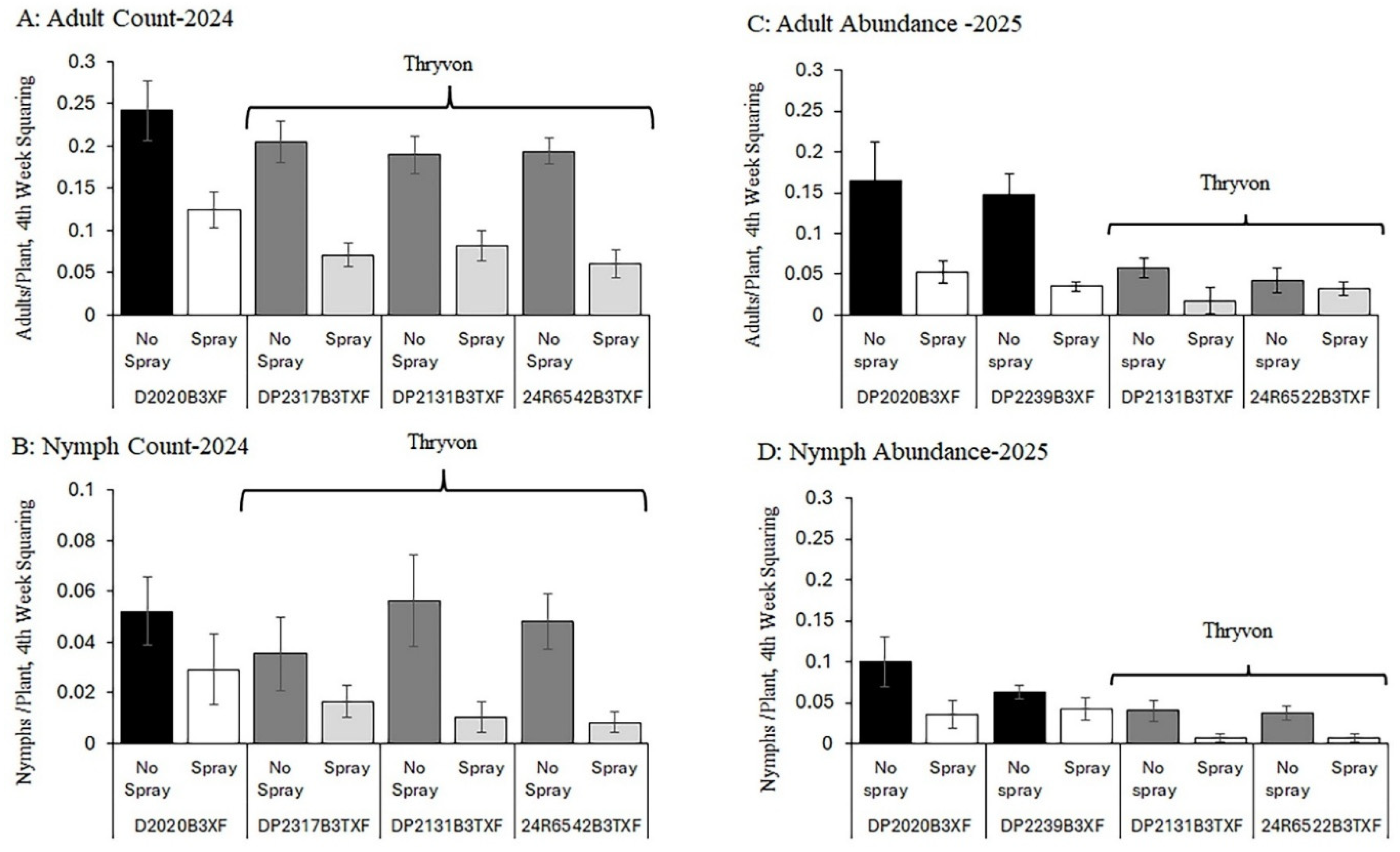
3.1. Cotton Fleahopper Abundance
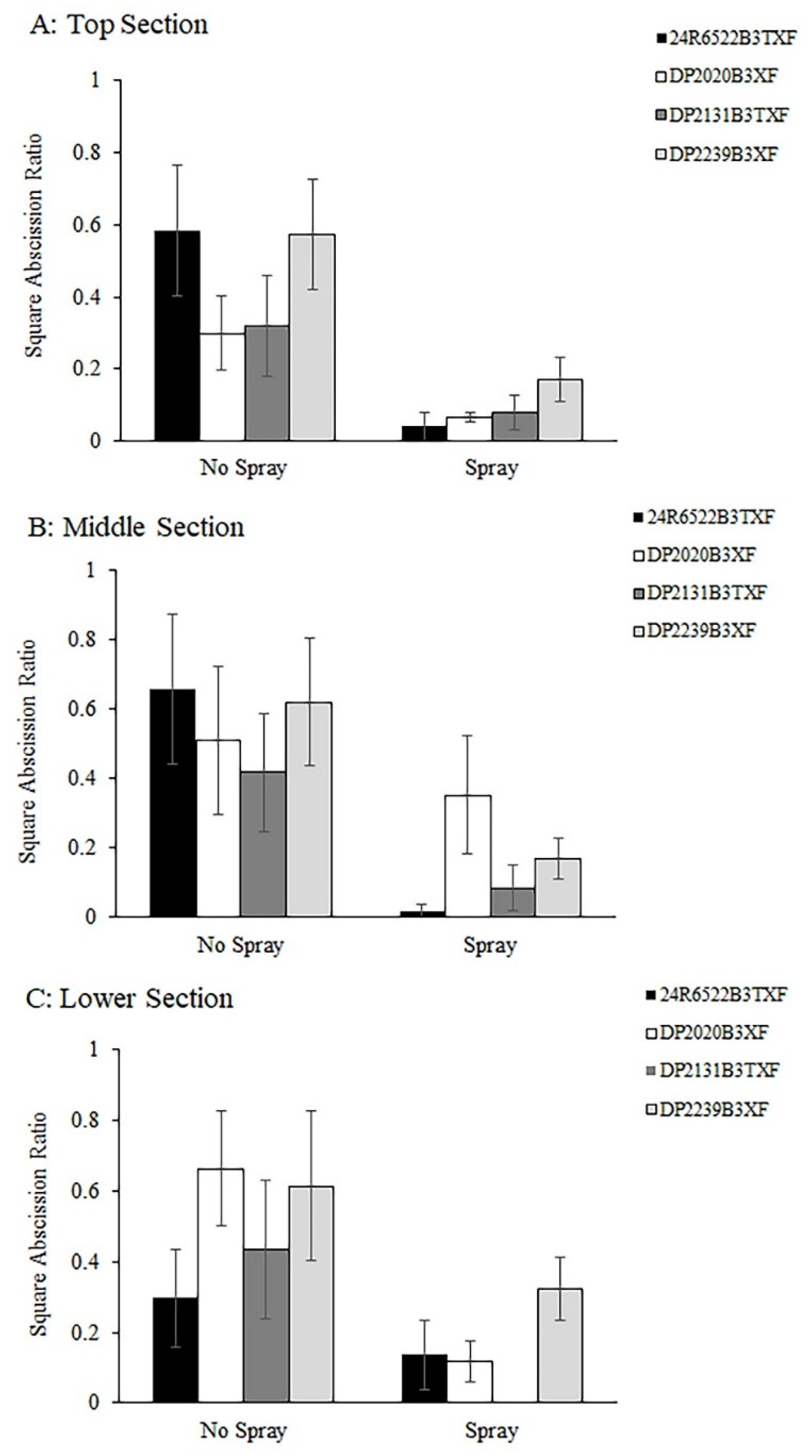
3.2. Square Abscission
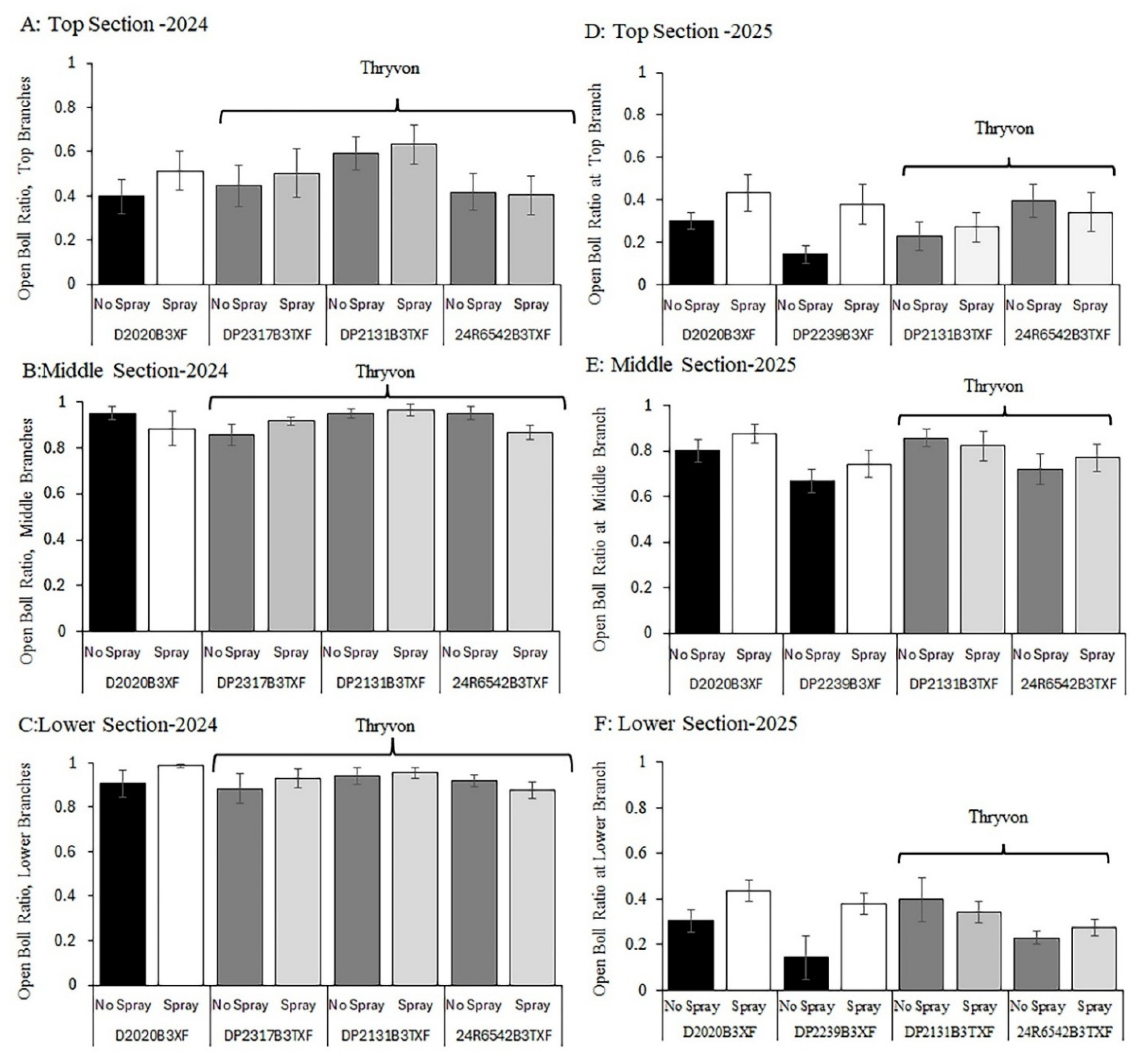
3.3. Open Boll Ratio
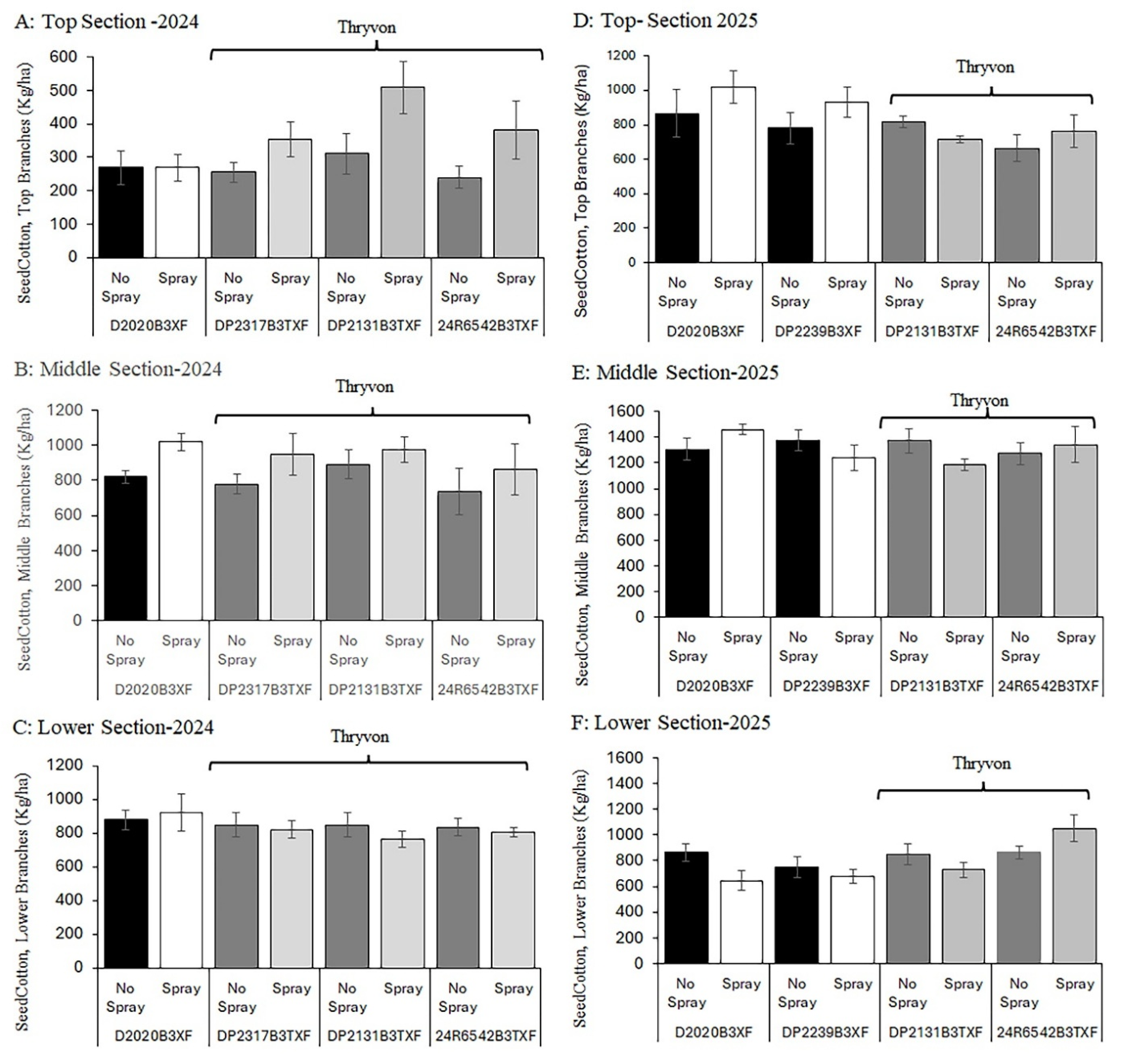
3.4. Seed Cotton Weight by Hand Harvest of Three Plant Sections
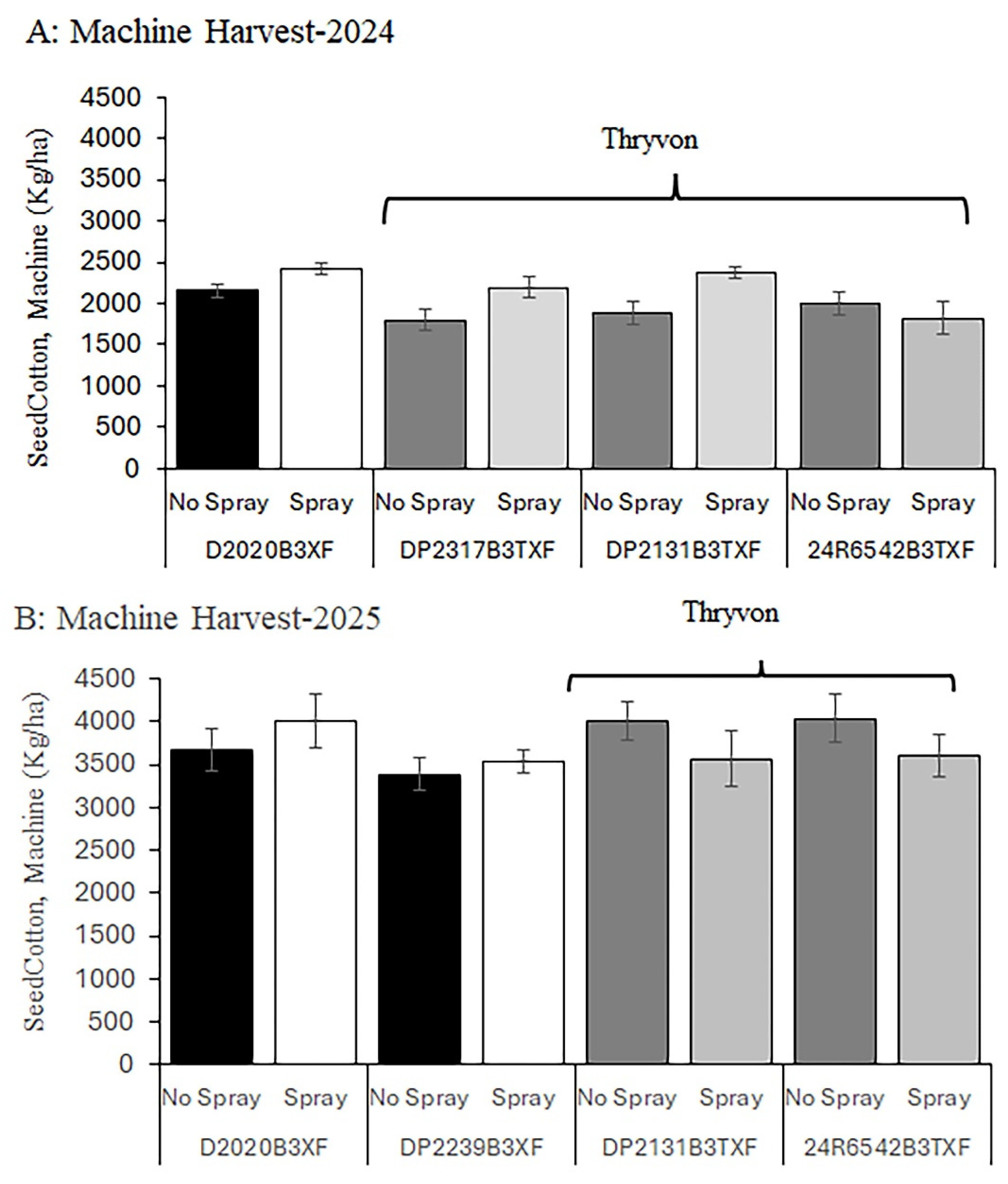
3.5. Seed Cotton Weight from Machine Harvesting
4. Discussion
Supplementary Materials
Author Contributions
Funding
Data Availability Statement
Acknowledgments
Conflicts of Interest
References
- Perkin, L.C.; Hamons, K.L.; Suh, C.P.C.; Sword, G.A. Amplicon sequencing of plant material links cotton fleahopper to host plants. J. Cotton Sci. 2023, 27, 43–51. [Google Scholar] [CrossRef] [Scilit]
- Alwedyan, M.A.; Helms, A.M.; Brewer, M.J. Response of cotton cultivars with varying maturity traits to cotton fleahopper (Hemiptera: Miridae) feeding. J. Econ. Entomol. 2025, 118, 1271–1280. [Google Scholar] [CrossRef] [Scilit] [PubMed]
- Parajulee, M.N.; Shrestha, R.B.; Leser, J.F. Sampling methods, dispersion patterns, and fixed precision sequential sampling plans for western flower thrips (Thysanoptera: Thripidae) and cotton fleahoppers (Hemiptera: Miridae) in cotton. J. Econ. Entomol. 2006, 99, 568–577. [Google Scholar] [CrossRef] [PubMed]
- Brewer, M.J.; Anderson, D.J.; Parajulee, M.N. Cotton water-deficit stress, age, and cultivars as moderating factors of cotton fleahopper abundance and yield loss. Crop Prot. 2016, 86, 56–61. [Google Scholar] [CrossRef] [Scilit]
- Luttrell, R.G.; Teague, T.G.; Brewer, M.J. Cotton insect pest management. In Cotton; American Society of Agronomy, Inc.: Madison, WI, USA, 2015; Volume 57, pp. 509–546. [Google Scholar] [CrossRef] [Scilit]
- Lu, Y.; Wu, K.; Jiang, Y.; Xia, B.; Li, P.; Feng, H.; Wyckhuys, K.A.; Guo, Y. Mirid bug outbreaks in multiple crops correlated with wide-scale adoption of Bt cotton in China. Science 2010, 328, 1151–1154. [Google Scholar] [CrossRef] [Scilit] [PubMed]
- Tabashnik, B.E.; Liesner, L.R.; Ellsworth, P.C.; Unnithan, G.C.; Fabrick, J.A.; Naranjo, S.E.; Li, X.; Dennehy, T.J.; Antilla, L.; Staten, R.T.; et al. Transgenic cotton and sterile insect releases synergize eradication of pink bollworm a century after it invaded the United States. Proc. Natl. Acad. Sci. 2021, 118, e2019115118. [Google Scholar] [CrossRef] [Scilit] [PubMed]
- Kumar, R.; Bhede, B.V.; Paul, D.; Bhute, N.K.; Patil, P.; Patel, R.D.; Variya, M.V.; Hanchinal, S.G.; Matti, P.V.; Navi, S.; et al. Resistance development in pink bollworm (Pectinophora gossypiella Saunders) against Bt cotton and its establishment as mid season pest in India. Sci. Rep. 2025, 15, 7012. [Google Scholar] [CrossRef] [Scilit] [PubMed]
- Adamczyk, A.; Mahaffey, J.S. Efficacy of Vip3A and Cry1Ab transgenic traits in cotton against various Lepidopteran pests. Flor. Entomol. 2008, 91, 570–575. [Google Scholar] [CrossRef] [Scilit]
- Bachman, P.M.; Ahmad, A.; Ahrens, J.E.; Akbar, W.; Baum, J.A.; Brown, S.; Clark, T.L.; Fridley, J.M.; Gowda, A.; Greenplate, J.T.; et al. Characterization of the activity spectrum of MON 88702 and the plant-incorporated protectant Cry51Aa2.834_16. PLoS ONE 2017, 12, e0169409. [Google Scholar] [CrossRef] [Scilit] [PubMed]
- Gowda, A.; Rydel, T.J.; Wollacott, A.M.; Brown, R.S.; Akbar, W.; Clark, T.L.; Flasinski, S.; Nageotte, J.R.; Read, A.C.; Shi, X.; et al. A transgenic approach for controlling Lygus in cotton. Nat. Commun. 2016, 7, 12213. [Google Scholar] [CrossRef] [Scilit] [PubMed]
- Arthur, B.P.; Suh, C.P.C.; McKnight, B.M.; Parajulee, M.N.; Yang, F.; Chappell, T.M.; Kerns, D.L. Evaluation of cotton fleahopper (Pseudatomoscelis seriatus (Reuter)) feeding on Mpp51Aa2-traited cotton utilizing electrical penetration graph (EPG) waveforms. Insects 2024, 15, 316. [Google Scholar] [CrossRef] [Scilit] [PubMed]
- Arthur, B.P.; Suh, C.P.; McKnight, B.M.; Parajulee, M.N.; Yang, F.; Kerns, D.L. Field evaluation of cotton expressing Mpp51Aa2 as a management tool for cotton fleahoppers, Pseudatomoscelis seriatus (Reuter). Toxins 2023, 15, 644. [Google Scholar] [CrossRef] [Scilit] [PubMed]
- Brewer, M.J.; Anderson, D.J.; Armstrong, J.S.; Villanueva, R.T. Sampling strategies for square and boll-feeding plant bugs (Hemiptera: Miridae) occurring on cotton. J. Econ. Entomol. 2012, 105, 896–905. [Google Scholar] [CrossRef] [Scilit] [PubMed]
- Liu, Z.Y.; Chen, Y.; Li, Y.B.; Chen, C.; Ma, Y.X.; Chen, D.H.; Zhang, X.; Zhou, M. Construction of optimum number of fruiting nodes benefit high yield in cotton population. Ind. Crop. Prod. 2020, 158, 113020. [Google Scholar] [CrossRef] [Scilit]
- Littell, R.C.; Freund, R.J.; Spector, P.C. SAS System for Linear Models, 3rd ed.; SAS Institute Inc.: Cary, NC, USA, 1991. [Google Scholar]
- Neter, J.; Wasserman, W.; Kutner, M.H. Applied Linear Statistical Models: Regression, Analysis of Variance, and Experimental Designs, 2nd ed.; R.D. Irwin: Homewood, IL, USA, 1985. [Google Scholar]
- Akbar, W.; Gowda, A.; Ahrens, J.E.; Stelzer, J.W.; Brown, R.S.; Bollman, S.L.; Greenplate, J.T.; Gore, J.; Catchot, A.L.; Lorenz, G.; et al. First transgenic trait for control of plant bugs and thrips in cotton. Pest Manag. Sci. 2019, 75, 867–877. [Google Scholar] [CrossRef] [Scilit] [PubMed]
- Graham, S.H.; Stewart, S.D. Field study investigating Cry51Aa2.834-16 in cotton for control of thrips (Thysanoptera: Thripidae) and tarnished plant bugs (Hemiptera: Miridae). J. Econ. Entomol. 2018, 111, 2717–2726. [Google Scholar] [CrossRef] [Scilit]
- Glover, J.P.; Brewer, M.J.; Parajulee, M.N.; Sword, G.A. Plant response and economic injury levels for a boll-feeding sucking bug complex on cotton. J. Econ. Entomol. 2019, 112, 1227–1236. [Google Scholar] [CrossRef] [Scilit] [PubMed]
- Siviter, H.; Muth, F. Do novel insecticides pose a threat to beneficial insects? Proc. Biol. Sci. 2020, 287, 20201265. [Google Scholar] [CrossRef] [Scilit] [PubMed]
- United States Environmental Protection Agency (USEPA). Insect resistance management for Bt plant-incorporated protectants; U.S. Environmental Protection Agency: Washington, DC, USA, 2026. Available online: https://www.epa.gov/regulation-biotechnology-under-tsca-and-fifra/insect-resistance-management-bt-plant-incorporated (accessed on 23 January 2026).


Disclaimer/Publisher’s Note: The statements, opinions and data contained in all publications are solely those of the individual author(s) and contributor(s) and not of MDPI and/or the editor(s). MDPI and/or the editor(s) disclaim responsibility for any injury to people or property resulting from any ideas, methods, instructions or products referred to in the content. |
© 2026 by the authors. Licensee MDPI, Basel, Switzerland. This article is an open access article distributed under the terms and conditions of the Creative Commons Attribution (CC BY) license.
Share and Cite
Alwedyan, M.A.; Bradicich, P.A.; McGinty, J.A.; Brewer, M.J. Effect of Transgenic Cotton with Bt Event Mpp51Aa2 on Cotton Fleahopper (Pseudatomoscelis seriatus) During Early Cotton Growth and Resulting Plant Injury. Insects 2026, 17, 233. https://doi.org/10.3390/insects17030233
Alwedyan MA, Bradicich PA, McGinty JA, Brewer MJ. Effect of Transgenic Cotton with Bt Event Mpp51Aa2 on Cotton Fleahopper (Pseudatomoscelis seriatus) During Early Cotton Growth and Resulting Plant Injury. Insects. 2026; 17(3):233. https://doi.org/10.3390/insects17030233
Chicago/Turabian StyleAlwedyan, Malek A., Pius A. Bradicich, Joshua A. McGinty, and Michael J. Brewer. 2026. "Effect of Transgenic Cotton with Bt Event Mpp51Aa2 on Cotton Fleahopper (Pseudatomoscelis seriatus) During Early Cotton Growth and Resulting Plant Injury" Insects 17, no. 3: 233. https://doi.org/10.3390/insects17030233
APA StyleAlwedyan, M. A., Bradicich, P. A., McGinty, J. A., & Brewer, M. J. (2026). Effect of Transgenic Cotton with Bt Event Mpp51Aa2 on Cotton Fleahopper (Pseudatomoscelis seriatus) During Early Cotton Growth and Resulting Plant Injury. Insects, 17(3), 233. https://doi.org/10.3390/insects17030233