


Simple Summary
The application of synthetic pesticides remains a cornerstone of contemporary integrated pest management in agriculture; however, growing public and scientific concern surrounds the environmental persistence, non-target toxicity, and human health implications of pesticide residues. Chlorpyrifos, cyfluthrin, emamectin benzoate, and acetamiprid are four widely deployed neurotoxic insecticides that exhibit both contact and systemic toxicity. While their primary mechanisms involve disruption of neuronal signaling, emerging evidence indicates that secondary physiological consequences including impaired cellular energy metabolism and mitochondrial respiration are consistently observed following exposure. As central regulators of cellular bioenergetics, mitochondria harbor a compact, evolutionarily conserved genome encoding core subunits of the oxidative phosphorylation (OXPHOS) complexes. Their high metabolic activity, limited DNA repair capacity, and proximity to reactive oxygen species render them exceptionally vulnerable to xenobiotic stress. This functional and structural sensitivity prompts a critical question: can quantitative changes in mitochondrial gene expression serve as sensitive, mechanistically informed biomarkers for early detection and risk assessment of neurotoxic pesticide exposure?
Abstract
This study investigates the mitochondrial transcriptomic responses of Ramulus phyllodeus (Chen & He, 2008); Phasmatodea: Phasmatidae) to acute exposure to four widely used neurotoxic insecticides: chlorpyrifos, cyfluthrin, emamectin benzoate, and acetamiprid. Using quantitative real-time PCR (qRT-PCR), we quantified transcriptional changes in 10 mitochondrial protein-coding genes, which showed significant transcriptional changes (p < 0.05) when the insect was exposed to four commonly used pesticides (each at a concentration of 5 μg/L) for 24 h. Exposure to chlorpyrifos induced significant upregulation of ND2 (2.08 ± 0.048) and ND5 (1.38 ± 0.15). Cyfluthrin triggered coordinated upregulation across seven genes: ND1 (1.71 ± 0.07), ND2 (2.33 ± 0.38), ND3 (1.74 ± 0.25), ND5 (1.65 ± 0.38), COX1 (2.91 ± 0.40), COX3 (1.69 ± 0.18), and Cytb (2.81 ± 0.53). Emamectin benzoate induced the upregulation of ND1 (1.98 ± 0.21), ND2 (3.04 ± 0.41), ND3 (1.82 ± 0.26), ND4 (2.79 ± 0.64), COX1 (2.36 ± 0.34), ATP6 (3.26 ± 0.61), and Cytb (2.39 ± 0.81). Acetamiprid induced more selective upregulation, affecting only ND1 (1.67 ± 0.18), ND4 (1.43 ± 0.16), and ND5 (1.66 ± 0.10). Critically, each insecticide elicited a distinct, non-overlapping transcriptional signature, defined by both the identity and magnitude of responsive genes, indicating compound-specific modulation of mitochondrial gene expression. Notably, no gene exhibited significant downregulation under any single-compound treatment, and all differentially expressed genes were upregulated exclusively in response to individual pesticides. This absence of transcriptional suppression suggests that these neurotoxicants converge on shared upstream stress-response pathways that preferentially activate mitochondrial biogenesis or compensatory transcription, rather than inducing global transcriptional repression. Collectively, these findings establish mitochondrial protein-coding genes in R. phyllodeus as sensitive, mechanistically grounded molecular sentinels for neurotoxic pesticide exposure. The compound-specific transcriptional profiles further suggest potential utility in multiplex detection strategies for environmental monitoring, enabling discrimination among individual residues.
1. Introduction
Synthetic pesticides, which are vital to agricultural production activities, are extensively utilized in agriculture, forestry, and animal husbandry to prevent and control pests and diseases, thereby ensuring high crop yields [1,2]. However, pesticides are currently recognized as one of the primary contributors to environmental pollution worldwide. They contaminate the environment via runoff, leaching, bioaccumulation, and drift [3]. Moreover, compared to substances with lower acute toxicity, pesticides exhibit high acute toxicity and a pronounced tendency to accumulate within living organisms [4,5]. In other words, long-term contact with pesticides, even at small dosages, might bring about a series of negative effects. The extent of pesticide loss during application is influenced by multiple factors, including cultivated species, climatic conditions, application parameters, and modes of action [6]. For instance, insufficient emphasis on pest control during the egg and nymph stages often results in increased dosages during the adult stage. Additionally, improper dilution ratios, repeated use of specific pesticides, and dose escalation in response to the resistance of Lepidopteran pests further exacerbate pesticide losses [7]. Residual pesticides in the environment can pollute the atmosphere, water, and soil environment [8,9,10], enhance pest resistance to pesticides, alter the structure and function of soil microorganisms [11,12], and even pose threats to the stability of the food chain [13,14].
Currently, pesticide residue detection relies predominantly on three analytical paradigms: chromatographic methods, enzyme inhibition assays, and immunoassay [15]. Chromatography enables highly specific, quantitative multi-residue analysis but requires high instrumentation costs, lengthy sample preparation and analysis times, and specialized technical expertise [16,17]. The enzyme inhibition assays exploit the well-established principle that organophosphates and carbamates reversibly inhibit the activity of acetylcholinesterase (AChE) [18,19]. While this method circumvents complex sample cleanup and offers rapid screening capability, its utility is constrained by inherent enzyme instability, susceptibility to environmental interference, and limited sensitivity toward non-cholinesterase-inhibiting pesticides. Immunoassay is a biochemical detection technology based on the specific interaction between antigens and antibodies, which is sensitive but demands artificial antigen synthesis and often targets single analytes [20,21]. Collectively, these limitations impede scalable, real-time, and multi-analyte monitoring, particularly in field-deployable or resource-limited settings.
Insecticides exert toxic effects on insects through stomach poisoning, contact killing, and fumigation, thereby reducing insect population density [22]. In natural agroecosystems, non-target herbivorous insects are routinely exposed to environmentally relevant, sublethal concentrations of residual pesticides [23]. Such exposure induces a spectrum of sublethal phenotypic impairments including reduced feeding rates, prolonged developmental duration, diminished fecundity, and transgenerational fitness deficits [24,25,26,27]. Residual pesticides can also alter the behavior of herbivorous insects, such as reduced foraging activity, impaired flight ability, and weakened phototaxis, which further affect the survival competitiveness and environmental adaptability [28]. At the molecular level, such exposure modulates the expression of genes related to detoxification and target sites [29,30]. For instance, sublethal imidacloprid exposure alters expression of nicotinic acetylcholine receptor (nAChR) subunit in cockroaches and cytochrome P450 genes in bee larvae [31,32].
Mitochondria, the cellular “powerhouses”, are center to aerobic energy metabolism and exhibit exceptional sensitivity to environmental stress [33]. Insect mitochondrial DNA (mtDNA) is a closed circular molecule with a size ranging from 14,000 bp to 19,000 bp and typically comprises 37 genes, including 13 protein-coding genes (PCGs) essential for oxidative phosphorylation (OXPHOS) [34]. Mounting evidence indicates that mitochondrial gene expression is dynamically regulated in response to diverse stressors including parasitism, thermal stress, and xenobiotic exposure such as pesticide application [35,36,37,38,39,40,41,42]. Pesticides can disrupt mitochondrial function by uncoupling OXPHOS, inhibiting respiratory chain complexes, or inducing excessive reactive oxygen species (ROS) generation [43]. For instance, Guan et al. reported downregulation of COX3, ND4, and ND4L in the mayfly Choroterpes yixingensis following imidacloprid exposure [44], while Chen et al. reported differential mitochondrial gene transcriptional responses to chlorpyrifos across three dragonfly species [35]. However, these studies employed single-pesticide exposure, lacking cross-compound comparisons and thus offer limited capacity to resolve compound-specific molecular signatures. To bridge this methodological gap, this study investigates the transcriptional responses of 10 mitochondrial PCGs in the stick insect Ramulus phyllodeus (Chen & He, 2008) following acute exposure to four widely used neurotoxic pesticides (chlorpyrifos, cyfluthrin, emamectin benzoate, acetamiprid) at a uniform sublethal concentration (5 μg/L, consistent with national food safety standards GB 2763.1-2022 and GB 2763-2021) [45,46]. We aim to (i) identify pesticide-specific regulation patterns among mitochondrial PCGs; (ii) rigorously evaluate their discriminatory power for distinguishing distinct pesticide exposures; and (iii) provide a biologically grounded, transcriptome-informed framework for multi-pesticide environmental monitoring.
2. Materials and Methods
2.1. Sampling and Pesticide Exposure Protocol
The samples used in the experiment were morphologically identified as R. phyllodeus, collected from Wenshan, Yunnan Province, China. A founding population of one wild-caught individual was established in the laboratory and maintained under controlled conditions (25 °C, 80% RH, 12:12 h light–dark photoperiod) for three years across four parthenogenetic generations to ensure genetic homogeneity [47]. Insects were reared in ventilated insect-rearing boxes (80 × 50 × 50 cm) lined with a 2 cm layer of sterilized loamy soil to approximate natural substrate conditions. Perching branches and fresh leaves of Rosa chinensis were provided as both physical support and food source; foliage was replaced every 48 h to maintain nutritional quality and hygiene. Population density was strictly regulated (≤15 nymphs per box) to mitigate intraspecific competition and thereby preserve physiological consistency and viability (>95% survival rate throughout acclimation). For experimental consistency, 45 healthy, developmentally synchronized fourth-instar nymphs, measuring 6.5–8.5 cm in body length (mean ± SD: 7.24 ± 0.53 cm), were selected. All test subjects originated from the same laboratory generation and exhibited uniform morphological and behavioral characteristics. Nymphs were randomly assigned to five treatment groups (n = 9 per group): a chlorpyrifos group (DSP), a cyfluthrin group (FLQ), an emamectin benzoate group (BJS), an acetamiprid group (DCM), and a control group. All exposures were conducted under identical environmental conditions (25 °C, 80% RH, 12:12 h light–dark photoperiod).
The selected exposure concentration of 5 μg/L (about 5 × 10⁻³ mg/kg) was uniformly applied across all four test pesticides and rigorously aligned with the Maximum Residue Limits (MRLs) stipulated in China’s national food safety standards GB 2763.1-2022 and GB 2763-2021 [45,46] for chlorpyrifos, cyfluthrin, emamectin benzoate, and acetamiprid in relevant agricultural commodities. This concentration falls at or below the MRLs for multiple crop categories—including leafy vegetables, fruits, and tea—thereby representing a realistic, environmentally relevant, sublethal exposure level. Its selection ensures ecological validity while enabling detection of subtle physiological and molecular perturbations in R. phyllodeus under chronic low-dose pesticide pressure. A uniform concentration was adopted specifically to control for dosage variability and facilitate direct, cross-compound comparison of mitochondrial gene expression profiles. Critically, no mortality or overt behavioral impairment was observed during the 24 h exposure period, confirming its sublethal nature and suitability for transcriptional analysis. Chlorpyrifos (40% w/w; Jinan Yinong Chemical Co., Ltd., Jinan, China), cyfluthrin (50 g/L EC; Shenzhen Nuopuxin Agrochemical Co., Ltd., Shenzhen, China), emamectin benzoate (5% w/w; Henan Jinxiuzhixing Crop Protection Co., Ltd., Zhengzhou, China), and acetamiprid (5% w/w; Dezhou Xianglong Biochemical Co., Ltd., Dezhou, China) were used in this study. Each compound was serially diluted in ultrapure water to yield a final working concentration of 5 μg/L. Aliquots of 10 mL of each dilution were transferred into pre-labeled, sterile spray bottles; 5 mL was then evenly atomized onto the interior surfaces of corresponding rearing boxes (80 × 50 × 50 cm) containing test nymphs. To minimize errors caused by residual diluent adhering to the inner walls of the spray bottles, the difference method was employed. The control group received an identical volume (5 mL) of ultrapure water under otherwise identical conditions. Following 24 h of exposure, standardized behavioral assessments were conducted immediately prior to dissection. Key observation indicators included overall activity level, grip strength on branches and leaves, and response speed to external stimuli (light touch with a soft brush). Observations were completed within 5 min per group to avoid disturbing the insects excessively. Subsequently, stick insects from each group were removed and dissected individually. The intestines from the first four abdominal segments were excised, placed into labeled 1.5 mL centrifuge tubes, immediately frozen in liquid nitrogen, and afterward kept at −80 °C for subsequent analysis.
2.2. DNA Extraction and Sequencing
A single intestinal sample from a control group, R. phyllodeus was randomly collected. Total genomic DNA was extracted using the Ezup Column Animal Genomic DNA Purification Kit (Shanghai Sangon Biotech Co., Ltd., Shanghai, China) and subsequently stored at −20 °C. The DNA integrity was assessed through 1.0% agarose gel electrophoresis (120 V, 20 min) and visualized under the blue light gel documentation system. Samples exhibiting distinct DNA bands were further analyzed using an Infinite 200 microplate reader in conjunction with I-control software v1.12.4.0 to determine DNA concentration and purity. Samples with a concentration exceeding 50 ng/μL and an A260/A280 ratio within the range of 1.7–1.9 were selected for packaging. Paired-end whole-genome sequencing (2 × 150 bp) was performed on the Illumina NovaSeq 6000 platform (PE150 mode) by Novogene Co., Ltd, Beijing, China.
2.3. Sequence Splicing and Annotation
Complete mitochondrial genome sequences of several species from the Phasmatodea family, downloaded from NCBI, were utilized as reference sequences. High-throughput sequencing data obtained from the server were assembled using NOVOPlasty [48] and GetOrganelle [49] to ensure accuracy in the results. Upon obtaining the complete circular fragments, protein-coding genes, tRNA genes, rRNA genes, and control regions were annotated using SnapGene software v6.0.2; (https://www.snapgene.com/, accessed on 19 May 2022). For further verification and refinement of protein-coding genes, the complete mitochondrial genome sequences of Phasmatodea species with high similarity to the sample sequence were downloaded from NCBI. The “Align selected block by ClustalW” tool in Mega 7.0 software [50] was then used to align and analyze the homologous genes, thereby determining the region and orientations of 13 mtPCGs. For tRNA gene fragment identification, the gene location table provided by MITOS server (http://mitos.bioinf.uni-leipzig.de/index.py, accessed on 10 June 2022) [51] was adopted as the standard. Following localization and annotation, the sequence was uploaded to NCBI to acquire the GenBank accession number with PX092319.
2.4. RNA Extraction and Reverse Transcription
Four intestinal tissue samples were randomly selected from each experimental group (n = 4 per group). Total RNA was extracted using the TaKaRa Mini BEST Universal RNA Extraction Kit (Takara, Tokyo, Japan), in strict accordance with the kit’s operating instructions. The concentration and purity of all extracted RNA samples were determined using an Infinite200 microplate reader with I-control software v1.12.4.0. Samples with an A260/A280 ratio between 1.8 and 2.0 were considered qualified for subsequent experiments and were then stored at −80 °C. Prior to reverse transcription, a DNA removal reaction system was prepared on ice to further eliminate residual DNA. To standardize the RNA input at 500 ng per reaction, the required volumes of qualified RNA and RNase-Free ddH2O were calculated based on the average RNA concentration of each sample group, adjusting the total volume of the RNA-ddH2O mixture to 7 μL. The 10 μL reaction system included 7 μL of the RNA and RNase-Free ddH2O mixture, 2 μL of 5× gDNA Eraser Buffer, and 1 μL of gDNA Eraser. After preparation, the reaction was performed at 42 °C for 2 min. Subsequently, 1 µL PrimerScript RT Enzyme Mix I, 1 µL RT Primer Mix I, 4 µL 5× PrimerScript Buffer 2, and 4 µL RNase-Free ddH2O were added to each tube to prepare a 20 μL reverse transcription reaction system. The reaction program was set as follows: reverse transcription reaction at 37 °C for 15 min, followed by reverse transcriptase inactivation at 85 °C for 5 s. The resulting cDNA samples were promptly stored at −80 °C.
2.5. Design and Screening of RT-qPCR Primers
Based on the complete mitochondrial genome sequence of R. phyllodeus, fluorescent quantitative primers targeting 10 protein-coding genes were designed using Primer Premier v6.0 software (Premier Biosoft International, Palo Alto, CA, USA). The remaining three protein-coding genes (ND4L, ND6, ATP8) were too short to allow for the design of effective primers. For the reference gene, the β-actin gene sequence (GenBank No. MZ486031) closely related to R. phyllodeus was aligned from NCBI using Mega 7.0 [50], and the conserved regions identified from the alignment were used as the basis for designing primers. The cDNA template was diluted in a gradient of 1, 10, 100, 1000, and 10,000 with sterilized water. The RT-qPCR reaction system (20 μL total volume) was prepared on ice, containing 6 µL ddH2O, 10 µL TB Green Premix Ex Taq II (2×), 0.8 µL each of the designed forward and reverse primers, 0.4 µL ROX Reference Dye, and 2 µL cDNA. Three technical replicates were set up for each gradient concentration sample. RT-qPCR reactions were conducted on an Applied Biosystems 7500 instrument, following a standardized procedure: initial pre-denaturation at 95 °C for 30 s, succeeded by 40 amplification cycles (each cycle consisting of denaturation at 95 °C for 5 s and annealing at 52 °C for 30 s), and concluding with a melting curve analysis phase (95 °C for 15 s, 60 °C for 1 min, and 95 °C for 15 s). Eleven pairs of fluorescent quantitative primers, with β-actin serving as the reference gene, were selected adhering to the criteria of a single melting curve peak, an R2 value of the standard curve greater than 0.980, and an E value within the range of 90–110, as summarized in Table 1. All selected primers were synthesized by Sangon Biotech Co., Ltd., Shanghai, China.
Table 1.
Primer sequences of 10 protein-coding genes and β-actin gene in RT-qPCR reaction.
2.6. RT-qPCR Reaction and Data Analysis
The expression changes of ten protein-coding genes relative to the reference gene were analyzed using RT-qPCR. The cDNA template was diluted tenfold for RT-qPCR reaction system preparation, and the reaction system and procedures were consistent with those used for the standard curve determination described above, with three technical replicates per sample. Mean Ct values for each gene were obtained using StepOne Software v2.2.2 (Applied Biosystems, Foster City, CA, USA). In the same sample, the β-actin gene served as the reference gene for calculating target gene expression (ΔCt). For the same gene, the difference in the target gene expression between the experimental group and the control group was calculated (ΔΔCt). Subsequently, the relative fold change in target gene expression (experimental group/control group) was determined using the formula (2−ΔΔCt). Results for each group are presented as “mean ± standard error” of the relative fold change. Genes exhibiting significant differences (p < 0.05) or extremely significant differences (p < 0.01) between the experimental and control groups were identified using a t-test. To visualize gene expression differences, graphs were generated using Origin 8.0 software (https://www.originlab.com/, accessed on 20 July 2022). The t-test was used to examine the significant differences between the experimental and control groups (p < 0.05 for a significant difference; p < 0.01 for an extremely significant difference).
3. Results
3.1. Components of the Mitochondrial Genome of Ramulus phyllodeus
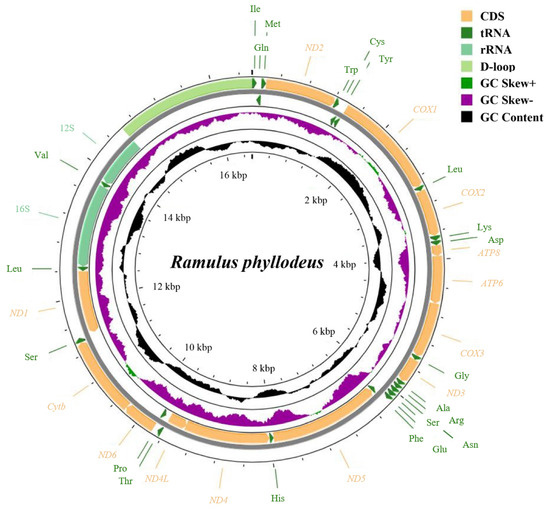
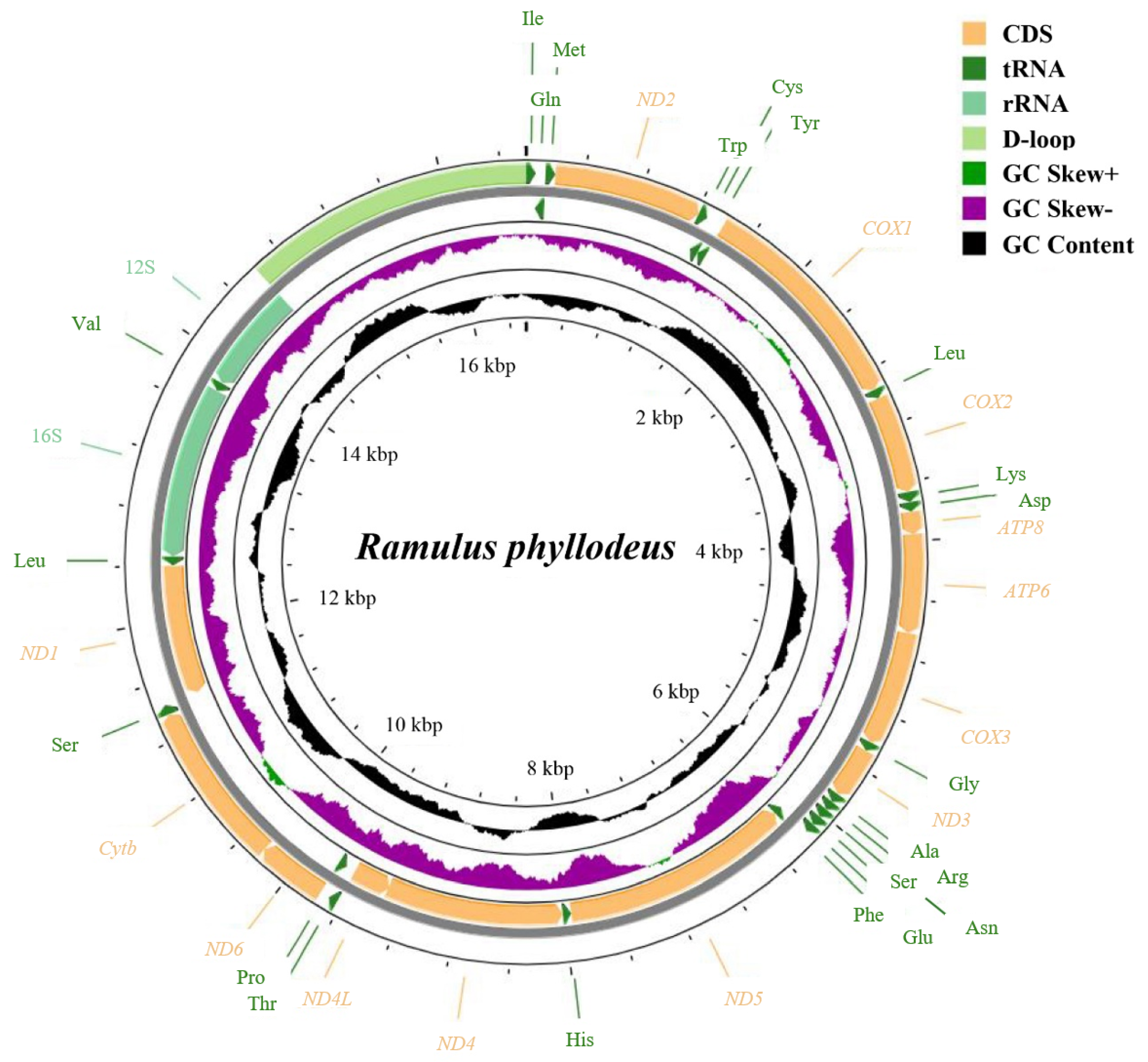
This study determined the complete mitochondrial genome sequence of R. phyllodeus with the length of 16,575 bp. The gene arrangement is consistent with that of the congeneric species published in NCBI. The circular mitochondrial genome comprises 13 protein-coding genes, 2 rRNA genes, and 22 tRNA genes, along with a control region (D-loop) located between ND1 and ND2 (see Figure 1). Among them, the ND1, ND4, ND4L, and ND5 genes, as well as eight tRNA genes (trnQ, trnC, trnY, trnF, trnH, trnP, trnL, trnV), are encoded by the light strand, while the remaining genes are encoded by the heavy strand. The base composition of the heavy strand is as follows: A (43.02%), T (32.75%), C (13.99%), and G (10.24%).
Figure 1.
Visualization of the complete mitochondrial genome sequence of Ramulus phyllodeus.
3.2. Quantitative Analysis of Mitochondrial Protein-Coding Genes
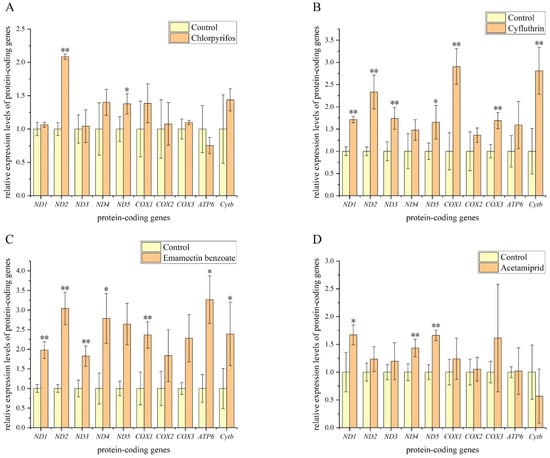
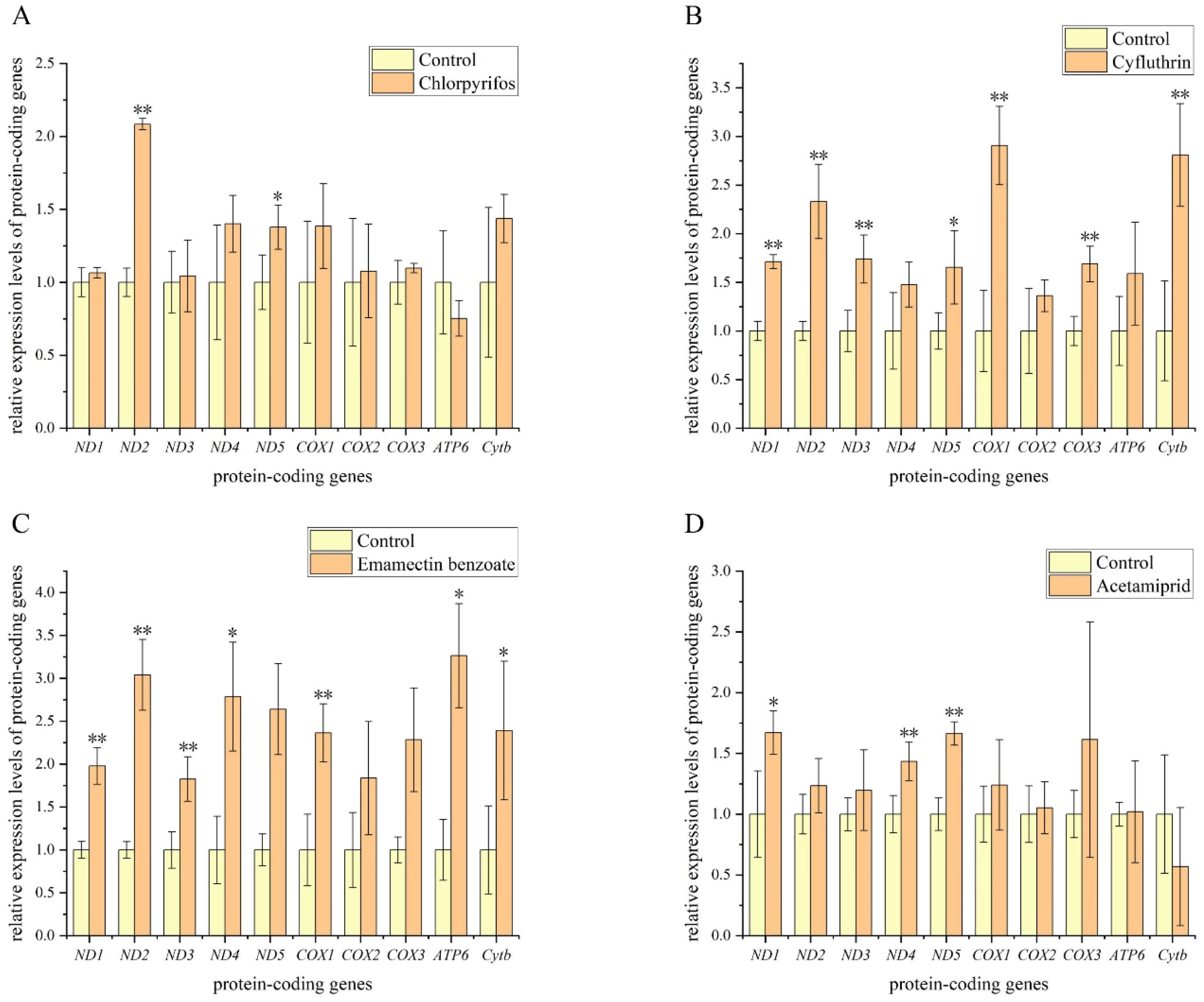
The relative expression levels of 10 protein-coding genes were determined by RT-qPCR in R. phyllodeus nymphs following 24 h exposure to 5 μg/L of each test pesticide. As shown in Figure 2, all treatments induced significant, compound-specific transcriptional modulation of mitochondrial protein-coding genes. After 24 h exposure to 5 μg/L chlorpyrifos, significant upregulation was observed in the transcription levels of two genes: ND2 and ND5. Specifically, ND2 transcription increased by 2.08 ± 0.04 (p < 0.05), while ND5 transcription rose by 1.38 ± 0.15 (p < 0.01), both showing statistically significant differences compared to the control group. For the cyfluthrin treatment group (5 μg/L, 24 h), the transcriptional level of ND5 was upregulated by 1.65 ± 0.38 (p < 0.05), while the transcriptional levels of ND1, ND2, ND3, COX1, COX3, and Cytb were significantly different from those of the control group (p < 0.01), with fold changes of 1.71 ± 0.07, 2.33 ± 0.38, 1.74 ± 0.25, 2.91 ± 0.40, 1.69 ± 0.18, and 2.81 ± 0.53, respectively. After treatment with 5 μg/L emamectin benzoate for 24 h, the transcription levels of ND4, ATP6, and Cytb were increased by 2.79 ± 0.64, 3.26 ± 0.61, and 2.39 ± 0.81, respectively (p < 0.05). Additionally, the transcription levels of ND1, ND2, ND3, and COX1 were increased by 1.98 ± 0.21, 3.04 ± 0.41, 1.82 ± 0.26, and 2.36 ± 0.34, respectively (p < 0.01). After treatment with 5 μg/L acetamiprid for 24 h, the expression level of ND1 was increased by 1.67 ± 0.18 (p < 0.05), and the expression levels of ND4 and ND5 were increased by 1.43 ± 0.16 and 1.66 ± 0.10 (p < 0.01), respectively.
Figure 2.
Relative expression levels of 10 protein-coding genes under 5 μg/L of different pesticide stresses compared to the control group: (A) chlorpyrifos, (B) cyfluthrin, (C) emamectin benzoate, and (D) acetamiprid. The X-axis represents gene name, and the Y-axis represents the relative gene expression levels. Error bars indicate standard errors, and asterisks denote levels of significance: *, p < 0.05; **, p < 0.01 (p values were calculated using t-test analysis).
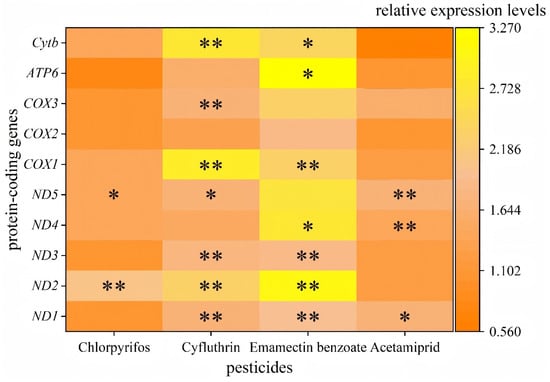
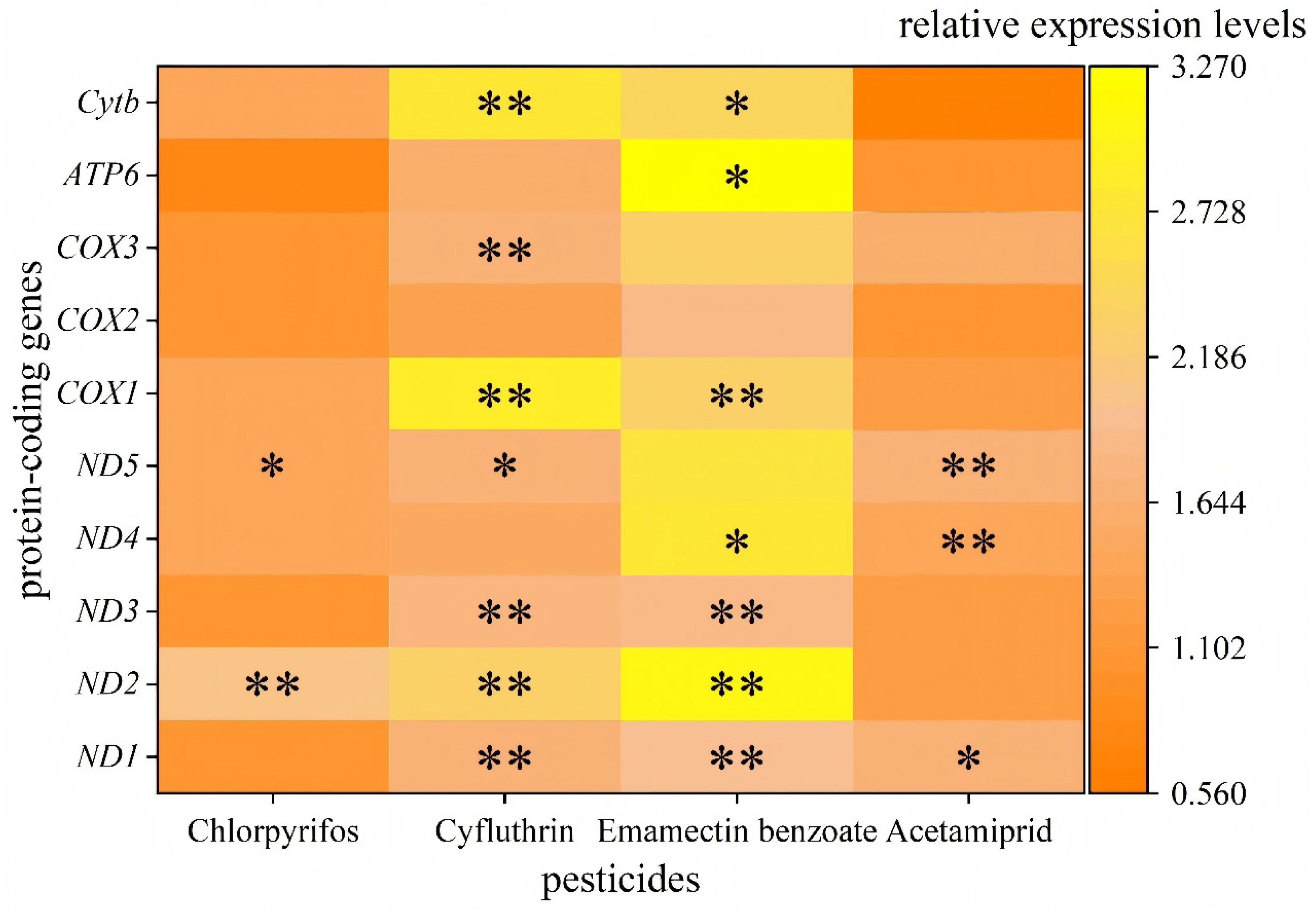
To systematically compare mitochondrial gene expression responses across pesticide treatments, fold-change data from Figure 2 were consolidated into an unsupervised hierarchical heatmap (Figure 3). Hierarchical clustering revealed three treatment-associated expression modules: the cyfluthrin treatment group was characterized by high expression of COX3 and Cytb; ATP6 exhibited exclusive, high-magnitude induction only under emamectin benzoate exposure; and ND2/ND5 showed coordinated upregulation in chlorpyrifos-treated nymphs, while ND1/ND4/ND5 constituted a functionally coherent response module specific to acetamiprid.
Figure 3.
Heatmap of differential expression of 10 protein-coding genes in R. phyllodeus exposed to four neurotoxic pesticides. In the heat map, the Y-axis represents gene names, while the X-axis indicates four pesticide treatment groups (DSP: chlorpyrifos, FLQ: cyfluthrin, BJS: emamectin benzoate, DCM: acetamiprid); the color gradient reflects the relative expression level of genes, and asterisks mark genes with significant differential expression (*, p < 0.05; **, p < 0.01).
Following 24 h exposure to 5 μg/L chlorpyrifos, cyfluthrin, emamectin benzoate, or acetamiprid compared to the control, no mortality was observed in all five treatment groups. Among them, R. phyllodeus exposed to chlorpyrifos or acetamiprid groups maintained normal locomotor activity and grip strength, suggesting inherent tolerance to these compounds. In contrast, individuals exposed to cyfluthrin or emamectin benzoate exhibited significantly reduced branch adhesion, delayed righting reflexes, and sluggish movement, consistent with sublethal neurotoxic impairment. Critically, this behavioral sensitivity correlated strongly with transcriptional responsiveness: cyfluthrin and emamectin benzoate induced significant expression changes in seven different mitochondrial genes, whereas chlorpyrifos and acetamiprid affected only two and three genes (Figure 3). This concordance between phenotypic and molecular endpoints underscores the biological relevance of the observed gene expression shifts.
4. Discussion
4.1. Analysis of Differences Between Pesticide Treatments
Under cyfluthrin exposure, COX3 was significantly upregulated, a response observed exclusively in the cyfluthrin-treated group across all replicate experiments. As an essential structural subunit of mitochondrial respiratory complex IV, the COX3 gene is indispensable for efficient electron transfer and proton-pumping activity. Mitochondria serve as the central target for pyrethroids insecticide toxicity [52,53]. Pyrethroids act by interacting with lipid membranes, disrupting the delicate balance between membrane lipids and membrane proteins (particularly mitochondrial substrate transporters and electron carriers), thereby altering the metabolic strategies for energy production. Therefore, the specific upregulation of COX3 may be related to the interference of pyrethroid pesticides on mitochondrial membrane structure [54,55]. The selective induction of COX3 therefore likely represents a compensatory transcriptional adaptation aimed at stabilizing complex IV assembly and function in response to membrane destabilization.
The ATP6 gene exhibited exclusive upregulation only in the emamectin benzoate treatment group. Its transcription level increased by 3.26 ± 0.61 compared with the control group (p < 0.05), while no significant expression changes were detected in the chlorpyrifos, cyfluthrin, and acetamiprid treatment groups (p > 0.05). Given its central role in coupling proton motive force to ATP synthesis, ATP6 induction strongly suggests that emamectin benzoate compromises mitochondrial membrane potential, thereby reducing oxidative phosphorylation efficiency. This upregulation is interpreted as a homeostatic feedback response enhancing ATP synthase biogenesis to partially restore cellular energy homeostasis [56].
Collectively, each pesticide elicited a non-overlapping, class-specific transcriptional signature among the ten mitochondrial protein-coding genes. This high degree of specificity enables unambiguous discrimination between neurotoxic pesticide classes based on gene expression profiles, a capability that extends beyond conventional residue detection methods (e.g., GC-MS, ELISA), which rely on chemical identification of single compounds. Notably, all differentially expressed genes showed consistent unidirectional upregulation; no downregulation or transcriptional suppression was observed under any treatment. This uniform directional response implies additive or synergistic transcriptional activation under multi-pesticide exposure, supporting the utility of this mitochondrial gene panel for detecting environmentally realistic pesticide mixtures. By linking molecular signatures to mechanistically distinct neurotoxic pathways, this approach provides a biologically grounded, functionally interpretable alternative to purely analytical monitoring strategies.
4.2. Mechanism of Pesticide-Specific Gene Expression
In this study, sublethal doses of four different pesticides at low concentrations and short exposure durations were applied to stress R. phyllodeus. Compared with traditional toxicology studies that primarily focus on the toxic effects of high pollutant concentrations, this approach better reflects the actual response of target organisms and facilitates the screening of indicator genes sensitive to specific toxicities. The mitochondrial genome of insect cells has been identified as containing 13 protein-coding genes, all integral components of the oxidative phosphorylation system [57]. Critically, emerging evidence indicates the four test pesticides concurrently disrupt mitochondrial bioenergetics through compound-specific pathways: cyfluthrin impairs membrane integrity; emamectin benzoate compromises mitochondrial membrane potential; chlorpyrifos inhibits complex I; and acetamiprid alters calcium homeostasis, all converging on suppressed oxidative phosphorylation [58,59].
Mitochondria serve as both sensors and effectors of cellular energy stress. Pesticide-induced inhibition of glycolysis reduces pyruvate flux into mitochondria, dampening tricarboxylic acid (TCA) cycle activity and ATP synthesis. Concurrently, respiratory chain interference elevates reactive oxygen species (ROS) production, triggering oxidative stress [60,61]. The observed upregulation of mitochondrial protein-coding genes thus reflects a coordinated adaptive program: enhancing respiratory complex biogenesis to sustain ATP supply under energetic deficit; and bolstering antioxidant defense capacity to mitigate ROS-mediated damage and preserve redox homeostasis [62]. Importantly, the distinct gene expression patterns induced by each neuro-insecticide, demonstrated to be reproducible and statistically robust, differ significantly from transcriptional signatures reported for fungicides, herbicides, botanical agents (e.g., azadirachtin), or abiotic stressors in insects [35,36,37,38,39,40,41,42,43,44]. This may indicate that they can serve as reliable biomarkers for distinguishing neurotoxic pesticide exposure.
4.3. Advantages of Biological Monitoring
Biological monitoring has key advantages over chemical residue analysis: it integrates exposure, uptake, biotransformation, and bioaccumulation to deliver a physiologically meaningful, time-integrated measure of ecotoxicological impact. Due to bioaccumulation, biological monitoring can more directly and rapidly reflect the impact of environmental quality on ecosystems compared to chemical detection methods. R. phyllodeus, widely distributed in southern China, is easy to culture and highly sensitive to environmental changes, making it a suitable indicator organism. It not only quantifies actual pesticide exposure and tissue-level accumulation in ecosystems but also serves as an early-warning indicator of ecological risk, thereby delivering direct, field-applicable biological evidence to support environmental pesticide residue monitoring. This functional responsiveness robustly validates the use of R. phyllodeus mitochondrial gene expression signatures as mechanism-informed biomarkers for neurotoxic pesticide exposure.
5. Conclusions
This study investigated the transcriptional responses of 10 mitochondrial protein-coding genes in R. phyllodeus after 24 h exposure to four neurotoxic pesticides (chlorpyrifos, cyfluthrin, emamectin benzoate, acetamiprid) at an environmentally relevant sublethal concentration of 5 μg/L. All differentially expressed mitochondrial genes exhibited a significant upregulation pattern with no downregulation or antagonism, which reveals a conserved adaptive stress response mechanism in R. phyllodeus—the activation of mitochondrial gene expression to compensate for pesticide-induced impairments in cellular energy metabolism and oxidative phosphorylation. More importantly, each of the four pesticides induced a distinct transcriptional signature of mitochondrial genes, with chlorpyrifos specifically regulating ND2 and ND5; cyfluthrin modulating seven genes including ND1, ND2, ND3, ND5, COX1, COX3, and Cytb; emamectin benzoate regulating ND1, ND2, ND3, ND4, COX1, ATP6, and Cytb; acetamiprid targeting ND1, ND4, and ND5. These patterns enable mixed-pesticide residue detection, overcoming limitations of single-target methods like chromatography. However, this study did not verify gene expression changes under combined pesticide treatments nor establish concentration gradient stress culture to fit gene expression level change curve across a concentration series. Practical field applications will rely on supplementary data from follow-up experiments, particularly those regarding combined-pesticide effects and dose–response relationships. Nonetheless, this study underscores the potential of mitochondrial protein-coding gene transcript levels as mechanistically grounded biomarkers and provides a novel research direction for environmental pesticide residue monitoring.
Author Contributions
T.L.: Writing—original draft, Visualization, Writing—review and editing, Validation, Software, Funding acquisition, Data curation. F.G.: Writing—original draft, Visualization, Writing—review and editing, Validation, Software, Data curation. Y.C.: Software, Methodology, Writing—review and editing, Validation, Data curation. S.M.: Software, Methodology, Writing—review and editing, Data curation. J.H.: Software, Methodology, Writing—review and editing, Data curation. D.Y.: Methodology, Writing—review and editing, Project administration. J.Z.: Methodology, Writing—review and editing, Resources, Project administration, Funding acquisition. All authors have read and agreed to the published version of the manuscript.
Funding
This work was supported by the Natural Science Foundation of China (32470475) and the College Students’ Innovation and Entrepreneurship Training Program of China (Grant No. 202410345057). The funders had no role in the study design, data collection and analysis, decision to publish, or preparation of the manuscript.
Data Availability Statement
The data supporting the findings of this study are openly available from the National Center for Biotechnology Information at https://www.ncbi.nlm.nih.gov (accessed on 3 May 2024). The accession number is PX092319.
Acknowledgments
We gratefully acknowledge Yani Yuan, Lijie Zhao, and Sijie Zhu for their valuable contributions to the experiment.
Conflicts of Interest
The authors declare no conflicts of interest.
References
- Mahmood, I.; Imadi, S.R.; Shazadi, K.; Gul, A.; Hakeem, K.R. Effects of Pesticides on Environment. In Plant, Soil and Microbes: Volume 1: Implications in Crop Science; Hakeem, K.R., Akhtar, M.S., Abdullah, S.N.A., Eds.; Springer International Publishing: Cham, Switzerland, 2016; pp. 253–269. [Google Scholar]
- Sharma, A.; Kumar, V.; Shahzad, B.; Tanveer, M.; Sidhu, G.P.S.; Handa, N.; Kohli, S.K.; Yadav, P.; Bali, A.S.; Parihar, R.D.; et al. Worldwide pesticide usage and its impacts on ecosystem. SN Appl. Sci. 2019, 1, 1446. [Google Scholar] [CrossRef] [Scilit]
- Nehra, M.; Dilbaghi, N.; Marrazza, G.; Kaushik, A.; Sonne, C.; Kim, K.H.; Kumar, S. Emerging nanobiotechnology in agriculture for the management of pesticide residues. J. Hazard. Mater. 2021, 401, 123369. [Google Scholar] [CrossRef] [Scilit] [PubMed]
- Al-Saleh, I.A. Pesticides: A review article. J. Environ. Pathol. Toxicol. Oncol. 1994, 13, 151–161. [Google Scholar] [PubMed]
- Cheng, H.H. Pesticides in the Soil Environment—An Overview. In Pesticides in the Soil Environment: Processes, Impacts and Modeling; SSSA Book Series; Soil Science Society of America: Madison, WI, USA, 1990; pp. 1–5. [Google Scholar]
- Farha, W.; Abd El Aty, A.M.; Rahman, M.M.; Shin, H.C.; Shim, J.H. An overview on common aspects influencing the dissipation pattern of pesticides: A review. Environ. Monit. Assess. 2016, 188, 693. [Google Scholar] [CrossRef] [Scilit]
- Wan, N.F.; Fu, L.; Dainese, M.; Kiær, L.P.; Hu, Y.Q.; Xin, F.; Goulson, D.; Woodcock, B.A.; Vanbergen, A.J.; Spurgeon, D.J.; et al. Pesticides have negative effects on non-target organisms. Nat. Commun. 2025, 16, 1360. [Google Scholar] [CrossRef] [Scilit]
- Ali, S.; Ullah, M.I.; Sajjad, A.; Shakeel, Q.; Hussain, A. Environmental and Health Effects of Pesticide Residues. In Sustainable Agriculture Reviews 48: Pesticide Occurrence, Analysis and Remediation Vol. 2 Analysis; Inamuddin, Ahamed, M.I., Lichtfouse, E., Eds.; Springer International Publishing: Cham, Switzerland, 2021; pp. 311–336. [Google Scholar]
- Klátyik, S.; Takács, E.; Barócsi, A.; Lenk, S.; Kocsányi, L.; Darvas, B.; Székács, A. Hormesis, the individual and combined phytotoxicity of the components of glyphosate-based formulations on algal growth and photosynthetic activity. Toxics 2024, 12, 257. [Google Scholar] [CrossRef] [Scilit]
- Syafrudin, M.; Kristanti, R.A.; Yuniarto, A.; Hadibarata, T.; Rhee, J.; Al-Onazi, W.A.; Algarni, T.S.; Almarri, A.H.; Al-Mohaimeed, A.M. Pesticides in drinking water—A review. Int. J. Environ. Res. Public Health 2021, 18, 468. [Google Scholar] [CrossRef] [Scilit]
- Meena, R.S.; Kumar, S.; Datta, R.; Lal, R.; Vijayakumar, V.; Brtnicky, M.; Sharma, M.P.; Yadav, G.S.; Jhariya, M.K.; Jangir, C.K. Impact of agrochemicals on soil microbiota and management: A review. Land 2020, 9, 34. [Google Scholar] [CrossRef] [Scilit]
- Gupta, A.; Singh, U.B.; Sahu, P.K.; Paul, S.; Kumar, A.; Malviya, D.; Singh, S.; Kuppusamy, P.; Singh, P.; Paul, D. Linking soil microbial diversity to modern agriculture practices: A review. Int. J. Environ. Res. Public Health 2022, 19, 3141. [Google Scholar] [CrossRef] [Scilit]
- Mostafalou, S.; Abdollahi, M. Pesticides and human chronic diseases: Evidences, mechanisms, and perspectives. Toxicol. Appl. Pharmacol. 2013, 268, 157–177. [Google Scholar] [CrossRef] [Scilit]
- Parven, A.; Khan, M.S.I.; Prodhan, M.D.H.; Venkateswarlu, K.; Megharaj, M.; Meftaul, I.M. Human health risk assessment through quantitative screening of insecticide residues in two green beans to ensure food safety. J. Food Compos. Anal. 2021, 103, 104121. [Google Scholar] [CrossRef] [Scilit]
- Yun, P.; Jinorose, M.; Devahastin, S. Rapid smartphone-based assays for pesticides inspection in foods: Current status, limitations, and future directions. Crit. Rev. Food Sci. Nutr. 2024, 64, 6251–6271. [Google Scholar] [CrossRef] [Scilit] [PubMed]
- Pundir, C.; Malik, A. Bio-sensing of organophosphorus pesticides: A review. Biosens. Bioelectron. 2019, 140, 111348. [Google Scholar] [CrossRef] [Scilit] [PubMed]
- Ejigu, A.; Tefera, M.; Guadie, A.; Abate, S.G.; Kassa, A. A review of voltammetric techniques for sensitive detection of organophosphate pesticides in environmental samples. ACS Omega 2025, 10, 29929–29949. [Google Scholar] [CrossRef] [Scilit] [PubMed]
- Guo, Y.; Zheng, X.; Wang, X.; Zhang, Z.; Qin, S.; Wang, X.; Jing, X. Deep eutectic solvent-based adhesive tape extraction combined with enzyme inhibition assay for the determination and distinction of dithiocarbamate pesticides in food samples. Talanta 2023, 260, 124601. [Google Scholar] [CrossRef] [Scilit]
- Ma, Y.; Liu, X.; Zheng, J.; Huang, M.; Hou, J.; Luo, H.; Hou, C.; Huo, D. Detection of organophosphorus pesticides by a fluorescent sensing assay coupled with enzyme inhibition. J. Food Compos. Anal. 2024, 129, 106139. [Google Scholar] [CrossRef] [Scilit]
- Fang, B.; Xiong, Q.; Duan, H.; Xiong, Y.; Lai, W. Tailored quantum dots for enhancing sensing performance of lateral flow immunoassay. Trends Anal. Chem. 2022, 157, 116754. [Google Scholar] [CrossRef] [Scilit]
- Li, Z.; Dong, H.; Wang, H.; Li, D.; Zhou, S.; Zhai, S.; Huang, J.; Xu, R.; Zhao, W.; Ahmed, M.B.M. Novel time-resolved fluorescent-based multiplex immunochromatography test strip for simultaneous detection of pesticides in vegetables. Food Chem. 2025, 464, 141916. [Google Scholar] [CrossRef] [Scilit]
- Rasheed, R.; Buhroo, A. Toxic and behavioral effect of pesticides on aphidophagus predator, Coccinella septempunctata (Linnaeus, 1758) (Coleoptera: Coccinellidae) under laboratory conditions. J. Entomol. Res. Soc. 2023, 25, 491–505. [Google Scholar] [CrossRef] [Scilit]
- Liu, J.; Shi, J.; Hu, Y.; Su, Y.; Zhang, Y.; Wu, X. Flumethrin exposure perturbs gut microbiota structure and intestinal metabolism in honeybees (Apis mellifera). J. Hazard. Mater. 2024, 480, 135886. [Google Scholar] [CrossRef] [Scilit]
- Chen, M.; Jing, Z.; Chen, L.; Ye, H.; Yan, C.; Feng, G. Insect growth inhibitor activity of allamdin against Spodoptera litura (Fabricius) (Lepidoptera: Noctuidae). Chin. J. Trop. Crops 2020, 41, 346–350. [Google Scholar] [CrossRef]
- Meng, X.; Zhang, N.; Yang, X.; Miao, L.; Jiang, H.; Ji, C.; Xu, B.; Qian, K.; Wang, J. Sublethal effects of chlorantraniliprole on molting hormone levels and mRNA expressions of three Halloween genes in the rice stem borer, Chilo suppressalis. Chemosphere 2020, 238, 124676. [Google Scholar] [CrossRef] [Scilit] [PubMed]
- Long, G.; Liu, L.; Yang, H.; Wang, Z.; Jin, D.; Zhou, C. Sublethal effects of pymetrozine on the development, reproduction and insecticidal susceptibility of Sogatella furcifera (Hemiptera: Delphacidae). Acta. Entomol. Sin. 2017, 60, 790–798. [Google Scholar] [CrossRef]
- Wu, C.; Sun, T.; He, M.; Zhang, L.; Zhang, Y.; Mao, L.; Zhu, L.; Jiang, H.; Zheng, Y.; Liu, X. Sublethal toxicity, transgenerational effects, and transcriptome expression of the neonicotinoid pesticide cycloxaprid on demographic fitness of Coccinella septempunctata. Sci. Total Environ. 2022, 842, 156887. [Google Scholar] [CrossRef] [Scilit]
- Tan, K.; Chen, W.; Dong, S.; Liu, X.; Wang, Y.; Nieh, J.C. A neonicotinoid impairs olfactory learning in Asian honey bees (Apis cerana) exposed as larvae or as adults. Sci. Rep. 2015, 5, 10989. [Google Scholar] [CrossRef] [Scilit]
- Roat, T.C.; Carvalho, S.M.; Palma, M.S.; Malaspina, O. Biochemical response of the Africanized honeybee exposed to fipronil. Environ. Toxicol. Chem. 2017, 36, 1652–1660. [Google Scholar] [CrossRef] [Scilit]
- Lalouette, L.; Pottier, M.A.; Wycke, M.A.; Boitard, C.; Bozzolan, F.; Maria, A.; Demondion, E.; Chertemps, T.; Lucas, P.; Renault, D.; et al. Unexpected effects of sublethal doses of insecticide on the peripheral olfactory response and sexual behavior in a pest insect. Environ. Sci. Pollut. Res. 2016, 23, 3073–3085. [Google Scholar] [CrossRef] [Scilit]
- Wang, X.; Sun, H.; Zhang, Y.; Liu, C.; Liu, Z. Transcriptional changes in nAChRs, interactive proteins and P450s in Locusta migratoria manilensis (Orthoptera: Acrididae) CNS in response to high and low oral doses of imidacloprid. J. Insect Sci. 2015, 15, 102. [Google Scholar] [CrossRef] [Scilit]
- Derecka, K.; Blythe, M.J.; Malla, S.; Genereux, D.P.; Guffanti, A.; Pavan, P.; Moles, A.; Snart, C.; Ryder, T.; Ortori, C.A.; et al. Transient exposure to low levels of insecticide affects metabolic networks of honeybee larvae. PLoS ONE 2013, 8, e68191. [Google Scholar] [CrossRef] [Scilit]
- Boore, J.L. Animal mitochondrial genomes. Nucleic Acids Res. 1999, 27, 1767–1780. [Google Scholar] [CrossRef] [Scilit]
- Jiang, S.T.; Hong, G.Y.; Yu, M.; Li, N.; Yang, Y.; Liu, Y.Q.; Wei, Z.J. Characterization of the complete mitochondrial genome of the giant silkworm moth, Eriogyna pyretorum (Lepidoptera: Saturniidae). Int. J. Biol. Sci. 2009, 5, 351–365. [Google Scholar] [CrossRef] [Scilit]
- Chen, Y.; Yang, Z.; Guo, Z.; Zhan, L.; Storey, K.B.; Yu, D.; Zhang, J. Mitochondrial gene expression of three different dragonflies under the stress of chlorpyrifos. Insects 2025, 16, 85. [Google Scholar] [CrossRef] [Scilit] [PubMed]
- Hong, Y.H.; Yuan, Y.N.; Li, K.; Storey, K.B.; Zhang, J.Y.; Zhang, S.S.; Yu, D.N. Differential mitochondrial genome expression of four Hylid frog species under low-temperature stress and its relationship with Amphibian temperature adaptation. Int. J. Mol. Sci. 2024, 25, 5967. [Google Scholar] [CrossRef] [Scilit] [PubMed]
- Jin, W.T.; Guan, J.Y.; Dai, X.Y.; Wu, G.J.; Zhang, L.P.; Storey, K.B.; Zhang, J.Y.; Zheng, R.Q.; Yu, D.N. Mitochondrial gene expression in different organs of Hoplobatrachus rugulosus from China and Thailand under low-temperature stress. BMC Zool. 2022, 7, 24. [Google Scholar] [CrossRef] [Scilit] [PubMed]
- Wang, J.Y.; Zhang, L.H.; Hong, Y.H.; Cai, L.N.; Storey, K.B.; Zhang, J.Y.; Zhang, S.S.; Yu, D.N. How does mitochondrial protein-coding gene expression in Fejervarya kawamurai (Anura: Dicroglossidae) respond to extreme temperatures? Animals 2023, 13, 3015. [Google Scholar] [CrossRef] [Scilit]
- Wu, X.; Zhan, L.; Storey, K.B.; Zhang, J.; Yu, D. Differential mitochondrial genome expression of four skink species under high-temperature stress and selection pressure analyses in Scincidae. Animals 2025, 15, 999. [Google Scholar] [CrossRef] [Scilit]
- Zhan, L.; He, J.; Ding, L.; Storey, K.B.; Zhang, J.; Yu, D. Comparison of mitochondrial genome expression differences among four skink species distributed at different latitudes under low-temperature stress. Int. J. Mol. Sci. 2024, 25, 10637. [Google Scholar] [CrossRef] [Scilit]
- Zhan, L.; He, J.; Meng, S.; Guo, Z.; Chen, Y.; Storey, K.B.; Zhang, J.; Yu, D. Mitochondrial protein-coding gene expression in the Lizard Sphenomorphus incognitus (Squamata: Scincidae) responding to different temperature stresses. Animals 2024, 14, 1671. [Google Scholar] [CrossRef] [Scilit]
- Zhang, Z.Y.; Guan, J.Y.; Cao, Y.R.; Dai, X.Y.; Storey, K.B.; Yu, D.N.; Zhang, J.Y. Mitogenome analysis of four Lamiinae species (Coleoptera: Cerambycidae) and gene expression responses by Monochamus alternatus when infected with the parasitic nematode, Bursaphelenchus mucronatus. Insects 2021, 12, 453. [Google Scholar] [CrossRef] [Scilit]
- Black, B.C.; Hollingworth, R.M.; Ahammadsahib, K.I.; Kukel, C.D.; Donovan, S. Insecticidal action and mitochondrial uncoupling activity of AC-303,630 and related halogenated pyrroles. Pestic. Biochem. Physiol. 1994, 50, 115–128. [Google Scholar] [CrossRef] [Scilit]
- Guan, J.Y.; Zhang, Z.Y.; Cao, Y.R.; Xu, X.D.; Storey, K.B.; Yu, D.N.; Zhang, J.Y. The complete mitochondrial genome of Choroterpes (Euthralus) yixingensis (Ephemeroptera: Leptophlebiidae) and its mitochondrial protein-coding gene expression under imidacloprid stress. Gene 2021, 800, 145833. [Google Scholar] [CrossRef] [Scilit] [PubMed]
- GB 2763.1-2022; National Food Safety Standard: Maximum Residue Limits for 112 Pesticides Including Sodium 2,4-D Butyrate in Food. National Health Commission of the People’s Republic of China: Beijing, China, 2022. Available online: https://www.nhc.gov.cn/sps/c100088/202301/6ce92fc58fb443f1b99d94e013770460.shtml (accessed on 3 April 2023).
- GB 2763-2021; National Food Safety Standard: Maximum Residue Limits of Pesticides in Food. National Health Commission of the People’s Republic of China: Beijing, China, 2021. Available online: http://www.chinapesticide.org.cn/oldfile/181729272s82.pdf (accessed on 19 December 2022).
- Chen, S.; He, Y. Phasmatodea of China; China Forestry Publishing House: Beijing, China, 2008. [Google Scholar]
- Dierckxsens, N.; Mardulyn, P.; Smits, G. NOVOPlasty: De novo assembly of organelle genomes from whole genome data. Nucleic Acids Res. 2017, 45, e18. [Google Scholar] [CrossRef] [Scilit] [PubMed]
- Jin, J.J.; Yu, W.B.; Yang, J.B.; Song, Y.; dePamphilis, C.W.; Yi, T.S.; Li, D.Z. GetOrganelle: A fast and versatile toolkit for accurate de novo assembly of organelle genomes. Genome Biol. 2020, 21, 241. [Google Scholar] [CrossRef] [Scilit] [PubMed]
- Kumar, S.; Stecher, G.; Tamura, K. MEGA7: Molecular evolutionary genetics analysis version 7.0 for bigger datasets. Mol. Biol. Evol. 2016, 33, 1870–1874. [Google Scholar] [CrossRef] [Scilit]
- Bernt, M.; Donath, A.; Jühling, F.; Externbrink, F.; Florentz, C.; Fritzsch, G.; Pütz, J.; Middendorf, M.; Stadler, P.F. MITOS: Improved de novo metazoan mitochondrial genome annotation. Mol. Phylogenet. Evol. 2013, 69, 313–319. [Google Scholar] [CrossRef] [Scilit]
- Arif, A.; Quds, R.; Mahmood, R. Bioallethrin enhances generation of ROS, damages DNA, impairs the redox system and causes mitochondrial dysfunction in human lymphocytes. Sci. Rep. 2021, 11, 8300. [Google Scholar] [CrossRef] [Scilit]
- Guven, C.; Sevgiler, Y.; Taskin, E. Pyrethroid insecticides as the mitochondrial dysfunction inducers. Mitochondrial Dis. 2018, 293, 322. [Google Scholar] [CrossRef] [Scilit]
- Romero, A.; Ramos, E.; Ares, I.; Castellano, V.; Martínez, M.; Martínez Larrañaga, M.R.; Anadón, A.; Martínez, M.A. Oxidative stress and gene expression profiling of cell death pathways in alpha-cypermethrin-treated SH-SY5Y cells. Arch. Toxicol. 2017, 91, 2151–2164. [Google Scholar] [CrossRef] [Scilit]
- Ni, W.; Gao, H.; Wu, B.; Zhao, J.; Sun, J.; Song, Y.; Sun, Y.; Yang, H. Gestational exposure to cyfluthrin through endoplasmic reticulum (ER) stress—Mediated PERK signaling pathway impairs placental development. Toxics 2022, 10, 733. [Google Scholar] [CrossRef] [Scilit]
- Yun, X.; Rao, W.; Xiao, C.; Huang, Q. Apoptosis of leukemia K562 and Molt-4 cells induced by emamectin benzoate involving mitochondrial membrane potential loss and intracellular Ca2+ modulation. Environ. Toxicol. Pharmacol. 2017, 52, 280–287. [Google Scholar] [CrossRef] [Scilit]
- Cameron, S.L. How to sequence and annotate insect mitochondrial genomes for systematic and comparative genomics research. Syst. Entomol. 2014, 39, 400–411. [Google Scholar] [CrossRef] [Scilit]
- Wu, M.C.; Chang, Y.W.; Lu, K.H.; Yang, E.C. Gene expression changes in honey bees induced by sublethal imidacloprid exposure during the larval stage. Insect Biochem. Mol. Biol. 2017, 88, 12–20. [Google Scholar] [CrossRef] [Scilit]
- Ji, X.; Ku, T.; Zhu, N.; Ning, X.; Wei, W.; Li, G.; Sang, N. Potential hepatic toxicity of buprofezin at sublethal concentrations: ROS-mediated conversion of energy metabolism. J. Hazard. Mater. 2016, 320, 176–186. [Google Scholar] [CrossRef] [Scilit]
- Bailey, D.C.; Todt, C.E.; Burchfield, S.L.; Pressley, A.S.; Denney, R.D.; Snapp, I.B.; Negga, R.; Traynor, W.L.; Fitsanakis, V.A. Chronic exposure to a glyphosate-containing pesticide leads to mitochondrial dysfunction and increased reactive oxygen species production in Caenorhabditis elegans. Environ. Toxicol. Pharmacol. 2018, 57, 46–52. [Google Scholar] [CrossRef] [Scilit]
- Liu, L.; Yu, X.; Huang, Y.; Liu, C.; Xie, X.; Wu, Z.; Lin, J.; Shu, B. Exposure to sublethal concentrations of dinotefuran induces apoptosis in the gut of Diaphorina citri adults via activating the mitochondrial apoptotic pathway. J. Agric. Food Chem. 2024, 72, 19342–19352. [Google Scholar] [CrossRef] [Scilit]
- Garesse, R.; Vallejo, C.G. Animal mitochondrial biogenesis and function: A regulatory cross-talk between two genomes. Gene 2001, 263, 1–16. [Google Scholar] [CrossRef] [Scilit]

Disclaimer/Publisher’s Note: The statements, opinions and data contained in all publications are solely those of the individual author(s) and contributor(s) and not of MDPI and/or the editor(s). MDPI and/or the editor(s) disclaim responsibility for any injury to people or property resulting from any ideas, methods, instructions or products referred to in the content. |
© 2026 by the authors. Licensee MDPI, Basel, Switzerland. This article is an open access article distributed under the terms and conditions of the Creative Commons Attribution (CC BY) license.