Using a Standardized Protocol to Assess Female Codling Moth, Cydia pomonella (L.), Mating Status Under Mating Disruption Technologies

Simple Summary
Abstract
1. Introduction
2. Materials and Methods
2.1. Lures and Traps
2.2. MD Dispensers
2.3. Trials Description
2.3.1. Individual CM MD Programs
2.3.2. Multi-Component CM MD Programs
2.4. Sterilized Moth Releases
2.5. Fruit Injury Assessment, 2024
2.6. Statistical Analysis
3. Results
3.1. Individual CM MD Programs
3.2. Multi-Component CM MD Programs
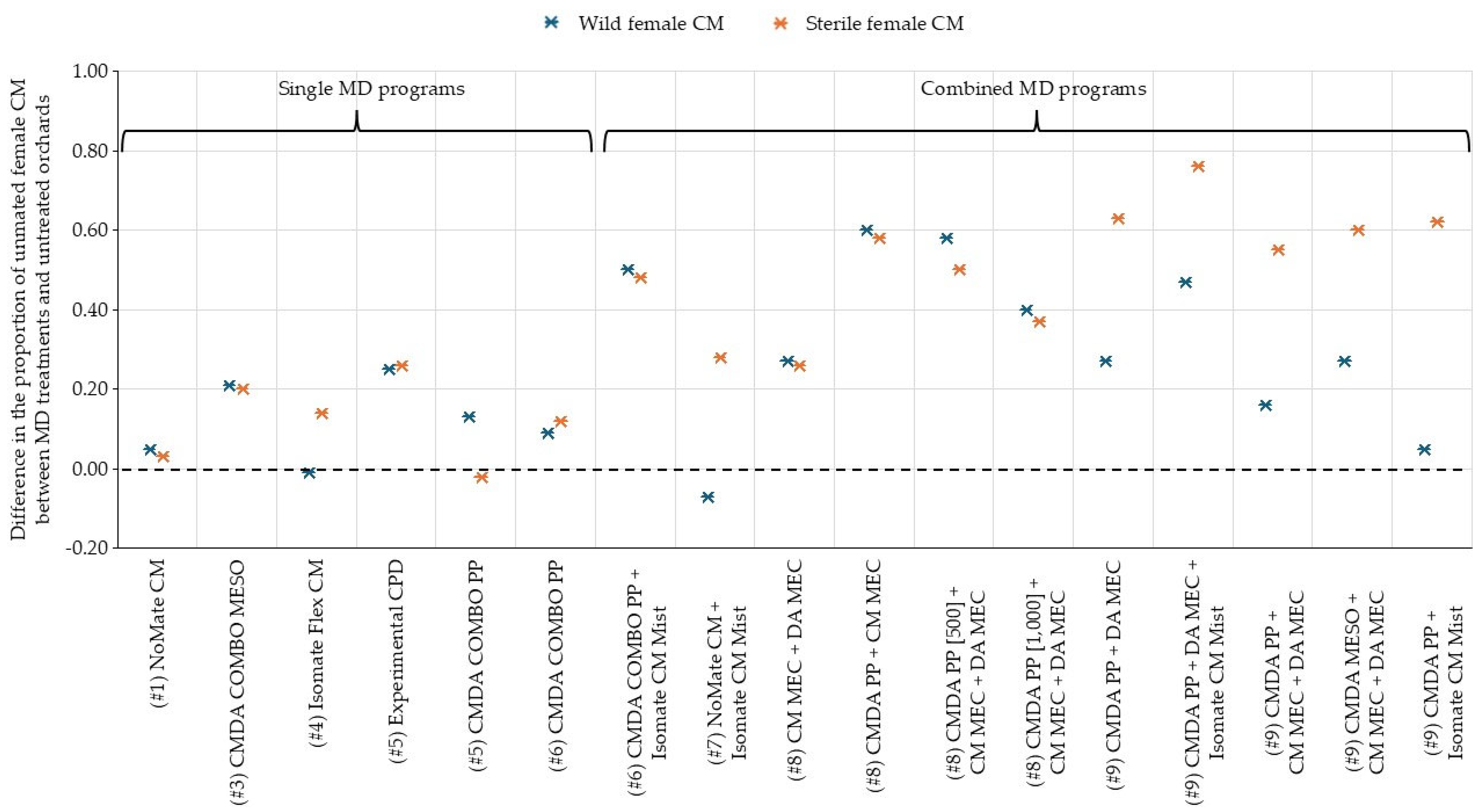
3.3. Wild and Sterile CM Females Mating Status
3.4. Level of Fruit Injury, 2024
4. Discussion and Conclusions
Author Contributions
Funding
Data Availability Statement
Acknowledgments
Conflicts of Interest
References
- Knight, A.L.; Preti, M.; Basoalto, E. What can we learn from dissecting tortricid females about the efficacy of mating disruption programs? Insects 2025, 16, 248. [Google Scholar] [CrossRef]
- Knight, A.L.; Preti, M.; Basoalto, E.; Mujica, M.V.; Favaro, R.; Angeli, S. Combining female removal with mating disruption for management of Cydia pomonella in apple. Entomol. Gen. 2021, 42, 309–321. [Google Scholar] [CrossRef]
- Knight, A.L.; Preti, M.; Basoalto, E. Active assessment of female codling moth, Cydia pomonella (L.), mating status under mating disruption technologies. Insects 2026, 17, 41. [Google Scholar] [CrossRef]
- Knight, A.L.; Preti, M.; Basoalto, E. Factors impacting the use of an allelochemical lure in pome fruit for Cydia pomonella (L.) monitoring. Insects 2025, 16, 172. [Google Scholar] [CrossRef] [PubMed]
- Wearing, C.H. Life table simulations of a univoltine codling moth, Cydia pomonella, population 3. Impact of immigration on the effectiveness of mating disruption. Biocontrol Sci. Technol. 2022, 32, 1156–1176. [Google Scholar] [CrossRef]
- Howell, J.F.; Clift, A.E. The dispersal of sterilized codling moths released in the Wenas Valley, Washington. Environ. Entomol. 1974, 3, 75–81. [Google Scholar] [CrossRef]
- Mani, E.; Wildbolz, T. The dispersal of male codling moths (Laspeyresia pomonella L.) in the Upper Rhine Valley. J. Appl. Entomol. 1977, 83, 161–168. [Google Scholar] [CrossRef]
- Schumacher, P.; Weyeneth, A.; Weber, D.C.; Dorn, S. Long flights in Cydia pomonella L. (Lepidoptera: Tortricidae) measured by a flight mill: Influence of sex, mated status and age. Physiol. Entomol. 2008, 22, 149–160. [Google Scholar] [CrossRef]
- Knight, A.L.; Preti, M.; Basoalto, E. Sprayable sex pheromones for codling moth: Waiting for grower adoption. In Advances in Entomology; Rebolledo Ranz, R.E., Ed.; Intech Open: London, UK, 2025; pp. 47–67. [Google Scholar] [CrossRef]
- Agrian Label. Available online: https://www.agrian.com/labelcenter/results.cfm (accessed on 4 December 2025).
- R Core Team. R: A Language and Environment for Statistical Computing; R Foundation for Statistical Computing: Vienna, Austria, 2025. Available online: https://www.R-project.org/ (accessed on 4 December 2025).
- Kovanci, O.B. Co-application of microencapsulated pear ester and codlemone for mating disruption of Cydia pomonella. J. Pest. Sci. 2015, 88, 311–319. [Google Scholar] [CrossRef]
- Light, D.M.; Grant, J.A.; Haff, R.P.; Knight, A.L. Addition of pear ester with sex pheromone enhances disruption of mating by female codling moth (Lepidoptera: Tortricidae) in walnut orchards treated with meso dispensers. Environ. Entomol. 2017, 46, 319–327. [Google Scholar] [CrossRef]
- Arthurs, S.P.; Hilton, R.; Knight, A.L.; Lacey, L.A. Evaluation of the pear ester kairomone as a formulation additive for the granulovirus of codling moth (Lepidoptera: Tortricidae) in pome fruit. J. Econ. Entomol. 2007, 100, 702–709. [Google Scholar] [CrossRef]
- Schmidt, S.; Tomasi, C.; Pasqualini, E.; Ioriatti, C. The biological efficacy of pear ester on the activity of granulosis virus for codling moth. J. Pest. Sci. 2008, 81, 29–34. [Google Scholar] [CrossRef]
- Light, D.M.; Knight, A.L. Microencapsulated pear ester enhances insecticide efficacy in walnuts for codling moth (Lepidoptera: Tortricidae) and navel orangeworm (Lepidoptera: Pyralidae). J. Econ. Entomol. 2011, 104, 1309–1315. [Google Scholar] [CrossRef] [PubMed]
- Knight, A.L.; Light, D.M. Adding microencapsulated pear ester to insecticides for control of Cydia pomonella (Lepidoptera: Tortricidae) in apple. Pest Man. Sci. 2013, 69, 66–74. [Google Scholar] [CrossRef]
- Knight, A.L.; Flexner, L. Disruption of mating in codling moth (Lepidoptera: Tortricidae) by chlorantraniliprole, an anthranilic diamide insecticide. Pest Man. Sci. 2007, 63, 180–189. [Google Scholar] [CrossRef] [PubMed]
- Thomson, D.; Brunner, J.; Gut, L.; Judd, G.; Knight, A. Ten years implementing codling moth mating disruption in the orchards of Washington and British Columbia: Starting right and managing for success! IOBC WPRS Bull. 2001, 24, 23–30. [Google Scholar]
- Jones, V.P.; Baker, C.C.; Wilburn, T.D. Movement of codling moth between abandoned and commercial orchards. In Proceedings of the Orchard Pest & Disease Management Conference 81, Portland, OR, USA, 10–12 January 2007; Volume 37. [Google Scholar]
- Sharon, R.; Tomer, M.; Avraham, A.; Harari, A.R. Female codling moths evade the mating disruption control tactic. Res. Sq. 2024. [Google Scholar] [CrossRef]
- Knight, A.L. Codling moth area wide integrated management. In Areawide Pest Management: Theory and Implementation; Koul, O., Cuperus, G., Elliot, N., Eds.; CAB International: Wallingford, UK, 2008; pp. 159–190. [Google Scholar]
- McGhee, P.; Epstein, D.; Gut, L. Quantifying the benefits of areawide pheromone mating disruption programs that target codling moth (Lepidoptera: Tortricidae). Am. Entomol. 2011, 57, 94–100. [Google Scholar] [CrossRef]
- Ioriatti, C.; Lucchi, A. Semiochemical strategies for tortricid moth control in apple orchards and vineyards in Italy. J. Chem. Ecol. 2016, 42, 571–583. [Google Scholar] [CrossRef]
- Witzgall, P.; Stelinski, L.; Gut, L.; Thomson, D. Codling moth management and chemical ecology. Annu. Rev. Entomol. 2008, 53, 503–522. [Google Scholar] [CrossRef]
- Knight, A.L. Assessing the mating status of female codling moth (Lepidoptera: Tortricidae) in orchards treated with sex pheromone using traps baited with ethyl (E,Z)-2,4-decadienoate. Environ. Entomol. 2006, 35, 894–900. [Google Scholar] [CrossRef]
- Tyson, R.; Newton, K.D.; Thistlewood, H.; Judd, G. Mating rates between sterile and wild codling moths (Cydia pomonella) in springtime: A simulation study. J. Theor. Biol. 2008, 254, 319–330. [Google Scholar] [CrossRef]
- Judd, G.J.R.; Thistlewood, H.M.A.; Gardiner, M.G.T.; Lannard, B.L. Is lack of mating competitiveness in spring linked to mating asynchrony between wild and mass-reared codling moths from an operational sterile insect programme? Entomol. Exp. Appl. 2006, 120, 113–124. [Google Scholar] [CrossRef]
- Judd, G.J.R.; Arthur, S.; Deglow, K.; Gardiner, M.G.T. Operational mark-release-recapture field tests comparing competitiveness of wild and differentially mass-reared codling moths from the Okanagan-Kootenay sterile insect program. Can. Entomol. 2011, 143, 300–316. [Google Scholar] [CrossRef]
- Evenden, M.L.; McClaughlin, J.R. Male oriental fruit moth response to a combined pheromone-based attracticide formulation targeting both oriental fruit moth and codling moth (Lepidoptera: Tortricidae). J. Econ. Entomol. 2005, 98, 317–325. [Google Scholar] [CrossRef]
- Il’ichev, A.L.; Williams, D.G.; Gut, L.J. Dual pheromone dispenser for combined control of codling moth Cydia pomonella L. and oriental fruit moth Grapholita molesta (Busck) (Lep. Tortricidae) in pears. J. Appl. Entomol. 2007, 131, 368–376. [Google Scholar] [CrossRef]
- Joshi, N.; Hull, L.A.; Krawczyk, G.; Rajotte, E.G. Field results of mating disruption technologies for the control of codling moth, Cydia pomonella (L.), and oriental fruit moth, Grapholita molesta (Busck) in Pennsylvania apple orchards. Asp. Appl. Biol. 2008, 84, 153–161. [Google Scholar]
- Stelinski, L.L.; Gut, L.J.; Haas, M.; McGhee, P.; Epstein, D. Evaluation of aerosol devices for simultaneous disruption of sex pheromone communication in Cydia pomonella and Grapholita molesta (Lepidoptera: Tortricidae). J. Pest. Sci. 2007, 80, 225–233. [Google Scholar] [CrossRef]
- Stelinski, L.L.; Il’ichev, A.L.; Gut, L. Efficacy and release rate of reservoir pheromone dispensers for simultaneous mating disruption of codling moth and oriental fruit moth (Lepidoptera: Tortricidae). J. Econ. Entomol. 2009, 102, 315–323. [Google Scholar] [CrossRef]
- Knight, A.; Cichon, L.; Lago, J.; Fuentes-Contreras, E.F.; Barros-Parada, W.; Hull, L.; Krawczyk, G.; Zoller, B.; Hansen, R.; Hilton, R.; et al. Monitoring oriental fruit moth ad codling moth (Lepidoptera: Tortricidae) with combinations of pheromone and kairomones. J. Appl. Entomol. 2014, 138, 783–794. [Google Scholar] [CrossRef]
- Knight, A.L.; Mujica, V.; Basoalto, E.; Preti, M. Simultaneous effective monitoring of Grapholita molesta and Cydia pomonella (Lepidoptera; Tortricidae) in traps with a dual sex pheromone/kairomone lure plus a UV-A light. J. Appl. Entomol. 2024, 148, 1261–1275. [Google Scholar] [CrossRef]
- Knight, A.L.; Preti, M.; Basoalto, E.; Fuentes-Contreras, E.F. Increasing catches of adult moth pests (Lepidoptera: Tortricidae) in pome fruit with low-intensity LED lights added to sex pheromone/kairomone lure-baited traps. J. Appl. Entomol. 2023, 147, 843–856. [Google Scholar] [CrossRef]


| Type of CM MD | Manufacturer | Active Ingredients Loading | Dispenser or Liquid Rate ha−1 |
|---|---|---|---|
| Semios CM Eco Aerosol | Semios BIO Technologies Inc., Vancouver, BC, Canada | 55.4 g codlemone | 2.5 |
| Isomate CM Mist | Pacific Biocontrol Corp., Vancouver, WA, USA | 23.6 g codlemone | 2.5 |
| NoMate CM Spiral | Scentry Biologicals Inc., Billings, MT, USA | 135 g codlemone | 1000 |
| Isomate CM Flex | Pacific Biocontrol Corp., Vancouver, WA, USA | 95.5 g codlemone + 62 mg of 1-dodecanol and 1-tetradecanol | 1000 |
| CIDETRAK CMDA COMBO PP | Trécé Inc., Adair, OK, USA | 90 g codlemone 60 g pear ester | 500–1000 |
| CIDETRAK CMDA COMBO MESO-A | Trécé Inc., Adair, OK, USA | 850 g codlemone 500 g pear ester | 80 |
| Experimental CPD | Trécé Inc., Adair, OK, USA | 850 g codlemone 500 g pear ester | 10 |
| CIDETRAK CMDA + OFM MESO | Trécé Inc., Adair, OK, USA | 800 mg codlemone + 450 mg pear ester + 550 mg OFM PH blend | 80 |
| CIDETRAK CM MEC | Trécé Inc., Adair, OK, USA | 7% codlemone | 250 mL |
| CIDETRAK DA MEC | Trécé Inc., Adair, OK, USA | 5% pear ester | 30 mL |
| Trial #, Dates, # Replicates | Treatments b | Mean ± SE Proportion of Unmated Females a | |
|---|---|---|---|
| Wild [# Females] | Sterile [# Females] c | ||
| 1, 29 May–19 June 2023, N = 5 | Untreated | 0.24 ± 0.09 Aa [22] | 0.40 ± 0.09 Aa [201] |
| NoMate CM | 0.29 ± 0.05 Aa [211] | 0.43 ± 0.04 Aa [250] | |
| Treatments: F1,16 = 0.58, p = 0.4572 Moths: F1,16 = 2.35, p = 0.1446 Treatments × moths: F1,16 = 0.18, p = 0.6742 | |||
| 2, 26 June–18 July 2023, N = 5 | Untreated | - | 0.39 ± 0.07 A [243] |
| Isomate CM Mist | - | 0.64 ± 0.02 B [366] | |
| Treatments: F1,8 = 6.29, p = 0.0080 | |||
| 3, 28 June–12 July 2023, N = 6 | Untreated | 0.11 ± 0.05 Aa [30] | 0.25 ± 0.08 Aa [89] |
| CIDETRAK CMDA COMBO MESO-A | 0.32 ± 0.03 Ba [109] | 0.45 ± 0.10 Ba [45] | |
| Treatments: F1,20 = 6.97, p = 0.0157 Moths: F1,20 = 2.96, p = 0.1009 Treatments × moths: F1,20 = 0.73, p = 0.4026 | |||
| 4, 24 July–4 September 2023, N = 5 | Untreated | 0.22 ± 0.05 Aa [32] | 0.24 ± 0.06 Aa [166] |
| Isomate Flex CM | 0.21 ± 0.02 Aa [97] | 0.38 ± 0.04 Aa [94] | |
| Treatments: F1,16 = 2.10, p = 0.1670 Moths: F1,16 = 3.84, p = 0.0677 Treatments × moths: F1,16 = 2.14, p = 0.1625 | |||
| 5, 13 May–7 September 2024, N = 4 | Untreated | 0.19 ± 0.06 Bb [105] | 0.35 ± 0.01 Bb [955] |
| Experimental CPD | 0.44 ± 0.03 Aa [155] | 0.61 ± 0.02 Aa [854] | |
| CIDETRAK CMDA COMBO PP | 0.32 ± 0.05 Bb [122] | 0.33 ± 0.08 Bb [165] | |
| Treatments: F2,18 = 13.91, p = 0.0002 Moths: F1,18 = 7.76, p = 0.0122 Treatments × moths: F2,18 = 1.71, p = 0.2093 | |||
| Trial #, Dates, Replicates | Treatments b | Mean ± SE Proportion of Unmated Females a | |
|---|---|---|---|
| Wild [# Females] | Sterile [# Females] c | ||
| 6, 1 May–10 July 2023, N = 5 | Untreated | 0.21 ± 0.06 Aa [45] | 0.35 ± 0.05 Ab [786] |
| CIDETRAK CMDA COMBO PP | 0.30 ± 0.06 Aa [245] | 0.47 ± 0.06 Ab [427] | |
| CIDETRAK CMDA COMBO PP + Isomate CM Mist | 0.71 ± 0.09 Ba [52] | 0.83 ± 0.05 Bb [348] | |
| Treatments: F2,24 = 26.66, p = 0.0001 Moths: F2,24 = 5.46, p = 0.0282 Treatments × moths: F2,24 = 0.08, p = 0.9190 | |||
| 7, 10 July–10 August 2023, N = 4 | Untreated | 0.34 ± 0.09 Aa [36] | 0.34 ± 0.03 Aa [198] |
| NoMate CM + Isomate CM Mist | 0.27 ± 0.05 Aa [142] | 0.62 ± 0.03 Ba [288] | |
| Treatments: F1,12 = 2.21, p = 0.1633 Moths: F1,12 = 4.12, p = 0.0651 Treatments × moths: F1,12 = 6.77, p = 0.0232 | |||
| Trial #, Dates | Treatments b | Number of Replicates | Mean ± SE Proportion of Unmated Females a | |
|---|---|---|---|---|
| Wild [# Females] | Sterile [# Females] c | |||
| 8, 6 May–26 August 2024 | Untreated | 4 | 0.17 ± 0.07 [105] Cb | 0.35 ± 0.01 [955] Ca |
| CM MEC + DA MEC | 4 | 0.44 ± 0.03 [155] Bb | 0.61 ± 0.02 [854] Ba | |
| CMDA PP [500] + CM MEC | 2 | 0.77 ± 0.03 [130] Ab | 0.93 ± 0.07 [91] Ab | |
| CMDA PP [500] + CM MEC + DA MEC | 2 | 0.75 ± 0.15 [66] Ab | 0.85 ± 0.03 [110] Aa | |
| CMDA PP [1000] + CM MEC + DA MEC | 2 | 0.57 ± 0.03 [285] ABb | 0.72 ± 0.00 [47] ABa | |
| Treatments: F4,17 = 20.95, p < 0.0001 Moths: F1,17 = 9.78, p = 0.0061 Treatments × moths: F4,17 = 0.36, p = 0.8361 | ||||
| 9, 6 May–26 August 2024 | Untreated | 4 | 0.32 ± 0.11 [30] Cb | 0.19 ± 0.06 [198] Ca |
| CMDA PP [840] + DA MEC | 5/6 | 0.59 ± 0.06 [480] ABb | 0.82 ± 0.04 [100] ABa | |
| CMDA PP [840] + DA MEC + Isomate CM Mist | 4 | 0.79 ± 0.07 [155] Ab | 0.95 ± 0.02 [66] Aa | |
| CMDA PP [1000] + CM MEC + DA MEC | 3 | 0.48 ± 0.03 [368] Bb | 0.74 ± 0.03 [277] Ba | |
| CMDA MESO-A + CM MEC + DA MEC | 3 | 0.59 ± 0.06 [216] ABb | 0.79 ± 0.13 [84] ABa | |
| CMDA PP [1000] + Isomate CM Mist | 2 | 0.37 ± 0.04 [114] Bb | 0.81 ± 0.08 [34] Ba | |
| Treatments: F5,31 = 13.97, p < 0.0001 Moths: F1,31 = 14.24, p = 0.0007 Treatments × moths: F5,31 = 2.14, p = 0.0870 | ||||
| 10, 1 May–10 July 2024 | Untreated | 3 | 0.17 ± 0.03 [119] C | - |
| CMDA/OFM MESO + DA MEC | 2 | 0.79 ± 0.10 [49] A | - | |
| CMDA PP [1000] | 6 | 0.32 ± 0.01 [371] B | - | |
| Treatments: F2,8 = 42.35. p < 0.0001 | ||||
| Comparison | Description | Number of Orchards | Mean ± SE Percent Fruit Injury a | Mean ± SE Proportion Unmated Females b | Paired t-Test | |
|---|---|---|---|---|---|---|
| Wild | Sterile | |||||
| Injury | With | 17 | 1.14 ± 0.23 | 0.46 ± 0.03 B | 0.64 ± 0.04 A | t16 = 3.81, p = 0.0016 |
| None | 11 | 0.00 ± 0.00 | 0.58 ± 0.04 A | 0.65 ± 0.03 A | t10 = 1.40, p = 0.1900 | |
| Immigration | Known | 8 | 1.41 ± 0.25 a | 0.42 ± 0.04 B | 0.59 ± 0.05 A | t7 = 2.48, p = 0.0419 |
| Unknown | 20 | 0.41 ± 0.19 b | 0.55 ± 0.03 B | 0.67 ± 0.03 A | t19 = 2.87, p = 0.0099 | |
| Management | Organic | 12 | 1.16 ± 0.29 a | 0.42 ± 0.03 B | 0.70 ± 0.04 A | t11 = 7.61, p < 0.0001 |
| Conventional | 16 | 0.35 ± 0.17 b | 0.58 ± 0.03 A | 0.60 ± 0.03 A | t15 = 0.64, p = 0.5287 | |
| Analysis for fruit injury: Immigration Management Immigration × management | z-value = −2.71, p = 0.0068 z-value = −2.40, p = 0.0163 z-value = −1.81, p = 0.0710 | |||||
Disclaimer/Publisher’s Note: The statements, opinions and data contained in all publications are solely those of the individual author(s) and contributor(s) and not of MDPI and/or the editor(s). MDPI and/or the editor(s) disclaim responsibility for any injury to people or property resulting from any ideas, methods, instructions or products referred to in the content. |
© 2026 by the authors. Licensee MDPI, Basel, Switzerland. This article is an open access article distributed under the terms and conditions of the Creative Commons Attribution (CC BY) license.
Share and Cite
Knight, A.L.; Preti, M.; Basoalto, E. Using a Standardized Protocol to Assess Female Codling Moth, Cydia pomonella (L.), Mating Status Under Mating Disruption Technologies. Insects 2026, 17, 99. https://doi.org/10.3390/insects17010099
Knight AL, Preti M, Basoalto E. Using a Standardized Protocol to Assess Female Codling Moth, Cydia pomonella (L.), Mating Status Under Mating Disruption Technologies. Insects. 2026; 17(1):99. https://doi.org/10.3390/insects17010099
Chicago/Turabian StyleKnight, Alan Lee, Michele Preti, and Esteban Basoalto. 2026. "Using a Standardized Protocol to Assess Female Codling Moth, Cydia pomonella (L.), Mating Status Under Mating Disruption Technologies" Insects 17, no. 1: 99. https://doi.org/10.3390/insects17010099
APA StyleKnight, A. L., Preti, M., & Basoalto, E. (2026). Using a Standardized Protocol to Assess Female Codling Moth, Cydia pomonella (L.), Mating Status Under Mating Disruption Technologies. Insects, 17(1), 99. https://doi.org/10.3390/insects17010099