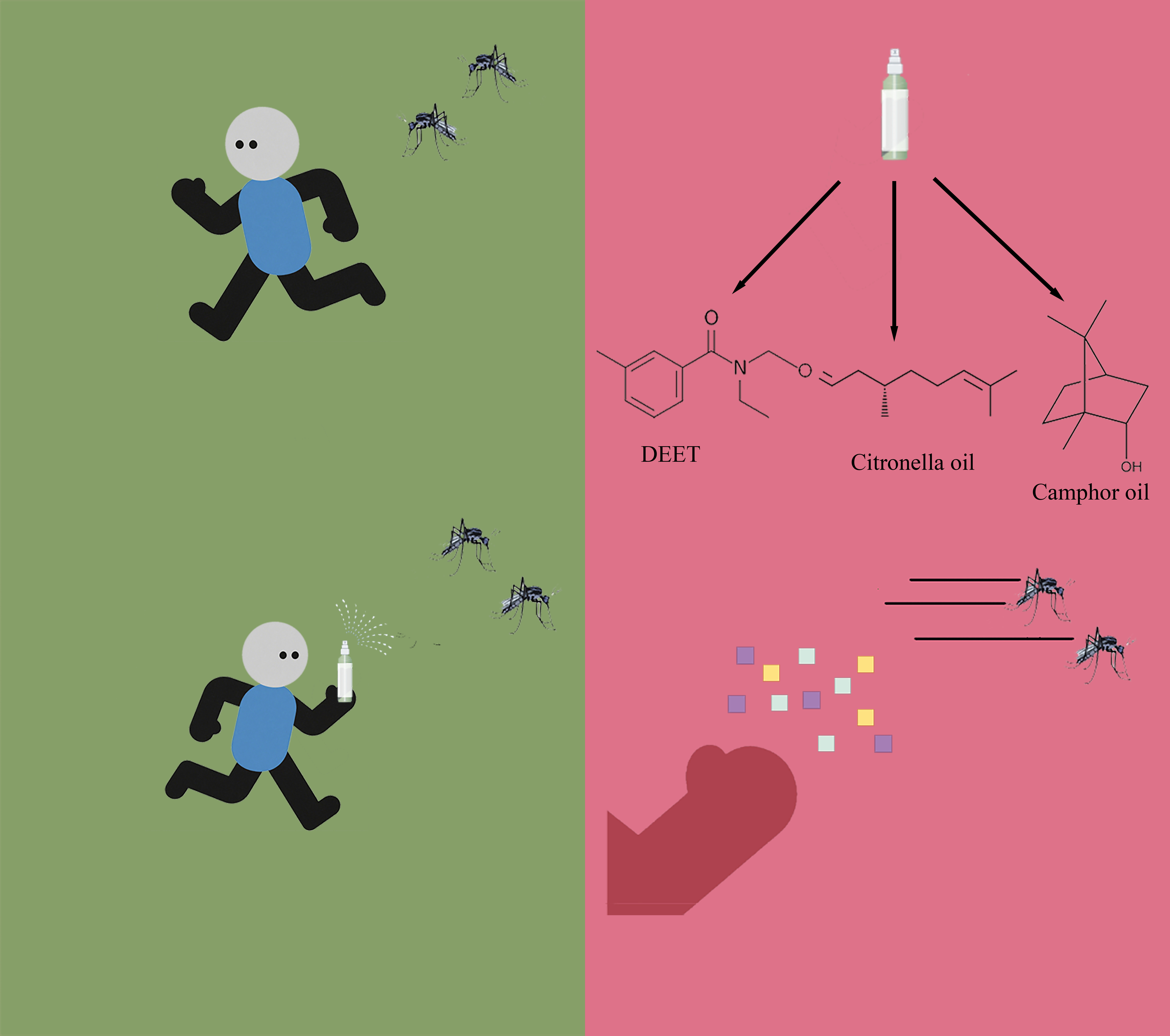
Triple-Olfactory Mechanism Synergy: Development of a Long-Lasting DEET–Botanical Composite Repellent Against Aedes albopictus
 and
and
Simple Summary
Abstract
1. Introduction
2. Materials and Methods
2.1. Mosquito Collection and Rearing
2.2. Compounds Used to Produce Odorant Blends
2.3. Bioassays
2.4. Scheme of Orthogonal Design

| Level | Factor | |||
|---|---|---|---|---|
| DEET (A) | Citronella Oil (B) | Catnip Oil (C) | Camphor Oil (D) | |
| 1 | 5% | 5% | 5% | 5% |
| 2 | 10% | 10% | 10% | 10% |
| 3 | 15% | 15% | 15% | 15% |
| 4 | - | 20% | 20% | 20% |
2.5. Comparative Efficacy Testing
2.6. Statistical Analysis
3. Results
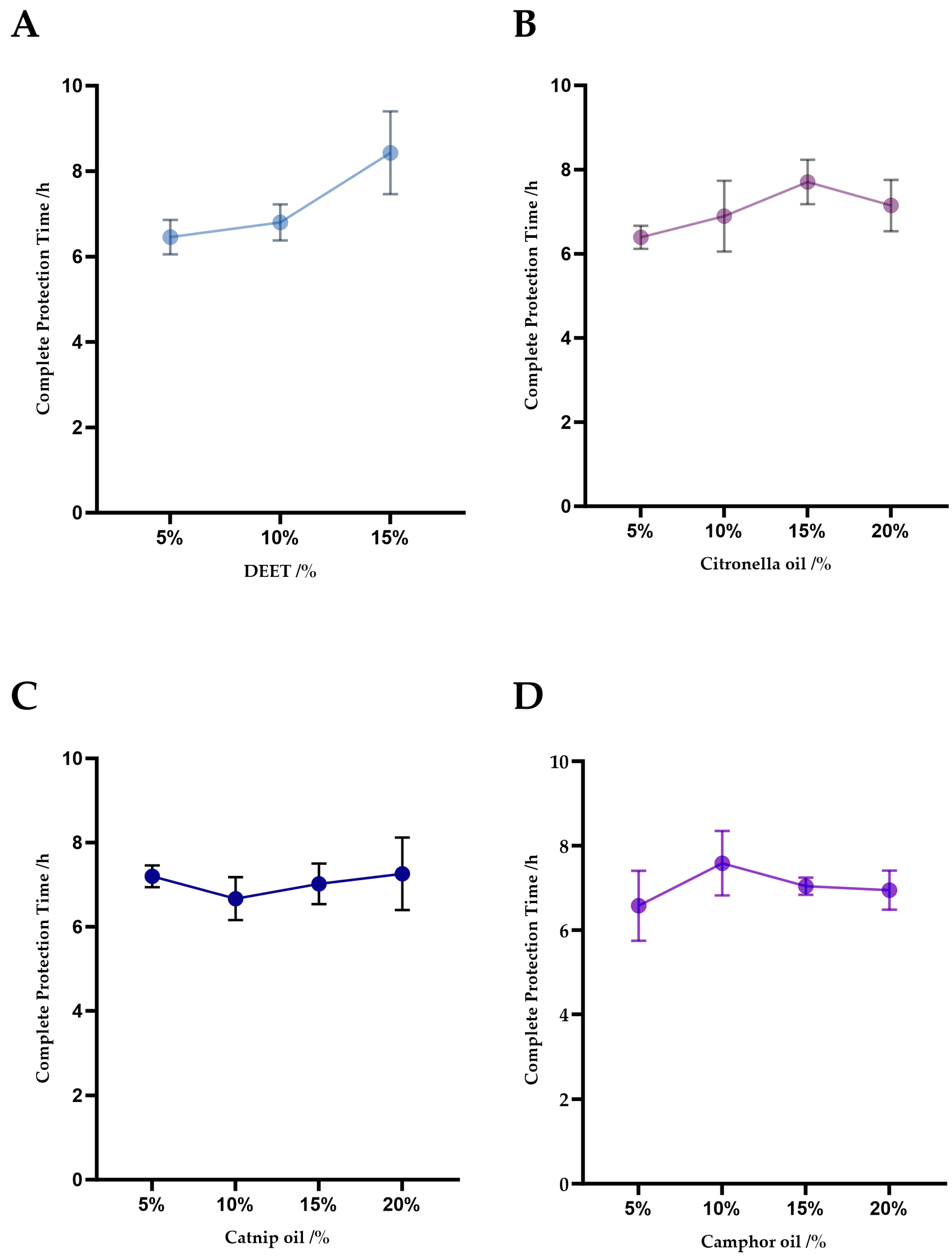
3.1. Orthogonal Optimization Identifies DEET–Citronella–Camphor as the Optimal Synergistic Combination
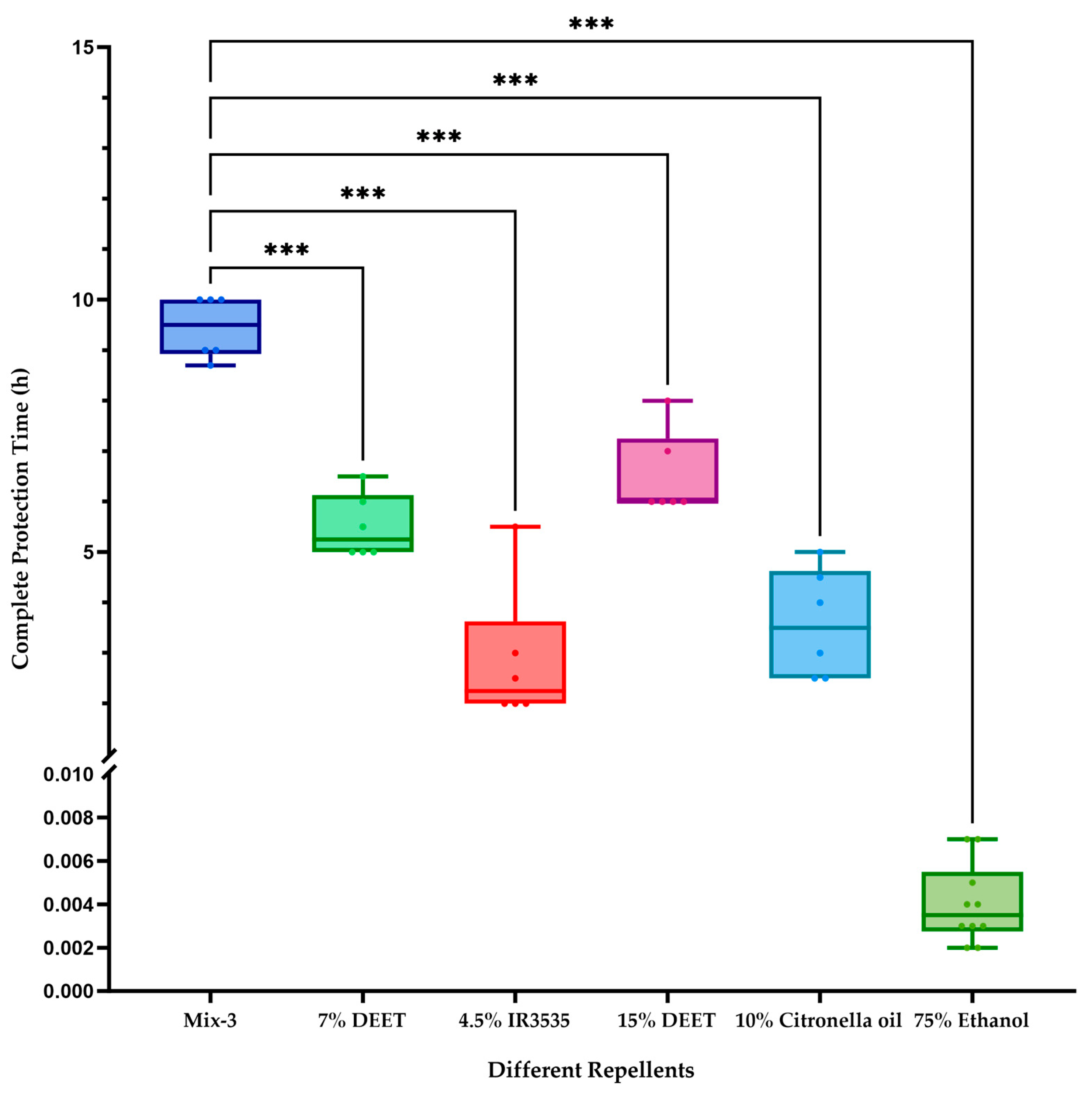
3.2. Optimized Blend Mix-3 Emerges as a High-Performance Alternative to the Main Components of Commercial Repellents

| Multiple Comparisons | ||||||
|---|---|---|---|---|---|---|
| (I) Combination | (J) Combination | Mean Difference (I-J) | Std. Error | Sig. | 95% Confidence Interval | |
| Lower Bound | Upper Bound | |||||
| Mix-3 | 7% DEET | 3.95 * | 0.55 | 0.000 | 2.82 | 5.08 |
| 4.5% IR3535 | 6.62 * | 0.55 | 0.000 | 5.49 | 7.74 | |
| 15% DEET | 2.95 * | 0.55 | 0.000 | 1.82 | 4.08 | |
| 10% citronella oil | 5.87 * | 0.55 | 0.000 | 4.74 | 6.99 | |
3.3. Safety Observations
4. Discussion
4.1. The Mode of Action of DEET and Essential Oils in Repelling Insects
4.2. Implications of the Optimized Repellent Blend
4.3. Toxicological and Environmental Considerations
5. Conclusions
Supplementary Materials
Author Contributions
Funding
Data Availability Statement
Acknowledgments
Conflicts of Interest
Abbreviations
| DEET | N,N-Diethyl-m-toluamide |
| EOs | Essential oil |
| ORs | Odorant receptors |
| Ae. albopictus | Aedes albopictus |
| Ae. aegypti | Aedes aegypti |
| EPA | Environmental Protection Agency |
| Df | Degrees of Freedom |
| RH | Relative humidity |
| TRPA1 | Transient receptor potential ankyrin 1 |
References
- Schiess, N.; Villabona-Rueda, A.; Cottier, K.E.; Huether, K.; Chipeta, J.; Stins, M.F. Pathophysiology and neurologic sequelae of cerebral malaria. Malar. J. 2020, 19, 266. [Google Scholar] [CrossRef]
- Song, X.; Wei, W.; Cheng, W.; Zhu, H.; Wang, W.; Dong, H.; Li, J. Cerebral malaria induced by plasmodium falciparum: Clinical features, pathogenesis, diagnosis, and treatment. Front. Cell Infect. Microbiol. 2022, 12, 939532. [Google Scholar] [CrossRef] [PubMed]
- Lee, I.K.; Hsieh, C.J.; Lee, C.T.; Liu, J.W. Diabetic patients suffering dengue are at risk for development of dengue shock syndrome/severe dengue: Emphasizing the impacts of co-existing comorbidity(ies) and glycemic control on dengue severity. J. Microbiol. Immunol. Infect. 2020, 53, 69–78. [Google Scholar] [CrossRef] [PubMed]
- Amer, A.; Mehlhorn, H. Repellency effect of forty-one essential oils against Aedes, Anopheles, and Culex mosquitoes. Parasitol. Res. 2006, 99, 478–490. [Google Scholar] [CrossRef] [PubMed]
- Alayo, M.A.; Femi-Oyewo, M.N.; Bakre, L.G.; Fashina, A.O. Larvicidal potential and Mosquito Repellent Activity of Cassia Mimosoides Extracts. Southeast. Asian J. Trop. Med. Public Health 2015, 46, 596–601. [Google Scholar]
- Noguera-Gahona, M.; Peña-Moreno, C.; Quiñones-Sobarzo, N.; Weinstein-Oppenheimer, C.; Guerra-Zúñiga, M.; Collao-Ferrada, X. Repellents against Aedes aegypti bites: Synthetic and natural origins. Front. Insect Sci. 2024, 4, 1510857. [Google Scholar] [CrossRef]
- U.S. Environmental Protection Agency. Reregistration Eligibility Decision (RED) for DEET (N,N-diethyl-m-toluamide). Available online: https://www.epa.gov/insect-repellents/deet (accessed on 4 November 2025).
- Centers for Disease Control and Prevention (CDC). DEET: Insect Repellent Information for the Public. U.S. Department of Health and Human Services. Available online: https://www.atsdr.cdc.gov/ToxProfiles/tp185-c1-b.pdf (accessed on 4 November 2025).
- Fradin, M.S.; Day, J.F. Comparative efficacy of insect repellents against mosquito bites. N. Engl. J. Med. 2002, 347, 13–18. [Google Scholar] [CrossRef]
- Yan, S.; Wang, J.; Xu, J.; Jiang, W.; Xiong, M.; Cao, Z.; Wang, Y.; Wang, Z.; Zhang, T.; Wang, Z.; et al. Exposure to N,N-diethyl-m-toluamide and cardiovascular diseases in adults. Front. Public Health 2022, 10, 922005. [Google Scholar] [CrossRef]
- Almeida, A.R.; Oliveira, N.D.; Pinheiro, F.; Morais, W.A.; Ferreira, L.S. Challenges encountered by natural repellents: Since obtaining until the final product. Pestic. Biochem. Physiol. 2023, 195, 105538. [Google Scholar] [CrossRef]
- Asadollahi, A.; Khoobdel, M.; Zahraei-Ramazani, A.; Azarmi, S.; Mosawi, S.H. Effectiveness of plant-based repellents against different Anopheles species: A systematic review. Malar. J. 2019, 18, 436. [Google Scholar] [CrossRef]
- Liu, Y.; Liu, R.; Zhang, J.; Yao, J.-Y.; Zhang, C.-G.; Li, X.; Wu, H.-Y.; Liu, H.-X. Screening for a new mosquito repellent formula and its repellent effect against Aedes albopictus in laboratory. Chin. J. Vector Biol. Control 2024, 35, 411–416. [Google Scholar]
- Champakaew, D.; Rattanasophon, P.; Phannasee, C.; Saehao, W.; Sukkanon, C.; Intirach, J.; Junkum, A.; Pitasawat, B. Repellent effect of local indigenous knowledge-based repellent in Nakhon Si Thammarat, Thailand, against Aedes aegypti mosquito. Heliyon 2023, 9, e21589. [Google Scholar] [CrossRef] [PubMed]
- Batume, C.; Mulongo, I.M.; Ludlow, R.; Ssebaale, J.; Randerson, P.; Pickett, J.A.; Mukisa, I.M.; Scofield, S. Evaluating repellence properties of catnip essential oil against the mosquito species Aedes aegypti using a Y-tube olfactometer. Sci. Rep. 2024, 14, 2269. [Google Scholar] [CrossRef] [PubMed]
- Melo, N.; Capek, M.; Arenas, O.M.; Afify, A.; Yilmaz, A.; Potter, C.J.; Laminette, P.J.; Para, A.; Gallio, M.; Stensmyr, M.C. The irritant receptor TRPA1 mediates the mosquito repellent effect of catnip. Curr. Biol. 2021, 31, 1988–1994.e1985. [Google Scholar] [CrossRef]
- Peach, D.A.H.; Almond, M.; Gries, R.; Gries, G. Lemongrass and Cinnamon Bark: Plant Essential Oil Blend as a Spatial Repellent for Mosquitoes in a Field Setting. J. Med. Entomol. 2019, 56, 1346–1352, Corrigendum in J. Med. Entomol. 2019, 56, 1750. https://doi.org/10.1093/jme/tjz135. [Google Scholar] [CrossRef]
- Wu, Z.M.; Liu, D.P.; Chen, H.N.; Yang, W.F.; Liu, H.; Tian, Y.; Zhang, Y.F.; Zhang, A.J.; Chu, H.L. Efficacy of six kinds of repellents against Aedes albopictus in laboratory. Chin. J. Hyg. Insect Equip. 2021, 27, 499–500. [Google Scholar] [CrossRef]
- World Health Organization (WHO). Guidelines for Efficacy Testing of Mosquito Repellents for Human Skin; WHO/HTM/NTD/WHOPES/2009.4; World Health Organization: Geneva, Switzerland, 2009; Available online: https://www.who.int/publications/i/item/WHO-HTM-NTD-WHOPES-2009.4 (accessed on 28 November 2025).
- Xie, L.; Yang, W.; Liu, H.; Liu, T.; Xie, Y.; Lin, F.; Zhou, G.; Zhou, X.; Wu, K.; Gu, J.; et al. Enhancing attraction of the vector mosquito Aedes albopictus by using a novel synthetic odorant blend. Parasit. Vectors 2019, 12, 382. [Google Scholar] [CrossRef]
- Lee, Y.; Kim, S.H.; Montell, C. Avoiding DEET through insect gustatory receptors. Neuron 2010, 67, 555–561. [Google Scholar] [CrossRef]
- Ditzen, M.; Pellegrino, M.; Vosshall, L.B. Insect odorant receptors are molecular targets of the insect repellent DEET. Science 2008, 319, 1838–1842. [Google Scholar] [CrossRef]
- Stanczyk, N.M.; Brookfield, J.F.; Ignell, R.; Logan, J.G.; Field, L.M. Behavioral insensitivity to DEET in Aedes aegypti is a genetically determined trait residing in changes in sensillum function. Proc. Natl. Acad. Sci. USA 2010, 107, 8575–8580. [Google Scholar] [CrossRef]
- Dennis, E.J.; Goldman, O.V.; Vosshall, L.B. Aedes aegypti Mosquitoes Use Their Legs to Sense DEET on Contact. Curr. Biol. 2019, 29, 1551–1556.e1555. [Google Scholar] [CrossRef] [PubMed]
- Bohbot, J.D.; Dickens, J.C. Odorant receptor modulation: Ternary paradigm for mode of action of insect repellents. Neuropharmacology 2012, 62, 2086–2095. [Google Scholar] [CrossRef] [PubMed]
- Müller, G.C.; Junnila, A.; Butler, J.; Kravchenko, V.D.; Revay, E.E.; Weiss, R.W.; Schlein, Y. Efficacy of the botanical repellents geraniol, linalool, and citronella against mosquitoes. J. Vector Ecol. 2009, 34, 2–8. [Google Scholar] [CrossRef] [PubMed]
- Wu, W.; Li, S.; Yang, M.; Lin, Y.; Zheng, K.; Akutse, K.S. Citronellal perception and transmission by Anopheles gambiae s.s. (Diptera: Culicidae) females. Sci. Rep. 2020, 10, 18615. [Google Scholar] [CrossRef]
- Vainer, Y.; Wang, Y.; Huff, R.M.; Perets, D.; Sar-Shalom, E.; Yakir, E.; Ghaninia, M.; Coutinho-Abreu Gomes, I.V.; Ruiz, C.; Rajamanickam, D.; et al. A conserved odorant receptor underpins borneol-mediated repellency in culicine mosquitoes. bioRxiv 2024. [Google Scholar] [CrossRef]
- Li, H.-Y.; Hu, Y.-X.; Li, C.-Y.; Wang, J. Study on Screening of 35 Volatile Allergic Fragrances in New Mosquito Repellent Products and Their Volatilization Patterns. J. Instrum. Anal. 2022, 41, 1758–1764. [Google Scholar] [CrossRef]
- Ansari, M.A.; Razdan, R.K. Relative efficacy of various oils in repelling mosquitoes. Indian. J. Malariol. 1995, 32, 104–111. [Google Scholar]
- Carroll, J.F.; Benante, J.P.; Klun, J.A.; White, C.E.; Debboun, M.; Pound, J.M.; Dheranetra, W. Twelve-hour duration testing of cream formulations of three repellents against Amblyomma americanum. Med. Vet. Entomol. 2008, 22, 144–151. [Google Scholar] [CrossRef]
- Chen-Hussey, V.; Behrens, R.; Logan, J.G. Assessment of methods used to determine the safety of the topical insect repellent N,N-diethyl-m-toluamide (DEET). Parasit. Vectors 2014, 7, 173. [Google Scholar] [CrossRef]
- Goodyer, L.I.; Croft, A.M.; Frances, S.P.; Hill, N.; Moore, S.J.; Onyango, S.P.; Debboun, M. Expert review of the evidence base for arthropod bite avoidance. J. Travel. Med. 2010, 17, 182–192. [Google Scholar] [CrossRef]
- Luker, H.A.; Salas, K.R.; Esmaeili, D.; Holguin, F.O.; Bendzus-Mendoza, H.; Hansen, I.A. Repellent efficacy of 20 essential oils on Aedes aegypti mosquitoes and Ixodes scapularis ticks in contact-repellency assays. Sci. Rep. 2023, 13, 1705. [Google Scholar] [CrossRef]
- Kongkaew, C.; Sakunrag, I.; Chaiyakunapruk, N.; Tawatsin, A. Effectiveness of citronella preparations in preventing mosquito bites: Systematic review of controlled laboratory experimental studies. Trop. Med. Int. Health 2011, 16, 802–810. [Google Scholar] [CrossRef]
- Birkett, M.A.; Hassanali, A.; Hoglund, S.; Pettersson, J.; Pickett, J.A. Repellent activity of catmint, Nepeta cataria, and iridoid nepetalactone isomers against Afro-tropical mosquitoes, ixodid ticks and red poultry mites. Phytochemistry 2011, 72, 109–114. [Google Scholar] [CrossRef]
- Chen, C.P.; Chen, C.C.; Huang, C.W.; Chang, Y.C. Evaluating Molecular Properties Involved in Transport of Small Molecules in Stratum Corneum: A Quantitative Structure-Activity Relationship for Skin Permeability. Molecules 2018, 23, 911. [Google Scholar] [CrossRef]
- Soni, V.; Bharti, D.; Bharadwaj, M.; Soni, V.; Saxena, R.; Arora, C. Chapter 12 Toxicity of essential oils. In Essential Oils; Rajendra Chandra, P., Dakeshwar Kumar, V., Charu, A., Pramod Kumar, M., Eds.; De Gruyter: Berlin, Germany; Boston, MA, USA, 2023; pp. 253–268. [Google Scholar]
- Bampidis, V.; Azimonti, G.; Bastos, M.L.; Christensen, H.; Durjava, M.; Kouba, M.; López-Alonso, M.; López Puente, S.; Marcon, F.; Mayo, B.; et al. Safety and efficacy of a feed additive consisting of an essential oil derived from the leaves of Cymbopogon nardus (L.) Rendle (citronella oil) for use in all animal species (FEFANA asbl). Efsa J. 2024, 22, e8790. [Google Scholar] [CrossRef]
- Hagvall, L.; Rudbäck, J.; Bråred Christensson, J.; Karlberg, A.T. Patch testing with purified and oxidized citronellol. Contact Dermat. 2020, 83, 372–379. [Google Scholar] [CrossRef]
- Dornic, N.; Ficheux, A.S.; Roudot, A.C. Qualitative and quantitative composition of essential oils: A literature-based database on contact allergens used for safety assessment. Regul. Toxicol. Pharmacol. 2016, 80, 226–232. [Google Scholar] [CrossRef]
- ISO 10993-10; Biological Evaluation of Medical Devices Part 10: Tests for Skin Sensitization. ISO: Geneva, Switzerland, 2021.
- OECD. Test No. 404: Acute Dermal Irritation/Corrosion. In OECD Guidelines for the Testing of Chemicals, Section 4; OECD Publishing: Paris, France, 2015. [Google Scholar] [CrossRef]
- Kremer Pigmente GmbH & Co. KG. Safety Data Sheet: Camphor (Article No. 78710). 2023. Revised Edition: 28 July 2023, Version: 4.0. Available online: https://www.kremer-pigmente.com (accessed on 28 November 2025).
- TMK Packers Ltd. Safety Data Sheet: Citronella Lamp Oil. 2025. Available online: https://www.tmkpackers.co.nz (accessed on 28 November 2025).
- OECD. Test No. 201: Freshwater Alga and Cyanobacteria, Growth Inhibition Test. In OECD Guidelines for the Testing of Chemicals; OECD: Paris, France, 2011. [Google Scholar]
- OECD. Test No. 202: Daphnia sp. Acute Immobilisation Test. In OECD Guidelines for the Testing of Chemicals; OECD: Paris, France, 2004. [Google Scholar]
- OECD. Test No. 203: Fish, Acute Toxicity Test. In OECD Guidelines for the Testing of Chemicals; OECD: Paris, France, 1992. [Google Scholar]
- OECD. Test No. 432: In Vitro 3T3 NRU Phototoxicity Test. In OECD Guidelines for the Testing of Chemicals; OECD: Paris, France, 2019. [Google Scholar]

| No. | Mosquito Repellents | Bioassay Standard | Manufacturer |
|---|---|---|---|
| 1 | DEET | GB2009 [18] | MACKLIN (Shanghai, China) |
| 2 | Citronella oil | GB2009 [18] | Yuan Ye (Shanghai, China) |
| 3 | Catnip oil | GB2009 [18] | Yuan Ye (Shanghai, China) |
| 4 | Camphor oil | GB2009 [18] | Yuan Ye (Shanghai, China) |
| Test Scheme | Factor | |||
|---|---|---|---|---|
| DEET (A) | Citronella Oil (B) | Catnip Oil (C) | Camphor Oil (D) | |
| 1 | 10% | 5% | 10% | 10% |
| 2 | 5% | 15% | 5% | 15% |
| 3 | 5% | 5% | 5% | 5% |
| 4 | 15% | 20% | 20% | 5% |
| 5 | 5% | 15% | 20% | 10% |
| 6 | 15% | 15% | 10% | 20% |
| 7 | 10% | 20% | 5% | 20% |
| 8 | 5% | 10% | 15% | 20% |
| 9 | 5% | 5% | 20% | 20% |
| 10 | 10% | 15% | 15% | 5% |
| 11 | 15% | 10% | 5% | 10% |
| 12 | 5% | 10% | 10% | 5% |
| 13 | 5% | 20% | 15% | 10% |
| 14 | 10% | 10% | 20% | 15% |
| 15 | 5% | 20% | 10% | 15% |
| 16 | 15% | 5% | 15% | 15% |
| Source | Type III Sum of Squares | Df | Mean Square | F-Value | p-Value | η2 |
|---|---|---|---|---|---|---|
| Corrected model | 103.20 | 11 | 9.38 | 7.18 | 0.000 | 0.485 |
| Intercept | 4515.34 | 1 | 4515.34 | 3454.83 | 0.000 | 0.976 |
| DEET | 64.03 | 2 | 32.01 | 24.50 | 0.000 | 0.368 |
| Citronella Oil | 21.59 | 3 | 7.20 | 5.51 | 0.002 | 0.164 |
| Catnip oil | 5.10 | 3 | 1.70 | 1.30 | 0.28 | 0.044 |
| Camphor Oil | 12.50 | 3 | 4.17 | 3.19 | 0.028 | 0.102 |
| Error | 109.79 | 84 | 1.31 | |||
| Total | 4965.41 | 96 | ||||
| Corrected total | 212.99 | 95 |
| Group | N | Mean (Std. Deviation) | t | p | |
|---|---|---|---|---|---|
| Result | Group 1 | 6 | 9.45 (0.61237) | 0.14 | 0.90 |
| Group 2 | 6 | 9.4 (0.66633) |
Disclaimer/Publisher’s Note: The statements, opinions and data contained in all publications are solely those of the individual author(s) and contributor(s) and not of MDPI and/or the editor(s). MDPI and/or the editor(s) disclaim responsibility for any injury to people or property resulting from any ideas, methods, instructions or products referred to in the content. |
© 2026 by the authors. Licensee MDPI, Basel, Switzerland. This article is an open access article distributed under the terms and conditions of the Creative Commons Attribution (CC BY) license.
Share and Cite
Lin, C.-X.; Huang, X.-Y.; Sun, Y.-H.; Lan, B.-H.; Deng, A.-Q.; Chen, L.-Y.; Lin, Q.-Y.; Huang, X.-T.; Li, J.-L.; Wu, C.; et al. Triple-Olfactory Mechanism Synergy: Development of a Long-Lasting DEET–Botanical Composite Repellent Against Aedes albopictus. Insects 2026, 17, 98. https://doi.org/10.3390/insects17010098
Lin C-X, Huang X-Y, Sun Y-H, Lan B-H, Deng A-Q, Chen L-Y, Lin Q-Y, Huang X-T, Li J-L, Wu C, et al. Triple-Olfactory Mechanism Synergy: Development of a Long-Lasting DEET–Botanical Composite Repellent Against Aedes albopictus. Insects. 2026; 17(1):98. https://doi.org/10.3390/insects17010098
Chicago/Turabian StyleLin, Chen-Xu, Xin-Yi Huang, Yi-Hai Sun, Bi-Hang Lan, An-Qi Deng, Le-Yan Chen, Qiu-Yun Lin, Xi-Tong Huang, Jun-Long Li, Cheng Wu, and et al. 2026. "Triple-Olfactory Mechanism Synergy: Development of a Long-Lasting DEET–Botanical Composite Repellent Against Aedes albopictus" Insects 17, no. 1: 98. https://doi.org/10.3390/insects17010098
APA StyleLin, C.-X., Huang, X.-Y., Sun, Y.-H., Lan, B.-H., Deng, A.-Q., Chen, L.-Y., Lin, Q.-Y., Huang, X.-T., Li, J.-L., Wu, C., & Xie, L.-H. (2026). Triple-Olfactory Mechanism Synergy: Development of a Long-Lasting DEET–Botanical Composite Repellent Against Aedes albopictus. Insects, 17(1), 98. https://doi.org/10.3390/insects17010098