Active Assessment of Female Codling Moth, Cydia pomonella (L.), Mating Status Under Mating Disruption Technologies

Simple Summary
Abstract
1. Introduction
2. Materials and Methods
2.1. Lures and Traps
2.2. Mating Disruption Dispensers
2.3. Seasonal CM Monitoring in Orchards Under Different Types of MD
2.4. Statistical Analysis
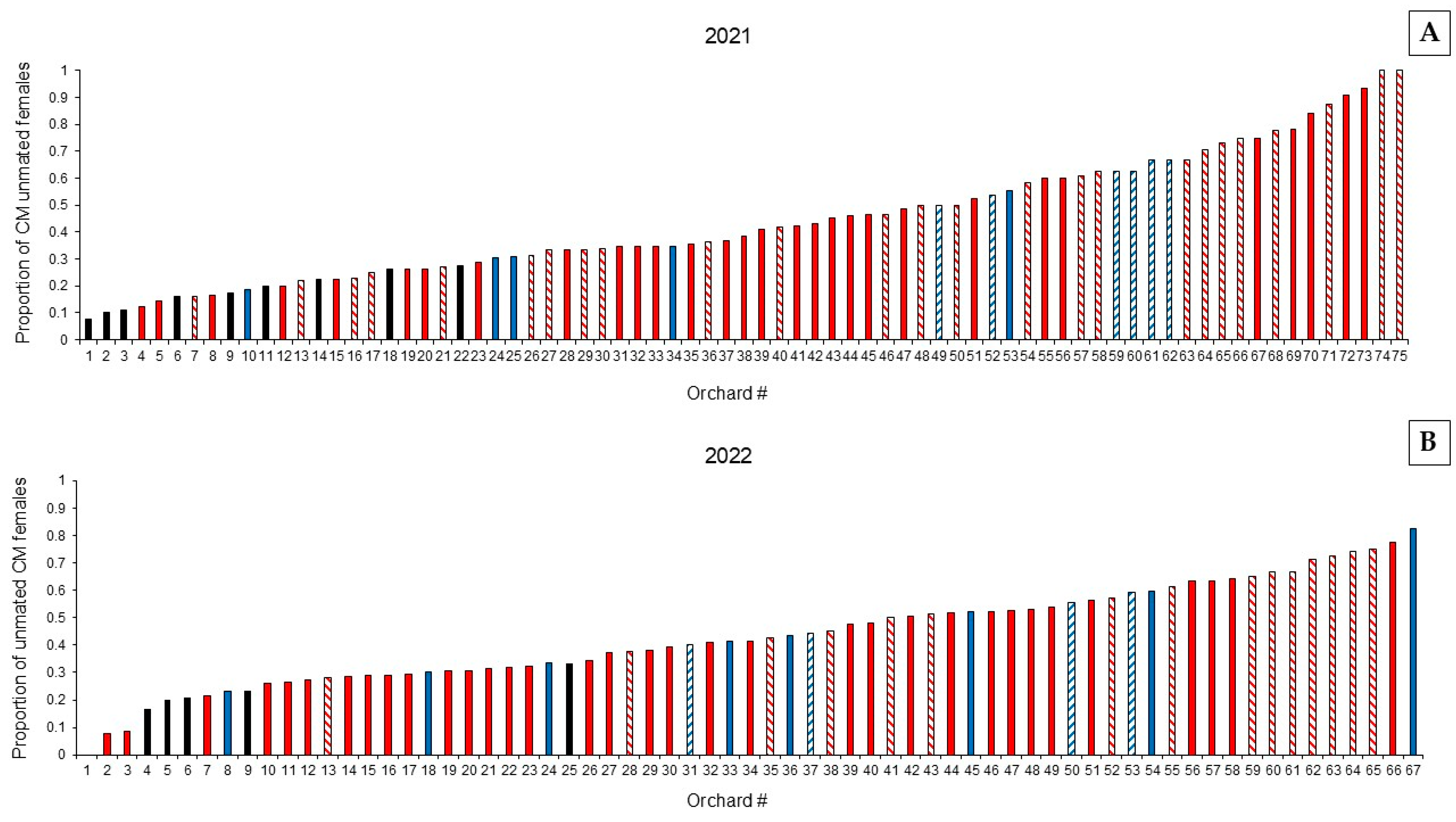
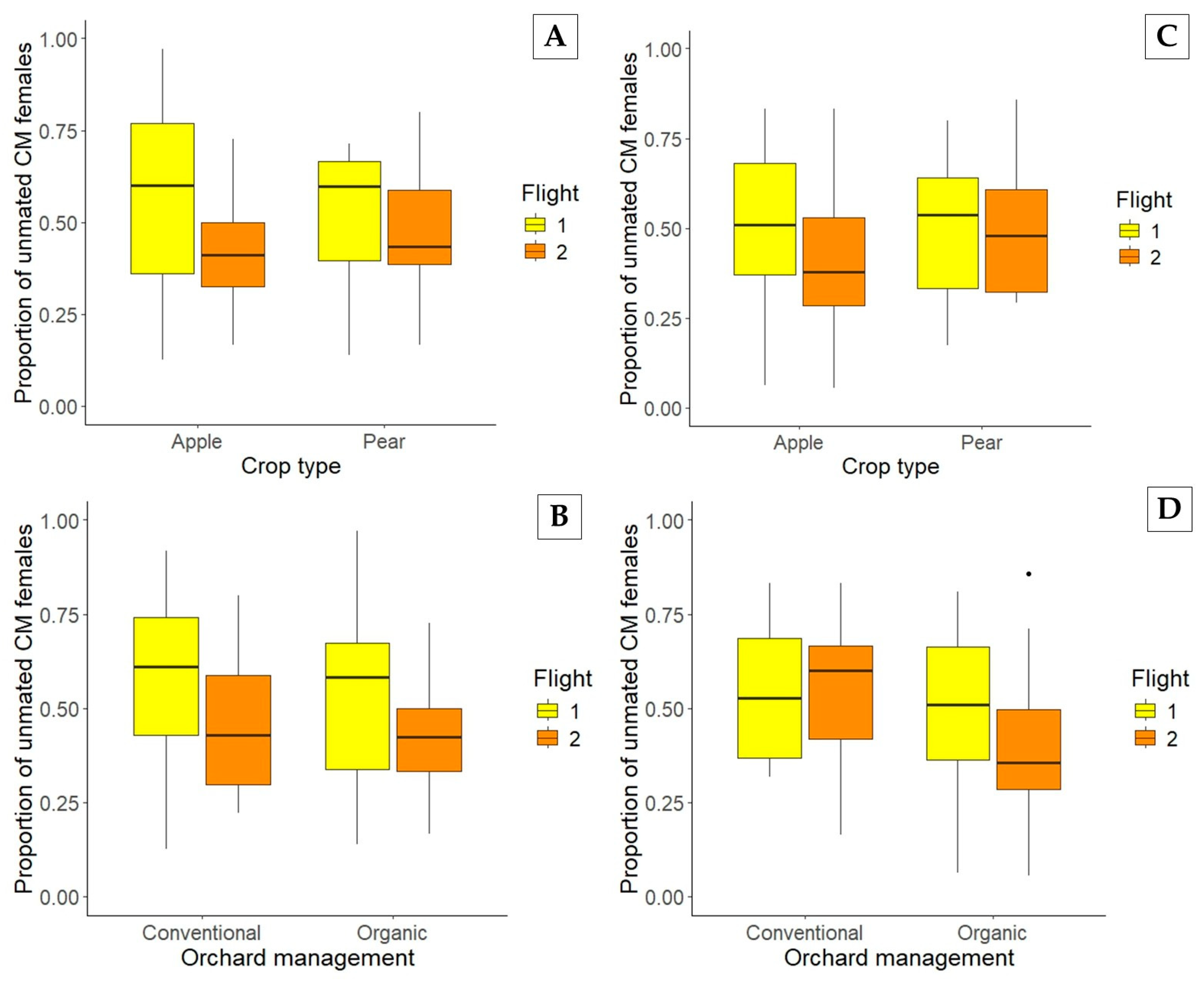
3. Results
4. Discussion
5. Conclusions
Author Contributions
Funding
Data Availability Statement
Acknowledgments
Conflicts of Interest
References
- Witzgall, P.; Stelinski, L.; Gut, L.; Thomson, D. Codling moth management and chemical ecology. Annu. Rev. Entomol. 2008, 53, 503–522. [Google Scholar] [CrossRef]
- Miller, J.R.; Gut, L.J. Mating disruption for the 21st Century: Matching technology with mechanism. Environ. Entomol. 2015, 44, 427–453. [Google Scholar] [CrossRef] [PubMed]
- Cardé, R.T.; Minks, A.K. Control of moth pests by mating disruption: Successes and constraints. Annu. Rev. Entomol. 1995, 40, 559–585. [Google Scholar] [CrossRef]
- Waldner, W. Three years of large-scale control of codling moth by mating disruption in the South Tyrol, Italy. IOBC WPRS Bull. 1997, 20, 35–44. [Google Scholar]
- Thomson, D.; Brunner, J.; Gut, L.; Judd, G.; Knight, A. Ten years implementing codling moth mating disruption in the orchards of Washington and British Columbia: Starting right and managing for success! IOBC WPRS Bull. 2001, 24, 23–30. [Google Scholar]
- Knight, A.L. Codling moth area wide integrated management. In Areawide Pest Management: Theory and Implementation; Koul, O., Cuperus, G., Elliot, N., Eds.; CAB International: Wallingford, UK, 2008; pp. 159–190. [Google Scholar] [CrossRef]
- McGhee, P.; Epstein, D.; Gut, L. Quantifying the benefits of areawide pheromone mating disruption programs that target codling moth (Lepidoptera: Tortricidae). Am. Entomol. 2011, 57, 94–100. [Google Scholar] [CrossRef]
- Ioriatti, C.; Lucchi, A. Semiochemical strategies for tortricid moth control in apple orchards and vineyards in Italy. J. Chem. Ecol. 2016, 42, 571–583. [Google Scholar] [CrossRef]
- Howell, J.F.; Knight, A.L.; Unruh, T.R.; Brown, D.F.; Krysan, J.L.; Sell, C.R.; Kirsch, P.A. Control of codling moth in apple and pear with sex pheromone-mediated mating disruption. J. Econ. Entomol. 1992, 85, 918–925. [Google Scholar] [CrossRef]
- Knight, A. The impact of codling moth (Lepidoptera: Tortricidae) mating disruption on apple pest management in Yakima Valley, Washington. J. Entomol. Soc. B. C. 1995, 92, 29–38. [Google Scholar]
- Kehat, M.; Anshelevich, L.; Harel, M.; Dunkelblum, E. Control of the codling moth (Cydia pomonella) in apple and pear orchards in Israel by mating disruption. Phytoparasitica 1995, 23, 285–296. [Google Scholar] [CrossRef]
- Trimble, R.M. Mating disruption for controlling the codling moth, Cydia pomonella (L.) (Lepidoptera: Tortricidae), in organic apple production in southwestern Ontario. Can. Entomol. 1995, 127, 493–505. [Google Scholar] [CrossRef]
- Judd, G.J.R.; Gardiner, M.G.T.; Thomson, D.R. Commercial trials of pheromone-mediated mating disruption with Isomate-C® to control codling moth in British Columbia apple and pear orchards. J. Entomol. Soc. B. C. 1996, 92, 23–34. [Google Scholar]
- Judd, G.J.R.; Gardiner, M.G.T.; Thomson, D.R. Control of codling moth in organically managed apple orchards by combining pheromone-mediated mating disruption, post-harvest fruit removal and tree banding. Entomol. Exp. Appl. 1997, 83, 137–146. [Google Scholar] [CrossRef]
- Gut, L.J.; Brunner, J.F. Pheromone-based management of codling moth (Lepidoptera: Tortricidae) in Washington apple orchards. J. Agric. Entomol. 1998, 15, 387–405. [Google Scholar]
- Judd, G.J.R.; Gardiner, M.G.T. Towards eradication of codling moth in British Columbia by complimentary actions of mating disruption, tree banding, and sterile insect technique: Five-year study in organic orchards. Crop Prot. 2005, 24, 718–733. [Google Scholar] [CrossRef]
- Epstein, D.L.; Stelinski, L.L.; Reed, T.P.; Miller, J.R.; Gut, L.J. Higher densities of distributed pheromone sources provide disruption of codling moth (Lepidoptera: Tortricidae) superior to that of lower densities of clumped sources. J. Econ. Entomol. 2006, 99, 1327–1333. [Google Scholar] [CrossRef]
- Bohnenblust, E.; Hull, L.A.; Krawczyk, G. A comparison of various mating disruption technologies for control of two internally feeding Lepidoptera in apples. Entomol. Exp. Appl. 2011, 138, 202–211. [Google Scholar] [CrossRef]
- McGhee, P.S.; Miller, J.R.; Thomson, D.R.; Gut, L.J. Optimizing aerosol dispensers for mating disruption of codling moth, Cydia pomonella L. J. Chem. Ecol. 2016, 42, 612–616. [Google Scholar] [CrossRef]
- Light, D.M.; Grant, J.A.; Haff, R.P.; Knight, A.L. Addition of pear ester with sex pheromone enhances disruption of mating by female codling moth (Lepidoptera: Tortricidae) in walnut orchards treated with meso dispensers. Environ. Entomol. 2017, 46, 319–327. [Google Scholar] [CrossRef] [PubMed]
- Horner, R.M.; Lo, P.L.; Rogers, D.J.; Walker, J.T.S.; Suckling, D.M. Combined effects of mating disruption, insecticides, and the sterile insect technique on Cydia pomonella in New Zealand. Insects 2020, 11, 837. [Google Scholar] [CrossRef] [PubMed]
- Millar, J.G. Degradation and stabilization of E8,E10-Dodecadienol, the major component of the sex pheromone of the codling moth (Lepidoptera: Tortricidae). J. Econ. Entomol. 1995, 88, 1425–1432. [Google Scholar] [CrossRef]
- Reyes, M.; Franck, P.; Olivares, J.; Margaritopoulos, J.; Knight, A.; Sauphanor, B. Worldwide variability of insecticide resistance mechanisms in the codling moth, Cydia pomonella L. (Lepidoptera: Tortricidae). Bull. Entomol. Res. 2009, 99, 359–369. [Google Scholar] [CrossRef]
- Gut, L.J.; Adams, C.; Miller, J.; McGhee, P.; Thomson, D. Biological control in integrated management of deciduous fruit insect pests: The use of semiochemicals. In Integrated Management of Diseases and Insect Pests of Tree Fruit; Xu, X., Fountain, M., Eds.; Burleigh Dodds Science Publishing: Philadelphia, PA, USA, 2019; pp. 571–662. [Google Scholar]
- Krawczyk, G.; Mellott, L.; Gere, J.; Seutter, T. Developing challenges in managing codling moth with diamide insecticides. Proc. Oregon Pest Disease Manag. Conf. 2025, 99, 57. [Google Scholar]
- Nielsen, A.L.; Rucker, A. Update on the status of resistance to CpGV in Washington codling moth. Proc. Or. Pest Dis. Manag. Conf. 2025, 99, 39. [Google Scholar]
- Chouinard, G.; Pelletier, F.; Vincent, C. Pest activity and protection practices: Four decades of transformation in Quebec apple orchards. Insects 2021, 12, 197. [Google Scholar] [CrossRef]
- Knight, A.L.; Preti, M.; Basoalto, E. What can we learn from dissecting tortricid females about the efficacy of mating disruption programs? Insects 2025, 16, 248. [Google Scholar] [CrossRef] [PubMed]
- Light, D.M.; Knight, A.L.; Henrick, C.A.; Rajapaska, D.; Lingren, B.; Dickens, J.C.; Reynolds, K.M.; Buttery, R.G.; Merrill, G.; Roitman, J.; et al. A pear derived kairomone with pheromonal potency that attracts male and female codling moth, Cydia pomonella (L.). Naturwissenschaften 2001, 88, 333–338. [Google Scholar] [CrossRef] [PubMed]
- Knight, A.L.; Light, D.M.; Judd, G.J.; Witzgall, P. Pear ester from discovery to delivery for improved codling moth management. In Roles of Natural Products for Biorational Pesticides in Agriculture; Beck, J., Ed.; American Chemical Society: Washington, DC, USA, 2018; pp. 83–113. [Google Scholar] [CrossRef]
- Knight, A.L.; Mujica, V.; Larson Herrera, S.L.; Tasin, M. Addition of terpenoids to pear ester plus acetic acid increases catches of codling moth (Lepidoptera: Tortricidae). J. Appl. Entomol. 2019, 143, 813–821. [Google Scholar] [CrossRef]
- Knight, A.L.; Mujica, V.; Larsson Herrera, S.; Tasin, M. Monitoring codling moth (Lepidoptera: Tortricidae) with a four-component volatile blend compared to a sex pheromone-based blend. J. Appl. Entomol. 2019, 143, 942–947. [Google Scholar] [CrossRef]
- Preti, M.; Knight, A.L.; Favaro, R.; Basoalto, E.; Tasin, M.; Angeli, S. Comparison of new kairomone-based lures for Cydia pomonella (Lepidoptera: Tortricidae) in Italy and USA. Insects 2021, 12, 72. [Google Scholar] [CrossRef]
- Preti, M.; Knight, A.L.; Mujica, M.V.; Basoalto, E.; Favaro, R.; Angeli, S. Developing female removal for Cydia pomonella (Lepidoptera: Tortricidae) in organic pear in the USA and Italy. J. Appl. Entomol. 2021, 145, 856–868. [Google Scholar] [CrossRef]
- Knight, A.L.; Preti, M.; Basoalto, E.; Mujica, M.V.; Favaro, R.; Angeli, S. Combining female removal with mating disruption for management of Cydia pomonella in apple. Entomol. Gen. 2022, 42, 309–321. [Google Scholar] [CrossRef]
- Knight, A.L.; Preti, M.; Basoalto, E. Factors impacting the use of an allelochemical lure in pome fruit for Cydia pomonella (L.) monitoring. Insects 2025, 16, 172. [Google Scholar] [CrossRef] [PubMed]
- Knight, A.L. Monitoring codling moth (Lepidoptera: Tortricidae) with passive interception traps in sex pheromone-treated apple orchards. J. Econ. Entomol. 2000, 93, 1744–1751. [Google Scholar] [CrossRef] [PubMed]
- Knight, A.L. Assessing the mating status of female codling moth (Lepidoptera: Tortricidae) in orchards treated with sex pheromone using traps baited with ethyl (E,Z)-2,4-decadienoate. Environ. Entomol. 2006, 35, 894–900. [Google Scholar] [CrossRef]
- Yang, Z.; Casado, D.; Ioriatti, C.; Bengtsson, M.; Witzgall, P. Pheromone pre-exposure and mating modulate codling moth (Lepidoptera: Tortricidae) response to host plant volatiles. Agric. Forest Entomol. 2005, 7, 231–236. [Google Scholar] [CrossRef]
- Agrian Label. Available online: https://www.agrian.com/labelcenter/results.cfm (accessed on 23 December 2025).
- Knight, A.L. Multiple mating of male and female codling moth (Lepidoptera: Tortricidae) in apple orchards treated with sex pheromone. Environ. Entomol. 2007, 36, 157–164. [Google Scholar] [CrossRef]
- R Core Team. R: A Language and Environment for Statistical Computing; R Foundation for Statistical Computing: Vienna, Austria, 2025; Available online: https://www.R-project.org/ (accessed on 23 December 2025).
- Williamson, E.R.; Folwell, R.J.; Knight, A.; Howell, J.F. Economics of employing pheromones for mating disruption of the codling moth, Carpocapsa pomonella. Crop Prot. 1996, 15, 473–477. [Google Scholar] [CrossRef]
- Knight, A.L.; Basoalto, E.; Preti, M. Sprayable sex pheromones for codling moth: Waiting for grower adoption. In Advances in Entomology; Rebolledo Ranz, R.E., Ed.; IntechOpen: London, UK, 2025; p. 47. [Google Scholar] [CrossRef]
- Knight, A.L.; Howell, J.F.; McDonough, L.M.; Weiss, M. Mating disruption of codling moth (Lepidoptera: Tortricidae) with polyethylene tube dispensers: Determining emission rates and the distribution of fruit injuries. J. Agric. Entomol. 1995, 12, 85–100. [Google Scholar]
- Angeli, G.; Anfora, G.; Baldessari, M.; Germinara, G.S.; Rama, F.; De Cristafaro, A.; Ioriatti, C. Mating disruption of codling moth Cydia pomonella with high densities of Ecodian sex pheromone dispensers. J. Appl. Entomol. 2007, 131, 311–318. [Google Scholar] [CrossRef]
- Trona, F.; Anfora, G.; Baldessari, M.; Mazzoni, V.; Casagrande, E.; Ioriatti, C.; Angeli, G. Mating disruption of codling moth with a continuous adhesive tape carrying high densities of pheromone dispensers. Bull. Insect. 2009, 62, 7–13. [Google Scholar]
- Knight, A.L. Testing an attracticide hollow fibre formulation for control of codling moth, Cydia pomonella (Lepidoptera: Tortricidae). J. Entomol. Soc. Brit. Columbia 2003, 100, 71–81. [Google Scholar]
- Knight, A.L.; Larsen, T.E. Creating point sources for codling moth (Lepidoptera: Tortricidae) with low-volume sprays of a microencapsulated ex pheromone formulation. Environ. Entomol. 2008, 37, 1136–1144. [Google Scholar] [CrossRef]
- Stelinski, L.L.; McGhee, P.; Grieshop, M.; Brunner, J.; Gut, L.J. Efficacy and mode of action of female equivalent dispensers of pheromone for mating disruption of codling moth. Agric. For. Entomol. 2008, 10, 389–397. [Google Scholar] [CrossRef]
- Barrett, B.A. Effect of synthetic pheromone permeation on captures of male codling moth (Lepidoptera: Tortricidae) in pheromone and virgin female moth baited traps at different tree heights in small orchard blocks. Environ. Entomol. 1995, 24, 1201–1206. [Google Scholar] [CrossRef]
- Knight, A.L. Managing codling moth (Lepidoptera: Tortricidae) with an internal grid of either aerosol puffers or dispenser clusters plus border applications of individual dispensers. J. Entomol. Soc. Brit. Columbia 2004, 101, 69–77. [Google Scholar]
- Trimble, R.M.; Solymar, B. Modified summer programme using border sprays for managing codling moth, Cydia pomonella (L.) and apple maggot, Rhagoletis pomonella (Walsh) in Ontario apple orchards. Crop Prot. 1997, 16, 73–79. [Google Scholar] [CrossRef]
- McGhee, P.S.; Gut, L.J.; Miller, J.R. Aerosol emitters disrupt codling moth, Cydia pomonella, competitively. Pest Manag. Sci. 2014, 70, 1859–1862. [Google Scholar] [CrossRef] [PubMed]
- Thistlewood, H.M.; Judd, G.J. Twenty-five years of research experience with the sterile insect technique and area-wide management of codling moth, Cydia pomonella (L.), in Canada. Insects 2019, 10, 292. [Google Scholar] [CrossRef]
- Vreysen, M.J.B.; Carpenter, J.E.; Marec, F. Improvement of the sterile insect technique for codling moth Cydia pomonella (Linnaeus) (Lepidoptera: Tortricidae) to facilitate expansion of field application. J. Appl. Entomol. 2010, 134, 165–181. [Google Scholar] [CrossRef]
- Karabo, B.; Malinga, L.N. Research advancements on the application of sterile insect technique for the control of lepidopteran pests over the past two decades: A Systematic Review. bioRxiv 2025. [Google Scholar] [CrossRef]
- Botto, E.; Glaz, P. Potential for controlling codling moth Cydia pomonella (Linnaeus) (Lepidoptera: Tortricidae) in Argentina using the sterile insect technique and egg parasitoids. J. Appl. Entomol. 2010, 134, 251–260. [Google Scholar] [CrossRef]
- Preti, M.; Basoalto, E.; Knight, A.L. Tree architecture impacts the effectiveness of exclusion netting for Cydia pomonella mating suppression in pome fruit. Bull. Insectology 2024, 77, 193–205. [Google Scholar]
- Knight, A.L.; Flexner, L. Disruption of mating in codling moth (Lepidoptera: Tortricidae) by chlorantranilipole, an anthranilic diamide insecticide. Pest Manag. Sci. 2007, 63, 180–189. [Google Scholar] [CrossRef]
- Ishiguri, Y. Effects of chlorantraniliprole, an anthranilic diamide insecticide, on reproductive success of peach fruit moth, Carposina sasakii. Annu. Rep. Soc. Plant Prot. North Jpn. 2013, 64, 265–270. [Google Scholar]
- Zhang, Q.; Liu, Y.; Wyckhuys, K.A.; Liang, H.; Desneux, N.; Lu, Y. Lethal and sublethal effects of chlorantraniliprole on Helicoverpa armigera adults enhance the potential for use in ‘attract-and-kill’ control strategies. Entomol. Gen. 2021, 41, 111–120. [Google Scholar] [CrossRef]
- Sun, X.; Barrett, B.; Song, Q. Effects of age and length of exposure on the reproduction of adult codling moth (Lepidoptera: Tortricidae) exposed to surfaces treated with ecdysone agonists. J. Entomol. Sci. 2004, 39, 417–425. [Google Scholar] [CrossRef]
- Ullah, F.; Güncan, A.; Abbas, A.; Gul, H.; Guedes, R.N.C.; Zhang, Z.; Huang, J.; Khan, K.A.; Ghramh, H.A.; Chavarín-Gómez, L.E.; et al. Sublethal effects of neonicotinoids on insect pests. Entomol. Gen. 2024, 44, 1145–1160. [Google Scholar] [CrossRef]
- Navarro-Roldán, M.A.; Gemeno, C. Sublethal effects of neonicotinoid insecticide on calling behavior and pheromone production of tortricid moths. J. Chem. Ecol. 2017, 43, 881–890. [Google Scholar] [CrossRef]
- Light, D.M.; Knight, A.L. Microencapsulated pear ester enhances insecticide efficacy in walnuts for codling moth (Lepidoptera: Tortricidae) and navel orangeworm (Lepidoptera: Pyralidae). J. Econ. Entomol. 2011, 104, 1309–1315. [Google Scholar] [CrossRef] [PubMed]
- Knight, A.L.; Light, D.M. Adding microencapsulated pear ester to insecticides for control of Cydia pomonella (Lepidoptera: Tortricidae) in apple. Pest Manag. Sci. 2013, 69, 66–74. [Google Scholar] [CrossRef]
- Arthurs, S.P.; Hilton, R.; Knight, A.L.; Lacey, L.A. Evaluation of the pear ester kairomone as a formulation additive for the granulovirus of codling moth (Lepidoptera: Tortricidae) in pome fruit. J. Econ. Entomol. 2007, 100, 702–709. [Google Scholar] [CrossRef] [PubMed]
- Schmidt, S.; Tomasi, C.; Pasqualini, E.; Ioriatti, C. The biological efficacy of pear ester on the activity of granulosis virus for codling moth. J. Pest Sci. 2008, 81, 29–34. [Google Scholar] [CrossRef]
- Kovanci, O.B. Co-application of microencapsulated pear ester and codlemone for mating disruption of Cydia pomonella. J. Pest Sci. 2015, 88, 311–319. [Google Scholar] [CrossRef]



| CM MD Programs | Type of CM MD | Manufacturer | Active Ingredients Loading | Dispenser Rate ha−1 |
|---|---|---|---|---|
| 1 | Semios CM Eco Aerosol | Semios BIO Technologies Inc., Vancouver, BC, Canada | 55.4 g codlemone | 2.5 |
| 2 | Isomate CM Mist | Pacific Biocontrol Corp., Vancouver, WA, USA | 23.6 g codlemone | 2.5 |
| 3 | NoMate CM Spiral | Scentry Biologicals Inc., Billings, MT, USA | 135 g codlemone | 1000 |
| 4 | Isomate CM Flex | Pacific Biocontrol Corp., Vancouver, WA, USA | 95.5 g codlemone + 62 mg of 1-dodecanol and 1-tetradecanol | 1000 |
| 5 | CIDETRAK CMDA COMBO PP | Trécé Inc., Adair, OK, USA | 90 g codlemone 60 g pear ester | 500–840 |
| 6 | CIDETRAK CMDA COMBO MESO-A | Trécé Inc., Adair, OK, USA | 850 g codlemone 500 g pear ester | 80 |
| 7 | Experimental CPD | Trécé Inc., Adair, OK, USA | 850 g codlemone 500 g pear ester | 2.5–10 |
| 8 | Semios CM Eco Aerosol + MESO-A/CPD | Semios BIO Technologies Inc., Vancouver, BC, Canada + Trécé Inc., Adair, OK, USA | 55.4 g codlemone + 850 g codlemone 500 g pear ester | 2.5+ 2.5–80 |
| Year | Crop | Management | Types of CM MD a | Number of Orchards | Monitored Both Flights b |
|---|---|---|---|---|---|
| 2021 | Apple | Conventional | CMDA PP | 21 | 15 |
| CMDA MESO | 1 | 1 | |||
| exp. CPD | 3 | 0 | |||
| Apple | Organic | no MD | 5 | 0 | |
| CMDA PP | 14 | 14 | |||
| CMDA MESO | 3 | 0 | |||
| exp. CPD | 9 | 0 | |||
| Semios Aerosol + CPD/MESO (2X MD) | 4 | 4 | |||
| Pear | Conventional | CMDA PP | 6 | 6 | |
| Pear | Organic | no MD | 4 | 0 | |
| CMDA PP | 5 | 5 | |||
| Total | 75 | 45 | |||
| 2022 | Apple | Conventional | no MD | 3 | 0 |
| CMDA MESO | 6 | 6 | |||
| exp. CPD | 9 | 9 | |||
| Apple | Organic | CMDA PP | 9 | 8 | |
| CMDA MESO | 3 | 2 | |||
| exp. CPD | 2 | 0 | |||
| Isomate Aerosol | 7 | 7 | |||
| Isomate CM Flex | 6 | 5 | |||
| NoMate CM Spiral | 7 | 5 | |||
| Pear | Conventional | no MD | 3 | 0 | |
| CMDA MESO | 2 | 2 | |||
| exp. CPD | 2 | 2 | |||
| Pear | Organic | CMDA PP | 6 | 4 | |
| NoMate CM Spiral | 2 | 2 | |||
| Total | 67 | 52 | |||
| Year | Treatment, Dispensers ha−1, Management | Number of Orchards | Number of Dissected Females | Mean Values (±SE) a | |
|---|---|---|---|---|---|
| Proportion of Unmated Females | Proportion of Multiple-Mated Females | ||||
| 2021 | Untreated, organic | 9 | 350 | 0.18 ± 0.02 d | 0.12 ± 0.03 a |
| CIDETRAK CMDA PP, 500–840, conventional | 25 | 554 | 0.54 ± 0.04 b | 0.02 ± 0.01 b | |
| CIDETRAK CMDA PP, 500–840, organic | 19 | 1448 | 0.39 ± 0.02 c | 0.03 ± 0.01 b | |
| CIDETRAK CMDA MESO-A, 80, conventional and organic | 4 | 189 | 0.32 ± 0.04 bcd | 0.03 ± 0.01 b | |
| Experimental CPD, 2.5–10, conventional and organic | 11 | 402 | 0.28 ± 0.04 cd | 0.05 ± 0.02 b | |
| CIDETRAK CMDA MESO/CPD, 80/2.5–10 + Semios Aerosol, 2.5, organic | 4 | 145 | 0.87 ± 0.03 a | 0.00 ± 0.00 | |
| Statistic | X2 = 97.09, p < 0.001 | X2 = 51.33, p < 0.001 | |||
| 2022 | Untreated, conventional | 6 | 78 | 0.19 ± 0.04 c | 0.10 ± 0.03 a |
| NoMate CM, 1000, organic | 9 | 704 | 0.47 ± 0.06 ab | 0.04 ± 0.01 b | |
| Isomate CM Flex, 1000, organic | 6 | 352 | 0.33 ± 0.09 bc | 0.01 ± 0.01 b | |
| CIDETRAK CMDA PP, 500–840, organic | 15 | 711 | 0.38 ± 0.03 bc | 0.02 ± 0.01 b | |
| CIDETRAK CMDA MESO-A, 80, conventional and organic | 10 | 571 | 0.46 ± 0.05 ab | 0.03 ± 0.02 b | |
| Experimental CPD, 10, conventional and organic | 12 | 319 | 0.58 ± 0.05 a | 0.01 ± 0.01 b | |
| Isomate CM Mist Aerosol, 2.5, organic | 7 | 303 | 0.45 ± 0.06 abc | 0.03 ± 0.01 b | |
| Statistic | F6,58 = 5.15, p < 0.001 | X2 = 55.48, p < 0.001 | |||
Disclaimer/Publisher’s Note: The statements, opinions and data contained in all publications are solely those of the individual author(s) and contributor(s) and not of MDPI and/or the editor(s). MDPI and/or the editor(s) disclaim responsibility for any injury to people or property resulting from any ideas, methods, instructions or products referred to in the content. |
© 2025 by the authors. Licensee MDPI, Basel, Switzerland. This article is an open access article distributed under the terms and conditions of the Creative Commons Attribution (CC BY) license.
Share and Cite
Knight, A.L.; Preti, M.; Basoalto, E. Active Assessment of Female Codling Moth, Cydia pomonella (L.), Mating Status Under Mating Disruption Technologies. Insects 2026, 17, 41. https://doi.org/10.3390/insects17010041
Knight AL, Preti M, Basoalto E. Active Assessment of Female Codling Moth, Cydia pomonella (L.), Mating Status Under Mating Disruption Technologies. Insects. 2026; 17(1):41. https://doi.org/10.3390/insects17010041
Chicago/Turabian StyleKnight, Alan Lee, Michele Preti, and Esteban Basoalto. 2026. "Active Assessment of Female Codling Moth, Cydia pomonella (L.), Mating Status Under Mating Disruption Technologies" Insects 17, no. 1: 41. https://doi.org/10.3390/insects17010041
APA StyleKnight, A. L., Preti, M., & Basoalto, E. (2026). Active Assessment of Female Codling Moth, Cydia pomonella (L.), Mating Status Under Mating Disruption Technologies. Insects, 17(1), 41. https://doi.org/10.3390/insects17010041