Article

Validation of Stable Reference Genes for RT-qPCR Normalization in Oxycetonia jucunda (Coleoptera: Scarabaeidae)


1
Shijiazhuang Institute of Pomology, Hebei Academy of Agriculture and Forestry Sciences, Shijiazhuang 050061, China
2
Laboratory of Insect Collection, Shijiazhuang Institute of Pomology, Hebei Academy of Agriculture and Forestry Sciences, Shijiazhuang 050061, China
3
College of Agriculture, Guangxi University, Nanning 530004, China
*
Authors to whom correspondence should be addressed.
Insects 2026, 17(1), 57; https://doi.org/10.3390/insects17010057 (registering DOI)
Submission received: 27 November 2025 / Revised: 27 December 2025 / Accepted: 28 December 2025 / Published: 1 January 2026
(This article belongs to the Section Insect Molecular Biology and Genomics)

Simple Summary

Oxycetonia jucunda Faldermann is a polyphagous pest that inflicts damage on a range of fruit tree species. The selection of an appropriate reference gene is essential for the reliable analysis of gene expression when using real-time quantitative polymerase chain reactions. This study aimed to identify stable internal controls by evaluating the stability of seven candidate reference genes across several O. jucunda tissues and assessing their suitability using five different algorithms. To verify the screening results, we examined the expression patterns of the odor-binding protein gene OBP3. The most stable reference genes identified using these analyses will provide a basis for further molecular studies on O. jucunda.

Abstract

The polyphagous pest Oxycetonia jucunda Faldermann can cause substantial damage to a range of economically important crops, with the adult beetles feeding directly on floral tissues and young leaves. RT-qPCR is widely used to analyze gene expression, for which the selection of stable reference genes is essential for enabling an accurate normalization of expression. However, no systematic evaluations of suitable reference genes for RT-qPCR analysis using different tissues of O. jucunda have been conducted. To assess their applicability as reliable normalization controls, we used five computational methods to examine the stability of seven potential reference genes (GAPDH, EF1α, RPS3, RPS18, RPL18, RPS31, and UBC5A) across six adult tissues, with three biological replicates per tissue. The findings revealed RPS3 and RPS31 to be the most stably expressed. This pair of reference genes was further validated by normalizing the expression of the odorant-binding protein 3 (OBP3) target gene. Our findings will provide important foundational data for the accurate analysis of functional gene expression in O. jucunda.

1. Introduction

Oxycetonia jucunda Faldermann (Coleoptera: Scarabaeidae) is a notable polyphagous agricultural pest, the host range of which encompasses more than 30 economically important crops, including species in the families Rosaceae and Vitaceae [1], with the adult beetles feeding directly on the floral organs and young leaves of fruit trees. Severe infestations can lead to complete defoliation, significantly compromising fruit production, yield, and tree vigor [2]. Although current pest control strategies are primarily dependent on chemical methods, the peak of adult beetle activity often coincides with the full bloom stage of crops, such as apples, thereby posing a significant risk of off-target effects on pollinator communities [3,4,5,6]. Consequently, researchers urgently need to develop more sustainable and effective management strategies for the control of this harmful species. Achieving this goal will necessitate a comprehensive understanding of the molecular mechanisms underlying key physiological processes in O. jucunda, which will provide a basis for the development of novel green precision control tools, such as RNAi-based pesticides [7,8,9]. The successful application of RNAi, however, critically depends on the prior identification of effective target genes through accurate gene expression profiling. However, molecular resources for O. jucunda, including validated reference genes for real-time quantitative polymerase chain reaction (RT-qPCR) normalization, are generally lacking, thereby limiting molecular studies on this species. The maturation of next-generation sequencing has made it feasible to systematically elucidate the genetic basis of these molecular mechanisms [10]. Such functional studies typically rely on two major approaches: quantitative gene expression analysis and targeted RNA interference [11,12], with RT-qPCR serving as an indispensable technique for gene expression analysis, given its high sensitivity and accuracy.
As the gold standard technique for gene expression analysis, the reliability of RT-qPCR data is highly dependent on the selection of appropriate reference genes [13,14,15,16,17,18,19]. Therefore, establishing stable reference genes is an essential prerequisite for basic gene function research and for the downstream identification and validation of candidate genes suitable for RNAi mediated pest control. In insect gene expression studies, systematic experimental variation primarily arises from a heterogeneity in sample preparation, fluctuations in RNA extraction efficiency, and biases during reverse transcription. To minimize such technical variability, performing normalization using stably expressed reference genes is thus necessary [20,21,22,23].
Traditionally used reference genes include members of the ribosomal protein (RP) family (RPS/RPL), glyceraldehyde-3-phosphate dehydrogenase (GAPDH), ubiquitin-conjugating enzyme (UBC), and elongation factor-1α (EF1α) [24]. To ensure reliable normalization, the expression of such reference genes should remain stable among different tissues, developmental stages, and experimental conditions [25]. However, substantial evidence indicates that the stability of reference gene expression is often characterized by pronounced species specificity and tissue dependence, and, as yet, no universally applicable reference genes suitable for normalization across all experimental conditions have been identified [14,19,26,27].
To date, no systematic validation of reference genes has been conducted for O. jucunda. This study addresses this critical knowledge gap by presenting the first comprehensive identification and evaluation of stable reference genes for RT-qPCR normalization in this species. Consequently, in this study, we sought to address the current lack of validated RT-qPCR normalization standards by identifying and evaluating the stability of reference gene expression across multiple tissues in O. jucunda using a multi-algorithm analytical framework. Specifically, we evaluated seven candidate reference genes (GAPDH, EF1α, RPS3, RPS18, RPL18, RPS31, and UBC5A) for stability of expression in different O. jucunda tissues using five algorithms (ΔCt method, BestKeeper, geNorm, NormFinder, and RefFinder), with the final selection validated by profiling expression patterns of the odorant-binding protein gene OBP3 in O. jucunda. Based on our findings, we identified a set of reliable reference genes for further gene expression and molecular mechanistic studies on this species.

2. Materials and Methods

2.1. Insect Source

Specimens of adult O. jucunda were collected from an apple orchard in Pingyang Town, Fuping County, Baoding City, Hebei Province, and were subsequently reared for successive generations in an artificial climate chamber (26 ± 1 °C, 70% ± 5% relative humidity, and a 14:10 h Light:Dark photoperiod) at the Shijiazhuang Institute of Pomology, Hebei Academy of Agricultural and Forestry Sciences. The beetles were fed fresh apples.

2.2. Tissue Sample Collection

Tissue samples from the antennae, head, thorax, abdomen, legs, and wings of sexually mature F2 generation (10 days post-eclosion) adult O. jucunda beetles were obtained via dissection and separation. For each tissue, a biological replicate was constructed by pooling tissues collected from 10 different individuals (5 males and 5 females). The collected samples were immediately placed in 1.5 mL microcentrifuge tubes, rapidly frozen in liquid nitrogen, and thereafter stored long-term at −80 °C in an ultra-low temperature freezer to ensure RNA integrity for subsequent experiments.

2.3. RNA Extraction and cDNA Synthesis

Total RNA was extracted from the tissue sample using TRIzol Reagent (TransGen Biotech, Beijing, China), following the manufacturer’s protocol. Subsequently, the concentration and purity of RNA samples were determined using a NanoDrop 2000 spectrophotometer (Thermo Fisher Scientific, Waltham, MA, USA); all samples had A260/280 ratios between 1.8 and 2.0, indicating high purity. Using a 1 μg sample of the quantified RNA as a template, reverse transcription to yield first-strand cDNA was performed using a cDNA reverse transcription kit (TransGen Biotech, Beijing, China).

2.4. Quantitative Real-Time PCR Analysis

The candidate reference genes were initially selected from our unpublished transcriptome dataset of O. jucunda. Following functional annotation against public databases, including Nr and Swiss-Prot, the complete sequences of the following seven conventional reference genes were obtained: GAPDH, EF1α, RPS3, RPS18, RPL18, RPS31, and UBC5A. The target sequences were amplified via conventional PCR, and the resulting PCR amplicons were purified and commercially sequenced by Sangon Biotech (Shanghai, China). Gene-specific primers for real-time RT-qPCR were designed using Premier Primer 5.0 (Premier Biosoft; https://www.premierbiosoft.com/, accessed on 6 June 2025) (Table S1), and synthesis was performed by Sangon Biotech (Shanghai, China). Amplification was performed using an ABI 7500 Fast real-time PCR system (Thermo Fisher Scientific, Waltham, MA, USA) in conjunction with a Hieff qPCR SYBR Green Master Mix (TransGen Biotech, Beijing, China). Reaction mixtures (20 μL) contained 10 μL of SYBR Green qPCR premix, 0.4 μL of each of the forward (10 μM) and reverse (10 μM) primers, 1 μL of cDNA template, and 8.2 μL of nucleated acid enzyme water. The amplification program was as follows: an initial denaturation at 95 °C for 5 min, followed by 40 cycles of denaturation at 95 °C for 10 s and annealing/extension at 60 °C for 30 s. Confirmation of the specificity of the amplification product was based on melting curve analysis. For each tissue type, we used three biological replicates, each with three technical repetitions. To evaluate amplification efficiency, we constructed standard curves using eight-fold gradient dilutions of the respective cDNA samples, and PCR efficiency and associated regression coefficients (R2) were calculated from the slope of the curves.

2.5. Analysis of the Stability of Candidate Reference Genes

On the basis of the Ct values obtained for RT-qPCR, we conducted analyses of reference gene stability [28]. Initially, the ΔCt method used raw Cq values, and gene stability was evaluated by calculating the standard deviation (SD) of these values across all tissue samples, with a lower SD indicating greater stability. For geNorm and NormFinder analysis, the original Ct value was initially converted to the 2−ΔCt form, for which ΔCt is the smallest Ct value of the gene in all samples minus the Ct value of each sample [29].
In the geNorm (version 2002) analysis, gene stability is expressed as the indicator M, with values below 0.7 considered stable [14]. The number of optimized reference genes required was determined using paired variation analysis (Vn/Vn+1), with a threshold of 0.15. A Vn/Vn+1 value lower than this value indicates that n reference genes are sufficient for standardization.
NormFinder (version 20) provides stability values that can be used to identify the optimal reference gene by evaluating intra- and inter-group gene mutations, with lower values corresponding to higher stability [30]. BestKeeper (version 1) comprehensively evaluates the stability of a gene based on the standard deviation (SD), variation coefficient, and correlation coefficient of the Ct values for each gene, with genes assigned an SD value greater than 1 considered unstable [31]. Finally, using the RefFinder online platform (https://blooge.cn/RefFinder/, access date: 10 August 2025), we integrated the evaluation results obtained using the aforementioned four methods to generate a comprehensive stability ranking for each candidate gene [32].

2.6. Validation of Reference Gene Stability

To validate the stability of reference genes, we profiled expression of the odorant-binding protein gene OBP3, with expression levels in different tissues from adults normalized to both the top- and bottom-ranked candidate genes, and calculated using the 2−ΔΔCt method. The experiment was conducted using three biological replicates, each consisting of three technical replicates.

2.7. Statistical Analysis

Differences in gene expression among the assessed tissues were analyzed for significance using a one-way ANOVA with Tukey’s test (p < 0.05) in IBM SPSS Statistics 25.0 (IBM Corp., Armonk, NY, USA). All figures were generated using GraphPad Prism 10.1.2 (GraphPad Software, San Diego, CA, USA).

3. Results

3.1. Specificity and Amplification Efficiency of RT-qPCR Primers

Standard curve analysis confirmed that all applied primers were amplified with high efficiency, with individual values ranging from 95.5% to 108.6%, which is within the accepted optimal range (90–110%), and that the correlation coefficients (R2) for all assays exceeded 0.99 (Table 1). The specificity of amplification was verified by the presence of a single peak in the melting curves for each primer pair. All negative controls, including NTC and no-RT, yielded negative results. We also established the high inter-replicate reproducibility of the amplification profiles (Figure S1). These experimental and reporting steps were designed in accordance with key MIQE guidelines to ensure data robustness.

3.2. ΔCt Method

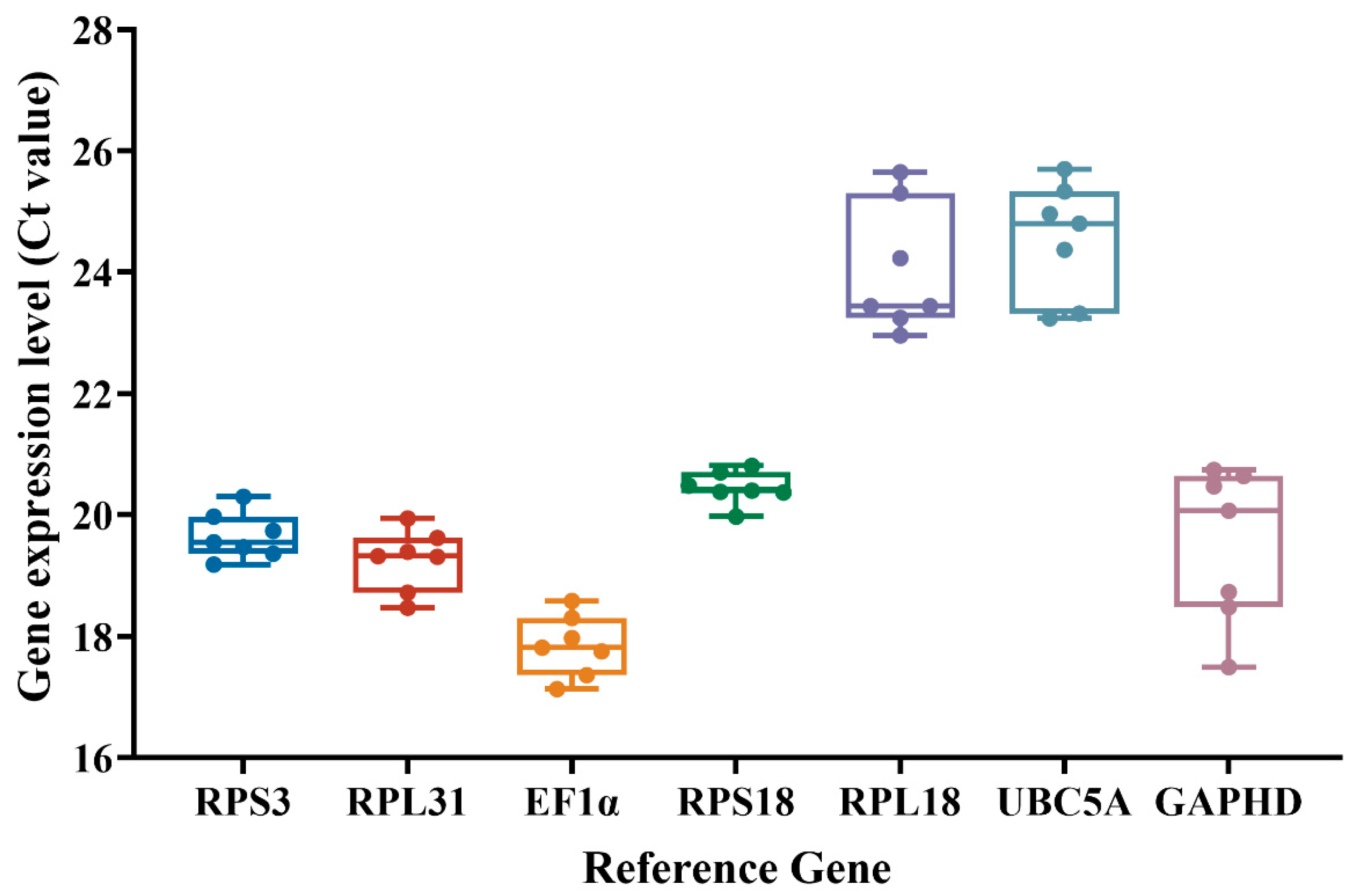
The expression variation of the seven candidate reference genes across all tested tissues is visualized in Figure 1. Analysis of expression stability using the ΔCt method revealed that RPS3 (0.59) and RPS31 (0.62) were the most stably expressed genes, characterized by the least variation among samples, followed by EF1α (0.64) and RPS18 (0.67), which showed moderate stability. Comparatively, GAPDH (1.22) and UBC5A (1.10) showed the most wide-ranging variability and were accordingly identified as the least stable.

3.3. GeNorm and NormFinder Analyses

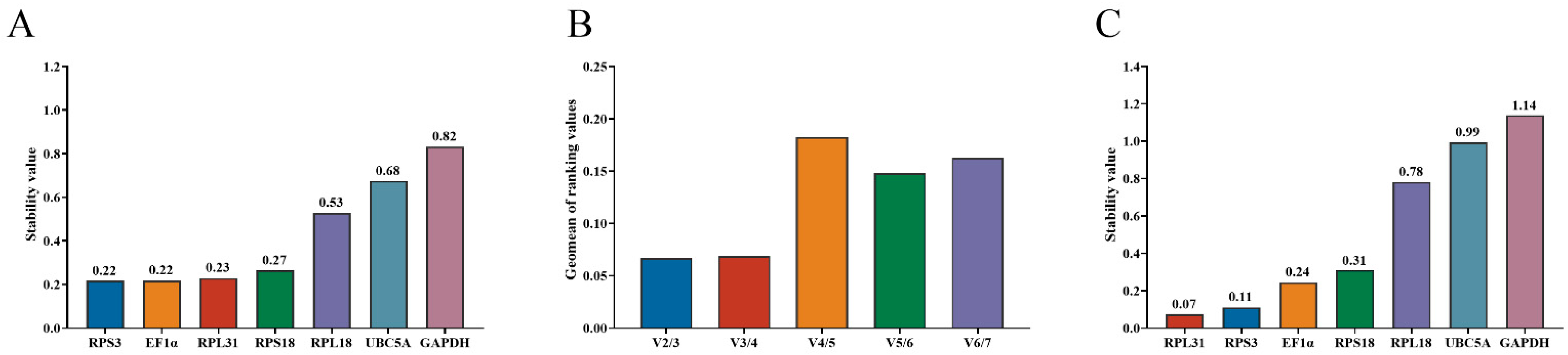
The stabilities of candidate reference gene expression were determined using geNorm with a threshold of M < 0.7 (Figure 2A). Among these genes, EF1α and RPS3 (M = 0.219) had the highest stability, followed by RPS31 (M = 0.229) and RPS18 (M = 0.265). In contrast, UBC5A (M = 0.675) and GAPDH (M = 0.832) showed M values approaching or exceeding the threshold, indicating a lower stability. Pairwise variation V2/V3 values below the 0.15 threshold indicated that two reference genes were sufficient for reliable normalization (Figure 2B).
NormFinder analysis (Figure 2C) revealed that RPS31, which had the lowest stability value (0.074) among the candidate genes, had the highest expression stability, closely followed by RPS3 (0.11) and EF1α (0.244). Conversely, we obtained notably higher stability values for RPL18 (0.782), UBC5A (0.994), and GAPDH (1.139), with GAPDH exhibiting the greatest variability. These findings thus provided evidence that RPS31 and RPS3 were the most suitable genes for reference purposes in this experimental system, whereas GAPDH exhibited relatively poor stability.

3.4. BestKeeper Analysis

BestKeeper can be used to assess gene stability based on the standard deviation (SD) of Ct values (Table 2), with lower SD values indicating a higher stability of expression. According to the BestKeeper criterion, any gene with an SD greater than 1 is considered unstable, and we accordingly identified RPS18 and RPS3 as the genes exhibiting the highest expression stability among the assessed O. jucunda tissues.

3.5. RefFinder Analysis

Given that the algorithms geNorm, NormFinder, the ΔCt method, and BestKeeper employ distinct principles to evaluate gene stability, we utilized the RefFinder platform to integrate the respective results, thereby providing a consensus ranking of stability based on the geometric mean of the individual algorithm rankings (Table 3). Collectively, our analyses identified RPS3 and RPS31 as the most stable reference genes, as these two genes were consistently ranked among the top three most stable genes using all four algorithms. Conversely, UBC5A and GAPDH received the lowest comprehensive rankings, indicating that experimental conditions had a notable influence on their expression, hence accounting for the poor stability.

3.6. Validation of the Stability of Reference Genes

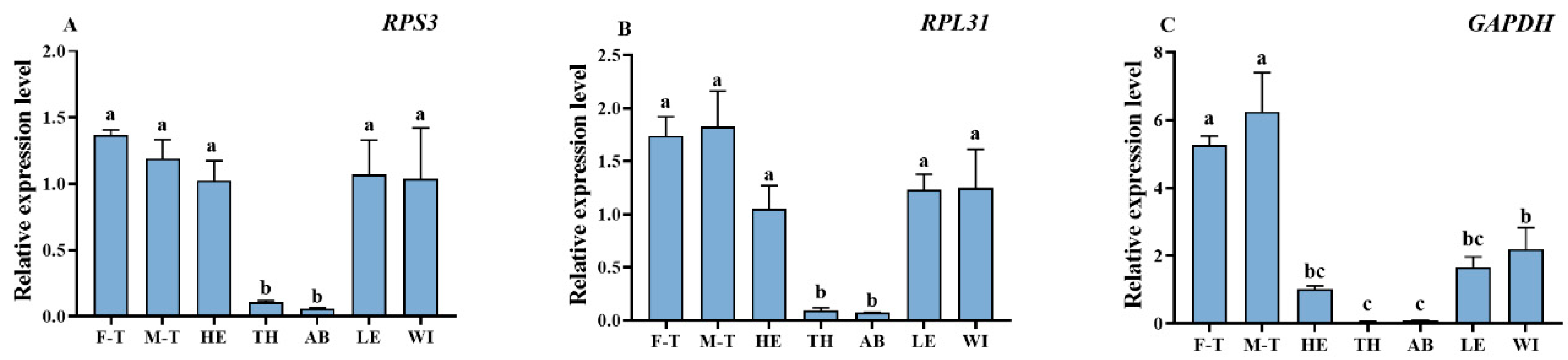
To assess the influence of reference gene selection, we compared the normalized expression of a target gene (OBP3) using the most and least stable gene candidates. The results revealed that when RPS3 and RPS31 were used as internal references, the expression trends of OBP3 across different tissues were highly consistent. Conversely, using a less stably expressed gene, GAPDH, resulted in significant deviations in its expression patterns (Figure 3). These comparisons accordingly revealed that using either RPS3 or RPS31 individually can effectively minimize technical variation. In contrast, the inherent instability of GAPDH introduces substantial normalization bias.

4. Discussion

Although RT-qPCR is a fundamental method for assessing gene expression, the precision of the results depends on the use of stable reference genes to normalize the data. [21,33,34]. Extensive evidence indicates that reference gene expression can vary considerably across experimental conditions, including within the same species, and, at present, no universally applicable reference genes have been identified [35,36]. Consequently, to prevent analytical bias, candidate reference genes need to be rigorously validated under specific experimental conditions. Hence, seven candidate reference genes (GAPDH, EF1α, RPS3, RPS18, RPL18, RPS31, and UBC5A) were selected, the stability of expression of which was systematically analyzed in different tissues of O. jucunda, and on the basis of a comprehensive evaluation using four distinct algorithms, we established a set of optimal reference genes for multiple tissue expression analysis.
Among the assessed candidates, ribosomal protein genes, which play pivotal roles in cellular metabolism and growth regulation, are characterized by highly conserved sequences and functions among different species. Given their evolutionary stability, these genes have been widely adopted as internal reference genes across a range of insect studies [37,38,39]. For example, RPS18 has been shown to exhibit stable inter-tissue expression in Gynaephora qinghaiensis [37], and RPS15 has been found to exhibit consistent normalization performance in the larval tissues of Helicoverpa armigera across different developmental stages [40]. Similarly, throughout the developmental cycle of Plutella xylostella, RPS13 and RPS23 are highly stable [41]. Consistent with these reports, RPS3 and RPS31 were identified as the most stable reference genes across the tested tissues of O. jucunda, supporting the utility of ribosomal protein genes for normalization. The specific superior stability of RPS3 and RPS31 among the RP genes assessed may be attributed to their fundamental roles in ribosome biogenesis and function. Notably, RPS3 was consistently ranked among the top two most stable genes in the multiple algorithmic evaluations we performed. These findings thus reinforce the applicability of RP genes as reliable reference genes in O. jucunda and are consistent with evidence supporting the use of RPS or RPL genes for expression normalization in insects, thereby highlighting their broad utility in gene expression studies [42,43,44,45].
The GAPDH-encoded enzyme catalyzes the reversible oxidation and phosphorylation of glyceraldehyde-3-phosphate to 1,3-bisphosphoglycerate, a central step in both glycolysis and gluconeogenesis [46]. Given its essential function in core carbon metabolism, GAPDH is constitutively expressed at high levels among a wide range of tissues and cell types, and, as such, researchers often assume that the expression of this gene remains stable under different experimental conditions. Consequently, researchers widely employ it as a reference gene for normalizing quantitative data in molecular biology [47]. However, the validity of this assumption is questionable, as substantial evidence indicates that GAPDH expression is readily regulated by a range of physiological and pathological stimuli. Such regulation accordingly introduces substantial bias into gene expression analysis, thereby compromising the accuracy and interpretability of the results obtained [47,48]. Indeed, GAPDH was found to be unstable for normalizing expression across multiple tissue types in O. jucunda, consistently ranked as the least stable candidate by all algorithms and the RefFinder analysis. Validation using OBP3 expression profiles corroborated this finding, confirming that GAPDH was the most unstable gene among those evaluated, consistent with findings reported for other species, including Aquatica leii, Bactrocera dorsalis, and Pandora neoaphidis, in which GAPDH is characterized by similarly unstable expression [49,50,51].
To ensure experimental reliability, we evaluated the stability of reference genes using four established algorithms (ΔCT, geNorm, NormFinder, and BestKeeper). Whereas the findings of ΔCT and geNorm analyses identified RPS3 as the most stable, RPS18 performed best in the BestKeeper analysis, and RPS31 and EF1α ranked highest with NormFinder. This discrepancy in rankings can be ascribed to differences in the mathematical principles underlying the operation of these algorithms, and is a commonly observed phenomenon in such studies [45,51,52,53,54]. Notably, the geNorm algorithm is particularly sensitive to coregulation among candidate genes, as it ranks stability based on pairwise expression correlation. This can introduce a bias favoring genes with similar expression patterns, even if those patterns are not constitutively stable across conditions. To mitigate this limitation and obtain a robust consensus, we integrated the results from all four methods using RefFinder, with the consolidated ranking considered to serve as the definitive assessment of reference gene stability.
Currently, neither genomic nor transcriptomic data are available for O. jucunda. The identification of stable reference genes (RPS3 and RPS31) in O. jucunda directly establishes the essential foundation for quantifying gene expression, which is a critical step in RNAi pest control. However, it will be necessary to further validate the stability of these candidate reference genes across a broader range of biological conditions, including at different stages of development and in response to environmental stresses, to establish a more robust and universal qPCR normalization framework for functional gene studies in this pest.

5. Conclusions

This study represents the first systematic evaluation of reference genes in O. jucunda based on transcriptomic data. Based on our comprehensive evaluation of seven candidate genes using five established computational methods, RPS3 and RPS31 were identified as the most stable reference genes across the assessed tissues. These findings will facilitate reliable reference gene application and provide a robust data foundation for future functional gene studies in this species.

Supplementary Materials

The following supporting information can be downloaded at: https://www.mdpi.com/article/10.3390/insects17010057/s1, Table S1: Primers of reference genes in O. jucunda. Figure S1: Melting curve analysis of seven candidate reference genes.

Author Contributions

Conceptualization, G.-L.X. and N.Z.; methodology, S.-H.Z. and Y.Y.; formal analysis, S.-H.Z., R.-T.Y. and Q.G.; investigation, R.-T.Y. and J.-Q.Z.; resources, S.-H.Z., Y.Y. and S.-P.Z.; data curation, Y.Y. and S.-P.Z.; writing—original draft preparation, S.-H.Z. and Y.Y.; writing—review and editing, G.-L.X. and N.Z.; visualization, Q.G., J.-Q.Z. and S.-P.Z.; supervision, R.-T.Y. and S.-P.Z.; project administration, G.-L.X. and N.Z.; funding acquisition, G.-L.X. and N.Z. All authors have read and agreed to the published version of the manuscript.

Funding

This research was funded by the Hebei Agriculture Research System (HBCT2024150208) and the Basic Research Funds of Hebei Academy of Agriculture and Forestry Sciences (2025100102).

Data Availability Statement

The original contributions presented in this study are included in the article/Supplementary Materials. Further inquiries can be directed to the corresponding authors.

Acknowledgments

We acknowledge the Biological Safety and Risk Assessment Team of National Nanfan Research Institute, Chinese Academy of Agricultural Sciences, for their support in this experiment. We also acknowledge the Hebei Academy of Agricultural and Forestry Sciences Young Scientific and Technological Talents Domestic Further Training and Cultivation Program for funding this study.

Conflicts of Interest

The authors declare no conflicts of interest.

References

  1. Miao, M.; Li, J.Q. Harm of Oxycetonia jucunda Faldermann to apple trees. For. Pest Dis. 2016, 35, 20–22. [Google Scholar]
  2. Ni, T.L.; Li, Z.Y.; Wang, M.; Guo, G.Y. Occurrence and control of Oxycetonia jucunda Faldermann. J. Hebei For. Sci. Technol. 2003, 43. [Google Scholar] [CrossRef]
  3. Zhen, H.W.; Wang, R.Z.; Wang, R.X.; Gu, W.W. Experiment on trapping Oxycetonia jucunda with Sophora japonica. J. Hebei For. Sci. Technol. 2005, 5–6. [Google Scholar] [CrossRef]
  4. Mulvey, J.; Cresswell, J.E. Time-dependent effects on bumble bees of dietary exposures to farmland insecticides (imidacloprid, thiamethoxam and fipronil). Pest Manag. Sci. 2020, 76, 2846–2853. [Google Scholar] [CrossRef] [PubMed]
  5. Sun, X.H.; Sun, S.M.; Qiao, J.Z.; Zhang, J.J. Study on the Outbreak Patterns and Biological Characteristics of Apple Orchard Beetles in Henan Province. Huazhong Insect Res. 2013, 9, 289–293. [Google Scholar]
  6. Farder-Gomes, C.F.; Grella, T.C.; Malaspina, O.; Nocelli, R.F.C. Exposure to sublethal concentrations of imidacloprid, pyraclostrobin, and glyphosate harm the behavior and fat body cells of the stingless bee Scaptotrigona postica. Sci. Total Environ. 2024, 907, 168072. [Google Scholar] [CrossRef] [PubMed]
  7. Cedden, D.; Güney, G.; Rostás, M.; Bucher, G. Optimizing dsRNA sequences for RNAi in pest control and research with the dsRIP web platform. BMC Biol. 2025, 23, 114. [Google Scholar] [CrossRef] [PubMed]
  8. List, F.; Tarone, A.M.; Zhu-Salzman, K.; Vargo, E.L. RNA meets toxicology: Efficacy indicators from the experimental design of RNAi studies for insect pest management. Pest Manag. Sci. 2022, 78, 3215–3225. [Google Scholar] [CrossRef]
  9. Lu, Q.; Cui, H.; Li, W.; Liu, T.; Chen, Q.; Yang, Q. Synthetic nanoscale RNAi constructs as pesticides for the control of Locusta migratoria. J. Agric. Food Chem. 2022, 70, 10762–10770. [Google Scholar] [CrossRef]
  10. Aly, S.M.; Sabri, D.M. Next generation sequencing (NGS): A golden tool in forensic toolkit. Arch. Med. Sadowej Kryminol. 2015, 65, 260–271. [Google Scholar] [CrossRef]
  11. Castellanos, N.L.; Smagghe, G.; Taning, C.N.T.; Oliveira, E.E.; Christiaens, O. Risk assessment of RNAi-based pesticides to non-target organisms: Evaluating the effects of sequence similarity in the parasitoid wasp Telenomus podisi. Sci. Total Environ. 2022, 832, 154746. [Google Scholar] [CrossRef]
  12. Parsons, K.H.; Mondal, M.H.; McCormick, C.L.; Flynt, A.S. Guanidinium-functionalized interpolyelectrolyte complexes enabling RNAi in resistant insect pests. Biomacromolecules 2018, 19, 1111–1117. [Google Scholar] [CrossRef]
  13. Lee, D.E.; Lee, S.H.; Kim, J.H. Validation of reliable reference genes for comparison of gene expression across species in the Anopheles hyrcanus group. Sci. Rep. 2025, 15, 9037. [Google Scholar] [CrossRef]
  14. Vandesompele, J.; De Preter, K.; Pattyn, F.; Poppe, B.; Van Roy, N.; De Paepe, A.; Speleman, F. Accurate normalization of real-time quantitative RT-PCR data by geometric averaging of multiple internal control genes. Genome Biol. 2002, 3, research0034.1. [Google Scholar] [CrossRef] [PubMed]
  15. Bustin, S.A. Absolute quantification of mRNA using real-time reverse transcription polymerase chain reaction assays. J. Mol. Endocrinol. 2000, 25, 169–193. [Google Scholar] [CrossRef]
  16. Bustin, S.A.; Benes, V.; Nolan, T.; Pfaffl, M.W. Quantitative real-time RT-PCR—A perspective. J. Mol. Endocrinol. 2005, 34, 597–601. [Google Scholar] [CrossRef]
  17. VanGuilder, H.D.; Vrana, K.E.; Freeman, W.M. Twenty-five years of quantitative PCR for gene expression analysis. Biotechniques 2008, 44, 619–626. [Google Scholar] [CrossRef] [PubMed]
  18. Lee, P.D.; Sladek, R.; Greenwood, C.M.T.; Hudson, T.J. Control genes and variability: Absence of ubiquitous reference transcripts in diverse mammalian expression studies. Genome Res. 2002, 12, 292–297. [Google Scholar] [CrossRef] [PubMed]
  19. Nolan, T.; Hands, R.E.; Bustin, S.A. Quantification of mRNA using real-time RT-PCR. Nat. Protoc. 2006, 1, 1559–1582. [Google Scholar] [CrossRef]
  20. Yuan, F.; Xie, Z.; Li, Z.; Lian, P.; Wei, C. Screening of reference genes for gene expression study in different tissues from the transcriptome data of the vector leafhopper Psammotettix striatus. Gene 2024, 927, 148696. [Google Scholar] [CrossRef]
  21. Xin, H.-J.; Liu, C.-Y.; Yan, F.; Wang, L.-D.; Zhang, H.-H.; Shen, C.-H.; Zhai, Q. Reference gene selection for quantitative gene expression analysis in Argynnis hyperbius. Insects 2025, 16, 1008. [Google Scholar] [CrossRef]
  22. Yang, C.; Pan, H.; Noland, J.E.; Zhang, D.; Zhang, Z.; Liu, Y.; Zhou, X. Selection of reference genes for RT-qPCR analysis in a predatory biological control agent, Coleomegilla maculata (Coleoptera: Coccinellidae). Sci. Rep. 2015, 5, 18201. [Google Scholar] [CrossRef]
  23. Yang, C.; Preisser, E.L.; Zhang, H.; Liu, Y.; Dai, L.; Pan, H.; Zhou, X. Selection of reference genes for RT-qPCR analysis in Coccinella septempunctata to assess un-intended effects of RNAi transgenic plants. Front. Plant Sci. 2016, 7, 1672. [Google Scholar] [CrossRef]
  24. Zhang, B.; Liu, J.; Yuan, G.; Chen, X.; Gao, X. Selection and evaluation of potential reference genes for gene expression analysis in greenbug (Schizaphis graminum Rondani). J. Integr. Agric. 2018, 17, 2054–2065. [Google Scholar] [CrossRef]
  25. Huggett, J.; Dheda, K.; Bustin, S.; Zumla, A. Real-time RT-PCR normalisation; strategies and considerations. Genes Immun. 2005, 6, 279–284. [Google Scholar] [CrossRef] [PubMed]
  26. Bansal, R.; Mittapelly, P.; Chen, Y.; Mamidala, P.; Zhao, C.; Michel, A. Quantitative RT-PCR gene evaluation and RNA interference in the brown marmorated stink bug. PLoS ONE 2016, 11, e0152730. [Google Scholar] [CrossRef]
  27. Radonić, A.; Thulke, S.; Mackay, I.M.; Landt, O.; Siegert, W.; Nitsche, A. Guideline to reference gene selection for quantitative real-time PCR. Biochem. Biophys. Res. Commun. 2004, 313, 856–862. [Google Scholar] [CrossRef] [PubMed]
  28. Shakeel, M.; Rodriguez, A.; Tahir, U.B.; Jin, F. Gene expression studies of reference genes for quantitative real-time PCR: An overview in insects. Biotechnol. Lett. 2018, 40, 227–236. [Google Scholar] [CrossRef]
  29. Silver, N.; Best, S.; Jiang, J.; Thein, S.L. Selection of housekeeping genes for gene expression studies in human reticulocytes using real-time PCR. BMC Mol. Biol. 2006, 7, 33. [Google Scholar] [CrossRef]
  30. Andersen, C.L.; Jensen, J.L.; Ørntoft, T.F. Normalization of real-time quantitative reverse transcription-PCR data: A model-based variance estimation approach to identify genes suited for normalization, applied to bladder and colon cancer data sets. Cancer Res. 2004, 64, 5245–5250. [Google Scholar] [CrossRef]
  31. Pfaffl, M.W.; Tichopad, A.; Prgomet, C.; Neuvians, T.P. Determination of stable housekeeping genes, differentially regulated target genes and sample integrity: BestKeeper—Excel-based tool using pair-wise correlations. Biotechnol. Lett. 2004, 26, 509–515. [Google Scholar] [CrossRef]
  32. Xie, F.; Wang, J.; Zhang, B. RefFinder: A web-based tool for comprehensively analyzing and identifying reference genes. Funct. Integr. Genom. 2023, 23, 125. [Google Scholar] [CrossRef]
  33. Valasek, M.A.; Repa, J.J. The power of real-time PCR. Adv. Physiol. Educ. 2005, 29, 151–159. [Google Scholar] [CrossRef]
  34. Gutierrez, L.; Mauriat, M.; Guénin, S.; Pelloux, J.; Lefebvre, J.; Louvet, R.; Rusterucci, C.; Moritz, T.; Guerineau, F.; Bellini, C.; et al. The lack of a systematic validation of reference genes: A serious pitfall undervalued in reverse transcription-polymerase chain reaction (RT-PCR) analysis in plants. Plant Biotechnol. J. 2008, 6, 609–618. [Google Scholar] [CrossRef]
  35. Kozera, B.; Rapacz, M. Reference genes in real-time PCR. J. Appl. Genet. 2013, 54, 391–406. [Google Scholar] [CrossRef]
  36. Hildyard, J.C.W.; Finch, A.M.; Wells, D.J. Identification of qPCR reference genes suitable for normalizing gene expression in the mdx mouse model of Duchenne muscular dystrophy. PLoS ONE 2019, 14, e0211384. [Google Scholar] [CrossRef]
  37. Li, H.; Chang, F.; Cui, X.; Xi, B.; Li, G.; Liu, D.; Niu, K. Stability evaluation of reference genes in Gynaephora qinghaiensis (Lepidoptera: Lymantriidae) for qRT-PCR normalization. Insects 2025, 16, 1019. [Google Scholar] [CrossRef] [PubMed]
  38. Lü, J.; Yang, C.; Zhang, Y.; Pan, H. Selection of reference genes for the normalization of RT-qPCR data in gene expression studies in insects: A systematic review. Front. Physiol. 2018, 9, 1560. [Google Scholar] [CrossRef] [PubMed]
  39. Shi, C.; Yang, F.; Zhu, X.; Du, E.; Yang, Y.; Wang, S.; Wu, Q.; Zhang, Y. Evaluation of housekeeping genes for quantitative real-time PCR analysis of Bradysia odoriphaga (Diptera: Sciaridae). Int. J. Mol. Sci. 2016, 17, 1034. [Google Scholar] [CrossRef] [PubMed]
  40. Zhang, S.; An, S.; Li, Z.; Wu, F.; Yang, Q.; Liu, Y.; Cao, J.; Zhang, H.; Zhang, Q.; Liu, X. Identification and validation of reference genes for normalization of gene expression analysis using qRT-PCR in Helicoverpa armigera (Lepidoptera: Noctuidae). Gene 2015, 555, 393–402. [Google Scholar] [CrossRef]
  41. Fu, W.; Xie, W.; Zhang, Z.; Wang, S.; Wu, Q.; Liu, Y.; Zhou, X.; Zhou, X.; Zhang, Y. Exploring valid reference genes for quantitative real-time PCR analysis in Plutella xylostella (Lepidoptera: Plutellidae). Int. J. Biol. Sci. 2013, 9, 792–802. [Google Scholar] [CrossRef]
  42. Yang, X.; Pan, H.; Yuan, L.; Zhou, X. Reference gene selection for RT-qPCR analysis in Harmonia axyridis, a global invasive lady beetle. Sci. Rep. 2018, 8, 2689. [Google Scholar] [CrossRef]
  43. Lord, J.C.; Hartzer, K.; Toutges, M.; Oppert, B. Evaluation of quantitative PCR reference genes for gene expression studies in Tribolium castaneum after fungal challenge. J. Microbiol. Methods 2010, 80, 219–221. [Google Scholar] [CrossRef]
  44. Luo, J.; Ma, C.; Li, Z.; Zhu, B.; Zhang, J.; Lei, C.; Jin, S.; Hull, J.J.; Chen, L. Assessment of suitable reference genes for qRT-PCR analysis in Adelphocoris suturalis. J. Integr. Agric. 2018, 17, 2745–2757. [Google Scholar] [CrossRef]
  45. Chen, C.; Li, S.; Zhu, H.; Fan, B.; Wang, Y.; Hao, D. Identification and evaluation of reference genes for gene expression analysis in the weevil pest Pagiophloeus tsushimanus using RT-qPCR. J. Asia-Pac. Entomol. 2020, 23, 336–344. [Google Scholar] [CrossRef]
  46. Sirover, M.A. New insights into an old protein: The functional diversity of mammalian glyceraldehyde-3-phosphate dehydrogenase. Biochim. Biophys. Acta 1999, 1432, 159–184. [Google Scholar] [CrossRef] [PubMed]
  47. Nazari, F.; Parham, A.; Maleki, A.F. GAPDH, β-actin and Β2-microglobulin, as three common reference genes, are not reliable for gene expression studies in equine adipose- and marrow-derived mesenchymal stem cells. J. Anim. Sci. Technol. 2015, 57, 18. [Google Scholar] [CrossRef] [PubMed]
  48. Muronetz, V.I.; Medvedeva, M.V.; Sevostyanova, I.A.; Schmalhausen, E.V. Modification of glyceraldehyde-3-phosphate dehydrogenase with nitric oxide: Role in signal transduction and development of apoptosis. Biomolecules 2021, 11, 1656. [Google Scholar] [CrossRef]
  49. Fu, X.; Meyer-Rochow, V.B. Selection and validation of suitable reference genes for RT-qPCR analysis in the rare aquatic firefly Aquatica leii (Coleoptera: Lampyridae). Insects 2021, 12, 359. [Google Scholar] [CrossRef]
  50. Zhang, S.; Chen, C.; Xie, T.; Ye, S. Identification and validation of reference genes for qRT-PCR studies of the obligate aphid pathogenic fungus Pandora neoaphidis during different developmental stages. PLoS ONE 2017, 12, e0179930. [Google Scholar] [CrossRef]
  51. Cao, Y.; Li, B.; Chen, N.; Yang, D.; Li, L.; Liu, T. Evaluation of reference genes for quantitative reverse transcription polymerase chain reaction in Bactrocera dorsalis (Diptera: Tephritidae) subjected to various phytosanitary treatments. Insects 2021, 12, 945. [Google Scholar] [CrossRef] [PubMed]
  52. Hu, H.; Ye, X.; Wang, H.; Ji, R. Selection of reference genes for normalization of real-time PCR data in Calliptamus italicus (Orthoptera: Acrididae) under different temperature conditions. J. Insect Sci. 2019, 19, 7. [Google Scholar] [CrossRef] [PubMed]
  53. Sharath Chandra, G.; Asokan, R.; Manamohan, M.; Krishna Kumar, N.K.; Sita, T. Evaluation of reference genes for quantitative real-time PCR normalization in cotton bollworm Helicoverpa armigera. Mol. Biol. 2014, 48, 813–822. [Google Scholar] [CrossRef]
  54. Yuan, M.; Lu, Y.; Zhu, X.; Wan, H.; Shakeel, M.; Zhan, S.; Jin, B.-R.; Li, J. Selection and evaluation of potential reference genes for gene expression analysis in the brown planthopper, Nilaparvata lugens (Hemiptera: Delphacidae) using reverse-transcription quantitative PCR. PLoS ONE 2014, 9, e86503. [Google Scholar] [CrossRef]
Figure 1. Expression of the candidate reference genes in different tissues obtained from Oxycetonia jucunda. The box plots show the median (center line), inter-quartile range (box), and range (whiskers). A more compact box and shorter whiskers indicate lower expression variability and higher stability.
Insects 17 00057 g001
Figure 2. Stability analysis of candidate reference genes in different tissues of O. jucunda. (A) Expression stability ranking (M value) determined by geNorm. Lower M values indicate higher stability. (B) Determination of the optimal number of reference genes by geNorm pairwise variation (Vn/Vn+1) analysis. The dashed line indicates the 0.15 cutoff. (C) Stability ranking determined by NormFinder. Lower stability values indicate higher stability.
Insects 17 00057 g002
Figure 3. Relative expression of OBP3 in Oxycetonia jucunda tissues normalized with different reference genes. Different lowercase letters above bars indicate statistically significant differences between the groups (p < 0.05). Tissue abbreviations: F-T, female tentacles; M-T, male tentacles; HE, heads (antennae removed); TH, thorax; AB, abdomen; LE, legs; WI, wings.
Insects 17 00057 g003
Table 1. Amplification efficiencies of the seven candidate reference genes in Oxycetonia jucunda identified by RT-qPCR.
GeneEfficiency (%)R2
RPL18108.60.991
RPS31107.30.997
UBC5A106.10.997
GAPDH95.60.995
EF-1α95.50.998
RPS398.60.998
RPS1896.50.998
Table 2. Results of evaluations of the stability of reference gene expression in different tissues of adult Oxycetonia jucunda using BestKeeper.
ParameterGAPDHEF1αRPS3RPS18UBC5ARPL18RPS31
std dev [+/− CP]1.10.380.30.190.760.880.38
CV [% CP]5.642.121.530.923.13.641.95
p-value0.0560.020.0010.0450.4640.0410.006
Table 3. Comparative ranking of the stability of candidate reference genes.
Method1234567
Delta CTRPS3RPS31EF1αRPS18RPL18UBC5AGAPDH
BestKeeperRPS18RPS3RPS31EF1αUBC5ARPL18GAPDH
NormfinderRPS31RPS3EF1αRPS18RPL18UBC5AGAPDH
GenormEF1α|RPS3 RPS31RPS18RPL18UBC5AGAPDH
OVERALLRPS3RPS31EF1αRPS18RPL18UBC5AGAPDH
Disclaimer/Publisher’s Note: The statements, opinions and data contained in all publications are solely those of the individual author(s) and contributor(s) and not of MDPI and/or the editor(s). MDPI and/or the editor(s) disclaim responsibility for any injury to people or property resulting from any ideas, methods, instructions or products referred to in the content.