


Molecules, Morphometrics and Modeling of the Medically Important Genus Hemiscorpius Peters, 1861 (Scorpiones: Hemiscorpiidae) in Iran Reveal New Species from Kerman

 , ,
, ,  and
and
Simple Summary
Abstract
1. Introduction
2. Materials and Methods
2.1. Fieldwork
2.2. Material and Morphology
2.3. Morphometrics
2.4. Molecular Analyses
2.5. Ecological Niche Modeling
3. Results
3.1. Morphometric Analyses
3.2. Molecular Analyses
3.3. Ecological Niche Modeling
3.4. Systematics
- Family Hemiscorpiidae Pocock, 1893
- Genus Hemiscorpius Peters 1861
- Hemiscorpius acanthocercus Monod & Lourenço, 2005
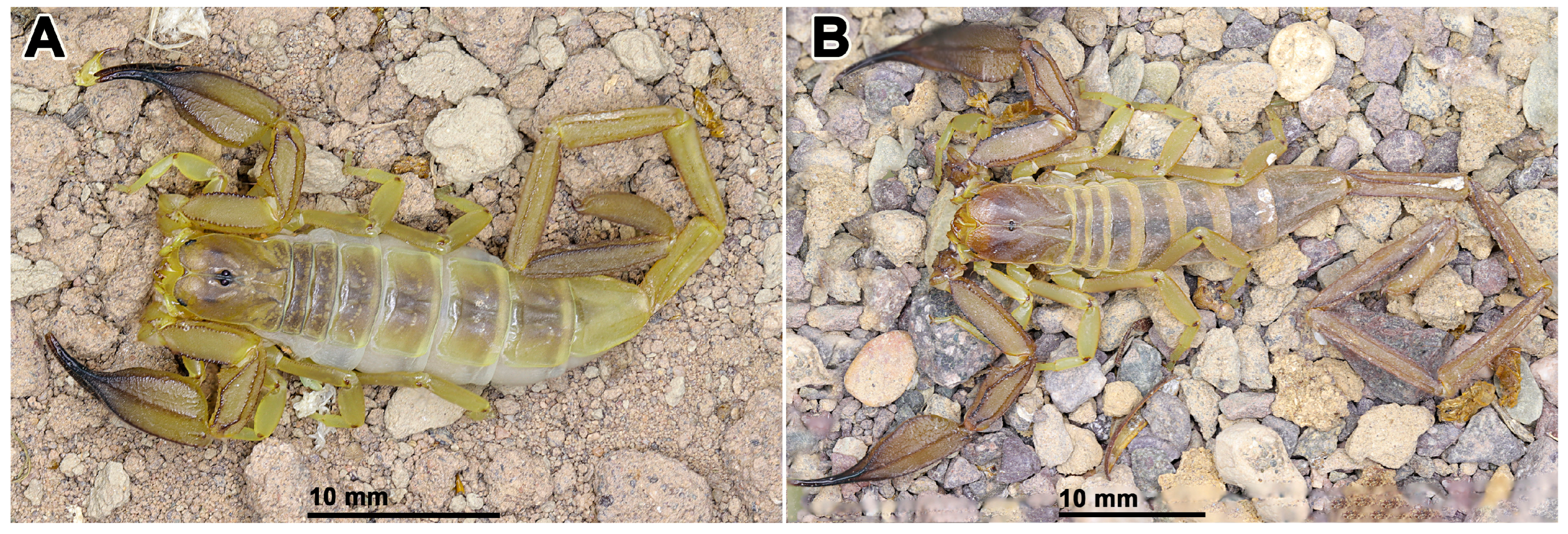
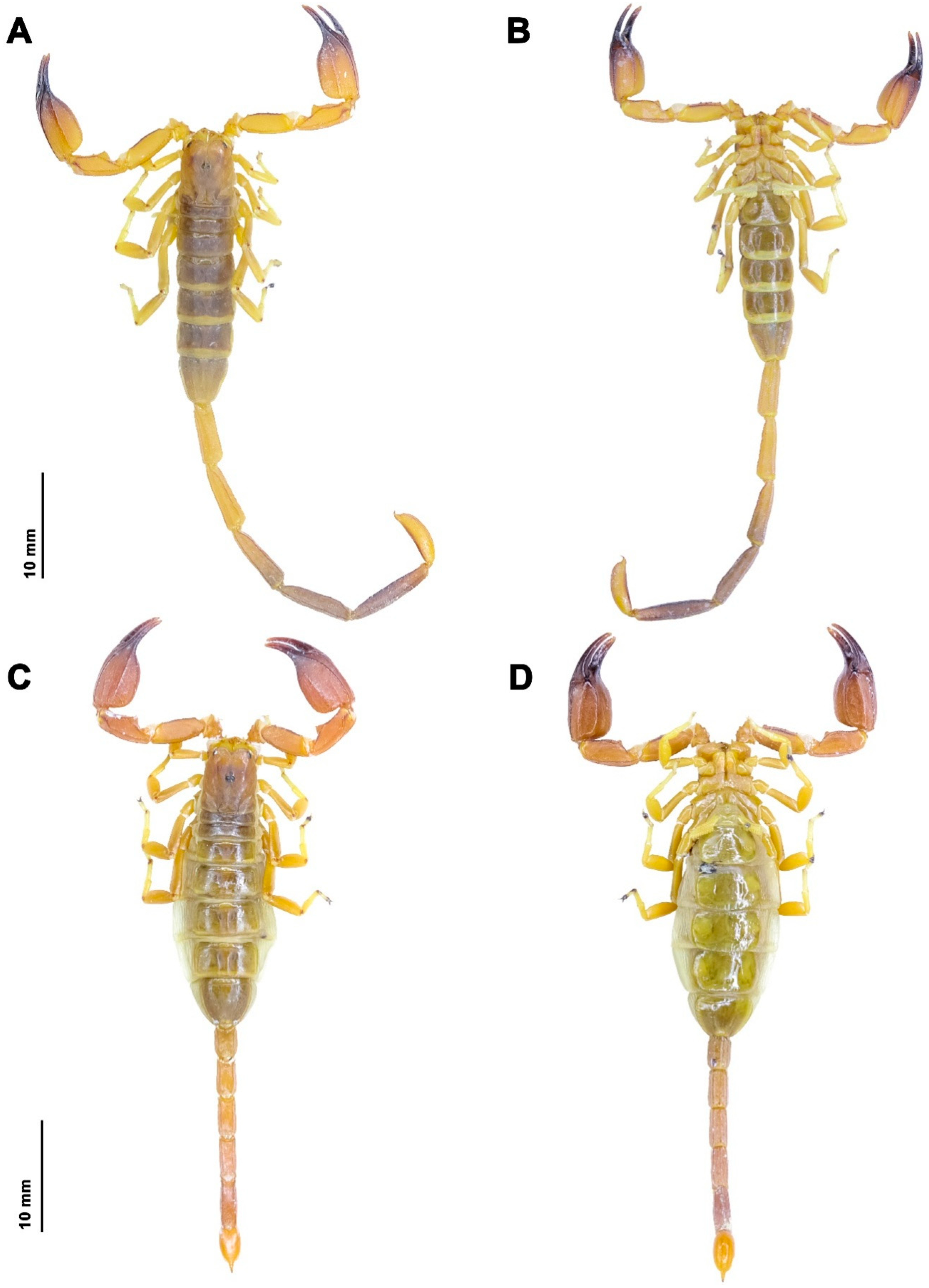
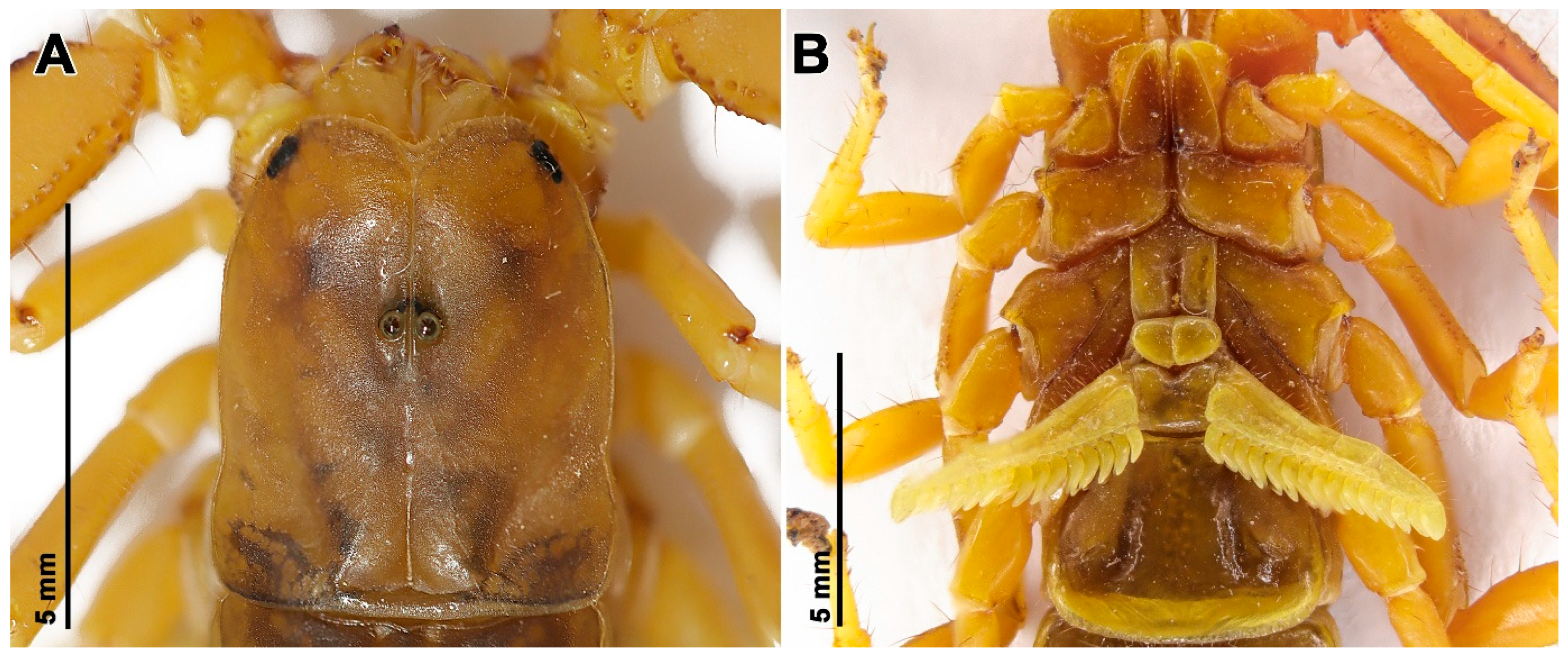
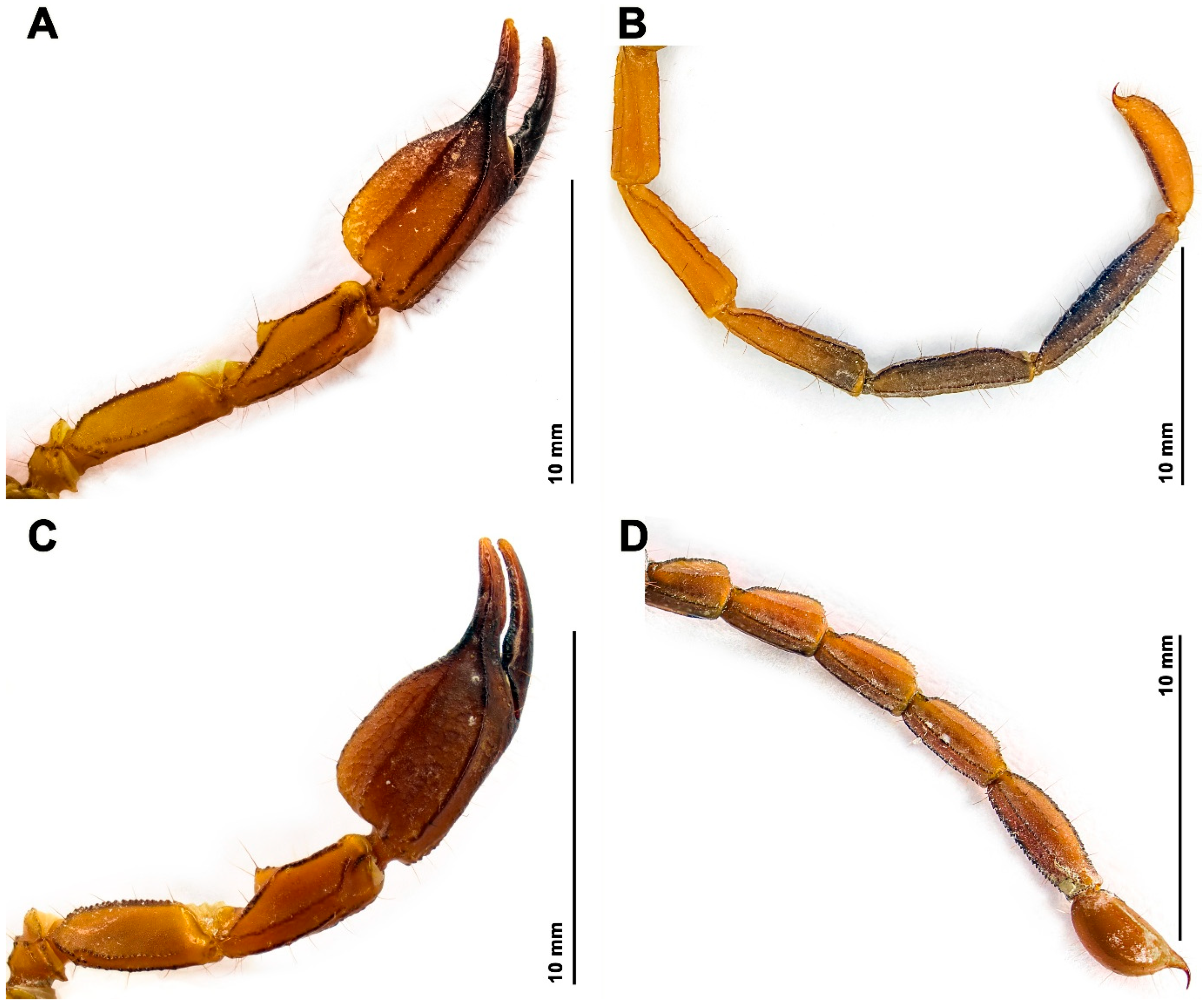
- Hemiscorpius aratta Barahoei & Prendini sp. n.
- Hemiscorpius enischnochela Monod & Lourenço, 2005
- Hemiscorpius jiroftensis Amiri Ghanat Saman et al., 2025
- Hemiscorpius lepturus Peters, 1861
- Hemiscorpius persicus (Birula, 1903)
4. Discussion
4.1. Morphological Variation
4.2. Morphometric Analyses
4.3. Molecular Analyses
4.4. Iranian Biogeography
4.5. Ecological Niche Modeling
5. Conclusions
Supplementary Materials
Author Contributions
Funding
Institutional Review Board Statement
Data Availability Statement
Acknowledgments
Conflicts of Interest
References
- Lourenço, W.R. The genus Hemiscorpius Peters, 1861 (Scorpiones: Hemiscorpiidae) in East Africa, and description of a new species from Somalia. Entomol. Mitteilungen Aus Dem Zool. Mus. Hambg. 2011, 15, 275–285. [Google Scholar]
- Hussen, F.; Erdek, M.; Yağmur, E. External morphology of Hemiscorpius lepturus Peters, 1861 (Scorpiones: Hemiscorpiidae). Arthropoda Sel. 2023, 32, 419–437. [Google Scholar] [CrossRef]
- Prendini, L. Substratum specialization and speciation in southern African scorpions: The Effect Hypothesis revisited. In Scorpions 2001; Fet, V., Selden, P.A., Eds.; In Memoriam Gary A. Polis; British Arachnological Society: Burnham Beeches, UK, 2001; pp. 113–138. [Google Scholar]
- Sridhara, S.; Chakravarthy, A.K.; Kalarani, V.; Reddy, D.C. Diversity and ecology of scorpions: Evolutionary success through venom. In Arthropod Diversity and Conservation in the Tropics and Sub-Tropics; Springer: Singapore, 2016; pp. 57–80. [Google Scholar]
- Rafinejad, J.; Shahi, M.; Navidpour, S.; Jahanifard, E.; Hanafi-Bojd, A.A. Effect of climate change on spatial distribution of scorpions of significant public health importance in Iran. Asian Pac. J. Trop. Med. 2020, 13, 503–514. [Google Scholar] [CrossRef]
- Shahi, M.; Barahoei, H. Morphological study of Hemiscorpius Peters, 1861 (Scorpiones: Hemiscorpiidae) in Hormozgan Province, southern Iran. Arch. Razi Inst. 2023, 78, 1588–1600. [Google Scholar] [CrossRef]
- Amiri Ghanat Saman, E.; Barahoei, H.; Dehghan, H.; Oshaghi, M.A.; Rafinejad, J.; Azarm, A.; Prendini, L. A new species of the medically important scorpion genus, Hemiscorpius Peters, 1861 (Hemiscorpiidae), from southern Iran. Diversity 2025, 17, 321. [Google Scholar] [CrossRef]
- Zamani, A. Arthropod diversity in Iran: Class Arachnida Lamarck, 1801 (excl. Acariformes Zakhvatkin, 1952 and Parasitiformes Reuter, 1909). J. Insect Biodivers. Syst. 2025, 11, 981–1002. [Google Scholar]
- Ebrahimi, V.; Hamdami, E.; Moemenbellah-Fard, M.D.; Jahromi, S.E. Predictive determinants of scorpion stings in a tropical zone of south Iran: Use of mixed seasonal autoregressive moving average model. J. Venom. Anim. Toxins Incl. Trop. Dis. 2017, 23, 39. [Google Scholar] [CrossRef]
- Adeli-Sardou, M.; Shahi, M.; Dehghan, H.; Ahmadyousefi-Sarhadi, M.; Falah, G.; Barahoei, H. Geographical distribution of scorpions (Arachnida: Scorpiones) in southern regions of Kerman Province, Iran. Biol. Bull. 2024, 51, 644–654. [Google Scholar] [CrossRef]
- Pipelzadeh, M.H.; Jalali, A.; Taraz, M.; Pourabbas, R.; Zaremirakabadi, A. An epidemiological and a clinical study on scorpionism by the Iranian scorpion Hemiscorpius lepturus. Toxicon 2007, 50, 984–992. [Google Scholar] [CrossRef] [PubMed]
- Valavi, E.; Amuri, P.; Ahmadzadeh, A.; Cheraghian, B.; Ahankoob, E. Acute kidney injury in Hemiscorpius lepturus scorpion stung children: Risk factors and clinical features. Saudi J. Kidney Dis. Transpl. 2016, 27, 936–941. [Google Scholar] [CrossRef] [PubMed]
- Dehghani, R.; Kamiabi, F.; Mohammadi, M. Scorpionism by Hemiscorpius spp. in Iran: A review. J. Venom. Anim. Toxins incl. Trop. Dis. 2018, 24, 8. [Google Scholar] [CrossRef]
- Shahi, M.; Moosavy, S.H.; Sanaei-Zadeh, H. Severe hemoglobinuria due to Hemiscorpius enischnochela (Scorpiones: Hemiscorpiidae) envenomation from south of Iran. J. Emerg. Pract. Trauma. 2020, 6, 121–125. [Google Scholar] [CrossRef]
- Monod, L.; Lourenço, W.R. Hemiscorpiidae (Scorpiones) from Iran, with descriptions of two new species and notes on biogeography and phylogenetic relationships. Rev. Suisse De Zool. 2005, 112, 869–942. [Google Scholar] [CrossRef]
- Karataş, A.; Gharkheloo, M.M. A new Hemiscorpius Peters, 1861 (Scorpiones: Hemiscorpiidae) from southwestern Iran. Turk. J. Zool. 2013, 37, 15–23. [Google Scholar] [CrossRef]
- Kovařík, F.; Navidpour, S.; Soleglad, M.E. Hemiscorpius shahii sp. n. from Iran (Scorpiones: Hemiscorpiidae). Euscorpius 2017, 249, 1–9. [Google Scholar] [CrossRef]
- Jolodar, A. Molecular characterization and phylogeny analysis based on sequences of cytochrome oxidase gene from Hemiscorpius lepturus of Iran. Iran. J. Vet. Res. 2019, 13, 59–67. [Google Scholar]
- Shahi, M.; Barahoei, H. Molecular study of Hemiscorpius Peters (Scorpiones: Hemiscorpiidae) in Hormozgan Province, south of Iran. Arch. Razi Inst. 2024, 79, 216–222. [Google Scholar]
- Stahnke, H.L. Scorpion nomenclature and mensuration. Entomol. News 1970, 81, 297–316. [Google Scholar]
- Sissom, W.D. Systematics, biogeography and paleontology. In The Biology of Scorpions; Polis, G.A., Ed.; Stanford University Press: Stanford, CA, USA, 1990; pp. 31–80. [Google Scholar]
- Prendini, L. Phylogeny and classification of the superfamily Scorpionoidea Latreille 1802 (Chelicerata, Scorpiones): An exemplar approach. Cladistics 2000, 16, 1–78. [Google Scholar] [CrossRef]
- Loria, S.F.; Prendini, L. Homology of the lateral eyes of Scorpiones: A six-ocellus model. PLoS ONE 2014, 9, e112913. [Google Scholar] [CrossRef]
- González-Santillán, E.; Prendini, L. Redefinition and generic revision of the North American vaejovid scorpion subfamily Syntropinae Kraepelin, 1905, with descriptions of six new genera. Bull. Am. Mus. Nat. Hist. 2013, 382, 1–71. [Google Scholar] [CrossRef]
- Sissom, W.D.; Polis, G.A.; Watt, D.D. Field and laboratory methods. In The Biology of Scorpions; Polis, G.A., Ed.; Stanford University Press: Stanford, CA, USA, 1990; pp. 215–221. [Google Scholar]
- Barahoei, H.; Navidpour, S.; Aliabadian, M.; Siahsarvie, R.; Mirshamsi, O. Sexual dimorphism in the scorpions of the genus Odontobuthus Vachon, 1950 (Scorpiones: Buthidae). Iran. J. Anim. Biosyst. 2020, 16, 21–35. [Google Scholar] [CrossRef]
- Barahoei, H.; Prendini, L.; Navidpour, S.; Tahir, H.M.; Aliabadian, M.; Siahsarvie, R.; Mirshamsi, O. Integrative systematics of the tooth-tailed scorpions, Odontobuthus (Buthidae), with descriptions of three new species from the Iranian Plateau. Zool. J. Linn. Soc. 2022, 195, 355–398. [Google Scholar] [CrossRef]
- Barahoei, H.; Mirshamsi, O.; Amiri, M.; Moeinaddini, A.; Rakhshani, E. Integrative taxonomy reveals existence of a new species of the fat-tailed scorpions, Androctonus (Buthidae) in Iran. Turk. J. Zool. 2025, 49, 48–74. [Google Scholar] [CrossRef]
- Amiri, M.; Aliabadian, M.; Siahsarvie, R.; Ghassemzadeh, F.; Mirshamsi, O. Geometric morphometric analysis in nine species of genus Hottentotta (Birula 1908) (Arachnida: Scorpiones) from Iran. Iran. J. Anim. Biosyst. 2023, 19, 1–12. [Google Scholar] [CrossRef]
- Sundberg, F.A. Morphological diversification of Ptychopariida (Trilobita) from the Marjumiid biomeren (Middle and Upper Cambrian). Paleobiology 1996, 22, 49–65. [Google Scholar] [CrossRef]
- Navarro, N.; Zatarain, X.; Montuire, S. Effects of morphometric descriptor changes on statistical classification and morphospaces. Biol. J. Linn. Soc. 2004, 83, 243–260. [Google Scholar] [CrossRef]
- Eldredge, N. Systematics and evolution of Phacops rana (Green, 1832) and Phacops iowensis Delo, 1935 (Trilobita) from the Middle Devonian of North America. Bull. Am. Mus. Nat. Hist. 1972, 147, 45–114. [Google Scholar]
- Lira, A.F.A.; Rego, F.N.A.A.; Salomão, R.P.; De Albuquerque, C.M.R. Effects of habitat quality on body size of the litter dwelling scorpion Tityus pusillus in fragmented rainforests of Brazil. J. Arachnol. 2021, 48, 295–299. [Google Scholar]
- R Core Team. R: A Language and Environment for Statistical Computing. Vienna: R Foundation for Statistical Computing. 2019. Available online: https://www.R-project.org (accessed on 12 December 2025).
- Venables, W.N.; Ripley, B.D. Modern Applied Statistics with S, 4th ed.; Springer: New York, NY, USA, 2002. [Google Scholar]
- Fox, J.; Weisberg, S. An R Companion to Applied Regression, 3rd ed.; Sage: Thousand Oaks, CA, USA, 2019. [Google Scholar]
- Wickham, H. Ggplot2: Elegant Graphics for Data Analysis; Springer: New York, NY, USA, 2016. [Google Scholar]
- Claude, J. Morphometrics with R; Springer: New York, NY, USA, 2008. [Google Scholar]
- Folmer, O.; Black, M.; Hoeh, W.; Lutz, R.; Vrijenhoek, R. DNA primers for amplification of mitochondrial Cytochrome c Oxidase Subunit I from diverse metazoan invertebrates. Mol. Mar. Biol. Biotechnol. 1994, 3, 294–299. [Google Scholar]
- Hall, T.A. BioEdit: A user-friendly biological sequence alignment editor and analysis program for Windows 95/98/NT. Nucleic Acids Symp. Ser. 1999, 41, 95–98. [Google Scholar]
- Tamura, K.; Stecher, G.; Kumar, S. MEGA11: Molecular Evolutionary Genetics Analysis version 11. Mol. Biol. Evol. 2021, 38, 3022–3027. [Google Scholar] [CrossRef]
- Miller, M.A.; Pfeiffer, W.; Schwartz, T. Creating the CIPRES Science Gateway for inference of large phylogenetic trees. In Proceedings of the 2010 Gateway Computing Environments Workshop (GCE), New Orleans, LA, USA, 14 November 2010; p. 7. [Google Scholar] [CrossRef]
- Ronquist, F.; Huelsenbeck, J.P. MrBayes 3: Bayesian phylogenetic inference under mixed models. Bioinformatics 2003, 19, 1572–1574. [Google Scholar] [CrossRef]
- Phillips, S.J.; Anderson, R.P.; Schapire, R.E. Maximum entropy modeling of species geographic distributions. Ecol. Model. 2006, 190, 231–259. [Google Scholar] [CrossRef]
- De Souza Muñoz, M.E.; De Giovanni, R.; De Siqueira, M.F.; Sutton, T.; Brewer, P.; Pereira, R.S.; Canhos, D.A.L.; Canhos, V.P. Openmodeller: A generic approach to species’ potential distribution modelling. GeoInformatica 2011, 15, 111–135. [Google Scholar] [CrossRef]
- Environmental Systems Research Institute (ESRI). ArcGIS Desktop: Release 10; Environmental Systems Research Institute: Redlands, CA, USA, 2011. [Google Scholar]
- Fick, S.E.; Hijmans, R.J. WorldClim 2: New 1-km spatial resolution climate surfaces for global land areas. Int. J. Climatol. 2017, 37, 4302–4315. [Google Scholar] [CrossRef]
- Manel, S.; Williams, H.C.; Ormerod, S.J. Evaluating presence–absence models in ecology: The need to account for prevalence. J. Appl. Ecol. 2001, 38, 291–931. [Google Scholar] [CrossRef]
- Prendini, L.; Crowe, T.M.; Wheeler, W.C. Systematics and biogeography of the family Scorpionidae (Chelicerata: Scorpiones), with a discussion of phylogenetic methods. Invertebr. Syst. 2003, 17, 185–259. [Google Scholar] [CrossRef]
- Barahoei, H.; Navidpour, S.; Aliabadian, M.; Siahsarvie, R.; Mirshamsi, O. Scorpions of Iran (Arachnida: Scorpiones): Annotated checklist, DELTA database and identification key. J. Insect Biodivers. 2020, 6, 375–474. [Google Scholar] [CrossRef]
- Navidpour, S.; Fet, V.; Kovařík, F.; Soleglad, M.E. Scorpions of Iran (Arachnida, Scorpiones). Part VIII. Fars Province. Euscorpius 2012, 139, 1–29. [Google Scholar] [CrossRef]
- Peters, W. Eine neue Untergattung von Skorpionen. Monatsber. K. Preuss. Akad. Wiss. Berlin 1861, 1861, 426–427. [Google Scholar]
- Birula, A.A. Beitrage zur Kenntniss der Scorpionenfauna Ost-Persiens (2. Beitrag). Bull. Acad. Imp. Sci. 1903, 19, 67–80. [Google Scholar]
- Moradi, M.; Yağmur, E.A.; Soltanabadi, M.; Sarpiri, S. The scorpion fauna (Arachnida: Scorpiones) of the southern regions of Sistan & Baluchistan Province with notes on the occurrence of Androctonus baluchicus (Pocock, 1900) in Iran. Biharean Biol. 2020, 14, 90–97. [Google Scholar]
- Fekri, S.; Badzohre, A.; Safari, R.; Azizi, K. Species identification and geographic distribution of scorpions in Jask town County, Hormozgan Province. J. Hormozgan Univ. Med. Sci. 2012, 16, 135–142. [Google Scholar]
- Carlson, B.E.; McGinley, S.; Rowe, M.P. Meek males and fighting: Sexually-dimorphic antipredator behavior and locomotor performance is explained by morphology in bark scorpions (Centruroides vittatus). PLoS ONE 2014, 9, e97648. [Google Scholar] [CrossRef]
- Sentenská, L.; Franziska, G.; Rihard, M.; Kropf, C. Sexual dimorphism in venom gland morphology in sexually stinging scorpion. Biol. J. Linn. Soc. 2017, 122, 429–443. [Google Scholar] [CrossRef]
- Shahi, M.; Rafinejad, J.; Az-Khosravi, L.; Moosavy, S.H. First report of death due to Hemiscorpius acanthocercus envenomation in Iran: Case report. Electron. Physician 2015, 7, 1234–1238. [Google Scholar]
- Mohammadi Bavani, M.; Jesri, N.; Sarvi, M.; Saeedi, S.; Saghafipour, A.; Shirani-Bidabadi, L. New data on medically important scorpion species of Iran. Heliyon 2022, 8, e09877. [Google Scholar] [CrossRef] [PubMed]
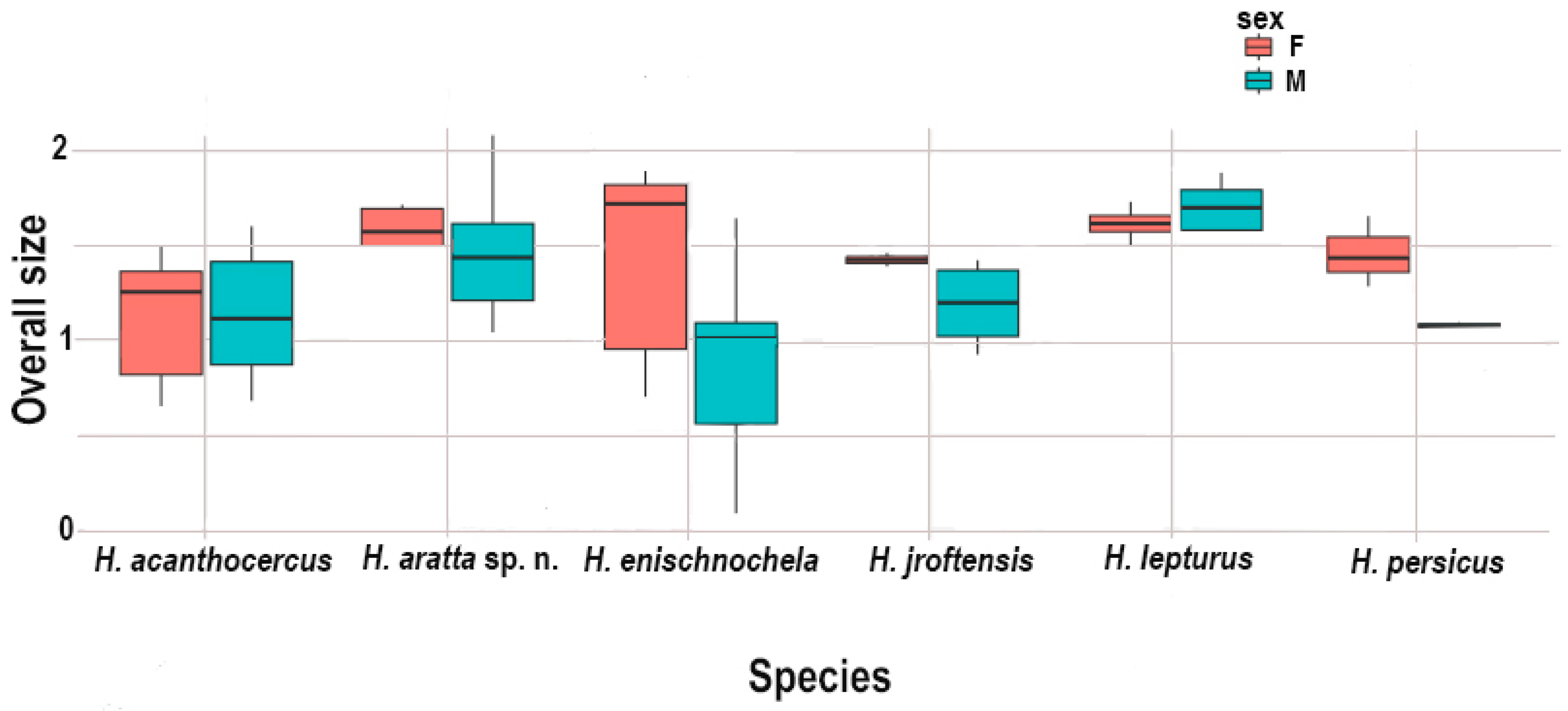
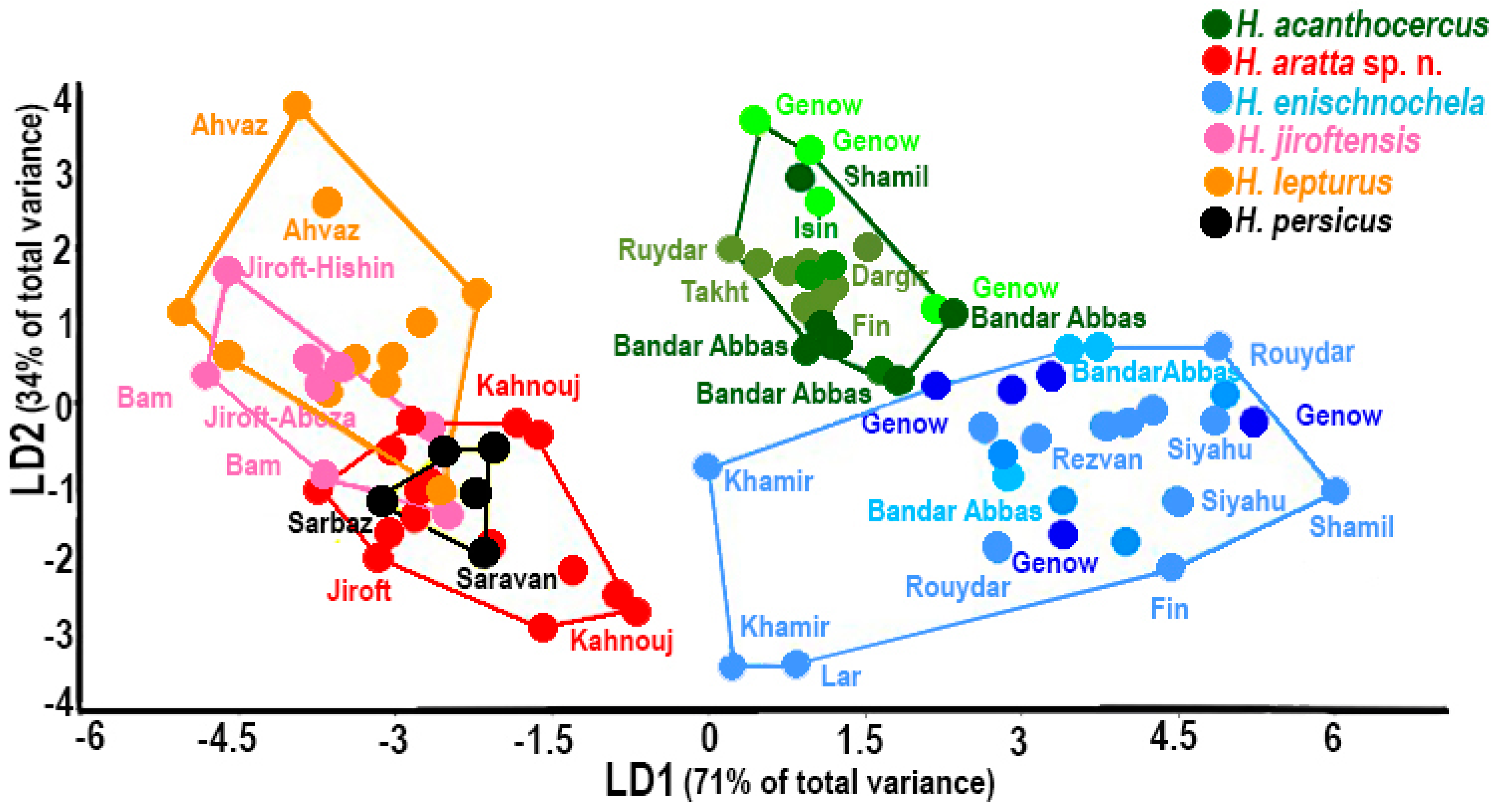
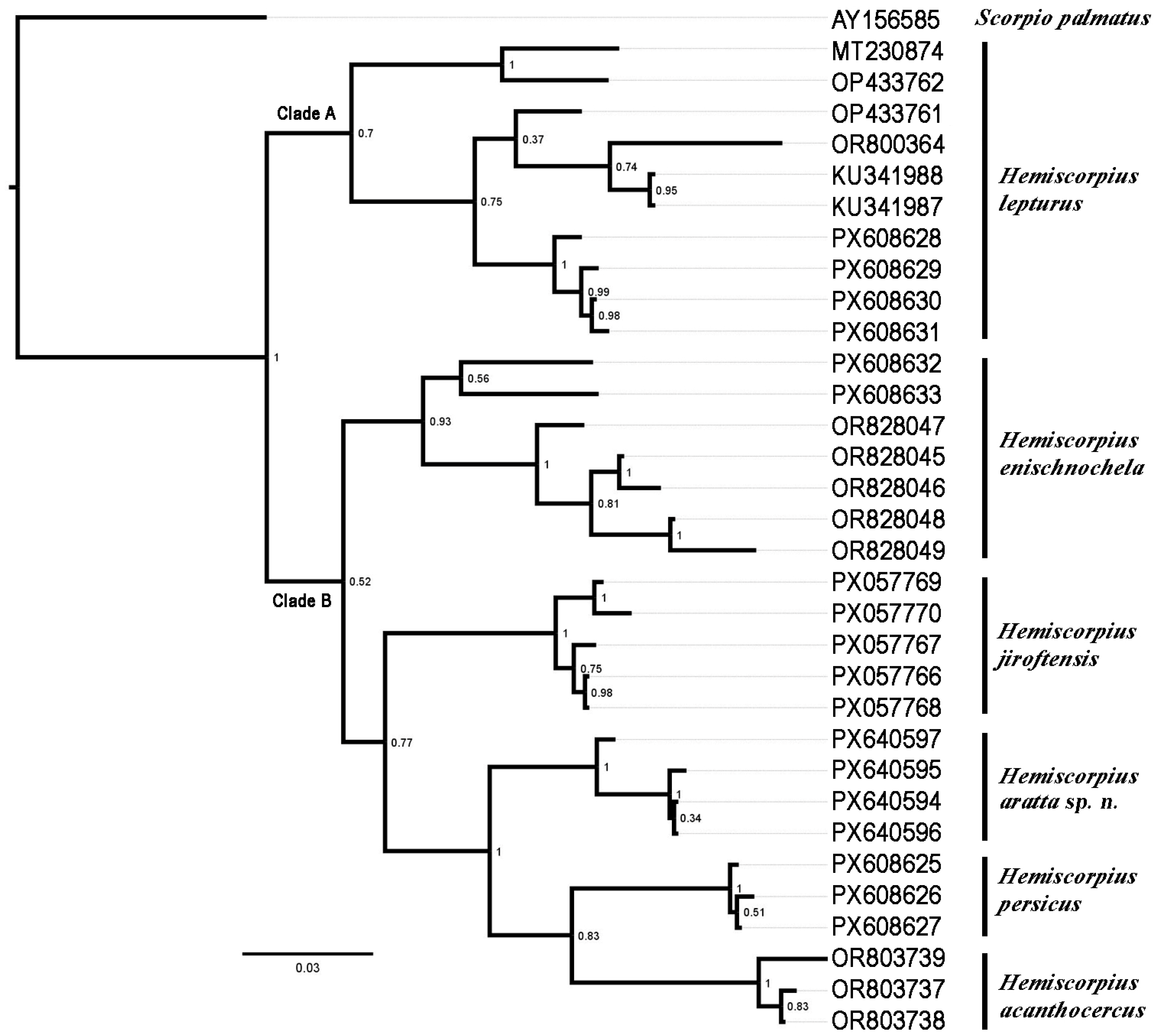
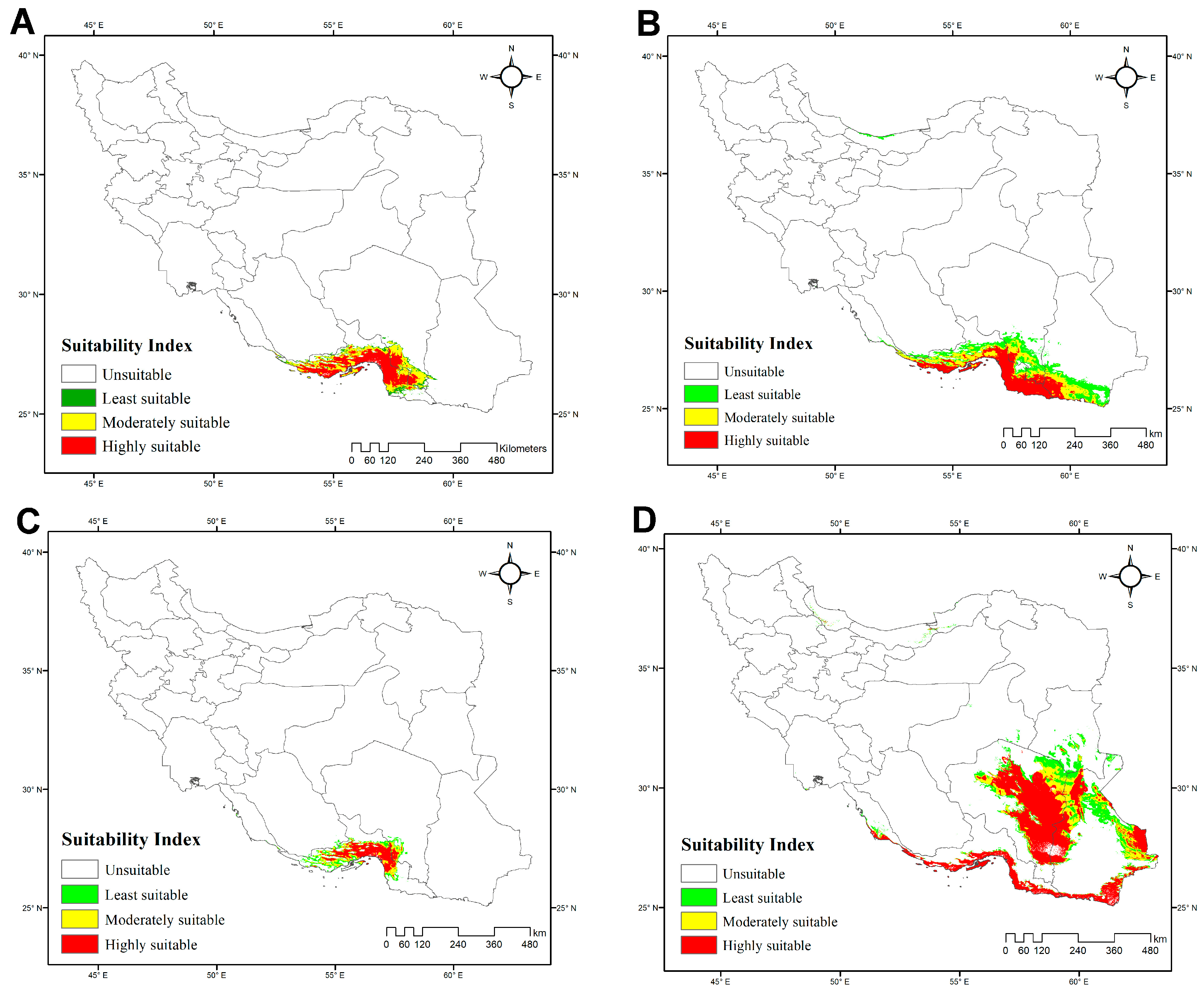


| Character | Species | |||||
|---|---|---|---|---|---|---|
| H. acanthocercus | H. aratta sp. n. | H. enischnochela | H. jiroftensis | H. lepturus | H. persicus | |
| CL | f * | ns | ns | ns | ns | ns |
| CW | ns | ns | ns | ns | ns | ns |
| FL | ns | ns | ns | ns | ns | ns |
| FW | f * | ns | ns | ns | ns | ns |
| PL | ns | ns | ns | ns | ns | ns |
| PW | ns | ns | ns | ns | ns | ns |
| ML | ns | ns | ns | ns | ns | ns |
| MW | ns | ns | ns | ns | ns | ns |
| MFL | ns | ns | ns | ns | ns | ns |
| MSL | ns | ns | ns | ns | ns | ns |
| MSW | f ** | f * | ns | ns | ns | ns |
| MT1L | m *** | m *** | m *** | ns | m *** | ns |
| MT1W | f *** | f * | ns | ns | ns | ns |
| MT2L | m *** | m *** | m *** | m * | m *** | m * |
| MT2W | f *** | f * | ns | ns | f * | ns |
| MT3L | m *** | m *** | m *** | m ** | m *** | m * |
| MT3W | f *** | f * | ns | ns | f ** | ns |
| MT4L | m *** | m *** | m *** | m * | m *** | m * |
| MT4W | f *** | f ** | ns | ns | f ** | ns |
| MT5L | m *** | m *** | m *** | ns | m *** | m * |
| MT5W | f ** | f * | ns | ns | f * | ns |
| TL | m * | m * | ns | ns | m * | ns |
| BTL | m *** | m *** | m *** | ns | m * | ns |
| CL/W | ns | ns | ns | ns | ns | ns |
| FL/W | ns | ns | ns | ns | ns | m * |
| PL/W | ns | m * | ns | ns | ns | ns |
| ML/W | ns | ns | ns | ns | m * | ns |
| MFL/ML | ns | ns | ns | ns | ns | ns |
| MSL/MSW | m ** | ns | m * | ns | ns | m * |
| MT1L/W | m *** | ns | m *** | m *** | m *** | ns |
| MT2L/W | m *** | m *** | m *** | m *** | m *** | m ** |
| MT3L/W | m *** | m *** | m *** | m ** | m *** | m * |
| MT4L/W | m *** | m *** | m *** | m *** | m *** | m *** |
| MT5L/W | m *** | m *** | m *** | m ** | m *** | m * |
| Species | Collection | Locality | GenBank | Reference |
|---|---|---|---|---|
| H. acanthocercus | RIZ [Hem-098A] | IRAN: Hormozgan Prov.: Bandar Abbas | OR803737 | [19] |
| RIZ [Hem-098B] | OR803738 | |||
| RIZ [Hem-151] | OR803739 | |||
| H. aratta sp. n. | RIZ [HD-28] | IRAN: Kerman Prov.: Kahnouj | PX640594 | This study |
| JMU [HD-33] | PX640595 | |||
| JMU [HD-34] | PX640596 | |||
| JMU [HD-36] | PX640597 | |||
| H. enischnochela | RIZ [Hem-098A] | IRAN: Hormozgan Prov.: Parsian | OR828045 | [19] |
| RIZ [Hem-098A] | OR828046 | |||
| RIZ [Hem-148] | IRAN: Hormozgan Prov.: Bandar Abbas | OR828047 | ||
| RIZ [Hem-098] | OR828048 | |||
| RIZ [Hem-087] | IRAN: Hormozgan Prov.: Khamir | OR828049 | ||
| JMU [HD-15] | IRAN: Fars Prov.: Lar | PX608632 | This study | |
| JMU [HD-19] | PX608633 | |||
| H. jiroftensis | JMU [HD-23] | IRAN: Kerman Prov.: Bam | PX057766 | [7] |
| JMU [HD-45A] | PX057767 | |||
| JMU [HD-45B] | PX057768 | |||
| RIZ [HD-44A] | IRAN: Kerman Prov.: Jiroft | PX057769 | ||
| RIZ [HD-44B] | PX057770 | |||
| H. lepturus | RIZ [Hem-162] | IRAN: Khuzestan Prov.: Dezful | OR800364 | [19] |
| - | IRAQ | MT230874 | ||
| - | IRAN: Khuzestan Prov.: Izeh | KU341987 | ||
| - | IRAN: Khuzestan Prov.: Ramhormoz | KU341988 | ||
| - | IRAN: Khuzestan Prov. | OP433761 | Unpublished | |
| - | IRAN: Lorestan Prov. | OP433762 | ||
| RIZ [HD-42A] | IRAN: Khuzestan Prov.: Ahvaz | PX608629 | This study | |
| RIZ [HD-42B] | PX608630 | |||
| RIZ [HD-42C] | PX608631 | |||
| RIZ [HD-42H] | PX608628 | |||
| H. persicus | ZMBK [MM-19] | IRAN: Sistan & Baluchistan Prov.: Saravan | PX608625 | |
| ZMBK [MM-20] | PX608626 | |||
| ZMBK [MM-21] | PX608627 | |||
| S. palmatus | AMCC 101706 | EGYPT | AY156585 | [49] |
| Species | 1 | 2 | 3 | 4 | 5 | 6 |
|---|---|---|---|---|---|---|
| H. acanthocercus (1) | 0.027 | |||||
| H. aratta sp. n. (2) | 0.078 | 0.000 | ||||
| H. enischnochela (3) | 0.116 | 0.078 | 0.051 | |||
| H. jiroftensis (4) | 0.120 | 0.078 | 0.093 | 0.013 | ||
| H. lepturus (5) | 0.136 | 0.103 | 0.133 | 0.122 | 0.068 | |
| H. persicus (6) | 0.100 | 0.067 | 0.096 | 0.090 | 0.128 | 0.003 |
| Variables | H. acanthocercus | H. aratta sp. n. | H. enischnochela | H. jiroftensis | H. kashkayi | H. lepturus | H. persicus | H. shahii | |
|---|---|---|---|---|---|---|---|---|---|
| BIO2 | Mean diurnal range, i.e., mean of monthly (maximum temperature – minimum temperature) | 28.5 | - | - | - | 0 | 3.1 | - | - |
| BIO3 | Isothermality (BIO2/BIO7 × 100) | 0.9 | 0 | 2.1 | 0 | 0.2 | - | 39.6 | - |
| BIO4 | Temperature seasonality | 24.7 | - | - | 38.1 | - | 0.1 | - | 81.3 |
| BIO5 | Max temperature of warmest month | - | 0 | 5.7 | - | 87.3 | - | 0 | - |
| BIO6 | Min temperature of coldest month | 32.5 | - | 65 | - | - | - | - | - |
| BIO7 | Temperature annual range (BIO5, BIO6) | - | 74.5 | - | 3.6 | 0.8 | - | - | - |
| BIO9 | Mean temperature of driest quarter | 0.1 | - | - | - | - | - | 7.3 | 3.4 |
| BIO10 | Mean temperature of warmest quarter | 0.8 | - | 2.6 | - | - | - | - | - |
| BIO11 | Mean temperature of coldest quarter | - | - | - | - | - | - | 22.7 | - |
| BIO12 | Annual precipitation | 0.8 | - | 0.4 | 32.5 | - | 1.2 | - | - |
| BIO13 | Precipitation of wettest month | - | - | - | - | 9.2 | 0.3 | - | - |
| BIO14 | Precipitation of driest month | - | - | - | 3.6 | - | 23.6 | - | 6 |
| BIO15 | Precipitation seasonality | - | 21.1 | - | - | - | 0.4 | - | 8.8 |
| BIO16 | Precipitation of wettest quarter | - | 4 | - | - | - | - | 28.6 | - |
| BIO17 | Precipitation of driest quarter | - | - | - | - | - | 4.2 | - | - |
| BIO18 | Precipitation of warmest quarter | - | - | - | 18.5 | - | 0 | - | - |
| BIO19 | Precipitation of coldest quarter | 11.1 | - | 23.7 | - | - | 66.9 | - | - |
| Slope | 0.4 | 0.4 | 0.5 | 3.8 | 2.4 | 0.1 | 1.9 | 0.4 | |
| Specimen | JMU | JMU | RIZ | RIZ | RIZ | RIZ | JMU | JMU | JMU | RIZ | JMU | JMU | JMU | JMU | JMU | ||
|---|---|---|---|---|---|---|---|---|---|---|---|---|---|---|---|---|---|
| 14 | 14 | 28 | 28 | 31 | 30 | 35 | 37 | 14 | 28 | 33 | 34 | 36 | 36 | 40 | |||
| Character | PT | PT | PT | PT | PT | HT | PT | PT | PT | PT | PT | PT | PT | PT | PT | ||
| ♂ | ♂ | ♂ | ♂ | ♂ | ♂ | ♂ | ♂ | ♀ | ♀ | ♀ | ♀ | ♀ | ♀ | ♀ | |||
| Total body | L | 58.6 | 57.9 | 65.5 | 59.2 | 49.7 | 68.9 | 60.8 | 57.23 | 39.6 | 48.3 | 48.4 | 44.7 | 44.23 | 38.81 | 44.86 | |
| Carapace | L | 5.93 | 5.58 | 6.17 | 5.96 | 4.88 | 6.41 | 5.85 | 5.91 | 5.35 | 6.05 | 6.03 | 5.61 | 6.3 | 5.37 | 5.98 | |
| ant. W | 3.66 | 3.94 | 4.13 | 3.91 | 3.22 | 4.74 | 4.11 | 3.83 | 3.63 | 4.05 | 3.94 | 3.83 | 4.09 | 3.48 | 3.79 | ||
| post. W | 4.94 | 4.98 | 5.18 | 4.67 | 4.02 | 5.66 | 5.08 | 4.76 | 4.85 | 5.13 | 4.89 | 5.11 | 5.23 | 4.43 | 4.89 | ||
| Pedipalp | femur | L | 5.07 | 5.14 | 5.47 | 5.11 | 4.1 | 6.21 | 5.53 | 5.25 | 4.58 | 5 | 5.14 | 4.77 | 4.94 | 4.45 | 4.91 |
| W | 2.13 | 1.19 | 2.16 | 2.02 | 1.72 | 2.15 | 1.94 | 2.03 | 1.86 | 1.9 | 1.97 | 2.02 | 2.02 | 1.78 | 2.3 | ||
| patella | L | 5.21 | 5.43 | 5.84 | 5.38 | 4.66 | 6.03 | 5.64 | 5.28 | 4.81 | 5.4 | 5.3 | 4.84 | 5.38 | 4.82 | 4.7 | |
| W | 2.25 | 1.98 | 2.36 | 2.25 | 1.96 | 2.12 | 2.41 | 2.08 | 2.14 | 2.28 | 2.31 | 2.36 | 2.31 | 2.07 | 1.99 | ||
| manus | L | 5.15 | 5.14 | 5.58 | 5.37 | 4.42 | 6.16 | 5.52 | 5.32 | 4.8 | 5.9 | 5.31 | 5.38 | 5.62 | 4.69 | 5.4 | |
| W | 3.48 | 2.38 | 4 | 3.65 | 1.95 | 3.74 | 3.69 | 3.67 | 2.16 | 3.82 | 3.73 | 3.84 | 3.68 | 3.6 | 3.39 | ||
| D | 2.27 | 3.51 | 2.26 | 2.16 | 3.18 | 2.65 | 2.29 | 2.18 | 3.75 | 2.36 | 2.08 | 2.66 | 2.48 | 1.94 | 1.97 | ||
| mov. finger | L | 5.06 | 5.07 | 5.39 | 5.2 | 4.27 | 5.92 | 5.33 | 5.02 | 4.61 | 5.7 | 5.2 | 5.14 | 5.4 | 4.44 | 5.27 | |
| Mesosoma | L | 13.41 | 12.8 | 16.3 | 15.2 | 13.5 | 16.6 | 14.7 | 13.98 | 12.3 | 16.1 | 17.5 | 15.6 | 12.35 | 11.66 | 17.34 | |
| Metasoma I | L | 6.16 | 5.5 | 6.69 | 5.19 | 4.41 | 6.07 | 6.1 | 5.28 | 3.04 | 3.02 | 3.18 | 2.83 | 3.56 | 3.07 | 2.87 | |
| W | 1.8 | 1.8 | 1.84 | 1.68 | 1.55 | 1.84 | 1.73 | 1.48 | 1.82 | 1.96 | 1.97 | 1.95 | 2.04 | 1.95 | 1.68 | ||
| D | 1.73 | 1.74 | 188 | 1.72 | 1.48 | 1.72 | 1.63 | 1.45 | 1.59 | 1.7 | 1.65 | 1.64 | 1.62 | 1.57 | 1.53 | ||
| Metasoma II | L | 6.65 | 6.31 | 7.34 | 5.96 | 5.22 | 7.2 | 6.56 | 5.9 | 3.27 | 3.39 | 3.66 | 3.49 | 3.81 | 3.16 | 3.08 | |
| W | 1.74 | 1.58 | 1.67 | 1.52 | 1.3 | 1.54 | 1.32 | 1.27 | 1.62 | 1.75 | 1.74 | 1.73 | 1.76 | 1.62 | 1.49 | ||
| D | 1.69 | 1.76 | 1.72 | 1.58 | 1.47 | 1.61 | 1.57 | 1.54 | 1.56 | 1.67 | 1.65 | 1.67 | 1.6 | 1.65 | 1.67 | ||
| Metasoma III | L | 6.92 | 6.48 | 7.65 | 6.71 | 5.07 | 7.88 | 6.79 | 6.1 | 3.11 | 4.04 | 3.95 | 3.78 | 4.29 | 3.36 | 3.58 | |
| W | 1.61 | 1.46 | 1.49 | 1.45 | 1.39 | 1.54 | 1.29 | 1.2 | 1.76 | 1.5 | 1.6 | 1.62 | 1.63 | 1.51 | 1.43 | ||
| D | 1.68 | 1.73 | 1.8 | 1.6 | 1.48 | 1.73 | 1.68 | 1.51 | 1.46 | 1.68 | 1.69 | 1.64 | 1.57 | 1.61 | 1.63 | ||
| Metasoma IV | L | 6.8 | 7.05 | 8.17 | 6.88 | 5.47 | 7.88 | 7.13 | 6.71 | 3.68 | 5.26 | 4.12 | 3.79 | 3.94 | 3.18 | 3.58 | |
| W | 1.33 | 1.25 | 1.19 | 1.13 | 1.09 | 1.41 | 1.15 | 1.14 | 1.38 | 1.63 | 1.38 | 1.47 | 1.48 | 1.34 | 1.36 | ||
| D | 1.63 | 1.62 | 1.55 | 1.49 | 1.46 | 1.8 | 1.6 | 1.59 | 1.59 | 1.35 | 1.66 | 1.65 | 1.69 | 1.51 | 1.62 | ||
| Metasoma V | L | 7.62 | 8.01 | 8.72 | 7.67 | 6.32 | 9.53 | 7.9 | 7.79 | 4.3 | 5.34 | 5.07 | 4.86 | 5.21 | 4.52 | 4.22 | |
| W | 1.66 | 1.38 | 1.18 | 1.23 | 1.04 | 1.39 | 1.18 | 1.2 | 1.39 | 1.66 | 1.78 | 1.51 | 1.52 | 1.38 | 1.38 | ||
| D | 1.69 | 1.68 | 1.69 | 1.59 | 1.54 | 1.83 | 1.73 | 1.61 | 1.58 | 1.38 | 1.99 | 1.72 | 1.59 | 1.6 | 1.58 | ||
| Telson | L | 5.11 | 6.14 | 4.44 | 5.61 | 4.82 | 7.31 | 5.82 | 5.56 | 4.57 | 5.14 | 4.93 | 4.7 | 4.77 | 4.49 | 4.21 | |
| W | 1.53 | 1.62 | 1.73 | 1.43 | 1.35 | 1.7 | 1.45 | 1.44 | 1.71 | 2.11 | 1.83 | 1.9 | 1.94 | 1.83 | 1.75 | ||
| D | 1.8 | 1.75 | 1.04 | 1.7 | 1.56 | 1.92 | 1.82 | 1.66 | 1.81 | 2.04 | 1.97 | 1.93 | 1.85 | 1.84 | 1.67 | ||
| Pectinal teeth | count | 14 | 15 | 14 | 14 | 14 | 15 | 14 | 15 | 8 | 9 | 8 | 9 | 10 | 9 | 10 | |
| Mov./fixed fingers | rows | 6/6 | 6/7 | 7/8 | 7/6 | 7/7 | 9/8 | 6/8 | 7/7 | 7/8 | 6/7 | 7/7 | 8/8 | 7/7 | 8/8 | 6/6 | |
Disclaimer/Publisher’s Note: The statements, opinions and data contained in all publications are solely those of the individual author(s) and contributor(s) and not of MDPI and/or the editor(s). MDPI and/or the editor(s) disclaim responsibility for any injury to people or property resulting from any ideas, methods, instructions or products referred to in the content. |
© 2025 by the authors. Licensee MDPI, Basel, Switzerland. This article is an open access article distributed under the terms and conditions of the Creative Commons Attribution (CC BY) license.
Share and Cite
Dehghan, H.; Amiri Ghanat Saman, E.; Madjdzadeh, S.M.; Amiri, M.; Moeinadini, A.; Prendini, L.; Barahoei, H. Molecules, Morphometrics and Modeling of the Medically Important Genus Hemiscorpius Peters, 1861 (Scorpiones: Hemiscorpiidae) in Iran Reveal New Species from Kerman. Insects 2026, 17, 18. https://doi.org/10.3390/insects17010018
Dehghan H, Amiri Ghanat Saman E, Madjdzadeh SM, Amiri M, Moeinadini A, Prendini L, Barahoei H. Molecules, Morphometrics and Modeling of the Medically Important Genus Hemiscorpius Peters, 1861 (Scorpiones: Hemiscorpiidae) in Iran Reveal New Species from Kerman. Insects. 2026; 17(1):18. https://doi.org/10.3390/insects17010018
Chicago/Turabian StyleDehghan, Hossein, Esmail Amiri Ghanat Saman, Seyed Massoud Madjdzadeh, Masoumeh Amiri, Asma Moeinadini, Lorenzo Prendini, and Hossein Barahoei. 2026. "Molecules, Morphometrics and Modeling of the Medically Important Genus Hemiscorpius Peters, 1861 (Scorpiones: Hemiscorpiidae) in Iran Reveal New Species from Kerman" Insects 17, no. 1: 18. https://doi.org/10.3390/insects17010018
APA StyleDehghan, H., Amiri Ghanat Saman, E., Madjdzadeh, S. M., Amiri, M., Moeinadini, A., Prendini, L., & Barahoei, H. (2026). Molecules, Morphometrics and Modeling of the Medically Important Genus Hemiscorpius Peters, 1861 (Scorpiones: Hemiscorpiidae) in Iran Reveal New Species from Kerman. Insects, 17(1), 18. https://doi.org/10.3390/insects17010018



