Drosicha corpulenta (Hemiptera: Monophlebidae) in an Arid New City: Phenology, Host Suitability, and Spatial Distribution of Overwintering Eggs

Simple Summary
Abstract
1. Introduction
2. Materials and Methods
2.1. Experimental Materials
2.2. Field Investigation on the Life History of D. corpulenta
2.3. Colonization of Different Host Trees by Nymphs
2.4. Soil Colonization by Fecund Females
2.5. Spatial Distribution Survey of D. corpulenta Eggs
Analysis of Spatial Distribution Pattern and Aggregation Indices of D. corpulenta Overwintering Eggs
2.6. Measurement and Data Analysis
3. Results
3.1. Life History Survey of D. corpulenta in Cocodala City
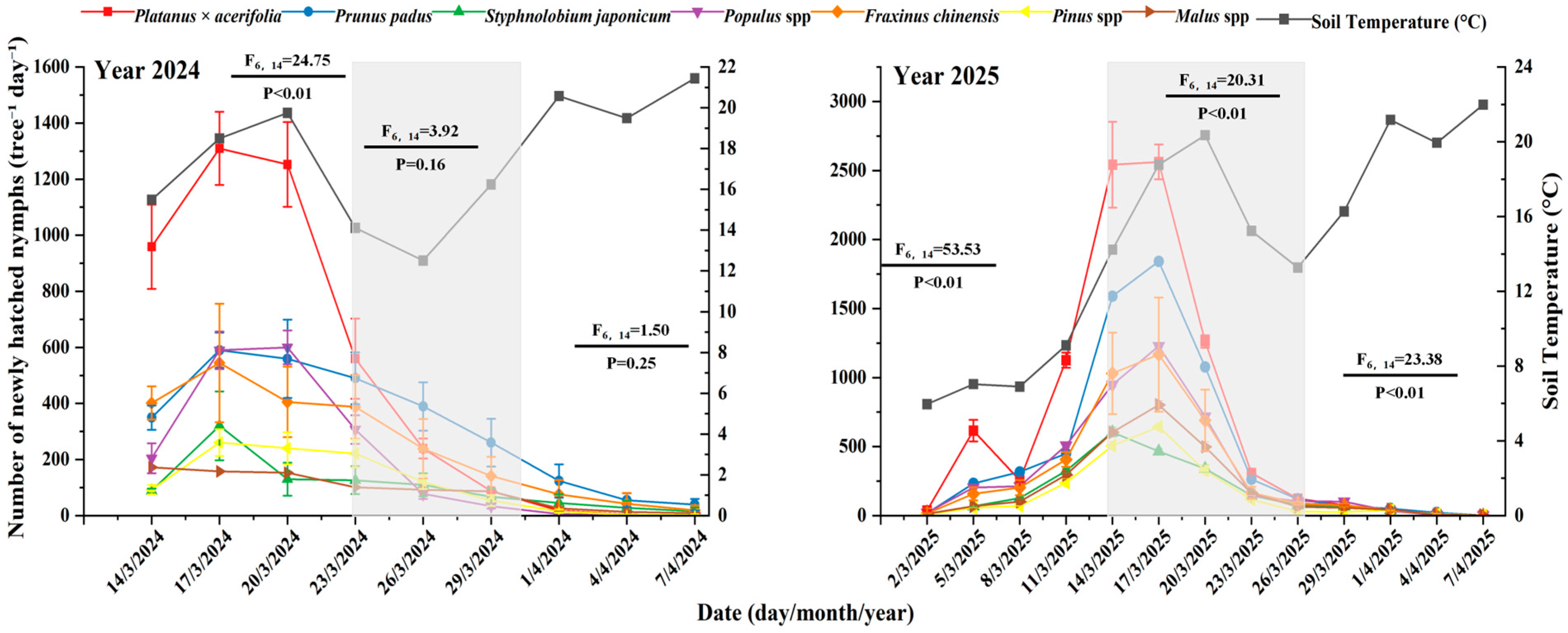
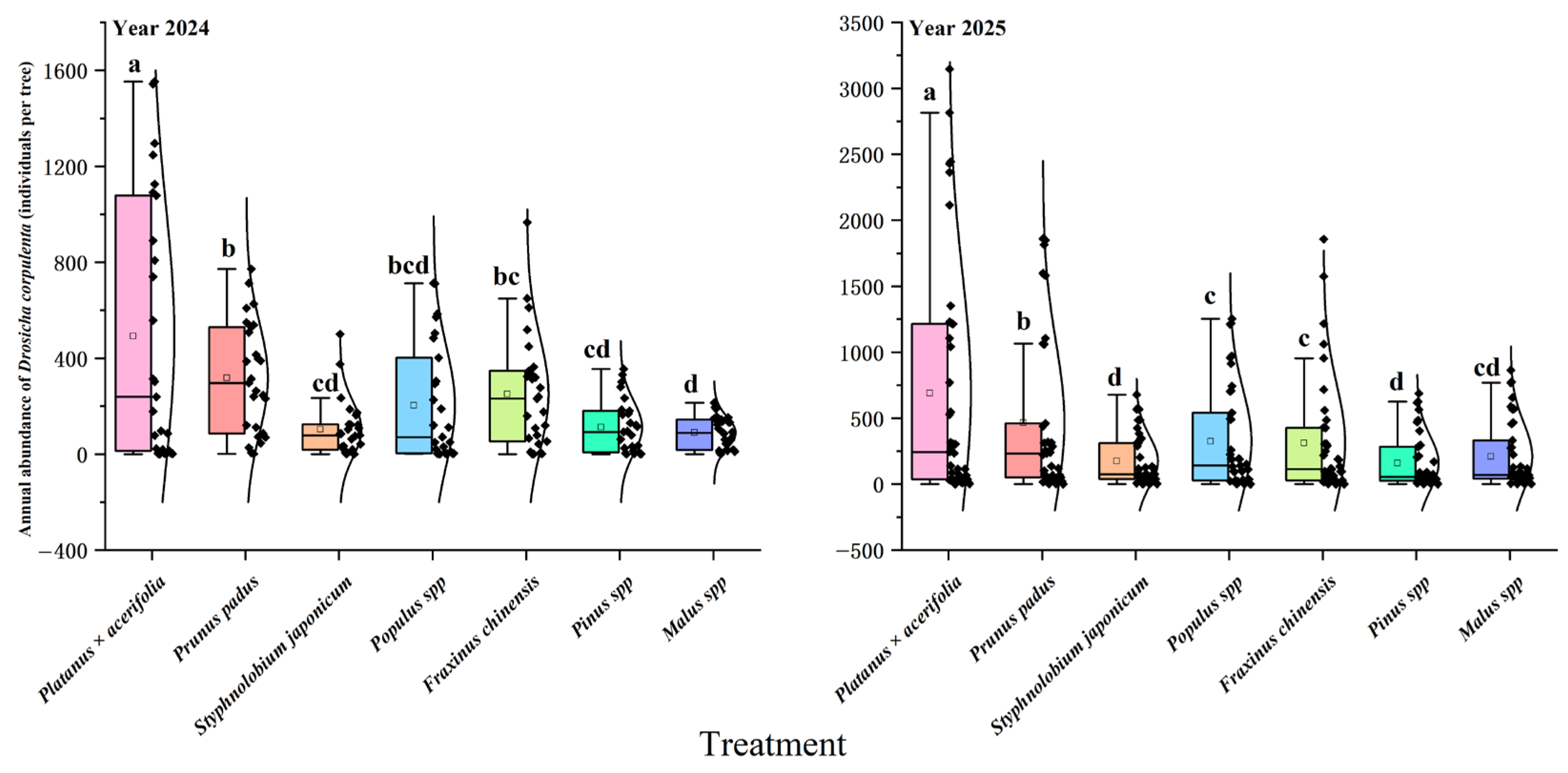
3.2. Occurrence Dynamics Survey of Newly Hatched Nymphs of D. corpulenta on Different Host Plants
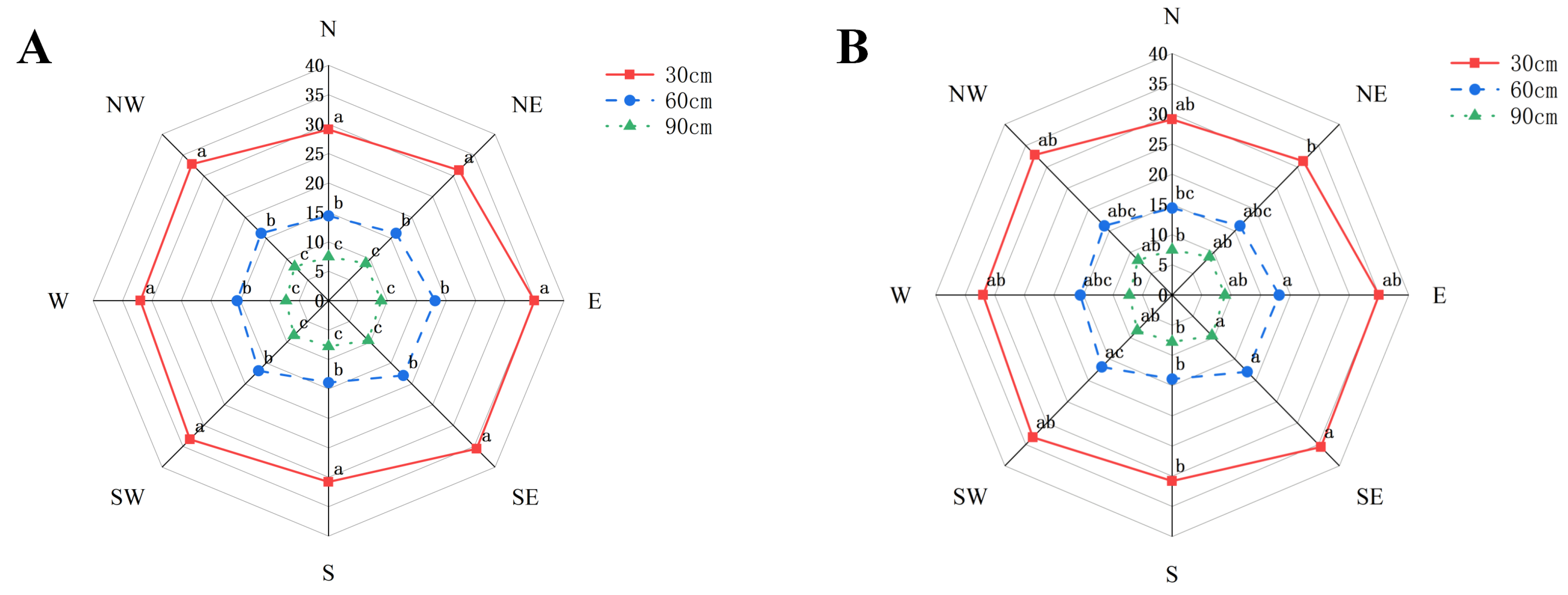
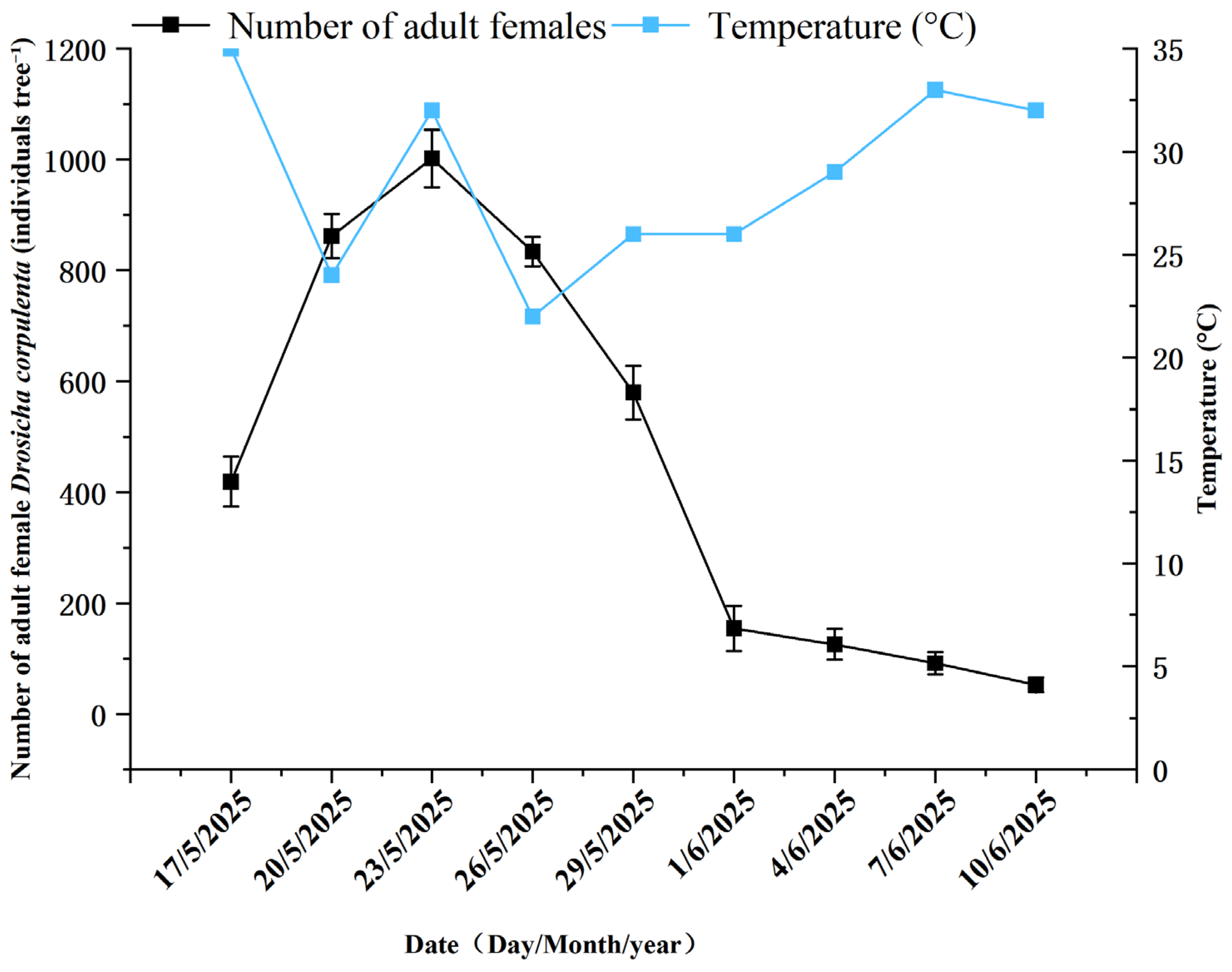
3.3. Survey on the Soil Colonization Dynamics of Adult Female D. corpulenta
3.4. Survey on the Spatial Distribution of D. corpulenta Eggs
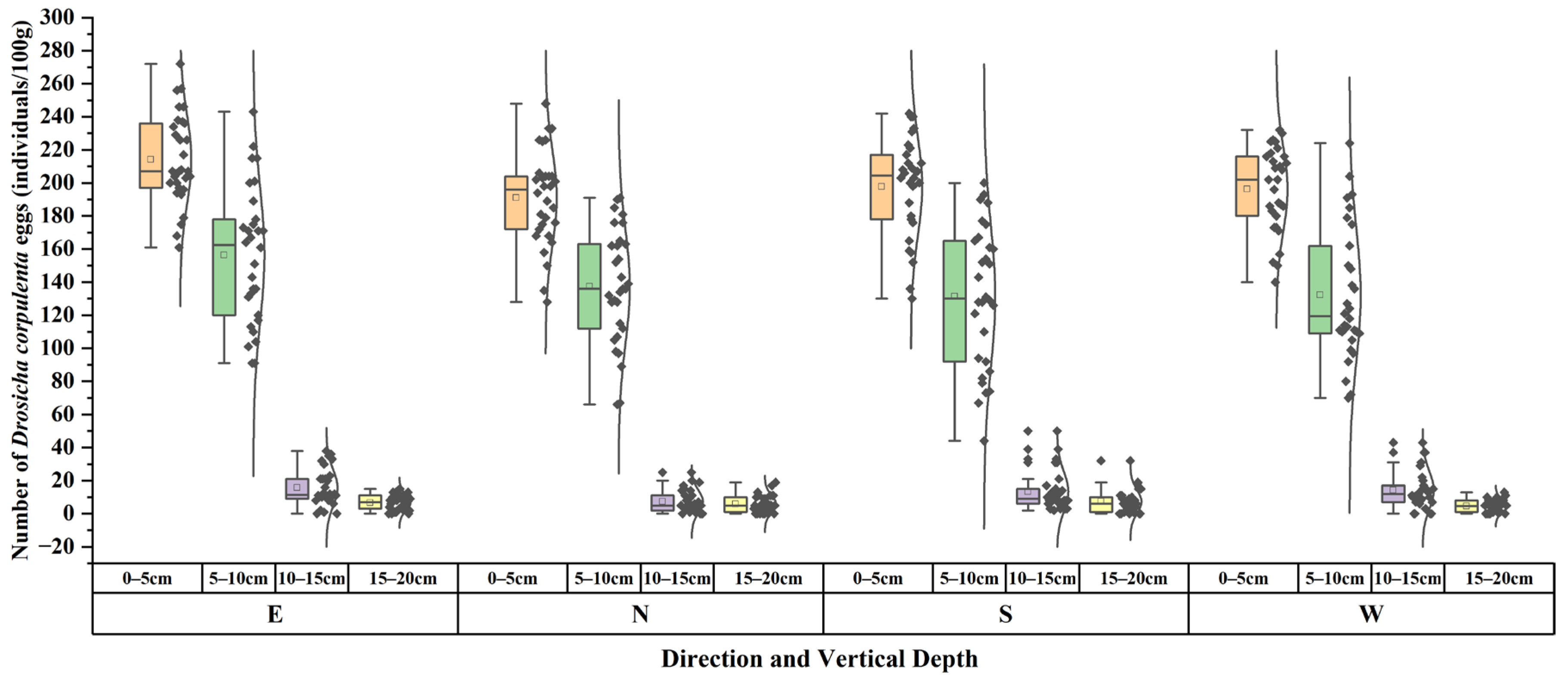
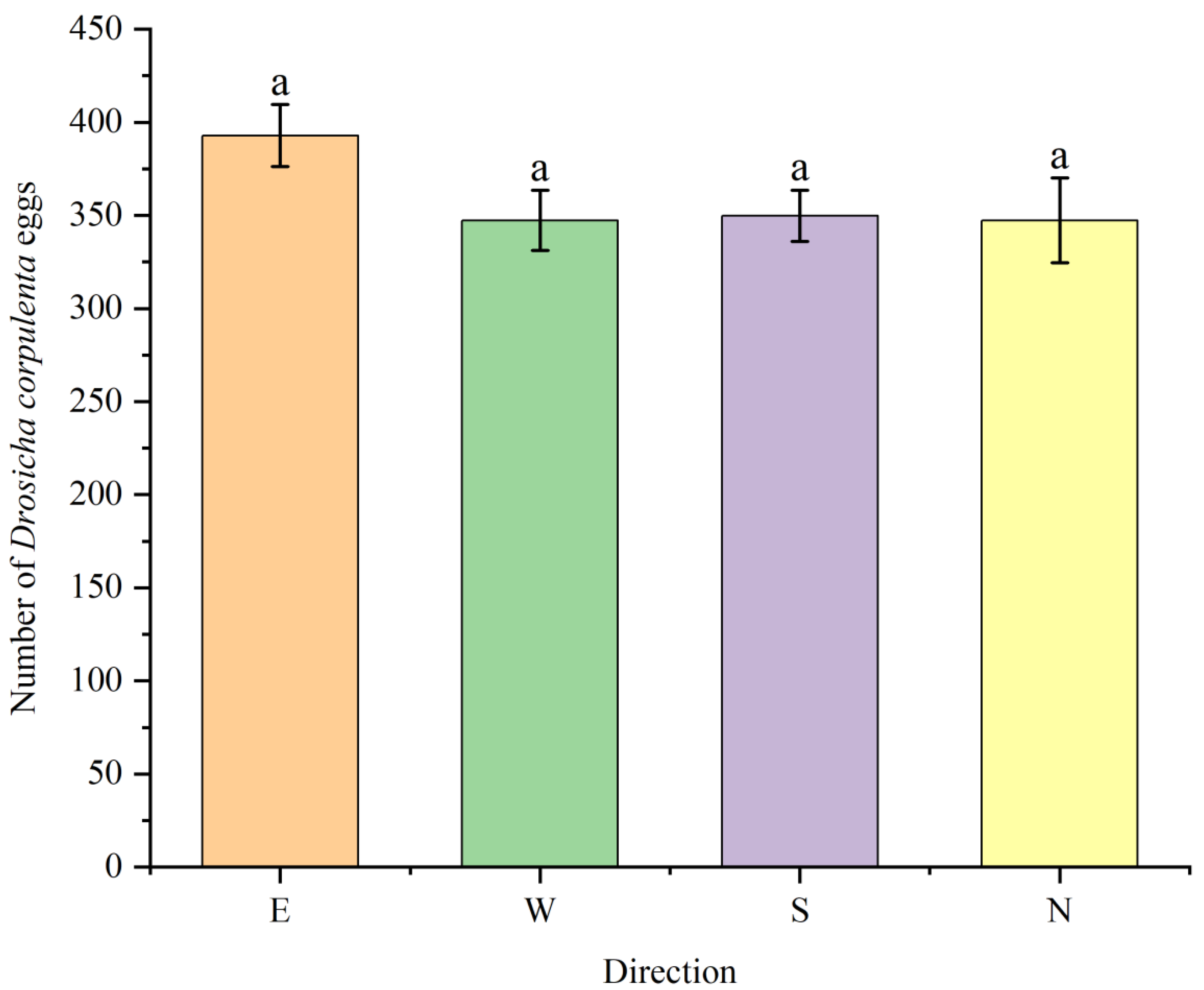
3.4.1. Spatial Distribution of D. corpulenta Eggs Across Soil Depths, Azimuths, and Horizontal Distances from Tree Trunks
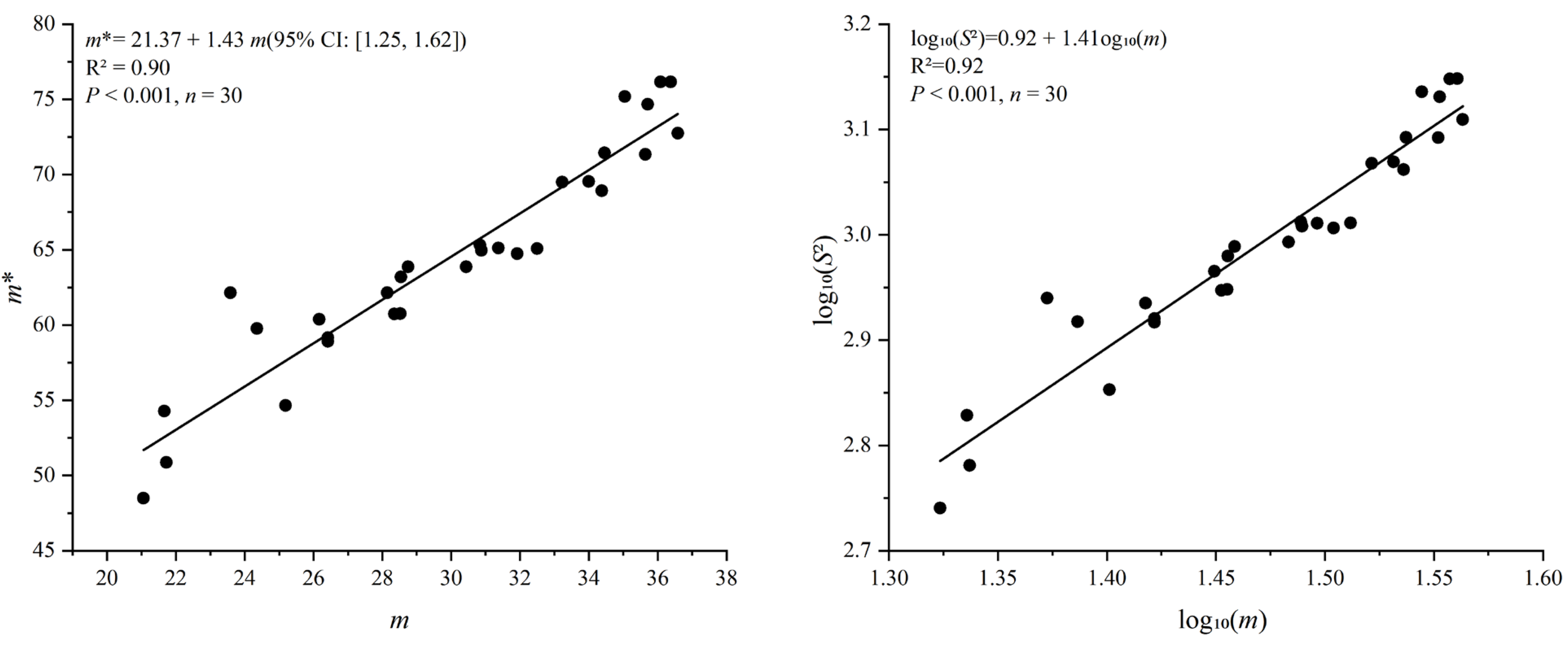
3.4.2. Spatial Distribution Pattern of D. corpulenta Eggs
4. Discussion
5. Conclusions
Author Contributions
Funding
Data Availability Statement
Acknowledgments
Conflicts of Interest
References
- González-Césped, C.; Alaniz, A.J.; Vergara, P.M.; Chiappa, E.; Zamorano, J.; Mandujano, V. Effects of urban environmental conditions and landscape structure on taxonomic and functional groups of insects. Urban For. Urban Green. 2020, 58, 126902. [Google Scholar] [CrossRef]
- Garcia, A.; Vaz, P.G.; Franco, J.C.; Nunes, P.; Jactel, H.; Branco, M. Urban tree isolation affects the abundance of its pests and their natural enemies. Landsc. Urban Plan. 2022, 227, 104515. [Google Scholar] [CrossRef]
- Langellotto, G.A.; Denno, R.F. Responses of invertebrate natural enemies to complex-structured habitats: A meta-analytical synthesis. Oecologia 2004, 139, 1–10. [Google Scholar] [CrossRef] [PubMed]
- Parsons, S.E.; Frank, S.D. Urban tree pests and natural enemies respond to habitat at different spatial scales. J. Urban Ecol. 2019, 5, juz010. [Google Scholar] [CrossRef]
- Dale, A.G.; Frank, S.D. Warming and drought combine to increase pest insect fitness on urban trees. PLoS ONE 2017, 12, e0173844. [Google Scholar] [CrossRef]
- Meineke, E.K.; Dunn, R.R.; Sexton, J.O.; Frank, S.D. Urban warming drives insect pest abundance on street trees. PLoS ONE 2013, 8, e59687. [Google Scholar] [CrossRef]
- Fyie, L.R.; Tronetti, H.R.; Gardiner, M.M.; Meuti, M.E. Potential for urban warming to postpone overwintering dormancy of temperate mosquitoes. J. Therm. Biol. 2023, 115, 103594. [Google Scholar] [CrossRef]
- Blank, L. How urban proximity shapes agricultural pest dynamics: A review. Pest Manag. Sci. 2025, 81, 2704–2711. [Google Scholar] [CrossRef]
- Stemmelen, A.; Paquette, A.; Benot, M.-L.; Kadiri, Y.; Jactel, H.; Castagneyrol, B. Insect herbivory on urban trees: Complementary effects of tree neighbours and predation. Peer Community J. 2022, 2, e22. [Google Scholar] [CrossRef]
- Kakoti, B.; Deka, B.; Roy, S.; Babu, A. The scale insects: Its status, biology, ecology and management in tea plantations. Front. Insect Sci. 2023, 2, 1048299. [Google Scholar] [CrossRef]
- Frank, S.D.; Just, M.G. Can Cities Activate Sleeper Species and Predict Future Forest Pests? A Case Study of Scale Insects. Insects 2020, 11, 142. [Google Scholar] [CrossRef]
- Salmond, J.A.; Tadaki, M.; Vardoulakis, S.; Arbuthnott, K.; Coutts, A.; Demuzere, M.; Dirks, K.N.; Heaviside, C.; Lim, S.; MacIntyre, H.; et al. Health and climate related ecosystem services provided by street trees in the urban environment. Environ. Health 2016, 15, 95–111. [Google Scholar] [CrossRef] [PubMed]
- Morales, M.G.; Denno, B.D.; Miller, D.R.; Miller, G.L.; Ben-Dov, Y.; Hardy, N.B. ScaleNet: A literature-based model of scale insect biology and systematics. Database 2016, 2016, bav118. [Google Scholar] [CrossRef]
- Zhang, Y.; Li, K.; Wu, S.; Wen, L.; Wang, J. Screening of Olfactory-Related Genes in Male Adults of Planococcus lilacinus and Functional Analysis of Odor-Binding Proteins. Plant Prot. 2025, 52, 959–971. [Google Scholar] [CrossRef]
- Liu, Z.; Li, X.; Shi, G.; Zhang, P.; Yang, J.; Fan, J.; Fan, R. Study on the Occurrence Patterns and Pesticide Control of Two Species of Soft Scale Insects in the Fruit Orchards of Southern Shanxi. J. Fruit Sci. 2017, 34, 1185–1191. [Google Scholar]
- Wilson, C.J.; Frank, S.D. Scale Insects Support Natural Enemies in Both Landscape Trees and Shrubs Below Them. Environ. Entomol. 2022, 51, 1094–1105. [Google Scholar] [CrossRef]
- Hou, Y.; Guo, X.; Tan, P.; Liu, X. Life History of Planococcus lilacinus and Investigation of the Distribution of Overwintering Eggs in the Soil. Shanxi For. Sci. Technol. 1999, 54–56, 59. [Google Scholar]
- Cui, M.; Chen, Z.; Liu, H. Investigation on the Spatial Distribution of Planococcus lilacinus Populations in Pear Orchards of Southern Hebei. Guizhou Agric. Sci. 2015, 43, 79–81. [Google Scholar]
- Jiang, H. Preliminary Study on the Important Natural Enemy of Planococcus lilacinus—The Red-Circled Ladybug. Insect Nat. Enemies 1980, 1, 17–23. [Google Scholar]
- Wang, J.; Tian, Y.; Lao, Y.; Lin, J.; Zhou, L. Dynamic Analysis of the Integrated Control Model for Planococcus lilacinus. J. Shihezi Univ. (Nat. Sci. Ed.) 2024, 42, 252–259. [Google Scholar] [CrossRef]
- Long, L.C.; D’AMico, V.; Frank, S.D. Urban forest fragments buffer trees from warming and pests. Sci. Total. Environ. 2018, 658, 1523–1530. [Google Scholar] [CrossRef] [PubMed]
- Peng, J.; Liang, J.; Zheng, S.; Bashir, M.H.; Ali, S.; Wang, X. Demographic Characteristics of Novius penicillioides (Coleoptera, Coccinellidae) in Relation to Icerya jacobsoni (Hemiptera, Monophlebidae) Reared on Different Host Plants. Agronomy 2025, 15, 2457. [Google Scholar] [CrossRef]
- Zhang, L.; Qin, Z.; Liu, P.; Yin, Y.; Felton, G.W.; Shi, W. Influence of Plant Physical and Anatomical Characteristics on the Ovipositional Preference of Orius sauteri (Hemiptera: Anthocoridae). Insects 2021, 12, 326. [Google Scholar] [CrossRef] [PubMed]
- Robert, C.A.M.; Erb, M.; Duployer, M.; Zwahlen, C.; Doyen, G.R.; Turlings, T.C.J. Herbivore-induced plant volatiles mediate host selection by a root herbivore. New Phytol. 2012, 194, 1061–1069. [Google Scholar] [CrossRef]
- Pan, H.-S.; Xiu, C.-L.; Williams, L.; Lu, Y.-H. Plant Volatiles Modulate Seasonal Dynamics between Hosts of the Polyphagous Mirid Bug Apolygus lucorum. J. Chem. Ecol. 2021, 47, 87–98. [Google Scholar] [CrossRef]
- Bakry, M.; Badawy, A.; Mohamed, L. Spatial Distribution and Abundance of the Mealybug, Phenacoccus solenopsis (Hemiptera: Pseudococcidae) Infesting Okra Plants. SVU-Int. J. Agric. Sci. 2023, 5, 1–17. [Google Scholar] [CrossRef]
- Costa, J.; Madureira, M.; Pereira, J.A.; Rodrigues, I. Spatial distribution pattern of male adults of Phyllocnistis citrella Stainton (Lepidoptera: Gracillariidae) in lemon orchards in Northern Portugal. J. Appl. Entomol. 2024, 148, 643–650. [Google Scholar] [CrossRef]
- David, F.N.; Moore, P.G. Notes on Contagious Distributions in Plant Populations. Ann. Bot. 1954, 18, 47–53. [Google Scholar] [CrossRef]
- Taylor, L.R. Assessing and interpreting the spatial distributions of insect populations. Annu. Rev. Entomol. 1984, 29, 321–357. [Google Scholar] [CrossRef]
- Morisita, M. I σ-Index, a measure of dispersion of individuals. Res. Popul. Ecol. 1962, 4, 1–7. [Google Scholar] [CrossRef]
- Waters, W.E. A quantitative measure of aggregation in insects. J. Econ. Entomol. 1959, 52, 1180–1184. [Google Scholar] [CrossRef]
- Taylor, L.R. Aggregation, variance and the mean. Nature 1961, 189, 732–735. [Google Scholar] [CrossRef]
- Lloyd, M. Mean crowding. J. Anim. Ecol. 1967, 36, 1–30. [Google Scholar] [CrossRef]
- Iwao, S. A new regression method for analyzing the aggregation pattern of animal populations. Popul. Ecol. 1968, 10, 1–20. [Google Scholar] [CrossRef]
- Cassie, R.M. Frequency Distribution Models in the Ecology of Plankton and Other Organisms. J. Anim. Ecol. 1962, 31, 65–92. [Google Scholar] [CrossRef]
- Iwao, S.; Kuno, E. Use of the Regression of Mean Crowding on Mean Density for Estimating Sample Size and the Transformation of Data for the Analysis of Variance. Res. Popul. Ecol. 1968, 10, 210–214. [Google Scholar] [CrossRef]
- Mollie, E.B.; Kristensen, K.; Koen, J.; Magnusson, A.; Casper, W.B.; Nielsen, A.; Hans, J.S.; Mächler, M.; Benjamin, M.B. glmmTMB Balances Speed and Flexibility Among Packages for Zero-inflated Generalized Linear Mixed Modeling. R J. 2017, 9, 378–400. [Google Scholar] [CrossRef]
- Fox, J.; Weisberg, S. An R Companion to Applied Regression; Sage Publications: Thousand Oaks, CA, USA, 2018. [Google Scholar]
- Lenth, R.V. emmeans: Estimated Marginal Means, aka Least-Squares Means; R Foundation for Statistical Computing: Vienna, Austria, 2017. [Google Scholar]
- Wang, P.; Wu, J.; Dong, B.; Qiu, Z.; Hu, Z. Spatial distribution of Drosicha corpulenta under ground. Entomol. Knowl. 2005, 42, 412415. [Google Scholar]
- Waqas, M.S.; Shi, Z.; Yi, T.; Xiao, R.; Shoaib, A.A.Z.; Elabasy, A.S.S.; Jin, D. Biology, ecology, and management of cotton mealybug Phenacoccus solenopsis Tinsley (Hemiptera: Pseudococcidae). Pest Manag. Sci. 2021, 77, 5321–5333. [Google Scholar] [CrossRef]
- Kéfi, S.; Génin, A.; Garcia-Mayor, A.; Guirado, E.; Cabral, J.S.; Berdugo, M.; Guerber, J.; Solé, R.; Maestre, F.T. Self-organization as a mechanism of resilience in dryland ecosystems. Proc. Natl. Acad. Sci. USA 2024, 121, e2305153121. [Google Scholar] [CrossRef]
- Camacho, E.R.; Chong, J.-H.; Braman, S.K.; Frank, S.D.; Schultz, P.B. Life History of Parthenolecanium spp. (Hemiptera: Coccidae) in Urban Landscapes of the Southeastern United States. J. Econ. Entomol. 2017, 110, 1668–1675. [Google Scholar] [CrossRef] [PubMed]
- Dogar, A.M.; Ayyaz, M.; Abbas, N.; Shad, S.A.; Naeem, A. Effect of host plants on life history traits of Phenacoccus solenopsis (Homoptera: Pseudococcidae). Int. J. Trop. Insect Sci. 2018, 38, 387–393. [Google Scholar] [CrossRef]
- Damodaram, K.J.P.; Kempraj, V.; Aurade, R.M.; Rajasekhar, S.B.; Venkataramanappa, R.K.; Nandagopal, B.; Verghese, A. Centuries of domestication has not impaired oviposition site-selection function in the silkmoth, Bombyx mori. Sci. Rep. 2014, 4, 7472. [Google Scholar] [CrossRef] [PubMed]
- Wang, J.; Liu, H.; Chen, C.; Zhang, S.; Guo, F.; Li, Y. The resilience research of the plant and soil optimization design base on the habitat-site design in semiarid green space. Environ. Monit. Assess. 2019, 191, 225. [Google Scholar] [CrossRef]
- Valdés-Correcher, E.; Popova, A.; Galmán, A.; Prinzing, A.; Selikhovkin, A.V.; Howe, A.G.; Mrazova, A.; Dulaurent, A.; Hampe, A.; Tack, A.J.M.; et al. Herbivory on the pedunculate oak along an urbanization gradient in Europe: Effects of impervious surface, local tree cover, and insect feeding guild. Ecol. Evol. 2022, 12, e8709. [Google Scholar] [CrossRef]
- Nestel, D.; Cohen, H.; Saphir, N.; Klein, M.; Mendel, Z. Spatial Distribution of Scale Insects: Comparative Study Using Taylor’s Power Law. Environ. Entomol. 1995, 24, 506–512. [Google Scholar] [CrossRef]
- Naeimamini, S.; Abbasipour, H.; Aghajanzadeh, S. Spatial distribution of the cottony camellia scale, Pulvinaria floccifera (Westwood) (Hemiptera: Coccidae) in the tea orchards. J. Plant Prot. Res. 2014, 54, 44–52. [Google Scholar] [CrossRef]
- Waters, E.K.; Furlong, M.J.; Benke, K.K.; Grove, J.R.; Hamilton, A.J. Iwao’s Patchiness Regression Through the Origin: Biological Importance and Efficiency of Sampling Applications. Popul. Ecol. 2014, 56, 393–399. [Google Scholar] [CrossRef]
- Damos, P. Density-invariant dispersion indices and fixed precision sequential sampling plans for the peach twig borer Anarsia lineatella (Lepidoptera: Gelechiidae). Eur. J. Entomol. 2018, 115, 642–649. [Google Scholar] [CrossRef]




| Developmental Stage | 2024 | 2025 | Remarks |
|---|---|---|---|
| Crawlers/newly hatched nymphs | Early March–early April | Early March–early April | First emergence from soil and dispersal onto host trees. |
| 1st instar nymphs | Late March–early April | Late March–early April | Reached dominance shortly after crawler emergence. |
| 2nd instar nymphs | Early April–mid-April | Early April–mid-April | Instar succession following the 1st instar. |
| Female 3rd instar nymphs → adult eclosion | Mid-/late April–early May | Mid-/late April–early May | Females completed the 3rd molt and eclosed to adults on trees. |
| Male pupae | Mid-/late April–early May | Mid-/late April–early May | Males began pupation while females molted to adults. |
| Adults: mating period | Early May–mid-/late May | Early May–mid-/late May | Adults present on trees; mating observed. |
| Females entering soil and egg sacs. | Late May–early June | Late May–early June | Females descended from trees, entered the soil, and formed egg sacs. |
| Eggs overwinter in egg sacs | Early June–early March of next year | Early June–early March of next year | Eggs overwintered inside egg sacs; hatching started in early March. |
| Source of Variation | df | χ2 | p |
|---|---|---|---|
| Direction | 7 | 69.64 | <0.001 |
| Distance from trunk | 2 | 2532.67 | <0.001 |
| Direction × distance | 14 | 12.13 | 0.6 |
| Tree ID | Mean | Standard Deviation | Variance S2 | Clumping Parameter I | Cassie Index CA | Mean Crowding m* | Patchiness m*/x | Diffusion Coefficient | Negative Binomial K |
|---|---|---|---|---|---|---|---|---|---|
| 1 | 35.71 | 36.77 | 1352.08 | 37.86 | 1.03 | 72.57 | 2.03 | 36.86 | 0.97 |
| 2 | 28.15 | 30.38 | 923.19 | 32.8 | 1.13 | 59.95 | 2.13 | 31.8 | 0.89 |
| 3 | 26.17 | 29.34 | 861.04 | 32.91 | 1.22 | 58.07 | 2.22 | 31.91 | 0.82 |
| 4 | 28.54 | 30.89 | 954.38 | 33.44 | 1.14 | 60.98 | 2.14 | 32.44 | 0.88 |
| 5 | 30.88 | 31.92 | 1018.62 | 32.99 | 1.04 | 62.87 | 2.04 | 31.99 | 0.97 |
| 6 | 34.38 | 33.96 | 1153.43 | 33.55 | 0.95 | 66.93 | 1.95 | 32.55 | 1.06 |
| 7 | 35.04 | 36.97 | 1366.76 | 39.0 | 1.08 | 73.05 | 2.08 | 38.0 | 0.92 |
| 8 | 36.08 | 37.5 | 1406.16 | 38.97 | 1.05 | 74.05 | 2.05 | 37.97 | 0.95 |
| 9 | 33.23 | 34.19 | 1169.29 | 35.19 | 1.03 | 67.42 | 2.03 | 34.19 | 0.97 |
| 10 | 28.52 | 29.79 | 887.32 | 31.11 | 1.06 | 58.63 | 2.06 | 30.11 | 0.95 |
| 11 | 26.42 | 28.85 | 832.16 | 31.5 | 1.15 | 56.92 | 2.15 | 30.5 | 0.87 |
| 12 | 34.46 | 35.18 | 1237.53 | 35.91 | 1.01 | 69.37 | 2.01 | 34.91 | 0.99 |
| 13 | 31.92 | 31.86 | 1015.18 | 31.81 | 0.97 | 62.72 | 1.97 | 30.81 | 1.04 |
| 14 | 31.38 | 32.02 | 1025.3 | 32.68 | 1.01 | 63.05 | 2.01 | 31.68 | 0.99 |
| 15 | 28.35 | 29.76 | 885.77 | 31.24 | 1.07 | 58.59 | 2.07 | 30.24 | 0.94 |
| 16 | 28.75 | 31.22 | 974.4 | 33.89 | 1.14 | 61.64 | 2.14 | 32.89 | 0.87 |
| 17 | 36.38 | 37.51 | 1407.13 | 38.68 | 1.04 | 74.06 | 2.04 | 37.68 | 0.97 |
| 18 | 26.42 | 28.74 | 826.12 | 31.27 | 1.15 | 56.69 | 2.15 | 30.27 | 0.87 |
| 19 | 32.5 | 32.04 | 1026.51 | 31.58 | 0.94 | 63.08 | 1.94 | 30.58 | 1.06 |
| 20 | 34.0 | 34.25 | 1172.81 | 34.49 | 0.99 | 67.49 | 1.99 | 33.49 | 1.02 |
| 21 | 30.44 | 31.37 | 984.12 | 32.33 | 1.03 | 61.77 | 2.03 | 31.33 | 0.97 |
| 22 | 24.35 | 28.76 | 826.91 | 33.95 | 1.35 | 57.31 | 2.35 | 32.95 | 0.74 |
| 23 | 36.58 | 35.87 | 1286.93 | 35.18 | 0.93 | 70.76 | 1.93 | 34.18 | 1.07 |
| 24 | 35.65 | 35.16 | 1236.57 | 34.69 | 0.95 | 69.34 | 1.95 | 33.69 | 1.06 |
| 25 | 21.67 | 25.96 | 674.1 | 31.11 | 1.39 | 51.78 | 2.39 | 30.11 | 0.72 |
| 26 | 23.58 | 29.51 | 870.93 | 36.93 | 1.52 | 59.51 | 2.52 | 35.93 | 0.66 |
| 27 | 21.06 | 23.46 | 550.19 | 26.12 | 1.19 | 46.18 | 2.19 | 25.12 | 0.84 |
| 28 | 30.83 | 32.07 | 1028.74 | 33.36 | 1.05 | 63.2 | 2.05 | 32.36 | 0.95 |
| 29 | 21.73 | 24.58 | 604.03 | 27.8 | 1.23 | 48.53 | 2.23 | 26.8 | 0.81 |
| 30 | 25.19 | 26.7 | 712.92 | 28.3 | 1.08 | 52.49 | 2.08 | 27.3 | 0.92 |
Disclaimer/Publisher’s Note: The statements, opinions and data contained in all publications are solely those of the individual author(s) and contributor(s) and not of MDPI and/or the editor(s). MDPI and/or the editor(s) disclaim responsibility for any injury to people or property resulting from any ideas, methods, instructions or products referred to in the content. |
© 2026 by the authors. Licensee MDPI, Basel, Switzerland. This article is an open access article distributed under the terms and conditions of the Creative Commons Attribution (CC BY) license.
Share and Cite
Axpanmu, A.; Li, W.; Liu, C.; Yang, Z.; Pu, X.; Liu, Q.; Wang, S. Drosicha corpulenta (Hemiptera: Monophlebidae) in an Arid New City: Phenology, Host Suitability, and Spatial Distribution of Overwintering Eggs. Insects 2026, 17, 127. https://doi.org/10.3390/insects17010127
Axpanmu A, Li W, Liu C, Yang Z, Pu X, Liu Q, Wang S. Drosicha corpulenta (Hemiptera: Monophlebidae) in an Arid New City: Phenology, Host Suitability, and Spatial Distribution of Overwintering Eggs. Insects. 2026; 17(1):127. https://doi.org/10.3390/insects17010127
Chicago/Turabian StyleAxpanmu, Abdushalam, Wenhui Li, Changyue Liu, Zihan Yang, Xingyu Pu, Qizhi Liu, and Shaoshan Wang. 2026. "Drosicha corpulenta (Hemiptera: Monophlebidae) in an Arid New City: Phenology, Host Suitability, and Spatial Distribution of Overwintering Eggs" Insects 17, no. 1: 127. https://doi.org/10.3390/insects17010127
APA StyleAxpanmu, A., Li, W., Liu, C., Yang, Z., Pu, X., Liu, Q., & Wang, S. (2026). Drosicha corpulenta (Hemiptera: Monophlebidae) in an Arid New City: Phenology, Host Suitability, and Spatial Distribution of Overwintering Eggs. Insects, 17(1), 127. https://doi.org/10.3390/insects17010127