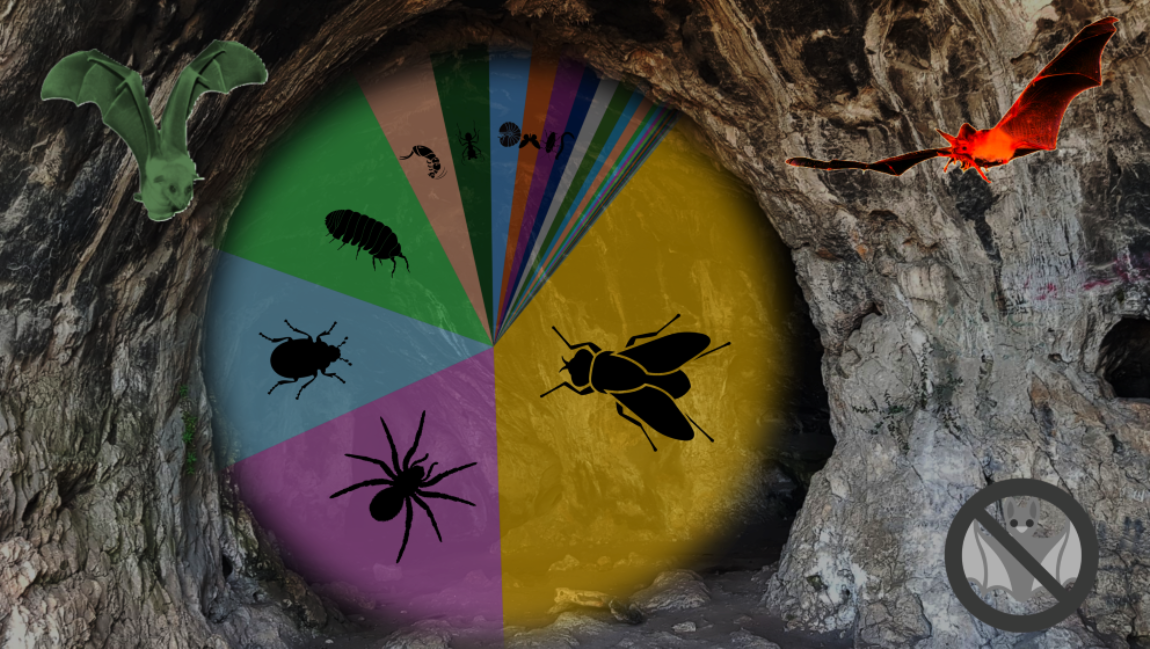

Bat Colony and Cave Zone Shape Arthropod Assemblages in Levantine Caves


Simple Summary
Abstract
1. Introduction
2. Materials and Methods
2.1. Study Sites
2.2. Arthropod Sampling
2.3. Statistical Analysis
3. Results
3.1. Arthropod Abundance and Richness by Cave Type, Zone, and Microhabitat
- a.
- Arthropod abundance
- b.
- Arthropod species richness
- c.
- Arachnid troglophile species richness
- d.
- Arachnid troglobite species richness
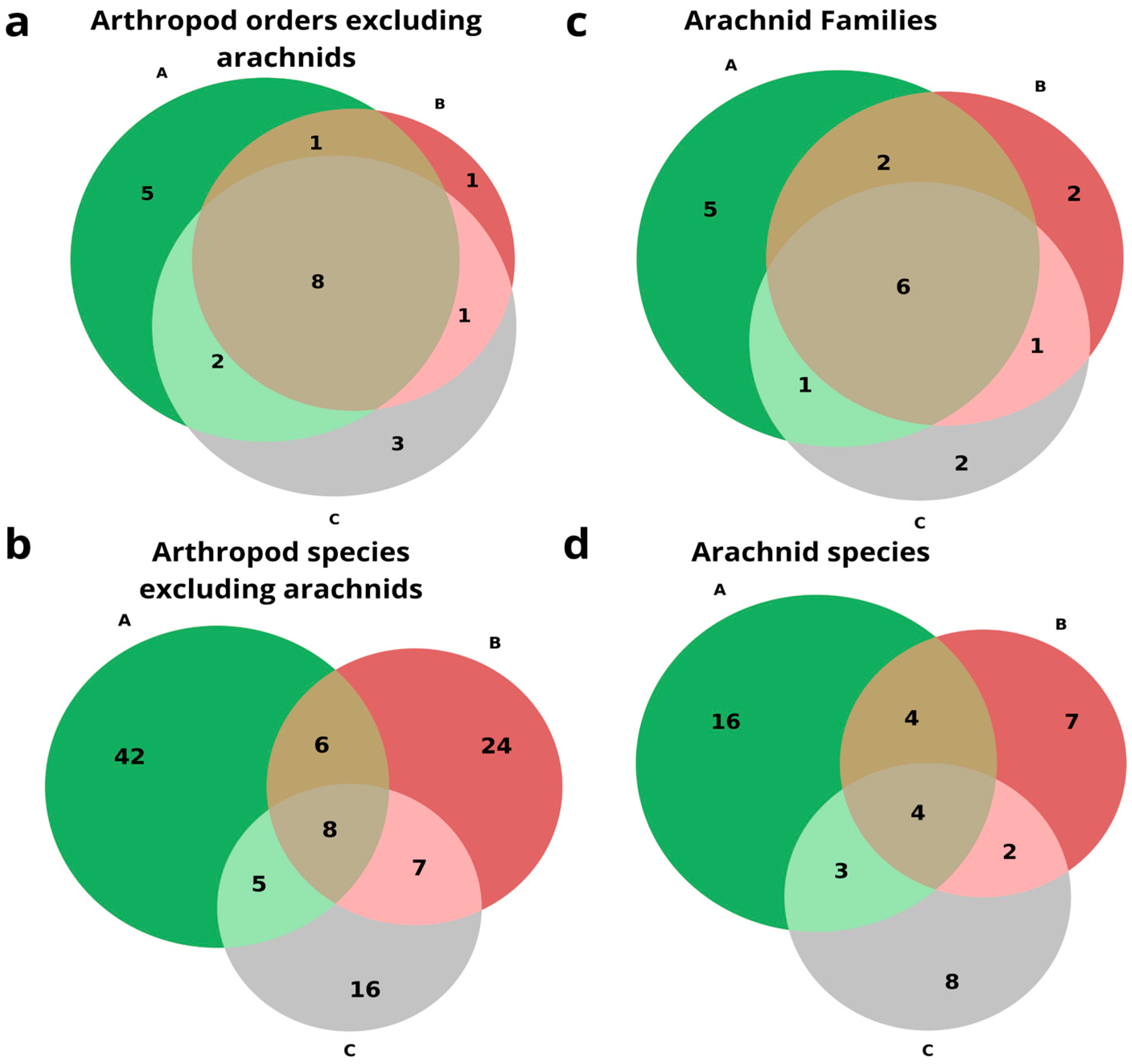
3.2. Arthropod Assemblage Composition and Species Overlap
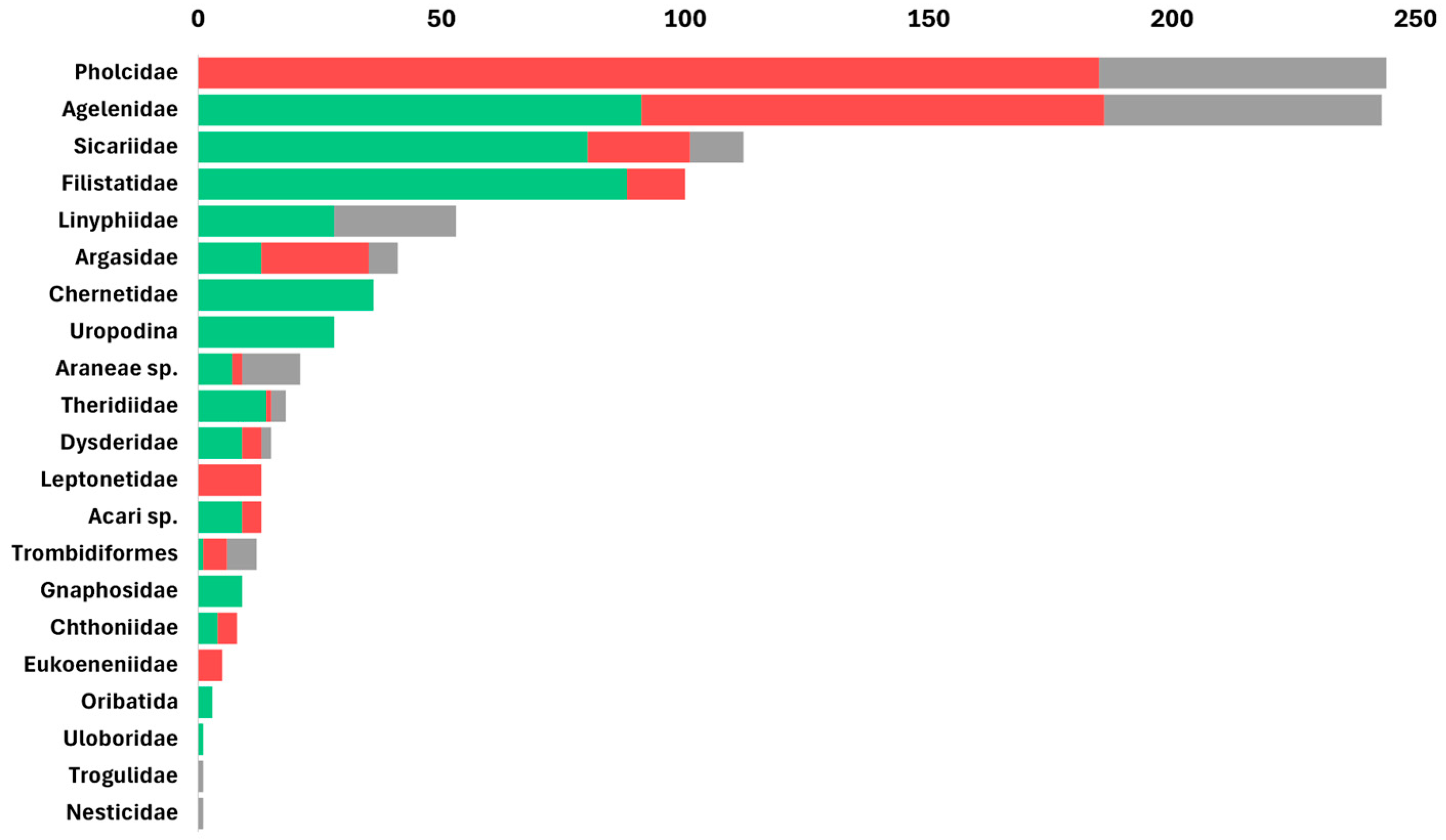
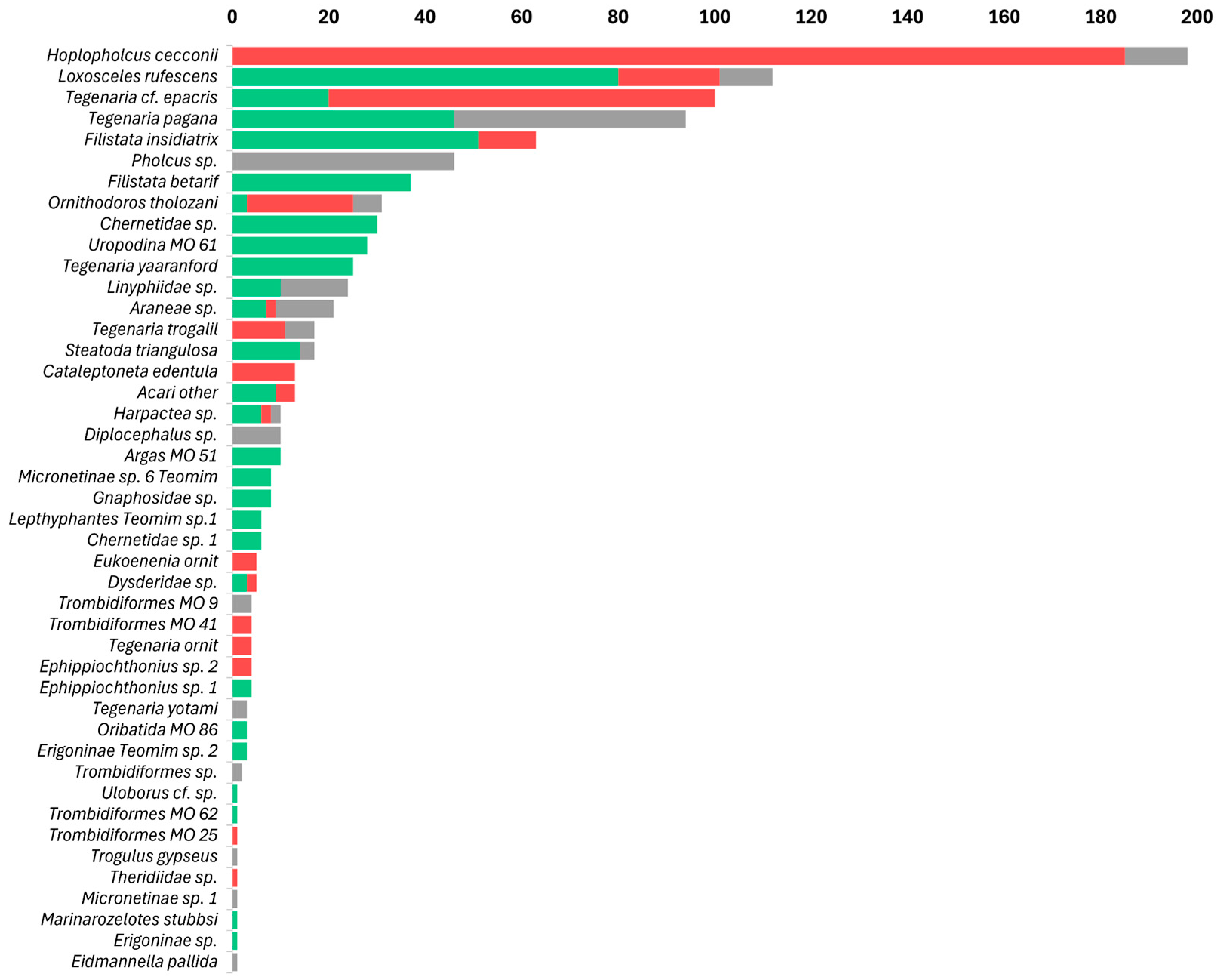
3.3. Taxonomic Composition of Arthropod Assemblages Across Cave Types
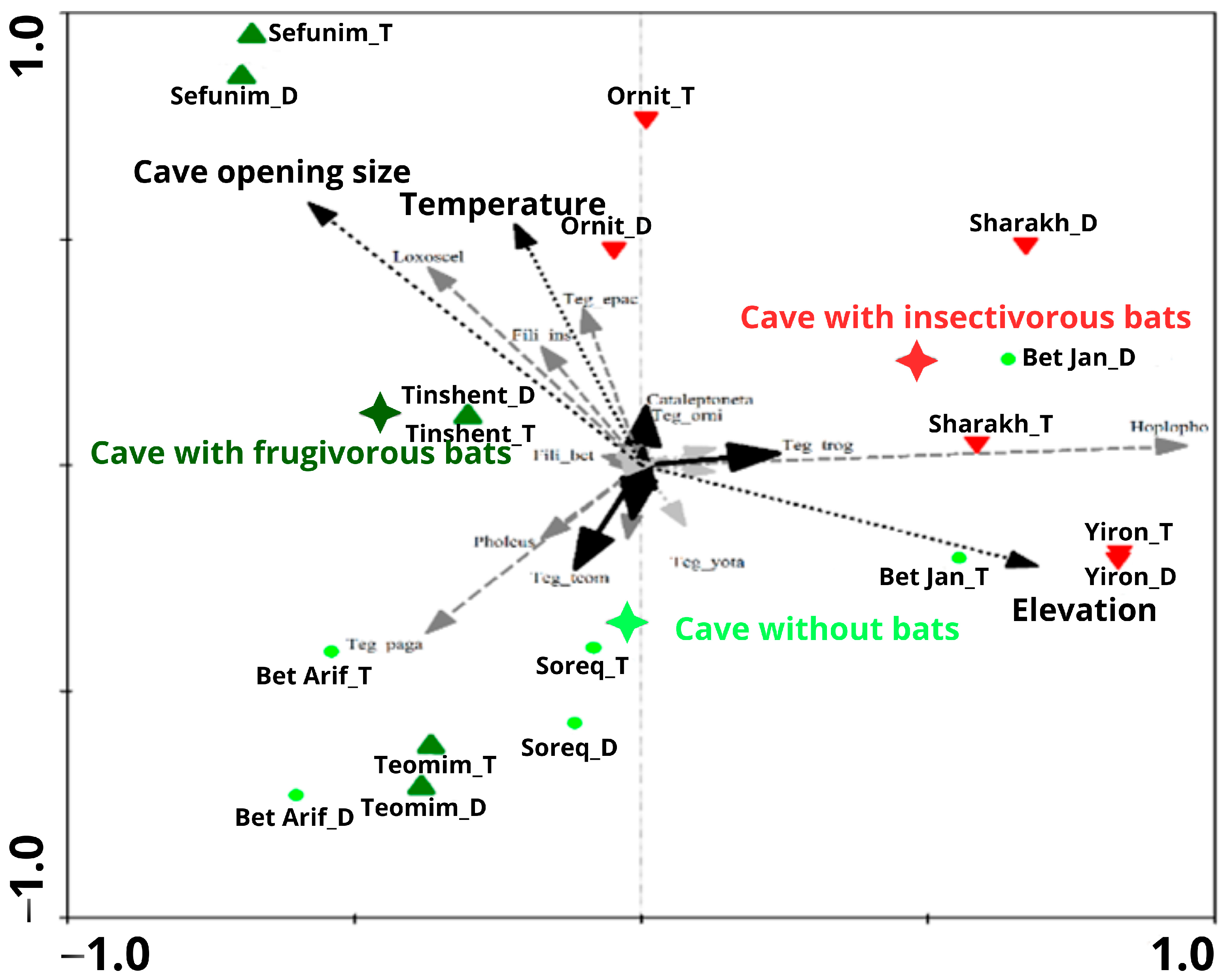
3.4. Environmental Drivers of Arachnid Assemblage Composition
4. Discussion
5. Conclusions
Supplementary Materials
Author Contributions
Funding
Data Availability Statement
Acknowledgments
Conflicts of Interest
Abbreviations
| ANOVA | Analysis of variance |
| CCA | Canonical Correspondence Analysis |
| df | Degrees of freedom |
| GLMM | Generalized Linear Mixed Model |
| GIS | Geographic Information System |
| sp. | Undetermined species within a genus |
Appendix A

| Cave Type | Cave Name | N | E | Elevation | Cave Length Estimate | Cave Entrance Size | Zone | Temperature | Humidity |
|---|---|---|---|---|---|---|---|---|---|
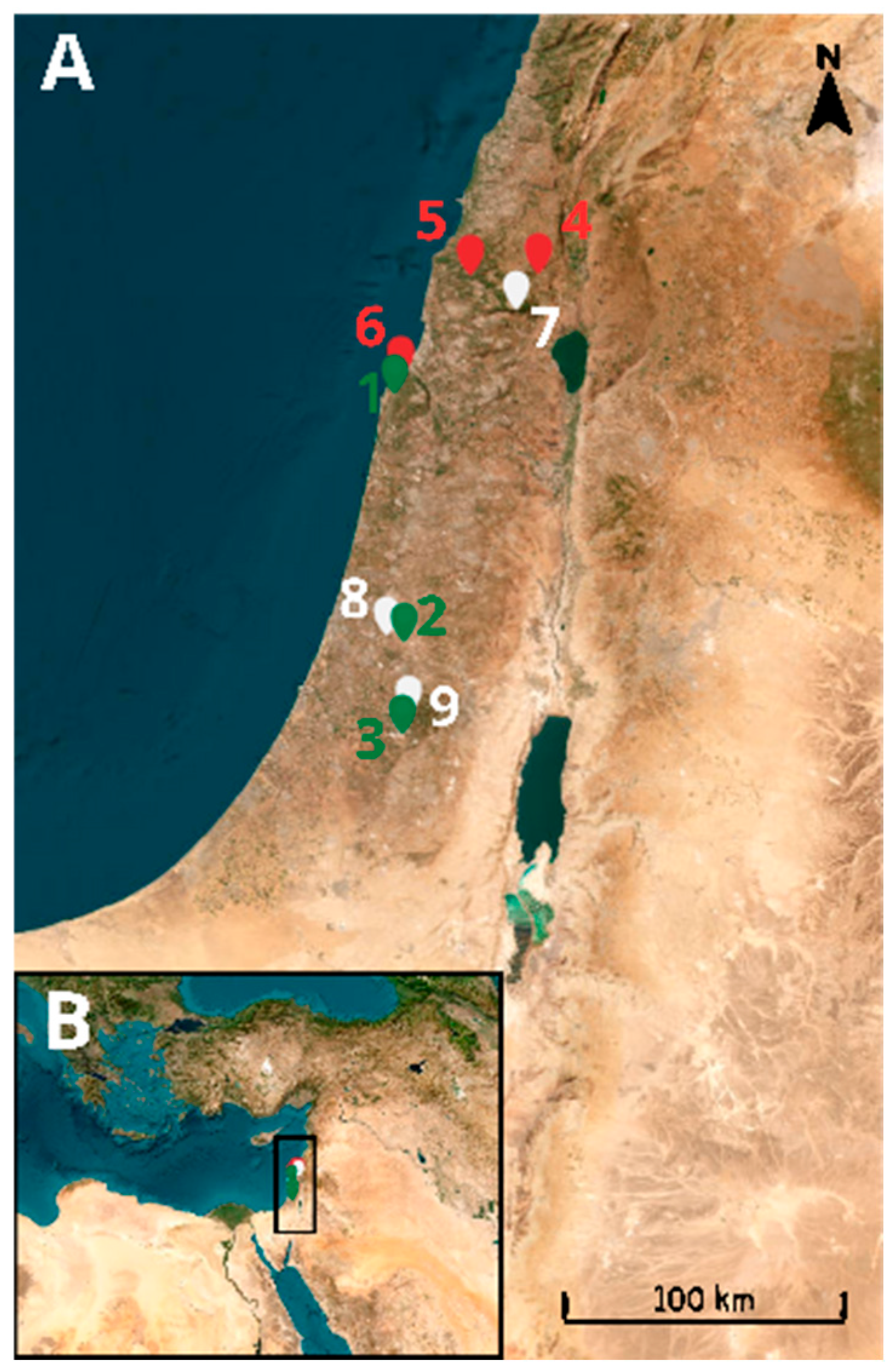
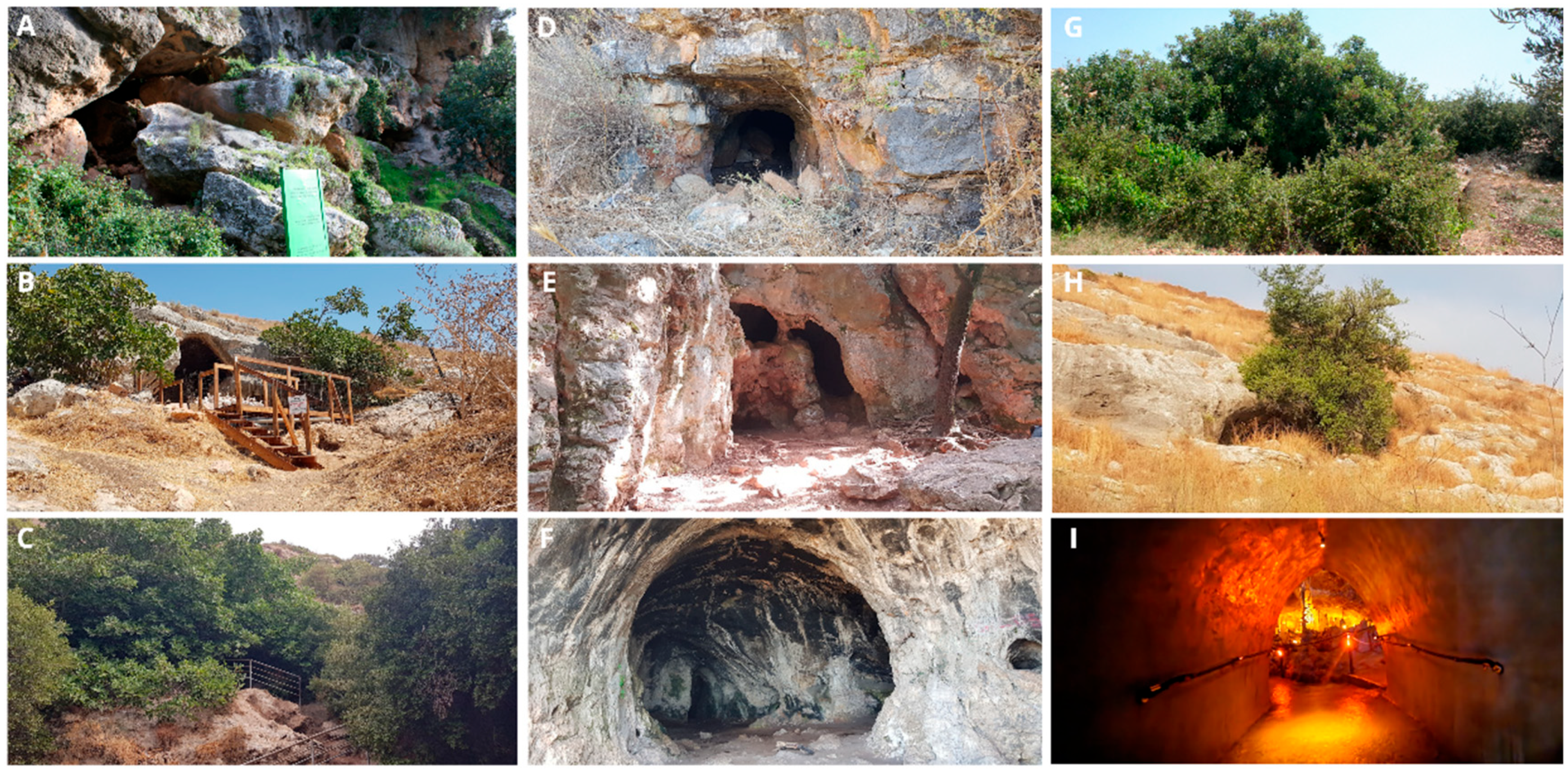
| Caves with frugivorous bat colonies | (1) Sefunim | 32.7370 | 34.9784 | 126 | 50 | 104 | Twilight | 26.3 | 0.84 |
| Dark | 25.7 | 0.823 | |||||||
| (2) Tinshemet | 31.9994 | 34.9681 | 100 | 43 | 97 | Twilight | 29 | 0.76 | |
| Dark | 29 | 0.79 | |||||||
| (3) Te’omim | 31.7262 | 35.0217 | 375 | 134 | 128 | Twilight | 17.3 | 0.795 | |
| Dark | 16.7 | 0.86 | |||||||
| Caves with insectivorous bat colonies | (4) Yir’on | 33.0679 | 35.4665 | 528 | 150 | 79 | Twilight | 21 | 0.961 |
| Dark | 20.9 | 0.875 | |||||||
| (5) Sharakh | 33.0740 | 35.2378 | 299 | 85 | 99 | Twilight | 25.1 | 0.81 | |
| Dark | 28 | 0.223 | |||||||
| (6) Ornit | 32.7566 | 34.9897 | 192 | 66 | 71 | Twilight | 23 | 0.83 | |
| Dark | 21.1 | 0.894 | |||||||
| Caves without bat colonies | (7) Bet Jan | 32.9615 | 35.3951 | 927 | 33.5 | 105 | Twilight | 24.3 | 0.824 |
| Dark | 22.2 | 0.88 | |||||||
| (8) Bet A’rif | 32.0026 | 34.9642 | 95 | 45 | 73 | Twilight | 16.2 | 0.823 | |
| Dark | 19.1 | 0.74 | |||||||
| (9) Soreq | 31.7560 | 35.0227 | 405 | 80 | 10 | Twilight | 21.7 | 0.984 | |
| Dark | 20.6 | 0.919 |
References
- Barr, T.C.; Holsinger, J.R. Speciation in cave faunas. Annu. Rev. Ecol. Syst. 1985, 16, 313–337. [Google Scholar] [CrossRef]
- Gibert, J.; Deharveng, L. Subterranean ecosystems: A truncated functional biodiversity. BioScience 2002, 52, 473–481. [Google Scholar] [CrossRef]
- Mammola, S. Finding answers in the dark: Caves as models in ecology fifty years after Poulson and White. Ecography 2019, 42, 1331–1351. [Google Scholar] [CrossRef]
- Gavish-Regev, E.; Aharon, S.; Armiach Steinpress, I.; Seifan, M.; Lubin, Y. A primer on spider assemblages in Levantine caves: The neglected subterranean habitats of the Levant—A biodiversity mine. Diversity 2021, 13, 179. [Google Scholar] [CrossRef]
- Cuff, J.P.; Aharon, S.; Armiach Steinpress, I.; Seifan, M.; Lubin, Y.; Gavish-Regev, E. It’s all about the zone: Spider assemblages in different ecological zones of Levantine caves. Diversity 2021, 13, 576. [Google Scholar] [CrossRef]
- Manenti, R.; Lunghi, E.; Ficetola, G.F. The distribution of cave twilight-zone spiders depends on microclimatic features and trophic supply. Invertebr. Biol. 2015, 134, 242–251. [Google Scholar] [CrossRef]
- Howarth, F.G.; Moldovan, O.T. Where cave animals live. In Cave Ecology; Moldovan, O.T., Kováč, Ľ., Halse, S., Eds.; Ecological Studies; Springer International Publishing: Cham, Switzerland, 2018; Volume 235, pp. 23–37. ISBN 978-3-319-98850-4. [Google Scholar]
- Tobin, B.; Hutchins, B.; Schwartz, B. Spatial and temporal changes in invertebrate assemblage structure from the entrance to deep-cave zone of a temperate marble cave. Int. J. Speleol. 2013, 42, 203–214. [Google Scholar] [CrossRef]
- Poulson, T.L.; White, W.B. The cave environment: Limestone caves provide unique natural laboratories for studying biological and geological processes. Science 1969, 165, 971–981. [Google Scholar] [CrossRef]
- Howarth, F.G. High-stress subterranean habitats and evolutionary change in cave-inhabiting arthropods. Am. Nat. 1993, 142, S65–S77. [Google Scholar] [CrossRef]
- Sket, B. Can we agree on an ecological classification of subterranean animals? J. Nat. Hist. 2008, 42, 1549–1563. [Google Scholar] [CrossRef]
- Culver, D.C.; Pipan, T. Adaptations to subterranean life. In The Biology of Caves and Other Subterranean Habitats; Oxford University Press: Oxford, UK, 2019; pp. 119–146. ISBN 978-0-19-882076-5. [Google Scholar]
- Resende, L.P.A.; Bichuette, M.E. Sharing the space: Coexistence among terrestrial predators in Neotropical caves. J. Nat. Hist. 2016, 50, 2107–2128. [Google Scholar] [CrossRef]
- Kováč, Ľ. Caves as oligotrophic ecosystems. In Cave Ecology; Moldovan, O.T., Kováč, Ľ., Halse, S., Eds.; Ecological Studies; Springer International Publishing: Cham, Switzerland, 2018; Volume 235, pp. 297–307. ISBN 978-3-319-98850-4. [Google Scholar]
- Engel, A.S. Chemolithoautotrophy. In Encyclopedia of Caves; Elsevier: Amsterdam, The Netherlands, 2019; pp. 267–276. ISBN 978-0-12-814124-3. [Google Scholar]
- Wischer, D.; Kumaresan, D.; Johnston, A.; El Khawand, M.; Stephenson, J.; Hillebrand-Voiculescu, A.M.; Chen, Y.; Murrell, J.C. Bacterial metabolism of methylated amines and identification of novel methylotrophs in Movile Cave. ISME J. 2015, 9, 195–206. [Google Scholar] [CrossRef] [PubMed]
- Cardoso, P. Diversity and community assembly patterns of epigean vs. troglobiont spiders in the Iberian Peninsula. Int. J. Speleol. 2012, 41, 83–94. [Google Scholar] [CrossRef]
- Chen, B.; Wise, D.H. Bottom-up limitation of predaceous arthropods in a detritus-based terrestrial food web. Ecology 1999, 80, 761–772. [Google Scholar] [CrossRef]
- Simon, K.S.; Benfield, E.F.; Macko, S.A. Food web structure and the role of epilithic biofilms in cave streams. Ecology 2003, 84, 2395–2406. [Google Scholar] [CrossRef]
- Ferreira, R.L.; Martins, R.P. Trophic structure and natural history of bat guano invertebrate communities, with special reference to Brazilian caves. Trop. Zool. 1999, 12, 231–252. [Google Scholar] [CrossRef]
- Emerson, J.K.; Roark, A.M. Composition of guano produced by frugivorous, sanguivorous, and insectivorous bats. Acta Chiropterologica 2007, 9, 261–267. [Google Scholar] [CrossRef]
- Abd Rahman, S.-S.N.F.; Tawie Tingga, R.C.; Mohamad Bukhori, M.F.; Abdullah, S.M.A.A. A brief review of the nutritive value and chemical components of bat guano and its potential use as a natural fertiliser in agriculture. Borneo J. Resour. Sci. Technol. 2023, 13, 22–31. [Google Scholar] [CrossRef]
- Gnaspini, P. Guano communities. In Encyclopedia of Caves, 2nd ed.; White, W.B., Culver, D.C., Eds.; Elsevier: Amsterdam, The Netherlands, 2012; pp. 357–364. [Google Scholar]
- Mammola, S.; Cardoso, P.; Ribera, C.; Pavlek, M.; Isaia, M. A synthesis on cave-dwelling spiders in Europe. J. Zool. Syst. Evol. Res. 2018, 56, 301–316. [Google Scholar] [CrossRef]
- Trajano, E.; Bichuette, M.E. Diversity of Brazilian subterranean invertebrates, with a list of troglomorphic taxa. Subterr. Biol. 2010, 7, 1–16. [Google Scholar]
- Dippenaar-Schoeman, A.S.; Myburgh, J.G. A review of the cave spiders (Arachnida: Araneae) from South Africa. Trans. R. Soc. S. Afr. 2009, 64, 53–61. [Google Scholar] [CrossRef]
- Turbanov, I.S.; Palatov, D.M.; Golovatch, S.I. The state of the art of biospeleology in Russia and other countries of the former Soviet Union: A review of the cave (endogean) invertebrate fauna. 2. Arachnida—Acknowledgments. Entomol. Rev. 2016, 96, 1297–1333. [Google Scholar] [CrossRef]
- Ferreira, R.L.; Prous, X.; Martins, R.P. Structure of bat guano communities in a dry Brazilian cave. Trop. Zool. 2007, 20, 55–74. [Google Scholar]
- Webster, J.M.; Whitaker, J.O. Study of guano communities of big brown bat colonies in Indiana and neighboring Illinois counties. Northeast Nat. 2005, 12, 221–232. [Google Scholar] [CrossRef]
- Ferreira, R.L.; Martins, R.P. Diversity and distribution of spiders associated with bat guano piles in Morrinho Cave (Bahia State, Brazil). Divers. Distrib. 1998, 4, 235–241. [Google Scholar]
- Dainelli, L.; Martínez, A.; Serena, F.; Gammuto, L.; Graco-Roza, C.; Langeneck, J.; Mammola, S.; Petroni, G. Macroinvertebrate diversity patterns in a guano-rich temperate cave. Biodivers. Conserv. 2025, 34, 2425–2449. [Google Scholar] [CrossRef]
- Smith, T.M.; Smith, R.L. Decomposition and nutrient cycling. In Elements of Ecology, 8th ed.; Wilbur, B., Ed.; Pearson Education Inc.: London, UK, 2012. [Google Scholar]
- Gloor, D.; Blick, T.; Nentwig, W.; Kropf, C.; Hänggi, A. Spiders of Europe. Natural History Museum Bern. 2010. Available online: https://www.araneae.nmbe.ch (accessed on 23 June 2025).
- Roberts, M.J. Spiders of Britain and Northern Europe, Reprint ed.; Collins Field Guide: London, UK, 2016; ISBN 978-0-00-219981-0. [Google Scholar]
- Warburg, S.; Aharon, S.; Armiach Steinpress, I.; Sharma, P.P.; Harms, D.; Gavish-Regev, E. Pseudoscorpions of Israel: Annotated checklist and key, with new records of two families (Arachnida: Pseudoscorpiones). Taxonomy 2023, 3, 466–496. [Google Scholar] [CrossRef]
- ter Braak, C.J.F. Canonical correspondence analysis: A new eigenvector technique for multivariate direct gradient analysis. Ecology 1986, 67, 1167–1179. [Google Scholar] [CrossRef]
- ter Braak, C.; Šmilauer, P. Canoco—Software for Ordination, Version 5.10; Microcomputer Power: Ithaca, NY, USA, 2020. Available online: http://www.canoco5.com (accessed on 17 March 2024).
- ter Braak, C.; Šmilauer, P. Canoco Reference Manual and User’s Guide: Software for Ordination, Version 5.10; Microcomputer Power: Ithaca, NY, USA, 2018.
- Magalhaes, I.L.F.; Aharon, S.; Ganem, Z.; Gavish-Regev, E. A new semi-cryptic Filistata from caves in the Levant with comments on the limits of Filistata insidiatrix (Forsskål, 1775) (Arachnida: Araneae: Filistatidae). Eur. J. Taxon. 2022, 831, 149–174. [Google Scholar] [CrossRef]
- Aharon, S.; Ballesteros, J.A.; Gainett, G.; Hawlena, D.; Sharma, P.P.; Gavish-Regev, E. In the land of the blind: Exceptional subterranean speciation of cryptic troglobitic spiders of the genus Tegenaria (Araneae: Agelenidae) in Israel. Mol. Phylogenetics Evol. 2023, 183, 107705. [Google Scholar] [CrossRef]
- da Rocha Melo, L.M.; Ferreira, R.L.; Silva, M.S. A review of the factors influencing invertebrate community structure in subterranean habitats. Community Ecol. 2025, 26, 449–463. [Google Scholar] [CrossRef]
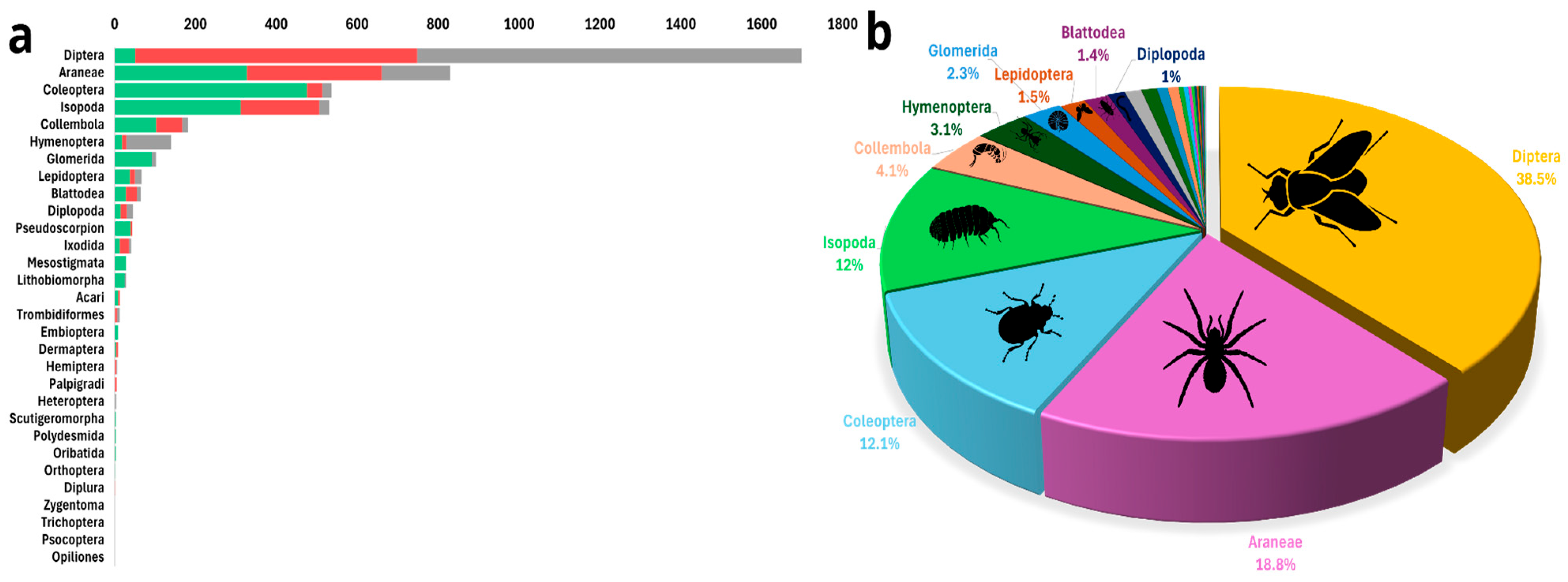
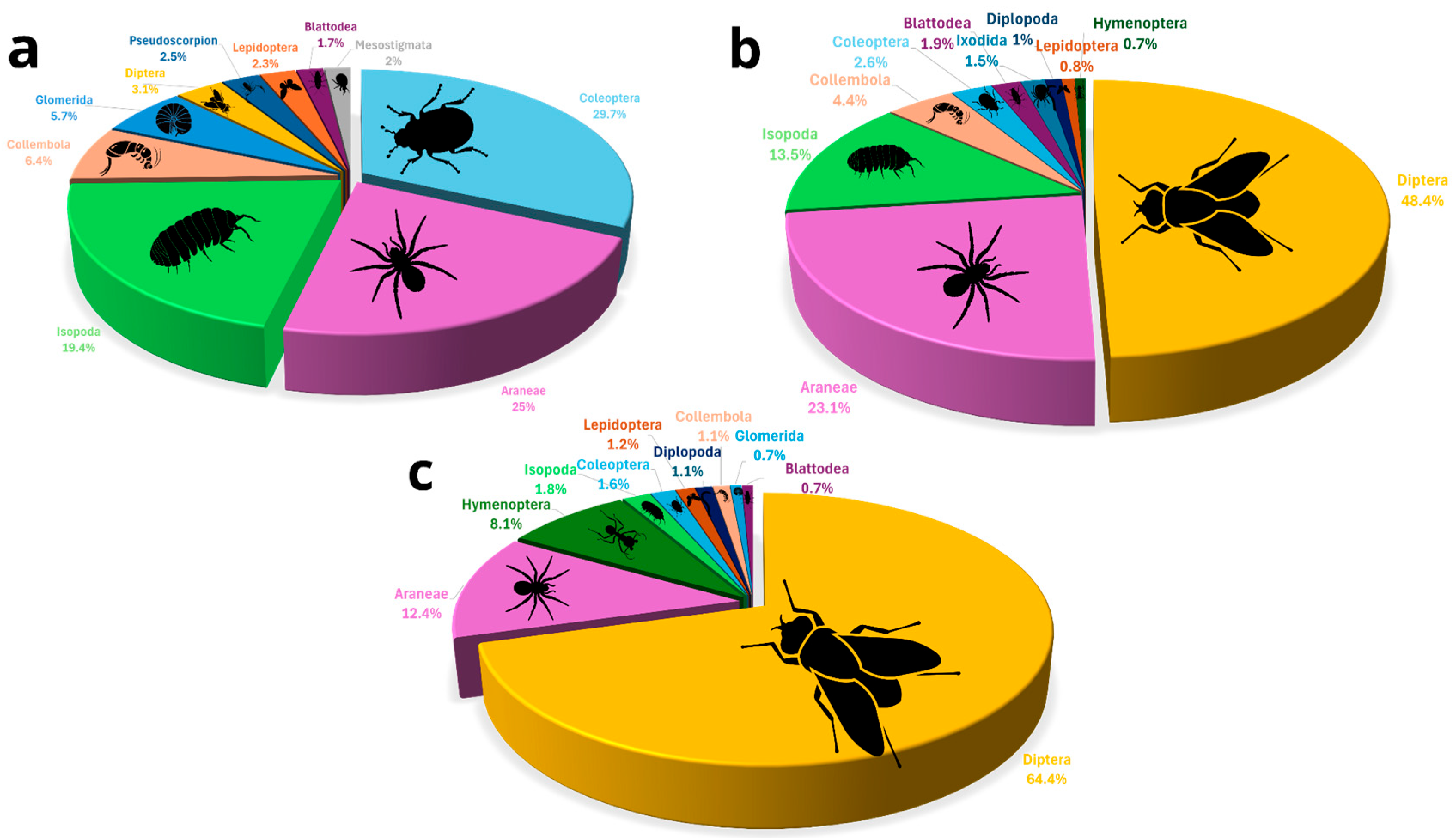
| Order | Total Abundance and % of All Arthropods in Caves Housing Different Bat Colony Types | Total Abundance and % of All Arthropods in All Cave Types | ||
|---|---|---|---|---|
| Frugivorous Bats | Insectivorous Bats | Caves Without Bats | ||
| Diptera | 51 (3.2%) | 697 (48.4%) | 951 (69.4%) | 1699 (38.5%) |
| Araneae | 327 (20.4%) | 333 (23.1%) | 170 (12.4%) | 830 (18.8%) |
| Coleoptera | 476 (29.7%) | 38 (2.6%) | 22 (1.6%) | 536 (12.2%) |
| Isopoda | 312 (19.5%) | 194 (13.5%) | 25 (1.8%) | 531 (12.0%) |
| Collembola | 103 (6.4%) | 64 (4.4%) | 15 (1.1%) | 182 (4.1%) |
| Hymenoptera | 19 (1.2%) | 10 (0.7%) | 111 (8.1%) | 140 (3.2%) |
| Glomerida | 92 (5.7%) | 0 (0%) | 10 (0.7%) | 102 (2.3%) |
| Arthropod Species Abundance | Arthropod Species Richness | Arachnid Troglophile Species Richness | Arachnid Troglobite Species Richness | ||||||
|---|---|---|---|---|---|---|---|---|---|
| Source | DF | Chi-Square | p | Chi-Square | p | Chi-Square | p | Chi-Square | p |
| Ecological zone | 1 | 871.43811 | 0.0001 | 18.460635 | 0.0001 | 10.635347 | 0.0011 | 1.0432444 | 0.0443 |
| Cave type | 2 | 134.9522 | 0.0001 | 53.863126 | 0.0001 | 15.567073 | 0.0004 | 10.366709 | 0.0056 |
| Zone × Cave type | 2 | 211.6879 | 0.0001 | 2.8472486 | 0.2408 | 4.7598304 | 0.0926 | 8.1413147 | 0.0171 |
| Microhabitats | 2 | 79.499781 | 0.0001 | 30.660839 | 0.0001 | 3.8671121 | 0.1446 | 1.5213041 | 0.4674 |
Disclaimer/Publisher’s Note: The statements, opinions and data contained in all publications are solely those of the individual author(s) and contributor(s) and not of MDPI and/or the editor(s). MDPI and/or the editor(s) disclaim responsibility for any injury to people or property resulting from any ideas, methods, instructions or products referred to in the content. |
© 2026 by the authors. Licensee MDPI, Basel, Switzerland. This article is an open access article distributed under the terms and conditions of the Creative Commons Attribution (CC BY) license.
Share and Cite
Ganem, Z.; Aharon, S.; Hawlena, D.; Gavish-Regev, E. Bat Colony and Cave Zone Shape Arthropod Assemblages in Levantine Caves. Insects 2026, 17, 118. https://doi.org/10.3390/insects17010118
Ganem Z, Aharon S, Hawlena D, Gavish-Regev E. Bat Colony and Cave Zone Shape Arthropod Assemblages in Levantine Caves. Insects. 2026; 17(1):118. https://doi.org/10.3390/insects17010118
Chicago/Turabian StyleGanem, Zeana, Shlomi Aharon, Dror Hawlena, and Efrat Gavish-Regev. 2026. "Bat Colony and Cave Zone Shape Arthropod Assemblages in Levantine Caves" Insects 17, no. 1: 118. https://doi.org/10.3390/insects17010118
APA StyleGanem, Z., Aharon, S., Hawlena, D., & Gavish-Regev, E. (2026). Bat Colony and Cave Zone Shape Arthropod Assemblages in Levantine Caves. Insects, 17(1), 118. https://doi.org/10.3390/insects17010118