Bioclimatic and Land Use/Land Cover Factors as Determinants of Crabronidae (Hymenoptera) Community Structure in Yunnan, China


Simple Summary
Abstract
1. Introduction
2. Materials and Methods
2.1. Study Site and Data Collection
2.2. Habitat Suitability Assessment and Statistical Analysis
3. Results
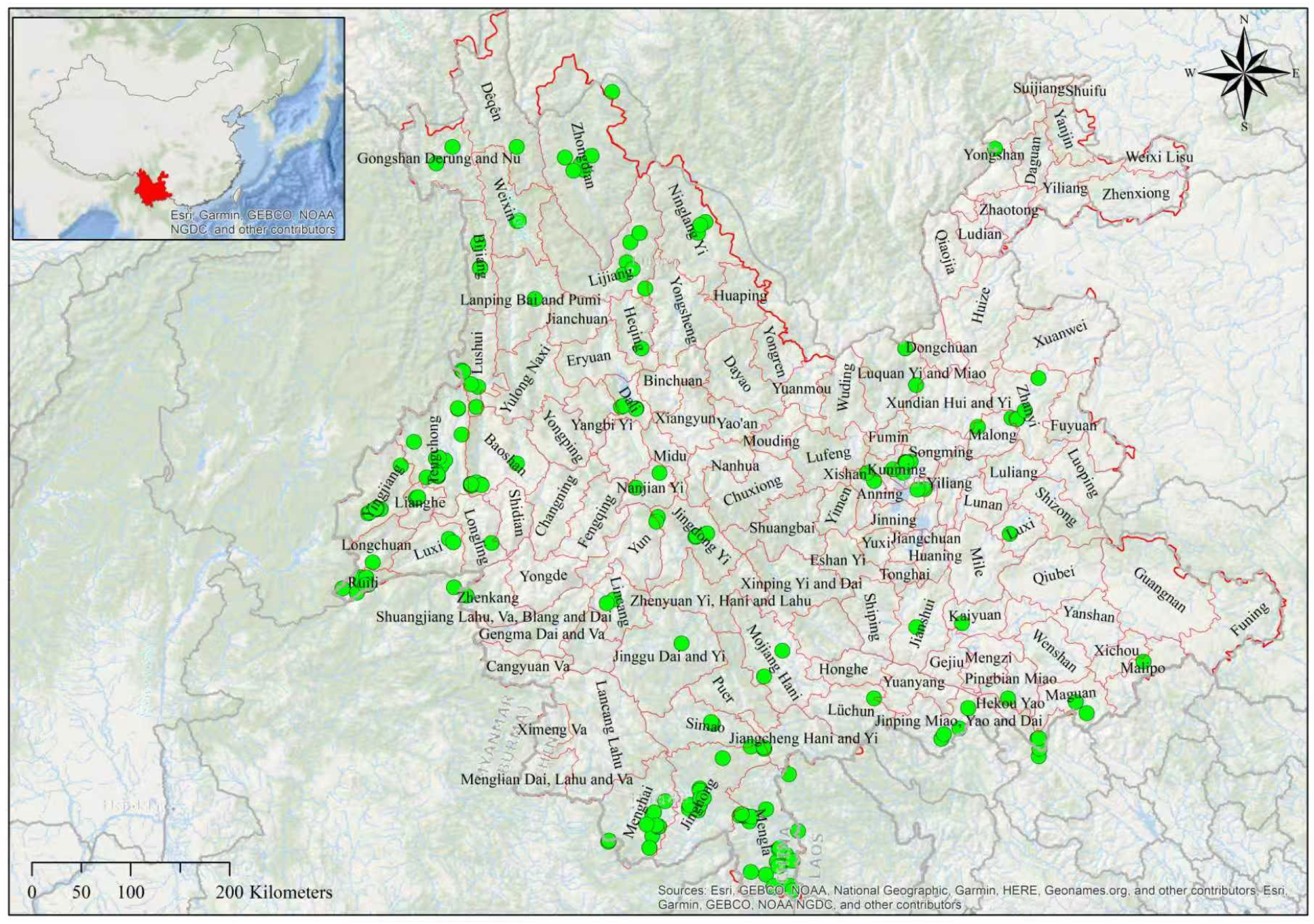
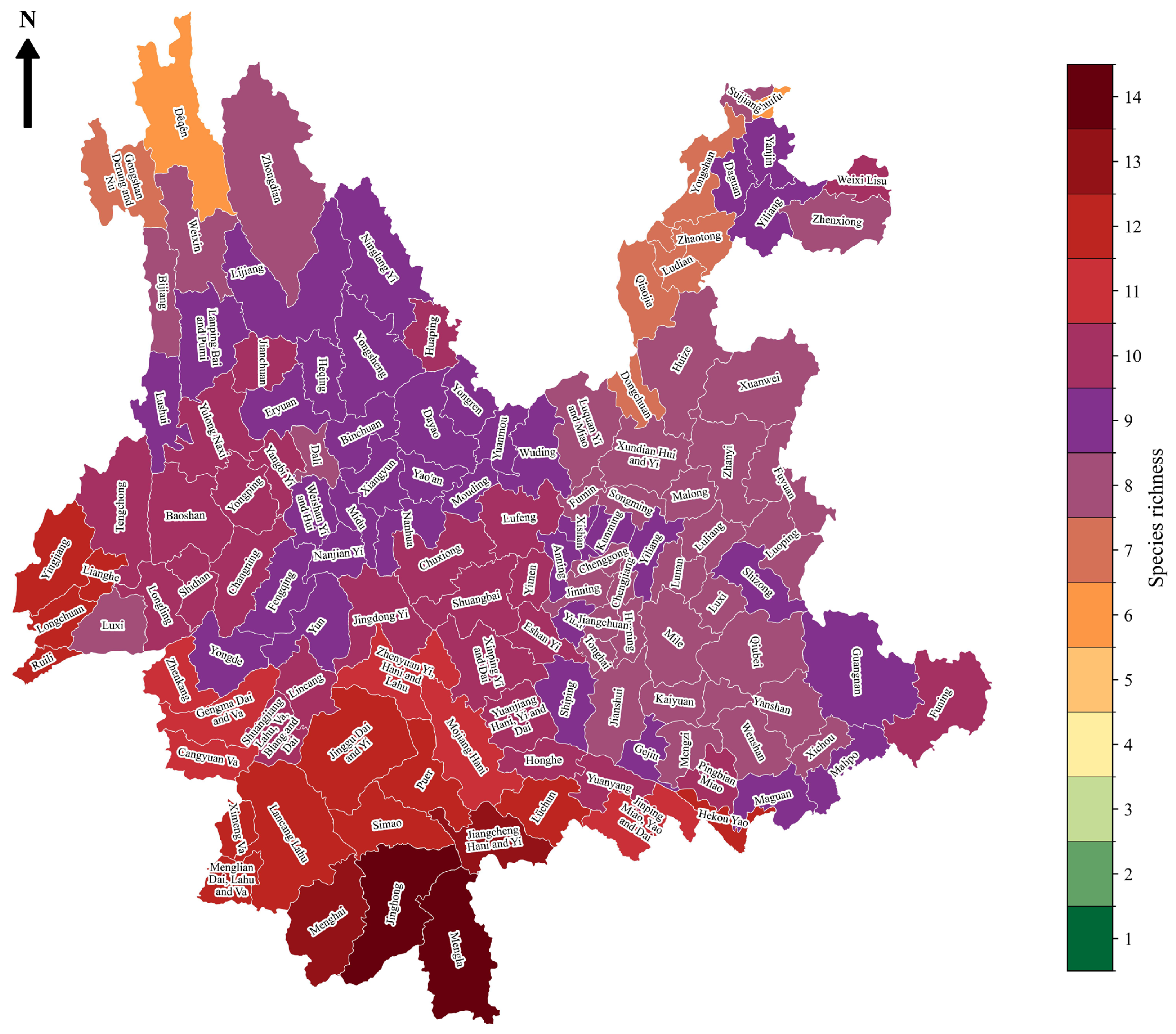
3.1. Mapping of Crabronidae Community in Yunnan
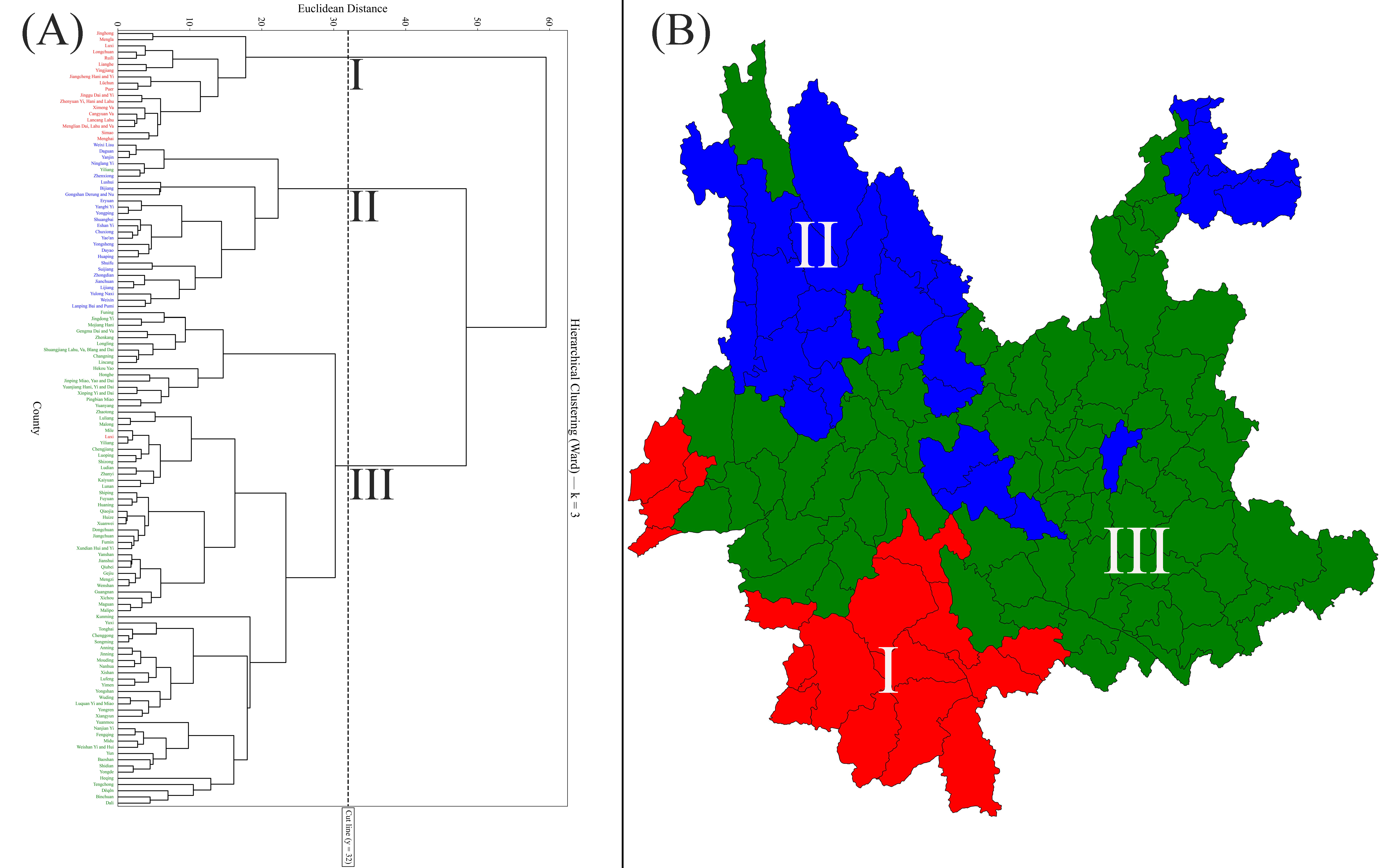
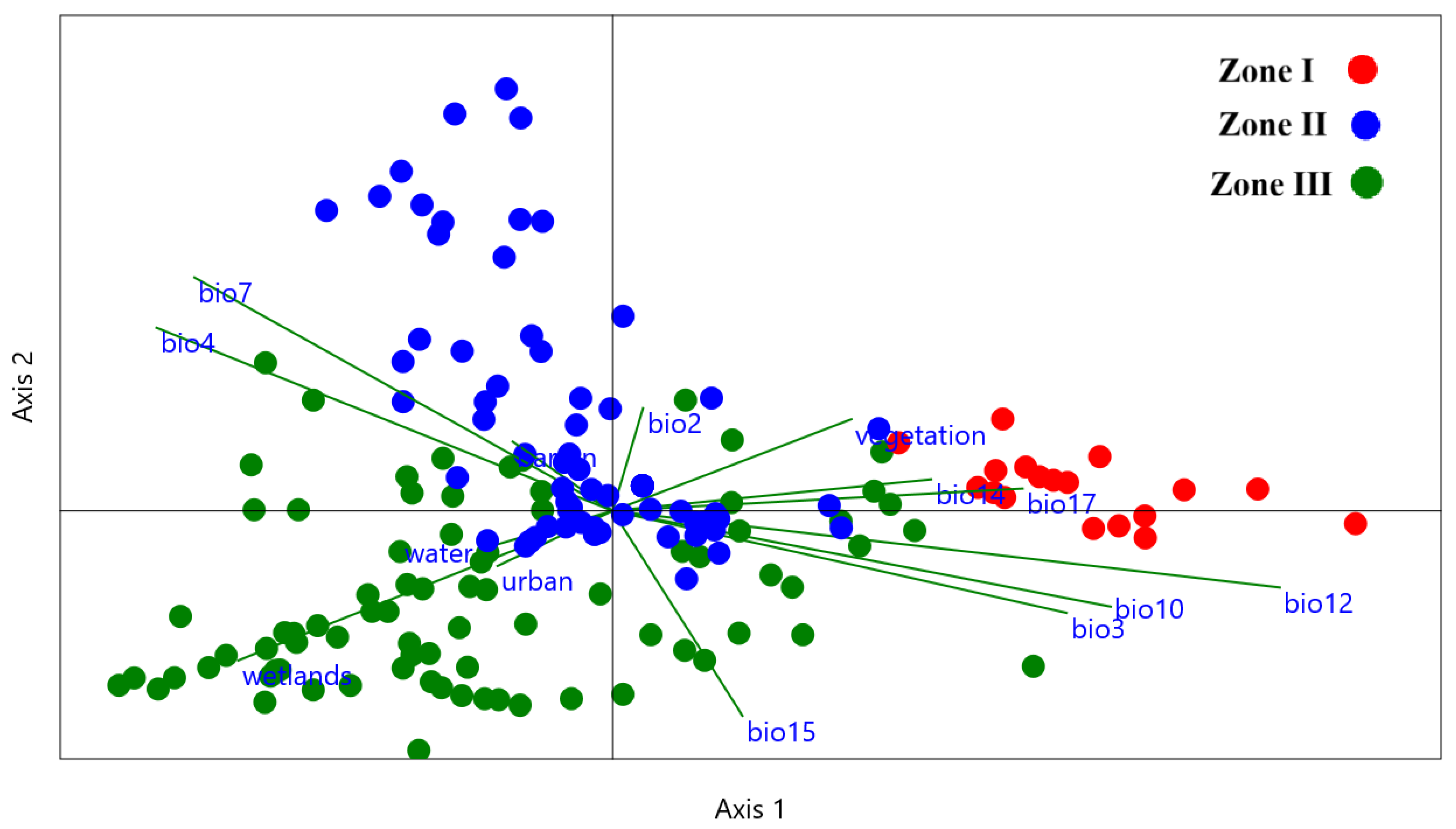
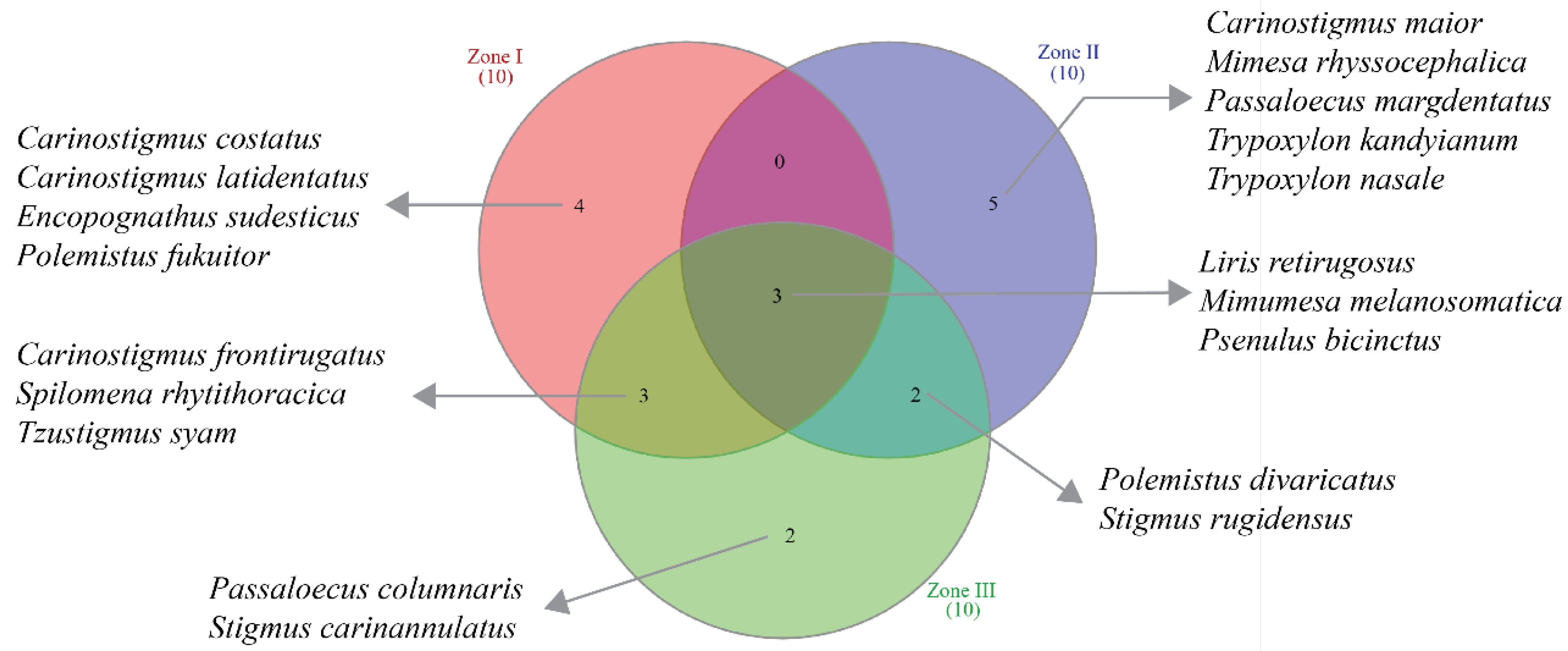
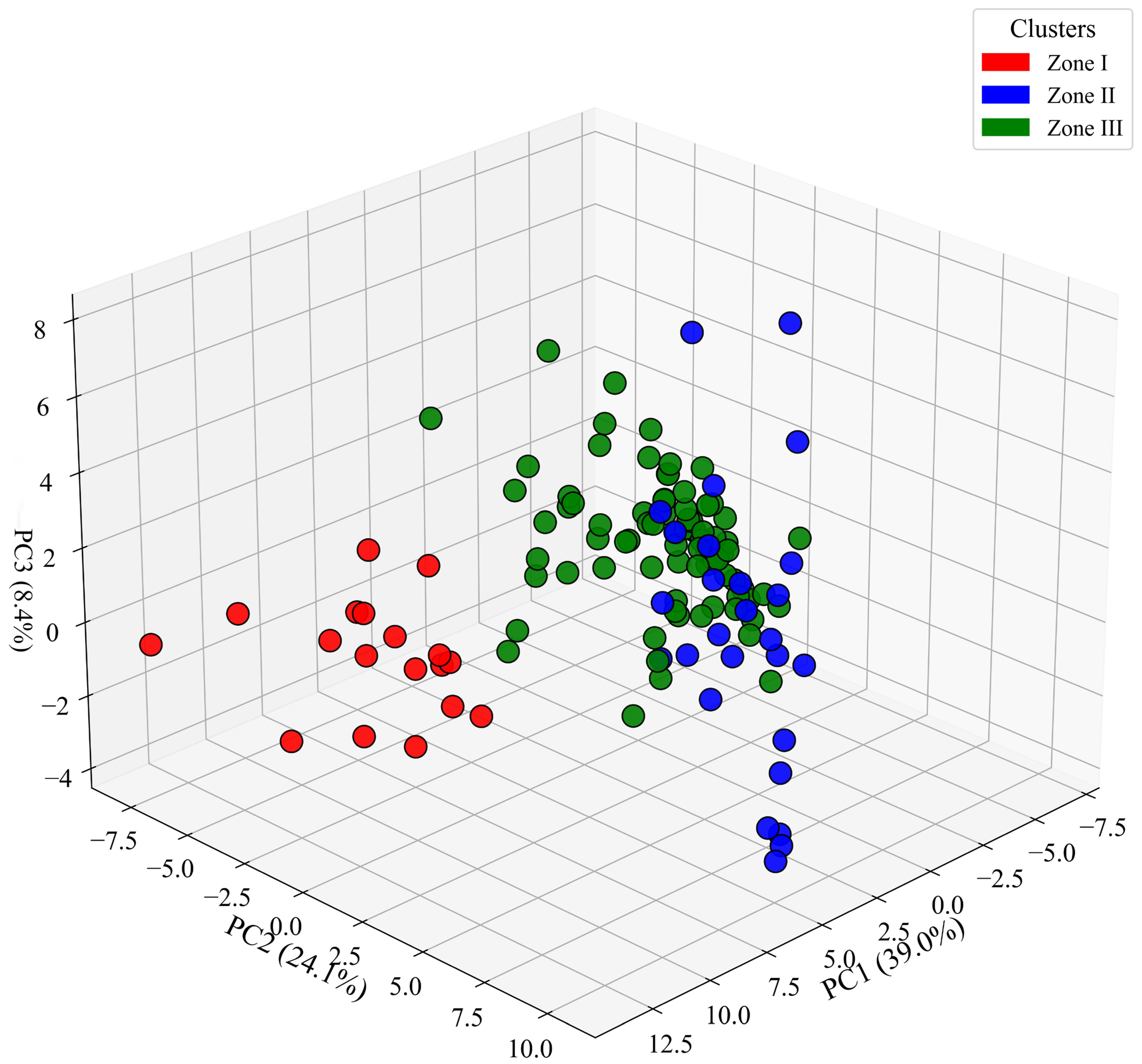
3.2. Crabronidae Community Assemblages and Their Environmental Factors in Yunnan Province, China
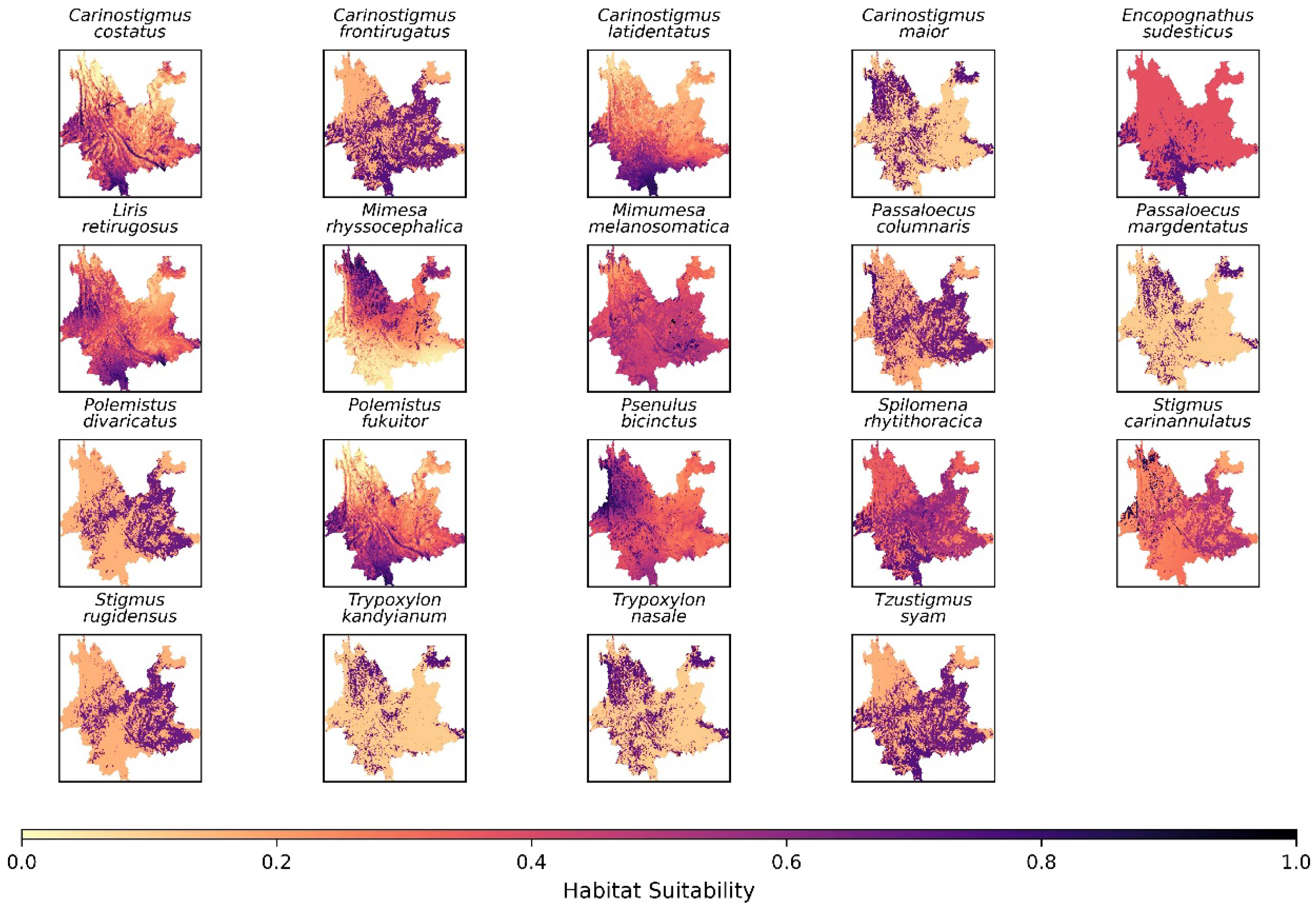
3.3. Habitat Suitability of Crabronidae Community Assemblages and Contributing Variables
4. Discussion
5. Conclusions
Supplementary Materials
Author Contributions
Funding
Data Availability Statement
Acknowledgments
Conflicts of Interest
References
- Khedher, H.B.; Yildirim, E.; Braham, M.; Chaaban, S.B. Check list and newly recorded Crabronid wasps (Hymenoptera: Crabronidae) for the fauna of Tozeur Province, Tunisia. In Proceedings of the 6th International Conference on Sustainable Agriculture and Environment, Konya, Turkey, 3–5 October 2019; pp. 189–197. [Google Scholar]
- Vieira, L.; Oliveira, N.; Gayubo, S. On the use of Apiformes and Spheciformes (Insecta: Hymenoptera) populations as a management tool. Biodivers. Conserv. 2011, 20, 519–530. [Google Scholar] [CrossRef]
- Ingham, C.S. Host Adaptation Protects a Defensive Symbiont During Vertical Transmission in Beewolf Wasps (Hymenoptera: Crabronidae). Doctoral Dissertation, Johannes Gutenberg-Universität Mainz, Mainz, Germany, 2024. [Google Scholar]
- Vanoye-Eligio, M.; Ramírez, V.M.; Ayala, R.; Navarro, J.; Delfin-González, H. Predatory Wasps (Hymenoptera) of the Yucatan Peninsula. Southwest. Entomol. 2014, 39, 635–646. [Google Scholar] [CrossRef]
- Raven, P.H.; Wagner, D.L. Agricultural intensification and climate change are rapidly decreasing insect biodiversity. Proc. Natl. Acad. Sci. USA 2021, 118, e2002548117. [Google Scholar] [CrossRef] [PubMed]
- Brühl, C.A.; Zaller, J.G. Biodiversity decline as a consequence of an inappropriate environmental risk assessment of pesticides. Front. Environ. Sci. 2019, 7, 464007. [Google Scholar] [CrossRef]
- Chen, H.; Bashir, N.H.; Li, Q.; Liu, C.; Naeem, M.; Wang, H.; Gao, W.; Corlett, R.T.; Liu, C.; Vidal, M.C. The Role of Pathogens in Bumblebee Decline: A Review. Pathogens 2025, 14, 94. [Google Scholar] [CrossRef]
- Van Der Sluijs, J.P. Insect decline, an emerging global environmental risk. Curr. Opin. Environ. Sustain. 2020, 46, 39–42. [Google Scholar] [CrossRef]
- Sánchez-Bayo, F.; Wyckhuys, K.A. Worldwide decline of the entomofauna: A review of its drivers. Biol. Conserv. 2019, 232, 8–27. [Google Scholar] [CrossRef]
- Shinohara, N.; Nakadai, R.; Suzuki, Y.; Terui, A. Spatiotemporal dimensions of community assembly. Popul. Ecol. 2023, 65, 5–16. [Google Scholar] [CrossRef]
- Trivellone, V.; Bougeard, S.; Giavi, S.; Krebs, P.; Balseiro, D.; Dray, S.; Moretti, M. Factors shaping community assemblages and species co-occurrence of different trophic levels. Ecol. Evol. 2017, 7, 4745–4754. [Google Scholar] [CrossRef]
- Dovey, K.; Ristic, M. Mapping urban assemblages: The production of spatial knowledge. J. Urban. Int. Res. Placemak. Urban Sustain. 2017, 10, 15–28. [Google Scholar] [CrossRef]
- Anderson, M.; Comer, P.; Grossman, D.; Groves, C.; Poiani, K.; Reid, M.; Schneider, R.; Vickery, B.; Weakley, A. Guidelines for Representing Ecological Communities in Ecoregional Conservation Plans; The Nature Conservancy: Arlington, VA, USA, 1999. [Google Scholar]
- Márquez, J.C.; Kolasa, J. Local and regional processes in community assembly. PLoS ONE 2013, 8, e54580. [Google Scholar] [CrossRef]
- Rodriguez-Tapia, G.; Prieto-Amparan, J.A.; Cordoba-Aguilar, A. Linking potential habitats of Odonata (Insecta) with changes in land use/land cover in Mexico. Eur. J. Entomol. 2022, 119, 272–284. [Google Scholar] [CrossRef]
- Marta, S.; Brunetti, M.; Manenti, R.; Provenzale, A.; Ficetola, G.F. Climate and land-use changes drive biodiversity turnover in arthropod assemblages over 150 years. Nat. Ecol. Evol. 2021, 5, 1291–1300. [Google Scholar] [CrossRef] [PubMed]
- Yu, T.-T.; Chang, Z.; Dong, Z.-W.; Li, K.-Q.; Ma, F.-Z.; Wang, W.; Li, X.-Y. A glimpse into the biodiversity of insects in Yunnan: An updated and annotated checklist of butterflies (Lepidoptera, Papilionoidea). Zool. Res. 2022, 43, 1009. [Google Scholar] [CrossRef] [PubMed]
- Bashir, N.H.; Naeem, M.; Hassan, M.A.; van Steenis, J.; Li, X.; Chen, H. First Record of Neoascia anassa Reemer and Hippa, 2005 (Diptera: Syrphidae) from China with Description of Previously Unknown Female. J. Entomol. Res. Soc. 2025, 27, 247–254. [Google Scholar] [CrossRef]
- Liu, C.; Guénard, B.; Garcia, F.H.; Yamane, S.; Blanchard, B.; Yang, D.-R.; Economo, E. New records of ant species from Yunnan, China. ZooKeys 2015, 17, 17–78. [Google Scholar] [CrossRef]
- Dong, Z.; Yiu, V.; Liu, G.; He, J.; Zhao, R.; Peng, Y.; Li, X. Three new species of Lamprigera Motschulsky (Coleoptera, Lampyridae) from China, with notes on known species. Zootaxa 2021, 4950, 441–468. [Google Scholar] [CrossRef]
- Bashir, N.H.; Ma, L.; Li, Q. Chinese species of Carinostigmus Tsuneki (Hymenoptera, Crabronidae), including three new species and a new record to China. ZooKeys 2020, 987, 115. [Google Scholar] [CrossRef]
- Fu, Y.; Bashir, N.H.; Li, Q.; Ma, L. A review of Trypoxylon Latreille, 1796 (Hymenoptera, Crabronidae) of Southwest China with descriptions of two new species. J. Hymenopt. Res. 2024, 97, 307–347. [Google Scholar] [CrossRef]
- Bashir, N.H.; Yue, D.; Jiang, H.; Ma, L.; Li, Q. Taxonomic study of the subtribe Pemphredonina Dahlbom, 1835 (Hymenoptera: Crabronidae) with a new species and six new records from China. J. Asia-Pac. Entomol. 2021, 24, 1055–1065. [Google Scholar] [CrossRef]
- Li, J.; Li, Q.; Ma, L. Five new species of the genus Stigmus Panzer (Hymenoptera, Crabronidae) from China, with a key to all Chinese species. ZooKeys 2024, 1204, 313–336. [Google Scholar] [CrossRef] [PubMed]
- Pulawski, W.J. Catalog of Sphecidae: Number of Extant Species of Sphecidae. 2025. Available online: https://www.calacademy.org/catalog-of-sphecidae-genera-and-species (accessed on 20 October 2025).
- Li, J.; Ma, L.; Li, Q. Five new species of Passaloecus Shuckard (Hymenoptera, Crabronidae) from China, with a key to Chinese species. J. Hymenopt. Res. 2024, 97, 1141–1161. [Google Scholar] [CrossRef]
- Deng, Y.; Ma, L.; Li, Q. Two new species of Psen Latreille, 1796 (Hymenoptera, Apoidea, Crabronidae) from China, with a key to Psen species of China. ZooKeys 2025, 1224, 87. [Google Scholar] [CrossRef] [PubMed]
- Jiang, H.; Li, Q.; Ma, L. The Genus Psenulus Kohl, 1897 (Hymenoptera: Crabronidae) in China, with Two New Species and Two New Country Records. Insects 2025, 16, 432. [Google Scholar] [CrossRef]
- Li, C.; Li, Q.; Ma, L. Six new species of the genus Nitela Latreille (Hymenoptera, Crabronidae) from China, with a key to the Oriental species. J. Hymenopt. Res. 2025, 98, 871–896. [Google Scholar] [CrossRef]
- Dormann, C.F.; Elith, J.; Bacher, S.; Buchmann, C.; Carl, G.; Carré, G.; Marquéz, J.R.G.; Gruber, B.; Lafourcade, B.; Leitão, P.J. Collinearity: A review of methods to deal with it and a simulation study evaluating their performance. Ecography 2013, 36, 27–46. [Google Scholar] [CrossRef]
- Phillips, S.J.; Anderson, R.P.; Schapire, R.E. Maximum entropy modeling of species geographic distributions. Ecol. Modell. 2006, 190, 231–259. [Google Scholar] [CrossRef]
- Phillips, S.J.; Dudík, M. Modeling of species distributions with Maxent: New extensions and a comprehensive evaluation. Ecography 2008, 31, 161–175. [Google Scholar] [CrossRef]
- Merow, C.; Smith, M.J.; Silander, J.A., Jr. A practical guide to MaxEnt for modeling species’ distributions: What it does, and why inputs and settings matter. Ecography 2013, 36, 1058–1069. [Google Scholar] [CrossRef]
- Giordani, P. Principal component analysis. In Encyclopedia of Social Network Analysis and Mining; Springer: New York, NY, USA, 2018; pp. 1831–1844. [Google Scholar]
- Davies, D.L.; Bouldin, D.W. A cluster separation measure. IEEE Trans. Pattern Anal. Mach. Intell. 2009, 1, 224–227. [Google Scholar] [CrossRef]
- Caliński, T.; Harabasz, J. A dendrite method for cluster analysis. Commun. Stat. Methods 1974, 3, 1–27. [Google Scholar] [CrossRef]
- Rousseeuw, P.J. Silhouettes: A graphical aid to the interpretation and validation of cluster analysis. J. Comput. Appl. Math. 1987, 20, 53–65. [Google Scholar] [CrossRef]
- Charre-Medellín, J.F.; Ferrer-Ferrando, D.; Monterrubio-Rico, T.C.; Fernández-López, J.; Acevedo, P. Using species distribution modeling to generate relative abundance information in socio-politically unstable territories: Conservation of Felidae in the central-western region of Mexico. Ecol. Evol. 2023, 13, e10534. [Google Scholar] [CrossRef] [PubMed]
- Chen, H.; Naeem, M.; Meng, L.; Bashir, N.H.; Riasat, M.; Liu, Z.; Pan, C. Mapping Bumblebee Community Assemblages and Their Associated Drivers in Yunnan, China. Biology 2025, 14, 1222. [Google Scholar] [CrossRef]
- Naeem, M.; Rani, A.; Lyu, W.; Zhao, H.; Riasat, M.; Abbas, S.; Hussain, S.; Bashir, N.H.; Li, Q.; Chen, H. Temperature-Related Bioclimatic Variables Play a Greater Role in the Spatial Distribution of Bumblebee Species in Northern Pakistan. Insects 2024, 16, 1. [Google Scholar] [CrossRef]
- Orr, M.C.; Hughes, A.C.; Chesters, D.; Pickering, J.; Zhu, C.-D.; Ascher, J.S. Global patterns and drivers of bee distribution. Curr. Biol. 2021, 31, 451–458.e4. [Google Scholar] [CrossRef]
- Knops, J.M.; Tilman, D.; Haddad, N.M.; Naeem, S.; Mitchell, C.E.; Haarstad, J.; Ritchie, M.E.; Howe, K.M.; Reich, P.B.; Siemann, E. Effects of plant species richness on invasion dynamics, disease outbreaks, insect abundances and diversity. Ecol. Lett. 1999, 2, 286–293. [Google Scholar] [CrossRef]
- Morpurgo, J.; Huurdeman, M.A.; Oostermeijer, J.G.B.; Remme, R.P. Vegetation density is the main driver of insect species richness and diversity in small private urban front gardens. Urban Forest. Urban Green. 2024, 101, 128531. [Google Scholar] [CrossRef]
- Le Lann, C.; Wardziak, T.; Van Baaren, J.; van Alphen, J.J. Thermal plasticity of metabolic rates linked to life-history traits and foraging behaviour in a parasitic wasp. Funct. Ecol. 2011, 25, 641–651. [Google Scholar] [CrossRef]
- Stahlschmidt, Z.R.; Jodrey, A.D.; Luoma, R.L. Consequences of complex environments: Temperature and energy intake interact to influence growth and metabolic rate. Comp. Biochem. Physiol. Part. A Mol. Integr. Physiol. 2015, 187, 1–7. [Google Scholar] [CrossRef]
- Stephens, D.W.; Brown, J.S.; Ydenberg, R.C. Foraging: Behavior and Ecology; University of Chicago Press: Chicago, IL, USA, 2008; ISBN 0226772659. [Google Scholar]
- Ogwu, M.; Osawaru, M. Principal component analysis: A tool for multivariate analysis of genetic variability. Afr. J. Plant Sci. 2016, in press. [Google Scholar]
- Naeem, M.; Chen, H.; Li, W.; Hughes, A.C.; Williams, P.H.; Bashir, N.H.; Miao, Z.; Huang, J.; An, J. Patterns and Drivers of Bumblebee Diversity in Gansu. Insects 2024, 15, 552. [Google Scholar] [CrossRef] [PubMed]
- Naeem, M.; Huang, J.; Zhang, S.; Luo, S.; Liu, Y.; Zhang, H.; Luo, Q.; Zhou, Z.; Ding, G.; An, J. Diagnostic indicators of wild pollinators for biodiversity monitoring in long-term conservation. Sci. Total Environ. 2020, 708, 135231. [Google Scholar] [CrossRef] [PubMed]
- Murtagh, F.; Legendre, P. Ward’s hierarchical clustering method: Clustering criterion and agglomerative algorithm. arXiv 2011, arXiv:1111.6285. [Google Scholar]
- Pérez-Sánchez, A.J.; Schibalski, A.; Schröder, B.; Klimek, S.; Dauber, J. Local and landscape environmental heterogeneity drive ant community structure in temperate seminatural upland grasslands. Ecol. Evol. 2023, 13, e9889. [Google Scholar] [CrossRef]
- Ward, J.H., Jr. Hierarchical grouping to optimize an objective function. J. Am. Stat. Assoc. 1963, 58, 236–244. [Google Scholar] [CrossRef]
- Legendre, P.; Legendre, L. Numerical Ecology; Elsevier: Amsterdam, The Netherlands, 2012; ISBN 0444538690. [Google Scholar]
- Lozier, J.D.; Strange, J.P.; Heraghty, S.D. Whole genome demographic models indicate divergent effective population size histories shape contemporary genetic diversity gradients in a montane bumble bee. Ecol. Evol. 2023, 13, e9778. [Google Scholar] [CrossRef]
- Galaiduk, R.; Halford, A.R.; Radford, B.T.; Moore, C.H.; Harvey, E.S. Regional-scale environmental drivers of highly endemic temperate fish communities located within a climate change hotspot. Divers. Distrib. 2017, 23, 1256–1267. [Google Scholar] [CrossRef]





| Environmental Factors | Axis 1 (CCA Plot) | Axis 2 (CCA Plot) |
|---|---|---|
| bio10 | 0.60 | −0.26 |
| bio12 | 0.81 | −0.21 |
| bio14 | 0.38 | 0.08 |
| bio15 | 0.16 | −0.55 |
| bio17 | 0.49 | 0.06 |
| bio2 | 0.04 | 0.28 |
| bio3 | 0.55 | −0.27 |
| bio4 | −0.55 | 0.49 |
| bio7 | −0.50 | 0.63 |
| water | −0.16 | −0.11 |
| vegetation | 0.29 | 0.25 |
| wetlands | −0.45 | −0.40 |
Disclaimer/Publisher’s Note: The statements, opinions and data contained in all publications are solely those of the individual author(s) and contributor(s) and not of MDPI and/or the editor(s). MDPI and/or the editor(s) disclaim responsibility for any injury to people or property resulting from any ideas, methods, instructions or products referred to in the content. |
© 2026 by the authors. Licensee MDPI, Basel, Switzerland. This article is an open access article distributed under the terms and conditions of the Creative Commons Attribution (CC BY) license.
Share and Cite
Bashir, N.H.; Naeem, M.; Li, Q.; Chen, H. Bioclimatic and Land Use/Land Cover Factors as Determinants of Crabronidae (Hymenoptera) Community Structure in Yunnan, China. Insects 2026, 17, 100. https://doi.org/10.3390/insects17010100
Bashir NH, Naeem M, Li Q, Chen H. Bioclimatic and Land Use/Land Cover Factors as Determinants of Crabronidae (Hymenoptera) Community Structure in Yunnan, China. Insects. 2026; 17(1):100. https://doi.org/10.3390/insects17010100
Chicago/Turabian StyleBashir, Nawaz Haider, Muhammad Naeem, Qiang Li, and Huanhuan Chen. 2026. "Bioclimatic and Land Use/Land Cover Factors as Determinants of Crabronidae (Hymenoptera) Community Structure in Yunnan, China" Insects 17, no. 1: 100. https://doi.org/10.3390/insects17010100
APA StyleBashir, N. H., Naeem, M., Li, Q., & Chen, H. (2026). Bioclimatic and Land Use/Land Cover Factors as Determinants of Crabronidae (Hymenoptera) Community Structure in Yunnan, China. Insects, 17(1), 100. https://doi.org/10.3390/insects17010100