Developmental Thresholds and Thermal Requirements of Two Pupal Parasitoids of the Invasive Fall Webworm



1
Department of Plant Protection, Faculty of Agriculture, Bolu Abant Izzet Baysal University, Golkoy, Bolu 14030, Türkiye
2
Service d’Automatique et d’Analyse des Systèmes, Université Libre de Bruxelles, 1050 Brussels, Belgium
3
International Centre for Advanced Mediterranean Agronomic Studies of Bari (CIHEAM Bari), 70010 Valenzano, Italy
*
Authors to whom correspondence should be addressed.
Insects 2025, 16(3), 284; https://doi.org/10.3390/insects16030284
Submission received: 30 January 2025
/
Revised: 6 March 2025
/
Accepted: 7 March 2025
/
Published: 8 March 2025
(This article belongs to the Section Insect Pest and Vector Management)
Simple Summary
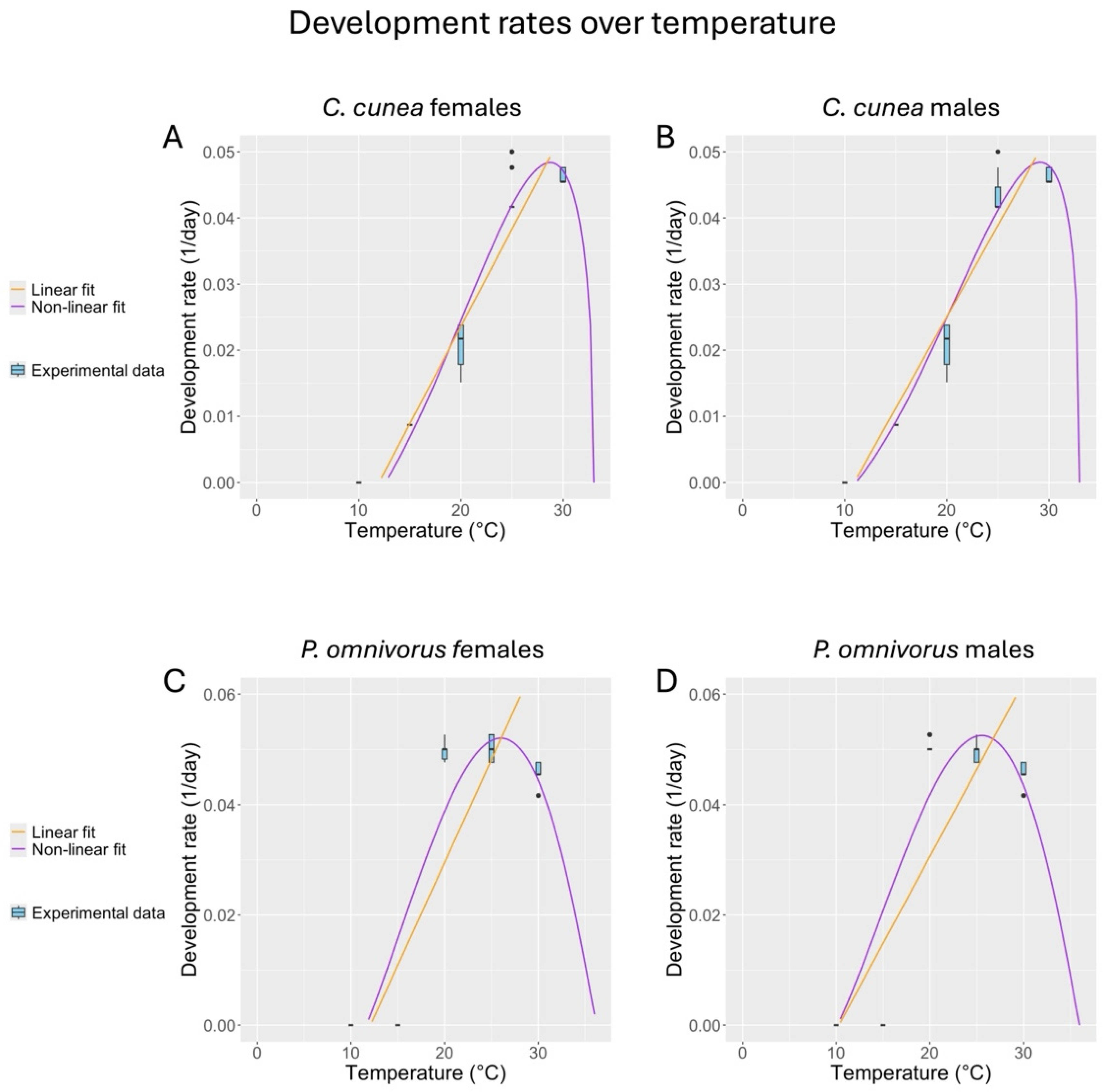
The fall webworm, Hyphantria cunea (Lepidoptera: Erebidae) is an invasive insect pest that threatens agricultural crops such as fruit trees (especially hazelnut) forests, and urban vegetation areas. Besides the damages to the host plants, the fall webworm also impacts citizens day life. Last instar larvae often enter houses, shops, stores, or vehicles to pupate, leading to allergic skin reactions in sensitive individuals triggered by the long larval hairs. The climate change of recent years is causing extreme temperature conditions, which seems to be more favourable for the development of this pest and possibly of its natural enemies. The effect of temperature, known on this pest, is still poorly explored in relation to its two main hymenopteran parasitoids, Chouioia cunea Yang (Eulophidae) and Psychophagus omnivorus (Walker) (Pteromalidae). Testing the effect of indigenous parasitoids at different temperature conditions can yield valuable information to plan alternative control strategies for the fall webworm. Laboratory tests conducted at different temperatures are a good starting point to gain insights about the main biological features of the two parasitoid species, such as development, survival, reproduction, and parasitism. This study aims to investigate on this topic, as such information is still scarce in the current literature.
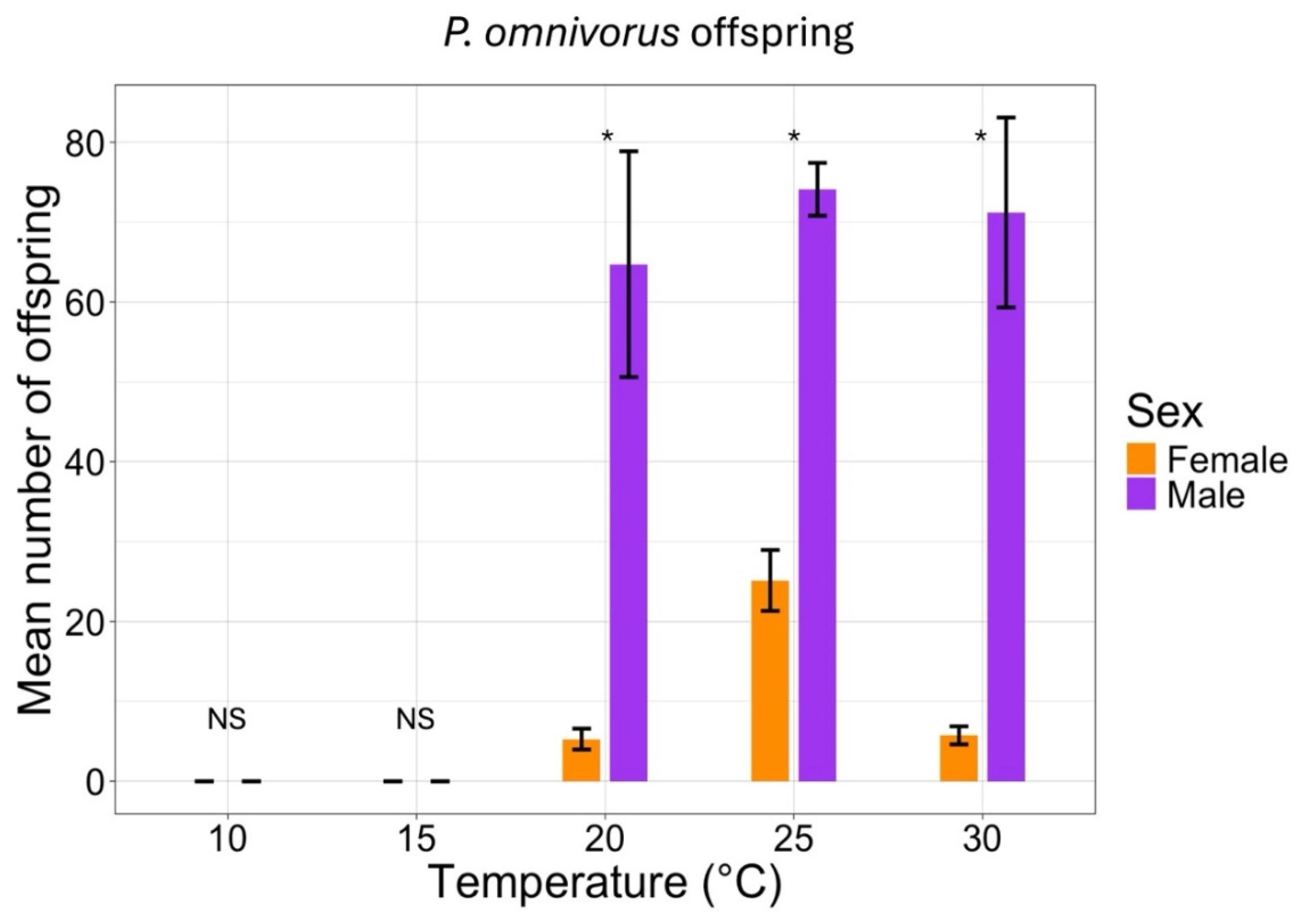
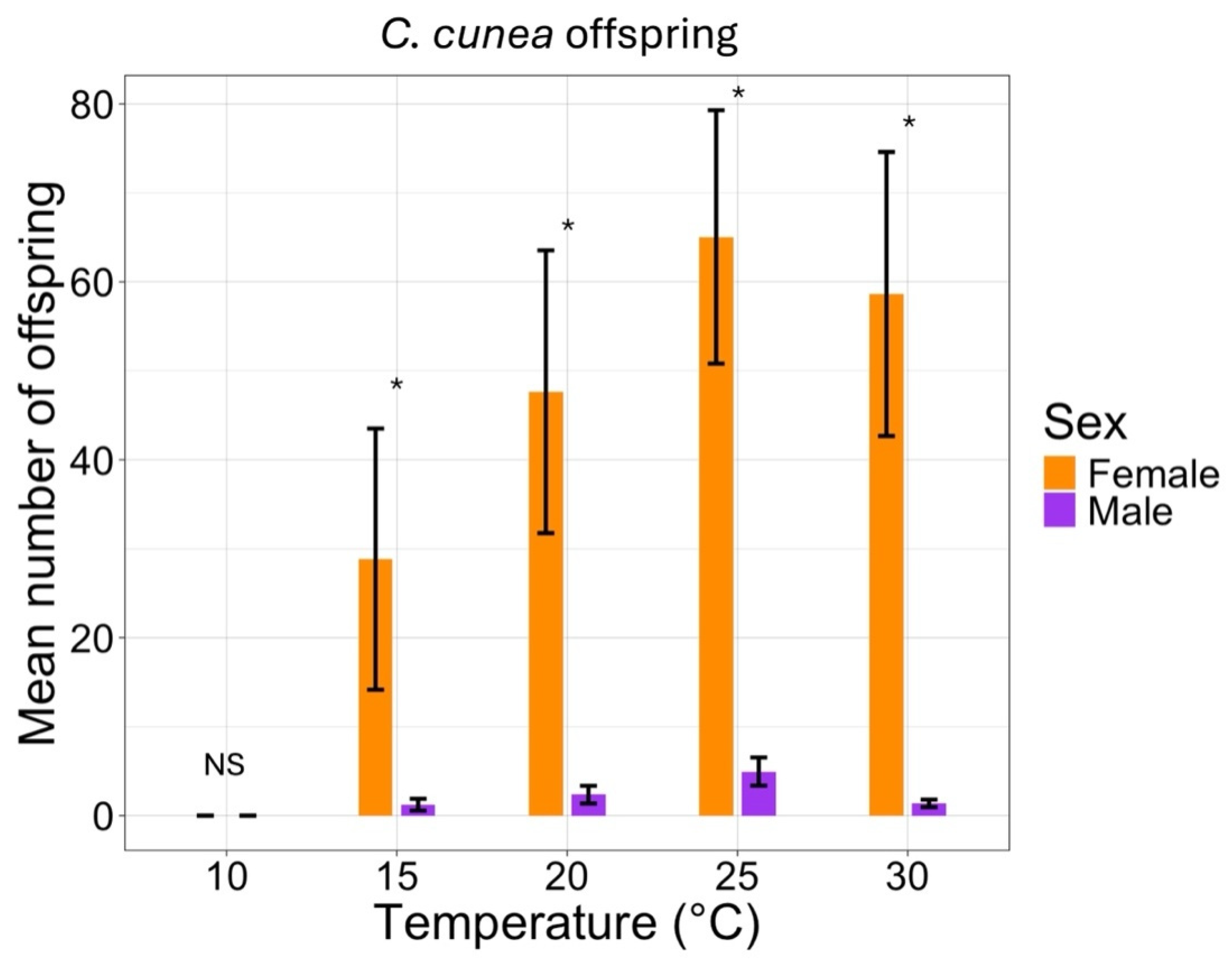
Abstract
The fall webworm is an injurious pest for many host plants in agriculture, forest, and urban environments. Recent observations showed that the faster spread of this pest can be supported by temperature increases, with a subsequent higher severity of the outbreaks and higher impact on the environment. Traditional chemical control is not effective on this pest, while biological control is a valuable alternative, especially if native natural enemies are used. In this study, the performance of Turkish populations of two parasitoids—Chouioia cunea and Psychophagus omnivorus—at different temperatures is evaluated. Laboratory trials were conducted in climatic chambers under five constant temperatures (10, 15, 20, 25, and 30 °C) and cold storage conditions (6 and 12 °C) for periods of 15, 30, and 45 days. The optimal developmental temperature and the upper thermal threshold of the two parasitoids were similar, while C. cunea showed a lower thermal threshold temperature. Both species could develop and survive between 20 and 30 °C, whereas development below 20 °C for C. cunea, and below 15 °C for P. omnivorus was not possible, respectively. Chouioia cunae was less tolerant to temperature changes than P. omnivorus in terms of offspring survival, development, reproduction, and parasitism. Under cold storage temperatures, the two species did not develop into adults. This study provided relevant eco-biological information that can further support biological control programmes.