
The Role of Henosepilachna vigintioctopunctata in Facilitating the Spread of Tomato Brown Rugose Fruit Virus (ToBRFV) Among Hosts

 , and
, and
Simple Summary
Abstract
1. Introduction
2. Materials and Methods
2.1. Plants and Insects
2.2. Virus Inoculation and Quantification
2.2.1. Mechanical Inoculation (Positive Control)
2.2.2. RNA Extraction and RT-qPCR
2.2.3. Quantification Method
2.3. Beetle-Mediated Transmission Assays
2.3.1. Virus Acquisition by Beetles
2.3.2. Transmission to Tomato (S. lycopersicum)
2.3.3. Temporal Dynamics of Infection
2.4. Transmission to Other Solanaceous Hosts
2.4.1. Non-Choice Assay
2.4.2. Free-Choice Cage Experiment
2.5. Analysis of Virus Retention and Localization
2.5.1. Retention of Infectivity
- (1)
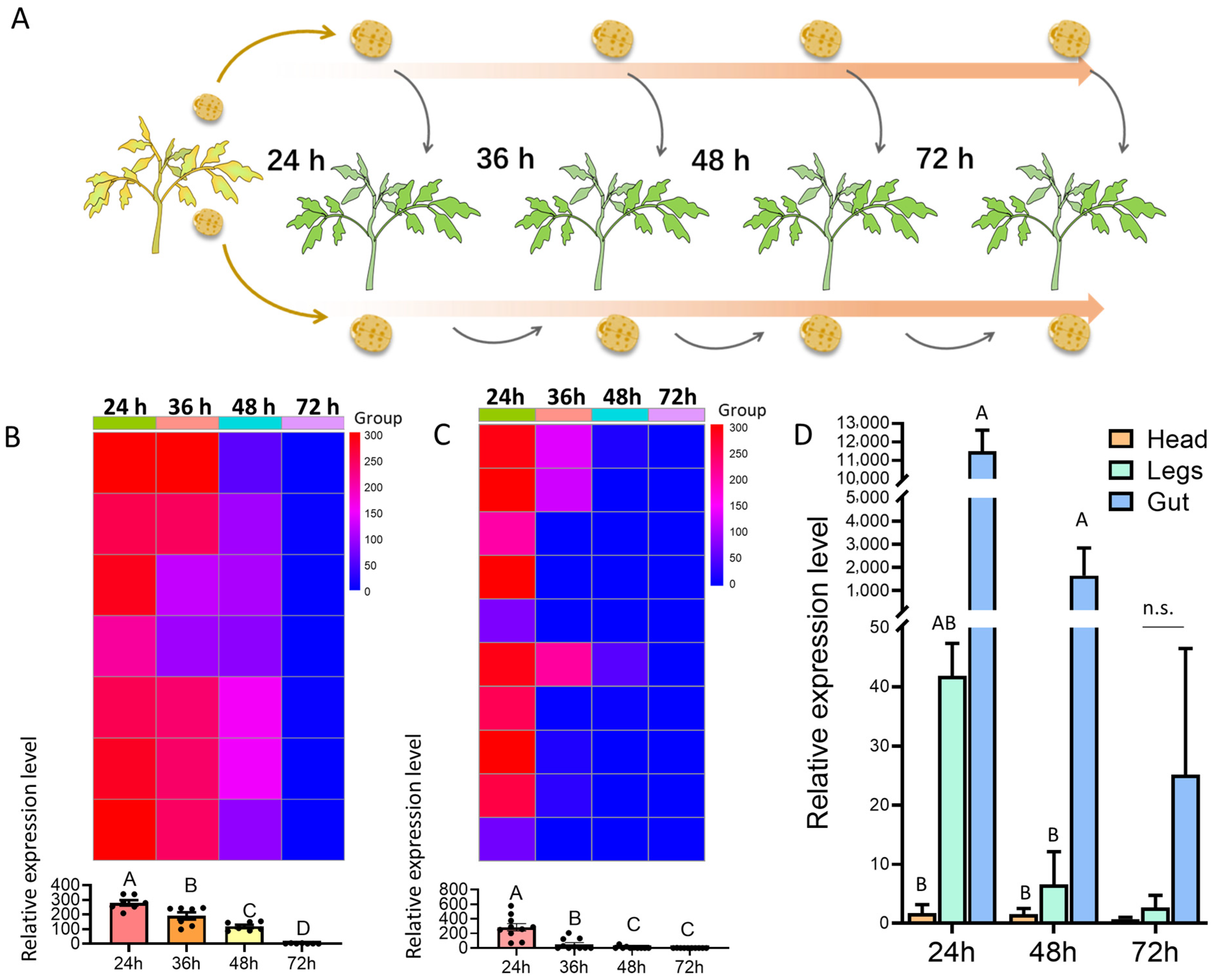
- Starved Beetles: Viruliferous beetles were held without food and transferred to a new healthy tomato plant at 24, 36, 48, and 72 h post-acquisition to feed (Figure 3A). Each time point had seven replicates.
- (2)
- Continuously Fed Beetles: Viruliferous beetles were serially transferred to a new healthy tomato plant every 12 h. Transmission to plants at 24, 36, 48, and 72 h post-initial acquisition was assessed. Each time point had ten replicates.
2.5.2. Viral Localization in Beetle Tissues
2.6. Role of Beetle Feeding Wounds and Transmission Ability of H. vigintioctopunctata Following Varying Degrees of Feeding
2.7. Statistical Analysis
3. Results
3.1. Verification of ToBRFV Transmission by H. vigintioctopunctata
3.1.1. Detection Results at 30 Days Post-Inoculation in S. lycopersicum
3.1.2. Continuous Monitoring at 3-Day Intervals Post-Inoculation
3.1.3. Transmission of ToBRFV Among Solanaceous Plants Facilitated by H. vigintioctopunctata
3.2. Cage Experiment: H. vigintioctopunctata-Facilitated Transmission of ToBRFV Among Different Solanaceous Plants
3.3. Analysis of Sustained Virus Transmission and Viral Localization in H. vigintioctopunctata
3.3.1. Sustained Transmission Capacity of ToBRFV by H. vigintioctopunctata
3.3.2. Viral Localization in Different Body Parts of H. vigintioctopunctata
3.4. Risk Assessment of Feeding Wounds Created by Virus-Free H. vigintioctopunctata
3.5. ToBRFV Transmission Ability of H. vigintioctopunctata Following Varying Degrees of Feedings
4. Discussion
5. Conclusions
Supplementary Materials
Author Contributions
Funding
Data Availability Statement
Acknowledgments
Conflicts of Interest
Abbreviations
| ToBRFV | Tomato brown rugose fruit virus |
| RT-qPCR | reverse transcription quantitative PCR |
References
- Caruso, A.G.; Bertacca, S.; Parrella, G.; Rizzo, R.; Davino, S.; Panno, S. Tomato brown rugose fruit virus: A pathogen that is changing the tomato production worldwide. Ann. Appl. Biol. 2022, 181, 258–274. [Google Scholar] [CrossRef]
- Jeyasankar, A.; Premalatha, S.; Elumalai, K. Antifeedant and insecticidal activities of selected plant extracts against Epilachna beetle, Henosepilachna vigintioctopunctata (Coleoptera: Coccinellidae). Adv. Entomol. 2014, 2, 14–19. [Google Scholar] [CrossRef]
- Zhang, Q.L.; Wang, F.; Guo, J.; Zhang, S.; Li, Y.; Xu, X. Characterization of ladybird Henosepilachna vigintioctopunctata transcriptomes across various life stages. Sci. Data 2018, 5, 180093. [Google Scholar] [CrossRef]
- Kawazu, K. Rearing the 28-spotted ladybird beetle, Henosepilachna vigintioctopunctata (Coleoptera: Coccinellidae), with a switchover from host plant leaves to artificial diet. Appl. Entomol. Zool. 2014, 49, 359–362. [Google Scholar] [CrossRef]
- Shinogi, T.; Hamanishi, Y.; Otsu, Y.; Wang, Y.Q.; Nonomura, T.; Matsuda, Y.; Mayama, S. Role of induced resistance in interactions of Epilachna vigintioctopunctata with host and non-host plant species. Plant Sci. 2005, 168, 1477–1485. [Google Scholar] [CrossRef]
- Huang, H.W.; Chi, H.; Smith, C.L. Linking demography and consumption of Henosepilachna vigintioctopunctata (Coleoptera: Coccinellidae) fed on Solanum photeinocarpum (Solanales: Solanaceae): With a new method to project the uncertainty of population growth and consumption. J. Econ. Entomol. 2018, 111, 1–9. [Google Scholar] [CrossRef] [PubMed]
- Luria, N.; Smith, E.; Reingold, V.; Bekelman, I.; Lapidot, M.; Levin, I.; Dombrovsky, A. A new Israeli tobamovirus isolate infects tomato plants harboring Tm-22 resistance genes. PLoS ONE 2017, 12, e0170429. [Google Scholar] [CrossRef] [PubMed]
- Salem, N.M.; Mansour, A.; Ciuffo, M.; Falk, B.W.; Turina, M. A new tobamovirus infecting tomato crops in Jordan. Arch. Virol. 2016, 161, 503–506. [Google Scholar] [CrossRef] [PubMed]
- Yan, Z.Y.; Ma, H.Y.; Han, S.L.; Geng, C.; Tian, Y.P.; Li, X.D. First report of Tomato brown rugose fruit virus infecting tomato in China. Plant Dis. 2019, 103, 2973. [Google Scholar] [CrossRef]
- Panno, S.; Caruso, A.G.; Davino, S. First report of Tomato brown rugose fruit virus on tomato crops in Italy. Plant Dis. 2019, 103, 1443. [Google Scholar] [CrossRef]
- Alfaro-Fernández, A.; Castillo, P.; Sanahuja, E.; Rodríguez-Salido, M.C.; Font, M.I. First report of Tomato brown rugose fruit virus in tomato in Spain. Plant Dis. 2021, 105, 515. [Google Scholar] [CrossRef]
- Panno, S.; Caruso, A.G.; Barone, S.; Lo Bosco, G.; Rangel, E.A.; Davino, S. Spread of Tomato brown rugose fruit virus in Sicily and evaluation of the spatiotemporal dispersion in experimental conditions. Agronomy 2020, 10, 834. [Google Scholar] [CrossRef]
- Zhang, S.; Griffiths, J.S.; Marchand, G.; Bernards, M.A.; Wang, A. Tomato brown rugose fruit virus: An emerging and rapidly spreading plant RNA virus that threatens tomato production worldwide. Mol. Plant Pathol. 2022, 23, 1262–1277. [Google Scholar] [CrossRef]
- Salem, N.M.; Abumuslem, M.; Turina, M.; Samarah, N.; Sulaiman, A.; Abu-Irmaileh, B.; Ata, Y. New weed hosts for Tomato brown rugose fruit virus in wild Mediterranean vegetation. Plants 2022, 11, 2287. [Google Scholar] [CrossRef]
- Davino, S.; Caruso, A.G.; Bertacca, S.; Barone, S.; Panno, S. Tomato brown rugose fruit virus: Seed transmission rate and efficacy of different seed disinfection treatments. Plants 2020, 9, 1615. [Google Scholar] [CrossRef] [PubMed]
- Wilstermann, A.; Ziebell, H. Tomato brown rugose fruit virus (ToBRFV). JKI Data Sheets—Plant Dis. Diagn. 2019, 4, 1–4. [Google Scholar]
- Gilbertson, R.L.; Batuman, O.; Webster, C.G.; Adkins, S. Role of the insect supervectors Bemisia tabaci and Frankliniella occidentalis in the emergence and global spread of plant viruses. Annu. Rev. Virol. 2015, 2, 67–93. [Google Scholar] [CrossRef] [PubMed]
- Levitzky, N.; Smith, E.; Lachman, O.; Luria, N.; Mizrahi, Y.; Bakelman, H.; Dombrovsky, A. The bumblebee Bombus terrestris carries a primary inoculum of Tomato brown rugose fruit virus contributing to disease spread in tomatoes. PLoS ONE 2019, 14, e0210871. [Google Scholar] [CrossRef]
- Andrea, G.C.; Simona, T.; Salvatore, D.; Bertacca, S.; Ragona, A.; Lo Verde, G.; Biondi, A.; Noris, E.; Rizzo, R.; Panno, S. The invasive tomato pest Tuta absoluta can transmit the emergent tomato brown rugose fruit virus. Entomol. Gen. 2024, 44, 289–296. [Google Scholar]
- Sobko, O.A.; Matsishina, N.V.; Fisenko, P.V.; Kim, I.V.; Didora, A.S.; Boginskay, N.G.; Volkov, D.I. Viruses in the agrobiocenosis of the potato fields. IOP Conf. Ser. Earth Environ. Sci. 2021, 677, 052093. [Google Scholar] [CrossRef]
- Alyokhin, A.; Gao, Y. Chapter 10—Potato ladybirds. In Insect Pests of Potato, 2nd ed.; Alyokhin, A., Rondon, S.I., Gao, Y., Eds.; Academic Press: Cambridge, MA, USA, 2022; pp. 189–198. [Google Scholar]
- Fidan, H.; Sarikaya, P.Z.; Yıldız, K.; Topkaya, B.; Erkis, G.; Calis, O. Robust molecular detection of the new Tomato brown rugose fruit virus in infected tomato and pepper plants from Turkey. J. Integr. Agric. 2021, 20, 2170–2179. [Google Scholar] [CrossRef]
- Wang, X.; Wang, B.; Jin, B.; Wang, W.; Zhu, X.; Liu, W.; Yang, L.; Wei, X. AmiRNA technology enhances tomato disease resistance by suppressing plant–pathogen interaction pathways through inhibiting TYLCV replication. J. Agric. Food Chem. 2024, 72, 26558–26571. [Google Scholar] [CrossRef]
- Xu, W.; Zhang, M.; Li, Y.; He, W.; Li, S.; Zhang, J. Complete protection from Henosepilachna vigintioctopunctata by expressing long double-stranded RNAs in potato plastids. J. Integr. Plant Biol. 2023, 65, 1003–1011. [Google Scholar] [CrossRef] [PubMed]
- Tang, D.; Chen, M.; Huang, X.; Zhang, G.; Zeng, L.; Zhang, G.; Wu, S.; Wang, Y. SRplot: A free online platform for data visualization and graphing. PLoS ONE 2023, 18, e0294236. [Google Scholar] [CrossRef] [PubMed]
- Ng, J.C.; Falk, B.W. Virus-vector interactions mediating nonpersistent and semipersistent transmission of plant viruses. Annu. Rev. Phytopathol. 2006, 44, 183–212. [Google Scholar] [CrossRef] [PubMed]
- Gergerich, R.C.; Scott, H.A.; Fulton, J.P. Regurgitant as a determinant of specificity in the transmission of plant viruses by beetles. Phytopathology 1983, 73, 936–938. [Google Scholar] [CrossRef]

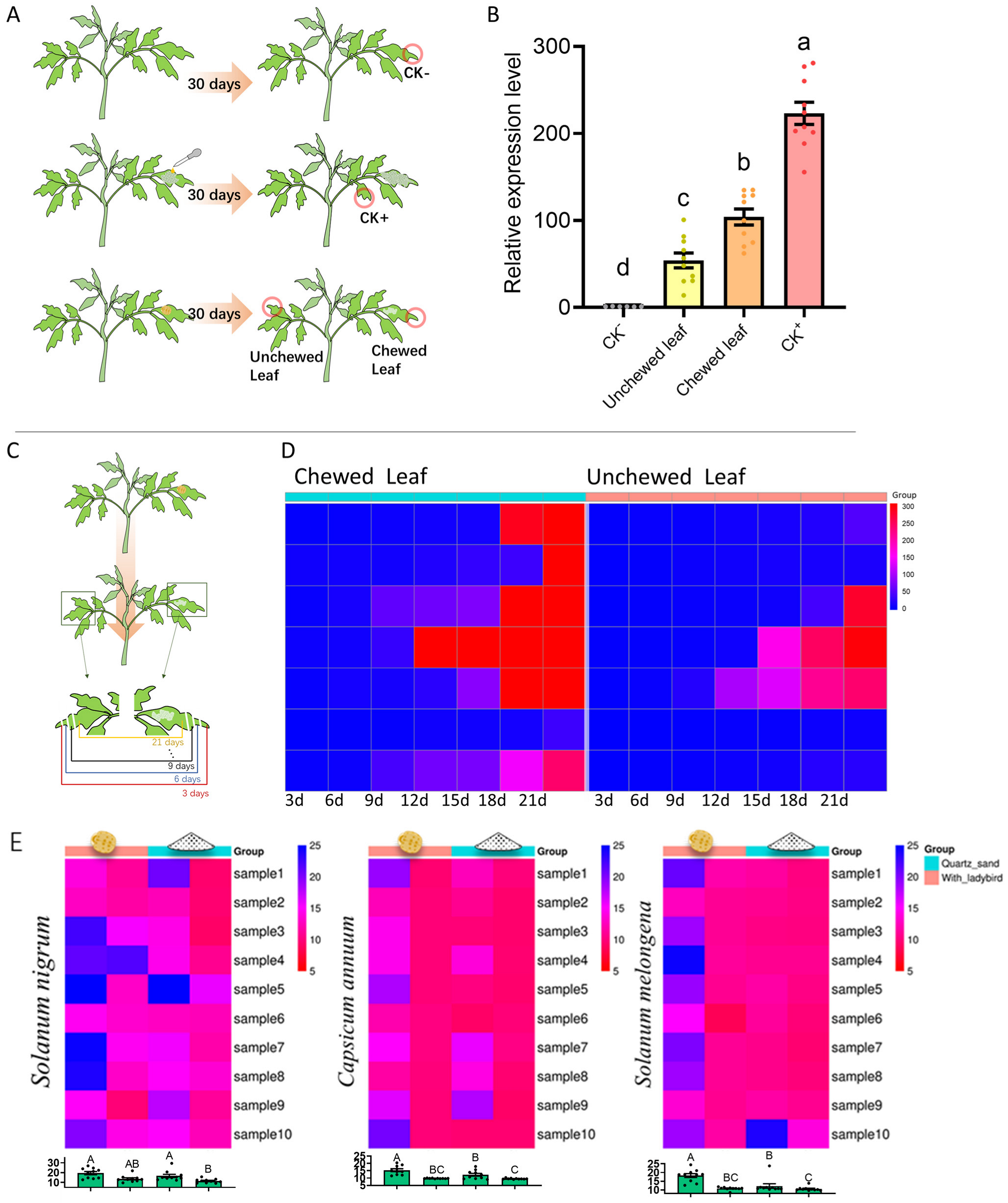
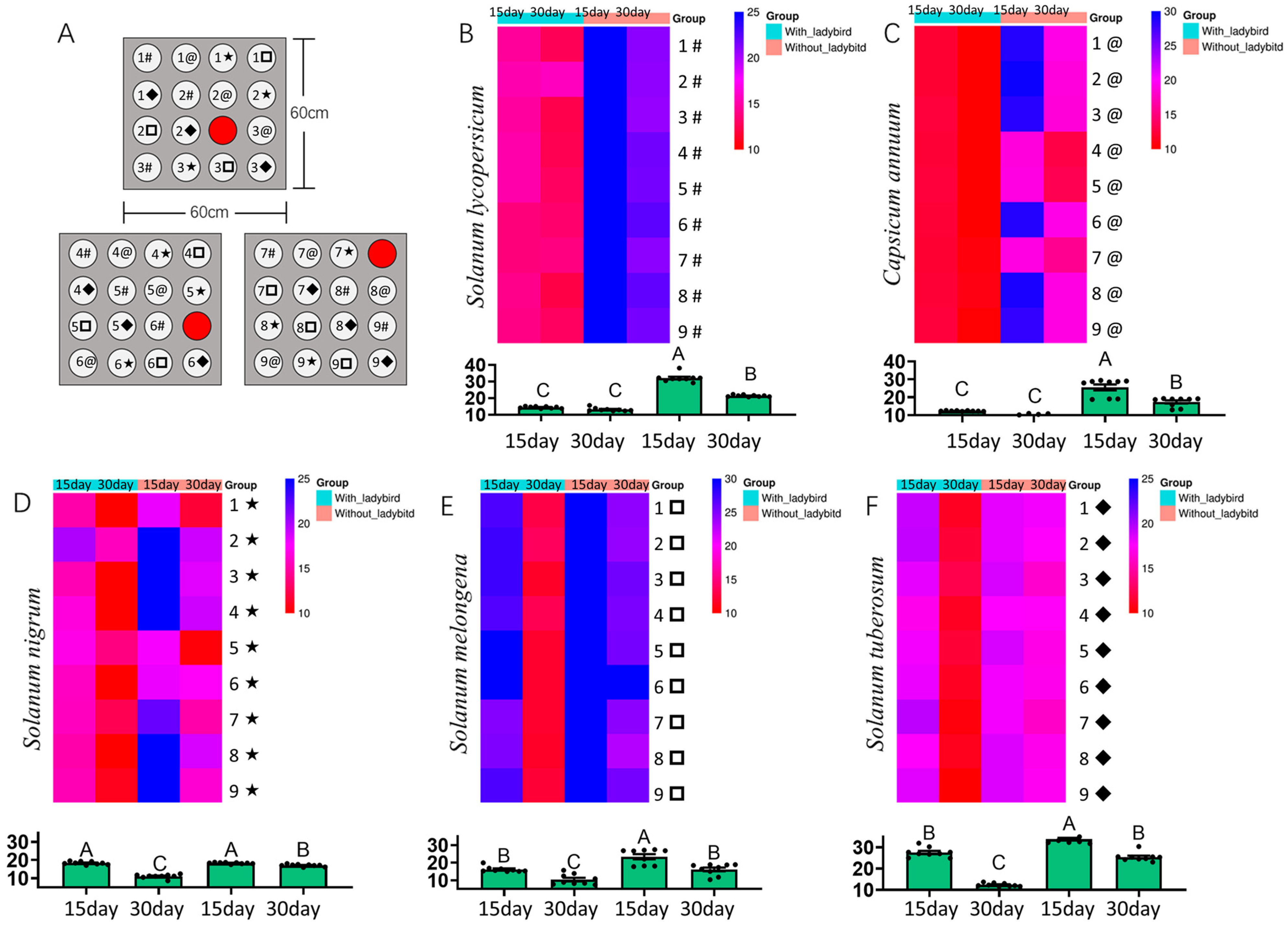
 for S. melongena; ◆ for S. tuberosum). Red circles indicate the ToBRFV-infected source plant, placed at different positions. White circles represent initially virus-free plants of five species. (B–F) Bar charts showing the virus load (RT-qPCR Ct values) in tomato (B), pepper (C), black nightshade (D), eggplant (E), and potato (F) at 15 and 30 dpi, with and without beetles. Lower Ct values indicate higher virus loads. Bars represent mean values ± SE. Different letters above bars indicate statistically significant differences (One-way ANOVA, Duncan’s test, p < 0.05). Note: Lower Ct values indicate higher viral loads.
for S. melongena; ◆ for S. tuberosum). Red circles indicate the ToBRFV-infected source plant, placed at different positions. White circles represent initially virus-free plants of five species. (B–F) Bar charts showing the virus load (RT-qPCR Ct values) in tomato (B), pepper (C), black nightshade (D), eggplant (E), and potato (F) at 15 and 30 dpi, with and without beetles. Lower Ct values indicate higher virus loads. Bars represent mean values ± SE. Different letters above bars indicate statistically significant differences (One-way ANOVA, Duncan’s test, p < 0.05). Note: Lower Ct values indicate higher viral loads.
for S. melongena; ◆ for S. tuberosum). Red circles indicate the ToBRFV-infected source plant, placed at different positions. White circles represent initially virus-free plants of five species. (B–F) Bar charts showing the virus load (RT-qPCR Ct values) in tomato (B), pepper (C), black nightshade (D), eggplant (E), and potato (F) at 15 and 30 dpi, with and without beetles. Lower Ct values indicate higher virus loads. Bars represent mean values ± SE. Different letters above bars indicate statistically significant differences (One-way ANOVA, Duncan’s test, p < 0.05). Note: Lower Ct values indicate higher viral loads.


Disclaimer/Publisher’s Note: The statements, opinions and data contained in all publications are solely those of the individual author(s) and contributor(s) and not of MDPI and/or the editor(s). MDPI and/or the editor(s) disclaim responsibility for any injury to people or property resulting from any ideas, methods, instructions or products referred to in the content. |
© 2025 by the authors. Licensee MDPI, Basel, Switzerland. This article is an open access article distributed under the terms and conditions of the Creative Commons Attribution (CC BY) license (https://creativecommons.org/licenses/by/4.0/).
Share and Cite
Wang, X.-X.; Xing, Q.-J.; Zhang, C.; Liu, Y.-N.; Liu, T.-X.; Zhang, Y. The Role of Henosepilachna vigintioctopunctata in Facilitating the Spread of Tomato Brown Rugose Fruit Virus (ToBRFV) Among Hosts. Insects 2025, 16, 1225. https://doi.org/10.3390/insects16121225
Wang X-X, Xing Q-J, Zhang C, Liu Y-N, Liu T-X, Zhang Y. The Role of Henosepilachna vigintioctopunctata in Facilitating the Spread of Tomato Brown Rugose Fruit Virus (ToBRFV) Among Hosts. Insects. 2025; 16(12):1225. https://doi.org/10.3390/insects16121225
Chicago/Turabian StyleWang, Xing-Xing, Qing-Jiang Xing, Chong Zhang, Ya-Nan Liu, Tong-Xian Liu, and Yi Zhang. 2025. "The Role of Henosepilachna vigintioctopunctata in Facilitating the Spread of Tomato Brown Rugose Fruit Virus (ToBRFV) Among Hosts" Insects 16, no. 12: 1225. https://doi.org/10.3390/insects16121225
APA StyleWang, X.-X., Xing, Q.-J., Zhang, C., Liu, Y.-N., Liu, T.-X., & Zhang, Y. (2025). The Role of Henosepilachna vigintioctopunctata in Facilitating the Spread of Tomato Brown Rugose Fruit Virus (ToBRFV) Among Hosts. Insects, 16(12), 1225. https://doi.org/10.3390/insects16121225