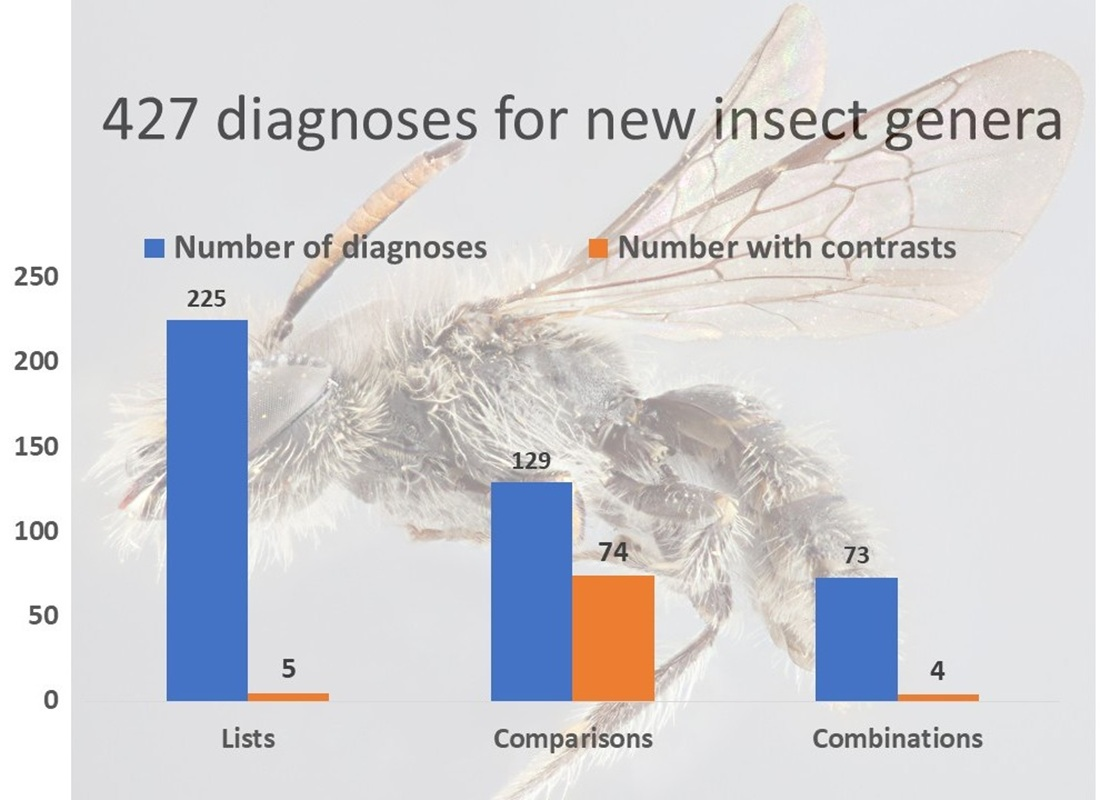
On the Importance of Contrasts in Taxonomic Diagnoses: A Survey of 405 Newly Described Insect Genera


Simple Summary
Abstract
1. Introduction
2. Materials and Methods
3. Results
4. Discussion
5. Conclusions
Funding
Institutional Review Board Statement
Data Availability Statement
Acknowledgments
Conflicts of Interest
References
- International Commission on Zoological Nomenclature (ICZN). International Code of Zoological Nomenclature, 4th ed.; International Trust for Zoological Nomenclature: London, UK, 1999. [Google Scholar]
- Rheindt, F.E.; Bouchard, P.; Pyle, R.L.; Welter-Schultes, F.; Aescht, E.; Ahyong, S.T.; Ballerio, A.; Bourgoin, T.; Ceríaco, L.M.; Dmitriev, D.; et al. Tightening the requirements for species diagnoses would help integrate DNA-based descriptions in taxonomic practice. PLoS Biol. 2023, 21, e3002251. [Google Scholar] [CrossRef]
- Packer, L. A survey of keys for the identification of newly described insect genera: Recommendations for authors, reviewers, editors, and publishers. ZooKeys 2024, 1215, 65–90. [Google Scholar] [CrossRef]
- Packer, L. Two simple ways to make taxonomic diagnoses more useful. Taxonomy 2025, 5, 43. [Google Scholar] [CrossRef]
- Volynkin, A.V.; Černý, K. Setteleia, a new genus for four new species from the Philippines (Insecta: Lepidoptera: Erebidae: Arctiinae). Zool. Stud. 2021, 60, e27. [Google Scholar] [CrossRef]
- Volynkin, A.V.; László, G.M. Siccasura, a new genus for the Afrasura numida (Holland, 1893) species-group, with descriptions of six new species (Lepidoptera: Erebidae: Arctiinae: Lithosiini). Ecol. Montenegrina 2021, 40, 1–25. [Google Scholar] [CrossRef]
- Walter, D.E.; Winterton, S. Keys and the crisis in taxonomy: Extinction or reinvention? Ann. Rev. Entomol. 2007, 52, 193–208. [Google Scholar] [CrossRef]
- Farris, J.S. Phylogenetic classification of fossils with recent species. Syst. Zool. 1976, 25, 271–282. [Google Scholar] [CrossRef]
- Goloboff, P.A. From Observations to Optimal Phylogenetic Trees: Phylogenetic Analysis of Morphological Data; CRC Press: Boca Raton, FL, USA; London, UK, 2022; Volume 1, pp. 1–277. [Google Scholar]
- Liu, Y.J.; Xu, J.Y.; He, Z.Q. Report of a new genus Majialandrevus, with a new species M. dingguo from Western Yunnan, China (Orthoptera: Gryllidae: Landrevinae). Zootaxa 2021, 4985, 137–141. [Google Scholar] [CrossRef] [PubMed]
- Skowron Volponi, M. Hidden jewels of Malaysia: Two new genera and species of remarkable clearwing moths (Lepidoptera: Sesiidae: Osminiini). Eur. Zool. J. 2021, 89, 579–589. [Google Scholar] [CrossRef]
- Benedek, B.; Volynkin, A.V.; Babics, J.; Saldaitis, A. Burmanyctycia, a new genus for a new species from north-western Myanmar with notes on closely related genera (Lepidoptera: Noctuidae: Noctuinae: Xylenini). Zootaxa 2021, 5061, 167–176. [Google Scholar] [CrossRef] [PubMed]
- Matson, T.A.; Ferguson, D.C. A new geometrid genus from the Southwestern United States (Lepidoptera: Geometridae). Proc. Entomol. Soc. Wash. 2021, 123, 350–359. [Google Scholar] [CrossRef]
- Gimmel, M.L.; Leschen, R.A. Revision of the genera of Picrotini (Coleoptera: Cryptophagidae: Cryptophaginae). Acta Entomol. Musei Natl. Pragae 2022, 62, 61–109. [Google Scholar] [CrossRef]
- Ardila-Camacho, A.; Rivera-Gasperín, S.L.; Martins, C.C.; Contreras-Ramos, A. A reappraisal of the taxonomy of Neotropical Sialidae (Insecta: Megaloptera): With the description of a new genus from Cuba. Eur. J. Taxon. 2021, 782, 21–54. [Google Scholar] [CrossRef]
- Arias, J.; Boom, A.; Wang, M.; Clitheroe, C.; Šobotník, J.; Stiblik, P.; Bourguignon, T.; Roisin, Y. Molecular phylogeny and historical biogeography of Apicotermitinae (Blattodea: Termitidae). Syst. Entomol. 2021, 46, 741–756. [Google Scholar] [CrossRef]
- Barr, C.B.; Shepard, W.D. A review of the Larainae of Australia with description of seven new species and the new genus Australara (Coleoptera, Byrrhoidea, Elmidae). ZooKeys 2021, 1073, 55–117. [Google Scholar] [CrossRef]
- Belles, X. A synopsis of the spider beetles (Coleoptera: Ptinidae) of Socotra, with the description of a new genus and two new species. Zool. Middle East 2021, 67, 133–143. [Google Scholar] [CrossRef]
- Bolotov, I.N.; Kolosova, Y.S.; Chapurina, Y.E.; Spitsyna, E.A.; Spitsyn, V.M. A new genus and species of planthopper from Seychelles endemic palm forest (Hemiptera: Fulgoromorpha: Derbidae). J. Nat. Hist. 2021, 55, 1311–1321. [Google Scholar] [CrossRef]
- Brown, B.V. Two new genera of phorid flies, Macgrathphora and Aurisetiphora, from Costa Rica (Diptera: Phoridae), with recommendations for naming new genera in the family. Zootaxa 2022, 5115, 571–581. [Google Scholar] [CrossRef]
- Chatzimanolis, S. Out of Xanthopygus (Coleoptera: Staphylinidae): Escape from polyphyly. ZooKeys 2021, 1071, 83–107. [Google Scholar] [CrossRef]
- Çıplak, B.; Yahyaoğlu, Ö.; Uluar, O. Revisiting Pholidopterini (Orthoptera, Tettigoniidae): Rapid radiation causes homoplasy and phylogenetic instability. Zool. Scr. 2021, 50, 225–240. [Google Scholar] [CrossRef]
- Ćurčić, S.; Pavićević, D.; Vesović, N.; Vrbica, M.; Kuraica, M.; Marković, Đ.; Petković, M.; Lazović, V.; Pantelić, D.; Bosco, F. On the diversity of subterranean beetles of the Dinarides: New leiodid taxa (Coleoptera: Leiodidae) from Serbia. Eur. J. Taxon. 2021, 782, 55–81. [Google Scholar] [CrossRef]
- Deranja, M.; Kasalo, N.; Adžić, K.; Franjević, D.; Skejo, J. Lepocranus and Valalyllum gen. nov. (Orthoptera, Tetrigidae, Cladonotinae), endangered Malagasy dead-leaf-like grasshoppers. ZooKeys 2022, 1109, 1–15. [Google Scholar] [CrossRef]
- Dorchin, N.; van Munster, S.; Klak, C.; Bowie, R.C.K.; Coville, J.F. Hidden diversity—A new speciose gall midge genus (Diptera: Cecidomyiidae) associated with succulent karoo in South Africa. Insects 2022, 13, 75. [Google Scholar] [CrossRef]
- Emeljanov, A.F. A new genus and two new species of the family Kinnaridae (Cicadina) from India and Iran. Entomol. Rev. 2021, 101, 224–231. [Google Scholar] [CrossRef]
- Engel, M.S.; Nguyen, L.T.P.; Tran, N.T.; Truong, T.A.; Motta, A.F.H. A new genus of minute stingless bees from Southeast Asia (Hymenoptera, Apidae). ZooKeys 2022, 1089, 53–72. [Google Scholar] [CrossRef]
- Fateryga, A.V. Two new Nearctic genera in the tribe Odynerini s. str. revealed on the bionomics and morphology, with a comment on the cocoons of the eumenine wasps (Hymenoptera: Vespidae: Eumeninae). Far East. Entomol. 2021, 427, 1–19. [Google Scholar] [CrossRef]
- García, K.; Botero, J.P.; Santos-Silva, A. A new genus of Achrysonini and new records in Cerambycidae (Coleoptera, Chrysomeloidea) from Colombia. Eur. J. Taxon. 2021, 735, 89–109. [Google Scholar] [CrossRef]
- Ghirotto, V.M.; Crispino, E.B.; Engelking, P.W.; Neves, P.A.B.A.; De Góis, J.; Chiquetto-Machado, P.I. Arumatia, a new genus of Diapheromerinae stick insects (Insecta, Phasmatodea) from Brazil, with description of five new species and reassessment of species misplaced in Australian genera. Eur. J. Taxon. 2022, 827, 1–85. [Google Scholar] [CrossRef]
- Grebennikov, V.V. Phylogenetic placement of a new paleoendemic pill scarab from the Udzungwa Mountains, Tanzania, triggers biogeographic interpretations (Coleoptera: Hybosoridae: Ceratocanthinae). Frag. Entomol. 2021, 53, 283–298. [Google Scholar] [CrossRef]
- Haran, J.; Benoit, L.; Procheş, Ş.; Kergoat, G.J. Ebenacobius Haran, a new southern African genus of flower weevils (Coleoptera: Curculioninae: Derelomini) associated with dicotyledonous plants. Eur. J. Taxon. 2022, 818, 1–54. [Google Scholar] [CrossRef]
- Hugel, S.; Desutter-Grandcolas, L. New intertidal crickets from Comoros and Mascarene islands (Orthoptera: Trigonidiidae: Nemobiinae: Burcini). Zootaxa 2021, 4995, 1–26. [Google Scholar] [CrossRef] [PubMed]
- Ingrisch, S. Revision of the genera Habetia Kirby, 1906 and Parahebetia gen. nov. from New Guinea (Orthoptera, Tettigoniidae, Conocephalinae, Agraeciii). Zootaxa 2021, 5020, 201–256. [Google Scholar] [CrossRef]
- Johansson, N. Contribution to the subfamily Ophioninae (Hymenoptera: Ichneumonidae) of Southern Europe with the description of one new genus and 15 new species. Zootaxa 2021, 5023, 301–334. [Google Scholar] [CrossRef]
- Lin, M.-Y.; Ge, S.-Q. Tsounkranaglenea hefferni get et sp. nov. from Sabah, Malaysia (Coleoptera, Cerambycidae, LamiinaeL Saperdini). Zootaxa 2021, 5048, 289–297. [Google Scholar] [CrossRef]
- López-Pérez, S.; Zaragoza-Caballero, S. Two new genera of Telegeusidae (Coleoptera) from Mexico. Rev. Mex. Biodiv. 2021, 92, e923613. [Google Scholar] [CrossRef]
- Lu, X.-Y.; Deng, W.-A. New genus and new species of the subfamily Metrodorinae from China (Orthoptera: Tetrigidae). Zootaxa 2021, 4964, 345–362. [Google Scholar] [CrossRef]
- Martinez, J.I.; Schmidt, B.C.; Miller, J.Y. A new Andean genus, Lafontaineana, with descriptions of four new species and two new Neotropical species of Panthea (Noctuidae, Pantheinae). ZooKeys 2021, 1028, 113–134. [Google Scholar] [CrossRef]
- Medianero, E.; Nicholls, J.A.; Stone, G.N.; Nieves-Aldrey, J.L. A new genus of Neotropical oak gall wasp, Prokius Nieves-Aldrey, Medianero & Nicholls, gen. nov. (Hymenoptera: Cynipidae: Cynipini), with description of two new species from Panama. Zootaxa 2021, 5081, 203–222. [Google Scholar] [CrossRef]
- Mondragón-F, S.P.; Morales, I.; Moreira, F.F. Telmatometropsis fredyi gen. nov, sp. nov.: A new water strider from the Colombian Pacific region (Insecta, Hemiptera, Gerridae). ZooKeys 2021, 1043, 87–102. [Google Scholar] [CrossRef] [PubMed]
- Nakahara, S.; Rodríguez-Melgarejo, M.; Kleckner, K.; Corahua-Espinoza, T.; Tejeira, R.; Espeland, M.; Casagrande, M.M.; Barbosa, E.P.; See, J.; Gallice, G.; et al. Systematic revision of a new butterfly genus, Cisandina Nakahara & Espeland, n. gen, with descriptions of three new taxa (Lepidoptera: Nymphalidae: Satyrinae). Insect Syst. Divers. 2022, 6, 2. [Google Scholar] [CrossRef]
- Namaki-Khameneh, R.; Khaghaninia, S.; Disney, R.H.L.; Maleki-Ravasan, N. The scuttle flies (Diptera: Phoridae) of Iran with the description of Mahabadphora aesthesphora as a new genus and species. PLoS ONE 2021, 16, e0257899. [Google Scholar] [CrossRef] [PubMed]
- Novák, V. New genera of Alleculinae (Coleoptera: Tenebrionidae: Alleculinae: Alleculini) from the Oriental Region. Part XI-Vietnalia gen. nov. Zootaxa 2021, 4920, 439–444. [Google Scholar] [CrossRef] [PubMed]
- Núñez-Bazán, R.; Estrada-Álvarez, J.C.; Osorio-Beristain, M. Earwigs (Dermaptera: Insecta) of Morelos, Mexico, with new data and description of a new genus and species. Biologia 2022, 77, 1305–1316. [Google Scholar] [CrossRef]
- Parizotto, D.R.; Melo, G.A.R. The bee subtribe Epanthidiina, a new taxon for the Neotropical clade of Anthidiini (Hymenoptera, Apidae, Megachilinae). Rev. Bras. Entomol. 2022, 66, e20220006. [Google Scholar] [CrossRef]
- Park, K.T.; Koo, J.M. A new genus Viperinus Park with descriptions of two new species, and two new species of the genus Protolychnis Meyrick, 1925 (Lepidoptera, Gelechioidea, Lecithoceridae) in Kenya and Tanzania, with a checklist of the world species. Zootaxa 2021, 4985, 359–370. [Google Scholar] [CrossRef]
- Park, K.T.; Koo, J.M. Description of Spiniola hanaro Park, gen. and sp. nov, and three new species of Torodora Meyrick, 1894 (Lepidoptera, Lecithoceridae, Torodorinae) from the Afrotropical Region. Zootaxa 2022, 5092, 576–586. [Google Scholar] [CrossRef]
- Pham, T.H.; Lee, Y.J. A new genus and species of the subtribe Leptopsaltriina (Hemiptera: Cicadidae: Leptopsaltriini) from Vietnam, with a key to the genera of Leptopsaltriina. J. Asia-Pac. Entomol. 2021, 24, 1202–1205. [Google Scholar] [CrossRef]
- Polak, S.; Mulaomerović, J. Rudogorites simonei gen. nov. and sp. nov. from Central Bosnia (Coleoptera: Leiodidae: Cholevinae: Leptodirini). Zootaxa 2021, 5061, 545–558. [Google Scholar] [CrossRef]
- Polizei, T.T.S.; Costa, L.D.S.M.; da Conceição Bispo, P. Spanglerelmis, a new genus of Elmidae (Insecta: Coleoptera) from Brazil with new species and biological notes. Eur. J. Taxon. 2022, 813, 33–56. [Google Scholar] [CrossRef]
- Prathapan, K.D.; Konstantinov, A.S. Revision of Oriental flea beetle genera with subparallel intercoxal ridges on the first abdominal ventrite (Coleoptera, Chrysomelidae, Galerucinae, Alticini). J. Nat. Hist. 2021, 55, 1521–1598. [Google Scholar] [CrossRef]
- Ranjith, A.P.; Samartsev, K.G.; Nasser, M. Discovery of the chelonine tribe Adeliini Viereck, 1918 (Hymenoptera: Braconidae) from the Indian subcontinent with the description of a new genus from south India. Zootaxa 2021, 4926, 1–25. [Google Scholar] [CrossRef]
- Roca-Cusachs, M.; Rider, D.A.; Jung, S. New genus and species of Pentatomidae from Borneo (Hemiptera: Heteroptera). Zootaxa 2021, 4958, 560–569. [Google Scholar] [CrossRef] [PubMed]
- Sanborn, A.F. The cicadas (Hemiptera: Cicadoidea: Cicadidae) of Madagascar including a new tribe, five new genera, twelve new species, four new species synonymies, five revised species status, ten new combinations, new tribal assignments for four genera, one new subtribe synonymy, a checklist and key to the species. Zootaxa 2021, 4937, 1–79. [Google Scholar] [CrossRef] [PubMed]
- Scheffrahn, R.H.; Roisin, Y.; Akama, P.D.; Šobotnik, J. Ebogotermes raphaeli, new genus and new species, an African soldierless termite described from the worker caste (Isoptera, Termitidae, Apicotermitinae). Zootaxa 2021, 5067, 279–284. [Google Scholar] [CrossRef]
- Schwarz, C.J. Three new praying mantises from Panay Island, Philippines (Insecta: Mantodea). Integr. Syst. 2021, 3, 35–56. [Google Scholar] [CrossRef]
- Setliff, G.; Pancini, L.; Bramanti, A. Review of Eudyasmus, with descriptions of a new species from Waigeo Island, Indonesia, and a closely related new genus (Coleoptera: Curculionidae, Molytinae, Eudyasmini). Frag. Entomol. 2021, 53, 377–390. [Google Scholar] [CrossRef]
- Sharkey, M.J.; Janzen, D.H.; Hallwachs, W.; Chapman, E.G.; Smith, M.A.; Dapkey, T.; Brown, A.; Ratnasingham, S.; Naik, S.; Manjunath, R.; et al. Minimalist revision and description of 403 new species in 11 subfamilies of Costa Rican braconid parasitoid wasps, including host records for 219 species. ZooKeys 2021, 1013, 1–665. [Google Scholar] [CrossRef] [PubMed]
- Silva Júnior, J.O.; Haseyama, K.L.; Souza, D.D.S. Phylogenetic approach redefines Plistonax (Coleoptera, Cerambycidae, Lamiinae) with new combinations and a new genus of flat-faced long-horned beetles. Org. Divers. Evol. 2021, 21, 491–520. [Google Scholar] [CrossRef]
- Souma, J.; Kamitani, S. Taxonomic review of the lace bug genus Omoplax (Hemiptera: Heteroptera: Tingidae) endemic to “Oriental Galapagos” (the Ogasawara Islands, Japan) with the description of its new allied genus and species. Entomol. Sci. 2021, 24, 3–11. [Google Scholar] [CrossRef]
- Świerczewski, D.; Stroiński, A. Selizitapia gen. nov. (Hemiptera: Fulgoromorpha: Flatidae) from tapia woodlands of Madagascar. Eur. J. Taxon. 2021, 750, 124–139. [Google Scholar] [CrossRef]
- Świerczewski, D.; Bourgoin, T.; Stroiński, A. Makaya gen. nov. (Hemiptera: Fulgoromorpha: Flatidae) from dry forests in western Madagascar. Pol. J. Entomol. 2021, 90, 194–208. [Google Scholar] [CrossRef]
- Talavera, G.; Lukhtanov, V.; Pierce, N.E.; Vila, R. DNA barcodes combined with multilocus data of representative taxa can generate reliable higher-level phylogenies. Syst. Biol. 2022, 71, 382–395. [Google Scholar] [CrossRef]
- Tan, M.K.; Robillard, T. Rugabinthus, a new genus of Lebinthina (Orthoptera, Gryllidae, Eneopterinae) from New Guinea. J. Orthoptera Res. 2022, 31, 9–40. [Google Scholar] [CrossRef]
- Tan, M.K.; Malem, J.; Legendre, F.; Dong, J.; Baroga-Barbecho, J.B.; Yap, S.A.; Wahab, R.B.H.A.; Japir, R.; Chung, A.Y.; Robillard, T. Phylogeny, systematics and evolution of calling songs of the Lebinthini crickets (Orthoptera, Grylloidea, Eneopterinae), with description of two new genera. Syst. Entomol. 2021, 46, 1060–1087. [Google Scholar] [CrossRef]
- Tavares, G.C.; de Mello, F.D.A.G.; de Mello Mendes, D.M. A new genus and three new species of Agraeciini (Orthoptera: Tettigoniidae: Conocephalinae) from the Brazilian Atlantic Forest, with comments on the function of some phallic components. Zootaxa 2021, 5057, 201–227. [Google Scholar] [CrossRef]
- Vargas, H.A. Systematics of Helioandesia tarregai gen. et sp. nov. (Lepidoptera: Yponomeutoidea: Heliodinidae) from the Andes of Northern Chile. Eur. J. Taxon. 2021, 731, 117–134. [Google Scholar] [CrossRef]
- Vega-Badillo, V.; Cancino-López, R.J.; Martins, C.C.; Contreras-Ramos, A. A remarkable new genus and species of wedge-shaped beetle from Volcán Tacaná, Mexico (Coleoptera: Ripiphoridae: Ripidiinae). Biologia 2022, 77, 479–488. [Google Scholar] [CrossRef]
- Velez-Bravo, A.; Daza, J.M. Molecular systematics and genital morphology of the Neotropical cockroaches from the genus Xestoblatta (Blattellidae). Zootaxa 2021, 5057, 301–328. [Google Scholar] [CrossRef]
- Viidalepp, J.; Kostjuk, I. Taxonomic notes on two endemic geometrine genera from Middle Asia (Lepidoptera: Geometridae, Geometrinae). Zootaxa 2021, 5052, 137–144. [Google Scholar] [CrossRef]
- Viswajyothi, K.; Clark, S.M. A new genus to accommodate Central and South American beetles with broadly explanate elytra, formerly assigned to Monocesta Clark and Coelomera Chevrolat (Coleoptera: Chrysomelidae: Galerucinae: Galerucini). Coleopt. Bull. 2021, 75, 473–484. [Google Scholar] [CrossRef]
- Viswayjothi, K.; Clark, S.M. New World genera of Galerucinae Latreille, 1802 (tribes Galerucini Latreille, 1802, Metacyclini Chapuis, 1875, and Luperini Gistel, 1848): An annotated list and identification ey (Coleoptera: Chrysomelidae). Eur. J. Taxon. 2022, 842, 1–102. [Google Scholar] [CrossRef]
- Volynkin, A.V. Juxtilema, a new genus for a new species from Zambia (Lepidoptera: Erebidae: Arctiinae: Lithosiini). Bonn Zool. Bull. 2021, 70, 377–382. [Google Scholar] [CrossRef]
- Volynkin, A.V.; László, G.M. Kruegerilema, a new genus for a new species endemic to São Tomé Island (Lepidoptera: Erebidae: Arctiinae: Lithosiini). Bonn Zool. Bull. 2021, 70, 333–338. [Google Scholar] [CrossRef]
- Wanke, D.; Feizpour, S.; Hausmann, A.; Viidalepp, J.; Rajaei, H. Taxonomy and systematics of the enigmatic emerald moth Xenochlorodes graminaria (Kollar, 1850) (Lepidoptera: Geometridae), and its assignment to a new genus. Int. Syst. 2022, 5, 61–71. [Google Scholar] [CrossRef]
- Wood, T.J.; Patiny, S.; Bossert, S. An unexpected new genus of panurgine bees (Hymenoptera, Andrenidae) from Europe discovered after phylogenomic analysis. J. Hymenopt. Res. 2022, 89, 183–210. [Google Scholar] [CrossRef]
- Yan, Y.C.; Yan, W.L.; Deng, T.J.; Wei, M.C. Asicimbex Yan, Deng & Wei, a new genus with eight new species and four new combinations (Hymenoptera, Cimbicidae). J. Hymenopt. Res. 2022, 91, 265–308. [Google Scholar] [CrossRef]
- Braby, M.F.; Hsu, Y.-F.; Lamas, G. How to describe a new species in zoology and avoid mistakes. Zool. J. Linn. Soc. 2024, 202, 1–16. [Google Scholar] [CrossRef]
- Favret, C. The 5 ‘D’s of taxonomy: A user’s guide. Quart. Rev. Biol. 2024, 99, 131–156. [Google Scholar] [CrossRef]
- Borkent, A. Diagnosing diagnoses-Can we improve our taxonomy? ZooKeys 2021, 1071, 43–48. [Google Scholar] [CrossRef]
- Witzel, C. Misconceptions about colour categories. Rev. Philos. Psychol. 2019, 10, 499–540. [Google Scholar] [CrossRef]

| Reference | # Contrasts | ||||
|---|---|---|---|---|---|
| Paper a | Genus | Order | Family | Group d | /# Features |
| [15] | Caribesialis | Megaloptera | Sialidae | family | 4/4 |
| [16] | Apolemotermes | Blattodea | Termitidae | subfamily * | 7/7 |
| [16] | Koutabatermes | Blattodea | Termitidae | subfamily * | 4/4 |
| [17] | Australara | Coleoptera | Elmidae | subfamily * | 7/7 |
| [18] | Soqotranus | Coleoptera | Ptinidae | family | 7/7 |
| [12] | Burmanyctycia | Lepidoptera | Noctuidae | genus grp | 11/11 |
| [19] | Salaziella | Hemiptera | Derbidae | tribe | 2/4 |
| [20] | Aurisetiphora | Diptera | Phoridae | subfamily | 2/4 |
| [21] | Photinopygus | Coleoptera | Staphylinidae | subtribe | 12/12 |
| [22] | Spinopholidoptera | Orthoptera | Tettigoniidae | tribe | 16/16 |
| [23] | Bozidaria | Coleoptera | Leiodidae | genus grp | 15/15 |
| [24] | Valallylum | Orthoptera | Tetrigidae | tribe | 7/22 |
| [24] | Valallylum | Orthoptera | Tetrigidae | tribe | 7/7 |
| [25] | Ruschiola | Diptera | Cecidomyiidae | tribe * | 2/2 |
| [26] | Ptorthus | Hemiptera | Kinnaridae | genus grp ? | 1/5 |
| [27] | Ebaiotrigona e | Hymenoptera | Apidae | tribe * | 12/12 |
| [28] | Parkerodynerus | Hymenoptera | Vespidae | genus grp | 1/5 |
| [28] | Bohartodynerus | Hymenoptera | Vespidae | genus grp | 7/7 |
| [29] | Ysachron | Coleoptera | Cerambycidae | tribe | 5/5 |
| [30] | Arumatia | Phasmatodea | Diapheromeridae | subfamily | 2/12 |
| [14] | Papuacryptus | Coleoptera | Cryptophagidae | tribe | 1/4 |
| [31] | Balleriodes | Coleoptera | Hybosoridae | subfamily | 1/4 |
| [32] | Ebenacobius | Coleoptera | Curculionidae | tribe * | 1/5 |
| [33] | Makalapobius | Orthoptera | Trigonidiidae | genus grp | 11/11 |
| [33] | Gabusibius | Orthoptera | Trigonidiidae | genus grp | 11/11 |
| [34] | Parahabetia | Orthoptera | Tettigoniidae | tribe | 9/17 |
| [35] | Nyxia | Hymenoptera | Ichneumonidae | subfamily * | 2/5 |
| [36] | Tsounkranaglenea | Coleoptera | Cerambycidae | tribe | 2/6 |
| [10] | Majialandrevus | Orthoptera | Gryllidae | genus grp ? | 1/2 |
| [37] | Platydrilus | Coleoptera | Telegeusidae | family | 8/8 |
| [37] | Stenodrilus | Coleoptera | Telegeusidae | family | 8/8 |
| [38] | Concavetettix | Orthoptera | Tetrigidae | genus grp | 7/7 |
| [39] | Lafontaineana | Lepidoptera | Noctuidae | one genus | 6/8 |
| [13] | Knudsonia | Lepidoptera | Geometridae | tribe | 2/4 |
| [40] | Prokius | Hymenoptera | Cynipidae | tribe | 3/4 |
| [41] | Telmatometropsis | Hemiptera | Gerridae | subfamily * | 7/8 |
| [42] | Cisandina | Lepidoptera | Nymphalidae | genus grp | 6/6 |
| [43] | Mahabadphora | Diptera | Phoridae | subfamily | 1/4 |
| [44] | Vietnalia | Coleoptera | Tenebrionidae | subfamily | 7/7 |
| [45] | Dubianus | Dermaptera | Forficulidae | order * | 2/2 |
| [46] | Urbanthidium | Hymenoptera | Megachilidae c | subtribe | 3/5 |
| [47] | Viperinus | Lepidoptera | Lecithoceridae | one genus | 1/3 |
| [48] | Spiniola | Lepidoptera | Lecithoceridae | genus grp | 2/2 |
| [49] | Vietanna | Hemiptera | Cicadidae | subtribe | 6/6 |
| [50] | Rudogorites | Coleoptera | Leiodidae | genus grp | 1/7 |
| [51] | Spanglerelmis | Coleoptera | Elmidae | family | 6/6 |
| [52] | Sahyadrialtica | Coleoptera | Chrysomelidae | genus grp | 4/4 |
| [53] | Carinadelius | Hymenoptera | Braconidae | tribe | 8/8 |
| [54] | Graziasternum | Hemiptera | Pentatomidae | 1 genus | 7/7 |
| [55] | Nelbroma | Hemiptera | Cicadidae | tribe | 4/4 |
| [56] | Ebogotermes | Blattodea b | Termitidae | subfamily * | 2/2 |
| [57] | Compsogusa | Mantodea | Gonypetidae | one genus | 2/4 |
| [58] | Protrachyasmus | Coleoptera | Curculionidae | one genus | 14/14 |
| [59] | Michener | Hymenoptera | Braconidae | subfamily | 4/4 |
| [60] | Miguelmonneus | Coleoptera | Cerambycidae | genus grp ? | 1/8 |
| [11] | Scarlata | Lepidoptera | Sesiidae | genus grp | 2/6 |
| [11] | Malayomelitta | Lepidoptera | Sesiidae | genus grp | 3/8 |
| [61] | Acanthamoplax | Hemiptera | Tingidae | family | 7/7 |
| [62] | Selizitapia | Hemiptera | Flatidae | tribe * | 5/5 |
| [63] | Makaya | Hemiptera | Flatidae | tribe | 5/5 |
| [64] | Birabiro | Lepidoptera | Lycaenidae | genus grp | 1/3 |
| [65] | Rugabinthus | Orthoptera | Gryllidae | subtribe | 4/8 |
| [66] | Fadinthus | Orthoptera | Gryllidae | subtribe | 2/9 |
| [66] | Falcerminthus | Orthoptera | Gryllidae | subtribe | 3/10 |
| [67] | Warimiri | Orthoptera | Tettigoniidae | genus grp ? | 3/3 |
| [68] | Helioandesia | Lepidoptera | Heliodinidae | family | 6/6 |
| [69] | Zaragozapirhidius | Coleoptera | Ripiphoridae | subfamily | 3/3 |
| [70] | Sinatablatta | Blattodea | Blatellidae | one genus | 1/1 |
| [70] | Antroxestoblatta | Blattodea | Blatellidae | genus grp | 2/2 |
| [71] | Ratsa | Lepidoptera | Geometridae | two genera | 3/11 |
| [72] | Platycesta | Coleoptera | Chrysomelidae | genus grp | 3/3 |
| [73] | Pyesexora | Coleoptera | Chrysomelidae | tribe | 1/1 |
| [73] | Yingaburxia | Coleoptera | Chrysomelidae | <tribe | 1/1 |
| [74] | Juxtilema | Lepidoptera | Erebidae | subfamily | 17/18 |
| [5] | Setteleia | Lepidoptera | Erebidae | genus grp | 12/12 |
| [5] | Setteleia | Lepidoptera | Erebidae | two genera | 2/2 |
| [6] | Siccasura | Lepidoptera | Erebidae | species grp | 3/3 |
| [6] | Siccasura | Lepidoptera | Erebidae | genus | 3/3 |
| [6] | Siccasura | Lepidoptera | Erebidae | genus grp | 6/6 |
| [75] | Kruegerilema | Lepidoptera | Erebidae | one genus | 8/8 |
| [76] | Sabzia | Lepidoptera | Geometridae | two genera | 12/13 |
| [77] | Halopanurgus | Hymenoptera | Andrenidae | genus grp | 8/8 |
| [78] | Asicimbex | Hymenoptera | Cimbicidae | subfamily | 15/15 |
Disclaimer/Publisher’s Note: The statements, opinions and data contained in all publications are solely those of the individual author(s) and contributor(s) and not of MDPI and/or the editor(s). MDPI and/or the editor(s) disclaim responsibility for any injury to people or property resulting from any ideas, methods, instructions or products referred to in the content. |
© 2025 by the author. Licensee MDPI, Basel, Switzerland. This article is an open access article distributed under the terms and conditions of the Creative Commons Attribution (CC BY) license (https://creativecommons.org/licenses/by/4.0/).
Share and Cite
Packer, L. On the Importance of Contrasts in Taxonomic Diagnoses: A Survey of 405 Newly Described Insect Genera. Insects 2025, 16, 1224. https://doi.org/10.3390/insects16121224
Packer L. On the Importance of Contrasts in Taxonomic Diagnoses: A Survey of 405 Newly Described Insect Genera. Insects. 2025; 16(12):1224. https://doi.org/10.3390/insects16121224
Chicago/Turabian StylePacker, Laurence. 2025. "On the Importance of Contrasts in Taxonomic Diagnoses: A Survey of 405 Newly Described Insect Genera" Insects 16, no. 12: 1224. https://doi.org/10.3390/insects16121224
APA StylePacker, L. (2025). On the Importance of Contrasts in Taxonomic Diagnoses: A Survey of 405 Newly Described Insect Genera. Insects, 16(12), 1224. https://doi.org/10.3390/insects16121224