
Article

Development of Sarcophaga princeps Wiedemann (Diptera: Sarcophagidae) Under Constant Temperature and Its Implication in Forensic Entomology

1
Characteristic Laboratory of Forensic Science in the Universities of Shandong Province, Shandong University of Political Science and Law, Jinan 250014, China
2
Hebei Key Laboratory of Forensic Medicine, Shijiazhuang 050017, China
3
Department of Anatomy, Shihezi University School of Medicine, Shihezi 832003, China
4
Department of Forensic Medicine, Soochow University, Suzhou 215000, China
*
Authors to whom correspondence should be addressed.
Insects 2025, 16(11), 1153; https://doi.org/10.3390/insects16111153
Submission received: 14 October 2025 / Revised: 4 November 2025 / Accepted: 9 November 2025 / Published: 11 November 2025
(This article belongs to the Section Insect Physiology, Reproduction and Development)

Simple Summary

Sarcophagidae are often the first insects to arrive and larviposit at corpses. They are forensically important insect species for estimating minimum postmortem intervals (PMImin). Sarcophaga princeps Wiedemann (Diptera: Sarcophagidae) is an important species of sarcosaprophagous insects which colonizes buried and indoor bodies. This study was conducted to provide developmental data of S. princeps for PMImin estimation. The development of S. princeps from larvae to adults was studied at constant temperatures ranging from 16 to 34 °C. Developmental times decrease from 1090.00 ± 57.65 to 313.67 ± 5.69 h as temperatures increase. Developmental models were constructed that can be used to estimate the age of this species. In addition, the lower critical thermal threshold (TL), intrinsic optimum temperature (TΦ), and upper critical thermal threshold (TH) were estimated at 11.11 °C, 21.85 °C, and 35.88 °C using the Optim SSI model. This study provides baseline data for postmortem PMImin in forensic entomology.

Abstract

Sarcophagidae are often the first sarcosaprophagous insects to colonize corpses in specialized cases such as indoor discoveries and burials, making them forensically crucial for estimating the minimum postmortem interval (PMImin). Among these, Sarcophaga princeps Wiedemann (Diptera: Sarcophagidae) is a prominent species frequently associated with both buried and indoor bodies. In this study, the development time of S. princeps from larvae to adults at constant temperatures of 16, 19, 22, 25, 28, 31, and 34 °C was studied, and the times required were 1090.00 ± 57.65, 721.00 ± 8.72, 562.33 ± 27.21, 416.67 ± 27.70, 356.33 ± 16.01, 327.00 ± 7.94, and 313.67 ± 5.69 h, respectively, demonstrating a significant inverse relationship with temperature. Various developmental models were constructed using the basic developmental data, including the isomorphen diagram, isomegalen diagram, nonlinear thermodynamic Optim SSI model, and logistic regression model. These models enable the estimation of the developmental age of the specimens. In addition, the lower critical thermal threshold (TL), intrinsic optimum temperature (TΦ), and upper critical thermal threshold (TH) estimated by the nonlinear thermodynamic Optim SSI model were 11.11 °C, 21.85 °C, and 35.88 °C. This study provides comprehensive developmental data of S. princeps for PMImin estimation.

1. Introduction

Accurate estimation of postmortem interval (PMI) is of particular importance for forensic investigations [1,2]. The development time of the offspring of sarcosaprophagous insects represents the minimum time since death. Estimating this minimum postmortem interval (PMImin) in forensic entomology depends on precise developmental data of sarcosaprophagous insects [3]. Consequently, the growth and development patterns of insects collected from corpses are a focal point of forensic entomological research [4,5].
Flesh flies (Diptera: Sarcophagidae) are among the first insects to arrive at a corpse, being similar to blow flies (Diptera: Calliphoridae) [6,7,8]. Sarcophagids exhibit an ovoviviparous reproductive strategy, which may enable their offspring to develop more rapidly compared to the more extensively studied calliphorid species [9]. Sarcophagid larvae are generally larger than calliphorid larvae of the same age, a characteristic that facilitates their collection at crime scenes [6]. Recent studies suggest that sarcophagids may be the PMImin indicator insect at crime scenes [10,11], especially for corpses that are in indoor and burial environments [12]. However, there are few studies on Sarcophagidae development, which limits the application of Sarcophagidae in PMImin estimation [6,13].
Sarcophaga princeps Wiedemann, 1830 (syn. Seniorwhitea reciproca Walker, 1856), is distributed across the Oriental region and portions of the Palearctic region [14,15,16]. It is commonly found on dead fish, animals, and other decaying organic matter [14,15],. and can colonize decomposing bodies [17,18]. This species was the dominant species found on carcasses in our buried carcass experiments (unpublished data). This dominance is likely because the larvae are directly larviposited by this species and can reach carcasses buried beneath the soil via crawling, whereas other species (e.g., Chrysomya megacephala) are prevented from colonizing the carcasses due to soil isolation [19]. Burial is one of the most common means by which criminals conceal evidence, and the developmental pattern of insects on buried bodies is important evidence for estimating the time of burial [20,21,22]. However, in practical case applications, it is necessary to consider whether insect colonization has preceded burial.
Sinaha [14] studied the life history and larval development patterns of this species on the coastal fish Panna microdon (Bleeker), including the mating mode, mating time, larval production time, and larval production quantity of this species, and described the morphology of larvae at different developmental stages. Currently, the studies on S. princeps have primarily focused on its molecular identification and the systematic classification [23,24]. However, there are a lack of systematic developmental studies of this species under constant temperatures in laboratory-controlled conditions, resulting in a lack of basic data for PMImin estimation based on this species.
In this study, we investigated the development of S. princeps under seven constant temperatures (16–34 °C) in the laboratory, analyzing parameters such as developmental duration, larval body length, and pupal characteristics (such as pupal length, pupal width, and pupal weight), and establishing various developmental models at the above temperature. This study aims to provide foundational data for estimating PMImin using S. princeps by establishing and studying laboratory populations collected from buried bodies, with a particular focus on buried remains.

2. Materials and Methods

2.1. Laboratory Population Establishment

This colony of S. princeps originated from a field experiment designed to study succession on carcasses buried 30 cm deep. Thirty rabbit carcasses were used in the study on succession of buried bodies in Suzhou City, Yangtze River Delta, during autumn of 2022. The protocols for the animal studies were approved by the Animal Protection and Use Committee and were conducted in accordance with the Soochow University regulations on animal experiments (ECSU-20190000109). Larvae of S. princeps were first detected on the fifth day post-burial, returned to the laboratory and were placed in a Petri dish (12 cm diameter) with 20 g of pork slices. The Petri dish was then placed in a rearing box with 2 cm of wet soil at the bottom. The rearing box was then placed into a microenvironment incubator (LHP-300H, Yingmin Co., Ltd., Changzhou, China) set at 28 °C to rear the larvae, with humidity at 70%, and photoperiod L12:D12. Pork was regularly replenished until pupariation was observed. After eclosion, the adults were placed in 90 × 90 × 90 cm rearing cages equipped with a 1:1 ratio of powdered milk and sugar for nourishment, and moistened sponges with fresh water for drinking. Fresh pork was provided in the rearing cages for protein supplementation after 5 days. The larvae were reared as described above. After five generations, experiments were started when the adult population reached 2000. The flies were identified via morphological methods [15,16] and supplemented with molecular identification using the COI gene. The corresponding gene sequence was submitted to GenBank (Accession Number: OQ860090).

2.2. Observation of Developmental Duration and Measurement of Larval Body Length

The developmental duration and larval length measurement experiments were conducted under laboratory conditions of 16, 19, 22, 25, 28, 31 and 34 °C, respectively. Twenty grams of fresh pork was placed in a Petri dish, which was then placed in an insect cage to trap adult flies for larviposition. Larviposition was monitored, and all larvae deposited within a 3 h window were collected and used for the experiment. The 25, 28, 31 and 34 °C experiments required that the number of larvae be more than 300, and 22, 19, and 16 °C experiments required that the number of larvae be more than 500. The time larvae were placed in the incubator was designated as point 0 for larval sampling, i.e., the 1st sampling. Thereafter, samples were taken at 4 h intervals until pupariation. Five larvae were collected from each sampling time point, and placed in hot water at 90 °C for 30 s then stored in 80% ethanol. The instar was identified using Zeiss 2000-C stereomicroscope (ZEISS, Oberkochen, Germany). The time of wandering, pupariation, and eclosion was recorded every 4 h throughout the experiment. The body lengths were measured with a digital vernier caliper (Sangon, Shanghai, China). Experiments were repeated three times at each temperature.

2.3. Measurement of Pupal Length, Pupal Width, and Pupal Weight

The same method as described in Section 2.2 was used to obtain larvae. Larvae (>200) collected within a 2 h window were reared as described above until wandering. Observations were then made 2 h until the pupae were formed and collected. If >50 pupae were collected in 2 h, twenty pupae were selected for weight, body width, and body length measurements. Pupal weight was measured with an electronic balance (FA1204N, Xingyun, Changzhou, China) with an accuracy of 0.0001 g. Pupal body length and width were measured with a digital vernier caliper (Sangon, Shanghai, China) with an accuracy of 0.01 mm. The above experiments were repeated three times at each temperature.

2.4. Data Analysis

A scatter diagram was utilized to establish an isomorphen diagram based on the mean value and standard deviation of the time required for five developmental events at seven constant temperatures, with the time from larviposition (h) on the X-axis and temperature (°C) on the Y-axis. An isomegalen diagram of S. princeps was plotted using development time as the X-axis, development temperature as the Y-axis, and body length change as the Z-axis. The above data analysis was conducted using Origin 2023. Python 3.9 was utilized to simulate the relationship between larval body length (mm) and time post-larviposition (h) using a modified logistic equation by Gao et al. [25] to generate a function for estimating PMImin.
Thermobiological parameters for each developmental stage of S. princeps were evaluated using the nonlinear thermodynamic model (Optim SSI), which was previously proposed by Ikemoto and Kiritani [26]. The SSI model is expressed as follows:
r ( T ) = ρ T T e x p [ Δ H A R ( 1 T 1 T ) ] 1 + e x p [ Δ H L R ( 1 T L 1 T ) ] + e x p [ Δ H H R ( 1 T H 1 T ) ]
where r is the Mean development rate (1/day); T is the Absolute temperature (K) (273.15 K = 0 °C); R is a Gas constant (1.987 cal/deg/mol); ΔHA is the Enthalpy of activation of the reaction that is catalyzed by the enzyme (cal/mol); ΔHL is the Change in enthalpy associated with low temperature inactivation of the enzyme (cal/mol); ΔHH is the Change in enthalpy associated with high-temperature inactivation of the enzyme (cal/mol); TL is the Temperature at which the enzyme is active at 50% because of low temperature (K); TH is the Temperature at which the enzyme is 50% active because of high temperature (K); TΦ is the Intrinsic optimum temperature at which the probability of the enzyme being in the active state is maximal (K); ρΦ is the Development rate at the intrinsic optimum temperature TΦ (1/day) assuming no enzyme inactivation.
The above data analysis was conducted using Origin 2023 and R 4.3.0 (https://www.r-project.org/). Box plots of pupal weight, and 2Ys box plots of pupal body length and width were plotted using Origin 2023.

3. Results

3.1. Developmental Duration and Isomorphen Diagram

Sarcophaga princeps developed from larvae to adult in the laboratory at a constant temperature of 16–34 °C. The duration of each developmental event gradually decreased with increasing temperature. The total developmental time ranged from 1090.00 h at 16 °C to 313.67 h at 34 °C (Table 1). An isomorphen diagram was generated, showing different developmental events as different lines (Figure 1). Notably, the temperature and developmental time of S. princeps showed a negative correlation in all five developmental events. The intra-puparial period was longer than that of blowflies, accounting for 67.52–72.81% of the total developmental duration. By determining the on-site temperature (Y-axis) and the developmental stage of the flies, one can estimate the developmental time for that specific stage (X-axis).

3.2. Nonlinear Thermodynamic Optim SSI Model

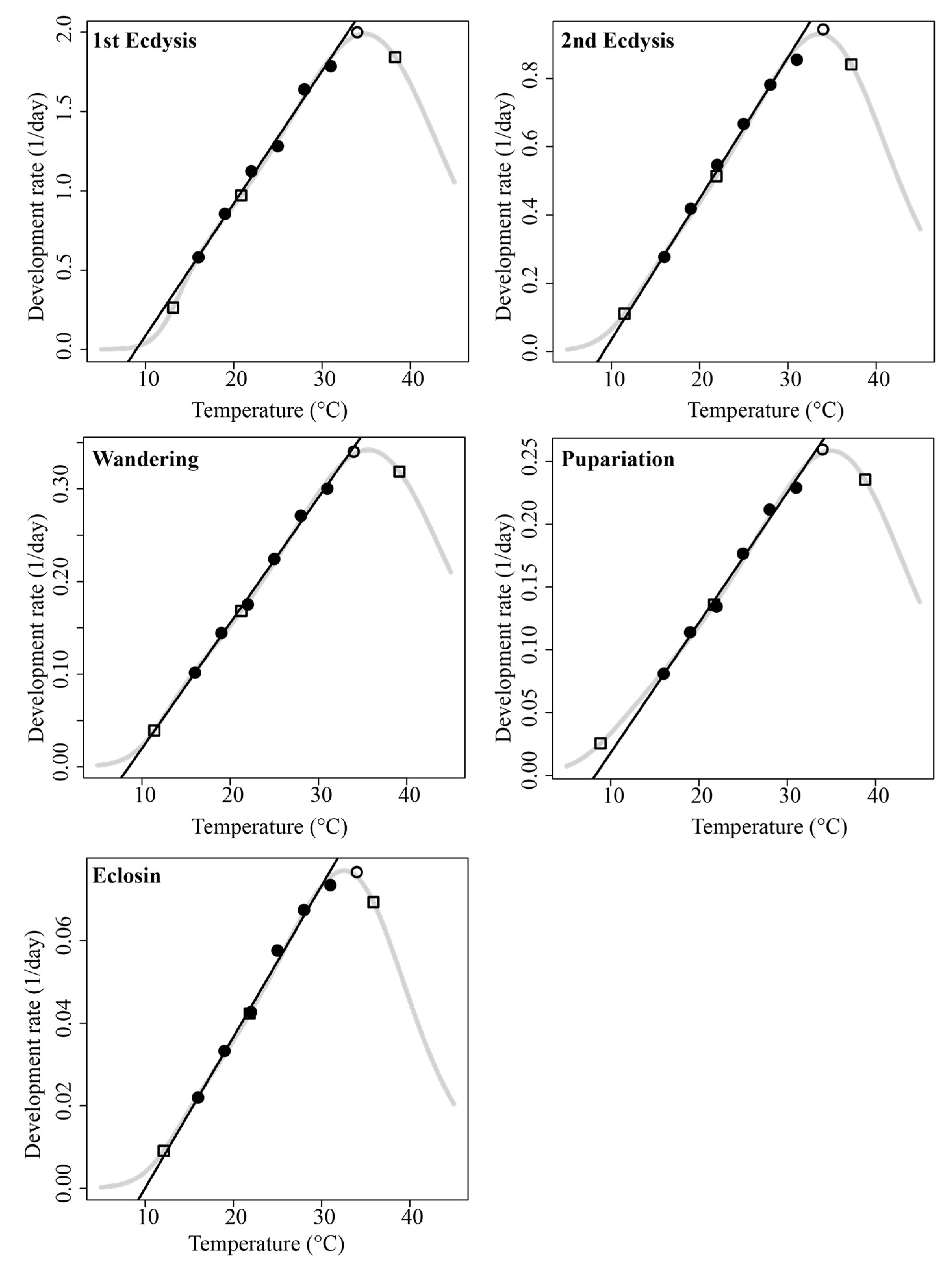
The nonlinear accumulated temperature model (Optim SSI) describing the relationship between the developmental rate of S. princeps and temperature across the seven experimental temperatures is shown in Figure 2. The figure shows that the developmental rate at 34 °C deviates from the linear fit, indicating that the nonlinear model provides a better fit and improves the accuracy of thermal response predictions. The thermodynamic parameters for each developmental event are shown in Table 2. The R2 of each model is greater than 0.99, which indicated that the model simulation effect was better. Among the estimated parameters, three are of particular relevance to forensic entomology. The intrinsic optimum temperature (TΦ) varied little across different developmental stages, whereas the lower (TL) and upper (TH) critical thermal thresholds showed greater variation. These differences are likely attributable to varying adaptive capacities of the insects at different life stages.

3.3. Larval Body Length Variation and Isomegalen Diagram

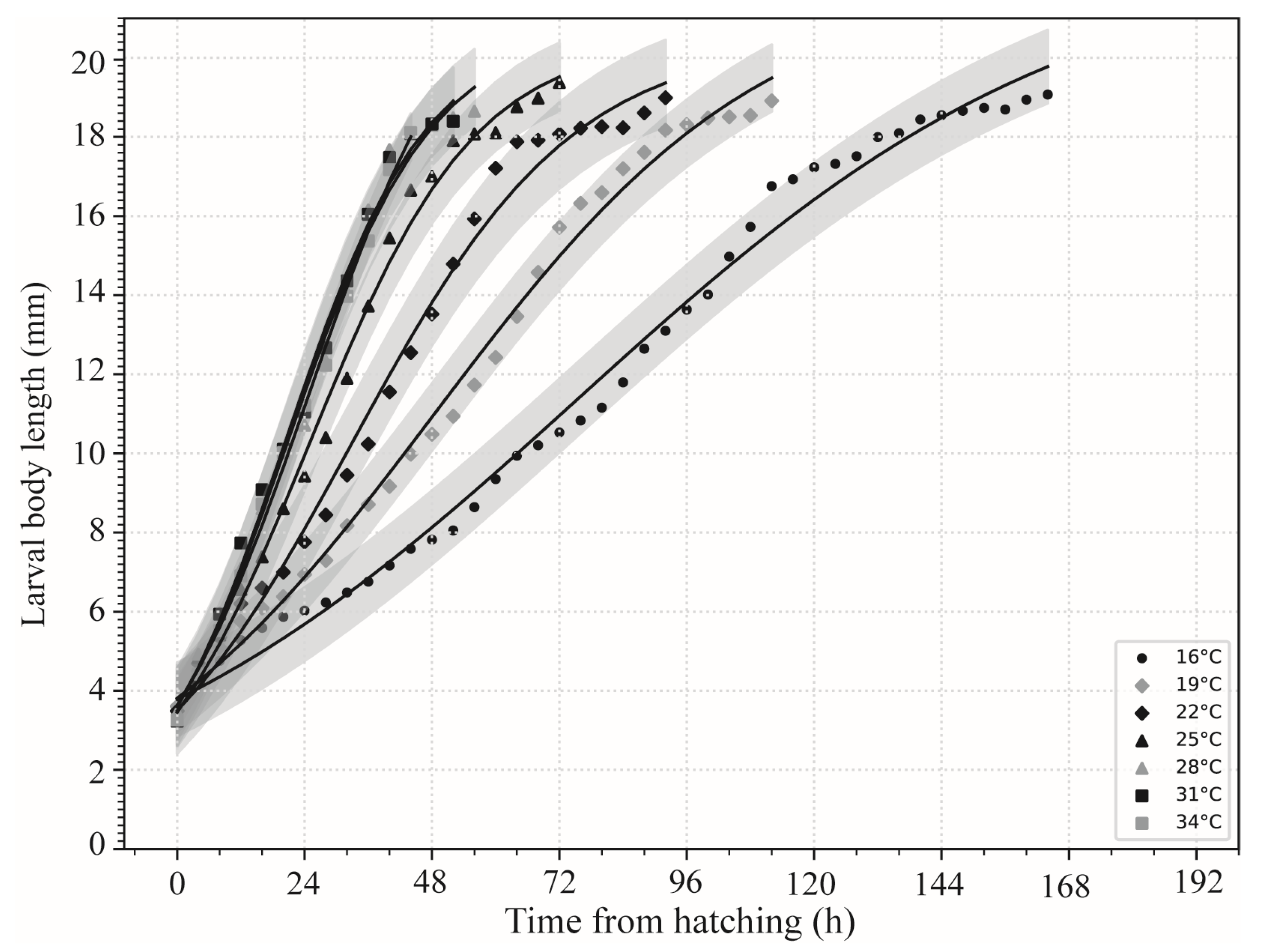
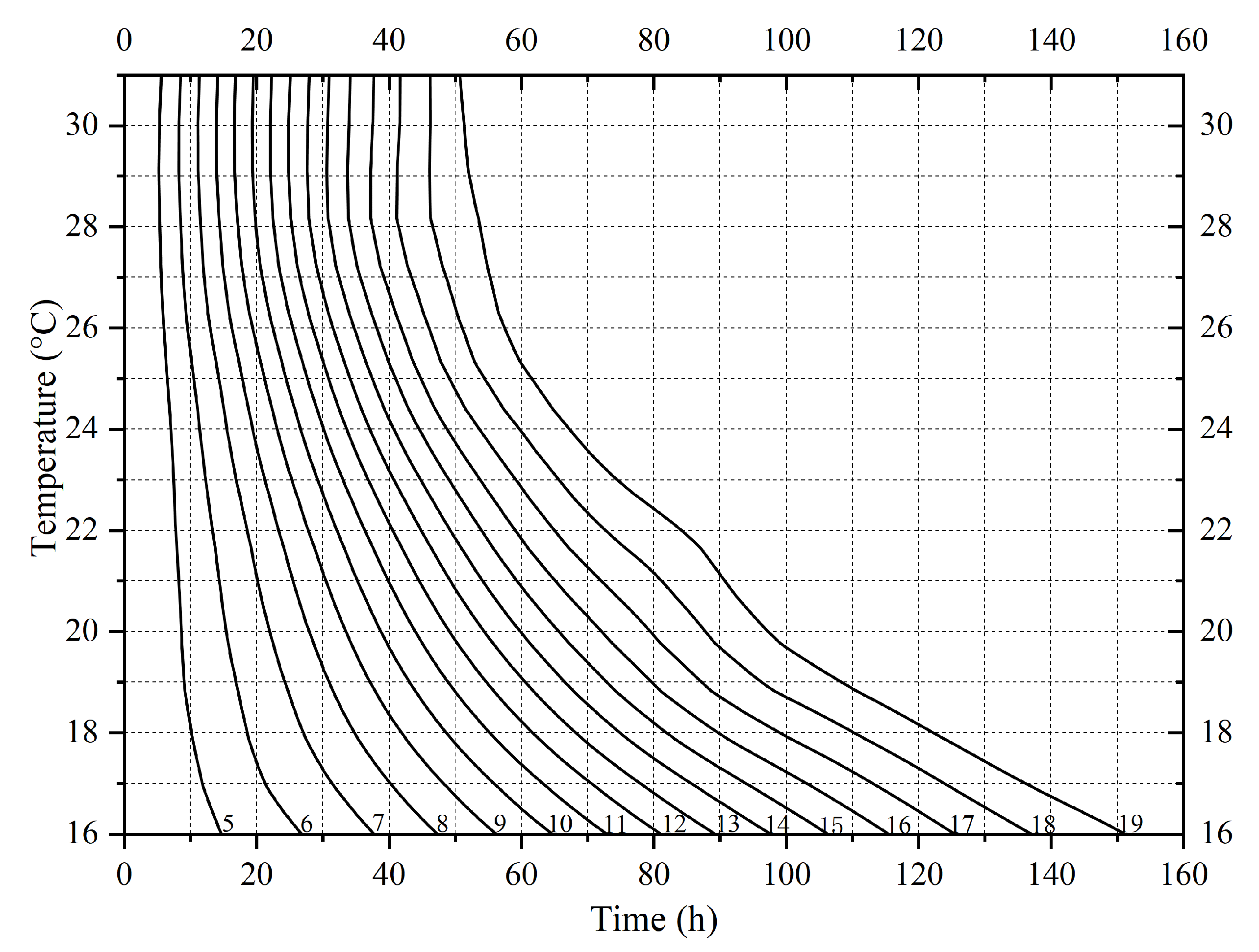
The variation in larval body length of S. princeps over time at different constant temperatures is shown in Figure 3. Overall, the growth in larval body length followed a sigmoidal (“S”-shaped) pattern. Within the temperature range of 16–34 °C, the larval development rate increased with temperature. The logistic equations for the relationship between larval body length change and time since larviposition are shown in Table 3. The isomegalen diagram of S. princeps is shown in Figure 4. Numbers on the curves represent larval body lengths, with the lengths starting from 5 mm and increasing in 1 mm increments up to a maximum average of 19 mm.

3.4. Pupal Weight, Pupal Length and Pupal Width at Different Constant Temperature

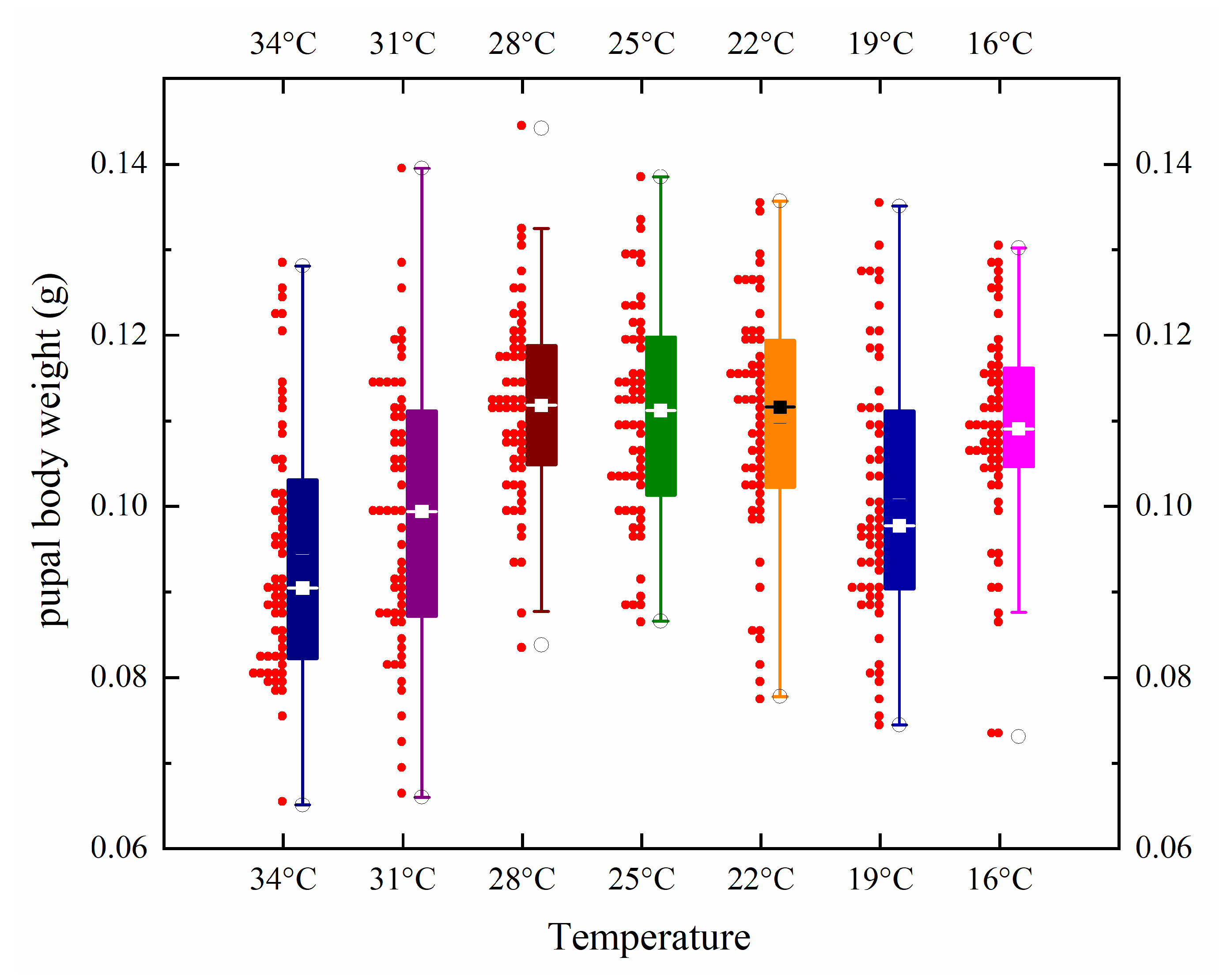
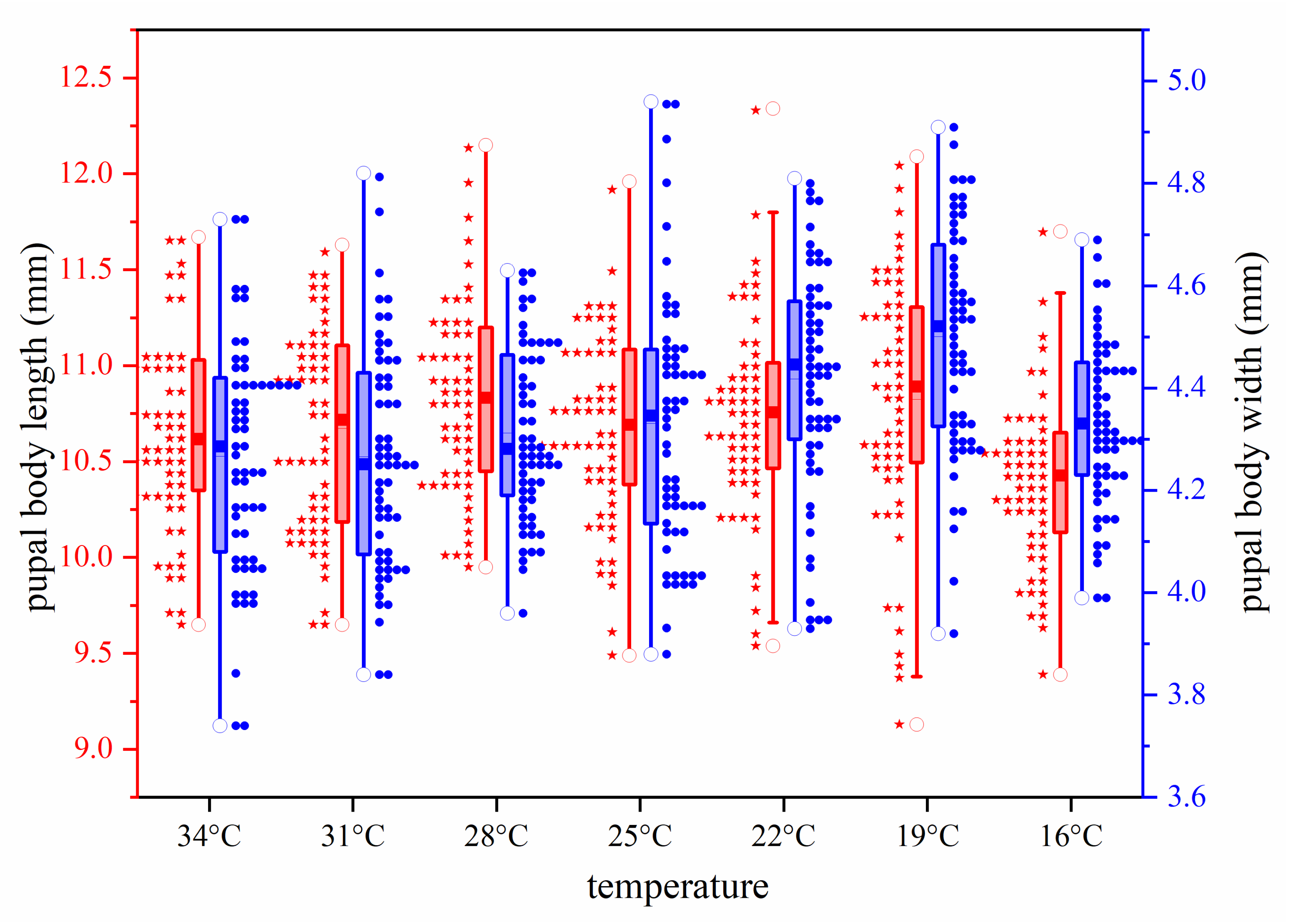
The maximum, minimum, and average values of pupal body weight, length, and width of S. princeps under seven constant temperature conditions are presented in Table 4. Among different temperature conditions, the maximum mean body weight is 0.1117 g, the maximum mean body length is 10.84 mm, and the maximum mean body width is 4.50 mm. For illustration, the pupal body weights, lengths, and widths of S. princeps at different temperatures are shown in Figure 5 and Figure 6. The results indicate that pupal weights, lengths, and widths are generally smaller at higher and lower temperatures, while the pupal weights obtained at 22–28 °C are larger, and the lengths and widths are larger at 19–25 °C.

4. Discussion

Sarcophaga princeps can colonize and reproduce on both buried and indoor cadavers, and belongs to the initial colonizing insect assemblage. In this study, we examined the developmental duration and larval body length variations of S. princeps across seven constant temperatures (16–34 °C). We established multiple models for estimating the PMImin, including isomorphen diagrams, the Optim SSI model, larval body length variation models, and isomegalen diagrams. These models can be used to estimate the age of S. princeps, providing valuable baseline data for forensic practice when this species is encountered at crime scenes.
To date, only one study has documented the life cycle of S. princeps [14]. However, the specific rearing temperature was not specified in that study, precluding direct comparison with our results. Another congeneric species, S. peregrina, exhibits comparable developmental periods at low temperatures (16–25 °C) but shorter periods at high temperatures (28–34 °C). The developmental periods of Sarcophaga dux at 15, 20, 25, and 30 °C were 1090.3, 566.6, 404.6, and 280.3 h, respectively, whereas our study found those of S. princeps at 16, 19, 25, and 31 °C to be 1090.00, 721.00, 416.67, and 327.00 h, respectively [9]. At comparable temperatures, S. dux exhibited a longer developmental period than S. princeps at 16, 19, and 22 °C but a shorter period at higher temperatures [27]. These data show that developmental duration varies even among congeneric species, a pattern that could be attributed to interspecific differences in native microhabitats, resource utilization, or physiological thresholds. Our findings underscore the risk of using congeneric data for PMImin estimation and reinforce the necessity of species-specific developmental data [5,28].
Flesh flies, including S. princeps, are among the primary colonizers of cadavers, similar to blow flies [29,30,31]. However, in forensic entomology, research on the developmental patterns of blow flies far surpasses that on flesh flies, primarily due to the focus of most succession studies on exposed cadavers [7,31], where blow flies outnumber flesh flies in colonizing exposed remains. Another reason Sarcophagidae are more frequently neglected is that identifying their specimens, both adults and larvae, is more difficult than identifying specimens of Calliphoridae. In certain specialized environments, sarcophagid flies can act as the primary colonizers of cadavers and thus serve as critical entomological evidence for PMImin estimation [10,32]. The S. princeps population used in this study was collected from our burial succession experiment conducted in the Yangtze River Delta region. In this experiment, calliphorid flies were unable to colonize the 30 cm deep buried rabbit carcasses, whereas S. princeps was the earliest to colonize and reproduce on these buried remains. Moreover, pupae of S. princeps were still detectable on the carcasses 120 days post-burial. This highlights the significant value of S. princeps in unique death scene environments (e.g., buried contexts). Compared to common blow fly species, sarcophagids typically exhibit longer developmental durations, enabling them to indicate longer PMImin. In the present study, the total developmental durations of S. princeps at 25 °C was 17.36 days (416.67 h), whereas that of calliphorid species such as Calliphora vicina [33], C. megacephala [34], Chrysomya rufifacies [35], and Lucilia sericata [36] was 16, 11.7, 12.1, and 15.5 days, respectively. This suggests that S. princeps requires a longer period to complete one generation on cadavers compared to these common calliphorid species.
The TL is a key indicator reflecting the cold adaptability of sarcosaprophagous insects. In this study, the nonlinear thermodynamic Optim SSI model was used to calculate the TL of S. princeps as 11.11 °C, which is most similar to that of S. peregrina also collected from the Yangtze River Delta region [37]. The TL of S. princeps is greater than that of Parasarcophaga similis (9.60 °C) [38] and Sarcophaga argyrostoma (7.4 °C) [39] but lower than that of S. dux (12.26 °C) [27]. The TL of a species is primarily determined by its biological characteristics, though it may also be influenced by the calculation method as an estimated parameter. Previous studies have predominantly used the linear thermal summation model to calculate the TL of sarcosaprophagous insects [27,37,38,39]. However, in this study, we employed the nonlinear Optim SSI model proposed by Ikemoto and Kiritani [26], primarily because we observed a decline in the developmental rate of S. princeps at temperatures exceeding 31 °C, making the nonlinear model more suitable for data fitting to obtain more accurate estimates. In addition to TL, the nonlinear Optim SSI model can estimate the intrinsic optimum temperature (TΦ) and upper critical thermal threshold (TH), providing additional thermobiological insights into this species.
In this study, the maximum temperature tested was 34 °C, with no experiments conducted at higher temperatures. This is because our experiments demonstrated that the observed eclosion rate of S. princeps pupae at 34 °C was only 50.74 ± 2.54% (Table S1), leading us to infer that 34 °C is near the critical thermal threshold of this species. The TH calculated by the nonlinear thermodynamic Optim SSI model was 35.88 °C, which largely supports this assumption. Shang et al. [9] also reported that S. peregrina cannot complete development at 35 °C, indicating that 34–35 °C is near the maximum developmental threshold for sarcophagid flies.
Numerous studies have noted that sarcophagid flies exhibit infrequent oviposition alongside their typical larviposition behavior [37,40,41], a phenomenon also observed in the present study. Specifically, when adult female S. princeps individuals were collected over consecutive days, they occasionally displayed oviposition behavior. However, the number of eggs laid was extremely low (generally fewer than 10), and these eggs either hatched immediately or failed to hatch, which is consistent with previous reports [37]. Overall, oviposition is infrequent in this species. Furthermore, considering that eggs hatch immediately upon deposition, we propose that this phenomenon can be disregarded in routine case extrapolations. Thus, when utilizing data from this study for PMImin estimation in typical forensic cases, accounting for oviposition is unnecessary.
This study presents data on the growth and development of S. princeps under laboratory constant temperature conditions, and its growth and development here inevitably differ from that under natural fluctuating temperature conditions. Relevant studies have shown that Protophormia terraenovae [42] exhibits accelerated development under fluctuating temperatures, while species such as C. megacephala [43] and S. peregrina [44] show delayed development. Compared with laboratory constant temperature conditions, under natural fluctuating temperature conditions, the growth and development of S. princeps is also influenced by additional factors such as humidity, soil type, and interspecific interference. Future research should focus on two key areas: first, the specific impact of burial depth on the development of S. princeps; and second, the differences in its growth and development under natural fluctuating temperatures versus laboratory constant temperatures.

Supplementary Materials

The following supporting information can be downloaded at: https://www.mdpi.com/article/10.3390/insects16111153/s1, Table S1: developmental duration data of S. princeps. Table S2: larval body length data of S. princeps. Table S3: pupae data of S. princeps.

Author Contributions

Conceptualization, L.L., S.L. and Y.W.; methodology, L.L. and Q.F.; software, L.L. and Y.W.; validation, X.L. and J.J.; formal analysis, Y.Z. (Yumeng Zhuo); investigation, L.L. and Y.Z. (Yingna Zhang); resources, S.L. and Y.W.; data curation, L.L. and G.H.; writing—original draft preparation, L.L.; writing—review and editing, Y.W.; visualization, L.L.; supervision, S.L. and Y.W.; project administration, Y.W.; funding acquisition, Y.Z. (Yingna Zhang), X.L., S.L. and Y.W. All authors have read and agreed to the published version of the manuscript.

Funding

This work was supported by the National Natural Science Foundation of China (grant numbers 32270545, 32070508), Major Project of National Natural Science Foundation of China (grant numbers 82293650, 82293651), Open Project of Hebei Key Laboratory of Forensic Medicine (grant numbers JYFY-23KF006), National Natural Science Foundation of China (grant numbers 82160323), and Natural Science Foundation of Shandong Province (ZR2023MH350).

Data Availability Statement

The original contributions presented in this study are included in the article/Supplementary Materials. Further inquiries can be directed to the corresponding authors.

Conflicts of Interest

The authors declare no conflicts of interest.

References

  1. Amendt, J.; Richards, C.S.; Campobasso, C.P.; Zehner, R.; Hall, M.J.R. Forensic entomology: Applications and limitations. Forensic Sci. Med. Pathol. 2011, 7, 379–392. [Google Scholar] [CrossRef] [PubMed]
  2. Iancu, L.; Sahlean, T.; Davis, T.; Simmons, R. Necrophagous insect species succession on decomposed pig carcasses in North Dakota, USA. J. Med. Entomol. 2024, 61, 55–63. [Google Scholar] [CrossRef]
  3. Greenberg, B. Flies as forensic indicators. J. Med. Entomol. 1991, 28, 565–577. [Google Scholar] [CrossRef]
  4. Krosch, M.N.; Johnston, N.P.; Law, K.; Wallman, J.F.; Archer, M.S. Retrospective review of forensic entomology casework in eastern Australia from 1994 to 2022. Forensic Sci. Int. 2025, 367, 112355. [Google Scholar] [CrossRef]
  5. Matuszewski, S.; Mądra-Bielewicz, A. Field validation of post-mortem interval estimation based on insect development. Part 1: Accuracy gains from the laboratory rearing of insect evidence. Forensic Sci. Int. 2024, 354, 111902. [Google Scholar] [CrossRef]
  6. Szpila, K.; Mądra, A.; Jarmusz, M.; Matuszewski, S. Flesh flies (Diptera: Sarcophagidae) colonising large carcasses in Central Europe. Parasitol. Res. 2015, 114, 2341–2348. [Google Scholar] [CrossRef]
  7. Li, L.; Guo, Y.; Zhou, Y.; Yang, Y.; Kang, C.; Hu, G.; Wang, Y.; Zhang, Y.; Wang, Y.; Wang, J. Succession patterns of sarcosaprophagous insects on pig carcasses in different months in Yangtze River Delta, China. Forensic Sci. Int. 2023, 342, 111518. [Google Scholar] [CrossRef]
  8. Yamany, A.S.; Elkhadragy, M.F.; Abdel-Gaber, R. Wohlfahrtia nuba (Wiedemann, 1830) (Diptera: Sarcophagidae) development and survival under fluctuating temperatures. Insects 2025, 16, 628. [Google Scholar] [CrossRef] [PubMed]
  9. Shang, Y.; Amendt, J.; Wang, Y.; Ren, L.; Yang, F.; Zhang, X.; Zhang, C.; Guo, Y. Multimethod combination for age estimation of Sarcophaga peregrina (Diptera: Sarcophagidae) with implications for estimation of the postmortem interval. Int. J. Leg. Med. 2023, 137, 329–344. [Google Scholar] [CrossRef] [PubMed]
  10. VanLaerhoven, S.L.; Merritt, R.W. 50 years later, insect evidence overturns Canada’s most notorious case—Regina v. Steven Truscott. Forensic Sci. Int. 2019, 301, 326–330. [Google Scholar] [CrossRef]
  11. Vairo, K.P.; Caneparo, M.F.D.C.; Corrêa, R.C.; Preti, D.; Moura, M.O. Can Sarcophagidae (Diptera) be the most important entomological evidence at a death scene? Microcerella halli as a forensic indicator. Rev. Bras. Entomol. 2017, 61, 275–276. [Google Scholar] [CrossRef]
  12. Sanford, M.R. Insects and associated arthropods analyzed during medicolegal death investigations in Harris County, Texas, USA: January 2013–April 2016. PLoS ONE 2017, 12, e0179404. [Google Scholar] [CrossRef] [PubMed]
  13. Vasconcelos, S.D.; Soares, T.F.; Costa, D.L. Multiple colonization of a cadaver by insects in an indoor environment: First record of Fannia trimaculata (Diptera: Fanniidae) and Peckia (Peckia) chrysostoma (Sarcophagidae) as colonizers of a human corpse. Int. J. Leg. Med. 2014, 128, 229–233. [Google Scholar] [CrossRef]
  14. Sinha, S.K. Study of life cycle of Seniorwhitea reciproca (Walker) (Diptera: Sarcophagidae) on coastal fish Panna microdon (Bleeker) in laboratory conditions. Rec. Zool. Surv. India 2009, 109, 67. [Google Scholar] [CrossRef]
  15. Fan, Z. The Keys of Common Flies of China, 2nd ed.; Science Press: Beijing, China, 1992. [Google Scholar]
  16. Wang, C. Taxonomic Study of Sarcophaga in China (Diptera: Sarcophagidae). Ph.D. Thesis, Beijing Forestry University, Beijing, China, 2020. [Google Scholar]
  17. Bharti, M.; Singh, D.; Singh Sidhu, I. First record of some carrion flies (Diptera: Cyclorrhapha) from India. Uttar Pradesh J. Zool. 2001, 21, 267–268. [Google Scholar]
  18. Kumara, T.K.; Disney, R.H.L.; Hassan, A.A.; Flores, M.; Hwa, T.S.; Mohamed, Z.; CheSalmah, M.R.; Bhupinder, S. Occurrence of oriental flies associated with indoor and outdoor human remains in the tropical climate of north Malaysia. J. Vector Ecol. 2012, 37, 62–68. [Google Scholar] [CrossRef]
  19. Szpila, K.; Voss, J.G.; Pape, T. A new dipteran forensic indicator in buried bodies. Med. Vet. Entomol. 2010, 24, 278–283. [Google Scholar] [CrossRef]
  20. AL-Mekhlafi, F.A.; Al-Zahrani, O.; Al-Qahtni, A.H.; Al-Khalifal, M.S. Decomposition of buried rabbits and pattern succession of insect arrival on buried carcasses. Int. J. Trop. Insect Sci. 2024, 44, 1037–1044. [Google Scholar] [CrossRef]
  21. Zhang, J.; Wang, M.; Qi, X.; Shi, L.; Zhang, J.; Zhang, X.; Yang, T.; Ren, J.; Liu, F.; Zhang, G.; et al. Predicting the postmortem interval of burial cadavers based on microbial community succession. Forensic Sci. Int. Genet. 2021, 52, 102488. [Google Scholar] [CrossRef]
  22. Bonacci, T.; Mendicino, F.; Bonelli, D.; Carlomagno, F.; Curia, G.; Scapoli, C.; Pezzi, M. Investigations on arthropods associated with decay stages of buried animals in Italy. Insects 2021, 12, 311. [Google Scholar] [CrossRef] [PubMed]
  23. Tan, S.H.; Rizman-Idid, M.; Mohd-Aris, E.; Kurahashi, H.; Mohamed, Z. DNA-based characterisation and classification of forensically important flesh flies (Diptera: Sarcophagidae) in Malaysia. Forensic Sci. Int. 2010, 199, 43–49. [Google Scholar] [CrossRef] [PubMed]
  24. Sharma, M.; Singh, D.; Sharma, A.K. Molecular identification of two forensically important Indian flesh flies (Diptera: Sarcophagidae). Int. J. Adv. Res. Sci. Eng. Technol. 2015, 2, 814–818. [Google Scholar]
  25. Gao, Y.; Zhang, Y.; Li, L.; Wang, Y.; Zhang, Y.; Guo, Y.; Hu, G.; Kang, C.; Chen, J.; Wang, J.; et al. A novel mathematical model and application software for estimating the age of necrophagous fly larvae. Forensic Sci. Int. 2024, 354, 111894. [Google Scholar] [CrossRef] [PubMed]
  26. Ikemoto, T.; Kiritani, K. Novel method of specifying low and high threshold temperatures using thermodynamic SSI Model of insect development. Environ. Entomol. 2019, 48, 479–488. [Google Scholar] [CrossRef]
  27. Zhang, X.; Li, Y.; Shang, Y.; Ren, L.; Chen, W.; Wang, S.; Guo, Y. Development of Sarcophaga dux (Diptera: Sarcophagidae) at constant temperatures and differential gene expression for age estimation of the pupae. J. Therm. Biol. 2020, 93, 102735. [Google Scholar] [CrossRef]
  28. Matuszewski, S.; Mądra-Bielewicz, A. Field validation of post-mortem interval estimation based on insect development. Part 2: Pre-appearance interval, expert evidence selection and accuracy baseline data. Forensic Sci. Int. 2025, 367, 112316. [Google Scholar] [CrossRef]
  29. Dias, G.D.S.; Oliveira-Costa, J.; De Mello-Patiu, C.A. New records of Sarcophagidae species (Diptera) with forensic potential in Rio de Janeiro. Rev. Bras. Entomol. 2015, 59, 255–256. [Google Scholar] [CrossRef]
  30. Vairo, K.P.E.; Ururahy-Rodrigues, A.; Osvaldo Moura, M.; Antunes De Mello-Patiu, C. Sarcophagidae (Diptera) with forensic potential in Amazonas: A pictorial key. Trop. Zool. 2014, 27, 140–152. [Google Scholar] [CrossRef]
  31. Garção-Neto, C.H.; Cortinhas, L.B.; Mendonça, P.M.; Duarte, M.L.; Martins, R.T.; De Carvalho Queiroz, M.M. Dipteran succession on decomposing domestic pig carcasses in a rural area of southeastern Brazil. Sci. Rep. 2025, 15, 18496. [Google Scholar] [CrossRef]
  32. De Barros, S.E.G.; Bicho, C.D.L.; Ferreira, H.R.P.; Vasconcelos, S.D. Death, flies and environments: Towards a qualitative assessment of insect (Diptera) colonization of human cadavers retrieved from sites of death in Brazil. Forensic Sci. Int. 2024, 365, 112241. [Google Scholar] [CrossRef]
  33. Defilippo, F.; Bonilauri, P.; Dottori, M. Effect of temperature on six different developmental landmarks within the pupal stage of the forensically important blowfly Calliphora vicina (Robineau–Desvoidy) (Diptera: Calliphoridae). J. Forensic Sci. 2013, 58, 1554–1557. [Google Scholar] [CrossRef]
  34. Zhang, Y.; Wang, Y.; Yang, L.; Tao, L.; Wang, J. Development of Chrysomya megacephala at constant temperatures within its colony range in Yangtze River Delta region of China. Forensic Sci. Res. 2018, 3, 74–82. [Google Scholar] [CrossRef] [PubMed]
  35. Hu, G.; Wang, Y.; Sun, Y.; Zhang, Y.; Wang, M.; Wang, J. Development of Chrysomya rufifacies (Diptera: Calliphoridae) at constant temperatures within its colony range in Yangtze River Delta Region of China. J. Med. Entomol. 2019, 56, 1215–1224. [Google Scholar] [CrossRef]
  36. Wang, M.; Wang, Y.; Hu, G.; Wang, Y.; Xu, W.; Wu, M.; Wang, J. Development of Lucilia sericata (Diptera: Calliphoridae) under constant temperatures and its significance for the estimation of time of death. J. Med. Entomol. 2020, 57, 1373–1381. [Google Scholar] [CrossRef]
  37. Wang, Y.; Wang, J.F.; Zhang, Y.N.; Tao, L.Y.; Wang, M. Forensically important Boettcherisca peregrina (Diptera: Sarcophagidae) in China: Development pattern and significance for estimating postmortem interval. J. Med. Entomol. 2017, 54, 1491–1497. [Google Scholar] [CrossRef]
  38. Yang, L.; Wang, Y.; Li, L.; Wang, J.; Wang, M.; Zhang, Y.; Chu, J.; Liu, K.; Hou, Y.; Tao, L. Temperature–dependent development of Parasarcophaga similis (meade 1876) and its significance in estimating postmortem interval. J. Forensic Sci. 2017, 62, 1234–1243. [Google Scholar] [CrossRef] [PubMed]
  39. Grassberger, M.; Reiter, C. Effect of temperature on development of Liopygia (=Sarcophaga) argyrostoma (Robineau-Desvoidy) (Diptera: Sarcophagidae) and its forensic implications. J. Forensic Sci. 2002, 47, 1332–1336. [Google Scholar] [CrossRef] [PubMed]
  40. Barbosa, T.M.; Cruz, M.R.P.; Pontes, W.J.T.; Vasconcelos, S.D. Aspects of the reproductive behaviour and development of two forensically relevant species, Blaesoxipha (Gigantotheca) stallengi (Lahille, 1907) and Sarcophaga (Liopygia) ruficornis (Fabricius, 1794) (Diptera: Sarcophagidae). Rev. Bras. Entomol. 2019, 63, 124–129. [Google Scholar] [CrossRef]
  41. Lesne, P.; Srivastav, S.P.; El-Hefnawy, A.; Parrott, J.J.; Sanford, M.R.; Tarone, A.M. Facultative Viviparity in a Flesh Fly (Diptera: Sarcophagidae): Forensic Implications of High Variability in Rates of Oviparity in Blaesoxipha plinthopyga (Diptera: Sarcophagidae). J. Med. Entomol. 2020, 57, 697–704. [Google Scholar] [CrossRef]
  42. Warren, J.-A.; Anderson, G.S. Effect of Fluctuating Temperatures on the Development of a Forensically Important Blow Fly, Protophormia terraenovae (Diptera: Calliphoridae). Env. Entomol 2013, 42, 167–172. [Google Scholar] [CrossRef]
  43. Wang, Y.; Zhang, R.; Gao, Y.; Shao, S.; Liu, S.; Wang, Y. Effect of fluctuating temperatures on the development of forensically important fly species, Chrysomya megacephala (Diptera: Calliphoridae). Forensic Sci. Int. 2025, 367, 112373. [Google Scholar] [CrossRef] [PubMed]
  44. Shang, Y.; Yang, F.; Ngando, F.J.; Zhang, X.; Feng, Y.; Ren, L.; Guo, Y. Development of Forensically Important Sarcophaga peregrina (Diptera: Sarcophagidae) and Intra-Puparial Age Estimation Utilizing Multiple Methods at Constant and Fluctuating Temperatures. Animals 2023, 13, 1607. [Google Scholar] [CrossRef] [PubMed]
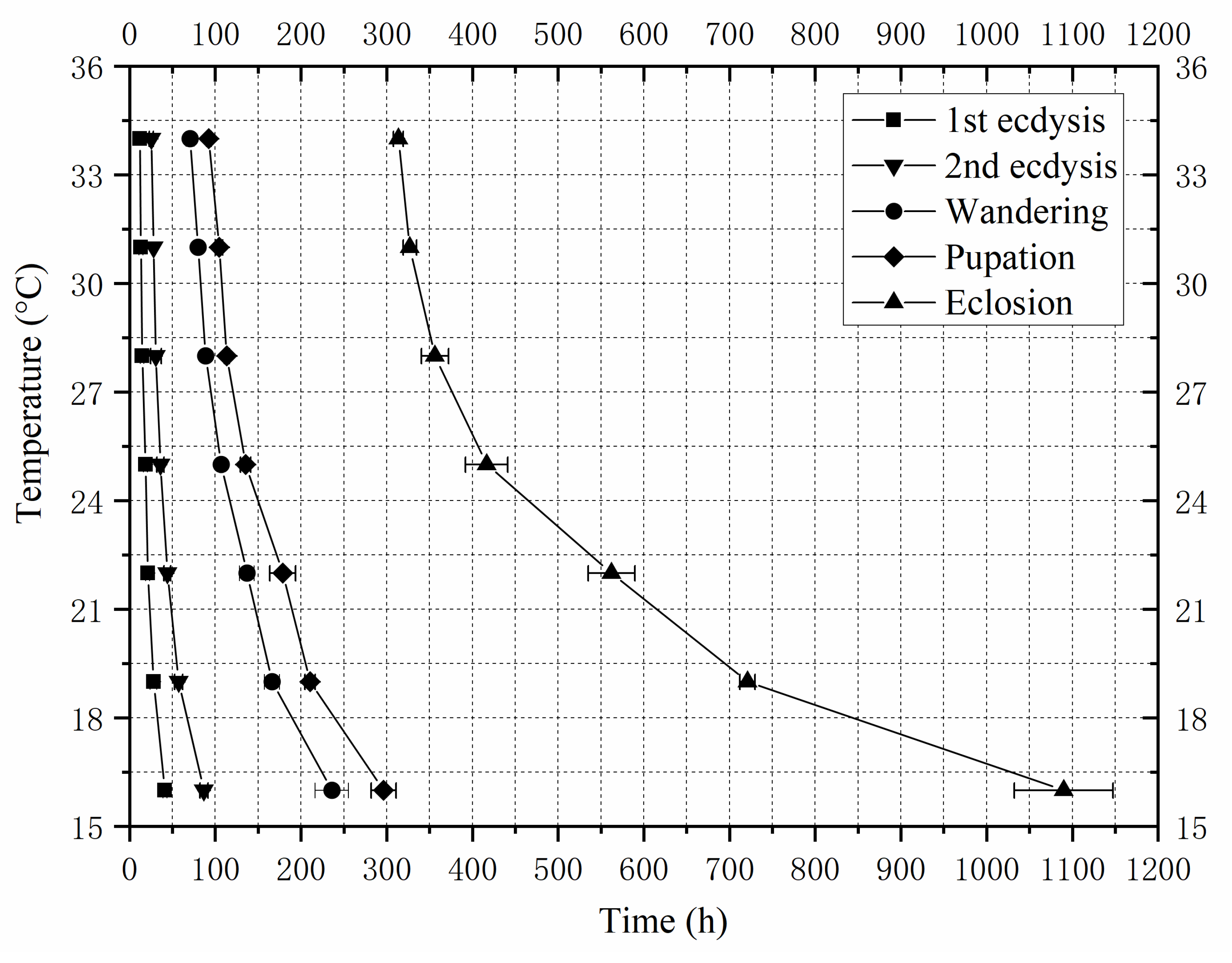
Figure 1. Isomorphen diagram of Sarcophaga princeps. The duration of each development milestone (first-ecdysis, second-ecdysis, wandering, pupariation, and eclosion) is plotted against the time from larviposition to the onset of each milestone. Each curve corresponds to a developmental milestone, and the error bar is the standard deviation of each milestone.
Insects 16 01153 g001
Figure 2. Nonlinear thermodynamic Optim SSI model for five developmental events of Sarcophaga princeps. Circles (black and white) indicate data points, and curves indicate the developmental rates predicted by the Optim SSI model. The three squares denote the predicted mean developmental rates of TL, TΦ, and TH. The black lines are generated by linear fitting of the black circle data, whereas the white circles are the data excluded from the linear fitting.
Insects 16 01153 g002
Figure 3. Larval body length variation over time in Sarcophaga princeps at different constant temperatures (16–34 °C).
Insects 16 01153 g003
Figure 4. Isomegalen diagram of Sarcophaga princeps. Each line represents the length (mm) of developing larvae, with lengths ranging from 5 to 19 mm. The number at the bottom right of each line denotes the corresponding larval length.
Insects 16 01153 g004
Figure 5. Box plots of pupal weight for Sarcophaga princeps pupae formed within a 2 h period at different temperatures, where “○” represents maximum and minimum values, “–” represents mean values, and “▪” represents median values.
Insects 16 01153 g005
Figure 6. Box plots of pupal length and width for Sarcophaga princeps pupae formed within a 2 h period at different temperatures, where “○” represents maximum and minimum values, “–” represents mean values, and “▪” represents median values. The red five-pointed star on the left represents pupal length, and the blue solid circle on the right represents pupal width.
Insects 16 01153 g006
Table 1. Average (±SD) duration (hour) to each development event from larviposition to the onset of each development event of Sarcophaga princeps at seven constant temperatures with 75% humidity and a light cycle of 12:12 (L:D).
TemperaturesFirst EcdysisSecond EcdysisWanderingPupariationEclosion
16 °C41.33 ± 2.3186.67 ± 4.62236.00 ± 19.52296.33 ± 14.431090.00 ± 57.65
19 °C28.00 ± 4.0057.33 ± 4.62166.33 ± 8.74210.67 ± 6.11721.00 ± 8.72
22 °C21.33 ± 2.3144.00 ± 4.00137.00 ± 8.66178.67 ± 15.28562.33 ± 27.21
25 °C18.67 ± 2.3136.00 ± 4.00107.00 ± 4.00135.33 ± 5.86416.67 ± 27.70
28 °C14.67 ± 2.3130.67 ± 6.1188.67 ± 3.21113.33 ± 2.89356.33 ± 16.01
31 °C13.33 ± 2.3128.00 ± 0.0080.00 ± 2.00104.67 ± 4.16327.00 ± 7.94
34 °C12.00 ± 0.0025.33 ± 2.3170.67 ± 4.6292.33 ± 2.52313.67 ± 5.69
Table 2. Thermodynamic parameters of each developmental event of Sarcophaga princeps derived from the nonlinear Optim SSI model.
Parameter (Unit)1st Ecdysis2nd EcdysisWanderingPupariationEclosion
TΦ (℃)20.8321.9121.2521.7321.85
ρΦ (day−1)0.990.530.170.140.04
∆HA (cal/mol)1.31 × 1041.32 × 1041.27 × 1041.24 × 1041.44 × 104
∆HL (cal/mol)−1.14 × 105−7.26 × 10⁴−8.15 × 10⁴−5.75 × 10⁵−7.87 × 10⁴
∆HH (cal/mol)4.47 × 1044.94 × 1044.25 × 1044.53 × 1045.44 × 104
TL (℃)12.1310.4910.407.8611.11
TH (℃)38.337.2039.1738.8335.88
χ28.20 × 10−35.21 × 10−36.03 × 10−41.01 × 10−32.82 × 10⁻⁴
R20.9930.9910.9970.9930.994
Table 3. A general model describing the relationship between the body length of Sarcophaga princeps larvae (L) (mm) and the time after larviposition (t) (hour).
ModelSE
L t = L m 1 + L m L 0 1 e λ t /(1)
L 0 T = 4.4738 0.0371 T ±0.2600(2a)
L m T = 25.6924 0.1960 T ±0.8589(2b)
λ T = 0.0456 + 0.0042 T ±0.0025(2c)
L(t) is the larval length at time t, L0 is the initial length (i.e., at t = 0), Lm is the final length, and λ is a parameter expressing growth rate. Equations (2a)–(2c) are the relationship between temperature (T) and L0, Lm and λ.
Table 4. The maximum, minimum, and average values of pupal weight, length, and width of Sarcophaga princeps under seven constant temperature conditions (16–34 °C) (n = 60).
TemperaturesPupal Body Weight (g)Pupal Body Length (mm)Pupal Body Width (mm)
MaxMinAvg ± SDMaxMinAvg ± SDMaxMinAvg ± SD
34 °C0.12810.06510.0944 ± 0.014511.679.6510.65 ± 0.18774.733.744.27 ± 0.2218
31 °C0.13950.06600.0991 ± 0.015711.639.6510.67 ± 0.52614.823.844.27 ± 0.2165
28 °C0.14420.08380.1117 ± 0.011312.159.9510.84 ± 0.49024.633.964.31 ± 0.1662
25 °C0.13850.08660.1106 ± 0.012511.969.4910.69 ± 0.48854.963.884.33 ± 0.2503
22 °C0.13570.07780.1097 ± 0.013512.349.5410.76 ± 0.51484.813.934.42 ± 0.2251
19 °C0.13510.07450.1009 ± 0.015112.099.1310.82 ± 0.66314.913.924.50 ± 0.2208
16 °C0.13020.07310.1088 ± 0.012211.709.3910.41 ± 0.43124.693.994.33 ± 0.1608
Disclaimer/Publisher’s Note: The statements, opinions and data contained in all publications are solely those of the individual author(s) and contributor(s) and not of MDPI and/or the editor(s). MDPI and/or the editor(s) disclaim responsibility for any injury to people or property resulting from any ideas, methods, instructions or products referred to in the content.