The Effect of Lure Position and Vegetation on the Performance of YATLORf Traps in the Monitoring of Click Beetles (Agriotes spp., Coleoptera: Elateridae)


1
Veneto Agricoltura, Agricultural Research Department, Viale dell’Università, 14, 35020 Legnaro, Italy
2
Department of Agronomy, Food, Natural Resources, Animals and Environment, University of Padova, 35020 Legnaro, Italy
3
Centre for Agricultural Research, Plant Protection Institute, ELKH, H-1022 Budapest, Hungary
*
Author to whom correspondence should be addressed.
Insects 2023, 14(6), 542; https://doi.org/10.3390/insects14060542
Submission received: 7 April 2023
/
Revised: 1 June 2023
/
Accepted: 7 June 2023
/
Published: 10 June 2023
(This article belongs to the Section Insect Pest and Vector Management)
Simple Summary
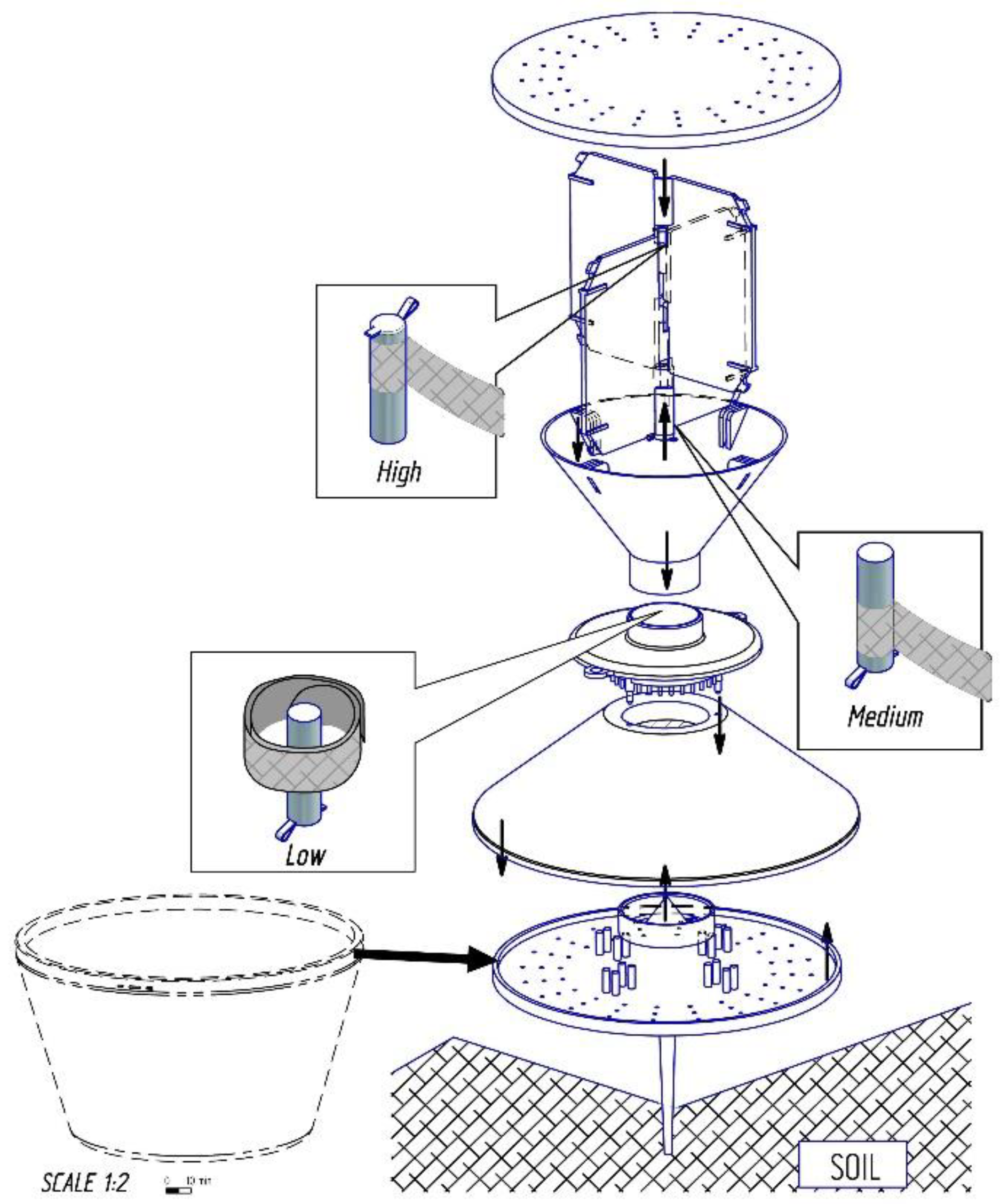
The EU has established ambitious goals for pesticide reduction. The achievement of these goals requires the introduction of easy-to-use, low-cost and effective tools to monitor crop pests. Sex pheromone YATLORf (Yf) traps have proven to be a reliable low-cost tool for monitoring Agriotes spp., which are the most harmful group of soil pests in Europe. They can damage a wide range of arable crops, including potato, maize and sunflower. In order to optimize Yf use, this study explored the effect of lure position in the trap and vegetation field cover density on trap performance. Lure attractant capacity varied greatly with the lure’s position in the trap and the extent of the vegetation density around the trap. Guidelines for making practical decisions are given. The ‘low’ lure position in the Yf is suitable for all species in all field conditions and is the best choice for A. brevis; the ‘medium’ position should be considered for A. brevis only when vegetation is dense. The ‘high’ lure position is unsuitable for A. brevis and A. obscurus, and should be considered for some species only. Dense vegetation (e.g., winter wheat) reduced the potential for catching A. sordidus. Placing the trap just outside the field, or in a nearby field with bare/sparse vegetation, maintained the maximum catching potential. Vegetation density was found to influence beetle sex ratio, with no or very few female A. brevis and A. sordidus being found in traps placed in the middle of fields with dense vegetation. This research has made it possible to conduct studies on multi-baiting the same trap, which can significantly reduce monitoring costs.
Abstract
Low-cost monitoring tools are needed to implement IPM in arable crops. YATLORf (Yf) traps baited with respective synthetic pheromone lures have proven to be a reliable tool for monitoring Agriotes spp., Europe’s most harmful soil pests. To optimize Yf use, we studied the effect of lure position in the trap and crop density on trap performance. Yf management detail was studied between 2000–2003 and 2014–2016 in various countries, with the traps being arranged in blocks. Each block contained one trap per treatment (i.e., lure position) under study. It was ascertained that lure attractant capacity can vary greatly with the lure’s position in the trap and the extent of vegetation. Information for making practical decisions is given. The ‘low’ lure position is suitable for all species in all field conditions, and is the best choice for A. brevis. Lures for A. brevis and A. lineatus need to be placed in the low position when the field has no or sparse vegetation cover. The ‘high’ lure position is unsuitable for A. brevis and A. obscurus, and should be considered for some species only. There are no restrictions on position for catching A. sordidus, i.e., any position is suitable. Dense vegetation (e.g., wheat) reduced the Yf trap’s potential for catching A. sordidus. Placing the trap just outside the field, or in a nearby field with bare/sparse vegetation, maintained the maximum catching potential. Vegetation density also influenced beetle sex ratio, with A. brevis and A. sordidus females always found in traps placed in fields with bare or low-density vegetation. Our findings have made it possible to obtain consistent monitoring outputs and to begin studies on multi-baiting the same trap, which can significantly reduce monitoring costs.
Keywords:
IPM; Agriotes brevis; A. ustulatus; A. sordidus; A. lineatus; A. litigiosus