Research Progress on the Regulation of Autophagy and Apoptosis in Insects by Sterol Hormone 20-Hydroxyecdysone


1
Guangdong Province Key Laboratory of Biotechnology Drug Candidates, School of Life Sciences and Biopharmaceuticals, Guangdong Pharmaceutical University, Guangzhou 510006, China
2
School of Health Sciences, Guangzhou Xinhua University, 19 Huamei Road, Tianhe District, Guangzhou 510520, China
3
State Key Laboratory of Biocontrol, Guangdong Key Laboratory of Pharmaceutical Functional Genes, School of Life Sciences, Sun Yat-sen University, Guangzhou 510275, China
*
Author to whom correspondence should be addressed.
†
These authors contributed equally to this work.
Insects 2023, 14(11), 871; https://doi.org/10.3390/insects14110871
Submission received: 15 October 2023
/
Revised: 6 November 2023
/
Accepted: 10 November 2023
/
Published: 12 November 2023
(This article belongs to the Special Issue Insect Hormones, Metabolism, Immunity and Development)
Simple Summary
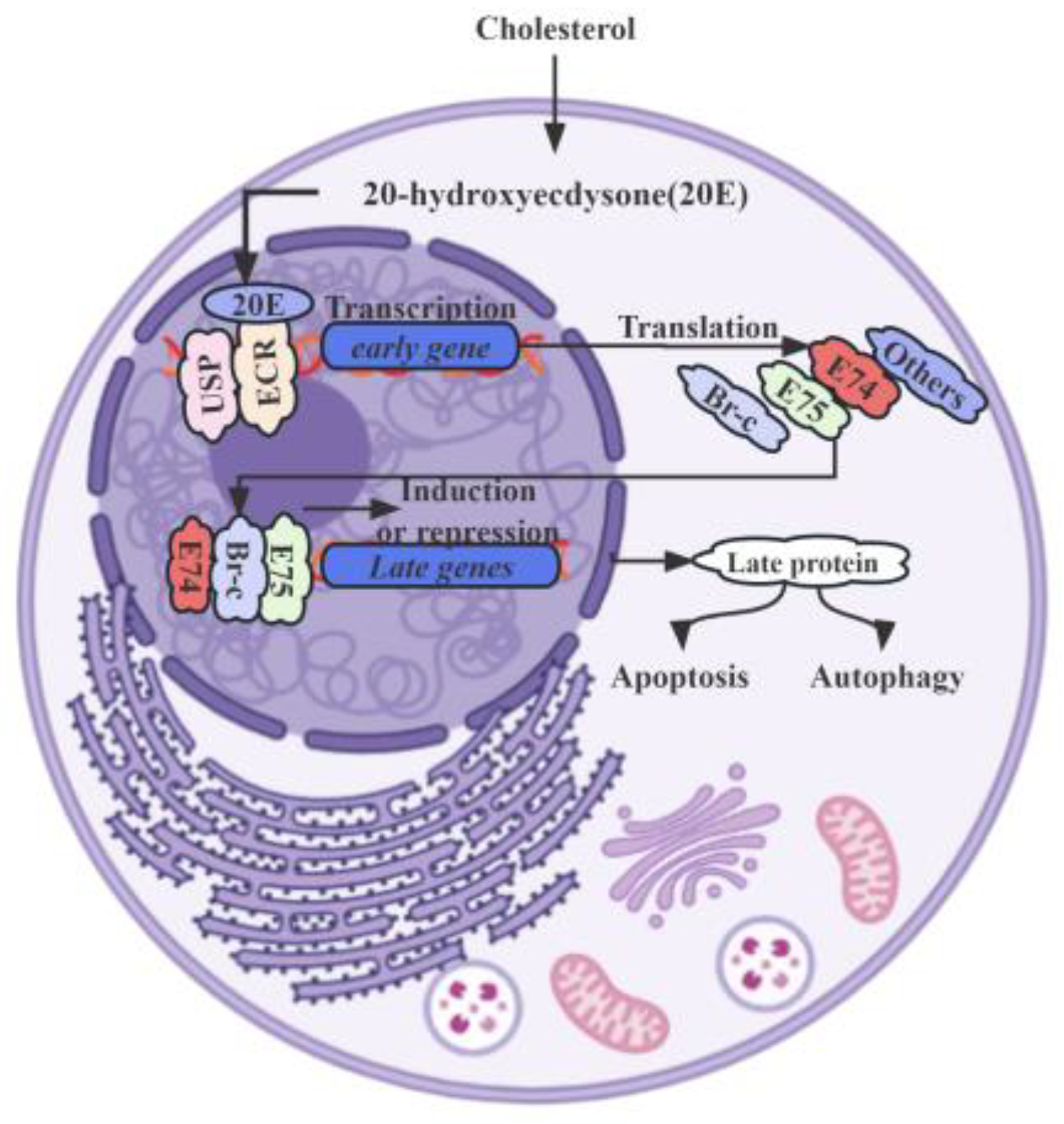
Insects rely on a sterol hormone known as 20-Hydroxyecdysone to regulate vital cellular activities. This study delves deep into the biosynthesis of this hormone, its signal transduction, and the mechanisms by which it regulates autophagy (cellular self-cleaning) and apoptosis (programmed cell death). Our primary goal was to unravel the intricate interplay between 20-Hydroxyecdysone and these cellular processes. Through our research, we uncovered the intricate pathways and mechanisms that this hormone influences in cell renewal and controlled cell death. These insights not only hold significance for comprehending insect development and survival but also have broader implications in fields like agriculture and pest control. By shedding light on these processes, we aim to provide valuable knowledge that can be leveraged for the betterment of our environment and society.
Abstract
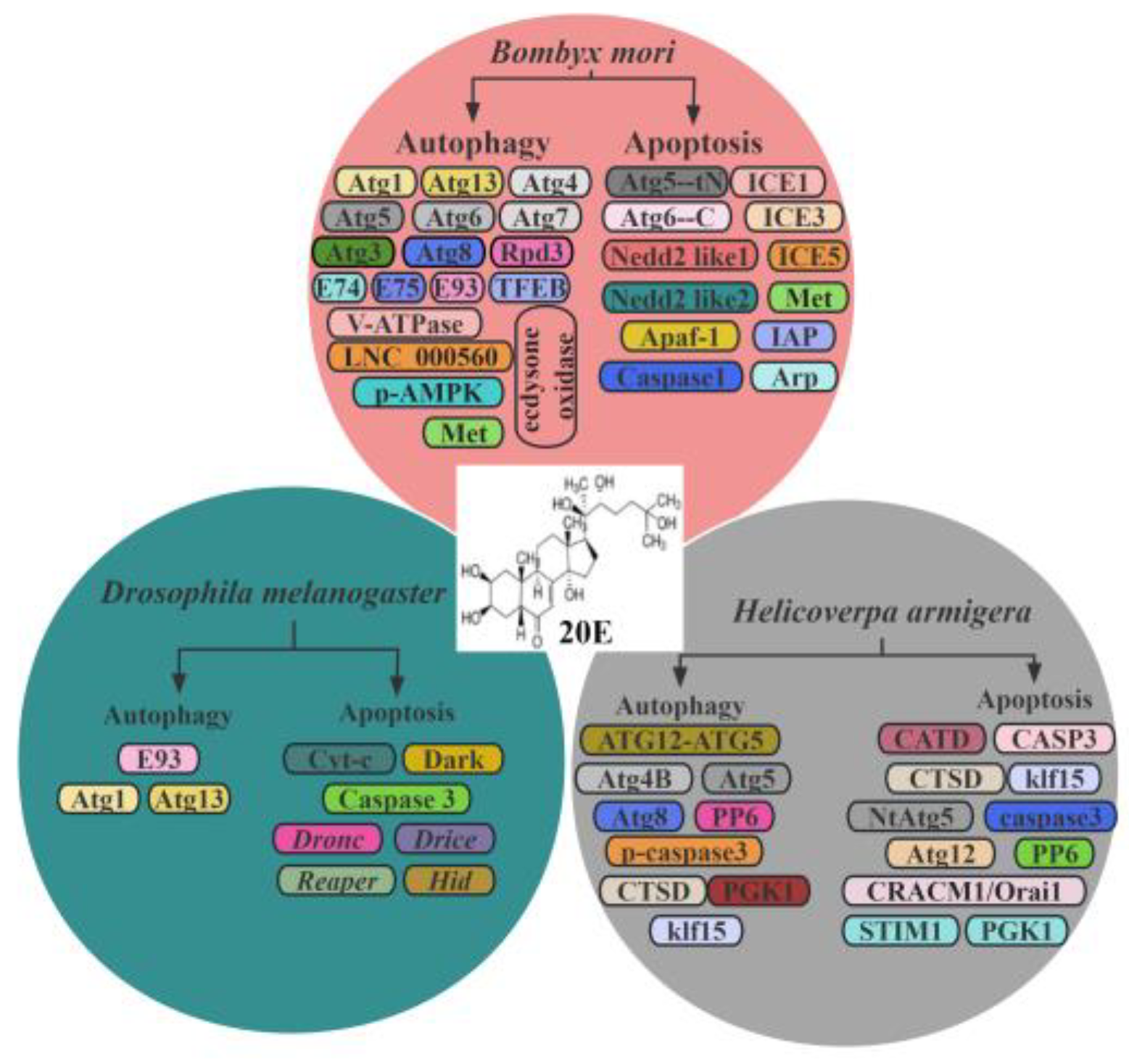
20E (20-Hydroxyecdysone) is a central steroid hormone that orchestrates developmental changes and metamorphosis in arthropods. While its molecular mechanisms have been recognized for some time, detailed elucidation has primarily emerged in the past decade. PCD (Programmed cell death), including apoptosis, necrosis, efferocytosis, pyroptosis, ferroptosis, and autophagy, plays a crucial role in regulated cell elimination, which is vital for cells’ development and tissue homeostasis. This review summarizes recent findings on 20E signaling regulated autophagy and apoptosis in insects, including Drosophila melanogaster, Bombyx mori, Helicoverpa armigera, and other species. Firstly, we comprehensively explore the biosynthesis of the sterol hormone 20E and its subsequent signal transduction in various species. Then, we focus on the involvement of 20E in regulating autophagy and apoptosis, elucidating its roles in both developmental contexts and bacterial infection scenarios. Furthermore, our discussion unfolds as a panoramic exposition, where we delve into the fundamental questions with our findings, anchoring them within the grander scheme of our study in insects. Deepening the understanding of 20E-autophagy/apoptosis axis not only underscores the intricate tapestry of endocrine networks, but also offers fresh perspectives on the adaptive mechanisms that have evolved in the face of environmental challenges.