Electroantennographic Responses of Wild and Laboratory-Reared Females of Xyleborus affinis Eichhoff and Xyleborus ferrugineus (Fabricius) (Coleoptera: Curculionidae: Scolytinae) to Ethanol and Bark Volatiles of Three Host-Plant Species
by
 , , , ,
Patricia Romero
1,* ,
,
Luis A. Ibarra-Juárez
2,3,
Daniel Carrillo
4 ,
,
José A. Guerrero-Analco
2,
Paul E. Kendra
5,
Ana L. Kiel-Martínez
2 and
Larissa Guillén
1,* 1
Red de Manejo Biorracional de Plagas y Vectores, Instituto de Ecología AC (INECOL)—Clúster Científico y Tecnológico BioMimic®, Carretera Antigua a Coatepec 351, El Haya, Xalapa 91073, Veracruz, Mexico
2
Red de Estudios Moleculares Avanzados, Instituto de Ecología AC (INECOL)—Clúster Científico y Tecnológico BioMimic®, Carretera Antigua a Coatepec 351, El Haya, Xalapa 91073, Veracruz, Mexico
3
Consejo Nacional de Ciencia y Tecnología (Cátedras) Commissioned to Instituto de Ecología AC (INECOL), Xalapa 91073, Veracruz, Mexico
4
Tropical Research and Education Center, University of Florida, Homestead, FL 33031, USA
5
United States Department of Agriculture, Agricultural Research Service, Subtropical Horticulture Research Station, 13601 Old Cutler Rd., Miami, FL 33158, USA
*
Authors to whom correspondence should be addressed.
Insects 2022, 13(7), 655; https://doi.org/10.3390/insects13070655
Submission received: 7 June 2022
/
Revised: 12 July 2022
/
Accepted: 14 July 2022
/
Published: 21 July 2022
(This article belongs to the Topic Advances in Chemical Ecology)
Simple Summary
The ambrosia beetles Xyleborus affinis and Xyleborus ferrugineus are wood borers reported as secondary vectors of pathogenic fungi that cause lethal vascular diseases in mango, cacao, and trees within the laurel family. The use of specific attractants or repellants is one potential method for monitoring or controlling these pests. Chemical ecology studies to develop such tools often use wild or laboratory-reared beetles without first determining whether there are differences in their responses. We compared the antennal olfactory responses of wild and laboratory-reared X. affinis and X. ferrugineus to bark odors of gumbo-limbo (Bursera simaruba), mango (Mangifera indica) and chinini (Persea schiedeana) with different aging times and used GC–MS to analyze the chemical composition of these bark odors. The antennal responses of laboratory-reared and wild females differed in X. affinis and X. ferrugineus when interacting with odors. In addition, both beetle species displayed stronger antennal responses to aged bark odors of gumbo-limbo and chinini, apparently due to changes in volatile emissions over time.
Abstract
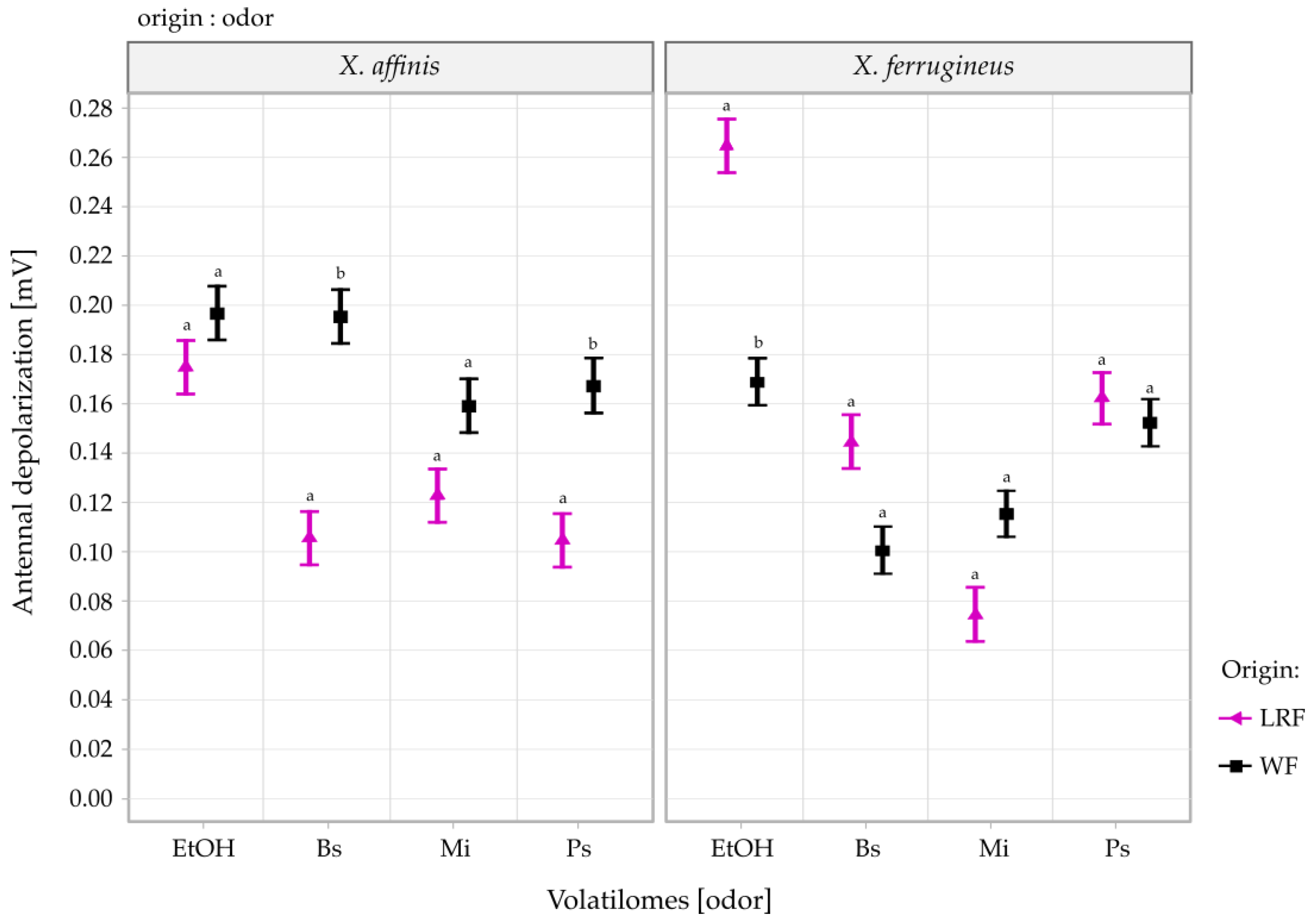
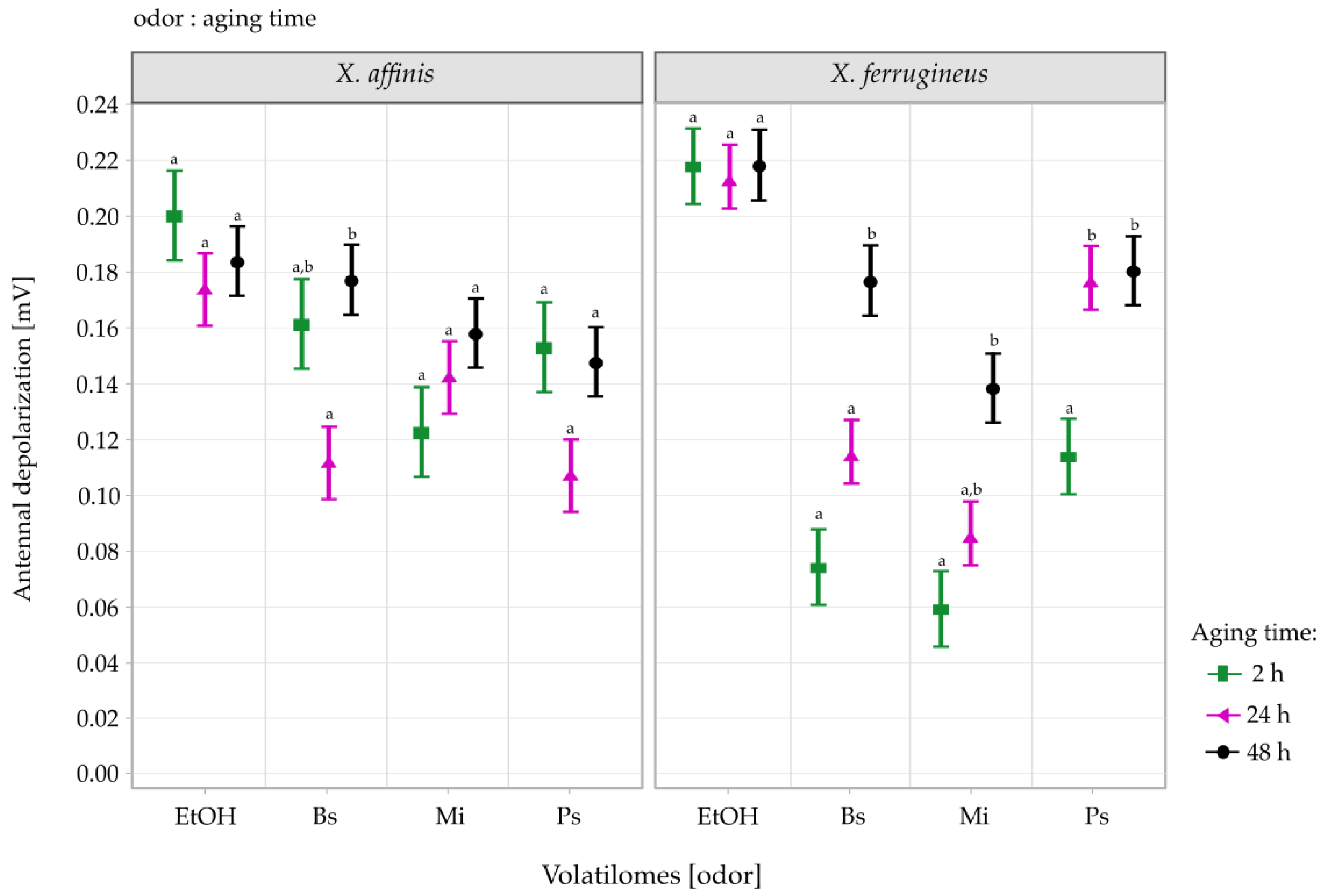
Chemical ecology studies on ambrosia beetles are typically conducted with either wild or laboratory-reared specimens. Unlike laboratory-reared insects, important aspects that potentially influence behavioral responses, such as age, physiological state, and prior experience are unknown in wild specimens. In this study, we compared the electroantennographic (EAG) responses of laboratory-reared and wild X. affinis and X. ferrugineus to 70% ethanol and bark odors (host kairomones) of Bursera simaruba, Mangifera indica, and Persea schiedeana aged for 2, 24, and 48 h. Chemical analyses of each odor treatment (bark species x length of aging) were performed to determine their volatilome composition. EAG responses were different between laboratory-reared and wild X. ferrugineus when exposed to ethanol, whereas wild X. affinis exhibited similar EAG responses to the laboratory-reared insects. Ethanol elicited the strongest olfactory responses in both species. Among the bark-odors, the highest responses were triggered by B. simaruba at 48 h in X. affinis, and P. schiedeana at 24 and 48 h in X. ferrugineus. Volatile profiles varied among aged bark samples; 3-carene and limonene were predominant in B. simaruba, whereas α-copaene and α-cubebene were abundant in P. schiedeana. Further studies are needed to determine the biological function of B. simaruba and P. schiedeana terpenes on X. affinis and X. ferrugineus, and their potential application for the development of effective lures.