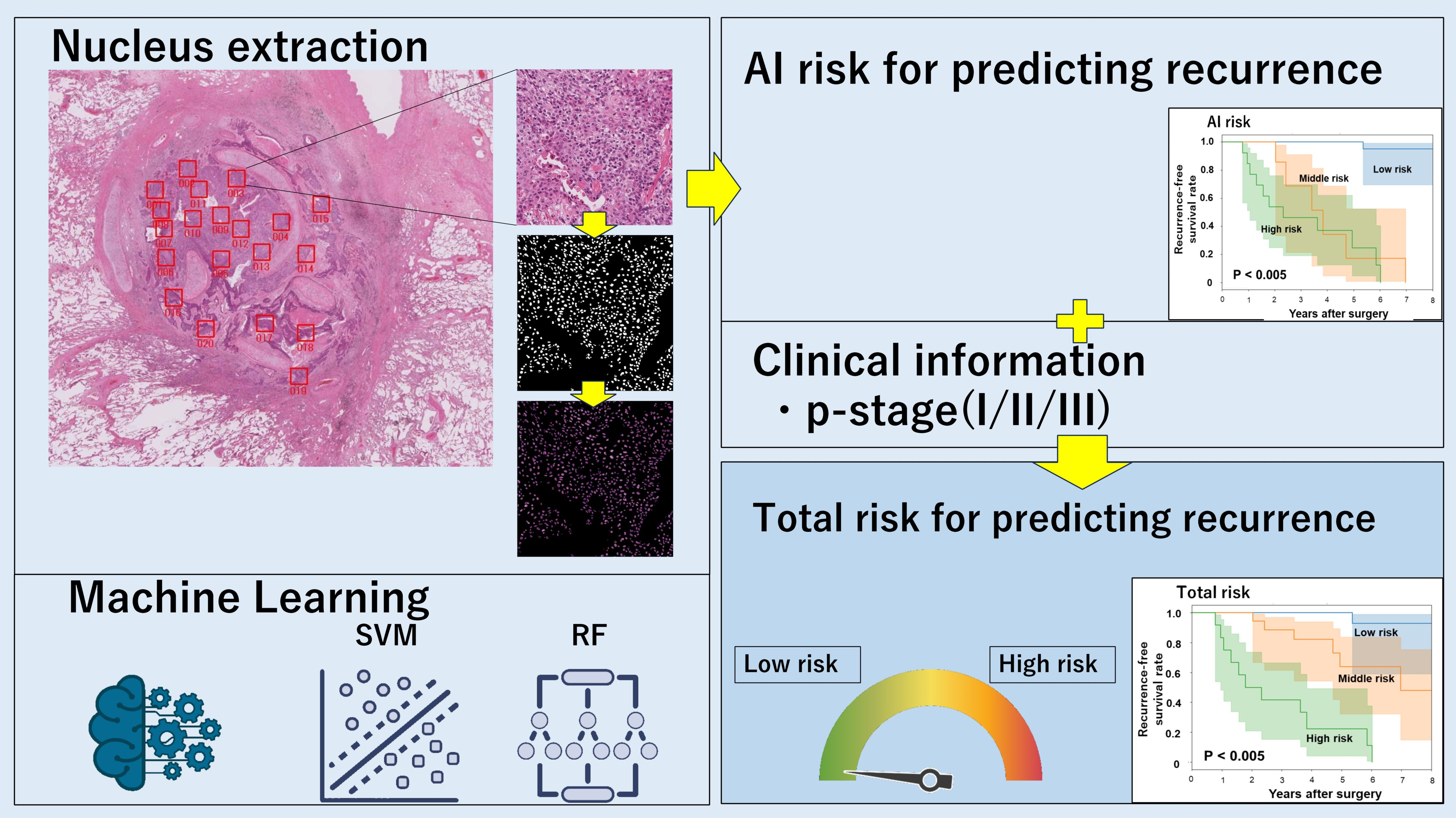

Personalized Prediction of Postoperative Recurrence in Lung Squamous Cell Carcinoma: Integrating AI-Based Nuclear Morphometry and Clinical Data

 , ,
, ,  , and
, and
Abstract
1. Introduction
2. Materials and Methods
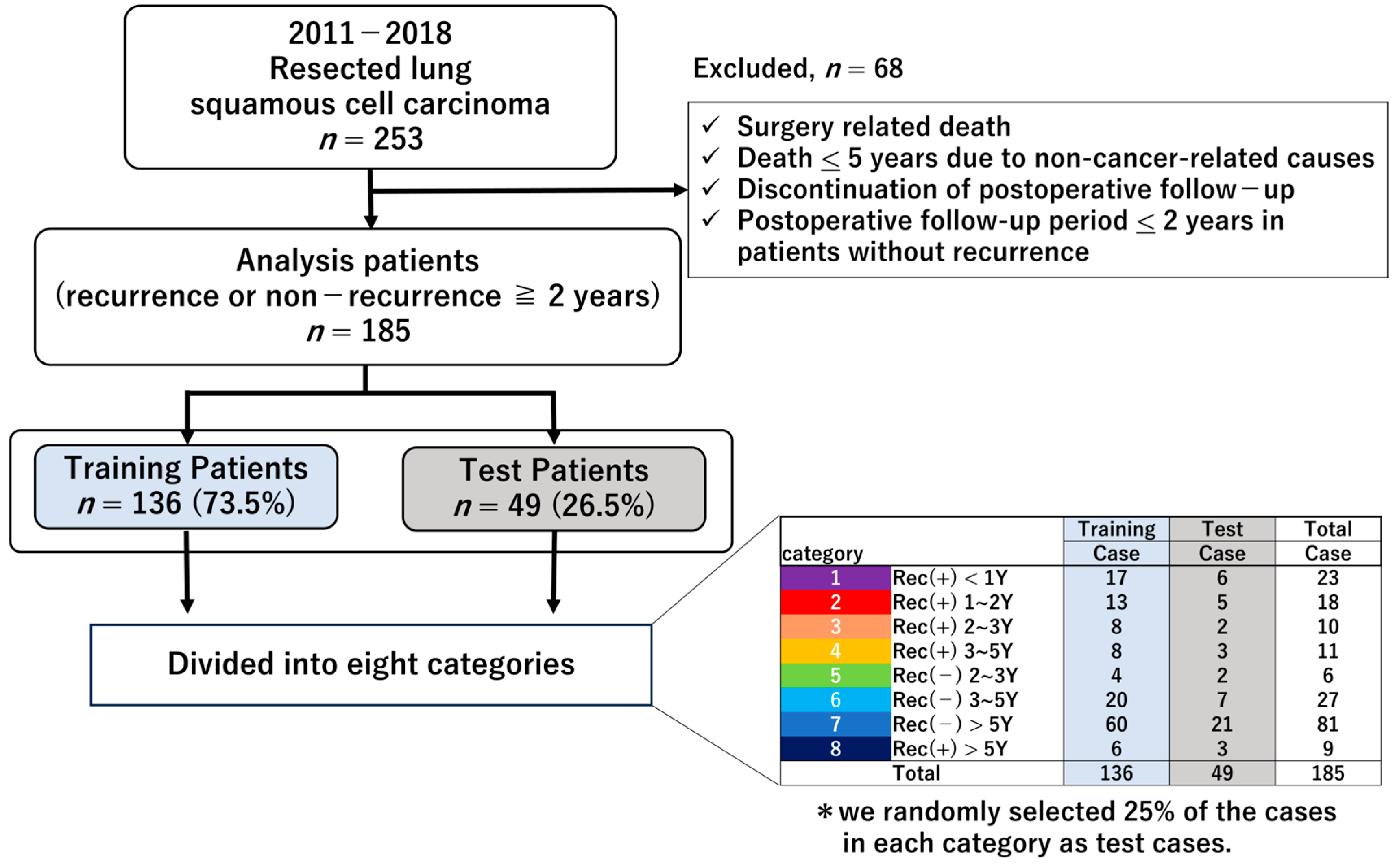
2.1. Patients
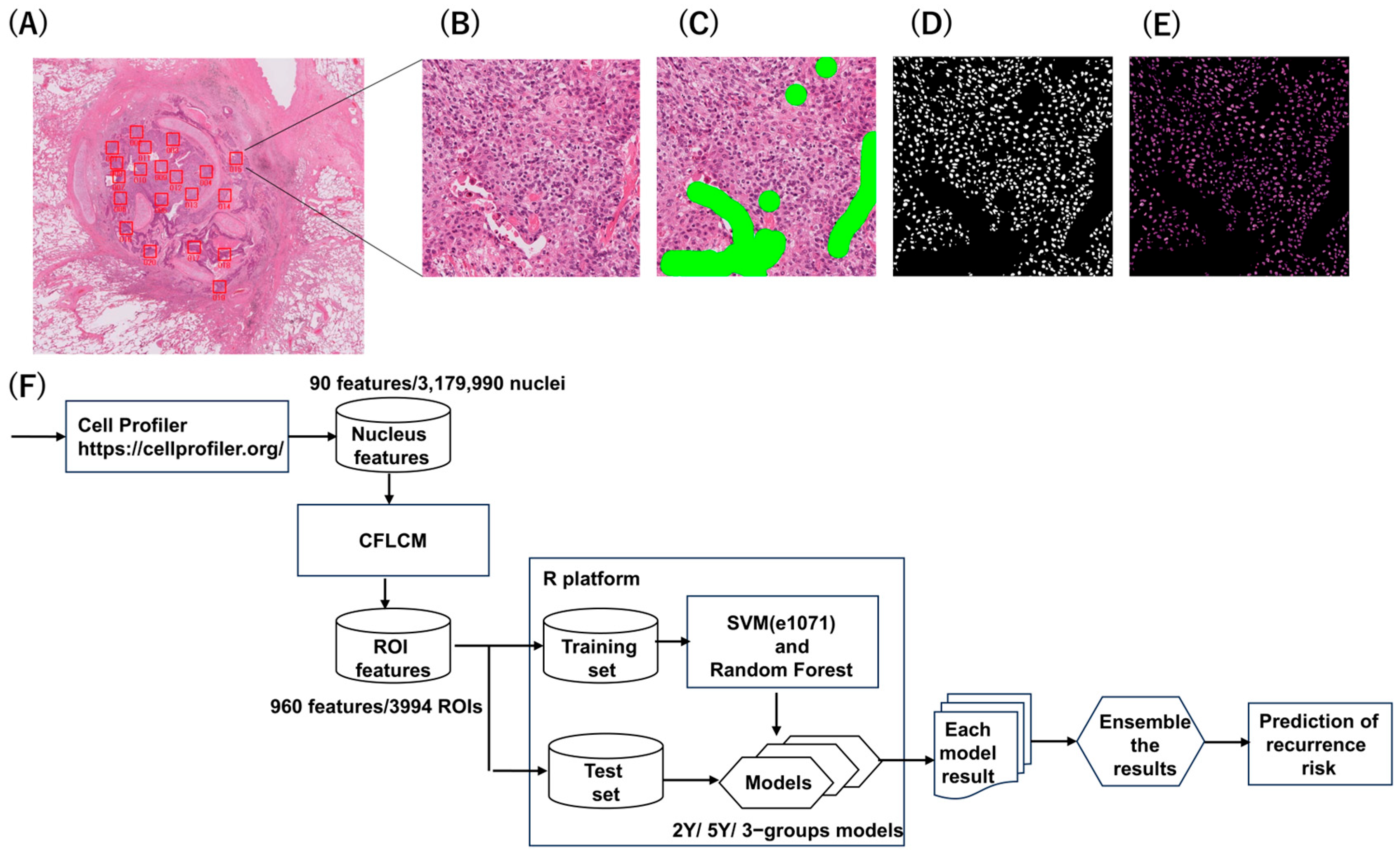
2.2. Whole-Slide Scanning and Selection of Images
2.3. Nuclear Extraction and Segmentation
2.4. Quantitative Measurement of Nuclei
2.5. Analysis Methods
3. Results
3.1. Patient Characteristics and Quantitative Nuclear Morphological Features
3.2. Predictive Performance of All Six AI Models for Postoperative Recurrence
3.3. Results of the Six AI Models
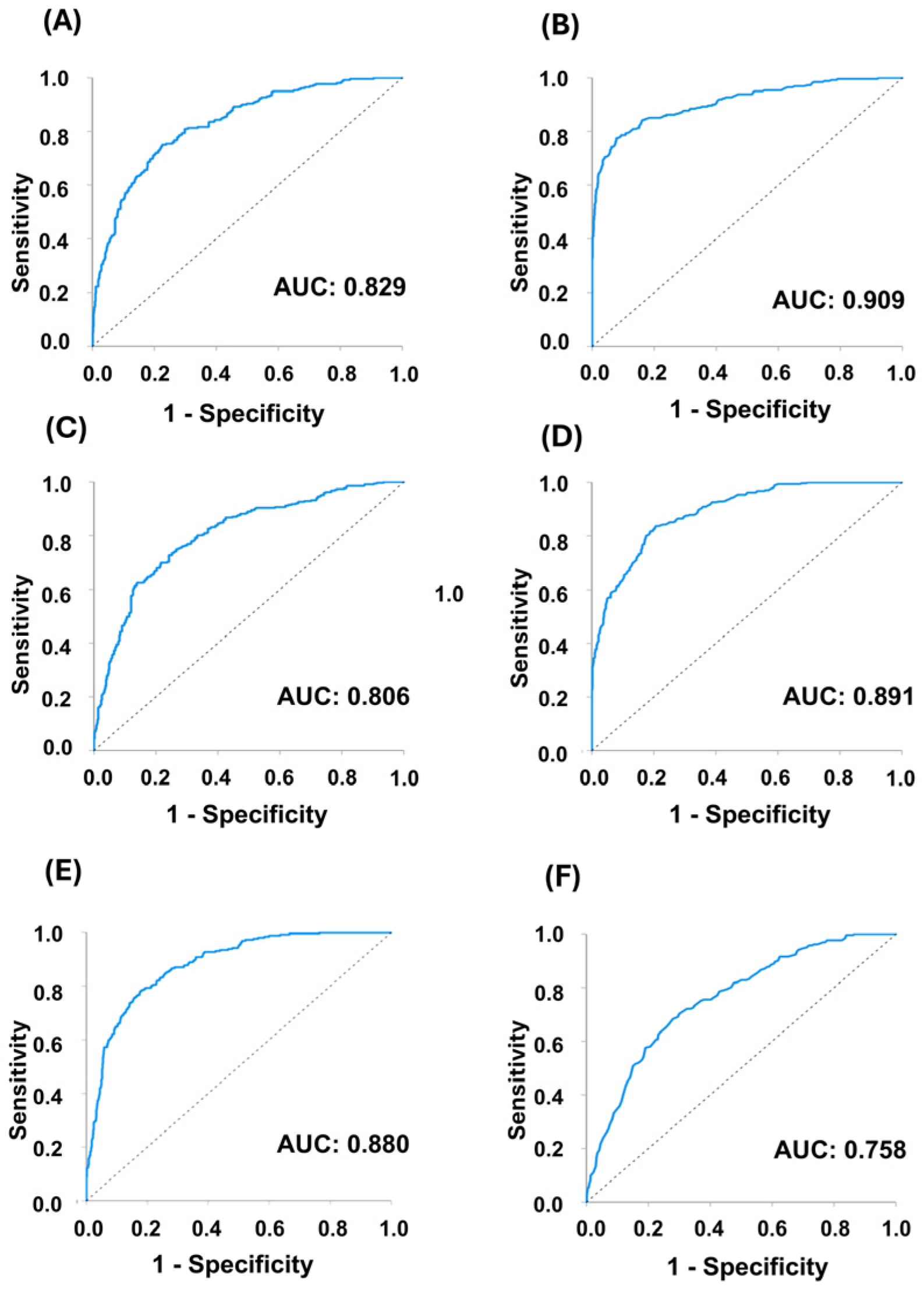
3.4. Results of ROC Curve Analysis
3.5. Survival Analysis
4. Discussion
5. Conclusions
Supplementary Materials
Author Contributions
Funding
Institutional Review Board Statement
Informed Consent Statement
Data Availability Statement
Conflicts of Interest
References
- Barta, J.A.; Powell, C.A.; Wisnivesky, J.P. Global epidemiology of lung cancer. Ann. Glob. Health 2019, 85, 8. [Google Scholar] [CrossRef]
- Lau, S.C.M.; Pan, Y.; Velcheti, V.; Wong, K.K. Squamous cell lung cancer: Current landscape and future therapeutic options. Cancer Cell 2022, 40, 1279–1293. [Google Scholar] [CrossRef] [PubMed]
- Antonia, S.J.; Villegas, A.; Daniel, D.; Vicente, D.; Murakami, S.; Hui, R.; Kurata, T.; Chiappori, A.; Lee, K.H.; De Wit, M.; et al. Overall survival with durvalumab after chemoradiotherapy in stage III NSCLC. N. Engl. J. Med. 2018, 379, 2342–2350. [Google Scholar] [CrossRef] [PubMed]
- Felip, E.; Altorki, N.; Zhou, C.; Csőszi, T.; Vynnychenko, I.; Goloborodko, O.; Luft, A.; Akopov, A.; Martinez-Marti, A.; Kenmotsu, H.; et al. Adjuvant atezolizumab after adjuvant chemotherapy in resected stage IB-IIIA non-small-cell lung cancer (IMpower010): A randomised, multicentre, open-label, phase 3 trial. Lancet 2021, 398, 1344–1357. [Google Scholar] [CrossRef]
- Reck, M.; Rodríguez-Abreu, D.; Robinson, A.G.; Hui, R.; Csőszi, T.; Fülöp, A.; Gottfried, M.; Peled, N.; Tafreshi, A.; Cuffe, S.; et al. Pembrolizumab versus chemotherapy for PD-L1-positive non-small-cell lung cancer. N. Engl. J. Med. 2016, 375, 1823–1833. [Google Scholar] [CrossRef]
- Nicholson, A.G.; Tsao, M.S.; Beasley, M.B.; Borczuk, A.C.; Brambilla, E.; Cooper, W.A.; Dacic, S.; Jain, D.; Khoor, A.; Lantuejoul, S.; et al. The 2021 WHO Classification of Lung Tumors: Impact of Advances Since 2015. J. Thorac. Oncol. 2022, 17, 362–387. [Google Scholar] [CrossRef]
- Sawabata, N.; Miyaoka, E.; Asamura, H.; Nakanishi, Y.; Eguchi, K.; Mori, M.; Nomori, H.; Fujii, Y.; Okumura, M.; Yokoi, K. Japanese lung cancer registry study of 11,663 surgical cases in 2004: Demographic and prognosis changes over decade. J. Thorac. Oncol. 2011, 6, 1229–1235. [Google Scholar] [CrossRef]
- Izaki, Y.; Mimae, T.; Kagimoto, A.; Handa, Y.; Tsutani, Y.; Miyata, Y.; Okada, M.; Takeshima, Y. Differences in postoperative prognosis between early-stage lung adenocarcinoma and squamous cell carcinoma. Jpn. J. Clin. Oncol. 2024, 54, 813–821. [Google Scholar] [CrossRef]
- Shimada, Y.; Kudo, Y.; Maehara, S.; Amemiya, R.; Masuno, R.; Park, J. Radiomics with artificial intelligence for the prediction of early recurrence in patients with clinical stage IA lung cancer. Ann. Surg. Oncol. 2022, 29, 8185–8193. [Google Scholar] [CrossRef]
- Kiankhooy, A.; Taylor, M.D.; LaPar, D.J.; Isbell, J.M.; Lau, C.L.; Kozower, B.D.; Jones, D.R. Predictors of early recurrence for node-negative T1 to T2b non-small cell lung cancer. Ann. Thorac. Surg. 2014, 98, 1175–1183. [Google Scholar] [CrossRef] [PubMed]
- Altorki, N.; Wang, X.; Kozono, D.; Watt, C.; Landrenau, R.; Wigle, D.; Port, J.; Jones, D.R.; Conti, M.; Ashrafi, A.S.; et al. Lobar or Sublobar Resection for Peripheral Stage IA Non–SmallCell Lung Cancer. N. Eng. J. Med. 2023, 388, 489–498. [Google Scholar] [CrossRef]
- Koteluk, O.; Wartecki, A.; Mazurek, S.; Kołodziejczak, I.; Mackiewicz, A. How do machines learn? Artificial intelligence as a new era in medicine. J. Pers. Med. 2021, 11, 32. [Google Scholar] [CrossRef]
- Marletta, S.; Pantanowitz, L.; Santonicco, N.; Caputo, A.; Bragantini, E.; Brunelli, M.; Girolami, I.; Eccher, A. Application of digital imaging and artificial intelligence to pathology of the placenta. Pediatr. Dev. Pathol. 2023, 26, 5–12. [Google Scholar] [CrossRef] [PubMed]
- Zarella, M.D.; Bowman, D.; Aeffner, F.; Farahani, N.; Xthona, A.; Absar, S.F.; Parwani, A.; Bui, M.; Hartman, D.J. A practical guide to whole slide imaging: A white paper from the Digital Pathology Association. Arch. Pathol. Lab. Med. 2019, 143, 222–234. [Google Scholar] [CrossRef]
- Rizzo, P.C.; Caputo, A.; Maddalena, E.; Caldonazzi, N.; Girolami, I.; Tos, A.P.D.; Scarpa, A.; Sbaraglia, M.; Brunelli, M.; Gobbo, S.; et al. Digital pathology world tour. Digit. Health 2023, 9, 20552076231194551. [Google Scholar] [CrossRef]
- Tateishi, A.; Horinouchi, H.; Kouno, N.; Takeda, K.; Takasawa, K.; Mizuno, T.; Okubo, Y.; Yoshida, Y.; Miyake, M.; Kusumoto, M.; et al. Prediction recurrence in stage I epidermal growth factor receptor-mutated non-small cell lung cancer using multi-modal data. Lung Cancer 2025, 207, 108727. [Google Scholar] [CrossRef]
- Jung, H.A.; Lee, D.; Park, B.; Lee, K.; Lee, H.Y.; Kim, T.J.; Jeon, Y.J.; Lee, J.; Park, S.Y.; Cho, J.H.; et al. Deep-learning model for real-time prediction of recurrence in early-stage non-small cell lung cancer: A multimodal approach (RADAR CARE Study). JCO Precis. Oncol. 2025, 9, e2500172. [Google Scholar] [CrossRef]
- Matsubara, S.; Saito, A.; Tokuyama, N.; Muraoka, R.; Hashimoto, T.; Satake, N.; Nagao, T.; Kuroda, M.; Ohno, Y. Recurrence prediction in clear cell renal cell carcinoma using machine learning of quantitative nuclear features. Sci. Rep. 2023, 13, 11035. [Google Scholar] [CrossRef] [PubMed]
- Saito, A.; Toyoda, H.; Kobayashi, M.; Koiwa, Y.; Fujii, H.; Fujita, K.; Maeda, A.; Kaneoka, Y.; Hazama, S.; Nagano, H.; et al. Prediction of early recurrence of hepatocellular carcinoma after resection using digital pathology images assessed by machine learning. Mod. Pathol. 2021, 34, 417–425. [Google Scholar] [CrossRef]
- Shen, B.; Saito, A.; Ueda, A.; Fujita, K.; Nagamatsu, Y.; Hashimoto, M.; Kobayashi, M.; Mirza, A.H.; Graf, H.P.; Cosatto, E.; et al. Development of multiple AI pipelines that predict neoadjuvant chemotherapy response of breast cancer using H&E-stained tissues. J. Pathol. Clin. Res. 2023, 9, 182–194. [Google Scholar] [CrossRef] [PubMed]
- Saito, A.; Numata, Y.; Hamada, T.; Horisawa, T.; Cosatto, E.; Graf, H.-P.; Kuroda, M.; Yamamoto, Y. A novel method for morphological pleomorphism and heterogeneity quantitative measurement: Named cell feature level co-occurrence matrix. J. Pathol. Inform. 2016, 7, 36. [Google Scholar] [CrossRef] [PubMed]
- Canal, M.; Virga, A.; Angeli, D.; Fonzi, E.; Gnetti, L.; Dubini, A.; Tedaldi, G.; Urbini, M.; Bocchialini, G.; Petracci, E.; et al. Genomic and Transcriptomic Profiles in Smokers and Never-Smokers Lung Squamous Cell Carcinoma Patients. Lung Cancer 2025, 16, 85–96. [Google Scholar] [CrossRef]
- Henick, B.S.; Taylor, A.M.; Nakagawa, H. Squamous cell cancers of the aero-upper digestive tract: A unified perspective on biology, genetics, and therapy. Cancer Cell 2025, 43, 178–194. [Google Scholar] [CrossRef]
- Lin, Y.; Mekala, V.; Li, J. Gene signatures characterizing driver mutations in lung squamous carcinoma are predictive of the progression of pre-cancer lesions. Int. J. Cancer 2025. [Google Scholar] [CrossRef] [PubMed]
- Zhang, X.-M.; Gao, T.-H.; Cai, Q.-Y.; Xia, J.-B.; Sun, Y.-N.; Yang, J.; Li, W.-H.; Zhang, S.-X.; Lou, H.-R.; Yu, X.-T.; et al. Artificial intelligence in digital pathology diagnosis and analysis: Technologies, challenges, and future prospects. Mil. Med. Res. 2025, 12, 93. [Google Scholar] [CrossRef] [PubMed]
- Tang, M.; Abbas, H.A.; Negrao, M.V.; Ramineni, M.; Hu, X.; Hubert, S.M.; Fujimoto, J.; Reuben, A.; Varghese, S.; Zhang, J.; et al. The histologic phenotype of lung cancers is associated with transcriptomic features rather than genomic characteristics. Nat. Commun. 2021, 12, 7081. [Google Scholar] [CrossRef] [PubMed]
- Fang, X.; Li, D.; Wan, S. Insights into the heterogeneity of the tumor microenvironment in lung adenocarcinoma and squamous carcinoma through single-cell transcriptomic analysis: Implications for distinct immunotherapy outcomes. J. Gene Med. 2024, 26, e3694. [Google Scholar] [CrossRef]
- Travis, W.D.; Brambilla, E.; Nicholson, A.G.; Yatabe, Y.; Austin, J.H.M.; Beasley, M.B.; Chirieac, L.R.; Dacic, S.; Duhig, E.; Flieder, D.B.; et al. The 2015 World Health Organization classification of lung tumors: Impact of genetic, clinical and radiologic advances since the 2004 classification. J. Thorac. Oncol. 2015, 10, 1243–1260. [Google Scholar] [CrossRef]
- Satpathy, S.; Krug, K.; Jean Beltran, P.M.; Savage, S.R.; Petralia, F.; Kumar-Sinha, C.; Dou, Y.; Reva, B.; Kane, M.H.; Avanessian, S.C.; et al. A proteogenomic portrait of lung squamous cell carcinoma. Cell 2021, 184, 4348–4371. [Google Scholar] [CrossRef]
- Shimada, Y.; Matsubayashi, J.; Saito, A.; Ohira, T.; Kuroda, M.; Ikeda, N. Small RNA sequencing to differentiate lung squamous cell carcinomas from metastatic lung tumors from head and neck cancers. PLoS ONE 2021, 16, e0248206. [Google Scholar] [CrossRef]
- Bode, A.M.; Dong, Z. Precision oncology—The future of personalized cancer medicine? npj Precis. Oncol. 2017, 1, 2. [Google Scholar] [CrossRef] [PubMed]
- Darvish, M.; Trask, R.; Tallon, P. AI-Enabled Lung Cancer Prognosis. arXiv 2024, arXiv:2402.09476. [Google Scholar] [CrossRef]
- Ciardiello, F.; Arnold, D.; Casali, P.G.; Cervantes, A.; Douillard, J.-Y.; Eggermont, A.; Eniu, A.; McGregor, K.; Peters, S.; Piccart, M.; et al. Delivering precision medicine in oncology today and in future—The promise and challenges of personalised cancer medicine: A position paper by the European Society for Medical Oncology (ESMO). Ann. Oncol. 2014, 25, 1673–1678. [Google Scholar] [CrossRef] [PubMed]





| Variables, n (%) | Overall n = 185 | Training Patients n = 136 (73.5) | Test Patients n = 49 (26.5) | p Value |
|---|---|---|---|---|
| Sex, n (%) | 0.823 | |||
| Male | 156 (84.3) | 114 (83.8) | 42 (85.7) | |
| Female | 29 (15.7) | 22 (16.2) | 7 (14.3) | |
| Age, median (range) | 73 (41–86) | 72 (41–86) | 74 (58–86) | 0.258 |
| Age category, n (%) | ||||
| ≧65 | 155 (83.8) | 111 (81.6) | 44 (89.8) | |
| <65 | 30 (16.2) | 25 (18.4) | 5 (10.2) | |
| Smoking status, n (%) | 0.100 | |||
| Current/Former | 182 (98.4) | 133 (97.8) | 49 (100) | |
| Never | 3 (1.6) | 3 (2.2) | 0 (0) | |
| Clinical stage, n (%) | 0.45 | |||
| Stage I | 107 (57.8) | 76 (55.9) | 31 (63.3) | |
| Stage II | 45 (24.3) | 33 (24.3) | 12 (24.5) | |
| Stage III | 31 (16.8) | 26 (19.1) | 5 (10.2) | |
| Stage IV | 2 (1.1) | 1 (0.7) | 1 (2.0) | |
| Pathologic stage, n (%) | 0.72 | |||
| Stage I | 108 (58.4) | 78 (57.4) | 30 (61.2) | |
| Stage II | 40 (21.6) | 29 (21.3) | 11 (22.4) | |
| Stage III | 37 (20.0) | 29 (21.3) | 8 (16.3) | |
| Pathologic N stage, n (%) | 0.324 | |||
| N0 | 118 (63.8) | 89 (65.4) | 29 (59.2) | |
| N1–3 | 56 (30.3) | 41 (30.2) | 15 (30.6) | |
| NX | 11 (5.9) | 6 (4.4) | 5 (10.2) | |
| Vascular invasion, n (%) | 1.000 | |||
| Negative | 66 (35.7) | 49 (36.0) | 17 (34.7) | |
| Positive | 119 (64.3) | 87 (64.0) | 32 (65.3) | |
| Lymphatic invasion, n (%) | 0.867 | |||
| Negative | 83 (44.9) | 62 (45.6) | 21 (42.9) | |
| Positive | 102 (55.1) | 74 (54.4) | 28 (57.1) | |
| Pleural invasion, n (%) | 0.500 | |||
| Negative | 113 (61.1) | 81 (59.6) | 32 (65.3) | |
| Positive | 72 (38.9) | 55 (40.4) | 17 (34.7) |
Disclaimer/Publisher’s Note: The statements, opinions and data contained in all publications are solely those of the individual author(s) and contributor(s) and not of MDPI and/or the editor(s). MDPI and/or the editor(s) disclaim responsibility for any injury to people or property resulting from any ideas, methods, instructions or products referred to in the content. |
© 2026 by the authors. Licensee MDPI, Basel, Switzerland. This article is an open access article distributed under the terms and conditions of the Creative Commons Attribution (CC BY) license.
Share and Cite
Omori, T.; Saito, A.; Shimada, Y.; Kudo, Y.; Matsubayashi, J.; Nagao, T.; Kuroda, M.; Ikeda, N. Personalized Prediction of Postoperative Recurrence in Lung Squamous Cell Carcinoma: Integrating AI-Based Nuclear Morphometry and Clinical Data. J. Pers. Med. 2026, 16, 205. https://doi.org/10.3390/jpm16040205
Omori T, Saito A, Shimada Y, Kudo Y, Matsubayashi J, Nagao T, Kuroda M, Ikeda N. Personalized Prediction of Postoperative Recurrence in Lung Squamous Cell Carcinoma: Integrating AI-Based Nuclear Morphometry and Clinical Data. Journal of Personalized Medicine. 2026; 16(4):205. https://doi.org/10.3390/jpm16040205
Chicago/Turabian StyleOmori, Tomokazu, Akira Saito, Yoshihisa Shimada, Yujin Kudo, Jun Matsubayashi, Toshitaka Nagao, Masahiko Kuroda, and Norihiko Ikeda. 2026. "Personalized Prediction of Postoperative Recurrence in Lung Squamous Cell Carcinoma: Integrating AI-Based Nuclear Morphometry and Clinical Data" Journal of Personalized Medicine 16, no. 4: 205. https://doi.org/10.3390/jpm16040205
APA StyleOmori, T., Saito, A., Shimada, Y., Kudo, Y., Matsubayashi, J., Nagao, T., Kuroda, M., & Ikeda, N. (2026). Personalized Prediction of Postoperative Recurrence in Lung Squamous Cell Carcinoma: Integrating AI-Based Nuclear Morphometry and Clinical Data. Journal of Personalized Medicine, 16(4), 205. https://doi.org/10.3390/jpm16040205